Working Memory Is Complex and Dynamic, Like Your Thoughts Free
Timothy J. Buschman
Earl K. Miller
SimpleOriginal

Summary

Working memory is not a static process but a dynamic system using multiple mechanisms, including activity-silent states and neural rhythms, enabling flexible, task-dependent control over thoughts and behavior.

2022

Working Memory Is Complex and Dynamic, Like Your Thoughts Free

Keywords working memory; neural basis; activity-silent; short-term plasticity; top-down control; brain rhythms; spatial computing; cognitive control; dynamic representation; persistent activity

Abstract

Working memory is where thoughts are held and manipulated. For many years, the dominant model was that working memory relied on steady-state neural dynamics. A neural representation was activated and then held in that state. However, as often happens, the more we examine working memory (especially with new technology), the more complex it looks. Recent discoveries show that working memory involves multiple mechanisms, including discontinuous bouts of spiking. Memories are also dynamic, evolving in a task-dependent manner. Cortical rhythms may control those dynamics, thereby endowing top–down “executive” control over our thoughts.

INTRODUCTION

Over 30 years ago, working memory was solved. We had found the neural basis for holding an item in working memory. The model was straightforward. A stimulus activates neural spiking in the pFC. That activity is sustained after the stimulus disappears and its memory is held in working memory (Miller, Erickson, & Desimone, 1996; Funahashi, Bruce, & Goldman-Rakic, 1989; Fuster & Alexander, 1971). Decades of research had supported and elaborated this model. We now know working memory representations are seen in a variety of cortical areas (Christophel, Klink, Spitzer, Roelfsema, & Haynes, 2017). We learned about the important role of neuromodulators (Vijayraghavan, Wang, Birnbaum, Williams, & Arnsten, 2007). We gained insight into the biophysical and circuit mechanisms that keep activity elevated (Wang, 1999).

However, as usually happens in science, we came to realize that the neural bases of working memory are more complex than we originally thought. New technology has allowed a more detailed understanding of working memory. These insights confirmed that neural activity seen during a memory delay plays an important role in working memory. However, they also revealed working memory is not simply steady-state maintenance, like a latch circuit in your brain that turns on and off. There are bouts of spiking versus no spiking. There are dynamics and emergent properties that can only be seen at the level of neuron populations and the summed activity of millions of neurons (in local field potentials [LFPs]). Furthermore, new work has shown these dynamics support the most important thing about working memory: It is under top–down “executive” control. We can choose what to think about and how to think about it.

Mark Stokes was a catalyst in driving this new understanding of working memory. Here, we review our take on the “Stokesian” view of working memory. There were two key insights. First, working memory is not simply the persistent activity of neurons. It is also “activity-silent” with bouts of spiking versus little or no spiking. During the “silent” periods, the memories are held by short-term plasticity mechanisms, like an echo or impression that spiking leaves in the network. Second, working memory activity is not a persistent, veridical, representation of sensory inputs. Instead, it is highly dynamic with representations that change and evolve over time. These are not unrelated insights. The activity-silent dynamics contribute to, and leave room for, emergent properties like oscillatory rhythms at different frequencies. Recent work on those rhythms has captured the neural signatures of top–down control.

WORKING MEMORY IS ACTIVITY-SILENT

The classic view of working memory is that it is represented in the sustained activity of neurons within pFC. For example, when monkeys were trained to remember the location of a reward (Fuster & Alexander, 1971) or remember the location of a stimulus (Funahashi et al., 1989), neurons in pFC were found to be tonically active for as long as the animal held the item in memory. This matched our own experience of working memory as an active process that requires effort. So, naturally, researchers assumed the sustained activity was what maintained representations over memory delays.

However, over the past decade, close inspection of neural activity has found neural responses in pFC are not as sustained as we once believed. As reviewed in Stokes (2015), neural responses often return to “baseline” levels after a few seconds. Furthermore, interrupting working memory maintenance, by having an animal briefly switch to another task, caused working memory representations to disappear. They then re-emerged when the animal re-engaged the original working memory task (Watanabe & Funahashi, 2014). These results led to the idea that other mechanisms may support memory representations. Several possibilities have been raised over the last few years.

First, building on theoretical work (Mongillo, Barak, & Tsodyks, 2008), Stokes and colleagues proposed working memory could be maintained in the short-term synaptic plasticity (STSP). In this model, transient neural representations, such as the ones evoked by a sensory stimulus, can temporarily change synaptic weights in the network (e.g., by altering synaptic vesicle and/or neurotransmitter receptor concentration). These changes are thought to be short term (under 1 sec) but last long enough to maintain the trace of a stimulus in the connectivity within the network over a memory delay. In other words, spiking leaves an “impression” in the network that can maintain the memory between spiking.

Of course, one inherent difficulty in testing this theory is that we cannot directly observe synaptic weights in the behaving brain—all of our methods detect neural activity. To get around this, the Stokes and Postle laboratories developed a clever approach to measuring the synaptic changes—“ping” the system with a bright visual stimulus (Wolff, Jochim, Akyürek, & Stokes, 2017) or a TMS pulse (Rose et al., 2016). If the memory is stored in short-term synaptic changes, then the neural response induced by the stimulus/pulse should change as a function of what is being held in memory. In other words, the pulse should “re-activate” the memory. Consistent with the activity-silent model, the item in memory could not be decoded (with EEG or fMRI) before the pulse. However, the memory could be decoded in the neural response following the visual stimulus/TMS pulse. Although not entirely excluding alternative explanations, these studies provide the first test of an activity-silent form of memory.

STSP may not be the only activity-silent mechanism at play in working memory tasks. Long-term episodic memory plays an important role in supporting working memory (Beukers, Buschman, Cohen, & Norman, 2021; Sutterer, Foster, Serences, Vogel, & Awh, 2019). However, one limitation of long-term memory is that it suffers from “proactive interference.” This interference occurs when two memories are similar, making it hard to distinguish a current memory from the recent past (e.g., the previous behavioral trial). Theoretical work suggests that episodic memory could mitigate interference by storing the context in which the memory occurred (DuBrow, Rouhani, Niv, & Norman, 2017; Mensink & Raaijmakers, 1988). Such context information could provide a unique marker to sort and differentiate between different memories, keeping them from interfering with each other (Beukers et al., 2021). In this way, long-term memory could provide another activity-silent mechanism supporting working memory. Consistent with this, recent work has found proactive interference is strongest on trials in which participants must remember a large number of items (likely exceeding the capacity of working memory; Oberauer & Awh, 2022). This suggests participants may engage long-term memory only when it is helpful to supplement working memory.

Altogether, these results suggest the brain uses multiple mechanisms to maintain information in working memory. This makes sense—maintaining short-term memories of sensory inputs is critical to cognition, allowing it to break free from the immediate world. There may have been strong evolutionary pressure to develop multiple mechanisms for maintaining information in working memory. For example, recent modeling work has shown STSP can make working memory more robust. Kozachkov and colleagues (2022) trained artificial recurrent neural networks (RNNs) with and without STSP to perform an object working memory task. Both RNNs with and without STSP were able to maintain memories, even in the face of a distractor. However, RNNs with STSP were more robust to noise and network degradation than RNNs without STSP. Furthermore, RNNs with STSP showed activity that was similar to that seen in the cortex of a non–human-primate performing the same task. RNNs without STSP were more artificial, less brain-like. In short, STSP, and other activity-silent mechanisms, make working memory networks work better. Next, we discuss how working memory is also dynamic.

WORKING MEMORY IS DYNAMIC

The classic view of working memory is that it is a stable representation of recent sensory inputs. Work from Fuster, Goldman-Rakic, and others found neurons in pFC that responded to visual stimuli and then maintained spiking activity over a subsequent memory delay (Miller et al., 1996; Funahashi et al., 1989; Fuster & Alexander, 1971). However, more recent work has shown working memory is more dynamic than once thought. Newer large-scale recordings of populations of neurons have allowed us to decode neural information with far greater sensitivity than the previous single-electrode approach (King & Dehaene, 2014; Meyers, Freedman, Kreiman, Miller, & Poggio, 2008). If representations are stable, then a decoder trained on neural representations at one moment in time should be able to decode the representation at another moment in time. Alternatively, if representations are dynamic, then the decoder should fail to generalize across time. Using this approach, Stokes and colleagues (2013) showed that memory representations are highly dynamic. Decoders trained to decode the identity of the visual stimulus when it was visible were unable to decode the memory of that same stimulus, even just 250 msec into the memory delay. This suggests that, at the population level, the neural code for sensory inputs and memories are different. Similar results have been seen in rodents (Harvey, Coen, & Tank, 2012). Interestingly, Stokes and colleagues found that, after a few hundred milliseconds, the representation stabilized (Spaak, Watanabe, Funahashi, & Stokes, 2017). Then, toward the end of the delay period, when the animal was preparing to respond, the neural representation again became dynamic.

Building on this work, Panichello and Buschman (2021) found dynamics in working memory are under cognitive control. Monkeys performed a task that required them to remember the color of two squares (Figure 1A). After a memory delay, the monkeys were cued to select one of the two squares and then, after a second memory delay, report the color of the selected square by saccading to the matching color on a color wheel. Consistent with previous work, the memory representation in pFC was dynamic. Interestingly, how the memory representation changed depended on whether it was selected for a response (or forgotten).

Figure 1.
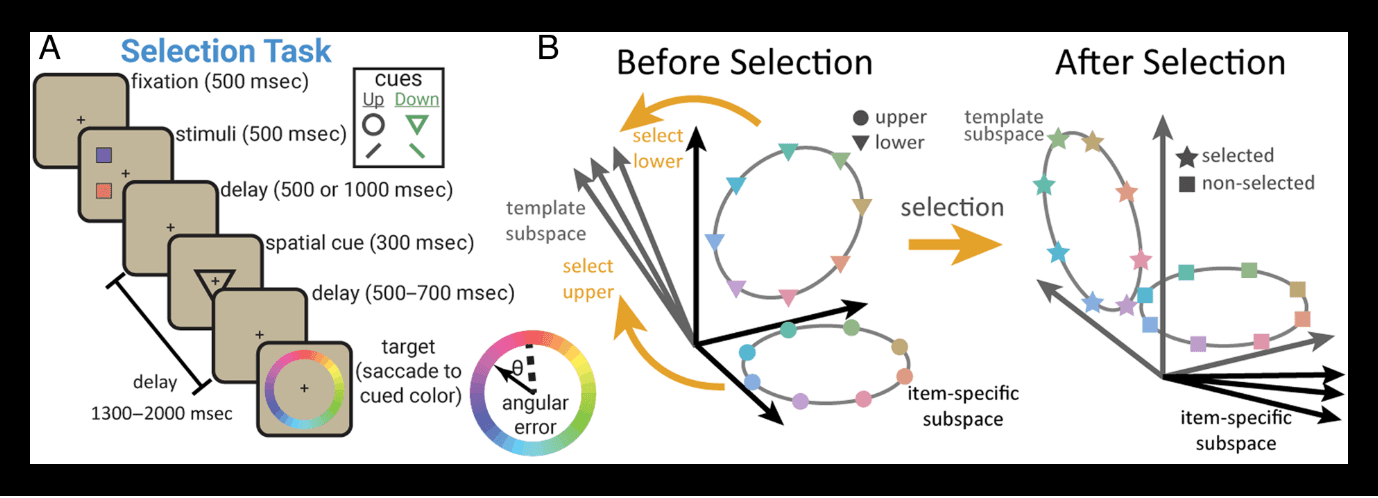
Figure 1

Model of dynamic control of working memory. (A) Behavioral task for selecting an item from working memory. (B) Memory representations transformed in a task-dependent manner. Before selection, the color of each item was represented in an independent subspace within the neural population in LPFC (left). Selection transformed the selected item into a new “target” subspace (right) that was used to guide behavior. Adapted from Panichello and Buschman (2021).

During the first memory delay (before selection), the color of each item was stably encoded as a ring, forming two color wheels in neural space (schematized in Figure 1B, left). Interestingly, each item's ring existed in its own independent “subspace” of neural activity. However, this changed when a memory was selected. The ring representing the color of the selected item moved from its independent subspace into a new “target” subspace (Figure 1B, right). This target subspace was the same for both items. When Memory 1 was selected, its representation moved into the target subspace, and when Memory 2 was selected, it moved into the same subspace. In other words, the dynamics of the memory depended on which memory was selected: Selecting Memory 1 induced one set of dynamics that moved Memory 1 from its independent subspace into the target subspace, whereas selecting Memory 2 induced a different set of dynamics that transformed the representation of Memory 2 into the target subspace.

These results show dynamics in working memory are under cognitive control. But, to what purpose? The independent subspaces observed during the first memory delay make sense—the animal's task is to remember the color of each square separately, which is facilitated by the independent subspaces (Libby & Buschman, 2021). However, after selection, the animal's task changes. Now, they must report the color of the selected item, regardless of whether it used to be Memory 1 or 2. This can explain the dynamics observed in working memory. When Memory 1 is selected, the dynamics “move” the Memory 1 representation into the target subspace (and vice versa for Memory 2). Now that the selected item is in the common target subspace, downstream circuits can use this representation to drive the animal's response, regardless of which memory was selected. In this way, cognitive control may induce different dynamics to support different cognitive tasks.

This same model could explain the dynamics observed in other studies. Many of these tasks require the brain to shift from processing a sensory stimulus to preparing a motor response (classically referred to as a shift from retrospective to prospective memory; Rainer, Rao, & Miller, 1999). In other words, working memory does not just maintain a veridical representation of inputs. Rather, it exists to support cognition and behavior. From this perspective, it makes sense that working memory representations would be dynamic—they evolve in a way that facilitates the task at hand.

WORKING MEMORY IS RHYTHMIC (AND RHYTHMS ARE CONTROL)

Working memory is under top–down (“executive”) control. We can choose what to encode in working memory, we can manipulate those thoughts, and we can ignore distractions and choose to stop thinking those thoughts. pFC plays a key role in controlling working memory (Panichello & Buschman, 2021; Gazzaley & Nobre, 2012; Miller & Cohen, 2001). As discussed above, top–down control of neural dynamics may change how working memory representations are used. Mounting evidence suggests control may arise from oscillatory dynamics that emerge at a higher level of integration—in the LFPs. LFPs are the summation of coordinated, oscillatory, activity of millions of neurons. The electrical fields that arise from this activity can act as “guard rails” that control higher-dimensional, neuron-level activity by funneling it along stable low-dimensional routes (Pinotsis & Miller, 2022).

The central idea is that sensory information (the contents of working memory) and control signals use different frequency bands that interact. As reviewed by Miller, Lundqvist, and Bastos (2018), recent work suggests sensory information is carried by spiking associated with bursts of gamma (>30 Hz) power. The top–down control signals are carried by alpha/beta rhythms (8–30 Hz). Alpha/beta inhibits gamma wherever they “collide” in cortex. Thus, top–down (alpha/beta) controls bottom–up (gamma/spiking). Figure 2 shows how this works. The top–down alpha/beta are carried in the deep layers of cortex. The deep cortical layers carry feedback signals down the cortical hierarchy. Bottom–up sensory information in gamma/spiking is carried in the superficial cortical layers that send signals in a feedforward manner, up the cortical hierarchy. Alpha/beta originating in the deep layers inhibits gamma/spiking in the superficial layers (Bastos, Loonis, Kornblith, Lundqvist, & Miller, 2018).

Figure 2.
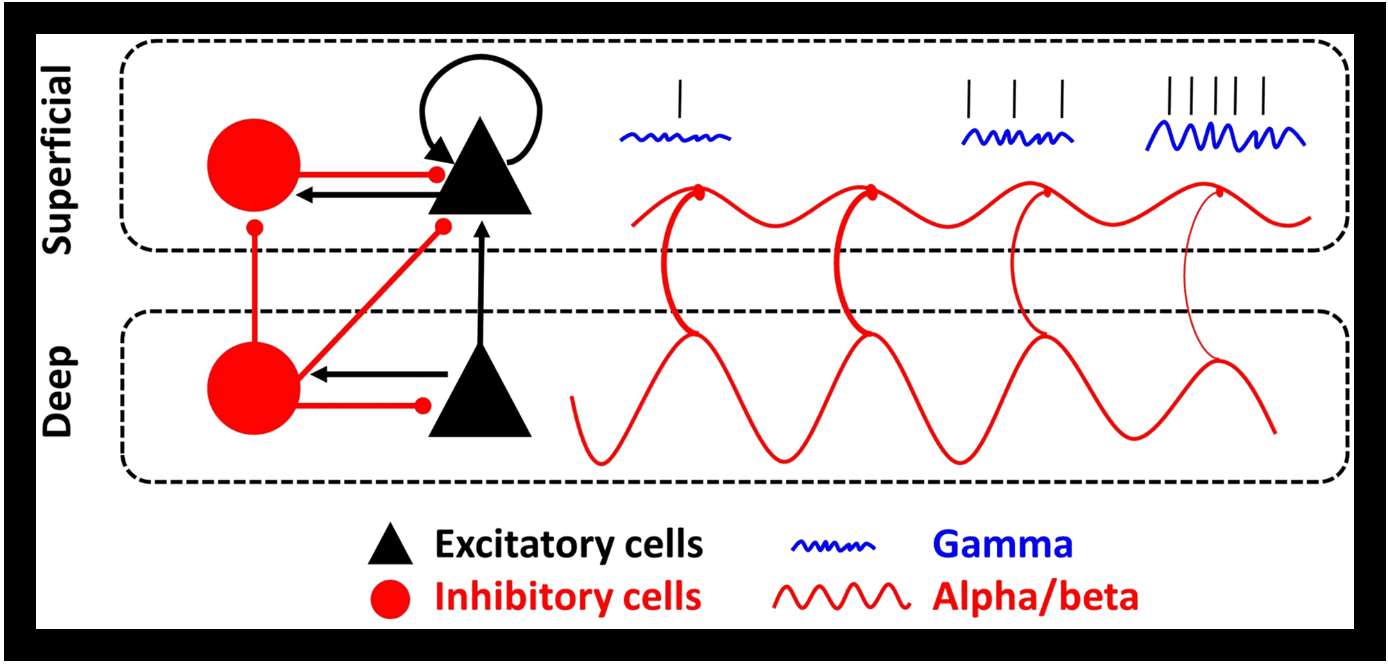
Figure 2

Top–down control model of working memory by brain rhythms. Inhibitory connections are line segments with a red, rounded end, and excitatory connections are line segments with a black, arrow end. The sinusoidal red line in deep layers reflects beta oscillations and their driving influence on superficial beta oscillations. Beta oscillations are phase-amplitude coupled with gamma oscillations (blue squiggly lines), and these gamma oscillations organize delay-period spiking representing working memory content (straight black marks). Over time, moving from left to right in the figure, the deep beta reduces in power and releases inhibition onto the superficial layers. This results in enhanced superficial gamma and spiking. The reversed process (enhancement of deep layer beta, enhanced suppression of superficial layer gamma/spiking) would “clear out” the contents of working memory. From the work of Bastos and colleagues (2018).

To gain access to working memory, deep-layer alpha/beta power and/or its coupling to superficial layer beta weakens. This disinhibits recurrent excitation of superficial layer neurons, generating bursts of gamma and spiking to sensory inputs. During memory maintenance, the balance between alpha/beta and gamma can regulate the level of spiking to occasionally refresh the synaptic weight changes that help maintain memories (Miller et al., 2018).

To read out information from working memory, alpha/beta power/coherence drops. This allows increased gamma bursting and the ramp-up of spiking often seen near the end of memory delays (Hussar & Pasternak, 2010; Roesch & Olson, 2005). The disinhibition of gamma increases spiking so that the memories can acquire control of behavior. Balance between alpha/beta and gamma during the memory delay can keep gamma to a moderate level. That way, spiking does not prematurely gain control over behavior. To clear out working memory, beta power/coupling increases. This suppresses gamma and the spiking that was maintaining the memory. Examples of these dynamics can be found in Lundqvist and colleagues (2016) and Lundqvist, Herman, Warden, Brincat, and Miller (2018).

These dynamics may have a role in many cognitive functions, not just working memory. The superficial layer gamma and deep-layer alpha-beta is a ubiquitous motif seen across all of cortex (Mendoza-Halliday et al., 2022; Lundqvist, Bastos, & Miller, 2020). Recent work suggests that the same dynamics play a role in predictive coding (Bastos, Lundqvist, Waite, Kopell, & Miller, 2020). It is possible that much of cognitive control stems from the balance and control of these rhythms.

TOP–DOWN CONTROL BY SPATIAL COMPUTING

Thus far, we have discussed alpha/beta as if it were a coarse-gating signal. It turns working memory on and off like turning a faucet or a light switch on and off. However, its control can be more specific, operating on the level of individual contents of working memory. In Predictive Coding, for example, alpha/beta targets representations of specific stimuli in visual cortex to inhibit processing of predicted sensory inputs (Bastos et al., 2020).

Recent work has shown top–down information, such as the task at hand, is carried by unique patterns of alpha/beta synchrony across cortex (Antzoulatos & Miller, 2014, 2016; Buschman, Denovellis, Diogo, Bullock, & Miller, 2012). In other words, patterns of alpha/beta form neural “ensembles” that reflect top–down information. Importantly, the spatial resolution of these patches is on the macro-scale. It is seen at the level of LFPs that reflect the summed activity of millions of neurons. These LFPs synchronize across millimeters or more of cortex (sometimes across large expanses of cortex). It is these patterns that may provide the control.

The idea is called “spatial computing” (Lundqvist et al., 2022). It suggests that patterns of alpha/beta power and coherence create a macro-scale patchwork of higher power alpha/beta versus higher power gamma across cortical networks. Wherever alpha-beta power is low, gamma and spiking are high and vice versa. Different patterns of alpha/beta result in different patterns of gamma/spiking. By contrast, stimulus information (e.g., the contents of working memory) is represented at a much finer scale. It is carried by patterns of activity of (and connectivity between) individual neurons (rather than millions of neurons). Stimulus information is widely distributed and repeated across the networks, like sand across a larger scale “checkboard” pattern of alpha/beta and gamma. In other words, the contents (stimuli) and the control of working memory operate on very different spatial scales. Stimulus representation is high-dimensional, reflected by spiking patterns of populations of individual neurons. By contrast, control is low-dimensional, operating at the level of groups of millions of neurons via patterns of alpha–beta versus gamma coherence.

Control comes from where in network space a stimulus representation is currently expressed. The patterns of alpha/beta versus gamma and changes in those patterns are computations. Applying a set of operations (e.g., executing a task's rules) corresponds to imposing different macro scale patterns of alpha/beta and gamma. Items can be accessed and operated on just by knowing their place in network space.

To understand how this works, consider a task requiring an animal to remember two objects (A and B) in the order in which they appeared (first or second; Lundqvist et al., 2018; Warden & Miller, 2007). Just before the first object is shown, the alpha/beta patterns create a mirror-image pattern of gamma. That specific pattern corresponds to “1st item.” When the object appears (say, object A), neurons in the gamma patches selective for that object are activated, priming them (via STSP). Next, before the second object is shown, a different pattern of alpha/beta sets up a different pattern of gamma that corresponds to “2nd item.” When the second object (say object B) appears, neurons in those gamma patches are activated and primed. To maintain and read out which object was first or second, the pattern corresponding to the first or second item is re-established. The primed neurons in the corresponding gamma patches will “ring back” and spike more strongly. When, for example, the patchwork corresponding to the first object is re-established, the neurons ring back with “object A” because they were primed by that object when it appeared first. In short, spatial computing posits that working memory control stems from the spatio-temporal activity patterns across network space that reflect and change with top–down task demands.

The separation of content versus control to high versus low-dimensional scales solves a critical issue in many neural network models. In typical models, the rules of the task (the control) and the content (e.g., the items held in working memory) are both encoded in the high-dimensional details of connectivity between spiking neurons. Because of this lack of separation, if one wants to introduce novel items into working memory, the network has to be retrained. They do not show the flexibility of working memory seen in humans and animals. Typical network models cannot do “zero-shot” learning (instant generalization) that real brains can (see Bouchacourt & Buschman, 2019, for a different model of flexibility; O'Reilly & Frank, 2006). Spatial Computing solves this by separating control versus content into different scales of representation.

From a normative perspective, the brain may use a small (low-dimensional) set of control states to flexibly adapt to new situations (MacDowell, Tafazoli, & Buschman, 2022). Adapting to a new situation requires the brain to identify the control state that is appropriate for the current situation. This control state will determine how information is processed, maintained, and used to guide behavior in that situation. Although a large number of high-dimensional control states would allow for precise control of behavior, optimizing it for the current situation, this would also make it difficult to identify the “best” control state. In contrast, if the brain uses a small, low-dimensional set of control states, then it will be easier to find the best one of the set. However, such low-dimensional control states will be necessarily coarse and, so, imperfect. This suggests that there is a trade-off between high-dimensional control states, which would be accurate but slow to adapt, and low-dimensional control states, which would be flexible, yet suboptimal. Given this, the brain may choose to sample a limited number of control states that can balance precision and flexibility (MacDowell et al., 2022).

SUMMARY

Working memory is central to cognition, acting as a workspace on which thoughts are stored and manipulated. Given its importance, it is no surprise that multiple mechanisms have evolved to support the maintenance of working memory. Classic results showing the sustained representations of items in working memory are not wrong, they are just an incomplete picture. Mounting evidence points to other mechanisms and emergent properties. The neural basis of working memory is complex and dynamic, just as Mark Stokes told us. It is in these dynamics that we have gained insight into both how we hold items “in mind” and how those thoughts are controlled. Working memory is not yet solved, but the work of Mark Stokes showed us a path to a deeper level of understanding.

Open Article as PDF

Abstract

Working memory is where thoughts are held and manipulated. For many years, the dominant model was that working memory relied on steady-state neural dynamics. A neural representation was activated and then held in that state. However, as often happens, the more we examine working memory (especially with new technology), the more complex it looks. Recent discoveries show that working memory involves multiple mechanisms, including discontinuous bouts of spiking. Memories are also dynamic, evolving in a task-dependent manner. Cortical rhythms may control those dynamics, thereby endowing top–down “executive” control over our thoughts.

Summary

Research on working memory has advanced significantly over the past three decades. Initially, a simple model suggested that neural activity in the prefrontal cortex (pFC) sustained after a stimulus represented an item in working memory. This model was supported by extensive research showing working memory representations across various cortical areas, the role of neuromodulators, and the biophysical mechanisms maintaining elevated neural activity.

However, recent technological advancements have revealed a more intricate understanding of working memory. While sustained neural activity is important, working memory also involves "activity-silent" periods. During these times, memories are maintained by short-term changes in the connections between neurons, similar to an impression left in a network. Additionally, working memory representations are not static but highly dynamic, changing and evolving over time. These dynamics contribute to emergent properties, such as oscillatory rhythms at different frequencies, which are crucial for top-down executive control. Mark Stokes's work has been instrumental in shaping this expanded view, highlighting that working memory is neither solely persistent activity nor a fixed representation of sensory inputs, but rather a flexible system enabling active cognitive control.

Working Memory is Activity-Silent

The traditional understanding of working memory involved neurons in the pFC maintaining continuous activity to hold information. Studies observed sustained neural firing in monkeys remembering locations, aligning with the idea of working memory as an effortful, active process.

In the last decade, detailed examination of neural activity has shown that pFC responses are often not continuously sustained, frequently returning to baseline levels within a few seconds. Furthermore, interruptions to a working memory task can cause representations to disappear and then reappear when the task resumes. These findings suggest that other mechanisms might also support memory maintenance.

One proposed mechanism, building on theoretical work, is short-term synaptic plasticity (STSP). In this model, temporary neural activity, like that from a sensory stimulus, can briefly alter synaptic connections. These changes, though short-lived, are thought to be sufficient to maintain a memory trace within the neural network during a delay. In essence, neural firing leaves an "impression" that helps sustain the memory between active firing periods.

Testing this theory is challenging because synaptic weights cannot be directly observed in a living brain. Researchers developed an approach to infer synaptic changes by "pinging" the system with a visual stimulus or a Transcranial Magnetic Stimulation (TMS) pulse. If memory is stored in STSP, the neural response to this pulse should change based on what is being remembered, effectively "re-activating" the memory. Studies using this method found that memory could not be decoded before the pulse but became decodable in the neural response after the stimulus or pulse, supporting the activity-silent model.

STSP might not be the only activity-silent mechanism. Long-term episodic memory also contributes to working memory, especially in mitigating "proactive interference," where similar memories from the past interfere with current ones. Theoretical work suggests episodic memory could store the context of a memory, providing unique markers to differentiate between similar items and prevent interference. This allows long-term memory to act as another activity-silent support for working memory. Research indicates that participants engage long-term memory primarily when working memory capacity is challenged, suggesting a supplementary role.

These findings suggest that the brain employs multiple strategies to maintain information in working memory. This adaptability is crucial for cognitive function, allowing the brain to operate independently of immediate sensory input. Evolutionary pressures likely favored the development of diverse mechanisms for robust working memory. For example, modeling studies have shown that artificial neural networks with STSP are more resilient to noise and degradation while performing working memory tasks, demonstrating a more brain-like function. This indicates that activity-silent mechanisms enhance the efficiency and robustness of working memory networks.

Working Memory is Dynamic

The conventional view of working memory proposed stable representations of recent sensory inputs, with pFC neurons maintaining spiking activity during memory delays. However, more recent research indicates that working memory is considerably more dynamic. Large-scale recordings of neuronal populations now allow for much more sensitive decoding of neural information compared to earlier single-electrode methods. If representations were stable, a decoder trained on neural activity at one point in time should successfully decode the representation at another point. Conversely, if representations are dynamic, such a decoder would fail across time. Using this approach, studies have shown that memory representations are highly dynamic, with decoders trained on sensory input unable to decode the memory of the same stimulus shortly after its disappearance. This suggests that the neural code for sensory inputs and memories differs at the population level. Similar results have been observed in rodents. Interestingly, representations tend to stabilize after a few hundred milliseconds, only to become dynamic again toward the end of the delay period as an animal prepares to respond.

Further research has demonstrated that working memory dynamics are subject to cognitive control. In a task where monkeys remembered the colors of two squares and then were cued to select one for a response, memory representations in the pFC were dynamic. Crucially, the way these representations changed depended on whether an item was selected for a response or disregarded.

During the initial memory delay, before selection, each item's color was encoded stably within its own distinct "subspace" of neural activity, forming separate representations in neural space. However, upon selection, the representation of the chosen item shifted from its independent subspace into a shared "target" subspace. This target subspace was consistent for both items; regardless of which memory was selected, its representation moved into this common space. This indicates that the dynamics of memory depend on which memory is actively selected, with different sets of dynamics transforming the selected memory into the target subspace.

These findings highlight that working memory dynamics are under cognitive control. The initial independent subspaces are logical for tasks requiring the separate remembrance of multiple items. However, once an item is selected, the task changes to reporting the color of that specific item, irrespective of its original position. The observed dynamics, where the selected memory moves into a common target subspace, facilitate this. This allows downstream brain regions to use this unified representation to guide behavior, regardless of which memory was originally selected. Thus, cognitive control can induce specific dynamics to support diverse cognitive tasks.

This model can also explain dynamics observed in other studies, particularly those involving a shift from processing sensory information to preparing a motor response. This suggests that working memory does not merely maintain an exact copy of sensory inputs but actively evolves to support ongoing cognitive processes and behavior. From this perspective, dynamic working memory representations are functional, adapting to facilitate the task at hand.

Working Memory is Rhythmic (and Rhythms Are Control)

Working memory is regulated by top-down executive control, allowing for selective encoding, manipulation, and suppression of thoughts. The pFC plays a critical role in this control, influencing how working memory representations are used through neural dynamics. Emerging evidence suggests that this control stems from oscillatory dynamics observed at a higher level of integration, specifically in Local Field Potentials (LFPs). LFPs represent the combined, synchronized activity of millions of neurons, and their electrical fields can act as "guard rails" that guide high-dimensional neural activity along stable, lower-dimensional pathways.

The central concept is that sensory information (working memory content) and control signals operate in different frequency bands and interact. Research suggests that sensory information is carried by neural spiking associated with bursts of gamma power (above 30 Hz). Top-down control signals are conveyed by alpha/beta rhythms (8–30 Hz). Alpha/beta rhythms inhibit gamma activity wherever they occur together in the cortex. Thus, top-down alpha/beta activity controls bottom-up gamma/spiking. Deep layers of the cortex transmit top-down alpha/beta, which convey feedback signals down the cortical hierarchy. Conversely, bottom-up sensory information in gamma/spiking is carried in the superficial cortical layers, sending feedforward signals up the hierarchy. Alpha/beta originating in the deep layers suppresses gamma/spiking in the superficial layers.

To access working memory, the power of deep-layer alpha/beta and/or its connection to superficial layer beta weakens. This reduces inhibition on recurrent excitation of superficial layer neurons, leading to bursts of gamma and spiking in response to sensory inputs. During memory maintenance, the balance between alpha/beta and gamma can regulate spiking levels to periodically refresh the synaptic changes that help sustain memories.

For information to be read out from working memory, alpha/beta power or coherence decreases. This allows for increased gamma bursting and the escalation of spiking often seen as memory delays conclude, enabling memories to influence behavior. A moderate balance between alpha/beta and gamma during the memory delay prevents spiking from prematurely gaining control over behavior. To clear out working memory, beta power and/or coupling increases, suppressing gamma and the spiking maintaining the memory. These dynamics are observed in various cognitive functions beyond working memory, as the superficial layer gamma and deep-layer alpha-beta motif is widespread across the cortex, and these dynamics may play a role in predictive coding. Much of cognitive control might arise from the regulation and balance of these rhythms.

Top-Down Control by Spatial Computing

Alpha/beta rhythms are not merely broad gating signals that turn working memory on or off. Their control can be more specific, targeting individual items within working memory. For instance, in predictive coding, alpha/beta activity can selectively inhibit the processing of anticipated sensory inputs in the visual cortex.

Recent work indicates that top-down information, such as task requirements, is conveyed by distinct patterns of alpha/beta synchrony across the cortex. These patterns of alpha/beta form neural "ensembles" that reflect top-down information. These macro-scale patterns, observed in LFPs representing the combined activity of millions of neurons, synchronize across significant cortical distances and may provide the mechanism for control.

This concept is termed "spatial computing," suggesting that patterns of alpha/beta power and coherence create a large-scale mosaic of alternating high alpha/beta power and high gamma power across cortical networks. Areas with low alpha/beta power exhibit high gamma and spiking, and vice versa. Different alpha/beta patterns lead to different gamma/spiking patterns. In contrast, stimulus information, such as working memory content, is represented at a much finer scale through activity patterns of individual neurons, distributed across networks like "sand" over a larger "chessboard" of alpha/beta and gamma. This implies that working memory content and its control operate at vastly different spatial scales: content is high-dimensional (individual neuron spiking), while control is low-dimensional (patterns of activity across millions of neurons via alpha-beta and gamma coherence).

Control arises from the specific location within the neural network where a stimulus representation is currently expressed. The patterns of alpha/beta versus gamma and their changes represent computations. Applying a set of operations, such as executing task rules, corresponds to imposing different macro-scale patterns of alpha/beta and gamma. Items can be accessed and manipulated based on their position in network space.

Consider a task requiring an animal to remember two objects (A and B) in their order of appearance. Before the first object is shown, alpha/beta patterns create a mirror-image pattern of gamma, signaling "1st item." When object A appears, neurons in the gamma patches selective for A are activated and primed through STSP. Before the second object appears, a different alpha/beta pattern establishes a distinct gamma pattern corresponding to "2nd item." When object B appears, neurons in those gamma patches are activated and primed. To maintain and recall the order, the pattern corresponding to the first or second item is re-established. The primed neurons in the relevant gamma patches will "ring back" and spike more strongly. For example, when the pattern for the first object is re-established, neurons associated with "object A" will spike because they were primed when it appeared first. In essence, spatial computing posits that working memory control originates from spatio-temporal activity patterns across the network that reflect and adapt to top-down task demands.

This separation of content and control into high and low-dimensional scales addresses a significant issue in many neural network models. In typical models, both task rules (control) and content (items in working memory) are encoded in the high-dimensional details of neuronal connectivity. This lack of separation means that introducing novel items often requires retraining the network, hindering the flexibility seen in biological working memory. Such models struggle with "zero-shot" learning (instant generalization) that real brains exhibit. Spatial computing resolves this by separating control and content into different representational scales.

From a theoretical perspective, the brain might use a small, low-dimensional set of control states to adapt flexibly to new situations. Identifying the appropriate control state for a given situation determines how information is processed and used to guide behavior. While a large number of high-dimensional control states would allow for precise, situation-specific control, it would also make it difficult to identify the optimal state. Conversely, a small, low-dimensional set of control states is easier to identify but inherently less precise. This suggests a trade-off between the accuracy of high-dimensional control and the flexibility of low-dimensional control. The brain may, therefore, sample a limited number of control states to balance precision and flexibility.

Open Article as PDF

Abstract

Working memory is where thoughts are held and manipulated. For many years, the dominant model was that working memory relied on steady-state neural dynamics. A neural representation was activated and then held in that state. However, as often happens, the more we examine working memory (especially with new technology), the more complex it looks. Recent discoveries show that working memory involves multiple mechanisms, including discontinuous bouts of spiking. Memories are also dynamic, evolving in a task-dependent manner. Cortical rhythms may control those dynamics, thereby endowing top–down “executive” control over our thoughts.

INTRODUCTION

For decades, the understanding of working memory centered on the persistent firing of neurons in the prefrontal cortex (pFC). This model proposed that a stimulus would activate pFC neurons, and their continued activity after the stimulus disappeared maintained the memory. Extensive research supported this idea, showing working memory representations in various brain regions and highlighting the role of neuromodulators and mechanisms that sustain neural activity.

However, scientific progress has revealed a more intricate picture of working memory. New technologies offer detailed insights, confirming the importance of neural activity during memory delays but also showing that working memory is not simply a constant, steady state. Instead, it involves fluctuating patterns of neural spiking and pauses. Dynamic properties and the combined activity of large neuron populations (reflected in local field potentials or LFPs) are now recognized as crucial. Furthermore, recent work emphasizes that these dynamics support the most critical aspect of working memory: its control by higher-level cognitive processes, allowing individuals to choose what to focus on and how to process it.

Mark Stokes significantly contributed to this updated understanding. A key aspect of this "Stokesian" perspective involves two main insights. First, working memory is not solely reliant on continuous neural activity; it also involves "activity-silent" periods where memories are maintained by short-term changes in neural connections, like an after-effect of spiking activity. Second, working memory activity is not a static copy of sensory information. Instead, it is highly dynamic, with representations that change and develop over time. These insights are interconnected, as activity-silent dynamics allow for emergent properties, such as oscillatory rhythms at different frequencies, which have been linked to top-down control.

WORKING MEMORY IS ACTIVITY-SILENT

Traditionally, working memory was thought to be stored in the sustained activity of neurons within the pFC. For example, studies in monkeys showed pFC neurons remained active as long as an animal remembered a reward location or a stimulus location. This aligned with the common experience of working memory as an effortful, active process, leading researchers to believe that sustained neural activity was responsible for maintaining memory representations during delays.

However, in the last decade, detailed examination of neural activity revealed that pFC responses are often not continuously sustained. Research shows neural responses frequently return to baseline levels after a few seconds. Additionally, interrupting working memory by having an animal perform another brief task caused memory representations to vanish, only to reappear when the animal resumed the original task. These findings suggest that other mechanisms might also support memory maintenance.

One proposed mechanism, building on earlier theoretical work, is that working memory can be maintained through short-term synaptic plasticity (STSP). In this model, temporary neural representations, such as those caused by a sensory stimulus, can briefly alter the strength of connections between neurons. These changes are short-lived, typically less than a second, but they can persist long enough to maintain a memory trace within the neural network during a memory delay. This means that neural spiking leaves an "impression" in the network that can sustain the memory even when neurons are not actively firing.

A challenge in testing this theory is that synaptic changes cannot be directly observed in a living brain, as current methods detect neural activity. To overcome this, researchers developed a method to indirectly measure these synaptic changes by "pinging" the system with a visual stimulus or a magnetic pulse. If memory is stored in short-term synaptic changes, then the neural response to this "ping" should vary depending on what is being held in memory; the pulse should "re-activate" the memory. Consistent with the activity-silent model, memory content could not be decoded from brain activity (measured with EEG or fMRI) before the pulse, but it could be decoded from the neural response immediately following the stimulus or pulse. While not definitively ruling out other explanations, these studies provided initial evidence for an activity-silent form of memory.

Short-term synaptic plasticity may not be the only activity-silent mechanism involved in working memory. Long-term episodic memory also plays a significant role in supporting working memory. However, long-term memory is susceptible to "proactive interference," where similar past memories make it difficult to recall current information. Theoretical work suggests that episodic memory could reduce this interference by storing the context in which a memory occurred. This contextual information could serve as a unique marker to distinguish between different memories, preventing them from interfering with each other. In this way, long-term memory could provide another activity-silent mechanism for working memory. Supporting this, recent studies found that proactive interference is strongest when individuals must remember many items, likely exceeding the capacity of working memory. This suggests that individuals may engage long-term memory primarily when it helps supplement working memory.

These findings collectively indicate that the brain uses multiple mechanisms to hold information in working memory. This makes sense, as maintaining short-term memories of sensory input is essential for cognition, allowing the brain to operate independently of immediate external stimuli. There may have been strong evolutionary pressures to develop various mechanisms for working memory. For example, recent computational modeling showed that STSP can enhance the robustness of working memory. Artificial neural networks trained with STSP were more resilient to noise and network damage while performing an object working memory task compared to networks without STSP. Furthermore, networks with STSP exhibited activity patterns similar to those observed in the brains of non-human primates performing the same task, making them more biologically realistic. In essence, STSP and other activity-silent mechanisms improve the function of working memory networks. The dynamic nature of working memory is also an important area of study.

WORKING MEMORY IS DYNAMIC

The traditional view of working memory posits it as a stable representation of recent sensory inputs. Early research found neurons in the pFC that responded to visual stimuli and then maintained their firing activity during a subsequent memory delay. However, more recent work indicates that working memory is more dynamic than previously thought. Advanced large-scale recordings of neuron populations allow for more sensitive decoding of neural information than older single-electrode methods. If representations are stable, a decoder trained on neural activity at one point in time should accurately decode the representation at a later time. Conversely, if representations are dynamic, the decoder would fail to generalize across time. Using this approach, studies have shown that memory representations are highly dynamic. Decoders trained to identify a visual stimulus when it was visible were unable to decode the memory of that same stimulus even a mere 250 milliseconds into the memory delay. This suggests that, at the level of neuron populations, the neural codes for sensory inputs and memories are distinct. Similar findings have been observed in rodents. Interestingly, representations were found to stabilize after a few hundred milliseconds, but then became dynamic again toward the end of the delay period, as the animal prepared to respond.

Building on this, research found that working memory dynamics are under cognitive control. Monkeys performing a task that required them to remember the colors of two squares, then select one, and finally report its color, showed dynamic memory representations in the pFC. Crucially, how the memory representation changed depended on whether it was selected for a response.

During the initial memory delay (before selection), the color of each item was stably encoded as a ring in neural space, with each item's representation existing in its own independent "subspace" of neural activity. However, this changed upon selection. The ring representing the color of the selected item transitioned from its independent subspace into a new "target" subspace. This target subspace was common for both items; selecting Memory 1 moved its representation into this target subspace, and selecting Memory 2 moved its representation into the same target subspace. This indicates that the memory's dynamics were dependent on which memory was chosen: selecting Memory 1 triggered one set of dynamics that transformed Memory 1 into the target subspace, while selecting Memory 2 triggered a different set of dynamics that transformed Memory 2 into the target subspace.

These findings demonstrate that working memory dynamics are subject to cognitive control. The independent subspaces observed before selection make sense, as the task required remembering each square's color separately. However, after selection, the task changed to reporting the color of the chosen item, regardless of its original position. This explains the observed dynamics. When Memory 1 is selected, its representation moves into the target subspace (and similarly for Memory 2). Once the selected item is in this common target subspace, downstream brain circuits can use this unified representation to guide the animal's response, irrespective of which memory was originally selected. Thus, cognitive control can induce different dynamics to support various cognitive tasks.

This model can also explain dynamics observed in other studies. Many tasks require a shift from processing sensory information to preparing a motor response, a transition from retrospective to prospective memory. This perspective suggests that working memory does not simply maintain a static representation of inputs. Instead, its purpose is to support cognition and behavior, and its representations evolve in a way that facilitates the task at hand.

WORKING MEMORY IS RHYTHMIC (AND RHYTHMS ARE CONTROL)

Working memory is influenced by top-down ("executive") control. Individuals can choose what to store, manipulate thoughts, ignore distractions, and cease particular thoughts. The pFC plays a central role in controlling working memory. As discussed, top-down control over neural dynamics can alter how working memory representations are used. Growing evidence suggests that this control may arise from oscillatory dynamics observed at a higher level of integration, specifically in local field potentials (LFPs). LFPs represent the summed, coordinated, oscillatory activity of millions of neurons. The electrical fields generated by this activity may act as "guard rails," guiding higher-dimensional, neuron-level activity along stable, low-dimensional pathways.

The core idea is that sensory information (the content of working memory) and control signals use different frequency bands that interact. Research suggests that sensory information is carried by neural spiking associated with bursts of gamma frequency power (>30 Hz). Top-down control signals are carried by alpha/beta rhythms (8–30 Hz). Alpha/beta activity inhibits gamma activity wherever they interact in the cortex. Therefore, top-down (alpha/beta) signals control bottom-up (gamma/spiking) information. Deep layers of the cortex carry top-down alpha/beta signals, which represent feedback signals down the cortical hierarchy. Conversely, bottom-up sensory information in gamma/spiking is carried in the superficial cortical layers, which send signals in a feedforward manner up the cortical hierarchy. Alpha/beta originating in the deep layers inhibits gamma/spiking in the superficial layers.

To access working memory, the power of deep-layer alpha/beta or its coupling to superficial layer beta weakens. This reduces inhibition on the recurrent excitation of superficial layer neurons, leading to bursts of gamma and spiking in response to sensory inputs. During memory maintenance, the balance between alpha/beta and gamma can regulate the level of spiking, occasionally refreshing the synaptic changes that help sustain memories.

To retrieve information from working memory, alpha/beta power or coherence decreases. This allows for increased gamma bursting and the ramp-up of spiking often seen toward the end of memory delays. The reduced inhibition of gamma increases spiking, enabling memories to influence behavior. A balanced interplay between alpha/beta and gamma during the memory delay can keep gamma at a moderate level, preventing spiking from prematurely controlling behavior. To clear out working memory, beta power or coupling increases, suppressing gamma and the spiking that maintained the memory.

These dynamics may be relevant for many cognitive functions, not just working memory. The pattern of superficial layer gamma and deep-layer alpha-beta activity is a common feature across the cortex. Recent work suggests these same dynamics contribute to predictive coding. It is possible that a large portion of cognitive control arises from the balance and regulation of these brain rhythms.

TOP-DOWN CONTROL BY SPATIAL COMPUTING

Alpha/beta rhythms are not merely a coarse on-off switch for working memory. Their control can be more specific, operating on individual items within working memory. In predictive coding, for instance, alpha/beta activity targets specific stimulus representations in the visual cortex to inhibit the processing of predicted sensory inputs.

Recent studies have shown that top-down information, such as the current task, is conveyed by unique patterns of alpha/beta synchrony across the cortex. These patterns of alpha/beta form neural "ensembles" that reflect top-down information. Importantly, these patterns occur at a macro-scale, detectable in LFPs that represent the combined activity of millions of neurons. These LFPs synchronize across millimeters or even larger areas of the cortex, and these spatial patterns may provide the mechanism for control.

This concept is termed "spatial computing," which proposes that patterns of alpha/beta power and coherence create a large-scale patchwork of high alpha/beta power versus high gamma power across cortical networks. Where alpha-beta power is low, gamma and spiking are high, and vice versa. Different alpha/beta patterns result in different gamma/spiking patterns. In contrast, stimulus information (e.g., the contents of working memory) is represented at a much finer scale, carried by patterns of activity of (and connections between) individual neurons, rather than millions. Stimulus information is widely distributed across the networks, analogous to sand spread across a larger "chessboard" pattern of alpha/beta and gamma. In essence, the contents (stimuli) and the control of working memory operate at very different spatial scales. Stimulus representation is high-dimensional, reflected by spiking patterns of individual neurons, while control is low-dimensional, operating at the level of large groups of neurons through patterns of alpha-beta versus gamma coherence.

Control stems from where in network space a stimulus representation is currently expressed. The patterns of alpha/beta versus gamma, and changes in those patterns, represent computations. Applying a set of operations (ee.g., executing task rules) corresponds to imposing different macro-scale patterns of alpha/beta and gamma. Items can be accessed and manipulated simply by knowing their location in network space.

Consider a task where an animal must remember two objects (A and B) in the order they appeared (first or second). Before the first object is shown, alpha/beta patterns create a mirror-image pattern of gamma, corresponding to "1st item." When object A appears, neurons in the gamma patches selective for that object are activated, preparing them through short-term synaptic plasticity. Next, before the second object is shown, a different alpha/beta pattern establishes a different gamma pattern, corresponding to "2nd item." When object B appears, neurons in those gamma patches are activated and prepared. To maintain and recall which object was first or second, the pattern corresponding to the first or second item is re-established. The prepared neurons in the relevant gamma patches will "ring back" and spike more strongly. For instance, when the patchwork corresponding to the first object is re-established, the neurons recall "object A" because they were prepared by that object when it appeared first. In summary, spatial computing suggests that working memory control arises from spatio-temporal activity patterns across network space that reflect and change with top-down task demands.

This separation of content and control into high- and low-dimensional scales addresses a critical issue in many neural network models. In typical models, both task rules (control) and content (e.g., items in working memory) are encoded in the high-dimensional details of connections between spiking neurons. This lack of separation means that introducing new items into working memory often requires retraining the network, limiting its flexibility compared to human and animal working memory, which can exhibit "zero-shot" learning (instant generalization). Spatial Computing resolves this by separating control from content into different scales of representation.

From a functional perspective, the brain may use a small, low-dimensional set of control states to adapt flexibly to new situations. Adapting to a new situation requires identifying the appropriate control state, which then dictates how information is processed, maintained, and used to guide behavior. While a large number of high-dimensional control states would allow for precise control, optimizing for the current situation would be slow. Conversely, a small, low-dimensional set of control states would be easier to find but would be inherently coarse and imperfect. This implies a trade-off between accurate but slow high-dimensional control states and flexible but suboptimal low-dimensional ones. The brain may select a limited number of control states that balance precision and flexibility.

SUMMARY

Working memory is a fundamental aspect of cognition, serving as a mental space for storing and manipulating thoughts. Its importance suggests the evolution of multiple mechanisms to support its function. Early findings on sustained neural representations in working memory are valid but provide an incomplete picture. Growing evidence points to additional mechanisms and emergent properties. The neural basis of working memory is complex and dynamic, as suggested by Mark Stokes' work. These dynamics offer insights into how information is held "in mind" and how those thoughts are controlled. While working memory is not fully understood, Stokes' contributions have paved the way for a deeper level of comprehension.

Open Article as PDF

Abstract

Working memory is where thoughts are held and manipulated. For many years, the dominant model was that working memory relied on steady-state neural dynamics. A neural representation was activated and then held in that state. However, as often happens, the more we examine working memory (especially with new technology), the more complex it looks. Recent discoveries show that working memory involves multiple mechanisms, including discontinuous bouts of spiking. Memories are also dynamic, evolving in a task-dependent manner. Cortical rhythms may control those dynamics, thereby endowing top–down “executive” control over our thoughts.

Introduction

For many years, scientists believed they had fully understood working memory. It was thought that when a person held something in mind, specific brain cells in the prefrontal cortex (pFC) would become active and stay active as long as the memory was held. This idea was supported by decades of research. Scientists learned that different brain areas are involved and that certain brain chemicals play important roles. They also gained insights into how brain circuits keep this activity going.

However, as is common in science, the understanding of working memory proved to be more complicated than initially thought. New technologies provided a more detailed view. These new insights confirmed that neural activity during a memory task is crucial. Yet, they also showed that working memory is not just a constant "on" or "off" state. Instead, there are periods of activity followed by periods of less activity. These patterns, along with the combined activity of millions of brain cells, reveal how working memory is actively controlled. People can choose what to focus on and how to think about it.

Mark Stokes played a key role in developing this new understanding of working memory. His ideas suggest two main points. First, working memory is not only about continuous neuron activity; it also includes "activity-silent" periods where memories are held by short-term changes in the brain's connections, like an echo. Second, working memory is not a fixed copy of sensory information. Instead, it is highly active, with representations that change over time. These ideas are connected, as the activity-silent processes allow for the emergence of brain rhythms, which are linked to how the brain controls working memory.

Working Memory Is Activity-Silent

The traditional view of working memory suggested that it relies on the continuous activity of neurons in the prefrontal cortex (pFC). For example, when animals had to remember a location, neurons in the pFC stayed active for the entire time the animal held the memory. This seemed to match the human experience of working memory as an active, effortful process. Researchers therefore assumed that this sustained activity was what kept memories in mind.

However, recent studies looking closely at neural activity have shown that responses in the pFC are not as continuous as previously thought. Often, neural activity returns to a basic level after a few seconds. Also, if working memory was interrupted, for example, by having an animal briefly switch to another task, the memory disappeared and only reappeared when the animal resumed the original task. These findings led to the idea that other processes might be involved in holding memories.

One suggestion is that working memory could be maintained through short-term changes in the connections between neurons, known as short-term synaptic plasticity (STSP). In this model, temporary neural activity, like that from seeing something, can briefly alter the strength of connections in the brain network. These changes are short-lived but can last long enough to keep a trace of the information in the network's connections during a memory delay. This means that neural firing leaves a temporary "impression" in the network that helps maintain the memory between bursts of activity.

It is difficult to directly observe these synaptic changes in a living brain. To overcome this, researchers developed a method to "ping" the system with a visual stimulus or a magnetic pulse. If memory is stored in short-term synaptic changes, then the brain's response to this "ping" should change based on what is being held in memory; the pulse should "reactivate" the memory. Studies found that the memory could not be identified before the pulse, but it could be identified in the neural response after the pulse. These results support the idea of an activity-silent form of memory.

Short-term synaptic plasticity may not be the only silent mechanism involved in working memory. Long-term episodic memory also plays a role. However, long-term memory can suffer from "proactive interference," where similar past memories make it hard to recall current ones. Theoretical models suggest that episodic memory could help by storing the context of a memory, creating a unique marker to prevent interference. This allows long-term memory to act as another activity-silent support for working memory. Studies show proactive interference is strongest when people must remember many items, suggesting that long-term memory is used when working memory capacity is exceeded.

In summary, the brain appears to use multiple methods to hold information in working memory. This makes sense because keeping short-term memories of sensory information is essential for thinking and helps the mind move beyond immediate experiences. There might have been strong evolutionary pressure to develop various ways to maintain this information. For example, recent computer models showed that STSP can make working memory more resilient. Networks with STSP were better at maintaining memories, even with distractions, and were more resistant to noise and damage, behaving more like real brains. This suggests that STSP and other silent mechanisms improve how working memory networks function.

Working Memory Is Dynamic

The traditional view of working memory suggested that it maintains a steady representation of recent sensory information. Research found neurons in the pFC that would respond to visual stimuli and then continue to fire during a memory delay. However, more recent studies have shown that working memory is more active and changing than previously believed. New techniques that record the activity of large groups of neurons allow for much more sensitive decoding of brain information. If memory representations were stable, a decoder trained to identify neural patterns at one moment should be able to identify them at a different moment. If they are dynamic, the decoder would not be able to do this.

Using this approach, researchers found that memory representations are highly dynamic. Decoders trained to identify a visual stimulus when it was visible could not identify the memory of that same stimulus just 250 milliseconds into the memory delay. This suggests that the neural codes for sensory input and memories are different at the population level. Similar results have been seen in rodents. Interestingly, after a few hundred milliseconds, the representation became stable. Then, near the end of the memory period, when the animal was preparing to respond, the neural representation became dynamic again.

Building on this, another study found that working memory dynamics are under conscious control. Monkeys in a task had to remember the colors of two squares. After a memory delay, they were told to choose one square, and then after a second delay, they reported its color by looking at a matching color on a wheel. Consistent with earlier work, the memory representation in the pFC was dynamic. How the memory representation changed depended on whether it was chosen for a response or forgotten.

During the first memory delay, before a choice was made, the color of each item was steadily encoded in a specific way within the neural population. Each item’s representation existed in its own independent "subspace" of neural activity. However, this changed after a memory was chosen. The representation of the selected item moved from its independent subspace into a new "target" subspace. This target subspace was the same regardless of which item was chosen. This means that the dynamics of the memory depended on which memory was selected: choosing one memory led to specific changes that moved its representation into the target subspace, and choosing the other memory led to different changes that moved its representation into the same target subspace.

These findings show that changes in working memory are under cognitive control. But why is this the case? The independent subspaces seen during the first memory delay make sense, as the animal needed to remember each square's color separately. However, after selection, the animal's task changes to reporting the color of the chosen item, regardless of its original position. This explains the observed dynamics in working memory. When an item is selected, its representation moves into the target subspace. Once the selected item is in this shared target subspace, other brain circuits can use this representation to guide the animal's response, no matter which memory was originally selected. This suggests that cognitive control can induce different dynamics to support different tasks.

This model could also explain dynamics observed in other studies. Many tasks require the brain to shift from processing sensory information to preparing a motor response, which is a shift from remembering the past to anticipating the future. In other words, working memory does not just hold an exact copy of what was perceived. Instead, it exists to support thinking and behavior. From this viewpoint, it makes sense for working memory representations to be dynamic, evolving in ways that help with the task at hand.

Working Memory Is Rhythmic (and Rhythms Are Control)

Working memory is guided by top-down, or "executive," control. People can choose what to store, how to manipulate those thoughts, and how to ignore distractions. The prefrontal cortex (pFC) is crucial for controlling working memory. As discussed earlier, top-down control of brain activity patterns can change how working memory representations are used. Growing evidence suggests that this control may come from rhythmic brain activity, specifically in local field potentials (LFPs), which represent the combined, coordinated activity of millions of neurons. These electrical fields can act as "guide rails," directing the activity of individual neurons along stable pathways.

The main idea is that sensory information (the content of working memory) and control signals use different brainwave frequencies that interact. Recent research suggests that sensory information is carried by neural firing associated with bursts of gamma waves (over 30 Hz). Top-down control signals are carried by alpha and beta rhythms (8–30 Hz). Alpha/beta rhythms inhibit gamma activity wherever they occur together in the brain. Therefore, top-down (alpha/beta) signals control bottom-up (gamma/spiking) information. Top-down alpha/beta rhythms are found in the deeper layers of the cortex, which send feedback signals down the brain's hierarchy. Bottom-up sensory information in gamma/spiking is found in the superficial layers of the cortex, which send signals up the hierarchy. Alpha/beta signals from the deep layers inhibit gamma/spiking in the superficial layers.

To allow information into working memory, the alpha/beta power in the deep layers, or its connection to superficial layer beta, weakens. This reduces the inhibition on recurrent activity of superficial layer neurons, leading to bursts of gamma waves and neural firing in response to sensory inputs. During memory maintenance, the balance between alpha/beta and gamma can regulate the level of neural firing to occasionally refresh the synaptic changes that help maintain memories.

To retrieve information from working memory, alpha/beta power and coherence decrease. This allows for increased gamma bursts and a rise in neural firing, often seen near the end of memory delays. The reduction of alpha/beta inhibition increases neural firing, allowing memories to guide behavior. Maintaining a balance between alpha/beta and gamma during the memory delay keeps gamma activity at a moderate level, preventing neural firing from prematurely taking control of behavior. To clear working memory, beta power and connections increase, which suppresses gamma and the neural firing that maintained the memory.

These dynamic processes may be involved in many cognitive functions, not just working memory. The pattern of superficial layer gamma and deep-layer alpha-beta is common throughout the brain's cortex. Recent studies suggest that the same dynamics play a role in predictive coding, where the brain anticipates future events. It is possible that much of cognitive control stems from the balance and regulation of these brain rhythms.

Top-Down Control by Spatial Computing

Up to this point, alpha/beta rhythms have been described as a general "gating" signal that turns working memory on and off. However, their control can be more specific, affecting individual pieces of information within working memory. For example, in predictive coding, alpha/beta rhythms target specific stimulus representations in the visual cortex to block the processing of expected sensory inputs.

Recent studies have shown that top-down information, such as the current task, is carried by unique patterns of alpha/beta synchrony across the cortex. In other words, patterns of alpha/beta form neural "ensembles" that reflect top-down information. Importantly, these patterns occur at a large scale, visible in the summed activity of millions of neurons (LFPs). These LFPs synchronize across large areas of the brain. It is these patterns that may provide the control.

This idea is called "spatial computing." It suggests that patterns of alpha/beta power and coherence create a large-scale mosaic of areas with higher alpha/beta power versus areas with higher gamma power across brain networks. Where alpha/beta power is low, gamma and neural firing are high, and vice versa. Different alpha/beta patterns lead to different gamma/spiking patterns. In contrast, information about stimuli (like what is being held in working memory) is represented at a much smaller scale. It is carried by the activity and connections of individual neurons, rather than millions of neurons. Stimulus information is spread out and repeated across networks, like sand scattered over a larger "checkerboard" pattern of alpha/beta and gamma. This means that the content (stimuli) and the control of working memory operate at very different spatial scales. Stimulus representation is complex and detailed, reflecting the firing patterns of individual neurons. Control, on the other hand, is simpler, operating at the level of large groups of neurons through patterns of alpha/beta versus gamma coherence.

Control comes from where in the brain network a stimulus representation is currently active. The patterns of alpha/beta versus gamma, and changes in those patterns, are the actual computations. Applying a set of operations (like following a task's rules) means imposing different large-scale patterns of alpha/beta and gamma. Items can be accessed and acted upon simply by knowing their location in the network space.

To understand this, consider a task where an animal remembers two objects (A and B) in the order they appeared (first or second). Just before the first object appears, alpha/beta patterns create a mirror-image pattern of gamma, which corresponds to "1st item." When object A appears, neurons in the gamma patches specific to that object are activated, preparing them through short-term synaptic plasticity (STSP). Then, before the second object appears, a different alpha/beta pattern creates a different gamma pattern corresponding to "2nd item." When object B appears, neurons in those gamma patches are activated and prepared. To remember and recall which object was first or second, the pattern corresponding to "first item" or "second item" is re-established. The prepared neurons in the corresponding gamma patches will "ring back" and fire more strongly. For example, when the pattern for the first object is re-established, the neurons recall "object A" because they were prepared by that object when it appeared first. In short, spatial computing proposes that working memory control comes from brain activity patterns across network space that reflect and change with top-down task demands.

Separating content from control into high- and low-dimensional scales solves a key problem in many neural network models. In typical models, both task rules (control) and content (items in working memory) are encoded in the detailed connections between firing neurons. Because they are not separated, if new items are introduced into working memory, the network must be retrained. These models do not show the flexibility of working memory seen in humans and animals, and they cannot learn new things instantly ("zero-shot" learning) like real brains. Spatial computing solves this by separating control from content into different scales of representation.

From a practical perspective, the brain may use a small, simpler set of control states to adapt flexibly to new situations. Adapting to a new situation requires the brain to identify the appropriate control state, which then determines how information is processed, maintained, and used to guide behavior. While a large number of detailed control states would allow for precise control, making it optimal for each situation, it would also be difficult to identify the "best" control state. In contrast, if the brain uses a small, simpler set of control states, it will be easier to find the best one. However, such simple control states would be less precise and therefore imperfect. This suggests a trade-off: detailed control states are accurate but slow to adapt, while simple control states are flexible but less optimal. Given this, the brain may choose to use a limited number of control states that balance precision and flexibility.

Summary

Working memory is crucial for thinking, acting as a mental space where thoughts are stored and manipulated. Because of its importance, it is not surprising that several mechanisms have developed to support it. The classic findings showing continuous representations of items in working memory are not wrong, but they offer an incomplete picture. Growing evidence points to other mechanisms and emerging properties. The neural basis of working memory is complex and active, just as Mark Stokes suggested. Through understanding these dynamics, scientists have gained insight into both how thoughts are held in mind and how those thoughts are controlled. Working memory is not yet fully understood, but Mark Stokes's work has provided a path to a deeper understanding.

Open Article as PDF

Abstract

Working memory is where thoughts are held and manipulated. For many years, the dominant model was that working memory relied on steady-state neural dynamics. A neural representation was activated and then held in that state. However, as often happens, the more we examine working memory (especially with new technology), the more complex it looks. Recent discoveries show that working memory involves multiple mechanisms, including discontinuous bouts of spiking. Memories are also dynamic, evolving in a task-dependent manner. Cortical rhythms may control those dynamics, thereby endowing top–down “executive” control over our thoughts.

Summary

For many years, scientists thought they understood how people remember things for a short time, which is called working memory. They believed that certain brain cells, called neurons, in a part of the brain called the pFC, would stay active to hold a memory. This idea was supported by research for a long time. But now, with better tools, scientists are learning that working memory is more complex.

New findings show that working memory is not just about brain cells staying active all the time. Sometimes, memories are held in a "silent" way, like an echo left in the brain after the cells stop firing. Also, the way memories are stored is not always the same; it changes and moves in the brain. These new ideas help us understand how people can choose what to focus on and how to think about things.

Working Memory Can Be "Silent"

The old idea was that memories are held in the brain because neurons in the pFC stay active. For example, when monkeys remembered where something was, their brain cells stayed busy. This made sense because people feel like they are actively working to remember things. So, it seemed like these active brain cells were holding the memories.

But in the last ten years, looking closely at brain activity showed that these cells do not always stay active. Their activity often goes back to normal after a few seconds. Also, if a monkey was made to switch to another task, the memory would disappear and then come back when the monkey went back to the first task. This led to the idea that other ways of holding memories might exist.

One idea is that short-term changes in the connections between brain cells, like a temporary imprint, hold memories. When brain cells fire, they can briefly change these connections, like leaving a mark. These marks might last long enough to hold a memory even when the cells are not actively firing.

It is hard to see these changes directly in a living brain. So, scientists found a way to test this. They would "ping" the brain with a flash of light or a special pulse. If the memory was stored in these connection changes, then the brain's response to the "ping" should show what was being remembered. Tests showed that the memory could not be seen before the "ping," but it could be seen after, supporting the idea of "silent" memory storage.

Other "silent" ways to hold memory might also exist. Long-term memory helps with working memory, especially when there are many things to remember. Long-term memory can help sort out similar memories by remembering the setting where they happened. This keeps memories from getting mixed up. This suggests that long-term memory can act as another "silent" helper for working memory.

All these findings suggest that the brain uses many ways to hold short-term memories. This makes sense because remembering things for a short time is very important for thinking. It helps people think about things beyond what is right in front of them. Having many ways to do this makes working memory stronger. For example, studies with computer models showed that the "silent" way of storing memories made the computer's working memory work better and more like a real brain.

Working Memory Is Always Changing

The old idea was that working memory holds a steady picture of what was just seen. Scientists found brain cells that reacted to something seen and then stayed active to hold that memory. But newer research shows that working memory is always changing.

New ways to record brain activity from many cells at once have allowed scientists to see more clearly. If memories were stable, a computer trained to recognize a memory at one moment should be able to recognize it at another moment. But this did not happen. Memories changed even within a quarter of a second. This means the brain's way of coding what is seen and what is remembered is different. After a short time, the memory became steady, but then it changed again when the brain was getting ready to act.

Building on this, studies showed that these changes in working memory are controlled by thought. Monkeys had to remember the color of two squares. Then they were told which square to focus on, and then they had to remember its color. The memory changed depending on which square was chosen to be remembered.

Before a square was chosen, each square's color was kept in its own separate "space" in the brain. But when one square was chosen, its color moved into a new "target" space. This target space was the same for both squares. So, the way the memory changed depended on which memory was picked. This shows that the changes in working memory are guided by what a person needs to do.

This also makes sense for other tasks. The brain often has to switch from just seeing something to getting ready to do something. Working memory does not just keep a perfect copy of what was seen. Instead, it changes in ways that help with the task at hand.

Working Memory Has Rhythms

Working memory is controlled by higher-level thinking. People can choose what to remember, how to think about it, and how to ignore distractions. The pFC part of the brain is very important for this control. As mentioned before, this control can change how memories are used.

Many signs show that this control comes from special brain rhythms, which are like waves of activity from millions of brain cells working together. These rhythms can guide the activity of individual brain cells, like guard rails keeping a car on the road.

The main idea is that information from the senses and signals that control thinking use different speeds of these brain rhythms. Sensory information is carried by fast rhythms, while control signals are carried by slower rhythms. The slower rhythms can quiet down the faster rhythms where they meet in the brain. So, the slower, controlling rhythms can manage the faster, sensory rhythms. The slower rhythms come from deeper parts of the brain and send signals down. The faster, sensory rhythms come from the outer parts of the brain and send signals up. The slower rhythms from the deeper parts can stop the faster rhythms in the outer parts.

To get information into working memory, the control rhythms get weaker. This allows the sensory rhythms and brain cell firing to increase, letting in new information. To keep a memory, the balance between the two rhythms can adjust how much brain cells fire, helping to refresh the memory.

To use information from working memory, the control rhythms get weaker, allowing more sensory rhythms and brain cell firing. This helps the memories take control of actions. The balance of rhythms during memory holding keeps the sensory firing from taking over too soon. To clear out working memory, the control rhythms get stronger, stopping the sensory rhythms and brain cell firing that held the memory. These rhythms might be important for many brain functions, not just working memory.

Thinking Is Guided by Space in the Brain

So far, we have talked about the brain rhythms like a simple on-off switch for working memory. But this control can be more specific, affecting single memories. For example, these rhythms can stop the brain from processing things it expects to see.

New research shows that task information, like what needs to be done, is carried by special patterns of these brain rhythms across the brain. These patterns of rhythms act like "teams" of brain cells that show what the brain is trying to do. These patterns spread over large areas of the brain, involving millions of cells working together. These patterns are what might provide the control.

This idea is called "spatial computing." It suggests that patterns of brain rhythms create a large-scale map in the brain where some areas have strong slow rhythms and others have strong fast rhythms. Where the slow rhythms are weak, the fast rhythms and brain cell firing are strong, and vice versa. Different patterns of these rhythms lead to different patterns of brain cell firing.

On the other hand, what is being remembered (like a picture) is stored in a much smaller way, by individual brain cells, not millions. This memory information is spread out across the brain, like sand spread over a checkerboard pattern of rhythms. This means the things being remembered and the control over them work at very different scales in the brain. Remembering details uses many brain cells, while control uses large groups of millions of cells.

Control comes from where in the brain a memory is currently active. The patterns of rhythms and how they change are like calculations. Doing a task means creating certain patterns of rhythms. Memories can be used just by knowing their spot in the brain's "map."

For example, imagine an animal remembering two objects in order. Before the first object appears, the rhythm patterns create a map that means "first item." When the first object appears, brain cells in those areas become active, getting ready. Before the second object appears, different rhythm patterns set up a different map for "second item." When the second object appears, those brain cells get ready. To remember which object was first or second, the brain brings back the pattern for "first item" or "second item." The ready brain cells in those areas will "ring back" and fire more strongly, showing which object was first. So, "spatial computing" means that working memory control comes from how brain activity changes across the brain, reflecting what the task requires.

This idea helps solve a problem in many computer models of the brain. In typical models, both the task rules (control) and the memory content are stored in the same complex way in how brain cells connect. This means if new things need to be remembered, the model has to be completely re-trained. It is not as flexible as human and animal brains, which can learn new things instantly. "Spatial computing" solves this by keeping control and content separate, at different scales.

From a thinking point of view, the brain might use a small set of control patterns to adapt to new situations easily. This control pattern would decide how information is handled and used for actions. While many complex control patterns would allow for very precise actions, it would be hard to choose the best one. But if the brain uses a few simple control patterns, it is easier to pick the right one. However, these simple patterns might not be perfect. This suggests a balance: very precise control would be slow, but flexible control would be less exact. The brain might choose a limited number of control patterns that can balance being precise and being flexible.

Conclusion

Working memory is essential for thinking, acting like a workspace for thoughts. Because it is so important, the brain uses many ways to keep memories short-term. The old ideas about brain cells staying active to hold memories are not wrong, but they are only part of the story. More and more evidence points to other ways and new qualities of working memory.

Working memory in the brain is complex and always changing, just as scientist Mark Stokes taught us. These changes help us understand how we hold things in our minds and how those thoughts are controlled. Working memory is not fully understood yet, but Mark Stokes's work has shown us the way to a deeper understanding.

Open Article as PDF

Footnotes and Citation

Cite

Buschman, T. J., & Miller, E. K. (2022). Working memory is complex and dynamic, like your thoughts. Journal of cognitive neuroscience, 35(1), 17-23.

    Highlights