What Doesn’t Kill You Makes You Stronger: Psychological Trauma and Its Relationship to Enhanced Memory Control
Justin C. Hulbert
Michael C. Anderson
SimpleOriginal

Summary

People with more trauma experience can better suppress unwanted memories, suggesting trauma may improve memory control and resilience.

2018

What Doesn’t Kill You Makes You Stronger: Psychological Trauma and Its Relationship to Enhanced Memory Control

Keywords forgetting; inhibitory control; memory suppression; resilience; trauma

Abstract

Control processes engaged in halting the automatic retrieval of unwanted memories have been shown to reduce the later recallability of the targets of suppression. Like other cognitive skills that benefit from practice, we hypothesized that memory control is similarly experience dependent, such that individuals with greater real-life experience at stopping retrieval would exhibit better inhibitory control over unwanted memories. Across two experiments, we found that college students reporting a greater history of trauma exhibited more suppression-induced forgetting of both negative and neutral memories than did those in a matched group who had reported experiencing little to no trauma. The association was especially evident on a test of suppression-induced forgetting involving independent retrieval cues that are designed to better isolate the effects of inhibitory control on memory. Participants reporting more trauma demonstrated greater generalized forgetting of suppressed material. These findings raise the possibility that, given proper training, individuals can learn to better manage intrusive experiences, and are broadly consistent with the view that moderate adversity can foster resilience later in life.

After traumatic experiences, survivors often experience intrusive memories that undermine their peace of mind. Innocuous stimuli have the power to evoke unwelcome memories. The jump of a child on a sidewalk may remind a veteran of a roadside attack in Afghanistan, or a dog barking may trigger memories of the night a person got news of a loved-one’s death. Intrusive memories, however, decline over time for most people (Dougall, Craig, & Baum, 1999). This observation raises a fundamental question about the nature of this remission: Why do intrusions decline? Does this remission reflect a passive forgetting that happens to all memories? Or might people’s early efforts to cope with intrusions help enhance mental functioning to handle new challenges? Put simply, is it that “Time heals all wounds” or “What doesn’t kill you, makes you stronger?”

In this article, we consider whether the remission of intrusive memories after traumamight derive, in part, from the strengthened ability to suppress retrieval through inhibitory control. Three general observations support our hypothesis. First, after a trauma, people often report suppressing unwelcome remindings so that they can regain focus (Bomyea & Lang, 2016; Ehlers, Mayou, & Bryant, 1998). If so, repeatedly engaging this control process may have far-reaching consequences (e.g., Hulbert, Henson, & Anderson, 2016). It could constitute a natural and strongly motivated case of cognitive training, facilitating the development of effective habits of control (cf. Hertel, 2004). Recovering from intrusive memories, therefore, could partially reflect improved memory inhibition, possibly explaining why those sufferingfrom enduring posttraumatic stress disorder (PTSD) exhibit worse memory control in laboratory studies (e.g., Catarino, Küpper, Werner-Seidler, Dalgleish, & Anderson, 2015). Second, evidence for experience-dependent cortical plasticity indicates that practicing cognitive tasks can cause lasting structural changes (see, e.g., Draganski, Kherif, & Lutti, 2014; May, 2011, for reviews). Of particular relevance, Lyoo et al. (2011) found that survivors of a tragic arson event exhibited a selective increase of cortical thickness in lateral prefrontal regions a year after the trauma. Cortical thickness of the affected regions, which were broadly consistent with those engaged in retrieval suppression (Anderson & Hanslmayr, 2014), predicted recovery from PTSD symptoms, such as memory intrusions. Third, and critically, the notion that trauma, at least in moderate amounts, may have enduring benefits receives strong support from longitudinal studies that have linked cumulative lifetime adversity to improved resilience: People exposed to some adversity exhibit better mental healthand resilience to adversity later in life, relative to individuals exposed to either a high amount of adversity or to no adversity (e.g., Seery, 2011; Seery, Holman, & Silver, 2010). The counterintuitive observation that adversity can be beneficial lends credence to the possibility that trauma history fosters experience-dependent changes in cognitive skills that could support resilience, although the nature of those skills remains unclear.

Here we consider whether one skill that might benefit from adversity is the ability to reduce intrusions from unwanted memories. Specifically, we report two experiments testing whether people who have experienced more traumatic events are better at inhibiting memories compared with individuals who were largely spared from such experiences. We asked participants to perform a version of the Think/No-Think (hereinafter, TNT) task (Anderson & Green, 2001) that incorporated emotionally neutral and negative items. The task requires participants to attend to reminders of previously acquired associations involving those items. For each reminder, they are cued either to retrieve the associated memory (Think trials) or to instead suppress its retrieval (No-Think trials). Repeatedly suppressing retrieval impairs retention of the associated memory, a phenomenon known as suppression-induced forgetting(Anderson & Green, 2001; see Anderson & Hanslmayr, 2014, for a review). Retrieving memories, in contrast, enhances later recall of the associates. Notably, comparable fronto-parietal control regions are engaged during suppression of neutral and negative content (e.g., Anderson et al., 2004; Butler & James, 2010; Depue, Curran, & Banich, 2007; Gagnepain, Hulbert, & Anderson, 2017; see Anderson & Hanslmayr, 2014, for a review), and successful engagement of these regions to suppress retrieval also reduces negative affect associated with unpleasant images (Gagnepain et al., 2017).

In our adaptation of the TNT task, participants were first trained on word pairs consisting of neutral cues (e.g., street) and either neutral (violin) or unpleasant response words (corpse). Participants then were instructed to retrieve or suppress the associated response 0 (Baseline), one or 16 times during the TNT phase. Following this manipulation, we measured the accessibility of all of the response words using two surprise cued-recall tests, the order of which was counterbalanced across participants: the “same-probe” test and the “independent-probe” test (Anderson & Green, 2001). Whereas the same-probe test (hereinafter the SP test) measured accessibility by using the same cues originally studied with the response, the independent-probe test (hereinafter, the IP test) instead used extralist semanticcues (e.g., anatomy c___). This latter test provides a purer assay of the aftereffects of inhibitory processes on the suppressed response because it sidesteps the original cue-target association (Anderson & Green, 2001). Indeed, the SP test likely mixes the contributions of persisting memory inhibition with associative interference(Anderson & Huddleston, 2011; Anderson & Levy, 2009; Noreen & de Fockert, 2017; Wang, Cao, Zhu, Cai, & Wu, 2015), making it harder to isolate individual differencesin inhibitory processes using this test of suppression-induced forgetting (Anderson & Levy, 2007). Item-specific cuing tests, such as our IP measure, are more sensitive to individual differences in inhibition (e.g., Anderson, Reinholz, Kuhl, & Mayr, 2011; for related findings, see Schilling, Storm, & Anderson, 2014). Suppression-induced forgetting has regularly been observed using IP tests for a variety of stimuli (see Anderson & Hanslmayr, 2014; Anderson & Huddleston, 2011, for reviews), including emotional materials (e.g., see Lambert, Good, & Kirk, 2010; Murray, Anderson, & Kensinger, 2015; Murray, Muscatell, & Kensinger, 2011).

To determine whether self-reported trauma is related to individual differences in suppression-induced forgetting, we asked college-aged participants to estimate the number of traumas they experienced prior to the age of 18 using a survey that addressed a wide range of trauma types (Goldberg & Freyd, 2006). We then examined whether individuals reporting more traumatic experiences demonstrated greater suppression-induced forgetting on the final tests of the TNT paradigm for both negative and neutral target items. Given the similarity in the brain systems engaged to suppress retrieval of negative and neutral content in prior work (Anderson et al., 2004; Depue et al., 2007; Gagnepain et al., 2017), we predicted that any advantage in suppression-induced forgetting should arise regardless of the valence of suppressed content. Indeed, to the extent that traumatic experience augments memory control abilities generally, the advantage should extend beyond negative materials. Nevertheless, it is possible that there may be an additional adaptive benefit for materials that give rise to a negative affective context more closely matching that which motivated suppression practice outside of the laboratory. To rigorously compare the relative magnitude of suppression-induced forgetting across valences, we (a) carefully matched negative and neutral response words on length, frequency, concreteness, and other dimensions that are sometimes confounded with valence manipulations (see Method) and (b) ensured that the same reminder cues paired with neutral targets were also paired with negative targets (across participants). Finally, given prior evidence that item-specific, cue-independent measures of forgetting are more sensitive to individual differences in inhibitory control (Anderson et al., 2011; Schilling et al., 2014), we predicted that the influence of prior trauma history on suppression-induced forgetting may be especially evident on our IP test of cue-independent forgetting.

Experiment 1

In Experiment 1, we defined the lower- and higher-trauma groups based on a postexperimentally administered traumatic experiences survey (Goldberg & Freyd, 2006). The survey asked participants to estimate the frequency of a range of traumatic incidents (e.g., witnessing or experiencing accidents, natural disasters, violence, sexual assault/abuse, emotional abuse, and the death of significant individuals) separately for the periods before age 18 and afterward. We divided our sample into equal groups reporting lower and higher levels of total trauma events prior to the age of 18, while holding our stimulus and test order counterbalancingfactors constant. We sought to establish two groups that were treated identically during the experiment, notwithstanding their differing levels of self-reported trauma. If a greater history of trauma provides a natural opportunity to practice retrievalsuppression, and if these experiences yield a generalized suppression skill, we should find greater suppression-induced forgetting in our higher-trauma group.

Method

Participants

Participants were undergraduates (N = 48) receiving credit for a course requirement. The stopping point for data collection was preselected based on previous research using a similar design (Anderson & Green, 2001) and was constrained by counterbalancing (there were 24 unique cells after combining our stimulus and test order counterbalancing factors; see Materials). An additional five participants were run but were excluded and will not be considered further on the basis of their inability to reach criterion for initial learning (n = 2), failure to comply with instructions (n = 2), or history of brain damage (n = 1). These exclusion criteria were based on long-standing lab protocols (see, e.g., Anderson et al., 2004, 2011) and supported by empirical evidence (e.g., Hertel & Calcaterra, 2005). All participants provided written informed consent in accordance with the protocol approved by the University of Oregon’s Institutional Review Board.

Materials

Stimuli

We predicted that more extensive experience inhibiting unwanted memories would lead to improved suppression ability on material that was not necessarily related to the original trauma (cf., Catarino et al., 2015). As such, a single set of 60 critical word pairs (e.g., street-violin; trunk-corpse) and six fillers was constructed, each pair being composed of a neutral cue word and either a neutral or negative response word. The full stimulus set can be found in Table S3 in the online supplemental materials.

Cue words were counterbalanced across participants, such that each neutral cue appeared equally often with neutral and negative response words (e.g., one set of participants would receive the above pairings, whereas another set would study trunk-violin and street-corpse). The cues were selected to be moderately relatable to their target responses but unrelated to any other words in the stimulus set.

Negative response words were defined as having a valence rating of less than 3.00, whereas the valence ratings for neutral words fell between 4.02–5.98 according to the Affective Norms for English Words (ANEW; Bradley & Lang, 1999). In addition to the deliberate difference in valence (Mneutral = 5.61, SDneutral = .53; Mnegative = 2.21, SDnegative = .51), negative responses were also associated with significantly greater arousal and reduced dominance, p < .001 in all cases. In the instances for which norming data were unavailable, an independent sample of 10 raters used comparable methodologies to determine the relevant values. Response members of word pairs were carefully selected so that, across item sets (negative vs. neutral items), they did not differ on any of the following dimensions: word-length, syllables, word frequency, concreteness, or associative set size (Nelson, McEvoy, & Schreiber, 2004), p > .24 in all cases. Special care was taken to avoid strong preexisting associations between any two responses.

Independent probes for all of the response words were constructed by selecting other words that were highly related to the target response but unrelated to the original cues (e.g., lessons-vi__ for violin) according to norms (Nelson et al., 2004). Unlike in most studies using independent probes (see Anderson & Hanslmayr, 2014, for a review), we provided a two-letter stem cue (vi__ in the above example) instead of a single letter stem. This change in lexical information was motivated by our use, in this study, of associative independent probes (e.g., lessons- for violin) instead of categorical ones (e.g., meat- for beef). The change in cue type was necessitated by our manipulationof response valence: Because we required 30 neutral and 30 negatively valenced response words, it was challenging to identify enough distinct semantic categories to serve as independent probes in each grouping. Because of this, we cued with semantic associates instead of categories. Out of concern that associations may be too weak as cues, we provided additional cuing support by increasing the lexical information provided by the stem.

Traumatic experiences survey

We administered the Brief Betrayal-Trauma Survey (BBTS; Goldberg & Freyd, 2006) after participants completed the TNT task. The 12-item survey asked participants to estimate the frequency of traumatic incidents separately for the periods before age 18 and afterward. Because the mean age of participants in Experiment 1 was only 20.35 years (SD = 2.21), we operationalized traumahistory as the average frequency score based on events that happened before age 18, disregarding type of trauma. Specifically, these average scores were derived from participants’ best estimate of the number of instances of each type of trauma assessed using a 6-point scale for each item on the survey [0 = never; 1 = one time; 2 = two to five times; 3 = six to 20 times; 4 = 21 to 100 times; 5 = more than 100 times]. See Table S1 in the online supplemental materials for descriptive statistics and further demographic information.

Procedure

Participants initially viewed each of the word pairs for 6 s. After this study phase, we drilled participants on the pairs. We presented each cue and asked participants to vocally respond with the associated response word within a 4-s time window. We provided corrective feedback after each trial. We gave participants up to three cyclesto correctly recall at least 50% of the items, a training threshold representative of many studies (e.g., Anderson & Green, 2001; Anderson et al., 2004; Benoit & Anderson, 2012; van Schie & Anderson, 2017).

After reaching learning criterion, participants entered the TNT phase, in which we instructed them to say the associated response word to any cue word presented in green as fast as possible (feedback would be presented if they failed to respond out loud). In contrast to these Think trials, if a cue word appeared in red (indicating a No-Think trial), they were to avoid both thinking about and saying the response word for the same 4-s trial duration. In all cases, participants were to direct their eyes and attention to the cue word. Cue words appeared consistently in either green or red 0 (Baseline), 1, or 16 times during the phase. The counterbalancing of word pairs across these six conditions (0, 1, or 16 repetitions in either the Think or No-Think instruction conditions) crossed with the two possible response pairings described earlier (neutral and negative valence), produced 12 counterbalancing cells to achieve full balancing of stimulus materials across conditions.

Two surprise recall tests were then administered for all of the learned responses (Anderson & Green, 2001). The same probe (SP) test presented participants with the original cue words, for which they had up to 4 s to say the associated response aloud. The independent probe (IP) test was structured similarly, except that the probe consisted of a novel semantic cue and a word stem. The two tests were administered in a counterbalanced order across participants. Combining this test order factor with the 12 stimulus-counterbalancing levels discussed above yielded a total of 24 unique counterbalancing combinations. For both the SP and IP tests, we encouraged participants to provide the correct answer as quickly as possible for every probe, regardless of the instructions during the TNT phase.

After the final memory tests, participants rated each word from the stimulus set and a random selection of 30 positive words in terms of valence using a method akin to the ANEW (Bradley & Lang, 1999). A postexperimental questionnaire assessing compliance was then administered prior to the Beck Depression Inventory (see Table S1 for BDI scores; Beck, Steer, & Carbin, 1988). Finally, we asked participants to complete Goldberg and Freyd’s (2006) traumatic experiences survey, which was used to establish their group status. Given that 24 participants were required to obtain even counterbalancing, we ran 48 participants, to enable construction of two groups, matched perfectly for counterbalancing, but differing in reported trauma.

Analysis approach

In analyzing the final test recall data, we first examined suppression-induced forgetting and retrieval-induced facilitation effects across test types (i.e., aggregated over the SP and IP tests) to characterize the general influence of our instruction manipulation on recall, irrespective of the nature of the final test cue. We then followed these analyses with tests of possible interactions by test type to determine whether the effects of interest generalized over different retrieval cues used to assess performance. If suppression-induced forgetting is cue-independent, for example, we would expect it to emerge in response to both types of test cues. If a significant interaction with test type was observed, we characterized these effects separately for each test type to isolate the nature of the interaction. If an overall effect was significant but no interaction observed, we interpreted this to suggest that test type did not moderate the overall effect, consistent with cue-independence.

We analyzed the relation between trauma experience and inhibitory control over memory via a group analysis (see later section entitled “Integrated Analyses of Experiments 1 and 2” for a complementary analysis using robust correlation). We divided our sample into equal groups reporting lower and higher levels of trauma, while holding our stimulus and test order counterbalancing factors constant. Thus, lower- and higher-trauma groups were established via a median split based on participants’ trauma scores, separately within each of our 24 counterbalancing conditions. By combining the lower-trauma halves of each of these splits together, we formed a fully counterbalanced sample that had lower trauma scores than did the corresponding higher-trauma group, which was similarly composed by combining the higher-trauma halves of these splits (for other examples of this approach, see, e.g., Anderson et al., 2004; Hanslmayr, Leipold, Pastötter, & Bäuml, 2009). In cases for which participants had the same trauma frequency (of which there were two), ties were broken based on the number of traumas reported after the age of 18 or, in a single case, a coin toss.

One disadvantage of our group analysis approach is that it runs the risk of reducing the difference in level of trauma across the higher- and lower-trauma groups. By conducting the median split within each counterbalancing group, for example, it is possible for the “higher” trauma participants in one split to have lower levels of trauma than “lower” trauma groups in a different split for another counterbalancing group. Thus, by insisting on the constraint that the groups be matched across all counterbalancing dimensions, the trauma scores of the two groups may have some overlap. To determine whether this issue compromised how strongly our lower- and higher-trauma groups differed in their level of trauma, we conducted a check on the quality of our split. To do this, we compared the trauma levels in our carefully matched median split to the trauma levels that would have been obtained had we simply performed a median split on the entire sample of 48, disregarding counterbalancing. This latter version of the split revealed a difference in averagetrauma scores across the groups that broadly matched that of the groups formed using the original procedure (compare Table S1 with Table S2), suggesting that our matching procedure did little to compromise how strongly the higher- and lower-trauma groups differed.

Results

Training phase performance

Participants took 1.88 (SD = 0.70) cycles on average to reach criterion (averaging 41 out of 66 items correct in their final cycle, SD = 5.88), discounting five participants (three lower-trauma and two higher-trauma participants) for whom the criterion datawere not retained in error. Neither the number of cycles to reach criterion, t(41) = 0.63, p = .535, nor the number of correct items in the last cycle, t(41) = −0.07, p = .946, differed significantly across higher- and lower-trauma groups (two-tailed tests).

Final test phase performance

By crossing the instruction factor (Think vs. No-Think) with repetition (0 vs. 16), our experiment had two identical Baseline (0 repetitions) cells. Because these cells should not meaningfully differ, we combined them for ANOVAs that focused on the suppression-induced forgetting and retrieval-induced facilitation effects. The ANOVA addressing the overall memory control effect (Think vs. No-Think), however, necessitated separation of these baselines (e.g., testing the interaction of repetition by instruction).

Overall memory control effects

Participants showed robust control over the retrieval process, as reflected by the interaction of instruction with repetition on final test recall, F(1, 24) = 20.86, p < .001, ηp2 = .465. Both lower-trauma participants, F(1, 24) = 3.17, p = .088, ηp2 = .117, and higher-trauma participants, F(1, 24) = 21.90, p < .001, ηp2 = .477, showed evidence for control effects, as can be seen in Figure 1.
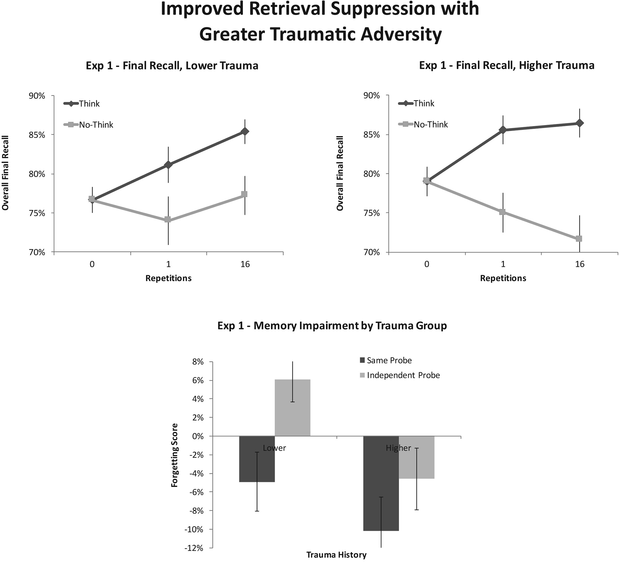
Figure 1

This recall benefit for Think items relative to No-Think items indicates that participants could, at a minimum, stop the retrieval process from occurring on No-Think trials often enough to preempt the strengthening/facilitation that retrieved Think items usually exhibit. It does not, however, address the separate effects of retrieval-induced facilitation (specifically, Think recall relative to Baseline) or suppression-induced forgetting (specifically, No-Think recall relative to Baseline), which we discuss next.

Retrieval-induced facilitation

Consistent with prior work, we found that final recall performance for Think items was reliably better after 16 retrieval attempts than after none (Baseline), F(1, 24) = 61.79, p < .001, ηp2 = .720. This effect did not interact with valence, F < 1. Importantly, the facilitation did not differ reliably across trauma groups, F < 1, despite a small numerical tendency for higher-trauma participants to show less facilitation. Thus, attending to Think items produced retention benefits that were statistically similar for the two trauma groups. This similarity of facilitation across higher- and lower-trauma groups was true irrespective of target item valence, as reflected in a nonsignificanttrauma History × Repetition × Valence (neutral vs. negative) interaction, F < 1.

Facilitation was, however, greater when Think items were tested on the SP compared with the IP test, F(1, 24) = 85.10, p < .001, ηp2 = .780. In particular, whereas the SP test showed robust facilitation of Think items, F(1, 24) = 151.45, p < .001, ηp2 = .863, the IP test showed no evidence of facilitation, F < 1. This attenuated facilitation on the IP test is consistently observed in the Think/No-Think paradigm (see Anderson & Huddleston, 2011, for a meta-analysis of 1300 participants tested with IPs) and indicates that the benefits of repeated retrieval on later retention are primarily associative and cue-specific.

Suppression-induced forgetting

Next, we examined whether suppressing the retrieval process impaired final test performance for No-Think items relative to Baseline performance. To estimatesuppression, we compared recall of No-Think response words after 0 suppression attempts (Baseline) to performance after 16 suppression attempts. We first tested for suppression-induced forgetting, collapsed over type of test and valence, to assess the effect of suppression on overall retention. The group, as a whole, showed better recall in the Baseline condition than after retrieval suppression, although this effect was marginally significant, F(1, 24) = 4.06, p = .055, ηp2 = .145. Thus, independent of trauma history, suppressing retrieval tended to impair overall retention of suppressed items in a manner largely consistent with prior work. The counterbalanced order in which the two constituent tests were administered did not affect this conclusion, as reflected in a nonsignificant interaction of test Order × Repetition, F(1, 48) = 1.47, p = .232, ηp2 = .030. Importantly, the repetition effect did not interact with the emotional valence of the suppression target, F < 1, indicating that the effect was comparable for both neutral and negative items.

Of key interest, however, was whether participants who reported having lived through more traumatic experiences differed in how well they contended with unwanted memories. Strikingly, we found that, whereas participants with greater experience with trauma displayed significant forgetting of No-Think items (Baseline minus No-Think recall = 80% − 72%, yielding an 8% suppression-induced forgetting effect), F(1, 24) = 9.62, p = .005, ηp2 = .286, the lower-trauma group displayed no reliable evidence of this ability to forget, (Baseline minus No-Think recall = 77% − 77%, yielding a 0% effect), F < 1. This difference in suppression-induced forgetting was significant, as reflected by an interaction of repetition and trauma, F(1, 24) = 5.62, p = .026, ηp2 = .190. Importantly, this apparent trauma-history advantage did not interact reliably with the emotional valence of the target material being suppressed, F < 1, suggesting that it reflects a generalized skill of suppression, regardless of valence. Thus, more extensive trauma exposure was associated with an enhanced ability to suppress unwanted memories.

Variation in suppression-induced forgetting by test type

To determine whether suppression impaired access to unwanted memories in a cue-independent manner (Anderson & Green, 2001), we tested whether suppression-induced forgetting varied across our SP and IP tests. Contrary to our expectation, we observed a significant interaction of Repetition × Test type, F(1, 24) = 11.28, p = .003, ηp2 = .320, with significant suppression-induced forgetting on the SP test, F(1, 24) = 11.53, p = .002, ηp2 = .325, but no reliable forgetting on the IP test, F < 1. This variation in suppression-induced forgetting across test type did not interact with the valence of target items, F < 1.

Despite the lack of an overall effect of suppression-induced forgetting on the IP test, this finding does not address the origins of trauma-history advantage. To the extent that greater suppression-induced forgetting for higher-trauma participants reflects an enhanced ability to inhibit memories, the suppression advantage should generalize to IPs. To test this, we examined the interaction of Repetition × Trauma × Test type. Consistent with this generalization, the trauma-history advantage in suppression-induced forgetting did not interact with test type, F(1, 24) = 1.18, p = .289, ηp2 = .047. As can be seen in Figure 1, participants with lower trauma showed reliable suppression-induced facilitation on the IP test, F(1, 24) = 4.88, p = .037, ηp2 = .169, whereas higher-trauma participants show a weak trend toward suppression-induced forgetting, F(1, 24) = 2.76, p = .109, ηp2 = .103. The foregoing findings suggest that the suppression-induced forgetting advantage for those reporting higher levels of trauma might arise, in part, from greater engagement of inhibition to stop retrieval.

Discussion

Experiment 1 indicates that people who report having greater experience with traumatic events may, indeed, be better at suppressing the retrieval of unwanted memories, even in our simple laboratory task. As predicted, participants in our higher-trauma group exhibited greater suppression-induced forgetting than did participants in our lower-trauma group. Interestingly, although the latter group could likely prevent retrieval from happening (as suggested by the lack of an overall positive benefit of being repeatedly exposed to reminders for No-Think items), they showed no evidence of an ability to forget the items that they had tried to suppress. The superior forgetting exhibited by our higher-trauma group did not vary across negative or neutrally valenced materials, consistent with the possibility that the mechanism underlying the retrieval-suppression advantage is not tied to aversive experiences, per se, but rather to controlling mnemonic content in general. The trauma-history advantage also did not vary with test type, with similar benefits on the SP and IP tests, consistent with the possible contribution of improved inhibitory control over memory. Indeed, lower-trauma participants showed a reversal of suppression on the IP test, indicating that their forgetting is cue-dependent.

In Experiment 1, overall suppression-induced forgetting did not generalize to the IP test. This contrasts with other, similarly conducted experiments showing comparable effects on SP and IP tests (see Anderson & Hanslmayr, 2014, for a review; see also Wang et al., 2015). One possibility is that reduced IP forgetting may be linked to the additional lexical information provided to subjects: Unlike in most other TNT studies, which most commonly use IP cues with a single letter stem (e.g., Anderson & Green, 2001; Anderson et al., 2004) or no stem (Wang et al., 2015), we provided two letters. Moreover, the IPs were associative (e.g., anatomy-co__ for corpse and bag-ga__ for garbage) rather than categorical (e.g., meat-be__ for beef). Associative cues might have been more difficult, prompting greater reliance on a lexical search strategy in response to the expanded letter stem. Evidence suggests that indirect word fragment completion tasks are less sensitive to suppression-induced forgetting (Angello, Storm, & Smith, 2015). If so, then our IP measure of inhibition may have been diluted by nonepisodic lexical retrieval.

Experiment 1 did not clearly support our prediction that IP tests would be more sensitive to the hypothesized differences in inhibitory control. Specifically, we predicted that the difference between lower- and higher-trauma groups in suppression-induced forgetting would be larger on the IP test. Although there was a trend in that direction (higher-trauma participants displayed an 11% averagesuppression-induced forgetting effect on the SP test, compared with a 5% effect displayed by lower-trauma participants—resulting in a 6 percentage-point forgetting advantage for higher-trauma participants; on the IP test, by contrast, higher-trauma participants displayed a 5% average suppression-induced forgetting effect, compared with a −6% effect displayed by lower-trauma participants—resulting in an 11 percentage-point forgetting advantage for higher-trauma participants; see Table 1), this interaction was not significant. The predicted sensitivity of the IP test may yet emerge if the contributions of lexical retrieval are controlled.
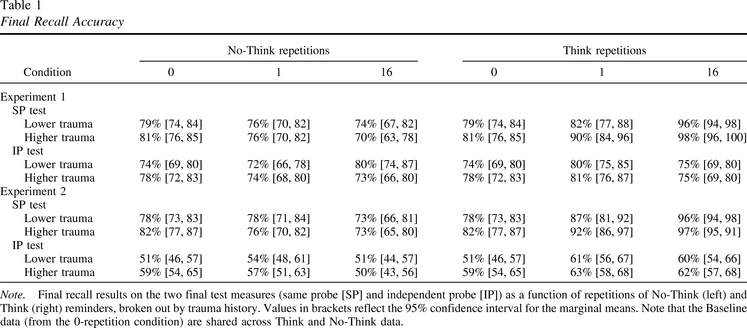
Table 1

Although the foregoing results broadly support a trauma-history advantage in suppression-induced forgetting, it is important to consider whether, our findings truly reflect a greater capacity to forget, or instead the contributions of experimenter/participant biases. Although unlikely, by administering the traumatic experiences survey at the end of the experiment, the experimenters could, in principle, have been unintentionally influenced in their scoring of the data (e.g., to the extent that any responses were ambiguous) by their knowledge of a participant’s trauma status. Alternatively, when participants attempted to suppress the retrieval of unwanted memories during our task, they may have formed opinions about the purpose of the experiment that led them to alter their responses to the traumatic experiences survey in some fashion. Some participants also might have been tempted to withhold correctly recalled responses based on these demands. Although largely excluded as an account of suppression-induced forgetting in several experiments previously (Anderson & Green, 2001), it is important to consider whether, in the current study, such biases could play a role. We address these possibilities, along with the foregoing issues about cue-independent forgetting, in Experiment 2.

Experiment 2

Experiment 2 sought to replicate the findings of Experiment 1 but with even more rigorous procedural controls. These controls were designed to ensure that (a) neither experimenter nor participant bias contaminated any evidence for trauma-related improvements in memory control, and (b) participants were suitably motivated on the final test to recall the items they had suppressed. Toward these ends, instead of administering the traumatic experiences survey postexperimentally, we administered it in a multilaboratory battery weeks (or longer) before the experiment, in an independent prescreening session online. This procedure ensured a clean separation of higher- and lower-trauma groups by their reported level of traumatic experience. Moreover, it disguised any relationship between our experiment and participants’ trauma history, so that participants’ responses on the survey would neither (a) be influenced by taking part in the TNT task, nor (b) be known to experimenters administering the procedure or scoring the data. To ensure the latter point, we also used a blinding procedure whereby the laboratory coordinator assigned experimenters to participants in a manner that did not identify participants’ trauma status. Moreover, during the final tests, we tried to ensure that participants always reported a recalled response, if they could. We modified the test instructions to strongly emphasize the need to provide answers to all items, if possible, even if participants were unsure of their answers. We also offered monetary incentives for each critical memory item correctly recalled (cf. Anderson & Green, 2001) to motivate participants to report every answer. Finally, Experiment 2 also modified the IP test by reducing the number of letters in the stem cue from two to one to increase sensitivity of the test to inhibition. As in Experiment 1, we predicted that the pattern of greater forgetting for higher trauma participants should generalize over cues, and so, not vary as a function of the type of test.

Method

Participants

We selected participants in the higher- or the lower-trauma groups on the basis of their scores on Goldberg and Freyd’s (2006) traumatic experiences survey, as in Experiment 1. However, this survey was administered with other measures across online prescreening sessions for introductory psychology classes (N = 512 over two semesters) as part of a multilab effort. From this, potentially eligible recruits were invited to participate in what was ostensibly an independent study, without foreknowledge that their self-reported trauma scores for events occurring prior to the age of 18 defined their assignment to either the lower- or higher-trauma groups within each one of our counterbalancing conditions.

Forty-eight undergraduates participated in exchange for course credit (and a potential monetary bonus), run by an experimenter who was blind as to their traumahistory (see below). We ran an additional nine participants to replace subjects who were excluded because of an inability to reach the initial learning criterion (n = 7), failure to comply with instructions (n = 1), or prior exposure to the TNT paradigm (n = 1). All participants provided written informed consent in accordance with the protocolapproved by the University of Oregon’s Institutional Review Board.

Materials and procedure

The materials and procedure were identical to those in Experiment 1, with the following exceptions.

Final test

We reduced the length of the word stem used for IPs to be a single letter instead of two letters as was used in Experiment 1, to increase sensitivity to inhibition. In addition, the final test instructions for Experiment 2 put additional emphasis on the importance of recalling as many of the responses as possible, even if participants were unsure of their answers. To emphasize this point further and to facilitate motivation, we offered a monetary reward of 20 cents for any correct response (provided on at least one of the two test types) for a predetermined subset of final test items (cf. Anderson & Green, 2001). Participants were informed that they could earn up to $4.00 for providing correct responses on unspecified “critical items,” which happened to consist of the five No-Think responses each from their 1-repetition neutral, 1-repetition negative, 16-repetition neutral, and 16-repetition negative counterbalanced sets.

Blinding procedures

To ensure that experimenters were not biased in the manner in which they administered the TNT task to participants in the higher- or lower-trauma groups, we adopted a blinding procedure in which experimenters had no knowledge of the group that participants were in. A laboratory coordinator randomly assigned participants to experimenters and did not label participant materials in a way that indicated group status. Finally, to ensure that data coding was unbiased, experimenters remained blinded to participants’ group status while scoring recall performance.

Results

Training phase performance

Participants took 1.75 (SD = 0.70) cycles on average to reach criterion (averaging 41 of 66 items correct in their final cycle, SD = 6.04). Neither the number of cycles to reach criterion, t(46) = 1.25, p = .219, nor the number of correct items in the last cycle t(46) = 0.55, p = .588, differed significantly across higher- and lower-trauma groups (two-tailed tests).

Final test phase performance

Overall memory control effects

Participants showed robust control over the retrieval process, as reflected by the interaction of instruction with repetition, F(1, 24) = 30.30, p < .001, ηp2 = .588. This overall memory control effect did not vary by trauma group, F < 1. Both lower-trauma participants, and higher-trauma participants, showed evidence for control effects, as can be seen in Figure 2 and Table 1. This indicates that, as in Experiment 1, participants could, at a minimum, stop the retrieval process from occurring on No-Think trials often enough to preempt the strengthening/facilitation that retrieved items usually exhibit. We next turn to the separate effects of retrieval-induced facilitation and suppression-induced forgetting.

Retrieval-induced facilitation

The facilitation effects in Experiment 2 replicated those observed in Experiment 1 in nearly every respect. Final recall performance for Think items was reliably greater after 16 retrieval attempts than after none (Baseline), F(1, 24) = 48.98, p < .001, ηp2 = .671. This effect that did not interact with valence, F < 1. Importantly, as in Experiment 1, the facilitation did not differ across the trauma groups, F(1, 24) = 1.83, p = .188, ηp2 = .071. Thus, retrieving Think items produced retention benefits that were statistically similar for the two trauma groups. This similarity of facilitation across groups was true irrespective of target item valence, as reflected by a nonsignificant Repetition × Trauma × Valence interaction, F(1, 24) = 1.97, p = .173, ηp2 = .076.

As in Experiment 1, facilitation was greater when we tested Think items on the SP compared with the IP test, F(1, 24) = 11.57, p = .002, ηp2 = .325. In particular, whereas the SP test showed robust facilitation of Think items, F(1, 24) = 98.61, p < .001, ηp2 = .804, the IP test showed reliable, but quantitatively less facilitation, F(1, 24) = 5.06, p = .034, ηp2 = .174. The latter finding deviates from Experiment 1, which found no evidence of facilitation on the IP test, perhaps indicating that reducing letter stem cues in Experiment 2 improved sensitivity to facilitation. Nevertheless, the facilitation was less pronounced on the IP test, which is consistently observed in the Think/No-Think task (Anderson & Huddleston, 2011).

Suppression-induced forgetting

As with facilitation, the overall suppression-induced forgetting findings from Experiment 2 replicated Experiment 1. Collapsing over trauma group, test type, and valence, the sample as a whole showed robust suppression-induced forgetting, with better recall in the Baseline condition (0 repetitions) than after 16 retrieval suppression repetitions, F(1, 24) = 8.52, p = .008, ηp2 = .262. Thus, independent of trauma history, suppressing retrieval impaired overall retention of No-Think items in a manner consistent with Experiment 1 and prior work. The counterbalanced order in which we administered the two constituent tests did not affect this conclusion, as reflected by a nonsignificantinteraction of test order and repetition, F(1, 24) = 1.06, p = .308, ηp2 = .024. Importantly, the suppression-induced forgetting effect showed no interaction with the valence of the suppression target, F < 1, demonstrating that the effect was comparable for both neutral and negative items.

Of key interest, however, was whether higher-trauma participants would show superior suppression-induced forgetting, as they had in Experiment 1, despite the array of procedural controls introduced in Experiment 2. Critically, whereas participants with higher trauma displayed robust forgetting of No-Think items (Baseline minus No-Think recall = 71% − 62%, a 9% effect), F(1, 24) = 10.22, p = .004, ηp2 = .299, the lower-trauma group, in contrast, displayed no reliable evidence of an ability to forget No-Think items, (Baseline minus No-Think recall = 64.5% − 62% = a 2.5% effect), F(1, 24) = 0.87, p = .361, ηp2 = .035. The interaction of trauma Group × Repetition, however, did not quite reach significance in this sample, F(1, 24) = 2.57, p = .122, ηp2 = .097. Nevertheless, the pattern of suppression observed across the higher- and lower-trauma groups is both qualitatively and quantitatively similar to that observed in Experiment 1 (see section entitled “Integrated Analyses of Experiments 1 and 2” for a formal statistical comparison of these patterns). Importantly, this apparent trauma-history advantage did not interact reliably with the emotional valence of the target material being suppressed, F(1, 24) = 1.64, p = .213, ηp2 = .064, suggesting that this effect reflects a generalized skill at suppression, regardless of valence.

Variation in suppression-induced forgetting by test type

Unlike in Experiment 1, suppression-induced forgetting did not vary reliably across our SP and IP tests, F < 1, with similar forgetting on the SP test (Baseline minus No-Think = 80% − 73% = 7%), and on the IP test (Baseline minus No-Think = 55% − 50% = 5%). Thus, suppression-induced forgetting generalized over cues, a pattern that did not interact with the valence of target items, F < 1. These findings suggest that participants in Experiment 1 may have been relying on a lexically focused retrieval strategy, a possibility consistent with the fact that overall IP recall performance fell precipitously from 76% in Experiment 1 to 57% in Experiment 2 (a 19% reduction), a drop that was highly significant, F(1, 48) = 98.44, p < .001, ηp2 = .672.

Next, we examined whether the greater suppression-induced forgetting for higher-trauma participants reflected an enhanced ability to inhibit unwanted memories. If so, we would expect the trauma-history advantage to generalize to IPs, as it did in Experiment 1. To test this, we examined the interaction of Repetition × Trauma × Test type. Consistent with this possibility, the trauma-history advantage in suppression-induced forgetting showed no evidence of interacting with test type, F < 1. This reflects the fact that participants with lower reported trauma showed weaker suppression-induced forgetting than higher-trauma participants (Baseline minus No-Think recall) on both the SP test (lower trauma: 78% − 73% = 5%; higher trauma: 82% − 73% = 9%) and the IP test (lower trauma: 51% − 51% = 0%; higher trauma: 59% − 50% = 9%; see Figure 2). As in Experiment 1, the difference in SIF across higher- and lower-trauma groups was numerically smaller on the SP test (9% − 5% = 4%) than on the IP test (9% − 0% = 9%), consistent with the possibility that the IP test is more sensitive to differences in inhibitory function. However, as detailed above, this interaction was not reliable. Overall, these findings suggest that the suppression-induced forgetting advantage for higher-trauma participants arises, in part, from better engagement of inhibition.

Discussion

Experiment 2 suggests that the trauma-history advantage in suppression-induced forgetting does not arise from participant or experimenter bias or from participants not being motivated to recall or report suppressed items. In Experiment 1, bias could have influenced the data in several ways: awareness of participants’ trauma status (as reported on the postexperimental questionnaire) could have influenced how experimenters scored the data; or participants might have altered their trauma history reporting after having participated in a task involving suppression; or participants might have guessed the purpose of the study (to find evidence for forgetting) and then deliberately withheld correctly recalled No-Think items on the test. By collecting trauma-history data in a separate and seemingly unrelated session weeks earlier, by adopting rigorous blinding procedures, and by strongly encouraging participants to report all recalled responses (and adding monetary incentives), Experiment 2 bolsters confidence that the trauma-history advantage reflects a genuine difference in forgetting of the memories people tried not to think about. This advantage did not vary as a function of the valence of the suppressed items, suggesting that it reflects a generalized enhancement of the suppression process. Experiment 2 also replicated the finding that the trauma-history advantage in suppression-induced forgetting did not vary by test type, demonstrating that the superior forgetting generalized across cues. This finding is consistent with the possibility that the advantage reflects better inhibitory control in the higher-trauma group.

Integrated Analyses of Experiments 1 and 2

To explore the relation of trauma history and suppression-induced forgetting with greater statistical power, we combined the data from our two similar experiments. In this section, we report this analysis, which includes the same factors as in the experiment-specific analyses, but with an additional between-subjects experiment factor. This analysis enables us to establish, in a large sample, the overall robustness of patterns observed in individual experiments and to assess the reliability of any apparent differences across studies. We also report a complementary set of robust and partial correlation analyses based on the combined sample to examine whether a continuous relationship exists between the frequency of trauma and suppression-induced forgetting, as well as to assess the contributions of potential confounding variables, such as depression or Baseline performance.

Results

Overall memory control effects

Participants showed extremely robust control over the retrieval process, as reflected by the interaction of instruction (Think vs. No-Think) with repetition (0 vs. 16), F(1, 48) = 55.10, p < .001, ηp2 = .534. This overall memory control effect was a general feature of both studies and did not interact with experiment, F(1, 48) = 2.39, p = .129, ηp2 = .047. Importantly, both lower-trauma F(1, 48) = 21.78, p < .001, ηp2 = .312, and higher-trauma participants, F(1, 48) = 33.99, p < .001, ηp2 = .415, showed robust control effects.

Retrieval-induced facilitation

Overall, the facilitated recall arising from repeated retrieval of Think items was statistically comparable across Experiments 1 and 2. The tendency for 16 retrieval attempts to facilitate memories compared with Baseline (0 attempts) was extremely robust, F(1, 48) = 102.62, p < .001, ηp2 = .681, and did not vary by experiment, F(1, 48) = 2.77, p = .103, ηp2 = .055, or with valence of the target, F < 1. Facilitation was, however, greater on the SP compared with the IP test, F(1, 48) = 62.36, p < .001, ηp2 = .565, a pattern which did interact with experiment, F(1, 48) = 4.86, p = .032, ηp2 = .092.

Importantly, even in this much larger, integrated sample, facilitation of Think items did not differ reliably across the trauma groups, F(1, 48) = 2.21, p = .143, ηp2 = .044, with both lower-, F(1, 48) = 67.49, p < .001, ηp2 = .584, and higher-trauma, F(1, 48) = 37.34, p < .001, ηp2 = .438, participants experiencing robust facilitation. The comparable facilitation across groups did not interact with experiment, as reflected by a nonsignificant Repetition × Trauma × Experiment interaction, F < 1. These findings indicate that our lower- and higher-trauma groups both benefited from the repeated retrieval of memories and that this was consistent across studies.

Suppression-induced forgetting

The overall suppression-induced forgetting effect was highly robust and comparable across experiments. No-Think items were generally recalled more poorly than were Baseline items, F(1, 48) = 12.51, p = .001, ηp2 = .207, and this effect did not interact reliably with experiment, F(1, 48) = 1.02, p = .317, ηp2 = .021. Critically, as suggested by the individual studies, the apparently greater suppression-induced forgetting for higher-trauma participants was supported by a significant interaction between repetition and trauma history, F(1, 48) = 7.48, p = .009, ηp2 = .135. Whereas participants with greater experience with trauma displayed significant forgetting of No-Think items across the final tests, F(1, 48) = 19.67, p < .001, ηp2 = .291, the lower-trauma group displayed no reliable evidence of an ability to forget No-Think items, even in this much larger, integrated sample. The trauma-history advantage did not show any evidence of interacting with valence (see Figure 3), F(1, 48) = 1.21, p = .278, ηp2 = .025, or with experiment, F < 1. Thus, despite the marginal interaction of trauma and repetition in Experiment 2, the relative difference in suppression-induced forgetting across higher- and lower-trauma groups was statistically indistinguishable across experiments. Indeed, the significant forgetting in the higher-trauma group did not interact with experiment, F < 1, nor did the lack of suppression-induced forgetting in the lower-trauma group, F < 1.

Thus, despite highly similar overall memory performance and comparable facilitation of Think items, a prior history of more trauma was associated selectively with the enhanced ability to suppress unwanted memories.

Comparison of the trauma-history advantage over test type

Although we had hypothesized that the IP test would be more sensitive to differences in inhibitory control and although both studies showed a numerical tendency supporting this, the trauma-history advantage in suppression-induced forgetting still did not vary reliably across our SP and IP tests, F(1, 48) = 1.33, p = .255, ηp2 = .027, despite the increase in sample size. This pattern did not interact with experiment, as reflected in a nonsignificant interaction of Repetition × Trauma × Test type × experiment, F < 1. Nevertheless, the lack of an interaction of test type with repetitionsuggests that the superior forgetting exhibited by participants with more traumatic experience occurs irrespective of test type, and so may have a grounding in improved inhibitory control. Indeed, higher-trauma participants exhibited significant forgetting, regardless of whether No-Think items were analyzed with respect to the SP, F(1, 48) = 18.22, p < .001, ηp2 = .275, or the IP test, F(1, 48) = 7.29, p = .010, ηp2 = .132, consistent with this possibility.

Interestingly, lower-trauma participants exhibited qualitatively different patterns of forgetting on the SP and IP tests. Whereas overall forgetting (collapsed over test type) was not reliable, lower-trauma participants exhibited reliable cue-specific forgetting on the SP test. This cue-specific forgetting pattern in the lower-trauma group was substantiated by a significant interaction of repetition by test type, F(1, 48) = 6.04, p = .018, ηp2 = .112. In contrast to the reliable forgetting seen for this group on the SP test, F(1, 48) = 4.70, p = .035, ηp2 = .089, no impairment was observed on the IP test, F(1, 48) = 1.11, p = .297, ηp2 = .023. This pattern did not interact with experiment, F(1, 48) = 1.07, p = .306, ηp2 = .022. Thus, participants who reported relatively little experience with trauma showed modest forgetting that also appeared to be largely cue-dependent. This suggests that the observed forgetting may not have reflected inhibition (Anderson & Levy, 2009; Anderson et al., 2011; Noreen & de Fockert, 2017; Wang et al., 2015). Taken together, the findings from this integrated analysis suggest that experience with traumatic events may lead to more effective use of inhibitory processes to control unwanted memories, and, as a consequence, to more generalized forgetting of those memories in different cuing situations.

Correlational analyses of the integrated sample

We based the foregoing conclusions about trauma history and forgetting on a group analysis approach. To complement this analysis, we also leveraged the additional statistical power afforded with supplementary correlation analyses by treating trauma history as a continuous measure (DeCoster, Iselin, & Gallucci, 2009). These analyses sought to address several issues. First, although our group analyses matched lower- and higher-trauma groups perfectly with regard to our stimulus and test order counterbalancing manipulations, they dichotomized our sample according to the level of reported trauma, discarding information about gradations in trauma that could be helpful in evaluating the generality of the relationship between traumatic experience and inhibition. Second, our group analyses provided numerically suggestive evidence that the IP test is more sensitive to individual differences in inhibitory control capacity that may be related to trauma history. These tendencies were nonetheless not significant. It is possible that the predicted superiority of the IP test in detecting differences in inhibition may surface if our analysis considered more continuous variation in trauma level. Finally, we sought to address potential influences of self-reported depression and Baseline recall level as factors contributing to the putative trauma-history advantage.

To address these objectives, we ran robust correlation tests for our IP and SP measures of suppression-induced forgetting, treating the average trauma score as a continuous measure across our 96 participants. After z-transforming the suppression-induced forgetting and trauma scores within each of the stimulus counterbalancing conditions, we used the Robust Correlation Toolbox for Matlab, which down-weights/removes analytically identified bivariate outliers, while statistically correcting for their removal (Pernet, Wilcox, & Rousselet, 2013). Reliability of the Spearman outlier-skipped correlation was determined based on the percentile bootstrap confidence interval (i.e., if the 95% interval includes 0, the null hypothesis of independence was not rejected), a method that is more robust against heteroscedasticity than the traditional t test (Pernet et al., 2013). We then subjected the data—stripped of analytically identified bivariate outliers—to an additional partial correlation analysis that examined the relationship between traumatic experience and suppression-induced forgetting while controlling simultaneously for both self-reported depression severity and Baseline recall performance.

In this correlational analysis, we confirmed that increasing levels of reported traumaare associated with more generalized suppression-induced forgetting, as evident by greater forgetting on the IP test. Indeed, as can be seen in Figure 4, the clearest association with trauma history was evident on the IP test (skipped Spearman rs = 0.25, bootstrap-based 95% confidence interval [CI] accounting for automatically removed bivariate outliers: [0.03, 0.45]). In contrast, the relationship between trauma history and forgetting on the SP test was not reliable (skipped Spearman rs = 0.02, 95% CI [−0.17, 0.23]). Across the nonoutlier data points, the IP and SP correlation coefficients significantly differed according to a one-tailed Meng’s z test for correlated correlation coefficients, Meng’s z = 1.67, p = .048 (Meng, Rosenthal, & Rubin, 1992). This disparity across test types is consistent with prior work indicating that item-specific cuing tests such as the IP test are more sensitive to individual differences in inhibitory control (Anderson & Levy, 2009; Anderson et al., 2011; Schilling et al., 2014; Wang et al., 2015).
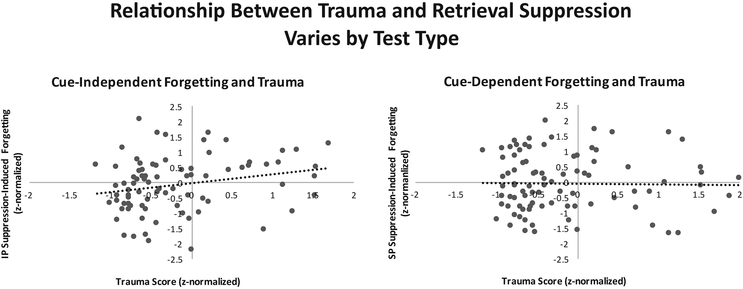
Figure 4

Next, we addressed potential influences of self-reported depression and Baseline recall via our supplementary correlational approach. First, it should be noted that in the group analysis, we found that our trauma groups differed in neither BDI scores, F< 1, nor Baseline recall, F(1, 48) = 3.63, p = .063, ηp2 = .070, suggesting that these variables are unlikely to explain differences observed in this analysis. Still, we asked whether these factors possibly could account for the observed relationship between trauma history and suppression-induced forgetting; partial correlation analyses (two-tailed tests) suggested not. After controlling for both of these variables, trauma history and IP forgetting remained significantly related, prs(82) = 0.25, p = .025. In contrast, there again was no reliable relationship between trauma history and SP forgetting, prs(82) = 0.03, p = .798.

Discussion

The integrated analysis helped confirm several important aspects of the case for a trauma-history advantage. First, the combined analysis demonstrated that our participants, who reported experiencing varying amounts of trauma, did not differ reliably in other aspects of performance that were unrelated to inhibitory control, including the ability to benefit from repeated retrieval of Think items—even when considering a much larger sample of participants. The groups did, however, consistently differ in the amount of suppression-induced forgetting they exhibited, a pattern that was statistically equivalent across the two studies. Second, our correlational analyses revealed that the relationship between trauma history and superior forgetting is not tied specifically to our group analysis approach, as it also emerges when one considers continuous variation in the level of trauma. The correlational approach further revealed evidence for the superiority of the IP test in isolating evidence of improved inhibitory control with higher trauma—an effect that was suggestive, though statistically weak, in our group approach. Third, these analyses suggest that differences in Baseline recall or in depression symptoms across trauma groups are unlikely to provide an alternative account of our findings. Finally, the combined analysis yielded evidence that even participants who reported experiencing lower rates of trauma exhibit some forgetting, but that this forgetting is cue-dependent, which may not reflect inhibition.3 Taken together, these findings provide strong converging evidence that participants who have lived through more adverse experiences in their lives show improved ability to contend with unwanted memories, as hypothesized.

General Discussion

Life experience often supplies natural opportunities for refining skills. Whereas few would argue that traumas are good, they may nonetheless drive adaptation that promotes resilience. We claim that controlling one’s memories—remembering what is relevant and setting aside that which is maladaptive—is a valuable skill (see Nørby, 2018, for a review). Here we considered the possibility that trauma experience affords many survivors the opportunity to adapt their memory control abilities, enabling them to better regulate intrusive memories. Though honed in response to particular traumas, these adaptations may generalize to unrelated memories producing lasting benefits that promote long-term resilience in the face of adversity (Seery, 2011). Our data, although correlational in nature, are consistent with this possibility. In our samples, those reporting more traumatic life events prior to age 18 were better at suppressing retrieval of novel associations, regardless of the valence of the suppressed content. We observed evidence of this advantage across two experiments. These individual differences in suppression success are unlikely to reflect biases in reporting to-be-suppressed items or experimenter bias in the administration or scoring of the Think/No-Think task: Offering financial incentives for accurate recall and blinding experimenters/data coders to participants’ trauma history had no effect on the suppression advantage. These findings suggest that those participants who had lived through a greater number of adversities were genuinely better at forgetting experiences they sought not to think about, at least in the context of our controlled laboratory task.

Notably, our higher- and lower-trauma groups performed comparably in other respects, despite differences in retrieval-suppression. The two groups differed neither in Baseline recall nor in the tendency for repeated retrieval to facilitate Think items. Comparable recall after paired-associates training suggests that our traumagroups did not differ markedly in their general motivation to perform our laboratory tasks. Potential motivational differences warrant special scrutiny when the groups under consideration might differ on psychiatric variables, such as depression. However, we found that symptoms of depression were generally low, on average, and were similar across groups—in itself a remarkable finding, given the higher-trauma group’s history of adversity. Importantly, partialing out depression scores did not meaningfully alter the relationship between trauma exposure and suppression-induced forgetting. Taken together, these findings are consistent with trauma experience selectively improving memory inhibition, rather than affecting overall memory performance or motivation. Indeed, the enhanced forgetting in the higher-trauma group was especially evident on a test of cue-independent forgetting designed to isolate the influence of inhibitory control (Levy & Anderson, 2008; Schilling et al., 2014). In contrast to the higher-trauma group, forgetting in the lower-trauma group did not generalize across test types. This cue-dependent pattern observed for the lower-trauma group suggests that the effect reflects mechanisms that promoted retrieval interference at the time of test, more than inhibition of the to-be-suppressed responses.

Interestingly, the current data indicate that the trauma-related memory advantage did not vary according to the valence of the target items being suppressed. Benefits arose for both negative and neutral stimuli. There are reasons to expect that this need not have been the case. For one, people with a greater history of trauma might have shown less benefit of their prior experience for negative material, perhaps because they could have been distracted by relationships of the materials to their own lives. For another, greater benefits for negative content might have arisen if suppressing traumatic intrusions had fostered distinctive component processes not involved in suppressing neutral content. The absence of such an advantage in our data could indicate that the cognitive and neural mechanisms involved in suppressing aversive and neutral content are similar, a possibility compatible with imaging work on retrieval suppression (Gagnepain et al., 2017). Alternatively, differential effects for valenced content might have been observed had we manipulated valence more strongly (e.g., with aversive pictures) or had we used materials tailored to trauma (as is sometimes done in directed forgetting work—McNally, Ristuccia, & Perlman, 2005; Moulds & Bryant, 2002; Noreen & MacLeod, 2013; Zoellner, Sacks, & Foa, 2003). The present pattern of results is, nonetheless, consistent with our theory that trauma history fosters a generalized retrieval suppression skill not limited to affective content.

Although both experiments found superior memory inhibition in participants with a history of adversity, our data may underestimate the true strength of this relationship. Our ability to test this relationship depended on how accurately we could quantify participants’ trauma history. Should individuals with more traumas be better at forgetting, as predicted, this superior memory control ability may actually cause them to underestimate the true frequency of their own adverse experiences. In some cases, this underestimation even might have led them to be misclassified into our lower-trauma group. The impact of this dynamic should depend on the nature of the forgetting induced by retrieval suppression. On the one hand, if suppression primarily reduces involuntary retrievals of unwanted memories or degrades the specificity of episodic details of those events without affecting voluntary access to them (e.g., Noreen & MacLeod, 2013; Stephens, Braid, & Hertel, 2013), suppression may not alter people’s estimates of their own trauma frequency very much. On the other hand, if suppression induces more generalized memory loss for the unwanted events, frequency estimates may be more distorted, reducing differences in forgetting across lower- and higher-trauma groups, increasing the likelihood of potential misclassifications, and reducing correlations between forgetting and trauma history. Although we cannot discern the influence of such an effect in our dataset, this putative bias works against our hypothesis. That we nevertheless observed a robust relationship between trauma history and suppression-induced forgetting is, therefore, all the more remarkable.

Relation to Existing Work

Two features of the current work make it unique in its capacity to shed light on how cumulative lifetime adversity might affect the ability to control intrusive memories. First, prior studies that examined the relationship of trauma to memory inhibitionused variants of the retrieval-induced forgetting or directed forgetting paradigms(Amir, Badour, & Freese, 2009; McNally et al., 2005; Moulds & Bryant, 2002; Zoellner et al., 2003). The relevance of the behavioral circumstances posed by these two procedures to controlling intrusive memories is arguably indirect: Retrieval-induced forgetting concerns the tendency for retrieval of some items to incidentally inhibit other competing memories; directed forgetting concerns the ability to forget an immediately preceding event or set of events, in some cases by terminating encoding of the event. Although both tasks can involve inhibitory control, neither addresses the situation most relevant to combating intrusive memories of trauma: confronting unwelcome reminders and needing to suppress episodic retrieval to prevent awareness of an intrusive memory. We argue that studying retrieval suppression as we do here more directly speaks to the mechanisms relevant to understanding how people regulate intrusions of experiences that are well encoded (Anderson & Hanslmayr, 2014). Second, little work with the directed forgetting procedure has quantified lifetime history of adversity; rather, most such studies have instead focused on diagnostic groups with documented evidence of a disorder (e.g., PTSD or acute stress disorder; e.g., McNally et al., 2005; Moulds & Bryant, 2002; Zoellner et al., 2003). Although findings have been variable, patients with PTSD often show impaired directed forgetting (see, e.g., McNally, 1998), paralleling studies of retrieval suppression in PTSD (Catarino et al., 2015). However, by focusing on a more diverse sample of participants, rather than preselecting on the basis of clinical disorders, we argue that the current study, with its relatively comprehensive accounting of lifetime traumatic experience, is better positioned to characterize the general association between adversity and memory inhibition.

As such, this study adds to a growing body of work indicating that suppression-induced forgetting, as measured by the Think/No-Think paradigm, reflects mechanisms engaged in everyday control over unwanted memories that appear relevant to resilience in the face of unpleasant experiences. For instance, superiorself-reported ability to control everyday thoughts not only predicts lower levels of anxiety, depression, and obsessional thinking, but also better suppression-induced forgetting in the laboratory (Küpper, Benoit, Dalgleish, & Anderson, 2014). Other work has revealed negative relationships between suppression-induced forgetting and rumination (Fawcett et al., 2015; Hertel & Gerstle, 2003), trait anxiety (Dieler, Plichta, Dresler, & Fallgatter, 2010; Marzi, Regina, & Righi, 2014), and PTSD symptoms (Catarino et al., 2015). Importantly, individuals who demonstrated superior suppression-induced forgetting in a simple verbal Think/No-Think task were found to experience fewer distressing memory intrusions in the week following exposure to a traumatic film (Streb, Mecklinger, Anderson, Lass-Hennemann, & Michael, 2016). This finding suggests that laboratory measures of retrieval suppression ability are linked to resilience in the face of stressful events. Together with this literature, our current findings suggest that memory control processes engaged during retrieval suppression may play an important role in the adaptation that typically occurs after a trauma and to the building of future resilience. Nevertheless, it would be desirable in future work to directly establish, within the same study, the link between exposure to trauma, superior memory control, and resilience in the face of novel stressors (cf. Seery, Leo, Lupien, Kondrak, & Almonte, 2013).

The current findings cannot distinguish whether traumatic experiences improved participants’ memory control or, conversely, whether good preexisting memory control abilities enabled our higher-trauma participants to overcome their challenging history and make it to college and into our sample. Moreover, without detailed information regarding the severity or developmental timing of the traumas reported by our sample—or whether any led to PTSD or other mental health conditions—we are currently unable to address the extent to which these factors relate to memory suppression abilities and overall resilience. These questions merit careful scrutiny in future work. However, structural adaptations in the right DLPFC in the year following trauma and their relationship to recovery from PTSD (Lyoo et al., 2011) suggest that, at least in adults, retrieval suppression abilities may well undergo adaptation in many individuals, given the right DLPFC’s involvement in this control ability (Anderson & Hanslmayr, 2014). Analogous experience-dependent changes in task-relevant brain structures have been found after practice at golf (Bezzola, Mérillat, Gaser, & Jäncke, 2011), musical performance (Herholz & Zatorre, 2012), left-handed writing and drawing (Wenger et al., 2017), and even working memory (Metzler-Baddeley, Caeyenberghs, Foley, & Jones, 2016) and inhibitory control (Chavan, Mouthon, Draganski, van der Zwaag, & Spierer, 2015)—with these changes predicting behavioral performance (Draganski et al., 2014; May, 2011). To substantiate the hypothesized role of cortical plasticity in improving retrieval suppression, future work should track memory control ability longitudinally in participants who have recently experienced trauma. Doing so could help determine whether behavioral and structural adaptations arising from the trauma predict recovery from intrusion symptoms. If trauma can naturally improve retrieval suppression, as the Lyoo et al. (2011) and current data suggest, it would broaden our understanding of the consequences that trauma has on mental function. Such effects of trauma on memory control are consistent with the broad proposal that psychiatric conditions promote generalized habits of thought (Hertel, 2004).

Given the aforementioned considerations, the current evidence for trauma-related advantages in memory control provides a credible account regarding the cognitive mechanisms that underlie reports of positive effects of adversity on resilience. Seery et al. (2010) noted that, although adversity may have a negative effect on current and future mental health and well-being (e.g., Brewin, Andrews, & Valentine, 2000; Edwards, Holden, Felitti, & Anda, 2003; Golding, 1999), having experienced a moderate level of adversity may be beneficial in developing mechanisms that improve future resilience. In a large scale (N > 2000) longitudinal study, they found a nonmonotonic relationship between cumulative lifetime history of adversity and measures of mental health: Moderate adversity was associated with higher self-reported mental health (i.e., lower reported depression/anxiety, lower global distress, lower functional impairment, lower posttraumatic stress) and well-being (i.e., higher rated life satisfaction) compared with having experienced high adversity or no adversity at all. Higher cumulative adversity predicted greater resilience when encountering new traumas years later. Strikingly, the benefits of moderate adversity also arise in laboratory measures of people’s stress responses, including: (a) lower ratings of pain intensity during a cold-pressor task and reduced situational catastrophizing (persistent negative thoughts), and (b) reduced online cardiovascularmeasures of challenge/threat in response to a stressful intelligence test (Seery et al., 2013). Given evidence supporting a common inhibitory control mechanism mediated by the right prefrontal cortex underlying the suppression of unwanted thoughts, emotions, and actions (Depue, Orr, Smolker, Naaz, & Banich, 2016; Gagnepain et al., 2017; Guo, Schmitz, Mur, Ferreira, & Anderson, 2018; Schmitz, Correia, Ferreira, Prescot, & Anderson, 2017), we suggest that both the data on resilience and the current findings are compatible with the possibility that adversity trains a general inhibitory control mechanism. Although this inhibitionplasticity hypothesis is plausible, matters are complex, given trauma’s parallel detrimental impacts on well-being. For example, it is unclear why individuals with much higher lifetime adversity show poorer outcomes (Seery et al., 2010) under this account. One possibility is that high, repeated stress could have toxic effects that compromise the neural mechanisms that implement inhibitory control (e.g., GABAergic inhibition in the hippocampus; Schmitz et al., 2017). It remains possible that we, too, would have observed a nonmonotonic relationship between prior adversity and memory suppression had we captured in our sample a wider range of trauma frequency or severity.

Implications

If the inhibition plasticity hypothesis is correct and real-world conditions precipitate cortical plasticity that supports new habits of thought, this gives hope to potential interventions designed to train memory control, complementing standard cognitive–behavioral therapy. Currently, it is widely believed that avoiding distressing memories exacerbates PTSD symptoms by keeping suppressed memories accessible (e.g., Dalgleish, Hauer, & Kuyken, 2008). Cognitive–behavioral therapy for PTSD is considered effective because it encourages patients to stop avoiding memories and to confront reminders until the traumatic memories become less distressing (Kar, 2011). We suggest an alternative possibility, proposing that there is an important distinction between avoiding reminders, on the one hand, and avoiding the memory (via suppression) after a reminder is confronted, on the other. The former strategy is expected to preserve memories by depriving people of opportunities to forget via inhibitory control, whereas avoidance by successful retrieval suppression is beneficial. Thus, like cognitive–behavioral therapy, retrieval suppression forces people to confront reminders, but has the potential to allow many of these individuals to learn to control awareness of their memories. Given this perspective, training in retrieval suppression may augment the benefits of cognitive–behavioral therapy by enabling patients to confront reminders and redirect to more benign thoughts.

Suggesting that forgetting unwanted memories may be helpful might seem in conflict with the fact that memory lapses for significant aspects of a trauma are considered a hallmark symptom of PTSD, according to the current edition of the Diagnostic and Statistical Manual of Mental Disorders (DSM–5; American Psychiatric Association, 2013). If so, forgetting is arguably an unhealthy outcome rather than a healthy goal. Two points are worth emphasizing, however. First, as noted previously, research on retrieval-suppression (Catarino et al., 2015), directed forgetting (e.g., McNally, 1998), and even motor response inhibition (Falconer et al., 2008) point to a general deficit in inhibitory control that compromises the effective suppression of intrusive memories in PTSD. If so, then any memory lapses (often referred to as memory fragmentation; see, e.g., Brewin, 2007, 2014) that occur in PTSD may not arise from suppression, but rather from some other process. One possible origin may be compromised episodic encoding of trauma attributable to the impact of extreme stress on hippocampal function in response to the traumatic event (Brewin, Gregory, Lipton, & Burgess, 2010). If stress impairs encoding, then the loss of episodic memory may not itself be a direct cause of PTSD symptoms, but rather an indirect reflection (or marker) of the severity of the original stress response. Second, despite support from a number of studies (see, e.g., Brewin, 2007, 2014, for reviews), the existence of elevated fragmentation/incoherence of trauma memories in PTSD has been challenged (Rubin et al., 2016; but see Brewin, 2016), raising the possibility that memory lapses might not be as reliable a symptom of PTSD as previously thought. Given these observations, we see value in entertaining the possibility that forgetting arising from the successful down-regulation of intrusive memories via retrievalsuppression may be a healthy coping response that is dysfunctional in PTSD, leading to difficulty controlling intrusive memories.

Even if retrieval suppression may be healthy by helping to reduce intrusive memories, recent evidence suggests that this benefit also comes with other costs during the adjustment process. As people recover from trauma, they often exhibit generalized memory deficits—including overgeneral autobiographical memory and episodic memory impairments (e.g., Brewin, 2011; Ono, Devilly, & Shum, 2016). Evidence indicates that some forms of retrieval suppression may contribute to these side effects (Dalgleish et al., 2008; Hulbert et al., 2016). For example, when people suppress retrieval, it not only impairs memory for the suppressed trace, but also induces an amnesic shadow over events occurring before and after suppression (Hulbert et al., 2016; Hulbert, Hirschstein, Brontë, & Broughton, 2018). This diffuse memory deficit likely arises from the down-regulation of hippocampal activity caused by retrieval suppression (Anderson et al., 2004) and the resulting disturbance it creates in hippocampal processes like establishing stable, contextualized memories. Such deficits should be greatest in those victims of trauma with intact retrieval suppression ability. Though clearly not desirable, this temporary decline in memory function may represent a trade-off between the need to regulate intrusive memories that disrupt life on one hand, and general mnemonic functioning on the other. Once intrusive memories have been regulated and control processes refined, memory may improve. Indeed, these types of memory deficits following trauma often abate as intrusions decline (Guez et al., 2013).

Exposure to trauma, unfortunately, is pervasive. Data from the World Mental Health Survey Consortium indicate that more than 70% of the nearly 70,000 adults responding from 24 countries across the globe have been exposed to at least one traumatic event in their lifetimes; more than 30% have been exposed to four or more such events (Benjet et al., 2016). Benjet and colleagues went on to report that the overall prevalence of exposure in the United States topped 82% in the years surveyed. Within the U.S. college population from which our participants were drawn, published prevalence estimates range considerably (up to 84%), reflecting variable thresholds in classifying potentially traumatic events (Read, Ouimette, White, Colder, & Farrow, 2011). On the low end, a full 66% of the 3,014 incoming college students assessed across two midsized public universities reported exposure that met a strict criterion based on the DSM (Read et al., 2011). The students reported a mean of 1.5 traumatic events leading up to college matriculation, with a quarter of the overall sample reporting three or more events and 9% meeting criteria for PTSD.

In light of these numbers, it is perhaps not so surprising (albeit quite regrettable) that many of our participants were reportedly exposed to multiple traumas over the first 18 years of their lives. To compare with previous research using the BBTS, we summed the number of items on the traumatic experiences survey for which individuals reported at least one traumatic episode (e.g., Freyd, Klest, & Allard, 2005). This yielded an average of 2.00 (SD = 2.16) endorsed items across our entire sample (i.e., irrespective of both experiment and group classification). Broadly, this average is in line with other work using the BBTS. For example, Platt and Freyd (2015) reported that their sample of 124 undergraduates experienced 3.73 total traumas on average before the age of 18—the slightly higher value possibly reflecting that their sample was restricted to females, given the gendered nature of betrayal trauma (DePrince & Freyd, 2002).

It is important to note that we did not have the resources to verify the traumasreported by our participants. As noted previously, however, the incidence rates may, nevertheless, reflect an underestimate of trauma, especially for individuals better able to prevent unwanted memories from surfacing. Some of the reported traumas may reflect the fallout from singular events (e.g., a major hurricane resulting in significant loss), whereas others may reflect repeated episodes of mistreatment (e.g., emotional, physical, or sexual). Our investigation did not seek to assess the relative severity of these episodes. Instead, we aimed to capture an inclusive estimate of the number of events considered by participants to have been traumatic and relate it to suppression-induced forgetting in the laboratory. Indeed, if our hypothesis is correct and painful real-life experiences yield natural opportunities to practice a generalizable skill for controlling memories, the cumulative volume of these adverse experiences may matter more to the relationship than whether the experiences meet the same objective criteria across individuals. Lacking objective and subjective measures of the severity of verified traumatic experiences, we are unable to speak directly to this possibility at present.

Concluding Remarks

Although approximately 7% to 8% of people develop persistent PTSD in the wake of trauma, most people recover (Kessler et al., 2005). Our findings suggest that traumatic experiences—as horrible as they may be—might naturally contribute to the adaptation of cognitive control skills, thereby improving many survivors’ later resilience, at least those who experienced only moderate levels of trauma. We submit the novel hypothesis that the positive role of suppression in the remission of intrusive memories and its broader benefit to resilience may have been missed in prior work establishing thought suppression as a predictor of PTSD maintenance (e.g., Ehlers et al., 1998). Suppression may indeed increase intrusions and the duration of PTSD in a subsample of trauma survivors with general deficits in inhibitory control (Bomyea & Lang, 2016; Catarino et al., 2015; Falconer et al., 2008), and this may contribute to such an association, together with other maintaining factors. Chronic PTSD sufferers may also be less able to adapt control mechanisms over time, perhaps in part because of genetic variation in cortical plasticity (see Lyoo et al., 2011). But the present work suggests that, for many victims living with trauma, there may be hope in the adage that whatever doesn’t kill you makes you stronger.

Context of the Research

Clinicians and clinical researchers commonly believe that suppressing unwanted thoughts and memories is a maladaptive coping response to trauma that predicts worse mental health outcomes. We argue that this view overlooks the potential adaptive benefits of suppression in promoting current well-being and in shaping the future capacity for resilience. Whereas it is true that 7% to 8% of people develop persistent PTSD in the wake of trauma, most people recover (Kessler et al., 2005). Given the challenge that recovering from trauma poses, this process seems likely to shape cognitive and emotional processes. Our findings suggest that overcoming such adversity contributes to the adaptation of cognitive control skills, at least in those who experienced only moderate levels of trauma—potentially improving their later resilience. This proposed positive role of suppression in the remission of intrusive memories may have been missed in prior work establishing thought suppression as a predictor of PTSD maintenance (e.g., Ehlers et al., 1998). Suppression may indeed increase intrusions and the duration of PTSD in a subsample of trauma survivors with deficits in inhibitory control (Bomyea & Lang, 2016; Catarino et al., 2015; Falconer et al., 2008), and this may contribute to such an association. Chronic PTSD sufferers may also be less able to adapt control mechanisms over time, perhaps in part because of genetic variation in cortical plasticity (see Lyoo et al., 2011). But for many victims living with trauma, efforts to achieve emotional balance by down-regulating intrusive thoughts may act as a natural form of cognitive training.

Open Article as PDF

Abstract

Control processes engaged in halting the automatic retrieval of unwanted memories have been shown to reduce the later recallability of the targets of suppression. Like other cognitive skills that benefit from practice, we hypothesized that memory control is similarly experience dependent, such that individuals with greater real-life experience at stopping retrieval would exhibit better inhibitory control over unwanted memories. Across two experiments, we found that college students reporting a greater history of trauma exhibited more suppression-induced forgetting of both negative and neutral memories than did those in a matched group who had reported experiencing little to no trauma. The association was especially evident on a test of suppression-induced forgetting involving independent retrieval cues that are designed to better isolate the effects of inhibitory control on memory. Participants reporting more trauma demonstrated greater generalized forgetting of suppressed material. These findings raise the possibility that, given proper training, individuals can learn to better manage intrusive experiences, and are broadly consistent with the view that moderate adversity can foster resilience later in life.

Summary

After difficult experiences, people often have unwanted memories that disrupt their peace of mind. Certain things, like a child jumping, can bring back bad memories, similar to how a veteran might recall a past attack. However, for most people, these intrusive memories become less frequent over time. This leads to a question: why do these memories fade? Is it simply that all memories naturally weaken, or do people's efforts to manage these memories actually strengthen their mental ability to handle new problems? This research explores whether reducing unwanted memories after trauma helps improve the ability to stop memories from coming back. This is known as inhibitory control.

There are three main reasons supporting this idea. First, people often try to suppress unpleasant memories to regain focus after a trauma. Regularly doing this might be like a natural mental exercise, helping to develop better control habits. This could explain why those with long-term post-traumatic stress disorder (PTSD) show poorer memory control in studies. Second, evidence shows that practicing mental tasks can lead to lasting changes in the brain. For example, survivors of a fire had thicker brain regions involved in memory suppression, and this change predicted recovery from PTSD symptoms like intrusive memories. Third, studies show that facing some adversity can lead to better mental health and resilience later in life, compared to facing a lot of adversity or none at all. This suggests that past traumas might improve cognitive skills that help with resilience, although the exact nature of these skills is not yet clear.

This article investigates if one such skill improved by adversity is the ability to reduce unwanted memories. Two experiments were conducted to see if people who have experienced more traumatic events are better at suppressing memories than those who have not. Participants performed a task called Think/No-Think (TNT), where they were either told to recall a word associated with a cue (Think trials) or to actively suppress it (No-Think trials). Repeatedly suppressing a memory makes it harder to recall later, a process called suppression-induced forgetting. Conversely, recalling memories makes them easier to remember later. Brain areas involved in suppressing memories are similar for both neutral and negative content, and successfully using these areas can also reduce negative feelings associated with unpleasant images.

In the TNT task, participants first learned pairs of words, like "street-violin" (neutral) or "trunk-corpse" (unpleasant). Then, during the TNT phase, they were either asked to say the associated word (Think) or to avoid thinking about and saying it (No-Think). Words were repeated 0, 1, or 16 times in these conditions. After this, two surprise memory tests measured how accessible the words were: the "same-probe" test (SP), using the original cue, and the "independent-probe" test (IP), using a new related cue. The IP test is considered better for measuring the lasting effects of stopping memories, as it avoids the original cue-target link.

To see if self-reported trauma relates to how well people can suppress memories, college students were asked about their traumatic experiences before age 18 using a survey. The study then looked at whether those with more traumatic experiences showed greater suppression-induced forgetting for both negative and neutral words. Given that brain systems for suppressing negative and neutral content are similar, it was expected that any improvement in suppression would apply to both. The study also predicted that the IP test would be more sensitive to individual differences in memory inhibition due to trauma history.

Experiment 1

In Experiment 1, participants were divided into lower and higher trauma groups based on a survey about traumatic experiences before age 18. This survey asked about various incidents like accidents, natural disasters, violence, and abuse. The aim was to see if more past trauma led to better suppression-induced forgetting. If having more trauma provides practice in stopping unwanted memories and this creates a general suppression skill, then the higher-trauma group should show more suppression-induced forgetting.

Method

Participants

Forty-eight undergraduate students participated for course credit. Five additional participants were excluded because they did not meet initial learning requirements, did not follow instructions, or had a history of brain damage. All participants gave informed consent.

Materials

Stimuli

Sixty pairs of words and six filler pairs were created. Each critical pair had a neutral cue word (e.g., "street") and either a neutral (e.g., "violin") or a negative (e.g., "corpse") response word. Cue words were varied so that each neutral cue appeared equally often with neutral and negative responses across participants. Cues were chosen to be somewhat related to their responses but not to other words in the set.

Negative response words had low unpleasantness ratings, while neutral words had mid-range ratings. Negative words also had higher arousal and lower control ratings. Words were matched for length, syllables, frequency, concreteness, and associative set size to avoid influencing the results.

Independent probes were created by selecting words strongly related to the target response but not the original cue (e.g., "lessons-vi__" for "violin"). Unlike most studies, a two-letter stem was provided (e.g., "vi__") instead of one, and associative cues (e.g., "lessons-") were used instead of categorical ones. This was done because finding enough distinct categories for both neutral and negative words was difficult. The longer stem was meant to provide more support for these associative cues.

Traumatic experiences survey

The Brief Betrayal-Trauma Survey (BBTS) was given after the TNT task. This 12-item survey asked participants to estimate how often traumatic incidents happened before and after age 18. Trauma history was defined by the average frequency score of events before age 18, regardless of trauma type. Scores were based on a 6-point scale (0 = never to 5 = more than 100 times).

Procedure

Participants first saw each word pair for 6 seconds. Then, they were drilled on the pairs, saying the associated word within 4 seconds and receiving feedback. They had up to three attempts to correctly recall at least 50% of the items.

After reaching this learning goal, participants began the TNT phase. If a cue word was green, they were told to say the associated word quickly (Think trial). If it was red, they were to avoid thinking about or saying the word for 4 seconds (No-Think trial). Participants were to focus on the cue word. Each cue word appeared 0, 1, or 16 times in either the Think or No-Think condition.

Two surprise recall tests followed for all learned responses. The same probe (SP) test used the original cue words. The independent probe (IP) test used a new semantic cue and a word stem. The order of these tests was varied. Participants were encouraged to answer all probes quickly, regardless of prior instructions.

After the memory tests, participants rated the valence (pleasantness) of the stimulus words. A questionnaire assessing compliance and the Beck Depression Inventory were also administered. Finally, the traumatic experiences survey was completed to determine group status. Forty-eight participants were run to create two equally sized groups (lower and higher trauma) while maintaining consistent stimulus and test orders.

Analysis approach

First, overall suppression-induced forgetting and retrieval-induced facilitation were analyzed across both test types (SP and IP) to understand the general impact of the instructions. Then, potential interactions with test type were examined to see if the effects were consistent across different recall cues. If suppression-induced forgetting was cue-independent, it would appear in both test types. If there was a significant interaction, effects were analyzed separately for each test type.

The relationship between trauma experience and memory control was analyzed by dividing participants into lower and higher trauma groups. This was done by a median split within each of the 24 counterbalancing conditions, ensuring groups were matched on stimulus and test order factors. This method ensured balanced groups while allowing for differences in self-reported trauma. If participants had the same trauma frequency, ties were broken by trauma after age 18 or a coin toss.

A potential drawback of this method is that it might reduce the difference in trauma levels between groups. To check this, the trauma levels of the carefully matched groups were compared to those from a simple median split of the entire sample. The results showed similar differences in average trauma scores, suggesting the matching procedure did not significantly reduce the distinction between groups.

Results

Training phase performance

Participants, on average, took 1.88 cycles to meet the learning criteria. There were no significant differences between the higher and lower trauma groups in the number of cycles to reach criteria or the number of correct items in the last cycle.

Final test phase performance

The experiment included two identical baseline conditions (0 repetitions), which were combined for analyses focusing on suppression-induced forgetting and retrieval-induced facilitation. However, for analyses addressing the overall memory control effect (Think vs. No-Think), these baselines were kept separate.

Overall memory control effects

Participants showed strong control over memory retrieval. The interaction between instruction (Think vs. No-Think) and repetition was significant, indicating effective control. Both lower-trauma and higher-trauma participants demonstrated control effects, as shown in Figure 1. This suggests that participants could, at minimum, prevent retrieval on No-Think trials often enough to stop the strengthening of those memories that usually occurs with retrieved Think items. However, this does not distinguish between facilitation and forgetting.

Retrieval-induced facilitation

As expected from previous research, recalling Think items 16 times significantly improved later recall compared to not recalling them at all (Baseline). This effect was consistent regardless of the emotional nature of the words. Importantly, the amount of facilitation did not differ between the trauma groups, suggesting that both groups benefited similarly from repeated retrieval of memories. This remained true for both neutral and negative words.

Facilitation was stronger when Think items were tested using the original cue (SP test) than with a new cue (IP test). While the SP test showed strong facilitation, the IP test showed no significant facilitation. This aligns with common findings in the Think/No-Think task, indicating that the benefits of repeated retrieval are mainly linked to the original cue.

Suppression-induced forgetting

The study then examined whether actively suppressing memory retrieval reduced performance on No-Think items compared to Baseline. Overall, across all participants, there was a marginal tendency for suppressed items to be recalled less than Baseline items, which is consistent with prior work. This finding was not affected by the order of the tests or the emotional nature of the suppressed words.

However, a key finding was that participants with more traumatic experiences showed significant forgetting of No-Think items (8% effect), while the lower-trauma group showed no reliable forgetting (0% effect). This difference in suppression-induced forgetting between the trauma groups was statistically significant. Importantly, this advantage in forgetting for the higher-trauma group was consistent for both neutral and negative words, suggesting a general skill in suppression regardless of emotional content. Thus, a greater history of trauma was linked to an improved ability to suppress unwanted memories.

Variation in suppression-induced forgetting by test type

Contrary to expectations, suppression-induced forgetting varied significantly between the SP and IP tests. There was significant forgetting on the SP test, but no reliable forgetting on the IP test. This variation did not depend on the emotional valence of the words.

Despite the lack of overall suppression-induced forgetting on the IP test, the trauma-history advantage in forgetting did not differ between the two test types. This suggests that the improved suppression ability in higher-trauma participants applies broadly. As shown in Figure 1, lower-trauma participants actually showed a slight increase in recall for suppressed items on the IP test (facilitation), whereas higher-trauma participants showed a weak trend towards forgetting. These results suggest that the suppression-induced forgetting advantage in those with higher trauma might partly come from a greater use of inhibitory processes to stop memory retrieval.

Discussion

Experiment 1 indicates that individuals who have experienced more traumatic events may be better at suppressing unwanted memories, even in a controlled laboratory setting. The higher-trauma group showed greater suppression-induced forgetting than the lower-trauma group. Interestingly, while the lower-trauma group could likely prevent retrieval, they did not show an ability to forget the suppressed items. The superior forgetting in the higher-trauma group was consistent across both negative and neutral materials, suggesting that the underlying mechanism is a general skill in controlling memory content, rather than being specifically tied to unpleasant experiences. This trauma-history advantage also did not vary by test type, appearing similarly on both SP and IP tests, which supports the idea of improved inhibitory control over memory. In fact, lower-trauma participants showed a reversal of suppression on the IP test, indicating their forgetting was cue-dependent.

In Experiment 1, overall suppression-induced forgetting did not extend to the IP test, which differs from other similar experiments. One possible reason is the additional lexical information provided to participants (two-letter stems instead of one) and the use of associative cues instead of categorical ones, which might have made the IP test less sensitive to suppression-induced forgetting. If so, then the IP measure of inhibition may have been diluted by non-episodic word retrieval.

Experiment 1 did not clearly confirm the prediction that IP tests would be more sensitive to differences in inhibitory control related to trauma history. While there was a numerical trend for the higher-trauma group to show a greater forgetting advantage on the IP test (11 percentage points vs. 6 percentage points on the SP test), this interaction was not statistically significant. This predicted sensitivity of the IP test might emerge if the influence of lexical retrieval is managed more effectively.

While these results generally support a benefit of trauma history in suppression-induced forgetting, it is important to consider if the findings truly reflect a greater ability to forget, or if experimenter or participant biases played a role. Administering the trauma survey after the experiment could have unintentionally influenced experimenters' scoring. Alternatively, participants might have formed opinions about the experiment's purpose during the task and altered their survey responses or deliberately withheld correct answers for suppressed items. Although such biases have largely been ruled out in previous studies of suppression-induced forgetting, Experiment 2 addresses these possibilities, along with issues regarding cue-independent forgetting.

Experiment 2

Experiment 2 aimed to confirm the findings of Experiment 1 with more rigorous controls to rule out bias and ensure participant motivation. To prevent experimenter or participant bias, the traumatic experiences survey was given weeks or months before the experiment in an online pre-screening session, not known to be related to the study. This ensured clear separation of higher and lower trauma groups and prevented experimenters from knowing participants' trauma status during the study or data scoring. To further ensure motivation, test instructions emphasized providing all possible answers, and monetary incentives were offered for correct recalls. Finally, the IP test was modified by reducing the stem cue from two letters to one, aiming to increase its sensitivity to inhibition. As in Experiment 1, it was predicted that the pattern of greater forgetting for higher trauma participants would apply across all types of cues and tests.

Method

Participants

Participants for Experiment 2 were selected from a large online pre-screening survey completed weeks or months before the experiment. This survey included the traumatic experiences survey, and participants were assigned to lower or higher trauma groups based on their scores for events before age 18. This ensured that participants and experimenters were unaware of group assignments during the study.

Forty-eight undergraduates participated for course credit and a potential monetary bonus. Nine additional participants were excluded due to not meeting learning criteria, not following instructions, or prior exposure to the TNT task. All participants provided informed consent.

Materials and procedure

The materials and procedures were the same as in Experiment 1, with a few key differences.

Final test

The word stem for the IP test was shortened from two letters to one to make the test more sensitive to inhibition. Additionally, the final test instructions in Experiment 2 strongly emphasized recalling as many responses as possible, even if uncertain. To further encourage this, participants were offered a monetary reward of 20 cents for each correct response on certain "critical items," with a potential earning of up to $4.00.

Blinding procedures

To prevent experimenter bias, experimenters were unaware of participants' trauma history. A laboratory coordinator assigned participants randomly and did not label materials with group status. Experimenters also remained unaware of group status when scoring recall performance to ensure unbiased data coding.

Results

Training phase performance

Participants, on average, took 1.75 cycles to meet the learning criteria. There were no significant differences between the higher and lower trauma groups in the number of cycles to reach criteria or the number of correct items in the last cycle.

Final test phase performance

Overall memory control effects

Participants demonstrated strong control over memory retrieval, as indicated by a significant interaction between instruction and repetition. This overall memory control effect was consistent across both lower-trauma and higher-trauma groups, as shown in Figure 2 and Table 1. This means that, similar to Experiment 1, participants could prevent retrieval from happening on No-Think trials enough to avoid strengthening those memories.

Retrieval-induced facilitation

The facilitation effects in Experiment 2 were very similar to those in Experiment 1. Recalling Think items 16 times significantly improved later recall compared to not recalling them at all (Baseline). This effect was consistent regardless of the emotional nature of the words and, importantly, did not differ between the trauma groups. This suggests that both groups benefited similarly from repeatedly retrieving memories. This consistency across groups held true for both neutral and negative words.

As in Experiment 1, facilitation was stronger when Think items were tested using the original cue (SP test) than with a new cue (IP test). While the SP test showed strong facilitation, the IP test also showed a reliable, though smaller, amount of facilitation. This slight deviation from Experiment 1 (which showed no facilitation on the IP test) might be due to the shorter letter stem cues in Experiment 2, which could have improved sensitivity. Nevertheless, the facilitation was less pronounced on the IP test, which is a consistent finding in the Think/No-Think task.

Suppression-induced forgetting

Overall, the suppression-induced forgetting findings in Experiment 2 replicated Experiment 1. Across all participants, there was robust suppression-induced forgetting, meaning that No-Think items were recalled less well after 16 suppression attempts compared to Baseline. This effect was consistent with Experiment 1 and previous research, and it was not affected by the order of tests or the emotional nature of the suppressed words.

A key finding was that, similar to Experiment 1, participants with higher trauma showed robust forgetting of No-Think items (a 9% effect), while the lower-trauma group showed no reliable forgetting (a 2.5% effect). While the interaction between trauma group and repetition did not quite reach statistical significance in this specific sample, the pattern of suppression was qualitatively and quantitatively similar to Experiment 1. Importantly, this apparent advantage for the higher-trauma group did not significantly interact with the emotional valence of the suppressed material, suggesting a generalized skill in suppression regardless of emotional content.

Variation in suppression-induced forgetting by test type

Unlike in Experiment 1, suppression-induced forgetting did not vary significantly between the SP and IP tests, indicating similar forgetting on both (7% on SP, 5% on IP). This suggests that suppression-induced forgetting was general across different cues, and this pattern did not interact with the emotional valence of the words. These findings suggest that participants in Experiment 1 might have used a more lexical retrieval strategy, which is consistent with the significant drop in overall IP recall performance from Experiment 1 to Experiment 2 (a 19% reduction).

The study then examined whether the greater suppression-induced forgetting for higher-trauma participants reflected an enhanced ability to stop unwanted memories. If so, this advantage should extend to IP tests, as it did in Experiment 1. The trauma-history advantage in suppression-induced forgetting did not interact with test type, consistent with this possibility. This means that lower-trauma participants showed weaker suppression-induced forgetting than higher-trauma participants on both the SP test (5% vs. 9%) and the IP test (0% vs. 9%), as shown in Figure 2. Similar to Experiment 1, the difference in forgetting between trauma groups was numerically larger on the IP test, suggesting it may be more sensitive to differences in inhibitory function, although this interaction was not statistically significant. Overall, these findings suggest that the suppression-induced forgetting advantage for higher-trauma participants comes, in part, from better use of inhibition.

Discussion

Experiment 2 indicates that the advantage in suppression-induced forgetting observed in participants with a history of trauma is not due to biases from participants or experimenters, nor from participants being unmotivated to recall suppressed items. In Experiment 1, there were concerns that experimenters' knowledge of a participant's trauma status might influence data scoring, or that participants might alter their trauma reports or deliberately withhold answers if they guessed the study's purpose. Experiment 2 addressed these by collecting trauma history data weeks earlier in an unrelated session, implementing rigorous blinding procedures so experimenters were unaware of participants' trauma status, and strongly encouraging participants to report all recalled responses with monetary incentives. These measures increase confidence that the trauma-history advantage reflects a genuine difference in forgetting memories people tried to avoid. This advantage was consistent regardless of the emotional nature of the suppressed items, suggesting a generalized improvement in suppression skills. Experiment 2 also confirmed that the trauma-history advantage in suppression-induced forgetting did not vary by test type, showing that superior forgetting generalized across different cues. This finding supports the idea that the advantage reflects better inhibitory control in the higher-trauma group.

Integrated Analyses of Experiments 1 and 2

To gain more statistical power and further investigate the relationship between trauma history and suppression-induced forgetting, data from both experiments were combined. This combined analysis included the same factors as the individual experiment analyses, plus an additional factor for the experiment itself. This allowed for assessing the overall reliability of the patterns observed in each experiment and any apparent differences between studies. Complementary correlation analyses were also performed on the combined sample to explore the continuous relationship between trauma frequency and suppression-induced forgetting, and to assess the influence of potential confounding variables like depression or baseline performance.

Results

Overall memory control effects

Participants consistently showed strong control over memory retrieval, as indicated by a significant interaction between instruction (Think vs. No-Think) and repetition (0 vs. 16). This overall memory control effect was a general feature across both studies and did not differ significantly between them. Importantly, both lower-trauma and higher-trauma participants demonstrated robust control effects.

Retrieval-induced facilitation

Overall, the improved recall from repeatedly retrieving Think items was statistically similar across Experiments 1 and 2. The tendency for 16 retrieval attempts to facilitate memories compared to baseline (0 attempts) was very strong and did not vary by experiment or by the emotional nature of the target words. However, facilitation was greater on the SP test compared to the IP test, and this pattern did interact with the experiment.

Crucially, even with this larger combined sample, the facilitation of Think items did not differ significantly between the trauma groups. Both lower- and higher-trauma participants experienced robust facilitation. This comparable facilitation across groups was consistent across experiments. These findings indicate that both trauma groups benefited from repeated memory retrieval, and this was consistent in both studies.

Suppression-induced forgetting

The overall suppression-induced forgetting effect was very strong and consistent across both experiments. No-Think items were generally recalled less well than Baseline items, and this effect did not differ significantly between experiments. Importantly, as suggested by the individual studies, the greater suppression-induced forgetting in higher-trauma participants was supported by a significant interaction between repetition and trauma history. While participants with more experience with trauma showed significant forgetting of No-Think items across both final tests, the lower-trauma group showed no reliable evidence of this ability, even in this larger combined sample. The trauma-history advantage did not show any significant interaction with the emotional nature of the words (see Figure 3) or with the experiment. Therefore, despite a marginal interaction in Experiment 2, the difference in suppression-induced forgetting between higher- and lower-trauma groups was statistically similar across both experiments. The significant forgetting in the higher-trauma group and the lack of it in the lower-trauma group were also consistent across experiments.

Thus, despite similar overall memory performance and comparable facilitation of Think items, a history of more trauma was specifically linked to an enhanced ability to suppress unwanted memories.

Comparison of the trauma-history advantage over test type

Although it was hypothesized that the IP test would be more sensitive to differences in inhibitory control, and both studies showed a numerical trend supporting this, the trauma-history advantage in suppression-induced forgetting did not vary significantly between the SP and IP tests, even with the increased sample size. This pattern also did not interact with the experiment. However, the lack of an interaction with test type suggests that the superior forgetting in participants with more traumatic experience occurs regardless of the test type, and therefore may be linked to improved inhibitory control. Indeed, higher-trauma participants showed significant forgetting on both the SP and IP tests, supporting this possibility.

Interestingly, lower-trauma participants showed different patterns of forgetting on the SP and IP tests. While overall forgetting (across both test types) was not significant for this group, they did show reliable cue-specific forgetting on the SP test. However, no impairment was observed on the IP test. This pattern did not interact with the experiment. These findings suggest that participants with relatively little trauma showed modest forgetting that was largely dependent on the cue. This indicates that the observed forgetting might not have been due to inhibition. Taken together, the results from this combined analysis suggest that experiencing traumatic events may lead to a more effective use of inhibitory processes to control unwanted memories, resulting in more general forgetting of those memories in different testing situations.

Correlational analyses of the integrated sample

The previous conclusions about trauma history and forgetting were based on a group analysis. To add to this, additional correlation analyses were conducted, treating trauma history as a continuous measure across all 96 participants. These analyses aimed to address several points: first, that group analyses might lose information about varying levels of trauma; second, to see if the IP test's predicted sensitivity to inhibition differences would emerge with continuous trauma data; and third, to examine if self-reported depression or baseline performance influenced the observed trauma-history advantage.

To achieve these goals, robust correlation tests were performed for IP and SP measures of suppression-induced forgetting, with average trauma score as a continuous variable. The data were adjusted for outliers, and the reliability of the correlations was assessed using a bootstrap method. Then, a partial correlation analysis was conducted on the outlier-adjusted data to examine the relationship between traumatic experience and suppression-induced forgetting, while also controlling for self-reported depression severity and baseline recall performance.

This correlational analysis confirmed that higher levels of reported trauma are linked to more general suppression-induced forgetting, particularly on the IP test. As shown in Figure 4, the strongest link with trauma history was evident on the IP test. In contrast, the relationship between trauma history and forgetting on the SP test was not reliable. The difference between the IP and SP correlation coefficients was statistically significant, which supports previous research indicating that item-specific tests like the IP test are more sensitive to individual differences in inhibitory control.

Next, the potential influences of self-reported depression and baseline recall were examined. It was noted that in the group analysis, the trauma groups did not differ significantly in depression scores or baseline recall, suggesting these variables were unlikely to explain the observed differences. However, partial correlation analyses confirmed that even after controlling for both depression and baseline recall, trauma history and IP forgetting remained significantly related. In contrast, there was still no reliable relationship between trauma history and SP forgetting.

Discussion

The combined analysis helped confirm several important aspects of the argument for a trauma-history advantage. First, the analysis showed that participants reporting different amounts of trauma did not differ significantly in other aspects of performance unrelated to inhibitory control, such as the ability to benefit from repeatedly retrieving Think items, even with a larger sample. However, the groups consistently differed in the amount of suppression-induced forgetting they showed, and this pattern was statistically consistent across both studies. Second, the correlation analyses revealed that the relationship between trauma history and superior forgetting is not limited to the group analysis approach; it also appears when considering continuous variations in trauma levels. The correlational approach also provided evidence for the IP test's superiority in identifying improved inhibitory control with higher trauma, an effect that was suggested but not statistically strong in the group analysis. Third, these analyses suggest that differences in baseline recall or depression symptoms between trauma groups are unlikely to explain the findings. Finally, the combined analysis indicated that even participants reporting lower rates of trauma showed some forgetting, but this forgetting was cue-dependent, suggesting it might not reflect inhibition. Overall, these findings provide strong evidence that participants with more adverse experiences show an improved ability to manage unwanted memories, as hypothesized.

General Discussion

Life experiences often provide natural opportunities to refine skills. While few would argue that trauma is good, it may nonetheless lead to adaptations that promote resilience. Controlling one's memories—remembering what is relevant and letting go of what is harmful—is a valuable skill. This research considered the possibility that trauma experience gives many survivors the chance to adapt their memory control abilities, helping them better regulate intrusive memories. While these adaptations are honed in response to specific traumas, they may generalize to unrelated memories, creating lasting benefits that promote long-term resilience. The data, though correlational, are consistent with this idea. In the samples, those reporting more traumatic life events before age 18 were better at suppressing the retrieval of new associations, regardless of the emotional nature of the suppressed content. This advantage was observed across two experiments. These individual differences in suppression success are unlikely to be due to biases in reporting or experimenter bias, as offering financial incentives for accurate recall and blinding experimenters to participants' trauma history had no effect on the suppression advantage. These findings suggest that participants who had experienced more adversities were genuinely better at forgetting experiences they tried not to think about, within the context of the controlled laboratory task.

Notably, the higher- and lower-trauma groups performed similarly in other areas, despite differences in memory suppression. The groups did not differ in baseline recall or in how much repeated retrieval helped them remember Think items. Similar recall after training suggests that the trauma groups did not significantly differ in their overall motivation for the tasks. Potential motivational differences require close attention, especially when groups might differ on psychiatric measures like depression. However, symptoms of depression were generally low and similar across groups, which is a noteworthy finding given the higher-trauma group's history of adversity. Importantly, accounting for depression scores did not significantly change the relationship between trauma exposure and suppression-induced forgetting. These findings are consistent with trauma experience specifically improving memory inhibition, rather than affecting overall memory performance or motivation. Indeed, the increased forgetting in the higher-trauma group was particularly evident on a cue-independent test designed to isolate the influence of inhibitory control. In contrast to the higher-trauma group, forgetting in the lower-trauma group did not generalize across test types. This cue-dependent pattern observed for the lower-trauma group suggests that their forgetting might be due to mechanisms that caused retrieval interference during the test, rather than inhibition of the suppressed responses.

Interestingly, the current data indicate that the trauma-related memory advantage did not vary based on the emotional nature of the target items being suppressed. Benefits were seen for both negative and neutral stimuli. There were reasons to expect this might not be the case. For instance, people with more trauma might have shown less benefit for negative material, perhaps because they could have been distracted by its relation to their own lives. Conversely, greater benefits for negative content might have emerged if suppressing traumatic intrusions fostered unique processes not involved in suppressing neutral content. The absence of such an advantage in the data could mean that the mental and brain mechanisms involved in suppressing unpleasant and neutral content are similar, which is consistent with brain imaging studies on retrieval suppression. Alternatively, different effects for emotional content might have been observed if emotional intensity was manipulated more strongly (e.g., with unpleasant pictures) or if materials specifically tailored to trauma were used. Nevertheless, the current results support the theory that a history of trauma encourages a generalized skill in retrieval suppression that is not limited to emotional content.

Although both experiments found superior memory inhibition in participants with a history of adversity, the data might actually underestimate the true strength of this relationship. The ability to test this relationship depended on how accurately participants' trauma history could be measured. If individuals with more traumas are better at forgetting, as predicted, this superior memory control might actually lead them to underestimate the true frequency of their own adverse experiences. In some cases, this underestimation could even lead to misclassification into the lower-trauma group. The impact of this dynamic would depend on the nature of the forgetting induced by retrieval suppression. If suppression mainly reduces involuntary memories or blurs the specific details of those events without affecting voluntary access, then it might not significantly alter estimates of trauma frequency. However, if suppression leads to more general memory loss for unwanted events, then frequency estimates might be more distorted, reducing differences in forgetting between trauma groups, increasing misclassifications, and weakening correlations between forgetting and trauma history. While the influence of such an effect cannot be determined in this dataset, this potential bias works against the hypothesis. Therefore, the observation of a robust relationship between trauma history and suppression-induced forgetting is all the more remarkable.

Relation to Existing Work

Two aspects of the current research make it unique in understanding how a lifetime of adversity might influence the ability to control intrusive memories. First, previous studies on trauma and memory inhibition used variations of retrieval-induced forgetting or directed forgetting tasks. The relevance of these procedures to controlling intrusive memories is arguably indirect. Retrieval-induced forgetting involves one memory incidentally inhibiting other competing memories. Directed forgetting concerns the ability to forget a recently presented event or set of events, sometimes by stopping the encoding process. While both tasks can involve inhibitory control, neither directly addresses the situation most relevant to combating intrusive memories of trauma: encountering unwelcome reminders and needing to suppress the specific memory to prevent its conscious awareness. This research argues that studying retrieval suppression more directly addresses the mechanisms involved in how people regulate intrusions of well-encoded experiences. Second, little research using the directed forgetting procedure has quantified a lifetime history of adversity; instead, most such studies have focused on diagnostic groups with documented disorders like PTSD or acute stress disorder. While findings have varied, PTSD patients often show impaired directed forgetting, similar to studies of retrieval suppression in PTSD. However, by focusing on a more diverse sample of participants, rather than pre-selecting based on clinical disorders, this study, with its relatively comprehensive accounting of lifetime traumatic experience, is better positioned to describe the general link between adversity and memory inhibition.

As such, this study adds to a growing body of work indicating that suppression-induced forgetting, as measured by the Think/No-Think task, reflects mechanisms used in daily control over unwanted memories that seem relevant to resilience when facing unpleasant experiences. For example, a superior self-reported ability to control everyday thoughts not only predicts lower anxiety, depression, and obsessive thinking, but also better suppression-induced forgetting in the laboratory. Other research has shown negative relationships between suppression-induced forgetting and rumination, trait anxiety, and PTSD symptoms. Importantly, individuals who demonstrated superior suppression-induced forgetting in a simple verbal Think/No-Think task experienced fewer distressing memory intrusions in the week following exposure to a traumatic film. This suggests that laboratory measures of retrieval suppression ability are linked to resilience in stressful situations. Together with this existing literature, the current findings suggest that memory control processes involved in retrieval suppression may play an important role in the adaptation that typically occurs after trauma and in building future resilience. Nevertheless, future work should directly establish the link between trauma exposure, superior memory control, and resilience to new stressors within the same study.

The current findings cannot distinguish whether traumatic experiences improved participants' memory control or, conversely, whether good pre-existing memory control abilities enabled the higher-trauma participants to overcome their challenging history and participate in the study. Furthermore, without detailed information on the severity or developmental timing of the reported traumas—or whether any led to PTSD or other mental health conditions—it is currently impossible to address how these factors relate to memory suppression abilities and overall resilience. These questions warrant careful examination in future research. However, brain adaptations in the right prefrontal cortex observed a year after trauma and their link to recovery from PTSD suggest that, at least in adults, retrieval suppression abilities may indeed adapt in many individuals, given the involvement of this brain region in memory control. Similar experience-dependent changes in brain structures relevant to tasks have been found after practicing various skills, with these changes predicting behavioral performance. To confirm the hypothesized role of brain plasticity in improving retrieval suppression, future work should track memory control ability over time in participants who have recently experienced trauma. Doing so could help determine whether behavioral and structural adaptations arising from the trauma predict recovery from intrusive symptoms. If trauma can naturally improve retrieval suppression, as suggested by previous and current data, it would broaden the understanding of the consequences trauma has on mental function. Such effects of trauma on memory control align with the broader idea that psychiatric conditions promote generalized habits of thought.

Given these considerations, the current evidence for trauma-related advantages in memory control provides a believable explanation for the cognitive mechanisms underlying reports of positive effects of adversity on resilience. Researchers have noted that while adversity can negatively affect current and future mental health and well-being, experiencing a moderate level of adversity may be beneficial in developing mechanisms that improve future resilience. In a large-scale study, they found a non-linear relationship between cumulative lifetime adversity and measures of mental health: moderate adversity was linked to higher self-reported mental health (e.g., lower depression/anxiety, distress, functional impairment, PTSD) and well-being (e.g., higher life satisfaction) compared to experiencing high adversity or no adversity at all. Higher cumulative adversity also predicted greater resilience when facing new traumas years later. Remarkably, the benefits of moderate adversity also appear in laboratory measures of stress responses, including lower pain ratings and reduced negative thoughts during a cold-pressor task, and reduced physiological challenge/threat responses to a stressful intelligence test. Given evidence supporting a common inhibitory control mechanism, mediated by the right prefrontal cortex, that underlies the suppression of unwanted thoughts, emotions, and actions, this research suggests that both the resilience data and the current findings are consistent with the possibility that adversity trains a general inhibitory control mechanism. While this "inhibition plasticity hypothesis" is plausible, the situation is complex due to trauma's parallel negative impacts on well-being. For example, it is unclear why individuals with much higher lifetime adversity show poorer outcomes under this explanation. One possibility is that high, repeated stress could have harmful effects that compromise the brain mechanisms involved in inhibitory control. It is also possible that a non-linear relationship between prior adversity and memory suppression would have been observed if the sample captured a wider range of trauma frequency or severity.

Implications

If the inhibition plasticity hypothesis is correct and real-world conditions lead to brain changes that support new ways of thinking, this offers hope for potential interventions designed to train memory control, complementing standard cognitive-behavioral therapy. Currently, it is widely believed that avoiding distressing memories worsens PTSD symptoms by keeping suppressed memories accessible. Cognitive-behavioral therapy for PTSD is considered effective because it encourages patients to stop avoiding memories and to confront reminders until the traumatic memories become less distressing. This research suggests an alternative possibility: that there is an important difference between avoiding reminders and actively avoiding the memory (through suppression) after a reminder is confronted. The former strategy is expected to preserve memories by preventing opportunities for forgetting through inhibitory control, while avoidance through successful retrieval suppression is beneficial. Thus, like cognitive-behavioral therapy, retrieval suppression forces people to confront reminders, but it has the potential to allow many individuals to learn to control their awareness of these memories. From this perspective, training in retrieval suppression may enhance the benefits of cognitive-behavioral therapy by enabling patients to confront reminders and redirect their thoughts to more benign content.

Suggesting that forgetting unwanted memories may be helpful might seem to conflict with the fact that memory lapses for significant aspects of a trauma are considered a key symptom of PTSD in the current edition of the Diagnostic and Statistical Manual of Mental Disorders (DSM–5). If so, forgetting is arguably an unhealthy outcome rather than a healthy goal. However, two points are worth emphasizing. First, as noted previously, research on retrieval-suppression, directed forgetting, and even motor response inhibition points to a general deficit in inhibitory control that impairs the effective suppression of intrusive memories in PTSD. If this is true, then any memory lapses (often called memory fragmentation) that occur in PTSD may not come from suppression, but rather from some other process. One possible cause could be impaired episodic encoding of trauma due to the impact of extreme stress on brain function during the traumatic event. If stress impairs encoding, then the loss of episodic memory may not be a direct cause of PTSD symptoms, but rather an indirect reflection of the severity of the original stress response. Second, despite support from several studies, the existence of increased fragmentation or incoherence of trauma memories in PTSD has been questioned, raising the possibility that memory lapses might not be as reliable a symptom of PTSD as previously thought. Given these observations, it is valuable to consider the possibility that forgetting arising from the successful reduction of intrusive memories through retrieval suppression may be a healthy coping response that is impaired in PTSD, leading to difficulty controlling intrusive memories.

Even if retrieval suppression may be healthy by helping to reduce intrusive memories, recent evidence suggests that this benefit also comes with other costs during the adjustment process. As people recover from trauma, they often show general memory problems, including overly general autobiographical memories and impaired episodic memory. Evidence indicates that some forms of retrieval suppression may contribute to these side effects. For example, when people suppress retrieval, it not only impairs memory for the suppressed item but also creates a "shadow" of forgetfulness over events occurring before and after suppression. This widespread memory deficit likely arises from the reduction of brain activity caused by retrieval suppression and the resulting disruption it creates in brain processes that establish stable, contextualized memories. Such deficits should be greatest in trauma victims with intact retrieval suppression ability. While clearly not desirable, this temporary decline in memory function may represent a trade-off between the need to regulate intrusive memories that disrupt life and general memory functioning. Once intrusive memories have been regulated and control processes refined, memory may improve. Indeed, these types of memory deficits following trauma often lessen as intrusions decline.

Exposure to trauma is unfortunately widespread. Data from a global survey indicate that over 70% of nearly 70,000 adults from 24 countries have experienced at least one traumatic event in their lives; over 30% have experienced four or more such events. In the U.S., the overall prevalence of exposure was over 82%. Within the U.S. college population from which participants were drawn, reported prevalence estimates vary widely (up to 84%), depending on how traumatic events are defined. At the lower end, 66% of over 3,000 incoming college students at two public universities reported exposure that met strict diagnostic criteria. These students reported an average of 1.5 traumatic events before college, with a quarter reporting three or more events, and 9% meeting criteria for PTSD.

Given these numbers, it is perhaps not surprising (though regrettable) that many participants in this study reported experiencing multiple traumas during the first 18 years of their lives. To compare with previous research using the BBTS, the number of traumatic episodes reported by individuals was summed. This resulted in an average of 2.00 endorsed items across the entire sample (regardless of experiment or group). This average is generally consistent with other research using the BBTS. For example, one study reported an average of 3.73 total traumas before age 18 in their sample of undergraduates, with the slightly higher value possibly due to their sample being restricted to females, given the gendered nature of certain types of trauma.

It is important to note that the resources to verify the traumas reported by participants were not available. However, as mentioned earlier, the reported incidence rates may still underestimate trauma, especially for individuals who are better at preventing unwanted memories from surfacing. Some reported traumas might stem from single events (e.g., a major hurricane), while others might reflect repeated instances of mistreatment (e.g., emotional, physical, or sexual abuse). This investigation did not aim to assess the relative severity of these episodes. Instead, the goal was to obtain an inclusive estimate of the number of events participants considered traumatic and relate it to suppression-induced forgetting in the laboratory. Indeed, if the hypothesis is correct and painful real-life experiences provide natural opportunities to practice a generalizable skill for controlling memories, then the cumulative amount of these adverse experiences may be more important to the relationship than whether the experiences meet the same objective criteria across individuals. Lacking objective and subjective measures of the severity of verified traumatic experiences, this study cannot directly address this possibility at present.

Concluding Remarks

While approximately 7% to 8% of people develop persistent PTSD after trauma, most people recover. The findings suggest that traumatic experiences—as terrible as they may be—might naturally contribute to the adaptation of cognitive control skills, thereby improving many survivors' later resilience, at least for those who experienced only moderate levels of trauma. This research proposes the novel hypothesis that the positive role of suppression in the reduction of intrusive memories and its broader benefit to resilience may have been overlooked in previous work that identified thought suppression as a predictor of PTSD maintenance. Suppression may indeed increase intrusions and the duration of PTSD in a subset of trauma survivors with general deficits in inhibitory control, and this may contribute to such an association, along with other maintaining factors. Individuals with chronic PTSD may also be less able to adapt control mechanisms over time, perhaps partly due to genetic variations in brain plasticity. However, the current work suggests that, for many victims living with trauma, there may be hope in the saying that whatever doesn't kill you makes you stronger.

Context of the Research

Clinicians and clinical researchers commonly believe that suppressing unwanted thoughts and memories is an unhealthy coping response to trauma that predicts worse mental health outcomes. This research argues that this view overlooks the potential adaptive benefits of suppression in promoting current well-being and in shaping future capacity for resilience. While it is true that 7% to 8% of people develop persistent PTSD after trauma, most people recover. Given the challenge of recovering from trauma, this process is likely to shape cognitive and emotional processes. The findings suggest that overcoming such adversity contributes to the adaptation of cognitive control skills, at least in those who experienced only moderate levels of trauma—potentially improving their later resilience. This proposed positive role of suppression in the reduction of intrusive memories may have been missed in prior work that identified thought suppression as a predictor of PTSD maintenance. Suppression may indeed increase intrusions and the duration of PTSD in a subset of trauma survivors with deficits in inhibitory control, and this may contribute to such an association. Individuals with chronic PTSD may also be less able to adapt control mechanisms over time, perhaps partly due to genetic variations in brain plasticity. But for many victims living with trauma, efforts to achieve emotional balance by reducing intrusive thoughts may act as a natural form of cognitive training.

Open Article as PDF

Abstract

Control processes engaged in halting the automatic retrieval of unwanted memories have been shown to reduce the later recallability of the targets of suppression. Like other cognitive skills that benefit from practice, we hypothesized that memory control is similarly experience dependent, such that individuals with greater real-life experience at stopping retrieval would exhibit better inhibitory control over unwanted memories. Across two experiments, we found that college students reporting a greater history of trauma exhibited more suppression-induced forgetting of both negative and neutral memories than did those in a matched group who had reported experiencing little to no trauma. The association was especially evident on a test of suppression-induced forgetting involving independent retrieval cues that are designed to better isolate the effects of inhibitory control on memory. Participants reporting more trauma demonstrated greater generalized forgetting of suppressed material. These findings raise the possibility that, given proper training, individuals can learn to better manage intrusive experiences, and are broadly consistent with the view that moderate adversity can foster resilience later in life.

Summary

After difficult experiences, many adults find their peace of mind disturbed by unwanted memories. Simple things in daily life can bring these memories back. For example, a veteran might recall a roadside attack after seeing a child jump, or a dog's bark might trigger memories of a loved one's death. However, most people find these intrusive memories lessen over time. This leads to a question: Why do these memories fade? Is it simply a natural process of forgetting, or do early attempts to cope with these memories help improve mental abilities to handle new challenges? In simpler terms, does time heal all wounds, or does what doesn't kill someone make them stronger?

This article explores whether the reduction of intrusive memories after trauma might happen because people become better at stopping memories from coming back. Three main observations support this idea. First, after a trauma, people often try to block unwanted memories to regain focus. Doing this repeatedly might act like mental training, making them better at controlling their thoughts. This could explain why people with long-lasting PTSD often show less memory control in studies. Second, research suggests that practicing mental tasks can cause lasting changes in the brain. For example, survivors of an arson event showed an increase in brain thickness in areas related to memory control, and this change predicted recovery from PTSD symptoms. Third, studies show that experiencing some hardship can lead to better mental health and resilience later in life, compared to experiencing either a lot of hardship or none at all. This surprising finding suggests that past trauma might improve cognitive skills that help with resilience, though the exact nature of these skills is not yet fully understood.

The article specifically examines if the ability to reduce unwanted memories improves with more traumatic experiences. Researchers conducted two experiments to test this. Participants completed a "Think/No-Think" task, where they were shown cues and instructed either to recall an associated word (Think trials) or to actively suppress recalling it (No-Think trials). Repeatedly suppressing a memory makes it harder to remember later. The task used both neutral and negative words. Previous research indicates that similar brain areas are involved in suppressing both neutral and negative content, and successful suppression also reduces negative feelings linked to unpleasant images.

In the adapted Think/No-Think task, participants first learned pairs of words, such as "street-violin" (neutral) or "trunk-corpse" (unpleasant). Then, during the main part of the task, they were told to either think of or suppress the associated word. The word was presented 0, 1, or 16 times with these instructions. After this, participants took two unexpected memory tests to see how well they remembered the words. One test used the original cue (e.g., "street-____"), and the other used a new, related cue (e.g., "music-vi__" for "violin"). The second type of test is considered better at measuring the pure effects of blocking memories, as it avoids relying on the original cue.

To determine if self-reported trauma relates to how well people suppress memories, college students completed a survey about traumatic events they experienced before age 18. Researchers then checked if those who reported more traumatic experiences were better at suppressing memories in the task, for both negative and neutral words. Given that brain systems for suppressing both negative and neutral content are similar, it was expected that any improvement in memory suppression would apply generally. However, it was also considered possible that there might be an extra benefit for negative materials, as they might more closely match the real-life situations that first encouraged memory suppression. The researchers also carefully matched negative and neutral words to avoid other factors influencing the results and predicted that the new-cue test would be more sensitive to individual differences in memory blocking due to trauma history.

Experiment 1

In Experiment 1, participants were divided into groups based on whether they reported lower or higher levels of traumatic events before age 18. This was done after the experiment using a survey that covered various traumatic incidents. The goal was to see if a greater history of trauma, which might offer more chances to practice blocking unwanted memories, would lead to better memory suppression skills. If so, individuals in the higher-trauma group were expected to show greater forgetting of suppressed memories.

Method

Participants

Forty-eight undergraduate students participated for course credit. Five additional participants were excluded because they could not meet the learning requirements, did not follow instructions, or had a history of brain damage. All participants provided written consent.

Materials

Stimuli

Researchers created 60 word pairs, each with a neutral cue word and either a neutral or negative response word (e.g., "street-violin"; "trunk-corpse"). Each neutral cue was equally paired with neutral and negative response words across participants. The cue words were chosen to be somewhat related to their response words but not to other words in the set.

Negative response words were defined by low emotional ratings, while neutral words had mid-range emotional ratings. Negative words also had higher arousal and lower dominance ratings. The response words were carefully matched for length, syllables, frequency, and other factors to ensure differences were due to emotional content.

New cues for the response words were created using related words and a two-letter word stem (e.g., "lessons-vi__" for "violin"). This was different from typical studies that use single-letter stems or no stems, done to provide more support for remembering, especially since the cues were associative (e.g., "lessons" for "violin") rather than categorical.

Traumatic experiences survey

The Brief Betrayal-Trauma Survey (BBTS) was given after the experiment. This 12-item survey asked participants to estimate how often they experienced traumatic incidents before and after age 18. Trauma history was defined by the average frequency score for events before age 18, regardless of the type of trauma. Scores were based on a 6-point scale ranging from "never" to "more than 100 times."

Procedure

Participants first viewed each word pair for 6 seconds. Next, they practiced recalling the associated word for each cue within 4 seconds, receiving feedback. They needed to correctly recall at least 50% of the items within three tries.

After meeting the learning goal, participants entered the Think/No-Think phase. If a cue word was green, they were told to say the associated response word quickly. If a cue word was red, they were instructed not to think about or say the response word for 4 seconds. Participants were to focus on the cue word. Cues appeared 0, 1, or 16 times in either the Think or No-Think conditions.

Two unexpected recall tests followed for all learned words. The first test showed the original cue words, and participants had 4 seconds to say the associated response. The second test used new semantic cues with a word stem. The order of these two tests was varied across participants. Participants were encouraged to answer as quickly as possible for all probes, regardless of previous instructions.

After the memory tests, participants rated the emotional content of all words. They also completed a questionnaire about compliance and the Beck Depression Inventory. Finally, the traumatic experiences survey was administered to assign them to groups.

Analysis approach

To analyze the recall data, researchers first looked at how memory suppression and memory enhancement (from thinking about items) generally affected recall across both types of tests. Then, they examined if these effects differed between the two test types. If memory suppression was independent of the cue, it should appear on both tests. If there was a significant difference, effects were analyzed separately for each test type.

The relationship between trauma experience and memory control was analyzed by dividing participants into lower- and higher-trauma groups based on the median score of their trauma survey, while ensuring other factors were evenly distributed across groups. This method aimed to create two groups that were treated identically during the experiment, with the main difference being their reported trauma levels.

Results

Training phase performance

Participants generally took about 1.88 cycles to meet the learning criteria. There were no significant differences between the higher- and lower-trauma groups in how long it took to learn or how many items they recalled correctly in the final learning cycle.

Final test phase performance

The experiment had two identical baseline conditions (0 repetitions), which were combined for analyses focused on memory suppression and enhancement.

Overall memory control effects

Participants showed strong control over their memory retrieval. Both lower- and higher-trauma participants demonstrated control effects, meaning they could, at a minimum, prevent retrieval from happening often enough on No-Think trials to stop those memories from becoming stronger.

Retrieval-induced facilitation

As seen in previous studies, Think items were recalled significantly better after 16 retrieval attempts than after none. This benefit did not differ based on the emotional content of the words or between the trauma groups. However, the benefit was greater when Think items were tested with the original cue compared to the new cue. The new-cue test showed no evidence of facilitation, which is common in this type of experiment and suggests that repeated retrieval mainly helps with remembering specific cues.

Suppression-induced forgetting

Researchers then checked if suppressing retrieval impaired recall for No-Think items compared to the baseline. Overall, there was a tendency for suppressed items to be recalled less well, which was marginally significant. This effect was similar for both neutral and negative items.

Crucially, participants with more experience with trauma showed significant forgetting of No-Think items (an 8% reduction in recall). In contrast, the lower-trauma group showed no reliable forgetting (0% reduction). This difference in suppression-induced forgetting between the groups was significant. Importantly, this advantage in the higher-trauma group did not vary with the emotional content of the suppressed material, suggesting it is a general skill. Thus, more extensive trauma exposure was linked to a better ability to suppress unwanted memories.

Variation in suppression-induced forgetting by test type

Contrary to expectations, suppression-induced forgetting differed between the two types of memory tests. Significant forgetting occurred on the original-cue test, but not on the new-cue test. This difference did not change based on the emotional content of the words.

Despite the lack of overall forgetting on the new-cue test, the advantage for higher-trauma participants did not change based on the test type. Lower-trauma participants showed some facilitation (making memories stronger) on the new-cue test, while higher-trauma participants showed a slight trend toward forgetting. These findings suggest that the higher-trauma group's advantage in memory suppression might come from a stronger ability to block retrieval.

Discussion

Experiment 1 indicates that adults who report more traumatic experiences may be better at suppressing unwanted memories, even in a simple lab task. The higher-trauma group showed greater forgetting of suppressed memories compared to the lower-trauma group. While the lower-trauma group could likely prevent memories from coming back, they did not show the ability to truly forget them. The better forgetting shown by the higher-trauma group did not depend on whether the memories were negative or neutral, suggesting a general skill in controlling memory, rather than being specific to emotional content. This advantage also did not differ between the two types of recall tests, which supports the idea of improved inhibitory control over memory. In fact, lower-trauma participants showed an opposite effect on the new-cue test, suggesting their forgetting was tied to the specific cue, not general suppression.

In Experiment 1, the overall forgetting caused by suppression did not extend to the new-cue test. This is different from other similar experiments. One reason might be that participants were given two-letter stems in the new-cue test, providing more information than typically used. This might have led to a greater reliance on a lexical search strategy, which is less affected by memory suppression. If so, this could have weakened the measurement of inhibition on that test.

Experiment 1 did not clearly confirm the prediction that the new-cue test would be more sensitive to differences in memory control due to trauma. While there was a trend for the higher-trauma group to show a larger advantage on the new-cue test, this difference was not statistically significant. This predicted sensitivity might appear if the effects of lexical retrieval are better controlled.

While these results support the idea that trauma history improves memory suppression, it is important to consider if the findings were affected by biases. Since the trauma survey was given at the end, experimenters might have unintentionally influenced scoring, or participants might have changed their survey answers based on their ideas about the experiment. Participants might also have deliberately held back correct answers. These possibilities need to be addressed to ensure the results truly reflect a greater capacity to forget. These issues, along with questions about cue-independent forgetting, are explored in Experiment 2.

Experiment 2

Experiment 2 aimed to confirm the findings of Experiment 1 using stricter controls. These controls were designed to ensure that the results were not affected by biases from experimenters or participants, and that participants were motivated to recall all memories on the final test. To achieve this, the traumatic experiences survey was given weeks or months before the experiment, as part of an unrelated online screening. This separated the higher- and lower-trauma groups beforehand, hid the study's connection to trauma history from participants, and kept experimenters unaware of participants' trauma status during the study and data scoring. Additionally, test instructions were modified to strongly encourage participants to provide answers for all items, even if unsure, and monetary rewards were offered for correct recall to boost motivation. Finally, the new-cue test was modified by reducing the word stem from two letters to one, to make it more sensitive to memory blocking. As in Experiment 1, it was predicted that the pattern of greater forgetting for higher-trauma participants would be consistent across different types of cues.

Method

Participants

Participants were selected for either the higher- or lower-trauma groups based on their scores from the traumatic experiences survey, administered as part of a multi-lab prescreening weeks before the experiment. This ensured participants did not know their trauma status was relevant to the study. Forty-eight undergraduates participated, and the experimenters were unaware of their trauma history. Nine additional participants were replaced due to not meeting learning criteria, not following instructions, or having prior exposure to the task.

Materials and procedure

The materials and procedure were the same as in Experiment 1, with the following changes.

Final test

The word stem for new cues was shortened to a single letter to increase the test's sensitivity to memory blocking. Instructions for the final test were made stronger, emphasizing the need to recall as many responses as possible. Monetary rewards were also offered for correct answers on specific "critical items" to further motivate participants.

Blinding procedures

To prevent bias, experimenters were unaware of participants' trauma group status. A laboratory coordinator assigned participants and ensured materials did not reveal group information. Experimenters remained unaware of group status while scoring recall performance.

Results

Training phase performance

Participants took about 1.75 cycles to reach the learning criteria, with no significant differences between higher- and lower-trauma groups in learning time or final recall performance.

Final test phase performance

Overall memory control effects

Participants showed strong control over memory retrieval, as indicated by the interaction of instruction and repetition. This overall memory control effect was consistent across trauma groups. As in Experiment 1, this means participants could, at a minimum, prevent memories from strengthening on No-Think trials.

Retrieval-induced facilitation

The effects of memory enhancement in Experiment 2 were very similar to Experiment 1. Recalling Think items repeatedly significantly improved their recall later. This effect did not vary with the emotional content of the words or between the trauma groups.

As in Experiment 1, memory enhancement was stronger on the original-cue test than on the new-cue test. While the new-cue test showed some enhancement in Experiment 2 (unlike Experiment 1), it was still less pronounced than on the original-cue test, which is common in this task.

Suppression-induced forgetting

Overall, the findings for memory suppression in Experiment 2 mirrored Experiment 1. Across all participants, there was significant forgetting of No-Think items, meaning they were recalled less well after being suppressed. This effect was consistent regardless of trauma history or emotional content. The order of tests did not change this finding.

Crucially, as in Experiment 1, participants with higher trauma showed significant forgetting of No-Think items (a 9% effect), while the lower-trauma group showed no reliable forgetting (a 2.5% effect). Although the interaction between trauma group and repetition was not statistically significant in this specific sample, the pattern of suppression was very similar to Experiment 1. This trauma-history advantage did not reliably interact with the emotional content of the suppressed material, again suggesting a general skill.

Variation in suppression-induced forgetting by test type

Unlike Experiment 1, memory suppression did not significantly differ between the original-cue and new-cue tests in Experiment 2. Forgetting was similar on both tests, meaning it generalized across cues. This suggests that the issues in Experiment 1 with the new-cue test might have been due to the longer word stems, as reducing them improved the test's sensitivity.

The trauma-history advantage in memory suppression did not interact with test type, supporting the idea that this advantage extends to new cues, consistent with better inhibitory control. Both lower- and higher-trauma participants showed less forgetting on the new-cue test, but the difference between the groups was larger on this test, suggesting it might be more sensitive to inhibitory function.

Discussion

Experiment 2 suggests that the improved memory suppression seen in individuals with a history of trauma is not due to biases from participants or experimenters, nor from a lack of motivation to recall suppressed memories. By collecting trauma history data separately, using blinding procedures, and offering incentives for recall, Experiment 2 strengthens the confidence that the advantage reflects a real difference in the ability to forget unwanted memories. This advantage was consistent across negative and neutral items, suggesting a general improvement in suppression. The finding that the trauma-history advantage in memory suppression did not vary by test type further supports the idea that it reflects improved inhibitory control in the higher-trauma group.

Integrated Analyses of Experiments 1 and 2

To gain more statistical power, data from both experiments were combined. This larger analysis aimed to confirm the robustness of the observed patterns and assess any differences between the studies. Researchers also performed additional analyses to examine the continuous relationship between trauma frequency and memory suppression, and to consider the influence of depression or baseline performance.

Results

Overall memory control effects

Participants showed very strong control over memory retrieval across both experiments. Both lower- and higher-trauma participants showed robust control effects, meaning they could effectively manage their memories.

Retrieval-induced facilitation

Overall, the memory enhancement from repeatedly recalling Think items was consistently strong across both experiments. This effect did not differ based on the experiment or the emotional content of the memories. However, enhancement was greater on the original-cue test than on the new-cue test, and this pattern did show some difference between experiments.

Importantly, even with a larger sample, the enhancement of Think items did not differ significantly between the trauma groups. Both lower- and higher-trauma participants experienced strong memory enhancement. This consistency across groups and studies indicates that both groups benefited similarly from repeated memory retrieval.

Suppression-induced forgetting

The overall effect of memory suppression was very strong and consistent across both experiments. No-Think items were generally recalled less well than baseline items. Crucially, the greater memory suppression in higher-trauma participants was confirmed by a significant interaction between repetition and trauma history. Individuals with more trauma experience showed significant forgetting of No-Think items, while the lower-trauma group showed no reliable forgetting, even in this larger sample. This trauma-history advantage did not interact with the emotional content of the memories or with the experiment itself. This means that despite some marginal findings in Experiment 2, the difference in memory suppression between the trauma groups was statistically the same across both studies.

Therefore, despite similar overall memory performance and comparable enhancement of Think items, a history of more trauma was specifically linked to a better ability to suppress unwanted memories.

Comparison of the trauma-history advantage over test type

Although it was hypothesized that the new-cue test would be more sensitive to differences in memory control, the trauma-history advantage in memory suppression did not vary significantly between the original-cue and new-cue tests, even with the increased sample size. This pattern was consistent across experiments. This lack of interaction suggests that the superior forgetting in participants with more traumatic experiences occurs regardless of the test type, which may indicate improved inhibitory control. Indeed, higher-trauma participants showed significant forgetting on both types of tests, supporting this possibility.

Interestingly, lower-trauma participants showed different patterns of forgetting on the two tests. While overall forgetting was not strong for this group, they showed clear cue-specific forgetting on the original-cue test, but no impairment on the new-cue test. This pattern did not differ across experiments. This suggests that individuals with less trauma experience showed modest forgetting that was largely dependent on the original cue, which might not reflect true memory blocking. Taken together, these combined findings suggest that experiencing traumatic events may lead to a more effective use of inhibitory processes to control unwanted memories, resulting in a more general forgetting of those memories across different situations.

Correlational analyses of the integrated sample

To further support the findings, additional correlation analyses were conducted, treating trauma history as a continuous measure. These analyses aimed to confirm the continuous relationship between trauma frequency and memory suppression, check if the new-cue test was indeed more sensitive to individual differences in inhibitory control related to trauma, and assess the influence of depression or baseline performance.

These analyses confirmed that higher levels of reported trauma were linked to more generalized memory suppression, especially on the new-cue test. The relationship between trauma history and forgetting was strong on the new-cue test, but not reliable on the original-cue test. This difference between test types supports previous research suggesting that item-specific cue tests are more sensitive to individual differences in inhibitory control.

Next, researchers addressed whether self-reported depression or baseline recall performance could explain the observed link. Group analyses showed that trauma groups did not differ significantly in depression scores or baseline recall, suggesting these factors were unlikely to explain the differences. Partial correlation analyses further supported this: Even after accounting for depression and baseline recall, trauma history and new-cue forgetting remained significantly related. This was not the case for original-cue forgetting.

Discussion

The combined analysis confirmed several important aspects of the idea that a history of trauma provides an advantage in memory suppression. First, participants with varying amounts of trauma did not differ in other memory-related abilities, such as benefiting from repeated retrieval of Think items, even in a larger sample. However, the groups consistently differed in memory suppression, and this pattern was statistically the same across both studies. Second, the correlation analyses showed that the link between trauma history and better forgetting is not just limited to group comparisons; it also appears when looking at a continuous range of trauma levels. The correlational approach also provided stronger evidence for the new-cue test's ability to identify improved inhibitory control with higher trauma. Third, these analyses suggest that differences in baseline recall or depression symptoms are unlikely to explain the findings. Finally, the combined analysis indicated that even participants with lower trauma show some forgetting, but this forgetting is cue-dependent, which might not involve true inhibition. Overall, these findings strongly suggest that individuals who have experienced more adverse events in their lives show an improved ability to manage unwanted memories, as predicted.

General Discussion

Life experiences often provide opportunities to improve skills. While no one would argue that traumas are good, they might lead to adaptations that promote resilience. Controlling one's memories—remembering what is important and letting go of what is harmful—is a valuable skill. This research considered the possibility that trauma experiences allow many survivors to adapt their memory control abilities, helping them better manage intrusive memories. These adaptations, though developed in response to specific traumas, might extend to unrelated memories, providing lasting benefits that build long-term resilience. The data, while showing correlation, support this idea. In the studies, those who reported more traumatic life events before age 18 were better at suppressing new memories, regardless of their emotional content. This advantage was seen in both experiments. These individual differences in suppression success are unlikely to be due to biases in reporting or experimenter influence because financial incentives for accurate recall were offered, and experimenters were unaware of participants' trauma history. These findings suggest that participants who had experienced more adversities were genuinely better at forgetting experiences they tried not to think about, at least in the controlled lab setting.

It is worth noting that the higher- and lower-trauma groups performed similarly in other aspects, despite differences in memory suppression. They did not differ in their baseline memory recall or in how much repeated retrieval helped them remember Think items. Similar recall after training suggests that the trauma groups did not significantly differ in their general motivation for the tasks. Potential motivational differences are important to consider when groups might vary in psychiatric factors like depression. However, depression symptoms were generally low and similar across groups, which is remarkable given the higher-trauma group's history of adversity. Importantly, removing the influence of depression scores did not change the relationship between trauma exposure and memory suppression. These findings support the idea that trauma experience specifically improves memory inhibition, rather than affecting overall memory performance or motivation. Indeed, the enhanced forgetting in the higher-trauma group was particularly clear on a test designed to isolate inhibitory control. In contrast, the forgetting in the lower-trauma group did not generalize across test types, suggesting it reflected processes that interfered with retrieval at the time of testing, rather than true inhibition of the memories.

Interestingly, the current data show that the memory advantage related to trauma did not depend on the emotional content of the suppressed items; benefits appeared for both negative and neutral stimuli. This might not have been expected. For example, people with more trauma might have shown less benefit for negative material if they were distracted by personal connections, or greater benefits for negative content if suppressing traumatic intrusions involved unique processes. The absence of such differences in the data could mean that the mental and brain mechanisms for suppressing unpleasant and neutral content are similar. Alternatively, stronger emotional content or trauma-specific materials might have shown different effects. Nevertheless, the current results align with the theory that a history of trauma fosters a general skill in memory suppression that is not limited to emotional content.

Although both experiments found better memory inhibition in participants with a history of adversity, the data might actually underestimate the true strength of this relationship. If individuals with more traumas are better at forgetting, as predicted, this superior memory control might lead them to underestimate how often they experienced adverse events. This underestimation could even cause them to be misclassified into the lower-trauma group. The effect of this depends on how memory suppression works. If suppression mainly reduces involuntary memories or blurs specific details without affecting voluntary access, then it might not significantly change their estimates of trauma frequency. However, if suppression causes more general memory loss for unwanted events, then frequency estimates could be more distorted, reducing observed differences and correlations. While this potential bias cannot be confirmed with the current data, it works against the hypothesis. The fact that a strong relationship between trauma history and memory suppression was still observed is therefore quite noteworthy.

Relation to Existing Work

Two aspects of this research make it particularly helpful for understanding how accumulated life adversity might affect the ability to control intrusive memories. First, previous studies on trauma and memory inhibition used different methods, such as retrieval-induced forgetting or directed forgetting. These methods are somewhat indirect when it comes to controlling intrusive memories. Retrieval-induced forgetting looks at how recalling some items accidentally blocks others, while directed forgetting focuses on forgetting recent events. While both involve inhibitory control, neither directly addresses the situation most relevant to combating intrusive traumatic memories: facing unwanted reminders and needing to block memory retrieval to prevent an intrusive thought. This research, by studying retrieval suppression, more directly addresses the mechanisms involved in regulating well-encoded traumatic experiences. Second, few studies using the directed forgetting method have quantified a person's lifetime history of adversity; instead, most have focused on specific clinical groups with diagnosed disorders like PTSD. While findings have varied, PTSD patients often show impaired directed forgetting, similar to studies of retrieval suppression in PTSD. However, by studying a more diverse group of participants and comprehensively accounting for lifetime traumatic experience, this study is better suited to describe the general link between adversity and memory inhibition.

Thus, this study adds to a growing body of work suggesting that memory suppression, as measured by the Think/No-Think task, reflects mechanisms used in daily life to control unwanted memories, which are important for resilience in the face of unpleasant experiences. For example, a strong self-reported ability to control everyday thoughts predicts lower anxiety, depression, and obsessive thinking, as well as better memory suppression in the lab. Other research shows negative links between memory suppression and rumination (excessive thinking), anxiety, and PTSD symptoms. Importantly, individuals who showed better memory suppression in a simple verbal task also reported fewer distressing intrusive memories in the week after watching a traumatic film. This suggests that lab measures of memory suppression are related to resilience during stressful events. Along with this existing literature, these current findings suggest that the memory control processes used during retrieval suppression might play a key role in the adaptation that typically happens after trauma and in building future resilience. However, future research should directly investigate the link between trauma exposure, superior memory control, and resilience to new stressors within the same study.

The current findings cannot distinguish if traumatic experiences improved participants' memory control, or if good pre-existing memory control abilities helped higher-trauma participants overcome their challenges and enroll in college and the study. Additionally, without detailed information on the severity or timing of the traumas, or if they led to PTSD or other mental health conditions, it is not possible to fully address how these factors relate to memory suppression and overall resilience. These questions need further investigation. However, brain changes in the right prefrontal cortex after trauma and their link to PTSD recovery suggest that, at least in adults, memory suppression abilities may adapt in many individuals, given this brain region's role in memory control. Similar changes in brain structures related to task practice have been found in various skills, with these changes predicting performance. To confirm the role of brain plasticity in improving memory suppression, future research should track memory control abilities over time in individuals who have recently experienced trauma. This could help determine if behavioral and brain adaptations from trauma predict recovery from intrusive symptoms. If trauma can naturally improve memory suppression, as suggested by previous research and the current data, it would broaden the understanding of trauma's effects on mental function. These effects of trauma on memory control align with the general idea that psychiatric conditions can promote specific habits of thought.

Given these points, the current evidence for trauma-related advantages in memory control provides a plausible explanation for the cognitive mechanisms underlying reports of positive effects of adversity on resilience. Research has shown that while adversity can negatively impact mental health, a moderate level of adversity may be beneficial in developing mechanisms that improve future resilience. In a large study, moderate adversity was linked to better self-reported mental health and well-being compared to very high or no adversity. Higher accumulated adversity also predicted greater resilience when facing new traumas years later. The benefits of moderate adversity are also seen in lab measures of stress responses, such as lower pain ratings during a cold-pressor task and reduced negative thoughts during a stressful intelligence test. Given evidence for a common inhibitory control mechanism in the brain that suppresses unwanted thoughts, emotions, and actions, it is suggested that both resilience data and the current findings are consistent with the idea that adversity trains a general inhibitory control mechanism. While this "inhibition plasticity hypothesis" is plausible, the situation is complex due to trauma's negative impacts. For instance, it is unclear why individuals with much higher lifetime adversity show poorer outcomes under this explanation. One possibility is that high, repeated stress could harm the brain mechanisms that implement inhibitory control. It is possible that a similar non-linear relationship between prior adversity and memory suppression would have been observed if the study had included a wider range of trauma frequency or severity.

Implications

If the inhibition plasticity hypothesis is correct and real-world conditions lead to brain changes that support new ways of thinking, this offers hope for new interventions to train memory control, complementing standard cognitive-behavioral therapy. Currently, it is widely believed that avoiding distressing memories makes PTSD symptoms worse by keeping suppressed memories accessible. Cognitive-behavioral therapy for PTSD is effective because it encourages patients to stop avoiding memories and to confront reminders until the traumatic memories become less distressing. An alternative possibility is suggested here: that there's an important difference between avoiding reminders and avoiding the memory itself (through suppression) after a reminder is encountered. The former is expected to preserve memories by removing chances to forget through inhibitory control, while successful retrieval suppression is beneficial. Thus, like cognitive-behavioral therapy, retrieval suppression forces people to confront reminders, but it also allows many to learn to control their memories. From this perspective, training in retrieval suppression could enhance cognitive-behavioral therapy by helping patients confront reminders and redirect their thoughts to more positive ones.

Suggesting that forgetting unwanted memories can be helpful might seem to conflict with the idea that memory lapses for important parts of a trauma are a key symptom of PTSD. If so, forgetting would seem unhealthy. However, two points are important. First, research on memory suppression, directed forgetting, and even stopping motor responses points to a general deficit in inhibitory control that hinders the effective suppression of intrusive memories in PTSD. If this is true, then any memory lapses (often called memory fragmentation) in PTSD might not come from suppression, but from another process. One possible reason is that extreme stress during the traumatic event might impair how memories are encoded in the brain. If stress impairs encoding, then the loss of episodic memory might not directly cause PTSD symptoms, but rather reflect the severity of the original stress response. Second, despite support from several studies, the idea of increased fragmentation of trauma memories in PTSD has been questioned, raising the possibility that memory lapses might not be as reliable a symptom as previously thought. Given these observations, it is worthwhile to consider that forgetting resulting from successfully reducing intrusive memories through suppression might be a healthy coping mechanism that is dysfunctional in PTSD, leading to difficulty controlling intrusive memories.

Even if memory suppression can be healthy by reducing intrusive memories, recent evidence suggests this benefit can also come with other costs during recovery. As people recover from trauma, they often experience general memory problems, including overgeneral autobiographical memories and impaired episodic memory. Some forms of memory suppression may contribute to these side effects. For example, when people suppress a memory, it not only impairs that specific memory but also creates a temporary "amnesic shadow" over events before and after suppression. This widespread memory deficit likely arises from reduced brain activity in areas involved in memory, and the disturbance it creates in processes like forming stable, contextualized memories. These deficits should be greatest in trauma victims with intact memory suppression abilities. While not ideal, this temporary decline in memory function might be a trade-off between the need to control intrusive memories that disrupt life and general memory functioning. Once intrusive memories are managed and control processes are refined, memory may improve. Indeed, these types of memory deficits after trauma often lessen as intrusions decline.

Unfortunately, exposure to trauma is very common. Data from a global survey showed that over 70% of adults in 24 countries had experienced at least one traumatic event, and over 30% had experienced four or more. In the U.S., over 82% reported exposure to trauma. Among U.S. college students, the prevalence of trauma exposure is also high, with many reporting multiple traumatic events before college.

Given these numbers, it is perhaps not surprising that many participants in the study reported multiple traumas in their lives. The average number of traumatic incidents reported by participants was consistent with other research using similar surveys. It is important to note that the reported traumas were not verified by researchers. However, as mentioned, the reported incidence rates might even underestimate the true frequency of trauma, especially for individuals who are better at preventing unwanted memories from surfacing. Some reported traumas might be from single events, while others might be from repeated mistreatment. This study did not assess the severity of these episodes. Instead, it aimed to get a broad estimate of the number of events participants considered traumatic and link it to memory suppression in the lab. If the hypothesis is correct—that painful real-life experiences offer natural opportunities to practice a general skill for controlling memories—then the total number of adverse experiences might be more important than meeting specific objective criteria for trauma. Without objective and subjective measures of trauma severity, this possibility cannot be directly addressed at present.

Concluding Remarks

While about 7% to 8% of people develop long-lasting PTSD after trauma, most people recover. The findings suggest that traumatic experiences, despite being terrible, might naturally contribute to the adaptation of cognitive control skills, thereby improving many survivors' resilience, especially those who experienced only moderate levels of trauma. The novel idea is proposed that the positive role of suppression in reducing intrusive memories and its broader benefit to resilience may have been overlooked in previous research that linked thought suppression to the persistence of PTSD. Suppression might indeed increase intrusions and prolong PTSD in a subgroup of trauma survivors who have general deficits in inhibitory control, contributing to such an association, along with other factors. Individuals with chronic PTSD might also be less able to adapt control mechanisms over time, possibly due to genetic variations in brain plasticity. However, the current work suggests that for many trauma victims, there may be hope in the idea that whatever doesn't kill you makes you stronger.

Context of the Research

Clinicians and researchers commonly believe that suppressing unwanted thoughts and memories after trauma is a harmful coping strategy that leads to worse mental health. However, this view might overlook the potential adaptive benefits of suppression in promoting current well-being and building future resilience. While it is true that a small percentage of people develop persistent PTSD after trauma, most recover. Given the challenge of recovering from trauma, this process is likely to shape cognitive and emotional functions. The findings suggest that overcoming such adversity contributes to the adaptation of cognitive control skills, at least in those who experienced only moderate levels of trauma, potentially improving their future resilience. This proposed positive role of suppression in reducing intrusive memories may have been missed in earlier work that linked thought suppression to the persistence of PTSD. Suppression might indeed increase intrusions and prolong PTSD in a subgroup of trauma survivors with deficits in inhibitory control, and this could contribute to that association. Individuals with chronic PTSD might also be less able to adapt control mechanisms over time, possibly due to genetic variations in brain plasticity. But for many victims living with trauma, efforts to achieve emotional balance by reducing intrusive thoughts might act as a natural form of cognitive training.

Open Article as PDF

Abstract

Control processes engaged in halting the automatic retrieval of unwanted memories have been shown to reduce the later recallability of the targets of suppression. Like other cognitive skills that benefit from practice, we hypothesized that memory control is similarly experience dependent, such that individuals with greater real-life experience at stopping retrieval would exhibit better inhibitory control over unwanted memories. Across two experiments, we found that college students reporting a greater history of trauma exhibited more suppression-induced forgetting of both negative and neutral memories than did those in a matched group who had reported experiencing little to no trauma. The association was especially evident on a test of suppression-induced forgetting involving independent retrieval cues that are designed to better isolate the effects of inhibitory control on memory. Participants reporting more trauma demonstrated greater generalized forgetting of suppressed material. These findings raise the possibility that, given proper training, individuals can learn to better manage intrusive experiences, and are broadly consistent with the view that moderate adversity can foster resilience later in life.

Summary

After difficult experiences, people often have unwanted memories that disrupt their lives. These memories can be triggered by everyday things, like a child playing or a dog barking. However, for most individuals, these intrusive memories become less frequent over time. This research explores why these memories fade. It questions whether this fading is simply a natural forgetting process, or if early efforts to cope with these memories might actually strengthen a person's ability to handle new challenges. In simpler terms, the study asks if "time heals all wounds" or if "what doesn't kill you makes you stronger."

This article looks at whether the fading of intrusive memories after a trauma might come from an improved ability to block memories from coming to mind. There are three main reasons supporting this idea. First, after a trauma, people often try to stop unwelcome memories so they can focus. Regularly practicing this control might have lasting effects, acting as a natural way to train the brain and develop strong control habits. This could explain why people with long-lasting post-traumatic stress disorder (PTSD) have more difficulty controlling their memories in studies. Second, evidence shows that practicing mental tasks can lead to lasting changes in the brain's structure. For example, some individuals who experienced a serious fire showed an increase in the thickness of certain brain areas a year later. These brain areas are involved in blocking memories and their thickness predicted recovery from PTSD symptoms, like intrusive memories. Third, and most importantly, studies show that experiencing some adversity in life can actually lead to better mental health and a greater ability to bounce back from future challenges. This surprising finding suggests that past trauma might improve cognitive skills that help with resilience, although the exact nature of these skills is not yet fully understood.

The study investigates whether the ability to reduce unwanted memories is a skill that improves with adversity. Two experiments were conducted to see if individuals with more traumatic experiences are better at blocking memories than those with fewer such experiences. Participants completed a "Think/No-Think" task using neutral and negative words. In this task, they were either asked to remember a word linked to a cue (Think trials) or to actively block that memory (No-Think trials). Consistently blocking a memory makes it harder to remember later, a process known as "suppression-induced forgetting." Remembering memories, on the other hand, makes them easier to recall later. Importantly, the same brain regions are used to block both neutral and negative memories, and successfully using these regions to block memories also reduces the negative feelings linked to unpleasant images.

In the modified "Think/No-Think" task, participants first learned pairs of words, like "street-violin" (neutral) or "trunk-corpse" (unpleasant). Then, during the Think/No-Think phase, participants were instructed to either remember or block the associated word a certain number of times (0, 1, or 16 times). After this, two surprise memory tests were given to see how well they remembered all the words. One test used the original cue word (Same-Probe test), and the other used a new, related word as a cue (Independent-Probe test). The Independent-Probe test is considered a better measure of how well memories are blocked because it avoids the original cue-response link. This test is also more effective at showing differences in how well individuals can block memories.

To see if reported trauma is connected to differences in memory blocking, college students estimated the number of traumatic events they experienced before age 18. The researchers then checked if participants who reported more traumatic experiences showed greater suppression-induced forgetting for both negative and neutral words. Since earlier research showed that similar brain systems are used to block both negative and neutral content, it was expected that any improvement in memory blocking would apply to both types of memories. The researchers also carefully matched negative and neutral words in terms of length and other features and ensured that the same reminder cues were used for both. It was predicted that the effect of past trauma on memory blocking would be especially clear on the Independent-Probe test, which is more sensitive to individual differences in memory control.

Experiment 1

In Experiment 1, participants were divided into groups based on their self-reported traumatic experiences before age 18. The study aimed to see if a history of more trauma, leading to more practice in blocking memories, would result in better memory blocking skills in the higher-trauma group.

Method

Participants

Forty-eight college students participated for course credit. Five additional participants were excluded due to not meeting learning requirements, not following instructions, or having a history of brain damage. All participants provided informed consent.

Materials

Stimuli

Sixty pairs of words were created, each with a neutral cue word and either a neutral or negative response word. For example, "street-violin" or "trunk-corpse." These words were arranged so that each neutral cue appeared equally often with neutral and negative response words across participants. Negative words were those with a low "valence" (meaning they evoked unpleasant feelings), while neutral words had a medium valence. Negative words were also linked to higher arousal and lower dominance. The neutral and negative response words were carefully matched for length, syllables, frequency, concreteness, and other factors.

Independent probes for the response words were created using other words closely related to the target but not to the original cue (e.g., "lessons-vi__" for "violin"). Unlike most studies, two-letter word stems were used instead of single-letter stems, as the associative cues used were thought to be weaker.

Traumatic experiences survey

After the Think/No-Think task, participants completed a 12-item survey about traumatic incidents experienced before and after age 18. Trauma history was based on the average frequency score of events before age 18, regardless of the type of trauma. Scores ranged from 0 (never) to 5 (more than 100 times).

Procedure

Participants first viewed each word pair for 6 seconds. Then, they were drilled on the pairs, vocally recalling the associated word within 4 seconds, with feedback provided. Participants had up to three attempts to correctly recall at least 50% of the items.

After learning the words, participants entered the Think/No-Think phase. If a cue word appeared in green (Think trial), they had to say the associated word quickly. If a cue word appeared in red (No-Think trial), they had to avoid thinking about or saying the associated word for 4 seconds. Cue words appeared in green or red 0, 1, or 16 times.

Two surprise recall tests followed. The Same-Probe (SP) test used the original cue words, and the Independent-Probe (IP) test used a new semantic cue and a word stem. The order of these tests was varied. Participants were encouraged to answer as quickly and accurately as possible for both tests.

Finally, participants rated words for valence, completed a questionnaire about compliance, and the Beck Depression Inventory. The traumatic experiences survey was then administered to determine their trauma group. Forty-eight participants were chosen to create two trauma groups that were perfectly matched for other experimental factors.

Analysis approach

The recall data from the final tests were analyzed to understand the general effect of instructions (Think vs. No-Think) on memory. Subsequent analyses looked at how these effects might differ based on the type of test (SP vs. IP). If memory blocking works independently of the cue, it should be seen in both test types.

The relationship between trauma experience and memory control was examined by dividing participants into lower- and higher-trauma groups. These groups were formed by splitting the sample in half based on trauma scores within each experimental condition, ensuring that other experimental factors were balanced between the groups. This method might reduce the difference in trauma levels between the groups, so a check was performed to confirm that the groups still showed a meaningful difference in trauma scores.

Results

Training phase performance

Participants generally reached the learning goal quickly, averaging 1.88 cycles. There were no significant differences in training performance between the higher- and lower-trauma groups.

Final test phase performance

Overall memory control effects

Participants showed strong control over their memories, with a clear difference between Think and No-Think items. Both lower- and higher-trauma participants demonstrated this control. This means participants could prevent memories from strengthening on No-Think trials.

Retrieval-induced facilitation

As expected, remembering Think items multiple times (16 attempts) led to better recall than not remembering them (Baseline). This effect was consistent across different word valences and did not differ significantly between the trauma groups. This suggests that both groups benefited similarly from repeated remembering. However, this memory benefit was much stronger on the Same-Probe test, which used the original cues, and was not evident on the Independent-Probe test. This indicates that the benefits of repeated retrieval are mostly tied to the specific cue.

Suppression-induced forgetting

The study examined whether blocking memories (No-Think items) led to worse recall compared to Baseline. Overall, there was a slight tendency for suppressed items to be remembered less well. This effect was similar for both neutral and negative words.

Crucially, participants with more traumatic experiences showed significant forgetting of No-Think items, while the lower-trauma group did not. This difference in memory blocking between the trauma groups was significant. This advantage for the higher-trauma group did not change based on whether the memories were negative or neutral, suggesting a general skill in blocking memories. Therefore, more past trauma was linked to a better ability to block unwanted memories.

Variation in suppression-induced forgetting by test type

Contrary to expectations, memory blocking did not differ significantly between the Same-Probe and Independent-Probe tests. However, the advantage for the higher-trauma group in memory blocking did not differ by test type, meaning it applied to both types of cues. Lower-trauma participants actually showed improved memory for No-Think items on the Independent-Probe test, while higher-trauma participants showed a slight trend towards forgetting. These findings suggest that the higher-trauma group's advantage in memory blocking might partly come from a greater use of inhibition to stop memory retrieval.

Discussion

Experiment 1 indicates that individuals with more reported traumatic experiences might be better at blocking unwanted memories, even in a simple lab task. The higher-trauma group showed more memory blocking than the lower-trauma group. While the lower-trauma group could likely prevent memories from being retrieved, they did not show an ability to forget them. The better forgetting in the higher-trauma group was consistent for both negative and neutral materials, suggesting that the skill applies generally to controlling memories, not just unpleasant ones. This advantage also appeared on both types of memory tests, which aligns with the idea of improved inhibitory control over memory. In fact, lower-trauma participants showed a reversal of memory blocking on the Independent-Probe test, indicating that their forgetting was dependent on the specific cue.

In Experiment 1, the overall memory blocking effect did not extend to the Independent-Probe test, which is different from other similar studies. This might be because the Independent-Probe cues used two-letter stems and were associative, rather than single-letter stems or categorical cues typically used. This could have made the Independent-Probe test less effective at measuring inhibition, as participants might have relied on a different retrieval strategy.

While Experiment 1 did not clearly show that the Independent-Probe test was more sensitive to differences in memory control due to trauma, there was a numerical trend. The difference in memory blocking between the trauma groups was numerically larger on the Independent-Probe test, but this difference was not statistically significant. This greater sensitivity might appear if the effects of lexical retrieval are better controlled.

The results generally support that past trauma leads to better memory blocking, but it's important to consider if biases affected these findings. Since the trauma survey was given at the end, experimenters might have been unintentionally influenced when scoring data, or participants might have changed their survey responses based on the experiment. Participants might also have deliberately withheld correct answers on the test. Experiment 2 aimed to address these potential biases and other issues.

Experiment 2

Experiment 2 aimed to confirm the findings of Experiment 1 with stricter controls. These controls were put in place to ensure that neither the experimenters nor the participants unintentionally influenced the results related to trauma and memory control. They also ensured that participants were highly motivated to recall all items in the final test. To achieve this, the trauma survey was given weeks or more before the experiment during an online screening, making sure the experimenters were unaware of a participant's trauma history during the study. A blinding procedure was used where experimenters did not know the participants' trauma status. During the final tests, instructions were changed to strongly encourage participants to provide answers even if unsure, and monetary incentives were offered for correct recall. Finally, Experiment 2 changed the Independent-Probe test by using a single-letter stem cue instead of two letters to make the test more sensitive to memory blocking. As in Experiment 1, it was predicted that the improved memory blocking for higher-trauma participants would apply to all cues and not depend on the type of test.

Method

Participants

Participants were chosen for the higher- or lower-trauma groups based on their scores from the same trauma survey as in Experiment 1. However, this survey was given weeks earlier during a separate online screening. Forty-eight college students participated, and the experimenter was unaware of their trauma history. Nine additional participants were excluded for similar reasons as in Experiment 1. All participants gave written informed consent.

Materials and procedure

The materials and procedures were the same as in Experiment 1, with these changes:

Final test

The Independent-Probe test used a single-letter word stem instead of two letters to increase its sensitivity to memory blocking. The final test instructions strongly emphasized recalling as many responses as possible, even if unsure. Monetary rewards were offered for correctly recalled items to increase motivation.

Blinding procedures

To prevent bias, experimenters were unaware of participants' trauma history. A lab coordinator assigned participants to experimenters without revealing group status. Experimenters also remained unaware of group status when scoring recall performance.

Results

Training phase performance

Participants reached the learning goal quickly, averaging 1.75 cycles. No significant differences in training performance were found between the higher- and lower-trauma groups.

Final test phase performance

Overall memory control effects

Participants again showed strong control over memory retrieval, with clear differences between Think and No-Think instructions. This overall memory control effect was similar for both trauma groups. This means that, like in Experiment 1, participants could prevent memories from strengthening on No-Think trials.

Retrieval-induced facilitation

The memory benefits for Think items in Experiment 2 were similar to those in Experiment 1. Repeated retrieval of Think items (16 attempts) led to much better recall than no retrieval (Baseline). This effect was consistent regardless of word valence and did not differ between trauma groups. So, both groups benefited equally from recalling Think items. Similar to Experiment 1, this benefit was stronger on the Same-Probe test (original cues) than on the Independent-Probe test. However, unlike Experiment 1, the Independent-Probe test in Experiment 2 did show some memory benefit, possibly due to the shorter letter stem. Still, the benefit was less pronounced on the Independent-Probe test, which is a common finding.

Suppression-induced forgetting

Overall, the memory blocking findings in Experiment 2 replicated Experiment 1. Across all participants, blocking memories (No-Think items) led to worse recall than Baseline. This confirms that, regardless of trauma history, blocking memories generally impaired their later recall. The order of the tests did not change this finding, and the effect was similar for both neutral and negative items.

Most importantly, Experiment 2 again found that higher-trauma participants showed significant forgetting of No-Think items, while the lower-trauma group did not reliably forget these items. Although the statistical interaction between trauma group and repetition was not quite significant in this specific experiment, the pattern of memory blocking was very similar to Experiment 1. This advantage for the higher-trauma group did not change based on the emotional valence of the suppressed material, suggesting a general skill in blocking memories.

Variation in suppression-induced forgetting by test type

Unlike in Experiment 1, memory blocking did not differ between the Same-Probe and Independent-Probe tests, with similar forgetting on both. This suggests that memory blocking generalized across different cues in Experiment 2, a pattern that also did not vary with the valence of the items. These findings suggest that participants in Experiment 1 might have used a lexically focused retrieval strategy, as overall Independent-Probe recall dropped significantly from Experiment 1 to Experiment 2, possibly due to the shorter letter stems in Experiment 2.

The study then examined whether the greater memory blocking in higher-trauma participants reflected an improved ability to block unwanted memories, which would mean the trauma advantage should also appear on the Independent-Probe test. The advantage of trauma history in memory blocking did not interact with test type. This means that both the Same-Probe and Independent-Probe tests showed that participants with lower reported trauma had weaker memory blocking than higher-trauma participants. While the difference in memory blocking between the trauma groups was numerically larger on the Independent-Probe test, this interaction was not statistically significant. Overall, these findings suggest that the advantage in memory blocking for higher-trauma participants is partly due to a better use of inhibition.

Discussion

Experiment 2 suggests that the advantage in memory blocking observed in higher-trauma participants is not due to participant or experimenter bias, or to participants not being motivated to recall suppressed items. By collecting trauma history data separately and earlier, using strict blinding procedures, and encouraging participants to report all recalled responses with monetary incentives, Experiment 2 strengthened the confidence that the trauma advantage reflects a real difference in forgetting unwanted memories. This advantage was consistent regardless of the emotional value of the suppressed items, suggesting a general improvement in the suppression process. Experiment 2 also confirmed that the trauma-history advantage in memory blocking did not vary by test type, indicating that superior forgetting applied across different cues. This finding supports the idea that the advantage comes from better inhibitory control in the higher-trauma group.

Integrated Analyses of Experiments 1 and 2

To gain stronger statistical insights into the link between trauma history and memory blocking, the data from both experiments were combined. This section reports a combined analysis that includes all the same factors as the individual experiments, plus an additional factor for the experiment itself. This larger analysis helps confirm the overall patterns seen in each experiment and assess the consistency of any differences between the studies. Complementary correlation analyses were also performed on the combined data to see if there's a continuous relationship between the frequency of trauma and memory blocking, and to consider the influence of other factors like depression or baseline memory performance.

Results

Overall memory control effects

Participants showed very strong control over memory retrieval, with a clear difference between Think and No-Think items. This effect was consistent across both studies. Importantly, both lower- and higher-trauma participants demonstrated strong memory control.

Retrieval-induced facilitation

Overall, the memory benefits from repeatedly remembering Think items were similar across both experiments. Remembering items 16 times led to much better recall than no remembering, and this effect did not differ significantly between experiments or by the emotional value of the memory. However, the memory benefit was greater on the Same-Probe test (original cues) compared to the Independent-Probe test, and this pattern did differ slightly between experiments.

Importantly, even in this larger combined sample, the memory benefit for Think items did not differ significantly between the trauma groups. Both lower- and higher-trauma participants showed strong benefits from repeated remembering, and this was consistent across both studies.

Suppression-induced forgetting

The overall memory blocking effect was very strong and similar across both experiments. No-Think items were generally remembered less well than Baseline items. Crucially, the greater memory blocking for higher-trauma participants was confirmed by a significant interaction between repetition and trauma history. While participants with more trauma showed significant forgetting of No-Think items, the lower-trauma group did not reliably forget these items, even in this larger sample. The advantage linked to trauma history did not vary with the emotional value of the memory or with the experiment. Therefore, despite a slight trend in Experiment 2, the difference in memory blocking between higher- and lower-trauma groups was statistically the same across both studies.

In summary, despite similar overall memory performance and equal benefits from remembering Think items, a history of more trauma was specifically linked to a better ability to block unwanted memories.

Comparison of the trauma-history advantage over test type

Although it was predicted that the Independent-Probe test would be more sensitive to differences in memory control, and both studies showed a numerical trend in that direction, the trauma-history advantage in memory blocking did not vary significantly between the Same-Probe and Independent-Probe tests, even with the increased sample size. This pattern was consistent across both experiments. The lack of interaction with test type suggests that the superior forgetting in participants with more traumatic experience applies regardless of the type of test, which supports the idea of improved inhibitory control. Indeed, higher-trauma participants showed significant forgetting on both Same-Probe and Independent-Probe tests, supporting this possibility.

Interestingly, lower-trauma participants showed different patterns of forgetting on the two tests. While overall forgetting was not strong, they showed reliable cue-specific forgetting on the Same-Probe test. However, no impairment was observed on the Independent-Probe test for this group. This pattern was consistent across both experiments. This suggests that participants with less trauma experience showed modest forgetting that was largely dependent on the specific cue, implying it might not reflect true memory blocking. Taken together, the findings from this combined analysis suggest that experiencing traumatic events may lead to a more effective use of inhibition to control unwanted memories, resulting in more general forgetting across different cueing situations.

Correlational analyses of the integrated sample

The previous conclusions about trauma history and forgetting were based on group analyses. To add to this, additional correlation analyses were performed by treating trauma history as a continuous measure. These analyses aimed to confirm the relationship between trauma experience and inhibition, see if the Independent-Probe test was more sensitive to this relationship, and consider the influence of factors like depression or baseline memory performance.

In this correlational analysis, it was confirmed that higher levels of reported trauma are associated with more widespread memory blocking, particularly on the Independent-Probe test. The clearest link with trauma history was seen on the Independent-Probe test, while the relationship between trauma history and forgetting on the Same-Probe test was not reliable. This difference between test types supports earlier research suggesting that item-specific cueing tests, like the Independent-Probe test, are more sensitive to individual differences in inhibitory control.

Next, the potential influences of self-reported depression and baseline recall were examined. In the group analysis, the trauma groups did not differ significantly in depression scores or baseline recall, suggesting these factors were unlikely to explain the observed differences. Even after controlling for both depression and baseline recall, trauma history and Independent-Probe forgetting remained significantly related. In contrast, there was still no reliable relationship between trauma history and Same-Probe forgetting.

Discussion

The integrated analysis confirmed several important aspects of the argument for a trauma-history advantage. First, the combined analysis showed that participants who reported different amounts of trauma did not differ in other aspects of performance unrelated to memory blocking, such as benefiting from repeatedly remembering Think items, even with a larger sample. However, the groups consistently differed in the amount of memory blocking they showed, and this pattern was the same across both studies. Second, the correlation analyses revealed that the link between trauma history and superior forgetting is not limited to the group analysis approach; it also appears when considering continuous variations in trauma levels. The correlational approach also provided evidence that the Independent-Probe test is better at identifying improved inhibitory control with higher trauma, an effect that was suggested but not statistically strong in the group analysis. Third, these analyses suggest that differences in baseline recall or depression symptoms between trauma groups are unlikely to explain the findings. Finally, the combined analysis showed that even participants with less trauma experience exhibit some forgetting, but this forgetting depends on the cue and may not reflect true inhibition. Overall, these findings provide strong evidence that individuals who have experienced more adverse events in their lives show an improved ability to manage unwanted memories, as predicted.

General Discussion

Life experiences often provide chances to improve skills. While few would argue that traumas are good, they might lead to adaptations that build resilience. Controlling memories—remembering what is important and setting aside what is unhelpful—is a valuable skill. This study explored whether trauma experience gives many survivors the chance to adapt their memory control abilities, helping them better manage intrusive memories. Although developed in response to specific traumas, these adaptations might apply to unrelated memories, creating lasting benefits that promote resilience in the face of future difficulties. The study's data, though showing a correlation, supports this idea. In the samples, those who reported more traumatic life events before age 18 were better at blocking new memories, regardless of whether the memories were negative or neutral. This advantage was observed in both experiments. These individual differences in blocking success are unlikely to be due to biases in reporting or experimenter bias. Offering money for accurate recall and keeping experimenters and data coders unaware of participants' trauma history did not change the memory blocking advantage. These findings suggest that participants who had experienced more adversities were genuinely better at forgetting experiences they tried not to think about, at least in the controlled lab setting.

Notably, the higher- and lower-trauma groups performed similarly in other ways, despite differences in memory blocking. The groups did not differ in baseline recall or in how much they benefited from repeatedly remembering Think items. Similar recall after training suggests that the trauma groups did not significantly differ in their general motivation for the lab tasks. Potential motivational differences need close attention when groups might differ on psychiatric factors like depression. However, the study found that depression symptoms were generally low and similar across groups, which is noteworthy given the higher-trauma group's history of adversity. Importantly, accounting for depression scores did not significantly change the relationship between trauma exposure and memory blocking. These findings support the idea that trauma experience specifically improves memory blocking, rather than affecting overall memory performance or motivation. Indeed, the enhanced forgetting in the higher-trauma group was particularly clear on a test designed to isolate the influence of inhibitory control (the Independent-Probe test). In contrast to the higher-trauma group, forgetting in the lower-trauma group did not apply across different test types, suggesting that their observed forgetting might be due to retrieval interference rather than true memory blocking.

Interestingly, the current data show that the memory advantage related to trauma did not change based on the emotional value of the items being blocked. Benefits were seen for both negative and neutral stimuli. There were reasons to expect this might not be the case. For example, people with more trauma might have benefited less from their experience with negative material, perhaps because of distractions related to their own lives. Or, greater benefits for negative content might have occurred if blocking traumatic intrusions led to unique processes not involved in blocking neutral content. The absence of such an advantage in the data could mean that the mental and brain mechanisms for blocking unpleasant and neutral content are similar, which is consistent with brain imaging studies on memory blocking. Alternatively, different effects for emotional content might have been seen if emotions were manipulated more strongly (e.g., with disturbing pictures) or if materials specifically related to trauma were used. Nevertheless, the current results support the theory that a history of trauma develops a general memory blocking skill not limited to emotional content.

While both experiments found better memory blocking in participants with a history of adversity, these data might underestimate the true strength of this relationship. The ability to test this relationship depended on how accurately trauma history could be measured. If individuals with more traumas are better at forgetting, as predicted, this superior memory control might actually cause them to underestimate how often they've experienced adverse events. In some cases, this underestimation might even lead to them being misclassified into the lower-trauma group. The impact of this dynamic would depend on the nature of the forgetting caused by memory blocking. If blocking primarily reduces involuntary unwelcome memories or lessens the specific details of those events without affecting voluntary access, then it might not change people's estimates of their trauma frequency much. However, if blocking causes more general memory loss for unwanted events, then frequency estimates might be more distorted, reducing differences in forgetting between trauma groups and weakening correlations. While the influence of such an effect cannot be determined in this dataset, this potential bias works against the study's hypothesis. The fact that a strong relationship between trauma history and memory blocking was still observed is therefore even more notable.

Relation to Existing Work

Two aspects of this research make it particularly helpful for understanding how repeated adverse experiences throughout life might affect the ability to control intrusive memories. First, previous studies on trauma and memory blocking used different methods, such as retrieval-induced forgetting or directed forgetting. These methods are arguably less directly related to controlling intrusive memories. Retrieval-induced forgetting looks at how remembering some items can accidentally block other competing memories. Directed forgetting concerns the ability to forget an event or set of events immediately after they occur, sometimes by stopping the processing of the event. While both tasks can involve inhibitory control, neither directly addresses the most relevant situation for combating intrusive memories: facing unwelcome reminders and needing to block the memory to prevent awareness of an intrusive thought. This study's approach of studying retrieval suppression more directly relates to how people manage intrusions of well-learned experiences. Second, few studies using the directed forgetting method have measured a person's lifetime history of adversity. Instead, most focused on groups already diagnosed with a disorder like PTSD. While findings have varied, PTSD patients often show impaired directed forgetting, similar to studies on retrieval suppression in PTSD. However, by studying a more diverse group of participants rather than only those with clinical disorders, this study, with its comprehensive look at lifetime traumatic experience, is better positioned to describe the general link between adversity and memory blocking.

As such, this study contributes to a growing body of research indicating that memory blocking, as measured by the Think/No-Think task, reflects mechanisms used in daily control over unwanted memories that seem important for resilience in difficult situations. For example, a superior self-reported ability to control everyday thoughts not only predicts lower anxiety, depression, and obsessive thinking, but also better memory blocking in the lab. Other research has shown negative relationships between memory blocking and rumination (excessive worrying), trait anxiety, and PTSD symptoms. Importantly, individuals who showed better memory blocking in a simple verbal Think/No-Think task experienced fewer distressing intrusive memories in the week after watching a traumatic film. This finding suggests that lab measures of memory blocking ability are linked to resilience in stressful situations. Combined with this existing research, the current findings suggest that memory control processes used during memory blocking might play a crucial role in the adaptation that typically occurs after a trauma and in building future resilience. However, future research should directly confirm the link between trauma exposure, superior memory control, and resilience to new stressors within the same study.

The current findings cannot determine whether traumatic experiences improved participants' memory control, or if, conversely, strong existing memory control abilities allowed higher-trauma participants to overcome their challenging past and participate in the study. Furthermore, without detailed information about the severity or when the traumas occurred, or if they led to PTSD or other mental health conditions, the study cannot address how these factors relate to memory blocking abilities and overall resilience. These questions need careful study in future research. However, changes in certain brain structures a year after trauma and their link to recovery from PTSD suggest that, at least in adults, memory blocking abilities may adapt in many individuals, given that these brain areas are involved in this control ability. Similar changes in brain structures relevant to tasks have been found after practicing activities like golf, musical performance, writing with the non-dominant hand, and even working memory and inhibitory control. These changes predict performance. To support the idea of brain plasticity improving memory blocking, future research should track memory control abilities over time in individuals who have recently experienced trauma. This could help determine if behavioral and structural adaptations from trauma predict recovery from intrusive symptoms. If trauma can naturally improve memory blocking, as previous and current data suggest, it would broaden the understanding of how trauma affects mental function. Such effects of trauma on memory control are consistent with the general idea that psychiatric conditions promote specific habits of thought.

Considering the above, the current evidence for trauma-related advantages in memory control provides a plausible explanation for the mental processes behind reports of positive effects of adversity on resilience. Researchers have noted that while adversity can negatively affect current and future mental health and well-being, experiencing a moderate amount of adversity might be helpful in developing mechanisms that improve future resilience. In a large study, they found that a moderate history of lifetime adversity was linked to better self-reported mental health (e.g., lower depression/anxiety) and well-being (e.g., higher life satisfaction) compared to experiencing either high adversity or no adversity at all. More moderate adversity also predicted greater resilience when facing new traumas later in life. Notably, the benefits of moderate adversity also appear in lab measures of stress responses, including lower pain ratings during a cold-pressor task and reduced negative thoughts, as well as reduced physical signs of stress during a challenging intelligence test. Given evidence supporting a common inhibitory control mechanism, involving a specific brain region, that controls unwanted thoughts, emotions, and actions, this study suggests that both the resilience data and the current findings are consistent with the idea that adversity trains a general inhibitory control mechanism. While this "inhibition plasticity hypothesis" is plausible, the situation is complex due to trauma's negative effects on well-being. For example, it's unclear why individuals with much higher lifetime adversity show worse outcomes under this explanation. One possibility is that high, repeated stress could have harmful effects that damage the brain mechanisms responsible for inhibitory control. It's possible that a similar non-linear relationship between prior adversity and memory blocking would have been observed if the sample included a wider range of trauma frequency or severity.

Implications

If the inhibition plasticity hypothesis is correct and real-world conditions trigger brain changes that support new thought habits, this offers hope for new treatments designed to train memory control, alongside standard cognitive-behavioral therapy. Currently, it is widely believed that avoiding distressing memories makes PTSD symptoms worse by keeping suppressed memories accessible. Cognitive-behavioral therapy for PTSD is considered effective because it encourages patients to stop avoiding memories and confront reminders until the traumatic memories become less distressing. This study proposes an alternative idea: there's an important difference between avoiding reminders and avoiding the memory itself (through suppression) after a reminder is faced. The former strategy is expected to preserve memories by denying people opportunities to forget through inhibitory control, while avoidance through successful memory blocking is beneficial. Thus, like cognitive-behavioral therapy, memory blocking forces people to confront reminders, but it has the potential to allow many individuals to learn to control their awareness of these memories. From this perspective, training in memory blocking might enhance the benefits of cognitive-behavioral therapy by enabling patients to confront reminders and shift their focus to more positive thoughts.

Suggesting that forgetting unwanted memories might be helpful may seem to conflict with the fact that memory lapses for important aspects of a trauma are considered a key symptom of PTSD. In this view, forgetting is seen as an unhealthy outcome rather than a healthy goal. However, two points are important. First, research on memory blocking, directed forgetting, and even stopping physical responses points to a general weakness in inhibitory control that hinders the effective blocking of intrusive memories in PTSD. If so, any memory lapses in PTSD might not come from suppression, but from another process. One possible reason could be impaired encoding of trauma due to extreme stress affecting brain function during the traumatic event. If stress hinders encoding, then the loss of episodic memory might not be a direct cause of PTSD symptoms, but rather an indirect sign of the severity of the original stress response. Second, despite support from several studies, the idea of increased fragmentation or incoherence of trauma memories in PTSD has been questioned, raising the possibility that memory lapses might not be as reliable a symptom of PTSD as once thought. Given these observations, it is valuable to consider that forgetting resulting from successfully reducing intrusive memories through memory blocking might be a healthy coping response that is dysfunctional in PTSD, leading to difficulty controlling intrusive memories.

Even if memory blocking can be healthy by helping to reduce intrusive memories, recent evidence suggests that this benefit also comes with other costs during the adjustment process. As people recover from trauma, they often show general memory problems, including overgeneral autobiographical memory and impaired episodic memory. Evidence indicates that some forms of memory blocking might contribute to these side effects. For example, when people block memories, it not only impairs memory for the blocked trace but also creates a temporary "amnesic shadow" over events happening before and after the blocking. This widespread memory deficit likely arises from the reduction in brain activity caused by memory blocking and the resulting disruption it creates in brain processes that establish stable, contextualized memories. Such deficits should be greatest in trauma victims with intact memory blocking ability. While clearly not desirable, this temporary decline in memory function might be a trade-off between the need to regulate intrusive memories that disrupt life and general memory function. Once intrusive memories are regulated and control processes are refined, memory may improve. Indeed, these types of memory deficits after trauma often lessen as intrusions decline.

Unfortunately, exposure to trauma is widespread. Data from a global survey show that over 70% of nearly 70,000 adults from 24 countries have experienced at least one traumatic event in their lives; over 30% have experienced four or more such events. In the U.S., the overall prevalence of exposure was over 82%. Within the U.S. college population, estimates range considerably, with up to 84% reporting exposure to potentially traumatic events. A study of over 3,000 college students found that 66% met strict criteria for trauma exposure, with a quarter reporting three or more events and 9% meeting criteria for PTSD.

Given these numbers, it is perhaps not surprising that many participants in this study reported experiencing multiple traumas during their first 18 years of life. To compare with previous research, the average number of traumatic episodes reported across the entire sample was 2.00. This average is generally consistent with other studies using the same survey. For example, another study found an average of 3.73 total traumas before age 18 in college undergraduates, with the slightly higher value possibly due to the sample being restricted to females.

It is important to note that the resources to verify the traumas reported by participants were not available. However, as mentioned earlier, the reported rates of trauma may still be an underestimate, especially for individuals who are better at preventing unwanted memories from surfacing. Some reported traumas might be from single events (e.g., a hurricane), while others might be from repeated mistreatment (e.g., emotional, physical, or sexual abuse). This study did not try to assess the relative severity of these events. Instead, it aimed to get a broad estimate of the number of events participants considered traumatic and link it to memory blocking in the lab. Indeed, if the hypothesis is correct that painful real-life experiences provide natural opportunities to practice a general skill for controlling memories, then the total number of these adverse experiences might be more important to the relationship than whether the experiences meet the same objective criteria across individuals. Without objective and subjective measures of the severity of verified traumatic experiences, this possibility cannot be directly addressed at present.

Concluding Remarks

While about 7% to 8% of people develop long-lasting PTSD after trauma, most people recover. The findings suggest that traumatic experiences—as terrible as they may be—might naturally contribute to the adaptation of cognitive control skills, thereby improving many survivors' resilience, at least for those who experienced only moderate levels of trauma. This study proposes the new idea that the positive role of memory blocking in the fading of intrusive memories and its broader benefit to resilience may have been overlooked in previous research that linked thought suppression to the continuation of PTSD. Memory blocking may indeed increase intrusions and the duration of PTSD in a subset of trauma survivors with general deficits in inhibitory control, and this may contribute to such a link, along with other maintaining factors. Individuals with chronic PTSD might also be less able to adapt control mechanisms over time, perhaps partly due to genetic differences in brain plasticity. However, the current work suggests that, for many victims living with trauma, there may be hope in the saying that whatever doesn't kill you makes you stronger.

Context of the Research

Healthcare professionals and researchers commonly believe that blocking unwanted thoughts and memories is an unhelpful way to cope with trauma, and it predicts worse mental health outcomes. This study argues that this view overlooks the potential adaptive benefits of blocking memories in promoting current well-being and in shaping a person's future capacity for resilience. While it is true that 7% to 8% of people develop long-lasting PTSD after trauma, most people recover. Given the challenge of recovering from trauma, this process likely shapes how people think and feel. The findings suggest that overcoming such adversity contributes to the adaptation of cognitive control skills, at least in those who experienced only moderate levels of trauma—potentially improving their future resilience. This proposed positive role of memory blocking in the fading of intrusive memories may have been missed in prior research linking thought suppression to the continuation of PTSD. Memory blocking may indeed increase intrusions and the duration of PTSD in a subset of trauma survivors with deficits in inhibitory control, and this may contribute to such a link. Individuals with chronic PTSD might also be less able to adapt control mechanisms over time, perhaps partly due to genetic differences in brain plasticity. However, for many victims living with trauma, efforts to achieve emotional balance by reducing intrusive thoughts might act as a natural form of cognitive training.

Open Article as PDF

Abstract

Control processes engaged in halting the automatic retrieval of unwanted memories have been shown to reduce the later recallability of the targets of suppression. Like other cognitive skills that benefit from practice, we hypothesized that memory control is similarly experience dependent, such that individuals with greater real-life experience at stopping retrieval would exhibit better inhibitory control over unwanted memories. Across two experiments, we found that college students reporting a greater history of trauma exhibited more suppression-induced forgetting of both negative and neutral memories than did those in a matched group who had reported experiencing little to no trauma. The association was especially evident on a test of suppression-induced forgetting involving independent retrieval cues that are designed to better isolate the effects of inhibitory control on memory. Participants reporting more trauma demonstrated greater generalized forgetting of suppressed material. These findings raise the possibility that, given proper training, individuals can learn to better manage intrusive experiences, and are broadly consistent with the view that moderate adversity can foster resilience later in life.

Summary

After bad events, people often have unwanted memories that bother them. Simple things, like a child jumping, can bring back scary memories for a soldier, or a dog barking can remind someone of a loved one's death. But for most people, these memories get less strong over time. This makes us wonder why these memories fade. Do they just go away on their own, like all memories? Or do people learn to deal with them better, which helps them handle new problems? In other words, does "time heal all wounds," or does "what doesn't kill you make you stronger?"

This paper looks at whether getting better at pushing away unwanted memories after a bad event helps these memories fade. Three main ideas support this. First, people often try to stop unwanted memories so they can focus. Doing this often might make them better at controlling their thoughts. This could explain why people with lasting PTSD have a harder time controlling memories. Second, studies show that practicing brain tasks can change the brain. For example, some survivors of a fire had thicker brain areas that help with stopping memories, and this helped them get over PTSD symptoms. Third, studies show that facing some problems can make people stronger. Those who have faced some hardships often handle stress better later in life than those who have faced a lot of hardships or none at all. This suggests that bad experiences can help build skills that make people tougher.

The researchers wanted to see if people who have had more bad experiences are better at stopping unwanted memories. They tested people using a special task. In this task, people learned word pairs. Then, for some words, they were told to think about the other word in the pair, and for others, they were told not to think about it. If someone successfully stops thinking about a word, they often forget it later. Thinking about a word, however, makes it easier to remember later. The brain parts used to stop thinking about sad or neutral things are often the same.

The task used neutral words like "street" and "violin," and unpleasant words like "corpse." People learned these word pairs. Then, they were told to either think about the partner word or stop thinking about it, a certain number of times. After this, their memory for all the words was tested. There were two kinds of tests: one used the same first word from the pair, and the other used a new hint that was related to the second word. The second test is better at showing if someone truly forgot the word because they stopped thinking about it.

To see if past bad events were linked to being better at stopping memories, people filled out a survey about traumatic events they had before age 18. The researchers then checked if people who reported more bad events were better at forgetting words they tried to stop thinking about. They thought that being better at stopping memories would apply to both sad and neutral words. They also thought the new hint test would better show this improvement.

Experiment 1

In the first test, people were divided into two groups: those with fewer bad experiences before age 18 and those with more. The survey they filled out asked about accidents, natural disasters, violence, abuse, and deaths. The researchers wanted to see if people who had more bad experiences were better at stopping memories, assuming these experiences helped them practice this skill.

How the Study Was Done

Participants

There were 48 college students in the study. Five other students were not included because they could not learn the words well enough, did not follow directions, or had brain damage. Everyone agreed to be in the study.

Materials

They used 60 word pairs, like "street-violin" or "trunk-corpse." Some pairs had a neutral first word and a neutral second word, and others had a neutral first word and a negative second word. The words were chosen so that the negative and neutral words were similar in length, how often they are used, and other things, except for how pleasant they were.

For the test, new hints were made for all the second words. For example, for "violin," a hint might be "lessons-vi__." They used two letters in the hint instead of one to make it easier, because they used words that were related to each other instead of words that belonged to the same group (like "meat-beef").

After the memory task, people filled out a survey about bad experiences they had before age 18. This survey asked how often they had different types of bad events, using a scale from "never" to "more than 100 times." These scores were used to put people into the lower or higher trauma groups.

How the Study Was Done

First, people saw each word pair for 6 seconds. Then, they were tested on the pairs. They saw the first word and had 4 seconds to say the second word. They needed to get at least half of them right.

Next, came the main part. If a first word was green, they had to say the second word quickly. If a first word was red, they had to not think about or say the second word for 4 seconds. The words were either shown 0, 1, or 16 times in green (think) or red (no-think).

After this, there were two surprise memory tests for all the second words. One test used the original first word as a hint. The other used a new hint (like "lessons-vi__"). The order of these tests was changed for different people. They were told to try to remember every word, even if they had been told not to think about it before.

After the memory tests, people rated how pleasant each word was. They also filled out a survey about depression and the survey about bad experiences, which was used to divide them into groups.

How the Results Were Looked At

The researchers looked at how well people remembered words they were told to think about versus words they were told not to think about. They also looked at whether remembering was better or worse for different types of tests. They wanted to see if the effects were the same for both tests, which would mean the forgetting was truly due to stopping the memory, not just a trick of the test.

They split people into lower and higher trauma groups based on their survey scores. They made sure both groups had the same mix of other study conditions. They checked that the groups were truly different in their trauma levels.

Results

Learning the Words

It took people about 1.88 tries to learn the words well enough. There was no big difference between the lower and higher trauma groups in how long it took them to learn.

Final Memory Test

People were good at controlling their memories. Both lower and higher trauma groups showed that thinking about words made them easier to remember, and trying not to think about words made them harder to remember.

Remembering "Think" Words

When people thought about words 16 times, they remembered them much better than if they had not thought about them at all. This was true for both groups and for both neutral and negative words.

However, remembering "Think" words was much better on the test that used the original first word as a hint. On the test with new hints, there was almost no improvement in remembering, which is common in this type of study. This means that thinking about words helps mostly with remembering the exact pair, not just the single word.

Forgetting "No-Think" Words

People tended to remember words they were told not to think about less well than words they had not thought about at all. This was generally true across all groups and types of tests.

Most importantly, people with more bad experiences showed much clearer forgetting of "No-Think" words. They remembered about 8% fewer of these words. People with fewer bad experiences showed no real forgetting of "No-Think" words. This suggests that having more bad experiences was linked to being better at stopping unwanted memories. This advantage was the same for neutral and negative words, meaning it was a general skill.

How Forgetting Changed with Test Type

The researchers thought that the test with new hints would better show true forgetting. However, in this experiment, forgetting was stronger on the test that used the original hint, and less clear on the test with new hints.

Even so, the difference between the higher and lower trauma groups was about the same on both tests. This still suggests that people with more bad experiences were better at stopping memories. People with fewer bad experiences actually showed that they remembered more on the new hint test for "No-Think" words, while higher trauma people showed some forgetting. This hints that the higher trauma group might be better at stopping memories.

Discussion

Experiment 1 showed that people who said they had more bad experiences were better at stopping unwanted memories in the lab. They forgot more of the words they tried not to think about. People with fewer bad experiences could stop thinking about words, but they did not truly forget them. This better forgetting in the higher trauma group was the same for negative and neutral words, suggesting it is a general skill. The advantage was also similar on both types of tests, which means it might be due to better control over memories. People with fewer bad experiences seemed to forget words mostly when the original hint was used, which might not be true forgetting due to stopping memories.

The new hint test did not show strong forgetting in this experiment, which was different from other studies. This might be because they used two letters in the hint, which might have made people search for words differently. This could have made the test less good at showing true forgetting.

The difference between the trauma groups was not much bigger on the new hint test than on the old hint test, even though the researchers expected it to be. This might change if the way the new hint test is used is made better.

It is important to consider if the results were influenced by people's or researchers' beliefs. The survey about trauma was given at the end, so researchers might have accidentally scored things differently, or people might have changed their answers. Also, people might have guessed the purpose of the study and intentionally not reported words they remembered. These issues need to be looked at more carefully.

Experiment 2

Experiment 2 aimed to repeat the findings of Experiment 1, but with stricter rules to make sure the results were real. They wanted to prevent any bias from researchers or participants and make sure people were really trying to remember words on the final test. To do this, the trauma survey was given online weeks before the experiment, so no one in the lab knew who was in which group. This also meant people's answers on the survey would not be affected by the memory task. Also, the researchers did not know which group a person was in when they ran the study or scored the results. On the final tests, people were told very clearly to report all memories, even if they were unsure, and they were paid extra for each correct memory. Lastly, the new hint test was changed to use only one letter in the hint instead of two, to make it better at showing if memories were truly stopped. The researchers still thought that the forgetting advantage for people with more trauma would be general and show up on both tests.

How the Study Was Done

Participants

People were chosen for the higher or lower trauma groups based on their survey scores from a separate online survey given weeks or months earlier. This meant the researchers running the experiment did not know which group people were in.

Forty-eight college students took part. Nine others were not included because they could not learn the words well enough, did not follow instructions, or had done this type of task before.

Materials and How the Study Was Done

Everything was the same as in Experiment 1, except for these changes:

Final Test

The new hint test used only one letter in the hint to make it better at showing memory stopping. Also, the final test instructions made it very clear that people should try to remember everything. They were also paid money for each correct answer to make them try their best.

Blinding Procedures

To make sure researchers were not biased, they did not know which group a person was in. A lab helper made sure of this. Also, researchers did not know which group a person was in when they scored the memory tests.

Results

Learning the Words

It took people about 1.75 tries to learn the words well enough. There was no big difference between the lower and higher trauma groups in how long it took them.

Final Memory Test

People were very good at controlling their memories. Both lower and higher trauma groups showed they could control their memory. This means they could stop the process of remembering words when told not to.

Remembering "Think" Words

Just like in Experiment 1, people remembered "Think" words much better after thinking about them 16 times compared to not thinking about them at all. This was true for both groups and for both neutral and negative words.

Again, remembering "Think" words was better on the test that used the original first word. The test with new hints also showed some improvement in remembering, which was different from Experiment 1, perhaps because the hints were shorter. But still, the improvement was less on the new hint test.

Forgetting "No-Think" Words

Overall, people remembered "No-Think" words less well than words they had not thought about at all. This was consistent with Experiment 1. This forgetting was the same for neutral and negative words.

Importantly, people with more bad experiences showed clear forgetting of "No-Think" words, remembering about 9% fewer. People with fewer bad experiences showed only a small amount of forgetting, about 2.5%. The difference between the groups was not as strong in this experiment as in Experiment 1, but the pattern was very similar. This suggests that people with more bad experiences were better at stopping memories, and this was true regardless of whether the words were sad or neutral.

How Forgetting Changed with Test Type

Unlike in Experiment 1, forgetting was similar on both the original hint test and the new hint test. This means that forgetting was general and not tied to the original hint. This is also different from Experiment 1 and might be because the new hint test was better this time. Overall memory on the new hint test was also much lower in this experiment, which supports the idea that the new hint test was better.

Also, the forgetting advantage for higher trauma people was similar on both tests. This means that their better ability to stop memories was general. People with fewer traumas showed weaker forgetting on both tests. These results suggest that people with more bad experiences are better at using their brain to stop memories.

Discussion

Experiment 2 confirmed that the forgetting advantage for people with more bad experiences is real and not due to bias. Collecting trauma data separately, keeping researchers unaware of people's groups, and strongly encouraging people to report memories with money incentives, all helped make the results more trustworthy. This advantage was the same for neutral and negative words, meaning it is a general skill. The forgetting advantage also showed up on both types of tests, which fits with the idea that it is due to better memory control.

Combined Look at Experiments 1 and 2

To get an even clearer picture, the results from both experiments were combined. This allowed for a stronger statistical analysis and helped see if the patterns were consistent. They also looked at whether there was a steady link between the number of bad experiences and forgetting, and if things like sadness or how well people learned initially played a role.

Results

Overall Memory Control

People showed strong control over their memories in both studies. Both lower and higher trauma groups were good at controlling their memories.

Remembering "Think" Words

Overall, thinking about words many times made them much easier to remember. This was very consistent across both studies and for both neutral and negative words. This improvement was greater on the test with the original hint.

Importantly, even with more people, the two trauma groups did not differ in how much they remembered "Think" words. Both groups benefited from thinking about words often. This means that the groups were similar in their general memory and effort.

Forgetting "No-Think" Words

Overall, words people tried not to think about were remembered less well than words they had not thought about. This was very consistent across both studies. Most importantly, the stronger forgetting in people with more bad experiences was confirmed. People with more bad experiences showed clear forgetting, while those with fewer bad experiences showed no real forgetting, even in this larger study. This advantage for the higher trauma group was the same for neutral and negative words and was consistent across both experiments.

This means that even though both groups had similar overall memory and remembered "Think" words equally well, having more bad experiences was linked to being better at stopping unwanted memories.

Comparing the Trauma Advantage Across Test Types

Although the researchers thought the new hint test would be better at showing differences in memory control due to trauma, the advantage for higher trauma people was not much stronger on this test. However, the fact that the advantage was similar on both tests suggests that the better forgetting for people with more bad experiences comes from better control over memories. People with more bad experiences showed clear forgetting on both types of tests.

Interestingly, people with fewer bad experiences showed different patterns of forgetting. They showed forgetting only when the original hint was used, but not when a new hint was used. This suggests that their forgetting might not be true stopping of memory, but rather a trick of the test. So, overall, these combined results suggest that having more bad experiences might lead to better use of memory control to stop unwanted memories, causing these memories to be forgotten more generally.

Looking at the Links (Correlational Analysis)

Instead of just comparing two groups, the researchers also looked at the continuous link between the number of bad experiences and forgetting. This helped confirm that having more trauma was linked to better forgetting on the new hint test, which is a better measure of stopping memories. The link was not strong for the original hint test. This supports the idea that the new hint test is better at showing differences in memory control.

Also, the researchers checked if things like sadness or how well people remembered words initially could explain the link between trauma and forgetting. They found that these factors did not change the main finding: having more trauma was still linked to better forgetting on the new hint test.

Discussion

This combined look at the data confirmed several key points. First, people with different amounts of trauma were similar in other memory tasks, showing that the differences were specific to stopping memories. Second, the amount of forgetting they showed was consistently different between the trauma groups. Third, the analysis that looked at the continuous link between trauma and forgetting also showed this pattern, especially on the new hint test. Fourth, sadness or initial memory levels did not explain these findings. Finally, even people with less trauma showed some forgetting, but it seemed to be more about the test itself rather than truly stopping memories. All of these findings together strongly suggest that people who have faced more tough events in their lives are better at dealing with unwanted memories.

General Discussion

Life often gives chances to get better at skills. While bad events are not good, they might help people adapt and become stronger. Controlling memories—remembering what is helpful and letting go of what is not—is a valuable skill. This study looked at whether bad experiences help survivors get better at controlling their memories, so they can deal with unwanted thoughts. Even though these skills are learned in response to specific traumas, they might help with other memories too, making people stronger for future challenges. The study's findings support this idea: people who reported more traumatic events before age 18 were better at stopping new unwanted memories, whether they were negative or neutral. This was seen in both experiments. These differences are not likely due to people lying or researchers being biased, as careful steps were taken to prevent this. This suggests that people who have lived through more hard times were truly better at forgetting things they tried not to think about in the lab.

Interestingly, the groups with more or less trauma were similar in other ways. They remembered words equally well at the start and got better at remembering words they thought about often. This suggests that their general effort or memory ability was the same. The depression scores were also low and similar between the groups, which is surprising for the higher trauma group. Also, taking into account depression scores did not change the link between trauma and forgetting. All this points to trauma helping specifically with stopping memories, not just affecting overall memory or effort. The better forgetting in the higher trauma group was especially clear on the test designed to show true memory stopping. In contrast, the forgetting in the lower trauma group was more tied to the original hints, which might not be true memory stopping.

The study also found that the trauma-related memory advantage was the same for negative and neutral words. There were reasons to think this might not be the case. For example, people with more trauma might have been more distracted by negative words related to their own lives, or the way they stopped negative memories might have been different. But the results suggest that the brain works similarly to stop both sad and neutral memories. This fits with the idea that trauma helps build a general skill for stopping memories, not just sad ones.

It is important to note that the study might not fully show how strong this link truly is. If people who have more trauma are better at forgetting, they might actually remember fewer of their own past bad experiences, making them report less trauma than they truly had. This would make the link seem weaker than it is. But even with this possible issue, the study still found a clear link, which is impressive.

How This Study Connects to Other Work

This study is special because it helps us understand how a lifetime of bad experiences might affect the ability to control unwanted memories. Other studies have looked at similar things, but they often used different memory tasks or focused only on people with disorders like PTSD. This study used a task that more directly relates to stopping unwanted memories that pop into mind, which is important for people dealing with trauma. Also, by looking at a wider range of people, not just those with a diagnosis, this study gives a better idea of the general link between bad experiences and stopping memories.

This study adds to growing evidence that the ability to stop memories, as shown in the lab, is important for dealing with unwanted memories in everyday life and for being strong in the face of bad experiences. For example, people who say they are better at controlling their thoughts also have less anxiety and depression, and they are better at stopping memories in the lab. Other studies show links between stopping memories and less worrying or PTSD symptoms. People who were good at stopping memories in the lab also had fewer upsetting memories after watching a scary movie. This suggests that memory control helps people be stronger when facing stressful events. Along with these findings, this study suggests that controlling memories after a trauma might help people adapt and become more resilient.

It is not clear from this study if bad experiences made people better at controlling memories, or if people who were already good at controlling memories were better able to handle their bad experiences. Also, the study did not have detailed information about how bad the traumas were or when they happened, or if they led to PTSD. These are important questions for future studies. However, brain changes seen in some trauma survivors suggest that the ability to stop memories can indeed improve over time, at least in adults. Just like practicing other skills can change the brain, handling trauma might also change brain areas that help with memory control. Future studies should follow people over time after a trauma to see if these changes happen and if they help with recovery. If trauma can naturally improve memory stopping, it would change how we understand the effects of trauma on the brain.

Given these points, the current findings offer a good explanation for how facing bad experiences might lead to being stronger. Other research has found that a moderate level of bad experiences can actually be helpful in making people stronger for future challenges, compared to having many bad experiences or none at all. People with some bad experiences often report better mental health and are better at dealing with new stressful events. This study suggests that facing bad experiences might train a general skill for stopping unwanted thoughts, emotions, and actions. However, things are complex, as too much stress can also harm the brain. It is possible that if this study had looked at people with a wider range of trauma, it might have found that too much trauma is not helpful.

What This Means

If the idea that bad experiences can improve memory control is true, it gives hope for new ways to help people, in addition to regular therapy. It is often thought that avoiding upsetting memories makes PTSD worse. Therapy often encourages people to face their memories. But this study suggests there is a difference between avoiding reminders and avoiding the memory itself by stopping it after a reminder appears. Avoiding reminders might keep memories strong, but successfully stopping a memory after a reminder appears could be helpful. So, like therapy, stopping memories means facing reminders, but it also allows people to learn to control their memories. Training people to stop memories might add to the benefits of therapy by helping them face reminders and shift their thoughts to more positive things.

The idea that forgetting unwanted memories can be helpful might seem to go against the idea that memory problems are a key symptom of PTSD. But it is important to remember two things. First, studies often show that people with PTSD have trouble with general memory control, making it hard for them to stop unwanted memories. So, any memory problems in PTSD might come from other causes, like stress affecting how new memories are formed. If stress harms memory formation, then memory loss might be a sign of how severe the stress was, not a direct cause of PTSD symptoms. Second, some research has questioned whether memory problems are as consistent a symptom of PTSD as once thought. So, it is worth considering that forgetting that comes from successfully stopping intrusive memories might actually be a healthy way to cope, and that problems with this skill might make it harder to control intrusive memories in PTSD.

Even if stopping memories is helpful, it might come with other costs during recovery. As people get better after trauma, they sometimes have general memory problems. Some types of memory stopping might contribute to these problems. For example, when people stop a memory, it can also affect memories for things that happened right before and after. This general memory problem might come from the brain reducing activity in areas that help with memory, making it harder to form clear memories. These memory problems might be strongest in people who are good at stopping memories. While not ideal, this temporary dip in memory might be a trade-off: needing to control intrusive memories versus having good general memory. Once intrusive memories are under control, memory might improve. Indeed, these memory problems often get better as intrusive memories fade.

Sadly, bad experiences are very common. Studies show that most adults around the world have had at least one traumatic event. In the U.S. college students, many have experienced multiple traumas. So, it is not surprising that many people in this study reported several traumas early in life. The average number of traumatic events reported in this study was similar to other studies.

It is important to know that the researchers could not check if the traumas people reported were real. But as mentioned, people who are better at stopping memories might actually report fewer traumas. Some traumas might have been single events, while others were repeated bad treatment. This study did not look at how severe these events were. Instead, it tried to get a broad idea of how many events people felt were traumatic and link this to their ability to stop memories in the lab. If the idea is correct that painful real-life experiences help train a general skill for controlling memories, then the total number of bad experiences might matter more than how severe each one was.

Final Thoughts

While about 7% to 8% of people get long-lasting PTSD after trauma, most people get better. This study suggests that traumatic experiences, as awful as they are, might actually help people develop cognitive skills, making many survivors stronger later on, especially those who experienced a moderate amount of trauma. The idea that stopping memories can be helpful in getting rid of intrusive memories and building strength might have been missed in earlier studies that linked thought stopping to ongoing PTSD problems. Stopping thoughts might indeed make intrusive memories worse for some trauma survivors who have trouble with memory control, which could explain that link. People with long-term PTSD might also be less able to adapt their memory control over time. But this study suggests that for many people dealing with trauma, the idea that "what doesn't kill you makes you stronger" might offer hope.

About This Research

Doctors and researchers often think that stopping unwanted thoughts and memories after trauma is a bad way to cope and leads to worse mental health. This study argues that this idea overlooks the good things that stopping memories can do for current well-being and for building future strength. While 7% to 8% of people do get long-lasting PTSD after trauma, most people recover. Since getting over trauma is a big challenge, it likely changes how people think and feel. This study suggests that overcoming such hardships helps people get better at cognitive control skills, at least for those who had a moderate level of trauma, possibly making them stronger later on. This helpful role of stopping memories in getting rid of intrusive memories might have been missed in earlier studies that said stopping thoughts leads to ongoing PTSD. Stopping thoughts might indeed make intrusive memories worse for some trauma survivors who have trouble with memory control, and this could be part of the problem. People with long-term PTSD might also be less able to adapt their memory control over time. But for many people dealing with trauma, trying to feel better by stopping intrusive thoughts might be a natural way to train their brain.

Open Article as PDF

Footnotes and Citation

Cite

Hulbert, J. C., & Anderson, M. C. (2018). What doesn’t kill you makes you stronger: Psychological trauma and its relationship to enhanced memory control. Journal of Experimental Psychology: General, 147(12), 1931–1949. https://doi.org/10.1037/xge0000461

    Highlights