Abstract
Eyewitness misidentifications have contributed to many wrongful convictions. However, despite expressing high confidence at trial, many of these eyewitnesses did the opposite on the first test of uncontaminated memory—often correctly providing evidence of innocence—early in the police investigation. According to a new scientific consensus, it is important to focus on the results of that first test because (a) it provides the most reliable information and (b) the test itself contaminates the witness’s memory of the suspect. Yet the rules governing the admissibility of evidence place a higher priority on the last test, conducted at the criminal trial, when the witness is under oath and available for cross-examination. We conclude that wrongful convictions long attributed to the unreliability of eyewitness memory often reflect a system that unwittingly prioritizes sincerely held false memories elicited at trial over true memories elicited early in a police investigation.
The admissibility of evidence in all U.S. federal trials is governed by the Federal Rules of Evidence (2020) and by “case law” set forth in rulings made by the U.S. Supreme Court. The Federal Rules of Evidence were enacted in 1975 and remain substantially the same today despite having been occasionally amended by Congress over the years. Similarly, most of the U.S. Supreme Court rulings that govern the admissibility of eyewitness testimony were issued a half-century ago (e.g., Manson v. Brathwaite, 1977; Neil v. Biggers, 1972). Although deeply rooted in generations of legal analysis, this article advances the thesis that the rules of evidence and case law embody a view of memory substantially at odds with the scientific understanding that has emerged since 1975. In what follows, we highlight how the two perspectives diverge in ways that may contribute to wrongful convictions. Our analysis is presented from the perspective of experimental psychologists who specialize in the basic science of human memory. It is therefore an academic perspective on the rules of evidence as they are written, not as they are variously interpreted and applied in criminal trials. Thus, aspects of our analysis may not fully capture important legal nuances that emerge in practice. Nevertheless, a detailed comparison of how the rules of evidence and case law relate to the contemporary science of human memory is, in our view, long overdue. Our goal is to start a conversation about this important issue.
A well-known finding underscoring the importance of our comparative analysis is that confident eyewitness misidentifications at criminal trials have played a role in most of the wrongful convictions overturned by DNA evidence in the United States since 1989 (Innocence Project, 2023). To many, this means that eyewitness memory is unreliable, but we suggest there may be a more important consideration that has been largely overlooked, namely, the priority the legal system places on sworn testimony by an eyewitness at a criminal trial.
Our analysis suggests that the legal framework governing the admissibility of evidence in court largely overlooks a critical point: memory contamination can result in an eyewitness honestly remembering events that never happened. Memory contamination occurs when a witness’s original memory is altered by information encountered after the event, leaving a sincerely held memory that no longer represents an independent record of the crime. Being unaware of this threat, the rules prioritize a witness’s memory elicited at the criminal trial, which usually occurs months or years after the crime. Memory-based testimony at trial is special from a legal perspective because the witness is under oath, subject to cross-examination, and available for a jury to evaluate. Such testimony is prioritized in the sense that it is admissible as substantive evidence—that is, evidence the jury can use to determine the defendant’s innocence or guilt. The same is not necessarily true of the witness’s earlier out-of-court memories documented in police records.
In contrast to the legal system, scientists prioritize the first test of an eyewitness’s memory conducted by the police in the days or weeks after the witnessed crime, outside of court (Wells et al., 2020; Wixted et al., 2021). The first test is special from a scientific perspective because it minimizes forgetting, preserving the witness’s true memory of the perpetrator, while also minimizing contamination, reducing the likelihood of a false memory. In other words, the first test, not the last test, maximizes reliability.
Critically, if a witness who confidently identifies the defendant at trial initially stated that the perpetrator was not among the police lineup photos, despite the defendant’s photo being present, this earlier statement can often only be used to discredit (i.e., to “impeach”) the witness’s confident trial testimony. Discrediting apparent evidence of guilt provided by an eyewitness’s sincere testimony at trial is not the same as introducing evidence of innocence provided by that same eyewitness early in the police investigation. This matters because initial nonidentifications are, in fact, not “no information” outcomes but are instead probative of innocence (Clark et al., 2008; Lindsay et al., 2025; Wells & Lindsay, 1980; Wells et al., 2015).
Our emphasis on the first out-of-court memory test—when forgetting and contamination are minimized—contrasts with the traditional legal focus on whether an out-of-court eyewitness identification procedure was unduly “suggestive” (e.g., an unfair lineup). Suggestive procedures can certainly increase the risk of a witness confidently misidentifying an innocent suspect on an initial test and inflate confidence on later tests (Wells & Quinlivan, 2009). However, we propose that many wrongful convictions arise not from confident misidentifications on the initial test, but from cases in which witnesses responded appropriately—often by failing to identify the suspect—even when the procedure was suggestive. Yet due to subsequent forgetting and memory contamination, these same witnesses came to confidently misidentify an innocent defendant at trial. Meanwhile, the reliable outcome of the first test was often discounted, if it was considered at all.
Forgetting and Contamination
It seems uncontroversial that eyewitnesses are more likely to provide accurate information when their memory is tested within a few days of a crime rather than months or years later at trial. This shared recognition that memory fades likely explains why the Federal Rules of Evidence address forgetting, including provisions for “refreshing” forgotten memories.
Yet the Federal Rules of Evidence neglect what is arguably an even more important consideration: memory contamination (E. F. Loftus, 2005). People generally do not learn about this threat to the reliability of memory from their everyday experience because false memories are subjectively experienced as true (Bernstein & Loftus, 2009; Wachendörfer & Oeberst, 2023). Even memories of the 1986 Challenger disaster and the terrorist attacks of September 11, 2001, though confidently held, tend to become increasingly inaccurate with the passage of time (Neisser & Harsch, 1992; Talarico & Rubin, 2003).
Figure 1
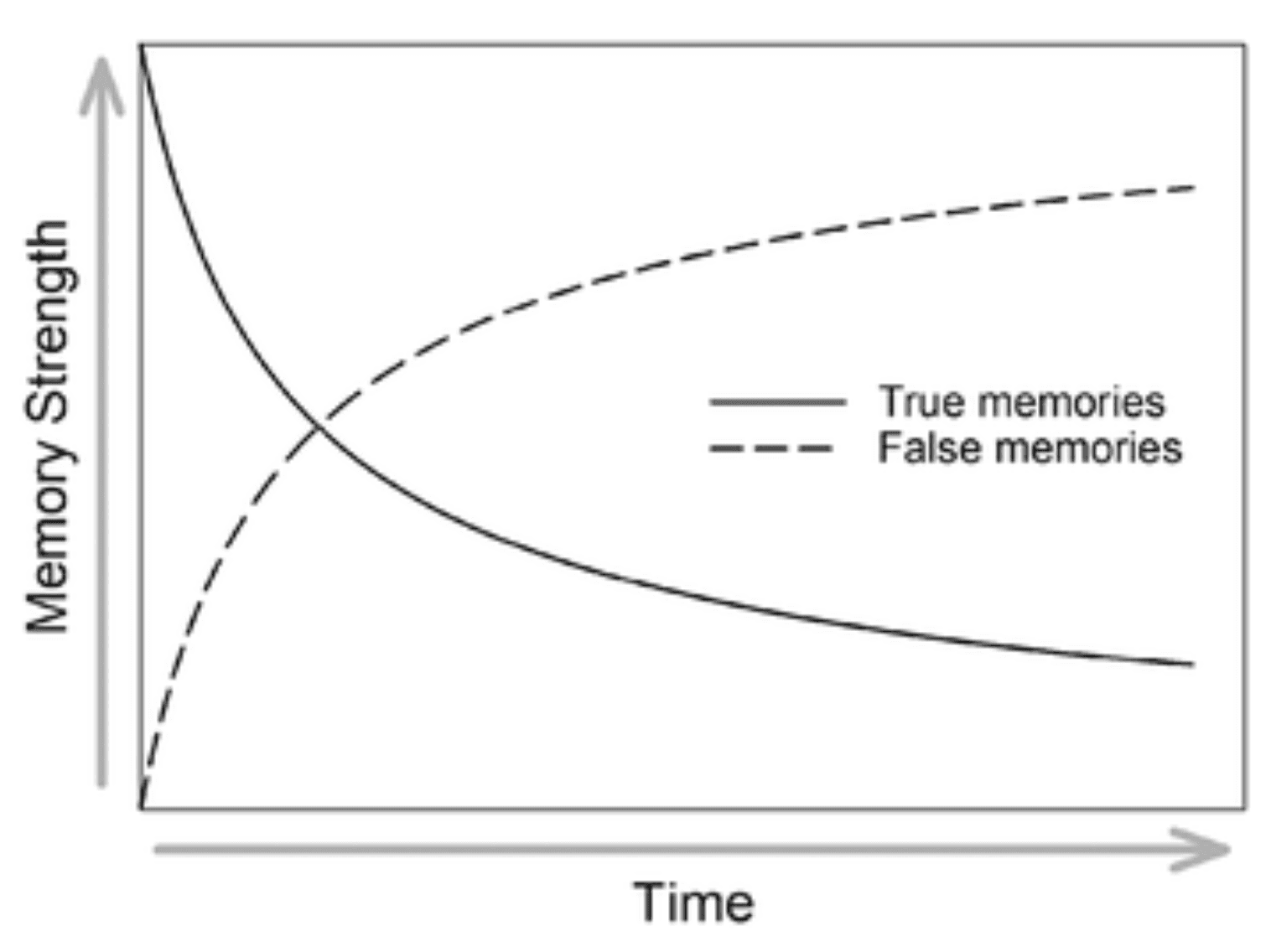
Figure 1. Conceptual Illustration of How, Over Time, True Memories (Solid Curve) Typically Weaken Through Forgetting, While Contaminated or False Memories (Dashed Curve) Can Strengthen Through Postevent ExposureNote. These curves depict hypothetical average trends, not precise data or any single memory. Time itself is not the causal factor; forgetting reflects interference, and contamination reflects postevent exposure to the suspect’s face. A similar pattern applies to forensic evidence: DNA from the perpetrator may degrade over time (forgetting), while extraneous DNA may be introduced later by others at the scene (contamination). For an overview of the psychology and neuroscience of forgetting, see Wixted (2004); for memory contamination, see Schacter (2001, 2022).
Figure 1 provides a general illustration of the two relevant memory-related phenomena, (a) the weakening of true memories as a function of time (forgetting) and (b) the strengthening of false memories over time (contamination). Forgetting happens because of interference and decay processes (Wixted, 2022). Contamination happens because memory can be changed by a wide variety of postevent factors, such as reading news reports (E. Loftus & Banaji, 1989), suggestive questioning (Zaragoza & Lane, 1994), feedback from the police (Wells & Bradfield, 1998; Wells et al., 2003), and even simply imagining the event repeatedly (Garry et al., 1996; Goff & Roediger, 1998).
Postevent contamination can strengthen the representation of a guilty perpetrator’s face or an innocent suspect’s face. Either way, the resulting testimony is problematic because it no longer reflects the witness’s original crime-scene memory but instead reflects a memory altered by investigative procedures. For this reason, we conceptualize even a strengthened memory of a guilty suspect’s face as a “false” memory in Figure 1—false not in the sense of being factually wrong, but because a jury will misconstrue it as the witness’s independent recollection of the crime. To our knowledge, nothing in the Federal Rules of Evidence and very little in case law directly addresses this problem of memory contamination.
Memory From the Perspective of the Legal System
We turn now to a detailed analysis of how memory is implicitly conceptualized in the Federal Rules of Evidence and case law, focusing on how they approach memory-based testimony. This analysis is based on our reading of both the rules themselves and authoritative evidence manuals such as McCormick on Evidence (Mosteller et al., 2020) and the Federal Rules of Evidence Manual (Saltzburg et al., 2019). For readers unfamiliar with legal terminology, Appendix A provides a glossary of basic legal concepts referenced below, and Appendix B lists the specific rules we consider. After distilling the view of memory they appear to reflect, we contrast it with the scientific understanding of memory that has developed over the last 50 years.
The Federal Rules of Evidence Most Relevant to Eyewitness Identification
The legal system’s approach to memory becomes apparent when examining the basic admissibility standards for eyewitness testimony. The key question is whether a witness’s memory-based testimony at trial counts as evidence the jury can consider in deciding whether the defendant is guilty or innocent. So long as the testimony in court is based on what the witness remembers perceiving firsthand (Rule 602—a low threshold that eyewitness testimony ordinarily meets) and is relevant to the matter before the court (Rules 401 and 402), it is generally admissible as substantive evidence for the jury’s consideration. It qualifies as substantive evidence rather than hearsay (Rule 801(c)) because it is not an out-of-court statement—it is made in court and based on the witness’s own firsthand perception. As an example, if the witness testifies at trial “I remember seeing the defendant commit the crime,” that testimony is typically admitted as substantive evidence of guilt.
But imagine that the same witness failed to identify the defendant from a lineup administered early in the police investigation—a common wrongful-conviction scenario. If the witness at trial now remembers having rejected the defendant earlier, it could potentially serve as substantive evidence of innocence, provided that the witness still believes that the initial rejection was accurate. For example, if the witness testifies, “Yes, now I remember my initial rejection and realize it was correct—he’s not the perpetrator,” then it is generally admitted for its truth, that is, as a present assertion of innocence based on the witness’s in-court recollection.
This scenario seems unlikely for several reasons. As noted earlier, memory contamination typically operates outside of conscious awareness (Bernstein & Loftus, 2009; Wachendörfer & Oeberst, 2023). Thus, the witness’s current vivid memory of the defendant committing the crime is likely to feel subjectively true. In addition, because most people understand that memory can sometimes fail (e.g., temporarily forgetting a name), the prior failure to recognize the defendant may seem unremarkable. Thus, instead of endorsing the earlier, more accurate statement, the witness is likely to discount it and instead endorse the current false memory as truth.
Importantly, the Federal Rules of Evidence allow witnesses to be questioned about prior inconsistent statements on cross-examination (Rule 611(b)). When cross-examined, the witness will likely provide a believable explanation/rationalization (e.g., “I was nervous during the first test”). In other words, they will minimize the significance of the prior statement in a way that makes sense both to themselves and the jury. Thus, while the in-court recollection of initially failing to recognize the defendant might qualify as substantive evidence of innocence, in practice, it would likely be used by the defense in an effort to impeach (i.e., discredit) the witness’s other in-court recollection, namely, their sincerely held false memory of the defendant committing the crime. Unfortunately, the witness’s believable explanation can undermine that impeachment effort, making it hard for the jury to appreciate the probative value of the initial rejection.
We emphasize the explanations that witnesses provide for prior inconsistent statements, both here and below, to foreshadow our later detailed analysis of them. For the moment, we simply note that when memory has been contaminated, these explanations—often sincere but wrong—are not only allowed but sometimes mandated by the rules of evidence, and they can be persuasive to jurors. This is a recipe for a wrongful conviction, one that we suggest has been followed many times.
Writing Used to Refresh a Witness’s Memory: Rule 612
What if a witness at trial cannot remember failing to identify the defendant early in the police investigation? Under Rule 612 (Writing Used to Refresh a Witness’s Memory), the court may permit the use of a document—such as a police report noting the witness’s rejection of a photo lineup—to help restore the witness’s recollection. This rule makes it clear that the Federal Rules of Evidence reflect an awareness of forgetting. If the report successfully refreshes the witness’s memory, and the witness then testifies that the earlier rejection was accurate, that in-court testimony—not the report itself—is admissible as substantive evidence of innocence. But if the witness does not endorse it as true, the memory will probably carry little probative weight. In that case, the earlier rejection could still be used to impeach the witness’s current in-court identification—though even this use can be undercut if the witness offers a seemingly plausible explanation for the discrepancy.
Extrinsic Evidence of a Prior Inconsistent Statement: Rule 613(b)
A similar impeachment result applies if the report fails to refresh the witness’s memory. Without further effort—such as laying the foundation for its admissibility under the “recorded recollection” exception (discussed below)—the report could only be introduced for impeachment purposes. In other words, it would not serve as evidence of innocence, not even in the limited sense that a refreshed recollection might. In this scenario, the report constitutes extrinsic evidence of a prior inconsistent statement (i.e., evidence not derived from the witness’s own testimony). To ensure fairness, such as when the evidence is introduced after the witness has left the stand, Rule 613(b) requires that the witness be given an opportunity to explain or deny the statement. Here again, the witness’s explanation will likely minimize its significance in a way that seems reasonable to jurors, creating a strong headwind to the impeachment effort.
Recorded Recollection: Rule 803(5)
Rule 803(5), Recorded Recollection, applies if a witness once knew about an event but now can no longer recall it well enough to testify, even after attempts to refresh their memory. Under these conditions, a record that the witness once made or adopted as accurate when the matter was fresh in their memory can be read into evidence. Unlike Rule 612, where the writing is not itself evidence and only the refreshed testimony counts, here the record’s contents are admitted under a hearsay exception and therefore become substantive evidence of innocence. Here again, the rules clearly reflect an understanding that forgetting happens (“when the matter was fresh in the witness’s memory”).
However, in our running example, far from having trouble recalling the crime well enough to testify about it, the witness clearly remembers the defendant committing the crime—albeit due to memory contamination, unbeknownst to all. Because the witness claims to remember the event clearly, Rule 803(5) does not apply. Thus, once again, evidence of guilt (the witness’s current memory of the defendant committing the crime), not evidence of innocence (what the witness initially remembered), is introduced as evidence at trial. Although the police report does not come in as substantive evidence, it could still be used in an effort to impeach the witness’s testimony that the defendant is the perpetrator. But as noted above, Rule 613(b) ensures that the witness will be provided with an opportunity to explain—typically resulting in a plausible-sounding rationalization that weakens the force of the impeachment.
A Declarant-Witness’s Prior Statement: Rule 801(d)(1)(A)
Another way that a prior inconsistent statement (e.g., a prior rejection of the defendant as the perpetrator) can be admitted as substantive evidence of innocence is if it was made under oath. Rule 801 (Exclusions from Hearsay), specifically Rule 801(d)(1)(A), allows such a statement to be admitted as evidence so long as it was given under penalty of perjury at a formal proceeding, such as a previous trial, hearing, or deposition. While this rule provides a pathway for the prior statement to be treated as substantive evidence of innocence, the same practical problem arises: the witness is still allowed to explain the inconsistency during cross-examination. To the extent that jurors find that explanation persuasive, yet again, the focus would be placed on the substantive of guilt provided by the witness’s confident testimony implicating the defendant.
Prior Identification: 801(d)(1)(C)
In contrast to the challenges of treating prior nonidentifications as substantive evidence, a witness’s earlier positive identification of the defendant during an out-of-court procedure is relatively easy to admit as substantive evidence if the witness can no longer identify the defendant at trial. Under Rule 801(d)(1)(C) (Prior Identification), a prior statement identifying a person the witness previously perceived is excluded from the definition of hearsay and thus admissible as substantive evidence of guilt, provided the witness is available for cross-examination. Moreover, the prior identification need not have been made under oath at a formal hearing.
The rationale behind this rule reflects the uncontroversial assumption that identifications made closer in time to the event are more reliable (Legal Information Institute, n.d.). Granting a hearsay exemption for initial positive identifications, but not for initial nonidentifications, is consistent with the common-sense notion embraced by the Federal Rules of Evidence that the primary failing of memory is forgetting. But with no appreciation for the other failing of memory, namely, contamination (Figure 1), there is no hearsay exemption for the opposite pattern. That is, there is no exemption for an initial non-ID morphing into a confident ID by the time of trial.
Case Law
Beyond the Federal Rules of Evidence, the admissibility of evidence at a criminal trial is also governed by case law (e.g., U.S. Supreme Court decisions). Courts have long been aware that how memory is tested during a police investigation can affect the likelihood of a later in-court misidentification. However, for the most part, their concern has been that suggestive procedures can reveal to the witness who the police believe to be guilty. Under Neil v. Biggers (1972) and Manson v. Brathwaite (1977), if the court finds that the identification procedure was impermissibly suggestive, it must then consider the reliability of the identification under the totality of the circumstances. If the court finds that the identification is not sufficiently reliable under the totality of the circumstances, it must exclude that evidence from trial.
In many cases, however, courts decline to exclude eyewitness testimony even when the initial identification arose from a suggestive procedure, based on the totality of the circumstances. As Wells and Quinlivan (2009) point out, the problem is that suggestive procedures cause witnesses to appear more reliable (e.g., more confident) on a later test, consistent with the contamination argument we are making here. Wells and Quinlivan argue that, just as courts exclude physical evidence obtained in violation of constitutional rights, initial positive identifications derived from suggestive procedures should likewise be excluded.
The implications become even more problematic in the reverse scenario: the police used a highly suggestive photo lineup procedure in which the suspect stands out, but the witness rejected the lineup anyway. At the upcoming criminal trial, the witness is prepared to confidently identify the same suspect due to memory contamination (contamination that began with the first, out-of-court, test). A judge could, in principle, exclude this testimony on the grounds that the identification procedure was impermissibly suggestive. Although such a ruling might be welcomed by the defense, the judge’s decision could also make it difficult to introduce substantive evidence of the defendant’s innocence. Specifically, when the witness’s true memory of the perpetrator was as strong as it ever would be and the opportunity for memory contamination minimized, the witness excluded the suspect despite the highly suggestive nature of the identification procedure. Yet this compelling evidence of innocence might not be heard if the eyewitness testimony is excluded.
These considerations raise a provocative possibility: a court could admit the earlier exculpatory statement as substantive evidence even though the witness now believes that the earlier statement was wrong, while excluding the witness’s current (likely contaminated) recollection of the defendant committing the crime. Such a ruling would make sense from a scientific perspective, but we are not sure if it has ever actually happened. If not, it merits careful consideration.
Summary
The legal system appears to have a blind spot about memory, one that creates ideal conditions for wrongful convictions. While the rules of evidence acknowledge the problem of normal forgetting by allowing various ways to refresh or substitute for faded memories, they largely ignore memory contamination. When a witness initially fails to identify a suspect but later develops a confident false memory, often due to postevent contamination, the legal system gets this backwards: the false memory becomes primary evidence of guilt, while the initial accurate rejection is easily dismissed or overlooked. This reversal occurs because contaminated memories feel subjectively real to witnesses, who then provide explanations for their earlier “mistakes”—explanations that often resonate with juries. In effect, the legal framework reinforces the very cognitive biases that memory researchers have shown can produce false memories, while systematically devaluing the more reliable initial decision. The result is that the scientifically less reliable evidence (contaminated memories) receives more weight than the scientifically more reliable evidence, increasing the risk of wrongful convictions.
In the next section, we review what science has learned about memory in the 50 years since the rules that govern the admissibility of evidence were established and then revisit the scientifically dubious but legally persuasive explanations witnesses are allowed to provide for their previous failure to confidently recognize the defendant despite doing so at trial.
Memory From a Scientific Perspective
Initial Identifications Are More Reliable Than Once Believed
Lab Studies and Field Studies
For decades, consensus documents, such as APA amicus briefs, expert surveys, and textbooks, characterized eyewitness memory as broadly unreliable, especially under nonideal conditions. However, recent research shows that, under optimal conditions, confidence in an initial suspect identification is indicative of accuracy (Lindsay et al., 2025; Wixted et al., 2015, 2018). Although some have urged caution in interpreting these findings (e.g., Moore et al., 2024; Sauer et al., 2019), a recent survey of memory experts suggests that this is now a widely accepted view (Seale-Carlisle et al., 2025). When a proper lineup is used, high-confidence suspect ID accuracy in the lab often exceeds 95% correct (Wixted & Wells, 2017), and similar conclusions have been drawn in a separate line of research involving actual eyewitnesses to a crime (Quigley-McBride & Wells, 2023; Wixted et al., 2016). Even under less optimal testing conditions, such as a suggestive showup (i.e., a single handcuffed suspect presented to the eyewitness for a yes/no decision), high-confidence suspect ID accuracy approaches 80% correct (Eisen et al., 2017, 2022).
To be clear, we are not suggesting that these accuracy estimates directly apply to all, or even most, real-world cases. There are various reasons why they might not apply to a given case (e.g., Fitzgerald et al., 2023; Smalarz, 2021). Our point is that initial identifications are more reliable than previously believed. Critically, to the extent that initial identifications are reliable, it follows that initial nonidentifications are not “no information” outcomes but are instead probative of innocence (Clark et al., 2008; Wells & Lindsay, 1980; Wells et al., 2015).
Exoneration Cases
In light of the surprisingly high reliability of initial tests of eyewitness memory in laboratory and field studies, it seems important to revisit a common assumption: that eyewitnesses in the DNA wrongful conviction cases made high-confidence misidentifications on the initial test of their memories. Here as well, the available evidence, though not conclusive, suggests that these witnesses were more reliable on the initial test than previously believed. For example, in 92 out of 161 DNA exoneration cases for which there was relevant trial testimony, the eyewitnesses who were confidently wrong at trial were apparently not confident on the initial identification test and often did not identify the suspect at all (Garrett, 2011). In other words, their initial responses often pointed toward innocence. Some remain cautious about drawing strong conclusions from such testimony, given the fallibility of memory (e.g., Berkowitz et al., 2022). Nevertheless, we believe the evidence warrants careful consideration. Witnesses who are highly confident at trial would typically be expected to either forget their earlier uncertainty or develop false memories of having been initially confident (e.g., Granhag et al., 2000; Wells & Bradfield, 1998). The fact that these witnesses, often many months or years later, recalled low initial confidence runs counter to this expected pattern, lending credibility to their testimony (Wixted et al., 2022). Moreover, the testimony about the initial outcome not only runs counter to a well-documented cognitive bias but also converges with the lab studies and field studies reviewed above (i.e., with studies suggesting that initial eyewitness identifications are more reliable than previously believed).
That said, we also agree that Garrett’s findings are not definitive. No single line of evidence, standing alone, meets that standard. To further explore this real-world line of evidence, we examined the National Registry of Exonerations (n.d.), which is a much larger database that includes the DNA exonerations plus many more non-DNA exonerations. Over 900 cases in this database are listed as involving eyewitness misidentification, and each case contains a narrative summary of the relevant facts. We read all of them. By our count, 208 of these misidentification cases have information about whether or not the initial identification, if it even occurred, was made with high or low confidence. Of these 208 cases, 190 witnesses initially made a lineup rejection, or a filler ID, or a hesitant suspect ID (e.g., “It could be him”). By contrast, only 18 involved a confident initial misidentification, such as a suspect ID with confidence of 90% or above. Thus, the evidence again suggests that, even in real-world cases, initial eyewitness identifications may be more reliable than previously believed. If so, it follows that initial nonidentifications provide more reliable evidence of innocence than previously believed as well. In this regard, a recent collaborative article by eyewitness identification experts representing competing perspectives (Lindsay et al., 2025) lists six consensus statements, the sixth of which is as follows: “Lineup rejections are exculpatory” (p. 759). The implications of this shift are not merely academic. This new understanding has recently contributed to the exoneration of several innocent prisoners who spent 20 years or more behind bars (Mickes et al., 2025).
The Initial Test Also Contaminates the Witness’s Memory
Decades of research in experimental psychology and cognitive neuroscience shows that a recognition memory test itself incidentally changes a participant’s memory by leaving a trace of the tested items (Buckner et al., 2001; Criss et al., 2018; Jacoby et al., 2005; Velanova et al., 2003). This means that the act of testing recognition memory for an innocent suspect contaminates the witness’s memory for that person (e.g., Steblay et al., 2013). As a result of the first test, the innocent suspect’s face will be more familiar on a subsequent memory test for the same face, and a well-known fallibility of human memory is the tendency to lose track of and then misattribute the source of that memory signal (Johnson et al., 1993; Schacter, 2001, 2022). That is, witnesses are at risk of misattributing the familiarity of the innocent suspect’s face to having seen it during the commission of the crime instead of on a previous memory test (Quigley-McBride & Wells, 2025). In light of this research, a recent scientific consensus has emphasized the importance of testing a witness’s memory for a suspect only once (Lindsay et al., 2025; Wells et al., 2020; Wixted et al., 2021).
The Mechanisms of Memory
We now turn to the cognitive and neural mechanisms that give rise to a memory signal—mechanisms well characterized in the basic science of memory but rarely considered in legal interpretations of eyewitness identification. For a comprehensive overview, see the recent handbook on the molecular, neural, cognitive, and computational foundations of memory (Wixted, 2025). This scientific perspective helps clarify why certain legal assumptions about eyewitness memory may be fundamentally misguided.
An implicit assumption of face-recognition memory often adopted in the courtroom is that it can fail on the first test conducted early in a police investigation (e.g., the witness rejects the lineup, excluding the suspect) and then succeed on a later test, at trial (e.g., the witness confidently identifies the same suspect, now on trial for a crime). This perspective is understandable given that memory can sometimes fail on an initial test, leave the witness’s memory in its original state, and then succeed on a later test even without contamination. But research suggests that face-recognition memory does not work this way. Absent memory contamination, a face that failed to trigger recognition during an initial test will not typically become recognizable later, let alone identified with certainty at trial.
The key to understanding this issue is that different brain mechanisms support different types of memory retrieval. The two types of retrieval of interest here are (a) the recollection of details and (b) the familiarity of a face. A recollection (i.e., recall) test asks about information that is not present at the time of the test (e.g., “What did the perpetrator look like?”). In response, the witness mentally searches their memory in hopes of conjuring up a record of the relevant prior experience. By contrast, a face-recognition test (e.g., a lineup) asks about information that is present at the time of the test. The witness is not asked to conjure up the memory of the perpetrator; instead, the witness is asked if one of the faces in the lineup is the perpetrator. No search of memory is required because the familiarity of each face in the lineup will be automatically experienced in the moments after the face is perceived.
Recollection Versus Familiarity
The key distinction between recollection and familiarity was effectively illustrated long ago (Mandler, 1980):
Consider seeing a man on a bus whom you are sure that you have seen before; you “know” him in that sense. Such a recognition is usually followed by a search process asking, in effect, Where could I know him from? Who is he? The search process generates likely contexts (Do I know him from work; is he a movie star, a TV commentator, the milkman?). Eventually the search may end with the insight, That’s the butcher from the supermarket! (pp. 252–253)
In this scenario, the familiarity of the physically present face is experienced immediately. By contrast, the sought-after context (the butcher shop) is neither physically present nor mentally activated, so a search of memory is required to find it. A search process is probabilistic (Gillund & Shiffrin, 1984; Polyn et al., 2009), which means that it will succeed with probability p (either immediately or after a sustained effort) or fail with probability 1 − p. Critically, if a probabilistic search fails initially, it might succeed on a second try. Analogously, you can fail to find your keys the first time you look for them and then manage to find them when you try again later. Such is the nature of a search process, and there is nothing inherently problematic about it.
Eyewitness Identification Is Not a Search Process
However, the sense of familiarity associated with a test item (e.g., a face in a lineup) is not the result of a probabilistic search process. Instead, the most influential models of human memory, known as global matching models, all hold that familiarity results from a matching process, not a search process (Clark & Gronlund, 1996; Cox & Shiffrin, 2017; Dennis & Humphreys, 2001; Eich, 1982; Gillund & Shiffrin, 1984; Hintzman, 1986, 1988; McClelland & Chappell, 1998; Murdock, 1982, 1993; Osth & Dennis, 2015; Pike, 1984; Ratcliff et al., 1992; Shiffrin & Steyvers, 1997). This same widely accepted idea is found in the most influential formal model of eyewitness identification, namely, Clark’s (2003) WITNESS model:
The WITNESS model may be viewed as an instance of a class of recognition memory models known as direct-access matching models … The term direct-access describes the assumption that memory is accessed without recall-like search processes. That is, a person need not search through the contents of memory to find the memory representation M. Instead, recognition decisions are based on the match of the test item T to this directly accessed memory M. (p. 630).
Mechanistically, a matching process is usually assumed to work by comparing the features of the test stimulus against similar memory representations that are currently activated in the witness’s brain (Clark, 2003). Given attention to the retrieval task at hand, the matching process is automatic and therefore occurs more or less immediately. Moreover, unlike a search process, it does not fail. Instead, a familiarity signal is automatically experienced upon perceiving the face, and its strength falls somewhere along a continuum (weak to strong).
Reminiscence and Hypermnesia
Predictions based on the theoretical analysis presented above have been tested empirically in research on “reminiscence” (remembering something that you failed to remember previously) and its close relative, “hypermnesia” (overall performance improving with each new memory test for the same previously encoded material). The first investigation of this issue found that hypermnesia occurs in recall, which involves an active search of memory, but not in recognition, which relies on a matching process (Payne & Roediger, 1987). Some scientists later challenged the idea that hypermnesia is never observed when memory is tested by recognition (Bergstein & Erdelyi, 2008), but they agreed that hypermnesia is not observed on standard recognition tests in which “… no obvious search or retrieval effort is required” (p. 691).
A police lineup does not require an effortful search of memory. Unlike the butcher on the bus scenario, in the eyewitness identification scenario, the context is already active in the witness’s brain (e.g., “Do you see the person who committed the crime?”). Because there is nothing to search for, a face will be familiar (or not) within seconds of perceiving it. Yet eyewitnesses often study police lineups for minutes if no face jumps out at them, as if familiarity might finally surface with enough effort.
With that in mind, consider this testimony quoted in State of New Jersey v. Henderson (2011):
At trial, Womble elaborated on his state of mind during the identification procedure. He testified that when he first looked at the photo array, he did not see anyone he recognized. As he explained, “[m]y mind was drawing a blank … so I just started eliminating photos.” To make a final identification, Womble said that he “really had to search deep.” He was nonetheless “sure” of the identification.
At trial, the witness did not have to “search deep” again and instead identified the defendant immediately and with high confidence (“Womble had no difficulty identifying defendant at trial 18 months later”). The first and most relevant test—when memory of the perpetrator was strongest and the opportunity for contamination was minimized—provides evidence that the face of the suspect did not strongly match the face of the perpetrator in the witness’s brain at that time. Otherwise, the initial identification would have been more or less immediate, not something that required a deep search. Therefore, explanations such as this, at trial, should alert courts to the possibility of contaminated memory.
Explanations That Witnesses Provide for a Prior Inconsistent Statement
As noted earlier, witnesses often explain away the outcome of the initial test using a rationalization that makes sense to them and, unfortunately, is persuasive to jurors as well (e.g., E. E. Jones et al., 2008; Key et al., 2022). Worse, because the witness is describing the operation of their own memory, about which they presumably have direct knowledge, the defense attorney is not in a strong position to challenge whatever explanation they come up with. We next consider three ways that witnesses may rationalize a prior inconsistent statement.
Rationalizations That Appeal to Stress
One common rationalization discussed by E. E. Jones et al. (2008) is that the defendant’s face did not seem familiar at first but does now because of an internal factor (e.g., “I was nervous”). However, a witness cannot know whether the suspect’s face was initially unfamiliar because (a) the defendant was innocent and only later became familiar due to memory contamination or (b) the defendant was guilty but the witness’s nervous state temporarily blocked the familiarity signal that would otherwise have occurred.
Research shows that the effects of stress on memory are complex—it may enhance memory, impair it, or leave it unchanged, depending on the circumstances (Gagnon & Wagner, 2016; Shields et al., 2017). Given the complexity of the issue, it seems important to scrutinize the details rather than uncritically accepting a witness’s simplistic explanation, such as “I was feeling stressed on the first test.” Figure 2 illustrates some of the factors that should be considered. One issue to consider is whether the high stress occurs at encoding (e.g., while witnessing a crime) or retrieval (e.g., during a memory test administered by the police), and a second issue to consider is whether, at retrieval, the witness’s memory is tested by recall (e.g., a police interview), or recognition (e.g., a lineup or showup).
Figure 2
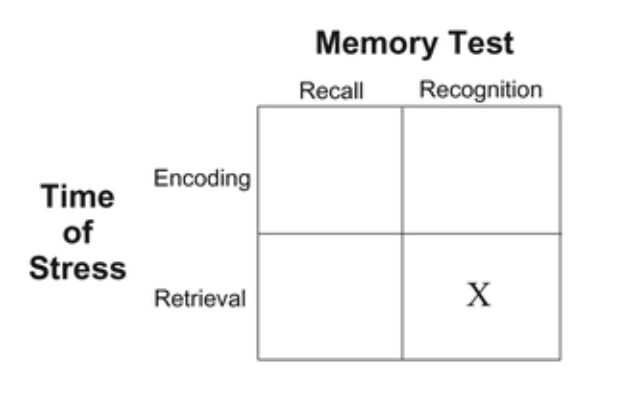
Figure 2. An Illustration of Two Important Factors to Consider When a Witness Explains That Memory for the Defendant’s Face Initially Failed due to Stress, Namely, the Time at Which the Stress Occurred (Encoding or Retrieval) and the Type of Memory Test (Recall or Recognition) That Would Later Be Administered by the PoliceNote. The “X” marks what is perhaps the most common explanation (i.e., “I was stressed during the face recognition test administered by the police”).
Stress at Encoding
Research investigating the neurobiology of memory usually finds that if stress is high enough to induce the release of stress hormones during encoding, the result is a more durable memory trace (e.g., Roozendaal & McGaugh, 2011). However, the relationship between stress and memory follows an inverted U-shaped pattern such that extremely high levels of stress during encoding can impair memory formation, perhaps because stress hormones overwhelm the neural systems that create new memories. Studies of eyewitness identification have found that moderate stress during the witnessed event may not enhance but also does not reduce later identification accuracy (e.g., Marr et al., 2021; Sauerland et al., 2016). However, as might be expected, extremely high levels of stress at encoding have been shown to significantly impair a witness’s ability to make accurate identifications (Morgan et al., 2004).
If stress at encoding is high enough to prevent effective memory formation, the witness will not retain a clear memory of the perpetrator. This kind of encoding failure explains why a witness might fail to recognize anyone from an initial lineup, even if the suspect is guilty. If, a year later at trial, the witness now claims to confidently recognize the defendant, the most plausible explanation is contamination: a genuine memory that was never encoded is highly unlikely to appear for the first time long after the crime.
Stress at Retrieval
Witnesses who identify a defendant at trial often explain that they initially failed to recognize the defendant due to stress at retrieval (i.e., high stress at the time of the identification test) rather than stress at encoding. Does stress at the time of a memory test temporarily block memory retrieval, a memory that can be recovered a year later at trial? Here, it is important to distinguish between the recall of contextual details versus the recognition of a recently seen face.
Research on the neurobiology of memory has found that stress at retrieval can impair recall (e.g., De Quervain et al., 2000), a finding consistently replicated in subsequent research (Shields et al., 2017). However, stress at retrieval appears to have less of an effect, and perhaps no effect at all, on familiarity-based recognition (Gagnon & Wagner, 2016). Four studies that are particularly relevant to eyewitness identification have specifically examined the effect of stress at retrieval on face recognition per se. Li et al. (2013) found that stress induced prior to retrieval caused a small but significant impairment of face recognition memory, but in a subsequent study, the same group (Li et al., 2014) reported no such impairment. Using an eyewitness identification paradigm, Price et al. (2022) and Marr et al. (2021) also reported no effect of stress on recognition performance. And finally, Pötzl et al. (2023) observed a small and statistically significant beneficial effect of stress on face recognition memory. Overall, current evidence suggests that stress does not appreciably impair familiarity-based face recognition memory.
This overall pattern of results accords with theoretical accounts that attribute the detrimental effect of stress at retrieval to its disruption of the memory search processes underlying recall and recollection, while leaving familiarity-based retrieval largely unaffected (Gagnon & Wagner, 2016). Supporting this view, research in educational settings shows that stress at retrieval impairs performance on tests requiring effortful search for contextual details but not on tests relying on more automatic retrieval (Smith et al., 2019). In further agreement with this perspective, a basic principle of cognitive neuroscience is that the same neural pathways that process the initial perception of a face also store a memory record of its visual features (She et al., 2024). Thus, perceiving the same face later tends to automatically elicit a familiarity signal. For stress to block that memory signal during a lineup test, it would theoretically have to impair face perception itself, which typical stress levels seem unlikely to do.
In light of these findings, even if the witness reports feeling stressed during the lineup memory test, recent research suggests that stress is unlikely to prevent recognition of the perpetrator’s face—certainly not to the extent that it would completely block an initial recognition signal strong enough to support a confident identification more than a year later. Thus, when a witness initially fails to recognize the defendant but later makes a confident identification at trial, the more plausible explanation is memory contamination. Crucially, because memory contamination operates outside of conscious awareness, the witness would have no insight into which explanation—stress-related retrieval failure or contamination—better accounts for the discrepancy. Unaware that their in-court memory may reflect postevent contamination, and lacking knowledge of the relevant scientific research, witnesses can easily offer a persuasive (though incorrect) rationalization that attributes their earlier failure to stress or fear. We next present a case example to illustrate this point.
In Commonwealth v. Davis (1983), a store clerk working the overnight shift at a pipe shop in Pittsburgh, Pennsylvania, was robbed by two men on March 9, 1977. Police officers transported two suspects to the shop for identification, one of whom was Charles Allen Davis. The witness failed to identify either man, but he confidently identified Davis in a later lineup, at a preliminary hearing, and at the criminal trial itself. The witness explained his prior inconsistent statement as follows: “If I wouldn’t have been frustrated, flustered at the time, I feel that I would have identified him. It was within my capability to have identified him then, but I did not.”Notably, the appeals court found that the witness had an “independent recollection of his observation during the time of the robbery under good conditions, i.e. in a well-lit shop at very close range observing the intruder’s face as well as his stature.” But if the witness had formed a clear memory of the perpetrator at that time (one that would have weakened due to ordinary forgetting by the time of the trial), then it stands to reason that he would have recognized him on the initial test if he were in fact in the lineup. In light of research suggesting that stress does not appreciably impair face recognition memory, a perfectly reasonable explanation for the initial nonidentification is that the defendant was innocent and therefore did not match the witness’s fresh memory of the perpetrator. Critically, no amount of introspection or reflection on the part of the witness can help to choose between these two possibilities. Yet the possibility that memory contamination might explain the inconsistency between the witness’s memory at trial and their initial memory was not considered. This may be the rule rather than the exception.
Rationalizations Based on the Poor Quality of the Initial Photo
Another scenario in which a witness’s initially weak memory of a suspect may become stronger on a later test arises when (a) the witness is tested more than once using different photos of the same suspect and (b) the first photo is informally dismissed as insufficient. For example, in response to a witness’s failure to identify the suspect on an initial test, the police might speculate that the photo was too old to faithfully represent the suspect’s appearance at the time of the crime. In response, they might obtain a newer photo of the same suspect and test the witness again. This time, the witness might positively identify the suspect, apparently confirming the bad photo theory adopted by the police. Later, that theory might be advanced to explain to a judge or jury why the witness failed to confidently identify the suspect’s face on the first test. According to this logic, the witness’s positive identification on the second test occurred because the second photo, unlike the first, matched what was assumed to be the witness’s untainted memory of the perpetrator.
An alternative explanation is that the suspect is innocent and did not match the witness’s initial memory of the perpetrator, thereby explaining the nonidentification. In addition, the test itself contaminated the witness’s memory by creating a representation of the innocent suspect’s face, leading to the positive identification on the second test. Critically, without further inquiry, none of the relevant parties—the witness, the lineup administrator, the prosecutor, or the judge—can know whether the outcome of the second reflects true recognition or memory contamination from the first test. A speculative informal assertion by an interested party seems especially insufficient. After all, two photos of the same face share a disproportionate number of facial features even across wide age gaps (Juefei-Xu et al., 2011; Li et al., 2011; Ramanathan & Chellappa, 2006). We next present a case that illustrates the use of this rationalization.
On January 29, 1998, 64-year-old Betty Black was murdered in her home in Farmers Branch, Texas. Two men were seen entering her home shortly before the murder. One, a man named Richard Childs, confessed to being the shooter and was sentenced to 30 years in prison as part of a plea deal. The accomplice was suspected of being a man named Charles Don Flores, and his trial was held in March of 1999. Based largely on the confident identification of a credible eyewitness, he was convicted and has been on death row for over 25 years (Wixted et al., 2021).
At trial, the witness identified Flores with more than 100% confidence as the man she saw entering her neighbor’s house on the day she was murdered. However, on the day the crime was committed, the same eyewitness described the perpetrator to the police as a White male with shoulder-length hair. A few days later, she used a computer to create a composite sketch of the perpetrator matching that description (Figure 3).
Figure 3
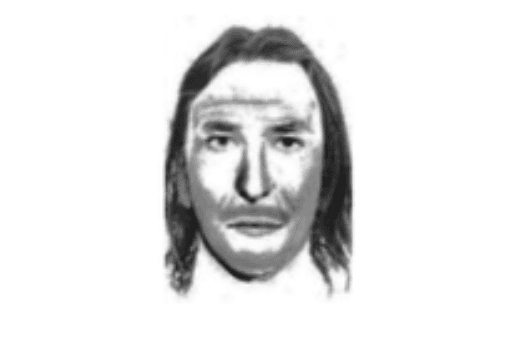
The Composite Sketch of the Perpetrator Provided by the Main Eyewitness
Figure 4
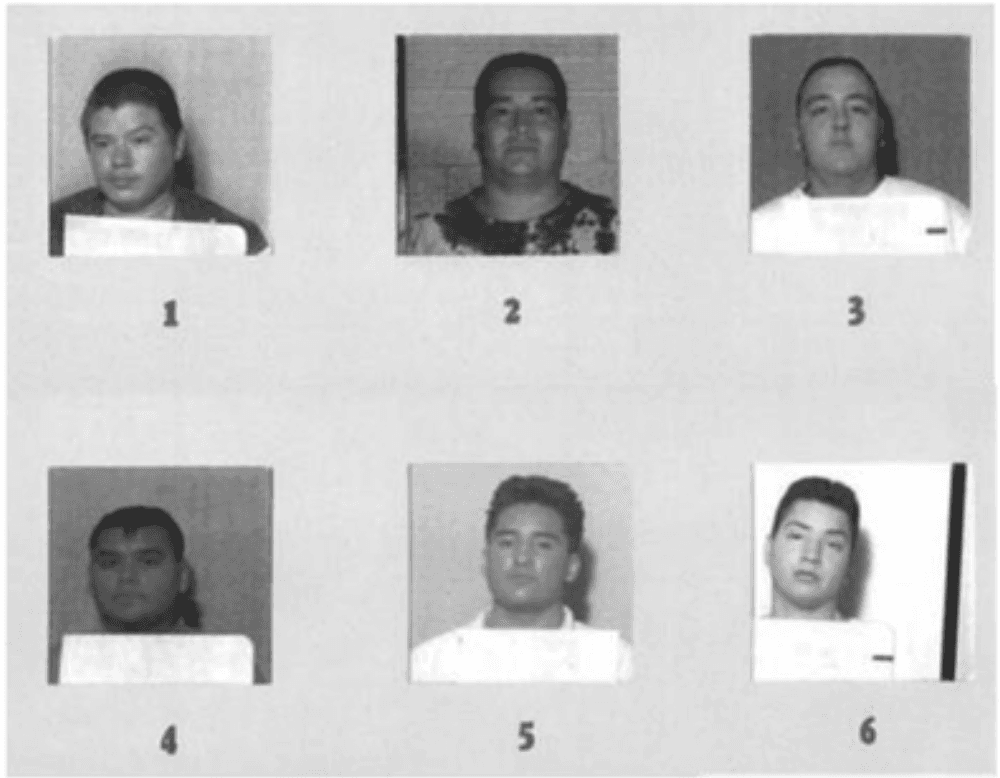
The Photo Lineup Containing Flores’s Face (2)Note. The witness rejected this lineup on the initial test conducted early in the police investigation (shortly after describing the perpetrator as a White male with long hair).
Understandably, given her description of the perpetrator, the witness rejected this photo lineup. The police nevertheless continued to suspect that Flores was the accomplice, and he was arrested in May 1998, 3 months after the crime.
At Flores’ trial, the witness was prepared to identify Flores. However, the admissibility of her identification was contested by the defense. When addressing whether the witness’s testimony about Flores should be suppressed, the judge took note of the fact that the witness failed to identify Flores on the initial lineup. In response, the prosecutor explained away the nonidentification, telling the judge “It was an old picture of the [Flores] that was included, since he hadn’t been arrested yet” (State of Texas v. Charles Don Flores, 1999, p. 15, Volume 36).
The photo of Flores in the lineup shown in Figure 4 (Photo 2) was a mugshot from an earlier arrest taken 5 months before the murder. The prosecutor theorized that this photo was too old to match the witness’s memory of Flores’s face, hence the lineup rejection. However, without further inquiry, the prosecutor cannot possibly know how well the photo matched Flores’s appearance on the day the crime was committed. An alternative theory is that the 5-month-old photo was a good match to his appearance on the day of the crime, but the witness rejected the lineup because it did not match her memory of the perpetrator (a plausible theory given that she described him as a White male with long hair). The key point is that the “bad photo” should not be accepted at face value because the phenomenon it seeks to explain (the initial non-ID) has a plausible alternative explanation (the suspect is innocent).
Rationalizations That Deny the Initial Nonidentification
A third type of rationalization is based on recollection of having always recognized the suspect’s face, despite indicating otherwise on the first identification test. Witnesses are obviously in a better position than anyone else to know whether they had actually recognized the suspect and chosen not to report it. However, if such testimony occurs for the first time at trial, months or even years after the initial failure to make a confident identification, even a sincere witness may be reporting a false memory. As always, the witness would have no way of knowing one way or the other because a contaminated memory is subjectively experienced as an accurate record of the past.
Critically, the longer the delay between the initial identification test and the later claim that the suspect’s face was initially recognized after all, the more opportunity there is for memory contamination to occur (Figure 1). As noted earlier, memory is like an unprotected crime scene that tends to become increasingly contaminated with the passage of time. For this reason, a delayed claim of prior recognition may itself reflect a false memory. This point can be illustrated by reconsidering one of the most famous cases of eyewitness misidentification—the case of Ronald Cotton.
Cotton was convicted of rape and spent almost 11 years in prison before he was ultimately exonerated in 1995. The evidence largely consisted of eyewitness identifications made by two rape victims, Jennifer Thompson and an unnamed second witness (both victimized by the same assailant on the same night in 1984). Early in the police investigation, both witnesses were administered two lineup procedures. The first was a photo lineup containing Cotton, conducted a few days after the crime. The second was a live lineup containing Cotton surrounded by a new set of fillers conducted about a week after the first. Jennifer Thompson analyzed the faces in the initial photo lineup for several minutes, finally tentatively identifying Cotton (saying, “I think that’s him”). The outcome was similar on the second test involving a live lineup, at which time she again spent minutes wavering between two faces, before finally settling on Cotton.
However, as is well known, by the time of Cotton’s first trial in 1985, Thompson’s doubts were gone. When asked at trial who raped her, she immediately misidentified Cotton with absolute confidence (Thompson et al., 2009). Moreover, when later reflecting on how confident she was at the time of her initial identification of Cotton, in an op-ed, Thompson (2000) incorrectly remembered having always been “absolutely, positively, without-a-doubt certain.” In other words, not surprisingly, her recollection of the memory of Cotton’s face on the initial lineup test had morphed to match her later trial testimony (i.e., it was a false memory).
The second eyewitness failed to identify anyone when viewing the initial photo lineup, correctly providing evidence of Cotton’s innocence. When she viewed the live lineup a week later, she picked a filler, not Cotton, again providing evidence of Cotton’s innocence. However, this information was excluded from Cotton’s first trial in 1985 and was the reason why an appeals court granted Cotton a second trial in 1987. At the 1987 trial, presumably after considerable press coverage of the 1985 trial and conviction, the second victim (along with Thompson) immediately and confidently misidentified Cotton as the person who raped them.
When given an opportunity to explain her prior inconsistent statement, the witness said that she had been scared to make the identification even though she could have. About the live lineup, a later appeals court summarized her trial testimony as follows:
The second victim testified she recognized the defendant as her assailant; however, she wrote down the wrong number because she was scared that the defendant, who could see her during the lineup, would get loose and kill her if she identified him. In court, she identified the defendant as her assailant. (State v. Cotton, 1990)
Thus, according to this testimony 3 years after the live lineup was administered, the witness’s failure to recognize Cotton’s face never happened because she recognized Cotton from the outset.
Cotton was later exonerated when DNA recovered from the second victim was found to match a man named Bobby Poole, excluding Cotton. The connection was not coincidental: The two assaults shared a similar modus operandi, which suggested that the same offender—Poole—was responsible for both rapes. Because true memories are the strongest soon after the crime, the face of Poole was presumably strong in the brains of both victims when the initial lineups were conducted in the days following his crime spree. Thus, a witness claiming to have recognized a face all along despite an initial lineup rejection or a filler ID would presumably have considerable probative value if the claim occurred shortly after the initial lineup test (i.e., when memories are still fresh and the opportunity for memory contamination is minimized). However, in light of what is known about the underlying mechanisms of human memory, the same is less likely to be true when a witness makes that claim for the first time long after the fact. By then, it may simply be a sincerely believed false memory. Moreover, a jury trying to determine the truth of the matter by assessing the witness’s sincerity is engaged in a fruitless endeavor.
Conclusion
The scenario of interest here consists of an eyewitness making a good-faith attempt to make an identification on an initial test—with an outcome other than an immediate high-confidence ID of the suspect—and a later ID of that same suspect, at trial, made without hesitation and with absolute confidence. This scenario applies to many wrongful convictions that are ordinarily attributed to the unreliability of eyewitness memory. However, we suggest that these convictions may be better conceptualized as stemming from two factors: (a) repeatedly testing a witness’s recognition memory of the same suspect and (b) the rules that govern the admissibility of both substantive evidence of innocence/guilt and a witness’s explanation for a prior inconsistent statement.
From our perspective, a key issue is that the Federal Rules of Evidence assign no special importance to the initial test of a witness’s uncontaminated memory. Instead, they prioritize a witness’s in-court recollection. In particular, whereas a witness’s in-court recollection is admissible as substantive evidence, the witness’s inconsistent memory on the initial test is not necessarily introduced at trial. Even when it is, the inconsistency is often easily dismissed by a simple, unexamined explanation offered by the witness (“I was nervous”). As a result, existing evidentiary practices make it difficult to treat the initial nonidentification for what it often is—substantive evidence of innocence.
Abolishing Courtroom Identifications?
The path to reform is ultimately a matter for legal scholars, if they agree with at least some of our analysis. Some legal scholars have already made recommendations that seem to align with the general thrust of our perspective. For example, the message from science is that it is important to focus on the initial test of a witness’s uncontaminated memory and to attach less weight to the test of a witness’s contaminated memory at trial. Yet judges often do the opposite by excluding the results of the initial test while permitting a courtroom identification. They do so based on the scientifically implausible theory that the courtroom identification is “independently sourced” in the witness’s memory of the crime, as if the witness’s memory has remained uncontaminated. Garrett (2012) proposed the following solution: “Instead, courts should per se exclude courtroom identifications if there was a prior identification, but they should sometimes admit out-of-court identifications” (p. 457). This recommendation makes sense from a scientific perspective but may seem too radical from a legal perspective to ever be widely adopted.
Prior Inconsistent Statements: Substantive Evidence or Impeachment?
A less extreme reform to the Federal Rules of Evidence has been proposed by other legal scholars (Capra, 2016). Specifically, a witness’s prior inconsistent statement should be admitted for the truth of the matter asserted, not just for impeachment purposes, provided the witness is available to testify about it at trial. This recommendation also aligns with our perspective and is neither novel nor radical. Indeed, when Congress adopted the Federal Rules of Evidence in 1975, its own Advisory Committee proposed that Rule 801(d)(1)(A) should be consistent with this recommendation. In its notes, the Committee stated the following: “Prior inconsistent statements traditionally have been admissible to impeach but not as substantive evidence. Under the rule they are substantive evidence” (Legal Information Institute, n.d.). Yet despite the recommendations of its own Advisory Committee, in 1975, Congress decided that a prior inconsistent statement would be admissible for the truth of the matter asserted only if it was made under oath at a hearing.
This debate about the merits of admitting a prior inconsistent statement as substantive evidence was not informed by scientific research. We suggest that incorporating scientific research into the discussion would strengthen the argument for adopting this alternative rule.
Explaining Away a Prior Inconsistent Statement
Other ways to address the standard wrongful conviction scenario (i.e., a tentative witness becoming more confident over time) would not involve changing any rules of evidence but would instead change how they are applied under certain conditions. For example, witnesses sometimes explain away a prior inconsistent statement by appealing to a scientifically implausible theory of recognition memory (e.g., stress renders a familiar face unrecognizable) while implicitly rejecting a scientifically plausible theory (namely, that memory on the initial test was uncontaminated but now it is contaminated, hence, the inconsistency). Such explanations are persuasive to jurors, but it is worth considering whether testimony along these lines amounts to offering an expert opinion. Potentially applicable rules include Rule 701 (Opinion Testimony by Lay Witnesses) and Rule 702 (Testimony by Expert Witnesses). From our perspective as memory scientists, it is glaringly obvious that the explanations witnesses provide to minimize a prior inconsistent statement often amount to expert testimony based on scientific knowledge they lack, but we can understand how it might be hard for the legal system to see it that way.
Witnesses also sometimes explain away their prior inability to confidently recognize the defendant on the grounds that the photo did not adequately represent his appearance on the day of the crime. However, witnesses only know what the perpetrator looked like on the day of the crime. Without further inquiry, the witness cannot know what the (possibly innocent) defendant looked like on that day. It is therefore worth considering whether allowing the witness to speculate along these lines runs afoul of Rule 602 (Need for Personal Knowledge), which states: “A witness may testify to a matter only if evidence is introduced sufficient to support a finding that the witness has personal knowledge of the matter.” If the witness did not see the defendant at the time of the crime, which would be true if the defendant is innocent, then they are in no position to know whether the defendant’s photo in the initial lineup did or did not match his appearance on the day of the crime.
A third type of rationalization offered by witnesses to explain a prior inconsistent statement is that they recognized the defendant initially but did not acknowledge it. This is certainly possible, and if the explanation occurs shortly after the identification attempt, nothing in the science of memory would help to inform triers of fact about its reliability. However, the more time that elapses between the initial identification attempt and the first-time claim to having recognized the defendant all along, the more likely it is that the claim itself reflects contaminated memory (Figure 1). It might therefore be worth considering whether such first-time testimony is more prejudicial than probative. Rule 403 warrants the exclusion of relevant evidence if its probative value is substantially outweighed by a danger of unfair prejudice.
Other Possible Solutions
Expert Testimony
The legal system has several safeguards in place that can help to address the issue that concerns us here. For example, expert testimony can be used to explain the science behind the new recommendation to focus on the first test. However, because courts sometimes hold that the vagaries of eyewitness memory fall within the ken of the average juror (in which case expert testimony is excluded), and because overworked and underfunded public defense attorneys may fail to use this approach, a more systemic solution would be preferable. Indeed, appeals have sometimes been denied on the grounds that the defense attorney might have had reasonable strategic reasons for not calling an eyewitness expert. In addition, memory differs from other domains where expert testimony is commonly used. Assumptions about memory are already enshrined in the rules of evidence themselves, unlike, for example, whether a radiologist should have detected an anomaly on an X-ray. For that reason, expert testimony on memory is unlikely to be the ultimate solution to the problem we highlight here.
Jury Instructions
Jury instructions represent another possible safeguard. In principle, they could be used to inform jurors at the end of trial about the importance of focusing on the initial test of memory rather than later, contaminated recollections. In practice, however, jury instructions on eyewitness memory have often proven ineffective (A. M. Jones et al., 2020), even when designed to reflect this scientific insight (Garrett et al., 2022). Nevertheless, recent work has reported more promising results (Huang & Wixted, 2025). Still, jury instructions face inherent limitations: they are delivered only after the evidence has been presented, when jurors may have already been swayed by compelling but contaminated testimony. As with expert testimony, this makes jury instructions a valuable tool but not a sufficient or systemic solution.
Balancing Scientific Evidence and Legal Practice
If the Federal Rules of Evidence and/or their application at criminal trials prove resistant to change, a process-oriented approach may be more realistic. Albright (2023) recently highlighted the tension between scientific research on matters of fact and the practical realities that shape courtroom procedures. He suggested that “The solution is to promote awareness and vigilance by all parties and to foster collaboration between gatekeeping judges and scientists.” Our analysis underscores the importance of that recommendation in the domain of eyewitness testimony.
Limitations
This article has been written by memory scientists, not by scholars of evidence law. Our expertise lies in the scientific study of memory, particularly the processes of memory contamination, and our aim has been to identify the implicit assumptions about memory embedded in the rules of evidence and to compare them with well-established scientific findings. We fully acknowledge that legal evidentiary scholars have a much deeper understanding of the Federal Rules of Evidence as well as their philosophical and doctrinal nuances than we do. Our goal is not to settle those legal debates but instead to highlight broad scientific concerns that deserve closer engagement by the legal and scientific community. We therefore hope that both disciplines will take up, refine, and challenge the arguments we advance here. Our intention is to begin a conversation across fields, not to close it.