The Role of Incarceration as a Risk Factor for Cognitive Impairment
Robynn J A Cox
Robert B Wallace
SimpleOriginal

Summary

Incarceration is linked to higher cognitive impairment and dementia in midlife, but largely through compounded disadvantages—like lower education, early cognition, and structural inequality—that shape brain health over time.

2022

The Role of Incarceration as a Risk Factor for Cognitive Impairment

Keywords Cognitive impairment; Cognitive reserve; Formerly incarcerated; Health disparities; Reentry

Abstract

Objectives: The objective of this study was to understand disparities in cognitive impairment between middle-aged formerly incarcerated (FI) and nonincarcerated individuals.

Methods: The 1979 National Longitudinal Survey of Youth is a nationally representative longitudinal data set containing information on incarceration, cognitive functioning, and other health conditions. Using a modified version of the Telephone Interview for Cognitive Status (TICS-m), adapted from the Health and Retirement Study, we analyzed the association between incarceration and cognitive impairment, cognitive impairment—not dementia and dementia. Multivariable regression models were estimated, including prior incarceration status and covariates associated with incarceration and cognitive functioning.

Results: FI individuals had lower unadjusted scores on TICS-m (−2.5, p < .001) and had significantly greater unadjusted odds ratios (OR) for scoring in the cognitive impairment (OR = 2.4, p < .001) and dementia (OR = 2.7, p < .001) range. Differences were largely explained by a combination of risk factors associated with incarceration and cognition. Education and premorbid cognition (measured by Armed Forces Qualification Test) separately and completely explained differences in the odds of dementia. Regardless of incarceration status, Blacks and Hispanics had significantly greater odds of cognitive impairment and dementia relative to Whites, holding other factors constant.

Discussion: The association between prior incarceration and cognitive impairment in middle age was largely explained by differences in educational attainment and premorbid cognitive functioning, supporting the cognitive reserve hypothesis. Greater prevalence of cognitive impairment and dementia among the FI could create challenges and should be considered in reentry planning. Structural and institutional factors should be considered when addressing health disparities in Alzheimer’s Disease and Related Dementias.

The Role of Incarceration as a Risk Factor for Cognitive Impairment

For more than 40 years, the United States conducted a political experiment in mass incarceration (Raphael & Stoll, 2013), such that it has the highest incarceration rate in the world (Fair & Walmsley, 2021). Although incarceration rates began declining in 2009 (Carson, 2015), over 600,000 individuals are released from prison each year. Mass incarceration has many documented costs (Cox, 2016, 2018); however, an understudied area is the consequences related to healthy aging and the ability of people in communities disproportionately affected by incarceration to successfully age (Cox, 2018). Specifically, there is a paucity of research focusing on aging and prisoner reentry even though people in prison aged 55 or older have increased by 400% since 1993, 95% will be released into society, and 48% of those released are 35 or older (Carson & Sabol, 2016). At the same time, the baby boomer generation has begun to pass the age of 65, and the number of people living with cognitive impairment is expected to increase, with greater increases among Hispanics and non-Hispanic Blacks (Rajan et al., 2021). Cognitive impairment is costly to society: Alzheimer’s and other dementias are the most expensive diseases to treat in the United States, with an estimated cost of $355 billion (Alzheimer’s Association, 2021). If incarceration affects cognitive functioning, these costs could grow by even more than expected, with the potential cost burden varying not only by state, but also by communities experiencing differential rates of incarceration, potentially causing increased disparities in Alzheimer’s Disease and Related Dementias (ADRD).

This study addresses an important gap in the literature. To the best of our knowledge, it is the first to investigate the relationship between cognitive functioning, cognitive impairment, and incarceration postrelease (within a reentry context) using a nationally representative sample of a cohort of formerly incarcerated (FI) and nonincarcerated (NI) middle-aged people. Early declines in cognitive functioning not only have direct medical costs, but also affect the quality of life and ability to function day-to-day. Transitioning from prison or jail into society is challenging with numerous barriers to success; lower cognitive functioning and increased cognitive impairment could create additional challenges to successfully reintegrate individuals from incarceration to society.

Racial Disparities in Mass Incarceration and Cognition

Due to mass incarceration, the imprisonment rate of African Americans increased to the point that a Black male born in 2001 had a 1 in 3 chance of going to prison in his lifetime (Bonczar, 2003). African American men are imprisoned at rates six times that of their White counterparts, whereas the corresponding rates for Hispanic men are 2.4 times that of their White counterparts. At the same time, the risk of cognitive impairment is greater for African Americans than Whites (Lines et al., 2014; Mayeda et al., 2016; Rajan et al., 2021; Schwartz et al., 2004; Sloan & Wang, 2005; Zhang et al., 2016). Racial disparities in the prevalence of cognitive impairment between African Americans and Whites are larger in midlife age groups. Specifically, the prevalence of cognitive impairment among African Americans who are 85 or older is roughly two times that of their White counterparts, whereas the prevalence is four times that of Whites for African Americans aged 55–64 (Lines et al., 2014). A significant relationship between incarceration and cognitive functioning could help to shed light on racial disparities in early-onset cognitive impairment.

Mass Incarceration, Health, and Aging

Conceptually, the era of mass incarceration could be viewed as a historical event that has changed the epidemiological environment of those exposed to it, with lasting affects on the health of surviving members later in life and possible cohort and generational effects (Finch & Crimmins, 2004). Contact with this environment could affect health for the duration of life after exposure, and whether this effect is positive or negative could depend on the strength of the “protective” factors of incarceration (e.g., access to social services and other human capital investments inaccessible prior to incarceration) relative to the risk factors and how the mark of or exposure to an incarceration might affect someone’s ability to function in everyday life (Cox, 2018).

Prior research found incarceration to be associated with prolonged levels of stress, the transmission of infectious disease, vascular disease, and head trauma (Anderson et al., 2016; Bick, 2007; Maruschak et al., 2015; Massoglia, 2008; Shiroma et al., 2012). Secondarily, incarceration may cause heightened stress and health problems postrelease due to stigma and barriers to reintegration (Cox, 2018;,Cox et al., 2021; Massoglia, 2008; Schnittker et al., 2012).

Given these findings, mass incarceration should be modeled from a life course perspective that aims to comprehend its effects on the cohort in question and successive birth cohorts, as well as its expression in disease trends over time in the population (Lynch & Smith, 2005).

Incarceration and Cognition

Incarceration may have direct and indirect effects on cognitive functioning. Although decline in cognitive fluid abilities is a normal part of aging (Murman, 2015), the effect of incarceration on cognitive functioning is conceptually ambiguous. On the one hand, incarceration can cause decreases in human capital (e.g., education, skill development, and health). Specifically, exposure to incarceration during adolescence could disrupt the development of protective factors such as educational attainment (Aizer & Doyle, 2015), and the experience during (Ezenwa et al., 2020; Umbach et al., 2018) and after incarceration may increase factors that collectively lead to brain injury and cognitive decline. Examples of these factors are head trauma, vascular disease, infectious diseases, substance use disorders (e.g., smoking and alcohol), and chronic stress, which are also risk factors for cognitive impairment (Barnes et al., 2006; Black, 2002; Case & Paxson, 2009; Forton et al., 2002; Gardner & Yaffe, 2014; Gorelick et al., 2011; Katan et al., 2013; Li et al., 2016; Lopez et al., 2003; McEwen & Sapolsky, 1995; Ozen et al., 2015; Sandi, 2004). The direct and indirect effects of incarceration through stress (Wilson et al., 2007) could negatively affect cognitive functioning, increase cognitive impairment, and ultimately cause a greater risk of ADRD. On the other hand, access to social services and opportunities for human capital investments (see Author Note 1) during confinement (e.g., mental health, education) could improve human capital and, therefore, cognitive functioning.

To make matters more complicated, incarcerated individuals are a highly selected population. They are more likely to experience other factors that influence the relationship between cognitive functioning and incarceration, such as adverse childhood experiences (ACEs), early onset of psychiatric disorders, and early problems with substance abuse (Schnittker et al., 2012). This suggests early life experiences should be controlled in models measuring the relationship between incarceration and cognitive functioning. Schnittker et al. (2012) found that early life experiences explain the relationship between incarceration and most psychiatric disorders. Nonetheless, after controlling for early life experiences related to childhood and substance abuse, incarceration was still strongly associated with mood disorders. When discussing the selection of the incarcerated population, it is important to note that structural factors (e.g., racism) can lead to environmental conditions that not only create barriers to develop and access protective factors for cognitive functioning (such as educational attainment) but may also increase exposure to stressful events that are potential risk factors for cognitive impairment (e.g., incarceration), especially for non-Whites (see Derenoncourt, 2022).

Taken together, the conceptualization of the relationship between incarceration and cognition should be modeled from a life course framework that incorporates how “early- and later-life biological, behavioral, social, and psychological exposures affect adult health” in general (Lynch & Smith, 2005, p. 2), and adult cognition in particular. Indeed, Richards and Deary (2005) propose a life course framework for cognitive reserve (a functional concept that emphasizes how the efficiency of neural networks can serve as protective factors against neuropathology), by placing a central focus on premorbid cognitive ability, which can be strengthened or, presumably, weakened over the life course and is influenced by the social and material environment, occupation, physical health, lifestyle, and health behaviors. Likewise, within the National Institute on Aging Health Disparities Framework (Hill et al., 2015), mass incarceration would be considered a structural factor that affects population health across the life course, and its impact should be analyzed at the environmental, sociocultural, behavioral, and biological levels.

Although, theoretically, the association between incarceration and cognition is ambiguous (see Appendix Figure 1 for a visualization of the conceptual framework), we hypothesize that the overwhelming negative direct and indirect effects of incarceration on the individual during and after an incarceration will compound the early life disadvantages disproportionately experienced by this population, resulting in lower cognitive reserve and a higher prevalence of early-onset cognitive impairment (no dementia and dementia) relative to individuals with no reported incarceration. Moreover, differences in cognitive impairment will largely be explained by the aforementioned factors that influence cognitive reserve.

Method

Data

The association between incarceration and cognitive functioning was estimated in a cohort of middle-aged men and women using the 1979 National Longitudinal Survey of Youth (NLSY79, U.S. Bureau of Labor Statistics, 2019). The NLSY79 is a unique panel data set that contains information on variables measuring criminal history, health, employment, education, parental information, cognitive ability, and childhood experiences. It offers substantial data to study the association between incarceration and cognitive functioning among middle-aged individuals because the cohort consists of respondents followed from 1979 to the present who were between 14 and 22 years old at baseline. At the time of the cognition module, respondents ranged in age from 46 to 60 years. Two health surveys were administered at age 40 or older and again at age 50 or older, starting in 1998 and 2008, respectively. Beginning in 2006, a modified version of the Telephone Interview for Cognitive Status (TICS-m; Crimmins et al., 2011; Gure et al., 2012) adapted from the Health and Retirement Study was administered as part of the 48+ cognition module (CM). By 2016, 8,021 men and women took the cognition survey. Multiple imputation by chained equations (MICE) was used to impute missing values due to item nonresponse. Although the survey is longitudinal, the TICS-m was only measured at one point. However, the longitudinal structure and richness of the data allow for analyzing a broad set of control variables suggested by the conceptual framework.

Cognitive Functioning Scale and Cognitive Impairment

The TICS-m measures fluid intelligence and was adapted from the Health and Retirement Study (Ofstedal et al., 2005). The scale measures episodic memory through immediate and delayed 10-word recall tests, working memory through a serial 7s subtraction test, and mental status using the backward count from 20 test (Ofstedal et al., 2005). The TICS-m score was calculated by summing the scores from each component of the test, with a range of 0–27 (Crimmins et al., 2011; Fisher et al., 2014; Langa et al., 2017; Ofstedal et al., 2005). Lower scores represent worse cognitive functioning. To assess the association between incarceration and early cognitive impairment, a categorical variable was created using cutpoints established in the literature (Crimmins et al., 2011; Langa et al., 2017). Specifically, scores between 7 and 11 were categorized as cognitive impairment—not dementia (CIND), whereas scores less than or equal to 6 were coded as dementia. Finally, we assessed overall cognitive impairment by combining respondents who were categorized as scoring in dementia or CIND range. That is, respondents with scores ranging from 0 to 11 on the 27-point scale were coded as cognitive impairment, and those with scores greater than or equal to 12 were coded as no cognitive impairment.

Incarceration

The NLSY79 directly asked questions regarding criminal participation and incarceration history until 1980. After 1980, incarceration status is captured, using the household variable “Type Of Residence R Is Living In” (e.g., own dwelling unit, jail, and parent household), which is asked in every survey wave (see Appendix Figure 2 for the distribution of proportion incarcerated by survey wave). Respondents whose residence is listed as “jail” are coded as incarcerated for the corresponding survey wave, while those whose residence is not reported as “jail” are coded as not incarcerated. In this way, incarceration status is documented in every survey year, which allows us to create our key independent variable of interest: incarcerated prior to the 48+ cognition survey (N = 567). Given the conceptual framework and research suggests that there could be direct effects of incarceration on cognition during incarceration, as well as indirect effects after release, we also created a dichotomous variable to control for those incarcerated at the time of the 48+ cognition survey year for which the TICS-m was administered (N = 60, of which 6 were not incarcerated prior to the 48+ cognition survey). One benefit of the data is that the NLSY project, when possible, obtained permission to interview respondents during incarceration spells (U.S. Bureau of Labor Statistics, 2011). Our measure of incarceration likely undercounts incarceration status because those with short periods of incarceration between waves are less likely to be captured. Moreover, this variable does not distinguish between the type of incarceration (i.e., jail or prison).

Control Variables

Following the conceptual framework and literature, sociodemographic covariates correlated with both incarceration and cognitive functioning were included in the regression models. The “standard” regression model included typical covariates accounted for in the literature (Langa et al., 2017). These covariates were age at the time of interview, race and ethnicity (i.e., non-Hispanic Black, Hispanic, and non-Hispanic and non-Black; see Author Note 2), highest grade completed (<12 years, 12 years, 13–15 years, and ≥16 years), and net-worth quartiles. In addition, reported diagnoses of chronic vascular conditions (i.e., ever being diagnosed with heart problems, high blood pressure, diabetes, and stroke) and body mass index (BMI), which was calculated from self-reported weight and height, were also controlled for (Langa et al., 2017). In addition, the standard regression model was augmented with early life variables associated with incarceration and cognitive functioning. These variables included premorbid cognition (i.e., 1980 Armed Forces Qualification Test [AFQT] score) and ACEs, such as if they had poor health as a child; if they were confined to home or bed for 4 or more weeks; if they were ever hospitalized for at least 2 weeks; whether they lived with anyone with depression, mental illness, or suicidal behavior; whether they lived with a problem drinker or alcoholic; how often a parent or adult physically harmed them; and how much parental love and affection they received. An indicator variable for having smoked more than 100 cigarettes during their lifetime was also included (Rodriguez et al., 2018).

Empirical Analysis

We estimated the association between TICS-m scores and incarceration using multiple regression analysis. The difference in odds of cognitive impairment between FI and NI were estimated using logistic regression. The generalized ordered logit estimator was used to model the odds of scoring in the CIND range relative to unimpaired and the odds of scoring in the dementia range relative to CIND and unimpaired (Williams, 2016).

Ten models were estimated for each of the three dependent variables by sequentially adding categories of the earlier mentioned covariates. Model 1 regresses the outcome variables on incarceration status (prior and current) and does not adjust for covariates. Models 2–5 sequentially add in the standard covariates and Models 6–9 individually add in the augmented regressors (described earlier) to the fully specified standard regression model (Model 5). Model 10 is the fully specified augmented model, which includes all standard covariates and all augmented regressors. For clarity and brevity, only Models 1, 5, 6 (Model 5 plus ACEs), and 10 are displayed; all other models can be found in the online Appendix. Missing values were imputed using MICE. All regressions, except Model 1, included urban and region fixed effects and were run using Stata/MP 16 (StataCorp, 2019).

Results

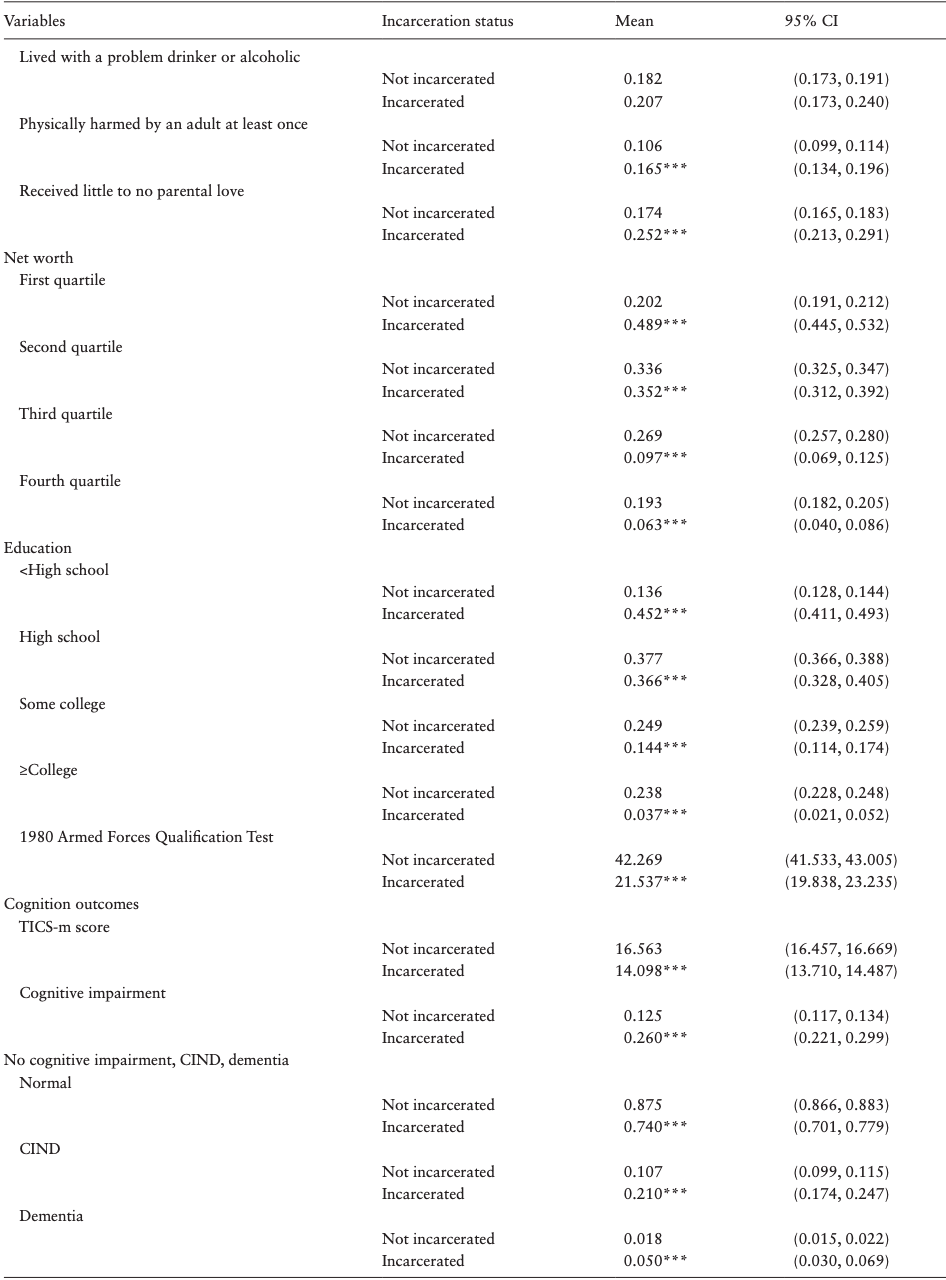
The population means for each independent variable are displayed in Table 1 for formerly and currently incarcerated (FI/I) and nonincarcerated (NI) individuals (see Appendix Table 4 for overall means of each variable). They show that FI/I was significantly different than NI in many characteristics. FI/I was significantly older, was more likely to be non-Hispanic Blacks or Hispanics, and was less likely to be women. In terms of health factors, a higher proportion of FI/I was underweight and overweight, but a lower proportion was obese. FI/I was also more likely to have been diagnosed with a heart problem, high blood pressure, and emotional problems or depression. Moreover, roughly 87% had smoked at least 100 cigarettes in their lifetime, compared to 56% among NI. In terms of ACEs, FI/I was significantly more likely to have reported hospitalization, being bedridden for at least 4 weeks, being physically harmed more than once by an adult, and receiving little to no parental love before age 18. A much greater proportion of FI/I was at the lower end of the income distribution relative to their NI counterparts, and a greater proportion had less than high school education. Finally, FI/I scored almost 21 points lower on the 1980 AFQT than NI. Table 1 also shows that FI/I score significantly lower on the TICS-m. Figure 1 shows that a greater proportion of the TICs-m scores for FI/I were in the range of cognitive impairment, CIND, and dementia. Based on the results in Table 1, FI/I was more disadvantaged than the NI group, and this disadvantage may have driven the large differences in cognitive impairment.

Table 1. Weighted Summary Statistics of Covariates and Outcomes by Incarceration Status
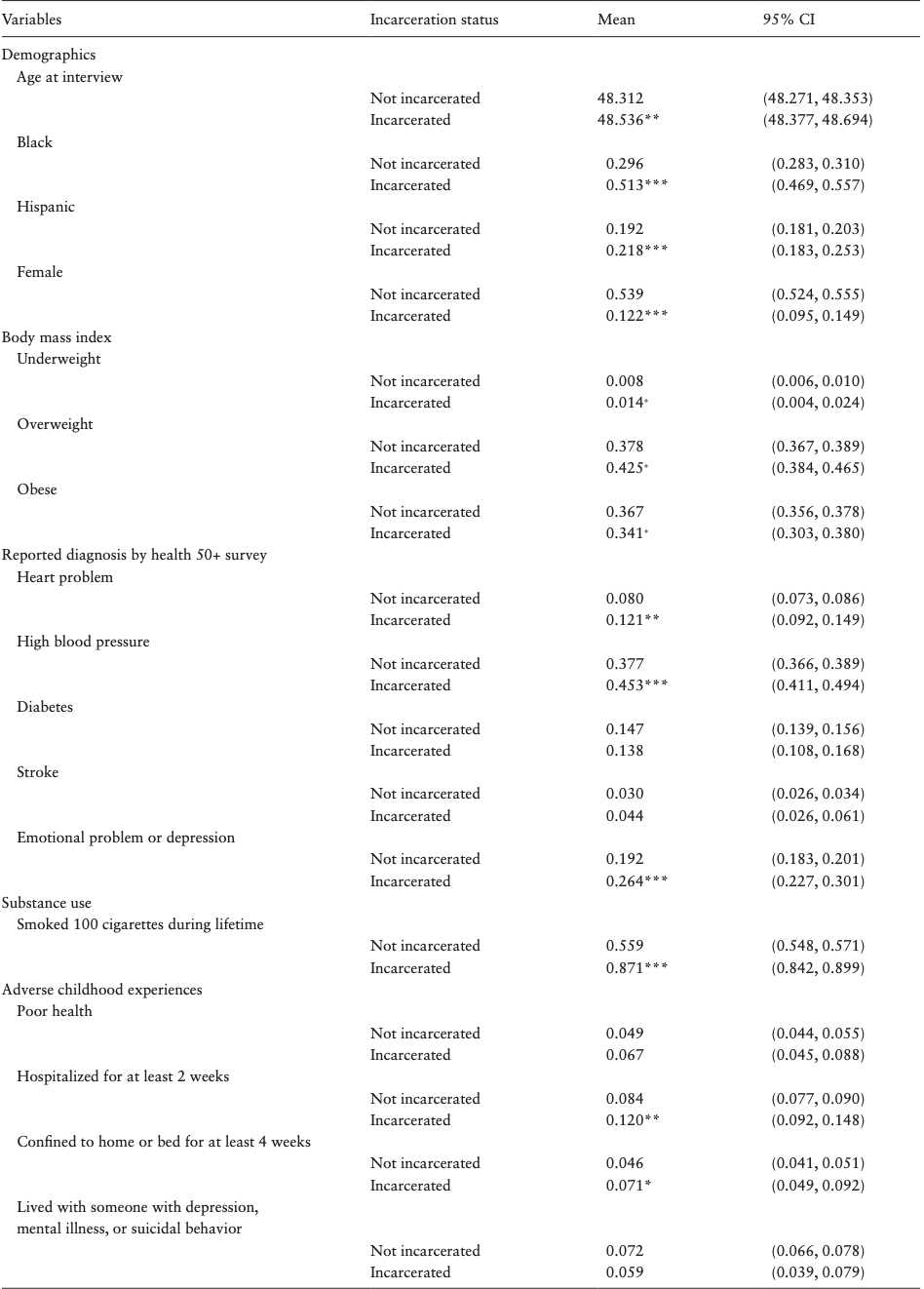
Table 1Table 1 (continued)Table 1 (continued 2)

Notes: Missing data imputed using multiple imputation by chained equations. Weighted means by incarceration status. Standard errors calculated using Taylor-linearized variance estimation. F test from a multinomial regression was used to calculate significance levels for BMI, net worth quartiles, race and ethnicity (Black, Hispanic, and White), and cognitive impairment (i.e., normal, CIND, and dementia). All other variables were calculated using t test from linear regression with incarceration as the independent variable and the variable of interest as the dependent variable. N is the total number of observations, N (FI/I) is the total number of individuals with any report of incarceration at the time of or prior to the 48+ cognition module, N (NI) is the total number with no reported incarceration. CI = confidence interval; TICS-m = modified version of the Telephone Interview for Cognitive Status; CIND = cognitive impairment—not dementia; FI/I = formerly and currently incarcerated; NI = nonincarcerated; BMI = body mass index.

+p < .10; *p < .05; **p < .01; ***p < .001.
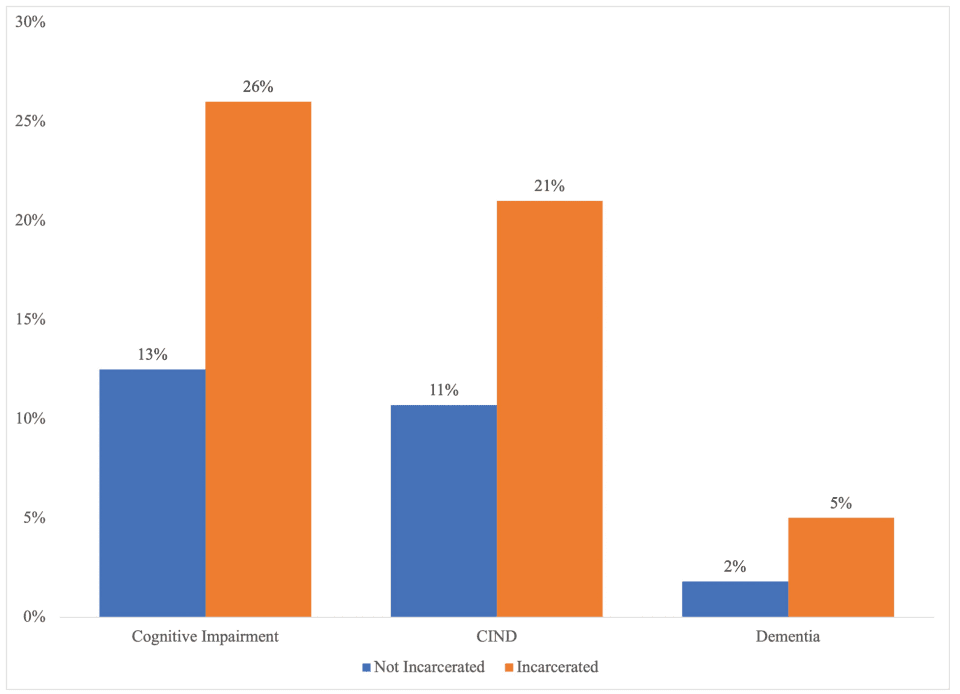
Figure 1
Figure 1.

Prevalence of cognitive impairment. Notes: Weighted means by incarceration status for cognitive impairment. Missing data were imputed using multiple imputation by chained equations. N = 8,021, N (FI/I) = 573, and N (NI) = 7,448. Following Langa et al. (2017), cognitively impaired (either with or without dementia) are those with TICS-m scores ≤ 11. Those with scores in the range 6 < TICS-m ≤ 11 were classified as CIND, and those with TICS-m scores ≤ 6 were categorized as dementia. All differences are significant at the 0.01 significance level or lower. FI/I = formerly and currently incarcerated; NI = nonincarcerated; TICS-m = modified version of the Telephone Interview for Cognitive Status; CIND = cognitive impairment—not dementia.

Cognitive Functioning

Table 2 presents regression coefficients measuring the effect of a prior incarceration on the TICS-m scores for Models 1, 5, 6, and 10 (see Appendix Figure 3 and Appendix Table 1 for the full models). Model 1 shows that FI scored roughly 2.4 (p < .001) points lower on the TICS-m than NI, there is no significant effect for current (at the time of interview) incarceration status. After including demographic variables (Appendix Table 1, Model 2), BMI, diagnoses of cardiovascular risks (i.e., heart disease, high blood pressure, diabetes, and stroke; Appendix Table 1, Model 3), and location fixed effects, the difference between FI and NI participants dropped to roughly −1.6 points (p < .001) but remained significant. After controlling for family net worth ( Appendix Table 2, Model 4), the difference in scores decreased further to roughly −1.1 but remained highly significant (p < .001). The gap between FI and NI respondents diminished after controlling for education (Model 5). Although the difference decreased in magnitude and significance, it remained marginally significant (−0.374, p < .10).

Table 2. TICS-m Regressions
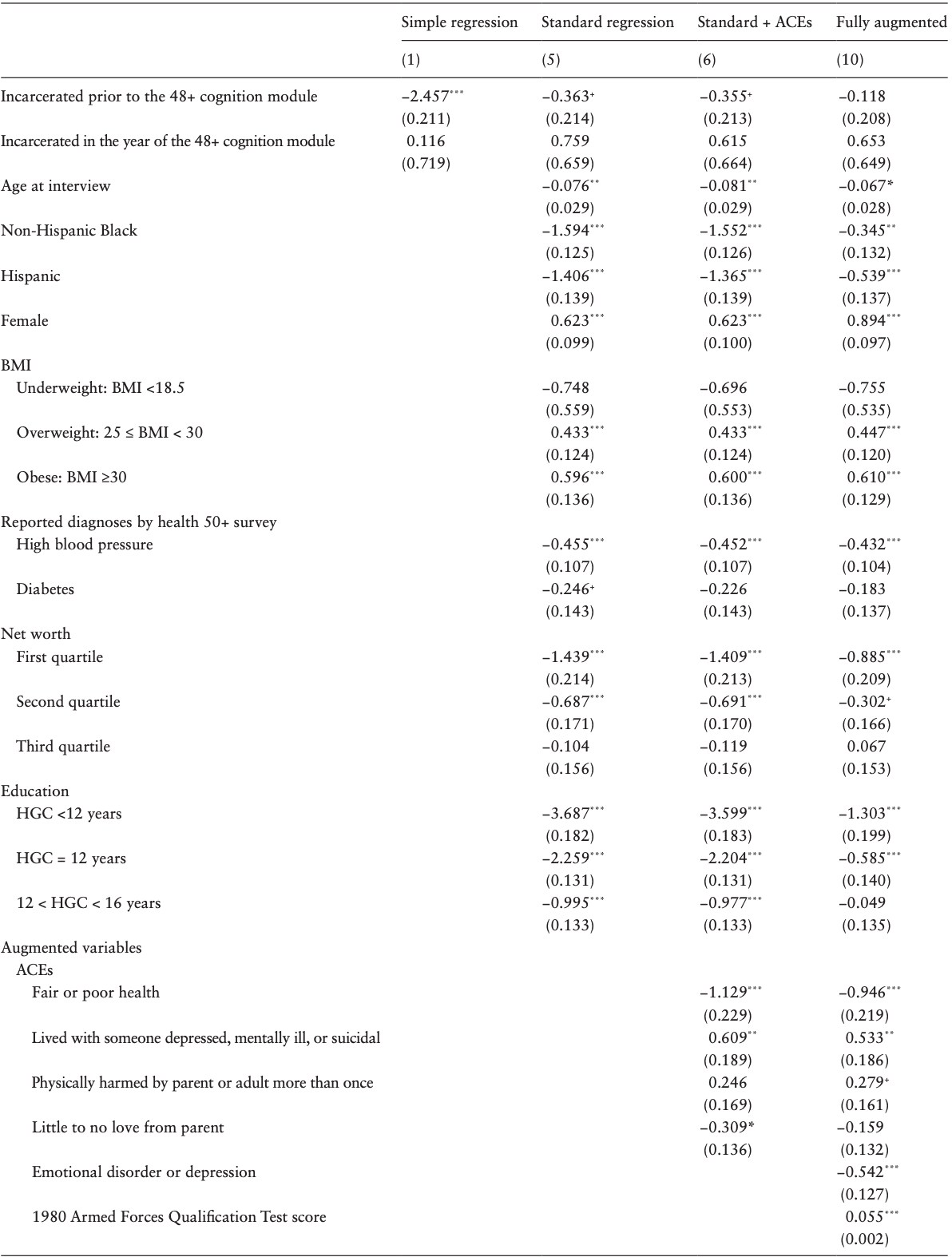
Table 1Table 2

Notes: Robust standard errors in parentheses. All models except the simple regression include fixed effects for type of city at baseline, region at baseline, type of city at year of survey, and region at year of survey. Missing data imputed using multiple imputation by chained equations. Results for heart problems, stroke, hospitalized for greater than or equal to 2 weeks, confined to home or bed for greater than or equal to 4 weeks, lived with a problem drinker, and smoked at least 100 cigarettes in one’s lifetime omitted from the table due to lack of significance and space but can be found in Appendix Table 1. N is the total number of observations, N (FI/I) is the total number of individuals with any report of incarceration at the time of or prior to the cognition survey, N (NI) is the total number with no reported incarceration. ACE = adverse childhood experiences; BMI = body mass index; FI/I = formerly and currently incarcerated; HGC = highest grade completed; NI = nonincarcerated.

+p < .10; *p < .05; **p < .01; ***p < .001.

We then augmented the standard models with variables for ACEs, smoking behavior, diagnoses of emotional problems or depression, and a premorbid measure of cognitive functioning, AFQT. Models 6–10 added these variables to the standard regression model, first one-by-one (Models 6–9) and then all together (Model 10), which we refer to as the fully specified regression. Models 6–8 in Appendix Table 1 show that the inclusion of ACEs, smoking behavior, and prior diagnoses of an emotional disorder had a small impact on the difference in TICS-m scores relative to the standard regression model (Model 5). Although smoking behavior was not significant in the model, some ACEs and being diagnosed with an emotional or depressive disorder significantly affected TICS-m scores. After including AFQT (see Model 9), the remaining difference between FI and NI decreased to −0.17 and was no longer statistically significant. Additional analyses regressing TICS-m scores on prior incarceration status adding in each control variable separately to the model reveal that no control variable completely explained the gap in TICS-m scores between FI and NI. However, differences in cognitive functioning between these groups seem to be associated with disparities in human capital (health and education) and early childhood experiences.

Focusing on the full TICS-m model in Table 2, regardless of incarceration status, TICS-m scores were significantly affected by demographic factors, health factors, education, ACEs, diagnosis of an emotional disorder or depression, and premorbid cognitive functioning (i.e., AFQT scores). Specifically, each additional year of age was associated with a decrease in TICS-m scores (−0.067, p < .05). Moreover, Blacks (−0.345, p < .01) and Hispanics (−0.539, p < .001) scored significantly lower on the TICS-m, even after controlling for the rich set of covariates in the model. However, women scored significantly higher than men (0.894, p < .001) on the TICS-m, holding other factors constant. Overweight (0.447, p < .001) and obese (0.610, p < .001) participants also scored higher on the TICS-m, whereas underweight individuals scored lower (−0.755, p = .159) than individuals with normal weight. Regarding cardiovascular risks, although diagnosed heart problems, high blood pressure, diabetes, or stroke significantly affected TICS-m scores in Model 3, only high blood pressure (−0.432, p < .001) remained statistically significant in the full model. Lower levels of net worth also significantly affected TICS-m scores. Individuals in the bottom quartile (−0.885, p < .001) or second quartile (−0.302, p < .10) of net worth scored significantly lower on the TICS-m than those in the top quartile. Likewise, those with less than (−1.303, p < .001) or equal to (−0.585, p < .001) 12 years of education scored lower on the TICS-m relative to individuals with at least 16 years of education. Regarding ACEs, individuals who reported having fair or poor health (−0.946, p < .001); having lived with someone with depression, other mental illness, or suicidal behavior (−0.533, p < .01); or being physically harmed by a parent or adult more than once (−0.279, p < .10) during childhood had significantly lower TICS-m scores relative to individuals who did not report these ACEs, holding other factors constant. In addition, those diagnosed with an emotional disorder or depression (−0.542, p < .001) scored lower than those who had not been diagnosed. Finally, each additional point on the AFQT was associated with a higher TICS-m score (0.055, p < .001).

Cognitive Impairment, CIND, and Dementia

Cognitive impairment

Overall cognitive impairment

Table 3 displays odds ratios (OR) measuring the effect of a prior incarceration on cognitive impairment (see Appendix Table 2 and Appendix Table 2 for the full regressions). Cognitive impairment is first estimated (instead of dementia) because of the relatively young age of the study population. As in the TICS-m score analysis, Models 1–5 represent the standard regression models, and Models 6–10 represent the augmented regression models. Table 3 displays Models 1, 5, 6, and 10 for clarity and brevity. Models 1–4 show that prior incarceration significantly increased the odds of cognitive impairment. Although demographic factors, cardiovascular risk, and net worth explained some of the positive association between prior incarceration and cognitive impairment, FI still had significantly increased odds of cognitive impairment (OR = 1.351, p < .05). However, after controlling for education (Model 5), the effect is removed both in significance and magnitude. Additional regressions not displayed here show that, as in the TICS-m analysis, one factor alone did not explain the difference in the odds of cognitive impairment between FI and NI groups. Rather, a combination of factors explained the between-group difference in cognition.

Table 3. Logistic Regressions for Cognitive Impairment
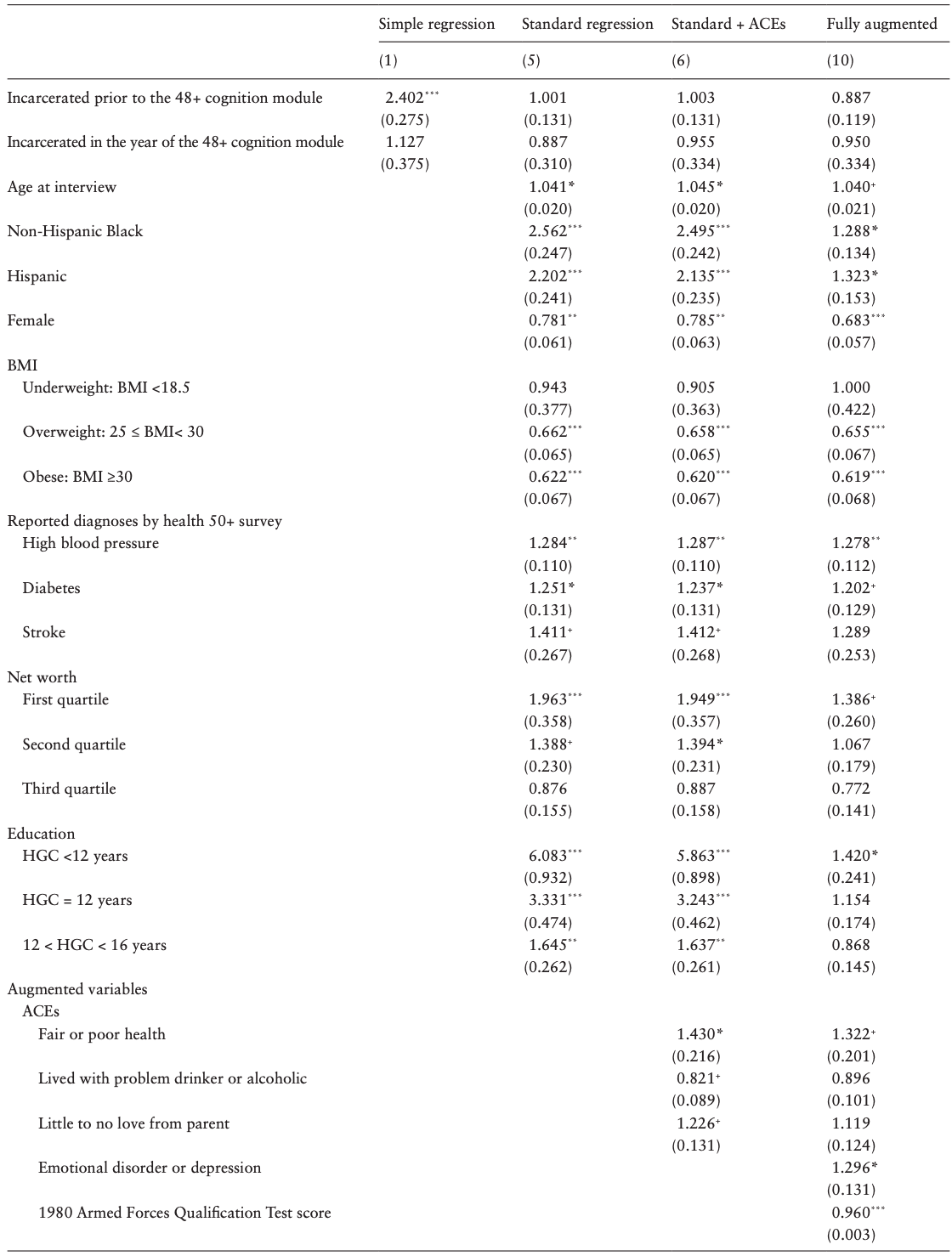
Table 3Table 3 (Continued)

Notes: Odds ratios with robust standard errors in parentheses. All models except the simple regression include fixed effects for type of city at baseline, region at baseline, type of city at year of survey, and region at year of survey. Missing data imputed using multiple imputation by chained equations. Results for diagnosis with a heart problem, hospitalized for greater than or equal to 2 weeks, confined to home or bed for greater than or equal to 4 weeks, lived with someone depressed, mentally ill, or suicidal, physically harmed by parent or adult more than once, and smoked at least 100 cigarettes in one’s lifetime omitted from the table due to lack of significance and space but can be found inAppendix Table 2. N is the total number of observations, N (FI/I) is the total number of individuals with any report of incarceration at the time of or prior to the cognition survey, N (NI) is the total number with no reported incarceration. ACE = adverse childhood experiences; BMI = body mass index; FI/I = formerly and currently incarcerated; HGC = highest grade completed; NI = nonincarcerated.

+p < .10; *p < .05; **p < .01; ***p < .001.

Irrespective of incarceration status, the augmented regressions in Table 3 and Appendix Table 2, show certain ACEs (Model 6), having been diagnosed with an emotional disorder or depression (Model 8), and AFQT scores (Model 9) were significantly associated with increased odds of cognitive impairment when individually added to the standard regression model (Model 5). However, in the fully specified regression in column 4 of Table 3 only age at interview, race and ethnicity, female sex, BMI, diagnoses of certain chronic illnesses, net worth, education, reporting fair or poor health during childhood, being diagnosed with an emotional disorder or depression, and AFQT scores remained significant. Age at interview, a diabetes diagnosis, being in the lowest quartile of net worth relative to the top quartile, and reporting fair or poor health as a child was associated with increased odds of cognitive impairment but were only marginally statistically significant, holding other factors constant. Blacks or Hispanics relative to Whites, those with high blood pressure, those with less than 12 years of education relative to those with 16 or more years of education, and those diagnosed with an emotional disorder or depression had significantly higher odds of cognitive impairment. Finally, women, overweight or obese relative to normal weight participants, and each additional point scored on the 1980 AFQT were associated with significantly lower odds of cognitive impairment, holding other factors constant.

CIND versus normal

The generalized ordered logit regressions comparing those scoring in the CIND range to those with no cognitive impairment can be found in Appendix Figure 5 and Appendix Table 3, Panel A. The results are almost identical to those presented in Table 3 for the overall cognitive impairment analysis; therefore, we omit the presentation and discussion of the results here due to space constraints.

Dementia versus CIND and no cognitive impairment

Table 4 presents the results for regression models estimating the likelihood of scoring in the dementia range on the TICS-m relative to scoring in the unimpaired or CIND range (see Appendix Figure 5 and Appendix Table 3 for the full regressions). Prior incarceration was significantly and positively associated with increased odds of dementia; however, the difference disappeared after including net worth to the model containing demographic and health covariates (Model 4, Appendix Table 3, Panel B). Separate regressions assessing the effect of including each variable separately, show that most variables, including net worth, did not individually explain differences in the likelihood of dementia between FI and NI groups. However, education and AFQT scores separately explained these differences. Once these variables were individually added to the simple regression model, the effect significantly decreased in size and was no longer significant at traditional levels. The remaining discussion focuses on the fully specified regression presented in column 4 of Table 4 to understand risk factors that explain the likelihood of scoring in the dementia range (irrespective of incarceration status) on the TICS-m.

Table 4. Generalized Ordered Logit Regressions: Dementia Versus CIND and Normal
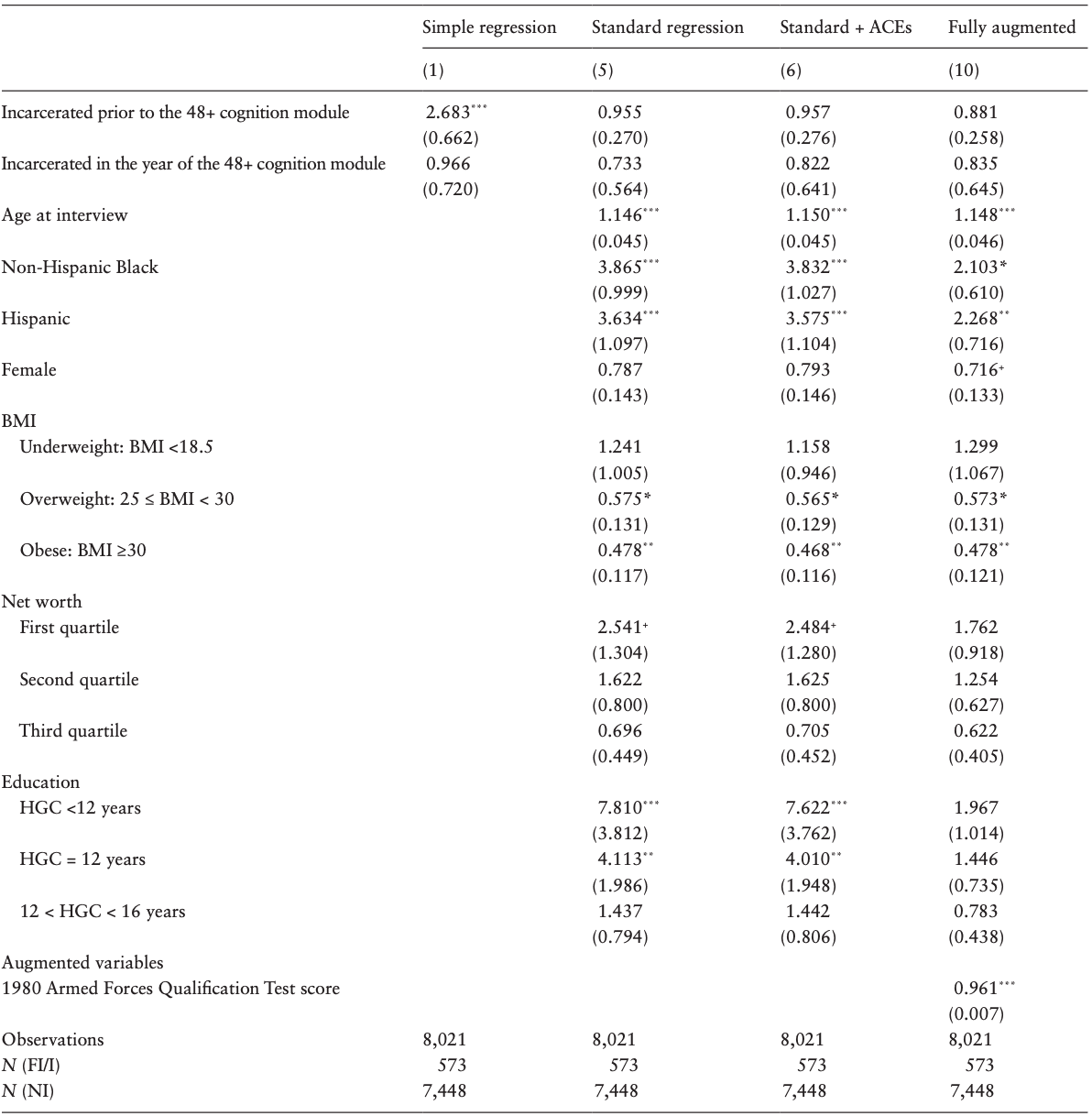
Table 4

Notes: Reported odds ratios with robust standard errors in parentheses. All models except the simple regression include fixed effects for type of city at baseline, region at baseline, type of city at year of survey, and region at year of survey. Please see the Appendix Table 3A for the CIND versus normal analysis. Missing data imputed using multiple imputation by chained equations. Results for all reported health diagnoses by the health 50+ survey, all ACEs variables, smoked at least 100 cigarettes in one’s lifetime, and having an emotional disorder or depression were omitted from the table due to lack of significance and space but can be found in Appendix Table 3. N is the total number of observations, N (FI/I) is the total number of individuals with any report of incarceration at the time of or prior to the cognition survey, and N (NI) is the total number with no reported incarceration. CIND = cognitive impairment—not dementia; HGC = highest grade completed; ACE = adverse childhood experiences; BMI = body mass index; FI/I = formerly and currently incarcerated; NI = nonincarcerated.

+p < .10; *p < .05; **p < .01; ***p < .001.

Column 4 of Table 4 demonstrates that age at interview, Black, Hispanic, female, BMI, and AFQT were significantly associated with dementia. Specifically, women, overweight or obese individuals (relative to those of normal weight), and each additional point on the AFQT were associated with lower odds of dementia relative to unimpaired or CIND, holding other factors constant. On the other hand, each additional year of age, being Black, and being Hispanic was associated with greater odds of dementia relative to unimpaired or CIND, holding all other factors constant.

Discussion

Recent research found declines in cognitive functioning during incarceration (Ezenwa et al., 2020; Umbach et al., 2018) and high prevalence rates of cognitive functioning among older incarcerated people (Ahalt et al., 2018; Perez et al., 2021). Nonetheless, these studies used specific samples of currently incarcerated people, and, as a result, exclude a sizable portion of individuals who have had contact with the correctional system. Moreover, there is scant evidence of risk factors for the higher prevalence rates found in this population (Lloyd, 2019). In a relatively sizable nationally representative survey of middle-aged men and women between the ages of 46 and 60 years, we found the unadjusted prevalence of cognitive impairment and early-onset dementia among FI men and women was at least two times the prevalence of those with no reported incarceration. Nonetheless, these differences were explained by a combination of factors associated with incarceration and cognitive functioning. The results suggest that incarceration could be affecting cognitive impairment through its effects on human capital (educational attainment, physical and mental health) and net worth. However, premorbid cognitive functioning was also significant. Incarceration could affect premorbid cognition and educational attainment through its timing (see Aizer & Doyle, 2015, for the link between juvenile detention, educational attainment, and later incarceration). The results provide further evidence for considering ADRD from a life course perspective in general, and a cumulative disadvantage framework in particular (Dannefer, 2003).

For cognitive impairment, it seems that incarceration may compound disadvantages over the life course leading to early cognitive decline. While differences between FI and NI for cognitive impairment were explained by a combination of factors, differences for dementia were independently explained by premorbid cognitive functioning and education. Nonetheless, while education becomes insignificant after controlling for AFQT scores, AFQT scores continue to significantly influence early-onset dementia above and beyond its effect through education (i.e., holding constant education levels; see Author Note 3). Finally, it is important to note the relatively resilient association between a prior diagnosis of an emotional disorder or depression and cognitive impairment could be a proxy for chronic psychological distress (Wilson et al., 2007) resulting from an incarceration (Schnittker et al., 2012).

The findings also align with research investigating the cognitive reserve hypothesis (Greenfield et al., 2020; Meng & D’Arcy, 2012; Schmand et al., 1997; Stern, 2012). This hypothesis purports that individuals with high levels of brain reserve can better endure age-related changes to the brain, which allows them to have a greater tolerance for disease, leading to a delay in the onset of dementia (larger brain reserve slows disease progression). Previous research have tested this hypothesis using education levels, IQ tests, reading tests, etc. This study included both education level and a premorbid test of cognition (i.e., 1980 AFQT). Consistent with prior studies (e.g., Schmand et al., 1997; Valenzuela & Sachdev, 2006), we found that premorbid measures of cognitive functioning captured by the AFQT were consistently important in explaining cognitive impairment. In fact, on its own, the AFQT significantly diminished differences in cognitive impairment, and both education and the AFQT separately absorbed the difference in odds of early-onset dementia between FI and NI groups. Given that AFQT scores are a reflection of environmental and socioeconomic factors (Cordero-Guzmán, 2001; Rodgers & Spriggs, 1996), our findings highlight the importance of modeling ADRD within a life course framework as adverse experiences throughout one’s life will affect cognitive reserve and, therefore, cognition later in life.

Irrespective of incarceration status, the findings are consistent with previous research that found significant associations between cognitive functioning and race (Lopez et al., 2003; Sloan & Wang, 2005), ethnicity (Garcia et al., 2018; Sloan & Wang, 2005), gender (Sloan & Wang, 2005), BMI (Langa et al., 2017), vascular diseases (Blazer & Wallace, 2016; Gorelick et al., 2011), some ACEs (Blazer & Wallace, 2016; Case & Paxson, 2009; Ritchie et al., 2011), emotional disorders and depression (Barnes et al., 2006; Blazer & Wallace, 2016; Rodriguez et al., 2018), education (Langa et al., 2017; Rodriguez et al., 2018), and premorbid measures of cognitive functioning (e.g., IQ test, reading test, and in our case, AFQT scores; Greenfield et al., 2020; Meng & D’Arcy, 2012; Schmand et al., 1997; Stern, 2012). It is worth noting that differences in cognitive impairment between Hispanics and non-Hispanic Blacks relative to Whites were persistent, holding other factors constant (including premorbid cognition), suggesting that discrimination and other barriers to social opportunities play a role in disparities in early-onset of ADRD.

Conclusion and Limitations

This study focused on understanding disparities in cognitive functioning among FI and NI people within a nationally representative sample of middle-aged women and men. We found large differences in cognitive functioning, cognitive impairment, and dementia between FI and NI (postrelease) that were explained by sociodemographic and human capital factors associated with incarceration as well as the selectivity of the FI population (e.g., higher rates of ACEs). Greater prevalence of cognitive impairment and dementia could create additional barriers for FI and should be incorporated into reentry planning. Moreover, given the resilience of the effect of race and ethnicity in this study after the inclusion of a rich set of covariates, the findings suggest that to address health disparities in ADRD, structural factors, such as racism and its direct and indirect effects on premorbid cognition (e.g., effect of discrimination on health, inequities in accessing high-quality educational opportunities), must be taken into consideration across the life course.

This study had several limitations. First, incarceration history was constructed from the variable measuring residence at the time of the interview. As a result, individuals who experienced short prison or jail stays were less likely to be categorized as incarcerated. This might have caused differences to be biased toward zero. Another limitation is that we do not observe the exact date of diagnosis of various health conditions. In addition, the results should be interpreted as conditional on having survived to take the survey. To the extent that incarcerated individuals are more likely to die before age 50, our results might be biased downwards. Of major concern is that the TICS-m and other similar tests capture differences in education (both quality and quantity) and not true differences in cognitive decline, especially among low-income populations like incarcerated people. If this is true, then we may not be capturing differences in cognitive decline but rather differences in education levels. Although we control for education, this could elucidate why education individually explained the difference in odds of dementia between FI and NI. Finally, our findings highlight the need to collect data that will support causal inference to better disentangle the mechanisms through which incarceration affects cognition.

Open Article as PDF

Abstract

Objectives: The objective of this study was to understand disparities in cognitive impairment between middle-aged formerly incarcerated (FI) and nonincarcerated individuals.

Methods: The 1979 National Longitudinal Survey of Youth is a nationally representative longitudinal data set containing information on incarceration, cognitive functioning, and other health conditions. Using a modified version of the Telephone Interview for Cognitive Status (TICS-m), adapted from the Health and Retirement Study, we analyzed the association between incarceration and cognitive impairment, cognitive impairment—not dementia and dementia. Multivariable regression models were estimated, including prior incarceration status and covariates associated with incarceration and cognitive functioning.

Results: FI individuals had lower unadjusted scores on TICS-m (−2.5, p < .001) and had significantly greater unadjusted odds ratios (OR) for scoring in the cognitive impairment (OR = 2.4, p < .001) and dementia (OR = 2.7, p < .001) range. Differences were largely explained by a combination of risk factors associated with incarceration and cognition. Education and premorbid cognition (measured by Armed Forces Qualification Test) separately and completely explained differences in the odds of dementia. Regardless of incarceration status, Blacks and Hispanics had significantly greater odds of cognitive impairment and dementia relative to Whites, holding other factors constant.

Discussion: The association between prior incarceration and cognitive impairment in middle age was largely explained by differences in educational attainment and premorbid cognitive functioning, supporting the cognitive reserve hypothesis. Greater prevalence of cognitive impairment and dementia among the FI could create challenges and should be considered in reentry planning. Structural and institutional factors should be considered when addressing health disparities in Alzheimer’s Disease and Related Dementias.

Summary

For over 40 years, the United States has had high rates of people in prison, known as mass incarceration. Even though these rates have gone down since 2009, more than 600,000 people leave prison each year. While there are many known problems with mass incarceration, less is understood about how it affects healthy aging and the ability of people in certain communities to age well. Specifically, there is little research on aging and returning to society after prison, even though the number of people in prison aged 55 or older has gone up by 400% since 1993. Most of these individuals will eventually be released.

At the same time, the number of older adults, especially among Hispanic and non-Hispanic Black populations, is expected to increase, leading to more cases of cognitive impairment. Cognitive impairment, including Alzheimer's and other dementias, is very expensive for society, costing hundreds of billions of dollars each year. If being in prison affects thinking abilities, these costs could grow even more than expected. This could also lead to greater differences in the rates of Alzheimer's Disease and Related Dementias (ADRD) across different states and communities with varying incarceration rates.

This study aims to fill an important gap in research. It is believed to be the first study to examine the link between thinking abilities, cognitive impairment, and being released from prison, using a national sample of middle-aged people who have been in prison and those who have not. A decline in thinking abilities early in life not only leads to direct medical costs but also affects a person's quality of life and daily functioning. It is already difficult to re-enter society after prison due to many obstacles. Poorer thinking abilities and increased cognitive impairment could make this process even harder.

Racial Disparities in Mass Incarceration and Cognition

Mass incarceration has led to very high imprisonment rates for African Americans; a Black male born in 2001 had a 1 in 3 chance of going to prison during his lifetime. African American men are imprisoned at rates six times higher than White men, and Hispanic men are imprisoned at rates 2.4 times higher than White men. Simultaneously, African Americans face a greater risk of cognitive impairment compared to White individuals. These racial differences in cognitive impairment are larger among middle-aged adults. For instance, the rate of cognitive impairment among African Americans aged 55–64 is four times higher than that of White individuals in the same age group, while for those 85 or older, it is about twice as high. A strong link between incarceration and cognitive functioning could help explain these racial differences in early-onset cognitive impairment.

Mass Incarceration, Health, and Aging

The period of mass incarceration can be seen as a historical event that has changed the health landscape for those who have experienced it. It can have lasting effects on their health later in life and may impact future generations. Being exposed to this environment could affect health for the rest of a person's life after release. Whether these effects are positive or negative may depend on how strong protective factors related to incarceration (like access to social services or education that were not available before prison) are compared to the risks, and how the experience of incarceration affects a person's ability to function in daily life.

Previous research has linked incarceration to ongoing stress, infectious diseases, heart disease, and head injuries. Additionally, the stigma and challenges of re-entering society after prison may lead to increased stress and health problems after release. Therefore, mass incarceration should be studied from a life course perspective. This approach considers how it affects individuals and future generations, as well as how it influences disease trends over time in the general population.

Incarceration and Cognition

Incarceration may directly and indirectly affect thinking abilities. While some decline in thinking skills is a normal part of aging, the impact of incarceration on these abilities is not straightforward. On one hand, incarceration can reduce a person's human capital, such as education, skill development, and health. For example, being in prison during adolescence could hinder the development of protective factors like educational achievement. The experience during and after incarceration may also increase factors that contribute to brain injury and a decline in thinking abilities. These factors include head trauma, vascular disease, infectious diseases, substance use (like smoking and alcohol), and ongoing stress, all of which are known risks for cognitive impairment. The direct and indirect effects of incarceration, particularly through stress, could negatively impact thinking abilities, increase cognitive impairment, and ultimately raise the risk of ADRD.

On the other hand, access to social services and opportunities for self-improvement, such as mental health support or education programs during confinement, could potentially improve human capital and, consequently, cognitive functioning.

To complicate matters, people who are incarcerated often have other factors that influence the relationship between thinking abilities and incarceration. They are more likely to have experienced adverse childhood events (ACEs), early psychiatric disorders, and substance use problems. This suggests that early life experiences should be considered when studying the link between incarceration and thinking abilities. Research has found that early life experiences explain the connection between incarceration and most psychiatric disorders. However, even after accounting for early life experiences related to childhood and substance use, incarceration remained strongly linked to mood disorders. When discussing the population in prison, it is important to recognize that societal factors, such as racism, can create environments that not only make it harder to develop and access protective factors for thinking abilities (like education) but also increase exposure to stressful events that are potential risk factors for cognitive impairment, especially for non-White individuals.

Overall, the relationship between incarceration and thinking abilities should be understood using a life course framework. This approach considers how biological, behavioral, social, and psychological exposures throughout life affect adult health and, specifically, adult cognition. For instance, one framework suggests that pre-existing cognitive ability, which can be strengthened or weakened over time, is influenced by social and material environments, occupation, physical health, lifestyle, and health behaviors. Similarly, within a broader health disparities framework, mass incarceration is seen as a societal factor that impacts population health across a person's lifespan, and its effects should be examined at environmental, social, behavioral, and biological levels.

Although the theoretical link between incarceration and thinking abilities is complex, the hypothesis is that the overwhelming negative direct and indirect effects of incarceration on an individual, both during and after their time in prison, will worsen the early life disadvantages disproportionately experienced by this population. This is expected to lead to lower cognitive reserve and a higher rate of early-onset cognitive impairment (both with and without dementia) compared to individuals who have not been incarcerated. Furthermore, differences in cognitive impairment are likely to be largely explained by the factors mentioned above that influence cognitive reserve.

Method

Data

The connection between incarceration and thinking abilities was studied in a group of middle-aged men and women using the 1979 National Longitudinal Survey of Youth (NLSY79). This survey provides information on criminal history, health, employment, education, family background, cognitive ability, and childhood experiences. It is valuable for studying the link between incarceration and thinking abilities in middle-aged adults because it tracks individuals from 1979 to the present who were between 14 and 22 years old at the start. When the cognitive abilities module was administered, respondents were between 46 and 60 years old. Health surveys were conducted when respondents were 40 or older, and again when they were 50 or older. Starting in 2006, a modified version of the Telephone Interview for Cognitive Status (TICS-m) was used as part of the cognitive abilities module for those aged 48 and older. By 2016, 8,021 men and women had completed the cognitive survey. Missing data were filled in using a statistical method called multiple imputation. Although the survey is ongoing, the TICS-m was only measured at one point. However, the comprehensive nature of the data allows for analyzing a wide range of control variables suggested by the study's framework.

Cognitive Functioning Scale and Cognitive Impairment

The TICS-m scale measures fluid intelligence and was adapted from another major health study. This scale assesses memory through immediate and delayed word recall tests, working memory through a serial subtraction test, and mental status using a backward counting test. The TICS-m score is calculated by adding the scores from each part of the test, with a possible range of 0–27. Lower scores mean poorer thinking abilities. To evaluate the link between incarceration and early cognitive impairment, a categorical variable was created using established score ranges. Specifically, scores between 7 and 11 were classified as cognitive impairment—not dementia (CIND), while scores of 6 or less were categorized as dementia. Finally, overall cognitive impairment was assessed by combining respondents classified as having dementia or CIND. That is, individuals with scores from 0 to 11 on the 27-point scale were considered to have cognitive impairment, and those with scores of 12 or higher were considered to have no cognitive impairment.

Incarceration

The NLSY79 directly asked about criminal history and incarceration until 1980. After 1980, incarceration status was determined using the "Type Of Residence R Is Living In" variable, which includes options like "own dwelling unit," "jail," and "parent household," and is asked in every survey round. Respondents whose residence was listed as "jail" were considered incarcerated for that survey period, while others were considered not incarcerated. This method allowed for documenting incarceration status in each survey year, which helped create the key independent variable: incarcerated prior to the 48+ cognitive survey (N = 567). Given that research suggests both direct effects of incarceration on cognition during confinement and indirect effects after release, a separate variable was also created to control for individuals incarcerated at the time of the 48+ cognitive survey (N = 60, with 6 of these not having been incarcerated prior to this survey). A benefit of the NLSY project is that, when possible, permission was obtained to interview respondents while they were incarcerated. The measure of incarceration likely underestimates the actual number of incarcerated individuals because short periods of incarceration between survey rounds might not be captured. Additionally, this variable does not differentiate between the type of incarceration (i.e., jail or prison).

Control Variables

Following the study's framework and existing research, various social and demographic factors linked to both incarceration and thinking abilities were included in the statistical models. The "standard" model included common variables found in previous studies. These variables were age at the time of the interview, race and ethnicity (non-Hispanic Black, Hispanic, and non-Hispanic and non-Black), highest grade completed (less than 12 years, 12 years, 13–15 years, and 16 or more years), and net worth quartiles. Additionally, reported diagnoses of chronic vascular conditions (such as heart problems, high blood pressure, diabetes, and stroke) and body mass index (BMI), calculated from self-reported weight and height, were also controlled for. The standard model was further enhanced with early life variables associated with incarceration and thinking abilities. These included pre-existing cognitive ability (measured by the 1980 Armed Forces Qualification Test [AFQT] score) and adverse childhood experiences (ACEs). Examples of ACEs included having poor health as a child, being confined to home or bed for 4 or more weeks, being hospitalized for at least 2 weeks, living with someone with depression, mental illness, or suicidal behavior, living with a problem drinker or alcoholic, how often a parent or adult physically harmed them, and the amount of parental love and affection received. A variable indicating whether a person had smoked more than 100 cigarettes in their lifetime was also included.

Empirical Analysis

The relationship between TICS-m scores and incarceration was analyzed using multiple regression. The difference in the likelihood of cognitive impairment between individuals who had been incarcerated (FI) and those who had not (NI) was estimated using logistic regression. A generalized ordered logit estimator was used to model the odds of scoring in the CIND range compared to having no impairment, and the odds of scoring in the dementia range compared to CIND and no impairment.

Ten models were created for each of the three dependent variables, by gradually adding categories of the previously mentioned control variables. Model 1 analyzed the outcome variables based only on incarceration status (prior and current) without adjusting for other factors. Models 2–5 progressively added the standard control variables, and Models 6–9 individually added the additional control variables to the fully specified standard model (Model 5). Model 10 was the fully specified augmented model, including all standard and additional control variables. For clarity and brevity, only Models 1, 5, 6 (Model 5 plus ACEs), and 10 are presented; all other models can be found in the online Appendix. Missing values were filled in using multiple imputation. All regressions, except Model 1, included urban and regional fixed effects and were performed using Stata/MP 16.

Results

The average values for each independent variable are shown in Table 1 for individuals who were formerly and currently incarcerated (FI/I) and those who were never incarcerated (NI). The results indicate that FI/I individuals differed significantly from NI individuals in many ways. FI/I individuals were notably older, more likely to be non-Hispanic Black or Hispanic, and less likely to be women. Regarding health, a higher proportion of FI/I individuals were underweight and overweight, though a lower proportion were obese. FI/I individuals were also more likely to have been diagnosed with heart problems, high blood pressure, and emotional problems or depression. Furthermore, about 87% of FI/I individuals had smoked at least 100 cigarettes in their lifetime, compared to 56% among NI individuals. In terms of adverse childhood experiences (ACEs), FI/I individuals were significantly more likely to report hospitalization, being confined to bed for at least 4 weeks, being physically harmed more than once by an adult, and receiving little to no parental love before age 18. A much larger proportion of FI/I individuals were in the lower income brackets compared to their NI counterparts, and a greater proportion had less than a high school education. Finally, FI/I individuals scored almost 21 points lower on the 1980 AFQT than NI individuals. Table 1 also shows that FI/I individuals scored significantly lower on the TICS-m. Figure 1 illustrates that a higher proportion of TICS-m scores for FI/I individuals fell within the ranges for cognitive impairment, CIND, and dementia. Based on these findings, FI/I individuals were more disadvantaged than the NI group, and this disadvantage may have contributed to the large differences observed in cognitive impairment.

Cognitive Functioning

Table 2 shows the results of regressions measuring the impact of prior incarceration on TICS-m scores for Models 1, 5, 6, and 10. Model 1 indicates that individuals with prior incarceration scored approximately 2.4 points lower on the TICS-m than those without incarceration, a statistically significant difference. There was no significant impact for current incarceration status. After including demographic variables, BMI, diagnoses of cardiovascular risks (such as heart disease, high blood pressure, diabetes, and stroke), and location effects, the difference between formerly incarcerated (FI) and non-incarcerated (NI) participants decreased to about -1.6 points but remained statistically significant. Further controlling for family net worth reduced the difference in scores to approximately -1.1, but it remained highly significant. The gap between FI and NI respondents lessened after accounting for education in Model 5. While the difference became smaller and less significant, it remained marginally significant (-0.374).

The standard models were then enhanced with variables for adverse childhood experiences (ACEs), smoking behavior, diagnoses of emotional problems or depression, and a measure of pre-existing cognitive ability, the AFQT. Models 6–10 added these variables to the standard regression model, first individually (Models 6–9) and then all together (Model 10), which is referred to as the fully specified regression. Models 6–8 show that including ACEs, smoking behavior, and a prior diagnosis of an emotional disorder had a minor impact on the difference in TICS-m scores compared to the standard regression model (Model 5). While smoking behavior was not significant, some ACEs and being diagnosed with an emotional or depressive disorder significantly affected TICS-m scores. After including AFQT (Model 9), the remaining difference between FI and NI decreased to -0.17 and was no longer statistically significant. Additional analyses, which separately added each control variable to the model to examine TICS-m scores against prior incarceration status, revealed that no single control variable fully explained the gap in TICS-m scores between FI and NI. However, differences in cognitive functioning between these groups appear to be linked to disparities in human capital (health and education) and early childhood experiences.

Focusing on the complete TICS-m model in Table 2, regardless of incarceration status, TICS-m scores were significantly influenced by demographic factors, health factors, education, adverse childhood experiences (ACEs), a diagnosis of an emotional disorder or depression, and pre-existing cognitive functioning (AFQT scores). Specifically, each additional year of age was linked to a decrease in TICS-m scores (-0.067). Additionally, Black individuals (-0.345) and Hispanic individuals (-0.539) scored significantly lower on the TICS-m, even after controlling for many other factors. However, women scored significantly higher than men (0.894) on the TICS-m, when other factors were held constant. Individuals who were overweight (0.447) and obese (0.610) also scored higher on the TICS-m, while underweight individuals scored lower (-0.755) compared to those with a normal weight. Regarding cardiovascular risks, although diagnosed heart problems, high blood pressure, diabetes, or stroke initially significantly affected TICS-m scores in Model 3, only high blood pressure (-0.432) remained statistically significant in the full model. Lower levels of net worth also significantly impacted TICS-m scores. Individuals in the bottom quartile (-0.885) or second quartile (-0.302) of net worth scored significantly lower on the TICS-m than those in the top quartile. Similarly, those with less than (-1.303) or exactly (-0.585) 12 years of education scored lower on the TICS-m compared to individuals with at least 16 years of education. For ACEs, individuals who reported fair or poor health (-0.946); having lived with someone with depression, other mental illness, or suicidal behavior (-0.533); or being physically harmed by a parent or adult more than once (-0.279) during childhood had significantly lower TICS-m scores relative to individuals who did not report these ACEs, holding other factors constant. Additionally, those diagnosed with an emotional disorder or depression (-0.542) scored lower than those who had not been diagnosed. Finally, each additional point on the AFQT was associated with a higher TICS-m score (0.055).

Cognitive Impairment, CIND, and Dementia

Cognitive Impairment

Overall Cognitive Impairment

Table 3 presents the odds ratios (OR) that measure the impact of a prior incarceration on cognitive impairment. Cognitive impairment is assessed first (rather than dementia) due to the relatively young age of the study participants. Similar to the TICS-m score analysis, Models 1–5 represent the standard regression models, and Models 6–10 represent the augmented regression models. For clarity and brevity, Table 3 shows Models 1, 5, 6, and 10. Models 1–4 indicate that prior incarceration significantly increased the odds of cognitive impairment. Although demographic factors, cardiovascular risk, and net worth explained some of the positive association between prior incarceration and cognitive impairment, individuals who had been incarcerated (FI) still had significantly increased odds of cognitive impairment (OR = 1.351). However, after controlling for education (Model 5), this effect lost both its statistical significance and magnitude. Additional regressions not shown here confirm that no single factor fully explained the difference in the odds of cognitive impairment between FI and non-incarcerated (NI) groups. Instead, a combination of factors explained the differences in cognition between these groups.

Regardless of incarceration status, the augmented regressions in Table 3 and Appendix Table 2 demonstrate that certain adverse childhood experiences (ACEs) (Model 6), a diagnosis of an emotional disorder or depression (Model 8), and AFQT scores (Model 9) were significantly associated with increased odds of cognitive impairment when individually added to the standard regression model (Model 5). However, in the fully specified regression in column 4 of Table 3, only age at interview, race and ethnicity, female sex, BMI, diagnoses of certain chronic illnesses, net worth, education, reporting fair or poor health during childhood, being diagnosed with an emotional disorder or depression, and AFQT scores remained significant. Age at interview, a diabetes diagnosis, being in the lowest quartile of net worth compared to the top quartile, and reporting fair or poor health as a child were associated with increased odds of cognitive impairment but were only marginally statistically significant, holding other factors constant. Black or Hispanic individuals compared to White individuals, those with high blood pressure, those with less than 12 years of education compared to those with 16 or more years of education, and those diagnosed with an emotional disorder or depression had significantly higher odds of cognitive impairment. Finally, women, overweight or obese participants compared to those of normal weight, and each additional point scored on the 1980 AFQT were associated with significantly lower odds of cognitive impairment, holding other factors constant.

CIND versus Normal

The results for the generalized ordered logit regressions comparing individuals scoring in the Cognitive Impairment, Not Dementia (CIND) range to those with no cognitive impairment are found in Appendix Figure 5 and Appendix Table 3, Panel A. These findings are almost identical to those presented in Table 3 for the overall cognitive impairment analysis. Therefore, to save space, the presentation and discussion of these results are omitted here.

Dementia versus CIND and No Cognitive Impairment

Table 4 presents the results for regression models that estimate the likelihood of scoring in the dementia range on the TICS-m, relative to scoring in the unimpaired or CIND range. Prior incarceration was significantly and positively associated with increased odds of dementia. However, this difference disappeared after including net worth in the model that already contained demographic and health factors (Model 4, Appendix Table 3, Panel B). Separate regressions, which assessed the effect of including each variable individually, show that most variables, including net worth, did not independently explain differences in the likelihood of dementia between formerly incarcerated (FI) and non-incarcerated (NI) groups. However, education and AFQT scores separately explained these differences. Once these variables were individually added to the simple regression model, the effect significantly decreased in size and was no longer statistically significant at traditional levels. The remaining discussion focuses on the fully specified regression presented in column 4 of Table 4 to understand the risk factors that explain the likelihood of scoring in the dementia range on the TICS-m, regardless of incarceration status.

Column 4 of Table 4 demonstrates that age at interview, being Black, Hispanic, female, body mass index (BMI), and AFQT scores were significantly associated with dementia. Specifically, women, individuals who were overweight or obese (compared to those of normal weight), and each additional point on the AFQT were associated with lower odds of dementia relative to being unimpaired or having CIND, when other factors were held constant. On the other hand, each additional year of age, being Black, and being Hispanic were associated with greater odds of dementia relative to being unimpaired or having CIND, when all other factors were held constant.

Discussion

Recent studies have shown a decline in thinking abilities during incarceration and a high prevalence of cognitive problems among older incarcerated individuals. However, these studies focused on specific groups of people currently in prison, which means they do not include a large number of individuals who have interacted with the justice system. Furthermore, there is little evidence on the risk factors that contribute to the higher rates of cognitive issues in this population. In a relatively large national survey of middle-aged men and women aged 46 to 60, it was found that the unadjusted rates of cognitive impairment and early-onset dementia among formerly incarcerated (FI) individuals were at least twice as high as among those who had never been incarcerated. However, these differences were explained by a combination of factors linked to both incarceration and cognitive functioning. The results suggest that incarceration could be affecting cognitive impairment through its impact on human capital (education, physical and mental health) and net worth. Nevertheless, pre-existing cognitive functioning was also significant. Incarceration could influence pre-existing cognition and educational attainment depending on when it occurs. The findings further support viewing Alzheimer's Disease and Related Dementias (ADRD) from a life course perspective, especially within a framework of cumulative disadvantage.

For cognitive impairment, it appears that incarceration may worsen disadvantages over a person's life, leading to an earlier decline in cognitive abilities. While differences in cognitive impairment between formerly incarcerated (FI) and non-incarcerated (NI) individuals were explained by a combination of factors, differences for dementia were independently explained by pre-existing cognitive functioning and education. Nevertheless, while the effect of education becomes insignificant after accounting for AFQT scores, AFQT scores continue to significantly influence early-onset dementia beyond their effect through education (i.e., even when education levels are held constant). Finally, it is important to note that the relatively stable link between a prior diagnosis of an emotional disorder or depression and cognitive impairment could represent ongoing psychological distress resulting from incarceration.

The findings also support the cognitive reserve hypothesis. This hypothesis suggests that individuals with high levels of "brain reserve" can better withstand age-related changes to the brain, allowing them to tolerate disease more effectively and delaying the onset of dementia. Previous research has tested this hypothesis using factors like education levels, IQ tests, and reading tests. This study included both education level and a pre-existing measure of cognitive ability (the 1980 AFQT). Consistent with earlier studies, the study found that pre-existing measures of cognitive functioning, as captured by the AFQT, were consistently important in explaining cognitive impairment. In fact, on its own, the AFQT significantly reduced differences in cognitive impairment, and both education and the AFQT separately accounted for the difference in the odds of early-onset dementia between formerly incarcerated (FI) and non-incarcerated (NI) groups. Since AFQT scores reflect environmental and socioeconomic factors, these findings highlight the importance of studying Alzheimer's Disease and Related Dementias within a life course framework, as adverse experiences throughout one's life will affect cognitive reserve and, consequently, cognitive abilities later in life.

Regardless of incarceration status, the findings are consistent with previous research that has shown significant links between cognitive functioning and factors such as race, ethnicity, gender, BMI, vascular diseases, some adverse childhood experiences (ACEs), emotional disorders and depression, education, and pre-existing measures of cognitive functioning (like IQ tests, reading tests, and in this study, AFQT scores). It is important to note that differences in cognitive impairment between Hispanic and non-Hispanic Black individuals compared to White individuals remained even after including a wide range of control variables, including pre-existing cognition. This suggests that discrimination and other barriers to social opportunities play a role in disparities in the early onset of Alzheimer's Disease and Related Dementias (ADRD).

Conclusion and Limitations

This study aimed to understand the differences in thinking abilities among formerly incarcerated and non-incarcerated people in a national sample of middle-aged men and women. Large differences were found in cognitive functioning, cognitive impairment, and dementia between formerly incarcerated and non-incarcerated individuals (after release). These differences were explained by social and demographic factors, human capital factors linked to incarceration, and the specific characteristics of the formerly incarcerated population (e.g., higher rates of adverse childhood experiences). A greater presence of cognitive impairment and dementia could create additional challenges for formerly incarcerated individuals and should be included in plans for re-entering society. Furthermore, given that the effect of race and ethnicity remained strong in this study even after including many control variables, the findings suggest that to address health differences in Alzheimer's Disease and Related Dementias (ADRD), societal factors, such as racism and its direct and indirect effects on pre-existing cognitive abilities (e.g., the impact of discrimination on health, unequal access to high-quality education), must be considered across a person's entire life.

This study had several limitations. First, incarceration history was created from a variable that measured where a person lived at the time of the interview. This means that individuals who had short stays in prison or jail were less likely to be counted as incarcerated, which might have made the observed differences appear smaller than they actually are. Another limitation is that the exact dates of diagnosis for various health conditions are not known. Additionally, the results should only be interpreted for those who survived to take the survey. If incarcerated individuals are more likely to die before age 50, the results might be lower than the true values. A major concern is that the TICS-m and similar tests might capture differences in education (both quality and quantity) rather than true differences in cognitive decline, especially among low-income populations like those who have been incarcerated. If this is true, then the study might be measuring differences in education levels instead of cognitive decline. Although education was controlled for, this could explain why education independently accounted for the difference in the odds of dementia between formerly incarcerated and non-incarcerated individuals. Finally, these findings highlight the need to collect data that can better support understanding the cause-and-effect relationships, to more clearly determine how incarceration affects cognition.

Open Article as PDF

Abstract

Objectives: The objective of this study was to understand disparities in cognitive impairment between middle-aged formerly incarcerated (FI) and nonincarcerated individuals.

Methods: The 1979 National Longitudinal Survey of Youth is a nationally representative longitudinal data set containing information on incarceration, cognitive functioning, and other health conditions. Using a modified version of the Telephone Interview for Cognitive Status (TICS-m), adapted from the Health and Retirement Study, we analyzed the association between incarceration and cognitive impairment, cognitive impairment—not dementia and dementia. Multivariable regression models were estimated, including prior incarceration status and covariates associated with incarceration and cognitive functioning.

Results: FI individuals had lower unadjusted scores on TICS-m (−2.5, p < .001) and had significantly greater unadjusted odds ratios (OR) for scoring in the cognitive impairment (OR = 2.4, p < .001) and dementia (OR = 2.7, p < .001) range. Differences were largely explained by a combination of risk factors associated with incarceration and cognition. Education and premorbid cognition (measured by Armed Forces Qualification Test) separately and completely explained differences in the odds of dementia. Regardless of incarceration status, Blacks and Hispanics had significantly greater odds of cognitive impairment and dementia relative to Whites, holding other factors constant.

Discussion: The association between prior incarceration and cognitive impairment in middle age was largely explained by differences in educational attainment and premorbid cognitive functioning, supporting the cognitive reserve hypothesis. Greater prevalence of cognitive impairment and dementia among the FI could create challenges and should be considered in reentry planning. Structural and institutional factors should be considered when addressing health disparities in Alzheimer’s Disease and Related Dementias.

Summary

For over 40 years, the United States has had a high rate of people in prison, a policy known as mass incarceration. Although this rate has decreased since 2009, more than 600,000 individuals leave prison each year. While many negative effects of mass incarceration are known, its impact on healthy aging and the ability of affected communities to age successfully is not well understood. Research on aging and re-entry into society for formerly incarcerated individuals is limited, even though the number of older people in prison has grown significantly. At the same time, the population of older adults, particularly among Hispanic and non-Hispanic Black groups, is increasing, and the number of people living with cognitive impairment is expected to rise. Cognitive impairment is very expensive for society, with Alzheimer’s and other dementias being among the costliest diseases to treat in the United States. If being in prison affects thinking abilities, these costs could increase even more than expected, leading to greater differences in the rates of Alzheimer’s Disease and Related Dementias (ADRD) across states and communities.

This study helps fill a gap in existing research. It is believed to be the first study to look at the connection between thinking abilities, cognitive impairment, and being released from prison, using information from a large national group of middle-aged people who were either formerly incarcerated or never incarcerated. Early problems with thinking abilities not only lead to medical costs but also affect a person's quality of life and daily functioning. Moving from prison or jail back into society is difficult due to many challenges. Lower thinking abilities and increased cognitive impairment could make it even harder for individuals to successfully re-enter society after being incarcerated.

Racial Differences in Mass Incarceration and Cognition

Due to mass incarceration, the rate at which African Americans are imprisoned significantly increased. For example, a Black male born in 2001 had a 1 in 3 chance of going to prison during his lifetime. African American men are imprisoned at rates six times higher than White men, and Hispanic men are imprisoned at rates 2.4 times higher than White men. At the same time, African Americans face a greater risk of cognitive impairment compared to White individuals. Differences in the rates of cognitive impairment between African Americans and Whites are larger in middle age. Specifically, among African Americans aged 85 or older, cognitive impairment is about two times more common than among their White counterparts. For African Americans aged 55–64, the prevalence is four times higher than for White individuals in the same age group. A strong link between incarceration and thinking abilities could help explain these racial differences in early-onset cognitive impairment.

Mass Incarceration, Health, and Aging

The period of mass incarceration can be seen as a historical event that changed the health environment for those exposed to it. This exposure can have lasting effects on the health of individuals later in life and may influence health across different generations. Contact with this environment could affect a person's health for the rest of their life after being exposed. Whether this effect is positive or negative might depend on how strong any "protective" factors of incarceration are (such as access to social services or skills gained that were not available before incarceration) compared to the risk factors. It also depends on how being incarcerated might affect a person's ability to function in daily life.

Past research has shown that incarceration is linked to long-term stress, the spread of infectious diseases, vascular diseases, and head trauma. Additionally, incarceration may lead to increased stress and health problems after release because of social stigma and difficulties in rejoining society.

Considering these findings, mass incarceration should be studied from a life course perspective. This approach aims to understand its effects on the group of people directly involved, as well as on future generations, and how it influences disease patterns in the population over time.

Incarceration and Cognition

Incarceration can directly and indirectly affect thinking abilities. While a decline in fluid cognitive abilities is a normal part of aging, the impact of incarceration on these abilities is not straightforward. On one hand, incarceration can reduce important personal resources, such as education, skill development, and health. For instance, being incarcerated during adolescence can interrupt educational progress, which is a protective factor. Experiences during and after incarceration may increase factors that can lead to brain injury and cognitive decline. These factors include head trauma, vascular disease, infectious diseases, substance use (like smoking and alcohol), and chronic stress, all of which are known risks for cognitive impairment. The direct and indirect effects of incarceration, particularly through stress, could negatively impact thinking abilities, increase cognitive impairment, and ultimately raise the risk of Alzheimer’s Disease and Related Dementias (ADRD).

On the other hand, access to social services and opportunities for self-improvement (like mental health support and education) while in confinement could improve personal resources and, therefore, thinking abilities.

To further complicate matters, incarcerated individuals are a specific group of people. They are more likely to have experienced other factors that influence the relationship between thinking abilities and incarceration, such as difficult childhood experiences, early onset of mental health disorders, and early problems with substance use. This suggests that early life experiences should be considered when studying the link between incarceration and thinking abilities. Some research has found that early life experiences explain the relationship between incarceration and most mental health disorders. However, even after accounting for early life experiences related to childhood and substance use, incarceration remained strongly linked to mood disorders. When discussing the characteristics of the incarcerated population, it is important to note that structural factors, like racism, can create environmental conditions. These conditions not only make it harder to develop and access protective factors for thinking abilities (such as education) but also increase exposure to stressful events that are potential risk factors for cognitive impairment (like incarceration), especially for non-White individuals.

Overall, the relationship between incarceration and cognition should be understood within a life course framework. This framework considers how biological, behavioral, social, and psychological experiences throughout life, both early and later, affect adult health in general and adult cognition in particular. Experts also suggest a life course framework for cognitive reserve, which focuses on how the efficiency of brain networks can protect against brain disease. This concept emphasizes that initial thinking ability can be strengthened or weakened over a person's life, influenced by their social and material environment, job, physical health, lifestyle, and health behaviors. Similarly, within the National Institute on Aging Health Disparities Framework, mass incarceration would be considered a structural factor that impacts population health throughout life, and its effects should be analyzed at environmental, social, behavioral, and biological levels.

Although the theoretical link between incarceration and cognition is complex, it is hypothesized that the overwhelming negative direct and indirect effects of incarceration on individuals, both during and after their incarceration, will worsen early life disadvantages that this population disproportionately experiences. This is expected to result in lower cognitive reserve and a higher rate of early-onset cognitive impairment (including both cognitive impairment not dementia and dementia) compared to individuals who have not been incarcerated. Furthermore, differences in cognitive impairment are likely to be largely explained by the factors mentioned that influence cognitive reserve.

Method

Data

The connection between incarceration and thinking abilities was studied in a group of middle-aged men and women using the 1979 National Longitudinal Survey of Youth (NLSY79). This unique survey collects information on criminal history, health, employment, education, family details, cognitive ability, and childhood experiences. It provides extensive data to examine the link between incarceration and thinking abilities among middle-aged individuals because it follows people from 1979 to the present who were between 14 and 22 years old at the start. At the time of the cognition survey, participants were between 46 and 60 years old. Two health surveys were given to participants aged 40 or older, and again at age 50 or older, starting in 1998 and 2008, respectively. Beginning in 2006, a modified version of the Telephone Interview for Cognitive Status (TICS-m) was administered as part of the cognition module for those aged 48 and older. By 2016, 8,021 men and women had completed the cognition survey. A method called multiple imputation by chained equations (MICE) was used to fill in any missing data. Although the survey is ongoing, the TICS-m was only measured at one specific point. However, the comprehensive and long-term nature of the data allows for the analysis of many control variables suggested by the study's conceptual framework.

Cognitive Functioning Scale and Cognitive Impairment

The TICS-m scale, adapted from the Health and Retirement Study, measures fluid intelligence. This scale evaluates immediate and delayed recall of 10 words for episodic memory, a serial 7s subtraction test for working memory, and a backward count from 20 test for mental status. The TICS-m score is the sum of scores from each part of the test, with a possible range of 0–27. Lower scores indicate worse thinking abilities. To assess the link between incarceration and early cognitive impairment, a categorical variable was created using established score ranges from other research. Specifically, scores between 7 and 11 were classified as cognitive impairment—not dementia (CIND), while scores of 6 or less were coded as dementia. Finally, overall cognitive impairment was assessed by grouping together respondents whose scores fell into the dementia or CIND range. That is, individuals with scores from 0 to 11 on the 27-point scale were considered to have cognitive impairment, and those with scores of 12 or higher were considered to have no cognitive impairment.

Incarceration

The NLSY79 survey directly asked questions about criminal activity and incarceration history until 1980. After 1980, incarceration status is identified using the household variable "Type Of Residence R Is Living In" (e.g., own home, jail, parent's home), which is asked in every survey period. Respondents whose residence is listed as "jail" are considered incarcerated for that specific survey period, while others are coded as not incarcerated. This method allows for documenting incarceration status in each survey year, which helped create the main independent variable: incarceration before the 48+ cognition survey (N = 567). Given the study's framework, which suggests that incarceration can have direct effects on cognition during confinement and indirect effects after release, a separate variable was also created for those incarcerated at the time of the 48+ cognition survey when the TICS-m was administered (N = 60, with 6 of these not incarcerated before the 48+ cognition survey). One advantage of the data is that the NLSY project, when possible, obtained permission to interview respondents while they were incarcerated. The measure of incarceration likely underestimates the true number of incarcerated individuals because those with short stays between survey periods are less likely to be captured. Additionally, this variable does not differentiate between types of incarceration (i.e., jail or prison).

Control Variables

Following the conceptual framework and existing research, sociodemographic factors known to be linked with both incarceration and thinking abilities were included in the regression models. The "standard" regression model included common variables found in previous studies. These variables were age at the time of the interview, race and ethnicity (non-Hispanic Black, Hispanic, and non-Hispanic and non-Black), highest education level completed (less than 12 years, 12 years, 13–15 years, and 16 or more years), and wealth quartiles. Additionally, reported diagnoses of chronic vascular conditions (such as heart problems, high blood pressure, diabetes, and stroke) and body mass index (BMI), calculated from self-reported weight and height, were also controlled for. The standard regression model was also enhanced with early life variables associated with incarceration and thinking abilities. These included a measure of cognitive ability before the study (1980 Armed Forces Qualification Test [AFQT] score) and adverse childhood experiences (ACEs). Examples of ACEs included: having poor health as a child; being confined to home or bed for 4 or more weeks; being hospitalized for at least 2 weeks; living with someone with depression, mental illness, or suicidal behavior; living with a problem drinker or alcoholic; how often a parent or adult physically harmed them; and how much parental love and affection they received. A variable indicating whether a person had smoked more than 100 cigarettes in their lifetime was also included.

Empirical Analysis

The connection between TICS-m scores and incarceration was analyzed using multiple regression. Differences in the chances of cognitive impairment between formerly incarcerated (FI) and non-incarcerated (NI) individuals were estimated using logistic regression. A generalized ordered logit estimator was used to model the chances of scoring in the CIND range compared to being unimpaired, and the chances of scoring in the dementia range compared to CIND and unimpaired.

Ten models were developed for each of the three dependent variables by gradually adding categories of the previously mentioned covariates. Model 1 analyzed the outcome variables based solely on incarceration status (prior and current) without adjusting for other factors. Models 2–5 progressively added standard covariates, and Models 6–9 individually added the expanded control variables to the fully specified standard regression model (Model 5). Model 10 represents the complete expanded model, which includes all standard and expanded control variables. For clarity and brevity, only Models 1, 5, 6 (Model 5 plus ACEs), and 10 are presented; all other models can be found in the online Appendix. Missing data were filled in using multiple imputation by chained equations (MICE). All regressions, except Model 1, included fixed effects for urban area and region and were conducted using Stata/MP 16.

Results

The average values for each independent variable are shown in Table 1 for individuals who were formerly or currently incarcerated (FI/I) and those who were never incarcerated (NI). The table shows that the FI/I group differed significantly from the NI group in many ways. FI/I individuals were notably older, more likely to be non-Hispanic Black or Hispanic, and less likely to be women. Regarding health, a higher proportion of FI/I individuals were underweight and overweight, but a smaller proportion were obese. FI/I individuals were also more likely to have been diagnosed with heart problems, high blood pressure, and emotional problems or depression. Furthermore, about 87% of FI/I individuals had smoked at least 100 cigarettes in their lifetime, compared to 56% of NI individuals.

Regarding adverse childhood experiences (ACEs), FI/I individuals were significantly more likely to have reported being hospitalized, being confined to home or bed for at least 4 weeks, being physically harmed more than once by an adult, and receiving little to no parental love before age 18. A much larger proportion of FI/I individuals were in the lower income brackets compared to their NI counterparts, and a greater proportion had less than a high school education. Finally, FI/I individuals scored almost 21 points lower on the 1980 AFQT than NI individuals. Table 1 also shows that FI/I individuals scored significantly lower on the TICS-m. Figure 1 indicates that a larger proportion of TICS-m scores for FI/I individuals fell into the range of cognitive impairment, CIND (cognitive impairment not dementia), and dementia. Based on the results in Table 1, FI/I individuals faced more disadvantages than the NI group, and these disadvantages may have contributed to the large differences observed in cognitive impairment.

Cognitive Functioning

Table 2 displays the regression coefficients that show how previous incarceration affects TICS-m scores for Models 1, 5, 6, and 10. Model 1 indicates that formerly incarcerated individuals scored approximately 2.4 points lower on the TICS-m than non-incarcerated individuals, and this difference was highly significant (p < .001). There was no significant effect for current incarceration status (at the time of the interview). After including demographic variables (Model 2), Body Mass Index (BMI), diagnoses of cardiovascular risks (heart disease, high blood pressure, diabetes, and stroke; Model 3), and location factors, the difference between formerly incarcerated and non-incarcerated participants decreased to about -1.6 points (p < .001) but remained significant. After accounting for family net worth (Model 4), the difference in scores further decreased to approximately -1.1 points but was still highly significant (p < .001). The gap between formerly incarcerated and non-incarcerated respondents became smaller after controlling for education (Model 5). Although the difference decreased in size and significance, it remained marginally significant (-0.374, p < .10).

The standard models were then enhanced with variables for adverse childhood experiences (ACEs), smoking behavior, diagnoses of emotional problems or depression, and a measure of cognitive functioning before the study, the AFQT. Models 6–10 added these variables to the standard regression model, first individually (Models 6–9) and then all together (Model 10), which is referred to as the fully specified regression. Models 6–8 show that including ACEs, smoking behavior, and previous diagnoses of an emotional disorder had only a small impact on the difference in TICS-m scores compared to the standard regression model (Model 5). While smoking behavior was not significant in the model, some ACEs and being diagnosed with an emotional or depressive disorder significantly affected TICS-m scores. After including the AFQT (Model 9), the remaining difference between formerly incarcerated and non-incarcerated individuals decreased to -0.17 and was no longer statistically significant. Additional analyses that separately added each control variable to the model to examine its effect on TICS-m scores showed that no single control variable fully explained the gap in TICS-m scores between formerly incarcerated and non-incarcerated individuals. However, differences in thinking abilities between these groups seem to be linked to inequalities in personal resources (health and education) and early childhood experiences.

Focusing on the complete TICS-m model in Table 2, regardless of incarceration status, TICS-m scores were significantly influenced by demographic factors, health factors, education, adverse childhood experiences (ACEs), diagnosis of an emotional disorder or depression, and cognitive functioning before the study (AFQT scores). Specifically, each additional year of age was linked to a decrease in TICS-m scores (-0.067, p < .05). Furthermore, Black individuals (-0.345, p < .01) and Hispanic individuals (-0.539, p < .001) scored significantly lower on the TICS-m, even after controlling for the many other factors in the model. However, women scored significantly higher than men (0.894, p < .001) on the TICS-m, when other factors were kept the same. Overweight (0.447, p < .001) and obese (0.610, p < .001) participants also scored higher on the TICS-m, while underweight individuals scored lower (-0.755, p = .159) compared to individuals of normal weight. Regarding risks for heart and blood vessel health, although diagnosed heart problems, high blood pressure, diabetes, or stroke significantly affected TICS-m scores in Model 3, only high blood pressure (-0.432, p < .001) remained statistically significant in the full model. Lower levels of wealth also significantly affected TICS-m scores. Individuals in the bottom quarter (-0.885, p < .001) or second quarter (-0.302, p < .10) of wealth scored significantly lower on the TICS-m than those in the top quarter. Similarly, those with less than (-1.303, p < .001) or exactly (-0.585, p < .001) 12 years of education scored lower on the TICS-m compared to individuals with at least 16 years of education. Regarding ACEs, individuals who reported having fair or poor health (-0.946, p < .001); having lived with someone with depression, other mental illness, or suicidal behavior (-0.533, p < .01); or being physically harmed by a parent or adult more than once (-0.279, p < .10) during childhood had significantly lower TICS-m scores compared to individuals who did not report these ACEs, when other factors were kept constant. Additionally, those diagnosed with an emotional disorder or depression (-0.542, p < .001) scored lower than those who had not been diagnosed. Finally, each additional point on the AFQT was linked to a higher TICS-m score (0.055, p < .001).

Cognitive Impairment, CIND, and Dementia

Cognitive impairment

Overall cognitive impairment

Table 3 shows the odds ratios (OR) which measure the effect of previous incarceration on cognitive impairment. Cognitive impairment is analyzed first (instead of dementia) because the study population is relatively young. As in the TICS-m score analysis, Models 1–5 represent the standard regression models, and Models 6–10 represent the expanded regression models. For clarity and brevity, Table 3 presents Models 1, 5, 6, and 10. Models 1–4 show that previous incarceration significantly increased the odds of cognitive impairment. Although demographic factors, cardiovascular risk, and net worth explained some of the positive link between previous incarceration and cognitive impairment, formerly incarcerated individuals still had significantly increased odds of cognitive impairment (OR = 1.351, p < .05). However, after controlling for education (Model 5), this effect was no longer significant in either magnitude or statistical importance. Additional regressions not displayed here indicate that, similar to the TICS-m analysis, no single factor alone explained the difference in the odds of cognitive impairment between formerly incarcerated and non-incarcerated groups. Instead, a combination of factors explained the differences in cognition between these groups.

Regardless of incarceration status, the expanded regressions in Table 3 and Appendix Table 2 show that certain adverse childhood experiences (Model 6), having been diagnosed with an emotional disorder or depression (Model 8), and AFQT scores (Model 9) were significantly linked to increased odds of cognitive impairment when individually added to the standard regression model (Model 5). However, in the fully specified regression in column 4 of Table 3, only age at interview, race and ethnicity, female sex, BMI, diagnoses of certain chronic illnesses, net worth, education, reporting fair or poor health during childhood, being diagnosed with an emotional disorder or depression, and AFQT scores remained significant. Age at interview, a diabetes diagnosis, being in the lowest quarter of net worth compared to the top quarter, and reporting fair or poor health as a child were linked to increased odds of cognitive impairment but were only marginally statistically significant, when other factors were held constant. Black or Hispanic individuals compared to White individuals, those with high blood pressure, those with less than 12 years of education compared to those with 16 or more years of education, and those diagnosed with an emotional disorder or depression had significantly higher odds of cognitive impairment. Finally, women, overweight or obese individuals compared to normal weight participants, and each additional point scored on the 1980 AFQT were linked to significantly lower odds of cognitive impairment, when other factors were held constant.

CIND versus normal

The generalized ordered logit regressions that compare individuals scoring in the CIND range to those with no cognitive impairment are found in Appendix Figure 5 and Appendix Table 3, Panel A. The results are almost identical to those presented in Table 3 for the overall cognitive impairment analysis. Therefore, to save space, the presentation and discussion of these results are omitted here.

Dementia versus CIND and no cognitive impairment

Table 4 presents the results for regression models that estimate the likelihood of scoring in the dementia range on the TICS-m compared to scoring in the unimpaired or CIND range. Previous incarceration was significantly and positively linked to increased odds of dementia. However, this difference disappeared after adding net worth to the model that already included demographic and health factors (Model 4, Appendix Table 3, Panel B). Separate regressions that assessed the effect of including each variable individually showed that most variables, including net worth, did not independently explain the differences in the likelihood of dementia between formerly incarcerated and non-incarcerated groups. However, education and AFQT scores separately explained these differences. Once these variables were individually added to the simple regression model, the effect significantly decreased in size and was no longer significant at standard levels. The remaining discussion focuses on the fully specified regression presented in column 4 of Table 4 to understand the risk factors that explain the likelihood of scoring in the dementia range on the TICS-m, regardless of incarceration status.

Column 4 of Table 4 demonstrates that age at interview, being Black, Hispanic, female, BMI, and AFQT scores were significantly linked to dementia. Specifically, women, overweight or obese individuals (compared to those of normal weight), and each additional point on the AFQT were associated with lower odds of dementia compared to being unimpaired or having CIND, when other factors were held constant. On the other hand, each additional year of age, being Black, and being Hispanic were associated with greater odds of dementia compared to being unimpaired or having CIND, when all other factors were held constant.

Discussion

Recent research has shown declines in thinking abilities during incarceration and high rates of cognitive problems among older incarcerated individuals. However, these studies used specific groups of currently incarcerated people, leaving out a large number of individuals who have interacted with the correctional system. Additionally, there is little evidence on the risk factors for the higher rates of cognitive problems found in this population. In a relatively large national survey of middle-aged men and women aged 46 to 60 years, it was found that the unadjusted rates of cognitive impairment and early-onset dementia among formerly incarcerated men and women were at least twice as high as among those who had never been incarcerated. However, these differences were explained by a combination of factors related to incarceration and cognitive functioning. The results suggest that incarceration could be affecting cognitive impairment through its impact on personal resources (education, physical and mental health) and wealth. However, cognitive functioning before the study was also significant. Incarceration could affect this early cognitive ability and educational achievement depending on when it occurs. The findings further support viewing Alzheimer’s Disease and Related Dementias (ADRD) from a life course perspective, especially within a framework of cumulative disadvantage.

For cognitive impairment, it appears that incarceration may worsen disadvantages throughout a person's life, leading to early decline in thinking abilities. While differences between formerly incarcerated and non-incarcerated individuals for cognitive impairment were explained by a combination of factors, differences for dementia were independently explained by cognitive functioning before the study and education. Nonetheless, while education becomes insignificant after controlling for AFQT scores, AFQT scores continue to significantly influence early-onset dementia even beyond its effect through education. Finally, it is important to note that the relatively consistent link between a prior diagnosis of an emotional disorder or depression and cognitive impairment could indicate ongoing chronic psychological distress resulting from incarceration.

The findings also align with research on the cognitive reserve hypothesis. This hypothesis suggests that individuals with high levels of brain reserve can better cope with age-related brain changes, which gives them a greater ability to tolerate disease, thereby delaying the onset of dementia. Previous research has tested this hypothesis using factors like education levels, IQ tests, and reading tests. This study included both education level and a measure of cognitive ability before the study (the 1980 AFQT). Consistent with prior studies, it was found that early measures of cognitive functioning, captured by the AFQT, were consistently important in explaining cognitive impairment. In fact, on its own, the AFQT significantly reduced differences in cognitive impairment, and both education and the AFQT separately explained the difference in the odds of early-onset dementia between formerly incarcerated and non-incarcerated groups. Given that AFQT scores reflect environmental and socioeconomic factors, these findings highlight the importance of studying Alzheimer’s Disease and Related Dementias (ADRD) within a life course framework, as negative experiences throughout life will affect cognitive reserve and, consequently, cognitive abilities later in life.

Regardless of incarceration status, the findings are consistent with previous research that found significant links between thinking abilities and race, ethnicity, gender, Body Mass Index (BMI), vascular diseases, some adverse childhood experiences (ACEs), emotional disorders and depression, education, and measures of cognitive functioning before the study (e.g., IQ tests, reading tests, and in this case, AFQT scores). It is worth noting that differences in cognitive impairment between Hispanic and non-Hispanic Black individuals compared to White individuals remained even after including many other control factors (including cognitive ability before the study). This suggests that discrimination and other barriers to social opportunities play a role in disparities in the early onset of Alzheimer’s Disease and Related Dementias (ADRD).

Conclusion and Limitations

This study aimed to understand differences in thinking abilities among formerly incarcerated and non-incarcerated individuals within a large national sample of middle-aged women and men. Significant differences were found in thinking abilities, cognitive impairment, and dementia between formerly incarcerated and non-incarcerated individuals (after release). These differences were explained by sociodemographic factors and personal resources linked to incarceration, as well as the unique characteristics of the formerly incarcerated population (e.g., higher rates of adverse childhood experiences). Higher rates of cognitive impairment and dementia could create additional challenges for formerly incarcerated individuals and should be considered in planning their re-entry into society. Furthermore, given that the effect of race and ethnicity remained strong in this study even after including many control variables, the findings suggest that to address health differences in Alzheimer’s Disease and Related Dementias (ADRD), structural factors like racism and its direct and indirect effects on cognitive ability before the study (e.g., the effect of discrimination on health, unequal access to high-quality education) must be considered throughout a person's life.

This study had several limitations. First, incarceration history was determined from the variable that measured a person's residence at the time of the interview. As a result, individuals who had short stays in prison or jail were less likely to be identified as incarcerated. This might have caused the observed differences to appear smaller than they actually are. Another limitation is that the exact date of diagnosis for various health conditions was not known. Additionally, the results should be understood as being applicable only to individuals who survived long enough to take the survey. If incarcerated individuals are more likely to die before age 50, then the results might underestimate the true effects. A major concern is that the TICS-m and similar tests might capture differences in education (both quality and amount) rather than actual differences in cognitive decline, especially among low-income populations like incarcerated individuals. If this is true, then the study might not be measuring differences in cognitive decline but instead differences in educational levels. Although education was controlled for, this could explain why education individually accounted for the difference in the odds of dementia between formerly incarcerated and non-incarcerated individuals. Finally, the findings highlight the need to collect data that can support conclusions about cause and effect to better understand the ways in which incarceration affects thinking abilities.

Open Article as PDF

Abstract

Objectives: The objective of this study was to understand disparities in cognitive impairment between middle-aged formerly incarcerated (FI) and nonincarcerated individuals.

Methods: The 1979 National Longitudinal Survey of Youth is a nationally representative longitudinal data set containing information on incarceration, cognitive functioning, and other health conditions. Using a modified version of the Telephone Interview for Cognitive Status (TICS-m), adapted from the Health and Retirement Study, we analyzed the association between incarceration and cognitive impairment, cognitive impairment—not dementia and dementia. Multivariable regression models were estimated, including prior incarceration status and covariates associated with incarceration and cognitive functioning.

Results: FI individuals had lower unadjusted scores on TICS-m (−2.5, p < .001) and had significantly greater unadjusted odds ratios (OR) for scoring in the cognitive impairment (OR = 2.4, p < .001) and dementia (OR = 2.7, p < .001) range. Differences were largely explained by a combination of risk factors associated with incarceration and cognition. Education and premorbid cognition (measured by Armed Forces Qualification Test) separately and completely explained differences in the odds of dementia. Regardless of incarceration status, Blacks and Hispanics had significantly greater odds of cognitive impairment and dementia relative to Whites, holding other factors constant.

Discussion: The association between prior incarceration and cognitive impairment in middle age was largely explained by differences in educational attainment and premorbid cognitive functioning, supporting the cognitive reserve hypothesis. Greater prevalence of cognitive impairment and dementia among the FI could create challenges and should be considered in reentry planning. Structural and institutional factors should be considered when addressing health disparities in Alzheimer’s Disease and Related Dementias.

The Link Between Incarceration and Thinking Skills in Adults

For over 40 years, the United States has seen a large increase in the number of people in prison, giving it the highest incarceration rate globally. Even though these rates have started to drop since 2009, over 600,000 individuals are released from prison each year. While mass incarceration has many known negative effects, less is understood about how it impacts healthy aging and the ability of people in affected communities to age well. Specifically, there is little research on aging and returning to society after prison, despite a 400% increase since 1993 in prisoners aged 55 or older. Most of these older prisoners will be released, with nearly half being 35 or older. At the same time, the number of people living with thinking problems is expected to grow, especially among Hispanic and non-Hispanic Black populations. Treating Alzheimer's disease and other related dementias is very expensive. If incarceration negatively affects thinking abilities, these costs could rise even more than expected, leading to greater differences in these conditions across communities with varying incarceration rates.

This study helps fill an important gap in existing research. It is believed to be the first to look at the connection between thinking skills, thinking problems, and incarceration after release, using a broad national sample of middle-aged adults who have been incarcerated and those who have not. A decline in thinking skills at an earlier age not only leads to medical costs but also affects daily life and overall quality of life. The transition from prison or jail back into society is already difficult, with many obstacles. Lower thinking skills and increased thinking problems could add more challenges to successfully rejoining society.

Racial Differences in Incarceration and Thinking Skills

Mass incarceration has led to a significant increase in the imprisonment of African Americans. A Black male born in 2001 had a 1 in 3 chance of going to prison during his lifetime. African American men are imprisoned at six times the rate of White men, and Hispanic men are imprisoned at 2.4 times the rate of White men. At the same time, African Americans face a higher risk of thinking problems than White individuals. These racial differences in thinking problems are more pronounced in middle-aged groups. For example, among African Americans aged 55–64, the rate of thinking problems is four times higher than for White individuals in the same age group, while for those 85 or older, it is about twice as high. A strong link between incarceration and thinking skills could help explain these racial differences in thinking problems that appear at an earlier age.

Mass Incarceration, Health, and Aging

The period of mass incarceration can be seen as a historical event that has changed the health landscape for those exposed to it. It may have lasting effects on the health of people later in life and could impact future generations. Being exposed to this environment could affect health for the rest of one's life. Whether these effects are positive or negative might depend on how strong any "protective" factors of incarceration are (like access to social services or skills training not available before prison) compared to the risks. It also depends on how the experience or stigma of incarceration affects a person's ability to function in daily life.

Previous research has linked incarceration to long-term stress, the spread of infectious diseases, blood vessel diseases, and head injuries. Incarceration can also cause increased stress and health problems after release due to stigma and difficulties rejoining society. Given these findings, the effects of mass incarceration on health should be studied over a person's entire life, looking at how it impacts groups of people over time and influences disease trends in the population.

Incarceration and Thinking Skills

Incarceration may directly and indirectly affect thinking skills. While a decline in certain thinking abilities is a normal part of aging, how incarceration affects these skills is not clear. On one hand, incarceration can reduce a person's "human capital," meaning their education, skill development, and health. For example, being incarcerated during adolescence could disrupt the development of protective factors like completing an education. Experiences during and after incarceration may also increase factors that contribute to brain injury and a decline in thinking skills. These factors include head trauma, blood vessel diseases, infectious diseases, substance use disorders (like smoking and alcohol), and chronic stress, all of which are known risks for thinking problems. The direct and indirect effects of incarceration through stress could negatively impact thinking skills, increase thinking problems, and ultimately raise the risk of Alzheimer’s disease and related dementias. On the other hand, access to social services and opportunities for self-improvement while in prison (such as mental health care or education) could potentially improve human capital and, therefore, thinking skills.

To further complicate matters, people who are incarcerated often come from backgrounds with other factors that influence the relationship between thinking skills and incarceration. They are more likely to have experienced difficult childhood events, an early start to mental health disorders, and early problems with substance use. This suggests that early life experiences should be considered when studying the link between incarceration and thinking skills. Research has shown that early life experiences can explain the connection between incarceration and most mental health disorders. However, even after accounting for childhood experiences and substance use, incarceration was still strongly linked to mood disorders. When discussing the population of incarcerated individuals, it is important to remember that societal factors, such as racism, can create environments that limit access to protective factors for thinking skills (like good education) and increase exposure to stressful events that are risk factors for thinking problems (like incarceration), especially for non-White individuals.

Overall, the relationship between incarceration and thinking skills should be studied from a life course perspective. This approach considers how biological, behavioral, social, and psychological exposures throughout a person's early and later life affect their overall health and, specifically, their thinking abilities. Similarly, within a framework for understanding health differences, mass incarceration would be considered a societal factor that impacts population health over a lifetime, and its effects should be analyzed at various levels, including environmental, social, behavioral, and biological. While the connection between incarceration and thinking skills is complex, researchers predict that the overwhelmingly negative direct and indirect effects of incarceration, both during and after imprisonment, will worsen the early life disadvantages often experienced by this population. This is expected to lead to lower "cognitive reserve" (the brain's ability to cope with damage) and a higher rate of thinking problems that start earlier in life, including dementia, compared to individuals who have not been incarcerated. Furthermore, differences in thinking problems will largely be explained by the factors mentioned above that influence cognitive reserve.

Methods

Data Used

This study examined the connection between incarceration and thinking skills in a group of middle-aged men and women using information from the 1979 National Longitudinal Survey of Youth (NLSY79). This survey is a unique long-term study that collects data on criminal history, health, employment, education, family information, thinking ability, and childhood experiences. It provides extensive data to study the link between incarceration and thinking skills among middle-aged adults, as participants have been followed from 1979 to the present, originally aged 14 to 22. When thinking skills were assessed, participants were between 46 and 60 years old. Health surveys were conducted when participants were aged 40 or older and again at 50 or older, starting in 1998 and 2008. Beginning in 2006, a modified version of the Telephone Interview for Cognitive Status (TICS-m) was included as part of a module focusing on thinking skills for those aged 48 and older. By 2016, 8,021 men and women had completed the thinking skills survey. Statistical methods were used to fill in any missing data. Although the survey tracks individuals over time, the TICS-m was only measured at one point. However, the study's long-term nature and rich data allow for the analysis of a wide range of factors suggested by the research framework.

Thinking Skills Scale and Impairment

The TICS-m measures certain types of intelligence and was adapted from another major health study. The scale assesses memory through immediate and delayed recall of 10 words, working memory through a test of subtracting 7s in a sequence, and mental status using a backward counting test from 20. The TICS-m score is calculated by adding the scores from each part of the test, with a possible range of 0–27. Lower scores indicate poorer thinking skills. To look at the connection between incarceration and early thinking problems, a variable was created with categories based on established score ranges. Scores between 7 and 11 were classified as cognitive impairment without dementia (CIND), while scores of 6 or less were categorized as dementia. Finally, overall thinking problems were assessed by combining those categorized as having dementia or CIND. This means participants with scores from 0 to 11 on the 27-point scale were identified as having thinking problems, and those with scores of 12 or higher were considered to have no thinking problems.

Incarceration History

The NLSY79 directly asked about criminal history and incarceration until 1980. After 1980, incarceration status is determined by the household variable "Type Of Residence R Is Living In" (e.g., own home, jail, parent's home), which is asked in every survey period. Participants whose residence was listed as "jail" were considered incarcerated for that survey period, while others were considered not incarcerated. This method allowed for tracking incarceration status in each survey year, which helped create the main variable of interest: individuals incarcerated before the 48+ thinking skills survey. Because research suggests that incarceration can have direct effects on thinking skills during imprisonment and indirect effects after release, a separate variable was also created to control for those incarcerated at the time of the 48+ thinking skills survey when the TICS-m was administered. One advantage of the data is that the NLSY project, when possible, got permission to interview participants while they were incarcerated. The way incarceration is measured in this study likely underestimates the actual number of incarcerated individuals because those with short stays between surveys may not be captured. Also, this variable does not distinguish between different types of incarceration (i.e., jail or prison).

Control Variables

Following the research framework and existing literature, social and demographic factors related to both incarceration and thinking skills were included in the statistical models. The "standard" model included common factors found in research. These factors included age at the time of the interview, race and ethnicity (non-Hispanic Black, Hispanic, and non-Hispanic non-Black), highest education level completed (less than 12 years, 12 years, 13–15 years, and 16 or more years), and wealth quartiles. In addition, reported diagnoses of chronic blood vessel conditions (such as heart problems, high blood pressure, diabetes, and stroke) and body mass index (BMI), calculated from self-reported weight and height, were also considered. The standard model was also enhanced with early life variables linked to incarceration and thinking skills. These included a measure of thinking ability before any cognitive decline (1980 Armed Forces Qualification Test [AFQT] score) and adverse childhood experiences (ACEs). These ACEs included: having poor health as a child; being confined to home or bed for 4 or more weeks; being hospitalized for at least 2 weeks; living with someone with depression, mental illness, or suicidal behavior; living with a problem drinker or alcoholic; how often a parent or adult physically harmed them; and how much parental love and affection they received. A variable indicating whether a person had smoked more than 100 cigarettes in their lifetime was also included.

Statistical Analysis

The connection between TICS-m scores and incarceration was analyzed using multiple regression. The differences in the chances of having thinking problems between formerly incarcerated and non-incarcerated individuals were estimated using logistic regression. A different statistical method was used to model the chances of scoring in the CIND range compared to having no impairment, and the chances of scoring in the dementia range compared to CIND and no impairment. Ten different models were run for each of the three outcomes, gradually adding more of the control variables mentioned earlier. Model 1 looked at the outcome variables based only on incarceration status (prior and current) without adjusting for other factors. Models 2–5 gradually added standard control variables, and Models 6–9 added augmented control variables individually to the full standard model (Model 5). Model 10 was the most comprehensive augmented model, including all standard and augmented control variables. For clarity and brevity, only Models 1, 5, 6 (Model 5 plus ACEs), and 10 are presented; all other models are in the online Appendix. Missing data were filled in using a statistical imputation method. All regressions, except Model 1, included adjustments for urban and regional factors and were performed using statistical software.

Results

The average values for each independent variable are shown for both formerly and currently incarcerated (FI/I) and non-incarcerated (NI) individuals. These results indicate that FI/I individuals were significantly different from NI individuals in many ways. FI/I individuals were notably older, more likely to be non-Hispanic Black or Hispanic, and less likely to be women. Regarding health, a higher proportion of FI/I individuals were underweight and overweight, but a smaller proportion were obese. FI/I individuals were also more likely to have been diagnosed with heart problems, high blood pressure, and emotional problems or depression. Additionally, about 87% of FI/I individuals had smoked at least 100 cigarettes in their lifetime, compared to 56% among NI individuals. In terms of adverse childhood experiences (ACEs), FI/I individuals were significantly more likely to report hospitalization, being confined to bed for at least 4 weeks, being physically harmed more than once by an adult, and receiving little to no parental love before age 18. A much larger percentage of FI/I individuals were in the lower income brackets compared to their NI counterparts, and a greater proportion had less than a high school education. Finally, FI/I individuals scored almost 21 points lower on the 1980 AFQT than NI individuals. The results also show that FI/I individuals scored significantly lower on the TICS-m, indicating worse cognitive functioning. A greater proportion of TICS-m scores for FI/I individuals fell within the range of cognitive impairment, CIND, and dementia. Based on these findings, FI/I individuals were more disadvantaged than the NI group, and this disadvantage likely contributed to the large differences in cognitive impairment.

Thinking Skills

The study's regression results indicate that formerly incarcerated individuals scored roughly 2.4 points lower on the TICS-m than non-incarcerated individuals, with no significant effect found for those currently incarcerated at the time of the interview. After accounting for demographic factors, body mass index, diagnoses of cardiovascular risks (such as heart disease, high blood pressure, diabetes, and stroke), and location, the difference in TICS-m scores between formerly incarcerated and non-incarcerated participants decreased to about 1.6 points but remained significant. When family net worth was also considered, the difference in scores further reduced to approximately 1.1 points, though still highly significant. The gap between these two groups lessened after including education in the model, becoming only marginally significant.

Further analysis, which added variables for adverse childhood experiences, smoking habits, previous diagnoses of emotional problems or depression, and a measure of thinking ability from before any cognitive decline (AFQT), showed small changes in the TICS-m score differences compared to the standard model. While smoking behavior was not significant, some adverse childhood experiences and a diagnosis of an emotional or depressive disorder did significantly affect TICS-m scores. After including the AFQT score, the remaining difference between formerly incarcerated and non-incarcerated individuals dropped to 0.17 and was no longer statistically significant. Additional analyses that added each control variable separately showed that no single control variable fully explained the difference in TICS-m scores between the two groups. However, differences in thinking skills between these groups appear to be linked to disparities in "human capital" (health and education) and early childhood experiences.

Focusing on the complete TICS-m model, regardless of incarceration status, thinking skills scores were significantly affected by demographic factors, health factors, education, adverse childhood experiences, a diagnosis of an emotional disorder or depression, and early thinking ability (AFQT scores). Specifically, each additional year of age was linked to a decrease in TICS-m scores. Moreover, Black and Hispanic individuals scored significantly lower on the TICS-m, even after accounting for many other factors. However, women scored significantly higher than men. Overweight and obese participants also scored higher on the TICS-m, while underweight individuals scored lower than those with a normal weight. Regarding cardiovascular risks, although diagnosed heart problems, high blood pressure, diabetes, or stroke initially affected TICS-m scores, only high blood pressure remained statistically significant in the full model. Lower levels of wealth also significantly affected TICS-m scores. Individuals in the bottom or second lowest wealth quartile scored significantly lower on the TICS-m than those in the top quartile. Similarly, those with less than or equal to 12 years of education scored lower on the TICS-m compared to individuals with at least 16 years of education. Regarding adverse childhood experiences, individuals who reported fair or poor health during childhood, living with someone with depression, other mental illness, or suicidal behavior, or being physically harmed by a parent or adult more than once had significantly lower TICS-m scores. In addition, those diagnosed with an emotional disorder or depression scored lower than those who had not been diagnosed. Finally, each additional point on the AFQT was associated with a higher TICS-m score.

Cognitive Impairment, CIND, and Dementia

Overall Thinking Problems

The results show that having been incarcerated before significantly increased the chances of having thinking problems. While demographic factors, cardiovascular risk, and wealth explained some of this connection, formerly incarcerated individuals still had significantly higher chances of thinking problems. However, after accounting for education, this effect disappeared in both its size and statistical significance. Further analyses showed that no single factor alone explained the difference in the chances of thinking problems between formerly incarcerated and non-incarcerated groups. Instead, a combination of factors explained these group differences in thinking skills.

Regardless of incarceration status, the detailed analyses revealed that certain adverse childhood experiences, having been diagnosed with an emotional disorder or depression, and earlier thinking ability (AFQT scores) were significantly linked to increased chances of thinking problems when added individually to the standard model. However, in the most comprehensive model, only age at interview, race and ethnicity, being female, body mass index, diagnoses of certain chronic illnesses, wealth, education, reporting fair or poor health during childhood, being diagnosed with an emotional disorder or depression, and AFQT scores remained significant. Age at interview, a diabetes diagnosis, being in the lowest wealth group, and reporting fair or poor health as a child were associated with increased chances of thinking problems, though only marginally significant. Black or Hispanic individuals compared to White individuals, those with high blood pressure, those with less than 12 years of education compared to those with 16 or more years, and those diagnosed with an emotional disorder or depression had significantly higher chances of thinking problems. Lastly, women, individuals who were overweight or obese compared to normal weight, and each additional point scored on the 1980 AFQT were associated with significantly lower chances of thinking problems.

Cognitive Impairment Without Dementia (CIND) vs. Normal

The results for comparing those with CIND to those with no thinking problems were almost identical to the findings for overall thinking problems. Therefore, these results are not discussed here in detail due to space limitations.

Dementia vs. CIND and No Thinking Problems

The study's findings indicate that a history of incarceration was significantly and positively linked to higher chances of scoring in the dementia range on the TICS-m. However, this difference disappeared after including a measure of net worth in the model that already contained demographic and health factors. Separate analyses that assessed the effect of adding each variable individually showed that most factors, including net worth, did not independently explain the differences in the likelihood of dementia between formerly incarcerated and non-incarcerated groups. However, education and AFQT scores, when added separately, did explain these differences. Once these variables were individually included in the basic model, the effect significantly decreased in size and was no longer statistically significant at typical levels. The following discussion focuses on the most comprehensive regression model to understand the risk factors that explain the likelihood of scoring in the dementia range on the TICS-m, regardless of incarceration status.

The most comprehensive model shows that age at interview, being Black, being Hispanic, being female, body mass index, and AFQT scores were significantly related to dementia. Specifically, women, individuals who were overweight or obese (compared to those of normal weight), and each additional point on the AFQT were associated with lower chances of dementia relative to being unimpaired or having CIND. On the other hand, each additional year of age, being Black, and being Hispanic were associated with greater chances of dementia relative to being unimpaired or having CIND.

Discussion

Recent research has shown a decline in thinking skills during incarceration and a high rate of thinking problems among older incarcerated individuals. However, these studies used specific groups of currently incarcerated people, leaving out a significant number of individuals who have interacted with the justice system. Furthermore, there is limited evidence about the risk factors contributing to the higher rates of thinking problems found in this population. In a relatively large national survey of middle-aged men and women aged 46 to 60, this study found that the unadjusted rates of thinking problems and early-onset dementia among formerly incarcerated men and women were at least twice as high as among those with no history of incarceration. However, these differences were explained by a combination of factors related to incarceration and thinking skills. The results suggest that incarceration could be affecting thinking problems through its impact on "human capital" (education, physical and mental health) and wealth. However, thinking ability from before any cognitive decline was also significant. Incarceration could affect this earlier thinking ability and educational achievement depending on when it occurs. The findings support the idea of looking at Alzheimer's disease and related dementias from a life course perspective, especially considering how disadvantages can accumulate over time.

For overall thinking problems, it appears that incarceration may worsen existing disadvantages throughout a person's life, leading to an earlier decline in thinking skills. While differences in thinking problems between formerly incarcerated and non-incarcerated individuals were explained by a combination of factors, differences for dementia were independently explained by earlier thinking ability and education. It is worth noting that while education became insignificant after controlling for AFQT scores, AFQT scores continued to significantly influence early-onset dementia even beyond its effect through education. Finally, the consistently strong link between a prior diagnosis of an emotional disorder or depression and thinking problems could represent chronic psychological distress resulting from incarceration.

The findings also support the "cognitive reserve hypothesis," which suggests that individuals with a higher capacity in their brain can better withstand age-related changes, allowing them to tolerate disease more effectively and delay the onset of dementia. This study included both education level and a measure of earlier thinking ability (the 1980 AFQT). Consistent with previous studies, earlier measures of thinking skills, as captured by the AFQT, were consistently important in explaining thinking problems. In fact, on its own, the AFQT significantly reduced differences in thinking problems, and both education and the AFQT separately accounted for the difference in the chances of early-onset dementia between formerly incarcerated and non-incarcerated groups. Since AFQT scores reflect environmental and socioeconomic factors, these findings emphasize the importance of studying Alzheimer's disease and related dementias within a life course framework. This means understanding how adverse experiences throughout life affect cognitive reserve and, consequently, thinking skills later in life.

Regardless of incarceration status, the findings are consistent with previous research that found significant links between thinking skills and race, ethnicity, gender, body mass index, blood vessel diseases, some adverse childhood experiences, emotional disorders and depression, education, and earlier measures of thinking skills (like IQ tests or reading tests). It is important to note that differences in thinking problems between Hispanic and non-Hispanic Black individuals compared to White individuals persisted even after including many other factors, including earlier thinking ability. This suggests that discrimination and other barriers to social opportunities play a role in differences in the early onset of Alzheimer's disease and related dementias.

Conclusion and Limitations

This study aimed to understand differences in thinking skills between formerly incarcerated and non-incarcerated people using a national sample of middle-aged men and women. Large differences were found in thinking skills, cognitive impairment, and dementia between these groups after release from prison. These differences were explained by social and demographic factors, as well as "human capital" factors related to incarceration, and the specific characteristics of the formerly incarcerated population (e.g., higher rates of adverse childhood experiences). A higher rate of thinking problems and dementia could create additional challenges for formerly incarcerated individuals and should be included in plans for their return to society. Furthermore, given the lasting effect of race and ethnicity in this study, even after accounting for many other factors, the findings suggest that to address health differences in Alzheimer's disease and related dementias, societal factors like racism and its direct and indirect effects on thinking ability before cognitive decline (e.g., the effect of discrimination on health, unequal access to quality education) must be considered throughout a person's life.

This study had several limitations. First, incarceration history was based on where a person reported living at the time of the interview. This means individuals with short prison or jail stays were less likely to be counted as incarcerated, which might have made the observed differences appear smaller than they actually are. Another limitation is that the exact dates of diagnosis for various health conditions were not available. Also, the results only apply to individuals who survived long enough to take the survey. If incarcerated individuals are more likely to die before age 50, the results might be an underestimate. A major concern is that the TICS-m and similar tests might capture differences in education (both quality and quantity) rather than true differences in cognitive decline, especially among lower-income groups like incarcerated people. If this is true, the study might be measuring differences in education levels instead of cognitive decline. While education was accounted for, this could explain why education independently explained the difference in the chances of dementia between formerly incarcerated and non-incarcerated individuals. Finally, these findings highlight the need to collect data that can better help determine cause and effect, to more clearly understand how incarceration affects thinking skills.

Open Article as PDF

Abstract

Objectives: The objective of this study was to understand disparities in cognitive impairment between middle-aged formerly incarcerated (FI) and nonincarcerated individuals.

Methods: The 1979 National Longitudinal Survey of Youth is a nationally representative longitudinal data set containing information on incarceration, cognitive functioning, and other health conditions. Using a modified version of the Telephone Interview for Cognitive Status (TICS-m), adapted from the Health and Retirement Study, we analyzed the association between incarceration and cognitive impairment, cognitive impairment—not dementia and dementia. Multivariable regression models were estimated, including prior incarceration status and covariates associated with incarceration and cognitive functioning.

Results: FI individuals had lower unadjusted scores on TICS-m (−2.5, p < .001) and had significantly greater unadjusted odds ratios (OR) for scoring in the cognitive impairment (OR = 2.4, p < .001) and dementia (OR = 2.7, p < .001) range. Differences were largely explained by a combination of risk factors associated with incarceration and cognition. Education and premorbid cognition (measured by Armed Forces Qualification Test) separately and completely explained differences in the odds of dementia. Regardless of incarceration status, Blacks and Hispanics had significantly greater odds of cognitive impairment and dementia relative to Whites, holding other factors constant.

Discussion: The association between prior incarceration and cognitive impairment in middle age was largely explained by differences in educational attainment and premorbid cognitive functioning, supporting the cognitive reserve hypothesis. Greater prevalence of cognitive impairment and dementia among the FI could create challenges and should be considered in reentry planning. Structural and institutional factors should be considered when addressing health disparities in Alzheimer’s Disease and Related Dementias.

Summary

For over 40 years, the United States has put more people in prison than any other country. Even though fewer people are going to prison now, over 600,000 people leave prison each year. Being in prison has many hidden costs. One area not well understood is how going to prison affects a person's health as they get older, especially how it affects their thinking and memory.

More people in prison are now over 55 years old. Most of these older people will eventually leave prison. At the same time, many people are getting older and more people are expected to have memory and thinking problems. These problems, like Alzheimer's disease, cost a lot of money to treat. If going to prison makes these problems worse, the costs could be even higher. This study looks at how going to prison might affect how people think and remember after they are released.

Racial Differences in Prison Stays and Thinking Skills

Because so many people have been sent to prison, a Black man born in 2001 had a 1 in 3 chance of going to prison during his life. Black men are sent to prison six times more often than White men. Hispanic men are sent to prison 2.4 times more often than White men. At the same time, Black people are more likely to have problems with thinking and memory than White people. These thinking problems show up more often in Black people who are middle-aged. For example, Black people aged 55-64 are four times more likely to have thinking problems than White people in the same age group. A link between going to prison and thinking skills could help explain why these differences in early thinking problems exist between races.

Prison Stays, Health, and Getting Older

Being in prison can be seen as something that changes people's health for a long time. It can affect how healthy someone is for the rest of their life. Sometimes, prison offers good things like health care or learning opportunities that a person didn't have before. Other times, it causes problems that make it harder for a person to live a normal life.

Past studies have found that being in prison can cause long-term stress, illnesses that can spread, heart problems, and head injuries. Also, after leaving prison, people may face more stress and health issues because of being judged and having trouble getting back into society. Because of these findings, it is important to look at how going to prison affects a person's health throughout their whole life.

Prison Stays and Thinking Skills

Being in prison can directly and indirectly affect how well a person thinks. It is normal for thinking skills to slowly get worse as people get older. But it is not clear exactly how being in prison affects these skills. On one hand, prison can take away things that help a person grow, like school or job training. For example, being in prison as a teenager can stop a person from finishing school. Also, during and after prison, people might face things that hurt their brain and thinking skills. These can include head injuries, heart disease, infections, drug and alcohol use, and constant stress. These things are also known to cause thinking problems. These problems from stress could hurt how a person thinks, cause more thinking problems, and lead to diseases like Alzheimer's.

On the other hand, some people in prison might get help like mental health care or education. These services could improve a person's skills and help their thinking.

It is also important to remember that people who go to prison often have other problems. They might have had a tough childhood, mental health issues early in life, or drug problems. These early life experiences can affect both going to prison and how well a person thinks. Studies show that early life experiences can explain why people in prison often have more mental health problems. However, even after accounting for these early problems, going to prison was still strongly linked to mood problems. Also, larger problems in society, like racism, can lead to difficult living conditions. These conditions can make it harder for people to get things that protect their thinking skills, like good education. They can also lead to more stressful events, like going to prison, especially for people who are not White.

So, when we think about how prison affects thinking, we should look at a person's whole life. This means looking at how things that happen early and later in life, like health, behavior, social situations, and feelings, affect thinking skills. Thinking skills can be made stronger or weaker over time. This is affected by a person's social life, job, health, lifestyle, and health choices. Going to prison is a big social factor that affects health throughout a person's life. Its effects should be looked at on many levels, including the environment, culture, behavior, and body.

Even though it's not clear exactly how going to prison and thinking skills are linked, it is thought that the many negative effects of prison, both during and after, will add to the problems people already face. This will lead to poorer thinking skills and more early thinking problems for people who have been to prison compared to those who have not. Also, these differences in thinking problems will likely be explained by how prison affects a person's overall thinking ability.

How the Study Was Done

This study looked at the link between going to prison and thinking skills in a group of middle-aged men and women. The information came from a large survey that has followed people since 1979. This survey collects details about a person's criminal history, health, jobs, education, family, and childhood experiences. This information is good for studying how going to prison affects thinking skills in middle-aged people because it follows them from age 14 to 22 up to now.

When the thinking skill tests were done, people in the study were between 46 and 60 years old. A special test called the TICS-m was used to measure thinking skills. This test looks at memory, focus, and general mental state. A lower score on this test means worse thinking skills. The scores were also used to group people into those with normal thinking, those with some thinking problems but not dementia, and those with dementia.

The study also looked at whether someone had been in prison before the thinking test. This was based on where people said they lived during the survey years. If they said "jail," they were counted as being in prison. This way, the study could track who had been in prison over time. However, this method might miss short prison stays. It also does not tell the difference between jail and prison.

The study also looked at other things that could affect both going to prison and thinking skills. These included age, race, education level, wealth, certain health problems (like heart problems or high blood pressure), body weight, early childhood experiences (like poor health as a child or abuse), and smoking habits. A test of thinking skills from 1980 was also used to measure a person's thinking ability before prison.

To understand the results, different types of math models were used. These models looked at how a past prison stay affected thinking test scores and the chances of having thinking problems. They added the other factors one by one to see how they changed the results.

Study Results

The study compared people who had been in prison or were currently in prison to those who had never been in prison. The groups were quite different in many ways. People who had been in prison were older, more often Black or Hispanic, and less often women. They were also more likely to be underweight or overweight, and had more health problems like heart issues, high blood pressure, and emotional problems. Most people who had been in prison had smoked a lot in their lifetime, much more than those who had not been in prison.

People who had been in prison also reported more difficult childhood experiences. For example, they were more likely to have been hospitalized, sick in bed for a long time, hurt by an adult, or felt little love from their parents. They also had less money and less education. The study found that people who had been in prison scored much lower on the thinking skills test. A higher number of people who had been in prison showed signs of thinking problems or dementia. These findings suggest that people who have been in prison start with more disadvantages, and these problems might lead to the large differences in thinking skills.

Thinking Skills

The study looked at how a past prison stay affected thinking test scores. At first, people who had been in prison scored about 2.4 points lower on the thinking test than those who had not. But the study found no clear link between being in prison at the time of the test and thinking scores.

After adding information like age, race, health, and wealth to the models, the difference in thinking scores between the groups became smaller but was still there. However, once education levels were included, the difference became much smaller and barely important.

When other factors like early childhood problems, smoking, emotional problems, and early thinking ability (from the 1980 test) were added, the difference in thinking scores between those who had been in prison and those who had not almost disappeared. This suggests that the differences in thinking skills between these groups are connected to differences in their health, education, and childhood experiences.

The study also found that many things affected thinking scores, no matter if someone had been in prison or not. For example, older age, being Black or Hispanic, having high blood pressure, having less money, having less education, having certain difficult childhood experiences, and having been diagnosed with emotional problems or depression were all linked to lower thinking scores. On the other hand, women, people who were overweight or obese, and those with higher scores on the early thinking ability test tended to have higher thinking scores.

Thinking Problems, Minor Thinking Problems, and Dementia

Overall Thinking Problems

The study also looked at the chances of having thinking problems. At first, having been in prison greatly increased the chances of having thinking problems. Even after accounting for age, race, health, and money, people who had been in prison still had a higher chance of having thinking problems. But when education was included, this link became less clear. The study found that many different factors, not just one, explained the differences in thinking problems between those who had been in prison and those who had not.

The study also found that certain factors were linked to a higher chance of thinking problems, regardless of prison history. These included being older, being Black or Hispanic, having high blood pressure, having less education, having certain difficult childhood experiences, and having been diagnosed with emotional problems or depression. Women, people who were overweight or obese, and those with higher early thinking ability scores had a lower chance of thinking problems.

Minor Thinking Problems versus Normal Thinking

The results for minor thinking problems were very similar to those for overall thinking problems.

Dementia versus Minor Thinking Problems and No Thinking Problems

The study looked at the chances of having dementia. At first, having been in prison was linked to a higher chance of dementia. However, this link disappeared after including wealth in the model. Further analysis showed that education and early thinking ability scores, on their own, helped explain these differences. Once these factors were included, the link between prison and dementia was no longer important.

The study also looked at other risk factors for dementia, regardless of prison history. It found that being older, being Black, and being Hispanic were linked to a higher chance of dementia. Women, people who were overweight or obese, and those with higher early thinking ability scores had a lower chance of dementia.

Discussion

Recent studies have shown that thinking skills can decline while in prison and that many older people in prison have thinking problems. However, these studies only looked at people currently in prison. This study included a wider group of middle-aged men and women, both those who had been in prison and those who had not. It found that people who had been in prison had much higher rates of thinking problems and early dementia. But these differences could be explained by a mix of factors related to prison and thinking skills.

The results suggest that being in prison might affect thinking skills because of its impact on a person's education, physical and mental health, and wealth. Early thinking ability was also important. The timing of going to prison, especially as a young person, might affect early thinking and education. These findings support the idea that thinking problems like Alzheimer's should be looked at by considering a person's whole life and all the disadvantages they have faced.

For thinking problems, it seems that going to prison can add to disadvantages over a person's life, leading to early declines in thinking. While many factors explained the differences in thinking problems between those who had been in prison and those who had not, differences in dementia were mostly explained by early thinking ability and education. It is also important to note that a past diagnosis of an emotional disorder or depression continued to be linked to thinking problems. This might be because of the lasting stress from being in prison.

These findings also support the idea that people with strong brains can handle changes that happen with age better, which can delay when dementia starts. This study found that early measures of thinking ability were very important in explaining thinking problems. In fact, early thinking ability alone greatly reduced the differences in thinking problems. Both education and early thinking ability helped explain the differences in early dementia between the groups. Since early thinking ability is shaped by a person's environment and social background, these findings show how important it is to look at how different experiences throughout life affect thinking as people get older.

No matter if someone had been in prison or not, the study found that thinking skills were linked to race, ethnicity, gender, body weight, heart diseases, certain difficult childhood experiences, emotional problems and depression, education, and early measures of thinking ability. The fact that differences in thinking problems between Hispanic and Black people compared to White people remained, even after accounting for many other factors, suggests that unfair treatment and lack of social opportunities play a role in early thinking problems.

Conclusion and Limitations

This study looked at how thinking skills differed between people who had been in prison and those who had not, using a large group of middle-aged men and women from across the country. It found big differences in thinking skills and early dementia. These differences were explained by social and health factors related to prison, as well as the fact that people who go to prison often have more tough experiences in life (like difficult childhoods). Having more thinking problems and dementia could make it even harder for people leaving prison to succeed. These issues should be considered when planning for people to return to society. Also, because race and ethnicity remained important factors, even after considering many other things, the study suggests that to fix health differences in thinking problems, bigger issues like racism and how it affects early thinking skills (like through discrimination and unequal education) must be considered throughout a person's life.

This study had some limits. First, it might have missed people who had short stays in prison or jail. This could make the differences seem smaller than they are. Also, the study did not know the exact dates when people were diagnosed with health problems. The results only apply to people who lived long enough to take the survey. If people who go to prison are more likely to die younger, the results might be lower than the true numbers. Another concern is that the thinking tests used might show differences in education rather than actual declines in thinking, especially for people with less money. While the study tried to account for education, this might explain why education helped explain the differences in dementia. Finally, the study shows that more information is needed to truly understand how going to prison affects thinking skills.

Open Article as PDF

Footnotes and Citation

Cite

Cox, R. J. A., & Wallace, R. B. (2022). The role of incarceration as a risk factor for cognitive impairment. The Journals of Gerontology: Series B, 77(12), e247–e262. https://doi.org/10.1093/geronb/gbac138

    Highlights