The Return of the Repressed: The Persistent and Problematic Claims of Long-Forgotten Trauma
Henry Otgaar
Mark Howe
Harald Merckelbach
Steven Jay Lynn
Scott Lilienfeld
SimpleOriginal

Summary

Belief in repressed memories is widespread in psychology and law despite scientific controversy. Research shows such beliefs and some therapeutic techniques may encourage false memories, creating risks in therapy and legal settings.

2019

The Return of the Repressed: The Persistent and Problematic Claims of Long-Forgotten Trauma

Keywords Repressed memories; memory wars; dissociative amnesia; false memories; trauma; psychotherapy; DSM-5; clinical beliefs; legal implications; memory research

Abstract

Can purely psychological trauma lead to a complete blockage of autobiographical memories? This long-standing question about the existence of repressed memories has been at the heart of one of the most heated debates in modern psychology. These so-called memory wars originated in the 1990s, and many scholars have assumed that they are over. We demonstrate that this assumption is incorrect and that the controversial issue of repressed memories is alive and well and may even be on the rise. We review converging research and data from legal cases indicating that the topic of repressed memories remains active in clinical, legal, and academic settings. We show that the belief in repressed memories occurs on a nontrivial scale (58%) and appears to have increased among clinical psychologists since the 1990s. We also demonstrate that the scientifically controversial concept of dissociative amnesia, which we argue is a substitute term for memory repression, has gained in popularity. Finally, we review work on the adverse side effects of certain psychotherapeutic techniques, some of which may be linked to the recovery of repressed memories. The memory wars have not vanished. They have continued to endure and contribute to potentially damaging consequences in clinical, legal, and academic contexts.

The past is never dead. It’s not even past.

Faulkner (1950/2011, p. 73)

More than 20 years ago, Crews (1995) coined the term “memory wars” to refer to a contentious debate regarding the existence of repressed memories, which refers to memories that become inaccessible for conscious inspection because of an active process known as repression. This debate raged throughout the 1990s and was widely assumed to have subsided in the new millennium. A number of prominent authors who were skeptical of repressed memories (e.g., Barden, 2016; McHugh, 2003; Paris, 2012) declared the memory wars to be effectively over, essentially arguing that most researchers and clinicians now understand that believing in such memories without reservation is at best questionable scientifically. The argument among these authors is essentially that the recovered-memory skeptics won. Others argue that the memory wars have been resolved in the opposite direction, stating that there is now better evidence for a trauma-dissociation model and less room for a skeptical stance toward repressed (dissociated; see below) memories (Dalenberg et al., 2012). Some proponents of the idea of dissociative amnesia (i.e., the inability to remember autobiographic experiences usually as a result of trauma) have even likened skeptics to climate-science deniers (Brand et al., 2018, in response to Merckelbach & Patihis, 2018). Their argument appears to be that they have won the memory wars, and further proof of this is the continued inclusion of dissociative amnesia in the fifth edition of the Diagnostic and Statistical Manual of Mental Disorders (DSM–5; American Psychiatric Association, 2013; see also Spiegel et al., 2011).

In this article, we present evidence that the debate concerning repressed memories is by no means dead. To the contrary, we contend that it rages on today and that the term dissociative amnesia is being used as a substitute term for repressed memory. To buttress this point, we present converging lines of evidence from several sources suggesting that the concept of repressed memories has not vanished and that it has merely reappeared in numerous guises (e.g., in the context of dissociative amnesia). Admittedly, some researchers have argued that the memory wars have persisted (e.g., Patihis, Ho, Tingen, Lilienfeld, & Loftus, 2014), but no review has systematically and critically evaluated this proposition. In this article, we amass evidence from multiple sources showing that beliefs associated with repressed memories and related topics such as dissociative amnesia, far from being extinguished, as claimed by some scholars, remain very much alive today. Furthermore, we demonstrate that these beliefs carry significant risks in clinical and legal settings.

Repressed Memories and the Memory Wars

As Ellenberger (1970) explained in his classic monograph, the concept of repressed memories traces its roots to the psychoanalytic theory and practice of Sigmund Freud, who in turn was influenced by physician-hypnotists, such as Jean-Martin Charcot, in the final decades of the 19th century. At the heart of this concept is the idea that traumatic experiences are often so overwhelming that people use defense mechanisms to cope with them. One of these mechanisms involves the automatic and unconscious repression of the traumatic memory with the consequence that people no longer recollect or retain awareness of the experience that triggered it (e.g., Loftus, 1993; McNally, 2005; Piper, Lillevik, & Kritzer, 2008). Nevertheless, according to this view, the repressed trauma ostensibly exacts a serious mental and physical toll (Hornstein, 1992), manifesting itself psychologically and somatically in a wide array of symptoms (e.g., fainting, amnesia, mutism). This influential body-keeps-the-score hypothesis implies that trauma can be “entirely organized on an implicit or perceptual level, without an accompanying narrative about what happened” (van der Kolk & Fisler, 1995, p. 512). The goal of therapy is thus to make the implicit—the repressed—explicit (Yapko, 1994a), following Freud’s famous tenet that psychoanalysis aims to make the unconscious conscious. Thus, the notion of repressed memories encompasses three ideas: People repress traumatic experiences, the repressed content has psychopathological potential, and recovering traumatic content is necessary for engendering symptom relief.

In the 1990s, as we demonstrate in a review of data of surveyed clinicians, the belief in repressed memories was endemic in therapeutic circles. Even when patients did not recollect the trauma, such as sexual abuse, some therapists suggested that their unconscious may harbor repressed memories. When clients presented with symptoms of, for example, anxiety, mood, personality, or eating disorders, many clinicians seemed to take these symptoms as signs of long-repressed memories of abuse. Furthermore, in the 1990s, dream interpretation, hypnosis, guided imagery, repeated cuing of memories, and diary methods, among other recovered-memory techniques, were used by many practitioners to ostensibly uncover repressed memories and bring them to the surface of consciousness. As a result of these treatments, patients started to recover purported memories of abuse, typically sexual abuse, and some filed criminal or civil suits against their alleged perpetrator (Loftus, 1994; Loftus & Ketcham, 1994).

During these therapeutic interventions, suggestive techniques were commonly used to recover the alleged repressed memory. At that time, laboratory research began to show the deleterious effects of suggestion on autobiographical recollections of childhood episodes. In one of the first such studies, Loftus and Pickrell (1995) asked students to report on four events that happened in their childhood. One event was fabricated and involved being lost in a shopping mall at about 5 years old. Students were told that their parents provided these narratives to the experimenters, while in fact, parents had confirmed that the event did not happen. After three suggestive interviews, 25% (n = 6) of the participants claimed that the false event in fact had occurred. This and other studies during the 1990s indicated that false autobiographical memories1 can be implanted with suggestive interviewing techniques (e.g., Hyman, Husband, & Billings, 1995; for earlier relevant work, see Laurence & Perry, 1983; for a review of false memories before 1980, see Patihis & Younes Burton, 2015).

Many memory scholars have argued on the basis of this research that repressed memories recovered in therapy may not be based on true events but could be false memories (Lindsay & Read, 1995; Loftus & Davis, 2006). An additional scenario offered by researchers is that some people may reinterpret childhood events as a result of therapy and come to experience this reinterpretation as a recovered memory of abuse (McNally, 2012). For example, Schooler (2001) argued that individuals may initially not experience their abuse as traumatic but later come to reevaluate it in this fashion. This change in meta-awareness may be experienced as a recovery of a memory when it instead comprises a new interpretation of a memory that was accessible all along. Schooler offered several case descriptions suggestive of this intriguing process, but strictly speaking it does not involve the reemergence of repressed memories into consciousness. Nevertheless, the reinterpretation account may be a plausible explanation of certain recovered memories of events that were genuinely experienced.

Still, not all cases that were described by Schooler (2001) can be interpreted in terms of reevaluation. Wagenaar and Crombag (2005), for example, noted the inherent problems that such descriptions have to demonstrate the existence of recovered memories. They criticized Schooler’s case descriptions on the grounds that many assumptions needed to be met to confirm the existence of recovered memories in these cases. For example, Wagenaar and Crombag observed that alleged victims sometimes received therapy that may have influenced their memories. In addition, Wagenaar and Crombag noted that claiming to have forgotten sexual abuse is not the same as having forgotten the abuse.

Apart from suggestive techniques that might lead to the creation of memory aberrations, some memory researchers noted that the concept of repressed memories is difficult to reconcile with studies on the effects of trauma on memory. Specifically, a large body of data suggests that the central aspects of trauma tend to be relatively well remembered (McNally, 2005). Several authors concluded that complete memory loss for traumatic events is rare among trauma victims, such as Holocaust survivors (Wagenaar & Groeneweg, 1990), survivors of Japanese/Indonesian concentration camps (Merckelbach, Dekkers, Wessel, & Roefs, 2003), and victims of sexual abuse (Goodman et al., 2003). Furthermore, the idea of repressed memories runs counter to well-established principles of human memory. For example, purported repressed memories are often about repeated experiences of abuse, but repeated events are generally well recollected. In addition, people with posttraumatic stress disorder (PTSD) frequently experience flashbacks and intrusive memories of the trauma and hence do not typically report repressed memories, at least of their triggering traumatic event. In addition, the idea of apparent recovered memories suggests that experiences can be forgotten and “recovered” following retrieval cues. This common memory phenomenon does not require the idea of repressed memories (for an overview, see Roediger & Bergman, 1998).

The recovery of mundane childhood memories is a perfectly normal phenomenon, although people may find it difficult to estimate how long they have not thought about a childhood experience (Parks, 1999). The recovery of a purportedly long-forgotten trauma is less plausible in light of everything that we know about traumatic memories (see above), and in such cases the question is whether there is independent evidence to corroborate the memory. Thus, a central issue concerning recovered memories is whether they can be independently corroborated. Studies examining corroborative evidence of recovered memories are often limited because they rely exclusively on victims’ characterizations of corroboration (e.g., Chu, Frey, Ganzel, & Matthews, 1999; Herman & Harvey, 1997). Research in which at least partial independent corroboration has been sought demonstrated that continuous memories of child sexual abuse recalled outside of therapy were more often corroborated than discontinued memories of abuse recovered in therapy (Geraerts et al., 2007; see also McNally, Perlman, Ristuccia, & Clancy, 2006). Another key point concerning recovered memories is that people may not think about the abuse for many years or may forget their previous recollections of their traumatic experience. Such people might then spontaneously recover memories of abuse when reminded about the abuse outside of therapy. However, such a phenomenon, psychologically important as it is, is a far cry from repressing a richly detailed memory in its entirety and later recalling it in therapy or everyday life (McNally & Geraerts, 2009).

One way to examine how clinicians think about the reality of repressed memories is to survey them about their beliefs on the topic and on their technical knowledge of how memory works. In this respect, a summary of practitioner-survey studies since the 1990s is informative.

Memory Beliefs About Repressed Memories: From Then to Now

Beliefs among clinical psychologists

Scientific interest in what therapists and other mental-health professionals know about the functioning of memory originated because incorrect beliefs about memory could catalyze suggestive clinical practices and flawed treatment plans (Gore-Felton et al., 2000). Yapko (1994a, 1994b) conducted one of the first surveys of memory beliefs of psychology professionals. He found that 34% (n = 190) of master’s-level psychotherapists and 23% (n = 48) of PhD psychotherapists agreed that traumatic memories uncovered via hypnosis are authentic. Moreover, 59% (n = 513) of clinicians agreed that “events that we know occurred but can’t remember are repressed memories” (Yapko, 1994a, p. 231). Yapko (1994a) also found that 49% (n = 419) agreed that “memory is a reliable mechanism when the self-defensive need for repression is lifted” (p. 232). Dammeyer, Nightingale, and McCoy (1997) found that 58% (n = 64) of PhD-level clinicians, 71% (n = 74) of PsyD-level clinicians, and 60% (n = 43) of MSW-level clinicians agreed that repressed memories are genuine. Merckelbach and Wessel (1998) detected an even higher percentage: 96% (n = 25) of licensed psychotherapists endorsed the view that repressed memories exist. Poole, Lindsay, Memon, and Bull (1995; Survey 2) found that 71% (n = 37) of clinical psychologists reported that they had encountered at least one case of a recovered memory (see also Polusny & Follette, 1996).

These studies were performed in the 1990s, which is considered to be the zenith of interest in repressed memories. After that period, a wealth of research published in psychological, psychiatric, and more legally oriented journals concluded that the notion of repressed memories is a highly problematic concept, particularly in the courts (Loftus, 2003; McNally, 2005; Piper et al., 2008; Porter, Campbell, Birt, & Woodworth, 2003; Rofé, 2008; Takarangi, Polaschek, Hignett, & Garry, 2008). Despite these critical articles, many psychologists, especially clinical and counseling psychologists, continue to harbor the idea that traumatic memories can be buried for years or decades in the unconscious and later recovered. Magnussen and Melinder (2012) surveyed licensed psychologists and found that 63% (n = 540) believed recovered memories to be “real.” Kemp, Spilling, Hughes, and de Pauw (2013) demonstrated that 89% (n = 333) of surveyed clinical psychologists believed that memories for childhood trauma (such as sexual abuse) can be “blocked out” for many years. Patihis et al. (2014) found that 60.3% (n = 35) of clinical practitioners and 69.1% (n = 56) of psychoanalysts agreed that traumatic memories are often repressed. Kagee and Breet (2015) found that 75.7% (n = 78) of 103 South African psychologists responded probably or definitely true to the statement that “individuals commonly repress the memories of traumatic experiences” (Kagee & Breet, 2015, p. 5).

Ost, Easton, Hope, French, and Wright (2017) showed that 69.6% (n = 87) of clinical psychologists strongly endorsed the belief that “the mind is capable of unconsciously ‘blocking out’ memories of traumatic events” (p. 60). Wessel (2018) recently examined memory beliefs among eye-movement desensitization and reprocessing (EMDR) practitioners. EMDR is thought to be effective in making traumatic memories less vivid and emotionally negative (Lee & Cuijpers, 2013). Wessel asked EMDR practitioners whether access to traumatic memories can be blocked and found that 93% (n = 457) responded affirmatively.

Beliefs among other professionals

Researchers have surveyed other professionals for whom it would be important to possess accurate knowledge concerning memory. Many of these studies did not specifically ask about professionals’ beliefs concerning the existence of repressed memories but instead asked about issues related to eyewitness memory (e.g., confidence-accuracy relationship; see Magnussen, Melinder, Stridbeck, & Raja, 2010). Exceptions to this trend include the study by Benton, Ross, Bradshaw, Thomas, and Bradshaw (2006). In an American sample, they demonstrated that 73% (n = 81) of jurors, 50% (n = 21) of judges, and 65% (n = 34) of law-enforcement personnel believed in long-term repressed memories. Odinot, Boon, and Wolters (2015) asked Dutch police interviewers about whether traumatic memories can be repressed. They found that 75.7% (n = 108) agreed that they could. In a recent study, 84% (n = 133) of Dutch child-protection workers indicated that traumatic memories are often repressed (Erens, Otgaar, Patihis, & De Ruiter, 2019).

Beliefs among laypersons

Laypeople such as undergraduates have also been asked in a number of studies to indicate their levels of belief concerning the existence of repressed memories (Lynn, Evans, Laurence, & Lilienfeld, 2015). Golding, Sanchez, and Sego (1996) reported that (a) 89% of 613 undergraduates were familiar with a circumstance in which someone recovered a repressed memory, (b) 75% of these students noted that the source of this information was television, and (c) belief in repressed memories was positively correlated with the amount of media exposure. Merckelbach and Wessel (1998) found that 94% (n = 47) of students endorsed the idea that repressed memories exist. Magnussen et al. (2006) surveyed 2000 Norwegian people from the general public. They found that 45% (n = 900) of respondents believed that traumatic memories can be repressed. Strikingly, 40% (n = 800) believed that people who committed a murder can repress the memory of that event. Finally, Patihis et al. (2014) found that 81% (n = 316) of undergraduates believed that traumatic memories are often repressed.

On the basis of these survey data, we calculated the overall percentage of people who believe in the existence of repressed memories in the combined samples (see Table 1). Although caution needs to be exercised when collapsing data across such surveys because the samples may vary on many dimensions, aggregated data can be informative given they can generally be expected to cancel out largely random differences in participant characteristics. On average, 58% (n = 4,745) of those who were surveyed indicated some degree of belief in the existence of repressed memories. When we examined the prevalence of these beliefs across subgroups within the combined sample, interesting results emerged. Among clinical psychologists, 70% (n = 2,305) believed in the existence of repressed memories. This percentage was somewhat lower in the 1990s (61%; n = 719) and increased to 76% (n = 1,586) from 2010 onward. Furthermore, 75% (n = 377) of other professionals expressed a strong belief in repressed memories, as did 46% (n = 2,063) of laypersons.

Table 1. Percentages of People Who Believe in the Concept of Repressed Memory Among Various Studies
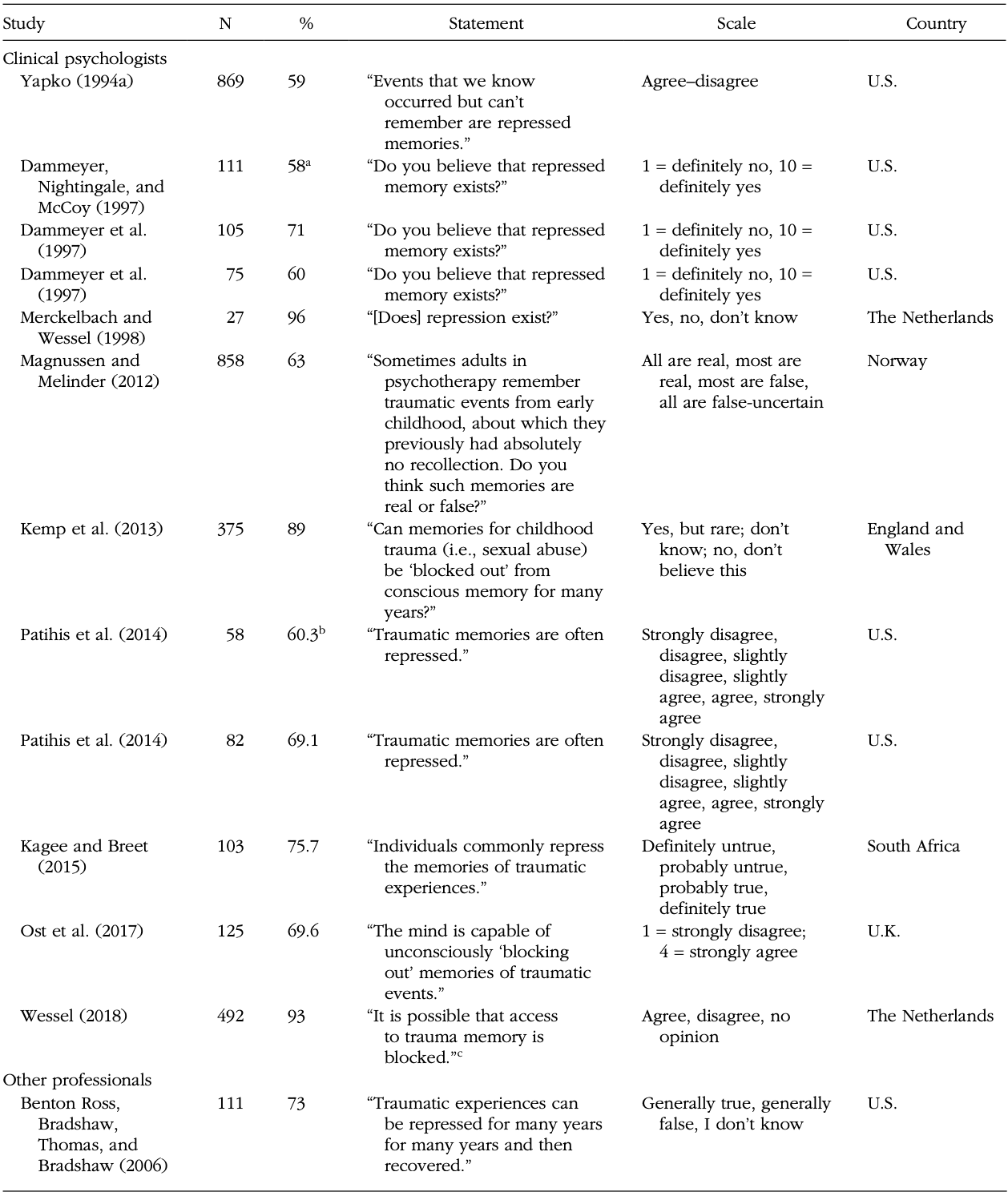
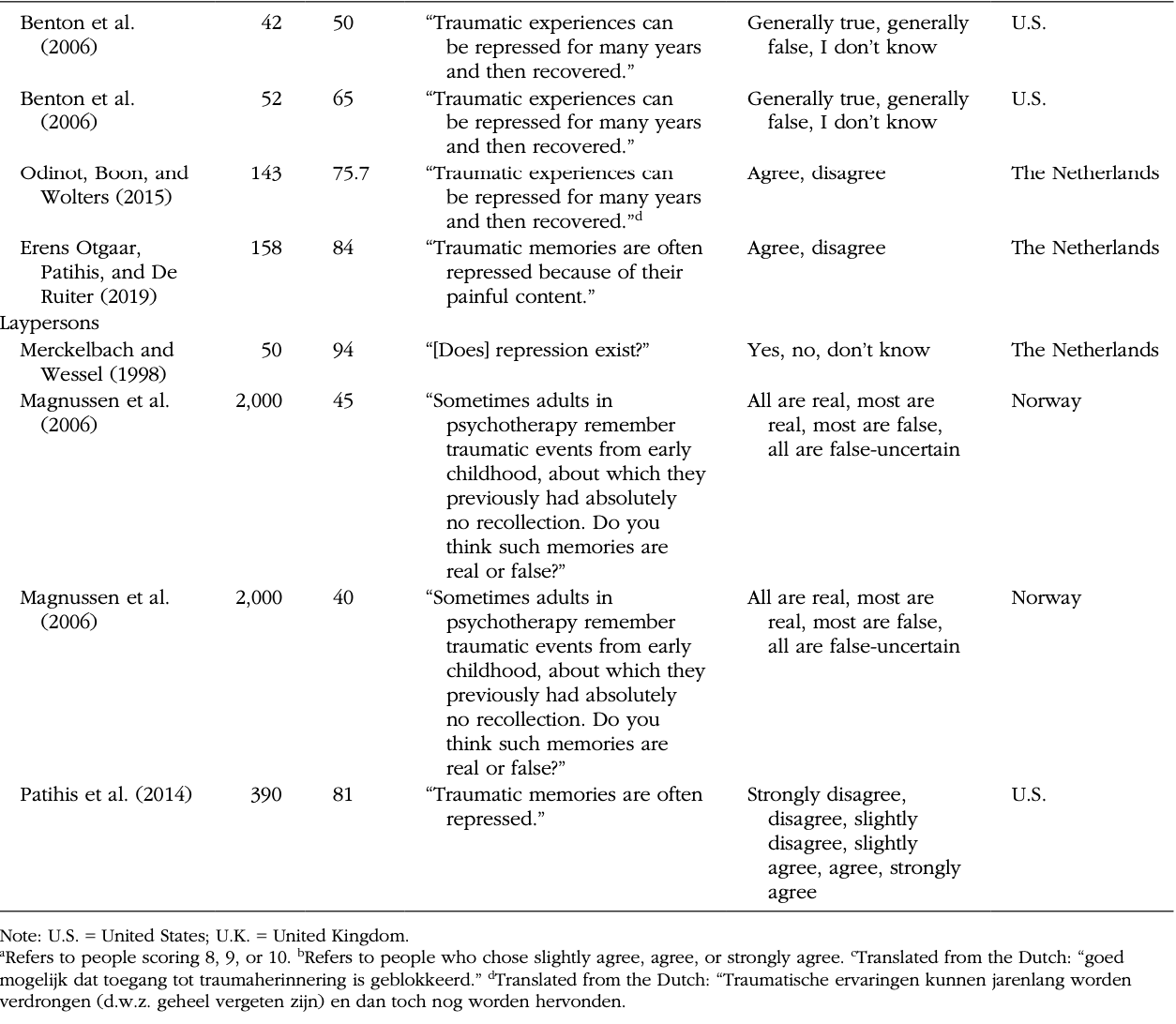
Table 1Table 1 (Continued)

We also performed additional analyses. For example, when we focused only on survey items using the word “repression,” we found a prevalence of 65% (n = 1,265) in the belief of repressed memories. In addition, because the items used differed to some extent among survey studies, we concentrated on statements for which people were asked specifically about the frequency of repressed memories (e.g., “Traumatic memories are often repressed”). When we focused on these statements (Erens et al., 2019; Kagee & Breet, 2015; Patihis et al., 2014), we found that 78% (n = 618) of surveyed people believed that traumatic experiences are often repressed. We also compared the rates of belief in repressed memories in the 1990s with those of all studies performed after the 1990s. A prevalence of 62% (n = 766) was observed for studies in the 1990s; this rate was slightly lower for studies performed after the 1990s (57%; n = 3,979).

Taken together, our data suggest, perhaps surprisingly, that mental-health professionals in our combined samples were not more critical about repressed memories than were laypeople. This finding underscores our argument that a belief in repressed memories is deeply rooted in modern Western societies. Moreover, the data suggest that despite a plethora of scientific work calling the existence of repressed memories into question (e.g., Loftus & Davis, 2006), clinical psychologists’, other mental-health professionals’, and the general public’s views on repressed memories remain strong. Furthermore, it seems that belief in repressed memories even increased within clinical psychologists.

Still, in certain groups of professionals, notably those working in legal psychology, skepticism regarding repressed memories is high. For example, Kassin, Tubb, Hosch, and Memon (2001) found that 22% of experts opined that repressed memories are “reliable enough” to present as evidence in the courtroom. Likewise, some recent research suggests that memory scientists tend to harbor strong reservations concerning the existence of repressed memories (only 12.5% agreed that repressed memories can be retrieved in therapy accurately; 27.2% of experimental psychologists agreed to some extent that traumatic memories are often repressed; Patihis, Ho, Loftus, & Herrera, 2018). It is important to emphasize that many informed scientists are skeptical: It counters the argument that repressed memories must exist because so many people believe in them, a tempting logical error termed the bandwagon fallacy (Briggs, 2014).

Many of these surveys relied on the terms repression or repressed memories. These terms may have all kinds of connotations, leading to artificially raised endorsement patterns suggestive of belief in repressed memories. Brewin, Li, Ntarantana, Unsworth, and McNeilis (2019; Study 3) recently argued that high endorsement rates in the belief in repressed memories (to the statement “Traumatic experiences can be repressed for many years and then recovered”) actually reflect a belief in conscious memory suppression (see section below on retrieval inhibition). They found that when members of the general public were asked about their belief in conscious repression and were questioned regarding repressed memories (“Traumatic experiences can be repressed for many years and then recovered”), similar endorsement rates were found. However, because Brewin and colleagues did not include a survey item on unconscious repression, it is unknown which endorsement rates would be detected for such a controversial statement. To remedy this omission, Otgaar et al. (2019) specifically inquired about people’s belief in unconscious repression. They found high endorsement rates for belief in both conscious and unconscious repression (around 60%), implying that the belief in repressed memories is still widespread. In what follows, we show that, as is true for the belief in repressed memories, dissociative amnesia, a conceptual twin of repression, has been deeply embedded into psychology lore in such a way that it could be the most potent threat to extending the memory wars.

Dissociative Amnesia = Repressed Memories?

Despite the widespread belief in repressed memory, the term “repression” became controversial in the memory wars and is now seldom used in a credible context in scientific publications. After the concept became intensely controversial, many clinicians adopted a new and perhaps more palatable term dissociative amnesia. This term became the preferred and more widely used appellation for the process whereby traumas are rendered inaccessible. For example, dissociative amnesia is mentioned in DSM–5 (American Psychiatric Association, 2013), whereas repressed memory or repression is not.

There might be several reasons for why dissociative amnesia is listed in the DSM–5. One likely reason is that the substantial majority of the Task Force members of the DSM–5 were psychiatrists rather than psychologists, and the Task Force did not include memory experts (see Yan, 2007). This Task Force also did not adequately reflect the full range of scientific opinions regarding the empirical status of dissociative disorders, including dissociative amnesia. Indeed, as Lilienfeld, Watts, and Smith (2012) noted the following:

It is troubling that the DSM–5 Anxiety, Obsessive-Compulsive Spectrum, Posttraumatic, and Dissociative Disorders Work Group contains no members who have expressed doubts in scholarly outlets regarding the etiology of dissociative identity disorder and related dissociative disorders (e.g., dissociative amnesia, dissociative fugue), despite the fact that these disorders are exceedingly controversial in the scientific community. (p. 831)

Case studies of patients claiming dissociative amnesia have also figured prominently in the clinical literature, in turn perhaps contributing to the prima facie validity of the construct of dissociative amnesia (e.g., Staniloiu, Markowitsch, & Kordon, 2018).

We propose that during and after the 1990s, when the term repressed memory was widely criticized, proponents began to favor the term dissociative amnesia instead. Perhaps Holmes (1994) was one of the first to notice this trend:

In the absence of good laboratory or clinical evidence for repression, proponents of the concept have begun to emphasize dissociation instead. But that is simply another name for repression; if one dissociates oneself from an event (is no longer aware of it), one has repressed it. Dissociative amnesia is supposed to occur after certain traumatic experiences. Yet alleged cases of this phenomenon are very rare. (p. 18)

Consistent with this idea, dissociative amnesia was not mentioned in pre-1990s work on repression by Holmes (1972, 1974) and Holmes and Schallow (1969). This subtle but significant name change has muddied the waters and provided a cover for the continued practice of psychotherapy that involves repressed memories, albeit under new terminology.

Dissociative amnesia is defined in the DSM–5 as the “inability to recall autobiographical information” that (a) is “usually of a traumatic or stressful nature,” (b) is “inconsistent with ordinary forgetting,” (c) should be “successfully stored,” (d) involves a period of time when there is an “inability to recall,” (e) is not caused by “a substance” or “neurological . . . condition,” and (f) is “always potentially reversible because the memory has been successfully stored” (American Psychiatric Association, 2013, p. 298). These defining features serve as an umbrella set of criteria for three types of dissociative amnesia listed in the DSM–5. Localized dissociative amnesia applies to memory loss for a “circumscribed period of time” and may be broader than amnesia for a single traumatic event, for example, “months or years associated with child abuse” (p. 298). Because localized dissociative amnesia most resembles what was formerly called repressed memory, it is noteworthy that the DSM–5 calls this type “the most common form of dissociative amnesia.” In selective dissociative amnesia, the individual “can recall some, but not all, of the events during a circumscribed period of time” (p. 298). Generalized dissociative amnesia involves “a complete loss of memory for one’s life history” and “is rare” (p. 298). The DSM–5 indicates “histories of trauma, child abuse, and victimization” as features that support a diagnosis of dissociative amnesia (p. 299).

Although dissociative symptoms can manifest themselves in contexts quite different from trauma—for example, after the ingestion or administration of the anesthetic ketamine (Simeon, 2004) or ecstasy, cannabis, and cocaine (van Heugten-van der Kloet et al., 2015)—Table 2 illustrates similarities in the definitions of dissociative amnesia from the DSM–5 and definitions advanced by scientific skeptics of repressed memory (text from Loftus, 1993; and Holmes, 1974). We contend, on the basis of striking parallels in definitions, that skeptical arguments against repressed memories should apply with equal force to dissociative amnesia. More specifically, definitions of both dissociative amnesia and repressed memory share the idea that traumatic or upsetting material is stored, becomes inaccessible because of the trauma, and can later be retrieved in intact form.

Table 2. Side-by-Side Comparisons of the Definitions of Dissociative Amnesia and Repressed Memory
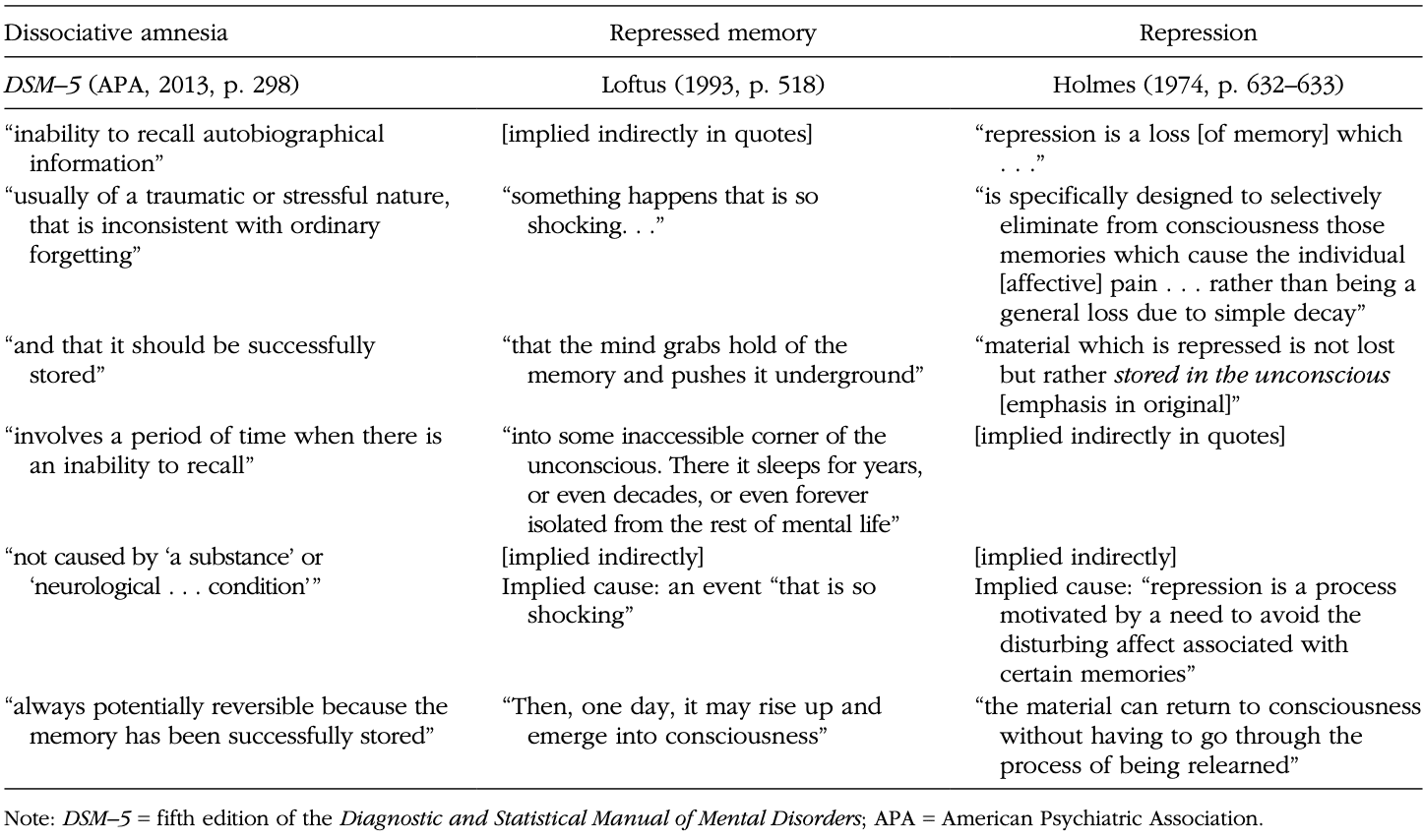
Table 2

Although repressed memory as a concept is rarely defended in scientific circles these days, the idea of dissociative amnesia has become popular, especially in some psychiatric quarters. For example, between 2010 and 2019, the Journal of Trauma & Dissociation has published 71 articles related to dissociative amnesia; between 1990 and 1999, no such articles were published.2 This ascension appears to be a major reason for the revitalization of the memory wars and for the continuation of therapies that attempt to exhume traumatic memories. In the first two editions of the DSM (American Psychiatric Association, 1952, 1968), neither dissociative amnesia nor psychogenic amnesia was listed or mentioned, although dissociative types of neurosis were. Psychogenic amnesia first appeared in the third edition of the DSM (American Psychiatric Association, 1980; mentioned 19 times). Dissociative amnesia appeared for the first time in the fourth edition of the DSM (American Psychiatric Association, 1994; mentioned 50 times). In DSM–5, dissociative amnesia appeared 75 times (American Psychiatric Association, 2013). Interestingly, in no edition of the DSM have the words repress, repressed memory, or repression been used.

The DSM has codified and widely disseminated the concept of dissociative amnesia. In some quarters of psychology and psychiatry, dissociative amnesia is apparently taken as a valid and totally unproblematic concept (with notable exceptions; see Pope, Poliakoff, Parker, Boynes, & Hudson, 2007). Nevertheless, the definition of dissociative amnesia is scientifically fraught in many respects, just as is repressed memory. There are inherent problems when trying to ascertain whether a trauma has been stored but is nevertheless inaccessible. First, there is the complex problem of the lack of falsifiability: The only way we can determine whether a memory was stored is by memorial report, but a memorial report instantly disproves the claim that the memory is inaccessible. Second, it is difficult to test, or falsify, whether psychological trauma is the reason why an event is not remembered. How this is established depends in part on the theoretical orientation of the psychologist and whether she or he interprets an inability to recall as having been caused by psychogenic trauma or mundane encoding failures or forgetting mechanisms.

Indeed, one key question is whether cases that seem to document dissociative amnesia or repressed memory can be explained in terms of ordinary memory mechanisms. An example is provided by McNally (2003), who commented on two alleged cases of dissociative/psychogenic amnesia in children who had witnessed a lightning strike. McNally concluded that the memory loss could plausibly be explained by the fact that

both amnestic youngsters had themselves been struck by side flashes from the main lightning bolt, knocked unconscious, and nearly killed. Given the serious effects on the brain of being knocked unconscious by lightning, it is little wonder that these two children had no memory of the event. (p. 192)

The presence of a history of (mild) brain injury in case descriptions of patients diagnosed with dissociative amnesia has also been noted by other authors (Staniloiu & Markowitsch, 2014).

Consider another example that is illustrative of many similar clinical reports. Harrison et al. (2017) claimed to have documented 53 cases of, as the authors preferred to call it, “psychogenic amnesia.” These cases are cited by others as evidence for the existence of dissociative amnesia (Brand et al., 2018). Harrison et al. (2017) asked the amnesics several questions concerning their autobiographical memory. Note that none of these cases adequately satisfied the six tenets of dissociative amnesia discussed earlier. For instance, amnesia due to neurological damage, such as “traumatic brain injury” (American Psychiatric Association, 2013, p. 298), substance use, or other physical causes were not ruled out, which would preclude memory loss from being diagnosed in the DSM–5 as dissociative amnesia. The possibility of head injury causing memory impairment is particularly relevant here, especially because Harrison et al. found that a history of head injury was common in the “psychogenic” cases. In addition, Harrison et al. did not establish whether psychological shock or trauma caused the reported memory problems or that any recalled memories really were inaccessible for a period of time (see also Patihis, Otgaar, & Merckelbach, 2019).

Another issue is that Harrison et al. (2017) did not exclude the possibility that the dissociative amnesia was the result of feigning. This omission is remarkable because many of the patients with dissociative amnesia described by these authors were plagued by financial problems, and it would have been relatively easy to administer symptom-validity tests to them. With these tests, one can gauge whether patients endorse atypical or bizarre symptoms in an attempt to exaggerate their problems (Lilienfeld, Thames, & Watts, 2013; Peters, van Oorsouw, Jelicic, & Merckelbach, 2013). Other authors have found that overreporting of bizarre and implausible symptoms (e.g., “When I hear voices I feel as though my teeth are leaving my body”) is prevalent among those who claim dissociative amnesia (Cima, Merckelbach, Hollnack, & Knauer, 2003). Claiming dissociative amnesia is not the same as suffering from it (see also Peters et al., 2013). With this consideration in mind, Staniloiu and Markowitsch (2014) acknowledged in their review article that “the main challenge posed by the differential diagnosis of dissociative amnesia is to distinguish between true and feigned or malingered amnesia” (p. 237).

Key to our argument is that the evidence that scholars put forward for dissociative amnesia is typically subject to more plausible explanations. McNally (2007) listed several alternative and perhaps more plausible interpretations of the evidence for dissociative amnesia. First, memory problems that emerge after trauma might be caused by everyday forgetfulness and should not be confused with amnesia for the trauma. Second, some dissociative-amnesia theorists have confused organic amnesia with dissociative amnesia. Third, people who have experienced trauma and cannot recollect all of it might have failed to encode relevant parts of the traumatic experience. Fourth, victims of abuse commonly fail to disclose the abuse (e.g., because they feel ashamed), a reporting decision that should not be confused with dissociative amnesia. Fifth, when people cannot recollect any events (even traumatic ones) before the age of about 3 years old, it likely reflects the well-established phenomenon of childhood amnesia (Fivush, Haden, & Adam, 1995; Howe, 2013) rather than dissociation. Sixth and finally, victims of abuse understandably often do not want to think about their traumatic experiences but often cannot help it because of flashbacks and intrusive memories. This phenomenon of suppression should not be confused with repression, and it falls well outside the domain of dissociative amnesia.

The Purported Empirical Evidence for Repressed-Memory Mechanisms

Three main areas of research are typically used to support repressed memories or dissociative amnesia: retrieval inhibition, motivated forgetting, and the relation between trauma and dissociation. Nevertheless, none of them fully supports all six parts of the definition of either concept shown in Table 2.

For example, the phenomenon of retrieval inhibition (M. C. Anderson & Green, 2001; Anderson & Hanslmayr, 2014; M. C. Anderson et al., 2004) suggests that some mechanism inhibits some memories whereas others come to consciousness, and that trying not to think about a memory can make it harder to remember. However, this phenomenon does not meet the six tenets of dissociative amnesia, such as the principle that the event is often traumatic in nature (see also Kihlstrom, 2002). Likewise, some research has shown limbic inhibition via the frontal cortex among individuals with a subtype of PTSD that involves emotional suppression (Lanius et al., 2010). Although interesting, cases of PTSD involving inhibited emotions do not establish that a memory is stored, that it is inaccessible because of trauma and then later becomes accessible. One can inhibit one’s emotions regarding a painful memory while retaining a full recollection of this memory.

Other research has shown that alleged cases of dissociative amnesia were accompanied by increased prefrontal cortex activity and decreased activation of the hippocampus when patients were exposed to stimuli (i.e., certain faces) for which they had reported amnesia (Kikuchi et al., 2009). However, it would be premature to interpret this study as evidence for repressed/dissociated memories. Before concluding that dissociative amnesia is involved, it is imperative to rule out other possible plausible explanations, such as feigned amnesia, which was not investigated in this work. This is all the more remarkable because one of the patients who claimed to be amnesic was worried about his impending marriage, whereas the other patient took a leave of absence from work after he had been involved in an accident.

Retrieval inhibition has been suggested to be “a viable model for repression” (M. C. Anderson & Green, 2001, p. 366). The canonical paradigm used to evaluate retrieval inhibition is the think/no-think paradigm (M. C. Anderson & Green, 2001). In the original version, participants see several unrelated word pairs (e.g., ordeal-roach). After seeing these stimuli, participants are presented with cue words (e.g., ordeal) and are instructed to either recall the associated word (think) or not (no-think). When participants are asked to recall all response words during the presentation of cue words, no-think response words are remembered less accurately. A meta-analysis showed that no-think words were associated with lower recall rates than items that were studied but not asked about during the think/no-think phase (8% reduction; M. C. Anderson & Huddleston, 2012). One problem with this meta-analysis is that no unpublished studies from other labs were included, raising the specter of file-drawer effects and therefore inflated effect sizes. In fact, Bulevich, Roediger, Balota, and Butler (2006) conducted three experiments that failed to replicate the think/no-think memory-suppression effect and noted that “while working on this project, we have become aware of other groups of researchers who have failed to replicate the original M. C. Anderson and Green (2001) results, although most have given up and not attempted to publish their results” (p. 1574). Other memory researchers have recently pointed to unpublished studies that failed to replicate the original think/no-think finding (A. J. Barnier, personal communication, November 17, 2018; I. Wessel, personal communication, January 10, 2019).

Our argument is that the following two research lines are needed in the area of the think/no-think memory-suppression effect. First, empirical work is necessary on the relation between trauma and memory suppression. To date, there is only limited work in this specific domain. For example, Hulbert and Anderson (2018) found that students reporting a greater history of trauma showed more memory suppression than did students who reported having little experience with trauma. Although interesting, this research does not causally establish whether trauma led to more memory suppression. Second, a multicenter replication attempt would yield critical information regarding the robustness, reliability, and potential boundary conditions of the think/no-think memory-suppression effect.

Motivated forgetting of trauma-related words in the directed-forgetting paradigm is another technique held up to support dissociative amnesia (as argued by DePrince et al., 2012 as part of betrayal trauma theory). For example, DePrince and Freyd (2001) argued they had adduced evidence for motivated forgetting in dissociated individuals. In this study, participants scoring low and high on the dissociative-experiences scale (DES; E. M. Bernstein & Putnam, 1986) received several words (trauma-related and neutral) and after each word were instructed to remember or forget the word. The authors found that under divided-attention conditions, participants scoring high on dissociation recalled fewer trauma-related and more neutral words than those scoring low on dissociation. Still, several other researchers could not replicate these results (e.g., Devilly et al., 2007; Giesbrecht & Merckelbach, 2009; McNally, Metzger, Lasko, Clancy, & Pitman, 1998). In recent research, Patihis and Place (2018) found only weak evidence supporting the hypothesis that traumatized and dissociated individuals would forget trauma-related words; only one of eight hypotheses predicted support for differential motivated forgetting. Patihis and Place (2018) pointed out the high number of “degrees of freedom” available to researchers to choose comparisons in such directed-forgetting experiments. As they noted:

Within a given data set, researchers can attempt to demonstrate differential forgetting between the To Be Remembered lists and the To Be Forgotten lists. If that fails they can compare trauma to positive or neutral words. If that fails they can look for statistical significance in several interactions—and they can make all these comparisons with a number of categorisations: on dissociation, trauma, diagnosis, acute stress, which all provide additional degrees of freedom. Given the number of possible combinations, a motivated researcher will likely be able to find one comparison that might be interpreted as motivated forgetting. (p. 630)

Even if this paradigm could consistently reveal that trauma words are remembered less well by dissociated individuals, it would not be evidence that a trauma can be stored and become both inaccessible and ultimately retrievable with accuracy. Furthermore, there is work showing that even directed forgetting of autobiographical memories is not significantly related to the emotional valence of these memories, a finding that runs counter to the expectation that trauma should lead to a distinctive repression effect on memory (Barnier et al., 2007). Despite many assertions in the literature to the contrary, directed-forgetting research provides no compelling evidence for repressed memories or dissociative amnesia. On a more general note, researchers have noted that the memory-impairing effects of directed forgetting may be due to a lack of rehearsal, thereby negating the need to invoke repressed memories (Roediger & Crowder, 1972).

In addition, researchers have heralded the statistical correlation between trauma and dissociative symptoms as support for a general theory that trauma can lead to dissociative amnesia (see Dalenberg et al., 2012, 2014; but see Lynn et al., 2014). However, even if this relation is strong—typically it is not (see Patihis & Lynn, 2017)—this does not establish evidence for dissociative amnesia. Dissociation, as measured by the widely used DES, assesses feelings of depersonalization, derealization, and memory problems. These symptoms are not unlikely correlates of being traumatized or stressed for a period of time. Nevertheless, the DES does not assess dissociative amnesia as it is defined in the DSM–5, despite the use of the word “dissociative.” Specifically, the dissociative-amnesia subscale of the DES (e.g., Stockdale, Gridley, Balogh, & Holtgraves, 2002) contains items such as “finding oneself in a place, but unaware how one got there,” “finding oneself dressed up in clothes one can’t remember putting on,” “finding unfamiliar things among one’s belongings,” “not recognizing friends or family members,” and “no memory of some important personal events (e.g., graduation)” (E. M. Bernstein & Putnam, 1986; pp. 733–734). These items do not describe dissociative amnesia and do not assess reactions to trauma and stored yet inaccessible memories. Rather, they might reflect poor attentive control and commonplace cognitive failures. Indeed, studies have found that in undergraduate samples, scores on the amnesia items of the DES correlate positively and significantly with a measure of poor attentive control—that is, cognitive failures (Merckelbach, Muris, & Rassin, 1999: Study 1, r = .49; Study 2, r = .36; see also Merckelbach et al., 2000); for replication in nonclinical groups, see Bruce, Ray, and Carlson (2007: r = .31–.46).

The picture we have so far does not imply that dissociation is unrelated to memory. Our position is that trauma can sometimes lead to feelings of depersonalization and that, probably because of accompanying stress levels, memory problems might arise. However, this position does not favor the existence of dissociative amnesia, which implies that memories of entire autobiographical experiences have been temporarily inaccessible and can later be completely and accurately recovered (see also Patihis et al., 2019). It is true that some earlier studies (e.g., Eich, Macaulay, Loewenstein, & Dihle, 1997) found suggestive evidence for interidentity amnesia in patients with dissociative identity disorder (DID). However, a more recent series of studies by Huntjens and colleagues demonstrated the importance of distinguishing between what people subjectively report about their memory loss and (the absence of) objective manifestations of such loss. Huntjens, Verschuere, and McNally (2012) assessed the transfer of information between personality states in patients with a diagnosis of DID. Both tests of explicit and implicit memory were included, as well as neutral, emotional, and autobiographical information. The data across studies were consistent in that, subjectively, DID patients reported amnesia between their personality states, but objectively, no evidence emerged for interidentity amnesia (e.g., Dorahy & Huntjens, 2007; Huntjens et al., 2012).

Psychotherapeutic Techniques, Memory Distortions, and Other Side Effects

We now consider the role of therapy in the emergence of repressed memories. We discuss research on how often therapists suggest to clients that they might have repressed memories, the effects of therapy on (false) memory, and the link between psychopathology and (false) memory recovery.

Reports of recovered memories in therapy

We have shown that a large percentage of clinical psychologists continue to believe that repressed memories might occur when people are faced with trauma. A pivotal point here is to know whether such beliefs bear any ramifications in therapeutic contexts. Patihis and Pendergrast (2019) surveyed 2,326 U.S. citizens about memory recovery in psychotherapy. Nine percent (n = 217) of the sample reported that their therapists had discussed the possibility that they (the client) had repressed memories of childhood abuse. Furthermore, those participants were 20 times more likely to report recovering memories of abuse in therapy (that they were unaware of before therapy) than participants whose therapists did not discuss the possibility of repressed memories. Five percent (n = 122) of the public sample reported that in the course of therapy, they had memories of being abused, of which they had no previous memory. Therapists who reported recovering memories engaged in a wide range of therapies, from attachment therapy to cognitive-behavioral therapy. In most therapy types, participants indicated a minority of therapists had discussed the possibility of repressed memories. For some therapies that involve working through past trauma, this occurred more frequently (e.g., attachment therapy, EMDR).

The study by Patihis and Pendergrast (2019) concerned recovered memories in the United States; however, Shaw, Leonte, Ball, and Felstead (2017) examined the frequency of repressed and recovered memories in the United Kingdom. They analyzed cases from the British False Memory Society, which is a charity that supports individuals claiming to have been falsely accused of a crime on the basis of a false memory. The society database contains more than 2,500 cases since 1993. The researchers selected a random sample from the database and found that 84.3% (n = 153) of daughters accusing fathers were said to have undergone a form of therapy ranging from standard psychotherapy to hypnosis. Furthermore, Shaw and Vredeveldt (2019) noted that the Dutch equivalent of the British False Memory Society, the Fictitious Memory Group, received 13 new possible false-memory cases from 2011 and 2018. Importantly, in 77% (n = 10) of these cases, alleged victims underwent some form of therapeutic intervention (e.g., EMDR, reincarnation therapy).

In Germany, a similar false-memory group called False Memory Deutschland (2019) maintains an archive containing cases of individuals claiming to have been falsely accused on the basis of recovered memories of sexual abuse. This group states on its website that at the time of the accusations, 83% (n = 81) of alleged victims had been receiving psychotherapy. Even more interesting, the number of accusations has increased since 2002. All in all, reports of repressed memories in therapy occur on a nontrivial scale and can be found in many different countries. Of course, here too, the data should be interpreted with caution because selection biases might play a role. Still, the data provide additional evidence that the issue of repressed memories has not disappeared, and there are even some indications that that it has made a resurgence, at least in some areas (see also below).

Therapy and side effects

One of the most important hypotheses underlying the memory wars was that during psychological treatment, some therapists suggested to clients that they had repressed a memory of trauma, which might have engendered false memories. Although experimental work has confirmed that suggestive questions can elicit false memories (Scoboria et al., 2017), a paucity of systematic research exists on how therapy shapes memory. Goodman, Goldfarb, Quas, and Lyon (2017) investigated whether therapy during a child sexual-abuse prosecution predicted memory consistency (10–16 years later). Interestingly, the authors found that therapy use positively correlated with memory consistency. Specifically, alleged victims who received therapy during or shortly after the prosecution were more likely to correctly remember abuse-related details (e.g., name of the perpetrator, perpetrators’ age) than those who did not. The use of nonsuggestive psychotherapy may aid memory consistency rather than hinder it. However, consistent remembering is not the same as accurate remembering (Smeets, Candel, & Merckelbach, 2004; Talarico & Rubin, 2003).

Nevertheless, Goodman et al. (2017) did not specifically assess whether the type of therapy used was related to memory accuracy, and no causal conclusions concerning the effect of therapy on memory accuracy could be drawn from their study. Establishing a causal relation is important because some therapies, such as EMDR and psychoanalytic therapies, rely on patients retrieving specific autobiographical memories, and hence there might an increased risk of false memories. Furthermore, an important issue is whether certain therapies might increase people’s proneness to acquiesce with suggestions and form false memories. Indeed, Goodman et al. (2017) argued that “a study using an experimental design with random assignment to groups to investigate the effects of therapeutic intervention on true and false memory for traumatic events would be a welcome contribution to this important field of study” (p. 929). Houben, Otgaar, Roelofs, and Merckelbach (2018) addressed this issue by examining the effect of eye movements as provided in EMDR on false-memory formation (i.e., reporting of misinformation). Participants who received eye-movement treatments were more susceptible to creating false memories than participants who did not receive eye-movement treatments. Presumably, eye movements degraded memory, which might make people more susceptible to accept external misleading information—which could result in false memories (but see also van Schie & Leer, 2019). So, although eye movements as in EMDR may improve memory retrieval (e.g., Lyle, 2018), they might also increase people’s willingness to accept external suggestions.

In addition to focusing on the effects of therapy on memory performance, it is imperative to examine unwanted side effects of psychotherapy as reported by the therapists and patients themselves. Although this work is limited, research has shown that psychotherapy can in some cases engender negative side effects (Lilienfeld, 2007; Merckelbach, Houben, Dandachi-Fitzgerald, Otgaar, & Roelofs, 2018; Rozental et al., 2018). Of special interest are studies that examined the relation between therapy and memory. For example, Rozental, Kottorp, Boettcher, Andersson, and Carlbring (2016) surveyed participants who had been in treatment for social anxiety and found that the most frequently endorsed side effect of treatment was “unpleasant memories resurfaced” (n = 251; 38%).

Especially relevant are studies examining what happened after clients recovered memories via therapy. Fetkewicz, Sharma, and Merskey (2000) noted that suicide attempts increased after patients received recovered-memory therapy, although the absence of a comparison group of patients who did not receive such interventions mitigates their conclusions. Loftus (1997) observed a similar pattern with patients who received compensation after recovering memories in therapy. Before memory recovery, 3 patients (10%) reported thinking about committing suicide, whereas after recovery 20 patients (67%) reported being suicidal. Of course, it cannot be concluded that this specific therapy caused these suicide attempts or feelings, but it is concerning that patients can become more symptomatic after such therapeutic interventions. Collectively, research on the negative side effects of therapy, although limited in quantity, suggests that negative effects of therapy may not be negligible and that memory recovery may play a role in deterioration.

Psychopathology and false memory

Another way to examine the role of therapy in the reported unearthing of repressed memories is to determine whether people with some form of psychopathology are at higher risk for false memories than are people without psychopathology. This information is vital because people might seek an explanation for their disorder in therapy (cf. “effort after meaning,” Bartlett, 1932), and therapists might actively search for such explanations in patients’ memories and thereby create a springboard for false memories. Authors have voiced differing opinions with regard to the relation between psychopathology and false-memory generation. For example, Bookbinder and Brainerd (2016) stated that “with respect to PTSD especially, available data do not provide a consistent picture of false memory effects” (p. 1345). In contrast, Scoboria et al. (2017) opined that “people struggling with psychopathology who seek help for their symptoms may be particularly vulnerable to suggestions” (p. 160).

Otgaar, Muris, Howe, and Merckelbach (2017) recently reviewed the body of empirical work related to psychopathology and false-memory creation. Specifically, they focused on false-memory effects in people with PTSD, depression, and a history of trauma and found that in most of these studies, researchers used the Deese/Roediger-McDermott (DRM) false-memory paradigm (Deese, 1959; Roediger & McDermott, 1995). In this paradigm, participants receive word lists containing associatively related words (e.g., night, pillow, moon). During recall and recognition tasks, participants frequently misremember a related but not presented word called the critical lure (in this case, sleep). Otgaar, Muris, et al. (2017) also included experiments that relied on emotionally charged word lists related to some aspects of the participants’ psychopathology. For example, for patients with depression, lists could be used that focused on the word sad. The general finding from the review was that people with PTSD, depression, or a history of trauma were at increased risk of forming false memories when they received word lists linked to their symptoms (see also Howe & Malone, 2011). There is good evidence that certain forms of psychopathology (e.g., schizophrenia) go hand in hand with a tendency to accept and give in to external pressure (Peters, Moritz, Tekin, Jelicic, & Merckelbach, 2012). More importantly, existing work also indicates that psychopathology (i.e., depression, PTSD) is linked to an enhanced propensity to produce spontaneous false memories.

The implications of this review should be drawn with care, however, because spontaneous false memories as induced by the DRM paradigm are typically weakly related or even unrelated to false memories induced by suggestion (e.g., D. M. Bernstein, Scoboria, Desjarlais, & Soucie, 2018; Calado, Otgaar, & Muris, 2019; Nichols & Loftus, 2019; Ost et al., 2013; Otgaar & Candel, 2011; Patihis, Frenda, & Loftus, 2018; Zhu, Chen, Loftus, Lin, & Dong, 2013). So, although psychopathology seems to be related to an increased vulnerability for spontaneous false-memory production, this does not necessarily imply that it is also linked to an increased susceptibility to suggestion-induced false memories.

The Creation of Implanted False Memories

Many battles of the memory wars revolved around the issue of therapists who informed patients that they had repressed memories of childhood. The fact that some therapists suggested to patients that they had been sexually abused raised concerns regarding false memories in psychotherapy (Loftus, 1994) as well as whether suggestive therapeutic interventions could fuel false-memory formation. Focusing on cases in which recovered memories surfaced, researchers began to examine the conditions, such as the types of events suggested, under which false events could be inadvertently implanted in memory. Specifically, a question that was addressed was whether false events could be implanted and whether even emotionally negative false memories could be formed.

False events and implanted false memories

Researchers have used the false-memory-implantation paradigm to demonstrate that entire events, ranging from positive (e.g., a birthday party) to negative (e.g., getting lost in a shopping mall), can be implanted. In the false-memory-implantation paradigm (Loftus & Pickrell, 1995), participants are asked what they can remember about a true experienced event and a false event. Participants are (falsely) told that their parents confirmed that these events were experienced by the participants. During multiple suggestive interviews, about 30% of participants claim to remember the false event (Scoboria et al., 2017). Studies that have successfully implanted negative events bear special relevance to the claim that recovered memories of abuse may be instances of rich false memories.

For example, Hyman et al. (1995) found in their implantation study that at the second suggestive interview 10% (n = 2) of their subjects falsely remembered that they spent a night at the hospital because of a high fever and an ear infection. Loftus and Pickrell (1995) showed that 25% (n = 6) of their sample created false memories of being lost in a shopping mall. Porter, Yuille, and Lehman (1999) implanted several negative events (i.e., getting lost, serious medical procedure, getting seriously hurt by a child, animal attack, indoor accident), and percentages of implantation ranged from 16.7% (n = 3; getting lost) to 36.8% (n = 7; animal attack). Shaw and Porter (2015) found that 70% (n = 21) of participants formed false memories of committing a crime (but see Wade, Garry, & Pezdek, 2018, who used another scoring method and reported that only 26% to 30% of Shaw and Porter’s subjects formed false memories).

Of course, the events that have been implanted in experimental studies on false memories differ in various ways from recollected events in real cases (e.g., sexual abuse), which almost always involve feelings of shame and taboo (Goodman, Quas, & Ogle, 2010). Indeed, when Pezdek, Finger, and Hodge (1997) attempted to implant an experience of a rectal enema in adult participants, none of them fell prey to the suggestion. However, this is not to say that such events cannot be implanted in memory. Otgaar, Candel, Scoboria, and Merckelbach (2010) found that during the second interview, six children (10%) falsely reported having received a rectal enema (see also Hart & Schooler, 2006). Furthermore, in general, research suggests that negative events are more likely to be misremembered than are more mundane events (e.g., Otgaar, Candel, & Merckelbach, 2008; Porter, Taylor, & ten Brinke, 2008). This finding has been explained by the fact that because emotionally negative memories contain a high level of connectivity with other memories, it is relatively easy to activate and then remember events that were not experienced but related to the experienced event (e.g., Bookbinder & Brainerd, 2016; Otgaar, Merckelbach, et al., 2017).

Although one could argue that the type of events implanted in false-memory research do not match events of interest in legal cases, in false-memory-implantation studies, participants are generally interviewed two or three times in a suggestive fashion, whereas legal cases often drive home the point that people with false memories received suggestive interviews by therapists over the course of years (Maran, 2010; van Til, 1997). It seems safe to assume that with enough suggestive pressure, even extreme negative events may be implantable in memory.

Estimating the prevalence of false-memory implantation

Researchers have tried to estimate the percentage of individuals who develop false autobiographical memories in the laboratory. Such experiments have mainly involved healthy undergraduate students who are confronted with suggestive information, after which their memory reports are evaluated for indications of accepting false information. Attempting to come up with an accurate estimate is, however, a daunting task because studies differ in terms of coding and criteria for defining a report of false memory. Brewin and Andrews (2017) reviewed false-memory-implantation studies and concluded that in 15% of the recollective experiences induced by the implantation method, statements were rated as full-blown false memories. They argued that this statistic shows that “susceptibility to false memories of childhood events appears more limited than has been suggested” (p. 2).

Nevertheless, the review by Brewin and Andrews (2017) has been criticized (for a critical analysis, see Otgaar, Merckelbach, et al., 2017). First, as mentioned previously, the coding of false memories varied among false-memory-implantation studies. Therefore, Scoboria et al. (2017) devised a new coding system based on theories concerning remembering (e.g., Brewer, 1996; Conway & Pleydell-Pearce, 2000; Johnson, Hashtroudi, & Lindsay, 1993; Rubin, 2006). Using this system, they recoded transcripts from eight published false-memory-implantation studies. Overall, they found that 30.4% of transcripts were coded as false memories, which is twice the percentage that Brewin and Andrews (2017) reported. In addition, in the analysis by Scoboria et al., an additional 23% of cases were coded as having accepted the false event to some extent.

Second, Otgaar, Merckelbach, et al. (2017) reviewed 15 false-memory laboratory studies that investigated the confidence that participants place in their false memories. The data revealed a mean confidence rating of 74%, with an unweighted 95% confidence interval = [0.66, 0.78].3 Furthermore, in 93% (k = 14) of the studies, false-memory reports had confidence ratings exceeding the midpoint of the rating scale. Clearly, confidence is often high in implanted false memories.

Third, even if we accept the highly conservative 15% as a fair estimate of overall false-memory potential, this percentage still points to a significant problem in legal and therapeutic settings. It means that if a therapist using suggestive prompts consulted with 100 patients, on average, 15 of them might develop illusory autobiographical memories of, for example, sexual abuse, and some might falsely accuse an innocent person because of this memory (Nash, Wade, Garry, Loftus, & Ost, 2017; see also Smeets, Merckelbach, Jelicic, & Otgaar, 2017).

Memory Wars in the Courtroom and Beyond

We have reviewed several lines of evidence showing that the topic of repressed memories continues to be popular although scientifically controversial among psychologists and psychiatrists. We now examine the role of repressed memories and dissociative amnesia in legal cases and the persistence of naive memory beliefs in the courtroom.

Repressed memories and dissociative amnesia in the courtroom

In 2017, a French ministerial report was published proposing to increase the statute of limitations for prosecuting sexual abuse from 20 to 30 years (Flament & Calmettes, 2017). The reason given was that because victims often delay disclosing their abusive experience (e.g., Goodman-Brown, Edelstein, Goodman, Jones, & Gordon, 2003; see also Connolly & Read, 2006), they are still entitled to have their day in court. However, a more controversial reason for increasing the statute of limitations given in the report was that traumatic experiences of abuse could lead to dissociative amnesia (Dodier & Thomas, 2019). Dodier and Thomas rightly noted that the use of such a controversial term in an official governmental report might lead people with a history of trauma to believe that their traumatic memories are atypical and that to uncover additional memories they should rely on methods such as recovered memory therapy that might result in false memories. Admittedly, victims might take many years to disclose their traumatic experiences, but as noted before, there are more plausible explanations than dissociative amnesia for the delay in reporting the abuse, such as feeling ashamed of the trauma and reinterpreting the experience as abusive (e.g., Goodman-Brown et al., 2003; Schooler, 2001). This issue of delayed disclosure is especially relevant to stress, as there is currently much attention regarding historic sexual abuse cases, such as those that emerged in the #MeToo discussion, of which the overwhelming majority has nothing to do with memory repression or recovery (see also Goodman et al., 2017).

There is also evidence of recovered memories entering into some cases in the United Kingdom. The UK Advocate’s Gateway (2015) document on trauma explains to lawyers how to approach traumatized witnesses and victims. It stipulates that dissociative amnesia is possible and argues that “Trauma disrupts the left hemisphere function of the brain. . . . This disruption affects the ability to give a verbal narrative. . . . The right hemisphere of the brain stores implicit or sensory associated memories” (p. 5). This is questionable advice, with some potentially unsupported and pseudoscientific ideas mixed into the document.

An alternative way to examine whether the issue of repressed memories and dissociative amnesia is still prominent in the legal arena is to examine court proceedings and investigate the number of cases in which repressed memories played a role. In the Netherlands, an online database of court rulings (http://www.rechtspraak.nl) exists in which one can search for key terms in a diverse set of cases. The database is not exhaustive in that it only lists the most prominent court rulings. We used the search term verdringing (“repression”) and investigated criminal trials from 1990 to 2018 in which repressed memories were mentioned. Figure 1 demonstrates that cases in which this term was used referring to cases on repressed memories have increased over the past years. When a similar exercise was performed using the search term hervonden herinnering (“recovered memory”), a similar pattern emerged. Moreover, when we used the term dissociatieve amnesia (“dissociative amnesia”), again, we found that this term is on the rise.

Fig. 1. Number of Dutch legal cases mentioning repression, recovered memory, or dissociative memory from 1990 to 2018.
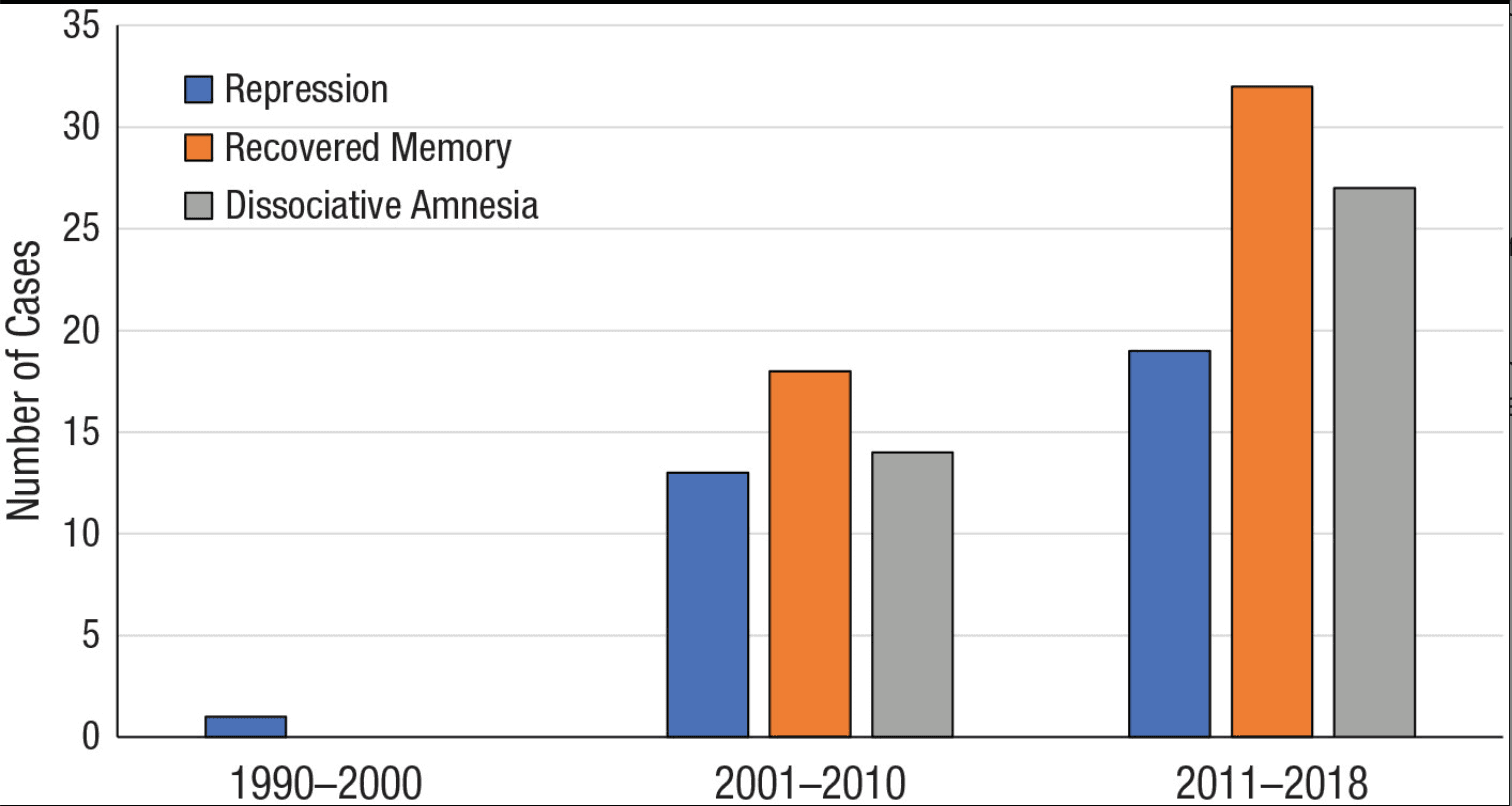
Figure 1

Caution should be exerted when interpreting these data. First, it is remarkable that virtually no legal cases were found on repression and recovered memory from 1990 to 2000. One reason might be that such older cases are not represented in this database. Second, although issues such as repressed and recovered memories were discussed in these criminal trials summarized by pertinent court rulings thereafter, judges did not necessarily accept these notions uncritically. Nonetheless, these data demonstrate that, at least in the Netherlands, legal professionals still use the Freudian and neo-Freudian nomenclature of repression and dissociative amnesia.

Memory beliefs in the courtroom

Although we have discussed naive beliefs about memory across a variety of lay and professional populations, these beliefs can be especially problematic in the courtroom. Because judicial outcomes may be influenced by the naive beliefs about memory that triers of fact harbor, it is critical that when testimony consists mainly of memory evidence (e.g., remembering event details, identifying the perpetrator), actors in the legal domain possess a scientifically informed view of how memory works.

To appreciate how the disconnect between the science of memory and the beliefs held by individuals in the legal arena can lead to unsafe convictions, one can examine the cases listed on the Innocence Project websites in the United States (http://www.innocenceproject.org) and the United Kingdom (http://www.innocencenetwork.org.uk). The most common factor in these false convictions has been faulty memory evidence (i.e., incorrect eyewitness identifications are implicated in more than 70% of cases). Police and prosecutors apparently made decisions about this memory evidence perhaps without exactly understanding the science of how memory works and often because other more objective evidence was lacking (for reviews, see Howe & Knott, 2015; Howe, Knott, & Conway, 2018).

Judges and prosecutors alike differ as to whether they will accept expert memory testimony. For example, in a Dutch revision case in which dissociative memories of abuse were the central issue, one senior prosecutor opined that in contrast to DNA experts, psychological experts do not aid judges in helping them to understand the intricacies of statements by witnesses or defendants (https://uitspraken.rechtspraak.nl/inziendocument?id=ECLI:NL:PHR:2015:2769). He added that the field of legal psychology is known for its lack of consensus and for its high degree of subjectivity, which is hyperbolic when one looks at the generally broad consensus on a range of topics found in surveys among legal psychologists (Kassin, Redlich, Alceste, & Luke, 2018; Kassin et al., 2001). Furthermore, research clearly indicates that judges routinely overestimate jurors’ ability to understand and correctly use memory evidence when in fact it is based solely on their “common sense”—such as that memory works like a video camera (e.g., Houston, Hope, Memon, & Read, 2013; Magnussen et al., 2010); for the Scooter Libby effect, see also Kassam, Gilbert, Swencionis, & Wilson, 2009).

The question of whether jurors’ commonsense views of memory in court are adequate also extends to cases in which adults are recollecting events that happened decades earlier in childhood. As elsewhere, it is not a given that judges will necessarily accept scientific expert testimony about memory in their courtroom to counteract the commonsense views held by jurors and others involved in the judicial system. Progress has been made in some U.S. states in which judges in trials involving eyewitness identification must now present jurors with cautions about the reliability of such evidence before their deliberation (State of New Jersey v. Henderson, 2011). In Pennsylvania, Loftus, Francis, and Turgeon (2012) drafted jury instructions that addressed issues concerning a broad spectrum of expert memory testimony. Likewise, in the United Kingdom, judges are now obligated to give juries so-called Turnbull guidelines in the cases that heavily rely on eyewitness identification (Trevelyan, n.d.). Admittedly, these are but a few recent examples, and much more research needs to be conducted to counteract the impact of erroneous lay beliefs about memory in the courtroom.

Furthermore, it is also imperative that such guidelines are not fixed but are provisional and can be updated any time. Guidelines are ideally based on the current corpus of scientific findings, but new findings might warrant amendments. For example, previous research has suggested that the confidence that eyewitnesses place in their identification is only weakly related to their accuracy. In contrast, recent research has demonstrated that under optimal conditions, confidence is strongly predictive of accuracy (Sauerland & Sporer, 2009; Wixted & Wells, 2017). It is important to be cognizant about such new developments.

Memory wars in the scientific literature

One might posit that although the controversial issue of repressed memories is still relevant in clinical and legal contexts, the debate concerning repressed memories is now muted in the scientific literature. There are two indications that this is not the case. First, in a recent bibliometric analysis, Dodier (2019) examined the number of publications and citations regarding repressed and recovered memories from 2001 to 2018. The author found that proponents and opponents of repressed memories have continued to publish articles about repressed and recovered memories throughout the time period. Notably, these articles were cited just as often as articles published during the presumed heyday of the memory wars in the 1990s. In addition, the year 2018 witnessed an increase in publications on this topic. This increase was characterized by a mix of articles in favor or against the concept of repressed memories. Specifically, of the 16 articles in 2018, 5 (31%) were largely or entirely in favor of the existence of repressed memories, whereas 9 (56%) articles expressed skepticism regarding the existence of repressed memories (two articles adopted a neutral position).

Second, the debate over repressed memories and dissociative amnesia has hardly vanished from the scientific literature. For example, Brand, Schielke, and Brams (2017) and Brand, Schielke, Brams, and DiComo (2017) recently tried to provide legal professionals with evidence-based knowledge on trauma-related dissociation and concomitant effects such as dissociative amnesia. Their articles provoked a disagreement between them and memory researchers who argued that their conclusions were not based on evidence and potentially hazardous (Brand et al., 2018; Merckelbach & Patihis, 2018; Patihis et al., 2019). Debates relating to the issue of dissociative amnesia, repressed memories, or both, are clearly alive and well in the scientific literature (see also Staniloiu & Markowitsch, 2014).

Conclusion

The claims of some authors to the contrary, the controversial topic of repressed memories and dissociative amnesia continues to be very much alive in clinical, legal, and academic contexts. Converging lines of evidence suggest that concerns regarding the widespread belief in repressed memories are far from having been resolved following the memory wars of the 1990s. Across many different professionals (e.g., psychotherapists), the percentage who believe in repressed memories remains high, generally above 50%. Furthermore, the idea of repressed memories has merely become popular under a different name—dissociative amnesia—which shares many characteristics with repressed memory and that carries the added cachet of being associated with the DSM–5 (American Psychiatric Association, 2013). In addition, research points to the possibility that some therapeutic techniques exert adverse effects by potentially increasing the likelihood of false memories. Finally, questions of repressed memories continue to be addressed in the courtroom and in the scientific literature. Taken together, these different threads of evidence imply that falsely recovered memories of abuse continue to pose a substantial risk in therapeutic settings, potentially leading to false accusations and associated miscarriages of justice.

A relevant question is how flawed ideas regarding the functioning of memory could be corrected. That unconscious repressed memory is still accepted with little qualification and remains popular among many mental-health professionals can be explained in part by the now well-replicated finding that it is typically difficult to correct erroneous beliefs. Specifically, when people are confronted with any form of misinformation (e.g., fake news), correcting such errors is challenging, a phenomenon referred to as the continued-influence effect (Lewandowsky, Ecker, Seifert, Schwarz, & Cook, 2012; see also Lilienfeld, Marshall, Todd, & Shane, 2014) or belief perseverance (C. A. Anderson, Lepper, & Ross, 1980). However, recent studies suggest that informing people that their firmly held beliefs are incorrect (“prebunking”), and even providing them with the correct alternative information (debunking), can often be effective in correcting these beliefs (e.g., Blank & Launay, 2014; Crozier & Strange, 2019). In addition to applying these provisional but promising methods, it is crucially important to educate individuals, especially legal professionals and clinicians, about the science of memory. This effort is all the more essential given that these professionals are often in close contact with victims, patients, witnesses, and suspects. Such interactions are a prime opportunity for inadvertent memory contamination. Increasing their awareness of potentially harmful beliefs about repressed memories should therefore be a priority in clinical and legal work as well as for psychological scientists at large.

Open Article as PDF

Abstract

Can purely psychological trauma lead to a complete blockage of autobiographical memories? This long-standing question about the existence of repressed memories has been at the heart of one of the most heated debates in modern psychology. These so-called memory wars originated in the 1990s, and many scholars have assumed that they are over. We demonstrate that this assumption is incorrect and that the controversial issue of repressed memories is alive and well and may even be on the rise. We review converging research and data from legal cases indicating that the topic of repressed memories remains active in clinical, legal, and academic settings. We show that the belief in repressed memories occurs on a nontrivial scale (58%) and appears to have increased among clinical psychologists since the 1990s. We also demonstrate that the scientifically controversial concept of dissociative amnesia, which we argue is a substitute term for memory repression, has gained in popularity. Finally, we review work on the adverse side effects of certain psychotherapeutic techniques, some of which may be linked to the recovery of repressed memories. The memory wars have not vanished. They have continued to endure and contribute to potentially damaging consequences in clinical, legal, and academic contexts.

Ongoing Debates About Memory

For over 20 years, a debate has existed about "repressed memories," which are memories thought to become unavailable to awareness due to a process called repression. This discussion, known as the "memory wars," was believed by some to have ended. Skeptics of repressed memories suggested that most experts now question the scientific basis of such memories. However, others argued that new evidence supports a trauma-dissociation model, making a skeptical view of these memories less valid. Some proponents even compared skeptics to those who deny climate science, pointing to the continued inclusion of "dissociative amnesia" in the Diagnostic and Statistical Manual of Mental Disorders (DSM–5) as proof of their position.

Evidence suggests that the debate over repressed memories is far from over. In fact, it continues today, with "dissociative amnesia" often serving as a replacement term for repressed memory. Many sources indicate that the idea of repressed memories has not disappeared but has simply taken on new forms, such as dissociative amnesia. While some researchers acknowledge the ongoing nature of these "memory wars," a thorough evaluation of this idea has been lacking. This discussion aims to show that beliefs linked to repressed memories and related concepts like dissociative amnesia are still very much present and pose significant risks in clinical and legal situations.

Repressed Memories and the Memory Wars

The idea of repressed memories originated from Sigmund Freud's psychoanalytic theory in the late 19th century. This concept suggests that highly distressing experiences can be so overwhelming that people use defense mechanisms to cope. One such mechanism is the automatic and unconscious repression of the traumatic memory. This means individuals may no longer remember or be aware of the experience that caused it. Despite this lack of conscious recall, the repressed trauma is believed to cause severe mental and physical harm, showing up as various psychological and physical symptoms. The main goal of therapy in this view is to bring these hidden, repressed experiences into conscious awareness to relieve symptoms. Thus, the concept involves three main ideas: traumatic experiences are repressed, repressed content can cause mental health problems, and recovering this content is essential for healing.

During the 1990s, belief in repressed memories was widespread among therapists. Many clinicians interpreted symptoms like anxiety or mood disorders as signs of deeply repressed memories of abuse, even if patients did not recall such events. Techniques like dream interpretation, hypnosis, guided imagery, and repeated prompting were commonly used by practitioners to supposedly uncover these memories, often of sexual abuse. As a result, some patients reported recovering memories of abuse and subsequently filed legal actions against their alleged abusers.

At the same time, laboratory research began to show how easily false memories could be created through suggestion. For instance, in one early study, participants were asked about childhood events, including a fabricated one about being lost in a shopping mall. After several suggestive interviews, a quarter of the participants claimed to remember the false event. This and similar studies showed that false autobiographical memories could be implanted using suggestive interview techniques.

Based on this research, many memory scholars argued that memories recovered in therapy might not be true events but rather false memories. Another explanation offered is that some people might re-interpret past childhood events as traumatic during therapy, mistakenly believing they have recovered a forgotten memory when it was accessible all along but simply re-understood. However, demonstrating the actual existence of truly recovered memories in such cases presents inherent problems, as therapeutic influences or the misinterpretation of "forgotten" versus "unreported" experiences can complicate conclusions.

The concept of repressed memories also faces challenges from studies on how trauma affects memory. Research generally suggests that the main aspects of traumatic events tend to be remembered quite well, not forgotten completely. For example, complete memory loss for trauma is rare among survivors of events like the Holocaust or sexual abuse. Furthermore, the idea of repressed memories often contradicts established principles of human memory, such as the fact that repeated events are usually well-remembered. People with post-traumatic stress disorder (PTSD) often experience intrusive memories and flashbacks, indicating they do not typically repress the memory of their traumatic event. The spontaneous recovery of forgotten memories is a normal phenomenon, but the idea of completely repressing a highly detailed traumatic memory and later fully recalling it in therapy is less plausible, especially without independent evidence.

Memory Beliefs About Repressed Memories

Surveys of mental health professionals show that incorrect beliefs about memory can lead to suggestive clinical practices. In the 1990s, early surveys found that many psychotherapists believed that traumatic memories uncovered through hypnosis were authentic or that forgotten events were repressed memories. A significant percentage of clinicians also believed that memory becomes reliable once repression is lifted. Studies throughout the 1990s consistently showed high percentages of clinical psychologists and other mental health professionals endorsing the existence of repressed memories, with some surveys reporting nearly universal belief among psychotherapists.

Despite extensive scientific research published since the 1990s that questions the concept of repressed memories, many psychologists, particularly clinical and counseling psychologists, continue to believe that traumatic memories can be buried and later recovered. More recent surveys from the 2010s show that a majority of licensed psychologists, clinical psychologists, psychoanalysts, and EMDR practitioners still hold strong beliefs in recovered memories or the idea that traumatic memories can be "blocked out" for many years.

These beliefs are not limited to mental health professionals. Surveys of other professionals, such as jurors, judges, law-enforcement personnel, and child-protection workers, also show high rates of belief in long-term repressed memories. Laypersons, including undergraduates and the general public, likewise demonstrate significant belief in the existence of repressed memories, with television often cited as a source of this information. Overall, more than half of all people surveyed across various groups expressed some belief in repressed memories.

Interestingly, mental health professionals, in general, were not found to be more critical of repressed memories than laypersons. This suggests that belief in repressed memories is deeply ingrained in modern Western societies and has remained strong despite scientific challenges. In fact, belief among clinical psychologists appears to have even increased in recent years. However, some professional groups, particularly legal psychologists and memory scientists, show greater skepticism regarding repressed memories. It is important to note that the widespread belief in a concept does not make it scientifically true, a logical error known as the bandwagon fallacy.

Some research suggests that high rates of belief in "repressed memories" might actually reflect a belief in conscious memory suppression rather than unconscious repression. However, studies specifically asking about unconscious repression also found high endorsement rates, implying that the belief in truly repressed memories remains widespread. This continued strong belief sets the stage for the ongoing "memory wars," particularly as the concept of dissociative amnesia has gained prominence.

Dissociative Amnesia Equals Repressed Memories?

Following intense criticism of the term "repression" during the memory wars, "dissociative amnesia" became a more widely accepted and less controversial term to describe the process of traumatic memories becoming inaccessible. This term is now included in the DSM–5, while "repressed memory" is not. One reason for its inclusion may be that the DSM-5 Task Force consisted mostly of psychiatrists, not psychologists or memory experts, and did not fully represent the range of scientific opinions on dissociative disorders.

It has been suggested that proponents of repressed memory began to favor "dissociative amnesia" as a substitute term. This subtle change in terminology may have obscured the continued use of psychotherapeutic practices that involve repressed memories. Dissociative amnesia, as defined in the DSM–5, refers to an "inability to recall autobiographical information" that is usually traumatic, inconsistent with normal forgetting, and always potentially reversible because the memory is successfully stored. The DSM–5 describes different types, with "localized" dissociative amnesia (memory loss for a specific time, often years of child abuse) being the most common, closely resembling what was previously called repressed memory.

There are striking similarities between the definitions of dissociative amnesia and older definitions of repressed memory. Both concepts share the idea that traumatic material is stored, becomes unavailable due to trauma, and can later be retrieved in its original form. Therefore, scientific arguments against repressed memories should also apply to dissociative amnesia. While "repressed memory" is rarely defended scientifically today, the concept of dissociative amnesia has become popular, particularly in some psychiatric fields.

Despite its popularity, the definition of dissociative amnesia, like repressed memory, is scientifically problematic in several ways. It is inherently difficult to prove whether a memory was stored but inaccessible, as reporting the memory instantly contradicts its inaccessibility. Also, it is hard to verify whether psychological trauma is the direct cause of memory loss, as interpretations can vary greatly among psychologists.

Many cases presented as evidence for dissociative amnesia can often be explained by ordinary memory mechanisms. For example, memory problems after trauma might be due to everyday forgetfulness, organic amnesia (like from a brain injury), or a failure to properly store the memory in the first place. Victims of abuse may also simply choose not to disclose their experiences due to shame, rather than repressing them. Furthermore, general memory loss for early childhood events is common and reflects normal childhood amnesia, not dissociation. People often consciously try not to think about traumatic events, but this suppression, accompanied by flashbacks and intrusive memories, is different from the unconscious process of repression or dissociative amnesia. Issues like feigning memory loss, particularly in cases with financial motivations, are also often not adequately ruled out when diagnosing dissociative amnesia.

Evidence for Repressed-Memory Mechanisms

Three main research areas are often cited to support repressed memories or dissociative amnesia: retrieval inhibition, motivated forgetting, and the link between trauma and dissociation. However, none of these fully support all aspects of the definitions of either concept.

Retrieval inhibition suggests that some memories are actively suppressed while others become conscious, and trying not to think about a memory can make it harder to recall. However, this phenomenon does not confirm that the forgotten event is traumatic in nature or that it was inaccessible due to trauma. Research showing brain activity changes during emotional suppression in PTSD also does not prove that memories are stored, inaccessible, and later fully retrievable. While the "think/no-think" paradigm is used to study retrieval inhibition, showing that "no-think" words are remembered less, this effect has faced replication challenges in various studies, suggesting it may not be as robust as initially believed. More research is needed to establish a causal link between trauma and memory suppression and to confirm the reliability of these effects.

Motivated forgetting, particularly of trauma-related words, is another technique used to support dissociative amnesia. Some studies claimed that highly dissociative individuals forgot trauma-related words more often under specific conditions. However, many other researchers have been unable to replicate these findings. Critics point to the flexibility researchers have in choosing comparisons in such experiments, potentially allowing for the accidental discovery of a "motivated forgetting" effect where none consistently exists. Even if such a pattern were consistent, it would not prove that a trauma is stored, becomes inaccessible, and is later accurately retrievable. Moreover, directed forgetting can often be explained by a simple lack of rehearsal, rather than needing to involve repressed memories.

The statistical correlation between trauma and dissociative symptoms is also presented as support for the idea that trauma can lead to dissociative amnesia. However, even a strong correlation does not prove the existence of dissociative amnesia. Measures of dissociation, such as the widely used Dissociative Experiences Scale (DES), often assess feelings like depersonalization, derealization, and general memory problems, which can be linked to stress or poor attention. These items do not specifically measure dissociative amnesia as defined by the DSM–5 (i.e., stored but inaccessible memories of entire autobiographical experiences). While trauma can lead to depersonalization and memory problems due to stress, this does not confirm the specific mechanism of dissociative amnesia, where complete, accurate memories are temporarily inaccessible and later recovered. Research on memory transfer between identities in dissociative identity disorder also indicates that while patients may subjectively report amnesia, objective evidence for such memory loss between personality states is often lacking.

Psychotherapeutic Techniques, Memory Distortions, and Other Side Effects

A significant concern during the memory wars was that suggestive therapies could lead to false memories. Research indicates that many clinical psychologists still believe in repressed memories, raising questions about the impact of these beliefs in therapy. Surveys show that a notable percentage of clients report that their therapists discussed the possibility of repressed memories of childhood abuse. These clients were significantly more likely to report recovering such memories during therapy, even if they had no prior awareness of them. This pattern is observed across various therapy types and in different countries, suggesting the issue of repressed memories in therapy has not disappeared and may even be re-emerging in some areas.

While some studies suggest that non-suggestive therapy might help memory consistency, establishing a causal link between specific therapies and memory accuracy remains important. Some therapies, like EMDR or psychoanalytic approaches, rely on retrieving specific memories, potentially increasing the risk of false memories. For example, some research suggests that eye movements used in EMDR might make individuals more susceptible to accepting external misleading information, leading to false memories. Beyond memory performance, there are reports of negative side effects from psychotherapy, with "unpleasant memories resurfacing" being a commonly endorsed side effect. Some research indicates an increase in suicidal thoughts or attempts after patients received recovered-memory therapy, raising concerns about the potential for deterioration after such interventions, although direct causality is difficult to prove.

Another aspect is whether individuals with psychological disorders are more prone to false memories, especially since they may seek explanations for their symptoms in therapy. While the relationship between psychopathology and false memory generation is complex, studies often use the Deese/Roediger-McDermott (DRM) paradigm, where participants misremember unpresented but related words. This research suggests that people with PTSD, depression, or a history of trauma may be at an increased risk for forming these spontaneous false memories, particularly when word lists are linked to their symptoms. However, it is crucial to note that spontaneous false memories from the DRM paradigm are typically only weakly related to false memories induced by suggestion. Therefore, while psychopathology may increase vulnerability to certain types of false memories, it does not necessarily imply increased susceptibility to suggestion-induced false memories in therapy.

The Creation of Implanted False Memories

A central concern during the memory wars was the potential for therapists to inadvertently create false memories through suggestion. This led researchers to investigate if entire false events, including negative ones, could be implanted into memory. The "false-memory-implantation paradigm" involves telling participants about a fabricated event (e.g., being lost in a shopping mall) and falsely claiming parents confirmed it. After multiple suggestive interviews, a significant percentage of participants often claim to remember the false event. Studies have successfully implanted memories of various negative experiences, such as hospital stays, animal attacks, or even committing a crime, demonstrating that rich false memories can be created.

While some implanted events might differ from real-life traumatic experiences, studies have shown that even highly sensitive events, like receiving a rectal enema, can be falsely remembered, especially in children. Negative events, in general, appear to be more easily misremembered than mundane ones, possibly because emotional memories have stronger connections to other memories, making it easier to activate related but unexperienced events. Given that laboratory studies usually involve only a few suggestive interviews, it is reasonable to assume that prolonged suggestive pressure, as sometimes occurs in therapy, could potentially implant even extreme negative events into memory.

Estimating the precise prevalence of false-memory implantation in laboratory settings is challenging due to variations in coding methods. However, even conservative estimates suggest that a notable percentage of individuals (e.g., 15% to 30%) can develop full-blown false memories of childhood events. Furthermore, studies show that confidence in these implanted false memories is often high. Even a seemingly small percentage of susceptibility can pose a significant problem in legal and therapeutic contexts. For instance, if a therapist uses suggestive prompts with many patients, some could develop false memories of abuse, potentially leading to false accusations against innocent individuals.

Memory Wars in the Courtroom and Beyond

The topic of repressed memories and dissociative amnesia continues to play a role in legal cases. For example, a French report suggested increasing the statute of limitations for sexual abuse, citing dissociative amnesia as a reason why victims delay disclosure. However, using such a controversial term in an official report risks encouraging individuals with trauma to believe their memories are atypical and to seek therapies that might lead to false memories. While delayed disclosure of abuse is a known phenomenon, more plausible explanations like shame or reinterpreting past experiences exist, rather than dissociative amnesia. Similar issues arise in the United Kingdom, where legal guidance for lawyers mentions dissociative amnesia and questionable neurological explanations for memory disruption in trauma. Online databases of court rulings in some countries show an increase in the mention of terms like "repression," "recovered memory," and "dissociative amnesia" in criminal trials, indicating their continued relevance in legal proceedings, even if judges do not always accept these concepts uncritically.

Naive beliefs about memory can be particularly problematic in the courtroom, influencing judicial outcomes. Faulty memory evidence, especially incorrect eyewitness identifications, is a leading cause of wrongful convictions. This highlights a disconnect between the science of memory and the common beliefs held by those in the legal system, who often operate under the mistaken idea that memory works like a video camera. Judges and prosecutors often differ on whether to accept expert memory testimony, sometimes viewing psychological experts as lacking consensus or being too subjective. While progress has been made in some jurisdictions with jury instructions on eyewitness reliability, much more research and education are needed to counter erroneous lay beliefs about memory. Furthermore, such guidelines should be flexible and updated to reflect new scientific findings, such as the understanding that under optimal conditions, eyewitness confidence can strongly predict accuracy.

The debate over repressed memories and dissociative amnesia has also not disappeared from scientific literature. Recent analyses show a continued stream of publications and citations on these topics, with an increase in articles in recent years that both support and question the concepts. Ongoing disagreements between researchers highlight that the "memory wars" are still active in academic discussions. These continued debates and the presence of these concepts in clinical and legal settings underscore the persistent risks of false memories and accusations.

Conclusion

Despite claims to the contrary, the controversial topic of repressed memories and dissociative amnesia remains highly relevant in clinical, legal, and academic contexts. Evidence suggests that concerns about widespread belief in repressed memories were not resolved after the "memory wars" of the 1990s. Across various professions, belief in repressed memories remains high, often above 50%. Moreover, the idea of repressed memories has gained popularity under the new name "dissociative amnesia," which shares many characteristics with the older concept and carries the authority of being included in the DSM–5. Research also indicates that certain therapeutic techniques may have negative effects by potentially increasing the likelihood of false memories. Furthermore, questions about repressed memories continue to be addressed in courtrooms and in scientific publications. Collectively, these lines of evidence suggest that falsely recovered memories of abuse continue to pose significant risks in therapeutic settings, potentially leading to false accusations and miscarriages of justice.

Addressing these flawed ideas about memory is crucial. The persistence of belief in unconscious repressed memory among many mental health professionals can be partly explained by the difficulty in correcting deeply held erroneous beliefs, a phenomenon known as the "continued-influence effect" or "belief perseverance." However, recent studies suggest that actively informing people that their beliefs are incorrect ("prebunking") and providing accurate alternative information ("debunking") can be effective. Therefore, it is essential to educate individuals, especially legal professionals and clinicians, about the science of memory. This education is particularly important because these professionals frequently interact with victims, patients, witnesses, and suspects, creating opportunities for inadvertent memory contamination. Increasing awareness of potentially harmful beliefs about repressed memories should be a priority in clinical, legal, and scientific fields.

Open Article as PDF

Abstract

Can purely psychological trauma lead to a complete blockage of autobiographical memories? This long-standing question about the existence of repressed memories has been at the heart of one of the most heated debates in modern psychology. These so-called memory wars originated in the 1990s, and many scholars have assumed that they are over. We demonstrate that this assumption is incorrect and that the controversial issue of repressed memories is alive and well and may even be on the rise. We review converging research and data from legal cases indicating that the topic of repressed memories remains active in clinical, legal, and academic settings. We show that the belief in repressed memories occurs on a nontrivial scale (58%) and appears to have increased among clinical psychologists since the 1990s. We also demonstrate that the scientifically controversial concept of dissociative amnesia, which we argue is a substitute term for memory repression, has gained in popularity. Finally, we review work on the adverse side effects of certain psychotherapeutic techniques, some of which may be linked to the recovery of repressed memories. The memory wars have not vanished. They have continued to endure and contribute to potentially damaging consequences in clinical, legal, and academic contexts.

The Ongoing Debate About Memory

For over two decades, there has been an intense disagreement, sometimes called "memory wars," about whether repressed memories exist. Repressed memories are those that become unavailable to conscious thought due to an active mental process called repression. While many believed this debate faded after the year 2000, some experts argued it was over, claiming most researchers and doctors now doubt such memories without strong scientific proof. Essentially, they believed skeptics of recovered memories had won.

However, others argue that the memory wars have been resolved in the opposite way. They suggest there is better evidence for a trauma-dissociation model, which leaves less room for skepticism about repressed memories, now often called dissociated memories. Some supporters of dissociative amnesia—the inability to recall personal experiences, often after trauma—have even compared skeptics to those who deny climate science. They point to the continued inclusion of dissociative amnesia in the Diagnostic and Statistical Manual of Mental Disorders (DSM–5) as proof that their view has prevailed.

This article presents evidence that the debate over repressed memories is by no means finished. Instead, it continues today, with the term dissociative amnesia often used as a substitute for repressed memory. Several lines of evidence suggest that the idea of repressed memories has not disappeared but has simply reappeared in different forms, such as within the concept of dissociative amnesia. While some researchers have noted the persistence of the memory wars, no comprehensive review has systematically examined this claim. This article gathers evidence from various sources to show that beliefs related to repressed memories and dissociative amnesia are still very much alive, despite claims by some scholars that they have been extinguished. Furthermore, these beliefs pose significant risks in clinical and legal settings.

Repressed Memories and the Memory Wars

The concept of repressed memories originated from the psychoanalytic theories of Sigmund Freud in the late 19th century. At its core, this idea suggests that traumatic experiences can be so overwhelming that people use defense mechanisms, like automatically and unconsciously repressing the memory. This means individuals may no longer consciously recall or be aware of the experience. According to this view, the repressed trauma can still cause serious mental and physical problems, appearing as various symptoms like fainting or amnesia. This theory implies that trauma can be stored at an unconscious or sensory level without a clear story of what happened. The goal of therapy, then, is to make these unconscious, repressed memories conscious, believing that recovering them is necessary for symptom relief.

In the 1990s, belief in repressed memories was common among therapists. Even when patients did not recall trauma, such as sexual abuse, some therapists suggested their unconscious might hold repressed memories. Many clinicians interpreted symptoms like anxiety or eating disorders as signs of long-repressed abuse memories. During this time, techniques like dream interpretation, hypnosis, and guided imagery were widely used by practitioners to supposedly uncover these memories. As a result, patients began to "recover" alleged memories of abuse, often sexual abuse, leading some to file lawsuits.

During these therapeutic interventions, suggestive techniques were frequently used. Laboratory research from the 1990s started to show how suggestion could harm the accuracy of childhood recollections. For instance, in one study, participants were asked about four childhood events, one of which was fabricated. After three suggestive interviews, 25% of participants claimed to remember the false event. These studies indicated that false autobiographical memories can be implanted through suggestive interviewing.

Many memory experts have argued, based on this research, that repressed memories recovered in therapy might not be true events but false memories. Another possibility is that some individuals might reinterpret childhood events in therapy, experiencing this reinterpretation as a newly recovered memory, even if the memory was accessible all along. While this reinterpretation might explain some recovered memories, it differs from the idea of repressed memories re-emerging from unconscious storage.

Furthermore, the concept of repressed memories conflicts with findings about how trauma affects memory. Research suggests that the central aspects of traumatic events are usually well-remembered. Complete memory loss for trauma is rare among survivors of various traumatic experiences. The idea of repressed memories also goes against established principles of human memory; for example, repeated traumatic events, which are often the subject of purported repressed memories, are typically well-recollected. People with post-traumatic stress disorder (PTSD) often experience intrusive memories and flashbacks, not a lack of memory. The phenomenon of forgetting experiences and then recalling them with retrieval cues is a normal memory process that does not require the idea of repression.

Recalling ordinary childhood memories is a normal process. However, the recovery of supposedly long-forgotten trauma is less plausible, given what is known about traumatic memories. In such cases, independent evidence to support the memory is crucial. Studies that have sought independent corroboration found that continuous memories of child sexual abuse recalled outside of therapy were more often confirmed than discontinuous memories of abuse recovered in therapy. While people may not think about abuse for many years or forget past recollections, and then spontaneously recall them when reminded, this is different from repressing a detailed memory entirely and later recalling it in therapy or daily life.

To understand how clinicians view repressed memories, surveys about their beliefs and knowledge of memory function are informative.

Memory Beliefs About Repressed Memories: From Then to Now

Beliefs among clinical psychologists

Scientific interest in therapists' knowledge about memory arose because incorrect beliefs could lead to suggestive clinical practices and flawed treatment. Early surveys in the 1990s showed that a significant portion of therapists believed traumatic memories uncovered through hypnosis were authentic, and many agreed that "events that we know occurred but can't remember are repressed memories." Belief in the genuineness of repressed memories was common, with some studies reporting up to 96% of licensed psychotherapists endorsing this view. Many clinical psychologists also reported encountering cases of recovered memory.

Despite extensive research published after the 1990s concluding that the notion of repressed memories is highly problematic, particularly in legal contexts, many psychologists, especially clinical and counseling psychologists, continue to believe that traumatic memories can be buried for years or decades and later recovered. More recent surveys show that a majority of licensed psychologists believe recovered memories are "real," and many believe childhood trauma memories can be "blocked out" for long periods. High percentages of clinical practitioners and psychoanalysts still agree that traumatic memories are often repressed. One study found that 93% of EMDR practitioners believe access to traumatic memories can be blocked.

Beliefs among other professionals

Surveys of other professionals, for whom accurate memory knowledge is important, have also been conducted. While many focused on eyewitness memory, some specifically asked about repressed memories. For example, studies found that a majority of jurors, judges, and law enforcement personnel believed in long-term repressed memories. Similarly, many Dutch police interviewers and child-protection workers agreed that traumatic memories can be repressed.

Beliefs among laypersons

Studies have also assessed laypersons' beliefs about repressed memories. Undergraduates frequently reported familiarity with recovered memory stories, often from television, and belief in repressed memories correlated with media exposure. Surveys found a high percentage of students endorsing the idea of repressed memories. A general public survey in Norway showed that nearly half of respondents believed traumatic memories could be repressed, and many believed people who committed murder could repress that memory.

Overall, data from these surveys suggest that a significant percentage of people, across various groups, believe in repressed memories. Among clinical psychologists, this belief rate has remained high, and even increased in recent years. Other professionals and laypersons also show strong belief in the concept. This suggests that the belief in repressed memories is deeply ingrained in modern Western societies. Despite scientific work questioning the existence of repressed memories, the views of clinical psychologists, other mental-health professionals, and the general public remain strong, indicating a potential increase in belief among clinical psychologists.

However, in some professional groups, particularly those in legal psychology, skepticism about repressed memories is high. For example, a minority of experts believe repressed memories are reliable enough for court. Many informed scientists are also skeptical, countering the logical error that something must exist because many people believe in it (the bandwagon fallacy).

Some recent research suggests that high endorsement rates for "repressed memories" might reflect a belief in conscious memory suppression, where people actively try not to think about a memory. However, other studies that specifically asked about unconscious repression still found high belief rates, indicating that the belief in repressed memories remains widespread. Just as with repressed memories, dissociative amnesia, a related concept, has become deeply embedded in psychology, potentially fueling the memory wars further.

Dissociative Amnesia = Repressed Memories?

The term "repression" became controversial in the memory wars and is now rarely used in credible scientific publications. Following this controversy, many clinicians adopted the term dissociative amnesia, which became the preferred way to describe inaccessible traumas. For instance, dissociative amnesia is included in DSM–5, while repressed memory or repression is not.

Several factors may explain why dissociative amnesia is listed in DSM–5. One likely reason is that the DSM–5 Task Force largely consisted of psychiatrists, not psychologists, and did not include memory experts. This Task Force also did not adequately represent the full range of scientific opinions regarding dissociative disorders. Additionally, case studies of patients claiming dissociative amnesia have been prominent in clinical literature, possibly contributing to the initial credibility of the concept.

It is proposed that during and after the 1990s, as the term repressed memory faced heavy criticism, supporters began favoring dissociative amnesia. Some observed this trend early on, suggesting that dissociative amnesia is simply another name for repression, implying that if one dissociates from an event, one has repressed it. This subtle but significant name change may have obscured the continued use of psychotherapeutic practices involving repressed memories under new terminology.

DSM–5 defines dissociative amnesia as the "inability to recall autobiographical information" that is usually traumatic or stressful, inconsistent with ordinary forgetting, and concerns memories that were successfully stored but are currently inaccessible. This memory loss must not be caused by substances or neurological conditions and is always potentially reversible. This definition covers three types of dissociative amnesia: Localized amnesia, the most common form, involves memory loss for a specific period, such as months or years related to child abuse. Selective amnesia means recalling some but not all events during a specific period. Generalized amnesia involves complete memory loss for one's life history and is rare. The DSM–5 notes that trauma, child abuse, and victimization often support a diagnosis of dissociative amnesia.

Despite dissociative symptoms potentially appearing in non-trauma contexts, there are striking similarities between the DSM–5 definition of dissociative amnesia and definitions of repressed memory offered by scientific skeptics. Both concepts share the idea that traumatic material is stored, becomes inaccessible due to trauma, and can later be retrieved in its original form. Based on these parallels, arguments against repressed memories should also apply to dissociative amnesia.

While repressed memory is seldom defended scientifically today, dissociative amnesia has gained popularity, especially in certain psychiatric fields. The number of articles on dissociative amnesia in scientific journals has significantly increased. This rise appears to be a major factor in the revitalization of the memory wars and the continuation of therapies aimed at uncovering traumatic memories. The term dissociative amnesia first appeared in the DSM in its fourth edition (1994) and its mention has steadily increased since then, while the terms repress or repressed memory have never been used in any DSM edition.

The DSM has formalized and widely spread the concept of dissociative amnesia. In some psychological and psychiatric circles, it is seen as a valid and unproblematic concept. However, the definition of dissociative amnesia, like repressed memory, is scientifically problematic in many ways. It is inherently difficult to determine if a trauma has been stored but remains inaccessible. First, there's a problem with falsifiability: the only way to know if a memory was stored is if it's recalled, but recalling it then disproves the claim of inaccessibility. Second, it's hard to test whether psychological trauma is the specific reason for memory loss. This interpretation often depends on the therapist's theoretical approach and whether they attribute memory loss to psychological trauma or ordinary forgetting.

Indeed, many alleged cases of dissociative amnesia or repressed memory can be explained by ordinary memory processes. For example, some cases of children losing memory after a lightning strike, initially attributed to dissociative amnesia, were more plausibly explained by the physical effects of being knocked unconscious by lightning. Brain injury, even mild, has been noted in other case descriptions of patients diagnosed with dissociative amnesia.

Another example involves studies claiming to document "psychogenic amnesia." These cases often fail to meet the full criteria for dissociative amnesia. For instance, the possibility of neurological damage or substance use causing memory loss, which would exclude a dissociative amnesia diagnosis, was not always ruled out. Histories of head injury were common in these "psychogenic" cases. Furthermore, it was not established that psychological trauma caused the memory problems, or that recalled memories were truly inaccessible for a period.

The possibility of feigning was also not always excluded, which is notable because some patients claiming dissociative amnesia had financial problems, and symptom-validity tests could have been administered. Research has found that overreporting of unusual symptoms is common among those who claim dissociative amnesia. Therefore, claiming dissociative amnesia is not the same as suffering from it.

Experts have listed several alternative and more plausible explanations for evidence presented for dissociative amnesia. These include: memory problems after trauma being due to everyday forgetfulness; confusing organic amnesia with dissociative amnesia; failing to encode parts of a traumatic experience; victims not disclosing abuse due to shame rather than amnesia; memory loss before age three being explained by normal childhood amnesia; and not wanting to think about trauma being suppression, not repression.

The Purported Empirical Evidence for Repressed-Memory Mechanisms

Three main research areas are typically cited to support repressed memories or dissociative amnesia: retrieval inhibition, motivated forgetting, and the link between trauma and dissociation. However, none of these fully support all aspects of the definitions of either concept.

For example, retrieval inhibition suggests that trying not to think about a memory can make it harder to recall. However, this phenomenon does not meet the criteria for dissociative amnesia, such as the memory being traumatic in nature. Similarly, while some research shows brain activity changes in PTSD cases involving emotional suppression, this does not prove that a memory is stored, inaccessible due to trauma, and then later becomes accessible. One can suppress emotions about a painful memory while fully remembering it.

Other research has shown increased prefrontal cortex activity and decreased hippocampus activity in alleged dissociative amnesia cases when patients were exposed to certain stimuli for which they reported amnesia. However, interpreting this as proof for repressed or dissociated memories is premature without ruling out other explanations, like feigned amnesia, which was not investigated. This is especially important given the patients' circumstances, such as worries about marriage or a leave of absence after an accident.

Retrieval inhibition has been suggested as a model for repression. The main method for studying retrieval inhibition is the "think/no-think" paradigm, where participants are instructed to either recall or not recall a word associated with a cue. Studies have shown that words instructed as "no-think" are remembered less accurately. However, a meta-analysis on this topic had limitations, and other researchers have reported difficulty replicating the original findings, suggesting potential issues with the robustness of this effect.

More research is needed on the link between trauma and memory suppression. Currently, there is limited work in this area, and existing studies do not causally establish that trauma leads to more memory suppression. A large-scale, multi-center replication study is also crucial to confirm the reliability and limitations of the think/no-think effect.

Motivated forgetting of trauma-related words in the directed-forgetting paradigm is another technique sometimes used to support dissociative amnesia. Some studies claimed to find evidence for motivated forgetting in individuals with high dissociation scores, where they recalled fewer trauma-related words. However, several other researchers have been unable to replicate these results. Recent research found only weak evidence for this hypothesis. It has been noted that researchers have many ways to analyze data in these experiments, making it easier to find a statistically significant comparison that could be interpreted as motivated forgetting.

Even if this paradigm consistently showed that trauma words are remembered less well by dissociated individuals, it would not prove that a trauma can be stored, become inaccessible, and then be accurately retrieved. Furthermore, some work indicates that directed forgetting of autobiographical memories is not significantly related to the emotional nature of these memories, which contradicts the idea that trauma causes a unique repression effect. Despite claims to the contrary, directed-forgetting research offers no strong evidence for repressed memories or dissociative amnesia. Generally, the memory-impairing effects of directed forgetting might simply be due to a lack of mental rehearsal, removing the need to invoke repressed memories.

Additionally, the statistical link between trauma and dissociative symptoms is sometimes presented as support for the idea that trauma causes dissociative amnesia. However, even if this link is strong (which it often isn't), it does not prove dissociative amnesia. Measures of dissociation, like the widely used Dissociative Experiences Scale (DES), assess feelings like depersonalization, derealization, and memory problems, which can be related to trauma or stress. However, the DES does not measure dissociative amnesia as defined in DSM–5. Its "dissociative amnesia" subscale items describe common cognitive failures, like finding oneself in a place without remembering how one got there, rather than specific reactions to trauma or stored yet inaccessible memories. Studies have shown these amnesia items correlate positively with measures of poor attentive control.

This overall picture does not mean dissociation is unrelated to memory. It is recognized that trauma can lead to feelings of depersonalization, and accompanying stress might cause memory problems. However, this position does not support the existence of dissociative amnesia, which implies that entire autobiographical experiences have been temporarily inaccessible and can later be completely and accurately recovered. While some older studies found evidence for memory loss between different identities in patients with dissociative identity disorder (DID), more recent research distinguishes between subjective reports of memory loss and objective evidence. These studies consistently show that while DID patients report amnesia between personality states, objective tests provide no evidence for such memory loss.

Psychotherapeutic Techniques, Memory Distortions, and Other Side Effects

The role of therapy in the emergence of repressed memories is significant. Research indicates how often therapists suggest repressed memories, how therapy affects memory, and the connection between mental health conditions and memory recovery.

Reports of recovered memories in therapy

A large percentage of clinical psychologists continue to believe that repressed memories can occur following trauma. It is crucial to understand if these beliefs impact therapeutic practices. Surveys of U.S. citizens have shown that a notable portion reported their therapists discussed the possibility of repressed childhood abuse memories. These participants were significantly more likely to report recovering memories of abuse in therapy that they were previously unaware of. This occurred across various therapy types, including those involving past trauma like attachment therapy and EMDR.

Similar findings come from the United Kingdom, where a charity supporting individuals falsely accused due to false memories found that a high percentage of accusers had undergone some form of therapy. In the Netherlands and Germany, similar groups report that alleged victims in false memory cases often received therapeutic interventions. These reports, while requiring cautious interpretation due to potential biases, provide further evidence that the issue of repressed memories persists and may even be resurging in some areas.

Therapy and side effects

A key hypothesis during the memory wars was that some therapists, by suggesting repressed trauma, inadvertently caused false memories in clients. While experiments confirm suggestive questions can create false memories, there's limited systematic research on how therapy specifically shapes memory. One study found that therapy during child sexual abuse prosecution correlated positively with memory consistency years later, suggesting non-suggestive psychotherapy might help memory consistency. However, consistent remembering does not equate to accurate remembering, and this study could not establish a causal link between therapy and memory accuracy.

Establishing a causal link is important because some therapies, like EMDR and psychoanalytic therapies, rely on retrieving specific autobiographical memories, potentially increasing the risk of false memories. It is also important to consider if certain therapies might make people more prone to suggestions and false memories. For example, some research suggests that eye movements used in EMDR might make individuals more susceptible to creating false memories by degrading memory and increasing openness to misleading information.

Beyond memory performance, it is vital to examine unwanted side effects of psychotherapy, as reported by therapists and patients. While limited, research suggests that therapy can have negative side effects. One survey of participants treated for social anxiety found that "unpleasant memories resurfaced" was a frequently reported side effect. Studies examining outcomes after recovered-memory therapy are particularly relevant. Some observations suggest an increase in suicide attempts and suicidal feelings after patients received such therapy. While a direct causal link cannot be definitively established from these observations, it is concerning that patients might become more symptomatic after these interventions. This limited research on negative side effects of therapy suggests that they may not be negligible, and memory recovery could play a role in worsening conditions.

Psychopathology and false memory

Another way to assess therapy's role in uncovering repressed memories is to determine if people with mental health conditions are more prone to false memories. This is crucial because individuals might seek explanations for their disorder in therapy, and therapists might actively search for such explanations in memories, potentially creating a foundation for false memories. Experts hold differing views on the link between mental health conditions and false memory generation.

A review of empirical work on mental health conditions and false memory creation found that people with PTSD, depression, or a history of trauma were at increased risk of forming false memories when presented with word lists related to their symptoms, as tested by the Deese/Roediger-McDermott (DRM) paradigm. This paradigm involves lists of related words, where participants often falsely recall a related but unpresented "critical lure." The general finding was an enhanced propensity to produce spontaneous false memories.

However, the implications of this review must be carefully considered because spontaneous false memories from the DRM paradigm are often weakly related or unrelated to false memories induced by suggestion. Thus, while mental health conditions appear linked to an increased vulnerability for spontaneous false memory production, this does not necessarily mean they increase susceptibility to suggestion-induced false memories.

The Creation of Implanted False Memories

Many disputes in the memory wars revolved around therapists informing patients that they had repressed childhood memories. The fact that some therapists suggested sexual abuse to patients raised concerns about false memories in psychotherapy and whether suggestive interventions could promote their formation. Researchers began to examine the conditions under which false events could be accidentally implanted in memory, focusing on whether entire events, including emotionally negative ones, could be implanted.

False events and implanted false memories

Researchers have used the false-memory-implantation paradigm to demonstrate that entire events, both positive and negative, can be implanted. In this paradigm, participants are told they experienced a true event and a false one, with false confirmation from parents. After multiple suggestive interviews, about 30% of participants claim to remember the false event. Studies successfully implanting negative events are particularly relevant to the idea that recovered memories of abuse might be elaborate false memories.

For instance, studies have shown participants falsely remembering events like spending a night in the hospital, getting lost in a shopping mall, or even committing a crime. While the events implanted in experimental studies differ from real-life recollections like sexual abuse, which involve shame and taboo, some research has shown that negative events are more likely to be misremembered than mundane ones. This is explained by the high connectivity of emotionally negative memories with other memories, making it easier to activate and remember related but unexperienced events.

Even if the types of events implanted in false-memory research don't perfectly match legal cases, participants in these studies are usually interviewed only a few times. In contrast, legal cases often involve patients who received suggestive interviews from therapists over years. It seems plausible that with enough suggestive pressure, even extremely negative events could be implanted in memory.

Estimating the prevalence of false-memory implantation

Researchers have tried to estimate how many individuals develop false autobiographical memories in laboratory settings, typically involving healthy undergraduate students exposed to suggestive information. Providing an accurate estimate is challenging due to variations in coding and criteria across studies. One review concluded that 15% of recollective experiences induced by implantation were full-blown false memories, suggesting that susceptibility to false memories might be more limited than thought.

However, this review has been criticized. First, the coding of false memories varied. A new coding system, based on memory theories, re-coded transcripts from several studies and found that 30.4% were coded as false memories, double the previous estimate. An additional 23% showed some acceptance of the false event. Second, studies show that confidence in implanted false memories is often high, with a mean confidence rating of 74%.

Third, even a conservative 15% estimate of false-memory potential still indicates a significant problem in legal and therapeutic settings. It means that if a therapist used suggestive prompts with 100 patients, an average of 15 might develop illusory memories, potentially leading to false accusations.

Memory Wars in the Courtroom and Beyond

The topic of repressed memories and dissociative amnesia continues to be popular and scientifically controversial among psychologists and psychiatrists. This section examines its role in legal cases and the persistence of incorrect memory beliefs in courtrooms.

Repressed memories and dissociative amnesia in the courtroom

In 2017, a French report proposed extending the statute of limitations for sexual abuse prosecution, partly because victims often delay disclosure. However, a more controversial reason given was that traumatic abuse could lead to dissociative amnesia. Experts noted that using such a controversial term in an official report might lead trauma survivors to believe their memories are atypical and to rely on potentially false-memory-inducing therapies. While delayed disclosure of trauma is real, more plausible explanations exist than dissociative amnesia, such as shame or reinterpreting the experience as abusive. This is particularly relevant to current discussions on historical sexual abuse cases, most of which do not involve memory repression or recovery.

Evidence also shows recovered memories influencing cases in the United Kingdom. A legal document advises lawyers that dissociative amnesia is possible, citing questionable ideas about how trauma affects brain function and verbal recall. This advice contains potentially unsupported and pseudoscientific elements.

Another way to assess the prominence of repressed memories and dissociative amnesia in the legal arena is to examine court proceedings. In the Netherlands, an online database of court rulings shows an increase in cases mentioning "repression," "recovered memory," or "dissociative amnesia" over the years. While these data require caution (e.g., older cases might not be fully represented, and judges don't always accept these notions uncritically), they demonstrate that legal professionals in the Netherlands still use this terminology.

Memory beliefs in the courtroom

Incorrect beliefs about memory can be especially problematic in court, as they can influence judicial outcomes. When testimony relies heavily on memory evidence, it is critical that legal actors have a scientifically informed understanding of how memory works.

The Innocence Project websites highlight how faulty memory evidence, particularly incorrect eyewitness identifications, is a common factor in wrongful convictions. Police and prosecutors often make decisions about memory evidence without fully understanding memory science, especially when other objective evidence is lacking.

Judges and prosecutors differ in their acceptance of expert memory testimony. Some believe psychological experts do not significantly help judges understand witness statements, citing perceived lack of consensus and subjectivity in legal psychology, which is often an exaggeration. Research clearly shows that judges routinely overestimate jurors' ability to understand and correctly use memory evidence based solely on "common sense," such as the belief that memory works like a video camera.

The question of whether jurors' commonsense views of memory are adequate also applies to cases where adults recall childhood events decades later. It is not guaranteed that judges will accept scientific expert testimony to counter these commonsense views. While progress has been made in some U.S. states requiring judges to caution jurors about eyewitness reliability, and in the UK with "Turnbull guidelines," these are limited examples. Much more research is needed to counteract erroneous lay beliefs about memory in court.

Furthermore, such guidelines should be flexible and regularly updated. They should be based on the latest scientific findings, as new discoveries might necessitate amendments. For example, recent research suggests that under optimal conditions, eyewitness confidence can strongly predict accuracy, contrasting with earlier findings. Awareness of such developments is important.

Memory wars in the scientific literature

One might assume that the scientific debate about repressed memories has quieted, even if the issue remains relevant in clinical and legal contexts. However, two indicators suggest this is not the case. First, a recent analysis of publications and citations regarding repressed and recovered memories from 2001 to 2018 found that proponents and opponents continued to publish, with articles cited as frequently as during the 1990s. Notably, 2018 saw an increase in publications on this topic, with a mix of articles supporting and skeptical of repressed memories.

Second, the debate over repressed memories and dissociative amnesia is still very active in scientific literature. For example, recent articles attempting to provide legal professionals with evidence-based knowledge on trauma-related dissociation and dissociative amnesia sparked disagreement with memory researchers who argued the conclusions lacked evidence and were potentially hazardous. Debates related to dissociative amnesia, repressed memories, or both, are clearly ongoing in scientific discussions.

Conclusion

Despite claims to the contrary, the controversial topic of repressed memories and dissociative amnesia remains highly relevant in clinical, legal, and academic contexts. Evidence indicates that concerns about widespread belief in repressed memories were not resolved by the memory wars of the 1990s. Across many professions, including psychotherapists, the belief in repressed memories remains high, often above 50%. Furthermore, the idea of repressed memories has gained popularity under a new name—dissociative amnesia—which shares many characteristics with the original concept and benefits from its association with the DSM–5. Research also suggests that some therapeutic techniques might have negative effects by potentially increasing the likelihood of false memories. Finally, questions about repressed memories continue to be addressed in courtrooms and in scientific literature. These lines of evidence imply that falsely recovered memories of abuse continue to pose a substantial risk in therapy settings, potentially leading to false accusations and wrongful convictions.

A critical question is how to correct flawed ideas about memory function. The continued acceptance of unconscious repressed memory among many mental-health professionals can be partly explained by the difficulty in correcting erroneous beliefs, a phenomenon known as the "continued-influence effect" or "belief perseverance." However, recent studies suggest that informing people that their firmly held beliefs are incorrect (prebunking), and providing correct alternative information (debunking), can often be effective. Beyond these promising methods, it is crucial to educate individuals, especially legal professionals and clinicians, about memory science. This effort is particularly important because these professionals frequently interact with victims, patients, witnesses, and suspects, creating opportunities for inadvertent memory contamination. Increasing their awareness of potentially harmful beliefs about repressed memories should be a priority in clinical and legal work, as well as for psychological scientists in general.

Open Article as PDF

Abstract

Can purely psychological trauma lead to a complete blockage of autobiographical memories? This long-standing question about the existence of repressed memories has been at the heart of one of the most heated debates in modern psychology. These so-called memory wars originated in the 1990s, and many scholars have assumed that they are over. We demonstrate that this assumption is incorrect and that the controversial issue of repressed memories is alive and well and may even be on the rise. We review converging research and data from legal cases indicating that the topic of repressed memories remains active in clinical, legal, and academic settings. We show that the belief in repressed memories occurs on a nontrivial scale (58%) and appears to have increased among clinical psychologists since the 1990s. We also demonstrate that the scientifically controversial concept of dissociative amnesia, which we argue is a substitute term for memory repression, has gained in popularity. Finally, we review work on the adverse side effects of certain psychotherapeutic techniques, some of which may be linked to the recovery of repressed memories. The memory wars have not vanished. They have continued to endure and contribute to potentially damaging consequences in clinical, legal, and academic contexts.

The Ongoing Debate About Repressed Memories

More than 20 years ago, a significant discussion began about whether "repressed memories" truly exist. These are memories thought to become hidden from conscious awareness due to a process called repression. Many people believed this debate had ended, especially by the new millennium. Some researchers and doctors felt that believing in such memories without question was scientifically unsound, suggesting that those who doubted recovered memories had won the argument.

However, others claimed the "memory wars" were resolved in the opposite way. They argued there was now better evidence for a model linking trauma to memory loss, called the trauma-dissociation model, which left less room for doubt about repressed, or dissociated, memories. Supporters of this view, which includes the idea of dissociative amnesia (a severe inability to recall personal experiences, usually after trauma), even compared skeptics to those who deny climate science. They saw the continued inclusion of dissociative amnesia in the Diagnostic and Statistical Manual of Mental Disorders (DSM–5) as proof that their side had won.

This document presents information showing that the debate about repressed memories is still very active. It argues that the term "dissociative amnesia" is often used as a replacement for "repressed memory." Evidence from several sources suggests that the concept of repressed memories has not disappeared but has simply reappeared under different names, such as dissociative amnesia. Although some researchers agree the memory wars have continued, there has not been a thorough review of this idea. This document gathers evidence from many sources, showing that beliefs about repressed memories and related ideas like dissociative amnesia are still very common. Furthermore, these beliefs can lead to serious risks in therapy and legal situations.

Repressed Memories and Their Impact

The idea of repressed memories began with Sigmund Freud's psychoanalytic theories in the late 1800s. It suggests that traumatic experiences can be so overwhelming that people unconsciously "repress" them to cope. This means the person loses awareness of the memory that caused the trauma. Even so, this repressed trauma is believed to cause significant mental and physical problems, such as fainting or other physical symptoms. The goal of therapy, according to this view, is to bring these hidden, repressed memories to the surface to relieve symptoms. This concept includes three main ideas: traumatic experiences are repressed, these hidden memories can cause psychological problems, and recovering them is necessary for healing.

In the 1990s, the belief in repressed memories was very common among therapists. Some therapists suggested to patients that their unconscious minds might hold repressed memories of abuse, even if the patients did not recall such events. When patients had symptoms like anxiety or mood disorders, many therapists saw these as signs of long-repressed abuse memories. Therapists used various techniques, including dream interpretation, hypnosis, and guided imagery, to supposedly uncover these memories. These treatments led some patients to "recover" memories, often of sexual abuse, and some then filed lawsuits against their alleged abusers.

During these therapies, suggestive techniques were often used. At the same time, laboratory research began to show how easily false memories of childhood events could be created through suggestion. For example, in one early study, participants were told about four childhood events, one of which was fake (being lost in a shopping mall). After a few suggestive interviews, about 25% of participants claimed to remember the false event as if it had truly happened. These studies showed that false memories can be implanted using suggestive interview methods.

Based on this research, many memory experts argued that repressed memories recovered in therapy might not be real events but could be false memories. Another explanation is that people might reinterpret childhood events during therapy, coming to see them as traumatic, and then experience this new understanding as a "recovered memory" that was always accessible. This means the memory itself wasn't repressed, but its meaning changed over time.

However, some experts questioned these reinterpretations, pointing out problems in how such cases were studied and the many assumptions needed to prove the existence of recovered memories. For instance, they noted that therapy itself might influence memories, and simply claiming to have forgotten abuse is not the same as truly having repressed it.

Beyond suggestive techniques, some researchers found that the concept of repressed memories contradicts what is known about how trauma affects memory. Much evidence suggests that the main parts of traumatic events are usually remembered quite well. Studies of trauma survivors, such as Holocaust survivors or victims of sexual abuse, often show that complete memory loss for traumatic events is rare. The idea of repressed memories also goes against basic principles of memory, like how repeated events are usually remembered clearly. People with post-traumatic stress disorder (PTSD) often have flashbacks and intrusive memories of their trauma, rather than repressed memories. Also, simply forgetting something and then recalling it later (a common memory phenomenon) does not require the idea of repressed memories.

While it is normal to spontaneously remember everyday childhood events after a long time, the idea of suddenly recalling a long-forgotten trauma is less likely given what is known about traumatic memories. Therefore, a key question for recovered memories is whether there is independent evidence to prove them. Studies that looked for outside proof found that continuous memories of child sexual abuse, remembered outside of therapy, were more often confirmed than memories recovered during therapy. People might not think about abuse for many years or might forget they had remembered it before, and then recall it later outside of therapy. While this is important psychologically, it is very different from fully repressing a detailed memory and later recalling it entirely in therapy or daily life. To understand what doctors think about repressed memories, surveys have been conducted on their beliefs and knowledge of memory.

Memory Beliefs About Repressed Memories: From Then to Now

Incorrect beliefs about memory can lead to harmful therapeutic practices and poor treatment plans. Surveys since the 1990s have shown how common the belief in repressed memories is among mental health professionals.

Beliefs Among Clinical Psychologists

In the 1990s, early surveys found that many psychotherapists and licensed psychologists believed traumatic memories uncovered by hypnosis were real, or that forgotten events were repressed memories. For example, some studies showed that over half of clinicians agreed that repressed memories were genuine, with one study reporting as high as 96%. These numbers reflect a peak interest in repressed memories during that decade.

Even after extensive research criticized the concept of repressed memories, especially in legal contexts, many psychologists, particularly clinical and counseling psychologists, continued to believe that traumatic memories could be buried and later recovered. More recent surveys, conducted from 2010 onward, consistently show high percentages. For example, some found that 63% of licensed psychologists believed recovered memories were "real," and up to 89% believed childhood trauma could be "blocked out" for many years. Practitioners of EMDR therapy, for instance, showed a 93% agreement that access to traumatic memories could be blocked.

Beliefs Among Other Professionals

Surveys also found high belief in repressed memories among other professionals whose work involves memory. In an American study, 73% of jurors, 50% of judges, and 65% of law enforcement personnel believed in long-term repressed memories. Similar findings emerged in other countries, with over 75% of Dutch police interviewers and 84% of Dutch child protection workers believing that traumatic memories are often repressed.

Beliefs Among Laypersons

Members of the general public and university students also show high levels of belief in repressed memories. Studies found that many undergraduates were familiar with recovered memories, often through television, and their belief correlated with media exposure. Overall, surveys indicated that about 80% of students believed in the existence of repressed memories, and nearly half of the general public in some countries also held this belief. A surprising 40% even believed that people who committed murder could repress the memory of that event.

Across all surveyed groups, about 58% of people showed some belief in repressed memories. This belief was particularly strong among clinical psychologists, with about 70% believing in them, a percentage that actually increased from the 1990s (61%) to more recent years (76%). Other professionals had about 75% belief, while laypersons showed about 46%. When focusing specifically on the term "repression," the belief rate was about 65%. For statements asking if traumatic memories are "often repressed," the rate was even higher, around 78%.

These findings surprisingly suggest that mental health professionals, as a whole, are not more critical of repressed memories than the general public. This indicates that the belief in repressed memories is deeply rooted in modern Western societies. Despite extensive scientific work questioning repressed memories, the views of clinical psychologists, other mental health professionals, and the public remain strong, with belief among clinical psychologists appearing to have even increased.

However, some groups of professionals are more skeptical. Legal psychologists, for example, show high skepticism, with only about 22% of experts considering repressed memories reliable enough for court. Memory scientists also express strong doubts, with only a small percentage believing repressed memories can be accurately retrieved in therapy. It is important to remember this scientific skepticism, as it challenges the common idea that something must be true simply because many people believe it, a logical error known as the "bandwagon fallacy."

Some of these surveys used terms like "repression," which can have different meanings, potentially inflating the reported belief rates. For example, some argue that belief in "repressed memories" might actually reflect a belief in conscious memory suppression (trying to avoid thinking about a memory). However, recent research that specifically asked about belief in unconscious repression found high endorsement rates (around 60%) for both conscious and unconscious forms. This confirms that the belief in truly repressed memories is still widespread. This widespread acceptance of dissociative amnesia, which is closely related to repression, poses a significant ongoing challenge to the "memory wars."

Dissociative Amnesia Equals Repressed Memories?

Because the term "repression" became controversial in the "memory wars," it is rarely used in scientific publications today. Instead, many clinicians adopted a new term: dissociative amnesia. This term became the preferred way to describe how traumas become inaccessible. For instance, dissociative amnesia is included in the DSM–5, while "repressed memory" or "repression" is not.

One reason for dissociative amnesia's inclusion in the DSM–5 might be that its task force consisted mostly of psychiatrists, not psychologists or memory experts. This group did not fully represent the scientific debates about dissociative disorders. In fact, some critics noted that the task force lacked members who had expressed doubts about these disorders, even though they are highly controversial in the scientific community. Clinical reports of patients claiming dissociative amnesia have also appeared frequently in medical literature, possibly adding to the idea that the concept is valid.

It has been suggested that as the term "repressed memory" faced criticism after the 1990s, its supporters started favoring "dissociative amnesia." Some experts noted this trend, arguing that dissociative amnesia is simply another name for repression. If someone "dissociates" from an event and is no longer aware of it, they have essentially repressed it. Dissociative amnesia was not mentioned in earlier work on repression before the 1990s. This subtle but significant name change may have confused the issue and allowed therapies involving repressed memories to continue under new terminology.

The DSM–5 defines dissociative amnesia as the inability to recall personal information, which is usually traumatic, inconsistent with ordinary forgetting, believed to be successfully stored, involves a period of inability to recall, is not caused by substances or medical conditions, and is always potentially reversible. These criteria define three types: localized (memory loss for a specific time, like months or years of child abuse, considered the most common type), selective (recalling some but not all events during a period), and generalized (complete memory loss for one's life history, which is rare). The DSM–5 lists trauma, child abuse, and victimization as factors supporting a diagnosis of dissociative amnesia.

Despite dissociative symptoms occurring in contexts other than trauma (like after using certain drugs), the definitions of dissociative amnesia in the DSM–5 are strikingly similar to earlier definitions of repressed memory. Both concepts share the idea that traumatic material is stored, becomes inaccessible due to trauma, and can later be retrieved in its original form. Therefore, scientific arguments against repressed memories should also apply to dissociative amnesia.

While repressed memory is seldom defended scientifically today, dissociative amnesia has become popular, especially in some psychiatric fields. For example, a major journal on trauma and dissociation published many articles on dissociative amnesia between 2010 and 2019, while none were published in the 1990s. This rise in popularity seems to be a key reason for the continuation of the "memory wars" and therapies aimed at recovering traumatic memories. Neither "dissociative amnesia" nor "psychogenic amnesia" appeared in the first two editions of the DSM, but "psychogenic amnesia" appeared in the third, and "dissociative amnesia" appeared in the fourth and fifth editions, with increasing frequency. The terms "repress," "repressed memory," or "repression" have never been used in any DSM edition.

The DSM has firmly established the concept of dissociative amnesia, and some psychologists and psychiatrists view it as valid without question. However, the definition of dissociative amnesia is scientifically problematic in many ways, just like repressed memory. It is difficult to confirm if a memory was stored but remains inaccessible. The only way to know if a memory was stored is if it is recalled, but recalling it immediately disproves the claim that it was inaccessible. It is also hard to prove that psychological trauma is the specific reason an event is not remembered, as this often depends on a psychologist's interpretation rather than clear evidence.

A crucial question is whether cases attributed to dissociative amnesia or repressed memory can be explained by normal memory processes. For instance, cases of children who reportedly had dissociative amnesia after witnessing a lightning strike were explained by experts as resulting from being knocked unconscious and nearly killed, causing brain injury and memory loss, rather than psychological dissociation. Brain injury is often present in cases diagnosed as dissociative amnesia.

Another example involves cases labeled "psychogenic amnesia." These cases often failed to rule out other causes of memory loss, such as head injury or substance use, which would prevent a diagnosis of dissociative amnesia under the DSM–5. Researchers also did not confirm if psychological trauma caused the memory problems or if memories were truly inaccessible for a period.

Furthermore, many "psychogenic amnesia" cases did not rule out the possibility of faking. This is especially relevant because some patients had financial problems, and simple tests could have checked if they were exaggerating symptoms. Studies have shown that people claiming dissociative amnesia sometimes report bizarre symptoms, suggesting they might be overreporting problems. Therefore, claiming dissociative amnesia is not the same as actually having it.

The evidence for dissociative amnesia can often be explained by simpler and more likely factors. For example, memory problems after trauma might just be everyday forgetfulness, or they could be confused with physical (organic) amnesia. People might fail to remember trauma because they never fully processed or encoded the event, or they might simply choose not to talk about it due to shame, which is not dissociative amnesia. Forgetting events before age three is also a normal phenomenon called childhood amnesia. Finally, trauma victims often try to avoid thinking about their experiences, but often experience intrusive thoughts and flashbacks instead. This conscious "suppression" of memories is different from "repression" and falls outside the definition of dissociative amnesia.

Purported Evidence for Repressed-Memory Mechanisms

Three main areas of research are often cited as supporting repressed memories or dissociative amnesia: retrieval inhibition, motivated forgetting, and the link between trauma and dissociation. However, none of these fully support all the defining characteristics of either concept.

The idea of retrieval inhibition suggests that some memories are blocked while others come to mind, and that trying not to think about a memory can make it harder to remember. However, this phenomenon does not fully align with dissociative amnesia's definition, particularly that the event is traumatic. Research showing emotional suppression in some PTSD cases also does not prove that a memory is stored, made inaccessible by trauma, and then later becomes fully accessible. Someone can manage their emotions about a painful memory while still remembering it completely. Brain imaging studies have shown brain activity changes in alleged dissociative amnesia cases, but these studies often fail to rule out other explanations, like feigning, before concluding that dissociation is involved.

Retrieval inhibition is often studied using the "think/no-think" paradigm. In this experiment, people are shown word pairs and then told either to remember one word (think) or not to think about another (no-think). Later, the "no-think" words are remembered less accurately. However, this effect does not prove that trauma causes memory suppression. Also, the reliability of this research is debated, as some studies have failed to replicate the original findings, suggesting the effect might not be as strong or consistent as initially thought. More research is needed to see how trauma relates to memory suppression and to confirm the reliability of these findings through widespread replication.

"Motivated forgetting" of trauma-related words, studied using the "directed-forgetting" paradigm, is another area sometimes used to support dissociative amnesia. Some early studies claimed to find evidence for motivated forgetting in people who reported dissociative experiences. However, many other researchers could not reproduce these results. Critics also note that researchers have many ways to analyze these experiments, making it easier to find a "significant" result that might be misleading. Even if this method consistently showed that trauma words are remembered less well by dissociated people, it would not prove that a trauma can be stored, become inaccessible, and then be accurately retrieved later. In general, directed-forgetting research does not offer strong evidence for repressed memories or dissociative amnesia.

Additionally, the statistical link between trauma and dissociative symptoms is sometimes presented as evidence that trauma can cause dissociative amnesia. However, even when this link is strong (which is not always the case), it does not prove dissociative amnesia. Dissociation measures, like the widely used Dissociative Experiences Scale (DES), assess feelings such as depersonalization and everyday memory problems, which are expected after trauma or stress. These symptoms are not the same as the complete autobiographical memory loss defined as dissociative amnesia in the DSM–5. Many DES items describe ordinary cognitive failures rather than truly repressed traumatic memories. While dissociation is related to memory, this connection does not support the idea of dissociative amnesia, which requires memories of entire experiences to be temporarily hidden and then completely and accurately recovered. Studies of Dissociative Identity Disorder (DID) have also shown that while patients subjectively report memory loss between personality states, objective tests often find no such memory transfer.

Psychotherapeutic Techniques, Memory Distortions, and Other Side Effects

Therapy can play a significant role in how repressed memories emerge. This section looks at how often therapists suggest repressed memories, how therapy affects memory (including false memories), and the connection between mental health conditions and false memory recovery.

Reports of Recovered Memories in Therapy

Surveys show that therapists commonly discuss the possibility of repressed memories with clients. For example, one U.S. study found that 9% of people reported their therapists discussing repressed childhood abuse memories. These clients were 20 times more likely to "recover" memories of abuse they were unaware of before therapy. Similar trends have been observed in other countries, where organizations supporting individuals falsely accused due to "recovered memories" report that a high percentage of alleged victims had undergone some form of therapy. These findings suggest that discussions of repressed memories in therapy are not rare and may contribute to the belief that such memories exist, even leading to accusations.

Therapy and Side Effects

A key argument in the memory wars was that some therapists, by suggesting repressed trauma memories, might accidentally create false memories in clients. While experiments confirm that suggestive questions can create false memories, there is limited systematic research on how therapy itself shapes memory. Some research has shown that therapy during child sexual abuse cases was linked to more consistent memories over time. However, remembering consistently does not necessarily mean remembering accurately.

The type of therapy used may affect memory accuracy. Some therapies, like EMDR, involve retrieving specific memories, potentially increasing the risk of false memories. Studies suggest that techniques used in EMDR, such as eye movements, might make people more open to accepting misleading information, which could lead to false memories. While eye movements might help memory retrieval, they might also increase a person's willingness to accept external suggestions.

Beyond memory effects, psychotherapy can have negative side effects. Some studies show that patients reported "unpleasant memories resurfacing" as a common side effect of treatment. More concerning are reports that suicide attempts increased after patients received "recovered-memory therapy." Although it's difficult to prove a direct cause, it is troubling that patients can become more distressed after such interventions. Research on negative side effects of therapy, though limited, suggests that these effects can be significant, and memory recovery might contribute to a patient's worsening condition.

Psychopathology and False Memory

Another aspect of therapy's role in "unearthing" repressed memories is whether people with mental health conditions are more prone to false memories. This is important because individuals in therapy might seek explanations for their conditions, and therapists might unintentionally guide them toward false memories. Experts have different opinions on this, but some suggest that people struggling with mental health issues may be especially vulnerable to suggestions.

A review of research on false memory creation in people with PTSD, depression, or a history of trauma often uses a test where participants are given lists of related words (e.g., "night, pillow, moon") and then frequently "remember" a related word that wasn't on the list (e.g., "sleep"). This research generally found that people with PTSD, depression, or a history of trauma were at higher risk of forming these "spontaneous" false memories, particularly when the word lists were related to their symptoms. While mental health conditions seem to increase vulnerability to spontaneous false memories, this does not automatically mean they increase susceptibility to false memories induced by suggestion.

The Creation of Implanted False Memories

A central battle in the memory wars focused on therapists who told patients they had repressed childhood memories. Concerns arose about false memories in therapy and whether suggestive methods could create them. Researchers began studying how false events could be accidentally implanted in memory, including emotionally negative false memories.

False Events and Implanted False Memories

Researchers have used a "false-memory-implantation" method to show that entire fake events, both positive (like a birthday party) and negative (like getting lost in a shopping mall), can be implanted. In these studies, participants are told their parents confirmed events, including one that never happened. After several suggestive interviews, about 30% of participants claim to remember the false event. Studies that successfully implanted negative events are especially important, suggesting that recovered memories of abuse might be false.

For example, studies have shown that 10% of participants falsely remembered a night in the hospital, 25% remembered being lost in a mall, and up to 37% remembered an animal attack. One study even found that 70% of participants formed false memories of committing a crime. While these lab-implanted events differ from real-world abuse, which often involves shame and taboo, research suggests that with enough suggestive pressure over time, even extreme negative events could be implanted in memory. Legal cases have often highlighted how people who reported false memories received years of suggestive interviews from therapists.

Estimating the Prevalence of False-Memory Implantation

Researchers have tried to estimate how many people can develop false autobiographical memories in a lab setting. It is challenging to get an exact number because studies use different methods to define and code false memories. One review of false-memory-implantation studies concluded that 15% of recollected experiences were full false memories, suggesting that people's susceptibility might be limited.

However, this review has been criticized. When studies were re-analyzed using a different coding system, it was found that 30.4% of participants developed full false memories, which is double the previous estimate. An additional 23% partially accepted the false event. Furthermore, in many studies, people reported high confidence in their false memories, averaging around 74%. Even if a conservative 15% estimate is used, this still represents a significant problem in legal and therapeutic settings. It means that if a therapist used suggestive prompts with 100 patients, an average of 15 might develop false memories, potentially leading to false accusations and miscarriages of justice.

Memory Wars in the Courtroom and Beyond

The debate over repressed memories and dissociative amnesia remains significant in clinical, legal, and academic fields.

Repressed Memories and Dissociative Amnesia in the Courtroom

In 2017, a French government report suggested increasing the time limit for prosecuting sexual abuse, partly due to the idea that trauma could lead to dissociative amnesia. Critics noted that using such a controversial term in an official report could lead trauma survivors to believe their memories are unusual and encourage them to seek "recovered memory therapy," potentially creating false memories. While victims often delay reporting abuse for understandable reasons like shame, dissociative amnesia is often a less likely explanation. Similarly, a UK legal document for lawyers advises that dissociative amnesia is possible, offering questionable advice about how trauma affects different parts of the brain.

In the Netherlands, court records show an increase in legal cases mentioning "repression," "recovered memory," or "dissociative amnesia" from 1990 to 2018. While judges do not always accept these concepts uncritically, these data show that legal professionals still use these terms.

Memory Beliefs in the Courtroom

Incorrect beliefs about memory are particularly problematic in courtrooms. When legal outcomes depend heavily on memory evidence, it is vital that those making decisions have a scientifically accurate understanding of how memory works. The Innocence Project has shown that faulty memory evidence, like incorrect eyewitness identification, is a major factor in over 70% of false convictions. Police and prosecutors sometimes make decisions about memory evidence without fully understanding memory science, especially when other objective evidence is lacking.

Judges and prosecutors vary in their acceptance of expert memory testimony. Some believe psychological experts are not as helpful as other scientific experts. Research shows that judges often overestimate jurors' ability to understand memory evidence based only on "common sense," which might lead them to believe memory works like a video camera. Some progress has been made in U.S. states and the UK, where judges now must warn jurors about the reliability of eyewitness evidence. However, these are limited examples, and more research is needed to counteract false beliefs about memory in court. It is also crucial that these guidelines are regularly updated to reflect new scientific findings, such as how confidence in an eyewitness identification can, under certain conditions, be strongly linked to accuracy.

Memory Wars in the Scientific Literature

Despite the strong relevance of repressed memories in clinical and legal settings, the debate is far from settled in scientific literature. A recent analysis of publications from 2001 to 2018 showed that both supporters and critics of repressed memories continue to publish articles, and these articles are cited as often as those from the 1990s. In 2018, there was even an increase in publications on this topic, showing a mix of arguments both for and against the concept.

Ongoing scientific disagreements about dissociative amnesia and repressed memories also highlight that the debate is very much alive. For instance, recent attempts to provide legal professionals with evidence-based knowledge on trauma and dissociative amnesia led to strong disagreements between researchers, with some arguing that the conclusions were not supported by evidence and potentially harmful.

Conclusion

The controversial topic of repressed memories and dissociative amnesia remains highly active in clinical, legal, and academic fields, contrary to what some authors suggest. Evidence indicates that widespread concerns about beliefs in repressed memories have not been resolved since the "memory wars" of the 1990s. Many professionals, including psychotherapists, continue to hold a strong belief in repressed memories, with percentages generally above 50%. Furthermore, the concept of repressed memories has largely gained popularity under a new name—dissociative amnesia—which shares many characteristics with the older term and is now included in the DSM–5.

Research also suggests that some therapeutic techniques may have negative effects, potentially increasing the chance of creating false memories. The issues surrounding repressed memories are still being addressed in courtrooms and discussed in scientific literature. All this evidence combined suggests that false memories of abuse, supposedly "recovered," continue to pose significant risks in therapy, potentially leading to false accusations and unfair legal outcomes.

A critical question is how to correct these flawed ideas about how memory works. It is well-known that correcting mistaken beliefs, especially deeply held ones, can be difficult. However, recent studies suggest that actively informing people that their beliefs are wrong ("prebunking") and providing correct information ("debunking") can be effective. It is vital to educate individuals, especially legal and clinical professionals, about the science of memory. These professionals often interact closely with victims, patients, witnesses, and suspects, creating opportunities for accidental memory distortion. Therefore, increasing their awareness of potentially harmful beliefs about repressed memories should be a top priority in clinical and legal work, as well as for psychological scientists generally.

Open Article as PDF

Abstract

Can purely psychological trauma lead to a complete blockage of autobiographical memories? This long-standing question about the existence of repressed memories has been at the heart of one of the most heated debates in modern psychology. These so-called memory wars originated in the 1990s, and many scholars have assumed that they are over. We demonstrate that this assumption is incorrect and that the controversial issue of repressed memories is alive and well and may even be on the rise. We review converging research and data from legal cases indicating that the topic of repressed memories remains active in clinical, legal, and academic settings. We show that the belief in repressed memories occurs on a nontrivial scale (58%) and appears to have increased among clinical psychologists since the 1990s. We also demonstrate that the scientifically controversial concept of dissociative amnesia, which we argue is a substitute term for memory repression, has gained in popularity. Finally, we review work on the adverse side effects of certain psychotherapeutic techniques, some of which may be linked to the recovery of repressed memories. The memory wars have not vanished. They have continued to endure and contribute to potentially damaging consequences in clinical, legal, and academic contexts.

The Memory Debate That Continues

A long time ago, a term called "memory wars" was used to talk about a big argument. This argument was about whether "repressed memories" really exist. Repressed memories are thought to be very upsetting memories that people forget on purpose, without even knowing it. This debate was very strong in the 1990s. Many people thought it ended after the year 2000.

Some writers who did not believe in repressed memories said the argument was over. They thought most experts now understood that believing in such memories without question was not scientific. They believed that those who doubted repressed memories had won. But others argued the opposite. They said there is now better proof for how trauma can cause people to forget, and that there is less reason to doubt repressed memories. Some who believe in this "dissociative amnesia" even compared those who doubt it to people who deny climate science. They felt they had won because dissociative amnesia is still listed in a main book for mental disorders.

However, this argument about repressed memories is not over. In fact, it is still very active today. The term "dissociative amnesia" is often used instead of "repressed memory." Many signs show that the idea of repressed memories has not gone away. It has just taken on new names, like dissociative amnesia. Some researchers have said the memory wars continued, but no one had fully looked at this idea. This document shows that beliefs about repressed memories and related ideas, like dissociative amnesia, are still very much alive. These beliefs can cause serious problems in medical and legal situations.

Repressed Memories and the Memory Wars

The idea of repressed memories started with Sigmund Freud in the late 1800s. He was a doctor who studied the mind. This idea suggests that very hard experiences are so overwhelming that people use ways to cope with them. One way is to automatically forget the traumatic memory without knowing it. This means people no longer remember what happened. But, according to this idea, the forgotten trauma still causes serious mental and physical problems. It can show up as many different symptoms, like fainting or not being able to speak. A main goal of therapy, then, is to help people remember these forgotten things.

So, the idea of repressed memories includes three main parts:

  1. People forget very upsetting experiences.

  2. These forgotten experiences can cause mental and physical problems.

  3. Remembering these forgotten experiences is needed to feel better.

In the 1990s, many therapists strongly believed in repressed memories. Even if patients did not remember a trauma, like abuse, some therapists thought their unconscious mind might hold forgotten memories. When patients had problems like anxiety or eating disorders, many therapists saw these as signs of long-forgotten abuse. In the 1990s, therapists used methods like dream study, hypnosis, and guided imagery to try and bring these hidden memories to the surface. After these treatments, some patients reported remembering abuse, usually sexual abuse. Some even took legal action against the people they accused.

During these therapy sessions, therapists often used suggestions to help patients "recover" these memories. At the same time, studies began to show that suggestions could badly affect real memories of childhood events. In one study, people were asked about four childhood events, but one was made up, like getting lost in a mall. People were told their parents had confirmed these events, even though the parents had said the made-up event never happened. After three talks with suggestions, one out of four people said they remembered the false event. Other studies in the 1990s also showed that false memories could be put into people's minds with suggestive questioning.

Many memory experts said that repressed memories found in therapy might not be true events but false memories. Another idea is that some people might rethink past childhood events during therapy. They might then feel this new understanding is a recovered memory of abuse. For example, some might not have seen an event as traumatic at the time, but later, they might rethink it and feel it was. This change in how they see things might feel like a memory they had forgotten and then found again.

However, not all cases fit this idea. Some experts pointed out problems with these stories, saying that many things had to be true for recovered memories to really exist. For example, they noted that the people who said they were victims sometimes had therapy that could have changed their memories. Also, just saying you forgot abuse is not the same as truly having forgotten it.

Besides suggestive methods that might create false memories, some researchers said the idea of repressed memories does not fit with studies on how trauma affects memory. Many facts show that the main parts of a traumatic event are usually remembered quite well. Experts found that completely forgetting a traumatic event is rare for people who have been through them, like survivors of war camps or abuse. Also, the idea of repressed memories goes against what is known about how memory works. For example, supposedly repressed memories are often about abuse that happened many times, but events that happen often are usually remembered well. Also, people with strong stress after trauma often have repeated, unwanted memories of the event and usually do not report forgetting them entirely.

Remembering normal childhood events that were forgotten is a common thing. But remembering a supposedly long-forgotten trauma is less likely, given what is known about traumatic memories. In such cases, it is important to check if there is other proof for the memory. Studies that looked for other proof found that memories of childhood sexual abuse that were remembered all along, without therapy, were more often proven true than memories of abuse found in therapy after being forgotten. Also, people might not think about abuse for many years or forget they remembered it before. Then they might remember it again if reminded outside of therapy. However, this is very different from completely forgetting a detailed memory and then fully remembering it later in therapy or daily life.

One way to see what therapists think about repressed memories is to ask them in surveys.

Memory Beliefs About Repressed Memories: From Then to Now

Beliefs among clinical psychologists

Experts started looking into what therapists know about memory because wrong beliefs could lead to harmful therapy methods and bad treatment plans. Early surveys in the 1990s showed that many therapists believed that traumatic memories found through hypnosis were real. Also, many believed that forgotten events that they knew had happened were repressed memories. A large number of therapists also thought that memory was reliable once the need to repress was gone. Other studies in the 1990s, when interest in repressed memories was highest, also showed that most therapists believed repressed memories were real and that they had seen cases of recovered memories.

After the 1990s, much research said that the idea of repressed memories was very problematic, especially in court. But despite this, many mental health experts, particularly those who help people with personal problems, still believe that traumatic memories can be hidden for years and later remembered. Recent surveys show that a large number of licensed psychologists believe recovered memories are "real." Many also believe that memories of childhood trauma can be "blocked out" for many years. A high percentage of therapists and psychoanalysts agreed that traumatic memories are often repressed. More recent studies show that many clinical psychologists strongly believe the mind can unconsciously "block out" memories of traumatic events. Even therapists who use specific treatments for trauma widely believe that access to traumatic memories can be blocked.

Beliefs among other professionals

Surveys have also been given to other professionals who need to know how memory works. Most of these studies asked about how reliable eyewitness memory is, but some did ask about repressed memories. For example, surveys found that many jurors, judges, and police officers in America believed in long-term repressed memories. In the Netherlands, many police interviewers also believed that traumatic memories could be repressed. A recent study found that most child protection workers believed traumatic memories are often repressed.

Beliefs among laypersons

Everyday people, like college students, have also been asked about their belief in repressed memories. Studies found that many students knew someone who had recovered a repressed memory, often from watching TV. Most students also believed that repressed memories exist. A survey of the general public in Norway found that almost half of the people believed traumatic memories could be repressed. And many believed that people who committed murder could repress the memory of it. Other studies showed that a large majority of students believed traumatic memories are often repressed.

When looking at all these surveys together, it seems that about half of all people surveyed believe in repressed memories. Among mental health professionals, about 7 out of 10 believed in repressed memories. This number was a bit lower in the 1990s but then grew after 2010. Other professionals also showed strong belief, and about half of everyday people believed in them.

These findings suggest that, surprisingly, mental health experts were not more critical of repressed memories than everyday people. This shows that the belief in repressed memories is deeply set in modern Western societies. The facts suggest that even though much science has questioned repressed memories, the views of mental health experts and the public remain strong. In fact, belief among clinical psychologists seems to have grown.

However, in some groups, like those who work in legal psychology, doubts about repressed memories are high. For example, only a small number of experts in legal psychology think repressed memories are "reliable enough" for court. Many scientists who study memory are also very doubtful. This goes against the idea that repressed memories must be real because so many people believe in them.

Some experts have argued that high belief rates in repressed memories actually show a belief in conscious memory hiding, where people try not to think about a memory. But other research specifically asked about unconscious forgetting and found high belief rates for both conscious and unconscious forgetting. This means the belief in repressed memories is still widespread.

The ideas related to repressed memory, especially "dissociative amnesia," are deeply rooted in how we understand the mind. This makes the memory wars continue.

Dissociative Amnesia = Repressed Memories?

The term "repression" became very controversial during the memory wars. Now, it is rarely used in scientific writings. After the idea became very disputed, many therapists started using a new, perhaps more acceptable, term: "dissociative amnesia." This term became the preferred way to describe how traumatic memories become forgotten. For example, "dissociative amnesia" is listed in the main mental disorder handbook, but "repressed memory" is not.

There are likely a few reasons why dissociative amnesia is in this handbook. One reason is that most of the people who worked on the handbook were psychiatrists, not psychologists, and it did not include memory experts. These experts did not include all scientific opinions on memory disorders. It is troubling that the group working on memory and trauma disorders did not include anyone who had doubts about the causes of these disorders, even though these disorders are very controversial.

Some experts believe that when the term "repressed memory" was heavily criticized in the 1990s, people who supported the idea started using "dissociative amnesia" instead. One expert noted that this new term was just another name for repression. If someone separates themselves from an event and is no longer aware of it, they have repressed it.

Dissociative amnesia is defined as not being able to remember personal information, especially about traumatic events. This forgetting is not like normal forgetting. The memory should have been stored properly, and the person cannot recall it for a period. It is not caused by drugs or a brain problem. And the memory can always be remembered again later. These are the main rules for diagnosing dissociative amnesia. There are three types:

  • Localized dissociative amnesia means forgetting a specific period of time, like months or years related to child abuse. This is the most common type and is most like what used to be called repressed memory.

  • Selective dissociative amnesia means a person can remember some, but not all, events from a certain time.

  • Generalized dissociative amnesia means a complete loss of memory for one's whole life. This is rare.

The mental disorder handbook says that a history of trauma, child abuse, and being a victim are things that support a diagnosis of dissociative amnesia.

When looking at the definitions of dissociative amnesia and repressed memory side-by-side, they are very similar. Both ideas share the belief that upsetting events are stored but become unreachable because of trauma. And both suggest these memories can later be fully remembered. Because their definitions are so alike, the same doubts raised against repressed memories should also apply to dissociative amnesia.

While the idea of repressed memory is not often defended in science today, dissociative amnesia has become popular, especially in some areas of mental health. This rise in popularity seems to be a big reason why the memory wars are continuing and why therapies that try to bring up forgotten traumatic memories are still being used. The mental disorder handbook has made the idea of dissociative amnesia widely known. In some parts of psychology and psychiatry, it is seen as a true and simple idea. However, the definition of dissociative amnesia has many scientific problems, just like repressed memory.

It is hard to know if a memory was stored but cannot be reached. First, it is difficult to prove wrong: The only way to know if a memory was stored is if someone remembers it. But if they remember it, it means it was not unreachable anymore. Second, it is hard to test if trauma is the reason an event is not remembered. How this is decided depends on a therapist's personal beliefs and whether they see forgetting as caused by trauma or just normal forgetting.

In fact, cases that seem to show dissociative amnesia can often be explained by normal memory processes. For example, in cases where children forgot seeing a lightning strike, it was found that the children had been hit by the lightning, knocked out, and nearly died. Given the serious effects on the brain from being knocked out by lightning, it is not surprising that these children had no memory of the event.

Another example comes from a study that claimed to find many cases of "psychological amnesia." But none of these cases fully met the rules for dissociative amnesia. For example, memory loss due to brain injury, drug use, or other physical causes were not ruled out. This would mean it could not be called dissociative amnesia by the book's rules. Head injury was common in the cases studied. Also, the study did not confirm that psychological shock caused the memory problems or that any remembered memories were truly unreachable for a period of time.

Another problem is that the study did not rule out the possibility that people were faking the amnesia. This is important because many of the patients had money problems. It would have been easy to use tests to see if patients were faking or overstating their problems. Just saying you have dissociative amnesia is not the same as actually having it.

Experts have listed several other, more likely, reasons for what appears to be dissociative amnesia.

  1. Memory problems after trauma might just be normal everyday forgetting.

  2. Some theories confuse forgetting due to brain injury with dissociative amnesia.

  3. People who went through trauma and cannot recall everything might have failed to properly record parts of the event in their memory.

  4. Victims of abuse often do not tell anyone about the abuse, perhaps because they feel ashamed. This choice not to tell is not the same as dissociative amnesia.

  5. When people cannot remember any events before about age 3, it is likely due to normal childhood amnesia, not trauma.

  6. Victims of abuse often do not want to think about their experiences, but they often cannot help it due to unwanted, repeated memories. This act of trying to push away thoughts is not the same as forgetting them completely and unconsciously.

The Purported Empirical Evidence for Repressed-Memory Mechanisms

Three main research areas are often used to support repressed memories or dissociative amnesia: holding back memories, motivated forgetting, and the link between trauma and forgetting. But none of these fully supports all parts of the definitions of either concept.

For example, the idea of "retrieval inhibition" suggests that some memories are held back while others come to mind, and trying not to think about a memory can make it harder to remember. But this idea does not fit all the rules for dissociative amnesia, such as the event being traumatic. Also, some research shows that some parts of the brain are less active in certain types of trauma when emotions are held back. But even with held-back emotions, it does not mean a memory was stored, became unreachable due to trauma, and then later became reachable. People can hold back emotions about a painful memory while still remembering the memory fully.

The main way to study retrieval inhibition is called the "think/no-think" method. In this method, people learn word pairs. Then they are shown one word and told to either remember the other word or not think about it. People remember the "no-think" words less well. However, this method has problems. A review found an effect, but it did not include studies that were not published, which could make the effect seem stronger than it is. In fact, some researchers have failed to copy the original findings, and many did not publish their negative results.

More research is needed on this topic. First, studies need to look at the link between trauma and memory suppression. So far, there is not much work in this area. Second, many different research centers should try to repeat the "think/no-think" study to see how strong and reliable the effect is.

"Motivated forgetting" of trauma-related words is another idea used to support dissociative amnesia. For example, some claimed that people with high levels of dissociation showed motivated forgetting of trauma words. But several other researchers could not get the same results. Recent research found only weak support for the idea that people who are traumatized and dissociated would forget trauma-related words. Experts have pointed out that researchers have many ways to compare results in these studies, making it easier to find a "significant" result that might not be real.

Even if this method could consistently show that trauma words are remembered less well by dissociated people, it would not prove that a trauma can be stored, become unreachable, and then be remembered perfectly later.

Also, researchers have said that the link between trauma and dissociative symptoms supports the idea that trauma can lead to dissociative amnesia. However, even if this link is strong (which it often isn't), it does not prove dissociative amnesia. The common way to measure dissociation asks about feelings of being disconnected from oneself, from reality, and about memory problems. These symptoms are likely to happen when someone is traumatized or stressed. But these measures do not really assess dissociative amnesia as it is defined in the mental disorder handbook. They might just show poor focus and normal forgetfulness.

The overall picture does not mean that feeling disconnected (dissociation) has nothing to do with memory. Trauma can sometimes lead to feelings of being disconnected. And because of high stress, memory problems might happen. But this does not prove dissociative amnesia, which suggests that memories of whole life experiences were temporarily unreachable and can later be remembered perfectly and fully. Some earlier studies found hints that people with multiple personalities might forget things between their different personalities. However, more recent studies showed that while these patients said they forgot things between personalities, there was no real proof of this memory loss when tested.

Psychotherapeutic Techniques, Memory Distortions, and Other Side Effects

Next, let's look at how therapy might cause repressed memories to appear. This includes how often therapists suggest clients might have repressed memories, how therapy affects true and false memories, and the link between mental problems and recovering false memories.

Reports of recovered memories in therapy

As mentioned, many therapists still believe that repressed memories can happen after trauma. It is important to know if these beliefs affect what happens in therapy. One study asked thousands of people in the U.S. about memory recovery in therapy. About 1 in 10 said their therapists had talked about the chance of them having repressed memories of childhood abuse. These people were 20 times more likely to say they remembered abuse in therapy (which they did not know about before therapy) than those whose therapists did not talk about repressed memories. About 1 in 20 people said that during therapy, they remembered abuse they had no memory of before. Therapists who reported finding memories used many different types of therapy. In most therapy types, a smaller number of therapists discussed the possibility of repressed memories. But in some therapies that focus on past trauma, this happened more often.

Other studies in the UK found similar results. One group that helps people falsely accused of crimes because of false memories has over 2,500 cases. In a sample from this group, most daughters who accused their fathers had been in some form of therapy, including hypnosis. In the Netherlands, a similar group received new possible false-memory cases. In most of these cases, the alleged victims had undergone some form of therapy. In Germany, another false-memory group found that most alleged victims were in therapy at the time of their accusations, and the number of accusations has grown. Overall, reports of repressed memories in therapy happen fairly often and can be found in many countries. Of course, these numbers should be looked at carefully because certain people might be more likely to report. But the information still shows that the issue of repressed memories has not gone away, and in some areas, it may even be coming back.

Therapy and side effects

A main idea behind the memory wars was that some therapists, during treatment, suggested to clients that they had repressed memories of trauma. This might have created false memories. While studies have shown that suggestive questions can lead to false memories, not much research exists on how therapy truly changes memory. One study looked at whether therapy during a child sexual abuse trial affected how consistent memories were years later. They found that therapy was linked to more consistent memories. That means alleged victims who had therapy remembered abuse-related details more consistently than those who did not. It is possible that therapy that does not use suggestions could help memory stay consistent, rather than harm it. However, remembering consistently is not the same as remembering accurately.

Still, that study did not specifically check if the type of therapy was linked to memory accuracy, so no clear conclusions could be made about therapy's effect on memory accuracy. Getting clear proof is important because some therapies, like those for trauma or those focusing on past issues, rely on patients remembering specific past events. This might increase the risk of creating false memories. Also, it is important to know if certain therapies might make people more likely to agree with suggestions and form false memories. In one study, people who received eye-movement treatments were more likely to create false memories than those who did not. This might be because eye movements made memory weaker, making people more likely to accept wrong information from outside sources, which could lead to false memories.

Besides looking at therapy's effect on memory, it is important to look at bad side effects of therapy as reported by therapists and patients. While there is limited research, studies have shown that therapy can sometimes cause negative side effects. Of special interest are studies that looked at therapy and memory. For example, a survey of people treated for social anxiety found that the most common side effect was "unpleasant memories resurfaced."

Studies on what happened after clients remembered memories through therapy are also important. One study noted that suicide attempts went up after patients had "recovered-memory therapy." Another expert found that before recovering memories, 1 out of 10 patients thought about suicide, but after recovering memories, 2 out of 3 patients felt suicidal. Of course, it cannot be said for sure that this specific therapy caused these feelings or actions. But it is concerning that patients can feel worse after such treatments. Taken together, research on the negative side effects of therapy, though limited, suggests that bad effects might not be small, and that remembering certain memories might play a part in patients feeling worse.

Psychopathology and false memory

Another way to look at therapy's role in finding repressed memories is to see if people with mental health problems are more likely to have false memories. This is important because people might seek explanations for their problems in therapy, and therapists might actively look for such explanations in patients' memories, which could create a chance for false memories to form. Experts have different ideas about the link between mental problems and creating false memories. Some say there is no clear pattern, especially for trauma-related stress. Others say that people struggling with mental problems who seek help might be especially open to suggestions.

A recent review looked at research on mental health problems and false memories. It focused on false memory effects in people with trauma-related stress, depression, and a history of trauma. Most of these studies used a special test where people are given lists of related words (like night, pillow, moon). Then, when asked to remember or recognize words, people often falsely remember a related word that was not on the list (like sleep). The review found that people with trauma-related stress, depression, or a history of trauma were more likely to form false memories when the word lists were linked to their symptoms. There is good proof that some mental health problems, like schizophrenia, are linked to a tendency to accept outside pressure. More importantly, existing work also shows that mental health problems like depression and trauma-related stress are linked to a greater chance of creating false memories on their own.

However, the meaning of this review should be understood carefully. The false memories created in these tests are usually only weakly connected, or not connected at all, to false memories caused by suggestion. So, while mental health problems seem to be linked to a greater chance of creating false memories on their own, it does not necessarily mean they are also linked to being more open to false memories caused by suggestions.

The Creation of Implanted False Memories

Many of the memory wars arguments were about therapists telling patients they had repressed childhood memories. The fact that some therapists suggested patients had been abused caused worries about false memories in therapy and whether suggestive therapy could cause false memories. Researchers then started to study how false events could be accidentally placed into memory, focusing on cases where recovered memories appeared.

False events and implanted false memories

Researchers have shown that whole false events, from good ones (like a birthday party) to bad ones (like getting lost in a mall), can be put into people's minds. In these studies, people are asked what they remember about a real event and a false one. They are told (wrongly) that their parents confirmed these events happened to them. After several suggestive talks, about 3 out of 10 people say they remember the false event. Studies that successfully put negative events into memory are very important to the idea that recovered abuse memories might be strong false memories.

For example, one study found that after a second suggestive talk, 1 out of 10 people falsely remembered spending a night in the hospital. Another study showed that 1 out of 4 people created false memories of being lost in a shopping mall. Other studies put several negative events into memory, like getting seriously hurt by an animal. The percentages of people who formed these false memories varied. One study found that 7 out of 10 people formed false memories of committing a crime.

Of course, the events put into people's minds in these studies are different in many ways from the memories of abuse in real cases, which almost always involve feelings of shame and taboos. Indeed, when researchers tried to put a memory of a rectal exam into adult participants, none of them believed it. However, this does not mean such events cannot be implanted. In another study, 1 out of 10 children falsely reported having a rectal exam. Also, research generally suggests that negative events are more likely to be falsely remembered than more ordinary events. This is because emotionally negative memories are strongly connected to other memories, making it easier to activate and remember events that did not happen but were related to something that did.

While one could say that the types of events used in false memory studies do not match the events in legal cases, in these studies, people are usually interviewed only two or three times with suggestions. In contrast, legal cases often point out that people with false memories received suggestive interviews from therapists over years. It seems fair to assume that with enough suggestive pressure, even very negative events can be put into memory.

Estimating the prevalence of false-memory implantation

Researchers have tried to guess how many people develop false memories of their past in the lab. These studies mainly involve healthy college students who are given suggestive information, and then their memory reports are checked for signs of accepting false information. Getting an exact number is hard because studies use different ways to score and define a false memory report. One review looked at studies where false memories were put into people's minds and concluded that about 15% of the memories were full false memories. They said this number showed that people are less likely to get false memories of childhood events than some had thought.

However, that review has been criticized. First, as mentioned, the way false memories were scored was different across studies. So, other researchers created a new scoring system. Using this system, they re-examined transcripts from many published studies. They found that about 3 out of 10 transcripts were scored as false memories, which is twice the number the other review reported. Also, their analysis showed that another 2 out of 10 cases accepted the false event to some degree.

Second, other researchers reviewed studies on how confident people were in their false memories. The findings showed that people were, on average, 74% confident in their false memories. In most of the studies, false memories were believed with more than medium confidence. Clearly, people are often very confident in false memories that have been put into their minds.

Third, even if we accept the very low estimate of 15% for creating false memories, this still points to a big problem in legal and therapy settings. It means that if a therapist using suggestive questions saw 100 patients, on average, 15 of them might create false memories of, for example, sexual abuse. Some might then falsely accuse an innocent person because of this memory.

Memory Wars in the Courtroom and Beyond

The memory wars topic continues to be important in medical, legal, and academic settings. Now, let's look at the role of repressed memories and dissociative amnesia in legal cases, and how simple beliefs about memory continue in courtrooms.

Repressed memories and dissociative amnesia in the courtroom

In 2017, a French government report suggested increasing the time limit for prosecuting sexual abuse from 20 to 30 years. The reason given was that victims often delay telling about their abuse. So, they should still have a chance to go to court. But a more controversial reason in the report was that traumatic abuse experiences could lead to dissociative amnesia. Experts correctly noted that using such a controversial term in a government report might make people with a history of trauma believe their memories are unusual. It might also lead them to rely on methods like recovered memory therapy, which could create false memories. It is true that victims might take many years to tell about their traumatic experiences. But, as noted before, there are more likely reasons for the delay than dissociative amnesia, such as feeling ashamed or rethinking the experience as abusive. This delay in telling is especially important today, with much attention on old sexual abuse cases, most of which have nothing to do with memory being repressed or recovered.

There is also proof that recovered memories are used in some cases in the United Kingdom. A UK guide for lawyers explains how to work with traumatized witnesses and victims. It states that dissociative amnesia is possible and argues that trauma affects a certain part of the brain, making it hard to tell a verbal story. It also says another part of the brain stores memories related to feelings or senses. This is questionable advice, mixing some potentially unproven and unscientific ideas into the document.

Another way to see if repressed memories and dissociative amnesia are still important in legal settings is to look at court cases. In the Netherlands, an online database of court rulings exists. Searching for terms like "repression," "recovered memory," or "dissociative amnesia" in criminal trials from 1990 to 2018 shows that cases mentioning these terms have grown over the past years.

However, these numbers should be understood carefully. First, it is notable that almost no cases were found from 1990 to 2000, perhaps because older cases are not in this database. Second, even though issues like repressed and recovered memories were discussed in these criminal trials, judges did not always accept these ideas without question. Still, these facts show that, at least in the Netherlands, legal professionals still use the old terms like repression and dissociative amnesia.

Memory beliefs in the courtroom

While we have talked about simple beliefs about memory among different groups, these beliefs can be especially problematic in the courtroom. Because court outcomes can be affected by simple beliefs about memory held by those making decisions, it is vital that when cases rely heavily on memory (like remembering event details or identifying a person), people in the legal field have a scientific understanding of how memory works.

To see how the gap between memory science and beliefs in the legal world can lead to unfair convictions, one can look at cases listed on the Innocence Project websites. The most common reason for these false convictions has been wrong memory evidence. For example, incorrect eyewitness identifications are involved in over 70% of cases. Police and lawyers often made decisions about this memory evidence without fully understanding how memory works, and often because other clear evidence was missing.

Judges and lawyers disagree on whether they will accept expert testimony about memory. For example, in a Dutch court case where dissociative memories of abuse were central, one senior lawyer said that, unlike DNA experts, psychological experts do not help judges understand witness statements. He added that the field of legal psychology is known for its lack of agreement and for being very subjective. This is an overstatement when looking at the general agreement among legal psychologists on many topics. Furthermore, research clearly shows that judges often overestimate how well juries can understand and use memory evidence when it is based only on their "common sense"—like thinking memory works like a video camera.

The question of whether jurors' common beliefs about memory in court are good enough also applies to cases where adults remember events from decades earlier in childhood. It is not always true that judges will accept scientific expert testimony about memory in their court to counter common beliefs held by juries and others in the legal system. Progress has been made in some US states, where judges in trials with eyewitness identification must now warn juries about how reliable such evidence is before they decide. In the UK, judges are now required to give juries certain guidelines in cases that rely heavily on eyewitness identification. These are just a few recent examples, and much more research is needed to counter the effect of wrong beliefs about memory in the courtroom.

Also, it is crucial that such guidelines are not fixed but can be updated at any time. Guidelines should be based on the latest scientific findings, and new findings might mean they need to be changed. For example, earlier research suggested that how confident eyewitnesses are about their identification is only weakly linked to how accurate they are. In contrast, recent research has shown that under good conditions, confidence strongly predicts accuracy. It is important to be aware of such new findings.

Memory wars in the scientific literature

One might think that while the controversial topic of repressed memories is still important in medical and legal settings, the debate about it has quieted down in science. But this is not true. First, a recent study looked at the number of articles and how often they were mentioned about repressed and recovered memories from 2001 to 2018. The study found that both supporters and opponents of repressed memories continued to publish articles throughout this time. These articles were mentioned just as often as articles published during the supposed peak of the memory wars in the 1990s. Also, in 2018, there was an increase in articles on this topic. These articles were a mix of those for and against the idea of repressed memories.

Second, the debate over repressed memories and dissociative amnesia has not vanished from scientific writings. For example, some researchers recently tried to give legal professionals facts about trauma-related dissociation and its effects, like dissociative amnesia. Their articles caused an argument between them and memory researchers who said their conclusions were not based on proof and could be dangerous. Debates about dissociative amnesia, repressed memories, or both, are clearly still active in scientific writings.

Conclusion

Despite what some writers claim, the controversial topic of repressed memories and dissociative amnesia is still very much alive in medical, legal, and academic areas. Many facts show that worries about the widespread belief in repressed memories are far from being solved since the memory wars of the 1990s. Among many different professionals, the number who believe in repressed memories remains high, usually more than half. Also, the idea of repressed memories has just become popular under a different name—dissociative amnesia—which is very similar to repressed memory and has the added respect of being in the main mental disorder handbook. In addition, research points to the chance that some therapy methods have bad effects by possibly increasing the likelihood of false memories. Finally, questions about repressed memories are still talked about in court and in scientific writings.

All these different facts mean that false recovered memories of abuse continue to pose a serious risk in therapy, possibly leading to false accusations and unfair legal outcomes.

A relevant question is how wrong ideas about how memory works could be corrected. That unconscious repressed memory is still accepted without much doubt and remains popular among many mental health professionals can be partly explained by how hard it is to correct wrong beliefs. When people face any wrong information, correcting it is challenging. This is called the "continued influence effect" or "belief stubbornness." However, recent studies suggest that telling people their strong beliefs are wrong and giving them the correct information can often help correct these beliefs. Besides using these hopeful methods, it is very important to teach people, especially legal professionals and therapists, about how memory really works. This effort is even more vital because these professionals often work closely with victims, patients, witnesses, and suspects. These interactions are a key chance for memories to be accidentally changed. Making them aware of potentially harmful beliefs about repressed memories should therefore be a main goal in medical and legal work, as well as for scientists who study the mind.

Open Article as PDF

Footnotes and Citation

Cite

Otgaar, H., Howe, M. L., Patihis, L., Merckelbach, H., Lynn, S. J., Lilienfeld, S. O., & Loftus, E. F. (2019). The return of the repressed: The persistent and problematic claims of long-forgotten trauma. Perspectives on Psychological Science, 14(6), 1072–1095. https://doi.org/10.1177/1745691619862306

    Highlights