The relationship between childhood trauma, personality, and subjective well-being in early and late adolescence: a network analysis
Weixi Zheng
Lian Zhou
Xin Lv
Jiayu Li
Yuhong Zhou
SimpleOriginal

Summary

Study of 2,620 adolescents shows childhood trauma lowers well-being by shaping personality and self-esteem. Higher emotional instability harms well-being, while positive traits help, with effects differing by age.

2026

The relationship between childhood trauma, personality, and subjective well-being in early and late adolescence: a network analysis

Keywords Subjective well-being; childhood trauma; personality traits; adolescence; neuroticism; self-esteem; emotional abuse; emotional neglect; network analysis; developmental stages

Abstract

Childhood trauma is strongly associated with impaired subjective well-being (SWB) in adolescence. However, the underlying mechanisms, particularly how they differ across specific developmental stages, remain inadequately explored. Based on the stress process model, childhood trauma may shape adolescent SWB by influencing the development of personal resources, such as personality traits and self-esteem. This study used network analysis to investigate the relationships among these factors based on the stress process model and compared the network model differences between early and late adolescents. A total of 2,620 adolescents aged 12–18 participated in the study. The results showed that neuroticism and self-esteem exhibited consistently strong connections with SWB across age groups within the network models. Emotional abuse and emotional neglect were consistently negatively connected to positive personal resources such as agreeableness, conscientiousness, extraversion, and self-esteem across all age groups, while emotional abuse was strongly positively connected to negative personal resources like neuroticism, which in turn were linked to adolescents’ SWB. Additionally, the associations between personality traits and SWB differed by developmental stage. Specifically, early adolescents exhibited a stronger connection between extraversion and SWB, while late adolescents showed a stronger connection between agreeableness and SWB. Early adolescents also displayed a weaker connection between openness and self-esteem compared to late adolescents, indicating that differences in the relationships among personality traits across developmental stages may be important factors influencing SWB. This study provides valuable insights into the developmental stage-specific mechanisms linking childhood trauma, personality traits, and subjective well-being, offering a foundation for age-tailored interventions to enhance adolescent mental health.

Introduction

Subjective well-being (SWB) is people’s assessment of what is happening in their lives, which includes both reflective cognitive evaluations and emotional responses to life, and is comprised of three components: life satisfaction, positive affect (PA), and negative affect (NA). Studies have found that SWB is associated with positive developmental outcomes in adolescence and that this positive protective effect persists into adulthood, such that adolescents with high SWB experience more positive peer and family relationships, better academic performance, and lower depression and anxiety, and less problematic social media use, substance abuse, and addictive behaviors. It is evident that SWB is an important indicator of adolescent mental health and a predictor of the occurrence of psychological disorders. Understanding the factors that influence SWB and the mechanisms through which it is shaped is essential for advancing adolescent mental health research and developing effective interventions.

The relationship between childhood trauma and subjective well-being

Childhood trauma is a significant negative predictor of adolescents’ subjective well-being. Defined as physical, emotional, or sexual abuse, as well as physical and emotional neglect by a caregiver or older individual, childhood trauma is one of the most pervasive risk factors for poor mental health outcomes. Studies have consistently linked childhood trauma to lower life satisfaction and reduced positive affect, such as diminished hope, optimism, and self-efficacy. Additionally, childhood trauma has long-lasting detrimental effects on SWB and mental health, affecting children, adolescents, and even adults. Recent studies have demonstrated that childhood trauma is associated with an increased risk of depression, anxiety, and other psychological issues in adulthood. These findings underscore the critical role of this early adverse experiences in shaping long-term mental health outcomes. Despite these established associations, the complex interplay between childhood trauma and SWB through a spectrum of personality traits, and how these pathways may differ across developmental stages, remains less explored.

The relationship between childhood trauma and personality

The theoretical framework for this study is derived from the stress process model. This model posits that the impact of stressors on mental health is primarily mediated through their effect on personal and social resources. Prior empirical work aligns with this premise, suggesting that childhood trauma is associated with compromised psychosocial resources (e.g., self-concept and self-esteem) and maladaptive personality functioning (e.g., higher neuroticism), which are relevant to later well-being outcomes. The model suggests that childhood trauma can hinder the development of positive personal resources, while promoting the formation of negative resources. This integrative perspective on “resources” is strongly supported by the Conservation of Resources (COR) theory proposed by Hobfoll, which defines resources as “those objects, personal characteristics, conditions, or energies that are valued by the individual”. Within this framework, both broad personality traits and self-esteem are conceptualized as distinct but comparable personal characteristic resources, the former defined as resources that “generally aid stress resistance”, and the latter explicitly listed as a key example of a resource. This provides a unified theoretical basis for examining their shared role in the stress process. Specifically, within the framework of the Five-Factor Model (FFM) of personality, traits such as high neuroticism, impulsivity, and borderline personality traits, are more prevalent in individuals who have experienced childhood abuse. On the other hand, the development of adaptive personality traits, such as agreeableness, openness to experience, conscientiousness, and extraversion, are hindered by early trauma, which may limit an individual’s ability to effectively engage with others, regulate emotions, and adapt to challenges, which may further impair the experience of subjective well-being. Furthermore, childhood trauma is associated with lower self-esteem. And self-esteem is a core positive personal resource, reflecting a fundamental sense of self-worth that buffers against challenges. Therefore, it is evident that childhood trauma has a crucial factor on obstructing the development of positive personal resources and fostering the emergence of negative traits.

The relationship between personality and subjective well-being

Personality has been shown to be one of the most reliable and powerful predictors of subjective well-being (SWB), with its influence extending over a decade or more in adolescents. Prior studies consistently demonstrate that SWB correlates positively with positive personal resources. For example, previous research has found that high agreeableness and conscientiousness contribute to favorable interpersonal feedback and reinforcement, leading to elevated SWB. Openness promotes SWB by fostering personal growth and appreciation for new experiences, while conscientiousness enhances SWB through self-discipline and goal attainment. Furthermore, self-esteem plays a significant role in SWB. High self-esteem enhances resilience and the ability to cope with adversity, leading to improved SWB and high self-esteem acting as a buffer that mitigates negative outcomes associated with adverse experiences. Meanwhile, negative personal resources such as neuroticism was found to be negatively associated with SWB. Individuals with high neuroticism tend to focus excessively on negative experiences, experiencing heightened negative emotions that impair SWB.

The group difference between early and late adolescence

Adolescence is a critical period of physical and psychological development, characterized by significant changes in neurocognitive, emotional, and personality domains as neural circuits gradually mature. Research in developmental neuroscience commonly distinguishes between different stages of adolescence, such as comparing early adolescents with mid-adolescents, to understand these transitions. Consistent with this approach, this developmental phase is commonly divided into two stages: early adolescence (ages 12–15) and late adolescence (ages 16–18),a categorization that has been widely adopted in empirical adolescent research when testing age-group differences (e.g.,. Early adolescence is marked by a second wave of synaptogenesis, followed by synaptic pruning as the brain matures, a process that continues and becomes more pronounced in late adolescence. Beyond these normative neurodevelopmental changes, adolescence has been characterized as a sensitive window during which stressors can exert differential influences on neurodevelopment and behavior. However, as a salient stressor, childhood trauma has shown inconsistent associations with later psychosocial outcomes across adolescent developmental stages: some studies suggest stronger effects in early adolescence, whereas others report more pronounced effects in late adolescence, suggesting that trauma-related pathways may not be uniform across developmental periods. Accordingly, potential age-stage differences in the associations between childhood trauma and subsequent personal resources and SWB were examined in the present study in an exploratory manner.

Exposure to early life stress, such as family violence or emotional abuse, during critical developmental periods has been shown to profoundly and enduringly affect brain development. For example, such stressors can disrupt the brain’s dopaminergic system, leading to reduced connectivity between the ventral tegmental area and hippocampus, potentially serving as an adaptive mechanism to prevent the overwriting of traumatic memories. Additionally, early life stress accelerates the maturation of frontoamygdala connectivity, which may provide resilience but also increases the risk of developing psychopathology during adolescence. From a personality development perspective, early adolescence often shows a temporary deceleration in personality maturation, that is, a normative and transient pattern of decreases in traits such as extraversion, conscientiousness, agreeableness, and openness, and an increase in neuroticism compared to earlier stages of development. Investigating such developmental changes necessitates a framework that distinguishes between different stages of adolescence. While personality traits begin to form early in life, they gradually stabilize over time. Concurrently, self-esteem follows a normative developmental trajectory, tending to increase from adolescence to middle adulthood.

In summary, the stress-induced alterations in adolescent brain development are posited to underlie the observed changes in personality formation. These personality traits, in turn, serve as key mechanisms through which early life stress ultimately influences subjective well-being. Considering the developmental characteristics of early and late adolescence, including the ongoing maturation of neural circuits, personality traits, and self-esteem, it is crucial to examine group differences in the relationships between childhood experiences, personality development, and SWB across these two stages. Given that early and late adolescence differ in the developmental context in which personality resources and self-evaluations operate, we expected that age-group differences would be reflected in the pattern and relative salience of associations among childhood trauma dimensions, personal resources (personality traits and self-esteem), and SWB.

Network analysis and network comparison

Network analysis is a powerful analytical tool that visually represents the relationships between variables, providing valuable insights into complex systems66. In contrast to the correlation network model, the partial correlation network model divides nodes into distinct communities to illustrate which variables are more closely connected67. The edges between nodes represent the unique associations among them, with non-zero edges depicting connections after accounting for all other variables in the network. This approach can reveal more precise and meaningful correlations between variables68,69. This approach provides a systems-level perspective, allowing us to identify the most central variables and the specific connections between different clusters (e.g., trauma and personality), thus complementing findings from conventional methods. Compared with conventional approaches such as multiple regression or SEM, which typically require a priori specification of predictor–outcome roles, the network approach models all variables simultaneously and estimates unique associations (partial correlations) among nodes while controlling for the rest of the system. This allows us to (a) identify which trauma dimensions are uniquely linked to specific personality traits and SWB beyond bivariate correlations, and (b) characterize the relative importance of variables within the overall system (e.g., central nodes) without imposing a strict causal hierarchy. We emphasize that the network approach is complementary rather than a substitute for conventional methods: it provides a systems-level, data-driven description of interdependence that can inform and refine subsequent hypothesis-driven modeling.

A network comparison test further enhances this analysis by allowing researchers to examine whether and how subgroups within a population differ in terms of node connectivity. Specifically, it evaluates differences in network structure (i.e., the patterns of interconnections among nodes across subsamples), global strength (i.e., the overall strength of all edges in the network), and edge strength (i.e., the strength of specific connections between nodes). When network structures are found to be similar, it suggests that nodes interact in comparable ways across different groups. On the other hand, networks with higher global strength may indicate stronger feedback loops among nodes, which could correspond to heightened vulnerability to severe mental disorders71. Furthermore, analyzing differences in edge strength provides a deeper understanding of variations in specific associations between nodes. Consistent with this approach, network analysis has been used in prior empirical studies to characterize multivariate relations among childhood adversity, personality-related characteristics, and mental health and developmental outcomes in youth and other populations (e.g.,.

The current study

According to the stress process model, we examine how childhood trauma, as a chronic stressor, may impede the development of positive personal resources (e.g., adaptive personality traits, self-esteem) and foster negative resources (e.g., neuroticism), which in turn influence subjective well-being. In the present manuscript, “personal resources” is used as a theoretical (stress-process) umbrella term for relatively stable personal characteristics (e.g., personality traits and self-esteem) that condition stress exposure–outcome associations. Importantly, the labels “positive” versus “negative” resources are used in the present study to denote their functional roles in relation to SWB in the context of this study (i.e., buffering vs. amplifying stress-related risks), rather than fixed or context-independent judgments about trait adaptiveness.

This study aims to investigate the relationships between childhood trauma, personality traits, and SWB during adolescence, with a specific focus on differences between early and late adolescence. Using network analysis as the primary method, the study seeks to uncover how these variables interact and differ in their connectivity across developmental stages. By employing network comparison tests, this research will explore variations in network structure, global strength, and edge strength, providing novel insights into the mechanisms through which early life stress shapes personality and SWB during adolescence.

Based on previous studies, three hypotheses are proposed in this study:

H1

Adolescent SWB is negatively associated with childhood trauma and neuroticism, but positively associated with agreeableness, openness to experience, conscientiousness, and extraversion.

H2

Childhood trauma is connected to well-being both directly and indirectly through its links with personality traits in the network model.

H3

The connections between childhood trauma, personality traits, and SWB are expected to differ significantly between early and late adolescence in the network comparison test.

Methods

Participants

Data for this study were collected via a questionnaire survey of Chinese adolescents. Participants were conveniently sampled from two public secondary schools in Chongqing, China. There were 2630 valid participants aged between 12 and 18, including 1560 females and 1070 males (M = 15.56, SD = 1.62), For network comparison, the sample was divided into two developmental stages: early adolescence (ages 12–15, n = 1254) and late adolescence (ages 16–18, n = 1376).

Procedure

All procedures were conducted in accordance with relevant institutional guidelines and the Declaration of Helsinki. The study was approved by the Institutional Review Board (Approval No. XL-20250724-0001). In coordination with the schools, parents or legal guardians were first informed of the study and their consent was obtained. Subsequently, students completed the online questionnaire via the Wenjuanxing platform, after providing their own assent. The entire process, including consent and survey completion, took approximately 15 min.

Measures

Chinese Big Five Personality Inventory Brief Version (CBF-PI-B)

A short version of the Chinese Big Five Personality Questionnaire was used to measure subjects’ personality traits; this scale has been used several times and has good credibility in studies (e.g.,. The questionnaire consists of 40 items scored on a 6-point Likert scale ranging from 1 = “very inaccurate” to 6 = “very accurate”. The CBF-PI-B contains 5 subscales focusing on the Big Five personality dimensions: openness, conscientiousness, extraversion, agreeableness, and neuroticism. There are seven reverse-rated items on the CBF, and each intrinsic personality trait is measured using eight items. The Cronbach’s alpha coefficients for the five dimensions of the scale are reported as follows: Neuroticism (α = 0.881), Conscientiousness (α = 0.834), Agreeableness (α = 0.772), Openness (α = 0.843), and Extraversion (α = 0.814).

Rosenberg Self-Esteem Scale (RSES)

The Chinese version of the RSES was used to measure subjects’ self-esteem. The scale consists of 10 items, including 5 positive and 5 negative scoring questions, on a 4-point Likert scale ranging from “strongly agree” (1) to “strongly disagree” (4), with a total possible score of between 10 and 40, with higher scores indicating a higher the level of self-esteem. The alpha coefficient of the scale in this study was 0.81.

Childhood Trauma Questionnaire-Short Form (CTQ-SF)

The Chinese version of the Childhood Trauma Questionnaire (CTQ), developed by and revised by, was used to measure the experience of childhood trauma. The scale is one of the world’s most recognized instruments for measuring childhood trauma. The CTQ-SF has 28 items, including five dimensions: emotional abuse, physical abuse, sexual abuse, emotional neglect, and physical neglect. Scored on a 5-point Likert scale from “never” (1) to “always” (5), each subscale ranges from 5 to 25, with a total CTQ-SF score of 25–125. A higher CTQ-SF score indicates more severe childhood trauma. The Cronbach’s alpha coefficients for the five dimensions of the scale are reported as follows: Physical Neglect (α = 0.511), Emotional Neglect (α = 0.854), Emotional Abuse (α = 0.768), Physical Abuse (α = 0.791), and Sexual Abuse (α = 0.791).

Index of Well-Being

The Index of Well-Being was used to measure subjective well-being (SWB). The index consists of nine items, the first eight of which are the Index of General Affect (IGA), measured on a 7-point semantic differential scale between opposing adjectives, and the ninth is a single question overall life satisfaction questionnaire (LSQ). To ensure that higher scores indicate higher well-being, four IGA items (‘interesting-boring’, ‘worthwhile-useless’, ‘hopeful-despairing’, and ‘rewarding-disappointing’) were reverse-scored. The composite Index of Well-Being was calculated according to the original formula: Index of Well-Being = 1.1 × (LS score) + 1.0 × (IGA total score). The alpha coefficient for this scale in this study was 0.92.

Statistical analysis

Descriptive statistics were calculated using SPSS 22. R software was used to measure Spearman correlation matrices, which were applied due to violations of bivariate normality, and to perform network analysis. We used the qgraph and glasso software packages for estimating and visualizing the network. The Gaussian graphical model (GGM) was chosen as the estimation model, where the edges between nodes and nodes are presented. The thickness of the edges depends on the strength of the correlation between the variables. The blue line indicates a positive correlation, while the red line indicates a negative correlation. In addition, qgraph was used to calculate the centrality index, which includes strength, betweenness, and closeness. These three dimensions show the relative importance of each node in the network, with higher values implying higher centrality. Strength centrality is calculated as the sum of direct connections of each node. Intermittency centrality is the shortest path through each node, while proximity centrality measures the sum of the shortest path lengths between the investigated node and the other nodes in the network model. The mgm software package was used to estimate the predictability of nodes and to display the common variance between each node and its neighboring nodes, which includes an absolute measure of its interconnectedness. In addition, to measure the accuracy and stability of the network model, the bootnet package was employed in this study. To test the accuracy of the edge weights, we bootstrapped with 95% confidence intervals (CIs). The narrower the CIs, the more accurate the estimation. We used the case-discard bootstrap method to test the stability of the network model. Stability is obtained by the correlation stability coefficient (CS-coefficient). The CS-coefficient is unsatisfactory when it is below 0.25, and relatively satisfactory when it is above 0.5. The NetworkComparisonTest package was used to test the differences between networks in the two stages of adolescence.

Results

The network model in the total sample of adolescence

Descriptive statistic and correlations

Figure 1 presents the mean, standard deviation, and Spearman correlation coefficients for each variable in the study. As shown in the upper triangular section of the heatmap correlation matrix, after applying the Bonferroni correction test (p < 0.05/(12 × 11/2)), the results indicate that SWB is positively associated with openness, conscientiousness, agreeableness, and self-esteem, while negatively associated with neuroticism, emotional abuse, physical abuse, sexual abuse, emotional neglect, and physical neglect. These findings provide support for Hypothesis 1 (H1).

Fig. 1
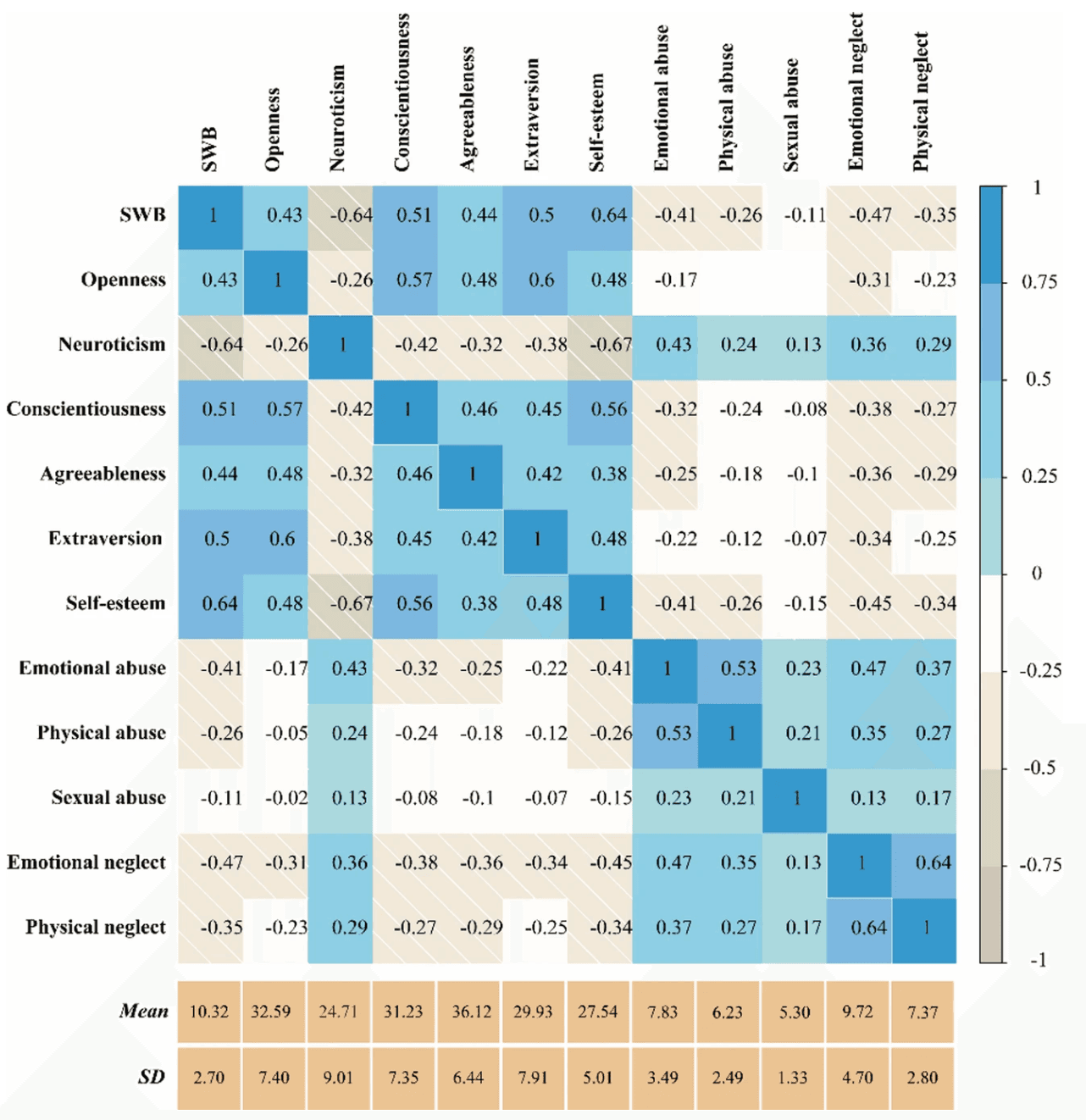
Fig 1

Heatmap of the Spearman correlation matrix. The number in each box is the Spearman correlation coefficient. The lower triangle presents all the coefficients whether significant or not. Only significant coefficients after Bonferroni correction test (p < 0.05/(12*11/2)) are displayed in the upper triangle and the blank box refers to nonsignificant.

Network estimation

Figure 2a illustrates the network model of childhood trauma, personality, and subjective well-being (SWB) for the total adolescence sample, comprising 12 nodes. Within the domain of personality and childhood trauma, the negative aspect of personality, neuroticism, is linked solely to emotional abuse (r = 0.14). Meanwhile, among positive personality resources, openness shows a positive connection with physical abuse (r = 0.09) and a weak and negligible connection with sexual abuse (r = 0.03). Conscientiousness displays negative connections with both physical abuse and emotional neglect (r = −0.08 and r = −0.04, respectively), while agreeableness is negatively associated with emotional neglect (r = −0.07) and physical neglect (r = −0.06). Extraversion, similarly, has a negative connection with emotional neglect (r = −0.04). Self-esteem has negative connections with both emotional neglect (r = −0.07), emotional abuse (r = −0.05), and sexual abuse (r = −0.04).

Fig. 2
Fig 2

Network Model of Childhood Trauma, Personality, and SWB. Blue lines represent positive connections, red lines represent negative connections. The thickness of lines represents the strength of connections. (a) represents the network model of total adolescence sample (n = 2630); (b) illustrates the network model of early adolescence sample (ages 12–15, n = 1254); (c) depicts the network model of late adolescence sample (ages 16–18, n = 1376).

Among all non-zero edges linked to SWB, negative personal resource such as neuroticism had the strongest connection with SWB (r = − 0.33). Among positive personal resources, the connection between SWB and self-esteem is the strongest (r = 0.19), followed by extraversion (r = 0.16), agreeableness (r = 0.12), and conscientiousness (r = 0.09). The weakest connection with SWB is openness (r = 0.03). Regarding the relationship between SWB and childhood trauma, SWB has the strongest connection with emotional neglect (r = −0.11), followed by the connection between SWB and emotional abuse (r = −0.06). There is no connection between SWB and physical neglect, physical abuse, or sexual abuse. Notably, in contrast to the moderate-degree correlations observed in the matrix, the network model reveals weaker or absent connections between childhood trauma and subjective well-being, indicating that their relationship is likely mediated by personality traits. These findings support our H2.

The Spinglass algorithm identified four communities out of 12 nodes. Cluster A, which includes SWB, neuroticism, and self-esteem, indicates that SWB is most closely associated with these two dimensions of personality resources. Cluster B includes openness, conscientiousness, agreeableness, and extraversion, all of which are parts of the positive personality resources. Cluster C consists of nodes for emotional abuse, physical abuse, and sexual abuse, all of which are dimensions related to abuse within childhood trauma. Lastly, Cluster D includes emotional neglect and physical neglect, which are the two dimensions related to neglect within childhood trauma.

As shown in Table 1, the predictability of node SWB was 0.58, indicating that 58% of its variance could be explained by surrounding nodes. The mean node predictability was 0.47, meaning that, on average, 47% of each node’s variance was explained by its neighbors in the network model.

Centrality estimation

Figure 3a presents the centrality of each node in the network model for the total sample. Larger dots represent nodes with stronger centrality indices. Node 2 (“Openness”) had the greatest impact on the individual, reflecting its highest strength centrality. Node 1 (“SWB”) exhibited the highest closeness centrality, indicating its effects spread most rapidly to other nodes. Nodes 1 (“SWB”) and 3 (“Neuroticism”) demonstrated the highest betweenness centrality, functioning as key bridges that connect different nodes within the network. For more details, see Table 1.

Network accuracy and stability

The edge-weight bootstrapping results (Fig. A1a) indicate small confidence intervals (CIs), suggesting relatively precise edge weight estimates. The CS coefficient (Fig. A2a) demonstrates good network stability, with strength = 0.75, closeness = 0.75, and betweenness = 0.21. The bootstrapped difference test revealed that the strongest edges significantly differed from the weakest (Fig. A3a), and the highest centrality indices were distinct from the lowest (Fig. A4a).

Table 1 List of nodes, their predictability, and their centrality estimation.
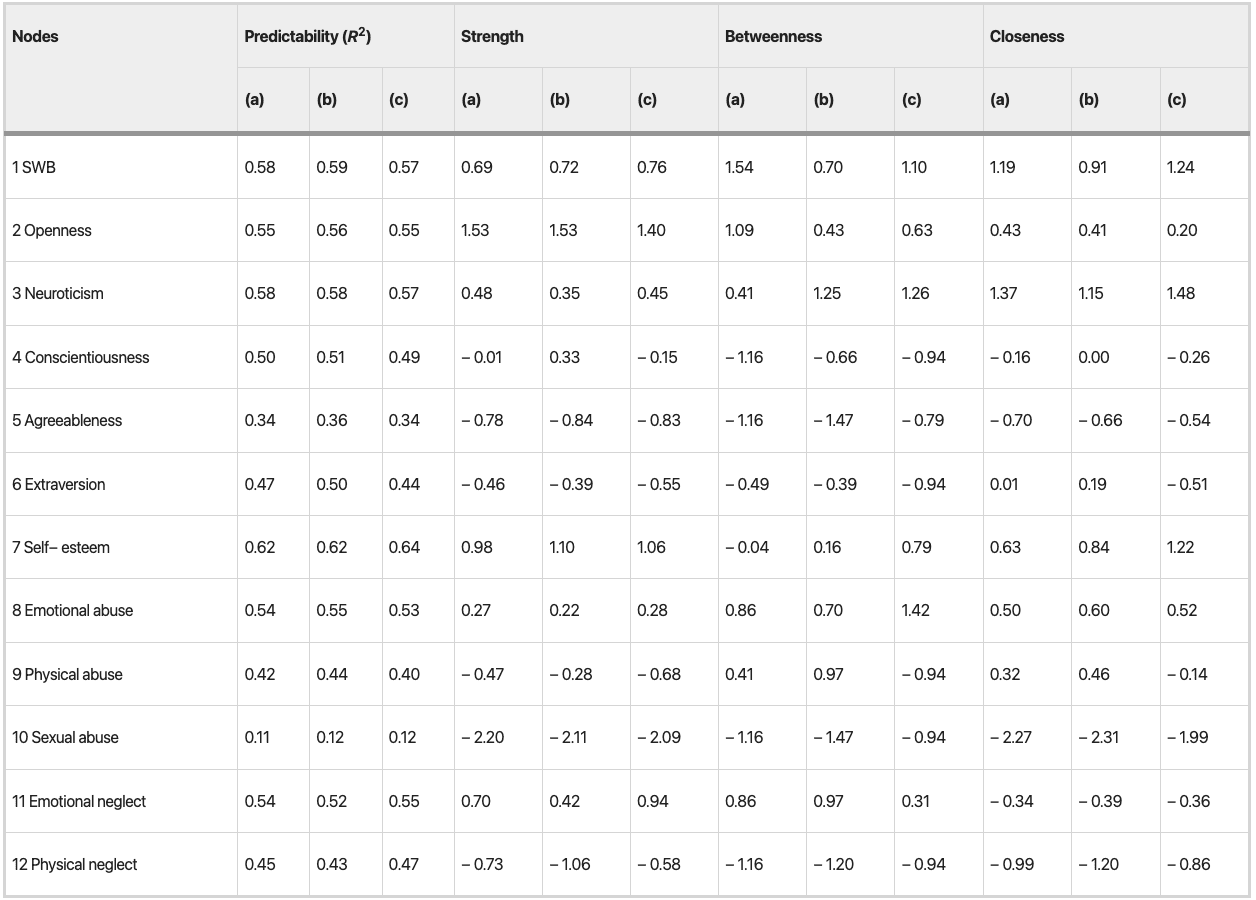
Table 1

The network model in the early and late adolescence

Network estimation

Figure 2b illustrates the network model for the early adolescence sample, featuring 12 nodes. Within personality and childhood trauma, neuroticism shows a strong association with emotional abuse (r = 0.16). Among positive personality traits, openness is linked solely to physical abuse (r = 0.10). Conscientiousness is negatively associated with emotional abuse, physical abuse, and emotional neglect (r = −0.03, r = −0.08, and r = −0.03, respectively) but positively correlated with sexual abuse (r = 0.05). Agreeableness had negative connections with physical abuse, sexual abuse, physical neglect, and emotional neglect (r = −0.04, r = −0.06, r = −0.07, and r = −0.03, respectively). Similarly, self-esteem has negative correlations with physical abuse, sexual abuse, physical neglect, and emotional neglect (r = −0.04, r = −0.04, r = −0.09, and r = −0.04, respectively). Extraversion, however, shows no connections with any dimension of childhood trauma.

Among all non-zero edges linked to SWB, neuroticism exhibits the strongest negative association (r = −0.34). For positive traits, extraversion has the strongest connection to SWB (r = 0.20), followed by self-esteem, conscientiousness, and agreeableness (r = 0.16, r = 0.09, and r = 0.08, respectively). Openness has the weakest association (r = 0.03). Regarding childhood trauma, SWB is most strongly connected with emotional neglect (r = −0.11), followed by emotional abuse (r = −0.07). There are no connections between SWB and physical neglect, physical abuse, or sexual abuse.

Figure 2c presents the network model for late adolescence, also with 12 nodes. Neuroticism remains significantly associated with emotional abuse (r = 0.14). Among positive traits, openness is positively correlated with physical abuse and sexual abuse (r = 0.08 and r = 0.03, respectively). Conscientiousness shows negative associations with physical abuse and emotional neglect (r = −0.05 for both). Agreeableness is negatively linked solely to physical neglect and emotional neglect (r = −0.06 and r = −0.07, respectively). Self-esteem is negatively associated with emotional abuse, sexual abuse, and emotional neglect (r = −0.04, r = −0.03, and r = −0.05, respectively). Extraversion is negatively linked only to emotional neglect (r = −0.05).

In late adolescence, neuroticism continues to have the strongest negative association with SWB (r = −0.30). Among positive traits, self-esteem shows the strongest connection to SWB (r = 0.22), followed by agreeableness, extraversion, and conscientiousness (r = 0.15, r = 0.12, and r = 0.11, respectively). Openness, however, shows no significant association. Regarding childhood trauma, SWB is most strongly linked with emotional neglect (r = −0.11), followed by emotional abuse and physical abuse (r = −0.06 and r = −0.04, respectively). No significant associations are observed between SWB and physical neglect or sexual abuse.

In the network model for the early adolescence sample (Table 1b), the predictability of the SWB node was 0.59, indicating that 59% of its variance could be accounted for by its surrounding nodes. The average predictability across all nodes was 0.48, suggesting that, on average, 48% of the variance for each node was explained by its neighbors within the network. Similarly, in the late adolescence sample, the SWB node also exhibited a predictability of 0.59, with 59% of its variance explained by surrounding nodes. The mean predictability for all nodes in this model was slightly lower at 0.47, indicating that 47% of the variance for each node, on average, was attributable to its neighboring nodes.

Centrality estimation

Figure 3b and c illustrate the centrality of each node in the network model for early and late adolescence, respectively. In early adolescence, Node 2 (“Openness”) has the highest strength centrality, while Node 3 (“Neuroticism”) exhibits the highest closeness and betweenness centrality. In late adolescence, Node 2 (“Openness”) continues to have the highest strength centrality, Node 8 (“Emotional Abuse”) demonstrates the highest betweenness centrality, and Node 3 (“Neuroticism”) maintains the highest closeness centrality.

Network accuracy and stability

The edge-weight bootstrapping results (Fig. A1b and A1c) indicate moderate accuracy for the adolescent stage networks. The CS coefficients (Fig. A2b and A2c) reveal centrality indices of 0.75 for strength, 0.75 for closeness, and 0.13 for betweenness in early adolescence, and 0.75, 0.67, and 0.52, respectively, in late adolescence. The bootstrapped difference test results are shown in Fig. A3b and A3c, while the node centrality difference test results are displayed in Fig. A4b and A4c.

Network comparison

Network comparisons between early and late adolescence were conducted using three tests. The network structure invariance test revealed no significant differences in overall structure (p = 0.08), indicating similarity between the two stages. Similarly, the global strength invariance test showed no significant differences in network strength (early = 5.60, late = 5.34; p = 0.27). However, the edge invariance test identified significant differences in specific connections. Specifically, eight edges demonstrated significant differences between early and late adolescence.

Among these, the edges linking SWB with agreeableness (p = 0.03) and physical abuse (p = 0.004) were weaker in early adolescence (r = 0.08, r = 0) compared to late adolescence (r = 0.15, r = −0.04). Conversely, the edge between SWB and extraversion (p = 0.03) was stronger in early adolescence (r = 0.19) than in late adolescence (r = 0.12). Additionally, connections between conscientiousness and agreeableness (p = 0.03) and conscientiousness and sexual abuse (p = 0.002) were stronger in early adolescence (r = 0.18, r = 0.05) compared to late adolescence (r = 0.10, r = −0.02). In contrast, the edge between openness and self-esteem (p = 0.006) was weaker in early adolescence (r = 0.08) than in late adolescence (r = 0.19). Further differences included a stronger connection between agreeableness and sexual abuse (p = 0.01) in early adolescence(r = −0.06) compared to late adolescence (r = 0). Lastly, the link between emotional neglect and physical neglect (p = 0.004) was weaker in early adolescence (r = 0.45) than in late adolescence (r = 0.55). To summarize, these findings support our H3.

Fig. 3
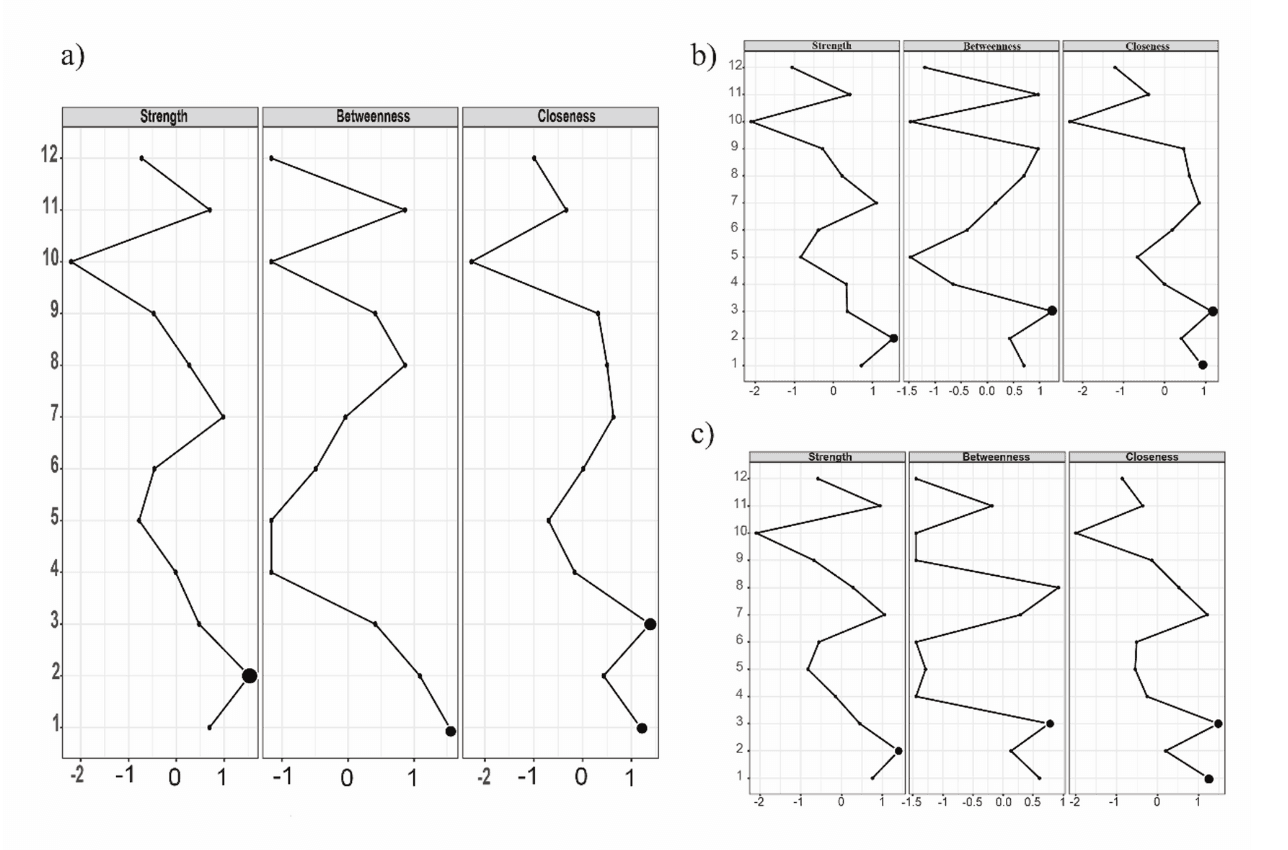
Fig 3

Centrality plots for 12 variables in the network model. The X-axis indicates the standardized z-score of three centrality indices (strength, betweenness, and closeness). The higher the value is, the more central the node is. Each number on the Y-axis represents a variable, as follows: 1: SWB, 2: Neuroticism, 3: Self-esteem, 4: Openness, 5: Conscientiousness, 6: Agreeableness, 7: Extraversion, 8: Emotional abuse, 9: Physical abuse, 10: Sexual abuse, 11: Emotional neglect, 12: Physical neglect. (a) represents the network model of total adolescence sample; (b) illustrates the network model of early adolescence sample (ages 12–15); (c) depicts the network model of late adolescence sample (ages 16–18)

Discussion

The present study used a network approach to examine the stress process model, investigating how childhood trauma, as a chronic stressor, relates to adolescent SWB through the mediation of personal resources, namely personality traits and self-esteem. The findings revealed that childhood trauma, as a chronic stressor, hinders the development of positive personal resources while fostering negative traits, particularly neuroticism, which significantly impacts SWB in adolescents. While the overall network structure and global strength were similar across early and late adolescence, notable differences in specific edge connections were observed between the two groups, highlighting developmental variations in these relationships.

Personality traits as key determinants of SWB

Our results revealed that SWB exhibited a negative connection with negative personal resources, such as neuroticism, and positive connections with positive personal resources, including self-esteem, agreeableness, extraversion, conscientiousness, and openness, within the total adolescence sample. Self-esteem emerged as the strongest positive predictor of SWB in our network models, with its influence becoming even more pronounced in late adolescence. However, some specific connections demonstrated notable group differences between early and late adolescence stages.

Individuals with high neuroticism tend to focus excessively on negative events, leading to heightened negative emotions. Additionally, neuroticism is characterized by heightened sensitivity to threats, which adversely impacts psychological well-being and, consequently, SWB. In contrast, highlighted that individuals who are “extraverted, optimistic, worry-free,” possess high self-esteem, and maintain moderate aspirations tend to experience greater happiness. Extraverted individuals are adept at interacting with others and maintaining a positive outlook when facing challenges, which explains the strong association between extraversion and SWB.

Similarly, individuals high in agreeableness and conscientiousness are more likely to receive positive feedback and reinforcement from others, fostering a higher sense of SWB. Therefore, both agreeableness and conscientiousness are positively linked to SWB. On the other hand, openness shows a relatively weaker association with SWB. These positive personality traits function as individual assets that interact with external environments to create developmental assets, such as support, empowerment, boundaries and expectations, and constructive use of time. Together, these individual and developmental assets act as internal and external factors that influence well-being, working in tandem to promote positive development and SWB.

Interestingly, some developmental trends emerged between the groups. Although neuroticism consistently showed strong negative connections with SWB across stages, its strength slightly weakened from early to late adolescence, possibly reflecting improved emotional regulation over time, even though this trend was not statistically significant. Meanwhile, self-esteem emerged as the strongest positive predictor of SWB, with its influence becoming more pronounced in late adolescence. This change, though not statistically significant, may underscore the growing importance of self-concept and identity development at this stage. Extraversion contributed more strongly to SWB in early adolescence, likely due to the developmental focus on forming peer connections and building social networks. Extraverted individuals, being outgoing and socially active, are better able to connect with others and adapt to these social demands, which may directly improve their well-being. In contrast, agreeableness gained greater relevance in late adolescence, a period marked by the increasing importance of deeper social bonds and cooperative interactions. During this stage, adolescents face more complex interpersonal relationships, such as preparing for adulthood and fostering trust and understanding in social and academic contexts. Traits like kindness and empathy, characteristic of agreeableness, likely facilitate these transitions, strengthening its association with SWB in late adolescence.

In summary, this study substantiates and elaborates on the stress process model by revealing that the pathways from childhood trauma to SWB are not uniform. The influence of specific personal resources evolves during adolescence, suggesting a developmentally-sensitive version of the model where the salience of certain resources changes with developmental tasks. Neuroticism’s negative impact weakens slightly over time, while self-esteem becomes increasingly important in late adolescence. Extraversion strongly supports SWB in early adolescence through social engagement, whereas agreeableness gains relevance later, reflecting the growing need for deeper social connections.

Emotional abuse and emotional neglect linked to SWB via personality

Our research identified emotional abuse as the only dimension of childhood trauma consistently linked to heightened neuroticism across all adolescent stages. This suggests that individuals exposed to emotional abuse during childhood may develop greater emotional sensitivity and difficulty managing negative emotions, core traits of neuroticism. While this heightened reactivity might initially serve as an adaptive response to unstable or threatening environments, over time, it likely contributes to persistent emotional distress and vulnerability to negative psychological outcomes, ultimately impairing subjective well-being (SWB).

Emotional neglect was consistently associated with lower conscientiousness, agreeableness, extraversion, and self-esteem across all stages of adolescence, underscoring its pervasive impact on personality development and self-perception. The lack of emotional support may disrupt the development of responsibility and goal-oriented behaviors, diminishing conscientiousness. Similarly, the lack of warmth and trust likely suppresses empathy and cooperation, further impacts agreeableness, while discouraging social engagement and assertiveness, which may reduce extraversion. Emotional neglect also undermines self-worth, fostering feelings of inadequacy and leading to lower self-esteem. These enduring negative associations emphasize how early emotional neglect shapes maladaptive personality traits and self-concept, further diminishes SWB.

Interestingly, openness demonstrated consistent positive connections with physical abuse across all adolescent stages. Physical abuse may heighten awareness and foster introspection as adaptive coping mechanisms, which could later manifest as traits characteristic of openness, such as imaginative thinking and curiosity about diverse perspectives. Despite this, openness showed only a weak direct association with SWB, suggesting its impact on well-being may be mediated by other traits, particularly self-esteem.

We also observed significant group differences in the connection between openness and self-esteem, with a weaker association in early adolescence compared to late adolescence. During early adolescence, identity exploration and self-concept are still developing, limiting the extent to which openness may enhance self-esteem because research had consistently found openness and self-esteem had strong correlations. In late adolescence, however, greater life experience and a clearer sense of identity appear to strengthen the role of openness in fostering self-esteem, which may further improve SWB. In contrast, other forms of trauma, such as physical and sexual abuse, demonstrated weaker connections in the network. This may indicate that their impact on adolescent SWB is less direct, potentially operating through other mediating mechanisms (e.g., specific psychopathology) not fully captured here, or that emotional maltreatment represents a core dimension with more pervasive effects on personality development.

Implications and limitations

This study identified the influencing paths of childhood trauma, personality, and SWB. Childhood trauma serves as a social environment that shapes individuals’ personality traits, thereby influencing their SWB. This network model directly presents the interrelationship between childhood trauma, personality traits, and SWB, from which it was revealed that the closest construct to SWB is personality. Neuroticism is a personality trait that negatively affects adolescent SWB, highlighting the value of recognizing vulnerability associated with neuroticism and supporting strengths and psychosocial resources (e.g., openness, agreeableness, conscientiousness, extraversion, and self-esteem) that are linked to better SWB. Childhood trauma is a factor that is negatively correlated with personality and has an impact on SWB via personality. That is, childhood trauma may be a negative factor of SWB, but not all adolescents with childhood trauma will have lower SWB. Therefore, the personality traits of adolescents are important in worsening or improving their SWB.

In addition, there are some limitations to this study. First, longitudinal network analyses are needed to verify the directionality and potential causal dynamics between these variables, such as testing whether neuroticism prospectively predicts decreases in SWB. Future studies could also expand the network by incorporating other critical mechanisms like social support, specific emotion regulation strategies, or psychopathological symptoms to build a more comprehensive ecological model. Second, the measures in this study, including the Childhood Trauma Questionnaire (CTQ), were self-reported. This is a common limitation in trauma research, as feelings of shame, guilt, or denial might introduce underreporting bias, potentially affecting the accuracy of the findings. Furthermore, cross-group comparisons in clinical or cross-cultural samples could test the generalizability of these networks and identify unique pathways in specific populations. Cultural contexts may shape how childhood trauma is interpreted and reported, as well as the social value and functional roles of specific personality traits and self-esteem, which in turn may alter the relative strength or salience of pathways linking trauma, personality, and subjective well-being. Moreover, cultural meaning systems can guide how adversity is appraised and integrated into the self. In East Asian contexts, more positive beliefs about adversity have been linked to better psychological adjustment and well-being. Cross-cultural evidence also suggests that East Asian individuals may be more likely than Western individuals to derive meaning from stressful experiences and to adopt positive reframing coping styles. These culturally shaped interpretations may moderate whether and how trauma-related experiences translate into personal resources and SWB, suggesting that future research should explicitly test cultural differences in the trauma–resources–SWB pathways. Ultimately, the central nodes identified here, such as neuroticism and self-esteem, provide empirically-derived targets for developing and testing the efficacy of tailored psychological interventions, moving from network models to targeted intervention design and evaluation in applied settings.

Conclusion

This study identified the pathways through which childhood trauma, as a chronic stressor, influences adolescent subjective well-being (SWB) via personality traits, with neuroticism and self-esteem emerging as the most significant factors in maintaining or improving SWB. Developmental stage-specific differences were observed in the connections between personality traits, particularly extraversion and agreeableness, and SWB. Additionally, differences were found in the interactions among personality traits, especially between openness and self-esteem. These findings suggest that developmental differences in personality play a crucial role in shaping adolescent SWB. While emotional abuse and neglect had the pivotal influence on shaping personality traits.

Open Article as PDF

Abstract

Childhood trauma is strongly associated with impaired subjective well-being (SWB) in adolescence. However, the underlying mechanisms, particularly how they differ across specific developmental stages, remain inadequately explored. Based on the stress process model, childhood trauma may shape adolescent SWB by influencing the development of personal resources, such as personality traits and self-esteem. This study used network analysis to investigate the relationships among these factors based on the stress process model and compared the network model differences between early and late adolescents. A total of 2,620 adolescents aged 12–18 participated in the study. The results showed that neuroticism and self-esteem exhibited consistently strong connections with SWB across age groups within the network models. Emotional abuse and emotional neglect were consistently negatively connected to positive personal resources such as agreeableness, conscientiousness, extraversion, and self-esteem across all age groups, while emotional abuse was strongly positively connected to negative personal resources like neuroticism, which in turn were linked to adolescents’ SWB. Additionally, the associations between personality traits and SWB differed by developmental stage. Specifically, early adolescents exhibited a stronger connection between extraversion and SWB, while late adolescents showed a stronger connection between agreeableness and SWB. Early adolescents also displayed a weaker connection between openness and self-esteem compared to late adolescents, indicating that differences in the relationships among personality traits across developmental stages may be important factors influencing SWB. This study provides valuable insights into the developmental stage-specific mechanisms linking childhood trauma, personality traits, and subjective well-being, offering a foundation for age-tailored interventions to enhance adolescent mental health.

Summary

Subjective well-being (SWB) is how people evaluate their lives, including their thoughts and feelings about what is happening. It has three parts: life satisfaction, positive feelings, and negative feelings. High SWB in young people leads to better relationships, school performance, and fewer mental health problems. Understanding what affects SWB is important for research and support for young people's mental health.

Childhood Trauma and Subjective Well-being

Childhood trauma, such as abuse or neglect, strongly predicts lower SWB in young people. It is a major risk factor for poor mental health. Studies show that trauma in childhood leads to less life satisfaction and fewer positive feelings like hope and self-confidence. The negative effects of childhood trauma can last into adulthood, increasing the risk of depression and anxiety. Even with these clear links, how trauma affects SWB through personality traits, and how this changes as people grow, needs more study.

Childhood Trauma and Personality

This study uses the idea that stress affects mental health by changing personal and social strengths. Past research suggests that childhood trauma harms personal strengths like self-concept and self-esteem, and can lead to unhelpful personality traits like high neuroticism. The theory is that trauma can stop positive personal growth and encourage negative traits. Personality traits and self-esteem are seen as important personal resources. For example, people who experience childhood abuse often show higher neuroticism, impulsivity, and borderline personality traits. Trauma can also hinder the development of helpful traits like agreeableness, openness, conscientiousness, and extraversion, making it harder for people to connect with others, manage emotions, and deal with challenges. This can further reduce their SWB. Additionally, childhood trauma is linked to lower self-esteem, which is a key personal strength that helps people cope with difficulties. This shows that childhood trauma is a major factor in blocking positive personal growth and promoting negative traits.

Personality and Subjective Well-being

Personality is a strong and consistent predictor of subjective well-being (SWB), with effects that can last for many years in young people. Research consistently shows that SWB is positively linked to positive personal strengths. For example, being agreeable and conscientious often leads to good social interactions and increased SWB. Openness helps SWB by encouraging personal growth and appreciation for new experiences, while conscientiousness improves SWB through self-discipline and achieving goals. Self-esteem also plays a significant role in SWB. High self-esteem builds resilience and the ability to handle challenges, leading to better SWB and helping to reduce the negative effects of difficult experiences. On the other hand, negative traits like neuroticism are linked to lower SWB. People with high neuroticism tend to focus too much on negative experiences and feel more negative emotions, which harms their SWB.

Differences Between Early and Late Adolescence

Adolescence is a key time of physical and mental growth, with major changes in brain development, emotions, and personality. Researchers often look at different stages of adolescence, such as early (ages 12–15) and late (ages 16–18), to understand these changes. During early adolescence, the brain undergoes significant development, a process that continues and becomes more noticeable in late adolescence. This period is also sensitive to stress, which can affect brain development and behavior. However, studies on how childhood trauma affects young people at different stages have shown mixed results. Some studies suggest stronger effects in early adolescence, while others find more significant impacts in late adolescence. This indicates that the ways trauma affects people might not be the same throughout adolescence. Therefore, this study explores how the connections between childhood trauma, personal strengths, and SWB might differ between early and late adolescence.

Stress in early life, such as family violence or emotional abuse, can significantly and permanently affect brain development. Such stress can disrupt brain systems, potentially leading to reduced connections in certain brain areas, which might be a way the brain adapts to prevent overwriting traumatic memories. Early life stress can also speed up the development of certain brain connections, which might offer some resilience but also increase the risk of mental health problems during adolescence. From a personality viewpoint, early adolescence often shows a temporary slowdown in personality development, with normal, short-term decreases in traits like extraversion, conscientiousness, agreeableness, and openness, and an increase in neuroticism compared to earlier stages. Understanding these developmental changes requires looking at different stages of adolescence. While personality traits start to form early, they become more stable over time. At the same time, self-esteem generally increases from adolescence into middle adulthood.

In summary, changes in brain development caused by stress during adolescence are believed to lead to changes in personality. These personality traits then act as key ways through which early life stress ultimately affects subjective well-being. Given the developmental differences in early and late adolescence, including ongoing brain maturation, personality traits, and self-esteem, it is important to examine how childhood experiences, personality development, and SWB are linked across these two stages. Because early and late adolescence involve different developmental contexts for how personality resources and self-evaluations work, it was expected that age-group differences would be seen in the patterns and importance of connections among childhood trauma, personal resources (personality traits and self-esteem), and SWB.

Network Analysis and Network Comparison

Network analysis is a powerful tool that shows relationships between different factors, helping to understand complex systems. Unlike simple correlation models, the partial correlation network model groups factors to show which ones are more closely connected. The lines between factors represent their unique connections, meaning that if a connection exists, it is present even when other factors are considered. This method can reveal more precise and meaningful relationships. It offers a broad view, helping to identify the most important factors and the specific connections between different groups (such as trauma and personality). This adds to what is learned from traditional research methods. Compared to methods like multiple regression, which usually require predicting outcomes beforehand, network analysis looks at all factors at once and estimates unique connections while controlling for the rest of the system. This allows researchers to identify which trauma factors are uniquely linked to specific personality traits and SWB beyond simple correlations, and to understand the relative importance of factors within the whole system without assuming a strict cause-and-effect order. It is important to note that the network approach supports, rather than replaces, traditional methods; it provides a data-driven description of how things are connected, which can help in developing future research questions.

A network comparison test further improves this analysis by allowing researchers to see if and how different groups within a population vary in their connections. Specifically, it assesses differences in network structure (the patterns of connections), global strength (the overall strength of all connections), and edge strength (the strength of specific connections between factors). If network structures are similar, it suggests that factors interact in comparable ways across groups. However, networks with higher global strength might indicate stronger feedback loops among factors, which could mean a greater risk for severe mental health problems. Analyzing differences in edge strength helps to understand variations in specific connections between factors. This approach has been used in past studies to describe the many ways childhood adversity, personality, and mental health outcomes are related in young people and other groups.

The Current Study

Based on the stress process model, this study investigates how childhood trauma, as an ongoing stressor, may hinder the development of positive personal resources (like helpful personality traits and self-esteem) and encourage negative traits (like neuroticism), which in turn affect subjective well-being (SWB). In this study, "personal resources" refers to stable personal characteristics (like personality traits and self-esteem) that affect how stress exposure leads to outcomes. The terms "positive" and "negative" resources are used to describe their roles in relation to SWB in this study (either reducing or increasing stress-related risks), not as fixed or universal judgments about how helpful a trait is.

This study aims to explore the connections between childhood trauma, personality traits, and SWB in young people, focusing on differences between early and late adolescence. Using network analysis, the study seeks to discover how these factors interact and how their connections differ across developmental stages. By using network comparison tests, this research will examine differences in network structure, overall strength, and the strength of specific connections, offering new insights into how early life stress shapes personality and SWB during adolescence.

Based on previous research, three hypotheses are proposed:

H1

Subjective well-being (SWB) in young people is negatively linked to childhood trauma and neuroticism, but positively linked to agreeableness, openness, conscientiousness, and extraversion.

H2

Childhood trauma is connected to well-being both directly and indirectly through its links with personality traits in the network model.

H3

The connections between childhood trauma, personality traits, and SWB are expected to differ significantly between early and late adolescence when compared using network tests.

Methods

Participants

Data for this study were collected through a survey of Chinese young people. Participants were selected from two public high schools in Chongqing, China. There were 2630 valid participants between the ages of 12 and 18, including 1560 females and 1070 males. The average age was 15.56 years. For comparing networks, the group was divided into two stages: early adolescence (ages 12–15, with 1254 participants) and late adolescence (ages 16–18, with 1376 participants).

Procedure

All procedures followed relevant institutional guidelines and the Declaration of Helsinki. The study received approval from the Institutional Review Board. In coordination with the schools, parents or legal guardians were first informed and provided their consent. Afterward, students completed an online survey after giving their own agreement to participate. The entire process, including consent and survey completion, took about 15 minutes.

Measures

Chinese Big Five Personality Inventory Brief Version (CBF-PI-B)

A short version of the Chinese Big Five Personality Questionnaire was used to measure personality traits. This scale has been used multiple times and is considered reliable in studies. The questionnaire has 40 items scored on a 6-point scale, from "very inaccurate" to "very accurate." The CBF-PI-B includes five subscales for the Big Five personality traits: openness, conscientiousness, extraversion, agreeableness, and neuroticism. Seven items are reverse-scored, and each trait is measured with eight items. The reliability coefficients for the five dimensions were: Neuroticism (α = 0.881), Conscientiousness (α = 0.834), Agreeableness (α = 0.772), Openness (α = 0.843), and Extraversion (α = 0.814).

Rosenberg Self-Esteem Scale (RSES)

The Chinese version of the RSES was used to measure self-esteem. This scale has 10 items, with 5 positive and 5 negative statements, scored on a 4-point scale from "strongly agree" to "strongly disagree." Scores range from 10 to 40, with higher scores indicating higher self-esteem. The reliability coefficient for this scale in the study was 0.81.

Childhood Trauma Questionnaire-Short Form (CTQ-SF)

The Chinese version of the Childhood Trauma Questionnaire (CTQ) was used to measure childhood trauma experiences. This scale is widely recognized for measuring childhood trauma. The CTQ-SF has 28 items, covering five types of trauma: emotional abuse, physical abuse, sexual abuse, emotional neglect, and physical neglect. Items are scored on a 5-point scale from "never" to "always." Each subscale ranges from 5 to 25, and the total CTQ-SF score ranges from 25 to 125. Higher scores mean more severe childhood trauma. The reliability coefficients for the five dimensions were: Physical Neglect (α = 0.511), Emotional Neglect (α = 0.854), Emotional Abuse (α = 0.768), Physical Abuse (α = 0.791), and Sexual Abuse (α = 0.791).

Index of Well-Being

The Index of Well-Being was used to measure subjective well-being (SWB). This index has nine items. The first eight items form the Index of General Affect (IGA), measured on a 7-point scale with opposing adjectives. The ninth item is a single question about overall life satisfaction (LSQ). To ensure higher scores mean higher well-being, four IGA items were reverse-scored. The combined Index of Well-Being was calculated using a specific formula: Index of Well-Being = 1.1 × (LS score) + 1.0 × (IGA total score). The reliability coefficient for this scale in the study was 0.92.

Statistical Analysis

Descriptive statistics were calculated using SPSS 22. R software was used to calculate Spearman correlation matrices, which were chosen because of issues with normal distribution of data, and to conduct network analysis. The qgraph and glasso software packages were used to estimate and visualize the network. The Gaussian graphical model (GGM) was selected for estimation, showing connections between factors. The thickness of the lines indicates the strength of the correlation, with blue lines for positive correlations and red lines for negative ones. qgraph was also used to calculate centrality indices: strength, betweenness, and closeness. These three measures show how important each factor is in the network, with higher values meaning greater importance. Strength centrality is the sum of a factor's direct connections. Betweenness centrality is how often a factor lies on the shortest path between other factors. Closeness centrality measures the sum of the shortest path lengths between a factor and all other factors. The mgm software package was used to estimate the predictability of factors and to display how much variance each factor shares with its neighbors, indicating its interconnectedness. To check the accuracy and stability of the network model, the bootnet package was used. Edge-weight bootstrapping with 95% confidence intervals (CIs) was used to test the accuracy of connection strengths; narrower CIs mean more accurate estimates. The case-discard bootstrap method was used to test network stability, measured by the correlation stability coefficient (CS-coefficient). A CS-coefficient below 0.25 is unsatisfactory, while above 0.5 is relatively satisfactory. The NetworkComparisonTest package was used to test differences between networks in the two adolescent stages.

Results

The Network Model in the Total Sample of Adolescence

Descriptive Statistics and Correlations

Figure 1 shows the mean, standard deviation, and Spearman correlation coefficients for each variable. The upper part of the correlation matrix, after adjusting for multiple comparisons, indicates that SWB is positively associated with openness, conscientiousness, agreeableness, and self-esteem. It is negatively associated with neuroticism, emotional abuse, physical abuse, sexual abuse, emotional neglect, and physical neglect. These findings support Hypothesis 1 (H1).

Network Estimation

Figure 2a shows the network model for childhood trauma, personality, and subjective well-being (SWB) for all adolescents, including 12 factors. For personality and childhood trauma, neuroticism is only linked to emotional abuse. Among positive personality resources, openness has a positive connection with physical abuse and a very weak connection with sexual abuse. Conscientiousness shows negative connections with both physical abuse and emotional neglect. Agreeableness is negatively associated with emotional neglect and physical neglect. Extraversion also has a negative connection with emotional neglect. Self-esteem has negative connections with emotional neglect, emotional abuse, and sexual abuse.

Among all connections to SWB, neuroticism, a negative personal resource, had the strongest negative connection. Among positive personal resources, the connection between SWB and self-esteem is the strongest, followed by extraversion, agreeableness, and conscientiousness. Openness has the weakest connection with SWB. Regarding the relationship between SWB and childhood trauma, SWB has the strongest connection with emotional neglect, followed by emotional abuse. There is no connection between SWB and physical neglect, physical abuse, or sexual abuse. Importantly, while correlations in the matrix were moderate, the network model shows weaker or no connections between childhood trauma and SWB directly, suggesting that personality traits likely play a role in mediating this relationship. These findings support Hypothesis 2 (H2).

The Spinglass algorithm identified four groups of the 12 factors. Group A, including SWB, neuroticism, and self-esteem, shows that SWB is most closely linked to these two personality resources. Group B includes openness, conscientiousness, agreeableness, and extraversion, all positive personality resources. Group C consists of emotional abuse, physical abuse, and sexual abuse, which are all types of abuse within childhood trauma. Lastly, Group D includes emotional neglect and physical neglect, the two types of neglect within childhood trauma.

Table 1 shows that the predictability of the SWB factor was 0.58, meaning that 58% of its variation could be explained by connected factors. The average predictability for all factors was 0.47, indicating that, on average, 47% of each factor's variation was explained by its neighbors in the network model.

Centrality Estimation

Figure 3a shows the centrality of each factor in the network model for the total sample. Larger dots mean factors with higher centrality. Factor 2 ("Openness") had the greatest overall impact. Factor 1 ("SWB") had the highest closeness centrality, meaning its effects spread most quickly to other factors. Factors 1 ("SWB") and 3 ("Neuroticism") showed the highest betweenness centrality, acting as key connectors between different factors in the network. More details are in Table 1.

Network Accuracy and Stability

The results from bootstrapping the edge weights (Fig. A1a) show small confidence intervals, suggesting that the estimates for connection strengths are fairly precise. The CS coefficient (Fig. A2a) indicates good network stability, with strength at 0.75, closeness at 0.75, and betweenness at 0.21. The bootstrapped difference test revealed that the strongest connections were significantly different from the weakest (Fig. A3a), and the highest centrality indices were distinct from the lowest (Fig. A4a).

The Network Model in Early and Late Adolescence

Network Estimation

Figure 2b shows the network model for the early adolescence sample, with 12 factors. Within personality and childhood trauma, neuroticism is strongly linked to emotional abuse. Among positive personality traits, openness is only linked to physical abuse. Conscientiousness is negatively linked to emotional abuse, physical abuse, and emotional neglect, but positively linked to sexual abuse. Agreeableness had negative connections with physical abuse, sexual abuse, physical neglect, and emotional neglect. Similarly, self-esteem has negative correlations with physical abuse, sexual abuse, physical neglect, and emotional neglect. Extraversion, however, shows no connections with any type of childhood trauma.

Among all connections to SWB, neuroticism shows the strongest negative link. For positive traits, extraversion has the strongest connection to SWB, followed by self-esteem, conscientiousness, and agreeableness. Openness has the weakest link. Regarding childhood trauma, SWB is most strongly connected with emotional neglect, followed by emotional abuse. There are no connections between SWB and physical neglect, physical abuse, or sexual abuse.

Figure 2c shows the network model for late adolescence, also with 12 factors. Neuroticism remains significantly linked to emotional abuse. Among positive traits, openness is positively linked to physical abuse and sexual abuse. Conscientiousness shows negative links with physical abuse and emotional neglect. Agreeableness is negatively linked only to physical neglect and emotional neglect. Self-esteem is negatively linked to emotional abuse, sexual abuse, and emotional neglect. Extraversion is negatively linked only to emotional neglect.

In late adolescence, neuroticism continues to have the strongest negative link with SWB. Among positive traits, self-esteem shows the strongest connection to SWB, followed by agreeableness, extraversion, and conscientiousness. Openness, however, shows no significant link. Regarding childhood trauma, SWB is most strongly linked with emotional neglect, followed by emotional abuse and physical abuse. No significant links are observed between SWB and physical neglect or sexual abuse.

In the network model for early adolescence (Table 1b), the predictability of the SWB factor was 0.59, meaning that 59% of its variation could be explained by surrounding factors. The average predictability across all factors was 0.48, suggesting that, on average, 48% of the variation for each factor was explained by its neighbors in the network. Similarly, in the late adolescence sample, the SWB factor also had a predictability of 0.59, with 59% of its variation explained by surrounding factors. The average predictability for all factors in this model was slightly lower at 0.47, indicating that 47% of the variation for each factor, on average, was due to its neighboring factors.

Centrality Estimation

Figures 3b and 3c show the centrality of each factor in the network model for early and late adolescence, respectively. In early adolescence, Factor 2 ("Openness") has the highest overall impact. Factor 3 ("Neuroticism") shows the highest closeness and betweenness centrality. In late adolescence, Factor 2 ("Openness") still has the highest overall impact. Factor 8 ("Emotional Abuse") shows the highest betweenness centrality, and Factor 3 ("Neuroticism") maintains the highest closeness centrality.

Network Accuracy and Stability

The results from bootstrapping the edge weights (Fig. A1b and A1c) show moderate accuracy for the networks in both adolescent stages. The CS coefficients (Fig. A2b and A2c) reveal centrality indices of 0.75 for strength, 0.75 for closeness, and 0.13 for betweenness in early adolescence, and 0.75, 0.67, and 0.52, respectively, in late adolescence. The results of the bootstrapped difference test are shown in Fig. A3b and A3c, while the results for the node centrality difference test are displayed in Fig. A4b and A4c.

Network Comparison

Comparisons between networks for early and late adolescence were conducted using three tests. The test for network structure invariance showed no significant differences in the overall structure, indicating similarity between the two stages. Similarly, the test for global strength invariance found no significant differences in the overall network strength (early = 5.60, late = 5.34). However, the edge invariance test found significant differences in specific connections. Specifically, eight connections showed significant differences between early and late adolescence.

Among these, the connections linking SWB with agreeableness and physical abuse were weaker in early adolescence compared to late adolescence. In contrast, the connection between SWB and extraversion was stronger in early adolescence than in late adolescence. Additionally, connections between conscientiousness and agreeableness, and conscientiousness and sexual abuse, were stronger in early adolescence compared to late adolescence. However, the connection between openness and self-esteem was weaker in early adolescence than in late adolescence. Further differences included a stronger connection between agreeableness and sexual abuse in early adolescence compared to late adolescence. Lastly, the link between emotional neglect and physical neglect was weaker in early adolescence than in late adolescence. In summary, these findings support Hypothesis 3 (H3).

Discussion

This study used a network approach to examine the stress process model, looking at how childhood trauma, as an ongoing stressor, relates to subjective well-being (SWB) in young people through personality traits and self-esteem. The findings showed that childhood trauma hinders the development of positive personal resources while encouraging negative traits, especially neuroticism, which significantly affects SWB in young people. While the overall network structure and general strength were similar across early and late adolescence, important differences in specific connections were observed between the two groups, highlighting how these relationships change developmentally.

Personality Traits as Key Determinants of SWB

The results showed that SWB had a negative connection with negative personal resources, such as neuroticism, and positive connections with positive personal resources, including self-esteem, agreeableness, extraversion, conscientiousness, and openness, within the total sample of young people. Self-esteem emerged as the strongest positive predictor of SWB in the network models, with its influence becoming even more noticeable in late adolescence. However, some specific connections showed important differences between early and late adolescence.

People with high neuroticism tend to focus too much on negative events, leading to more negative emotions. Also, neuroticism involves increased sensitivity to threats, which negatively affects psychological well-being and, consequently, SWB. In contrast, research highlights that people who are "extraverted, optimistic, worry-free," have high self-esteem, and have reasonable goals tend to experience greater happiness. Extraverted individuals are skilled at interacting with others and staying positive when facing challenges, which explains the strong link between extraversion and SWB.

Similarly, people who are highly agreeable and conscientious are more likely to receive positive feedback and encouragement from others, leading to a higher sense of SWB. Therefore, both agreeableness and conscientiousness are positively linked to SWB. On the other hand, openness shows a relatively weaker link with SWB. These positive personality traits act as individual strengths that interact with the environment to create developmental assets, such as support, empowerment, clear rules, and productive use of time. Together, these individual and developmental assets work as internal and external factors that influence well-being, promoting positive growth and SWB.

Interestingly, some developmental patterns appeared between the groups. Although neuroticism consistently showed strong negative links with SWB across stages, its strength slightly decreased from early to late adolescence, possibly reflecting better emotional regulation over time, though this change was not statistically significant. Meanwhile, self-esteem became the strongest positive predictor of SWB, with its influence growing more pronounced in late adolescence. This change, while not statistically significant, may highlight the increasing importance of self-concept and identity development at this stage. Extraversion contributed more strongly to SWB in early adolescence, likely because of the developmental focus on forming peer connections and building social networks. Extraverted individuals, being outgoing and socially active, are better able to connect with others and adapt to these social demands, which may directly improve their well-being. In contrast, agreeableness became more relevant in late adolescence, a period marked by the increasing importance of deeper social bonds and cooperative interactions. During this stage, young people face more complex interpersonal relationships, such as preparing for adulthood and building trust and understanding in social and academic settings. Traits like kindness and empathy, typical of agreeableness, likely help with these transitions, strengthening its link with SWB in late adolescence.

In summary, this study confirms and expands on the stress process model by showing that the pathways from childhood trauma to SWB are not uniform. The influence of specific personal resources changes during adolescence, suggesting a developmentally sensitive version of the model where the importance of certain resources shifts with developmental tasks. Neuroticism's negative impact slightly weakens over time, while self-esteem becomes increasingly important in late adolescence. Extraversion strongly supports SWB in early adolescence through social engagement, whereas agreeableness gains relevance later, reflecting the growing need for deeper social connections.

Emotional Abuse and Emotional Neglect Linked to SWB via Personality

This research found that emotional abuse was the only type of childhood trauma consistently linked to higher neuroticism across all adolescent stages. This suggests that people exposed to emotional abuse in childhood may become more emotionally sensitive and have more difficulty managing negative emotions, which are key traits of neuroticism. While this increased reactivity might initially be a way to cope with unstable or threatening environments, over time, it likely leads to ongoing emotional distress and vulnerability to negative psychological outcomes, ultimately harming subjective well-being (SWB).

Emotional neglect was consistently linked to lower conscientiousness, agreeableness, extraversion, and self-esteem across all adolescent stages, highlighting its widespread impact on personality development and self-perception. A lack of emotional support may disrupt the development of responsibility and goal-oriented behaviors, reducing conscientiousness. Similarly, a lack of warmth and trust likely suppresses empathy and cooperation, further affecting agreeableness, while discouraging social engagement and assertiveness, which may reduce extraversion. Emotional neglect also weakens self-worth, leading to feelings of inadequacy and lower self-esteem. These lasting negative connections emphasize how early emotional neglect shapes unhelpful personality traits and self-concept, further decreasing SWB.

Interestingly, openness showed consistent positive connections with physical abuse across all adolescent stages. Physical abuse may increase awareness and encourage self-reflection as ways of coping, which could later appear as traits of openness, such as imaginative thinking and curiosity about different perspectives. Despite this, openness showed only a weak direct link with SWB, suggesting its impact on well-being may be influenced by other traits, especially self-esteem.

Significant differences were also observed in the connection between openness and self-esteem, with a weaker link in early adolescence compared to late adolescence. During early adolescence, identity exploration and self-concept are still developing, limiting how much openness can boost self-esteem, even though research consistently finds strong correlations between openness and self-esteem. In late adolescence, however, more life experience and a clearer sense of identity seem to strengthen the role of openness in fostering self-esteem, which may further improve SWB. In contrast, other forms of trauma, such as physical and sexual abuse, showed weaker connections in the network. This might mean their impact on adolescent SWB is less direct, potentially working through other mediating factors (e.g., specific mental health issues) not fully captured here, or that emotional mistreatment is a central factor with more widespread effects on personality development.

Implications and Limitations

This study identified the pathways through which childhood trauma, personality, and SWB influence each other. Childhood trauma acts as a social environment that shapes individuals’ personality traits, thereby affecting their SWB. This network model directly shows the relationships between childhood trauma, personality traits, and SWB, revealing that personality is the closest factor to SWB. Neuroticism is a personality trait that negatively affects SWB in young people, highlighting the importance of recognizing the vulnerability associated with neuroticism and supporting strengths and personal resources (e.g., openness, agreeableness, conscientiousness, extraversion, and self-esteem) that are linked to better SWB. Childhood trauma is a factor that is negatively correlated with personality and affects SWB through personality. This means that while childhood trauma can be a negative factor for SWB, not all young people who experience it will have lower SWB. Therefore, the personality traits of young people are important in making their SWB better or worse.

However, this study has some limitations. First, longitudinal network analyses are needed to confirm the direction of these relationships and potential cause-and-effect dynamics, such as testing whether neuroticism predicts future decreases in SWB. Future studies could also expand the network by including other important factors like social support, specific emotion regulation strategies, or mental health symptoms to create a more complete model. Second, the measures in this study, including the Childhood Trauma Questionnaire (CTQ), were based on self-reports. This is a common limitation in trauma research, as feelings of shame, guilt, or denial might lead to underreporting, potentially affecting the accuracy of the findings. Furthermore, comparisons across clinical or different cultural groups could test how generally applicable these networks are and identify unique pathways in specific populations. Cultural contexts may influence how childhood trauma is understood and reported, as well as the social value and roles of specific personality traits and self-esteem, which in turn may change the relative strength or importance of the pathways linking trauma, personality, and SWB. Additionally, cultural belief systems can guide how difficult experiences are viewed and integrated into one's self-identity. In East Asian cultures, more positive beliefs about hardship have been linked to better psychological adjustment and well-being. Cross-cultural evidence also suggests that individuals in East Asia may be more likely than those in Western cultures to find meaning in stressful experiences and to adopt positive reframing coping styles. These culturally shaped interpretations may influence whether and how trauma-related experiences translate into personal resources and SWB, suggesting that future research should explicitly test cultural differences in the trauma–resources–SWB pathways. Ultimately, the central factors identified here, such as neuroticism and self-esteem, provide empirically supported targets for developing and testing the effectiveness of specific psychological interventions, moving from network models to focused intervention design and evaluation in practical settings.

Conclusion

This study identified the ways in which childhood trauma, as an ongoing stressor, influences subjective well-being (SWB) in young people through personality traits, with neuroticism and self-esteem being the most important factors for maintaining or improving SWB. Differences related to developmental stages were observed in the connections between personality traits, especially extraversion and agreeableness, and SWB. Additionally, differences were found in how personality traits interact with each other, particularly between openness and self-esteem. These findings suggest that developmental differences in personality play a crucial role in shaping SWB in young people. Emotional abuse and neglect had a key influence on shaping personality traits.

Open Article as PDF

Abstract

Childhood trauma is strongly associated with impaired subjective well-being (SWB) in adolescence. However, the underlying mechanisms, particularly how they differ across specific developmental stages, remain inadequately explored. Based on the stress process model, childhood trauma may shape adolescent SWB by influencing the development of personal resources, such as personality traits and self-esteem. This study used network analysis to investigate the relationships among these factors based on the stress process model and compared the network model differences between early and late adolescents. A total of 2,620 adolescents aged 12–18 participated in the study. The results showed that neuroticism and self-esteem exhibited consistently strong connections with SWB across age groups within the network models. Emotional abuse and emotional neglect were consistently negatively connected to positive personal resources such as agreeableness, conscientiousness, extraversion, and self-esteem across all age groups, while emotional abuse was strongly positively connected to negative personal resources like neuroticism, which in turn were linked to adolescents’ SWB. Additionally, the associations between personality traits and SWB differed by developmental stage. Specifically, early adolescents exhibited a stronger connection between extraversion and SWB, while late adolescents showed a stronger connection between agreeableness and SWB. Early adolescents also displayed a weaker connection between openness and self-esteem compared to late adolescents, indicating that differences in the relationships among personality traits across developmental stages may be important factors influencing SWB. This study provides valuable insights into the developmental stage-specific mechanisms linking childhood trauma, personality traits, and subjective well-being, offering a foundation for age-tailored interventions to enhance adolescent mental health.

Introduction

Subjective well-being (SWB) refers to how people evaluate their lives. This includes both their thoughts about life and their emotional responses to it. SWB has three parts: how satisfied one feels with life, positive emotions, and negative emotions. Research shows that high SWB in adolescence leads to better outcomes that last into adulthood. For example, adolescents with high SWB often have stronger relationships with peers and family, better school performance, and fewer problems like depression, anxiety, social media misuse, substance use, and addictive behaviors. Clearly, SWB is a key indicator of mental health in adolescents and can predict whether psychological problems will occur. Understanding what influences SWB and how it develops is vital for improving adolescent mental health research and creating effective support programs.

Childhood Trauma and Subjective Well-being

Childhood trauma significantly reduces adolescents' subjective well-being. Trauma includes physical, emotional, or sexual abuse, as well as physical and emotional neglect by a caregiver or older person. It is a major risk factor for poor mental health. Studies consistently link childhood trauma to lower life satisfaction and fewer positive emotions like hope, optimism, and self-efficacy. Childhood trauma also has lasting negative effects on SWB and mental health, impacting children, adolescents, and adults. Recent studies show that childhood trauma increases the risk of depression, anxiety, and other psychological problems in adulthood. These findings highlight how early negative experiences shape long-term mental health. Despite these known links, how childhood trauma, personality traits, and SWB interact, and if these interactions change at different developmental stages, is less understood.

Childhood Trauma and Personality

This study uses the stress process model as its framework. This model suggests that stress affects mental health mainly by influencing a person's individual and social resources. Past research supports this idea, showing that childhood trauma is linked to weaker personal resources (like self-concept and self-esteem) and unhealthy personality traits (like higher neuroticism), which then affect later well-being. The model proposes that childhood trauma can prevent the growth of positive personal resources while encouraging negative ones. This view of "resources" is strongly supported by Hobfoll's Conservation of Resources (COR) theory, which defines resources as "valued objects, personal characteristics, conditions, or energies." Within this theory, both broad personality traits and self-esteem are seen as important personal resources. Personality traits "generally aid stress resistance," and self-esteem is a key example of a resource. This offers a common base for studying their shared role in the stress process. Specifically, within the Five-Factor Model (FFM) of personality, traits like high neuroticism, impulsivity, and borderline personality traits are more common in individuals who have experienced childhood abuse. On the other hand, early trauma can hinder the development of positive personality traits such as agreeableness, openness to experience, conscientiousness, and extraversion. This can limit a person's ability to interact effectively with others, manage emotions, and adapt to challenges, further reducing subjective well-being. Additionally, childhood trauma is linked to lower self-esteem, which is a key positive personal resource reflecting a basic sense of self-worth that helps against difficulties. Therefore, childhood trauma clearly prevents the development of positive personal resources and promotes negative traits.

Personality and Subjective Well-being

Personality is a strong and reliable predictor of subjective well-being (SWB), influencing adolescents for a decade or more. Studies consistently show that SWB is positively related to positive personal resources. For instance, research has found that high agreeableness and conscientiousness lead to positive feedback and reinforcement from others, which boosts SWB. Openness promotes SWB by encouraging personal growth and appreciation for new experiences, while conscientiousness improves SWB through self-discipline and achieving goals. Furthermore, self-esteem plays a significant role in SWB. High self-esteem increases a person's ability to recover from challenges and cope with difficulties, leading to better SWB. It also acts as a buffer against negative outcomes from adverse experiences. In contrast, negative personal resources like neuroticism are linked to lower SWB. Individuals with high neuroticism tend to focus too much on negative experiences, feeling more negative emotions that harm their SWB.

Differences Between Early and Late Adolescence

Adolescence is a vital time for physical and mental growth, marked by major changes in brain function, emotions, and personality as nerve pathways mature. Developmental neuroscience often separates adolescence into stages, such as early versus middle adolescence, to understand these changes. This period is commonly divided into two stages: early adolescence (ages 12–15) and late adolescence (ages 16–18). This division is widely used in adolescent research to study age-group differences. Early adolescence involves a second wave of new brain connections, followed by a process where less-used connections are removed as the brain matures. This process continues and becomes more noticeable in late adolescence. Besides these normal brain changes, adolescence is seen as a sensitive time when stress can affect brain development and behavior differently. However, childhood trauma, a major stressor, has shown inconsistent links with later social and psychological outcomes across adolescent stages. Some studies suggest stronger effects in early adolescence, while others report more pronounced effects in late adolescence. This indicates that the paths related to trauma may not be the same throughout development. Thus, this study explored possible age-stage differences in how childhood trauma relates to personal resources and SWB.

Exposure to early life stress, such as family violence or emotional abuse, during key developmental periods, has profound and lasting effects on brain development. For example, such stressors can disrupt the brain’s dopamine system, leading to reduced connections between certain brain areas, which might be a way to prevent traumatic memories from being overwritten. Additionally, early life stress speeds up the maturation of connections involved in fear and emotion, which may offer resilience but also increases the risk of developing mental health issues during adolescence. From a personality development standpoint, early adolescence often shows a temporary slowdown in personality maturation. This is a normal and brief pattern of decreases in traits like extraversion, conscientiousness, agreeableness, and openness, and an increase in neuroticism, compared to earlier developmental stages. To study such developmental changes, a framework that distinguishes between different stages of adolescence is necessary. While personality traits begin to form early in life, they become more stable over time. At the same time, self-esteem generally increases from adolescence into middle adulthood.

To summarize, stress-related changes in adolescent brain development are believed to cause the observed changes in personality. These personality traits then act as key ways through which early life stress ultimately influences subjective well-being. Considering the developmental features of early and late adolescence, including the ongoing maturation of brain circuits, personality traits, and self-esteem, it is important to examine how the relationships between childhood experiences, personality development, and SWB differ across these two stages. Since early and late adolescence involve different developmental contexts for how personality resources and self-evaluations work, age-group differences are expected in the patterns and importance of links among childhood trauma, personal resources (personality traits and self-esteem), and SWB.

Network Analysis and Network Comparison

Network analysis is a powerful tool that visually shows relationships between variables, offering insights into complex systems. Unlike simple correlation networks, the partial correlation network model groups variables into distinct communities to show which are more closely connected. The lines (edges) between variables (nodes) represent unique connections, meaning that if a connection exists, it is present even after considering all other variables in the network. This method can reveal more precise and meaningful correlations between variables. It offers a system-level view, helping to identify the most central variables and specific connections between different groups (e.g., trauma and personality), which complements findings from traditional methods. Compared to traditional methods like multiple regression or SEM, which usually require researchers to decide beforehand which variables predict which outcomes, the network approach models all variables at once and estimates unique connections (partial correlations) between nodes while controlling for the rest of the system. This allows for identifying which trauma dimensions are uniquely linked to specific personality traits and SWB beyond simple correlations, and to describe the relative importance of variables within the overall system (e.g., central nodes) without imposing a strict cause-and-effect order. The network approach is seen as a complement, not a replacement, for traditional methods. It provides a system-level, data-driven description of how variables depend on each other, which can inform and improve later hypothesis-driven modeling.

A network comparison test further enhances this analysis by allowing researchers to examine if and how different subgroups within a population differ in their network connections. Specifically, it assesses differences in network structure (i.e., the patterns of interconnections among nodes across different groups), global strength (i.e., the overall strength of all connections in the network), and edge strength (i.e., the strength of specific connections between nodes). When network structures are similar, it suggests that variables interact in comparable ways across different groups. On the other hand, networks with higher global strength might indicate stronger feedback loops among variables, which could mean a greater risk for severe mental disorders. Furthermore, analyzing differences in edge strength provides a deeper understanding of variations in specific connections between variables. Consistent with this approach, network analysis has been used in previous studies to describe how childhood adversity, personality characteristics, and mental health outcomes are related in youth and other populations.

The Current Study

Based on the stress process model, this study explores how childhood trauma, as a ongoing stressor, might hinder the development of positive personal resources (like adaptive personality traits, self-esteem) and promote negative ones (like neuroticism), which then affect subjective well-being. In this paper, “personal resources” is a broad term from the stress-process theory that refers to relatively stable personal characteristics (such as personality traits and self-esteem) that influence how stress exposure and outcomes are related. Importantly, the terms “positive” versus “negative” resources are used in this study to describe their roles in relation to SWB (either protecting against or increasing stress-related risks), rather than fixed or universally applicable judgments about whether a trait is adaptive.

This study aims to investigate the relationships between childhood trauma, personality traits, and SWB during adolescence, focusing on differences between early and late adolescence. Using network analysis as the main method, the study seeks to discover how these variables interact and how their connections differ across developmental stages. By using network comparison tests, this research will explore variations in network structure, overall strength, and the strength of specific connections. This will provide new insights into how early life stress shapes personality and SWB during adolescence.

Based on previous research, three hypotheses are proposed in this study:

H1

Adolescent SWB is negatively linked to childhood trauma and neuroticism, but positively linked to agreeableness, openness to experience, conscientiousness, and extraversion.

H2

Childhood trauma is connected to well-being both directly and indirectly through its links with personality traits in the network model.

H3

The connections between childhood trauma, personality traits, and SWB are expected to differ significantly between early and late adolescence in the network comparison test.

Participants

Data for this study were collected through a survey of Chinese adolescents. Participants were chosen from two public secondary schools in Chongqing, China. There were 2630 valid participants, aged between 12 and 18, including 1560 females and 1070 males (average age = 15.56, standard deviation = 1.62). For comparing networks, the sample was divided into two developmental stages: early adolescence (ages 12–15, with 1254 participants) and late adolescence (ages 16–18, with 1376 participants).

Procedure

All procedures followed relevant institutional guidelines and the Declaration of Helsinki. The study received approval from the Institutional Review Board (Approval No. XL-20250724-0001). In coordination with the schools, parents or legal guardians were first informed about the study, and their consent was obtained. After that, students completed an online questionnaire using the Wenjuanxing platform, after giving their own agreement to participate. The entire process, including consent and survey completion, took about 15 minutes.

Measures

Chinese Big Five Personality Inventory Brief Version (CBF-PI-B)

A short version of the Chinese Big Five Personality Questionnaire was used to assess personality traits. This scale has been used in several studies and has proven to be reliable. The questionnaire consists of 40 items rated on a 6-point Likert scale, from 1 = “very inaccurate” to 6 = “very accurate.” The CBF-PI-B includes 5 subscales that cover the Big Five personality dimensions: openness, conscientiousness, extraversion, agreeableness, and neuroticism. There are seven items that are reverse-scored on the CBF, and each personality trait is measured using eight items. The Cronbach’s alpha coefficients for the five dimensions of the scale were: Neuroticism (α = 0.881), Conscientiousness (α = 0.834), Agreeableness (α = 0.772), Openness (α = 0.843), and Extraversion (α = 0.814).

Rosenberg Self-Esteem Scale (RSES)

The Chinese version of the RSES was used to measure self-esteem. This scale has 10 items, with 5 positive and 5 negative statements, rated on a 4-point Likert scale from “strongly agree” (1) to “strongly disagree” (4). Total scores can range from 10 to 40, with higher scores indicating higher self-esteem. The alpha coefficient for this scale in the study was 0.81.

Childhood Trauma Questionnaire-Short Form (CTQ-SF)

The Chinese version of the Childhood Trauma Questionnaire (CTQ), which has been developed and revised, was used to measure childhood trauma experiences. This scale is widely recognized internationally for measuring childhood trauma. The CTQ-SF has 28 items, covering five dimensions: emotional abuse, physical abuse, sexual abuse, emotional neglect, and physical neglect. Items are scored on a 5-point Likert scale from “never” (1) to “always” (5). Each subscale score ranges from 5 to 25, with a total CTQ-SF score between 25 and 125. A higher CTQ-SF score indicates more severe childhood trauma. The Cronbach’s alpha coefficients for the five dimensions of the scale were: Physical Neglect (α = 0.511), Emotional Neglect (α = 0.854), Emotional Abuse (α = 0.768), Physical Abuse (α = 0.791), and Sexual Abuse (α = 0.791).

Index of Well-Being

The Index of Well-Being was used to measure subjective well-being (SWB). This index has nine items. The first eight items form the Index of General Affect (IGA), which is measured on a 7-point scale where respondents choose between opposing adjectives. The ninth item is a single question about overall life satisfaction (LSQ). To ensure that higher scores indicate higher well-being, four IGA items (‘interesting-boring’, ‘worthwhile-useless’, ‘hopeful-despairing’, and ‘rewarding-disappointing’) were reverse-scored. The combined Index of Well-Being was calculated using the original formula: Index of Well-Being = 1.1 × (LS score) + 1.0 × (IGA total score). The alpha coefficient for this scale in the study was 0.92.

Statistical Analysis

Descriptive statistics were calculated using SPSS 22. R software was used to compute Spearman correlation matrices, which were necessary due to violations of bivariate normality, and to perform network analysis. The qgraph and glasso software packages were used for estimating and visualizing the network. The Gaussian graphical model (GGM) was chosen as the estimation model, which displays the edges (connections) between nodes (variables). The thickness of the edges represents the strength of the correlation between variables. Blue lines indicate a positive correlation, while red lines indicate a negative correlation. Additionally, qgraph was used to calculate centrality indices, including strength, betweenness, and closeness. These three measures show the relative importance of each node in the network, with higher values indicating greater centrality. Strength centrality is the sum of direct connections for each node. Betweenness centrality is the shortest path passing through each node. Closeness centrality measures the sum of the shortest path lengths between the node being examined and all other nodes in the network. The mgm software package was used to estimate the predictability of nodes and to show the shared variation between each node and its neighboring nodes, which includes an absolute measure of its interconnectedness. To assess the accuracy and stability of the network model, the bootnet package was employed. To test the accuracy of the edge weights, bootstrapping with 95% confidence intervals (CIs) was performed; narrower CIs indicate more accurate estimation. The case-discard bootstrap method was used to test the stability of the network model. Stability is measured by the correlation stability coefficient (CS-coefficient), which is considered unsatisfactory below 0.25 and relatively satisfactory above 0.5. The NetworkComparisonTest package was used to test for differences between networks in the two stages of adolescence.

Results

Network Model in the Total Sample of Adolescence

Descriptive Statistics and Correlations

Figure 1 shows the average, standard deviation, and Spearman correlation coefficients for each variable in the study. The upper triangular section of the heatmap correlation matrix indicates that after applying the Bonferroni correction test (p < 0.05/(12 × 11/2)), SWB is positively associated with openness, conscientiousness, agreeableness, and self-esteem. It is negatively associated with neuroticism, emotional abuse, physical abuse, sexual abuse, emotional neglect, and physical neglect. These findings support Hypothesis 1 (H1).

Network Estimation

Figure 2a shows the network model for childhood trauma, personality, and subjective well-being (SWB) in the total adolescent sample, which includes 12 nodes. Within the areas of personality and childhood trauma, neuroticism, a negative personality trait, is linked only to emotional abuse (r = 0.14). Among positive personality traits, openness shows a positive connection with physical abuse (r = 0.09) and a very weak connection with sexual abuse (r = 0.03). Conscientiousness is negatively linked to both physical abuse and emotional neglect (r = −0.08 and r = −0.04, respectively). Agreeableness is negatively associated with emotional neglect (r = −0.07) and physical neglect (r = −0.06). Similarly, extraversion has a negative connection with emotional neglect (r = −0.04). Self-esteem has negative connections with emotional neglect (r = −0.07), emotional abuse (r = −0.05), and sexual abuse (r = −0.04).

Among all significant connections to SWB, neuroticism, a negative personal resource, had the strongest link (r = −0.33). Among positive personal resources, the connection between SWB and self-esteem is the strongest (r = 0.19), followed by extraversion (r = 0.16), agreeableness (r = 0.12), and conscientiousness (r = 0.09). Openness has the weakest connection with SWB (r = 0.03). Regarding the relationship between SWB and childhood trauma, SWB has the strongest link with emotional neglect (r = −0.11), followed by emotional abuse (r = −0.06). There is no connection between SWB and physical neglect, physical abuse, or sexual abuse. Notably, in contrast to the moderate correlations seen in the matrix, the network model shows weaker or absent connections between childhood trauma and subjective well-being, suggesting that personality traits likely mediate their relationship. These findings support Hypothesis 2 (H2).

The Spinglass algorithm identified four groups (communities) among the 12 nodes. Group A, which includes SWB, neuroticism, and self-esteem, indicates that SWB is most closely associated with these two personality characteristics. Group B includes openness, conscientiousness, agreeableness, and extraversion, all of which are positive personality traits. Group C consists of emotional abuse, physical abuse, and sexual abuse, all related to abuse within childhood trauma. Finally, Group D includes emotional neglect and physical neglect, which are the two types of neglect within childhood trauma.

Table 1 shows that the predictability of the SWB node was 0.58, meaning that 58% of its variation could be explained by its surrounding nodes. The average predictability for all nodes was 0.47, indicating that, on average, 47% of each node’s variation was explained by its neighbors in the network model.

Centrality Estimation

Figure 3a shows the centrality of each node in the network model for the total sample. Larger dots represent nodes with stronger centrality measures. Node 2 (“Openness”) had the greatest impact on the individual, reflecting its highest strength centrality. Node 1 (“SWB”) showed the highest closeness centrality, meaning its effects spread most quickly to other nodes. Nodes 1 (“SWB”) and 3 (“Neuroticism”) had the highest betweenness centrality, acting as key bridges connecting different nodes within the network. More details can be found in Table 1.

Network Accuracy and Stability

The edge-weight bootstrapping results (Fig. A1a) show small confidence intervals (CIs), suggesting that the estimates for edge weights are relatively precise. The CS coefficient (Fig. A2a) indicates good network stability, with strength = 0.75, closeness = 0.75, and betweenness = 0.21. The bootstrapped difference test revealed that the strongest edges were significantly different from the weakest (Fig. A3a), and the highest centrality indices were distinct from the lowest (Fig. A4a).

Network Model in Early and Late Adolescence

Network Estimation

Figure 2b illustrates the network model for the early adolescence sample, which includes 12 nodes. Within personality and childhood trauma, neuroticism shows a strong connection with emotional abuse (r = 0.16). Among positive personality traits, openness is linked solely to physical abuse (r = 0.10). Conscientiousness is negatively associated with emotional abuse, physical abuse, and emotional neglect (r = −0.03, r = −0.08, and r = −0.03, respectively) but positively correlated with sexual abuse (r = 0.05). Agreeableness had negative connections with physical abuse, sexual abuse, physical neglect, and emotional neglect (r = −0.04, r = −0.06, r = −0.07, and r = −0.03, respectively). Similarly, self-esteem has negative correlations with physical abuse, sexual abuse, physical neglect, and emotional neglect (r = −0.04, r = −0.04, r = −0.09, and r = −0.04, respectively). Extraversion, however, shows no connections with any dimension of childhood trauma.

Among all significant connections to SWB, neuroticism shows the strongest negative link (r = −0.34). For positive traits, extraversion has the strongest connection to SWB (r = 0.20), followed by self-esteem, conscientiousness, and agreeableness (r = 0.16, r = 0.09, and r = 0.08, respectively). Openness has the weakest association (r = 0.03). Regarding childhood trauma, SWB is most strongly connected with emotional neglect (r = −0.11), followed by emotional abuse (r = −0.07). There are no connections between SWB and physical neglect, physical abuse, or sexual abuse.

Figure 2c presents the network model for late adolescence, also with 12 nodes. Neuroticism remains significantly associated with emotional abuse (r = 0.14). Among positive traits, openness is positively correlated with physical abuse and sexual abuse (r = 0.08 and r = 0.03, respectively). Conscientiousness shows negative associations with physical abuse and emotional neglect (r = −0.05 for both). Agreeableness is negatively linked only to physical neglect and emotional neglect (r = −0.06 and r = −0.07, respectively). Self-esteem is negatively associated with emotional abuse, sexual abuse, and emotional neglect (r = −0.04, r = −0.03, and r = −0.05, respectively). Extraversion is negatively linked only to emotional neglect (r = −0.05).

In late adolescence, neuroticism continues to have the strongest negative association with SWB (r = −0.30). Among positive traits, self-esteem shows the strongest connection to SWB (r = 0.22), followed by agreeableness, extraversion, and conscientiousness (r = 0.15, r = 0.12, and r = 0.11, respectively). Openness, however, shows no significant association. Regarding childhood trauma, SWB is most strongly linked with emotional neglect (r = −0.11), followed by emotional abuse and physical abuse (r = −0.06 and r = −0.04, respectively). No significant associations are observed between SWB and physical neglect or sexual abuse.

In the network model for early adolescence (Table 1b), the predictability of the SWB node was 0.59, meaning that 59% of its variation could be explained by its surrounding nodes. The average predictability across all nodes was 0.48, suggesting that, on average, 48% of the variation for each node was explained by its neighbors within the network. Similarly, in the late adolescence sample, the SWB node also showed a predictability of 0.59, with 59% of its variation explained by surrounding nodes. The average predictability for all nodes in this model was slightly lower at 0.47, indicating that 47% of the variation for each node, on average, was due to its neighboring nodes.

Centrality Estimation

Figures 3b and 3c illustrate the centrality of each node in the network model for early and late adolescence, respectively. In early adolescence, Node 2 (“Openness”) has the highest strength centrality, while Node 3 (“Neuroticism”) exhibits the highest closeness and betweenness centrality. In late adolescence, Node 2 (“Openness”) continues to have the highest strength centrality, Node 8 (“Emotional Abuse”) demonstrates the highest betweenness centrality, and Node 3 (“Neuroticism”) maintains the highest closeness centrality.

Network Accuracy and Stability

The edge-weight bootstrapping results (Fig. A1b and A1c) indicate moderate accuracy for the adolescent stage networks. The CS coefficients (Fig. A2b and A2c) show centrality indices of 0.75 for strength, 0.75 for closeness, and 0.13 for betweenness in early adolescence, and 0.75, 0.67, and 0.52, respectively, in late adolescence. The bootstrapped difference test results are shown in Fig. A3b and A3c, while the node centrality difference test results are displayed in Fig. A4b and A4c.

Network Comparison

Network comparisons between early and late adolescence were conducted using three tests. The network structure invariance test showed no significant differences in the overall structure (p = 0.08), indicating similarity between the two stages. Similarly, the global strength invariance test found no significant differences in network strength (early = 5.60, late = 5.34; p = 0.27). However, the edge invariance test identified significant differences in specific connections. Specifically, eight edges showed significant differences between early and late adolescence.

Among these, the connections linking SWB with agreeableness (p = 0.03) and physical abuse (p = 0.004) were weaker in early adolescence (r = 0.08, r = 0) compared to late adolescence (r = 0.15, r = −0.04). Conversely, the connection between SWB and extraversion (p = 0.03) was stronger in early adolescence (r = 0.19) than in late adolescence (r = 0.12). Additionally, connections between conscientiousness and agreeableness (p = 0.03) and conscientiousness and sexual abuse (p = 0.002) were stronger in early adolescence (r = 0.18, r = 0.05) compared to late adolescence (r = 0.10, r = −0.02). In contrast, the connection between openness and self-esteem (p = 0.006) was weaker in early adolescence (r = 0.08) than in late adolescence (r = 0.19). Further differences included a stronger connection between agreeableness and sexual abuse (p = 0.01) in early adolescence (r = −0.06) compared to late adolescence (r = 0). Lastly, the link between emotional neglect and physical neglect (p = 0.004) was weaker in early adolescence (r = 0.45) than in late adolescence (r = 0.55). To summarize, these findings support Hypothesis 3 (H3).

Discussion

This study used a network approach to examine the stress process model, investigating how childhood trauma, as a prolonged stressor, relates to adolescent subjective well-being (SWB) through personality traits and self-esteem. The findings showed that childhood trauma, as a chronic stressor, hinders the development of positive personal resources while promoting negative traits, particularly neuroticism, which significantly affects SWB in adolescents. While the overall network structure and general strength were similar across early and late adolescence, important differences in specific connections were observed between the two groups, highlighting how these relationships vary developmentally.

Personality Traits as Key Determinants of SWB

The results showed that SWB was negatively connected with negative personal resources, such as neuroticism, and positively connected with positive personal resources, including self-esteem, agreeableness, extraversion, conscientiousness, and openness, within the total adolescent sample. Self-esteem emerged as the strongest positive predictor of SWB in the network models, with its influence becoming even more noticeable in late adolescence. However, some specific connections showed significant differences between early and late adolescence.

Individuals with high neuroticism tend to focus too much on negative events, leading to more negative emotions. Neuroticism is also characterized by increased sensitivity to threats, which negatively affects psychological well-being and, consequently, SWB. In contrast, research highlights that individuals who are "extraverted, optimistic, worry-free," have high self-esteem, and maintain moderate goals tend to experience greater happiness. Extraverted individuals are good at interacting with others and staying positive when facing challenges, which explains the strong link between extraversion and SWB.

Similarly, individuals high in agreeableness and conscientiousness are more likely to receive positive feedback and support from others, leading to a higher sense of SWB. Therefore, both agreeableness and conscientiousness are positively linked to SWB. On the other hand, openness shows a relatively weaker association with SWB. These positive personality traits act as individual strengths that interact with external environments to create developmental assets, such as support, empowerment, clear rules and expectations, and productive use of time. Together, these individual and developmental assets work as internal and external factors that influence well-being, promoting positive development and SWB.

Interestingly, some developmental trends appeared between the groups. Although neuroticism consistently showed strong negative connections with SWB across stages, its strength slightly decreased from early to late adolescence, possibly reflecting better emotional regulation over time, even though this trend was not statistically significant. Meanwhile, self-esteem emerged as the strongest positive predictor of SWB, with its influence becoming more pronounced in late adolescence. This change, though not statistically significant, may highlight the growing importance of self-concept and identity development at this stage. Extraversion contributed more strongly to SWB in early adolescence, likely because of the developmental focus on forming peer connections and building social networks. Extraverted individuals, being outgoing and socially active, are better able to connect with others and adapt to these social demands, which may directly improve their well-being. In contrast, agreeableness became more relevant in late adolescence, a period marked by the increasing importance of deeper social bonds and cooperative interactions. During this stage, adolescents face more complex interpersonal relationships, such as preparing for adulthood and fostering trust and understanding in social and academic settings. Traits like kindness and empathy, characteristic of agreeableness, likely facilitate these transitions, strengthening its association with SWB in late adolescence.

In summary, this study confirms and expands on the stress process model by showing that the pathways from childhood trauma to SWB are not uniform. The influence of specific personal resources changes during adolescence, suggesting a developmentally sensitive version of the model where the importance of certain resources changes with developmental tasks. Neuroticism's negative impact slightly weakens over time, while self-esteem becomes increasingly important in late adolescence. Extraversion strongly supports SWB in early adolescence through social engagement, whereas agreeableness gains relevance later, reflecting the growing need for deeper social connections.

Emotional Abuse and Emotional Neglect Linked to SWB via Personality

Research identified emotional abuse as the only dimension of childhood trauma consistently linked to increased neuroticism across all adolescent stages. This suggests that individuals exposed to emotional abuse during childhood may develop greater emotional sensitivity and difficulty managing negative emotions, which are core traits of neuroticism. While this increased reactivity might initially serve as a way to adapt to unstable or threatening environments, over time, it likely leads to ongoing emotional distress and vulnerability to negative psychological outcomes, ultimately harming subjective well-being (SWB).

Emotional neglect was consistently associated with lower conscientiousness, agreeableness, extraversion, and self-esteem across all stages of adolescence, highlighting its widespread impact on personality development and self-perception. The lack of emotional support may disrupt the development of responsibility and goal-oriented behaviors, reducing conscientiousness. Similarly, the lack of warmth and trust likely suppresses empathy and cooperation, further affecting agreeableness, while discouraging social engagement and assertiveness, which may reduce extraversion. Emotional neglect also undermines self-worth, fostering feelings of inadequacy and leading to lower self-esteem. These lasting negative associations emphasize how early emotional neglect shapes unhealthy personality traits and self-concept, further decreasing SWB.

Interestingly, openness consistently showed positive connections with physical abuse across all adolescent stages. Physical abuse may heighten awareness and encourage introspection as adaptive coping mechanisms, which could later appear as traits characteristic of openness, such as imaginative thinking and curiosity about diverse perspectives. Despite this, openness showed only a weak direct link with SWB, suggesting its impact on well-being may be influenced by other traits, particularly self-esteem.

Significant group differences were also observed in the connection between openness and self-esteem, with a weaker association in early adolescence compared to late adolescence. During early adolescence, identity exploration and self-concept are still developing, limiting how much openness can boost self-esteem, even though research has consistently found strong correlations between openness and self-esteem. In late adolescence, however, more life experience and a clearer sense of identity seem to strengthen the role of openness in fostering self-esteem, which may further improve SWB. In contrast, other forms of trauma, such as physical and sexual abuse, showed weaker connections in the network. This may indicate that their impact on adolescent SWB is less direct, possibly working through other mediating mechanisms (e.g., specific psychological disorders) not fully captured here, or that emotional mistreatment represents a core dimension with more widespread effects on personality development.

Implications and Limitations

This study identified the pathways through which childhood trauma, personality, and SWB influence each other. Childhood trauma acts as a social environment that shapes individuals’ personality traits, thereby affecting their SWB. This network model directly shows the interrelationship between childhood trauma, personality traits, and SWB, revealing that personality is the construct most closely related to SWB. Neuroticism is a personality trait that negatively affects adolescent SWB, highlighting the importance of recognizing the vulnerability associated with neuroticism and supporting strengths and personal and social resources (e.g., openness, agreeableness, conscientiousness, extraversion, and self-esteem) that are linked to better SWB. Childhood trauma is a factor negatively correlated with personality and affects SWB through personality. This means that while childhood trauma may be a negative factor for SWB, not all adolescents who experience childhood trauma will have lower SWB. Therefore, adolescents' personality traits are important in either worsening or improving their SWB.

However, this study has some limitations. First, longitudinal network analyses are needed to confirm the direction of these relationships and potential cause-and-effect dynamics between variables, such as testing whether neuroticism predicts future decreases in SWB. Future studies could also expand the network by including other important factors like social support, specific emotion regulation strategies, or symptoms of psychological disorders to build a more complete model. Second, the measures in this study, including the Childhood Trauma Questionnaire (CTQ), relied on self-reports. This is a common limitation in trauma research, as feelings of shame, guilt, or denial might lead to underreporting, potentially affecting the accuracy of the findings. Furthermore, comparisons across clinical or different cultural groups could test how widely these networks apply and identify unique pathways in specific populations. Cultural contexts may influence how childhood trauma is understood and reported, as well as the social value and roles of specific personality traits and self-esteem, which in turn might alter the strength or importance of pathways linking trauma, personality, and subjective well-being. Moreover, cultural systems of meaning can guide how adversity is perceived and integrated into one’s self-concept. In East Asian contexts, more positive beliefs about adversity have been linked to better psychological adjustment and well-being. Cross-cultural evidence also suggests that East Asian individuals may be more likely than Western individuals to find meaning in stressful experiences and to adopt positive reframing coping styles. These culturally shaped interpretations may influence whether and how trauma-related experiences translate into personal resources and SWB, suggesting that future research should explicitly test cultural differences in the trauma–resources–SWB pathways. Ultimately, the central nodes identified here, such as neuroticism and self-esteem, provide targets for developing and testing the effectiveness of customized psychological interventions, moving from network models to focused intervention design and evaluation in real-world settings.

Conclusion

This study identified the ways in which childhood trauma, as a constant source of stress, influences adolescent subjective well-being (SWB) through personality traits. Neuroticism and self-esteem emerged as the most important factors for maintaining or improving SWB. Differences were observed in the connections between personality traits, especially extraversion and agreeableness, and SWB at different developmental stages. Additionally, differences were found in how personality traits interact, particularly between openness and self-esteem. These findings suggest that developmental differences in personality play a crucial role in shaping adolescent SWB. Emotional abuse and neglect had a key influence on shaping personality traits.

Open Article as PDF

Abstract

Childhood trauma is strongly associated with impaired subjective well-being (SWB) in adolescence. However, the underlying mechanisms, particularly how they differ across specific developmental stages, remain inadequately explored. Based on the stress process model, childhood trauma may shape adolescent SWB by influencing the development of personal resources, such as personality traits and self-esteem. This study used network analysis to investigate the relationships among these factors based on the stress process model and compared the network model differences between early and late adolescents. A total of 2,620 adolescents aged 12–18 participated in the study. The results showed that neuroticism and self-esteem exhibited consistently strong connections with SWB across age groups within the network models. Emotional abuse and emotional neglect were consistently negatively connected to positive personal resources such as agreeableness, conscientiousness, extraversion, and self-esteem across all age groups, while emotional abuse was strongly positively connected to negative personal resources like neuroticism, which in turn were linked to adolescents’ SWB. Additionally, the associations between personality traits and SWB differed by developmental stage. Specifically, early adolescents exhibited a stronger connection between extraversion and SWB, while late adolescents showed a stronger connection between agreeableness and SWB. Early adolescents also displayed a weaker connection between openness and self-esteem compared to late adolescents, indicating that differences in the relationships among personality traits across developmental stages may be important factors influencing SWB. This study provides valuable insights into the developmental stage-specific mechanisms linking childhood trauma, personality traits, and subjective well-being, offering a foundation for age-tailored interventions to enhance adolescent mental health.

Summary

This study looks at how childhood experiences and personality traits affect how teenagers feel about their lives. It focuses on how difficult childhood experiences can influence a teenager's well-being by shaping their personality. The study also explores how these relationships might change as teenagers get older, specifically comparing early adolescence (ages 12–15) with late adolescence (ages 16–18).

The Link Between Childhood Trauma and Well-Being

Difficult childhood experiences, such as abuse or neglect, can significantly reduce a teenager's sense of well-being. These experiences are known to be a major risk factor for poor mental health. Studies show that childhood trauma can lead to lower satisfaction with life and fewer positive emotions, such as hope or self-confidence. The negative effects of childhood trauma can last for many years, impacting children, teenagers, and even adults. Research has shown that childhood trauma increases the risk of depression, anxiety, and other mental health problems later in life. Understanding how these early difficult experiences affect long-term mental health is very important. However, the exact ways in which childhood trauma, personality, and well-being are connected, and how these connections might change over time, are still being explored.

How Childhood Trauma Shapes Personality

This study uses a model that suggests stress affects mental health mainly by influencing a person's individual strengths and social support. Past research supports this idea, showing that childhood trauma can harm a person's inner strengths, such as self-worth and self-esteem, and lead to less helpful personality traits, like high neuroticism, which can affect their well-being later. The model suggests that childhood trauma can prevent the development of positive personal qualities while promoting negative ones.

Personality traits and self-esteem are seen as important personal qualities. Broad personality traits are generally thought to help a person resist stress, and self-esteem is a key example of such a quality. This view helps to understand their combined role in how people deal with stress. For instance, people who have experienced childhood abuse often show traits like high neuroticism, impulsivity, and borderline personality traits. On the other hand, early trauma can prevent the development of positive personality traits like agreeableness, openness to experience, conscientiousness, and extraversion. This can make it harder for someone to get along with others, manage their emotions, and handle difficulties, which can then reduce their overall well-being. Childhood trauma is also linked to lower self-esteem, which is a key personal strength that helps protect against challenges. Therefore, it is clear that childhood trauma plays a significant role in blocking the development of positive personal qualities and encouraging negative ones.

The Connection Between Personality and Well-Being

Personality is a strong and reliable predictor of how satisfied people are with their lives, with its effects lasting for a decade or more in teenagers. Past studies consistently show that a sense of well-being is positively linked to positive personal qualities. For example, research has found that being agreeable and conscientious leads to better interactions with others and positive feedback, which improves well-being. Openness to new experiences helps well-being by encouraging personal growth and appreciation for new things, while conscientiousness improves well-being through self-discipline and achieving goals.

Furthermore, self-esteem plays a significant role in well-being. High self-esteem helps people be more resilient and better at handling difficulties, leading to improved well-being. High self-esteem acts as a protective factor that reduces the negative effects of challenging experiences. In contrast, negative personal qualities, such as neuroticism, are linked to lower well-being. People with high neuroticism tend to focus too much on negative experiences, feeling more negative emotions that can harm their overall sense of well-being.

Developmental Differences in Adolescence

Adolescence is a crucial time for physical and mental development, marked by big changes in brain function, emotions, and personality as the brain matures. Researchers often separate adolescence into stages, such as early and late adolescence, to understand these changes. This period is commonly divided into early adolescence (ages 12–15) and late adolescence (ages 16–18), a common approach in research when studying age-group differences. Early adolescence involves a second surge of brain cell connections, followed by a process where unused connections are removed as the brain develops. This process continues and becomes more noticeable in late adolescence.

Beyond these normal brain changes, adolescence is considered a sensitive time when stress can affect brain development and behavior differently. However, the impact of childhood trauma on later life outcomes in teenagers has varied across different stages of adolescence. Some studies suggest stronger effects in early adolescence, while others report more noticeable effects in late adolescence. This indicates that the ways trauma affects people might not be the same throughout different developmental periods. Therefore, this study explores possible differences in how childhood trauma, personal qualities, and well-being are linked in early versus late adolescence.

Exposure to stress early in life, such as family violence or emotional abuse, during key developmental periods, can have deep and lasting effects on brain development. For example, such stressors can disrupt brain systems, leading to reduced connections in certain brain areas. This might be a way for the brain to prevent traumatic memories from being too deeply ingrained. Additionally, early life stress can speed up the development of certain brain connections, which might offer some resilience but also increases the risk of developing mental health problems during adolescence.

From a personality development perspective, early adolescence often shows a temporary slowdown in personality maturity. This means there is a normal and temporary decrease in traits like extraversion, conscientiousness, agreeableness, and openness, and an increase in neuroticism, compared to earlier developmental stages. To study such developmental changes, it is important to use a framework that distinguishes between different stages of adolescence. While personality traits begin to form early in life, they gradually become more stable over time. At the same time, self-esteem tends to increase from adolescence to middle adulthood.

In summary, the changes in adolescent brain development caused by stress are thought to explain the observed changes in personality. These personality traits then act as key ways through which early life stress ultimately affects well-being. Considering the developmental features of early and late adolescence, including the ongoing maturation of neural circuits, personality traits, and self-esteem, it is important to examine how the relationships between childhood experiences, personality development, and well-being differ across these two stages. Since early and late adolescence differ in how personality resources and self-evaluations function, it is expected that age-group differences will be seen in the patterns and importance of connections between different aspects of childhood trauma, personal qualities (personality traits and self-esteem), and well-being.

Network Analysis and Comparison

Network analysis is a powerful tool that visually shows the relationships between different factors, offering important insights into complex systems. Unlike simple correlation models, the partial correlation network model divides factors into groups to show which ones are more closely connected. The lines between factors represent the unique links between them, meaning a connection exists even after considering all other factors in the network. This method can reveal more precise and meaningful connections between factors. It provides a comprehensive view, allowing researchers to identify the most important factors and the specific connections between different groups (such as trauma and personality). This approach adds to what can be learned from traditional research methods. Compared to traditional methods like multiple regression, which usually require researchers to decide beforehand which factors are predictors and which are outcomes, the network approach looks at all factors at once. It estimates the unique connections (partial correlations) between factors while controlling for the rest of the system. This allows researchers to: (a) identify which aspects of trauma are uniquely linked to specific personality traits and well-being beyond simple correlations, and (b) describe the importance of factors within the entire system (e.g., central factors) without forcing a strict cause-and-effect order. It is important to note that the network approach complements, rather than replaces, traditional methods. It provides a system-level, data-driven description of how factors depend on each other, which can inform and improve later research based on specific hypotheses.

A network comparison test further improves this analysis by letting researchers see if and how subgroups within a population differ in how their factors are connected. Specifically, it assesses differences in network structure (the patterns of connections among factors across different groups), global strength (the overall strength of all connections in the network), and individual connection strength (the strength of specific connections between factors). When network structures are found to be similar, it suggests that factors interact in similar ways across different groups. On the other hand, networks with higher overall strength might mean stronger feedback loops among factors, which could indicate a greater risk for severe mental health conditions. Furthermore, looking at differences in individual connection strength provides a deeper understanding of variations in specific links between factors. In line with this approach, network analysis has been used in previous studies to describe the many relationships among difficult childhood experiences, personality-related characteristics, and mental health and developmental outcomes in young people and other groups.

The Current Study

Based on the stress process model, this study examines how childhood trauma, as a long-term stressor, might hinder the development of positive personal qualities (like adaptive personality traits and self-esteem) and promote negative ones (like neuroticism), which then influence how people feel about their lives. In this study, "personal resources" is a broad term from the stress-process model that refers to stable personal characteristics (such as personality traits and self-esteem) that influence how stress exposure affects outcomes. Importantly, the terms "positive" versus "negative" resources are used in this study to describe their roles in relation to well-being (either protecting against stress or making stress-related risks worse), rather than being fixed judgments about whether a trait is good or bad in all situations.

This study aims to investigate the relationships between childhood trauma, personality traits, and well-being during adolescence, with a specific focus on differences between early and late adolescence. Using network analysis as the main method, the study seeks to discover how these variables interact and how their connections differ across developmental stages. By using network comparison tests, this research will explore variations in network structure, overall strength, and individual connection strength, offering new insights into how early life stress shapes personality and well-being during adolescence.

Based on previous studies, three hypotheses are proposed in this study:

H1

Adolescent well-being is negatively associated with childhood trauma and neuroticism, but positively associated with agreeableness, openness to experience, conscientiousness, and extraversion.

H2

Childhood trauma is connected to well-being both directly and indirectly through its links with personality traits in the network model.

H3

The connections between childhood trauma, personality traits, and well-being are expected to differ significantly between early and late adolescence in the network comparison test.

Methods

Participants

Data for this study were collected through a survey of Chinese adolescents. Participants were chosen from two public secondary schools in Chongqing, China. There were 2630 valid participants between the ages of 12 and 18, including 1560 females and 1070 males (average age = 15.56, standard deviation = 1.62). For comparing networks, the group was divided into two developmental stages: early adolescence (ages 12–15, with 1254 participants) and late adolescence (ages 16–18, with 1376 participants).

Procedure

All procedures followed relevant institutional guidelines and the Declaration of Helsinki. The study was approved by the Institutional Review Board (Approval No. XL-20250724-0001). Working with the schools, parents or legal guardians were first told about the study and gave their permission. Then, students completed an online survey using the Wenjuanxing platform, after giving their own agreement. The entire process, including getting consent and completing the survey, took about 15 minutes.

Measures

Chinese Big Five Personality Inventory Brief Version (CBF-PI-B)

A short version of the Chinese Big Five Personality Questionnaire was used to measure participants' personality traits. This scale has been used multiple times and is considered reliable in studies. The questionnaire has 40 items scored on a 6-point scale from 1 = "very inaccurate" to 6 = "very accurate." The CBF-PI-B includes 5 subscales that cover the Big Five personality dimensions: openness, conscientiousness, extraversion, agreeableness, and neuroticism. Seven items on the CBF are reverse-scored, and each personality trait is measured using eight items. The internal consistency of the five dimensions of the scale was good, with Cronbach's alpha coefficients ranging from 0.772 to 0.881.

Rosenberg Self-Esteem Scale (RSES)

The Chinese version of the RSES was used to measure participants' self-esteem. The scale has 10 items, with 5 positive and 5 negative questions, scored on a 4-point scale from "strongly agree" (1) to "strongly disagree" (4). The total score can range from 10 to 40, with higher scores indicating higher self-esteem. The internal consistency (alpha coefficient) of the scale in this study was 0.81.

Childhood Trauma Questionnaire-Short Form (CTQ-SF)

The Chinese version of the Childhood Trauma Questionnaire (CTQ), which has been developed and revised by others, was used to measure experiences of childhood trauma. This scale is widely recognized internationally for measuring childhood trauma. The CTQ-SF has 28 items, covering five dimensions: emotional abuse, physical abuse, sexual abuse, emotional neglect, and physical neglect. Items are scored on a 5-point scale from "never" (1) to "always" (5). Each subscale score ranges from 5 to 25, with a total CTQ-SF score between 25 and 125. A higher total score indicates more severe childhood trauma. The internal consistency (Cronbach's alpha coefficients) for the five dimensions of the scale ranged from 0.511 to 0.854.

Index of Well-Being

The Index of Well-Being was used to measure subjective well-being (SWB). This index has nine items. The first eight items form the Index of General Affect (IGA), which is measured on a 7-point scale using opposing adjectives. The ninth item is a single question about overall life satisfaction (LSQ). To ensure that higher scores mean higher well-being, four IGA items were reverse-scored. The combined Index of Well-Being was calculated using the original formula: Index of Well-Being = 1.1 × (LS score) + 1.0 × (IGA total score). The internal consistency (alpha coefficient) for this scale in this study was 0.92.

Statistical analysis

Descriptive statistics were calculated using SPSS 22. R software was used to calculate Spearman correlation matrices, which were necessary due to issues with the normality of the data, and to perform network analysis. The qgraph and glasso software packages were used to estimate and visualize the network. The Gaussian graphical model (GGM) was chosen as the estimation model, showing the connections (edges) between different factors (nodes). The thickness of the edges represents the strength of the correlation between the factors. Blue lines indicate a positive correlation, while red lines indicate a negative correlation. Additionally, qgraph was used to calculate centrality indices, which include strength, betweenness, and closeness. These three measures show how important each factor is in the network, with higher values meaning greater importance. Strength centrality is the sum of direct connections for each factor. Betweenness centrality measures how often a factor lies on the shortest path between other factors, while closeness centrality measures how quickly a factor can influence other factors in the network. The mgm software package was used to estimate how predictable factors are and to show the shared variance between each factor and its direct neighbors, which includes an absolute measure of how interconnected it is.

To assess the accuracy and stability of the network model, the bootnet package was used. Edge weights were tested for accuracy using bootstrapping with 95% confidence intervals (CIs); narrower CIs mean more accurate estimates. The case-discard bootstrap method was used to test the stability of the network model. Stability is measured by the correlation stability coefficient (CS-coefficient). A CS-coefficient below 0.25 is considered unsatisfactory, and above 0.5 is relatively satisfactory. The NetworkComparisonTest package was used to test for differences between networks in the two adolescent stages.

Results

The Network Model in the Total Sample of Adolescence

Descriptive statistics and correlations

Figure 1 shows the average, standard deviation, and Spearman correlation coefficients for each variable in the study. As seen in the upper part of the heatmap correlation matrix, after a statistical adjustment (Bonferroni correction test, p < 0.05/(12 × 11/2)), the results indicate that well-being is positively linked to openness, conscientiousness, agreeableness, and self-esteem. It is negatively linked to neuroticism, emotional abuse, physical abuse, sexual abuse, emotional neglect, and physical neglect. These findings support Hypothesis 1 (H1).

Network estimation

Figure 2a shows the network model of childhood trauma, personality, and well-being for all adolescents, including 12 factors. Within the areas of personality and childhood trauma, neuroticism, a negative personality trait, is only linked to emotional abuse (r = 0.14). Among positive personality traits, openness shows a positive connection with physical abuse (r = 0.09) and a very weak connection with sexual abuse (r = 0.03). Conscientiousness has negative connections with both physical abuse and emotional neglect (r = −0.08 and r = −0.04, respectively), while agreeableness is negatively linked to emotional neglect (r = −0.07) and physical neglect (r = −0.06). Extraversion also has a negative connection with emotional neglect (r = −0.04). Self-esteem has negative connections with emotional neglect (r = −0.07), emotional abuse (r = −0.05), and sexual abuse (r = −0.04).

Among all connections related to well-being, neuroticism, a negative personal quality, had the strongest link (r = −0.33). Among positive personal qualities, the connection between well-being and self-esteem is the strongest (r = 0.19), followed by extraversion (r = 0.16), agreeableness (r = 0.12), and conscientiousness (r = 0.09). Openness has the weakest connection with well-being (r = 0.03). Regarding the relationship between well-being and childhood trauma, well-being has the strongest connection with emotional neglect (r = −0.11), followed by emotional abuse (r = −0.06). There is no connection between well-being and physical neglect, physical abuse, or sexual abuse. It is important to note that, unlike the moderate correlations seen in the main data, the network model shows weaker or no connections between childhood trauma and well-being directly. This suggests that personality traits likely play a role in mediating this relationship. These findings support Hypothesis 2 (H2).

The Spinglass algorithm identified four groups out of the 12 factors. Group A, which includes well-being, neuroticism, and self-esteem, indicates that well-being is most closely related to these two personality aspects. Group B includes openness, conscientiousness, agreeableness, and extraversion, all of which are positive personality traits. Group C consists of factors for emotional abuse, physical abuse, and sexual abuse, all related to abuse within childhood trauma. Lastly, Group D includes emotional neglect and physical neglect, which are the two aspects related to neglect within childhood trauma.

As shown in Table 1, the predictability of the well-being factor was 0.58, meaning that 58% of its variation could be explained by the surrounding factors. The average predictability for all factors was 0.47, meaning that, on average, 47% of each factor's variation was explained by its neighbors in the network model.

Centrality estimation

Figure 3a shows how central each factor is in the network model for the entire group. Larger dots mean factors with higher centrality. Factor 2 ("Openness") had the biggest impact on the individual, reflecting its highest strength centrality. Factor 1 ("Well-being") showed the highest closeness centrality, meaning its effects spread fastest to other factors. Factors 1 ("Well-being") and 3 ("Neuroticism") had the highest betweenness centrality, acting as key bridges connecting different factors within the network. More details can be found in Table 1.

Network accuracy and stability

The results from bootstrapping the edge weights (Fig. A1a) show small confidence intervals, suggesting that the estimates for edge weights are relatively precise. The CS coefficient (Fig. A2a) indicates good network stability, with strength = 0.75, closeness = 0.75, and betweenness = 0.21. The bootstrapped difference test revealed that the strongest edges were significantly different from the weakest (Fig. A3a), and the highest centrality indices were distinct from the lowest (Fig. A4a).

The Network Model in Early and Late Adolescence

Network estimation

Figure 2b shows the network model for early adolescents, with 12 factors. Within personality and childhood trauma, neuroticism is strongly linked to emotional abuse (r = 0.16). Among positive personality traits, openness is only connected to physical abuse (r = 0.10). Conscientiousness is negatively linked to emotional abuse, physical abuse, and emotional neglect (r = −0.03, r = −0.08, and r = −0.03, respectively) but positively linked to sexual abuse (r = 0.05). Agreeableness has negative connections with physical abuse, sexual abuse, physical neglect, and emotional neglect (r = −0.04, r = −0.06, r = −0.07, and r = −0.03, respectively). Similarly, self-esteem has negative correlations with physical abuse, sexual abuse, physical neglect, and emotional neglect (r = −0.04, r = −0.04, r = −0.09, and r = −0.04, respectively). Extraversion, however, shows no connections with any aspect of childhood trauma.

Among all connections related to well-being, neuroticism shows the strongest negative link (r = −0.34). For positive traits, extraversion has the strongest connection to well-being (r = 0.20), followed by self-esteem, conscientiousness, and agreeableness (r = 0.16, r = 0.09, and r = 0.08, respectively). Openness has the weakest link (r = 0.03). Regarding childhood trauma, well-being is most strongly connected with emotional neglect (r = −0.11), followed by emotional abuse (r = −0.07). There are no connections between well-being and physical neglect, physical abuse, or sexual abuse.

Figure 2c shows the network model for late adolescence, also with 12 factors. Neuroticism remains significantly linked to emotional abuse (r = 0.14). Among positive traits, openness is positively linked to physical abuse and sexual abuse (r = 0.08 and r = 0.03, respectively). Conscientiousness shows negative links with physical abuse and emotional neglect (r = −0.05 for both). Agreeableness is negatively linked only to physical neglect and emotional neglect (r = −0.06 and r = −0.07, respectively). Self-esteem is negatively linked to emotional abuse, sexual abuse, and emotional neglect (r = −0.04, r = −0.03, and r = −0.05, respectively). Extraversion is negatively linked only to emotional neglect (r = −0.05).

In late adolescence, neuroticism continues to have the strongest negative link with well-being (r = −0.30). Among positive traits, self-esteem shows the strongest connection to well-being (r = 0.22), followed by agreeableness, extraversion, and conscientiousness (r = 0.15, r = 0.12, and r = 0.11, respectively). Openness, however, shows no significant link. Regarding childhood trauma, well-being is most strongly linked with emotional neglect (r = −0.11), followed by emotional abuse and physical abuse (r = −0.06 and r = −0.04, respectively). No significant links are observed between well-being and physical neglect or sexual abuse.

In the network model for early adolescents (Table 1b), the predictability of the well-being factor was 0.59, meaning that 59% of its variation could be explained by its surrounding factors. The average predictability across all factors was 0.48, suggesting that, on average, 48% of the variation for each factor was explained by its neighbors within the network. Similarly, in the late adolescent group, the well-being factor also showed a predictability of 0.59, with 59% of its variation explained by surrounding factors. The average predictability for all factors in this model was slightly lower at 0.47, indicating that 47% of the variation for each factor, on average, was due to its neighboring factors.

Centrality estimation

Figures 3b and 3c show how central each factor is in the network model for early and late adolescence, respectively. In early adolescence, Factor 2 ("Openness") has the highest strength centrality, while Factor 3 ("Neuroticism") shows the highest closeness and betweenness centrality. In late adolescence, Factor 2 ("Openness") still has the highest strength centrality, Factor 8 ("Emotional Abuse") shows the highest betweenness centrality, and Factor 3 ("Neuroticism") maintains the highest closeness centrality.

Network accuracy and stability

The results from bootstrapping the edge weights (Fig. A1b and A1c) indicate moderate accuracy for the networks in both adolescent stages. The CS coefficients (Fig. A2b and A2c) show centrality indices of 0.75 for strength, 0.75 for closeness, and 0.13 for betweenness in early adolescence, and 0.75, 0.67, and 0.52, respectively, in late adolescence. The bootstrapped difference test results are shown in Fig. A3b and A3c, while the node centrality difference test results are displayed in Fig. A4b and A4c.

Network comparison

Network comparisons between early and late adolescence were performed using three tests. The test for network structure invariance showed no significant differences in the overall structure (p = 0.08), suggesting similar patterns between the two stages. Similarly, the test for global strength invariance found no significant differences in network strength (early = 5.60, late = 5.34; p = 0.27). However, the edge invariance test identified significant differences in specific connections. Specifically, eight connections showed significant differences between early and late adolescence.

Among these, the connections linking well-being with agreeableness (p = 0.03) and physical abuse (p = 0.004) were weaker in early adolescence (r = 0.08, r = 0) compared to late adolescence (r = 0.15, r = −0.04). Conversely, the connection between well-being and extraversion (p = 0.03) was stronger in early adolescence (r = 0.19) than in late adolescence (r = 0.12). Additionally, connections between conscientiousness and agreeableness (p = 0.03) and conscientiousness and sexual abuse (p = 0.002) were stronger in early adolescence (r = 0.18, r = 0.05) compared to late adolescence (r = 0.10, r = −0.02). In contrast, the connection between openness and self-esteem (p = 0.006) was weaker in early adolescence (r = 0.08) than in late adolescence (r = 0.19). Further differences included a stronger connection between agreeableness and sexual abuse (p = 0.01) in early adolescence (r = −0.06) compared to late adolescence (r = 0). Lastly, the link between emotional neglect and physical neglect (p = 0.004) was weaker in early adolescence (r = 0.45) than in late adolescence (r = 0.55). In summary, these findings support Hypothesis 3 (H3).

Discussion

This study used a network approach to examine the stress process model, looking at how childhood trauma, as a long-term stressor, affects adolescent well-being through personality traits and self-esteem. The findings showed that childhood trauma hinders the development of positive personal qualities while encouraging negative traits, particularly neuroticism, which significantly impacts adolescents' well-being. Although the overall network structure and strength were similar in early and late adolescence, there were notable differences in specific connections between the two groups, showing how these relationships change with development.

Personality Traits as Key Factors in Well-Being

The results revealed that well-being showed a negative connection with negative personal qualities, such as neuroticism, and positive connections with positive personal qualities, including self-esteem, agreeableness, extraversion, conscientiousness, and openness, across all adolescents studied. Self-esteem emerged as the strongest positive predictor of well-being in the network models, with its influence becoming even more noticeable in late adolescence. However, some specific connections showed important differences between early and late adolescence.

People with high neuroticism tend to focus too much on negative events, leading to increased negative emotions. Additionally, neuroticism involves being overly sensitive to threats, which negatively affects psychological well-being and, as a result, overall well-being. In contrast, research has shown that individuals who are "extraverted, optimistic, worry-free," have high self-esteem, and maintain moderate goals tend to experience greater happiness. Extraverted individuals are good at interacting with others and staying positive when facing challenges, which explains the strong link between extraversion and well-being.

Similarly, individuals who are highly agreeable and conscientious are more likely to receive positive feedback and encouragement from others, leading to a higher sense of well-being. Therefore, both agreeableness and conscientiousness are positively linked to well-being. On the other hand, openness shows a relatively weaker link with well-being. These positive personality traits act as individual strengths that interact with the external environment to create developmental assets, such as support, empowerment, clear rules, and productive use of time. Together, these individual and developmental assets act as internal and external factors that influence well-being, working together to promote positive development and well-being.

Interestingly, some developmental patterns appeared between the groups. Although neuroticism consistently showed strong negative connections with well-being across both stages, its strength slightly decreased from early to late adolescence, possibly reflecting improved emotional regulation over time, even if this trend was not statistically significant. Meanwhile, self-esteem emerged as the strongest positive predictor of well-being, with its influence becoming more pronounced in late adolescence. This change, while not statistically significant, may highlight the growing importance of self-concept and identity development during this stage. Extraversion contributed more strongly to well-being in early adolescence, likely because this period focuses on forming friendships and building social networks. Extraverted individuals, being outgoing and socially active, are better able to connect with others and adapt to these social demands, which may directly improve their well-being. In contrast, agreeableness became more relevant in late adolescence, a time when deeper social bonds and cooperative interactions become increasingly important. During this stage, adolescents face more complex relationships, such as preparing for adulthood and building trust and understanding in social and academic settings. Traits like kindness and empathy, which are part of agreeableness, likely help with these transitions, strengthening its link with well-being in late adolescence.

In summary, this study confirms and expands on the stress process model by showing that the paths from childhood trauma to well-being are not all the same. The influence of specific personal qualities changes during adolescence, suggesting a version of the model that is sensitive to development, where the importance of certain qualities shifts with developmental tasks. Neuroticism's negative impact weakens slightly over time, while self-esteem becomes increasingly important in late adolescence. Extraversion strongly supports well-being in early adolescence through social engagement, whereas agreeableness gains relevance later, reflecting the growing need for deeper social connections.

Emotional Abuse and Emotional Neglect Linked to Well-Being via Personality

This research identified emotional abuse as the only aspect of childhood trauma consistently linked to increased neuroticism across all adolescent stages. This suggests that individuals exposed to emotional abuse during childhood may become more emotionally sensitive and find it harder to manage negative emotions, which are key characteristics of neuroticism. While this increased reactivity might initially help in adapting to unstable or threatening environments, over time, it likely leads to ongoing emotional distress and a greater vulnerability to negative psychological outcomes, ultimately harming overall well-being.

Emotional neglect was consistently linked to lower conscientiousness, agreeableness, extraversion, and self-esteem across all stages of adolescence, showing its broad impact on personality development and how people see themselves. A lack of emotional support can disrupt the development of responsibility and goal-oriented behaviors, reducing conscientiousness. Similarly, a lack of warmth and trust likely suppresses empathy and cooperation, further affecting agreeableness, while discouraging social engagement and assertiveness, which may reduce extraversion. Emotional neglect also undermines self-worth, leading to feelings of inadequacy and lower self-esteem. These lasting negative connections highlight how early emotional neglect shapes unhelpful personality traits and self-concept, further decreasing well-being.

Interestingly, openness showed consistent positive connections with physical abuse across all adolescent stages. Physical abuse may increase awareness and encourage self-reflection as ways to cope, which could later appear as traits of openness, such as imaginative thinking and curiosity about different viewpoints. Despite this, openness showed only a weak direct link with well-being, suggesting its impact on well-being may be influenced by other traits, especially self-esteem.

Significant differences were also observed in the connection between openness and self-esteem, with a weaker link in early adolescence compared to late adolescence. During early adolescence, identity exploration and self-concept are still developing, limiting how much openness can improve self-esteem, even though research has consistently found strong correlations between openness and self-esteem. In late adolescence, however, more life experience and a clearer sense of identity seem to strengthen the role of openness in fostering self-esteem, which may further improve well-being. In contrast, other forms of trauma, such as physical and sexual abuse, showed weaker connections in the network. This might mean their impact on adolescent well-being is less direct, possibly working through other mediating factors (e.g., specific mental health issues) not fully captured here, or that emotional mistreatment is a core dimension with more widespread effects on personality development.

Implications and Limitations

This study identified the paths through which childhood trauma, personality, and well-being influence each other. Childhood trauma acts as a social environment that shapes individuals' personality traits, which then affects their well-being. This network model directly shows the relationships between childhood trauma, personality traits, and well-being. It revealed that personality is the factor most closely related to well-being. Neuroticism is a personality trait that negatively affects adolescent well-being, highlighting the importance of recognizing the vulnerability associated with neuroticism and supporting strengths and personal resources (e.g., openness, agreeableness, conscientiousness, extraversion, and self-esteem) that are linked to better well-being. Childhood trauma is a factor that is negatively related to personality and affects well-being through personality. This means that while childhood trauma can be a negative factor for well-being, not all adolescents who experience childhood trauma will have lower well-being. Therefore, adolescents' personality traits are important in either making their well-being worse or improving it.

However, this study has some limitations. First, studies that follow people over time (longitudinal network analyses) are needed to confirm the direction of these relationships and potential cause-and-effect dynamics, such as testing whether neuroticism predicts future decreases in well-being. Future studies could also expand the network by including other important factors like social support, specific emotion regulation strategies, or mental health symptoms to create a more comprehensive model. Second, the measures in this study, including the Childhood Trauma Questionnaire (CTQ), relied on self-reports. This is a common limitation in trauma research, as feelings of shame, guilt, or denial might lead to underreporting, potentially affecting the accuracy of the findings. Furthermore, comparing groups in clinical or cross-cultural samples could test how broadly these networks apply and identify unique paths in specific populations. Cultural contexts can shape how childhood trauma is understood and reported, as well as the social value and roles of specific personality traits and self-esteem, which in turn might change the strength or importance of the paths linking trauma, personality, and well-being. Moreover, cultural belief systems can guide how difficult experiences are interpreted and incorporated into one's self-concept. In East Asian cultures, more positive beliefs about hardship have been linked to better psychological adjustment and well-being. Cross-cultural evidence also suggests that East Asian individuals may be more likely than Western individuals to find meaning in stressful experiences and to use positive coping styles. These culturally shaped interpretations may influence whether and how trauma-related experiences translate into personal strengths and well-being, suggesting that future research should specifically test cultural differences in these pathways. Ultimately, the central factors identified here, such as neuroticism and self-esteem, provide empirically based targets for developing and testing the effectiveness of tailored psychological interventions, moving from network models to targeted intervention design and evaluation in real-world settings.

Conclusion

This study identified the ways in which childhood trauma, as a long-term stressor, affects adolescent well-being through personality traits. Neuroticism and self-esteem emerged as the most important factors for maintaining or improving well-being. Differences were observed in how personality traits, especially extraversion and agreeableness, connected to well-being at different developmental stages. Additionally, differences were found in the interactions among personality traits, particularly between openness and self-esteem. These findings suggest that developmental differences in personality play a crucial role in shaping adolescent well-being. Emotional abuse and neglect had a major influence on shaping personality traits.

Open Article as PDF

Abstract

Childhood trauma is strongly associated with impaired subjective well-being (SWB) in adolescence. However, the underlying mechanisms, particularly how they differ across specific developmental stages, remain inadequately explored. Based on the stress process model, childhood trauma may shape adolescent SWB by influencing the development of personal resources, such as personality traits and self-esteem. This study used network analysis to investigate the relationships among these factors based on the stress process model and compared the network model differences between early and late adolescents. A total of 2,620 adolescents aged 12–18 participated in the study. The results showed that neuroticism and self-esteem exhibited consistently strong connections with SWB across age groups within the network models. Emotional abuse and emotional neglect were consistently negatively connected to positive personal resources such as agreeableness, conscientiousness, extraversion, and self-esteem across all age groups, while emotional abuse was strongly positively connected to negative personal resources like neuroticism, which in turn were linked to adolescents’ SWB. Additionally, the associations between personality traits and SWB differed by developmental stage. Specifically, early adolescents exhibited a stronger connection between extraversion and SWB, while late adolescents showed a stronger connection between agreeableness and SWB. Early adolescents also displayed a weaker connection between openness and self-esteem compared to late adolescents, indicating that differences in the relationships among personality traits across developmental stages may be important factors influencing SWB. This study provides valuable insights into the developmental stage-specific mechanisms linking childhood trauma, personality traits, and subjective well-being, offering a foundation for age-tailored interventions to enhance adolescent mental health.

Summary

How people feel about their lives is called subjective well-being (SWB). This includes how they think about their life and their feelings. SWB has three parts: how happy they are with their life, good feelings, and bad feelings. Studies show that a good SWB in young people leads to better friendships, family relationships, school grades, and less sadness, worry, social media problems, and drug use. This means SWB is important for a young person's mental health and can show if they might have mental health problems later. It is important to know what affects SWB and how it changes. This helps with research and finding ways to help young people.

Childhood Trauma and How People Feel About Life

Bad experiences as a child, called childhood trauma, can really hurt a young person's SWB. This trauma includes being hurt physically, emotionally, or sexually, or not getting enough care from an adult. It is a big reason why people have mental health problems. Studies always link childhood trauma to being less happy with life and having fewer good feelings, like hope or belief in oneself. Also, childhood trauma has long-lasting bad effects on how people feel and their mental health. It affects children, young people, and even adults. Recent studies show that childhood trauma can lead to more sadness, worry, and other mental health problems in adulthood. This shows how important early bad experiences are for long-term mental health. Even with these clear links, people still need to learn more about how childhood trauma, personality, and SWB are connected and if these connections change as people grow older.

Childhood Trauma and Personality

This study uses an idea called the stress process model. This idea says that stressful events affect mental health mainly by changing a person's inner strengths and social support. Past research agrees, showing that childhood trauma can harm a person's inner strengths (like how they see themselves) and lead to bad personality traits (like worrying a lot). These things affect how happy someone is later in life. The model suggests that childhood trauma can stop good inner strengths from growing and can cause bad ones to form. This idea is supported by a theory that says important things are "resources." These resources include personality traits and how a person feels about themselves. Both are seen as different but similar personal strengths that help people deal with stress. Things like worrying a lot or acting without thinking are more common in people who have had childhood trauma. But good personality traits, like being kind, open to new things, careful, and outgoing, are harder to develop after early trauma. This can make it harder for a person to get along with others, control their feelings, and deal with problems, which then hurts their SWB. Also, childhood trauma is linked to having low self-esteem. Self-esteem is a key inner strength that shows a person's basic self-worth and helps them handle tough times. So, it is clear that childhood trauma plays a big part in stopping good inner strengths from growing and causing bad traits to appear.

Personality and How People Feel About Life

Personality is one of the best ways to guess how a young person will feel about their life (SWB), and its effects can last for ten years or more. Past studies always show that SWB is better with good inner strengths. For example, being kind and careful leads to good feedback from others, which makes SWB higher. Being open to new things helps SWB by helping people grow and enjoy new experiences. Being careful helps SWB through being disciplined and reaching goals. Also, how a person feels about themselves is very important for SWB. Having high self-esteem helps people be strong and deal with hard times, leading to better SWB. High self-esteem acts like a shield against bad things that happen. On the other hand, bad inner strengths like worrying a lot are linked to lower SWB. People who worry a lot tend to focus too much on bad things, feeling more negative emotions that hurt their SWB.

Differences Between Younger and Older Teenagers

Being a teenager is a very important time for growing physically and mentally. During this time, the brain and a person's feelings and personality change a lot as the brain becomes fully grown. To understand these changes, studies often look at different stages of being a teenager, like comparing younger teenagers to middle teenagers. This time is often split into two parts: early teenage years (ages 12–15) and late teenage years (ages 16–18). This split is often used in studies about teenagers to see how age groups are different. In early teenage years, the brain grows new connections, and then it prunes these connections as it gets older. This continues and becomes clearer in late teenage years. Besides these normal brain changes, being a teenager is a time when stressful things can affect brain growth and behavior in different ways. However, childhood trauma, a major stressor, has shown mixed results on how it affects young people as they grow. Some studies say it has a bigger impact in early teenage years, while others say it is more noticeable in late teenage years. This suggests that how trauma affects people might not be the same at different ages. So, this study looked at possible differences in how childhood trauma affects inner strengths and SWB at different ages.

Bad experiences early in life, like family violence or emotional abuse, during important growth times can deeply and lastingly change how the brain develops. For example, these stressors can mess up parts of the brain, leading to fewer connections between certain areas, which might be a way for the brain to stop bad memories from taking over. Also, early life stress speeds up the growth of other brain connections, which might help people be strong but also increases the chance of having mental health problems as a teenager. When it comes to personality, early teenage years often show a temporary slowdown in personality growth. This means a normal and short-term drop in traits like being outgoing, careful, kind, and open, and a rise in worrying a lot, compared to younger ages. Looking at these growth changes needs a way to tell the different stages of being a teenager apart. While personality traits start forming early in life, they slowly become stable over time. At the same time, how a person feels about themselves generally gets better from being a teenager to middle adulthood.

In short, changes in the teenage brain caused by stress are thought to be why personality changes. These personality traits then act as key ways that early life stress affects how happy someone is. Since early and late teenage years are different in how brain parts, personality traits, and self-esteem are growing, it is important to look at how these groups differ in the connections between childhood experiences, personality growth, and SWB. Because early and late teenage years have different growth settings for personality strengths and how people see themselves, it was expected that age-group differences would show up in how childhood trauma, inner strengths (personality traits and self-esteem), and SWB are connected and how important each connection is.

Looking at Connections and Comparing Them

Network analysis is a strong tool that shows how different things are connected. It helps people understand complex systems. Unlike other models, a specific network model shows which things are more closely connected by putting them into different groups. The lines between these things show how they are uniquely connected. If there is a line, it means they are connected even after accounting for all other things in the network. This way, people can find clearer and more meaningful connections between things. This method gives a big picture view, helping to find the most important things and the specific connections between different groups (like trauma and personality). It also adds to what is found with other common methods. Compared to other ways of looking at data, which usually need to decide what causes what beforehand, the network method looks at all things at once. It finds unique connections while controlling for everything else. This helps to: (a) find which parts of trauma are uniquely linked to certain personality traits and SWB, beyond simple connections, and (b) understand how important different things are in the whole system (like central things) without saying one causes the other. It is important to remember that the network method helps other methods. It gives a big-picture, data-driven description of how things depend on each other, which can help create better ideas for future studies.

A network comparison test makes this analysis even better by letting researchers see if and how different groups of people are different in how things are connected. Specifically, it checks for differences in the network's structure (how things are connected across different groups), overall strength (how strong all the connections are), and the strength of specific connections. If network structures are similar, it means things work together in similar ways in different groups. But if networks have higher overall strength, it might mean stronger back-and-forth effects between things, which could mean a higher risk for serious mental problems. Also, looking at differences in connection strength helps people understand more deeply how specific things are linked differently. This method has been used in past studies to show how bad childhood experiences, personality, and mental health and growth are related in young people and other groups.

This Study

Using the stress process model, this study looks at how childhood trauma, as a long-term stressor, might stop good inner strengths (like good personality traits and self-esteem) from growing and encourage bad ones (like worrying a lot). These, in turn, affect how happy a person is. In this paper, "inner strengths" is a general term for stable personal qualities (like personality traits and self-esteem) that affect how stress leads to certain outcomes. It is important that "good" versus "bad" strengths are used here to show how they work in this study (meaning, stopping or making stress-related risks worse), not as fixed ideas about whether a trait is always good or bad.

This study wants to learn about the links between childhood trauma, personality traits, and how happy young people are, especially looking at differences between younger and older teenagers. The main method is network analysis, which will help uncover how these things work together and if their connections change at different ages. By using network comparison tests, this study will look at differences in how the network is built, its overall strength, and the strength of specific connections. This will give new insights into how bad experiences early in life shape personality and how happy young people are.

Based on past studies, this study suggests three main ideas:

Idea 1

How happy a young person is (SWB) is linked to childhood trauma and worrying a lot in a negative way. But it is linked to being kind, open to new things, careful, and outgoing, and having good self-esteem, in a positive way.

Idea 2

Childhood trauma is connected to how happy someone is both directly and indirectly through its links with personality traits in the network model.

Idea 3

The connections between childhood trauma, personality traits, and how happy someone is are expected to be very different between younger and older teenagers when comparing their networks.

How the Study Was Done

People Who Took Part

Data for this study came from a survey given to Chinese teenagers. The participants were chosen from two public high schools in Chongqing, China. There were 2630 valid participants, aged 12 to 18. This included 1560 girls and 1070 boys. The average age was 15.56 years, with a spread of 1.62 years. For comparing networks, the group was split into two age stages: early teenagers (ages 12–15, with 1254 people) and late teenagers (ages 16–18, with 1376 people).

How the Study Was Carried Out

All steps followed the rules of institutions and the Declaration of Helsinki. The study was approved by the Institutional Review Board (Approval No. XL-20250724-0001). Working with the schools, parents or guardians were first told about the study and gave their permission. After that, students filled out the online survey using the Wenjuanxing platform, after giving their own agreement. The whole process, including getting permission and finishing the survey, took about 15 minutes.

Tools Used

Chinese Big Five Personality Inventory Brief Version (CBF-PI-B)

A short version of the Chinese Big Five Personality Questionnaire was used to measure people's personality traits. This tool has been used many times and is known to be trustworthy in studies. The questionnaire has 40 questions, answered on a scale from 1 (meaning "very inaccurate") to 6 (meaning "very accurate"). The CBF-PI-B has 5 parts that look at the Big Five personality traits: openness, conscientiousness, extraversion, agreeableness, and neuroticism (worrying a lot). Seven questions are scored in reverse. Each main personality trait is measured with eight questions. The reliability scores (Cronbach's alpha) for the five parts were: Neuroticism (0.881), Conscientiousness (0.834), Agreeableness (0.772), Openness (0.843), and Extraversion (0.814).

Rosenberg Self-Esteem Scale (RSES)

The Chinese version of the RSES was used to measure how people feel about themselves. The scale has 10 questions, with 5 positive and 5 negative statements. Answers are on a scale from 1 ("strongly agree") to 4 ("strongly disagree"). The total score can be between 10 and 40. Higher scores mean a person feels better about themselves. In this study, the reliability score (alpha coefficient) for this scale was 0.81.

Childhood Trauma Questionnaire-Short Form (CTQ-SF)

The Chinese version of the Childhood Trauma Questionnaire (CTQ) was used to measure experiences of childhood trauma. This scale is one of the most recognized tools in the world for measuring childhood trauma. The CTQ-SF has 28 questions, looking at five areas: emotional abuse, physical abuse, sexual abuse, emotional neglect, and physical neglect. Answers are on a scale from 1 ("never") to 5 ("always"). Each area can score between 5 and 25, with a total CTQ-SF score between 25 and 125. A higher CTQ-SF score means more severe childhood trauma. The reliability scores (Cronbach's alpha) for the five areas were: Physical Neglect (0.511), Emotional Neglect (0.854), Emotional Abuse (0.768), Physical Abuse (0.791), and Sexual Abuse (0.791).

Index of Well-Being

The Index of Well-Being was used to measure how happy people are with their lives (SWB). The index has nine questions. The first eight are about general feelings and are measured on a 7-point scale between opposite words. The ninth is a single question about overall life satisfaction. To make sure higher scores mean more well-being, four of the feeling questions were scored in reverse. The total Index of Well-Being was figured out using a specific math problem. The reliability score (alpha coefficient) for this scale in this study was 0.92.

How the Numbers Were Looked At

Average numbers and how spread out the numbers were, were figured out using SPSS 22. R software was used to calculate Spearman correlation matrices (which look at how things relate when the data isn't perfectly normal) and to do network analysis. The qgraph and glasso software programs were used to make and show the network. The Gaussian graphical model (GGM) was chosen as the way to estimate the model, which shows the lines between different points. The thickness of the lines shows how strong the connection is between the things. Blue lines mean a positive connection, and red lines mean a negative connection. Also, qgraph was used to figure out how central each point was. This includes strength, betweenness, and closeness. These three measures show how important each point is in the network, with higher numbers meaning more importance. Strength shows how many direct connections each point has. Betweenness shows the shortest path through each point. Closeness measures the sum of the shortest path lengths between the point being looked at and the other points in the network. The mgm software program was used to guess how well points could be predicted and to show how much common ground each point had with its nearby points. This includes how much they are connected. Also, to check how accurate and stable the network model was, the bootnet program was used in this study. To check the accuracy of the line strengths, a method called bootstrapping was used, with a 95% confidence interval. Smaller intervals mean more accurate guesses. The case-discard bootstrap method was used to check how stable the network model was. Stability is shown by a correlation stability coefficient (CS-coefficient). If this coefficient is below 0.25, it is not good enough. If it is above 0.5, it is pretty good. The NetworkComparisonTest program was used to check for differences between the networks in the two stages of being a teenager.

What Was Found

The Network Model for All Teenagers

Basic Numbers and Connections

Figure 1 shows the average, spread of numbers, and Spearman correlation scores for each thing in the study. The top part of the heatmap correlation matrix shows that after a special correction (p < 0.05/(12 × 11/2)), the results mean that SWB is positively linked to being open, careful, kind, and having good self-esteem. It is negatively linked to worrying a lot, emotional abuse, physical abuse, sexual abuse, emotional neglect, and physical neglect. These findings support our first idea (H1).

How the Network Was Built

Figure 2a shows the network model of childhood trauma, personality, and how happy someone is (SWB) for all teenagers. It has 12 points. When looking at personality and childhood trauma, the negative part of personality, worrying a lot, is only linked to emotional abuse (r = 0.14). Meanwhile, among good personality strengths, being open shows a positive link with physical abuse (r = 0.09) and a very small link with sexual abuse (r = 0.03). Being careful shows negative links with both physical abuse and emotional neglect (r = -0.08 and r = -0.04). Being kind is negatively linked to emotional neglect (r = -0.07) and physical neglect (r = -0.06). Being outgoing also has a negative link with emotional neglect (r = -0.04). Self-esteem has negative links with emotional neglect (r = -0.07), emotional abuse (r = -0.05), and sexual abuse (r = -0.04).

Among all connections to SWB, worrying a lot (a negative personal strength) had the strongest negative connection with SWB (r = -0.33). Among positive personal strengths, the connection between SWB and self-esteem is the strongest (r = 0.19), then being outgoing (r = 0.16), being kind (r = 0.12), and being careful (r = 0.09). The weakest connection with SWB is being open (r = 0.03). When looking at the link between SWB and childhood trauma, SWB has the strongest connection with emotional neglect (r = -0.11), then with emotional abuse (r = -0.06). There is no connection between SWB and physical neglect, physical abuse, or sexual abuse. It is important to note that, unlike the medium-strength connections seen in the first matrix, the network model shows weaker or no connections between childhood trauma and how happy someone is. This means that personality traits likely play a part in connecting them. These findings support our second idea (H2).

A special computer method found four groups out of 12 points. Group A includes SWB, worrying a lot, and self-esteem. This shows that SWB is most closely linked to these two parts of personality. Group B includes being open, careful, kind, and outgoing, which are all parts of good personality strengths. Group C has points for emotional abuse, physical abuse, and sexual abuse, which are all parts of abuse in childhood trauma. Lastly, Group D includes emotional neglect and physical neglect, which are the two parts of neglect in childhood trauma.

Table 1 shows that the ability to guess the SWB point was 0.58. This means that 58% of how much it changed could be explained by the points around it. The average ability to guess any point was 0.47, meaning that, on average, 47% of how much each point changed was explained by its neighbors in the network model.

How Central Each Part Is

Figure 3a shows how central each point is in the network model for all the people in the study. Bigger dots mean points that are more central. Point 2 ("Openness") had the biggest effect on a person, showing it was the most central in terms of strength. Point 1 ("SWB") was the most central in terms of closeness, meaning its effects spread fastest to other points. Points 1 ("SWB") and 3 ("Neuroticism") were the most central in terms of betweenness, acting as key bridges that connect different points in the network. For more details, see Table 1.

How Accurate and Stable the Network Is

The results for checking the strength of the lines (Figure A1a) show small confidence intervals, meaning the guesses for line strength are quite exact. The CS coefficient (Figure A2a) shows the network is very stable, with strength = 0.75, closeness = 0.75, and betweenness = 0.21. The test for differences showed that the strongest lines were very different from the weakest (Figure A3a), and the highest centrality scores were clearly different from the lowest (Figure A4a).

The Network Model in Younger and Older Teenagers

How the Network Was Built

Figure 2b shows the network model for younger teenagers, with 12 points. Within personality and childhood trauma, worrying a lot is strongly linked to emotional abuse (r = 0.16). Among good personality traits, being open is only linked to physical abuse (r = 0.10). Being careful is negatively linked to emotional abuse, physical abuse, and emotional neglect (r = -0.03, r = -0.08, and r = -0.03, respectively) but positively linked to sexual abuse (r = 0.05). Being kind had negative links with physical abuse, sexual abuse, physical neglect, and emotional neglect (r = -0.04, r = -0.06, r = -0.07, and r = -0.03, respectively). Similarly, self-esteem has negative links with physical abuse, sexual abuse, physical neglect, and emotional neglect (r = -0.04, r = -0.04, r = -0.09, and r = -0.04, respectively). Being outgoing, however, has no links with any type of childhood trauma.

Among all connections to SWB, worrying a lot shows the strongest negative link (r = -0.34). For positive traits, being outgoing has the strongest connection to SWB (r = 0.20), followed by self-esteem, being careful, and being kind (r = 0.16, r = 0.09, and r = 0.08, respectively). Being open has the weakest link (r = 0.03). When looking at childhood trauma, SWB is most strongly connected with emotional neglect (r = -0.11), then emotional abuse (r = -0.07). There are no connections between SWB and physical neglect, physical abuse, or sexual abuse.

Figure 2c shows the network model for older teenagers, also with 12 points. Worrying a lot is still strongly linked to emotional abuse (r = 0.14). Among positive traits, being open is positively linked to physical abuse and sexual abuse (r = 0.08 and r = 0.03, respectively). Being careful shows negative links with physical abuse and emotional neglect (r = -0.05 for both). Being kind is negatively linked only to physical neglect and emotional neglect (r = -0.06 and r = -0.07, respectively). Self-esteem is negatively linked to emotional abuse, sexual abuse, and emotional neglect (r = -0.04, r = -0.03, and r = -0.05, respectively). Being outgoing is negatively linked only to emotional neglect (r = -0.05).

In older teenagers, worrying a lot continues to have the strongest negative link with SWB (r = -0.30). Among positive traits, self-esteem shows the strongest connection to SWB (r = 0.22), followed by being kind, outgoing, and careful (r = 0.15, r = 0.12, and r = 0.11, respectively). Being open, however, shows no strong link. When looking at childhood trauma, SWB is most strongly linked with emotional neglect (r = -0.11), then emotional abuse and physical abuse (r = -0.06 and r = -0.04, respectively). No strong links are seen between SWB and physical neglect or sexual abuse.

In the network model for younger teenagers (Table 1b), the ability to guess the SWB point was 0.59. This means that 59% of how much it changed could be explained by the points around it. The average ability to guess any point was 0.48, suggesting that, on average, 48% of how much each point changed was explained by its neighbors in the network. Similarly, in the older teenagers, the SWB point also had a guessability of 0.59, with 59% of how much it changed explained by the points around it. The average guessability for all points in this model was a little lower at 0.47, meaning that 47% of how much each point changed, on average, was due to its neighboring points.

How Central Each Part Is

Figures 3b and c show how central each point is in the network model for younger and older teenagers. In younger teenagers, Point 2 ("Openness") has the highest strength centrality. Point 3 ("Neuroticism") has the highest closeness and betweenness centrality. In older teenagers, Point 2 ("Openness") still has the highest strength centrality. Point 8 ("Emotional Abuse") shows the highest betweenness centrality, and Point 3 ("Neuroticism") keeps the highest closeness centrality.

How Accurate and Stable the Network Is

The results for checking the strength of the lines (Figures A1b and A1c) show that the networks for teenage stages are fairly accurate. The CS coefficients (Figures A2b and A2c) show centrality scores of 0.75 for strength, 0.75 for closeness, and 0.13 for betweenness in younger teenagers. In older teenagers, the scores are 0.75, 0.67, and 0.52, respectively. The results for the bootstrapped difference test are shown in Figures A3b and A3c. The results for the node centrality difference test are in Figures A4b and A4c.

Comparing Networks

Network comparisons between younger and older teenagers were done using three tests. The test for the overall network structure showed no big differences (p = 0.08), meaning the two stages were similar. Likewise, the test for overall network strength showed no big differences (early = 5.60, late = 5.34; p = 0.27). However, the test for individual line strengths found important differences in specific connections. Eight connections, in particular, showed big differences between younger and older teenagers.

Among these, the connections linking SWB with being kind (p = 0.03) and physical abuse (p = 0.004) were weaker in younger teenagers (r = 0.08, r = 0) compared to older teenagers (r = 0.15, r = -0.04). On the other hand, the connection between SWB and being outgoing (p = 0.03) was stronger in younger teenagers (r = 0.19) than in older teenagers (r = 0.12). Also, connections between being careful and being kind (p = 0.03) and being careful and sexual abuse (p = 0.002) were stronger in younger teenagers (r = 0.18, r = 0.05) compared to older teenagers (r = 0.10, r = -0.02). In contrast, the connection between being open and self-esteem (p = 0.006) was weaker in younger teenagers (r = 0.08) than in older teenagers (r = 0.19). Other differences included a stronger connection between being kind and sexual abuse (p = 0.01) in younger teenagers (r = -0.06) compared to older teenagers (r = 0). Lastly, the link between emotional neglect and physical neglect (p = 0.004) was weaker in younger teenagers (r = 0.45) than in older teenagers (r = 0.55). In short, these findings support our third idea (H3).

What Was Learned

This study used a network approach to look at how stress affects people. It explored how childhood trauma, as a long-term stressor, connects to how happy young people are (SWB) through their inner strengths, like personality traits and how they feel about themselves. The findings showed that childhood trauma, as a long-term stressor, makes it harder for good inner strengths to grow. Instead, it helps negative traits, especially worrying a lot, to form. These negative traits greatly affect how happy young people are. While the overall network structure and general strength were similar for younger and older teenagers, there were clear differences in specific connections between the two groups. This shows that these relationships change as people grow.

Personality Traits are Key to How Happy Someone Is

Our results showed that how happy someone is (SWB) has a negative link with negative inner strengths, like worrying a lot. It has positive links with positive inner strengths, including how someone feels about themselves, being kind, outgoing, careful, and open. This was seen in all the teenagers in the study. How someone feels about themselves was the strongest positive guess for SWB in our network models, and its importance grew even more in older teenagers. However, some specific connections showed clear differences between younger and older teenage years.

People who worry a lot tend to focus too much on bad things, leading to more negative feelings. Also, worrying a lot means being more sensitive to threats, which hurts mental well-being and, in turn, SWB. In contrast, people who are outgoing, hopeful, not worried, feel good about themselves, and have reasonable goals tend to be happier. Outgoing people are good at talking to others and staying positive when faced with problems, which explains the strong link between being outgoing and SWB.

Similarly, people who are kind and careful are more likely to get good feedback from others, which makes them feel happier. So, both being kind and careful are positively linked to SWB. On the other hand, being open shows a weaker link with SWB. These good personality traits act like personal advantages that work with the outside world to create developmental advantages. These include support, feeling capable, having rules and expectations, and using time wisely. Together, these personal and developmental advantages act as inner and outer factors that affect well-being, working together to promote good growth and SWB.

It was interesting to see some changes between the groups as they grew. Even though worrying a lot always showed strong negative links with SWB at all ages, its strength got a little weaker from younger to older teenage years. This might mean people get better at controlling their emotions over time, even if this change wasn't big enough to be statistically certain. Meanwhile, how someone feels about themselves became the strongest positive guess for SWB, and its importance grew more in older teenagers. This change, though not statistically certain, might show how important self-image and figuring out who you are become at this age. Being outgoing helped SWB more in younger teenagers. This is probably because forming friendships and building social groups are very important at that age. Outgoing people, who are friendly and social, are better able to connect with others and adapt to these social demands, which can directly improve their well-being. In contrast, being kind became more important in older teenagers. This is a time when deeper social bonds and working together become more important. At this age, teenagers face more complex relationships, like getting ready for adulthood and building trust and understanding in social and school settings. Traits like kindness and empathy, which are part of being kind, likely help with these changes, making its link with SWB stronger in older teenagers.

In summary, this study confirms and explains the stress process model by showing that the ways childhood trauma leads to SWB are not always the same. The effect of specific inner strengths changes during the teenage years, suggesting a version of the model that pays attention to age. In this version, the importance of certain strengths changes with what teenagers need to do as they grow. The negative impact of worrying a lot gets a little weaker over time, while how someone feels about themselves becomes more important in older teenagers. Being outgoing strongly supports SWB in younger teenagers through social interaction, while being kind becomes more important later, reflecting the growing need for deeper social connections.

Emotional Abuse and Emotional Neglect Linked to SWB Through Personality

Our research found that emotional abuse was the only type of childhood trauma consistently linked to more worrying (neuroticism) in all teenage years. This suggests that people who experienced emotional abuse as children might become more sensitive to emotions and have trouble managing negative feelings, which are key traits of worrying a lot. While this stronger reaction might at first help them cope with unstable or scary situations, over time, it likely leads to ongoing emotional distress and a higher chance of negative mental health problems, which ultimately hurts how happy they are (SWB).

Emotional neglect was always linked to being less careful, less kind, less outgoing, and having lower self-esteem at all stages of being a teenager. This shows how much it affects personality growth and how people see themselves. Not getting emotional support can stop the development of responsibility and working towards goals, making people less careful. Similarly, not having warmth and trust likely reduces empathy and cooperation, further affecting kindness. It also makes people less likely to be social and assertive, which can reduce being outgoing. Emotional neglect also hurts a person's self-worth, leading to feelings of not being good enough and lower self-esteem. These lasting negative links show how early emotional neglect shapes bad personality traits and how people see themselves, further reducing SWB.

Interestingly, being open showed consistent positive connections with physical abuse at all stages of being a teenager. Physical abuse might make people more aware and lead them to think deeply, which could later show up as traits of openness, like thinking imaginatively and being curious about different ideas. Despite this, being open only showed a weak direct link with SWB. This suggests its effect on how happy someone is might happen through other traits, especially self-esteem.

We also saw important group differences in the connection between being open and self-esteem. This connection was weaker in younger teenagers compared to older teenagers. During younger teenage years, figuring out who you are and developing a sense of self are still happening. This limits how much being open can improve self-esteem, even though research has consistently found strong links between being open and self-esteem. In older teenage years, however, more life experience and a clearer sense of self seem to make being open more important for building self-esteem, which might further improve SWB. In contrast, other types of trauma, like physical and sexual abuse, showed weaker connections in the network. This might mean their effect on how happy teenagers are is less direct, possibly working through other ways (like specific mental health problems) that weren't fully looked at here. Or it might mean that emotional harm is a core issue with broader effects on personality development.

What This Means and What Could Be Better

This study found the ways childhood trauma, personality, and how happy someone is (SWB) are connected. Childhood trauma acts as a social setting that shapes a person's personality traits, which then affects their SWB. This network model clearly shows how childhood trauma, personality traits, and SWB are linked. It showed that the thing most closely related to SWB is personality. Worrying a lot is a personality trait that negatively affects how happy young people are. This highlights the importance of knowing about the risks that come with worrying a lot and supporting strengths and social help (like being open, kind, careful, outgoing, and having good self-esteem) that are linked to better SWB. Childhood trauma is a factor that is negatively linked to personality and affects SWB through personality. This means that childhood trauma can be a negative factor for SWB, but not all teenagers who have experienced childhood trauma will be less happy. Therefore, a teenager's personality traits are important in making their SWB worse or better.

Also, this study has some weaknesses. First, future studies need to use network analyses that look at changes over time. This would help confirm the direction of these connections and what might cause them, like whether worrying a lot predicts a drop in SWB over time. Future studies could also add more important things to the network, like social support, specific ways to manage emotions, or mental health problems, to build a more complete model. Second, the tools used in this study, including the Childhood Trauma Questionnaire (CTQ), relied on people reporting their own experiences. This is a common weakness in trauma research, as feelings of shame, guilt, or not wanting to admit things might lead people to report less, which could affect how accurate the findings are. Furthermore, comparing groups in clinical or different cultural settings could check if these networks are true for everyone and find unique ways that things connect in specific groups of people. Cultural backgrounds can shape how childhood trauma is understood and reported, as well as the social value and roles of specific personality traits and self-esteem. This, in turn, might change how strong or important the connections are between trauma, personality, and how happy someone is. Also, cultural beliefs can guide how bad experiences are seen and how they become part of a person's identity. In East Asian cultures, more positive beliefs about bad experiences have been linked to better mental adjustment and well-being. Evidence from different cultures also suggests that people in East Asian cultures might be more likely than people in Western cultures to find meaning in stressful experiences and to use positive ways of coping. These culturally shaped understandings might change whether and how trauma-related experiences lead to inner strengths and SWB. This suggests that future research should clearly check for cultural differences in the pathways between trauma, inner strengths, and SWB. Finally, the main points found here, such as worrying a lot and self-esteem, give clear targets for creating and testing how well specific psychological treatments work. This moves from network models to designing and evaluating targeted help in real-world settings.

Conclusion

This study found the ways that childhood trauma, as a long-term stressor, affects how happy young people are (SWB) through their personality traits. Worrying a lot and self-esteem were the most important factors in keeping or improving SWB. Differences were seen in how personality traits, especially being outgoing and kind, connected to SWB at different ages. Also, differences were found in how personality traits worked together, especially between being open and self-esteem. These findings suggest that differences in personality as people grow play a very important part in shaping how happy young people are. Emotional abuse and neglect had a major effect on shaping personality traits.

Open Article as PDF

Footnotes and Citation

Cite

Zheng, W., Zhou, L., Lv, X., Li, J., & Zhou, Y. (2026). The relationship between childhood trauma, personality, and subjective well-being in early and late adolescence: a network analysis. Scientific Reports.

    Highlights