The power of negative and positive episodic memories
Samantha E. Williams
Jaclyn H. Ford
Elizabeth A. Kensinger
SimpleOriginal

Summary

Emotional episodic memories—both positive and negative—are more durable, vivid, and accessible than neutral ones, shaping mood, decisions, and behavior; effects depend on distinct cognitive and neural mechanisms influencing wellbeing.

2022

The power of negative and positive episodic memories

Keywords Episodic memories; emotional memory; negative memories; positive memories; memory durability; memory retrieval; emotion regulation; hippocampus; amygdala; mental wellbeing

Abstract

The power of episodic memories is that they bring a past moment into the present, providing opportunities for us to recall details of the experiences, reframe or update the memory, and use the retrieved information to guide our decisions. In these regards, negative and positive memories can be especially powerful: Life’s highs and lows are disproportionately represented in memory, and when they are retrieved, they often impact our current mood and thoughts and influence various forms of behavior. Research rooted in neuroscience and cognitive psychology has historically focused on memory for negative emotional content. Yet the study of autobiographical memories has highlighted the importance of positive emotional memories, and more recently, cognitive neuroscience methods have begun to clarify why positive memories may show powerful relations to mental wellbeing. Here, we review the models that have been proposed to explain why emotional memories are long-lasting (durable) and likely to be retrieved (accessible), describing how in overlapping—but distinctly separable—ways, positive and negative memories can be easier to retrieve, and more likely to influence behavior. We end by identifying potential implications of this literature for broader topics related to mental wellbeing, education, and workplace environments.

Episodic memories are powerful in their ability to transport us back in time, allowing us to reexperience and reflect on past moments (Tulving, 1972). As eloquently described by the concept of the “episodic buffer” (Baddeley, 2000), when we bring an episodic memory to mind, we bring the past into the present—into the current content of our consciousness. By doing so, we use the past to guide our current decisions and to shape our predictions about future occurrences (Gershman, 2017).

Most people have the intuition that emotional experiences—those that get our heart racing or that elicit a positive or negative reaction—are more likely to be retained in memory, and the data support this conjecture. While we do not retain all the details of an emotional experience accurately (Neisser & Harsch, 1992), we are less likely to altogether forget that it occurred (Kensinger & Schacter, 2008; Yonelinas & Ritchey, 2015). Meanwhile, many of life’s more mundane moments crumble from our memory stores, losing the ability to influence our behavior or predictions.

Emotional experiences also can be more accessible in memory than neutral experiences (Buchanan, 2007; van Schie et al., 2015). We may have to search effortfully to recall the last birthday of an acquaintance, whereas the details of a past emotional event may spring to mind effortlessly as we approach its anniversary. Thus, the collection of episodic memories available for us to bring into present consciousness will be biased toward the highs and lows that we have experienced, giving them more influence over our current decisions and predictions for the future.

We first review the evidence for the power of negative memories and then for the power of positive memories. We explain how emotion evokes mechanisms that lead these experiences to be retained in memory and accessed at retrieval, and we describe some of the consequences that the durability of these emotional memories have on our decisions, behaviors, and wellbeing. We end by pointing out potential implications of this literature for broader topics related to mental wellbeing, education, and workplace environments.

A Note on Terminology

Before launching into this review, we want to note some common confusions that can arise when using the term “emotional memory.” We use this term to describe how the emotion during an initial experience affects episodic memory. Although this is a common use of the term, there are several other ways that people might use or interpret the phrase “emotional memory” (see Box 1). Throughout this article, we will use “emotional memory,” and its branches of “negative memory” and “positive memory,” to refer to episodic memories for events that initially elicited a negative or positive affective response.

Box 1. Clarifying terminology

We define emotional memory as memory for a past event that elicited an emotional response.

This definition should not be confused with other possible meanings of “emotional memory”:

- The emotion of the memory. The use of “emotional” as a modifier to “memory” might suggest that it is the emotion of the memory that is being described. Yet as we use the term, it is entirely possible to have an “emotional memory” with episodic content, but little emotion reexperienced at the time the memory is brought to mind.

- Memory for a past emotional state. “Emotional memory” also could refer to memory of a past emotion, with the individual trying to remember how they felt previously. But in most studies of “emotional memory,” what is being queried is not memory for the emotion, but rather memory for the experience that triggered the earlier emotional response. Furthermore, extensive research has shown that people are quite bad at remembering a past emotional (or other mental) state; there can be disconnects between the emotional intensity experienced at encoding and retrieval (Hutchison et al., 2021; Levine et al., 2020), and the emotional state we remember has as much to do with the state we are currently in as with the state we previously experienced (Chang et al., 2018; Levine, 1997).

- Modulation of memory by mood or stress. Sometimes, “emotional memory” can encompass the study of how a person’s emotional state—the mood they are in or their stress level—influences memory. We do not specifically delve into these influences here, although in some studies it is ambiguous whether effects are driven only by short-lived emotional reactions or by longer-term changes in a person’s state.

- Memory for events that triggered feelings. When many affective scientists use the term “emotion,” they are talking about states associated with some conscious feeling and often are referring to feeling-states that we name (happiness, sadness, etc.). While there are some exceptions (Riegel et al., 2022), the bulk of the studies on “emotional memory” do not focus on discrete emotions (e.g., distinguishing fear memories from disgust memories). Moreover, many who study “emotional memory,” including ourselves, do not assume that participants are experiencing consciously accessible feeling states in all paradigms (such as when we use stimuli-like words or photo-objects that are only seen for a few seconds).

Given the way terms, such as “emotion” and “affect” are used in much current-day discussion (Barrett & Bliss-Moreau, 2009), “memory for affective experiences”—while a mouthful—might be a more accurate summary of what the bulk of research on “emotional memory” has studied. Nevertheless, we will stick with the more commonly used term “emotional memory,” and its derivatives “negative memory” and “positive memory,” to refer to memories for events that, at the time of their occurrence, elicited a negative or positive affective response.

Evidence for the Power of Negative Episodic Memories

The study of emotional memories has, until recent years, been dominated by the study of negative memory. It is still the case that many papers whose titles describe a study of “emotional memory” are specifically studying how individuals remember negative content. We glean this focus on the negative to have occurred for two primary reasons.

First, there is a clear power to negative memories and to negative emotions more generally. Baumeister aptly titled a 2001 paper, “Bad is stronger than good” (Baumeister et al., 2001). While it remains debated why that is the case (Alves et al., 2017; Lazarus, 2021), the result often is replicated across many domains. As outlined by Baumeister, people typically attend more to negative information than positive and weight losses more than gains. When constrained to the types of stimuli and participant populations traditionally used in psychology experiments, negativity biases in memory are likely to occur (Bebbington et al., 2017; Vaish et al., 2008). Negative memories also may be particularly durable; individuals may retrieve more remote sad memories than happy ones (Williamson et al., 2019). It is important to recognize that part of the reason for the predominance of the bad may be that, at least for the types of experiences that can easily be assessed in experimental settings, the bad tends to be of greater intensity. It is relatively easy to find photographs or to create vignettes that most people will find alarming or distressing. It is harder to find photographs or to create scenarios that people will find intensely positive, and there tends to be more variability in how people respond to positive stimuli. While this can lead to overestimations of the effects conveyed by negative relative to positive emotion, it also means that when experimenters are trying to use stimuli that will maximize the likelihood of revealing effects of emotion on memory, a focus on the negative is a good strategy.

Second, much of the work in humans was undergirded by a robust literature studying memory in rodents. This literature predominantly focused on how the arousal responses triggered by a shock or another short-lived stressor increased the likelihood that those events were remembered. These memory advantages were revealed to be linked to engagement of the amygdala and to the ability for the amygdala to modulate other medial temporal-lobe and sensory cortical regions (McGaugh, 2000; McGaugh, 2004). Although the amygdala had originally been linked specifically to fear responses (LeDoux, 2003) and to unpleasant stimuli (Lane et al., 1997; Morris et al., 1996), it soon became clear that the amygdala responded to positive as well as negative stimuli (Sergerie et al., 2008) and that memory enhancements extended to pleasurable events as well as aversive ones (McIntyre & Roozendaal, 2007). Despite the advances in the way amygdala reactivity was understood, the connection of these memory effects to arousal responses—and the easier ability to find aversive stimuli that elicit such arousal—likely kept the literature focused on memory for negative experiences. So, that is where we will begin our discussion of the power of emotional episodic memories.

What Gives Negative Episodic Memories Their Power?

An obvious answer to the question of what gives negative memories their power is that these memories stick around in our memory stores. From rodents to humans, and from simplistic stimuli to autobiographical experiences, there is abundant evidence that negative content is more likely to be remembered than neutral content, especially over longer-term durations. That is, negative content has a shallower forgetting curve than neutral content (Yonelinas & Ritchey, 2015 for review). Negative memories also may be powerful, because the cues to that content are prioritized at retrieval, and when these memories return to mind, they feel vivid, and people have confidence in their content. Thus, negative memories are powerful, because they have a strength of encoding and consolidation mechanisms that make them durable and because at the time of retrieval, they are accessible and vivid (Figure 1). We describe these features in more detail.

Fig. 1

Power of Negative Memories. Processes that unfold during the experience of a negative event, and in the seconds, minutes, and hours that follow, can lead these memories to be durable. Emotional enhancements of memory (EEM) can occur when memory is tested after only a short delay (immediate EEM), and these enhancements can grow as the delay interval increases (delayed EEM). Processes that unfold at retrieval also can increase the likelihood that a retrieval cue brings a negative memory to mind and that the memory is subjectively vivid. Often, what is prioritized at retrieval are the negative details of an event, while the associated contextual details may not be brought to mind. Of course, the processes that unfold at each phase of memory interact with one another, and some of the selectivity of negative memories, such as the tendency for negative memories to retain some details but not others, or for the EEM to be stronger in mixed-lists than pure-lists, likely reflect the way that processes span across these phases. All figures show mock data; see text for description of related studies

Negative Memories are Durable

We tend to retain even mundane experiences in memory for short periods of time. We can remember what we just ate for lunch or who sat next to us in the classroom earlier today. Where negative memories start to more noticeably diverge from memories of the mundane is when we examine memory over longer time-frames. We probably cannot remember what we ate for lunch 2 weeks ago or who sat next to us in the classroom on the third day of the semester. However, if we found a hair in our food or if our classmate tripped over our backpack on the way to their desk, memory for those negative experiences is likely to stick around longer.

Many models have been proposed to account for this enhanced durability of emotional memories (see Figure 2 for overview of models of emotional memory). The modulation model, developed from studies in rodents, was the first formalized model to explain the emotional enhancement of memory (McGaugh, 2000), and in particular to explain the time-dependency of the enhancement. (We say “formalized model,” because the “now print” mechanism proposed for Flashbulb Memories by Brown & Kulik, 1977 was an influential framework for understanding emotional memories). Extensive research demonstrated that the arousal associated with a (negative) emotional event triggered stress hormones that set off a cascade of processes resulting in upregulation of amygdala function and increasing amygdala-hippocampal connectivity (McGaugh, 2004) and synergy of action (Richter-Levin & Akirav, 2000).

Fig. 2
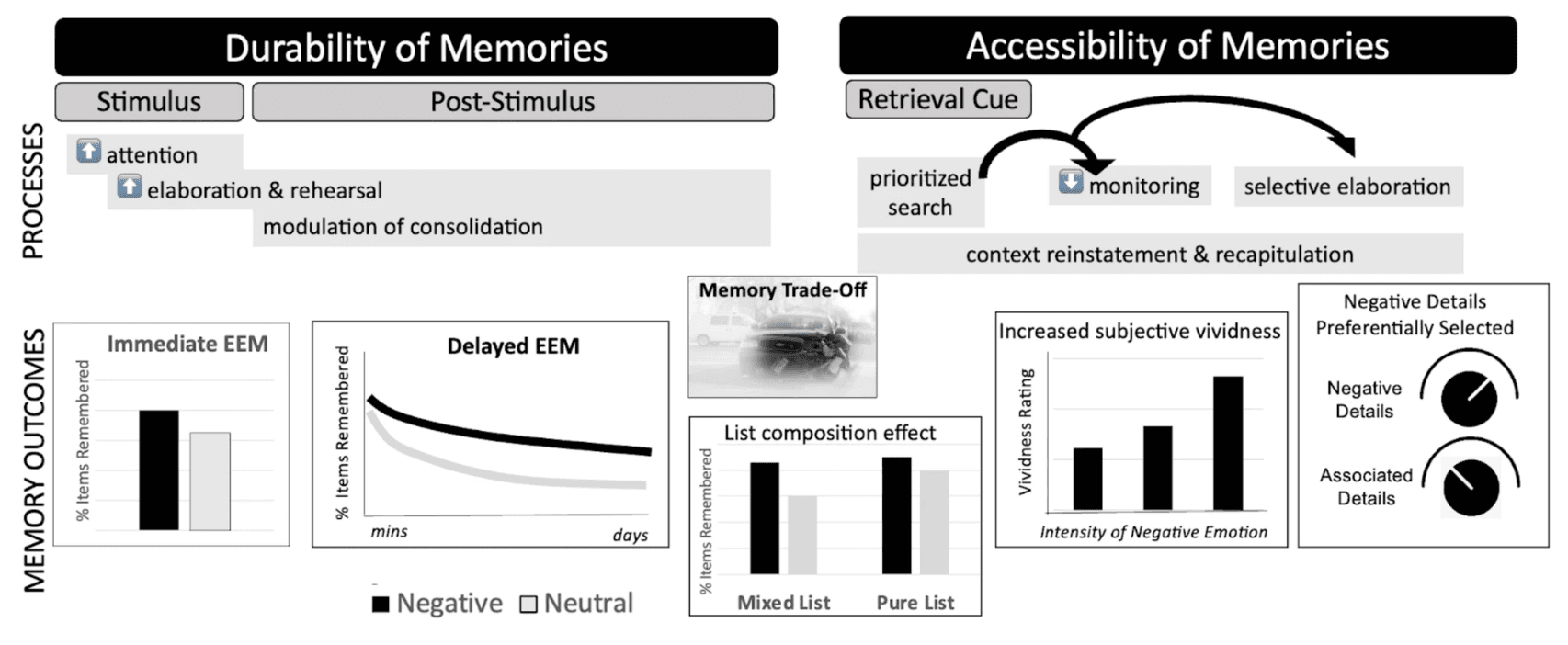
Fig 2

Models of Emotional Memory. There are multiple models of emotional memory. Many are not mutually exclusive, as they focus on different phases of memory or on different characteristics of memory

This model emphasized the importance of processes that unfolded during or shortly after an experience to influence the durability of a memory. Not surprisingly, given the influence of this model, the bulk of the initial research trying to understand the durability of humans’ negative episodic memories focused on those phases as well (reviewed by Hamann, 2001). These studies’ results were generally consistent with the modulation model: amygdala activity was enhanced during the successful encoding of negative content, and its relation to memory often was related to its interactions with the hippocampus (Richardson et al., 2004).

As additional research was conducted, and as experimental designs were expanded to measure additional aspects of episodic memories, it became clear that the modulation model was unlikely to be sufficient to explain the characteristics of negative episodic memories. In particular, the modulation model appeared insufficient in describing two key aspects of emotional memories: their tendency to show selective memory enhancements (see also Box 2), and the ability for there to be short-term enhancements in memory before consolidation processes had sufficient time to unfold.

Box 2. Models of Selective Memory Enhancements.

There has been longstanding interest in the “memory trade-offs” that occur for emotional memories. Loftus et al. (1987) noted the “weapon focus effect,” whereby individuals remember a weapon but not details of the perpetrator or broader context. Similarly, Reisberg and Heuer (2007) described “emotional memory narrowing,” and Safer et al. (1998) discussed “tunnel memory.” Adolphs et al. (2001) described how emotion seemed to enhance the gist for what had happened but to impair memory for details, and Kensinger and colleagues (Kensinger et al., 2005; Kensinger & Schacter, 2006a) described how emotion can lead central details to be remembered at the expense of their peripheral context.

The Arousal Biased Competition (ABC) theory (Mather & Sutherland, 2011) rooted these findings in the biased competition literature (Desimone & Duncan, 1995). Biased competition models essentially propose that there is a tug-of-war for attentional resources, with high-priority stimuli winning and low-priority stimuli losing. ABC suggests that in the presence of arousal, there is an amplification of this tug-of-war, such that the high-priority stimuli take even more of the resources and the low-priority stimuli are left with even less. Support for this model has come from behavioral studies, showing that when a shock or other arousing stimulus is presented, it leads to a greater discrepancy in processing and in memory for the high-priority stimuli (Sutherland & Mather, 2012). Additionally, a neuroimaging study showed that relative to a CS- control tone, when a CS+ tone (predicting a shock) was played, there was both enhanced visual activity for a high-priority visual stimulus and also reduced activity for the low-priority stimulus (Lee et al., 2014). These results suggest that arousal does not uniformly enhance perceptual processing but may do so specifically for high-priority content (see also Clewett & Murty, 2019). It has more recently been proposed, and formalized in the Glutamate Amplifies Noradrenergic Effects (GANE) model, that the neurobiological mechanism underlying this arousal-biased competition may be that “hot spots” are created by synergies between norepinephrine and glutamate release (Mather et al., 2016).

Durability for select aspects of negative experiences

Episodic memories are defined by the presence of contextual elements; this context is what makes these memories for events (episodes) rather than semantic memories for content void of any context. The multidimensional nature of that context means there are emotional parts to the experience and a myriad of other contextual features that are inconsequential to the emotional experience. Given the role of the hippocampus in binding many of those contextual details together into a stable representation (for different frameworks for this binding, see Backus et al., 2016; Moses & Ryan, 2006; Yonelinas et al., 2019), the modulation model might lead to the prediction that negative events should be remembered with a robust array of details. Yet the data have not borne out this prediction (Bisby & Burgess, 2014; Mather, 2016; Sutherland & Mather, 2012). In most cases, individuals remember only select content of negative experiences well. There remain debates about how best to characterize the mnemonic associations that are enhanced vs. impaired vs. unaffected by negative arousal. The distinctions may relate to how “intrinsic” the details are to the item (Kensinger, 2009; Mather, 2007) with features that are inherent to the stimulus, such as an object’s identity or color, prioritized in memory. For example, Palombo, Te, et al. (2021) designed an experiment in which participants viewed short video clips with inserted negative or neutral objects. Participants were asked to indicate whether they recognized the object, when during the video clip they had seen the object, and what other scenes had occurred within the same videoclip. Results revealed that negative emotion (compared to neutral) was related to improved recognition accuracy and temporal-order memory for the objects but poorer performance for choosing the scenes from the same videoclip. In other words, individuals remembered the emotional object from the film and approximately when in the clip it had appeared, but not the broader context in which the emotional object had appeared. The literature has more generally suggested that, for experiences with negative content, there may be a shift from prefrontally guided integration of content, which allows for retention of broader contextual information, and toward a reliance on sensory processing, which allows for retention of more item-specific detail (Bowen, Kark, & Kensinger, 2018). Content perceptually bound to the emotional item may be disproportionately remembered (Murray & Kensinger, 2014), while other aspects are forgotten.

The selective memory enhancements also may relate to the goal-states of the individual and the alignment of features with a participants’ encoding goals (Kaplan et al., 2012; Levine & Edelstein, 2009). For instance, when participants are explicitly instructed to process all elements of a scene (Kensinger & Schacter, 2008), they do better at remembering all elements of negative scenes, including the contextual details, compared with a naturalistic viewing condition; and when individuals are asked to unitize negative and neutral items together, creating a single, coherent representation, they are able to do so faster than for two neutral items (reviewed by Murray & Kensinger, 2013). In other words, when explicitly instructed to bind a contextual element to a negative item, individuals can use their encoding goals to do this more efficiently, but they do not appear to do so by default.

These memory enhancements for select aspects of experiences, and the corresponding evidence that contextual elements are often poorly remembered, is inconsistent with positive interactions between the amygdala and the hippocampus. Of course, the modulation model does not require that there are always these positive interactions, and indeed many have theorized of the amygdala and hippocampal memory systems as those that operate independently, except when they coordinate to support emotional memory (Phelps, 2004; Yang & Wang, 2017). However, there has been an alternate view in the human cognition literature for some time, with ideas of a “hot” emotional/fear, amygdala-driven system and a “cool” cognitive, hippocampal-driven memory system, with these systems being proposed to often act in opposition to one another (Metcalfe & Jacobs, 1996, 1998). Some studies of human memory are consistent with this idea of these systems acting in opposition, such as research demonstrating that while item memory is usually enhanced for negative relative to neutral stimuli, associative memory often is impaired (Bisby et al., 2016; Bisby & Burgess, 2014; Madan et al., 2012).

In their emotional binding model, Yonelinas and Ritchey (2015) proposed another alternative for the way to consider the roles of the amygdala and the hippocampus in emotional memory. They expanded upon an influential model of human episodic memory (Diana, Yonelinas, & Ranganath, 2007), in which the hippocampus serves to bind contextual details into an episodic memory representation, building in emotional memory by proposing that the amygdala separately acts to bind items to their emotional salience. Recent evidence to support this model has come from studies demonstrating that emotionality is only associated with an item when there is explicit recognition of that item (Bell et al., 2017; Palombo, Elizur, et al., 2021). In the absence of item recognition, individuals cannot remember whether snakes are poisonous or nonpoisonous (Bell et al., 2017), and a transfer of valence from a negative item to a neutral item seems to occur only if the neutral item was episodically bound to the negative item (Palombo, Elizur, et al., 2021). These results suggest the possibility that emotion may be inextricably bound to item representations in episodic memory and unable to be retrieved in the absence of those item representations.

A nice feature of the emotional binding model is that it does not require there to be opposition between the amygdala-binding and hippocampal-binding systems. It can allow for some situations in which amygdala-binding may take place at the expense of hippocampal-binding, which often is discussed when talking about the “weapon focus effect” (Loftus et al., 1987) and the tendency for negative memories to become separated from the context in which they occurred (Bisby & Burgess, 2017). The model also allows for other situations in which amygdala-binding may co-occur with hippocampal-binding, as may occur when emotional experiences are more likely to be remembered with their spatial (Schmidt et al., 2011) or temporal (Palombo, Te, et al., 2021) context, and as originally proposed by the modulation model.

Strength of encoding contributes to memory’s durability

While the modulation model and the emotional binding model both focus on processes specific to emotional memories, Talmi (2013) compellingly reviewed evidence that emotional memories also benefit from mechanisms that are engaged for many experiences and simply enhanced for emotional ones. Talmi’s mediation model proposes that emotional experiences benefit from boosted attention, elaboration, and organizational processes implemented at encoding (Talmi, 2013). A key element of this model is that it can explain emotional memory enhancements that arise over short-term delays; it does not require time for consolidation processes to unfold.

There is evidence that, at least in younger adults (see Box 4 for discussion of older adults), the types of encoding processes outlined by the mediation model may be particularly likely to be engaged for negative information (Kang et al., 2014; Kensinger, 2008; Ochsner, 2000), perhaps in part because of the modes of cognitive processing that negative emotions catalyze (Schwarz & Clore, 1996; Storbeck, 2012; Storbeck & Clore, 2005). That is, we remember negative experiences well, because they are prioritized for processing, and we grant them more of the cognitive processes that are well-known to increase the likelihood that an event becomes a part of our memory representations. For instance, Talmi et al. (2008) provided evidence for the attentional mediation of the emotional enhancement of memory. They asked participants to view negative arousing or neutral pictures under conditions that varied the attentional resources granted to those images, and then they gave participants an immediate recognition memory test. Results revealed that the immediate emotional enhancement of memory was related to the recruitment of a region of the left fusiform gyrus that also was associated with increased attention to the negative images.Evidence for the impact of encoding processes on negative memories’ durability has come from studies examining how emotion regulation impacts subsequent memory. Multiple studies have revealed that when participants are asked to engage in cognitive reappraisal—that is, to reframe an experience to make it less negative—memory for those experiences is enhanced (Kim & Hamann, 2012; Leventon et al., 2018). These studies can be thought of as testing the relative impact of the types of processes encompassed in the mediation model and those arousal-related processes emphasized in the modulation and emotional binding models. That is, cognitive reappraisal asks participants to grant additional attention and elaboration to negative stimuli (increasing those processes emphasized in the mediation model) to reduce the arousal associated with those stimuli (reducing the types of specialized mechanisms emphasized in the modulation and emotional binding models). The fact that this type of reappraisal leads to memory benefits for the negative content suggests the remarkable power of those cognitive processes that boost emotional memory via nonarousal-modulated mechanisms. They can enhance memory—including over a longer-term delay of two weeks (Kim & Hamann, 2012)—even while diminishing (though not entirely removing) the possibility of arousal-modulation processes.

Although the mediation model was proposed to explain the emotional memory enhancements over shorter time-frames, it is worth considering that these factors also could explain some aspects of the time-dependent enhancements for emotional information. It is plausible that when experiences (neutral or emotional) garner more attention, elaboration, and organization, this leads to increased rehearsal or reactivation over subsequent delays. Christianson (1992) emphasized the importance of rehearsal for the maintenance of emotional memories. It is well known that sleep, and other rest-filled delays, can serve as a time in which experiences are reactivated in memory, with some of the signals as to which memories ought to be reactivated coming from prioritization signals set up at encoding (reviewed by Payne & Kensinger, 2018). While these prioritization signals are often discussed in the context of emotional tagging, arising via arousal responses and amygdala activation (Richter-Levin & Akirav, 2003), prioritization signals can also arise due to goal-states related to anticipated future-relevance of stimuli. For instance, when students highlight material (Lo et al., 2016) or study material they know they will later be tested on (Bennion et al., 2016), those aspects are preferentially consolidated over sleep-filled delays. In at least some designs, these prioritization signals can even win out over any affective-tagging elicited by emotional content. For instance, Bennion et al. (2016) revealed that intentional encoding was such a strong boost to retention of information over a sleep-filled delay that, while emotional content was preferentially retained over sleep when it was incidentally encoded, the neutral items rose to nearly the level of the emotional items when they had been intentionally encoded for a memory test that participants knew would occur after the period of sleep.

Summary of factors leading to negative memories’ durability

In summary, extensive research has shown that negative memories are more durable than other types of memories. Their durability likely stems from multiple factors: Negative experiences are granted additional cognitive resources during encoding, aiding memory in the short-term (mediation model; Talmi, 2013) and providing prioritization signals that increase the likelihood that those experiences are later rehearsed (Christianson, 1992) or reactivated (Payne & Kensinger, 2018) in ways that benefit their maintenance over the longer-term. Negative experiences can also trigger mnemonic mechanisms that more directly influence consolidation. Sometimes, increased engagement of the hippocampus may contribute to the memory’s durability over time (modulation model; McGaugh, 2000, 2004). Other times, amygdala engagement can be sufficient to trigger item storage in the absence of hippocampal engagement (emotional binding model; Yonelinas & Ritchey, 2015). Importantly, what is durably retained are select portions of the emotional experience: those item aspects that were bound to the emotional salience (emotional binding model) and those aspects that, through emotional salience or goal-relevance, won out in prioritized competition for encoding resources (ABC and GANE models; Mather & Sutherland, 2011, Mather et al., 2016; see Figure 2 for depiction of these models of emotional memory).

Negative Content is Prioritized at Retrieval and Vividly Recollected

We all have examples of exceptionally vivid memories for particularly emotional, significant, and distinct events in our lives. Highly arousing personal memories stand out among more neutral autobiographical memories because of this increased vividness (Berntsen, 2001; Bohanek et al., 2005; Reisberg et al., 1988) and accessibility over time (Waters & Leeper, 1936). Our intuition tells us that these memories should also be more accurate, but this is often not the case. A landmark study by Neisser and Harsch (1992) revealed that in cases of “flashbulb memories” (Brown & Kulik, 1977), individuals remain highly confident in their memory for the details of the event, even though those details can become degraded and distorted over time. Talarico and Rubin (2003) expanded upon this important finding, declaring “Confidence, not consistency, characterizes flashbulb memories.” In other words, during retrieval, individuals experience inflated confidence for emotional memories, believing their memory to be accurate even when objective metrics suggest otherwise.

Initially, these results seemed contradictory with evidence that negative memories were often associated with a greater sense of recollection: Both when the retrieval cues themselves are emotional (Kensinger & Corkin, 2003; Ochsner, 2000) and when memory is assessed for neutral items encoded in negative versus neutral contexts (Jaeger et al., 2009; Maratos & Rugg, 2001; Smith et al., 2004), individuals are more likely to report that they have a vivid, specific recollection of a past negative event than of a past neutral event. Indeed, there are dissociations between the subjective vividness of a memory and its accuracy (Brewin & Langley, 2019). Phelps and Sharot (2008) argued that one reason for this disconnect is because of differences in the way that details of emotional versus neutral memories aggregate to affect the subjective experience of recollection associated with those memories. For emotional memories, individuals may base their recollective experiences on the strength or quality of a few select details, while for neutral memories, individuals may base their recollections on a broader and aggregated set of details. Indeed, when thinking back on the most negative events from our personal past, we tend to focus on those aspects that we think of as the most central to the event, rather than peripheral details (Berntsen, 2002; Talarico et al., 2009). It is almost as if people do not realize that there are missing details (Phelps & Sharot, 2008; Sharot et al., 2004) and that the visuo-perceptual vividness of their negative memories is fading with time (Cooper et al., 2019). This focus on selective portions may arise because those aspects are associated with prioritized search and elaboration processes, but with reduced monitoring at retrieval (Figure 1). Individuals may end their search for event details prematurely, once the negative elements come to mind, or they may skip to elaborating on the negative elements without monitoring for the accuracy or completeness of the retrieved content. In other words, metamemory or memory monitoring failures may account for some of the overconfidence in these memories’ accuracy (see discussion in Krug, 2007).

Considering the emotional binding model, another way to understand this pattern may be that, at retrieval, there is a prioritization of accessing the details retained via amygdala binding, with less emphasis given to retrieving details retained via hippocampal binding. Although this remains speculative, it would be consistent with a mystery in the literature: There are robust trade-offs in memory when tested via recognition. That is, individuals do better at recognizing emotional elements within scenes than neutral elements, but they do worse at recognizing the contexts in which emotional versus neutral elements were presented (Kensinger & Corkin, 2004; Kensinger et al., 2007). However, if the task is switched from a recognition task to a cued-recall task, where individuals are asked to generate the context that had been paired with an object, or vice-versa, there is a cued-recall advantage for the negative scenes (Madan et al., 2020; Mickley Steinmetz et al., 2016). While future work is needed to elucidate the basis for this dissociation, one possibility is that the cued-recall instructions, by putting emphasis on the retrieval of the association, force a focus onto details stored via hippocampal binding; by contrast, recognition instructions, by enabling a reliance on item processing alone, may keep the reliance on those details retained via amygdalar binding. More generally, these results are important in showcasing that the degree of selectivity for negative versus neutral memories can sometimes be related to how details are brought to mind at the moment of retrieval rather than to whether those details exist at all within the memory trace.

These behavioral data—showing dissociations between recognition and cued recall, and demonstrating disconnects between metrics of subjective vividness and objective memory content—imply an effect of emotion on retrieval and retrieval monitoring. As described earlier, much of the initial focus into understanding the cognitive neuroscience of emotional memory was on the processes that unfolded as an event was experienced and initially consolidated. Within the last few years, there has been a more direct focus on the role of retrieval processes in giving negative emotional memories their power. Here, we describe two models that focus specifically on how negative memories are prioritized at retrieval (eCMR; Talmi et al., 2019) and recollected with sensory detail (NEVER Forget; Bowen, Kark, & Kensinger, 2018).

eCMR: Negative Memories Crowd Out Neutral Memories

It is increasingly appreciated that associations are continuously being made between content and context—between information being learned or retrieved and the context in which those memory processes are unfolding (Lohnas et al., 2015; Polyn et al., 2009). It also has been demonstrated that the internal context of an individual is continually shifting, in ways that create temporal context shifts over time (Manns et al., 2007) and enable events to be linked via their shared temporal overlap (Cai et al., 2016).

A recent model, the emotional Context Maintenance and Retrieval Model (eCMR) (Talmi et al., 2019), has added emotion as a contextual dimension that can guide encoding and retrieval processes. This model accounts for the time-dependency of the emotional enhancement effect by proposing that emotional context can be more easily reinstated after delays than temporal or other contextual contexts. As predicted by context models of retrieval, this shared emotional context can lead to clustering effects in recall, whereby individuals will cluster their recall of items with negative emotional content even when those items were originally studied interspersed with neutral items (Barnacle et al., 2016; Long et al., 2015). However, the clustering effects have not yet been shown to relate to the degree of the emotional enhancement of memory, a pattern that would be expected were context effects at retrieval the primary driver of the memory enhancement.

An important revelation in studies comparing recall of items presented in pure-lists versus mixed-lists is that recall of emotional content often “crowds out” neutral content. That is, the reason why emotional items are remembered better than neutral items when studied in mixed lists, but not in pure lists, is largely explained by the fact that recall of neutral items is worse when appearing in mixed lists relative to appearing in pure lists. Although emotional items are sometimes better remembered in mixed lists compared to pure lists, this is not always the case (reviewed in Talmi et al., 2019). This crowding-out effect suggests that some of the improved accessibility of negative memories at retrieval may come from the fact that those memories are being selected at the expense of other neutral content and, once in mind, are setting up a context that will further bias the retrieval of additional negative content.

To our knowledge, eCMR has not yet been applied to paradigms that examine memory selectivity (e.g., memory for negative components at the expense of memory for neutral components of a photograph), but it seems plausible that the emotional context maintained could also be part of the explanation for the selectivity of memory. This ability for negative memories to crowd out neutral memories is reminiscent of trade-off effects, which have recently been attributed to retrieval effects as well as to encoding effects (Madan et al., 2020; Mickley Steinmetz et al., 2016). Future work will do well to examine whether retrieval context keeps memories honed onto the negative components while crowding out memory for other contextual details.

NEVER Forget: Negative memories yield sensory specificity and vividness via recapitulation

It has long been known that memory is best when a person’s state at retrieval—be it internal or external—matches their state at encoding (Tulving, 1974), with experimental evidence dating back to at least the 1940s (Abernethy, 1940). eCMR launches from this premise, expanding from the idea that emotional context is present at encoding and is sufficiently long-lasting to be recapitulated at retrieval. Another model also launches from this premise: that recapitulation is central to episodic memory retrieval, and that the power of negative memories can be understood by considering what happens when negative events are recapitulated in memory.

Bowen, Kark, and Kensinger (2018) proposed that Negative Emotional Valence Enhances Recapitulation (“NEVER Forget”). When memories are negative, there is an increased likelihood that the brain reconfigures itself at retrieval to be in a similar state to the one it was in during encoding. The model was based on evidence that negative memories are associated with greater encoding-to-retrieval overlap in a number of regions, including in sensory-processing regions (Bowen & Kensinger, 2017a; Kark & Kensinger, 2015). In fact, even when using exclusively neutral prompts to cue memory for a previously encountered positive, negative, or neutral event, one of the strongest predictors of retrieval-related activity in sensory regions was the valence of the encoded event (Bowen & Kensinger, 2017b).

Key tenants of that model were tested by Kark and Kensinger (2019a, 2019b), who replicated the finding that sensory recapitulation was greater for negative than neutral or positive memories, and who further showed that the way sensory regions were incorporated into memory networks led to those differences at retrieval. In particular, as physiological responding increased during encoding, early visual cortex regions became functionally connected to the amygdala in a way that enhanced memory for negative, but not positive or neutral events (Kark & Kensinger, 2019b). In other words, increased arousal led to the incorporation of sensory regions into emotional memory networks specifically for negative stimuli. Moreover, when those sensory regions stayed incorporated into emotional memory networks post-encoding, as measured via resting-state connectivity, that led to a more sensory-driven retrieval of negative memories and to a greater propensity for participants to show a negative memory bias. Thus, some of what gives negative memories their power is their sensory specificity and their vividness via recapitulation.

Clewett and Murty (2019) have proposed that the neurobiological underpinnings of this selective memory phenomenon may come from the activation of an arousal-related locus coeruleus-norepinephrine system. They suggest that when sympathetic arousal and activation of this system is high, there is a prioritization of item features at encoding and a reinstatement of the corresponding lower-level sensory cortical regions during retrieval. By their model, it is not the negative valence of the experiences per se, but the arousal and behavioral activation they elicit, and their ability to engage the norepinephrine system, that drives their effects on recapitulation. How best to characterize these differences—whether they are primarily related to the aversive or pleasant nature of the experiences or to differences in the motivational states they elicit—remains an important point for further research.

Prioritization of Negative Memory Retrieval

While the timecourse for these retrieval effects is still being investigated, extensive work has suggested that stimuli with high intrinsic motivational salience—often, high-arousal negative or threat-related stimuli—are prioritized for rapid access to retrieval processes. For instance, Jaeger et al. (2009) presented participants with items encoded in a scene with negative arousing content or with neutral content and later tested participants’ memories for the items while measuring event related potentials (ERPs); the key question was how the neural markers of retrieval would differ based on the previously studied encoding context of the items. Although the precise effects differed based on whether recognition was tested after 10 min or 24 hours, at both delay intervals, differences when recognizing items studied in a negative-arousing context versus a neutral context emerged around 200 ms, relatively early in the retrieval process and before markers of conscious recollection (see also Bowen, Fields, & Kensinger, 2018 for evidence of differences that emerged around 200 ms after retrieval-cue onset). Similarly, Righi et al. (2012) presented participants with images of faces with happy, fearful, or neutral facial expressions. Then, at retrieval, all individuals were presented with faces displaying a neutral expression, and ERP was used to measure the timecourse of responses as individuals indicated whether they recognized the face. Because all expressions were neutral at retrieval, any differences in timecourse would be based on the different facial expressions seen at encoding. Faces that had been studied with a fearful expression elicited ERP markers of enhanced visuo-attentional processing (a greater P100) and evidence of primed facial feature processing (a reduced N170 combined with a larger early frontocentral effect).

Negative memories may also enhance later recollective signatures and may engage later, postretrieval processes differently. For instance, Ventura-Bort et al. (2020) demonstrated that the late parietal old/new effect (occurring approximately 600-800 ms poststimulus) was evoked for old items previously associated with a (negative) emotional background. They additionally found that a waveform later in the retrieval epoch (800 ms and beyond) was enhanced for objects that had been encoded in that emotional context. Other ERP studies also have demonstrated that when images are unpleasant (Lavoie & O’Connor, 2013) or when neutral images are studied in negative contexts (Liu et al., 2021), those retrieval cues can modulate neural signatures later in the retrieval epoch. These types of results have led to the postulation that negative memories are associated with different retrieval orientations (Liu et al., 2021), with more sustained processing (Ventura-Bort et al., 2020), and with different levels of strategic control during retrieval (Herron, 2017). Together, these results suggest that there may be a privileged access to negative memories, and that once they are brought to mind, there is additional processing granted to the negative content of those memories.

When the Power of Negative Memories is Maladaptive

The power of negative memories can differ across people and across situations, and under some circumstances can become maladaptive. We briefly review how the power of negative memories is altered in individuals with affective disorders, such as depression and posttraumatic stress disorder (PTSD). We focus specifically on the negative memory biases that often exist in these disorders and can correlate with symptom severity, and on the role that rumination also may play.

Negative memory biases

Sometimes, the durability of negative memories can be problematic for mental wellbeing. In disorders, such as depression or PTSD, the way negative information is attended and interpreted is thought to play an important role (Ledoux & Muller, 1997), leading to negative memory biases that can contribute to symptom persistence (Harmer et al., 2009; Imbriano et al., 2022). Negative memory biases describe the relative quantity of events brought to mind, such that patients with depressive or PTSD symptoms are more likely to remember negative over positive or neutral experiences (Gibbs et al., 2013; Harmer et al., 2009; Imbriano et al., 2022), and this negative memory bias is thought to catalyze the onset of negative thinking and depressed mood (Harmer et al., 2009). For example, Imbriano et al. (2022) found that severity of PTSD symptoms, including depression, dysphoria, and panic attacks, was related to the tendency to remember studied negative material more accurately than studied neutral material.

Importantly, negative memory biases can result not only from enhancements in memory for negative events but also from reductions in memory for positive events. For instance, individuals with depression show relative impairments in memory for positive events compared with negative or neutral events, possibly because of dysfunctions in the dopaminergic system that would typically strengthen the encoding of these events into memory (Dillon, 2015; Dillon & Pizzagalli, 2018). Consistent with a dopaminergic hypothesis, acute administration of dopamine agonists has been shown to increase striatal activation in response to reward in individuals with major depressive disorder (Admon et al., 2017), and while there were not behavioral effects of that acute administration, longer-term administration of a dopamine agonist has shown beneficial for reducing symptoms of dysthymia or depression (Zangani et al., 2021). Similarly, in PTSD, pharmacological enhancement of cortical dopamine has shown some benefits for those with severe PTSD, reversing response biases toward fearful stimuli presented on a working memory task (Westphal et al., 2021).

Rumination

Other times, it is not the durability of negative relative to positive memories that is problematic, but the inability to stop reflecting on particular past negative experiences: rumination. Rumination is present across many affective disorders, and while it may sometimes be deployed in the hopes of achieving an adaptive outcome (Lyubomirsky & Nolen-Hoeksema, 1993), it instead tends to exacerbate negative moods and encourage maladaptive problem solving (Nolen-Hoeksema et al., 2008; Watkins, 2009).

While rumination may sometimes be deployed strategically, it also may arise because individuals fail to effectively gate their memory retrieval processes. Fawcett et al. (2015) revealed that those who ruminate are more likely to have difficulties controlling the contents of their memory; that is, they struggle to put unwanted or unneeded memories out of mind. A recent meta-analysis (Stramaccia et al., 2021) supported the conjecture that this type of memory suppression occurred more robustly in healthy individuals than in anxious or depressed individuals. These results may explain why rumination can be both a risk factor for the development of PTSD and also correlated with the maintenance of PTSD symptoms (Ehring, Ehlers, & Glucksman, 2008; Ehring, Frank, & Ehlers, 2008). It is plausible that the intentional focus on a past negative experience, when combined with a difficulty later suppressing the repeated retrieval of that experience, is a recipe for an intrusive memory (Ball & Brewin, 2012).

Modifying the Negativity of Memories while Maintaining their Power

Sometimes, a person can diminish the negativity of a memory, while retaining some of its power. We describe how the power of negative memories can be modified via engagement of emotion regulation strategies that change how individuals feel in response to an event (i.e., during event encoding: Gross, 1998) or a memory (i.e., during event retrieval: Holland & Kensinger, 2013a). We focus primarily on studies with nonclinical samples, but include brief discussion of connections to some commonly used therapies.

Emotion regulation at encoding

It is well known that the intensity of a negative event can be manipulated at encoding, by engaging in emotion regulation processes. A variety of strategies can be implemented, with different efficacy in-the-moment and with different consequences for later memory (Gross, 2002). Of the regulation strategies, cognitive reappraisal is usually discussed as being one of the most helpful. It works in-the-moment and is associated with better metrics of mental wellbeing than many other strategies, such as suppression or avoidance. As we described earlier, in the context of our discussion of the mediation model, an interesting aspect of cognitive reappraisal at encoding is that it can help to preserve memory for the content of an experience while stripping some of its affective intensity (Dillon et al., 2007; Richards & Gross, 2000). This pattern extends to autobiographical experiences: college students’ use of reappraisal just after a negative event corresponded with better memory performance and with a tendency to later underestimate the emotional impact of the event (Colombo et al., 2021). When you want to remember the critique given to you by a coworker, while not being overcome with negative emotion during the interaction or when reflecting on it later, cognitive reappraisal may be the strategy of choice.

The neurobiology that makes this possible is still not fully understood. It is clear that cognitive reappraisal engages prefrontal processes, often in the service of downregulating amygdala activity (Banks et al., 2007; Goldin et al., 2008). It may be that, by engaging those prefrontal processes that also serve to deepen the level-of-processing associated with encoding, memory is enhanced (Pannu Hayes et al., 2010). It also is plausible that part of the benefit to memory comes from reducing the experienced negative affect: If negative emotions shift the balance from a hippocampal-binding system toward an amygdala-binding system (see Box 3), then using reappraisal to weaken those negative emotions could help to keep the hippocampal-binding system engaged, increasing the likelihood that memories are able to be richly recalled and also decreasing the likelihood that they are recalled in maladaptive ways divorced from the encoded context. Thus, emotion regulation at encoding has the interesting potential to reduce the power of negative emotional memories insofar as it will reduce the intensity of the experienced negative emotion at the time of the experience and reduce the likelihood of maladaptive retrieval.

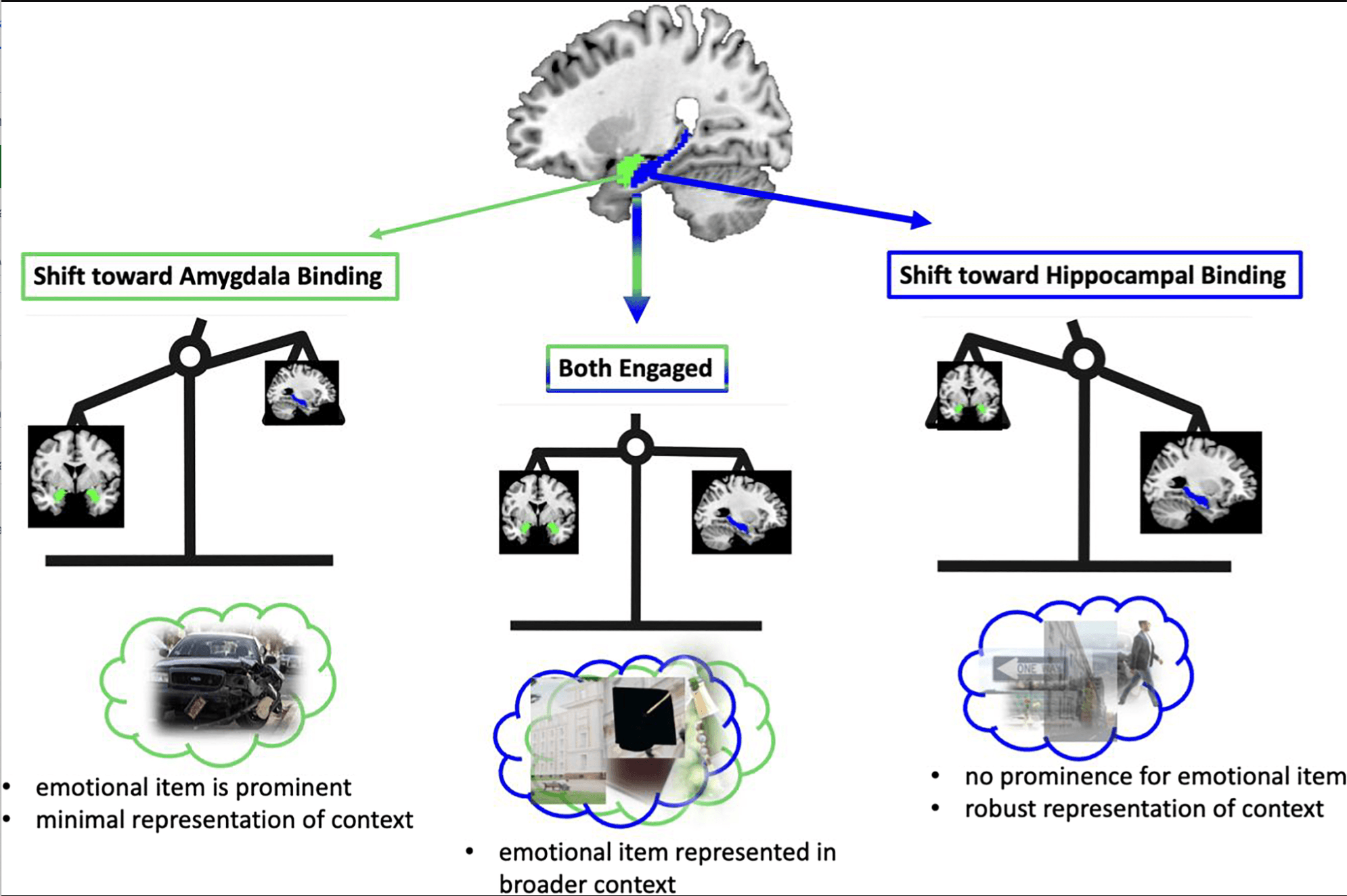
Box 3. Amygdalar and Hippocampal Binding Systems

The modulation model proposes that arousal, and specifically norepinephrine release, triggers cooperation between the amygdala and the hippocampus (Roozendaal & McGaugh, 2011).

Other research suggests that negative emotion can trigger disconnects between amygdala engagement and hippocampal engagement, consistent with behavioral evidence that negative emotion can lead to memories that are less coherent, with fewer within-event associations (Bisby & Burgess, 2017; Madan et al., 2017; Palombo, Elizur, et al., 2021). For instance, when individuals studied face-occupation pairs, the presence of negative occupations were associated with lower hippocampal engagement during encoding and with poorer memory for those associations (Berkers et al., 2016). Bisby et al. (2016) similarly found that the encoding of negative items was associated with a boost in amygdala activity but with a decrease in hippocampal activity, corresponding with an increase in item memory but a decrease in associative memory for those negative items.

Yonelinas and Ritchey’s (2015) Emotional Binding model may provide a framework in which to understand these seemingly conflicting results. By this model, there are two binding systems at work during encoding: an amygdala-based system, that prioritizes binding the item to its emotion, and a hippocampal-based system, that prioritizes binding the item to its context.

It is plausible that there are situations in which both systems are engaged, leading emotional items to be remembered in their broader context, and situations in which it is primarily the amygdala system that is engaged, leading emotional items to be remembered void of their context. An intriguing possibility to be addressed by future research is that negative emotion may create an imbalance between engagement of the amygdala and hippocampal systems and a shift toward amygdala binding, while positive emotion may be more likely to lead to simultaneous engagement of both systems or even a shift toward hippocampal binding.

box 3 image

Emotion regulation at retrieval

Not only can experiences be regulated, but also memories of those experiences can be regulated. This may be critically important to our mental health, If in the moment we fail to effectively regulate our responses to an event, later, as we reflect on the event, we can have another opportunity to reframe the experience (see review by Samide & Ritchey, 2021).

Individuals can intentionally and strategically regulate their responses to their memories, such as when individuals are specifically instructed to reduce their emotional reactions to a memory of an encoded negative image or a negative autobiographical memory (Holland & Kensinger, 2013a, 2013b). In these instances, it seems that individuals bring the past content into mind and then, similar to emotion reappraisal at encoding (Morawetz et al., 2017; Ochsner & Gross, 2005), engage lateral prefrontal control processes to down-regulate emotion regions and perhaps also sensory regions. There can be lasting consequences to this type of reappraisal, with individuals continuing to rate the memories as less emotionally intense even after some time has passed (Holland & Kensinger, 2013a, 2013b).

Strategic cognitive reappraisal may be similar to those processes encouraged in various forms of therapy (Kredlow et al., 2018). Broadly, cognitive behavioral therapy teaches techniques that patients can use to reframe negative thoughts as more positive ones (Coffey et al., 2015). Cognitive restructuring techniques more specifically encourage retrieval of a negative past experience, with the goal of the clinician guiding the rememberer toward a reinterpretation of the event’s meaning (Beck, 2011). Imagery rescripting similarly involves the retrieval of a past negative event coupled with the retelling of the memory with the inclusion of more positive and less negative imagery; this method has shown promise for multiple affective disorders linked to maladaptive negative memory retrieval (Morina et al., 2017).

While we have so far described methods that direct individuals to reframe or regulate their memories, aversive memories also may be spontaneous regulated. It is unclear if most people are able to engage in spontaneous regulation or if it primarily occurs in those individuals who are chronically motivated to reduce their experience of negative affect. In contrast to lateral prefrontal regions that may serve an outsized role in the strategic reappraisal of memories, the dorsomedial prefrontal cortex (dmPFC) may be particularly important for this type of spontaneous regulation. Kensinger and Ford (2021) have recently proposed that, at each phase of memory, the dmPFC participates in integrating the affective components of an experience with its other content. Through its various connections, including with the hippocampus (Ford & Kensinger, 2018), it may be able to play a key role in orchestrating memory framings that will either emphasize or deemphasize affective components. At retrieval, this may enable the dmPFC to down- or up-regulate the vividness of memories for negative images (Ford & Kensinger, 2017) or to dampen or intensify the focus on negative details of mixed-valence autobiographical events (Ford & Kensinger, 2019), even in the absence of explicit emotion-regulation instructions.

Finally, memories can be regulated by biological means. Rimmele et al. (2015) had participants read negative and neutral texts and then, 3 days later, recall the texts with either pharmacological suppression of cortisol levels or naturalistic levels. They found that when cortisol was suppressed, retrieval of the negative texts was impaired, with no corresponding impairment for the neutral texts. Importantly, these changes were long-lasting, with poorer memory for those negative texts persisting 1 week later. Although in this study, the regulation of cortisol happened via pharmacological intervention, it also is plausible that individuals could regulate their cortisol levels via naturalistic means, thereby weakening the strength of negative memories retrieved in that altered state.

Importantly, both the pharmacological work and the broader work on emotion regulation during retrieval (Holland & Kensinger, 2013a) suggests that the effects extend beyond the single occurrence during which the negative memory retrieval is regulated. Possibly by affecting the way that memories are reconsolidated after initial retrieval (Drexler & Wolf, 2017), once a memory is altered via regulation at retrieval (strategic, spontaneous, or biological), there can be lasting consequences for its content. We will return to a discussion of how negative memories may become more positive over retrievals when we discuss the power of positive memory retrieval.

Although future work is needed, it is possible that the timing of regulatory processes during retrieval is important. For instance, Holland and Kensinger (2013a, 2013b) found that when individuals were instructed to increase their emotional reactions to a negative memory, it was activity at the time those instructions were received—and before the memory prompt had appeared—that best corresponded with their success in upregulating their emotional reactions. Perhaps relatedly, a recent study (Bridgland & Takarangi, 2021) found that warning participants that retrieving a negative memory would be upsetting (designed to mirror “trigger warnings”) led those individuals to report a greater negative impact of the event than individuals who did not receive that warning. Thus, it is possible that part of what makes negative memories powerful relates to whether, before we have brought the memory to mind, we anticipate the impact of that recollective experience.

The Power of Negative Memories for the Future

Kensinger and Ford (2020) noted that although emotional memory retrieval often is measured as an end-point, as the culmination of processes that allow content to be accessed, it also is a starting-point. When we retrieve a memory, we create an opportunity to modify the memory representation: we may embellish some details and diminish emphasis on others, and we may reframe an experience, perhaps incorporating new information that changes our earlier interpretation. These effects can be long-lasting: Retrieval is a starting-point in the cycle of a memory, with the way a memory is retrieved at one time-point influencing how it is re-encoded, and how related content is encoded and how the memory is updated. The memories that come to mind can impact small decisions (Do we return to a restaurant?) and larger ones (Do we accept the invitation to present at a conference? Do we go on a second date?). The details that we recall also can affect our mental wellbeing and can influence our ability to effectively empathize with others.

Across many of these domains, negative content holds particular power. The Availability Heuristic describes the tendency for decision-making to rely on only a small subset of the total relevant information (Tversky & Kahneman, 1974); while there are many features that influence what content is used, content having negative valence is high among them, leading people to overestimate the likelihood of events, such as a terrorist attack (Sunstein & Zeckhauser, 2011). More generally, our negative autobiographical memories can serve important directive functions: informing, guiding, and motivating our current actions (Rasmussen & Berntsen, 2009). This directive function is often discussed as being adaptive (i.e., helping us to better navigate the future), which often occurs by being able to extract some lesson from a past negative experience (Figure 3). For example, memory for a particularly negative event (i.e., “rock bottom”) could serve as a turning point, leading us down a more successful path (i.e., an adaptive function; Pillemer, 2001, 2003; Habermas & Bluck, 2000). Even the most traumatic experiences can sometimes serve adaptive self, social, and directive functions (Pillemer, 2003; Rasmussen & Berntsen, 2009), a phenomenon known as posttraumatic growth (Schuettler & Boals, 2011; Tedeschi & Calhoun, 2004). However, recent research suggests that memories for negative events also can serve maladaptive functions (Burnell et al., 2020); for instance, that memory of “rock bottom” could cause us to give up on our more challenging goals (i.e., a maladaptive function). Thus, it is important to consider that negative memories, depending on how they are interpreted at retrieval, have the potential to serve either adaptive or maladaptive functions that will alter how decisions are made.

Fig. 3
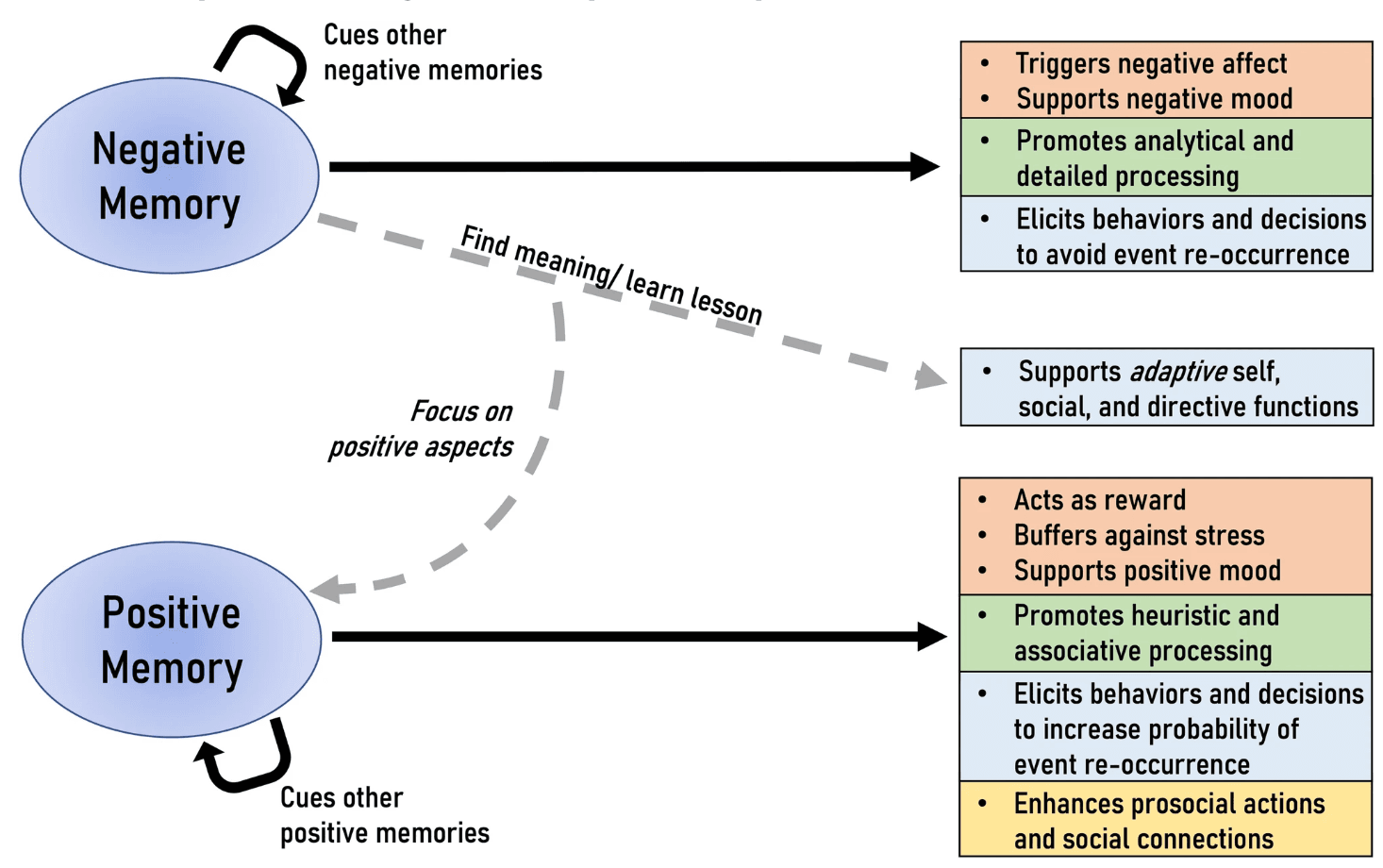
Fig 3

Consequences of Negative and Positive Episodic Memory Retrieval. The way a past negative or positive event is brought to mind has consequences across multiple domains. These memories can influence a person’s current affective state (denoted by peach color) and the way incoming information is processed (in green). They also can be used in directive ways, to guide actions and decisions (in blue) and, particularly in the case of positive memories, their retrieval can lead to prosocial behaviors (in yellow) Interestingly, one domain in which the negative does not seem to win out is in the domain of future prospection. When individuals think about the future, it often is positive events that are envisioned (D’Argembeau & Mathy, 2011; Rasmussen & Berntsen, 2013). People are slower to come up with negative future events than positive ones (Newby-Clark & Ross, 2003) and, while highly negative events are recalled from past time periods, the future projections more likely to be remembered are those that are positive (Gallo et al., 2011). Given that there is an immediate causal effect of positive future prospections on mental wellbeing (Grant & Wilson, 2021), it may be adaptive for individuals to envision a rosier view of their future (MacLeod & Conway, 2005). Indeed, despite so much research focused on how individuals remember negative experiences, memory for the good events from our past can hold tremendous power.

What Gives Positive Memories Their Power?

Positive memories gain power from many of the same factors that give negative memories their power: They are long-lasting and highly accessible. While positive memories may not show the same automaticity of retrieval mechanisms as negative events, positive events from our personal past come to mind more frequently than negative events and can do so involuntarily (Walker et al., 2003). They also are richly associative, which may increase the likelihood that retrieval of one positive memory cues another.

Positive memories also hold a power all their own. Unlike the affect associated with negative memories, which tends to fade relatively quickly, positive memories are more likely to retain their affective intensity (Walker et al., 1997; see recent review by Skowronski et al., 2014). This may be part of the reason why positive autobiographical memories act as rewards in themselves (Speer et al., 2014) and can buffer effects of stress (Speer & Delgado, 2017). Memories for positive personal events become more integrally tied to our sense of self and can perpetuate self-esteem (Çili & Stopa, 2015) and become an important part of our life story (Berntsen et al., 2011).

Given these features of positive autobiographical memories, it may come as no surprise that they have high utility and can be strategically recalled to good purposes (Figure 3). Positive memories are powerful in their ability to repair our moods after a negative mood induction (Joormann et al., 2007; Joormann & Siemer, 2004), to connect us socially (Rasmussen & Berntsen, 2009; Wolf & Demiray, 2019), and to inspire us toward prosocial behavior (Gaesser & Schacter, 2014). By activating reward circuitry, they even may trigger mnemonic circuitry that increases the likelihood that we encode the good in the world around us. We will review the literature shedding light on the power of positive memories.

Positive Memories are Durable

When we described the power of negative memories, we described the shallower forgetting curve for those events compared with neutral events. Studies of autobiographical memory demonstrate that positive memories also can show a shallower forgetting curve. We do not just remember a hair in our food or a classmate tripping over our backpack; we also remember a dessert accompanied by a birthday candle, or a classmate returning our dropped earbuds. Indeed, individuals can form flashbulb memories for positive events (Scott & Ponsoda, 1996), and many of the qualities of flashbulb memories can extend to personal events with high positive valence, such as when college students recall being asked to join a sorority or fraternity (Kraha & Boals, 2014). Positive memories also can be harder to put out of mind; in one recent study, individuals found it harder to direct themselves to forget positive social feedback relative to negative feedback (Xie et al., 2021).

Positive Memories are Associative

The characteristics of memories for highly positive versus highly negative experiences are not always identical. Most notably, several reports have suggested that individuals who feel positively about the outcome of an event recall its details confidently but with less factual accuracy (Bohn & Berntsen, 2007) or with less consistency over time (Kensinger & Schacter, 2006b; Holland & Kensinger, 2012) than do individuals who feel negatively about the outcome (but see Chiew, 2021 for no effect of valence). In other words, while negative emotional memories can be subject to distortion (Pesta et al., 2001) and overconfidence (Talarico & Rubin, 2003), these effects can be exaggerated for positive memories. For example, Holland and Kensinger (2012) found that adults recalled details of the 2008 Presidential Election more consistently over time when they perceived the outcome as negative compared with positive. These results are consistent with laboratory studies that suggest that memory for positive experiences often is associated with generally knowing that an event occurred rather than being able to recall specific details (Kensinger, 2009; Kensinger & Kark, 2018; Ochsner, 2000) and that memory for negative experiences can be associated with more sensory specificity, whereas memory for positive experiences can include more of the conceptual framing or gist (Kensinger, 2009).

The experience of remembering a positive personal event can feel quite different than that of remembering a negative event. Positive autobiographical memories often are associated with increased ratings of vividness and of reexperiencing the original event during retrieval compared with negative events (Ford et al., 2012; Talarico et al., 2004). Furthermore, while memories of negative autobiographical experiences tend to exhibit strong item memory at the expense of associations, memories of positive experiences seem more likely to retain contextual associations (Talarico et al., 2009). For instance, Zimmerman and Kelley (2010) found that when participants were asked to recall which neutral, negative, or positive words had been paired together, cued recall was better for positive pairs than for neutral or negative pairs. Madan et al. (2019) replicated this finding and showed that this improved association memory was greater when two positive stimuli were paired together than when a positive word was paired with a neutral word.

Perhaps relatedly, positive emotion appears to consistently enhance prospective memory. Prospective memory, which is the ability to remember to complete a task or behavior in the future, requires associating an intention to perform some action with a cue that occurs later in time—typically an event-cue (when driving past the store, make a stop to pick up milk) or a temporal-cue (at 5 pm, take medicine) (Crystal & George Wilson, 2015; McDaniel & Einstein, 2007; Shum et al., 1999). A recent meta-analysis revealed a main effect of positive emotion on prospective memory performance, in that performance improved for positive cues compared to negative or neutral cues. The enhancement effect occurred when positive cues were used during both encoding and retrieval. Furthermore, positive emotion cues additionally enhanced prospective memory for older adults compared with younger adults (Hostler et al., 2018).

Although research is limited, modulation of the dopamine system has been purported as a mechanism supporting prospective memory (Costa et al., 2008a) and at least some forms of associative memory (Lee et al., 2021). For instance, in Parkinson’s disease patients, who show prospective memory deficits, receiving an acute dose of levodopa led to better performance on a time-based prospective memory task (Costa et al., 2008b). Increased connectivity between the ventral tegmental area (i.e., the origin of dopaminergic transmission within the mesocorticolimbic system) and hippocampus lead to enhanced associative memory (Tompary et al., 2015). Thus, release of dopamine may boost associative processing and contribute to some of the cognitive consequences of positive affect (Ashby et al., 1999), although debates remain about the connections between dopaminergic transmission and positive emotion (Goschke & Bolte, 2014).

These memory patterns are generally consistent with the broaden-and-build theory of positive emotion (Fredrickson, 1998), which posits that positive emotions during an experience allow an individual to holistically process an event and to use the influx of information to identify actions that can be taken and resources that can be used to respond. As a result, the recollection of that event is more general and heuristic. In line with the broaden-and-build theory of positive emotion, some studies suggest positive emotions allow individuals to think more flexibly and creatively (Ashby et al., 1999; Isen et al., 1987; Sacharin, 2009). In this context, the memory results—suggesting that relative to negative memories, positive memories may retain less specific detail about any particular feature but may include more associative connections—would be consistent with the idea that positive emotions help participants to process information more holistically and to draw creative connections.

We have previously proposed that these differences may arise from how sensory (for negative) versus prefrontal (for positive) regions are incorporated into emotional memory networks (Bowen, Kark & Kensinger, 2018). Relative to negative memories, the encoding and retrieval of positive information tends to be associated with increased activity in prefrontal regions, both medial and lateral, and in midline regions including the posterior cingulate and precuneus (Erk et al., 2003; Ford et al., 2014; Kensinger & Schacter, 2008; Mickley & Kensinger, 2008; Ritchey et al., 2011). Reliance on prefrontal structures for positive memory may also explain the benefits to prospective memory, which also is thought to rely on prefrontal engagement (Burgess et al., 2011; Volle et al., 2011).

Individuals who have stronger prefrontal-amygdala connectivity also may show a greater tendency to remember positive experiences. This association has been revealed in older adults, with greater medial prefrontal-to-amygdala connectivity corresponding with the degree of a positivity bias in memory (Sakaki et al., 2013). Among younger adults, there can be a relationship between amygdala-prefrontal connectivity and the tendency to remember positive events (Kark & Kensinger, 2019b). The ability to use neurofeedback to increase the strength of this prefrontal-amygdala connectivity during retrieval of positive memories can even be linked to remission of symptoms of depression (Young et al., 2018).

Although fMRI studies cannot speak to the necessity of these regions for positive memory, two studies using repetitive transcranial magnetic stimulation suggest there may be causal links between prefrontal engagement and memory for positive information. In particular, these studies provide additional support for the argument that retrieval of positive memories is associated with activity in prefrontal cortex, having found that stimulating dorsolateral prefrontal cortex activity during retrieval can improve accuracy and reduce response times for positive compared to negative memories, even in subjects with high levels of anxiety (Balconi & Ferrari, 2012, 2013). Improved positive memory performance from increased prefrontal engagement is broadly consistent with the more heuristic and conceptual memory representations that individuals seem to retain for these experiences. A link between positive memory and frontal function also may be suggested by the fact that positive emotion enhances prospective memory, and prospective memory is known to rely on anterior prefrontal engagement (Burgess et al., 2003; Reynolds et al., 2009).

Although it is speculative at this point, an intriguing possibility is that positive versus negative memories may be associated with differences in how amygdala-binding and hippocampal-binding systems coordinate. While negative memories may be associated with enhanced amygdala-binding mechanisms, they also can be associated with reduced hippocampal-binding (reviewed by Bisby et al., 2020; see Box 3). By contrast, the behavioral data may suggest that positive experiences do not create that same opposition. Perhaps, for positive memories, there is amygdala-binding and also hippocampal-binding. While the bound contextual details may be lacking in some resolution due to their processing at a more heuristic level, positive memory representations may be more likely to contain those hippocampal-bound contextual details as well as the amygdala-bound emotional salience. This proposal is in many ways in line with the dissociation proposed by Clewett and Murty (2019), who suggested that activation of the locus coeruleus-norepinephrine system leads to high memory selectivity while activation of the dopaminergic-ventral tegmental area (VTA) system leads to a more integrative memory representation. They centered this dissociation more on the allocation of attentional resources and the nature of sensory processing. But it is possible that, complementary to these effects, are effects on the balance of binding mechanisms engaged. It is plausible that VTA projections to both the hippocampus (Murty & Adcock, 2014) and amygdala (Tang et al., 2020) enable these binding mechanisms to act synergistically rather than in opposition (pushing memory representations toward the balanced-scales example in Box 3 rather than to an amygdala-biased representation). Future work will be needed to address this possibility.Valence-related shifts in hippocampal- and amygdala-binding may help to explain the differential effects of arousal on positive and negative autobiographical memories. As discussed previously, positive autobiographical memories tend to contain more contextual information than negative memories (Berntsen, 2002; Talarico et al., 2009), leading to representations that are rated as richer and more vivid (Talarico et al., 2004). This effect of positive valence is independent of emotional arousal (Ford et al., 2012), suggesting that it may be supported, in part, by associative hippocampal processes. In contrast, the enhancing effect of negative valence on autobiographical memory has been shown to be dependent on arousal, only showing links to increased vividness and specificity for memories rated as highly emotional (Ford et al., 2012). In other words, the enhancing effects of autobiographical memory negativity may rely on more specific amygdala-binding systems that are triggered by increased arousal.

In addition to affecting the features of a successfully retrieved event, engagement of hippocampal- versus amygdala-binding systems may have implications for how memories are used for decision-making. While extensive research has framed decision-making as reliant on a running average compiled from past experiences, more recent work has highlighted that there are also many instances in which decision-making is more directly dependent on hippocampal-dependent episodic-memory mechanisms. For instance, Bornstein et al. (2017) revealed that incidentally reminding people of specific past decisions could bias their current decisions. This type of pattern suggests that decision-making is not relying on an average across past experiences but rather a sampling of past choices that can be influenced by the memories that are most accessible at a particular moment. Moreover, Murty et al. (2016) discovered that individuals could use past information to adaptively guide current decisions only when they had associative memory for the value associated with each item; item memory was insufficient. For example, it was only when a participant remembered which faces had been fair or unfair partners in a Dictator game that they were able to use that information to guide their decisions as to whom to select as a partner. More recently, FeldmanHall et al. (2021) connected this ability to adaptively choose partners to a trace signal in the hippocampus. Taken together, this burgeoning literature has led to new proposals for the role of the hippocampus in decision-making. Its role may predominate in situations in which a small number of past experiences are relevant, and also in cases where individuals must weigh different pros and cons, requiring an integration across multiple past experiences (He et al., 2022). In fact, some have gone so far as to suggest that the hippocampus’ ability to flexibly integrate across events gives it a central role in decision-making, even in circumstances that may not seem to have a dominant role for memory (Biderman et al., 2020), consistent with modern framings of the hippocampus as being specialized for guiding future behaviors more than for remembering past experiences (Biderman et al., 2020; Rubin et al., 2014). If true, then the engagement of the hippocampal-binding system could have important implications that transcend memory.

Positive Memories Retain Their Affective Strength and Act as Rewards

Positive memories show not only a shallow forgetting curve for the event but also show a shallow forgetting curve for the affect of the event. While the affect of negative memories dissipates over time, the affect of positive memories tends to remain strong, a phenomenon referred to as the Fading Affect Bias (FAB). For example, in one study that examined the trajectory of memories’ affective intensity over a one-year period (Ritchie et al., 2009), it was found that fading affect was the most likely trajectory for negative memories, while fixed affect (i.e., unchanged over time) was the most likely trajectory for positive memories. Skowronski and colleagues pointed out that the FAB reflects not only this tendency for the affect of a positive experience to stay associated with the memory for a longer period of time than the affect of a negative experience but also the increased tendency for a negative event to eventually trigger a more positive emotion (Skowronski et al., 2014; Walker & Skowronski, 2009). Someone may be devastated at the time of a breakup, and only later come to realize that the relationship was not a healthy one. With time, we cannot only come to appreciate that things were not as bad as they initially seemed but also to appreciate the silver linings (Ford et al., 2016; Ford et al., 2021; see Box 4 for discussion of how older adults may be particularly good at this).

Box 4. Older adults’ memory for the positive

While the negative can often win out in younger adults’ memories, older adults are more likely to show a focus on the positive (reviewed by Mather & Carstensen, 2005; Carstensen & DeLiema, 2018). This effect is often referred to as the age-related “positivity effect,” and the pattern often is interpreted as arising from age-related changes in motivations, goals and preferences (Carstensen et al., 1999). The positivity effect in older adults’ memories has been observed in a variety of experimental paradigms and for a wide range of stimulus types. Older adults have better memory for positive information over negative information in tasks employing emotional images, word lists, and faces (Reed & Carstensen, 2012), and a meta-analysis revealed that the positivity effect is larger when cognitive processing is not constrained by the task instructions and when the age difference between younger and older adult groups is more extreme (Reed et al., 2014).

It has more recently been demonstrated that not only do older adults remember proportionally more positive experiences than younger adults, they also can have an improved ability to focus on the positive aspects of otherwise-challenging life events. In a series of studies, Ford and colleagues demonstrated that, as compared to younger adults, older adults use more positive words to describe past events, even those that were viewed as quite negative at the time (Ford et al., 2016). After experiencing the 2013 Boston Marathon Bombing, older age was associated with an increased tendency to focus on the good that had come from the event (the heroism, the city coming together; Ford, DiBiase, & Kensinger, 2018), and 6 months later, older age also was associated with a decreased tendency to focus on the negative aspects of the event (Ford, DiBiase, Ryu, & Kensinger, 2018). A similar pattern was recently shown for reflections on the initial wave of the COVID-19 pandemic: older age was associated with an increased tendency to focus on the positive aspects (Ford et al., 2021).

Because the affect associated with positive experiences does not fade quickly, this allows individuals who recall positive past experiences to relive those pleasant feelings. Retrieval of positive memories is regularly used in laboratory experiments to manipulate mood, and multiple studies have shown its effectiveness in doing so (Gillihan & Farah, 2005; Siedlecka & Denson, 2019). For example, after a negative mood induction, participants are able to use the retrieval of positive memories to boost their mood, an effect termed the mood-repair effect (Joormann et al., 2007; Joormann & Siemer, 2004). There also are broader relations between the retrieval of positive memories and the increased experience of positive affect (Joorman et al., 2007) and life satisfaction (Hendriks et al., 2019).

More recently, it has been suggested that positive memories can literally be processed as rewards (Speer et al., 2014). When participants were asked to recall positive and neutral autobiographical memories, there was increased activity in corticostriatal circuitry typically associated with reward processing. Moreover, participants were willing to forego a small monetary reward in order to have the opportunity to recall a positive memory. The authors concluded that through their evocation of positive feelings and their engagement of reward-related regions, the recollection of positive experiences may be intrinsically valuable to an individual (Speer et al., 2014).

Speer and Delgado (2017) then went one step further, testing the hypothesis that positive memories can be used as a buffer for the effects of negative experiences by comparing the stress responses of individuals who recalled a positive or a neutral memory. Participants first underwent a Socially Evaluative Cold Pressor task (Schwabe et al., 2008). They then retrieved either positive or neutral autobiographical memories. Results were consistent with the buffering hypothesis of positive memories; individuals who retrieved positive memories had a smaller cortisol response to the stressor than did individuals who retrieved neutral memories, and they also reported less negative affect. Neuroimaging results, which showed increased prefrontal activity and connectivity among those who recalled positive memories after stress, led the authors to speculate that positive memories may serve emotion-regulation functions. In a follow-up study, Speer and Delgado (2020) showed that recalling positive memories with a social component could be particularly powerful in reducing the cortisol response following the same stressor task. These social-positive memories led to particular increases in activity in reward-related regions, emphasizing the impact of social engagement on positive memory recall and suggesting that positive memories that involve friends or family may provide additional resilience following stressful experiences.

Potentially related results have come from studies that looked at how nostalgia—a predominantly positive social emotion that arises from fond memories of one’s past (Sedikides et al., 2015)—can create analgesic effects. When people suffering from chronic pain wrote about an event that made them feel nostalgic (compared with an ordinary event that did not evoke such emotion), they reported lowered pain levels. Furthermore, college students who did not suffer from pain disorders were able to tolerate higher levels of applied pressure (i.e., showed higher pain tolerance) after writing about a nostalgic event (Kersten et al., 2020). This analgesic effect of nostalgia was recently confirmed in an fMRI study that showed participants images of objects or scenes designed to elicit nostalgic feelings of their childhood or to remind them of modern life (Zhang et al., 2022). During the viewing of the images that cued memories of childhood, participants reported more nostalgia, and when a painful stimulus followed those images, participants perceived it as less painful than when it followed the cues to modern life. FMRI results revealed that connectivity between the dorsolateral PFC and periaqueductal gray (a region linked to pain and analgesia; Linnman et al., 2012; Grahl et al., 2018) during the viewing of the nostalgic images related to this diminished perception of pain. Taken together, these studies suggest the fascinating possibility that retrieval of a positive memory can have retrograde and anterograde effects, minimizing the negative impacts of a just-experienced event (Speer & Delgado, 2017) or an about-to-be experienced event (Zhang et al., 2022).

Retrieving a positive memory may not only itself serve as a reward but also influence how patiently people wait for a future reward (Lempert et al., 2017). When faced with a choice between smaller, immediate gains and larger long-term benefits (i.e., intertemporal choices; Strotz, 1956), individuals who were asked to retrieve positive autobiographical events (Lempert et al., 2017) or to imagine specific positive future events (Peters & Buchel, 2010; Benoit et al., 2011) were more patient, opting more often for long-term benefits (i.e., reduced temporal discounting). Similar shifts in temporal discounting are not seen when participants are asked to retrieve negative autobiographical memories (Lempert et al., 2017), imagine specific negative future events (Liu et al., 2013), or imagine novel positive scenes related to their positive memories (Lempert et al., 2017), suggesting that both positive affect and episodic construction are critical to these effects. There is further neuroimaging evidence to suggest that not all positive autobiographical memories influence temporal discounting to the same extent. During positive memory retrieval, activity in regions associated with reward processing, such as the striatum, has been linked to more patient choices (Lempert et al., 2017). This association suggests that positive autobiographical memories may have more power to influence subsequent behavior when retrieval is more rewarding.

The Power of Positive Memories for Ourselves and for Our Future

We have already described the ability for positive memories to serve as rewards (Speer et al., 2014) and to serve important mood-enhancement functions (Bryant et al., 2005; Wolf & Demiray, 2019). Although these literatures have not been directly connected, it seems plausible that part of the power of positive memories for mood repair stems from their ability to act as an in-the-moment reward.

While retrieval of positive memories has the ability to transiently change how we feel, ongoing research is examining if the effects of positive memory recall are long-lasting. There is great interest in this topic across a range of subfields, with investigations of whether post-trauma mental-health indicators are tied to the accessibility of specific positive memories (Contractor et al., 2019) and whether positive-memory retrieval manipulations can benefit those with PTSD (Contractor et al., 2018, 2022). A recent systematic review of interventions conducted over the last twenty years (Miguel-Alvaro et al., 2021) described 12 intervention types, across 3 categories: techniques to increase access to and focus on positive memories; techniques to change qualities or features of positive memories; and techniques to improve self-esteem or emotion regulation. Specific methods employed included writing down positive autobiographical memories, describing the feelings and thoughts associated with a particular positive memory, and manipulating the vividness of recalled positive memories through narration to a therapist. Many interventions resulted in improved positive affect and reduced symptoms of depression. However, many of these effects appeared to be transient, and were not maintained at follow-up. The authors note that most assessments of these interventions lacked large sample sizes, replication studies, and longitudinal designs. Thus, future work is needed to examine the long-term utility of the use of positive memories.

It might not be too surprising to find that interventions that focus primarily on retrieving positive memories show short-term gains rather than longer-term effects. These interventions are unlikely to change the underlying memory representations, and instead may act primarily by providing the in-the-moment reward of the positive memory or potentially by increasing the accessibility of that positive memory (or related positive memories) for some period of time. However, as retrieval contexts shift (in time, in space, in brain-state), these influences might be expected to diminish in impact.

For longer-lasting influences to arise, it would seem essential for the underlying memory representation to be altered. Samide and Ritchey (2021) recently proposed that memory processes can be used as an emotion regulation device, helping to reframe the past and that the efficacy of these processes for emotion regulation may be tied to the completeness or strength of the recapitulation of the event in memory. This could even be one reason for the strong link between memory specificity and mental wellbeing; a specific memory has the opportunity to be updated in content and framing, while a general memory may not. This perspective also may shed light on the connections between overgeneral memory and depressive symptomology. An influential model of overgeneral memory proposes that it may be, in part, a cognitive avoidance strategy adopted to reduce negative affect (Williams et al., 2007), and a systematic review found evidence consistent with the idea that avoiding the retrieval of specific memories of an aversive event can reduce distress in the short-term (Sumner, 2012). Yet, over the long-term, this avoidance of specific memories appears to be harmful: Two meta-analyses have suggested that the presence of overgeneral memories at one time-point can predict greater depressive symptoms at follow-up (Sumner et al., 2010; Hallford et al., 2021; see also Chiu et al., 2019). By not retrieving specific memories, individuals may deprive themselves of opportunities to reframe the experience and to update the memory.

A recent study suggested that updating an underlying memory representation may be exactly what happens when, rather than asking people to focus on positive memories, people are asked to find positive meaning in a past negative event. Speer et al. (2021) found that participants who elaborated on the positive aspects of past negative events reported increased positive emotions and memory content upon future recollections of the same negative event, up to two months after the initial recollection. Paralleling these behavioral changes, the neural results suggested that the memory representations may have changed as a result of these reframings. During negative memory recollection, as memory content increased in positivity, neural activation patterns in regions associated with episodic memory retrieval (i.e., hippocampus) and reward-related processing (i.e., ventral striatum; Speer et al., 2014) became less similar to baseline activity profiles. Thus, by finding positive meaning in these past events, individuals may have changed the memory representations in ways that had long-term consequences. The authors proposed that the mechanisms may be akin to those engaged during positive reappraisal, consistent with the similarity between the neural activity engaged during positive meaning finding and that engaged in previous studies of positive reappraisal.

While more work is needed, there is reason to suspect that this type of positive reframing would be particularly powerful in its long-term consequences. In fact, a recent study found that memory-reframing helped children to remember a recent tonsillectomy more positively than those assigned to a control condition (Pavlova et al., 2022). It makes sense that changing the nature of the memory representation would have long-term consequences: In an animal model, artificially triggering a positive memory during the reactivation of a negative experience reversed the animal’s aversive behavior (Ramirez et al., 2015; Redondo et al., 2014), suggesting that reframing may be able to alter the memory representation. While this type of direct evidence does not yet exist, there is correlative evidence that older adults, who generally enjoy better mental wellbeing than younger adults even in the face of life stressors, are particularly good at this type of positive reframing. It is intriguing to consider whether there may be a causal link—whether part of the wisdom that is acquired with aging is the ability to positively reframe past negative experiences, and whether this tendency to reframe provides older adults with some of their resiliency (see Box 4).

Although we have so far focused on the benefits for mood, the power of positive memories extends into broader domains as well. Positive memories become integrally tied to our sense of self and become an important part of our life story (Berntsen et al., 2011; McAdams, 2001). Our ability to remember positive moments from our past is related to our self-esteem (Çili & Stopa, 2015). In this way, positive memories can be connected to our wellbeing by allowing us to maintain a positive self-concept.

Positive memories also serve important social functions (Rasmussen & Berntsen, 2009; Wolf & Demiray, 2019). We have already described how social context can enhance the value of memories (Speer & Delgado, 2020), with people willing to pay more to reminisce about socially relevant positive memories (a birthday party) rather than positive events that they experienced alone (receiving a good grade). Positive memories also can connect us socially; as Köhler et al. (2015) eloquently state, these memories constitute “the milestones of social communication” (p. 2). Reminiscing about past experiences can be a powerful way to improve positive affect (Bryant et al., 2005) and to solicit social support (Barry et al., 2019), and even is being explored as a way to boost cognitive function among older adults or those with dementia (Klever, 2013; Lazar et al., 2014). Thus, retrieving positive memories is rewarding in the moment and, through the social and integrative functions of reminiscence (Westerhof & Bohlmeijer, 2014) also can lead to other positive outcomes that can further potentiate those rewards.

Positive memories can propel us to help others. Children perform more good actions after remembering their past good actions (Tasimi & Young, 2016), and similarly, when adults remember specific instances when they have helped others in the past, this increases their prosocial intentions (Gaesser & Schacter, 2014). It may not even be necessary for people to remember their own good actions; specific memories for the good actions of others also may lead us to help. Ford, Gaesser, DiBiase, et al., (2018) found that individuals who remembered the details of others’ heroism during the 2013 Boston Marathon bombings were more likely to subsequently donate time or money to Boston-area charities while this helping behavior was lower in those who remembered fewer details of others’ heroism.

Using fMRI, Gaesser et al. (2019) found evidence that the way the medial temporal-lobe memory system and theory of mind networks were engaged related to this link to prosociality. Interestingly, when TMS was applied to a core node of the theory of mind network (the right temporal-parietal junction, RTPJ), there was no effect on the willingness to help, suggesting that it may be the episodic memory network engagement that plays the key role in the association to helping behavior. More work is needed to fully explicate how the retrieval of positive memories spur us toward prosocial intentions. But the extant data are exciting in suggesting that retrieval of positive memories may be beneficial not only to the rememberer but also to others through their prioritization of prosocial intentions.

Implications of the Power of Emotional Memories

In this final section, we aim to plant some seeds for future directions of research that we think could grow from the literature we have reviewed. In some cases, there is promising research already underway. In others, to our knowledge, there is not yet much that is known, and so here we point out possible links for future research to investigate.

The Power of Emotional Memories to Change our Moods

We have reviewed the power for positive emotional memories to be used as emotion regulation devices. Individuals tend to recall positive memories in order to counteract a negative mood (Joormann et al., 2007; Joormann & Siemer, 2004). More recent evidence has suggested this ability for positive memories to serve as emotion-regulation devices may come from the fact that they can serve as rewards (Speer et al., 2014), and buffer against the negative effects of stress (Speer & Delgado, 2017). We briefly discuss why positive memories, or positively reframed memories, may be particularly effective emotion regulation devices, and describe contexts in which their efficacy may be enhanced.

Positive memory retrieval as an emotion regulation device

While there are many other emotion regulation strategies people can use (McRae & Gross, 2020), there may be specific benefits conveyed by the use of positive memories. For one, the use of positive memories to change one’s mood may require less training than other emotion regulation strategies. While individuals often have to practice extensively to become good at reframing and reappraising experiences, autobiographical memory retrieval is a common part of daily experience. Second, the use of positive memories may be implementable across a wider range of scenarios, including instances where the emotion is not elicited by any specific situation that can be reframed or instances in which it is a mood rather than a short-lived emotional reaction that must be regulated.

Episodic specificity inductions to enhance negative memory reframing

It is not just positive memories that can provide positive impacts to our mental wellbeing. Negative memories can as well if we are able to reframe them so as to find the good that has come from them (Samide & Ritchey, 2021). In fact, reframing negative memories may be a particularly powerful way to boost our mental health, in long-lasting ways. As we described earlier, a barrier to such reframing may be if memories are retrieved in an overgeneral and semanticized way, rather than as an episodically rich memory. If true, then training individuals in how to retrieve specific memories may be advantageous.

Memory specificity training (Madore & Schacter, 2014; Raes et al., 2009), based on the cognitive interview (Geiselman et al., 1985), encourages individuals to thoroughly retrieve details of an event, using a guided process to enhance the retrieval of episodic details. There is promising work showing that specificity inductions can be linked to reductions in symptoms of PTSD (Moradi et al., 2014), depression (Neshat-Doost et al., 2013; Raes et al., 2009), and complicated grief (Maccallum & Bryant, 2011). It also may boost positive affect and decrease negative affect in healthy college students (Jing et al., 2016). Some of these benefits have been linked to the concept of episodic reappraisal (Jing et al., 2016) or the ability to reframe a negative experience that one is remembering or imagining.

Power of reminiscence for grief

Autobiographical memory retrieval can be powerful for individuals who are grieving (Mroz & Bluck, 2019). Whether those memories are powerful in harming or helping depends on the way people use their memories. Wolf et al. (2021) revealed that after the loss of a loved one, individuals benefited from recalling autobiographical memories if they did so in ways that have been described as “self-positive” (Cappeliez & O’Rourke, 2006) – using memories to maintain identity, to problem-solve, and to prepare for one’s own death. They suggested that when used this way, past memories may help individuals to reframe their identity and their future without their loved one. To our knowledge, there have not been interventions focused on helping individuals to use their memories in these self-positive ways, but there may be promise for doing so as a way to help those who are grieving a loss.

The Power of Emotional Memories in the Classroom

Educational psychology has been deeply influenced by research on executive functioning and cognitive control (Diamond & Lee, 2011). Yet the long-term memory literature has had relatively fewer intersections with the way classroom education is approached (Ofen, Yu, & Chen, 2016). There have been recent attempts to bridge this divide (Fandakova & Bunge, 2016), but to our knowledge there has been little discussion of how the literature on episodic emotional memories may be relevant to the classroom. We suggest the importance of considering two directions of connections.

Emotional material may benefit from different study techniques

Students do not just learn about neutral content in the classroom. They read fiction and nonfiction written to trigger positive and negative emotional reactions, discuss current events that are emotionally charged, and study about diseases and treatments that may directly affect loved ones. The advice given for how to effectively study this information is almost entirely based on laboratory research using nonemotional stimuli.

There is reason to think that many of the effective-study principles developed through examination of memory for neutral content will extend to emotional content. For instance, high-quality sleep has been shown to benefit memory for emotional content at least as much as nonemotional content (Payne & Kensinger, 2018). But what about spaced rehearsal? Or emphasizing quizzing over re-studying? What about taking notes in visual form versus written or in ways that emphasize associations among concepts? Few of these study principles have been examined for emotional content. To the extent that the emotional enhancement of memory is reliant on similar processes as engaged for neutral material (mediation model), the benefits should remain similar. But it seems plausible that where the mechanisms begin to diverge, so might the most effective study strategies. For instance, in contrast to the robust “testing effect” advantage conveyed for neutral content, there have been mixed results for negative content, and some suggestion that rather than the broad benefits conveyed for nonemotional content, retrieval practice may benefit memory for associations with negative content (Jia et al., 2018) but not memory for the negative items themselves (Jia et al., 2019). It seems possible that the different patterns of accessibility for negative versus neutral memories may contribute to this disconnect: If negative content is associated with a prioritized search process, this may mean that its retrieval conveys fewer benefits when compared to the more-effortful search process engaged for neutral information. It also is plausible that retrieval practice primarily engages content linked to hippocampal-binding mechanisms and may be less efficacious for content linked to amygdala-binding mechanisms.

Emotional memories and new learning

We have already described the power for emotional memories to at least transiently change our affective state. Classroom assignments are often designed to evoke these memories: In elementary school, children might be asked to write about a favorite experience or to consider when they have felt similarly to a protagonist. In high school and college, students may be encouraged to write about life experiences to gain facility in writing, or to connect their life experiences to material being presented. When this memory retrieval happens in the classroom, there are likely to be consequences for the processing of incoming information.

If emotional memories are changing individuals’ moods, this can then impact how they are processing incoming information. Individuals in a negative mood may attend to details and may process information in a more narrow, analytic fashion than people in positive or neutral moods (Clore et al., 2001). By contrast, participants in a positive mood are more likely to process information in a broader manner, focusing on the gist or global theme of the information, and often seeing creative connections among stimuli that others miss (Clore et al., 2001; Fredrickson, 2004). There is some work focused on customizing learning material based on real-time automated evaluations of students’ emotional states (Shen et al., 2009), although much of it has focused on students’ experiences of confusion, and so there remains much to be investigated.

In the classroom, it seems plausible that retrieval of emotional memories could be leveraged to encourage the relevant modes of information-processing. A student might be asked to think about a positive memory before engaging in a task requiring creative associations to be drawn. If positive memories can buffer from stress in educational contexts as they can in laboratory ones, there could be benefits to asking students to take a moment to retrieve a positive memory before handing out a pop-quiz or asking a student to read in front of the class.

The Power of Emotional Memories within Digital Contexts

Memory theories are increasingly recognizing the role of fluctuating internal as well as external contexts in guiding retrieval outputs, and how emotional state interacts with these retrieval outputs (e.g., eCMR model). It has long been considered how the encoding-to-retrieval match in physical environments affects learning (Abernethy, 1940; Godden & Baddeley, 1975). With the advent of digital contexts, and their pervasive use during the COVID-19 pandemic, individuals may now be able to decide “where” they study or work—what virtual background or environment they use, and for what situations they use it.

There would be good reason to think that consistency of digital contexts across study and retrieval episodes would benefit memory. Indeed, Cox et al. (2021) found when events occurred in the same contexts, retrieval performance for those events was better compared with retrieval of events presented in different contexts. Thus, returning to the same “virtual boardroom” may help an individual to recall ideas previously discussed in that virtual context.

There is a potential downside, which relates to the simplicity of the digital contexts. The use of a virtual background for a video call is quite similar to the juxtaposition of a facial expression upon an unrelated scene. What happens if that face is of your boss who is critiquing your latest presentation? Will the negative affect from that interaction “bleed” onto the background, as can happen in laboratory settings (Palombo et al., 2021; Madan & Kensinger, 2021)? These may be important questions to address, so that individuals can understand when continuity of digital context is helpful because the context-match from one meeting to another allows for increased content recollection, and when the possible downsides of “affective bleed” predominate.

Another consideration for digital workspaces is whether staying within the same digital “space” may affect our ability to create event boundaries. Event segmentation theory argues that humans proscribe boundaries to life events to organize and optimize the mountain of information we encounter in everyday life (Kurby & Zacks, 2008; Zacks & Swallow, 2007). Importantly, event boundaries are thought to help protect emotional memories from interference, allowing important emotional memories to be protected and prioritized (Dunsmoor et al., 2018). Events are traditionally defined as a period of time at a specific location that has a beginning and an end (Kurby & Zacks, 2008). Studies in real world settings show memory for items is improved when they were presented across events instead of within events (Pettijohn et al., 2016; Smith, 1982; Smith & Rothkopf, 1984). Curious if spatial location plays the same role in a digital context, a recent study used virtual reality to systematically identify if spatial boundaries are necessary to improve memory performance (Logie & Donaldson, 2021). In a series of four experiments, researchers showed that removing spatial boundaries, including doorways, walls, and separate rooms from a virtual reality space did not negatively affect free recall memory performance. The authors found spatial events are not necessary to create boundaries and that temporal boundaries were sufficient to provide memory enhancements (Logie & Donaldson, 2021). Thus, learning or working within a digital space that does not involve changes in physical location (e.g., a student who attends different classes throughout the day sitting in the same place on the same computer) may still leverage event boundaries toward memory success in the same way as when we are interacting with physical environments. More needs to be done to examine whether this holds for emotional content being remembered.

The implications can extend beyond work, as digital spaces are increasingly being used for social connection purposes as well. In what ways do memories of a birthday party or memorial service differ when experienced online versus in person? How do any differences influence the power of those memories?

Shifting the Balance of Hippocampal and Amygdala Binding Systems

In this review, we described how the hippocampus and amygdala may subserve different binding functions (Yonelinas & Ritchey, 2015) and may not always work synergistically (Bisby & Burgess, 2017). If indeed there can be shifts in the balance between the relative engagement of hippocampal and amygdala binding systems, this raises the question of whether there may be manipulations that can strategically shift these weights. Are there interventions that could increase the likelihood of remembering contextual details of high-arousal, negative experiences, by boosting the reliance on the hippocampal-binding system? Given that disruption of hippocampal mechanisms and the ability to remember specific, contextual details has been associated with depression (Belleau et al., 2019) and PTSD (Shin, 2006), this would seem an important question to examine. To our knowledge, there is no direct evidence to address this question, but we note two potentially promising directions for future research.

Neurofeedback

It remains unclear how the balance of hippocampal and amygdala binding systems is determined. There is beginning to be promising evidence that neurofeedback can be used to downregulate amygdala activity (Brühl et al., 2014) and to enhance emotion regulation (see Linhartová et al., 2019 for review). For instance, Herwig et al. (2019) provided participants with neurofeedback of their own amygdala activity while they were instructed to use cognitive reappraisal. Over four weekly sessions, they noted significant reductions in amygdala activity. Interestingly, amygdala connectivity with the hippocampus also increased. They did not examine memory for the pictorial stimuli presented during the neurofeedback session, but this pattern raises the question of whether methods like this may be useful for achieving a greater balance between hippocampal and amygdala binding systems.

Aerobic exercise

Extensive prior research has demonstrated that aerobic exercise is good for hippocampal function (Erickson et al., 2011) and may encourage cell growth in the hippocampus (Luo et al., 2019). Less is known about how exercise affects the amygdala. To date, most research has focused on the effect of exercise on emotion regulation, showing that exercise can boost prefrontal function (Ligeza et al., 2021) and can increase connectivity between the prefrontal cortex and amygdala in ways that have been interpreted as indicative of improved emotion regulation (Ge et al., 2021). If exercise is indeed increasing hippocampal function while decreasing amygdala engagement, it may create an intriguing scenario in which an emotional experience is remembered primarily with hippocampal-binding mechanisms engaged. To our knowledge, no work has examined whether participation in aerobic exercise programs or individual differences in aerobic fitness affect the types of details remembered about an emotional experience. Instead, the bulk of work has looked at how acute bursts of exercise around the time of learning or consolidation affect overall memory ability (Loprinzi et al., 2019 for review) or emotional memory ability specifically (Libkuman et al., 1999; Wade & Loprinzi, 2018). For example, future work could examine how exercise interventions affect associative as well as item memory for negative content.

Conclusions

Our memories are a powerful tool with which we navigate our lives; we use our memories to remind us of our past, to make sense of our present, and to direct our future. The current review has highlighted the ways in which emotional valence enhances this power. Positive and negative emotion can make memories easier to retrieve, more richly reexperienced, and more likely to influence behavior. These changes are supported by a variety of mechanisms that guide how events are encoded, consolidated, retrieved, and altered over time. We argue it is important for the field of emotional memory to 1) gain a firm understanding of the similarities and differences between the characteristics and uses of negative and positive memories, 2) the mechanisms that support these differences, and 3) their implications in clinical, educational, and professional domains.

Open Article as PDF

Abstract

The power of episodic memories is that they bring a past moment into the present, providing opportunities for us to recall details of the experiences, reframe or update the memory, and use the retrieved information to guide our decisions. In these regards, negative and positive memories can be especially powerful: Life’s highs and lows are disproportionately represented in memory, and when they are retrieved, they often impact our current mood and thoughts and influence various forms of behavior. Research rooted in neuroscience and cognitive psychology has historically focused on memory for negative emotional content. Yet the study of autobiographical memories has highlighted the importance of positive emotional memories, and more recently, cognitive neuroscience methods have begun to clarify why positive memories may show powerful relations to mental wellbeing. Here, we review the models that have been proposed to explain why emotional memories are long-lasting (durable) and likely to be retrieved (accessible), describing how in overlapping—but distinctly separable—ways, positive and negative memories can be easier to retrieve, and more likely to influence behavior. We end by identifying potential implications of this literature for broader topics related to mental wellbeing, education, and workplace environments.

Summary

Memories of past events, known as episodic memories, allow people to recall and reflect on their experiences. These memories help guide current decisions and shape future expectations. Emotional experiences, whether positive or negative, are more likely to be remembered than ordinary events, even if some details are not perfectly accurate. Emotional memories are also more accessible, meaning they come to mind more easily. This means a person's collection of memories is often influenced by significant emotional moments, which in turn affect future choices and predictions.

This document will first discuss the impact of negative memories, followed by positive memories. It will explain how emotions lead to these memories being stored and accessed, and how these lasting emotional memories affect decisions, behaviors, and well-being. Finally, it will touch on how this information applies to mental health, education, and work environments.

A Note on Terminology

The term "emotional memory" in this context refers to how the emotion felt during an initial experience affects episodic memory. Specifically, "emotional memory," "negative memory," and "positive memory" describe episodic memories for events that first caused a negative or positive emotional reaction.

Evidence for the Power of Negative Episodic Memories

Research on emotional memories has historically focused more on negative memories. This focus exists for two main reasons.

First, negative memories and emotions generally have a strong impact. Studies show that people tend to pay more attention to negative information and value losses more than gains. Negative memories can be especially lasting, with people sometimes recalling old sad memories more easily than happy ones. This may be partly because negative experiences used in experiments often have a greater intensity. It is easier to find images or create stories that evoke strong negative feelings than intensely positive ones, and people's reactions to positive stimuli vary more.

Second, much of the early human research built upon studies in animals, which mainly looked at how physical responses to stressors (like electric shocks) increased memory. These memory benefits were linked to the amygdala, a brain area that interacts with other memory regions. While the amygdala was first connected to fear, it became clear that it responds to both positive and negative stimuli, and that memory improvements extended to pleasant events as well. Despite this broader understanding, the ease of finding negative stimuli that cause strong physical responses likely kept research focused on negative experiences.

What Gives Negative Episodic Memories Their Power?

A key reason negative memories are powerful is their persistence. Evidence from both animal and human studies shows that negative content is remembered more often than neutral content, especially over longer periods. This means negative memories are forgotten more slowly. Negative memories are also powerful because their cues are prioritized during recall. When these memories return, they feel vivid, and people trust their content. Therefore, negative memories are powerful due to strong encoding and storage processes that make them durable, and because they are accessible and vivid when recalled.

Negative Memories are Durable

People remember everyday experiences for short periods. For example, recalling what was eaten for lunch today or who sat nearby in class. Negative memories become distinctly different when looking at longer timeframes. Most people cannot recall what they ate two weeks ago, but if they found a hair in their food or a classmate tripped over their backpack, those negative memories would likely last longer.

Several models explain why emotional memories are more lasting. The modulation model, based on animal studies, was the first to formally explain this, particularly its time-dependent nature. This model suggests that the physical arousal from a negative event triggers stress hormones, which increase amygdala activity and its connections to the hippocampus, a brain region important for memory. This model highlights the importance of processes occurring during or soon after an experience in making a memory durable. Early research in humans largely supported this, showing increased amygdala activity during the successful encoding of negative information, often linked to its interaction with the hippocampus.

As research progressed and more aspects of episodic memories were studied, it became clear the modulation model might not fully explain all characteristics of negative episodic memories. It seemed insufficient for explaining two main aspects: their tendency to show selective memory enhancements, and short-term memory improvements that occur before full memory consolidation.

Durability for select aspects of negative experiences

Episodic memories are defined by their contextual details, which make them memories of specific events. This context includes emotional aspects and many other less important features. Given the hippocampus's role in linking these contextual details, the modulation model might predict that negative events should be remembered with many rich details. However, research often shows that people remember only selected parts of negative experiences well. Debates continue about which memory associations are enhanced, impaired, or unaffected by negative arousal. The differences may relate to how "intrinsic" details are to an item. Features essential to a stimulus, like an object's identity or color, are often prioritized in memory. For instance, people might remember an emotional object from a video and when it appeared, but not the broader background. Generally, research suggests that for negative content, there may be a shift from broad, context-integrating processing to more sensory-focused processing, which favors item-specific details.

Selective memory enhancements may also depend on a person's goals and how well features align with their encoding goals. For example, if people are explicitly told to remember all parts of a negative scene, they do better at recalling contextual details than when they view it naturally. This means people can efficiently link contextual elements to negative items if instructed, but they do not typically do so on their own.

These selective memory enhancements, and the finding that contextual details are often poorly remembered, do not fully align with positive interactions between the amygdala and hippocampus. While the modulation model doesn't require constant positive interactions, and some theories propose these systems act independently except when supporting emotional memory, other views suggest they often work in opposition. Some studies of human memory support this, showing that while memory for individual negative items is often improved, memory for associated details can be impaired.

The emotional binding model offers another perspective on the roles of the amygdala and hippocampus in emotional memory. It suggests that the hippocampus binds contextual details into an episodic memory, while the amygdala separately binds items to their emotional significance. Evidence supports this, showing that emotionality is linked to an item only when that item is consciously recognized. This implies that emotion might be deeply connected to item representations in memory and cannot be recalled without them.

A valuable aspect of the emotional binding model is that it does not require the amygdala and hippocampus to be in opposition. It allows for situations where amygdala binding might occur at the expense of hippocampal binding (e.g., "weapon focus effect," where people remember a weapon but less of the scene). It also allows for situations where both systems work together, such as when emotional experiences are remembered with their spatial or temporal context, as originally suggested by the modulation model.

Strength of encoding contributes to memory's durability

While the modulation model and emotional binding model focus on processes specific to emotional memories, the mediation model proposes that emotional experiences also benefit from general memory mechanisms that are simply enhanced for emotional events. This model suggests that emotional experiences gain from increased attention, elaboration, and organization during encoding. A key part of this model is its ability to explain emotional memory improvements that occur over short periods, without needing time for consolidation.

Evidence suggests that, at least in younger adults, the encoding processes described by the mediation model are more likely to be engaged for negative information. This may be partly due to the cognitive processing styles that negative emotions trigger. People remember negative experiences well because they are prioritized for processing, receiving more of the cognitive resources known to improve memory. For example, studies have shown that increased attention to negative images is linked to immediate emotional memory enhancement.

Further evidence for the impact of encoding processes on negative memory durability comes from studies on emotion regulation. When people are asked to use cognitive reappraisal (reframing an experience to make it less negative), memory for those experiences is enhanced. Cognitive reappraisal involves giving more attention and thought to negative stimuli (boosting mediation model processes) while reducing the arousal associated with them (reducing modulation and emotional binding model mechanisms). The fact that reappraisal leads to memory benefits suggests the powerful role of these cognitive processes in improving emotional memory through non-arousal-related means. These processes can enhance memory, even over longer periods, while reducing arousal-driven modulation.

Although the mediation model initially explained short-term emotional memory enhancements, these factors could also explain some time-dependent improvements. It is possible that experiences (whether neutral or emotional) that receive more attention, elaboration, and organization are more likely to be rehearsed or reactivated later. Rehearsal is known to be important for maintaining emotional memories. Sleep and other rest periods can reactivate memories, with signals from encoding guiding which memories are prioritized. While these prioritization signals are often linked to emotional tagging via arousal and amygdala activation, they can also arise from goals related to a stimulus's future relevance. For example, students remember highlighted material or material they expect to be tested on better after sleep. In some cases, these goal-related prioritization signals can even outweigh emotional tagging.

Summary of factors leading to negative memories’ durability

In summary, research consistently shows that negative memories are more durable than other memory types. This durability likely comes from several factors: Negative experiences receive more cognitive resources during encoding, which helps short-term memory and creates signals that increase later rehearsal or reactivation, benefiting long-term storage. Negative experiences can also trigger specific memory mechanisms that directly influence consolidation. Sometimes, increased hippocampus involvement contributes to long-term memory durability. Other times, amygdala activity alone can be enough to store an item, even without hippocampal involvement. Importantly, only select parts of an emotional experience are durably retained: those item aspects linked to emotional significance and those that, due to emotional importance or goal relevance, were prioritized during encoding.

Negative Content is Prioritized at Retrieval and Vividly Recollected

Everyone has intensely vivid memories of particularly emotional, significant, or unusual life events. Highly arousing personal memories stand out from more neutral autobiographical memories because of their vividness and long-term accessibility. People intuitively believe these memories are also more accurate, but this is often not the case. A famous study showed that for "flashbulb memories" (memories of shocking public events), people remain highly confident in their details, even as those details become inaccurate over time. Another study concluded that confidence, not consistency, defines flashbulb memories. In other words, during recall, people have inflated confidence in emotional memories, believing them to be accurate even when objective measures show otherwise.

Initially, these findings seemed to contradict evidence that negative memories were often associated with a greater sense of recollection. Whether the retrieval cues themselves are emotional, or memory is tested for neutral items learned in negative contexts, people are more likely to report vivid, specific recall of a past negative event than a neutral one. Indeed, there can be differences between a memory's subjective vividness and its objective accuracy. Researchers have suggested one reason for this is how details of emotional versus neutral memories combine to create the feeling of recollection. For emotional memories, people might base their recollection on the strength or quality of a few select details, while for neutral memories, it relies on a broader set of aggregated details. When recalling deeply negative personal events, people tend to focus on what they consider most central, rather than peripheral details. It's almost as if people don't notice missing details, and the visual vividness of their negative memories fades over time. This focus on select parts may occur because these aspects are prioritized for search and processing, but with less monitoring during retrieval. People might stop searching for event details prematurely once negative elements come to mind, or they might elaborate on negative elements without checking the accuracy or completeness of what is recalled. Essentially, failures in monitoring one's own memory might explain some of the overconfidence in these memories' accuracy.

Considering the emotional binding model, this pattern could mean that during retrieval, there's a prioritization of accessing details stored via amygdala binding, with less emphasis on details stored via hippocampal binding. While speculative, this aligns with a puzzling finding: in recognition tasks, people are better at recognizing emotional elements within scenes but worse at recognizing the contexts in which emotional elements were presented. However, if the task is changed to cued recall (e.g., generating the context for an object), negative scenes show an advantage. This suggests that cued recall might force a focus on hippocampus-bound details, while recognition might rely more on amygdala-bound details. More broadly, these results highlight that the selectivity of negative memories can sometimes relate to how details are accessed during retrieval, rather than whether those details exist in the memory trace at all.

These behavioral findings—showing differences between recognition and cued recall, and mismatches between subjective vividness and objective memory content—suggest that emotion affects retrieval and memory monitoring. While early research focused on processes during encoding and initial consolidation, recent years have seen more direct focus on retrieval's role in making negative emotional memories powerful. Here, two models are described that specifically address how negative memories are prioritized during retrieval and vividly recollected.

eCMR: Negative Memories Crowd Out Neutral Memories

It is increasingly understood that associations are continuously formed between content and context—between information being learned or recalled and the environment in which those memory processes occur. It is also known that a person's internal context is constantly shifting, creating temporal context changes over time and linking events through shared temporal overlap.

A recent model, the emotional Context Maintenance and Retrieval Model (eCMR), adds emotion as a contextual dimension that guides encoding and retrieval. This model explains the time-dependent nature of emotional memory enhancement by proposing that emotional context can be more easily brought back after delays than temporal or other contextual cues. As context models of retrieval predict, this shared emotional context can lead to clustering during recall, where people recall negative emotional items together even if they were originally studied mixed with neutral items. However, these clustering effects have not yet been shown to directly relate to the degree of emotional memory enhancement, which would be expected if context effects during retrieval were the main driver.

An important finding from studies comparing recall of items presented in lists of only emotional or only neutral items versus mixed lists is that recall of emotional content often "crowds out" neutral content. This means that emotional items are remembered better in mixed lists (but not always in pure lists) largely because neutral items are remembered worse when mixed with emotional items. This crowding-out effect suggests that some of the increased accessibility of negative memories during retrieval may come from these memories being selected at the expense of other neutral content. Once recalled, they then create a context that further biases the retrieval of more negative content.

To date, the eCMR model has not been applied to studies examining memory selectivity (e.g., remembering negative parts of a picture at the expense of neutral parts), but it is plausible that the maintained emotional context could also explain this selectivity. This ability for negative memories to crowd out neutral memories is similar to trade-off effects, which have recently been linked to both retrieval and encoding processes. Future research should investigate whether retrieval context keeps memories focused on negative components while crowding out other contextual details.

NEVER Forget: Negative memories yield sensory specificity and vividness via recapitulation

It has long been known that memory is strongest when a person's state during retrieval (internal or external) matches their state during encoding. The eCMR model builds on this, suggesting that emotional context present during encoding can be brought back during retrieval. Another model also starts from this idea: that bringing back the original state is central to episodic memory, and the power of negative memories can be understood by what happens when negative events are brought back in memory.

The Negative Emotional Valence Enhances Recapitulation ("NEVER Forget") model proposes that for negative memories, the brain is more likely to reconfigure itself during retrieval to match its state during encoding. This model is based on evidence that negative memories are associated with greater overlap between encoding and retrieval activity in several brain regions, including those involved in sensory processing. Even when using only neutral cues to recall a past emotional event, the emotional nature of the original event was a strong predictor of activity in sensory regions during retrieval.

Key parts of this model were tested, confirming that sensory recapitulation was greater for negative memories than for neutral or positive ones. It was further shown that how sensory regions were integrated into memory networks led to these differences during retrieval. Specifically, as physiological arousal increased during encoding, early visual cortex regions functionally connected with the amygdala in a way that improved memory for negative, but not positive or neutral, events. This means increased arousal led to sensory regions being incorporated into emotional memory networks specifically for negative stimuli. Moreover, if these sensory regions remained integrated into emotional memory networks after encoding, as measured by resting-state connectivity, this led to more sensory-driven retrieval of negative memories and a greater tendency to show a negative memory bias. Thus, some of what makes negative memories powerful is their sensory specificity and vividness due to this recapitulation.

Researchers have suggested that the brain mechanisms behind this selective memory phenomenon might involve the activation of an arousal-related system called the locus coeruleus-norepinephrine system. They propose that when sympathetic arousal and activation of this system are high, item features are prioritized during encoding, and the corresponding lower-level sensory cortical regions are reactivated during retrieval. According to their model, it's not the negative emotion itself, but the arousal and behavioral activation it causes, and its ability to engage the norepinephrine system, that drives its effects on recapitulation. How best to describe these differences—whether they are mainly related to the unpleasant or pleasant nature of experiences or to differences in the motivational states they create—remains an important area for further research.

Prioritization of Negative Memory Retrieval

While the timing of these retrieval effects is still being studied, extensive research suggests that stimuli with high inherent motivational importance (often, high-arousal negative or threat-related stimuli) are prioritized for quick access during retrieval. For example, studies measuring brain activity (ERPs) showed that when recognizing items previously learned in a negative, arousing context compared to a neutral context, differences in brain signals appeared around 200 milliseconds, relatively early in the retrieval process and before conscious recollection. Similarly, when people viewed neutral faces that had previously been associated with fearful expressions, their brains showed signs of enhanced visual attention and primed processing of facial features very early in the retrieval process.

Negative memories may also enhance later signs of recollection and engage later, post-retrieval processes differently. For instance, studies have shown that brain activity patterns associated with recalling old items, particularly those linked to negative backgrounds, are enhanced later in the retrieval process (around 600-800 milliseconds and beyond). Other brain activity studies also demonstrate that unpleasant images or neutral images learned in negative contexts can alter brain signals later during retrieval. These findings suggest that negative memories might have privileged access, and once recalled, additional processing is given to their negative content.

When the Power of Negative Memories is Maladaptive

The strength of negative memories can vary among individuals and situations, sometimes becoming harmful. This section briefly discusses how the power of negative memories changes in people with mood disorders like depression and post-traumatic stress disorder (PTSD). The focus is on the negative memory biases common in these disorders, which can correlate with symptom severity, and the role that rumination (repeated negative thinking) may play.

Negative memory biases

Sometimes, the persistence of negative memories can be detrimental to mental well-being. In disorders like depression or PTSD, how negative information is processed is thought to be very important, leading to negative memory biases that can contribute to symptoms lasting. Negative memory biases describe a greater quantity of negative events being recalled compared to positive or neutral experiences in people with depression or PTSD symptoms. This bias is believed to trigger negative thinking and depressed mood. For example, a study found that the severity of PTSD symptoms was linked to remembering studied negative material more accurately than neutral material.

Importantly, negative memory biases can result not only from better memory for negative events but also from reduced memory for positive events. For instance, people with depression show poorer memory for positive events compared to negative or neutral ones. This may be due to problems with the dopamine system, which would typically strengthen the encoding of positive events into memory. Consistent with this idea, treatments that increase dopamine in the brain have shown some benefits for reducing symptoms of depression and PTSD.

Rumination

At other times, the problem is not the durability of negative versus positive memories, but the inability to stop thinking about particular past negative experiences: rumination. Rumination is common in many mood disorders. While it might sometimes be used with the hope of a positive outcome, it usually worsens negative moods and promotes unhelpful problem-solving.

While rumination can sometimes be a deliberate strategy, it may also occur because individuals struggle to control their memory retrieval processes. Research shows that those who ruminate have more difficulty pushing unwanted or unnecessary memories out of their minds. A recent large-scale analysis supported the idea that memory suppression is stronger in healthy individuals than in those with anxiety or depression. These findings might explain why rumination can be both a risk factor for developing PTSD and also linked to ongoing PTSD symptoms. It is plausible that intentionally focusing on a past negative experience, combined with difficulty later stopping its repeated recall, creates conditions for intrusive memories.

Modifying the Negativity of Memories while Maintaining their Power

Sometimes, a person can reduce the negative impact of a memory while keeping some of its usefulness. This section describes how the power of negative memories can be changed by using emotion regulation strategies. These strategies alter how individuals feel about an event (during the initial experience) or about a memory (during recall). The focus is primarily on studies with general populations, with brief mentions of connections to common therapies.

Emotion regulation at encoding

It is well known that the intensity of a negative event can be managed during the initial experience by using emotion regulation. Various strategies exist, with different immediate effects and later consequences for memory. Cognitive reappraisal is usually considered one of the most helpful strategies. It works immediately and is linked to better mental well-being than other strategies like suppression or avoidance. As discussed earlier with the mediation model, an interesting aspect of cognitive reappraisal during encoding is its ability to help preserve memory for the content of an experience while reducing its emotional intensity. This pattern also applies to personal experiences: college students who used reappraisal after a negative event had better memory for it and later tended to underestimate its emotional impact. If a person wants to remember a coworker's critique without being overwhelmed by negative emotion, either during the interaction or when thinking about it later, cognitive reappraisal might be the best strategy.

The brain mechanisms that make this possible are not fully understood. It is clear that cognitive reappraisal involves brain activity in the prefrontal cortex, often to reduce activity in the amygdala. It might be that by engaging these prefrontal processes, which also deepen the level of processing during encoding, memory is improved. It is also plausible that part of the memory benefit comes from reducing the negative emotion itself: If negative emotions shift the balance from a hippocampus-dependent memory system to an amygdala-dependent system, then using reappraisal to weaken those negative emotions could help keep the hippocampus-dependent system engaged. This would increase the likelihood of richly recalling memories and decrease the chance of recalling them in unhelpful ways, separate from their original context. Thus, emotion regulation during encoding has the interesting potential to reduce the power of negative emotional memories by lessening the intensity of the negative emotion felt at the time and reducing the likelihood of unhelpful retrieval.

Emotion regulation at retrieval

Not only can experiences be regulated, but memories of those experiences can also be regulated. This is vital for mental health. If a person fails to regulate their response to an event in the moment, they can later reframe the experience when reflecting on it.

People can intentionally and strategically manage their reactions to their memories, for example, when told to reduce their emotional response to a memory of a negative image or a negative personal memory. In these cases, it seems that people recall the past content and then, similar to emotion reappraisal during encoding, engage prefrontal control processes to lessen activity in emotion-related brain regions and possibly sensory regions. This type of reappraisal can have lasting effects, with individuals continuing to rate memories as less emotionally intense even after some time has passed.

Strategic cognitive reappraisal may resemble processes encouraged in various therapies. Cognitive behavioral therapy generally teaches techniques to reframe negative thoughts into more positive ones. Cognitive restructuring specifically encourages recalling a past negative experience, with the therapist guiding the person toward reinterpreting the event's meaning. Imagery rescripting similarly involves recalling a past negative event and retelling the memory with more positive and less negative imagery; this method shows promise for mood disorders linked to unhelpful negative memory retrieval.

While the discussion so far has focused on methods that direct individuals to reframe or regulate their memories, unpleasant memories can also be regulated spontaneously. It is unclear if most people can engage in spontaneous regulation or if it primarily occurs in those who are constantly motivated to reduce their experience of negative emotion. In contrast to lateral prefrontal regions that may play a larger role in strategic reappraisal of memories, the dorsomedial prefrontal cortex (dmPFC) may be especially important for this type of spontaneous regulation. Recent proposals suggest that the dmPFC helps integrate the emotional parts of an experience with its other content at each memory stage. Through its connections, including with the hippocampus, it may play a key role in arranging memory framings that either emphasize or de-emphasize emotional components. During retrieval, this might enable the dmPFC to lessen or intensify the vividness of memories for negative images or to dampen or intensify the focus on negative details of mixed-emotion personal events, even without specific emotion-regulation instructions.

Finally, memories can be regulated through biological means. One study found that when cortisol levels were suppressed, recall of negative texts was impaired, with no similar effect for neutral texts. Importantly, these changes were long-lasting, with poorer memory for negative texts persisting a week later. Although this study used medication to suppress cortisol, it is plausible that people could regulate their cortisol levels naturally, thereby weakening the strength of negative memories recalled in that altered state.

Importantly, both pharmacological research and broader work on emotion regulation during retrieval suggest that the effects extend beyond the single instance of regulating negative memory retrieval. Possibly by affecting how memories are re-stored after initial retrieval, once a memory is altered via regulation during retrieval (strategic, spontaneous, or biological), there can be lasting consequences for its content. The discussion will return to how negative memories may become more positive through repeated retrievals when discussing the power of positive memory retrieval.

Although more research is needed, it is possible that the timing of regulatory processes during retrieval is important. For instance, studies found that when people were told to increase their emotional reactions to a negative memory, activity at the moment those instructions were received—before the memory prompt appeared—was most linked to their success in intensifying their emotional reactions. Perhaps relatedly, a recent study found that warning participants that recalling a negative memory would be upsetting (like "trigger warnings") led them to report a greater negative impact of the event than those who did not receive the warning. Thus, it is possible that part of what makes negative memories powerful relates to whether, before a memory is even brought to mind, a person anticipates the impact of that recollective experience.

The Power of Negative Memories for the Future

Memory retrieval is not just the end of a process that allows access to content; it is also a starting point. When a memory is recalled, there is an opportunity to change its representation: some details might be exaggerated, others minimized, and an experience might be reframed, perhaps incorporating new information that alters the original interpretation. These effects can be long-lasting: retrieval is a beginning in the memory cycle, with how a memory is retrieved at one point influencing how it is re-encoded, how related content is encoded, and how the memory is updated. The memories that come to mind can affect small decisions (e.g., returning to a restaurant) and larger ones (e.g., accepting a conference invitation, going on a second date). The details recalled can also affect mental well-being and the ability to empathize with others.

Across many of these areas, negative content holds particular power. The Availability Heuristic describes the tendency for decision-making to rely on only a small portion of relevant information; negative emotional content is a major factor influencing what content is used, leading people to overestimate the likelihood of events like terrorist attacks. More broadly, negative personal memories can serve important guiding functions: informing, directing, and motivating current actions. This directive function is often seen as adaptive (helping to navigate the future better), often by extracting a lesson from a past negative experience. For example, remembering a particularly negative event (a "rock bottom") could serve as a turning point, leading to a more successful path (an adaptive function). Even highly traumatic experiences can sometimes serve adaptive personal, social, and directive functions, a phenomenon known as posttraumatic growth. However, recent research suggests that memories for negative events can also serve unhelpful functions; for instance, that "rock bottom" memory could cause someone to give up on challenging goals (an unhelpful function). Thus, it is important to consider that negative memories, depending on how they are interpreted during recall, can have either adaptive or unhelpful effects that will alter how decisions are made.

Interestingly, one area where negative information does not seem to prevail is in future thinking. When people imagine the future, they often envision positive events. People are slower to come up with negative future events than positive ones, and while highly negative events are recalled from the past, future projections that are more likely to be remembered are positive ones. Given that positive future thoughts have an immediate positive effect on mental well-being, it may be beneficial for individuals to imagine a more optimistic future. Indeed, despite extensive research on how people remember negative experiences, memories of past good events can hold tremendous power.

What Gives Positive Memories Their Power?

Positive memories derive their power from many of the same factors that make negative memories powerful: they are long-lasting and highly accessible. While positive memories may not be recalled with the same automaticity as negative events, positive events from a person's past come to mind more frequently and can do so without conscious effort. They are also richly interconnected, which may increase the likelihood that recalling one positive memory triggers another.

Positive memories also possess a unique power. Unlike the emotions associated with negative memories, which tend to fade relatively quickly, positive memories are more likely to retain their emotional intensity. This may partly explain why positive personal memories act as rewards in themselves and can buffer the effects of stress. Memories for positive personal events become more deeply linked to one's sense of self and can maintain self-esteem and become a significant part of one's life story.

Given these characteristics of positive personal memories, it is not surprising that they are highly useful and can be deliberately recalled for beneficial purposes. Positive memories are powerful in their ability to improve mood after a negative experience, to foster social connections, and to inspire helpful behavior. By activating brain regions associated with reward, they may even trigger memory circuits that increase the likelihood of noticing and remembering the good in the world. This section will review research that sheds light on the power of positive memories.

Positive Memories are Durable

When describing the power of negative memories, it was noted that they have a slower rate of forgetting compared to neutral events. Studies of personal memory show that positive memories can also exhibit a slower forgetting rate. People remember not only negative events like finding a hair in their food or a classmate tripping, but also positive ones like a birthday dessert with candles or a classmate returning dropped earbuds. Indeed, individuals can form "flashbulb memories" for positive events, and many qualities of flashbulb memories can extend to personal events with strong positive emotion, such as college students recalling being invited to join a fraternity or sorority. Positive memories can also be harder to dismiss; in a recent study, people found it more difficult to deliberately forget positive social feedback compared to negative feedback.

Positive Memories are Associative

The characteristics of memories for highly positive versus highly negative experiences are not always identical. Notably, several reports suggest that individuals who feel positive about an event's outcome recall its details confidently but with less factual accuracy or less consistency over time than those who feel negative about the outcome. In other words, while negative emotional memories can be distorted and subject to overconfidence, these effects can be more pronounced for positive memories. For example, one study found that adults recalled details of a Presidential Election more consistently over time if they viewed the outcome as negative compared to positive. These findings align with laboratory studies suggesting that memory for positive experiences often involves a general understanding that an event occurred rather than the recall of specific details, and that memory for negative experiences can have more sensory specificity, while memory for positive experiences might include more of the broader conceptual idea or gist.

The experience of remembering a positive personal event can feel quite different from remembering a negative one. Positive personal memories are often associated with higher ratings of vividness and a feeling of re-experiencing the original event during recall compared to negative events. Furthermore, while memories of negative personal experiences tend to show strong memory for individual items at the expense of associations, memories of positive experiences seem more likely to retain contextual associations. For example, studies found that when participants were asked to recall which words had been paired together, recall was better for positive pairs than for neutral or negative pairs. This improved associative memory was even stronger when two positive stimuli were paired together.

Perhaps relatedly, positive emotion consistently appears to improve prospective memory. Prospective memory is the ability to remember to perform a task or action in the future. It requires linking an intention to act with a later cue, either an event-cue (e.g., "stop for milk when driving past the store") or a time-cue (e.g., "take medicine at 5 pm"). A recent large-scale analysis revealed that positive emotion generally improves prospective memory performance, with better performance for positive cues compared to negative or neutral cues. This improvement occurred when positive cues were used during both encoding and retrieval. Moreover, positive emotion cues further enhanced prospective memory for older adults compared to younger adults.

Although research is limited, modulation of the dopamine system has been proposed as a mechanism supporting prospective memory and at least some forms of associative memory. For instance, in Parkinson's disease patients, who have prospective memory deficits, a dose of levodopa (a dopamine precursor) led to better performance on a time-based prospective memory task. Increased connections between the ventral tegmental area (the origin of dopamine transmission in the brain's reward system) and the hippocampus lead to improved associative memory. Thus, dopamine release may boost associative processing and contribute to some cognitive effects of positive emotion, though debates about the links between dopamine and positive emotion continue.

These memory patterns generally align with the broaden-and-build theory of positive emotion, which suggests that positive emotions during an experience allow a person to process an event holistically and use the incoming information to identify potential actions and resources. As a result, the recollection of that event is more general and based on broader themes. In line with this theory, some studies suggest positive emotions enable people to think more flexibly and creatively. In this context, the memory results—suggesting that compared to negative memories, positive memories may retain less specific detail about any particular feature but include more associative connections—would be consistent with the idea that positive emotions help participants process information more broadly and make creative links.

It has been previously suggested that these differences may arise from how sensory (for negative) versus prefrontal (for positive) brain regions are incorporated into emotional memory networks. Compared to negative memories, the encoding and retrieval of positive information tend to be associated with increased activity in prefrontal regions (both medial and lateral) and midline regions like the posterior cingulate and precuneus. Reliance on prefrontal structures for positive memory may also explain the benefits to prospective memory, which is also thought to involve prefrontal activity.

Individuals with stronger connections between the prefrontal cortex and the amygdala may also show a greater tendency to remember positive experiences. This link has been observed in older adults, where greater medial prefrontal-to-amygdala connectivity correlates with the degree of a positivity bias in memory. Among younger adults, there can be a relationship between amygdala-prefrontal connectivity and the tendency to remember positive events. The ability to use neurofeedback (a technique to control brain activity) to increase this prefrontal-amygdala connectivity during retrieval of positive memories can even be linked to a reduction in depression symptoms.

While fMRI studies cannot prove the necessity of these regions for positive memory, two studies using repetitive transcranial magnetic stimulation (rTMS) suggest there may be causal links between prefrontal activity and memory for positive information. Specifically, these studies provide additional support for the idea that retrieving positive memories involves activity in the prefrontal cortex, having found that stimulating the dorsolateral prefrontal cortex during retrieval can improve accuracy and reduce response times for positive compared to negative memories, even in highly anxious individuals. Improved positive memory performance from increased prefrontal activity is broadly consistent with the more general and conceptual memory representations people seem to retain for these experiences. A link between positive memory and frontal brain function may also be suggested by the fact that positive emotion enhances prospective memory, and prospective memory is known to rely on activity in the anterior prefrontal cortex.

Although speculative, an intriguing possibility is that positive versus negative memories may be associated with differences in how the amygdala-binding and hippocampus-binding systems coordinate. While negative memories may involve enhanced amygdala-binding, they can also be linked to reduced hippocampus-binding. In contrast, behavioral data may suggest that positive experiences do not create the same opposition. Perhaps for positive memories, both amygdala-binding and hippocampus-binding occur. While the bound contextual details might lack some sharpness due to being processed at a more general level, positive memory representations may be more likely to contain both hippocampus-bound contextual details and amygdala-bound emotional significance. This idea aligns with the dissociation proposed by researchers who suggested that activation of a specific brain system (locus coeruleus-norepinephrine) leads to high memory selectivity, while activation of another system (dopaminergic-ventral tegmental area, VTA) leads to a more integrated memory representation. They focused this distinction on how attention is allocated and the nature of sensory processing. But it is possible that, in addition to these effects, there are also effects on the balance of engaged binding mechanisms. It is plausible that VTA connections to both the hippocampus and amygdala enable these binding mechanisms to work together rather than in opposition. Further research is needed to explore this possibility.

Shifts in how the hippocampus and amygdala bind information, based on emotional valence, may help explain how arousal affects positive and negative personal memories differently. As previously discussed, positive personal memories tend to contain more contextual information than negative memories, leading to richer and more vivid representations. This effect of positive emotion is independent of emotional arousal, suggesting it may be supported, in part, by associative processes involving the hippocampus. In contrast, the enhancing effect of negative emotion on personal memory has been shown to depend on arousal, only linking to increased vividness and specificity for highly emotional memories. In other words, the enhancing effects of negative emotion on personal memory may rely on more specific amygdala-binding systems triggered by increased arousal.

In addition to affecting the features of a successfully retrieved event, the engagement of hippocampus-versus amygdala-binding systems may have implications for how memories are used in decision-making. While much research has framed decision-making as relying on an average compiled from past experiences, more recent work highlights that many decisions directly depend on hippocampus-dependent episodic-memory mechanisms. For example, studies show that subtly reminding people of specific past decisions can influence their current choices. This pattern suggests that decision-making does not rely on an average of past experiences but rather on a sample of past choices influenced by the most accessible memories at a given moment. Moreover, researchers found that people could use past information to guide current decisions adaptively only when they had associative memory for the value linked to each item; simply remembering the item was not enough. For example, people could only use past information to choose partners in a game if they remembered which faces had been fair or unfair. More recently, this ability to choose partners adaptively has been linked to a specific brain signal in the hippocampus. Taken together, this growing body of research has led to new ideas about the hippocampus's role in decision-making. Its role may be dominant when a small number of past experiences are relevant, and when people must weigh different pros and cons, requiring the integration of multiple past experiences. Some have even suggested that the hippocampus's ability to flexibly integrate events gives it a central role in decision-making, even in situations that might not seem primarily memory-driven, consistent with modern views of the hippocampus as specialized for guiding future behaviors more than for remembering past experiences. If true, then the engagement of the hippocampus-binding system could have important implications beyond memory.

Positive Memories Retain Their Affective Strength and Act as Rewards

Positive memories not only have a slow forgetting curve for the event itself but also for the emotion of the event. While the emotion of negative memories fades over time, the emotion of positive memories tends to remain strong, a phenomenon called the Fading Affect Bias (FAB). For example, a study examining how memories' emotional intensity changed over a year found that "fading affect" was the most common trajectory for negative memories, while "fixed affect" (unchanged over time) was most common for positive memories. Researchers have also pointed out that the FAB reflects not only this tendency for the emotion of a positive experience to stay associated with the memory longer than that of a negative experience but also the increased tendency for a negative event to eventually trigger a more positive emotion. Someone might be devastated by a breakup, only to later realize the relationship was unhealthy. With time, people can come to appreciate that things were not as bad as they initially seemed, and also to find the positive aspects.

Because the emotion associated with positive experiences does not fade quickly, this allows people who recall positive past experiences to relive those pleasant feelings. Recalling positive memories is regularly used in laboratory experiments to manipulate mood, and many studies have shown its effectiveness. For example, after a negative mood induction, participants can use the retrieval of positive memories to boost their mood, an effect called "mood repair." There are also broader links between recalling positive memories and increased experience of positive emotion and life satisfaction.

More recently, it has been suggested that positive memories can literally be processed as rewards. When participants were asked to recall positive and neutral personal memories, there was increased activity in brain circuits typically linked to reward processing. Moreover, participants were willing to give up a small amount of money for the chance to recall a positive memory. The researchers concluded that by evoking positive feelings and engaging reward-related brain regions, the recollection of positive experiences may be intrinsically valuable to an individual.

Researchers then went a step further, testing the idea that positive memories can buffer against the effects of negative experiences by comparing the stress responses of individuals who recalled a positive or a neutral memory. Participants first underwent a stressful task. Then they recalled either positive or neutral personal memories. The results supported the buffering idea of positive memories; individuals who recalled positive memories had a smaller stress hormone (cortisol) response to the stressor and also reported less negative emotion. Brain imaging results, which showed increased prefrontal brain activity and connectivity among those who recalled positive memories after stress, led the researchers to suggest that positive memories may serve emotion-regulation functions. In a follow-up study, it was shown that recalling positive memories with a social component could be particularly powerful in reducing the cortisol response after the same stressful task. These social-positive memories led to particular increases in activity in reward-related brain regions, highlighting the impact of social interaction on positive memory recall and suggesting that positive memories involving friends or family may provide extra resilience after stressful experiences.

Potentially related findings have come from studies examining how nostalgia—a primarily positive social emotion that arises from fond memories of one's past—can create pain-relieving effects. When people suffering from chronic pain wrote about a nostalgic event, they reported lower pain levels. Furthermore, college students without pain disorders could tolerate higher levels of applied pressure (showing higher pain tolerance) after writing about a nostalgic event. This pain-relieving effect of nostalgia was recently confirmed in a brain imaging study where participants viewed images designed to elicit nostalgic feelings of childhood or remind them of modern life. During the viewing of childhood-related images, participants reported more nostalgia, and when a painful stimulus followed those images, participants perceived it as less painful than when it followed modern life cues. Brain imaging results revealed that connections between the dorsolateral prefrontal cortex and a brain region linked to pain and pain relief (periaqueductal gray) during the viewing of nostalgic images were related to this reduced perception of pain. Taken together, these studies suggest the fascinating possibility that recalling a positive memory can have both backward-looking and forward-looking effects, minimizing the negative impacts of a just-experienced event or an event about to be experienced.

Recalling a positive memory may not only be rewarding in itself but also influence how patiently people wait for a future reward. When faced with a choice between smaller, immediate gains and larger long-term benefits (known as intertemporal choices), individuals who were asked to recall positive personal events or to imagine specific positive future events were more patient, choosing long-term benefits more often. Similar shifts in patience are not seen when participants recall negative personal memories, imagine specific negative future events, or imagine novel positive scenes unrelated to their positive memories, suggesting that both positive emotion and the detailed mental construction of the event are crucial for these effects. Further brain imaging evidence suggests that not all positive personal memories influence patience to the same extent. During positive memory retrieval, activity in reward-processing regions, such as the striatum, has been linked to more patient choices. This connection suggests that positive personal memories may have more power to influence subsequent behavior when their retrieval is more rewarding.

The Power of Positive Memories for Ourselves and for Our Future

Positive memories can act as rewards and significantly enhance mood. While these areas of research haven't been directly linked, it seems likely that part of positive memories' power for mood repair comes from their ability to be an immediate reward.

While recalling positive memories can temporarily change how people feel, ongoing research is investigating whether the effects of positive memory recall are long-lasting. There is great interest in this topic across various fields, with studies examining whether post-trauma mental health indicators are tied to the accessibility of specific positive memories and whether positive-memory retrieval techniques can help those with PTSD. A recent review of interventions over the past twenty years described 12 types, across three categories: techniques to increase access to and focus on positive memories; techniques to change qualities or features of positive memories; and techniques to improve self-esteem or emotion regulation. Specific methods included writing down positive personal memories, describing feelings and thoughts associated with a positive memory, and manipulating the vividness of recalled positive memories through narration to a therapist. Many interventions resulted in improved positive mood and reduced depression symptoms. However, many of these effects appeared to be temporary and were not maintained over time. The authors note that most assessments of these interventions lacked large sample sizes, replication studies, and long-term designs. Thus, future work is needed to examine the long-term usefulness of using positive memories.

It might not be surprising that interventions primarily focused on recalling positive memories show short-term gains rather than long-term effects. These interventions are unlikely to change the underlying memory representations. Instead, they may primarily act by providing the immediate reward of the positive memory or potentially by increasing its accessibility (or related positive memories) for a period. However, as retrieval contexts shift (in time, space, or brain state), these influences would be expected to diminish.

For longer-lasting influences to occur, it seems essential for the underlying memory representation to be altered. Researchers recently proposed that memory processes can be used for emotion regulation, helping to reframe the past, and that the effectiveness of these processes for emotion regulation may be linked to how completely or strongly an event is brought back into memory. This could even be one reason for the strong link between memory specificity and mental well-being; a specific memory has the opportunity to be updated in content and framing, while a general memory may not. This perspective may also clarify the connections between overgeneral memory and depressive symptoms. A prominent model of overgeneral memory suggests it may be partly a cognitive avoidance strategy to reduce negative emotion, and a systematic review found evidence that avoiding the retrieval of specific memories of an unpleasant event can reduce distress in the short term. However, over the long term, this avoidance of specific memories appears to be harmful: Two large-scale analyses suggest that the presence of overgeneral memories at one point can predict greater depressive symptoms later. By not retrieving specific memories, individuals may deprive themselves of opportunities to reframe the experience and update the memory.

A recent study suggested that updating an underlying memory representation may be exactly what happens when, instead of focusing on positive memories, people are asked to find positive meaning in a past negative event. Participants who focused on the positive aspects of past negative events reported increased positive emotions and memory content upon future recollections of the same negative event, up to two months later. Parallel to these behavioral changes, brain imaging results suggested that the memory representations themselves may have changed due to this reframing. During negative memory recollection, as memory content became more positive, brain activation patterns in regions associated with episodic memory retrieval (hippocampus) and reward-related processing (ventral striatum) became less similar to baseline activity. Thus, by finding positive meaning in these past events, individuals may have changed the memory representations in ways that had long-term consequences. The researchers proposed that the mechanisms might be similar to those engaged during positive reappraisal, consistent with the similarity between brain activity during positive meaning-finding and that seen in previous studies of positive reappraisal.

While more research is needed, there is reason to suspect that this type of positive reframing would have particularly powerful long-term consequences. In fact, a recent study found that memory-reframing helped children remember a recent tonsillectomy more positively than those in a control group. It makes sense that changing the nature of the memory representation would have long-term effects: In an animal study, artificially triggering a positive memory during the reactivation of a negative experience reversed the animal's negative behavior, suggesting that reframing may be able to alter the memory representation. While this type of direct evidence does not yet exist in humans, there is correlational evidence that older adults, who generally experience better mental well-being than younger adults even when facing life stressors, are particularly good at this type of positive reframing. It is intriguing to consider whether there may be a causal link—whether part of the wisdom acquired with aging is the ability to positively reframe past negative experiences, and whether this tendency to reframe provides older adults with some of their resilience.

Although the focus has been on mood benefits, the power of positive memories extends into broader areas as well. Positive memories become deeply connected to one's sense of self and become an important part of one's life story. The ability to remember positive moments from the past is linked to self-esteem. In this way, positive memories can contribute to well-being by allowing a person to maintain a positive self-concept.

Positive memories also serve important social functions. Social context can enhance the value of memories, with people willing to pay more to recall socially relevant positive memories (like a birthday party) than positive events experienced alone (like receiving a good grade). Positive memories can also connect people socially; as one study eloquently states, these memories are "the milestones of social communication." Reminiscing about past experiences can be a powerful way to improve positive mood and to seek social support, and is even being explored as a way to boost cognitive function among older adults or those with dementia. Thus, retrieving positive memories is rewarding in the moment and, through the social and integrative functions of reminiscing, can also lead to other positive outcomes that further enhance those rewards.

Positive memories can motivate people to help others. Children perform more good actions after remembering their past good actions, and similarly, when adults recall specific instances where they have helped others in the past, this increases their intention to be helpful. It may not even be necessary for people to remember their own good actions; specific memories for the good actions of others may also lead to helping behavior. One study found that individuals who remembered the details of others' heroism during the 2013 Boston Marathon bombings were more likely to later donate time or money to Boston-area charities, while this helping behavior was lower in those who remembered fewer details of others' heroism.

Using fMRI, researchers found evidence that how the medial temporal-lobe memory system and theory of mind networks were engaged was related to this link to prosociality. Interestingly, when a core node of the theory of mind network (the right temporal-parietal junction, RTPJ) was stimulated with TMS, there was no effect on willingness to help, suggesting that the episodic memory network engagement plays the key role in the association with helping behavior. More work is needed to fully explain how the retrieval of positive memories encourages prosocial intentions. But the existing data are exciting, suggesting that retrieving positive memories may be beneficial not only to the person remembering but also to others through their prioritization of prosocial intentions.

Implications of the Power of Emotional Memories

This section aims to suggest future research directions based on the reviewed literature. In some cases, promising research is already underway. In others, little is currently known, so this section points out possible links for future investigation.

The Power of Emotional Memories to Change our Moods

Positive emotional memories can be used as tools for emotion regulation. People tend to recall positive memories to counteract a negative mood. More recent evidence suggests this ability of positive memories to regulate emotion may come from their capacity to act as rewards and buffer against the negative effects of stress. This section briefly discusses why positive memories, or positively reframed memories, may be particularly effective emotion regulation tools, and describes contexts where their effectiveness may be enhanced.

Positive memory retrieval as an emotion regulation device

While there are many other emotion regulation strategies people can use, positive memories may offer specific benefits. For one, using positive memories to change one's mood may require less training than other emotion regulation strategies. While people often need extensive practice to become skilled at reframing and reappraising experiences, recalling personal memories is a common part of daily life. Second, positive memories may be usable across a wider range of situations, including instances where the emotion is not caused by a specific situation that can be reframed, or when it is a mood rather than a short-lived emotional reaction that needs to be regulated.

Episodic specificity inductions to enhance negative memory reframing

It is not only positive memories that can have positive effects on mental well-being. Negative memories can also contribute if people are able to reframe them to find the good that has come from them. In fact, reframing negative memories may be a particularly powerful way to boost mental health in long-lasting ways. As previously described, a barrier to such reframing may be if memories are retrieved in a very general and semantic way, rather than as a rich, detailed personal memory. If true, then training individuals on how to retrieve specific memories may be beneficial.

Memory specificity training, based on the cognitive interview, encourages individuals to thoroughly recall details of an event, using a guided process to improve the retrieval of episodic details. Promising work shows that specificity inductions can lead to reductions in symptoms of PTSD, depression, and complicated grief. It may also boost positive mood and decrease negative mood in healthy college students. Some of these benefits have been linked to "episodic reappraisal," or the ability to reframe a negative experience that one is remembering or imagining.

Power of reminiscence for grief

Recalling personal memories can be powerful for individuals who are grieving. Whether these memories are harmful or helpful depends on how people use them. One study revealed that after the loss of a loved one, individuals benefited from recalling personal memories if they did so in ways described as "self-positive"—using memories to maintain identity, to solve problems, and to prepare for one's own death. Researchers suggested that when used this way, past memories may help individuals reframe their identity and their future without their loved one. To date, there have not been interventions focused on helping individuals use their memories in these self-positive ways, but there may be promise in doing so to help those coping with a loss.

The Power of Emotional Memories in the Classroom

Educational psychology has been greatly influenced by research on executive functioning and cognitive control. However, the long-term memory literature has had relatively fewer connections with how classroom education is approached. While there have been recent attempts to bridge this gap, there has been little discussion of how research on episodic emotional memories might be relevant to the classroom. Two important areas for connection are suggested.

Emotional material may benefit from different study techniques

Students in the classroom do not just learn neutral content. They read fiction and nonfiction designed to trigger positive and negative emotional reactions, discuss emotionally charged current events, and study diseases and treatments that may directly affect loved ones. The advice given for effectively studying this information is almost entirely based on laboratory research using nonemotional stimuli.

There is reason to believe that many effective study principles developed from examining memory for neutral content will also apply to emotional content. For instance, high-quality sleep has been shown to benefit memory for emotional content at least as much as nonemotional content. But what about spaced repetition? Or emphasizing testing over re-studying? What about taking notes visually versus in writing, or in ways that emphasize connections between concepts? Few of these study principles have been examined for emotional content. To the extent that emotional memory enhancement relies on similar processes as neutral material (mediation model), the benefits should remain similar. But it seems plausible that where the mechanisms begin to differ, the most effective study strategies might also diverge. For example, in contrast to the strong "testing effect" advantage for neutral content, there have been mixed results for negative content. Some suggestions indicate that rather than broad benefits, retrieval practice may improve memory for associations with negative content but not for the negative items themselves. It seems possible that the different patterns of accessibility for negative versus neutral memories may contribute to this difference: If negative content is associated with a prioritized search process, this might mean its retrieval offers fewer benefits compared to the more effortful search process for neutral information. It is also plausible that retrieval practice mainly engages content linked to hippocampus-binding mechanisms and may be less effective for content linked to amygdala-binding mechanisms.

Emotional memories and new learning

Emotional memories can at least temporarily change a person's emotional state. Classroom assignments are often designed to evoke these memories: In elementary school, children might be asked to write about a favorite experience or consider when they felt similar to a story character. In high school and college, students may be encouraged to write about life experiences to improve their writing skills or to connect their experiences to the material being presented. When this memory retrieval happens in the classroom, it is likely to have consequences for how incoming information is processed.

If emotional memories are changing individuals' moods, this can then affect how they process new information. People in a negative mood may pay close attention to details and process information in a more focused, analytical way than people in positive or neutral moods. In contrast, people in a positive mood are more likely to process information broadly, focusing on the main idea or global theme, and often seeing creative connections among stimuli that others miss. Some research focuses on tailoring learning material based on real-time automated assessments of students' emotional states, though much of it has focused on student confusion, leaving much to be investigated.

In the classroom, recalling emotional memories could be used to encourage relevant modes of information processing. A student might be asked to think about a positive memory before tackling a task requiring creative associations. If positive memories can buffer against stress in educational settings as they do in laboratory ones, it could be beneficial to ask students to briefly recall a positive memory before a pop quiz or before reading aloud in class.

The Power of Emotional Memories within Digital Contexts

Memory theories increasingly recognize the role of fluctuating internal and external contexts in guiding what memories are retrieved, and how emotional state interacts with these retrieval outcomes (e.g., the eCMR model). How the match between physical environments during encoding and retrieval affects learning has long been considered. With the rise of digital environments, and their widespread use during the COVID-19 pandemic, individuals can now decide "where" they study or work—what virtual background or environment they use, and for which situations.

There is good reason to believe that consistency of digital contexts across studying and retrieving would benefit memory. Indeed, research found that when events occurred in the same contexts, recall performance for those events was better compared to events presented in different contexts. Thus, returning to the same "virtual boardroom" may help an individual recall ideas previously discussed in that virtual setting.

There is a potential drawback related to the simplicity of digital contexts. Using a virtual background for a video call is quite similar to placing a facial expression on an unrelated scene. What happens if that face is of a boss critiquing a recent presentation? Will the negative emotion from that interaction "bleed" onto the background, as can happen in laboratory settings? These are important questions to address so that individuals can understand when the continuity of a digital context is helpful (because the context-match from one meeting to another allows for increased content recollection) and when the possible downsides of "affective bleed" might dominate.

Another consideration for digital workspaces is whether staying within the same digital "space" affects the ability to create event boundaries. Event segmentation theory suggests that humans mentally divide life events into boundaries to organize and optimize the vast amount of information encountered daily. Importantly, event boundaries are thought to help protect emotional memories from interference, allowing important emotional memories to be preserved and prioritized. Events are traditionally defined as a period of time at a specific location with a beginning and an end. Studies in real-world settings show that memory for items is improved when they were presented across events instead of within events. Curious if spatial location plays the same role in a digital context, a recent study used virtual reality to systematically identify if spatial boundaries are necessary to improve memory performance. Researchers found that removing spatial boundaries (like doorways, walls, and separate rooms) from a virtual reality space did not negatively affect free recall memory performance. The authors concluded that spatial events are not necessary to create boundaries and that temporal boundaries were enough to provide memory enhancements. Thus, learning or working within a digital space that does not involve changes in physical location (e.g., a student attending different classes throughout the day from the same computer) may still use event boundaries to improve memory, similar to interacting with physical environments. More research is needed to examine whether this holds for emotional content being remembered.

The implications can extend beyond work, as digital spaces are increasingly used for social connection. How do memories of a birthday party or memorial service differ when experienced online versus in person? How do any differences influence the power of those memories?

Shifting the Balance of Hippocampal and Amygdala Binding Systems

This review described how the hippocampus and amygdala may perform different binding functions and may not always work together harmoniously. If there can indeed be shifts in the balance between the relative engagement of hippocampal and amygdala binding systems, this raises the question of whether there are ways to deliberately shift these weights. Are there interventions that could increase the likelihood of remembering contextual details of high-arousal, negative experiences, by boosting the reliance on the hippocampus-binding system? Given that disruption of hippocampal mechanisms and the ability to remember specific, contextual details has been linked to depression and PTSD, this seems an important question to examine. While there is no direct evidence to answer this question currently, two potentially promising directions for future research are noted.

Neurofeedback

It remains unclear how the balance of hippocampal and amygdala binding systems is determined. There is growing evidence that neurofeedback can be used to reduce amygdala activity and enhance emotion regulation. For instance, one study provided participants with neurofeedback of their own amygdala activity while they were instructed to use cognitive reappraisal. Over four weekly sessions, significant reductions in amygdala activity were observed. Interestingly, amygdala connectivity with the hippocampus also increased. While memory for the pictures shown during the neurofeedback session was not examined, this pattern raises the question of whether such methods could be useful for achieving a greater balance between hippocampal and amygdala binding systems.

Aerobic exercise

Extensive prior research has shown that aerobic exercise benefits hippocampal function and may encourage cell growth in the hippocampus. Less is known about how exercise affects the amygdala. To date, most research has focused on how exercise impacts emotion regulation, showing that exercise can boost prefrontal brain function and increase connections between the prefrontal cortex and amygdala in ways that have been interpreted as indicating improved emotion regulation. If exercise is indeed increasing hippocampal function while decreasing amygdala engagement, it might create an intriguing scenario where an emotional experience is remembered primarily through hippocampus-binding mechanisms. To date, no research has examined whether participation in aerobic exercise programs or individual differences in aerobic fitness affect the types of details remembered about an emotional experience. Instead, most work has looked at how short bursts of exercise around the time of learning or consolidation affect overall memory ability or specifically emotional memory ability. For example, future research could examine how exercise interventions affect associative as well as item memory for negative content.

Conclusions

Memories are a powerful tool for navigating life, used to recall the past, understand the present, and guide the future. This review has highlighted how emotional valence enhances this power. Both positive and negative emotions can make memories easier to retrieve, more vividly re-experienced, and more influential on behavior. These changes are supported by various mechanisms that guide how events are encoded, stored, retrieved, and modified over time. It is important for the field of emotional memory to: 1) gain a firm understanding of the similarities and differences in the characteristics and uses of negative and positive memories, 2) identify the mechanisms that support these differences, and 3) explore their implications in clinical, educational, and professional settings.

Open Article as PDF

Abstract

The power of episodic memories is that they bring a past moment into the present, providing opportunities for us to recall details of the experiences, reframe or update the memory, and use the retrieved information to guide our decisions. In these regards, negative and positive memories can be especially powerful: Life’s highs and lows are disproportionately represented in memory, and when they are retrieved, they often impact our current mood and thoughts and influence various forms of behavior. Research rooted in neuroscience and cognitive psychology has historically focused on memory for negative emotional content. Yet the study of autobiographical memories has highlighted the importance of positive emotional memories, and more recently, cognitive neuroscience methods have begun to clarify why positive memories may show powerful relations to mental wellbeing. Here, we review the models that have been proposed to explain why emotional memories are long-lasting (durable) and likely to be retrieved (accessible), describing how in overlapping—but distinctly separable—ways, positive and negative memories can be easier to retrieve, and more likely to influence behavior. We end by identifying potential implications of this literature for broader topics related to mental wellbeing, education, and workplace environments.

Summary

Memories of past events, known as episodic memories, allow people to revisit experiences and use them to guide current decisions and predict future outcomes. Emotional experiences, whether positive or negative, are often remembered more clearly and for longer periods than neutral events. This means that the collection of memories available for use in the present tends to be biased toward these emotional highs and lows.

This document first examines the strength of negative memories, then positive memories. It explains the processes through which emotions cause these experiences to be stored and accessed, and how these lasting emotional memories impact decisions, behaviors, and well-being. Finally, it considers how this information applies to mental health, education, and work environments.

A Note on Terminology

The term "emotional memory" in this context refers to how the emotion felt during an original experience affects episodic memory. While this is a common use, the phrase can have other meanings. In this discussion, "emotional memory," "negative memory," and "positive memory" specifically refer to episodic memories for events that initially caused a negative or positive emotional response.

Evidence for the Power of Negative Episodic Memories

Research on emotional memory has historically focused on negative memories. Many studies using the term "emotional memory" in their titles are specifically looking at how people remember negative information. This focus likely exists for two main reasons.

First, negative memories and emotions generally hold significant power. As one paper titled, "Bad is stronger than good," people tend to pay more attention to negative information and value losses more than gains. Negative biases in memory are common in psychological experiments, especially with certain types of stimuli and participants. Negative memories can also be particularly lasting; people may recall older sad memories more easily than happy ones. It is important to note that the predominance of negative memories in research may be partly because negative stimuli, such as alarming photographs or distressing stories, are often easier to create or find than intensely positive ones, which also tend to have more varied individual responses. Therefore, focusing on negative stimuli can be an effective strategy for researchers trying to maximize the effects of emotion on memory.

Second, much of the early human research was supported by extensive studies on memory in rodents. This research largely focused on how arousal responses, such as those triggered by a shock or brief stress, increased the likelihood of remembering those events. These memory benefits were linked to the amygdala's activity and its ability to influence other brain regions involved in memory and sensory processing. Although the amygdala was initially connected to fear and unpleasant stimuli, it soon became clear that it also responded to positive stimuli, and that memory enhancements extended to pleasurable as well as unpleasant events. Despite this broader understanding of amygdala activity, the link between these memory effects and arousal responses—and the easier availability of unpleasant stimuli that cause such arousal—likely kept the focus on negative experiences. Therefore, this discussion begins with the power of negative emotional episodic memories.

What Gives Negative Episodic Memories Their Power?

A clear reason for the strength of negative memories is their persistence in memory. From rodents to humans, and for simple stimuli to personal experiences, there is strong evidence that negative content is more likely to be remembered than neutral content, especially over longer periods. Negative content has a slower rate of forgetting than neutral content. Negative memories can also be powerful because cues for them are prioritized during retrieval, and when these memories come to mind, they feel vivid, and people trust their content. Thus, negative memories are strong because their encoding and consolidation processes make them durable, and at the time of retrieval, they are accessible and vivid.

Negative Memories Are Durable

People tend to remember everyday experiences for short periods. For example, recalling what was eaten for lunch or who sat nearby in class earlier today is common. However, negative memories stand out more clearly over longer timeframes. It is usually difficult to remember lunch from two weeks ago or a classmate from the third day of the semester. Yet, if food contained a hair or a classmate tripped over a backpack, these negative experiences are likely to be remembered for much longer.

Many theories have been proposed to explain why emotional memories are more lasting. The "modulation model," developed from rodent studies, was the first formal model to explain how emotions enhance memory, particularly its dependence on time. This model highlighted the importance of processes occurring during or soon after an emotional event in influencing memory durability.

Much early research on the durability of human negative episodic memories also focused on these phases. The results largely supported the modulation model: amygdala activity was heightened during the successful encoding of negative content, and its connection to memory often related to its interactions with the hippocampus.

However, as more research was conducted and experimental designs expanded to measure other aspects of episodic memories, it became clear that the modulation model alone could not fully explain negative episodic memories. Specifically, it seemed insufficient to describe two key aspects: their tendency to show selective memory enhancements and the ability for short-term memory improvements before consolidation processes fully developed.

Durability for Select Aspects of Negative Experiences

Episodic memories are defined by their contextual elements, which make them memories of events rather than isolated facts. This context includes emotional parts and many other features that may not be emotionally relevant. Given the hippocampus's role in linking these contextual details, the modulation model might predict that negative events would be remembered with a wide range of robust details. However, research does not consistently support this. In most cases, people only remember specific parts of negative experiences well. Debates continue about how best to describe which mnemonic associations are enhanced, impaired, or unaffected by negative arousal. The differences may relate to how "intrinsic" details are to an item, with features inherent to the stimulus, such as identity or color, being prioritized in memory. For example, one study found that negative emotion led to better recognition and temporal order memory for negative objects within videos, but poorer memory for other scenes from the same video. This suggests that people remembered the emotional object and when it appeared, but not the broader context. Research generally suggests that for negative experiences, there may be a shift from prefrontal processing, which integrates broad contextual information, toward reliance on sensory processing, which retains more item-specific details. Only content directly connected to the emotional item through perception may be disproportionately remembered, while other aspects are forgotten.

These selective memory enhancements may also be related to a person's goals and how well features align with their encoding goals. For example, when participants are specifically told to process all elements of a scene, they remember all elements of negative scenes better, including contextual details, compared to viewing conditions without such instructions. Also, when asked to combine negative and neutral items into a single representation, people do so faster than for two neutral items. This means that if explicitly told to link a contextual element to a negative item, people can do so more efficiently based on their encoding goals, but they do not typically do it by default.

These memory enhancements for specific aspects of experiences, and the corresponding evidence that contextual elements are often poorly remembered, do not align with consistently positive interactions between the amygdala and the hippocampus. Of course, the modulation model does not require constant positive interactions, and some theories propose that amygdala and hippocampal memory systems operate independently, only coordinating to support emotional memory. However, human cognition research has long presented an alternative view, suggesting a "hot" emotional, amygdala-driven system and a "cool" cognitive, hippocampal-driven memory system that often act in opposition. Some studies of human memory support this idea, showing that while memory for items is usually better for negative compared to neutral stimuli, associative memory is often impaired.

In their "emotional binding" model, Yonelinas and Ritchey proposed another way to consider the roles of the amygdala and hippocampus in emotional memory. They built upon an existing model of human episodic memory, which suggests the hippocampus binds contextual details into an episodic memory. Their model added that the amygdala separately binds items to their emotional significance. Recent evidence for this model shows that emotionality is only linked to an item when that item is explicitly recognized. Without item recognition, people cannot recall details like whether snakes are poisonous, and the transfer of emotional value from a negative item to a neutral one only seems to happen if the neutral item was episodically linked to the negative item. These results suggest that emotion might be permanently linked to item representations in episodic memory and cannot be retrieved without those item representations.

A useful feature of the emotional binding model is that it does not require the amygdala-binding and hippocampal-binding systems to be in opposition. It allows for situations where amygdala-binding might occur at the expense of hippocampal-binding, as seen in the "weapon focus effect" (where attention is drawn to a weapon during a crime, at the expense of other details) and the tendency for negative memories to become separated from their original context. The model also allows for situations where amygdala-binding and hippocampal-binding can happen together, such as when emotional experiences are more likely to be remembered with their spatial or temporal context, as initially suggested by the modulation model.

Strength of Encoding Contributes to Memory's Durability

While the modulation model and the emotional binding model focus on processes specific to emotional memories, Talmi convincingly reviewed evidence that emotional memories also benefit from mechanisms that are active for many experiences, but are simply enhanced for emotional ones. Talmi's "mediation model" suggests that emotional experiences benefit from increased attention, detailed processing, and organizational processes during encoding. A key aspect of this model is its ability to explain emotional memory enhancements that occur over short delays, without requiring time for consolidation processes to unfold.

Evidence suggests that, at least in younger adults, the types of encoding processes described by the mediation model are particularly likely to be engaged for negative information. This may be partly due to the cognitive processing modes that negative emotions trigger. In other words, people remember negative experiences well because they are prioritized for processing, and more cognitive resources known to increase the likelihood of an event becoming part of memory are dedicated to them. For example, one study showed that the immediate emotional enhancement of memory was linked to the activation of a brain region also associated with increased attention to negative images.

Further evidence for the impact of encoding processes on the durability of negative memories comes from studies examining how emotion regulation affects subsequent memory. Multiple studies have shown that when participants are asked to engage in cognitive reappraisal—rethinking an experience to make it less negative—memory for those experiences is enhanced. These studies can be seen as testing the relative impact of processes in the mediation model versus arousal-related processes emphasized in the modulation and emotional binding models. Cognitive reappraisal involves giving negative stimuli additional attention and detailed processing (increasing mediation model processes) while reducing the arousal associated with them (decreasing specialized mechanisms in the modulation and emotional binding models). The fact that this type of reappraisal leads to memory benefits for negative content suggests the significant power of cognitive processes that boost emotional memory through non-arousal-related mechanisms. These processes can enhance memory, even over a two-week delay, even while reducing (though not entirely eliminating) the possibility of arousal-modulation processes.

Although the mediation model was proposed to explain emotional memory enhancements over shorter timeframes, it is worth considering that these factors could also explain some aspects of time-dependent enhancements for emotional information. It is plausible that when experiences (neutral or emotional) receive more attention, elaboration, and organization, this leads to increased mental rehearsal or reactivation over subsequent delays. Christianson emphasized the importance of rehearsal for maintaining emotional memories. It is well known that sleep and other rest periods can serve as times when experiences are reactivated in memory, with signals about which memories should be reactivated often coming from prioritization signals established during encoding. While these prioritization signals are often discussed in the context of emotional tagging, arising from arousal responses and amygdala activation, they can also arise from goals related to the anticipated future relevance of stimuli. For example, when students highlight material or study material they know they will be tested on later, those aspects are preferentially consolidated during sleep. In some cases, these prioritization signals can even outweigh any emotional tagging. For instance, one study found that intentional encoding was such a strong boost to information retention over a sleep-filled delay that, while emotional content was preferentially retained during sleep when it was incidentally encoded, neutral items approached the same retention level as emotional items when they had been intentionally encoded for a memory test participants knew would occur after sleep.

Summary of Factors Leading to Negative Memories' Durability

In summary, extensive research shows that negative memories are more lasting than other types of memories. Their durability likely comes from several factors: Negative experiences receive extra cognitive resources during encoding, which helps short-term memory and provides prioritization signals that increase the chance those experiences are later rehearsed or reactivated, aiding their long-term maintenance. Negative experiences can also trigger specific memory mechanisms that directly influence consolidation. Sometimes, increased hippocampus involvement may contribute to a memory's long-term durability. Other times, amygdala activity alone can be enough to store an item without hippocampal involvement. Importantly, only select parts of the emotional experience are durably retained: those item aspects linked to emotional significance and those that, due to emotional salience or goal relevance, won out in the competition for encoding resources.

Negative Content is Prioritized at Retrieval and Vividly Recollected

Most people have vivid memories of particularly emotional, significant, and distinct events in their lives. Highly arousing personal memories stand out from more neutral autobiographical memories due to their increased vividness and accessibility over time. People intuitively believe these memories should also be more accurate, but this is often not the case. A significant study revealed that in cases of "flashbulb memories," individuals remain highly confident in their memory for event details, even if those details become degraded and distorted over time. Another study expanded on this, stating, "Confidence, not consistency, characterizes flashbulb memories." This means that during retrieval, people experience exaggerated confidence for emotional memories, believing their memory is accurate even when objective measures suggest otherwise.

Initially, these results seemed to conflict with evidence that negative memories were often linked to a greater sense of recollection. Whether the retrieval cues themselves are emotional, or if memory is assessed for neutral items encoded in negative versus neutral contexts, individuals are more likely to report a vivid, specific recollection of a past negative event than a neutral one. In fact, there are differences between the subjective vividness of a memory and its actual accuracy. Phelps and Sharot argued that one reason for this difference is how details of emotional versus neutral memories combine to influence the subjective experience of recollection. For emotional memories, people may base their recollection on the strength or quality of a few select details, while for neutral memories, recollections may be based on a broader and combined set of details. Indeed, when recalling the most negative events from one's personal past, people tend to focus on what they consider central to the event, rather than peripheral details. It is almost as if people do not realize that details are missing and that the visual vividness of their negative memories is fading over time. This focus on selective parts may arise because those aspects are associated with prioritized search and detailed processing, but with reduced monitoring during retrieval. Individuals might stop searching for event details prematurely once negative elements come to mind, or they might elaborate on negative elements without checking the accuracy or completeness of the retrieved content. In other words, failures in metamemory or memory monitoring may account for some of the overconfidence in the accuracy of these memories.

Considering the "emotional binding" model, another way to understand this pattern is that, during retrieval, there is a priority given to accessing details retained through amygdala binding, with less emphasis on retrieving details retained through hippocampal binding. Although this is still speculative, it would align with a puzzle in the research: there are significant trade-offs in memory when tested through recognition. That is, people are better at recognizing emotional elements within scenes than neutral elements, but they are worse at recognizing the contexts in which emotional versus neutral elements were presented. However, if the task changes from a recognition task to a cued-recall task, where individuals are asked to generate the context paired with an object (or vice-versa), there is a cued-recall advantage for negative scenes. While more research is needed to understand this difference, one possibility is that cued-recall instructions, by emphasizing the retrieval of associations, force a focus on details stored through hippocampal binding. In contrast, recognition instructions, by allowing reliance on item processing alone, may maintain the reliance on details retained through amygdala binding. More generally, these results are important for showing that the degree of selectivity for negative versus neutral memories can sometimes relate to how details are brought to mind during retrieval, rather than whether those details exist at all within the memory.

These behavioral data—showing differences between recognition and cued recall, and demonstrating discrepancies between subjective vividness and objective memory content—suggest that emotion affects retrieval and retrieval monitoring. As mentioned earlier, much of the initial focus in understanding the cognitive neuroscience of emotional memory was on processes occurring as an event was experienced and first consolidated. In recent years, there has been a more direct focus on the role of retrieval processes in giving negative emotional memories their power. Here, two models are described that specifically address how negative memories are prioritized during retrieval and recollected with sensory detail.

eCMR: Negative Memories Crowd Out Neutral Memories

It is increasingly understood that associations are continuously formed between content and context—between information being learned or retrieved and the context in which those memory processes occur. It has also been shown that a person's internal state constantly shifts, creating changes in temporal context over time and allowing events to be linked through shared temporal overlap.

A recent model, the emotional Context Maintenance and Retrieval Model (eCMR), has included emotion as a contextual dimension that can guide encoding and retrieval processes. This model explains the time-dependent nature of the emotional enhancement effect by suggesting that emotional context can be more easily reinstated after delays than temporal or other contextual contexts. As predicted by context models of retrieval, this shared emotional context can lead to clustering effects in recall, where individuals will group their recall of items with negative emotional content even when those items were originally studied mixed with neutral items. However, these clustering effects have not yet been shown to relate to the degree of emotional memory enhancement, a pattern that would be expected if context effects during retrieval were the primary driver of the memory enhancement.

An important finding in studies comparing the recall of items presented in pure lists versus mixed lists is that the recall of emotional content often "crowds out" neutral content. That is, emotional items are remembered better than neutral items when studied in mixed lists, but not in pure lists, largely because the recall of neutral items is worse when they appear in mixed lists compared to pure lists. Although emotional items are sometimes remembered better in mixed lists than in pure lists, this is not always the case. This crowding-out effect suggests that some of the improved accessibility of negative memories during retrieval may come from the fact that those memories are selected at the expense of other neutral content, and once recalled, they establish a context that further biases the retrieval of additional negative content.

To our knowledge, eCMR has not yet been applied to studies examining memory selectivity (e.g., remembering negative components at the expense of neutral components of a photograph). However, it seems plausible that the emotional context maintained could also partly explain memory selectivity. This ability for negative memories to crowd out neutral memories is similar to trade-off effects, which have recently been attributed to both retrieval and encoding processes. Future research would benefit from examining whether the retrieval context keeps memories focused on negative components while crowding out memory for other contextual details.

NEVER Forget: Negative Memories Yield Sensory Specificity and Vividness via Recapitulation

It has long been known that memory is strongest when a person's state during retrieval—whether internal or external—matches their state during encoding. The eCMR model builds on this idea, proposing that emotional context is present during encoding and lasts long enough to be reactivated during retrieval. Another model also starts from this premise: that reactivation is central to episodic memory retrieval, and the power of negative memories can be understood by considering what happens when negative events are reactivated in memory.

Bowen, Kark, and Kensinger proposed that Negative Emotional Valence Enhances Recapitulation ("NEVER Forget"). When memories are negative, there is an increased likelihood that the brain reorganizes itself during retrieval to be in a similar state to the one it was in during encoding. The model is based on evidence that negative memories are associated with greater overlap between encoding and retrieval in several brain regions, including sensory-processing areas. In fact, even when using only neutral prompts to trigger memories of previously encountered positive, negative, or neutral events, one of the strongest predictors of retrieval-related activity in sensory regions was the emotional valence of the encoded event.

Key principles of that model were tested by Kark and Kensinger, who confirmed that sensory reactivation was greater for negative than for neutral or positive memories. They further showed that how sensory regions were incorporated into memory networks led to these differences during retrieval. Specifically, as physiological arousal increased during encoding, early visual cortex regions became functionally connected to the amygdala in a way that enhanced memory for negative, but not positive or neutral, events. In other words, increased arousal led to the integration of sensory regions into emotional memory networks specifically for negative stimuli. Moreover, when those sensory regions remained integrated into emotional memory networks after encoding, as measured by resting-state connectivity, this led to a more sensory-driven retrieval of negative memories and a greater tendency for participants to show a negative memory bias. Thus, some of what gives negative memories their power is their sensory specificity and their vividness through reactivation.

Clewett and Murty have proposed that the brain mechanisms underlying this selective memory phenomenon may come from the activation of an arousal-related locus coeruleus-norepinephrine system. They suggest that when sympathetic arousal and activation of this system are high, item features are prioritized during encoding, and corresponding lower-level sensory cortical regions are reinstated during retrieval. According to their model, it is not the negative emotional quality of the experiences themselves, but the arousal and behavioral activation they trigger, and their ability to engage the norepinephrine system, that drives their effects on reactivation. How best to describe these differences—whether they are primarily related to the unpleasant or pleasant nature of the experiences or to differences in the motivational states they elicit—remains an important area for further research.

Prioritization of Negative Memory Retrieval

While the timing of these retrieval effects is still being investigated, extensive research suggests that stimuli with high inherent motivational significance—often, highly arousing negative or threat-related stimuli—are prioritized for quick access to retrieval processes. For example, one study presented participants with items encoded in a scene with negative, arousing content or neutral content. Later, when testing participants' memories for the items while measuring brain activity, differences in recognizing items studied in a negative-arousing context versus a neutral context emerged around 200 milliseconds, relatively early in the retrieval process and before markers of conscious recollection. Similarly, another study presented participants with images of faces showing happy, fearful, or neutral expressions. During retrieval, all participants saw faces with neutral expressions. Brain activity measurements showed that faces previously studied with a fearful expression triggered signs of enhanced visual attention processing and primed facial feature processing.

Negative memories may also enhance later recollection and engage later, post-retrieval processes differently. For instance, one study demonstrated that a specific brain activity pattern was observed for previously encountered items associated with a negative emotional background. They also found that another brainwave pattern later in the retrieval process was enhanced for objects that had been encoded in that emotional context. Other brainwave studies have also shown that unpleasant images or neutral images studied in negative contexts can influence brain signals later in the retrieval process. These results have led to the idea that negative memories are linked to different retrieval orientations, with more sustained processing and different levels of strategic control during retrieval. Together, these findings suggest that there may be a privileged access to negative memories, and once they come to mind, additional processing is given to their negative content.

When the Power of Negative Memories is Maladaptive

The power of negative memories varies among individuals and situations, and sometimes it can become harmful. This section briefly reviews how the power of negative memories changes in people with mood disorders like depression and post-traumatic stress disorder (PTSD). The focus is specifically on the negative memory biases often present in these disorders, which can correlate with how severe symptoms are, and on the role that rumination might play.

Negative Memory Biases

Sometimes, the persistence of negative memories can be detrimental to mental well-being. In disorders such as depression or PTSD, the way negative information is processed and interpreted is thought to be significant, leading to negative memory biases that can contribute to ongoing symptoms. Negative memory biases describe the relative quantity of events recalled, meaning that patients with depressive or PTSD symptoms are more likely to remember negative experiences over positive or neutral ones. This negative memory bias is believed to trigger negative thinking and depressed mood. For example, one study found that the severity of PTSD symptoms, including depression, dysphoria, and panic attacks, was related to a tendency to remember studied negative material more accurately than studied neutral material.

Importantly, negative memory biases can stem not only from improved memory for negative events but also from reduced memory for positive events. For instance, individuals with depression show poorer memory for positive events compared to negative or neutral ones. This may be due to problems with the dopamine system, which would normally strengthen the encoding of positive events into memory. Consistent with a dopamine-related hypothesis, administering dopamine agonists has been shown to increase brain activity in response to reward in individuals with major depressive disorder. While acute administration did not have behavioral effects, longer-term use of a dopamine agonist has been beneficial in reducing symptoms of dysthymia or depression. Similarly, in PTSD, pharmacological enhancement of dopamine in the brain has shown some benefits for those with severe PTSD, reversing biases toward fearful stimuli in a working memory task.

Rumination

At other times, the problem is not the greater durability of negative memories compared to positive ones, but the inability to stop thinking about particular past negative experiences: rumination. Rumination is present in many emotional disorders. While it may sometimes be used with the hope of achieving a positive outcome, it tends to worsen negative moods and encourage ineffective problem-solving.

While rumination may sometimes be used deliberately, it can also arise because individuals fail to effectively control their memory retrieval processes. One study revealed that those who ruminate are more likely to have difficulty controlling the contents of their memory; that is, they struggle to put unwanted or unnecessary memories out of mind. A recent analysis supported the idea that this type of memory suppression is more robust in healthy individuals than in anxious or depressed individuals. These results may explain why rumination can be both a risk factor for developing PTSD and correlated with maintaining PTSD symptoms. It is plausible that intentionally focusing on a past negative experience, combined with difficulty later suppressing the repeated retrieval of that experience, creates a pathway for intrusive memories.

Modifying the Negativity of Memories While Maintaining Their Power

Sometimes, a person can lessen the negativity of a memory while keeping some of its power. This section describes how the power of negative memories can be changed by using emotion regulation strategies. These strategies can alter how people feel in response to an event (during the event itself) or a memory (when recalling it). The focus is mainly on studies with people who do not have clinical conditions, but it also briefly touches on connections to common therapies.

Emotion Regulation at Encoding

It is well known that the intensity of a negative event can be controlled during encoding by using emotion regulation processes. A variety of strategies can be used, with different effectiveness at the moment and different consequences for later memory. Among these strategies, cognitive reappraisal is usually considered one of the most helpful. It works immediately and is linked to better mental well-being outcomes than many other strategies, such as suppression or avoidance. As discussed earlier regarding the mediation model, an interesting aspect of cognitive reappraisal during encoding is that it can help preserve memory for the content of an experience while reducing some of its emotional intensity. This pattern also applies to personal experiences: college students who used reappraisal just after a negative event had better memory performance and tended to underestimate the event's emotional impact later. If someone wants to remember a coworker's feedback without being overwhelmed by negative emotion during the interaction or when thinking about it later, cognitive reappraisal may be the preferred strategy.

The brain mechanisms that make this possible are not yet fully understood. It is clear that cognitive reappraisal involves prefrontal processes, often to reduce amygdala activity. It may be that by engaging those prefrontal processes, which also deepen the level of processing during encoding, memory is enhanced. It is also plausible that part of the memory benefit comes from reducing the negative emotions experienced. If negative emotions shift the balance from a hippocampal-binding system toward an amygdala-binding system, then using reappraisal to weaken those negative emotions could help keep the hippocampal-binding system engaged. This would increase the likelihood that memories are richly recalled and decrease the likelihood that they are recalled in unhelpful ways, disconnected from the original context. Thus, emotion regulation during encoding has the interesting potential to reduce the power of negative emotional memories by lessening the intensity of negative emotion experienced at the time and reducing the chance of unhelpful retrieval.

Emotion Regulation at Retrieval

Not only can experiences be regulated, but memories of those experiences can also be regulated. This may be critically important for mental health. If, at the moment, responses to an event are not effectively regulated, later, when reflecting on the event, another chance arises to reframe the experience.

Individuals can intentionally and strategically manage their reactions to their memories, for example, when specifically instructed to reduce emotional reactions to a memory of an encoded negative image or a negative autobiographical memory. In these cases, it appears that individuals bring the past content to mind and then, similar to emotion reappraisal during encoding, use lateral prefrontal control processes to decrease activity in emotion regions and possibly sensory regions. This type of reappraisal can have lasting effects, with individuals continuing to rate the memories as less emotionally intense even after some time has passed.

Strategic cognitive reappraisal may be similar to processes encouraged in various forms of therapy. Broadly, cognitive behavioral therapy teaches techniques patients can use to reframe negative thoughts into more positive ones. Cognitive restructuring techniques specifically encourage recalling a negative past experience, with the goal of the clinician guiding the person to reinterpret the event's meaning. Imagery rescripting similarly involves recalling a past negative event and retelling the memory with more positive and less negative imagery; this method has shown promise for multiple emotional disorders linked to unhelpful negative memory retrieval.

While the discussion so far has focused on methods that instruct individuals to reframe or regulate their memories, unpleasant memories can also be regulated spontaneously. It is unclear if most people can engage in spontaneous regulation or if it primarily occurs in individuals who are consistently motivated to reduce their experience of negative emotion. In contrast to lateral prefrontal regions, which may play a larger role in strategic reappraisal of memories, the dorsomedial prefrontal cortex (dmPFC) may be particularly important for this type of spontaneous regulation. Kensinger and Ford recently proposed that, at each stage of memory, the dmPFC helps integrate the emotional components of an experience with its other content. Through its various connections, including with the hippocampus, it may play a key role in arranging memory framings that either emphasize or de-emphasize emotional components. During retrieval, this might enable the dmPFC to lessen or intensify the vividness of memories for negative images or to dampen or intensify the focus on negative details of mixed-valence personal events, even without explicit emotion-regulation instructions.

Finally, memories can be regulated through biological means. One study had participants read negative and neutral texts and then, 3 days later, recall the texts with either pharmacological suppression of cortisol levels or naturalistic levels. They found that when cortisol was suppressed, recall of the negative texts was impaired, with no similar impairment for the neutral texts. Importantly, these changes were long-lasting, with poorer memory for those negative texts persisting 1 week later. Although in this study, cortisol regulation happened through medication, it is also plausible that individuals could regulate their cortisol levels naturally, thereby weakening the strength of negative memories retrieved in that altered state.

Importantly, both the pharmacological research and the broader work on emotion regulation during retrieval suggest that the effects extend beyond the single instance during which negative memory retrieval is regulated. Possibly by affecting how memories are re-consolidated after initial retrieval, once a memory is altered through regulation during retrieval (whether strategic, spontaneous, or biological), there can be lasting consequences for its content. The discussion will return to how negative memories may become more positive through repeated retrievals when discussing the power of positive memory retrieval.

Although more research is needed, it is possible that the timing of regulatory processes during retrieval is important. For instance, Holland and Kensinger found that when individuals were instructed to increase their emotional reactions to a negative memory, activity at the time those instructions were received—before the memory prompt appeared—best corresponded with their success in intensifying their emotional reactions. Perhaps relatedly, a recent study found that warning participants that retrieving a negative memory would be upsetting (designed to mimic "trigger warnings") led those individuals to report a greater negative impact of the event than individuals who did not receive that warning. Thus, it is possible that part of what makes negative memories powerful relates to whether, before a memory is brought to mind, one anticipates the impact of that recollective experience.

The Power of Negative Memories for the Future

Kensinger and Ford noted that while emotional memory retrieval is often measured as a final outcome, the result of processes allowing content to be accessed, it is also a starting point. When a memory is retrieved, an opportunity arises to modify the memory representation: some details may be embellished, others de-emphasized, and an experience may be reframed, perhaps incorporating new information that changes the earlier interpretation. These effects can be long-lasting: Retrieval is the beginning of a memory's cycle, with how a memory is retrieved at one point influencing how it is re-encoded, how related content is encoded, and how the memory is updated. The memories that come to mind can affect small decisions (e.g., whether to return to a restaurant) and larger ones (e.g., whether to accept a conference invitation or go on a second date). The details recalled can also affect mental well-being and the ability to empathize with others.

Across many of these areas, negative content holds particular power. The Availability Heuristic describes the tendency for decision-making to rely on only a small portion of all relevant information; negative emotional content is a major influence on what information is used, leading people to overestimate the likelihood of events like terrorist attacks. More generally, negative personal memories can serve important directive functions: informing, guiding, and motivating current actions. This directive function is often considered adaptive (i.e., helping to better navigate the future), which often occurs by being able to learn a lesson from a past negative experience. For example, remembering a particularly negative event ("rock bottom") could serve as a turning point, leading to a more successful path (an adaptive function). Even highly traumatic experiences can sometimes serve adaptive self, social, and directive functions, a phenomenon known as posttraumatic growth. However, recent research suggests that memories for negative events can also serve maladaptive functions; for instance, the memory of "rock bottom" could cause someone to give up on challenging goals (a maladaptive function). Thus, it is important to consider that negative memories, depending on how they are interpreted during retrieval, have the potential to serve either adaptive or maladaptive functions that will alter how decisions are made.

Interestingly, one area where negative information does not seem to prevail is in future thinking. When people think about the future, they often imagine positive events. People are slower to come up with negative future events than positive ones. While highly negative events are recalled from the past, future projections that are more likely to be remembered are positive ones. Given that positive future thoughts have an immediate positive effect on mental well-being, it may be beneficial for individuals to envision a more optimistic view of their future. Indeed, despite extensive research on how people remember negative experiences, memories of good past events can hold immense power.

What Gives Positive Memories Their Power?

Positive memories gain power from many of the same factors that strengthen negative memories: they are long-lasting and easily accessible. While positive memories may not show the same automatic retrieval mechanisms as negative events, positive events from one's personal past come to mind more frequently than negative events, and can do so involuntarily. They are also richly associative, which may increase the likelihood that recalling one positive memory triggers another.

Positive memories also possess a unique power. Unlike the emotions linked to negative memories, which tend to fade relatively quickly, positive memories are more likely to retain their emotional intensity. This may partly explain why positive autobiographical memories act as rewards in themselves and can buffer against the effects of stress. Memories for positive personal events become more deeply connected to one's sense of self and can foster self-esteem and become an important part of one's life story.

Given these characteristics of positive autobiographical memories, it is not surprising that they have high utility and can be deliberately recalled for good purposes. Positive memories are powerful in their ability to improve mood after a negative mood is induced, to connect people socially, and to inspire prosocial behavior. By activating reward pathways in the brain, they may even trigger memory mechanisms that increase the likelihood of noticing and encoding positive aspects of the world. This section reviews the research that highlights the power of positive memories.

Positive Memories are Durable

When discussing the power of negative memories, a slower forgetting rate for those events compared to neutral events was noted. Studies of personal memory show that positive memories can also exhibit a slower forgetting rate. People do not just remember a hair in their food or a classmate tripping over their backpack; they also remember a dessert with a birthday candle, or a classmate returning dropped earbuds. Indeed, individuals can form "flashbulb memories" for positive events, and many characteristics of flashbulb memories can extend to personal events with high positive value, such as when college students recall being invited to join a sorority or fraternity. Positive memories can also be harder to push out of mind; in one recent study, individuals found it more difficult to intentionally forget positive social feedback compared to negative feedback.

Positive Memories are Associative

The characteristics of memories for highly positive versus highly negative experiences are not always identical. Most notably, several reports suggest that individuals who feel positively about an event's outcome recall its details confidently but with less factual accuracy or less consistency over time than individuals who feel negatively about the outcome. In other words, while negative emotional memories can be subject to distortion and overconfidence, these effects can be exaggerated for positive memories. For example, one study found that adults recalled details of the 2008 Presidential Election more consistently over time when they perceived the outcome as negative compared to positive. These results are consistent with laboratory studies suggesting that memory for positive experiences is often associated with a general knowledge that an event occurred rather than the ability to recall specific details, and that memory for negative experiences can be associated with more sensory specificity, whereas memory for positive experiences can include more of the conceptual framing or gist.

The experience of recalling a positive personal event can feel quite different from recalling a negative event. Positive autobiographical memories are often linked to higher ratings of vividness and re-experiencing the original event during retrieval compared to negative events. Furthermore, while memories of negative personal experiences tend to show strong item memory at the expense of associations, memories of positive experiences seem more likely to retain contextual associations. For instance, one study found that when participants were asked to recall which neutral, negative, or positive words had been paired together, cued recall was better for positive pairs than for neutral or negative pairs. Another study replicated this finding and showed that this improved associative memory was greater when two positive stimuli were paired together than when a positive word was paired with a neutral word.

Perhaps relatedly, positive emotion consistently appears to enhance prospective memory. Prospective memory, the ability to remember to complete a future task or behavior, requires associating an intention to act with a later cue—typically an event-cue (e.g., stopping for milk when driving past the store) or a temporal-cue (e.g., taking medicine at 5 pm). A recent analysis revealed a significant effect of positive emotion on prospective memory performance, meaning performance improved for positive cues compared to negative or neutral cues. This enhancement occurred when positive cues were used during both encoding and retrieval. Furthermore, positive emotional cues additionally enhanced prospective memory for older adults compared with younger adults.

Although research is limited, the modulation of the dopamine system has been proposed as a mechanism supporting prospective memory and at least some forms of associative memory. For instance, in Parkinson's disease patients, who have prospective memory deficits, receiving an acute dose of levodopa led to better performance on a time-based prospective memory task. Increased connectivity between the ventral tegmental area (the source of dopamine transmission in the brain's reward system) and the hippocampus leads to enhanced associative memory. Thus, dopamine release may boost associative processing and contribute to some of the cognitive effects of positive emotion, although debates continue about the links between dopamine transmission and positive emotion.

These memory patterns generally align with the "broaden-and-build" theory of positive emotion, which suggests that positive emotions during an experience allow a person to process an event holistically and use the incoming information to identify potential actions and resources. As a result, the memory of that event is more general and based on overall impressions. Consistent with this theory, some studies suggest positive emotions enable individuals to think more flexibly and creatively. In this context, the memory results—suggesting that, compared to negative memories, positive memories may retain less specific detail about any particular feature but may include more associative connections—would be consistent with the idea that positive emotions help participants process information more holistically and make creative connections.

Previous proposals suggest these differences may arise from how sensory (for negative) versus prefrontal (for positive) brain regions are incorporated into emotional memory networks. Compared to negative memories, the encoding and retrieval of positive information tend to be associated with increased activity in prefrontal regions (both medial and lateral) and in midline regions including the posterior cingulate and precuneus. Reliance on prefrontal structures for positive memory may also explain the benefits to prospective memory, which is also thought to rely on prefrontal engagement.

Individuals with stronger connectivity between the prefrontal cortex and amygdala may also show a greater tendency to remember positive experiences. This link has been observed in older adults, where greater medial prefrontal-to-amygdala connectivity correlated with the degree of a positivity bias in memory. Among younger adults, there can be a relationship between amygdala-prefrontal connectivity and the tendency to remember positive events. The ability to use neurofeedback to increase the strength of this prefrontal-amygdala connectivity during the retrieval of positive memories can even be linked to the reduction of depression symptoms.

While fMRI studies cannot definitively prove the necessity of these regions for positive memory, two studies using repetitive transcranial magnetic stimulation suggest there may be direct causal links between prefrontal engagement and memory for positive information. Specifically, these studies provide additional support for the argument that retrieving positive memories is associated with activity in the prefrontal cortex. They found that stimulating the dorsolateral prefrontal cortex during retrieval can improve accuracy and reduce response times for positive compared to negative memories, even in individuals with high anxiety levels. Improved positive memory performance from increased prefrontal engagement broadly aligns with the more general and conceptual memory representations people seem to retain for these experiences. A link between positive memory and frontal brain function may also be suggested by the fact that positive emotion enhances prospective memory, and prospective memory is known to rely on anterior prefrontal engagement.

Although it is speculative at this point, an intriguing possibility is that positive versus negative memories may be associated with differences in how the amygdala-binding and hippocampal-binding systems coordinate. While negative memories may be linked to enhanced amygdala-binding mechanisms, they can also be associated with reduced hippocampal-binding. In contrast, behavioral data may suggest that positive experiences do not create the same opposition. Perhaps, for positive memories, there is both amygdala-binding and hippocampal-binding. While the bound contextual details may lack some clarity due to processing at a more general level, positive memory representations may be more likely to contain those hippocampal-bound contextual details as well as the amygdala-bound emotional significance. This proposal aligns with the dissociation proposed by Clewett and Murty, who suggested that activation of a specific brain system (locus coeruleus-norepinephrine) leads to high memory selectivity, while activation of another system (dopaminergic-ventral tegmental area, VTA) leads to a more integrated memory representation. They focused this dissociation on how attention is allocated and the nature of sensory processing. However, it is possible that, in addition to these effects, there are also effects on the balance of binding mechanisms engaged. It is plausible that VTA projections to both the hippocampus and amygdala enable these binding mechanisms to work together rather than in opposition, pushing memory representations toward a balanced integration rather than an amygdala-biased representation. Future research will be needed to explore this possibility.

Shifts in hippocampal and amygdala binding related to emotional valence may help explain the different effects of arousal on positive and negative autobiographical memories. As previously discussed, positive autobiographical memories tend to contain more contextual information than negative memories, leading to richer and more vivid representations. This effect of positive emotion is independent of emotional arousal, suggesting it may be partly supported by associative hippocampal processes. In contrast, the enhancing effect of negative emotion on autobiographical memory has been shown to depend on arousal, only showing links to increased vividness and specificity for memories rated as highly emotional. In other words, the enhancing effects of negative personal memory may rely on more specific amygdala-binding systems triggered by increased arousal.

In addition to affecting the features of a successfully retrieved event, the engagement of hippocampal versus amygdala binding systems may have implications for how memories are used in decision-making. While extensive research has viewed decision-making as relying on a running average compiled from past experiences, more recent work highlights that there are also many instances where decision-making directly depends on hippocampal-dependent episodic-memory mechanisms. For example, one study showed that incidentally reminding people of specific past decisions could bias their current choices. This pattern suggests that decision-making does not rely on an average across past experiences but rather a sampling of past choices that can be influenced by the most accessible memories at a particular moment. Moreover, another study found that individuals could use past information to adaptively guide current decisions only when they had associative memory for the value linked to each item; simply remembering the item was not enough. For example, participants could only use past information to guide their partner selections in a game if they remembered which faces had been fair or unfair partners. More recently, FeldmanHall and colleagues connected this ability to adaptively choose partners to a specific brain signal in the hippocampus. Taken together, this growing body of research has led to new proposals for the hippocampus's role in decision-making. Its role may be dominant in situations where a small number of past experiences are relevant, and also when individuals must weigh different pros and cons, requiring the integration of multiple past experiences. In fact, some have gone so far as to suggest that the hippocampus's ability to flexibly integrate across events gives it a central role in decision-making, even in circumstances that may not seem to heavily involve memory, consistent with modern views of the hippocampus as being specialized for guiding future behaviors more than for remembering past experiences. If true, then the engagement of the hippocampal-binding system could have important implications beyond memory.

Positive Memories Retain Their Affective Strength and Act as Rewards

Positive memories show not only a slow forgetting curve for the event itself but also a slow forgetting curve for the emotion associated with the event. While the emotion of negative memories fades over time, the emotion of positive memories tends to remain strong, a phenomenon known as the Fading Affect Bias (FAB). For example, one study that tracked memories' emotional intensity over a year found that "fading affect" was the most common pattern for negative memories, while "fixed affect" (unchanged over time) was most common for positive memories. Skowronski and colleagues pointed out that the FAB reflects not only this tendency for the emotion of a positive experience to remain linked to the memory for a longer period than the emotion of a negative experience but also the increased tendency for a negative event to eventually trigger a more positive emotion. Someone might be devastated at the time of a breakup, and only later realize the relationship was not healthy. With time, people can not only come to appreciate that things were not as bad as they initially seemed but also to find the positive aspects.

Because the emotion linked to positive experiences does not quickly fade, this allows individuals who recall positive past experiences to relive those pleasant feelings. Retrieval of positive memories is regularly used in laboratory experiments to manipulate mood, and multiple studies have shown its effectiveness in doing so. For example, after a negative mood is induced, participants can use the retrieval of positive memories to boost their mood, an effect called the mood-repair effect. There are also broader connections between recalling positive memories and an increased experience of positive emotion and life satisfaction.

More recently, it has been suggested that positive memories can literally be processed as rewards. When participants were asked to recall positive and neutral personal memories, there was increased activity in brain circuits typically associated with reward processing. Moreover, participants were willing to give up a small monetary reward to have the opportunity to recall a positive memory. The researchers concluded that through their ability to evoke positive feelings and engage reward-related brain regions, the recollection of positive experiences may be inherently valuable to an individual.

Speer and Delgado then went further, testing the idea that positive memories can act as a buffer against the effects of negative experiences by comparing the stress responses of individuals who recalled a positive or a neutral memory. Participants first underwent a stressful task. They then retrieved either positive or neutral personal memories. Results supported the buffering hypothesis of positive memories; individuals who retrieved positive memories had a smaller cortisol response to the stressor than those who retrieved neutral memories, and they also reported less negative emotion. Brain imaging results, which showed increased prefrontal activity and connectivity among those who recalled positive memories after stress, led the researchers to suggest that positive memories may serve emotion-regulation functions. In a follow-up study, Speer and Delgado showed that recalling positive memories with a social component could be particularly powerful in reducing the cortisol response after the same stressful task. These social-positive memories led to specific increases in activity in reward-related regions, highlighting the impact of social engagement on positive memory recall and suggesting that positive memories involving friends or family may provide additional resilience after stressful experiences.

Potentially related results have come from studies examining how nostalgia—a predominantly positive social emotion arising from fond memories of one's past—can create pain-relieving effects. When people suffering from chronic pain wrote about an event that made them feel nostalgic (compared with an ordinary event that did not evoke such emotion), they reported lower pain levels. Furthermore, college students who did not suffer from pain disorders were able to tolerate higher levels of applied pressure (i.e., showed higher pain tolerance) after writing about a nostalgic event. This pain-relieving effect of nostalgia was recently confirmed in a brain imaging study that showed participants images of objects or scenes designed to evoke nostalgic feelings of their childhood or remind them of modern life. During the viewing of images that cued childhood memories, participants reported more nostalgia, and when a painful stimulus followed those images, participants perceived it as less painful than when it followed the cues to modern life. Brain imaging results revealed that connectivity between the dorsolateral prefrontal cortex and a region linked to pain and analgesia during the viewing of nostalgic images related to this diminished perception of pain. Taken together, these studies suggest the fascinating possibility that recalling a positive memory can have both backward-looking and forward-looking effects, minimizing the negative impacts of an event just experienced or one about to be experienced.

Retrieving a positive memory may not only serve as a reward itself but also influence how patiently people wait for a future reward. When faced with a choice between smaller, immediate gains and larger long-term benefits (i.e., decisions involving different time points), individuals who were asked to retrieve positive personal events or to imagine specific positive future events were more patient, opting more often for long-term benefits (i.e., showed reduced temporal discounting). Similar shifts in temporal discounting are not observed when participants are asked to retrieve negative personal memories, imagine specific negative future events, or imagine novel positive scenes related to their positive memories. This suggests that both positive emotion and the mental construction of an event are crucial for these effects. Further brain imaging evidence suggests that not all positive personal memories influence temporal discounting to the same extent. During positive memory retrieval, activity in regions associated with reward processing, such as the striatum, has been linked to more patient choices. This association suggests that positive personal memories may have more power to influence subsequent behavior when retrieval is more rewarding.

The Power of Positive Memories for Ourselves and for Our Future

The ability of positive memories to serve as rewards and provide important mood-boosting functions has been discussed. While these areas of research have not been directly connected, it seems plausible that part of the power of positive memories for mood repair stems from their ability to act as an immediate reward.

While recalling positive memories can temporarily change how people feel, ongoing research is examining whether the effects of positive memory recall are long-lasting. There is significant interest in this topic across various fields, with investigations into whether post-trauma mental health indicators are tied to the accessibility of specific positive memories and whether positive-memory retrieval manipulations can benefit those with PTSD. A recent systematic review of interventions conducted over the last twenty years described 12 intervention types across 3 categories: techniques to increase access to and focus on positive memories; techniques to change qualities or features of positive memories; and techniques to improve self-esteem or emotion regulation. Specific methods used included writing down positive personal memories, describing the feelings and thoughts associated with a particular positive memory, and manipulating the vividness of recalled positive memories through narration to a therapist. Many interventions resulted in improved positive mood and reduced symptoms of depression. However, many of these effects appeared to be temporary and were not maintained at follow-up. The authors note that most assessments of these interventions lacked large sample sizes, replication studies, and long-term designs. Thus, future research is needed to examine the long-term usefulness of using positive memories.

It might not be too surprising to find that interventions focusing primarily on retrieving positive memories show short-term gains rather than longer-term effects. These interventions are unlikely to change the underlying memory representations, and instead may act primarily by providing the immediate reward of the positive memory or potentially by increasing the accessibility of that positive memory (or related positive memories) for some period of time. However, as retrieval contexts shift (in time, in space, in brain-state), these influences might be expected to diminish in impact.

For longer-lasting influences to emerge, it would seem essential for the underlying memory representation to be altered. Samide and Ritchey recently proposed that memory processes can be used as an emotion regulation tool, helping to reframe the past, and that the effectiveness of these processes for emotion regulation may be linked to how completely or strongly an event is reactivated in memory. This could even be one reason for the strong link between memory specificity and mental well-being; a specific memory has the opportunity to be updated in content and framing, while a general memory may not. This perspective may also shed light on the connections between overly general memory and depressive symptoms. An influential model of overly general memory suggests it may be, in part, a cognitive avoidance strategy adopted to reduce negative emotion, and a systematic review found evidence consistent with the idea that avoiding the retrieval of specific memories of an unpleasant event can reduce distress in the short term. Yet, over the long term, this avoidance of specific memories appears to be harmful: Two meta-analyses have suggested that the presence of overly general memories at one point in time can predict greater depressive symptoms at follow-up. By not retrieving specific memories, individuals may miss opportunities to reframe the experience and update the memory.

A recent study suggested that updating an underlying memory representation may be exactly what happens when, rather than asking people to focus on positive memories, people are asked to find positive meaning in a past negative event. Speer and colleagues found that participants who elaborated on the positive aspects of past negative events reported increased positive emotions and memory content upon future recollections of the same negative event, up to two months after the initial recollection. Parallel to these behavioral changes, the neural results suggested that the memory representations may have changed as a result of these reframings. During negative memory recollection, as memory content became more positive, brain activation patterns in regions associated with episodic memory retrieval (i.e., hippocampus) and reward-related processing (i.e., ventral striatum) became less similar to baseline activity profiles. Thus, by finding positive meaning in these past events, individuals may have changed the memory representations in ways that had long-term consequences. The authors proposed that the mechanisms may be similar to those engaged during positive reappraisal, consistent with the similarity between the brain activity engaged during positive meaning-finding and that engaged in previous studies of positive reappraisal.

While more research is needed, there is reason to believe that this type of positive reframing would have particularly powerful long-term consequences. In fact, a recent study found that memory reframing helped children remember a recent tonsillectomy more positively than those in a control group. It makes sense that changing the nature of the memory representation would have long-term consequences: In an animal model, artificially triggering a positive memory during the reactivation of a negative experience reversed the animal's negative behavior, suggesting that reframing may be able to alter the memory representation. While this type of direct evidence does not yet exist in humans, there is correlative evidence that older adults, who generally experience better mental well-being than younger adults even in the face of life stressors, are particularly good at this type of positive reframing. It is interesting to consider whether there may be a causal link—whether part of the wisdom acquired with aging is the ability to positively reframe past negative experiences, and whether this tendency to reframe provides older adults with some of their resilience.

Although the focus so far has been on benefits for mood, the power of positive memories extends into broader areas as well. Positive memories become deeply connected to one's sense of self and become an important part of one's life story. The ability to remember positive moments from the past is related to self-esteem. In this way, positive memories can contribute to well-being by allowing a person to maintain a positive self-concept.

Positive memories also serve important social functions. The discussion has already described how social context can enhance the value of memories, with people willing to pay more to reminisce about socially relevant positive memories (e.g., a birthday party) rather than positive events experienced alone (e.g., receiving a good grade). Positive memories can also connect people socially; as Köhler and colleagues eloquently state, these memories constitute "the milestones of social communication." Reminiscing about past experiences can be a powerful way to improve positive mood and to seek social support, and it is even being explored as a way to boost cognitive function among older adults or those with dementia. Thus, retrieving positive memories is rewarding in the moment and, through the social and integrative functions of reminiscence, can also lead to other positive outcomes that can further enhance those rewards.

Positive memories can inspire people to help others. Children perform more good actions after remembering their past good actions, and similarly, when adults remember specific instances when they have helped others in the past, this increases their intentions to be prosocial. It may not even be necessary for people to remember their own good actions; specific memories of others' good actions may also lead to helping behavior. One study found that individuals who remembered the details of others' heroism during a significant event were more likely to subsequently donate time or money to related charities, while this helping behavior was lower in those who remembered fewer details of others' heroism.

Using fMRI, Gaesser and colleagues found evidence that how the medial temporal-lobe memory system and theory of mind networks were engaged related to this link to prosociality. Interestingly, when a core part of the theory of mind network was stimulated, there was no effect on the willingness to help, suggesting that the episodic memory network engagement plays the key role in the association with helping behavior. More research is needed to fully explain how the retrieval of positive memories encourages prosocial intentions. However, the existing data are exciting, suggesting that retrieving positive memories may be beneficial not only to the person recalling them but also to others through the prioritization of prosocial intentions.

Implications of the Power of Emotional Memories

This final section aims to suggest future research directions that could emerge from the reviewed literature. In some cases, promising research is already underway. In others, little is currently known, so this section points out possible connections for future investigation.

The Power of Emotional Memories to Change Our Moods

The power of positive emotional memories as emotion regulation tools has been discussed. Individuals tend to recall positive memories to counteract a negative mood. More recent evidence suggests that this ability of positive memories to serve as emotion-regulation tools may stem from their capacity to act as rewards and buffer against the negative effects of stress. This section briefly discusses why positive memories, or positively reframed memories, may be particularly effective emotion regulation tools and describes contexts where their efficacy might be enhanced.

Positive Memory Retrieval as an Emotion Regulation Device

While there are many other emotion regulation strategies people can use, there may be specific benefits to using positive memories. For one, using positive memories to change one's mood may require less training than other emotion regulation strategies. While individuals often need extensive practice to become proficient at reframing and reappraising experiences, autobiographical memory retrieval is a common part of daily life. Second, the use of positive memories may be applicable across a wider range of scenarios, including instances where the emotion is not triggered by a specific situation that can be reframed, or instances where a mood rather than a short-lived emotional reaction needs to be regulated.

Episodic Specificity Inductions to Enhance Negative Memory Reframing

It is not only positive memories that can have positive impacts on mental well-being; negative memories can as well, if they are reframed to find the good that has come from them. In fact, reframing negative memories may be a particularly powerful way to boost mental health in lasting ways. As described earlier, a barrier to such reframing may be if memories are retrieved in an overly general and semanticized way, rather than as a richly detailed episodic memory. If this is true, then training individuals in how to retrieve specific memories may be beneficial.

Memory specificity training, based on the cognitive interview technique, encourages individuals to thoroughly recall details of an event, using a guided process to enhance the retrieval of episodic details. There is promising work showing that specificity inductions can be linked to reductions in symptoms of PTSD, depression, and complicated grief. It may also boost positive emotion and decrease negative emotion in healthy college students. Some of these benefits have been linked to the concept of episodic reappraisal, or the ability to reframe a negative experience that one is remembering or imagining.

Power of Reminiscence for Grief

Recalling autobiographical memories can be powerful for grieving individuals. Whether those memories are harmful or helpful depends on how people use them. One study revealed that after the loss of a loved one, individuals benefited from recalling autobiographical memories if they did so in ways described as "self-positive"—using memories to maintain identity, problem-solve, and prepare for one's own death. Researchers suggested that when used this way, past memories may help individuals reframe their identity and their future without their loved one. To our knowledge, no interventions have focused on helping individuals use their memories in these self-positive ways, but there may be promise in doing so as a way to help those grieving a loss.

The Power of Emotional Memories in the Classroom

Educational psychology has been significantly influenced by research on executive functioning and cognitive control. However, the literature on long-term memory has had relatively fewer intersections with how classroom education is approached. There have been recent attempts to bridge this gap, but to our knowledge, there has been little discussion about how research on episodic emotional memories may be relevant to the classroom. The importance of considering two directions of connections is suggested.

Emotional Material May Benefit from Different Study Techniques

Students do not just learn about neutral content in the classroom. They read fiction and nonfiction designed to evoke positive and negative emotional reactions, discuss emotionally charged current events, and study diseases and treatments that may directly affect loved ones. The advice given for how to effectively study this information is almost entirely based on laboratory research using nonemotional stimuli.

There is reason to believe that many effective study principles developed through examining memory for neutral content will also apply to emotional content. For instance, high-quality sleep has been shown to benefit memory for emotional content at least as much as nonemotional content. But what about spaced repetition? Or emphasizing testing over re-studying? What about taking notes in visual form versus written, or in ways that emphasize connections among concepts? Few of these study principles have been examined for emotional content. To the extent that the emotional enhancement of memory relies on similar processes as those engaged for neutral material, the benefits should remain similar. However, it seems plausible that where the mechanisms begin to differ, so might the most effective study strategies. For example, in contrast to the robust "testing effect" advantage for neutral content, there have been mixed results for negative content, and some suggestions that retrieval practice may benefit memory for associations with negative content but not memory for the negative items themselves. It seems possible that the different patterns of accessibility for negative versus neutral memories may contribute to this discrepancy: If negative content is associated with a prioritized search process, this may mean that its retrieval offers fewer benefits compared to the more effortful search process for neutral information. It is also plausible that retrieval practice primarily engages content linked to hippocampal-binding mechanisms and may be less effective for content linked to amygdala-binding mechanisms.

Emotional Memories and New Learning

The power of emotional memories to at least temporarily change a person's emotional state has already been discussed. Classroom assignments are often designed to evoke these memories: In elementary school, children might be asked to write about a favorite experience or to consider when they have felt similarly to a story character. In high school and college, students may be encouraged to write about life experiences to improve their writing skills or to connect their life experiences to the material being presented. When this memory retrieval occurs in the classroom, there are likely to be consequences for how incoming information is processed.

If emotional memories are changing individuals' moods, this can then impact how they process incoming information. People in a negative mood may pay attention to details and process information in a more narrow, analytical way than people in positive or neutral moods. In contrast, participants in a positive mood are more likely to process information broadly, focusing on the main idea or global theme, and often seeing creative connections among stimuli that others miss. Some research focuses on customizing learning material based on real-time automated evaluations of students' emotional states, although much of it has focused on students' experiences of confusion, so much remains to be investigated.

In the classroom, it seems plausible that the retrieval of emotional memories could be used to encourage relevant modes of information processing. A student might be asked to think about a positive memory before engaging in a task requiring creative associations. If positive memories can buffer against stress in educational contexts as they can in laboratory ones, there could be benefits to asking students to take a moment to retrieve a positive memory before handing out a pop quiz or asking a student to read in front of the class.

The Power of Emotional Memories within Digital Contexts

Memory theories are increasingly acknowledging the role of shifting internal and external contexts in guiding what memories are retrieved, and how emotional state interacts with these retrieval outcomes. The influence of a match between physical environments during encoding and retrieval on learning has long been considered. With the rise of digital environments and their widespread use during the COVID-19 pandemic, individuals can now decide "where" they study or work—what virtual background or environment they use, and for what situations.

There is good reason to believe that consistency of digital contexts across study and retrieval episodes would benefit memory. Indeed, one study found that when events occurred in the same digital contexts, retrieval performance for those events was better compared to retrieving events presented in different contexts. Thus, returning to the same "virtual boardroom" may help an individual recall ideas previously discussed in that virtual context.

There is a potential drawback, which relates to the simplicity of digital contexts. Using a virtual background for a video call is quite similar to placing a facial expression on an unrelated scene. What happens if that face is of a boss critiquing a presentation? Will the negative emotion from that interaction "bleed" onto the background, as can happen in laboratory settings? These may be important questions to address, so that individuals can understand when the continuity of digital context is helpful because the context-match from one meeting to another allows for increased content recollection, and when the possible downsides of "affective bleed" are more prominent.

Another consideration for digital workspaces is whether staying within the same digital "space" may affect the ability to create event boundaries. Event segmentation theory suggests that humans mark boundaries for life events to organize and optimize the vast amount of information encountered daily. Importantly, event boundaries are thought to help protect emotional memories from interference, allowing important emotional memories to be preserved and prioritized. Events are traditionally defined as a period of time at a specific location that has a beginning and an end. Studies in real-world settings show that memory for items is improved when they were presented across different events instead of within the same event. Curious if spatial location plays the same role in a digital context, a recent study used virtual reality to systematically identify if spatial boundaries are necessary to improve memory performance. In a series of four experiments, researchers showed that removing spatial boundaries, including doorways, walls, and separate rooms from a virtual reality space, did not negatively affect free recall memory performance. The authors found that spatial events are not necessary to create boundaries and that temporal boundaries were sufficient to provide memory enhancements. Thus, learning or working within a digital space that does not involve changes in physical location (e.g., a student attending different classes throughout the day sitting in the same place on the same computer) may still leverage event boundaries toward memory success in the same way as when interacting with physical environments. More research needs to be done to examine whether this holds for emotional content being remembered.

The implications can extend beyond work, as digital spaces are increasingly being used for social connection purposes as well. How do memories of a birthday party or memorial service differ when experienced online versus in person? How do any differences influence the power of those memories?

Shifting the Balance of Hippocampal and Amygdala Binding Systems

In this review, it was described how the hippocampus and amygdala may support different binding functions and may not always work together harmoniously. If there can indeed be shifts in the balance between the relative engagement of hippocampal and amygdala binding systems, this raises the question of whether manipulations could strategically shift these weights. Are there interventions that could increase the likelihood of remembering contextual details of highly arousing, negative experiences by boosting reliance on the hippocampal-binding system? Given that disruption of hippocampal mechanisms and the ability to remember specific, contextual details has been associated with depression and PTSD, this appears to be an important question to examine. To our knowledge, there is no direct evidence to address this question, but two potentially promising directions for future research are noted.

Neurofeedback

It remains unclear how the balance of hippocampal and amygdala binding systems is determined. There is emerging evidence that neurofeedback can be used to reduce amygdala activity and enhance emotion regulation. For instance, one study provided participants with neurofeedback of their own amygdala activity while they were instructed to use cognitive reappraisal. Over four weekly sessions, significant reductions in amygdala activity were observed. Interestingly, amygdala connectivity with the hippocampus also increased. The study did not examine memory for the pictorial stimuli presented during the neurofeedback session, but this pattern raises the question of whether methods like this may be useful for achieving a greater balance between hippocampal and amygdala binding systems.

Aerobic Exercise

Extensive previous research has shown that aerobic exercise is beneficial for hippocampal function and may encourage cell growth in the hippocampus. Less is known about how exercise affects the amygdala. To date, most research has focused on the effect of exercise on emotion regulation, showing that exercise can boost prefrontal function and can increase connectivity between the prefrontal cortex and amygdala in ways that have been interpreted as indicating improved emotion regulation. If exercise is indeed increasing hippocampal function while decreasing amygdala engagement, it may create an intriguing scenario where an emotional experience is remembered primarily with hippocampal-binding mechanisms engaged. To our knowledge, no work has examined whether participation in aerobic exercise programs or individual differences in aerobic fitness affect the types of details remembered about an emotional experience. Instead, the bulk of work has looked at how acute bursts of exercise around the time of learning or consolidation affect overall memory ability or emotional memory ability specifically. For example, future work could examine how exercise interventions affect associative as well as item memory for negative content.

Conclusions

Memories are a powerful tool used to navigate life; they remind us of the past, help make sense of the present, and guide the future. This review has highlighted how emotional valence enhances this power. Both positive and negative emotions can make memories easier to retrieve, more richly re-experienced, and more likely to influence behavior. These changes are supported by various mechanisms that direct how events are encoded, consolidated, retrieved, and altered over time. It is argued that it is important for the field of emotional memory to 1) gain a firm understanding of the similarities and differences between the characteristics and uses of negative and positive memories, 2) the mechanisms that support these differences, and 3) their implications in clinical, educational, and professional domains.

Open Article as PDF

Abstract

The power of episodic memories is that they bring a past moment into the present, providing opportunities for us to recall details of the experiences, reframe or update the memory, and use the retrieved information to guide our decisions. In these regards, negative and positive memories can be especially powerful: Life’s highs and lows are disproportionately represented in memory, and when they are retrieved, they often impact our current mood and thoughts and influence various forms of behavior. Research rooted in neuroscience and cognitive psychology has historically focused on memory for negative emotional content. Yet the study of autobiographical memories has highlighted the importance of positive emotional memories, and more recently, cognitive neuroscience methods have begun to clarify why positive memories may show powerful relations to mental wellbeing. Here, we review the models that have been proposed to explain why emotional memories are long-lasting (durable) and likely to be retrieved (accessible), describing how in overlapping—but distinctly separable—ways, positive and negative memories can be easier to retrieve, and more likely to influence behavior. We end by identifying potential implications of this literature for broader topics related to mental wellbeing, education, and workplace environments.

Summary

Memories of past events, known as episodic memories, allow people to revisit and reflect on experiences. These memories help guide current decisions and predict future events. Emotional experiences, whether positive or negative, are more likely to be remembered than ordinary moments, even if all details are not perfectly recalled. Emotional memories also tend to be more accessible, meaning they come to mind more easily. This can lead to a bias, where the highs and lows of life have more influence on current choices and future predictions.

This document will first look at how negative memories are powerful, then positive memories. It will explain why emotions make these experiences memorable and easy to access. It will also discuss how these lasting emotional memories affect decisions, behaviors, and overall well-being. Finally, it will touch on how this research might apply to mental health, education, and work environments.

A Note on Terminology

The term "emotional memory" in this context describes how the emotion felt during an initial experience affects episodic memory. Other interpretations of "emotional memory" exist, but here it refers to episodic memories of events that first caused a negative or positive feeling.

Evidence for the Power of Negative Episodic Memories

For many years, the study of emotional memories mainly focused on negative experiences. This focus likely happened for two main reasons.

First, negative memories and emotions generally have a strong impact. Research suggests that "bad is stronger than good," meaning people often pay more attention to negative information and value losses more than gains. Negative memories also tend to last longer; sad memories might be easier to recall from the distant past than happy ones. This might be because negative events used in studies often create stronger feelings. It is easier to find images or stories that most people find alarming than intensely positive ones. This focus on negative stimuli helps researchers see the effects of emotion on memory more clearly, though it might sometimes overstate the impact of negative emotions compared to positive ones.

Second, much of the research on human memory was built on studies of memory in animals. These studies mainly looked at how the body's reaction to stress, like an electric shock, made those events more memorable. This improved memory was linked to the amygdala, a brain region that can influence other memory areas. While the amygdala was initially linked to fear, it became clear that it reacts to both positive and negative stimuli, and that memory improves for both pleasant and unpleasant events. Despite this broader understanding, the focus on arousal responses—which are easier to trigger with unpleasant stimuli—kept the research mainly on negative experiences.

What Gives Negative Episodic Memories Their Power?

A key reason negative memories are powerful is that they tend to stay in memory longer. Research across different types of studies, from animal experiments to personal experiences, shows that negative content is more likely to be remembered than neutral content, especially over longer periods. This means negative content is forgotten more slowly than neutral content. Negative memories are also powerful because they are easier to access when trying to recall something, and they feel very real and trustworthy when remembered. In short, negative memories are strong because they are encoded and stored in a way that makes them durable, and when recalled, they are accessible and vivid.

Negative Memories are Durable

Most people remember everyday experiences for short times, like what was eaten for lunch today. However, negative memories stand out more when looking at longer timeframes. It is harder to recall what was eaten two weeks ago, but if a negative event occurred, like finding a hair in food, that memory is likely to last longer.

Several theories explain why emotional memories last longer. The modulation model, based on animal studies, was the first to explain how emotions improve memory and how this effect changes over time. Much research showed that the arousal from a negative emotional event triggers stress hormones, which in turn affect the amygdala and its connection to the hippocampus, enhancing memory.

This model emphasized the importance of processes that happen during or soon after an experience in making a memory last. Initial human research largely supported this, showing increased amygdala activity during the encoding of negative information, often linked to its interaction with the hippocampus.

However, as more research was done and different aspects of episodic memories were studied, it became clear that the modulation model might not fully explain all aspects of negative memories. Specifically, it seemed insufficient for explaining two key features: how emotional memories selectively enhance certain details, and how memory can be enhanced in the short term before consolidation processes have fully occurred.

Durability for Select Aspects of Negative Experiences

Episodic memories are defined by their contextual elements. The hippocampus helps combine these details into a stable memory. Based on the modulation model, one might expect negative events to be remembered with many details. However, research suggests that people often remember only some specific details of negative experiences well. There is debate about which specific memory connections are improved, impaired, or unaffected by negative arousal. It seems that details closely related to the main item, such as an object's identity or color, are prioritized. For example, a study showed that people remembered an emotional object from a video and when it appeared, but not the broader context of the video. This suggests that for negative experiences, the brain might shift from integrating broad contextual information to focusing on sensory processing, which helps retain more item-specific details.

These selective memory enhancements might also relate to a person's goals and how features align with what they aim to remember. If people are told to pay attention to all parts of a scene, they remember more details of negative scenes. They can also link negative and neutral items more quickly if asked to. This suggests that while people can efficiently bind contextual elements to negative items when instructed, they don't usually do it automatically.

These findings—that only certain parts of experiences are better remembered, while contextual details are often poorly recalled—do not fully align with the idea of positive interactions between the amygdala and hippocampus. Some theories suggest these brain systems might often work against each other, with an "emotional" amygdala-driven system and a "cognitive" hippocampus-driven system. Some studies support this, showing that while memory for individual negative items improves, memory for how they are linked to other things (associative memory) often gets worse.

In their emotional binding model, Yonelinas and Ritchey (2015) offered another way to look at the roles of the amygdala and hippocampus in emotional memory. Building on a model of human episodic memory where the hippocampus links contextual details, they proposed that the amygdala separately links items to their emotional importance. Recent studies support this, showing that emotion is only connected to an item if the item itself is clearly recognized. This suggests that emotion might be strongly tied to item memories and cannot be recalled without them.

The emotional binding model is useful because it does not require the amygdala and hippocampus systems to always oppose each other. It allows for situations where amygdala-binding might happen at the expense of hippocampal-binding, as seen in the "weapon focus effect" (where a person remembers a weapon but not other details of a crime). But it also allows for situations where both systems work together, for example, when emotional experiences are remembered with their spatial or temporal context, as first suggested by the modulation model.

Strength of Encoding Contributes to Memory's Durability

While the modulation model and emotional binding model focus on processes specific to emotional memories, the mediation model (Talmi, 2013) suggests that emotional memories also benefit from mechanisms that are common to many experiences but are simply stronger for emotional ones. This model proposes that emotional experiences get more attention, elaboration, and organization during encoding. A key part of this model is that it can explain memory enhancements over short periods, without needing time for consolidation.

There is evidence that, at least in younger adults, the encoding processes described by the mediation model are more likely to be used for negative information. This might be because negative emotions trigger certain ways of thinking. For instance, a study showed that the immediate improvement in remembering negative images was linked to increased attention to those images.

Evidence for how encoding processes affect the durability of negative memories also comes from studies on emotion regulation. Many studies show that when people are asked to use cognitive reappraisal—rethinking an experience to make it less negative—memory for those experiences improves. This suggests the power of cognitive processes that boost emotional memory through means other than arousal. These processes can enhance memory, even over longer delays, while reducing the impact of arousal-related mechanisms.

Even though the mediation model was proposed for short-term memory enhancements, these factors might also explain some of the long-term improvements for emotional information. When experiences, whether neutral or emotional, get more attention, elaboration, and organization, it might lead to more rehearsal or reactivation later. Sleep and other rest periods can reactivate memories, with signals from encoding guiding which memories are reactivated. These signals, though often linked to emotional tagging and amygdala activation, can also come from goals related to the future importance of stimuli. For example, students remember highlighted material or material they know they will be tested on more effectively. Sometimes, these goal-related signals can even override emotional tagging.

Summary of Factors Leading to Negative Memories' Durability

In short, a lot of research shows that negative memories last longer than other types of memories. This likely comes from several factors: Negative experiences get more mental resources during encoding, which helps short-term memory and creates signals that increase the chance they are rehearsed or reactivated later, helping them last longer. Negative experiences can also trigger specific memory mechanisms that directly affect how memories are stored. Sometimes, increased hippocampus activity helps memories last. Other times, the amygdala alone can store an item without the hippocampus. Importantly, only specific parts of the emotional experience are kept for a long time: those aspects tied to emotional importance, and those that, because of their emotional impact or relevance to goals, won out in the competition for encoding resources.

Negative Content is Prioritized at Retrieval and Vividly Recollected

Many people have vivid memories of highly emotional, important, and unique life events. These highly arousing personal memories stand out from more neutral memories because they are so vivid and easy to recall over time. People often intuitively believe these memories are also more accurate, but this is often not true. A significant study found that with "flashbulb memories" (memories of major public events), people remain very confident in their details, even as those details become inaccurate over time. Another study confirmed that "Confidence, not consistency, characterizes flashbulb memories." This means that when recalling emotional memories, people feel overly confident in their accuracy, even if objective measures show otherwise.

At first, these results seemed to contradict evidence that negative memories were often linked to a stronger sense of recollection. Whether the cues for recall are emotional or memory is tested for neutral items learned in negative settings, people are more likely to report a vivid, specific memory of a past negative event than a neutral one. There can indeed be differences between how vivid a memory feels and how accurate it is. Researchers have suggested one reason for this is that for emotional memories, people might base their feeling of recollection on the strength of a few chosen details, while for neutral memories, they might use a wider range of details. When thinking about intensely negative personal events, people tend to focus on what they see as the most important parts, rather than less important details. It's almost as if people don't realize some details are missing and that the visual vividness of their negative memories fades over time. This focus on certain parts might happen because those aspects are prioritized for search and elaboration, but with less checking for accuracy during recall. People might stop searching for details once the negative parts come to mind, or they might elaborate on the negative parts without checking if the retrieved information is accurate or complete. This suggests that errors in how people monitor their own memories might explain some of the overconfidence in these memories.

Considering the emotional binding model, another way to understand this pattern is that during recall, there is a priority on accessing details stored through amygdala binding, with less focus on details stored through hippocampal binding. While this is still a theory, it could explain a puzzle in research: there are often trade-offs in memory when tested by recognition. People are better at recognizing emotional elements within scenes but worse at recognizing the contexts where emotional elements appeared. However, if the task is a cued-recall task, where people are asked to produce the context paired with an object (or vice-versa), negative scenes show an advantage. While more research is needed to understand this difference, one idea is that cued-recall tasks, by focusing on remembering connections, force attention to details stored by the hippocampus. Recognition tasks, by allowing reliance on individual items, might keep the focus on details stored by the amygdala. Overall, these results show that how selective negative memories are compared to neutral ones can sometimes depend on how details are brought to mind during retrieval, not just whether those details exist in the memory trace at all.

These behavioral findings, showing differences between recognition and cued recall, and gaps between how vivid a memory feels and its actual content, suggest that emotion affects how memories are retrieved and monitored. Initially, much of the research on the neuroscience of emotional memory focused on processes happening during and shortly after an event. In recent years, there has been more direct attention on how retrieval processes contribute to the power of negative emotional memories. Here, we describe two models that specifically focus on how negative memories are prioritized during recall and how they are re-experienced with sensory detail.

eCMR: Negative Memories Crowd Out Neutral Memories

It is increasingly understood that connections are always forming between content and context—between information being learned or remembered and the situation in which those memory processes occur. It is also known that a person's internal state constantly shifts, creating changes in temporal context over time and linking events that happen around the same time.

A new model, the emotional Context Maintenance and Retrieval Model (eCMR) (Talmi et al., 2019), has added emotion as a contextual factor that can guide encoding and retrieval. This model explains why emotional memory enhancement changes over time by suggesting that emotional context can be more easily brought back to mind after delays than temporal or other contexts. As context models of retrieval predict, this shared emotional context can cause memories to cluster during recall. People tend to recall items with negative emotional content together, even if they were originally learned mixed with neutral items. However, these clustering effects have not yet been shown to directly relate to how much memory is emotionally enhanced, which would be expected if context effects during retrieval were the main driver.

An important finding in studies comparing recall of items presented in lists of only one type (pure-lists) versus mixed lists is that emotional content often "crowds out" neutral content. This means that emotional items are remembered better than neutral items in mixed lists, but not in pure lists. This is largely because neutral items are recalled worse when they appear in mixed lists compared to pure lists. While emotional items are sometimes better remembered in mixed lists, this is not always the case. This crowding-out effect suggests that some of the improved accessibility of negative memories during recall might come from those memories being chosen over other neutral content. Once recalled, they also create a context that further biases the retrieval of more negative content.

To our knowledge, eCMR has not yet been used to study memory selectivity (e.g., remembering negative parts at the expense of neutral parts of a photograph), but it seems possible that the maintained emotional context could also help explain why memory is selective. This ability for negative memories to crowd out neutral memories is similar to trade-off effects, which have recently been linked to both retrieval and encoding processes. Future research should examine whether the retrieval context keeps memories focused on negative parts while crowding out memory for other contextual details.

NEVER Forget: Negative Memories Yield Sensory Specificity and Vividness via Recapitulation

It has long been known that memory is best when a person's state during recall—internal or external—matches their state during encoding. The eCMR model builds on this, suggesting that emotional context is present during encoding and lasts long enough to be recreated during retrieval. Another model also starts from this idea: that recreating an experience is central to episodic memory retrieval, and the power of negative memories can be understood by looking at what happens when negative events are re-experienced in memory.

Bowen, Kark, and Kensinger (2018) proposed that Negative Emotional Valence Enhances Recapitulation ("NEVER Forget"). When memories are negative, the brain is more likely to return to a similar state during recall as it was during encoding. This model is based on evidence that negative memories show more overlap between encoding and retrieval in several brain regions, including those for sensory processing. In fact, even when neutral prompts were used to cue memories for past positive, negative, or neutral events, one of the strongest predictors of activity in sensory regions during recall was the emotional nature of the original event.

Key ideas of this model were tested in studies that confirmed sensory re-experience was greater for negative memories than for neutral or positive ones. They also showed that how sensory regions were linked into memory networks led to these differences during retrieval. Specifically, as physical responses increased during encoding, early visual areas of the brain became connected to the amygdala, which improved memory for negative, but not positive or neutral, events. In other words, increased arousal led to sensory regions being included in emotional memory networks only for negative stimuli. Furthermore, if these sensory regions stayed linked to emotional memory networks after encoding, this led to a more sensory-driven recall of negative memories and a greater tendency for people to show a negative memory bias. Thus, some of what makes negative memories powerful is their specific sensory details and their vividness through re-experience.

Researchers have suggested that the brain mechanisms behind this selective memory might involve the activation of a system related to arousal. They propose that when sympathetic arousal and this system are highly active, item features are prioritized during encoding, and lower-level sensory areas of the brain are reactivated during retrieval. According to their model, it's not the negative feeling itself, but the arousal and behavioral activation it causes, and its ability to engage this system, that drives its effects on re-experience. How best to describe these differences—whether they are mainly linked to the unpleasant or pleasant nature of experiences, or to differences in the motivational states they create—is an important area for future research.

Prioritization of Negative Memory Retrieval

While the timing of these retrieval effects is still being studied, much work suggests that stimuli with high natural importance—often highly arousing negative or threat-related stimuli—are quickly accessed for retrieval. For example, a study showed that when people recognized items previously learned in a negative context, brain activity differences appeared around 200 milliseconds, relatively early in the retrieval process. Similarly, another study found that faces previously seen with a fearful expression led to earlier brain markers of increased visual and attention processing during later recognition, even when the faces were neutral during recall.

Negative memories may also boost later signs of recollection and engage different post-retrieval processes. For instance, a study showed that a late brain activity pattern (around 600-800 ms after the stimulus) appeared for old items linked to a negative background. Another pattern later in the retrieval process (800 ms and beyond) was stronger for objects encoded in an emotional context. Other brain studies have also shown that unpleasant images or neutral images learned in negative contexts can change brain signals later in the retrieval period. These results suggest that negative memories might have special access, and once they come to mind, more processing is given to their negative content.

When the Power of Negative Memories is Maladaptive

The strength of negative memories can vary among people and situations, and sometimes it can become unhelpful. This section briefly reviews how the power of negative memories changes in people with mood disorders like depression and posttraumatic stress disorder (PTSD). The focus is on the negative memory biases common in these disorders, which can relate to how severe symptoms are, and the role of rumination.

Negative Memory Biases

Sometimes, the long-lasting nature of negative memories can harm mental well-being. In disorders like depression or PTSD, how negative information is paid attention to and understood plays a big role, leading to negative memory biases that can make symptoms worse. Negative memory biases mean that people with depression or PTSD symptoms are more likely to remember negative experiences than positive or neutral ones. This bias is thought to trigger negative thoughts and a depressed mood. For example, a study found that the severity of PTSD symptoms, including depression and panic attacks, was linked to remembering negative study material more accurately than neutral material.

Importantly, negative memory biases can result not only from better memory for negative events but also from poorer memory for positive events. For instance, people with depression show worse memory for positive events compared to negative or neutral ones, possibly due to problems in the brain's dopamine system that would normally strengthen memories for these events. This aligns with the idea that boosting dopamine can help reduce depression symptoms. Similarly, in PTSD, increasing dopamine in the brain has shown some benefits for those with severe PTSD, reversing biases toward fearful stimuli in a working memory task.

Rumination

Other times, the problem is not how long negative memories last compared to positive ones, but rather the inability to stop thinking about specific past negative experiences: this is called rumination. Rumination is present in many emotional disorders, and while it might sometimes be used to try and achieve a positive outcome, it usually makes negative moods worse and encourages unhelpful problem-solving.

While rumination can sometimes be a deliberate strategy, it can also happen because people struggle to control their memory retrieval processes. A study found that people who ruminate often have difficulty blocking unwanted or unnecessary memories from their minds. A recent review supported the idea that this kind of memory suppression works better in healthy individuals than in those who are anxious or depressed. These results might explain why rumination can both increase the risk of developing PTSD and be linked to keeping PTSD symptoms going. It's possible that purposely focusing on a past negative experience, combined with later difficulty stopping that repeated recall, leads to intrusive memories.

Modifying the Negativity of Memories While Maintaining Their Power

Sometimes, a person can lessen the negative feelings associated with a memory while still keeping some of its power. This section describes how the power of negative memories can be changed by using emotion regulation strategies. These strategies change how people feel in response to an event (during the event itself) or a memory (during recall). The focus is mainly on studies with people without clinical disorders, but connections to some common therapies are briefly mentioned.

Emotion Regulation at Encoding

It is well known that the intensity of a negative event can be controlled at the time it happens by using emotion regulation. Various strategies can be used, with different levels of effectiveness in the moment and different consequences for later memory. Cognitive reappraisal is usually considered one of the most helpful strategies. It works immediately and is linked to better mental well-being than many other strategies, like suppressing or avoiding emotions. As mentioned earlier, an interesting aspect of cognitive reappraisal during encoding is that it can help preserve memory for the content of an experience while reducing its emotional intensity. This pattern applies to personal experiences: college students who used reappraisal just after a negative event had better memory for it and later tended to underestimate its emotional impact. If someone wants to remember a coworker's feedback without being overwhelmed by negative emotion during the interaction or when thinking about it later, cognitive reappraisal might be the best strategy.

The brain mechanisms that make this possible are not fully understood. It is clear that cognitive reappraisal involves activity in the prefrontal cortex, often to reduce activity in the amygdala. It might be that by engaging these prefrontal processes, which also deepen how thoroughly information is processed during encoding, memory is improved. It is also possible that part of the memory benefit comes from reducing the negative emotion felt: if negative emotions shift the balance from a hippocampus-based binding system to an amygdala-based system, then using reappraisal to weaken those negative emotions could help keep the hippocampus-based system engaged. This would increase the likelihood of richly recalling memories and decrease the chance of recalling them in unhelpful ways, disconnected from their original context. Thus, emotion regulation during encoding has the interesting potential to reduce the power of negative emotional memories by lowering the intensity of the negative emotion felt at the time of the experience and reducing the chance of unhelpful recall.

Emotion Regulation at Retrieval

Not only can experiences be regulated, but memories of those experiences can also be regulated. This might be crucial for mental health. If a person fails to effectively manage their reactions to an event at the moment, they get another chance to reframe the experience later when they reflect on it.

People can intentionally and strategically control their reactions to their memories, such as when instructed to reduce emotional reactions to a memory of a negative image or a negative personal memory. In these cases, it seems that people bring the past content to mind and then, similar to emotion reappraisal during encoding, engage prefrontal control processes to reduce activity in emotional and possibly sensory brain regions. This type of reappraisal can have lasting effects, with people continuing to rate the memories as less emotionally intense even after some time has passed.

Strategic cognitive reappraisal might be similar to techniques used in various therapies. Cognitive behavioral therapy teaches patients how to reframe negative thoughts into more positive ones. Cognitive restructuring specifically encourages recalling a past negative experience, with the goal of a therapist guiding the person to reinterpret the event's meaning. Imagery rescripting also involves recalling a past negative event but retelling the memory with more positive and less negative imagery. This method has shown promise for several emotional disorders linked to unhelpful negative memory retrieval.

While the methods described so far involve purposely reframing or regulating memories, unpleasant memories can also be regulated spontaneously. It's unclear if most people can do this spontaneously or if it mainly happens in those who are always trying to reduce their negative feelings. In contrast to the lateral prefrontal regions used for strategic reappraisal, the dorsomedial prefrontal cortex (dmPFC) might be especially important for this spontaneous regulation. Researchers have proposed that the dmPFC helps integrate the emotional parts of an experience with its other content at each memory stage. Through its connections, including with the hippocampus, it might play a key role in arranging memory framings that either emphasize or deemphasize emotional components. During retrieval, this might allow the dmPFC to lessen or intensify the vividness of negative image memories or to dampen or strengthen the focus on negative details of mixed-emotion personal events, even without direct instructions to regulate emotion.

Finally, memories can be regulated through biological means. A study found that when cortisol levels were suppressed, recall of negative texts was impaired, with no similar impairment for neutral texts. These changes lasted for a week. Although this was done pharmacologically, it's possible people could regulate their cortisol levels naturally, thereby weakening negative memories retrieved in that altered state.

Importantly, both pharmacological work and broader research on emotion regulation during retrieval suggest that the effects go beyond the single instance where the negative memory retrieval is regulated. Possibly by affecting how memories are re-stored after initial retrieval, once a memory is changed by regulation during retrieval (strategic, spontaneous, or biological), there can be lasting consequences for its content. The discussion will return to how negative memories might become more positive over multiple retrievals when discussing the power of positive memory retrieval.

Although more research is needed, it is possible that the timing of regulatory processes during retrieval is important. For example, one study found that when people were told to increase their emotional reactions to a negative memory, activity at the moment those instructions were received—before the memory cue appeared—best predicted their success in boosting their emotional reactions. Perhaps relatedly, a recent study found that warning participants that recalling a negative memory would be upsetting (like "trigger warnings") led them to report a greater negative impact of the event than those who did not receive the warning. This suggests that part of what makes negative memories powerful might be whether, before recalling the memory, a person anticipates the impact of that recollective experience.

The Power of Negative Memories for the Future

Researchers have pointed out that while emotional memory retrieval is often seen as an endpoint, it is also a starting point. When a memory is retrieved, there is an opportunity to modify it: some details might be exaggerated, others minimized, and the experience might be reframed, perhaps including new information that changes the original interpretation. These effects can last a long time: Retrieval is the beginning of a memory's cycle, with how it's retrieved at one time influencing how it's re-encoded, how related content is encoded, and how the memory is updated. The memories that come to mind can affect small decisions (like whether to return to a restaurant) and larger ones (like accepting a job offer). The details recalled can also affect mental well-being and the ability to empathize with others.

In many of these areas, negative content holds particular power. The Availability Heuristic describes how decision-making often relies on only a small part of the relevant information. Negative emotions are a strong factor in this, leading people to overestimate the likelihood of events like a terrorist attack. More broadly, negative personal memories can serve important guiding functions: informing, directing, and motivating current actions. This guiding function is often seen as adaptive (helping to navigate the future better), often by learning a lesson from a past negative experience. For example, a memory of a very negative event ("rock bottom") could be a turning point, leading to a more successful path (an adaptive function). Even traumatic experiences can sometimes serve adaptive personal, social, and guiding functions, a phenomenon called posttraumatic growth. However, recent research suggests that memories of negative events can also serve maladaptive functions; for instance, the memory of "rock bottom" could cause someone to give up on challenging goals. Thus, it is important to consider that negative memories, depending on how they are interpreted during recall, have the potential to serve either adaptive or maladaptive functions that will alter how decisions are made.

Interestingly, one area where negativity does not seem to win is in thinking about the future. When people think about the future, they often imagine positive events. People are slower to come up with negative future events than positive ones, and while highly negative events are remembered from the past, future predictions that are remembered are more likely to be positive. Given that positive future thinking has an immediate impact on mental well-being, it might be helpful for individuals to imagine a more positive future. Indeed, despite much research on how people remember negative experiences, memories of good past events can hold immense power.

What Gives Positive Memories Their Power?

Positive memories get their power from many of the same things that make negative memories powerful: they last a long time and are easy to access. While positive memories may not be recalled as automatically as negative events, positive personal experiences come to mind more often than negative ones and can do so without effort. They are also rich in connections, which might make it more likely that recalling one positive memory cues another.

Positive memories also have their own unique power. Unlike the feelings linked to negative memories, which tend to fade relatively quickly, positive memories are more likely to keep their emotional intensity. This might be why positive personal memories are rewarding in themselves and can protect against the effects of stress. Memories of positive personal events become more deeply connected to a person's sense of self and can boost self-esteem, becoming an important part of one's life story.

Given these characteristics of positive personal memories, it is not surprising that they are very useful and can be recalled deliberately for good purposes. Positive memories are powerful because they can improve moods after a negative emotional experience, connect people socially, and inspire helpful behavior. By activating brain pathways associated with reward, they might even trigger memory pathways that increase the likelihood of noticing the good things in the world. This section will review the research that highlights the power of positive memories.

Positive Memories are Durable

When discussing the power of negative memories, it was noted that they are forgotten more slowly than neutral events. Studies of personal memories also show that positive memories can be forgotten more slowly. People remember not only negative events like finding a hair in their food but also positive ones like a birthday dessert or a classmate returning lost headphones. Indeed, people can form vivid, "flashbulb" memories for positive events, and many qualities of flashbulb memories can extend to personal events with strong positive feelings, such as when college students recall being invited to join a social group. Positive memories can also be harder to forget; in one study, people found it more difficult to consciously try to forget positive social feedback compared to negative feedback.

Positive Memories are Associative

Memories for very positive and very negative experiences are not always the same. Most notably, some reports suggest that people who feel good about an event's outcome recall its details confidently but with less factual accuracy or less consistency over time than those who feel bad about the outcome. In other words, while negative emotional memories can be distorted and overconfident, these effects can be stronger for positive memories. For example, a study found that adults recalled details of a presidential election more consistently over time if they saw the outcome as negative compared to positive. These results align with laboratory studies suggesting that memory for positive experiences is often about generally knowing an event happened rather than recalling specific details, and that memory for negative experiences can have more sensory specificity, while positive experiences might include more of the general idea or gist.

Remembering a positive personal event can feel quite different from remembering a negative one. Positive personal memories are often linked to higher ratings of vividness and re-experiencing the original event during recall compared to negative events. Furthermore, while memories of negative personal experiences tend to show strong item memory at the expense of connections, memories of positive experiences seem more likely to keep contextual associations. For example, a study found that when participants were asked to recall which neutral, negative, or positive words had been paired together, recall was better for positive pairs than for neutral or negative pairs. Another study confirmed this and showed that this improved associative memory was stronger when two positive stimuli were paired together.

Perhaps relatedly, positive emotion consistently seems to improve prospective memory. Prospective memory, which is the ability to remember to do a task or behavior in the future, requires linking an intention to act with a later cue—either an event-cue (like picking up milk when driving past the store) or a time-cue (like taking medicine at 5 pm). A recent review found that positive emotion generally improved prospective memory performance, meaning performance was better for positive cues compared to negative or neutral ones. This improvement occurred when positive cues were used during both encoding and retrieval. Moreover, positive emotion cues also enhanced prospective memory for older adults more than younger adults.

Although research is limited, the dopamine system is thought to be a mechanism supporting prospective memory and at least some forms of associative memory. For example, in Parkinson’s disease patients, who have prospective memory problems, a dose of levodopa led to better performance on a time-based prospective memory task. Increased connections between certain brain areas (ventral tegmental area and hippocampus) lead to improved associative memory. Thus, dopamine release might boost associative processing and contribute to some cognitive effects of positive emotions, although there are still debates about the links between dopamine and positive emotion.

These memory patterns generally align with the broaden-and-build theory of positive emotion, which suggests that positive emotions during an experience allow a person to process an event broadly and use the incoming information to identify possible actions and resources. As a result, the memory of that event is more general and based on overall meaning. In line with this theory, some studies suggest positive emotions allow people to think more flexibly and creatively. In this context, the memory results—suggesting that compared to negative memories, positive memories might retain less specific detail but include more associative connections—would support the idea that positive emotions help participants process information more holistically and make creative links.

Researchers have suggested that these differences might stem from how sensory (for negative) versus prefrontal (for positive) brain regions are integrated into emotional memory networks. Compared to negative memories, the encoding and retrieval of positive information tend to be linked to increased activity in prefrontal regions, both medial and lateral, and in midline regions. Reliance on prefrontal structures for positive memory might also explain the benefits to prospective memory, which is also thought to depend on prefrontal engagement.

Individuals with stronger connections between the prefrontal cortex and amygdala may also be more likely to remember positive experiences. This link has been observed in older adults, where stronger medial prefrontal-to-amygdala connectivity corresponded with a greater positivity bias in memory. In younger adults, there can be a relationship between amygdala-prefrontal connectivity and the tendency to remember positive events. The ability to use neurofeedback to strengthen this connection during positive memory retrieval has even been linked to a reduction in depression symptoms.

While fMRI studies cannot prove these brain regions are necessary for positive memory, two studies using repetitive transcranial magnetic stimulation suggest there might be causal links between prefrontal engagement and memory for positive information. Specifically, these studies provide more support for the idea that retrieving positive memories involves activity in the prefrontal cortex, having found that stimulating the dorsolateral prefrontal cortex during retrieval can improve accuracy and reduce response times for positive compared to negative memories, even in people with high anxiety. Improved positive memory performance from increased prefrontal engagement is generally consistent with the more general and conceptual memory representations people seem to keep for these experiences. A link between positive memory and frontal function might also be suggested by the fact that positive emotion enhances prospective memory, and prospective memory is known to rely on anterior prefrontal engagement.

While it is still speculative, an interesting idea is that positive versus negative memories might be linked to differences in how the amygdala-binding and hippocampus-binding systems work together. While negative memories might involve stronger amygdala-binding mechanisms, they can also be associated with reduced hippocampus-binding. In contrast, behavioral data might suggest that positive experiences do not create the same opposition. Perhaps for positive memories, there is both amygdala-binding and hippocampus-binding. While the linked contextual details might lack some sharpness due to being processed at a more general level, positive memory representations might be more likely to contain both hippocampus-bound contextual details and amygdala-bound emotional importance. This idea aligns with the dissociation proposed by Clewett and Murty (2019), who suggested that activation of a certain arousal system leads to highly selective memory, while activation of a dopamine system leads to a more integrated memory representation. They focused this distinction more on how attention is allocated and the nature of sensory processing. But it's possible that, in addition to these effects, there are also effects on the balance of binding mechanisms used. It is plausible that certain brain projections (from the VTA to both the hippocampus and amygdala) allow these binding mechanisms to work together rather than against each other. More research is needed to explore this possibility.

Shifts in how the hippocampus and amygdala bind information based on emotion might help explain why arousal affects positive and negative personal memories differently. As discussed earlier, positive personal memories tend to include more contextual information than negative ones, leading to memories that are rated as richer and more vivid. This effect of positive emotion is independent of emotional arousal, suggesting it might be supported, in part, by associative processes in the hippocampus. In contrast, the enhancing effect of negative emotion on personal memory has been shown to depend on arousal, only linking to increased vividness and specificity for memories rated as highly emotional. In other words, the enhancing effects of negative personal memory might rely on more specific amygdala-binding systems that are triggered by increased arousal.

In addition to affecting the features of a successfully retrieved event, the engagement of hippocampal versus amygdala binding systems might influence how memories are used for decision-making. While much research has framed decision-making as relying on an average of past experiences, more recent work has highlighted that there are also many cases where decision-making depends more directly on hippocampus-dependent episodic memory mechanisms. For instance, a study showed that incidentally reminding people of specific past decisions could bias their current decisions. This pattern suggests that decision-making is not relying on an average across past experiences but rather a sampling of past choices that can be influenced by the most accessible memories at a particular moment. Moreover, another study found that people could use past information to adaptively guide current decisions only when they had associative memory for the value linked to each item; simply remembering the item was not enough. For example, only when a participant remembered which faces had been fair or unfair partners in a game could they use that information to guide their choices. More recently, researchers connected this ability to adaptively choose partners to a trace signal in the hippocampus. Taken together, this growing body of research has led to new ideas about the hippocampus's role in decision-making. Its role might be most important in situations where a small number of past experiences are relevant, and also when people must weigh different pros and cons, requiring the integration of multiple past experiences. In fact, some have gone so far as to suggest that the hippocampus's ability to flexibly integrate across events gives it a central role in decision-making, even in circumstances that might not seem to primarily involve memory, which aligns with modern views of the hippocampus as specializing in guiding future behaviors more than remembering past experiences. If true, then the involvement of the hippocampus-binding system could have important implications beyond memory.

Positive Memories Retain Their Affective Strength and Act as Rewards

Positive memories not only show a slow forgetting curve for the event but also for the feelings associated with the event. While the feelings of negative memories fade over time, the feelings of positive memories tend to stay strong, a phenomenon called the Fading Affect Bias (FAB). For example, a study that tracked memories' emotional intensity over a year found that "fading affect" was the most common pattern for negative memories, while "fixed affect" (unchanged over time) was most common for positive memories. Researchers also noted that the FAB reflects not only this tendency for positive feelings to stay with a memory longer than negative feelings but also the increased tendency for a negative event to eventually trigger a more positive emotion. Someone might be devastated by a breakup initially, only later realizing the relationship was unhealthy. With time, people can come to appreciate that things weren't as bad as they first seemed and find the positive aspects.

Because the feelings associated with positive experiences do not fade quickly, this allows individuals who recall positive past experiences to relive those pleasant feelings. Recalling positive memories is regularly used in experiments to change mood, and multiple studies have shown its effectiveness. For example, after a negative mood is induced, participants can use the retrieval of positive memories to boost their mood, an effect called the mood-repair effect. There are also broader links between recalling positive memories and experiencing more positive emotions and greater life satisfaction.

More recently, it has been suggested that positive memories can literally be processed as rewards. When participants were asked to recall positive and neutral personal memories, there was increased activity in brain circuits typically linked to reward processing. Moreover, participants were willing to give up a small amount of money to have the chance to recall a positive memory. The researchers concluded that by evoking positive feelings and engaging reward-related brain regions, the recollection of positive experiences may be inherently valuable to a person.

Researchers then went a step further, testing the idea that positive memories can buffer against the effects of negative experiences by comparing the stress responses of individuals who recalled a positive or neutral memory. Participants first underwent a stressful task. They then recalled either positive or neutral personal memories. The results supported the buffering idea of positive memories; individuals who recalled positive memories had a smaller stress hormone response to the stressor and also reported less negative emotion. Brain imaging results, which showed increased prefrontal activity and connections among those who recalled positive memories after stress, led the researchers to suggest that positive memories might serve emotion-regulation functions. In a follow-up study, they showed that recalling positive memories with a social component could be particularly powerful in reducing the stress hormone response after the same stress task. These social-positive memories led to particular increases in activity in reward-related regions, highlighting the impact of social interaction on positive memory recall and suggesting that positive memories involving friends or family might offer additional resilience after stressful experiences.

Potentially related results have come from studies that looked at how nostalgia—a mostly positive social emotion that comes from fond memories of one's past—can create pain relief. When people suffering from chronic pain wrote about a nostalgic event (compared to an ordinary event that didn't evoke such emotion), they reported lower pain levels. Furthermore, college students without pain disorders could tolerate higher levels of applied pressure (i.e., showed higher pain tolerance) after writing about a nostalgic event. This pain-relieving effect of nostalgia was recently confirmed in a brain imaging study that showed participants images designed to elicit nostalgic feelings of their childhood or remind them of modern life. During the viewing of images that cued childhood memories, participants reported more nostalgia, and when a painful stimulus followed those images, participants felt it as less painful than when it followed cues to modern life. Brain imaging results showed that connections between certain brain regions (dorsolateral PFC and periaqueductal gray, a region linked to pain and pain relief) during the viewing of nostalgic images related to this decreased pain perception. Taken together, these studies suggest the fascinating possibility that recalling a positive memory can have both backward-looking and forward-looking effects, minimizing the negative impacts of an event just experienced or an event about to be experienced.

Recalling a positive memory might not only act as a reward itself but also influence how patiently people wait for a future reward. When faced with a choice between smaller, immediate gains and larger long-term benefits (choices across time), individuals asked to recall positive personal events or imagine specific positive future events were more patient, often choosing long-term benefits (i.e., less "temporal discounting"). Similar shifts in temporal discounting are not seen when participants are asked to recall negative personal memories, imagine specific negative future events, or imagine new positive scenes related to their positive memories, suggesting that both positive emotion and the act of constructing an event are critical to these effects. There is further brain imaging evidence suggesting that not all positive personal memories influence temporal discounting to the same extent. During positive memory retrieval, activity in regions associated with reward processing, such as the striatum, has been linked to more patient choices. This association suggests that positive personal memories may have more power to influence subsequent behavior when retrieval itself is more rewarding.

The Power of Positive Memories for Ourselves and for Our Future

Positive memories can act as rewards and help improve moods. Although these areas of research have not been directly linked, it seems likely that part of the power of positive memories for mood repair comes from their ability to provide an immediate reward.

While recalling positive memories can temporarily change how people feel, ongoing research is looking at whether the effects of recalling positive memories last a long time. There is a lot of interest in this across various fields, with studies exploring whether mental health after trauma is linked to how accessible specific positive memories are, and whether techniques involving positive memory retrieval can help people with PTSD. A recent review of interventions over the past twenty years described 12 types of interventions in three categories: techniques to increase access to and focus on positive memories; techniques to change qualities or features of positive memories; and techniques to improve self-esteem or emotion regulation. Many interventions led to improved positive mood and reduced depression symptoms. However, many of these effects appeared temporary and did not last. The authors noted that most assessments of these interventions lacked large sample sizes, replication studies, and long-term designs. Thus, future work is needed to examine the long-term usefulness of using positive memories.

It might not be too surprising that interventions focusing mainly on retrieving positive memories show short-term gains rather than long-term effects. These interventions are unlikely to change the basic memory representations and may primarily work by providing the immediate reward of the positive memory or potentially by making that positive memory (or related positive memories) easier to access for some time. However, as retrieval contexts change (in time, space, or brain state), these influences might be expected to lessen.

For longer-lasting influences, it would seem essential for the underlying memory representation to be altered. Researchers recently proposed that memory processes can be used to regulate emotion, helping to reframe the past, and that the effectiveness of these processes for emotion regulation might be tied to how complete or strong the re-experiencing of the event in memory is. This could even be one reason for the strong link between memory specificity and mental well-being; a specific memory has the chance to be updated in content and framing, while a general memory might not. This perspective might also shed light on the connections between overly general memory and depression symptoms. An influential model suggests that overly general memory might be, in part, a cognitive avoidance strategy used to reduce negative emotion, and a review found evidence that avoiding the retrieval of specific memories of an unpleasant event can reduce distress in the short term. However, over the long term, this avoidance of specific memories appears harmful: Two reviews have suggested that the presence of overly general memories at one point in time can predict more severe depression symptoms later. By not retrieving specific memories, individuals might miss opportunities to reframe the experience and update the memory.

A recent study suggested that updating an underlying memory representation might be exactly what happens when, instead of asking people to focus on positive memories, they are asked to find positive meaning in a past negative event. The study found that participants who focused on the positive aspects of past negative events reported increased positive emotions and memory content upon future recollections of the same negative event, up to two months later. In parallel with these behavioral changes, brain imaging results suggested that the memory representations might have changed as a result of these reframings. During negative memory recollection, as memory content became more positive, brain activation patterns in regions linked to episodic memory retrieval (hippocampus) and reward processing (ventral striatum) became less similar to baseline activity profiles. Thus, by finding positive meaning in these past events, individuals might have changed the memory representations in ways that had long-term consequences. The researchers proposed that the mechanisms might be similar to those used during positive reappraisal, consistent with the similarity between the brain activity during positive meaning-finding and that seen in previous studies of positive reappraisal.

While more work is needed, there is reason to believe that this type of positive reframing would have particularly strong long-term consequences. In fact, a recent study found that memory-reframing helped children remember a recent tonsillectomy more positively than those in a control group. It makes sense that changing the nature of the memory representation would have long-term consequences: In animal studies, artificially triggering a positive memory during the reactivation of a negative experience reversed the animal's fearful behavior, suggesting that reframing might be able to alter the memory representation. While this direct evidence does not yet exist for humans, there is a correlation that older adults, who generally have better mental well-being than younger adults even when facing life stressors, are particularly good at this type of positive reframing. It is interesting to consider if there might be a causal link—whether part of the wisdom gained with aging is the ability to positively reframe past negative experiences, and whether this tendency to reframe provides older adults with some of their resilience.

Although the focus has been on mood benefits, the power of positive memories extends to broader areas as well. Positive memories become deeply connected to one's sense of self and become an important part of one's life story. The ability to remember positive moments from the past is linked to self-esteem. In this way, positive memories can contribute to well-being by helping maintain a positive self-concept.

Positive memories also serve important social functions. Social context can increase the value of memories, with people willing to pay more to remember socially relevant positive memories (like a birthday party) rather than positive events experienced alone (like receiving a good grade). Positive memories can also connect people socially; as researchers eloquently state, these memories are "the milestones of social communication." Remembering past experiences can be a powerful way to improve positive mood and seek social support, and it is even being explored as a way to boost cognitive function among older adults or those with dementia. Thus, retrieving positive memories is rewarding in the moment and, through the social and integrative functions of reminiscence, can also lead to other positive outcomes that can further amplify those rewards.

Positive memories can encourage people to help others. Children perform more good actions after remembering their past good actions, and similarly, when adults remember specific times they have helped others in the past, this increases their intention to act prosocially. It may not even be necessary for people to remember their own good actions; specific memories of others' good actions can also lead to helping behavior. A study found that individuals who remembered the details of others' heroism during the Boston Marathon bombings were more likely to donate time or money to Boston-area charities, while this helping behavior was lower in those who remembered fewer details of others' heroism.

Using fMRI, researchers found evidence that how the medial temporal-lobe memory system and theory of mind networks were engaged related to this link to prosociality. Interestingly, when a specific brain region (right temporal-parietal junction, RTPJ) in the theory of mind network was stimulated, there was no effect on willingness to help, suggesting that the episodic memory network might play the key role in the association with helping behavior. More work is needed to fully explain how the retrieval of positive memories drives prosocial intentions. But the existing data are exciting in suggesting that retrieving positive memories may benefit not only the person recalling them but also others through prioritizing prosocial intentions.

Implications of the Power of Emotional Memories

This section aims to suggest future research directions based on the reviewed literature. In some cases, promising research is already underway. In others, little is known, so here are possible links for future research to explore.

The Power of Emotional Memories to Change Our Moods

The power of positive emotional memories to be used as emotion regulation tools has been reviewed. Individuals tend to recall positive memories to counter a negative mood. More recent evidence suggests this ability for positive memories to serve as emotion-regulation tools may come from their capacity to act as rewards and buffer against the negative effects of stress. This section briefly discusses why positive memories, or positively reframed memories, may be particularly effective emotion regulation tools and describes contexts where their effectiveness may be enhanced.

Positive Memory Retrieval as an Emotion Regulation Device

While many other emotion regulation strategies exist, using positive memories may offer specific benefits. First, using positive memories to change one's mood might require less training than other strategies. While people often need extensive practice to become good at reframing experiences, recalling personal memories is a common daily experience. Second, using positive memories might be applicable in a wider range of situations, including when emotion isn't caused by a specific situation that can be reframed, or when it's a general mood rather than a fleeting emotional reaction that needs to be regulated.

Episodic Specificity Inductions to Enhance Negative Memory Reframing

Not only positive memories can bring positive impacts to mental well-being; negative memories can as well if they are reframed to find the good that came from them. In fact, reframing negative memories might be a particularly powerful way to boost mental health, in lasting ways. As described earlier, a barrier to such reframing might be if memories are recalled in an overly general and factual way, rather than as a rich, detailed experience. If this is true, then training individuals in how to retrieve specific memories might be helpful.

Memory specificity training, based on the cognitive interview, encourages individuals to thoroughly recall details of an event using a guided process to improve the retrieval of episodic details. Promising research shows that specificity inductions can be linked to reductions in symptoms of PTSD, depression, and complicated grief. It may also boost positive feelings and decrease negative feelings in healthy college students. Some of these benefits have been linked to "episodic reappraisal," or the ability to reframe a negative experience being remembered or imagined.

Power of Reminiscence for Grief

Recalling personal memories can be powerful for individuals experiencing grief. Whether these memories are harmful or helpful depends on how people use them. A study revealed that after losing a loved one, individuals benefited from recalling personal memories if they did so in ways described as "self-positive"—using memories to maintain identity, solve problems, and prepare for one's own death. Researchers suggested that when used this way, past memories might help individuals reframe their identity and future without their loved one. To date, there haven't been interventions focused on helping individuals use their memories in these self-positive ways, but doing so might hold promise for those grieving a loss.

The Power of Emotional Memories in the Classroom

Educational psychology has been greatly influenced by research on executive functioning and cognitive control. However, long-term memory research has had fewer connections with how classroom education is approached. There have been recent efforts to bridge this gap, but little discussion exists, to our knowledge, about how research on episodic emotional memories might apply to the classroom. Two important connections are suggested.

Emotional Material May Benefit From Different Study Techniques

Students do not only learn about neutral content in the classroom. They read fiction and nonfiction designed to trigger positive and negative emotional reactions, discuss emotionally charged current events, and study diseases and treatments that may directly affect loved ones. The advice given for effective study of this information is almost entirely based on laboratory research using non-emotional stimuli.

There is reason to believe that many effective study principles developed from examining memory for neutral content will also apply to emotional content. For example, high-quality sleep has been shown to benefit memory for emotional content at least as much as non-emotional content. But what about spaced repetition? Or focusing on quizzing rather than re-reading? What about taking notes visually versus in writing or in ways that emphasize connections between concepts? Few of these study principles have been examined for emotional content. To the extent that emotional memory enhancement relies on similar processes as those engaged for neutral material, the benefits should remain similar. But it seems plausible that where the mechanisms start to differ, the most effective study strategies might also differ. For instance, in contrast to the strong "testing effect" advantage for neutral content, there have been mixed results for negative content, with some suggestions that retrieval practice might benefit memory for connections with negative content, but not memory for the negative items themselves. It seems possible that the different ways negative versus neutral memories are accessed might contribute to this difference: If negative content is linked to a prioritized search process, this might mean that recalling it offers fewer benefits compared to the more effortful search process for neutral information. It is also plausible that retrieval practice mainly involves content linked to hippocampus-binding mechanisms and may be less effective for content linked to amygdala-binding mechanisms.

Emotional Memories and New Learning

The power of emotional memories to at least temporarily change a person's emotional state has already been discussed. Classroom assignments are often designed to evoke these memories: In elementary school, children might be asked to write about a favorite experience or consider if they felt similar to a character. In high school and college, students might be encouraged to write about life experiences to improve writing skills or connect their experiences to the material being presented. When this memory retrieval happens in the classroom, it is likely to have consequences for how new information is processed.

If emotional memories change a person's mood, this can then affect how they process incoming information. People in a negative mood might pay attention to details and process information in a more narrow, analytical way than people in positive or neutral moods. In contrast, people in a positive mood are more likely to process information more broadly, focusing on the main idea or global theme, and often seeing creative connections among stimuli that others miss. Some work focuses on customizing learning material based on real-time automated evaluations of students' emotional states, although much of it has focused on students' experiences of confusion, so much remains to be investigated.

In the classroom, it seems plausible that recalling emotional memories could be used to encourage relevant ways of information processing. A student might be asked to think about a positive memory before doing a task that requires creative connections. If positive memories can buffer against stress in educational settings as they do in laboratory ones, it could be beneficial to ask students to take a moment to recall a positive memory before a pop quiz or before reading aloud in class.

The Power of Emotional Memories Within Digital Contexts

Memory theories increasingly acknowledge the role of changing internal and external environments in guiding memory recall, and how emotional state interacts with these outcomes (e.g., the eCMR model). It has long been considered how matching physical environments during learning and recall affects memory. With the rise of digital environments and their widespread use during the COVID-19 pandemic, individuals can now decide "where" they study or work—what virtual background or environment they use, and for what situations.

There is good reason to believe that consistent digital environments across study and retrieval would benefit memory. Indeed, a study found that when events occurred in the same contexts, recall performance for those events was better compared to recall of events presented in different contexts. Thus, returning to the same "virtual boardroom" might help a person recall ideas previously discussed in that virtual setting.

There is a potential drawback, which relates to the simplicity of digital contexts. Using a virtual background for a video call is quite similar to placing a facial expression on an unrelated scene. What happens if that face belongs to a boss critiquing a presentation? Will the negative feelings from that interaction "bleed" onto the background, as can happen in laboratory settings? These are important questions to address so that individuals can understand when the continuity of a digital context is helpful because the context match allows for better recall, and when the possible downsides of "affective bleed" are greater.

Another consideration for digital workspaces is whether staying within the same digital "space" might affect the ability to create event boundaries. Event segmentation theory argues that humans define boundaries for life events to organize and optimize the vast amount of information encountered daily. Importantly, event boundaries are thought to protect emotional memories from interference, allowing important emotional memories to be protected and prioritized. Events are traditionally defined as a period of time at a specific location with a beginning and an end. Studies in real-world settings show memory for items is better when they were presented across events instead of within events. Curious if spatial location plays the same role in a digital context, a recent study used virtual reality to systematically identify if spatial boundaries are necessary to improve memory performance. In a series of four experiments, researchers showed that removing spatial boundaries, including doorways, walls, and separate rooms from a virtual reality space, did not negatively affect free recall memory performance. The authors found that spatial events are not necessary to create boundaries and that temporal boundaries were sufficient to improve memory. Thus, learning or working within a digital space that does not involve changes in physical location (e.g., a student attending different classes throughout the day sitting in the same place on the same computer) may still use event boundaries for memory success in the same way as when interacting with physical environments. More research is needed to examine whether this holds for emotional content being remembered.

The implications can extend beyond work, as digital spaces are increasingly used for social connections. How do memories of a birthday party or memorial service differ when experienced online versus in person? How do any differences influence the power of those memories?

Shifting the Balance of Hippocampal and Amygdala Binding Systems

This review described how the hippocampus and amygdala might perform different binding functions and may not always work together harmoniously. If there can indeed be shifts in the balance between how much the hippocampal and amygdala binding systems are engaged, this raises the question of whether there are ways to deliberately shift these balances. Are there interventions that could increase the likelihood of remembering contextual details of highly arousing, negative experiences by boosting reliance on the hippocampal-binding system? Given that problems with hippocampal mechanisms and the ability to remember specific contextual details have been linked to depression and PTSD, this seems an important question to examine. To our knowledge, there is no direct evidence to address this question, but two potentially promising directions for future research are noted.

Neurofeedback

It remains unclear how the balance between hippocampal and amygdala binding systems is determined. There is growing evidence that neurofeedback can be used to decrease amygdala activity and improve emotion regulation. For instance, a study provided participants with neurofeedback of their own amygdala activity while they used cognitive reappraisal. Over four weekly sessions, they observed significant reductions in amygdala activity. Interestingly, amygdala connectivity with the hippocampus also increased. The study did not examine memory for the pictures presented during the neurofeedback session, but this pattern raises the question of whether such methods might be useful for achieving a greater balance between hippocampal and amygdala binding systems.

Aerobic Exercise

Extensive prior research has shown that aerobic exercise is good for hippocampal function and may encourage cell growth in the hippocampus. Less is known about how exercise affects the amygdala. To date, most research has focused on the effect of exercise on emotion regulation, showing that exercise can boost prefrontal function and increase connectivity between the prefrontal cortex and amygdala in ways that have been interpreted as showing improved emotion regulation. If exercise is indeed increasing hippocampal function while decreasing amygdala engagement, it might create an interesting scenario where an emotional experience is remembered primarily with hippocampal-binding mechanisms engaged. To our knowledge, no work has examined whether participating in aerobic exercise programs or individual differences in aerobic fitness affect the types of details remembered about an emotional experience. Instead, most work has looked at how short bursts of exercise around the time of learning or consolidation affect overall memory ability or specifically emotional memory ability. For example, future work could examine how exercise interventions affect associative as well as item memory for negative content.

Conclusions

Memories are a powerful tool used to navigate life; they remind people of the past, help make sense of the present, and guide the future. This review has highlighted how emotional intensity enhances this power. Both positive and negative emotions can make memories easier to recall, more vividly re-experienced, and more likely to influence behavior. These changes are supported by various mechanisms that guide how events are encoded, stored, retrieved, and changed over time. It is important for the field of emotional memory to 1) fully understand the similarities and differences in the characteristics and uses of negative and positive memories, 2) the mechanisms that support these differences, and 3) their implications in clinical, educational, and professional settings.

Open Article as PDF

Abstract

The power of episodic memories is that they bring a past moment into the present, providing opportunities for us to recall details of the experiences, reframe or update the memory, and use the retrieved information to guide our decisions. In these regards, negative and positive memories can be especially powerful: Life’s highs and lows are disproportionately represented in memory, and when they are retrieved, they often impact our current mood and thoughts and influence various forms of behavior. Research rooted in neuroscience and cognitive psychology has historically focused on memory for negative emotional content. Yet the study of autobiographical memories has highlighted the importance of positive emotional memories, and more recently, cognitive neuroscience methods have begun to clarify why positive memories may show powerful relations to mental wellbeing. Here, we review the models that have been proposed to explain why emotional memories are long-lasting (durable) and likely to be retrieved (accessible), describing how in overlapping—but distinctly separable—ways, positive and negative memories can be easier to retrieve, and more likely to influence behavior. We end by identifying potential implications of this literature for broader topics related to mental wellbeing, education, and workplace environments.

Summary

Memories help people remember the past, understand the present, and plan for the future. Memories linked to strong feelings, whether good or bad, are more powerful. These emotional memories are easier to remember, feel more real, and affect how people act. This happens because of how these memories are stored and brought back over time. It is important to understand how good and bad memories are alike and different, how they work, and how they impact people in daily life, at school, and at work.

The Power of Negative Memories

Negative memories stick with people. When something bad happens, like finding a hair in food or a classmate tripping, people remember it longer than everyday things. These memories are strong for a few reasons. First, the brain pays extra attention to bad events when they happen. This helps people remember them better for a short time. Also, the brain may think these bad memories are important, so it practices remembering them, especially during sleep. This helps people remember them for a long time.

Second, bad events can make the brain use special ways to store memories. Sometimes, a part of the brain called the hippocampus helps store many details of an event. Other times, another part called the amygdala helps store the emotional part of the event. For negative memories, the amygdala might work harder, making the memory of the bad feeling strong, even if other details are not remembered as well.

It is important to know that when people remember bad things, they often only remember certain parts very well. For example, a person might remember a scary object but forget where it was or what else was happening. This happens because the brain focuses on the emotional part, sometimes missing other details. People can remember more details if they try hard to remember everything, but normally, the brain just focuses on the bad parts.

Negative Memories Come to Mind Easily and Feel Real

People often have clear, strong memories of very emotional or important events. These bad memories feel more real and are easier to remember than neutral ones. But even if they feel real, these memories are not always perfectly correct. People might be very sure about a bad memory, but some details can change over time.

This happens because when people remember a bad event, they might focus on just a few strong details. For everyday memories, they might use many details to remember. For bad memories, people might stop looking for details once they recall the negative parts. They might not check if all the details are correct or complete.

Some ideas suggest that when people remember bad things, the brain puts more effort into recalling the strong emotional parts and less on other details. This could be why people remember bad items in a scene better than the scene itself. But if they are asked to remember the whole scene with the item, they can do it better. This means the details are there, but how people try to remember them changes what comes to mind.

When Negative Memories Are Not Helpful

Sometimes, having strong negative memories can be bad for a person's mental health. For people with sadness or those who have gone through trauma, negative memories can come to mind more often than good or neutral ones. This can make them feel worse.

Also, some people cannot stop thinking about bad past events, which is called rumination. This can make bad feelings worse and make it hard to solve problems. People who ruminate might find it harder to control what memories come to mind. They struggle to push unwanted memories away. This can explain why rumination is a risk for developing trauma-related stress and keeps those feelings going.

Changing Bad Memories While Keeping Their Lessons

People can sometimes make bad memories less negative while still learning from them. This can be done by changing how people react to an event when it happens or when they remember it later. This is often done in everyday life and in therapy.

One way is called "cognitive reappraisal." This means changing the way people think about a bad event to make it less negative. When people do this, they can still remember what happened, but it does not feel as bad. This helps them learn from the event without getting too upset.

People can also change how they feel about memories when they recall them. They can purposefully try to lower their emotional reaction to a past bad memory. This can make the memory feel less intense even much later. Therapies often teach people how to rethink bad memories to find new, more positive meanings in them.

Even without trying, people might change their memories. Sometimes, a part of the brain helps blend feelings with other memory details. This might help people focus less on the bad parts of a memory. Also, some medicines can change how stress hormones affect memory, making bad memories less strong. What is important is that once a memory is changed when it is recalled, these changes can last.

The Power of Negative Memories for the Future

Memories help people decide things in life. Bad memories can sometimes make people think bad events are more likely to happen, which affects their choices. For example, a person might remember a very bad event, like hitting "rock bottom," and use it to change their life for the better. But sometimes, a bad memory can make a person give up on hard goals. How people think about their bad memories can make them either helpful or harmful for future choices.

But when people think about the future, they often imagine good things, not bad. It takes longer to think of bad future events. This might be a good thing, as thinking about a brighter future can help people feel better.

The Power of Positive Memories

Good memories are also very powerful. They are long-lasting and easy to remember. People often recall positive events from their past, sometimes without even trying. These memories are often linked to other good memories, so recalling one can bring up many others.

Unlike bad memories, which tend to lose their strong feelings over time, good memories often keep their positive feelings for longer. This might be why good memories can feel like a reward and help people deal with stress. Positive memories are also important for a person's sense of self and life story.

Because of these traits, people can use good memories on purpose. They can help people feel better when they are sad, connect with others, and inspire them to do good things. Thinking about positive memories can even make people more likely to notice the good things around them.

Positive Memories Last a Long Time

Just like negative memories, positive memories also stay with people for a long time. People remember special good events, like a birthday celebration or getting into a club, for years. These positive memories can also be hard to forget, even if people try to push them out of their minds.

Positive Memories Are Linked to Many Things

Remembering a good event can feel different from remembering a bad one. People might remember good events with confidence, but sometimes with less exact detail than bad events. It's more about knowing the good event happened generally rather than recalling every single detail.

However, positive memories often include more connections to other things that happened around them. For example, people might remember which positive words were paired together better than neutral or negative words. This suggests that positive feelings help people see the bigger picture and make connections between different pieces of information. This might also be why positive feelings can help people think more openly and creatively.

Parts of the brain that help with planning and thinking are often active when people remember good things. This might explain why positive memories are good for remembering tasks people need to do in the future.

Positive Memories Keep Their Good Feelings and Feel Like Rewards

The good feelings from positive memories do not fade quickly. This allows people to "re-live" those pleasant feelings when they recall the memory. Recalling positive memories can make people feel better, especially after they have been in a bad mood. This effect is known as "mood repair."

Some studies show that positive memories are like rewards for the brain. When people recall good memories, parts of their brain that handle rewards become active. People are even willing to give up a small amount of money just to remember a positive memory.

Positive memories can also help people deal with stress. When people recall positive memories after a stressful event, they have less stress hormones in their body and feel less negative. Memories about good social events, like spending time with friends or family, can be especially helpful in reducing stress. Even feeling nostalgic, which comes from fond memories of the past, can help reduce pain.

Recalling a positive memory can also make people more patient. When people remember good events, they are more likely to choose bigger rewards in the future instead of smaller ones right away. This suggests that positive memories can affect how people make choices for their future.

How Emotional Memories Help People and Their Future

Positive memories are useful for improving mood and can even be like rewards. While they can make people feel better right away, researchers are still looking into whether these effects last a long time. It is possible that for lasting changes, the memory itself needs to be changed, not just recalled.

When people find good meaning in past bad events, it can change how they feel about those events later on. This means that changing how people think about a memory can lead to lasting good changes. Older adults are often good at finding positive meanings in past bad experiences, which might help them stay mentally strong.

Positive memories are also important for how people see themselves and for their life story. They help people feel good about themselves. They also help people connect with others, support each other, and inspire them to do good deeds. For example, remembering heroic actions of others can make people more likely to help others.

Important Lessons from Emotional Memories

The way memories make people feel can change their mood. Positive memories, or reframing negative memories in a good way, can be very helpful for a person's mental health. These kinds of memories can act as a way to feel better.

Emotional Memories and Learning

Emotional memories can also be important in school. Students learn about many things that cause strong feelings. But most advice on how to study is based on learning about things that are not emotional.

It is likely that many good study habits work for emotional content too, but there might be some differences. For example, testing oneself on what was learned is often helpful for regular information, but results are mixed for emotional content. This might be because the brain processes emotional information differently.

Also, when students remember emotional things in class, it can change how they learn new information. Feeling positive might help students think more broadly and creatively, while negative feelings might make them focus on small details. Teachers could use this by asking students to think about a positive memory before doing a task that needs creative thinking, or before a test to help ease stress.

Emotional Memories in Digital Life

Now that many people use digital tools for school and work, it's important to think about how this affects emotional memories. Being in the same virtual "room" for different tasks might help people remember things discussed there. But if a bad interaction happens in a virtual space, the negative feelings might get linked to that digital background. This is called "affective bleed." People need to understand when using the same digital space is helpful and when it might cause bad feelings to spread to other memories.

It is also important to know how digital spaces affect how the brain separates events. When events have clear starts and ends, it helps people organize and remember information. Even in digital spaces, time changes can create these "event boundaries," helping memory. More research is needed to see if this is true for emotional memories in digital settings.

Balancing How the Brain Stores Memories

The brain uses different systems to store memories, especially the hippocampus and the amygdala. The hippocampus helps remember many details, while the amygdala focuses on the emotional part. It is not clear how these two systems work together for different types of memories.

Researchers are looking into ways to help these brain systems work together better. For example, using special brain training or doing aerobic exercise might help strengthen the hippocampus and improve how emotional details are remembered. This could be helpful for people dealing with stress or trauma.

Final Thoughts

Memories are very strong tools for life. Emotional memories, both good and bad, make these tools even more powerful. They make memories easier to recall, feel more real, and affect how people act. This happens because of many ways the brain encodes, stores, recalls, and changes memories over time. It is key to understand how good and bad memories are similar and different, how they work, and what they mean for mental health, learning, and work.

Open Article as PDF

Footnotes and Citation

Cite

Williams, S. E., Ford, J. H., & Kensinger, E. A. (2022). The power of negative and positive episodic memories. Cognitive, Affective, & Behavioral Neuroscience, 22(5), 869-903.

    Highlights