The Impact of Detention on the Health of Asylum Seekers: An Updated Systematic Review
Trine Filges
Elizabeth Bengtsen
Edith Montgomery
Malene Wallach Kildemoes
SimpleOriginal

Summary

Detention worsens mental health in asylum seekers, increasing PTSD, depression, anxiety, and self-harm, with effects persisting after release; non-detained asylum seekers fare better.

2024

The Impact of Detention on the Health of Asylum Seekers: An Updated Systematic Review

Keywords field of practice; mental health; outcome; quantitative; systematic review

Abstract

Background The number of people fleeing persecution and regional conflicts is rising. Western countries have applied increasingly stringent measures to discourage those seeking asylum from entering their country, amongst them, to confine asylum seekers in detention facilities. Clinicians have expressed concerns over the mental health impact of detention on asylum seekers, a population already burdened with trauma, advocating against such practices. Objectives The main objective of this review is to assess evidence about the effects of detention on the mental and physical health and social functioning of asylum seekers. Search methods Relevant literature was identified through electronic searches of bibliographic databases, internet search engines, hand searching of core journals and citation tracking of included studies and relevant reviews. Searches were performed up to November 2023. Selection criteria Studies comparing detained asylum‐seekers with non‐detained asylum seekers were included. Qualitative approaches were excluded. Data collection and analysis Of 22,226 potential studies, 14 met the inclusion criteria. These studies, from 4 countries, involving a total of 13 asylum‐seeker populations. Six studies were used in the data synthesis, all of which reported only mental health outcomes. Eight studies had a critical risk of bias. Meta‐analyses, inverse variance weighted using random effects statistical models, were conducted on post‐traumatic stress disorder (PTSD), depression, and anxiety. Main results A total of 27,797 asylum seekers were analysed. Four studies provided data while the detained asylum seekers were still detained, and two studies after release. All outcomes are reported such that a positive effect size favours better outcomes for the non‐detained asylum seekers. The weighted average SMD while detained is 0.45 (95% CI 0.19, 0.71) for PTSD and after release 0.91 (95% CI 0.24, 1.57); for anxiety 0.42 (95% CI 0.18, 0.66) and for depression 0.68 (95% CI 0.10, 1.26) both while detained. Based on single‐study data, the SMD was 0.60 (95% CI 0.02, 1.17) for depression and 0.76 (95% CI 0.17, 1.34) for anxiety, both after release. Three studies (one study each) reported outcomes related to psychological distress, self‐harm and social well being. Psychological distress favoured the detained but was not significant; whereas both effect sizes on self‐harm and social wellbeing indicated highly negative impacts of detention; in particular, the impact on self‐harm was extremely high. The OR of self‐harm was reported separately for asylum seekers detained in three types of detention: Manus Island, Nauru and onshore detention. The ORs were in the range 12.18 to 74.44; all were significant. Authors' conclusions Despite similar post‐migration adversities amongst comparison groups, findings suggest an independent adverse impact of detention on asylum seekers' mental health, with the magnitude of the effect sizes lying in an important clinical range. These effects persisted beyond release into the community. While based on limited evidence, this review supports concerns regarding the detrimental impact of detention on the mental health of already traumatised asylum seekers. Further research is warranted to comprehensively explore these effects. Detention of asylum seekers, already grappling with significant trauma, appears to exacerbate mental health challenges. Policymakers and practitioners should consider these findings in shaping immigration and asylum policies, with a focus on minimising harm to vulnerable populations.

1. PLAIN LANGUAGE SUMMARY

1.1. Confining asylum seekers in detention centres negatively affects their mental health both during their detention and after their release

In this review, we aimed to find evidence of the impact of confining asylum seekers on their mental and physical health and social functioning.

1.2. What is this review about?

The number of people fleeing conflicts and persecution is increasing. However, many countries use harsh measures to discourage people who wish to apply for asylum, including confining asylum seekers in detention centres. The number of such centres is rising. Understanding the health impact of detaining asylum seekers is important. Asylum seekers have high rates of pre‐migration trauma from exposure to war, genocide or imprisonment. These experiences make them vulnerable to health problems. Confining them may worsen the effects of the trauma they have experienced already.

This Campbell systematic review assessed whether detaining asylum seekers has an impact on their mental health. The review also assessed whether detaining asylum seekers has a negative impact on their social functioning.

1.3. What is the aim of this review?

We aimed to examine the impact of detaining asylum seekers on their mental health, physical health and social functioning.

1.4. What studies are included?

Included studies compared asylum seekers who were detained with those who were not detained.

A total of 14 studies met the requirements for inclusion. The studies were conducted in four countries: the UK, Japan, Canada, and Australia.

All the studies used non‐randomised designs. Eight of the studies were excluded from the analysis because there were important differences between the groups which were compared, or because the studies were judged to have methodological limitations. All the excluded studies were conducted in Australia, which has a policy of mandatory detention.

1.5. What is the impact?

Detention has a negative impact on the mental health of asylum seekers. Levels of posttraumatic stress disorder (PTSD), depression, and anxiety both before and after release were found to be higher amongst asylum seekers who were detained compared to those who were not detained. The size of the effects was clinically important. One study each reported outcomes related to psychological distress, social functioning and self‐harm. In particular self‐harm was highly related to detention.

1.6. What do the findings of this review mean?

Policymakers should consider less harmful policy options than detention. These options may include reporting requirements, sureties or bail, or community supervision. Options that restrict people's freedom of movement should also be closely monitored to ensure that these do not also have negative mental health effects.

The research summarised in the review is of moderate quality. Further research is needed to assess the impacts of keeping asylum seekers in detention centres on their physical and mental health and social functioning. A deeper, comparative understanding of the impacts of different detention conditions on asylum seekers is also needed.

2. BACKGROUND

2.1. The problem, condition or issue

The last decades of the twentieth century were accompanied by an upsurge in the number of persons fleeing persecution and regional wars. According to the statistics offered by the United Nations High Commissioner for Refugees (UNHCR) 1,262,649 asylum applications were received by the countries in Europe, Canada, USA, Japan, Australia and New Zealand in 2022 (see https://www.unhcr.org/refugee-statistics/download/?url=1p7ePZ). Eurostat provides statistics on the gender and age distribution of asylum seekers in the EU. The most recent data is from 2022 where males account for 71%; children under 18 years, 25%; those aged 18–34 years, 54%; and those 35 years and older, 21% (see https://doi.org/10.2908/MIGR_ASYAPPCTZA).

Western countries have applied increasingly stringent measures to discourage those seeking asylum from entering their countries (United Nations, 2000; Human Rights Watch, 2001). There are various strategies aimed at deterring the influx of asylum seekers. These include confinement in detention centres, enforced dispersal within the community, more stringent refugee determination procedures, and temporary forms of asylum. In several countries, asylum seekers living in the community face restricted access to work, education, housing, welfare, and in some situations, to basic health care services (Silove, 2000).

The most controversial of the measures to discourage people from seeking asylum is the decision by some Western countries to confine asylum seekers in detention facilities (Loff, 2002; Summerfield et al., 1991). Many countries detain asylum seekers; however, Australia has been unique in establishing a policy of mandatory, indefinite detention. From 1992 to 2005, Australia implemented a policy of mandatory detention of all asylum seekers arriving by boat or without valid travel documents. This policy has been much criticised (Janet & Harriet, 2013) and in November 2011, Australia changed its policy aimed at limiting the time asylum seekers are held in detention (Cleveland et al., 2012b). In 2013 the Australian government announced a policy in which any asylum seeker arriving by boat without a visa will be refused settlement in Australia, instead they will be settled in Papua New Guinea (PNG) if they are found to be legitimate refugees (Regional resettlement arrangement between Australia and Papua New Guinea, 2013, National Legislative Bodies/National Authorities, 2013). The UNHCR has expressed concern with the policy, especially the lack of national capacity and expertise in processing, and poor physical conditions within open‐ended, mandatory and arbitrary detention settings (United Nations High Commissioner for Refugees, 2013).

Since the events of 9/11, other countries such as the USA and the UK (American Civil Liberties Union ACLU, 2007; Michael & Liza, 2005) have expanded immigration detention facilities and the use of detention. A similar trend appears to have emerged in Canada (Lacroix, 2006; NYERS, 2003). In December 2012 Canada implemented changes to the refugee determination system inter alia implying that asylum seekers aged 16 or older and designated as part of an ‘irregular arrival’ will be detained (Cleveland et al., 2012b; Canadian Council for Refugees, 2012). Furthermore, in a number of continental European countries, the use of detention has significantly increased and is often used as a first resort rather than last resort (Council of Europe, 2010).

Asylum seekers are detained at different stages of the asylum process. Detention is also used by most European countries to facilitate deportations (Schuster, 2004). Hence, recently arrived asylum seekers as well as asylum seekers whose appeals have not yet been heard are held in detention. In many European countries, deportation orders are issued concurrently with the initial rejection of the asylum claim (Schuster, 2004; Hughes & Liebaut, 1998).

Since the events of 9/11, other countries such as the USA and the UK (American Civil Liberties Union ACLU, 2007; Michael & Liza, 2005) have expanded immigration detention facilities and the use of detention. A similar trend appears to have emerged in Canada (Lacroix, 2006; NYERS, 2003). In December 2012, Canada implemented changes to the refugee determination system inter alia, implying that asylum seekers aged 16 or older and designated as part of an ‘irregular arrival’ will be detained (Cleveland et al., 2012b; Canadian Council for Refugees, 2012). Furthermore, in a number of continental European countries, the use of detention has significantly increased and is often used as a first resort rather than last resort (Council of Europe, 2010).

Asylum seekers are detained at different stages of the asylum process. Detention is also used by most European countries to facilitate deportations (Schuster, 2004). Hence, recently arrived asylum seekers as well as asylum seekers whose appeals have not yet been heard are held in detention. In many European countries, deportation orders are issued concurrently with the initial rejection of the asylum claim (Schuster, 2004); Hughes & Liebaut, 1998).

There are no official statistics on how many asylum seekers are detained or for how long (Hughes & Liebaut, 1998; Human Rights and Equal Opportunity Commission, 1998; The Information Centre about Asylum and Refugees [ICAR], 2007). A few countries do provide some information regarding the number and duration of detention of asylum seekers, however. In Australia, immigration detention statistics are provided by the Department of Home Affairs. Here, the statistic is given as a monthly snapshot on a particular date as opposed to a general annual total. As of 31 May 2013, there were 8521 persons in immigration detention facilities (including alternative places of detention) of which 79% were males and 18% were children (less than 18 years of age). There has been a significant decrease in the number of people in immigration detention facilities since then. In February 2024 there were 881 (including 785 with a criminal history) people in immigration detention facilities of which 93.5% were male, 5.8% female and 0.7% children (less than 18 years of age). The average duration of detention in Australia is likewise given only as a snapshot, and calculated as the average length of time (so far) for persons held in detention on a particular date. Thus, no statistics are published of the overall periods spent in detention by each detainee. Contrary to the number of people detained, the snapshot average length has increased from 74 days as of 31 May 2013 to 624 days as of February 2024. The length of stay in 2024 varied from 7 days or less (5.3%) to more than 1825 days (8.6%). The majority (19.2%) had spent between 183 and 365 days in detention. In the UK, the Home Office provides statistics, as of 31 December 2012, there were 1676 asylum seekers in detention, decreasing slightly to 1317 as of June 2022. The length of stay is not provided separately for immigrants who have sought asylum.

Little is known about why people are detained. There is no accessible legal framework governing the use of detention under either international human rights law or refugee law. According to the Council of Europe (2010), the national laws and regulations of many countries are insufficient and leave too much at the discretion of immigration officials. Detention policies are non‐transparent, which may imply a certain degree of arbitrariness in the decision process (Council of Europe, 2010).

Since 1999, UNHCR Guidelines (UN High Commissioner for Refugees UNHCR, 1999) have suggested considering the following as possible alternatives to detention monitoring requirements: provision of a guarantor/surety, release on bail, and open centres (JRS Europe policy). There are many ways in which these alternatives to detention are implemented in practice. JRS Europe (Jesuit Refugee Service Europe) emphasises that the type of alternative to detention that a government uses must fit the country's particular context, and especially the needs of the migrants who are participating in that alternative (Jesuit Refugee Service Europe, 2013).

That the decision to detain is often arbitrary is also stated by the UNHCR: ‘In many States the decision to detain is taken on the basis of sometimes very wide discretionary powers, often not prescribed by law. Moreover, even when the grounds upon which such orders are made are established in law, these are far too frequently applied in an arbitrary manner’ (United Nations High Commissioner for Refugees, 1999a, p. 3).

Although UNHCR guidelines on the detention of asylum seekers include the right to an automatic independent judicial review of all decisions to detain followed by periodic reviews of the necessity to continue to detain, several member states do not comply with UNHCR's guidelines on the detention of asylum seekers (United Nations, 2000; Human Rights Watch, 2001).

There is, however, growing evidence that the detention of asylum seekers is associated with substantial mental health problems (Mina & Derrick, 2006; Derrick et al., 2001; Physicians for Human Rights and the Bellevue/NYU Programme for Survivors of Torture, 2003). The Bellevue/NYU Programme for Survivors of Torture (Bellevue/NYU) and Physicians for Human Rights study reports that significant symptoms of depression were present in 86% of the detained asylum seekers; anxiety was present in 77% and PTSD in 50%. Hence, the mental health of asylum seekers was extremely poor and worsened the longer these individuals were in detention.

One important question arises from this: Is there any evidence of a causal effect of detention on the mental problems of asylum seekers? Research using appropriate controls can provide some relevant evidence on whether detention might cause adverse outcomes for asylum seekers: Considering the particular population under investigation in this review, it is vital that an appropriate comparison group is used to establish causality.

Another concern is that diagnostic difficulties can arise in a multicultural context, particularly when applying some Western mental health diagnoses to other cultures.

The ways of expressing distress and views on the causes of that distress may differ markedly from those of the dominant ‘Western’ culture. For example, depression may be seen as the result of ‘thinking too much’ or of witchcraft (Patel, 1995; Vikram et al., 1995). Some ethnic groups do not have certain Western diagnostic concepts, such as alcoholism, in their vocabulary, and the stigma attached to mental illness in some cultures may even be greater than in Western society (Jo & Rachel, 2002). Furthermore, although similar symptoms may exist in different cultures, they do not necessarily have the same value or meaning and there is variation in what is understood to constitute ‘normal’ emotional expression. For example, in some cultures, dreams of the dead are perceived as positive and comforting (Zur, 1996). Kirmayer (1996) discusses differences between cultures in how conscious and non‐conscious ways of dealing with distress are promoted, and notes that intrusion and avoidance symptoms vary in their ‘normality’ across cultures.

Asylum seekers often come from countries in conflict and many asylum seekers have experienced pre‐migration adversities that may have affected their health (Silove, 2000; Katy et al., 2009). High rates of pre‐migration trauma, and therefore of trauma‐related mental health problems, have been reported (Ingrid et al., 1997). However, research into post‐migration adversities suggests that aspects of the asylum‐seeking process may compound the stressors suffered by an already traumatised group (Sinnerbrink et al., 1997). Similarly, Derrick et al. (1997) conclude: ‘Our findings raise the possibility that current procedures for dealing with asylum‐seekers may contribute to high levels of stress and psychiatric symptoms in those who have been previously traumatised’, (Derrick et al., 1997, p. 351). Seven common post‐migration adversities are identified (termed the ‘seven Ds’): Discrimination, Detention, Dispersal, Destitution, Denial of the right to work, Denial of healthcare, and Delayed decisions on asylum applications (see Helen et al., 2008).

Hence, as detention is not the only post‐migration stressor and considering the fact that the population under investigation in this review most likely has high rates of pre‐migration trauma; we believe it is vital that an appropriate comparison group is used to establish causality. In particular, the comparison group should have similar rates of pre‐migration trauma (and time to recover in the country where asylum is sought) and be of the same geographical/ethnic orientation.

The main objective of this review is to assess what is known about the causal effects of detention on asylum seekers' mental health. The aim is to uncover and synthesise relevant studies that measure the causal effects on mental health of detaining asylum seekers. Although the primary focus is on mental health, all outcomes reported in studies comparing detained asylum seekers with a comparable non‐detained group are examined.

We are aware that tight causal conclusions cannot be drawn from the studies we found, as none were based on trials. However, a distinction can be drawn between studies that simply assess the association between the detention of asylum seekers and mental health outcomes, and studies that control for important confounding factors. Studies that control for important confounding factors provide some evidence for considering possible causal effects (See Section Selection criteria, 4 for a discussion of confounding factors). While conclusions about causal effects must be very tentative, it is important to extract and summarise the best evidence available.

2.2. The intervention

In this review, the detention of asylum seekers is regarded as a social intervention – with possible adverse consequences for the asylum seekers. A report from the Human Rights and Equal Opportunity Commission (1998) argues that detention of asylum seekers breach international human rights standards; seeking asylum is not illegal under international law and people have a right to be treated humanely and with dignity.

We define detention as the deprivation of liberty for asylum seekers in the host country.Those detained may be held in various facilities (immigration holding centres, remote camps or provincial jails) which may be run by public authorities or by private companies. In most countries, the detention of asylum seekers is an administrative procedure that is undertaken to verify the identity of individuals, process asylum claims, and/or ensure that a deportation order is carried out (The Global Detention Project, www.globaldetentionproject.org). It is important to note that one of the key concerns vis‐à‐vis this form of detention is precisely its administrative nature. Domestic legal systems are rarely detailed regarding these detention situations, which can result in detainees facing legal uncertainty (including lack of access to the outside world, e.g., to legal counsel), inadequate or no possibilities of challenging detention through the courts, and lack of limitations on the duration of detention. Living conditions differ, but in many countries, detention centres are operated as if they were prisons, with barred windows, high‐wire perimeter fencing, and with limited access to information, health care services and psychological support (The Global Detention Project and [Amaral & Jesuit Refugee Service Europe, 2010]).

2.3. How the intervention might work

Asylum seekers who are detained in the host country experience a set of stressors, reflecting the detention process itself and the detention centre environment, which may adversely affect their mental health status. These include loss of liberty, uncertainty regarding return to their country of origin, uncertain duration of detention, social isolation, separation from families, abuse from staff, riots, forceful removal, hunger strikes, and self‐harm (Mina & Derrick, 2006; Keller et al., 2003; Pourgourides et al., 1996).

How the mental health status of detained asylum seekers after release relates to the nature of their experience of detention has rarely been subjected to detailed examination and only a few such studies exist.

In the Bellevue/NYU Programme for Survivors of Torture (Bellevue/NYU) and Physicians for Human Rights study (Physicians for Human Rights and the Bellevue/NYU Programme for Survivors of Torture, 2003), it is reported that confinement and the loss of liberty profoundly disturbed asylum seekers and triggered feelings of isolation, powerlessness and disturbing memories of persecution that asylum seekers had suffered in their countries of origin. The study by Amaral (Amaral & Europe, 2010) shows that detention and the negative factors associated with it has a significant deteriorative effect on asylum seekers' self‐perception, with minors and long‐term detainees appearing to suffer the most.

Further research was undertaken in the Coffey et al. (2010) study, to examine the experience of detention from the perspective of the detained asylum seekers, and to identify the consequences of these experiences for their life after release. Detention was experienced as a dehumanising environment characterised by confinement, deprivation, injustice, inhumanity, isolation, fractured relationships, and mounting hopelessness and demoralisation.

The probable mechanisms by which the harmful effects of detention were transmitted appear to include the following: Changes in self‐perception, changes in relationships in accordance with how the detainee was perceived and treated by others and by ‘the system’, and alteration of core values. These mechanisms are recognised in psychological literature, especially in the trauma field, as ways in which negative psychological effects are maintained following experiences which threaten the self (Lewis, 1997; Abernathy, 2008; Janoff‐Bulman, 1992; Lifton, 1993; Keith et al., 2004).

Certain types of people are regarded as being vulnerable, that is, they may be especially susceptible to harm in detention. Women, children, unaccompanied minors and persons with a mental or physical disability are widely acknowledged to be vulnerable (Amaral & Europe, 2010). Amaral defines vulnerability as a ‘loss of control over oneself to someone, or something, with more power, thus making oneself susceptible to some type of harm’ (Amaral & Europe, 2010, p. 94). He concludes that the lack of information regarding asylum procedures, duration and reasons for detention and expected release is a critical indicator of detainees' ability to cope with their time in detention. According to Amaral (2010), younger detainees aged 10 to 24 are reported to possess less information compared to older detainees. Women in general, but especially women aged 18–24, are reported to possess less information than men do. Thus, younger detainees, and especially younger women, seem to particularly suffer from detention.

The UNHCR definition of vulnerable groups, in addition to the ones mentioned above, includes torture or trauma victims (United Nations High Commissioner for Refugees, 1999b).

This points towards another important aspect of the probable mechanisms by which detention may adversely affect detainees. Research suggests that asylum seekers worldwide report high rates of pre‐migration trauma and adversities (e.g., war, imprisonment, genocide, physical and sexual violence, witnessing violence to others, traumatic bereavement, starvation and homelessness) (Sinnerbrink et al., 1997; McColl et al., 2008), and therefore of trauma‐related mental health problems. The process of seeking asylum in Western countries places additional demands on this group. Post‐migratory stressors, in particular detention, seem to negatively affect this population, who are already vulnerable to mental health difficulties as a result of their previous exposure to traumatic events. Even though captivity is stressful in any context and in particular when it occurs over an indeterminate period, it may be even more stressful for people who have had previously traumatic experiences (Jo & Rachel, 2002; Pourgourides, 1997). The experience of detention may reactivate and exacerbate previous trauma. For example, the Medical Foundation for the Care of Victims of Torture (1994) reports that the indeterminate detention experienced by asylum seekers who have previously been imprisoned and tortured may prolong the psychological ‘demolition’ of the person and cause high levels of stress, despair and anxiety.

2.4. Why it is important to do this review

Given the well‐documented vulnerability of asylum seekers as a result of traumatic experiences before arrival, a number of clinicians have expressed concern that detention increases mental health difficulties in adult and child asylum seekers, and have called for an end to such practices (Fazel & Stein, 2004; Salinsky, 1997; Koopowitz & Abhary, 2004). This is clearly in conflict with government policies aimed at reducing the numbers of asylum seekers (Silove, 2000).

An obvious question arises: Is it worth conducting a systematic review when the likelihood is that few trial‐based studies are expected to be found? We believe so, as a systematic review may uncover high quality studies that may not be found using less thorough search methods. Secondly, if a systematic review demonstrates that high quality studies are lacking, this could encourage a new generation of primary research. Hence, even though we did not expect to find any trial‐based studies (and did not find any) and very few studies of the detention of asylum seekers based on control group comparison, we still believe it is worth conducting a review to gather and highlight the best available knowledge.

3. OBJECTIVES

The main objective of this review is to assess evidence about the effects of detention on the mental and physical health and social functioning of asylum seekers.

4. METHODS

The title for this systematic review was registered in December 2012. The systematic review protocol was approved on November 27, 2013 and published on 02.01.2014 (Filges et al., 2014). The original review was published with the Campbell Collaboration in 2015 and as an invited journal article in 2018 (published online in 2916) (Filges et al., 2015, 2018).

4.1. Criteria for considering studies for this review

4.1.1. Types of studies

Due to ethical considerations, it is hard to imagine that a researcher would control the allocation of asylum seekers into detention and non‐detention conditions. We therefore anticipated that relatively few controlled trials on this topic would be found although, in the unlikely event that a controlled trial had been found, it would have been included in the review. To summarise what is known about the possible causal effects of detention, we included all study designs that used a well‐defined control group such as, for example, asylum seekers in the same country who are not detained. Non‐randomised studies, where the use of detention occurred in the course of usual decisions outside the researcher's control, must have demonstrated pretreatment group equivalence via matching, statistical controls, or evidence of equivalence in the magnitude of key risk variables and participant characteristics. These factors are outlined in Section 4.3.3.1, and the methodological appropriateness of the included studies was assessed according to the risk of bias model outlined in Section 4.3.3.1.

The study designs eligible for inclusion in the review were:

  • 1.

    Controlled trials (where all parts of the study are prospective, such as identification of participants, assessment of baseline, and allocation to intervention which may be randomised, quasi‐randomised or non‐randomised), assessment of outcomes and generation of hypotheses (Higgins & Sally, 2011).

  • 2.

    Non‐randomised studies where the use of detention has occurred in the course of usual decisions, the allocation to detention and non‐detention is not controlled by the researcher, and there is a comparison of two or more groups of participants. In non‐randomised studies, participants are allocated by means such as time differences, location differences, decision makers or policy rules.

4.1.2. Types of participants

The ‘intervention population’ comprised asylum seekers who had been detained. The comparison population comprised asylum seekers who had not been detained. Asylum seekers whose asylum application had not been successful were included. We included asylum seekers of all ages and nationalities.

According to the United Nations Convention relating to the Status of Refugees as amended by its 1967 Protocol (the Refugee Convention, 1967), a refugee is a person who is outside their own country and is unable or unwilling to return due to a well‐founded fear of being persecuted because of their race, religion, nationality, membership of a particular social group, or political opinion (United Nations High Commissioner for Refugees, 2010). The terms ‘asylum seeker’ and ‘refugee’ are often used interchangeably. We follow UNHCR's definition and use the term ‘asylum seeker’ to mean an individual who has sought international protection and whose claim for refugee status has not yet been determined. As part of its obligation to protect refugees on its territory, the country of asylum is normally responsible for determining whether an asylum‐seeker is a refugee or not. This responsibility is often incorporated in the national legislation of the country and, for State Parties, is derived from the 1951 Convention Relating to the Status of Refugees (United Nations High Commissioner for Refugees, 2010). Only after the recognition of the asylum seeker's protection needs, can he or she officially be referred to as a refugee and enjoy refugee status, which carries certain rights and obligations according to the legislation of the receiving country.

4.1.3. Types of interventions

The intervention is the detention of asylum seekers, defined as the deprivation of liberty (personal freedom being taken away) for asylum seekers in the host country. Studies investigating returned asylum seekers detained in their home country (due to having applied for asylum) were not included. In most countries, the detention of asylum seekers is an administrative procedure and domestic legal systems rarely detail the detention situations. Detention of asylum seekers may be undertaken to verify the identity of individuals, process asylum claims, and/or ensure that a deportation order is carried out.

4.1.4. Types of outcome measures

We planned to include and examine all outcomes (such as mental health, physical health and social functioning) reported in studies using a comparable control group, although our primary focus was on measures of mental health.

4.1.5. Duration of follow‐up

Time points planned for measures were:

  • For participants currently detained

  • From the end of detention to 1 year after release

  • More than 1 year after release

No studies provided data more than 1 year after release.

4.1.6. Types of settings

All types of settings were eligible. The detained may be held in various detention facilities such as immigration holding centres, remote camps or provincial jails which may be run by public authorities or private companies.

4.2. Search methods for identification of studies

Search strategies for the original version of this review were reported in (Filges et al., 2015). The search for the update was performed by two review authors (EB, TF) of which one (EB) is an information specialist. We followed the search strategy of the original review.

Relevant studies for the update were identified through electronic searches in bibliographic databases, grey literature repositories and resources, citation tracking, contact to international experts and Internet search engines. Since we already searched the literature with no date restrictions from November 2013 through April 2014 in the original review, a date restriction of 2014 and onwards was applied in the updated search. No language restrictions were applied to the searches.

4.2.1. Electronic searches

The following electronic bibliographic databases were searched:

  • APA PsycINFO (EBSCO) – October 2023

  • PTSDpubs (ProQuest) – November 2023

  • International Bibliography of the Social Sciences (ProQuest) – November 2023

  • MEDLINE (OVID) – November 2023.

  • PubMed – November 2023

  • SocINDEX (EBSCO) – October 2023

  • Academic Search Premier (EBSCO) – October 2023

The database searches were performed between 25/10/2023 and 14/11/2023.

Description of the search‐string

The search string is based on the PICO(s)‐model, and contains two concepts, of which we developed two corresponding search facets: population characteristics and the intervention. The search string includes searches in title and abstract as well as subject terms and/or keywords for each facet. The subject terms in the facets were selected according to the thesaurus or index of each database. Keywords were supplied where the search technique provided additional results. Use of truncation and wildcards were used to address English spelling variants.

Example of a search‐string

Below is an exemplified search string utilised to search MEDLINE through the OVID search interface and exemplifies the search facets as they were searched:

4.2.2. MEDLINE (OVID)

Search strategy November 2nd, 2023.

Limit: 2014–2023

#

Query

Results

1

(asylum adj1 seek*).ab,ti.

2638

2

(Asylumseeker* or Asylum‐seeker*).ab,ti.

2291

3

‘Asylum applicant*’ .ab,ti.

39

4

(Asylum adj1 claim*).ab,ti.

61

5

‘Exile*’ .ab,ti.

704

6

‘Fugitive*’ .ab,ti.

886

7

‘Displaced person*’ .ab,ti.

908

8

(Refuge* or Migrant* or Immigrant*).ab,ti.

66,575

9

Refugees.sh.

13,405

10

1 or 2 or 3 or 4 or 5 or 6 or 7 or 8 or 9

72,052

11

detention.ab,ti.

3733

12

‘confin*’ .ab,ti.

120,905

13

(Depriv* adj2 liberty).ab,ti.

282

14

(Detain or Detained).ab,ti.

1992

15

(Restrain or Restrained).ab,ti.

21,739

16

(Confine or confined).ab,ti.

92,202

17

Immigration holding.ab,ti.

1

18

‘Imprison*’ .ab,ti.

2947

19

‘Incarcerat*’ .ab,ti.

14,948

20

(Reception adj1 cent*).ab,ti.

276

21

(Asylum adj1 cent*).ab,ti.

79

22

(Accommodation adj1 cent*).ab,ti.

54

23

Temporary protection.ab,ti.

216

24

Retention.ab,ti.

217,007

25

(refugee adj1 camp*).ab,ti.

1514

26

‘custod*’ .ab,ti.

4976

27

(Prison* or jail*).ab,ti.

22,659

28

11 or 12 or 13 or 14 or 15 or 16 or 17 or 18 or 19 or 20 or 21 or 22 or 23 or 24 or 25 or 26 or 27

402,134

29

10 and 28

3432

30

29 and 2014:2023.(sa_year).

1939

The documentation of the search strategies from the remaining databases can be found in Supporting Information: 1.

4.2.3. Searching other resources

Hand‐Search

The following journals that we considered most likely to include relevant primary studies were hand searched for the years 2023 and 2024:

  • Journal of Refugee Studies

  • International Migration Review

  • Forced Migration Review

  • International Migration

  • Refugee

Grey literature searches

We used Google and Google Scholar search engines and the advanced search options to search the web to identify potential studies which were unpublished and/or in progress. We checked the first 200 hits. Moreover, we searched WHO Europe, WHO Western Pacific, WHO Americas, the World Bank, Amnesty International, SSRN.

Citation‐tracking

To identify both published studies and grey literature, we utilised citation‐tracking/snowballing strategies. Our primary strategy was to citation‐track related systematic‐reviews and meta‐analyses. The review team also checked reference lists of included primary studies for new leads.

Contact to experts

By e‐mail during November 2023, we contacted international experts to identify unpublished and ongoing studies.

4.3. Data collection and analysis

4.3.1. Selection of studies

In pairs of two, two review authors (TF, MWK) and one research assistant (FMGB) independently screened titles and abstracts to exclude studies that were clearly irrelevant. Studies considered eligible by at least one author or studies where there was insufficient information in the title and abstract to judge eligibility, were retrieved in full text. The full texts were then screened independently in pairs of two, by two review authors (TF, MWK) and one research assistant (FMGB). Any disagreement about eligibility was resolved by discussion. Exclusion reasons for studies that otherwise might be expected to be eligible are documented.

The study inclusion criteria were identical to the ones used in Filges et al. (2015). The overall search and screening process is illustrated in a flow diagram. None of the review authors were blind to the authors, institutions, or the journals responsible for the publication of the articles.

4.3.2. Data extraction and management

In pairs of two, review authors independently coded and extracted data from all the included studies. Except for the risk of bias coding sheet, the coding sheets were identical to the ones used in (Filges et al., 2015). Disagreements were minor and resolved by discussion. Data and information was extracted on: available characteristics of participants, intervention characteristics and control conditions, research design, sample size, risk of bias and potential confounding factors, outcomes, and results. Analysis was conducted using RevMan Web. Extracted numerical and descriptive data, and the risk of bias assessments described in the next section, can be found in the Supporting Information.

4.3.3. Assessment of risk of bias

We updated our approach to the assessment of risk of bias from the previous review (Filges et al., 2015), to incorporate more explicit methods that had been developed since the original review was conducted.

We assessed the risk of bias in non‐randomised studies, using the model ROBINS–I, developed by members of the Cochrane Bias Methods Group and the Cochrane Non‐Randomised Studies Methods Group (Sterne et al., 2016). We used the latest template for completion (currently it is the version of 19 September 2016).

The ROBINS‐I tool is based on the Cochrane RoB2 tool for randomised trials, which was launched in 2008 and modified in 2011 (Higgins et al., 2011).

The ROBINS‐I tool covers seven domains (each with a set of signalling questions to be answered for a specific outcome) through which bias might be introduced into non‐randomised studies:

  • (1)

    bias due to confounding;

  • (2)

    bias in selection of participants;

  • (3)

    bias in classification of interventions;

  • (4)

    bias due to deviations from intended interventions (separate signalling questions for effect of assignment and adhering to intervention);

  • (5)

    bias due to missing outcome data;

  • (6)

    bias in measurement of the outcome;

  • (7)

    bias in selection of the reported result.

The first two domains address issues before the start of the interventions and the third domain addresses classification of the interventions themselves. The last four domains address issues after the start of interventions and there is substantial overlap between these four domains between bias in randomised studies and bias in non‐randomised studies trials (although signalling questions are somewhat different in several places, see Sterne, Higgins, et al., 2016 and Higgins et al., 2019).

Non‐randomised study outcomes were rated on a ‘Low/Moderate/Serious/Critical/No Information’ scale in each domain. The level ‘Critical’ means: the study (outcome) is too problematic in this domain to provide any useful evidence on the effects of intervention, and it is excluded from the data synthesis.

We stopped the assessment of a non‐randomised study outcome as soon as one domain in the ROBINS‐I was judged as ‘Critical’.

‘Serious’ risk of bias in multiple domains in the ROBINS‐I assessment tool may lead to a decision of an overall judgement of ‘Critical’ risk of bias for that outcome, and it will be excluded from the data synthesis.

Confounding

An important part of the risk of bias assessment of non‐randomised studies is how the studies deal with confounding factors. Selection bias is understood as systematic baseline differences between groups and can therefore compromise comparability between groups. Baseline differences can be observable (e.g., age and gender) and unobservable (to the researcher; e.g., ‘appearance’ of the asylum seeker). There is no single non‐randomised study design that always deals adequately with the selection problem: different designs represent different approaches to dealing with selection problems under different assumptions and require different types of data. There can be considerable variation in how different designs deal with selection on unobservables. The ‘adequate’ method depends on the model generating participation, that is, assumptions about the nature of the process by which participants are selected into a programme.

The primary studies must have demonstrated pretreatment group equivalence via matching, statistical controls, or evidence of equivalence on key risk variables and participant characteristics.

For this review, we identified the following observable confounding factors as most relevant: prior trauma exposure, gender, age, time since arrival to the country where asylum is applied for, and geographical/ethnic orientation. In each study, we assessed whether these confounding factors had been considered. We also assessed other confounding factors considered in the individual studies, and assessed how each study dealt with unobservables.

Importance of pre‐specified confounding factors

The motivation for focusing on prior trauma exposure, gender, age, time spent in the country where asylum is applied for and geographical/ethnic orientation is given below.

Prior trauma exposure

It is very likely that the population under investigation in this review has been exposed to traumatic pre‐migration events. Pre‐migration trauma exposure is a major determinant for refugee mental health (Kenneth et al., 2011; Ichikawa et al., 2006).

In relation to the expected high pre‐migration trauma exposure, gender and age are important factors to control for.

Gender

Women have been found to have higher prevalence rates of PTSD (Naomi et al., 1998; Kessler, 1995). However, this phenomenon can partly be explained by the different types of traumas men and women experience (Pratchett et al., 2010). According to Pratchett et al. (2010), women are more exposed to those types of trauma that are more likely to lead to PTSD symptoms, such as sexual assault. However, gender differences in exposure to different types of trauma cannot fully explain the gender differences in PTSD prevalence (Pratchett et al., 2010; Gavranidou & Rosner, 2003; Halligan & Rachel, 2000), but no other firm explanation for gender differences exists (Halligan & Rachel, 2000). According to Gavranidou and Rosner (2003), the question of whether women are at higher risk of being diagnosed with PTSD is unresolved. Gender (being female) is however found to be a risk factor for other psychiatric disorders (Halligan & Rachel, 2000).

Age

Given the different influences on development over the life course, particularly during the early years (Bosquet et al., 2012; Lustig et al., 2003), age is a likely risk factor with respect to the consequences of exposure to trauma.

Time since arrival to the country where asylum is applied for

If the non‐detained have stayed for longer in the asylum‐seeking country, they also have had longer time to recover from possible pre‐migration traumas than the detained, and vice versa.

Geographical/ethnic orientation

The ways of expressing distress and views of causes differ in some cultures markedly from those of the dominant ‘Western’ culture. Furthermore, although similar symptoms may exist in different cultures, they do not necessarily have the same value or meaning.

Unobservables

For the ‘intervention’ under consideration in this review, it is reasonable to expect a certain degree of arbitrariness in the decision process. If the criteria for detention are unclear, this implies that whether or not an asylum seeker is detained is unpredictable. According to the Council of Europe (2010), national detention policies are non‐transparent. Detention of asylum seekers is often applied in a way that is unlawful or arbitrary, and can be arbitrarily prolonged, as, for example, where there is no practical and imminent possibility of removal. In general, detainees have difficulty challenging the legality of their detention (Michael & Liza, 2005; Amaral & Europe, 2010; Council of Europe, 2010).

Although arbitrariness is not randomness, we assessed the degree of arbitrariness in the detention decision process as described by the authors. The risk of systematic differences in unobservable factors between those detained or not detained will probably be minimised if there is a high degree of arbitrariness in the decision process.

Effect of primary interest and important co‐interventions

The only effect possible to investigate in this review is the effect of starting and adhering to the intended intervention, that is, the treatment on the treated effect. The risk of bias was therefore assessed in relation to this specific effect.

The risk of bias assessments considered adherence and differences in additional interventions (‘co‐interventions’) between intervention groups. Relevant co‐interventions are those that individuals might receive with or after starting the intervention of interest and that are both related to the intervention received and prognostic for the outcome of interest. Important co‐interventions we considered were any kind of mental health treatments delivered on an individual basis.

Assessment

In pairs of two, review authors independently assessed the risk of bias for each relevant outcome from the included studies. We discussed all initial disagreements and were able to reach a consensus in all cases. We report the risk of bias assessment in risk of bias tables for each included study outcome in a supplementary document.

4.3.4. Measures of treatment effect

Reported effect sizes that could not be pooled (were reported in a single study only) were reported in as much detail as possible. For continuous outcomes, effects sizes with 95% confidence intervals (CIs) were calculated using means and standard deviations were available, or alternatively from mean differences, standard errors (SE) and 95% CIs (whichever were available), using the methods suggested by Lipsey and Wilson (2001). Hedges' g was used for estimating standardised mean differences (SMD).

For dichotomous outcomes, we calculated odds ratios (ORs) with 95% CIs.

There are statistical approaches available to re‐express dichotomous and continuous data to be pooled together (Sánchez‐Meca et al., 2003). We only transformed dichotomous effect sizes to SMD where appropriate, in the case where one study reported PTSD symptoms as a dichotomous outcome (Forrest & Steel, 2023). To calculate common metric ORs were converted to SMD effect sizes using the Cox transformation.

Software for storing data and statistical analyses were Excel and RevMan 5.4.

4.3.5. Unit of analysis issues

We checked for consistency in the unit of allocation and the unit of analysis, as statistical analysis errors can occur when they are different. There were no studies where the unit of allocation differed from the unit of analysis.

4.3.6. Criteria for determination of independent findings

To account for possible statistical dependencies, we examined a number of issues: whether individuals had undergone multiple interventions, whether there were multiple treatment groups, and whether several studies were based on the same data source.

Multiple interventions per individual

There were no studies with multiple interventions per individual.

Multiple studies using the same sample of data

Two studies reported on the same group of asylum seekers. In Momartin 2006 (Momartin et al., 2006) and in Steel 2011 (Steel et al., 2011), outcomes were reported on average 3.6 months after release, and Steel 2011 additionally reported outcomes on average 26.3 months after release.

We reviewed both studies, and would only have included one estimate of the effect of detention on average 3.6 months after release. However, neither study was used in the meta‐analysis because the risk of bias was assessed to be too high (see Section 5.2).

Multiple time points

Each time point (i.e., currently detained and from the end of detention to 1 year after release) was analysed separately.

4.3.7. Dealing with missing data

Where studies had missing summary data, such as missing standard deviations, we calculated SMDs from mean differences, SE and 95% CIs (whichever were available), using the methods suggested by Lipsey and Wilson (2001).

4.3.8. Assessment of heterogeneity

Heterogeneity amongst primary outcome studies was assessed with the Chi‐squared (Q) test, and the I 2, and τ 2 statistics (Higgins, 2003). Any interpretation of the Chi‐squared test was made cautiously on account of its low statistical power.

4.3.9. Assessment of reporting biases

Reporting bias refers to both publication bias and selective reporting of outcome data and results. Here, we state how we planned to assess publication bias. We planned to use funnel plots for information about possible publication bias, however we did not find sufficient studies (Higgins & Sally, 2011).

4.3.10. Data synthesis

Meta‐analysis of outcomes was conducted on each metric (as outlined in Section 4.1.4) separately. Studies that were rated critical risk of bias were not included in the data synthesis. The time points of outcome measurement differed between studies. The outcomes at each time point were analysed in separate analyses with other comparable studies taking measures at a similar time point. We grouped outcomes as follows: detained asylum seekers currently detained, from the end of their detention to 1 year after detained asylum seeker's release. None of the studies used in the data synthesis reported outcomes more than a year after release.

We carried out our meta‐analyses using the SMD. All analyses were inverse variance weighted using random effects statistical models that incorporate both the sampling variance and between study variance components into the study level weights. The estimation of τ 2was the DerSimonian and Laird (1986) estimate. Random effects weighted mean effect sizes were calculated using 95% CIs, and we provide graphical displays (forest plots) of effect sizes.

4.3.11. Subgroup analysis and investigation of heterogeneity

There were not enough studies to perform moderator analyses.

4.3.12. Sensitivity analysis

There were not enough studies to perform sensitivity analyses.

4.3.13. Treatment of qualitative research

We did not plan to include qualitative research.

4.3.14. Summary of findings and assessment of the certainty of the evidence

‘We did not plan to include Summary of findings and assessment of the certainty of the evidence’.

5. RESULTS

5.1. Description of studies

5.1.1. Results of the search

The search strategies for the original version of this review were performed between November 2013 and January 2014 and were reported (Filges et al., 2014). The updated search was performed November 2023. We used EPPI Reviewer for screening.

The results from both searches are summarised in a flow diagram Figure 1. Electronic database searches produced a total of 24,768 records. Of these, 12,218 records were identified in 2012 and 12,550 in 2023. The total number of potentially relevant records was 22,226 after excluding duplicates (database: 18,032; grey: 1521; hand search, snowballing and other resources: 4194). All 22,226 records were screened based on title and abstract; 21,600 were excluded for not fulfilling the first level screening criteria and 626 records were ordered for retrieval and screened in full text. Of these, 596 did not fulfil the second level screening criteria and were excluded. One potentially relevant record was subsequently excluded and 8 were duplicates. Three records were unobtainable despite efforts to locate them through libraries and searches on the internet (Barnes, 1988; Blair, 1996; Fell and Fell, 2010).
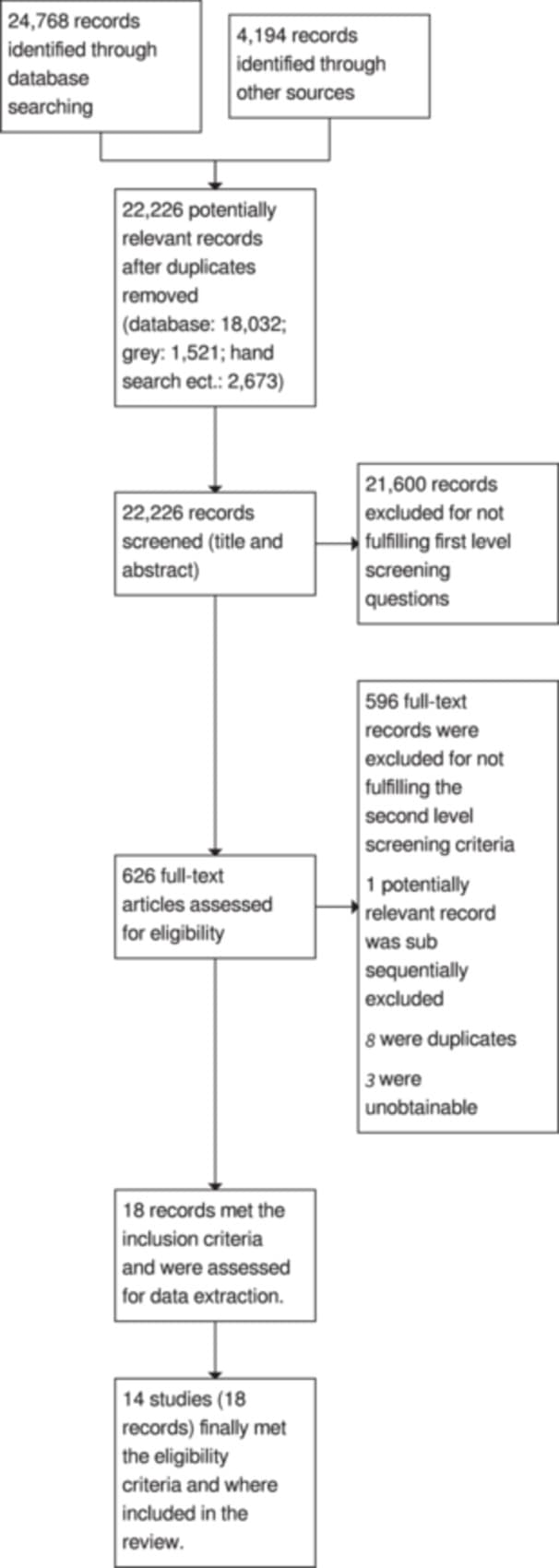
Figure 1

Seven records from the snowball search and 5 records from the database searches were included. A total of 14 unique studies, reported in 18 papers, were included in the review.

5.1.2. Included studies

The search resulted in a final selection of 14 studies that met the inclusion criteria for this review. The 14 studies analysed 13 different asylum populations. Two studies, Momartin (2006) and Steel (2011), reported on the same sample of asylum seekers in Australia at different time points after release.

The majority of studies were from Australia (11), one each was from Canada, Japan and the UK.

Prior traumatic experiences are a major determinant for refugee mental health (Carswell et al., 2011; Ichikawa et al., 2006). The population under investigation in this review had experienced a number of traumatic events before fleeing. Seven studies reported a variety of different traumatic events along with the share of asylum seekers having experienced them. Five studies used standard questionnaires to measure the pre‐migration traumatic experiences: section 1 of the Harvard Trauma Questionnaire (HTQ) and Part 1 of the Post‐traumatic diagnostic scale (PDS). Four studies (Cleveland [Cleveland & Rousseau, 2013; Cleveland et al., 2012a, 2012b]; Ichikawa [Ichikawa et al., 2006]; Steel [Steel et al., 2006]; Thompson [Thompson et al., 1998; Silove et al., 1998]) used the HTQ, probably the Indochinese version as they all refer to (Mollica et al., 1992), which describes the development and validation of an Indochinese version of the HTQ which originally included 17 items describing a range of traumatic experiences. In Ichikawa 2006 it is explicitly stated that all 17 original items were included, although only six items were reported. In Cleveland (2013) it is stated that prior trauma was assessed through a 20‐item version of the HTQ Trauma Events Checklist, and all 20 were reported. One study (Robjant et al., 2009; Robjant), used the PDS; 12 different traumas and the share of asylum seekers experiencing them were reported.

In Forrest (2023), six dichotomous indicators of premigration experiences were used and reported as the share of participants reporting ‘yes’ to the indicators and, finally, a testimony method was used in Thompson (2011). The full list of reported traumatic exposures and events is shown in Tables 1 and 2. Further descriptions of all studies are given in the Supporting Information.

Table 1

Study

Thompson (1998)

Ichikawa (2006)a

Steel (2006)

Cleveland (2013)

Prior trauma

Percent in treated/comparison group with exposure

Torture

72/26

67

18/12

43/29

Combat

40/23

80

15/8

27/39

Forced isolation

84/46

80

14/6

43/29

Forced separation from family and friends

80

26/11

65/68

Being close to death

88/40

82

76/29

90/92

Murder of family/friends

92/39

67

75/61

46/53

Witness murder of strangers

96/46

49/32

43/36

Serious injury

14/9

39/35

Imprisonment

37/15

32/21

Mean number of trauma exposures

15/7

9.9/9.5

5.3/3.1

9.3/9.2

Beaten and assaulted

67/76

Family member's health or safety seriously threatened

66/71

Threats or harassment by government or other organised groups

66/64

Family or friends assaulted

60/70

Lack of food or water

46/23

45/41

Unnatural death or disappearance of family or friends

79/62

44/53

Illness without access to medical care

38/16

40/30

Family or friends imprisoned or tortured

39/39

Lack of shelter

19/11

31/24

Kidnapped

11/6

23/17

Brainwashing

13/6

Mean number of trauma exposuresb

15/7

9.9/9.5

5.3/3.1

9.3/9.2

Table 2.

Prior trauma exposures: Treated/comparison.

Study

Robjant (2009) (Post‐traumatic diagnostic scale)

Thompson (2011) (A testimony method)

Forrest (2023) (Dichotomous indicators of premigration experiences)

Prior trauma exposure/experiences

Percent in treated/comparison group with exposure

Torture

39/20

45/68

Combat/war

43/35

21/21

59

Serious physical injury/violence

0/65

33

Nonsexual assaultb,*

46/28

62/47

Sexual assaultc

21/15

26/33

Imprisonment

43/24

52/12

20

Kidnapped

19/3

Accident/fire/explosion/natural disasterd

39/31

5/47

9

Life‐threatening illness

13/17

Threat to life*

93/53

Murder of family/friends*

90/47

Disappearance of family/friends*

88/26

Relative in jail as political prisoner

50/65

Persecution

62

Significant substantial material deprivation

22

Seeing loss of life*

88/68

Witnessed violence in mass demonstrations*

62/23

Search as result of organised violence*

88/59

Forced displacement*

95/6

Lived in refugee camps

5/59

6

Other traumatic event

54/37

Mean number of trauma exposurese

2.99/2.17

All are either tortured or have experienced at least two specific traumatic events (marked with *)

Note: ‘‐’: not reported.

a Total sample.

b In Robjant (2009) this item is divided into two categories: committed by a known assailant respectively by a stranger. In Forrest (2023) this item is refered to as ‘violence’.

c In Robjant (2009) this item is divided into two categories: committed by a known assailant respectively by a stranger. In Thompson (2011) this item is divided into three categories: Experienced rape, Witnessed rape family (forced within family) and Witnessed rape family (done) respectively.

d In Robjant (2009) this item is divided into two categories: Accident/fire/explosion respectively natural disaster.

e Not a percent but mean number of exposures.

Three studies (Momartin, 2006; Steel, 2011 and Johnston et al., 2009) analysing detained asylum seekers in Australia could not be used in the data synthesis because detention is contaminated with the holding of a Temporary protection visa (TPV). In the studies by Momartin 2006 and Steel 2011 all detained asylum seekers held a TPV, whereas all non‐detained asylum seekers held a Permanent protection visa (PPV). In Johnston (2009), a group of asylum seekers holding a TPV was compared to a group of asylum seekers holding a Permanent humanitarian visa (PHV). Nearly all TPVs (97%) and almost no PHVs (7%) had been held in immigration detention before release into the community (this information was kindly provided by Professor Johnston per e‐mail 12.03 2014). It was not possible to examine for the unique contribution of detention in these three studies. Previous research undertaken with Mandaean Iraqi asylum seekers subject to detention alone or detention and subsequent TPV status has supported a model in which both detention and TPV status were associated with a similar and additive adverse impact on mental health status (Steel, 2011). The studies would therefore most likely seriously overstate the effect of detention on mental health, and they were rated Critical risk of bias on the confounding domain; in accordance with the guidelines for ROBINS I tool we used (Sterne, Hernan, et al., 2016; Sterne, Higgins, et al., 2016), we excluded these from the data synthesis on the basis that they would be more likely to mislead than inform.

In addition, five studies analysing asylum seekers in Australia (Thompson, 1998; Steel, 2006; Thompson, 2011; Rowcliffe et al., 2016 and Mace et al., 2014) were judged to have Critical risk of bias on the confounding domain, and were excluded from the data synthesis on the basis that they would be more likely to mislead than inform.

The remaining six studies, all used in the data synthesis, analysed asylum seekers in the UK (Robjant, 2009), in Japan (Ichikawa, 2006), in Canada (Cleveland, 2013) and Australia (Forrest, 2023, Hedrick et al., 2019 and Zwi et al., 2018).

The main characteristics of the six studies used in the data synthesis are shown in Table 3 and a summary of characteristics are shown in Table 4.

Table 3.

Characteristics of studies used in data synthesis.

Study

Country

Time period

Sample size (T/C)

Country of origin

Mean age

Share of men

Length of detention

Still detained

Robjant (2009)

UK

Not reported

T:67; C:49

From 43 different countries

29.5 years

60%

Median 1 month

Yes

Ichikawa (2006)

Japan

2002–2003

T: 18; C: 37

Afghanistan

27.8 years

100%

Median 7 months, range is 4–10 months

No

Cleveland (2013)

Canada

2010–2011

T: 122; C: 66

Sub‐Saharan, Middle East and North Africa, South Asia, Latin America, Caribbean and Europe

31.6 years

67%

Mean: 31.2 days

Yes

Forrest (2023)

Australia

2013

T: 193; C: 83

Afghanistan, Iraq, Iran and Pakistan

33.70 years

88%

NR

No

Hedrick (2019)

Australia

2014–2015

T: 3903; C: 23894

NR

NR

87%

NR

Yes

Zwi (2018)

Australia

2014

T: 48; C: 38

Eastern Mediterranean, South East Asian, Western Pacific, African and ‘Stateless’

8.4 years

NR

7 months

Yes

Table 4.

Summary characteristics of studies used in data synthesis.

Characteristic (Number of comparisons reporting)

Country (6)

Australia

50%

UK, Canada, Japan

50%

Time period (5)

Median

2013

Range

2002–2014

Number of participants, detained (6)

Median

95

Range

18–3903

Number of participants, control (6)

Median

58

Range

37–23,894

Percent male (5)

Median

87%

Range

60%–100%

Age (5)

Median

29.5

Range

8.4–33.7

Length of detention (4)

Median

4 months

Range

1–7 months

Still detained (6)

Yes

67%

The reported time period spanned by the included studies is 10 years, from 2002 to 2015. In four studies, the asylum seekers originated from a variety of countries; in one study the common country of origin was Afghanistan; and in one study the countries of origin were not reported. In total, 27,797 asylum seekers were analysed, of which 14% had been detained. The median sample size of detained asylum seekers was 95 with a range of 18 to 3903. The median sample size of non‐detained asylum seekers was 58 with a range of 37 to 23,894. The mean age of the detained asylum seekers varied between 8.4 years and 33.7 years. In all studies, men accounted for more than 50% of the sample. The measure of length of detention varied between studies, with two reporting median length and two reporting mean length. Two studies did not report the length of detention. In the four studies reporting detention length, the reported median or mean lengths of detention was less than a year; however, in three of these studies the asylum seekers were still detained at the time of interviewing.

Characteristics of detention centres

Two of the studies provided general information about detention practices and on the characteristics of detention centres in the countries in question.

For Canada, Cleveland (2013) provided general information about living conditions in Canadian detention centres. The detention centres are prisons, men and women are held in separate wings, there are virtually no activities and only primary health care is provided.

Robjant (2009) provided information about the detention centres and living conditions from which participants were recruited in the UK. Two of the centres were high security centres with a large number of former male prisoners. The other two centres held male and female detainees, and also each had a family wing and hence detained children of any age, with their parents. Various activities were available and healthcare was provided on site and was privately run.

Unfortunately, the study from Japan, Ichikawa (2006), provided no information on detention centres and living conditions in Japan.

The Australian studies (Forrest, 2023; Hedrick, 2019; Zwi, 2018) did not provide much information on the characteristics of detention centres.

According to Forrest (2023): ‘Under the Migration Act, any noncitizen found in Australia without a valid visa must be detained, irrespective of their individual circumstances' (Migration [Australia] Act 1958, s.189). Thus, anyone who attempts to enter Australia without valid authorisation is subject to automatic detention’ (Forrest 2023, p. 643). Other than that, nothing was reported except the detained asylum seekers analysed were all held in detention centres inside Australia, that is, they were not deported to Nauru or Papua New Guinea.

In Hedrick (2019), three types of detention facilities were examined; onshore detention, offshore detention (Nauru), and offshore detention (Manus Island). Onshore immigration detention includes centres on the Australian mainland as well as on Christmas Island, a remote island located in the Indian Ocean. In the onshore detention network, asylum seekers are detained in both high‐security immigration detention facilities (with razor wire fences, surveillance, and other prison‐like features and practices), and low‐security accommodation (with a more domestic environment than other forms of detention, often used for families with children).

The characteristics of offshore processing (outsourced to private contractors by the Australian government, and referred to as ‘regional processing’) on Nauru and Manus Island have garnered a lot of attention. The Nauru Regional Processing Centre is an offshore Australian immigration detention facility in use since 2001 (Karlsen, 2016). It is located on the South Pacific island nation of Nauru and run by the government of Nauru. The Nauru facility was opened in 2001 as part of the Howard government's Pacific Solution (Phillips, 2012).

The Manus Regional Processing Centre, or Manus Island Regional Processing Centre (MIRCP), was one of a number of offshore Australian immigration detention facilities (Karlsen, 2016). The centre was located on the PNG Navy Base Lombrum on Los Negros Island in Manus Province, Papua New Guinea. It was originally established in 2001, along with the Nauru Regional Processing Centre, as an ‘offshore processing centre’.

Four of the six studies used in the data synthesis reported on prior traumatic exposures. The 12 most reported prior traumatic exposures along with the mean number of trauma exposures is shown in Table 5.

Table 5.

Percent reporting prior traumatic experiences in studies used in data synthesis.

Prior trauma

Ichikawa (2006)

Cleveland (2013)

Robjant (2009)

Forrest (2023)

Torture

67

43

39

Combat/war

80

27

43

59

Forced isolation

80

43

Forced separation from family and friends

80

65

Being close to death

82

90

Murder of family/friends

67

46

Witness murder of strangers

43

Serious injury/violence

39

13

33

Imprisonment

32

43

20

Persecution

62

Mean number of traumatic experiences

10

9

3

In three out of four studies reporting on traumatic events, 39% to 67% of the detained asylum seekers had experienced torture. Combat/war, murder of family and friends, forced isolation, serious injury/violence, persecution and imprisonment have also been commonly experienced amongst the detained asylum seekers.

5.1.3. Excluded studies

In addition to the 14 studies that met the inclusion criteria for this review, two studies (Essex et al., 2022; Keller et al., 2003) at first sight appeared relevant but did not meet our criteria. The studies and reason for exclusion are given in Table 6.

Table 6.

Studies excluded with reason.

Study

Reason for exclusion

Keller (2003)

The study analysed detained asylum seekers in the USA. The comparison group was released detained asylum seekers. Hence, it did not qualify for inclusion in the review.

Essex (2022)

All detained for various length of time

5.2. Risk of bias in included studies

The risk of bias coding for each of the 14 studies and their outcomes is shown in Supporting Information.

All studies used non‐randomised designs, and were rated using the ROBINS‐I tool.

Nine studies used opportunity sampling strategies and two studies in addition relied on snowball sampling. A detailed description of the sampling techniques is given in Table 7.

Table 7.

Sampling techniques.

Study

Sampling techniques

Cleveland (2013)

Opportunity sampling: For the adult study, we interviewed 122 adult asylum seekers detained (at least 7 days) in either the Laval (Montreal) or the Toronto Immigration Holding Centre. A comparison group of 66 recently‐arrived (within a year) adult asylum seekers who had never been detained in Canada completed the same questionnaires. For both the detained and nondetained groups, the study sample is highly representative. For the detained sample, researchers visited the Laval and Toronto Immigration holding Centres weekly in 2010–2011 and invited all asylum seekers who had been detained for at least a week to take part in the study. The nondetained sample was recruited through community and government agencies providing residential and settlement services to asylum seekers in Montreal and Toronto. Researchers did not select or filter participants in any way. All eligible individuals, without distinction, were invited to participate.

Forrest (2023)

Used the Longitudinal Study of Humanitarian Migrants (BNLA), a national longitudinal survey of recently arrived refugees who were granted asylum in Australia. All offshore applicants, including both primary and secondary applicants, who arrived in Australia between May and December 2013, and all onshore migrants who were granted permanent protection in the same period were eligible to participate in the survey. The survey sample was selected at random from the Australian Government's settlement database. For the current study the sample used was restricted to onshore migrants who were listed as the primary applicant on their visa application (N = 334).

Hedrick (2019)

Self‐harm incident reports were obtained from the Department of Immigration and Border Protection. The reports contain all self‐harm incidents among the whole Australian asylum seeker population that detention and community‐based staff and contractors are required to report. The reports are refering to self‐harm incidents occurring between 1st August 2014 and 31st July 2015.

Ichikawa (2006)

Opportunity sampling: contacted them through their lawyers or non‐governmental organisations. Of 73 contacted, 55 agreed to participate.

Johnston (2009)

Opportunity sampling and snowballing targeting women and men of varying ages, educational backgrounds and family compositions (e.g., intact and nonintact nuclear families). Excluded if they had not been living at least 6 months in the community (outside detention) and could not speak Arabic or English. Participants were recruited through community organisations such as Migrant Resource Centres and non‐government organisations providing services to refugees in the study site. Community health centres were not included as points of contact to avoid over‐representation of ‘patients’. Refugees who did not utilise these community services were accessed by snowballing within established community networks.

Mace (2014)

Used data from the revised health‐screening questionnaire used for all new patients reviewed by Princess Margaret Hospital (PMH) Refugee Health Service (RHS). The cohort studied was comprised of school‐aged children (4–18 years old) with a completed pro forma. Excluded were children in active/guarded detention.

Momartin (2006)/Steel (2011)

Opportunity sampling: The sample was recruited consecutively from the Early Intervention Programme of the Service for the Treatment and Rehabilitation of Torture and Trauma Survivors (STARTTS) in Sydney, New South Wales. Resettlement agencies in NSW are required to refer recent refugees (both TPV and PPV holders) to the programme, irrespective of their mental status or level of exposure to past trauma.

Robjant (2009)

Opportunity sampling: Treated: From four centres, recruited from the library and other communal areas, 75% agreed, main reason for not participating was language problems; Comparison: recruited from seven different community drop in centres, 60% of those approached agreed to participate.

Rowcliffe (2016)

Used clinical data recorded during standardised assessment of new patients referred to the Princess Margaret Hospital Refugee Health Service between October 2013 and December 2014.

Steel (2006)

Opportunity and snowball sampling: Lists of names provided by community leaders were supplemented by snowball sampling to recruit 241 Arabic‐speaking Mandaean (from Iraq or Iran)refugees in Sydney (60% of the total adult Mandaean population).

Thompson (1998)

Opportunity sampling: Comparison: Information about the study was provided through legal aid and resettlement services, ethnic radio stations, newspapers, newsletters, magazines and community meetings. It was emphasised that the research team was independent of any government department, and anonymity of responses was assured. All adult Tamils were invited to participate, irrespective of their residency status. Legal agencies in contact with asylum‐seekers and the Ealam Tamil Association agreed to mail questionnaires to their clients or membership without revealing individuals' names to the researchers. The Ealam Tamil Association provides a focus for cultural and social support for the Tamil community, and its membership is not limited to any particular sector or political faction (Silove et al., 1998). Treated: Tamils from Sri Lanka detained in the Maribyrnong Detention Centre.

Thompson (2011)

Selective opportunity sampling: Different ethnic organisations, the divisions of general medical practices, as well as legal agencies working with asylum seekers living in the community or in detention, were involved in asking their clients if they would participate in the research. All participants from an immigration detention centre who were seeking asylum were invited to participate in the study. The final included sample was selected based upon being either a survivor of torture of a survivor of other types of systemic abuse.

Zwi (2018)

Opportunity sampling: The community sample (aged 6 months to 15 years) was recruited from a population cohort of all newly arrived children settled in a non‐urban area. They were visited by nurses at their home between 2009 and 2013 and their families were invited to participate in the study. Data for detained children were collected in March 2014 during the Australian Human Rights Commission (AHRC) National Inquiry into Children in Immigration Detention.

Table 8 shows a summary of the risk of bias associated with the studies. One study was rated differently on different outcomes, the most favourable rating is included in the summary risk of bias table. We stopped the assessment of a non‐randomised study outcome when it was rated ‘Critical’ on any of the items. Therefore, not all studies are rated on all domains.

Table 8.

Risk of bias summary.

Judgement:

Low risk of bias

Moderate risk of bias

Serious risk of bias

Critical risk of bias

No information

Not rated on this domain

Risk of bias domain

Overall Judgement

0

4

2

8

0

0

Confounding bias

2

2

2

8

0

0

Selection of participants

4

2

0

0

0

8

Classification of intervention status

5

1

0

0

0

8

Deviation from intervention

6

0

0

0

0

8

Missing Outcome Data

4

1

0

0

1

8

Measurement of Outcome

0

5

1

0

0

8

Selection of Reported Results

1

5

0

0

0

8

Note: We stopped the assessment of a non‐randomised study outcome when it was rated ‘Critical’ on any of the items. Therefore, not all studies are rated on all domains.

Eight studies were rated Critical risk of bias on the Overall judgement item, corresponding to a risk of bias so high that the findings should not be considered in the data synthesis. The overall Critical risk of bias rating was due to issues on the Confounding bias item; all eight were rated Critical risk of bias on this item; that is, they failed to establish a comparison group that was balanced on important confounders and further did not control for any confounders.

In three studies (Johnston, 2009; Momartin, 2006; Steel, 2011) all (almost all in Johnston 2009) detained asylum seekers were also holders of a TPV and were compared to non‐detained holders of a PPV. In addition, three studies (Steel, 2006; Thompson, 1998, Thompson, 2011) did not adjust for confounding and there were some large imbalances on important confounders. Two studies did not consider any confounders at all (Mace, 2014; Rowcliffe, 2016); they were therefore rated to have a Critical risk of bias on the confounding item.

Two studies were rated Serious risk of bias overall and four studies were rated Moderate risk of bias overall.

Of the six studies not rated Critical risk of bias overall, two studies had serious issues on the Confounding item, two had Moderate issues and two were rated Low risk of bias. On the Selection bias item, four were rated Low risk of bias and two were rated Moderate risk of bias. Five studies were rated Low risk of bias on the Classification item and one was rated Moderate risk of bias; all six were rated Low risk of bias on the Deviation item. One study did not provide enough information to be rated on the Missing data item, whereas four were rated Low risk of bias and one was rated Moderate risk of bias. On the Measurement item, five were rated Moderate risk of bias and one was rated Serious risk of bias. Five studies were rated Moderate risk of bias on the Selection of Reported Results mainly because there was no a priori analysis plan and one study had a published protocol and no other issues and was rated Low risk of bias.

5.3. Synthesis of results

Of the 14 included studies, eight were judged to have a critical risk of bias and thus were not included in any syntheses. Of the six studies that did not have critical risks of bias, all studies provided data enabling the calculation of either a SMDs or ORs and their SE. Four studies reported outcomes while the detained asylum seekers were still detained, and two studies reported outcomes less than 2 years after release of the detained asylum seekers.

5.3.1. Mental health outcome results

The mental health outcomes measures reported in the studies were PTSD, depression, anxiety, social–emotional wellbeing, nonspecific psychological distress, and self‐harm. PTSD, depression, anxiety and social–emotional wellbeing were assessed using standardised measures. PTSD was assessed using the HTQ and the Impact of Events Scale‐revised (IES‐R). Depression and anxiety were assessed using the Hopkins Symptoms Checklist‐25 (HSCL‐25) and the Hospital Anxiety and Depression scale (HADS (D and A). Social–emotional wellbeing, assessed using the parent version of the strength and difficulties questionnaire (SDQ). Nonspecific psychological distress was assessed using the Kessler–6 Psychological Distress Scale (K6). Self‐harm incidents were recorded by detention and community‐based staff and contractors as required by contractual arrangements between the Department of Immigration and Border Protection (DIBP) and the immigration detention and community‐based service providers. The incident reports are sent to the DIBP where they are archived in a centralised database (Commonwealth Immigration Ombudsman, 2024). Eleven different types of self‐harm methods were used by the Australian asylum seeker population during the study period. The five most commonly used methods were cutting, self‐battery (defined as striking one's body against hard objects or beating oneself heavily and repeatedly to cause injury), hanging, self‐poisoning by medication and self‐poisoning by chemicals.

No other mental health outcomes were reported in the studies used in the data synthesis.

All outcomes are measured such that a negative effect size favours the detained asylum seekers, that is, when an effect size is negative, the detained asylum seekers are better off than the comparison groups of non‐detained asylum seekers, and when an effect size is positive, the non‐detained asylum seekers are better off than the detained asylum seekers.

PTSD

Two studies reported PTSD while detained asylum seekers were still detained and two other studies reported PTSD after their release from detention.

Detained asylum seekers still detained

There was no heterogeneity between the two studies reporting PTSD while the asylum seekers were still detained; the estimated τ 2 is 0.00 and I 2 is 0% as displayed in Figure 2. Both effect sizes favour the comparison group and are statistically significant. The weighted average SMD is 0.45 [95% CI 0.19, 0.71].

 Figure 2
After release of detained asylum seekers

There is some heterogeneity between the two studies reporting PTSD after release; the estimated τ 2 is 0.13 and I 2 is 55% as displayed in Figure 3. The pooled estimate and CI should therefore be interpreted with caution. Both effect sizes favour the comparison group and are statistically significant. The weighted SMD is 0.91 [95% CI 0.24, 1.57].

Figure 3
Depression

Two studies reported depression while still detained and one other study reported depression after release from detention.

Detained asylum seekers still detained

There is some heterogeneity between the two studies reporting depression while the asylum seekers are still detained; the estimated τ 2 is 0.14 and I 2 is 81% as displayed in Figure 4. The pooled estimate and CI should therefore be interpreted with caution. Both effect sizes favour the comparison group and are statistically significant. The weighted average SMD is 0.68 [95% CI 0.10, 1.26].

Figure 4
After release of detained asylum seekers

The effect size after release favours the comparison group and is statistically significant. Ichikawa reports a SMD of 0.60 [95% CI 0.02, 1.17] less than a year after release as displayed in Figure 5.

Figure 5
Anxiety

Two studies reported anxiety while still detained and one other study reported anxiety after release from detention.

Detained asylum seekers still detained

There is no heterogeneity between the two studies reporting anxiety while the asylum seekers are still detained; the estimated τ 2 is 0.00 and I 2 is 0% as displayed in Figure 6. Both effect sizes favour the comparison group and are statistically significant. The weighted average SMD is 0.42 [95% CI 0.18, 0.66].

Figure 6
After release of detained asylum seekers

The effect size after release favours the comparison group and is statistically significant. Ichikawa reports a SMD of 0.76 [95% CI 0.17, 1.34] less than a year after release as displayed in Figure 7.

Figure 7
Nonspecific psychological distress

No studies reported psychological distress while detained and one study reported after release.

After release of detained asylum seekers

The effect size favours the detained group and is not statistically significant; an OR of 0.28 [95% CI 0.04, 2.06] is reported as displayed in Figure 8.

Figure 8
Self‐harm

One study reported incidents of self‐harm (excluding suicide) while detained asylum seekers were still detained and none after release.

Detained asylum seekers still detained

Incidents were reported separately for the three types of detention: Manus Island, Nauru and onshore detention. We calculated the OR for each type of detention and an overall OR as well. All effect sizes favour the comparison group, are statistically significant and very high, as displayed in Figure 9.

Figure 9

For asylum seekers living in detention on Manus Island, the OR was 12.18 [95% CI 8.73, 17.00]. For asylum seekers living in detention in Nauru, the OR was 74.44 [95% CI 57.70, 96.04]. For asylum seekers living in onshore‐detention, the OR was 72.97 [95% CI 58.82, 90.52]. Overall, the OR for asylum seekers living in detention was 54.60 [95% CI 44.88, 66.42].

Social–emotional wellbeing

One study reported social‐emotional well‐being while detained asylum seekers were still detained and none reported after their release.

Detained asylum seekers still detained

One study reported social‐emotional well‐being for a sample of children held in detention on Christmas Island (a remote Indian Ocean island) aged 4–15 years.

The effect size favours the comparison group and is statistically significant; a SMD of 1.47 [95% CI 0.98, 1.96] is reported as displayed in Figure 10.

Figure 10

6. DISCUSSION

6.1. Summary of main results

The studies used in the data synthesis reported outcomes on mental health, measured as PTSD, depression, anxiety, psychological distress, self‐harm and social functioning.

Primary study effect sizes for PTSD, depression and anxiety while the asylum seekers were still detained lies in the range 0.35 to 0.99, all favouring the non‐detained asylum seekers.

The weighted average effect sizes while detained for PTSD and anxiety are of a magnitude which may be characterised as being of clinical importance and the weighted average effect size for depression is of an even higher magnitude. They all favour the non‐detained, that is, there is an adverse effect of detention on mental health. The magnitude of the pooled estimates should, however, be interpreted with caution as they are based on two studies (Cleveland, 2013; Robjant, 2009), and for depression there is some inconsistency in the magnitude of effect sizes between the two studies, one effect size is moderate (0.4) and the other is large (0.99).

Two studies (Forrest, 2023; Ichikawa, 2006) reported PTSD after release and the weighted average effect size is even higher than while detained with primary study effect sizes of 0.59 and 1.27.

One study (Ichikawa, 2006) reported the outcomes of depression and anxiety after release; the effect sizes are all of clinical importance and favour the non‐detained asylum seekers.

One study each (Forrest, 2023; Hedrick, 2019; Zwi, 2018) reported outcomes related to psychological distress, self‐harm and social functioning. Psychological distress favoured the detained but was not statistically significant; whereas both the studies reporting on self‐harm and social functioning reported high negative impacts of detention; in particular, the effect sizes of self‐harm were extremely high.

6.2. Overall completeness and applicability of evidence

In this review we included six studies in the data synthesis. This number is relatively low compared to the number of studies (14) meeting the inclusion criteria. The reduction was caused by two different factors. Unfortunately, three studies (of which one was a follow‐up to another) compared detained asylum seekers holding TPVs to non‐detained asylum seekers holding PPVs or PHVs (Johnston, 2009; Momartin, 2006; Steel, 2011). It was not possible to examine for the unique contribution of detention in these studies. They were rated critical risk of bias in the confounding domain and, in accordance with the protocol, were not used in the data synthesis. Almost all studies (two exceptions) collected information on some or all of the pre‐specified confounding variables (see the supplementary document). Unfortunately, three studies (Steel, 2006; Thompson, 1998, 2011) did not adjust for confounding and there were some large imbalances on important confounders. They were rated critical risk of bias in the confounding domain and, in accordance with the protocol, we excluded these from the data synthesis on the basis that they would be more likely to mislead than inform. Two studies did not consider any confounders at all (Mace, 2014; Rowcliffe, 2016).

A larger number of useable studies in the data synthesis would have provided a more robust literature on which to base conclusions.

One study used the entire population of asylum seekers in Australia between 1st August 2014 and 31st July 2015. The remaining studies used opportunity sampling strategies (two studies in addition relied on snowball sampling). The populations under investigation in the included studies may therefore, with one exception, not be representative of the general population of detained asylum seekers.

Studies investigating asylum seekers detained in four different countries (Australia, Canada, UK and Japan) were identified, and the asylum seekers originated from a variety of countries. However, none of the six studies investigating detention of asylum seekers in Australia were used in the data synthesis for the reasons given above. This is a clear limitation of the review as Australia has been unique in establishing a policy of mandatory detention of all asylum seekers arriving by boat or without valid travel documents.

6.3. Quality of the evidence

All studies used non‐randomised designs, thus we are aware that strong causal conclusions cannot be drawn from the included studies.

Considering the particular population under investigation in this review, it is essential that an appropriate comparison group is used to establish causality. All studies that were included used asylum seekers not detained as a comparison, which is a precondition for being an appropriate comparison group.

The quality of the evidence in this review was enhanced by excluding studies assessed to be at critical risk of bias using the ROBINS–I tool from the data synthesis. We believe this process excluded those studies that are more likely to mislead than inform.

Due to the sampling strategies used in all but one study (opportunity sampling and snowball sampling), obtaining balance on the confounding factors may be difficult and probably requires some luck.

Nevertheless, four of the six studies used in the data synthesis had no large imbalances on the pre‐specified confounders, and three of these studies in addition statistically controlled for the confounders.

Risk of bias due to confounding was rated not to be of concern in two studies, of some concern in two studies and of serious concern in two studies.

There was overall consistency in the direction of treatment effects in that all treatment effects favoured the non‐detained. For depression, while still detained, there is, however, some inconsistency in the magnitude of effect sizes between the two studies included in the analysis.

The magnitude of all pooled estimates in this review should be interpreted with caution as they are based on two studies.

6.4. Potential biases in the review process

We performed a comprehensive electronic database search, combined with grey literature searching, and citation screening of relevant studies and reviews. All citations were screened in teams by two independent review authors and one research assistant (TF, MWK, FMBG).

We believe that all the publicly available studies on the effect of detaining asylum seekers on their mental health, physical health and social functioning up to the censor date were identified during the review process.

However, three references were not obtained in full text (Barnes, 1988; Blair, 1996; Fell, 2010). A potential for bias arises from omitting these three unobtainable studies.

We are unable to comment on the possibility of publication bias as at most two comparisons were included in each meta‐analysis.

We believe that there are no other potential biases in the review process as two review authors and one research assistant in pairs of two (TF, MWK and FMBG) independently coded the included studies. Any disagreements were resolved by discussion. Assessment of study quality and numeric data extraction was made by one review author (TF) and each study was checked by one other review author (MWK). There were only minor disagreements and they were resolved by discussion.

6.5. Agreements and disagreements with other studies or reviews

We identified three systematic reviews on the mental health impacts of detention of asylum seekers (Robjant et al., 2009; Tania & Marianne, 2013) including an update (von Werthern et al., 2018; Mares, 2021). All reviews provided a narrative synthesis.

In Tania and Marianne (2013), the primary aim was to study the impact of detention of torture survivors, although primary studies where only some participants were torture survivors were also included. The author's conclusion is that although the studies do report severe mental health issues amongst detained torture survivors and, in general, serious mental health problems are found, the available data is insufficient to allow analysis of any specific effects.

The review by Robjant et al. (2009) included all studies that reported quantitative or qualitative measures of mental health for children, adolescents or adults who were either currently detained or who had previously been detained in immigration detention or removal centres in Australia, the UK or the USA. The authors concluded that primary studies consistently report high levels of mental health problems amongst detainees and there is some evidence to suggest an independent adverse effect of detention on mental health. However, they also note that research on this topic is in its infancy and primary studies are limited by methodological constraints. The review was updated in 2018 (von Werthern et al., 2018). The updated search did not place any restrictions on country of detention. The updated review provides a narrative synthesis which supports the findings from the 2009 review.

In Mares (2021) a scoping review was performed to answer the question: ‘What is the current evidence in the peer reviewed literature, about the impact of immigration detention on children and families who seek asylum?’ (Mares, 2021). included all studies that reported mental health and/or developmental outcomes of currently or former detained populations of children, adolescents and/or families who were refugees or seeking asylum. Based on a narrative analysis, the authors conclude that there are high rates of distress, mental disorder, physical health and developmental problems in children aged from infancy to adolescence which persist after resettlement. Restrictive detention is a particularly adverse reception experience and children and parents should not be detained or separated for immigration purposes. In line with Robjant et al. (2009) and the update (von Werthern et al., 2018) they also note that research on this topic is limited and primary studies all have acknowledged methodological weaknesses.

The three reviews and the update focus on different populations to the one in our review, have limitations of different kinds (limited to torture survivors in Tania & Marianne, 2013, limited to Australia, the UK or the USA in Robjant et al., 2009) and limited to children and adolescents in Mares (2021), do not apply restrictions to the quality of studies and none perform meta‐analyses but rely on a narrative synthesis. In our review, no limitations of this kind are employed, and we perform a meta‐analysis where possible.

Consistent with our conclusions, though, the apparent feedback from all three reviews and our update is that more research is needed. In addition, Robjant et al. (2009) and the update (von Werthern et al., 2018) conclude that the current evidence suggests an independent adverse effect of detention on mental health, which is in line with our conclusion.

7. AUTHORS' CONCLUSIONS

7.1. Implications for practice and policy

The process of seeking asylum in Western countries places additional demands on asylum seekers. These include, besides detention, enforced dispersal within the community, more stringent refugee determination procedures, and temporary forms of asylum. In several countries, asylum seekers living in the community face restricted access to work, education, housing, welfare and, in some situations, to basic health care services. Thus, post‐migratory stressors of various kinds seem to negatively affect this population who are already vulnerable to mental health difficulties as a result of their previous exposure to traumatic events.

Considering the fact that the population under investigation in this review has high rates of pre‐migration trauma and that detention is not the only post‐migration stressor, it was essential that an appropriate comparison group was used to establish causality.

All studies included in the data synthesis compared detained asylum seekers with a group of asylum seekers living in the community who had experienced similar traumatic events before arrival. Despite facing comparable post‐migration adversities and prior traumatic exposure, all studies reported adverse effects on the mental health of detained asylum seekers. There is thus some evidence to suggest an independent deterioration of the mental health due to detention of a group of people who are already highly traumatised.

Furthermore, adverse effects on mental health were found not only while the asylum seekers were detained, but persisted beyond the period of detention, as evidenced by two studies analysing asylum seekers post‐release. This suggests that the adverse mental health effect of detention may be prolonged, extending well beyond the point of release into the community.

Though, based on a single study, we find it important to mention the effects sizes showing alarming high odds of self‐harm for detained asylum seekers in Australia. Compared to community‐based asylum seekers, Hedrick (2019) reports an OR for asylum seekers living in detention overall of 54.60 and statistically significant. The OR of self‐harm was further reported separately for asylum seekers detained in three types of detention: Manus Island, Nauru and onshore detention. The ORs were in the range 12.18 to 74.44; all were significant.

As stated by Hedrick (2019) in his conclusion: ‘These findings clearly illuminate the deleterious impact of immigration detention on the health of detained asylum seekers; the extremely high self‐harm rates identified in the present study are cause for considerable concern and warrant urgent attention’.

Considering the potential adverse effects of detention on the mental health of already traumatised asylum seekers, the use of detention should be discontinued altogether or reserved strictly as a last resort, justified by purposes beyond the mere status of being an asylum seeker.

The necessity of exploring and implementing alternatives to immigration detention is firmly entrenched within both European and international legal frameworks. In recent years, there has been increasing focus on how these alternatives can assist states in managing migration without excessively resorting to depriving individuals of their freedom.

The Council of Europe (2019) suggest a range of different alternatives, including registration with authorities; temporary authorisation; case management or case‐worker support; family‐based care (for unaccompanied children and/or separated children); residential facilities; open or semi‐open centres; regular reporting; designated residence; supervision; return counselling; return houses; bail, bond guarantor or surety; or electronic monitoring.

Many of these alternatives, however, restrict the movement or deprive the liberty of asylum seekers and are thus subject to human rights oversight. The type of alternative to detention that a government uses must fit the country's particular context, and especially the needs of the individual asylum seeker. The least intrusive alternative must always be taken in each individual case.

The Council of Europe identifies ‘essential elements’ of effective implementation of the alternative. These elements are: screening and assessment; access to information; legal assistance; case management services; dignity and human rights; and trust in asylum and migration procedures.

These elements should be taken into consideration when implementing alternatives to detention.

7.2. Implications for research

Further research is required to fully address the potential adverse effects on the mental health of detained asylum seekers. Few studies have investigated this issue using appropriate comparison groups, and even fewer studies have investigated the long‐term effects after release.

It should be acknowledged that research in this field is problematic for a number of practical and methodological reasons. Researchers report encountering difficulties in acquiring access to detained asylum seekers. The small sample sizes recruited for some of the studies probably reflect some of these practical difficulties. However, sampling methods targeting individuals who have been released from detention at the time of the study, allows investigation of the longer‐term impact of detention.

Due to the nature of the research field, future studies will probably have to rely on opportunity sampling strategies and/or snowball sampling, as did most of the studies in this review. Obtaining balance on important confounding factors may be difficult, which adds to the importance of statistically controlling for relevant factors.

A few of the studies report only descriptive results even though data had been gathered on important confounding factors, such as prior traumatic experiences. The risk of bias due to confounding would be judged to be of less concern had the primary study authors controlled for these factors. As the data already are gathered it is recommended that analyses controlling for important confounding factors are carried out using these data.

Although the six studies used in the data synthesis cover people seeking asylum in four different countries, research from more countries is needed to generalise the results as conditions of detention varies across countries. As we recommend that the use of detention should in general come to an end or at least be used only as an absolutely last resort, these future studies will probably have to rely on sampling methods targeting individuals who have experienced detention but have been released at the time of the study, allowing investigation of only the longer‐term impact of detention.

Open Article as PDF

Abstract

Background The number of people fleeing persecution and regional conflicts is rising. Western countries have applied increasingly stringent measures to discourage those seeking asylum from entering their country, amongst them, to confine asylum seekers in detention facilities. Clinicians have expressed concerns over the mental health impact of detention on asylum seekers, a population already burdened with trauma, advocating against such practices. Objectives The main objective of this review is to assess evidence about the effects of detention on the mental and physical health and social functioning of asylum seekers. Search methods Relevant literature was identified through electronic searches of bibliographic databases, internet search engines, hand searching of core journals and citation tracking of included studies and relevant reviews. Searches were performed up to November 2023. Selection criteria Studies comparing detained asylum‐seekers with non‐detained asylum seekers were included. Qualitative approaches were excluded. Data collection and analysis Of 22,226 potential studies, 14 met the inclusion criteria. These studies, from 4 countries, involving a total of 13 asylum‐seeker populations. Six studies were used in the data synthesis, all of which reported only mental health outcomes. Eight studies had a critical risk of bias. Meta‐analyses, inverse variance weighted using random effects statistical models, were conducted on post‐traumatic stress disorder (PTSD), depression, and anxiety. Main results A total of 27,797 asylum seekers were analysed. Four studies provided data while the detained asylum seekers were still detained, and two studies after release. All outcomes are reported such that a positive effect size favours better outcomes for the non‐detained asylum seekers. The weighted average SMD while detained is 0.45 (95% CI 0.19, 0.71) for PTSD and after release 0.91 (95% CI 0.24, 1.57); for anxiety 0.42 (95% CI 0.18, 0.66) and for depression 0.68 (95% CI 0.10, 1.26) both while detained. Based on single‐study data, the SMD was 0.60 (95% CI 0.02, 1.17) for depression and 0.76 (95% CI 0.17, 1.34) for anxiety, both after release. Three studies (one study each) reported outcomes related to psychological distress, self‐harm and social well being. Psychological distress favoured the detained but was not significant; whereas both effect sizes on self‐harm and social wellbeing indicated highly negative impacts of detention; in particular, the impact on self‐harm was extremely high. The OR of self‐harm was reported separately for asylum seekers detained in three types of detention: Manus Island, Nauru and onshore detention. The ORs were in the range 12.18 to 74.44; all were significant. Authors' conclusions Despite similar post‐migration adversities amongst comparison groups, findings suggest an independent adverse impact of detention on asylum seekers' mental health, with the magnitude of the effect sizes lying in an important clinical range. These effects persisted beyond release into the community. While based on limited evidence, this review supports concerns regarding the detrimental impact of detention on the mental health of already traumatised asylum seekers. Further research is warranted to comprehensively explore these effects. Detention of asylum seekers, already grappling with significant trauma, appears to exacerbate mental health challenges. Policymakers and practitioners should consider these findings in shaping immigration and asylum policies, with a focus on minimising harm to vulnerable populations.

Summary

Confining Asylum Seekers in Detention Centers Negatively Affects Their Mental Health Both During and After Release

This review looked for evidence on how keeping asylum seekers in detention centers affects their mental and physical health, as well as their ability to function in society. The number of people fleeing conflict and persecution is increasing. However, many countries use strict measures, like detention centers, to discourage asylum applications. Understanding the health effects of detaining asylum seekers is important because they often have experienced significant trauma before migrating, which makes them vulnerable to health issues. Detention may worsen these existing problems.

This review specifically examined if detaining asylum seekers negatively impacts their mental health and social functioning. The goal was to understand the effects of detention on their mental health, physical health, and social functioning.

Studies Included

The review included studies that compared detained asylum seekers with those who were not detained. A total of 14 studies from the UK, Japan, Canada, and Australia met the inclusion criteria. All studies were observational, meaning the researchers did not control who was detained. Eight of these studies were excluded from the main analysis due to important differences between the groups being compared or other methodological issues. These excluded studies were all from Australia, which has a policy of mandatory detention.

Impact of Detention

Detention has a harmful effect on the mental health of asylum seekers. Compared to those not detained, asylum seekers who were detained showed higher rates of post-traumatic stress disorder (PTSD), depression, and anxiety, both during their detention and after their release. The severity of these effects was clinically significant. One study each reported outcomes related to psychological distress, social functioning, and self-harm. Self-harm, in particular, was strongly linked to detention.

Meaning of the Findings

Policymakers should consider alternatives to detention that are less harmful. These could include requirements to report to authorities, financial guarantees (sureties or bail), or community supervision. Any options that limit people's freedom of movement should also be carefully monitored to prevent negative mental health effects.

The research included in this review is of moderate quality. More research is needed to fully understand how keeping asylum seekers in detention centers affects their physical and mental health and social functioning. A more in-depth comparison of how different detention conditions impact asylum seekers is also necessary.

Background

The Issue: Rising Asylum Seekers and Detention Practices

The late 20th century saw a significant increase in people fleeing persecution and regional conflicts. In 2022, countries in Europe, Canada, the USA, Japan, Australia, and New Zealand received 1,262,649 asylum applications. Data from 2022 show that males accounted for 71% of asylum seekers in the EU, children under 18 years old were 25%, those aged 18–34 years were 54%, and those 35 years and older were 21%.

Western countries have adopted increasingly strict measures to deter asylum seekers. These strategies include confining asylum seekers in detention centers, distributing them within communities, tightening refugee determination procedures, and offering temporary asylum. In some countries, asylum seekers living in the community face limited access to work, education, housing, welfare, and sometimes even basic healthcare.

Detention of Asylum Seekers

Confining asylum seekers in detention facilities is the most controversial of these deterrents. While many countries detain asylum seekers, Australia historically had a unique policy of mandatory, indefinite detention from 1992 to 2005 for those arriving by boat or without valid travel documents. This policy faced significant criticism, leading to changes in 2011 to limit detention times. In 2013, Australia announced a policy to settle asylum seekers arriving by boat without a visa in Papua New Guinea (PNG) if they were deemed legitimate refugees. The UNHCR raised concerns about this policy, citing a lack of local capacity and poor conditions in indefinite, mandatory, and arbitrary detention settings.

Since 2001, countries like the USA and the UK have expanded immigration detention facilities. A similar trend has emerged in Canada, where changes in 2012 meant asylum seekers aged 16 or older designated as "irregular arrivals" would be detained. Many European countries have also increased their use of detention, often as a first resort.

Asylum seekers are detained at various stages of the asylum process, sometimes to facilitate deportations. This means both recently arrived asylum seekers and those whose appeals are pending can be held in detention. In many European countries, deportation orders are issued at the same time as initial asylum claims are denied.

There are no official statistics on how many asylum seekers are detained or for how long. Some countries provide limited information. In Australia, the number of people in immigration detention facilities decreased from 8,521 in May 2013 to 881 in February 2024. However, the average length of detention for those currently held increased from 74 days in May 2013 to 624 days in February 2024. In the UK, the number of asylum seekers in detention slightly decreased from 1,676 in December 2012 to 1,317 in June 2022. The length of stay for asylum seekers is not reported separately.

Lack of Transparency and Arbitrariness in Detention

Little is known about the reasons for detention. There is no clear legal framework under international human rights or refugee law that governs its use. The Council of Europe noted that many countries' national laws are insufficient, leaving too much power to immigration officials. Detention policies lack transparency, which may lead to arbitrary decision-making.

Since 1999, UNHCR guidelines have suggested alternatives to detention, such as reporting requirements, guarantors, bail, or open centers. These alternatives vary in implementation, and their effectiveness depends on the country's context and the migrants' needs. The UNHCR also states that detention decisions are often arbitrary, made with broad discretionary powers, and sometimes applied unlawfully or for extended periods without clear possibility of removal. Detainees often struggle to challenge the legality of their detention. While UNHCR guidelines recommend automatic and periodic independent judicial reviews of detention decisions, some countries do not comply.

Detention and Mental Health

There is growing evidence that detaining asylum seekers is linked to significant mental health problems. Studies show high rates of depression (86%), anxiety (77%), and PTSD (50%) among detained asylum seekers, with conditions worsening the longer individuals are detained. A key question is whether detention causes these mental health problems. Research that uses appropriate comparison groups can help determine this.

Diagnostic challenges can arise in multicultural settings, especially when applying Western mental health diagnoses to other cultures. Expressions of distress and beliefs about its causes can differ significantly. For example, depression might be linked to "thinking too much" or witchcraft in some cultures, and the stigma of mental illness can be greater than in Western societies. Even similar symptoms may have different meanings across cultures.

Asylum seekers often come from conflict-affected countries and have experienced pre-migration traumas such as war, genocide, or imprisonment, which can impact their health. These experiences contribute to high rates of trauma-related mental health problems. However, post-migration challenges, including detention, can worsen the stress for an already traumatized group. Detention is one of several post-migration difficulties, alongside discrimination, dispersal, destitution, denial of work, denial of healthcare, and delayed asylum decisions.

Given that detention is not the only post-migration stressor and that asylum seekers often have high rates of pre-migration trauma, it is crucial to use appropriate comparison groups to determine if detention causes adverse outcomes. Comparison groups should have similar levels of pre-migration trauma and recovery time, and similar geographical or ethnic backgrounds.

Purpose of this Review

The main goal of this review is to assess the causal effects of detention on asylum seekers' mental health by finding and synthesizing relevant studies. While the primary focus is mental health, all outcomes reported in studies comparing detained and comparable non-detained groups are examined.

Recognizing that strong causal conclusions cannot be drawn from the included observational studies, the review aims to identify studies that control for important factors that could influence the results. Even with tentative conclusions, it is important to summarize the best available evidence.

The Intervention: Detention of Asylum Seekers

In this review, the detention of asylum seekers is considered a social intervention with potential negative consequences. Reports suggest that detaining asylum seekers violates international human rights standards, as seeking asylum is not illegal, and people have a right to humane and dignified treatment.

Detention is defined as the removal of personal freedom for asylum seekers in the host country. Detained individuals may be held in various facilities, including immigration centers, remote camps, or provincial jails, operated by public or private entities. This form of administrative detention is a key concern because domestic legal systems often lack specific details for these situations, leading to legal uncertainty for detainees, limited access to legal counsel, inadequate avenues to challenge detention, and no limits on detention duration. Conditions can vary, but many centers operate like prisons with limited access to information, healthcare, and psychological support.

How Detention Might Work

Asylum seekers in detention experience various stressors related to the detention process and environment, which can harm their mental health. These include loss of liberty, uncertainty about returning home, unknown duration of detention, social isolation, family separation, abuse from staff, riots, forceful removal, hunger strikes, and self-harm.

There has been limited detailed examination of how detention experiences affect the mental health of detained asylum seekers after their release. Studies indicate that confinement and loss of liberty deeply disturb asylum seekers, leading to feelings of isolation, powerlessness, and a reactivation of traumatic memories from their home countries. Detention and its negative aspects significantly worsen asylum seekers' self-perception, with minors and long-term detainees appearing to suffer the most.

Further research explored the experiences of detained asylum seekers and the consequences for their lives after release. Detention was described as a dehumanizing environment marked by confinement, deprivation, injustice, inhumanity, isolation, fractured relationships, and growing hopelessness and demoralization.

The probable ways detention causes harm include changes in self-perception, altered relationships based on how detainees are treated by others and "the system," and shifts in core values. These mechanisms are known in psychology, particularly in trauma research, as ways negative psychological effects are maintained after experiences that threaten one's sense of self.

Some individuals are considered particularly vulnerable to harm in detention, including women, children, unaccompanied minors, and those with mental or physical disabilities. Vulnerability is defined as a loss of control to a more powerful entity, making one susceptible to harm. A lack of information about asylum procedures, detention duration, reasons for detention, and expected release significantly affects detainees' ability to cope. Younger detainees (10–24 years old), especially younger women, appear to suffer more due to less access to information. The UNHCR also includes torture or trauma victims among vulnerable groups.

This highlights another key aspect of how detention may cause harm. Asylum seekers worldwide often report high rates of pre-migration trauma (e.g., war, imprisonment, violence, bereavement, starvation, homelessness), leading to trauma-related mental health problems. The asylum-seeking process in Western countries adds further demands. Post-migratory stressors, especially detention, seem to negatively affect this population, who are already vulnerable to mental health difficulties from past traumatic events. Captivity is inherently stressful, particularly when indefinite, but it can be even more stressful for individuals with prior traumatic experiences. Detention may reactivate and worsen existing trauma. For example, indefinite detention for asylum seekers who have been previously imprisoned and tortured may prolong psychological damage and cause high levels of stress, despair, and anxiety.

Importance of This Review

Given the known vulnerability of asylum seekers due to pre-arrival traumatic experiences, many clinicians have voiced concerns that detention increases mental health problems in adults and children and have called for an end to such practices. This conflicts with government policies aimed at reducing asylum seeker numbers.

A question arises whether a systematic review is worthwhile if few trial-based studies are expected. This review believes it is, as a systematic review can uncover high-quality studies not found through less thorough methods. Also, if it shows a lack of high-quality studies, it could encourage new primary research. Therefore, even without expecting to find trial-based studies (and none were found) or many control group comparison studies on asylum seeker detention, this review aims to gather and highlight the best available knowledge.

Objectives

The main objective of this review is to assess the evidence regarding the effects of detention on the mental and physical health, and social functioning of asylum seekers.

Methods

Criteria for Considering Studies

Due to ethical considerations, it is unlikely that researchers would control whether asylum seekers are detained or not. Therefore, few controlled trials were expected. To understand the potential causal effects of detention, the review included all study designs with a clearly defined control group, such as non-detained asylum seekers in the same country. For non-randomized studies, where detention decisions occurred outside researcher control, studies needed to demonstrate that groups were similar before the intervention. This could be shown through matching, statistical controls, or evidence of equivalence in important risk factors and participant characteristics. These factors and the methodological quality of included studies were assessed for potential bias.

Eligible study designs included:

  • Controlled trials (prospective studies with identified participants, baseline assessment, intervention allocation—randomized, quasi-randomized, or non-randomized—and outcome assessment).

  • Non-randomized studies where detention decisions were not controlled by the researcher, but compared two or more groups of participants. Allocation in these studies might be based on time, location, decision-makers, or policy rules.

Types of Participants

The "intervention population" consisted of asylum seekers who had been detained. The comparison population included asylum seekers who had not been detained. Asylum seekers whose applications were unsuccessful were also included. Participants of all ages and nationalities were considered.

According to the UN Refugee Convention, a refugee is someone outside their country unable or unwilling to return due to a well-founded fear of persecution based on race, religion, nationality, social group, or political opinion. The terms "asylum seeker" and "refugee" are often used interchangeably. This review uses "asylum seeker" for individuals seeking international protection whose claim for refugee status has not yet been decided. The country of asylum is responsible for determining refugee status, which, once recognized, grants certain rights and obligations.

Types of Interventions

The intervention is the detention of asylum seekers, defined as the deprivation of liberty in the host country. Studies on asylum seekers detained in their home country after applying for asylum were not included. In most countries, detention is an administrative process to verify identity, process claims, or ensure deportation. A key concern is that domestic legal systems often lack specific regulations for this administrative detention, leading to legal uncertainty.

Types of Outcome Measures

The review aimed to include and examine all reported outcomes (mental health, physical health, social functioning) from studies with a comparable control group, with a primary focus on mental health measures.

Duration of Follow-Up

Planned time points for outcome measures were:

  • For participants currently detained.

  • From the end of detention to one year after release.

  • More than one year after release.

No studies provided data for more than one year after release.

Types of Settings

All types of settings were eligible. Detained individuals could be held in various facilities, such as immigration holding centers, remote camps, or provincial jails, operated by public authorities or private companies.

Search Methods for Identifying Studies

Search strategies for the original review were reported in 2015. The updated search was conducted in November 2023 by two review authors, one of whom is an information specialist, following the original strategy.

Relevant studies were identified through electronic databases, grey literature, citation tracking, expert contact, and internet search engines. A date restriction of 2014 onwards was applied for the updated search, as previous searches had no date restrictions. No language restrictions were applied.

Electronic Searches

The following electronic bibliographic databases were searched between October and November 2023:

  • APA PsycINFO

  • PTSDpubs

  • International Bibliography of the Social Sciences

  • MEDLINE

  • PubMed

  • SocINDEX

  • Academic Search Premier

The search string was based on the PICO(s) model, with two facets: population characteristics and intervention. It included title, abstract, subject terms, and keywords, using truncation and wildcards for English spelling variations. An example search string for MEDLINE (OVID) is provided, covering "Detention" and "Asylum Seekers" terms. Details for other databases are in the Supporting Information.

Searching Other Resources

Hand searches were conducted for the Journal of Refugee Studies, International Migration Review, Forced Migration Review, International Migration, and Refugee for 2023 and 2024. Google and Google Scholar were used for grey literature, checking the first 200 hits. Websites for WHO Europe, Western Pacific, Americas, World Bank, Amnesty International, and SSRN were also searched. Citation tracking of related systematic reviews and meta-analyses, and reference lists of included studies, was also performed. International experts were contacted via email in November 2023 to identify unpublished and ongoing studies.

Data Collection and Analysis

Two review authors and one research assistant independently screened titles and abstracts in pairs to exclude clearly irrelevant studies. Full texts of potentially eligible studies were retrieved and screened independently by pairs of two review authors and one research assistant. Disagreements were resolved through discussion. Reasons for excluding otherwise eligible studies were documented. Study inclusion criteria were consistent with the 2015 review. The search and screening process is shown in a flow diagram. Review authors were not blinded to authors, institutions, or journals.

Data Extraction and Management

Review authors independently coded and extracted data from all included studies in pairs. Coding sheets were identical to those used in the 2015 review, except for the risk of bias sheet. Minor disagreements were resolved through discussion. Data extracted included participant characteristics, intervention and control conditions, research design, sample size, risk of bias and confounding factors, outcomes, and results. Analysis was conducted using RevMan Web. Numerical and descriptive data, along with risk of bias assessments, are in the Supporting Information.

Assessment of Risk of Bias

The approach to assessing risk of bias was updated from the previous review to include more explicit methods developed since. The ROBINS-I tool, developed by Cochrane Bias Methods Group members, was used for non-randomized studies (Sterne et al., 2016). This tool, based on the Cochrane RoB2 tool for randomized trials, covers seven domains where bias might be introduced:

  1. Bias due to confounding.

  2. Bias in selection of participants.

  3. Bias in classification of interventions.

  4. Bias due to deviations from intended interventions.

  5. Bias due to missing outcome data.

  6. Bias in measurement of the outcome.

  7. Bias in selection of the reported result.

Non-randomized study outcomes were rated on a "Low/Moderate/Serious/Critical/No Information" scale for each domain. A "Critical" rating meant the study outcome was too problematic to provide useful evidence and was excluded from data synthesis. If a study outcome was rated "Critical" in any domain, assessment stopped. Multiple "Serious" ratings could also lead to an overall "Critical" judgment and exclusion.

Confounding

Confounding factors are an important part of bias assessment in non-randomized studies. Selection bias, systematic baseline differences between groups, can compromise comparability. These differences can be observable (e.g., age, gender) or unobservable. Different non-randomized designs handle selection problems in various ways. Studies must show pretreatment group equivalence through matching, statistical controls, or evidence of similarity in key risk variables and participant characteristics.

For this review, relevant observable confounding factors were identified as prior trauma exposure, gender, age, time since arrival in the asylum-seeking country, and geographical/ethnic background. It was assessed whether these and other confounding factors were considered in each study and how unobservable factors were addressed.

Importance of Pre-specified Confounding Factors

  • Prior trauma exposure: Asylum seekers often have experienced traumatic pre-migration events, a major determinant of their mental health.

  • Gender: Women have higher rates of PTSD, partly explained by different trauma types experienced, such as sexual assault, though other explanations are inconclusive. Gender is also a risk factor for other psychiatric disorders.

  • Age: Age is a likely risk factor for trauma consequences, especially during early development.

  • Time since arrival: A longer stay in the asylum-seeking country could mean more recovery time from pre-migration traumas for non-detained individuals, or vice versa.

  • Geographical/ethnic orientation: Ways of expressing distress and views on its causes can differ significantly across cultures, as can the meaning of similar symptoms.

Unobservables

For the "intervention" (detention), a degree of arbitrariness in the decision process is expected. Unclear detention criteria imply unpredictability. Non-transparent national detention policies can lead to unlawful or arbitrary detention, often prolonged, with detainees struggling to challenge legality.

Although arbitrariness is not randomness, the degree of arbitrariness in the detention decision process, as described by authors, was assessed. A high degree of arbitrariness might minimize systematic differences in unobservable factors between detained and non-detained groups.

Effect of Primary Interest and Co-interventions

The review focused on the effect of starting and adhering to the intended intervention (detention), i.e., the "treatment on the treated" effect. Bias assessment considered adherence and differences in "co-interventions" (additional interventions received with or after the main intervention that relate to the intervention and predict the outcome). Mental health treatments delivered individually were considered important co-interventions.

Assessment

Two review authors independently assessed the risk of bias for each relevant outcome from included studies. Disagreements were resolved through discussion. Risk of bias assessments are reported in supplementary tables for each outcome.

Measures of Treatment Effect

Effect sizes from single studies not suitable for pooling were reported in detail. For continuous outcomes, effect sizes with 95% confidence intervals (CIs) were calculated using means and standard deviations, or from mean differences, standard errors (SE), and 95% CIs. Hedges' g was used for standardized mean differences (SMD). For dichotomous outcomes, odds ratios (ORs) with 95% CIs were calculated. Dichotomous effect sizes were transformed to SMD using the Cox transformation where appropriate (e.g., for PTSD symptoms in one study). Excel and RevMan 5.4 were used for data storage and statistical analyses.

Unit of Analysis Issues

Consistency between the unit of allocation and the unit of analysis was checked to avoid statistical errors. No studies had different units of allocation and analysis.

Criteria for Independent Findings

Potential statistical dependencies were examined, including multiple interventions per individual, multiple treatment groups, and studies based on the same data source.

  • Multiple interventions per individual: No studies had multiple interventions per individual.

  • Multiple studies using the same sample of data: Two studies reported on the same group of asylum seekers at different time points (Momartin 2006 and Steel 2011). Only one estimate of the effect of detention after 3.6 months would have been included, but both were excluded from meta-analysis due to high risk of bias.

  • Multiple time points: Each time point (currently detained, and up to one year after release) was analyzed separately.

Dealing with Missing Data

When summary data like standard deviations were missing, SMDs were calculated from available mean differences, SE, and 95% CIs.

Assessment of Heterogeneity

Heterogeneity among primary outcome studies was assessed using the Chi-squared (Q) test, I2, and τ2 statistics. Interpretation of the Chi-squared test was cautious due to its low statistical power.

Assessment of Reporting Biases

Publication bias and selective reporting of outcomes were considered. Funnel plots were planned to assess publication bias, but there were not enough studies for this analysis.

Data Synthesis

Meta-analysis of outcomes was conducted separately for each metric. Studies rated as having a critical risk of bias were excluded from data synthesis. Outcome measurements varied across studies; outcomes at similar time points were analyzed together. Outcomes were grouped into: currently detained asylum seekers, and from the end of detention to one year after release. No studies in the data synthesis reported outcomes more than a year after release.

Meta-analyses used SMD. All analyses were inverse variance weighted using random-effects statistical models, incorporating both sampling and between-study variance into study weights. τ2 was estimated using the DerSimonian and Laird method. Random-effects weighted mean effect sizes were calculated with 95% CIs, and forest plots were provided.

Subgroup Analysis and Investigation of Heterogeneity

There were not enough studies to perform moderator analyses.

Sensitivity Analysis

There were not enough studies to perform sensitivity analyses.

Treatment of Qualitative Research

Qualitative research was not planned for inclusion.

Summary of Findings and Assessment of the Certainty of the Evidence

This was not planned for inclusion.

Results

Description of Studies

Results of the Search

The original search was from November 2013 to January 2014, and the updated search was in November 2023. EPPI Reviewer was used for screening.

Figure 1 summarizes the results from both searches. Electronic database searches yielded 24,768 records (12,218 in 2012, 12,550 in 2023). After removing duplicates, 22,226 potentially relevant records remained (18,032 from databases, 1,521 grey literature, 4,194 from hand searching, snowballing, and other resources). All 22,226 records were screened by title and abstract; 21,600 were excluded. Full texts were retrieved for 626 records; 596 were excluded. One record was excluded later, and eight were duplicates. Three records could not be obtained (Barnes, 1988; Blair, 1996; Fell and Fell, 2010).

Seven records from snowball searches and five from database searches were included. In total, 14 unique studies, reported in 18 papers, were included in the review.

Included Studies

The search resulted in 14 studies meeting inclusion criteria, analyzing 13 different asylum populations. Two studies (Momartin, 2006, and Steel, 2011) reported on the same group of Australian asylum seekers at different post-release time points.

Most studies (11) were from Australia; one each from Canada, Japan, and the UK.

Prior traumatic experiences strongly influence refugee mental health. Seven studies reported various traumatic events and their prevalence among asylum seekers. Five studies used standardized questionnaires (Harvard Trauma Questionnaire [HTQ] and Post-traumatic Diagnostic Scale [PDS]) to measure pre-migration trauma. Four studies used HTQ (likely the Indochinese version with 17 items, or a 20-item version). One study used PDS, reporting 12 different traumas. Forrest (2023) used six dichotomous indicators, and Thompson (2011) used a testimony method. Tables 1 and 2 provide the full list of reported traumatic exposures. Further study descriptions are in the Supporting Information.

Three studies (Momartin, 2006; Steel, 2011; Johnston et al., 2009) analyzing detained asylum seekers in Australia were not used in the data synthesis because detention was intertwined with holding a Temporary Protection Visa (TPV). In Momartin (2006) and Steel (2011), all detained asylum seekers had TPVs, while non-detained ones had Permanent Protection Visas (PPVs). In Johnston (2009), a TPV group was compared to a Permanent Humanitarian Visa (PHV) group; nearly all TPV holders had been in detention, while almost no PHV holders had. It was not possible to isolate the unique effect of detention in these studies. Previous research suggested both detention and TPV status had similar and additive negative impacts on mental health. These studies would likely overstate detention's effect and were rated Critical risk of bias for confounding, thus excluded from data synthesis.

Additionally, five other Australian studies (Thompson, 1998; Steel, 2006; Thompson, 2011; Rowcliffe et al., 2016; Mace et al., 2014) were judged to have Critical risk of bias in confounding and were excluded.

The remaining six studies, all used in the data synthesis, analyzed asylum seekers in the UK (Robjant, 2009), Japan (Ichikawa, 2006), Canada (Cleveland, 2013), and Australia (Forrest, 2023; Hedrick et al., 2019; Zwi et al., 2018).

Tables 3 and 4 summarize the characteristics of these six studies.

The studies covered a 10-year period from 2002 to 2015. Four studies included asylum seekers from various countries; one focused on Afghanistan; and one did not report countries of origin. In total, 27,797 asylum seekers were analyzed, with 14% having been detained. The median sample size for detained asylum seekers was 95 (range: 18–3903), and for non-detained, it was 58 (range: 37–23,894). The mean age of detained asylum seekers ranged from 8.4 to 33.7 years. Men comprised over 50% of the sample in all studies. Detention length varied: two studies reported median length, two reported mean length, and two did not report it. In the four studies that reported it, median or mean detention lengths were under a year, but in three of these, asylum seekers were still detained at the time of interview.

Characteristics of Detention Centers

Two studies provided general information on detention practices and centers. Cleveland (2013) described Canadian detention centers as prisons with separate wings for men and women, minimal activities, and only primary healthcare. Robjant (2009) detailed UK centers, noting two high-security centers for former male prisoners, and two others for both men and women, with family wings for children. These centers offered various activities and privately run on-site healthcare. Ichikawa (2006) provided no information on Japanese detention centers.

The Australian studies (Forrest, 2023; Hedrick, 2019; Zwi, 2018) offered limited details on detention center characteristics. Forrest (2023) stated that anyone entering Australia without a valid visa is subject to automatic detention under the Migration Act, but did not provide further details beyond confirming that analyzed detained asylum seekers were held in onshore Australian centers, not Nauru or Papua New Guinea. Hedrick (2019) examined three types: onshore detention (mainland Australia and Christmas Island, ranging from high-security, prison-like facilities to low-security accommodations for families), and offshore detention on Nauru and Manus Island. The offshore centers, known as "regional processing" facilities, are often managed by private contractors.

Four of the six studies used in the data synthesis reported on prior traumatic exposures. Table 5 shows the 12 most reported prior traumatic exposures and the mean number of trauma exposures.

In three of these four studies, 39% to 67% of detained asylum seekers had experienced torture. Combat/war, murder of family and friends, forced isolation, serious injury/violence, persecution, and imprisonment were also common experiences among detained asylum seekers.

Excluded Studies

Beyond the 14 included studies, two (Essex et al., 2022; Keller et al., 2003) initially appeared relevant but did not meet the criteria. Table 6 lists these studies and their exclusion reasons.

Risk of Bias in Included Studies

The risk of bias coding for all 14 studies and their outcomes is detailed in the Supporting Information.

All studies were non-randomized and assessed using the ROBINS-I tool. Nine studies used opportunity sampling, and two also used snowball sampling. Table 7 details the sampling techniques.

Table 8 summarizes the risk of bias. If a study was rated "Critical" in any domain, assessment stopped, and it was excluded from data synthesis. Eight studies received an overall "Critical" risk of bias rating, meaning their findings should not be considered in the data synthesis. This "Critical" rating was primarily due to issues in the Confounding bias domain, as these studies failed to establish a comparison group balanced on important confounders and did not control for any confounders.

Specifically, in three studies (Johnston, 2009; Momartin, 2006; Steel, 2011), all (or almost all) detained asylum seekers also held TPVs and were compared to non-detained individuals with PPVs or PHVs. Additionally, three studies (Steel, 2006; Thompson, 1998; Thompson, 2011) did not adjust for confounding, and showed significant imbalances in important confounders. Two studies (Mace, 2014; Rowcliffe, 2016) did not consider any confounders. All these were rated "Critical" for confounding bias and excluded from data synthesis.

Two studies had an overall "Serious" risk of bias, and four had an overall "Moderate" risk of bias.

Of the six studies not rated "Critical," two had serious issues with confounding, two had moderate issues, and two had low risk of bias. For selection bias, four were rated low risk, and two were moderate. Five studies had low risk of bias for classification, and one had moderate risk; all six had low risk for deviation from intended interventions. One study lacked information for the missing data item, while four had low risk and one had moderate risk. For measurement bias, five were moderate, and one was serious. Five studies had moderate risk of bias for selection of reported results, mainly due to the absence of a pre-specified analysis plan; one study with a published protocol and no other issues was rated low risk.

Synthesis of Results

Of the 14 included studies, eight had a critical risk of bias and were excluded from syntheses. The remaining six studies provided data for calculating SMDs or ORs and their SE. Four studies reported outcomes while asylum seekers were still detained, and two reported outcomes less than two years after release.

Mental Health Outcome Results

Mental health outcomes measured included PTSD, depression, anxiety, social-emotional well-being, nonspecific psychological distress, and self-harm. PTSD was assessed using the HTQ and IES-R. Depression and anxiety were assessed using HSCL-25 and HADS. Social-emotional well-being was assessed using the parent version of the SDQ. Nonspecific psychological distress used the Kessler–6 Psychological Distress Scale (K6). Self-harm incidents were recorded by Australian detention and community staff. Eleven types of self-harm were used, with cutting, self-battery, hanging, and self-poisoning (by medication or chemicals) being the most common.

No other mental health outcomes were reported in the studies used for data synthesis.

All outcome measures are interpreted such that a negative effect size indicates detained asylum seekers are better off, while a positive effect size indicates non-detained asylum seekers are better off.

PTSD

Two studies reported PTSD in currently detained asylum seekers, and two reported PTSD after their release.

Detained Asylum Seekers Still Detained

There was no heterogeneity between the two studies reporting PTSD in currently detained asylum seekers (τ2 = 0.00, I2 = 0%). Both effect sizes favored the comparison group and were statistically significant. The weighted average SMD was 0.45 [95% CI 0.19, 0.71].

After Release of Detained Asylum Seekers

Some heterogeneity was present between the two studies reporting PTSD after release (τ2 = 0.13, I2 = 55%). The pooled estimate should be interpreted cautiously. Both effect sizes favored the comparison group and were statistically significant. The weighted SMD was 0.91 [95% CI 0.24, 1.57].

Depression

Two studies reported depression in currently detained asylum seekers, and one reported depression after release.

Detained Asylum Seekers Still Detained

Some heterogeneity was found between the two studies reporting depression in currently detained asylum seekers (τ2 = 0.14, I2 = 81%). The pooled estimate should be interpreted cautiously. Both effect sizes favored the comparison group and were statistically significant. The weighted average SMD was 0.68 [95% CI 0.10, 1.26].

After Release of Detained Asylum Seekers

The effect size after release favored the comparison group and was statistically significant. Ichikawa reported an SMD of 0.60 [95% CI 0.02, 1.17] less than a year after release.

Anxiety

Two studies reported anxiety in currently detained asylum seekers, and one reported anxiety after release.

Detained Asylum Seekers Still Detained

There was no heterogeneity between the two studies reporting anxiety in currently detained asylum seekers (τ2 = 0.00, I2 = 0%). Both effect sizes favored the comparison group and were statistically significant. The weighted average SMD was 0.42 [95% CI 0.18, 0.66].

After Release of Detained Asylum Seekers

The effect size after release favored the comparison group and was statistically significant. Ichikawa reported an SMD of 0.76 [95% CI 0.17, 1.34] less than a year after release.

Nonspecific Psychological Distress

No studies reported psychological distress while detained, and one study reported it after release.

After Release of Detained Asylum Seekers

The effect size favored the detained group but was not statistically significant; an OR of 0.28 [95% CI 0.04, 2.06] was reported.

Self-Harm

One study reported incidents of self-harm (excluding suicide) while asylum seekers were still detained; none reported after release.

Detained Asylum Seekers Still Detained

Incidents were reported separately for three types of detention: Manus Island, Nauru, and onshore detention. ORs were calculated for each and an overall OR. All effect sizes favored the comparison group, were statistically significant, and very high.

For asylum seekers on Manus Island, the OR was 12.18 [95% CI 8.73, 17.00]. For those in Nauru, the OR was 74.44 [95% CI 57.70, 96.04]. For those in onshore detention, the OR was 72.97 [95% CI 58.82, 90.52]. Overall, the OR for asylum seekers in detention was 54.60 [95% CI 44.88, 66.42].

Social-Emotional Well-being

One study reported social-emotional well-being while detained; none reported after release.

Detained Asylum Seekers Still Detained

One study reported social-emotional well-being for children aged 4–15 held on Christmas Island. The effect size favored the comparison group and was statistically significant; an SMD of 1.47 [95% CI 0.98, 1.96] was reported.

Discussion

Summary of Main Results

The studies included in the data synthesis reported mental health outcomes, including PTSD, depression, anxiety, psychological distress, self-harm, and social functioning.

For currently detained asylum seekers, the primary study effect sizes for PTSD, depression, and anxiety ranged from 0.35 to 0.99, all favoring the non-detained group.

The weighted average effect sizes for PTSD and anxiety while detained are of a magnitude considered clinically important, and for depression, the weighted average effect size is even higher. All indicate an adverse effect of detention on mental health, favoring the non-detained. However, the magnitude of these pooled estimates should be interpreted cautiously as they are based on only two studies (Cleveland, 2013; Robjant, 2009). For depression, there is some inconsistency in the effect sizes between these two studies, one being moderate (0.4) and the other large (0.99).

Two studies (Forrest, 2023; Ichikawa, 2006) reported PTSD after release, with a weighted average effect size even higher than during detention, ranging from 0.59 to 1.27.

One study (Ichikawa, 2006) reported depression and anxiety outcomes after release; these effect sizes were all clinically important and favored the non-detained asylum seekers.

Single studies (Forrest, 2023; Hedrick, 2019; Zwi, 2018) reported psychological distress, self-harm, and social functioning outcomes. Psychological distress favored the detained group but was not statistically significant. However, studies on self-harm and social functioning reported significantly high negative impacts of detention, particularly for self-harm, which showed extremely high effect sizes.

Overall Completeness and Applicability of Evidence

This review included six studies in the data synthesis, which is a relatively low number compared to the 14 studies that initially met inclusion criteria. This reduction was due to two factors. Three studies (including one follow-up) compared detained asylum seekers with Temporary Protection Visas (TPVs) to non-detained asylum seekers with Permanent Protection Visas (PPVs) or Permanent Humanitarian Visas (PHVs). It was impossible to isolate the unique effect of detention in these studies, so they were rated as having a critical risk of bias in the confounding domain and excluded from the data synthesis. Most studies (with two exceptions) collected information on some or all of the pre-specified confounding variables. However, three studies did not adjust for confounding and showed significant imbalances in important confounders. These were also rated as having a critical risk of bias in the confounding domain and excluded. Two studies did not consider any confounders at all.

A larger number of usable studies in the data synthesis would have provided more robust conclusions.

With one exception, the studies used opportunity sampling strategies (two studies also used snowball sampling). Therefore, the populations studied may not represent the general population of detained asylum seekers.

Studies investigating asylum seekers detained in four different countries (Australia, Canada, UK, and Japan) were identified. However, none of the six studies from Australia were used in the data synthesis for the reasons mentioned above. This is a clear limitation of the review, given Australia's unique policy of mandatory detention for certain asylum seekers.

Quality of the Evidence

All studies used non-randomized designs, meaning strong causal conclusions cannot be drawn.

Considering the specific population, it is crucial to use an appropriate comparison group to establish causality. All included studies used non-detained asylum seekers as a comparison, which is a prerequisite for an appropriate comparison group.

The quality of evidence in this review was improved by excluding studies assessed as having a critical risk of bias using the ROBINS-I tool, as these studies were more likely to be misleading.

Due to the sampling strategies in all but one study (opportunity and snowball sampling), balancing confounding factors can be difficult and often relies on chance. This highlights the importance of statistically controlling for relevant factors.

Nevertheless, four of the six studies in the data synthesis had no major imbalances in the pre-specified confounders, and three of these statistically controlled for these factors.

Risk of bias due to confounding was deemed not a concern in two studies, of some concern in two, and serious in two.

Overall, the direction of treatment effects was consistent, with all favoring the non-detained. However, for depression while still detained, there was some inconsistency in the magnitude of effect sizes between the two studies included in the analysis.

The magnitude of all pooled estimates in this review should be interpreted with caution, as they are based on only two studies.

Potential Biases in the Review Process

A comprehensive electronic database search, grey literature search, and citation screening were performed. All citations were screened by independent review authors and a research assistant.

It is believed that all publicly available studies on the effect of detaining asylum seekers on their mental health, physical health, and social functioning up to the cutoff date were identified.

However, three references could not be obtained in full text (Barnes, 1988; Blair, 1996; Fell, 2010), potentially introducing bias.

The possibility of publication bias could not be commented on, as each meta-analysis included at most two comparisons.

It is believed there are no other potential biases in the review process, as two review authors and one research assistant independently coded the included studies in pairs, and disagreements were resolved through discussion. Assessment of study quality and numeric data extraction was performed by one review author and checked by another, with only minor disagreements resolved through discussion.

Agreements and Disagreements with Other Studies or Reviews

Three systematic reviews on the mental health impacts of detaining asylum seekers have been identified, including an update (Robjant et al., 2009; Tania & Marianne, 2013; von Werthern et al., 2018; Mares, 2021). All reviews provided a narrative synthesis.

In Tania and Marianne (2013), the primary aim was to study the impact of detention on torture survivors, although studies with some torture survivors were also included. The authors concluded that despite reports of severe mental health issues among detained torture survivors and serious mental health problems generally, the available data were insufficient for analyzing specific effects.

The review by Robjant et al. (2009) included all studies reporting quantitative or qualitative mental health measures for children, adolescents, or adults who were currently or previously detained in immigration detention or removal centers in Australia, the UK, or the USA. The authors concluded that primary studies consistently show high levels of mental health problems among detainees, and there is some evidence suggesting an independent adverse effect of detention on mental health. However, they also noted that research in this area is limited by methodological constraints. The review was updated in 2018 (von Werthern et al., 2018), with no country restrictions on detention. The updated review's narrative synthesis supported the 2009 findings.

Mares (2021) conducted a scoping review on the impact of immigration detention on children and families seeking asylum. It included studies reporting mental health and/or developmental outcomes for currently or formerly detained children, adolescents, and/or refugee families. Based on a narrative analysis, the authors concluded that high rates of distress, mental disorders, physical health, and developmental problems persist in children from infancy to adolescence after resettlement. Restrictive detention is particularly adverse, and children and parents should not be detained or separated for immigration purposes. Similar to Robjant et al. (2009) and its update, they noted that research in this area is limited and primary studies have methodological weaknesses.

These three reviews and their updates differ from this review in their focus populations (limited to torture survivors, specific countries, or children and adolescents). They do not apply quality restrictions to studies and rely on narrative syntheses rather than meta-analyses. This review has no such limitations and performs meta-analyses where possible.

However, consistent with this review's conclusions, all three reviews and their updates indicate a need for more research. Additionally, Robjant et al. (2009) and its update (von Werthern et al., 2018) conclude that current evidence suggests an independent adverse effect of detention on mental health, which aligns with this review's findings.

Authors' Conclusions

Implications for Practice and Policy

The process of seeking asylum in Western countries places additional demands on asylum seekers. These include, beyond detention, forced community dispersal, stricter refugee determination procedures, and temporary asylum. In several countries, asylum seekers in the community face limited access to work, education, housing, welfare, and sometimes basic healthcare. These various post-migratory stressors appear to negatively affect this population, who are already vulnerable to mental health difficulties due to prior traumatic experiences.

Given that this review's study population often has high rates of pre-migration trauma and that detention is not the only post-migration stressor, it was essential to use an appropriate comparison group to establish causality.

All studies included in the data synthesis compared detained asylum seekers with a group of non-detained asylum seekers living in the community who had experienced similar traumatic events before arrival. Despite facing comparable post-migration difficulties and prior traumatic exposure, all studies reported harmful effects on the mental health of detained asylum seekers. This suggests some evidence of an independent worsening of mental health due to detention in an already highly traumatized group.

Furthermore, these adverse mental health effects were observed not only during detention but also persisted after release, as shown by two studies analyzing asylum seekers post-release. This indicates that the negative mental health impact of detention can be prolonged, extending well beyond the period of release into the community.

Although based on a single study, it is important to note the alarming odds of self-harm among detained asylum seekers in Australia. Compared to community-based asylum seekers, Hedrick (2019) reported a statistically significant overall odds ratio (OR) of 54.60 for self-harm among asylum seekers in detention. The OR for self-harm was also reported separately for those detained on Manus Island (12.18), Nauru (74.44), and in onshore detention (72.97), all of which were statistically significant.

As Hedrick (2019) concluded, "These findings clearly illuminate the deleterious impact of immigration detention on the health of detained asylum seekers; the extremely high self-harm rates identified in the present study are cause for considerable concern and warrant urgent attention."

Considering the potential harmful effects of detention on the mental health of already traumatized asylum seekers, its use should be stopped entirely or reserved strictly as a last resort, only justified by reasons beyond merely being an asylum seeker.

The necessity of exploring and implementing alternatives to immigration detention is strongly supported by both European and international legal frameworks. In recent years, there has been a growing focus on how these alternatives can help states manage migration without excessive reliance on depriving individuals of their freedom.

The Council of Europe (2019) suggests various alternatives, including registration with authorities, temporary authorization, case management or caseworker support, family-based care (for unaccompanied or separated children), residential facilities, open or semi-open centers, regular reporting, designated residence, supervision, return counseling, return houses, bail, bond guarantor or surety, or electronic monitoring.

However, many of these alternatives restrict movement or liberty and are therefore subject to human rights oversight. The type of alternative used by a government must suit the country's specific context and, importantly, the individual asylum seeker's needs. The least intrusive alternative must always be chosen in each individual case.

The Council of Europe identifies "essential elements" for effective implementation of alternatives: screening and assessment, access to information, legal assistance, case management services, dignity and human rights, and trust in asylum and migration procedures. These elements should be considered when implementing alternatives to detention.

Implications for Research

Further research is needed to fully address the potential harmful effects on the mental health of detained asylum seekers. Few studies have investigated this issue using appropriate comparison groups, and even fewer have examined the long-term effects after release.

It should be acknowledged that research in this field faces practical and methodological challenges. Researchers often report difficulties in gaining access to detained asylum seekers, which likely explains the small sample sizes in some studies. However, sampling methods that target individuals released from detention at the time of the study allow for investigating the longer-term impact of detention.

Due to the nature of this research field, future studies will likely need to rely on opportunity sampling and/or snowball sampling, as most studies in this review did. Achieving balance on important confounding factors can be difficult, making it even more crucial to statistically control for relevant factors.

Some studies reported only descriptive results, even though data on important confounding factors, such as prior traumatic experiences, had been collected. The risk of bias due to confounding would be less concerning if the primary study authors had controlled for these factors. Since the data are already gathered, it is recommended that analyses controlling for important confounding factors be performed using these existing data.

While the six studies used in the data synthesis cover asylum seekers in four different countries, research from more countries is needed to generalize the results, as detention conditions vary across nations. As the recommendation is to end detention or use it only as an absolute last resort, future studies will likely need to rely on sampling methods targeting individuals who have experienced detention but have been released at the time of the study, allowing investigation of only the longer-term impact of detention.

Open Article as PDF

Abstract

Background The number of people fleeing persecution and regional conflicts is rising. Western countries have applied increasingly stringent measures to discourage those seeking asylum from entering their country, amongst them, to confine asylum seekers in detention facilities. Clinicians have expressed concerns over the mental health impact of detention on asylum seekers, a population already burdened with trauma, advocating against such practices. Objectives The main objective of this review is to assess evidence about the effects of detention on the mental and physical health and social functioning of asylum seekers. Search methods Relevant literature was identified through electronic searches of bibliographic databases, internet search engines, hand searching of core journals and citation tracking of included studies and relevant reviews. Searches were performed up to November 2023. Selection criteria Studies comparing detained asylum‐seekers with non‐detained asylum seekers were included. Qualitative approaches were excluded. Data collection and analysis Of 22,226 potential studies, 14 met the inclusion criteria. These studies, from 4 countries, involving a total of 13 asylum‐seeker populations. Six studies were used in the data synthesis, all of which reported only mental health outcomes. Eight studies had a critical risk of bias. Meta‐analyses, inverse variance weighted using random effects statistical models, were conducted on post‐traumatic stress disorder (PTSD), depression, and anxiety. Main results A total of 27,797 asylum seekers were analysed. Four studies provided data while the detained asylum seekers were still detained, and two studies after release. All outcomes are reported such that a positive effect size favours better outcomes for the non‐detained asylum seekers. The weighted average SMD while detained is 0.45 (95% CI 0.19, 0.71) for PTSD and after release 0.91 (95% CI 0.24, 1.57); for anxiety 0.42 (95% CI 0.18, 0.66) and for depression 0.68 (95% CI 0.10, 1.26) both while detained. Based on single‐study data, the SMD was 0.60 (95% CI 0.02, 1.17) for depression and 0.76 (95% CI 0.17, 1.34) for anxiety, both after release. Three studies (one study each) reported outcomes related to psychological distress, self‐harm and social well being. Psychological distress favoured the detained but was not significant; whereas both effect sizes on self‐harm and social wellbeing indicated highly negative impacts of detention; in particular, the impact on self‐harm was extremely high. The OR of self‐harm was reported separately for asylum seekers detained in three types of detention: Manus Island, Nauru and onshore detention. The ORs were in the range 12.18 to 74.44; all were significant. Authors' conclusions Despite similar post‐migration adversities amongst comparison groups, findings suggest an independent adverse impact of detention on asylum seekers' mental health, with the magnitude of the effect sizes lying in an important clinical range. These effects persisted beyond release into the community. While based on limited evidence, this review supports concerns regarding the detrimental impact of detention on the mental health of already traumatised asylum seekers. Further research is warranted to comprehensively explore these effects. Detention of asylum seekers, already grappling with significant trauma, appears to exacerbate mental health challenges. Policymakers and practitioners should consider these findings in shaping immigration and asylum policies, with a focus on minimising harm to vulnerable populations.

Summary

Confining asylum seekers in detention centers has a negative effect on their mental health, both while they are detained and after they are released. Researchers aimed to find evidence of how this confinement impacts asylum seekers' mental and physical health, as well as their ability to function socially.

The number of people seeking asylum is growing due to conflicts and persecution. However, many countries use strict measures to deter asylum seekers, including holding them in detention centers, which are increasing in number. Understanding the health effects of detaining asylum seekers is important because many have already experienced trauma from war, genocide, or imprisonment, making them vulnerable to health problems. Confinement can worsen these existing traumas.

This systematic review looked at whether detaining asylum seekers negatively impacts their mental health and social functioning. The review aimed to examine the effects on mental health, physical health, and social functioning.

Studies included in the review compared detained asylum seekers with those who were not detained. A total of 14 studies from the UK, Japan, Canada, and Australia met the inclusion criteria. All studies used non-randomized designs. Eight studies were excluded from the analysis due to significant differences between comparison groups or methodological flaws, with all excluded studies coming from Australia, a country with mandatory detention policies.

Detention negatively affects the mental health of asylum seekers. Higher rates of post-traumatic stress disorder (PTSD), depression, and anxiety were found in detained asylum seekers compared to non-detained individuals, both during detention and after release. These effects were clinically significant. One study each reported outcomes related to psychological distress, social functioning, and self-harm, with self-harm showing a strong link to detention.

Policy makers should consider less harmful options than detention, such as reporting requirements, bail, or community supervision. Any options that restrict freedom of movement should also be carefully monitored to ensure they do not cause negative mental health effects. The research quality in this review is moderate, and more studies are needed to understand the impacts of detention on asylum seekers' physical and mental health and social functioning. A comparative understanding of how different detention conditions affect asylum seekers is also necessary.

Background

The late twentieth century saw a rise in the number of individuals fleeing persecution and regional conflicts. In 2022, countries in Europe, Canada, the USA, Japan, Australia, and New Zealand received 1,262,649 asylum applications. Eurostat data from 2022 indicates that 71% of asylum seekers in the EU were male, 25% were under 18, 54% were between 18 and 34, and 21% were 35 or older.

Western countries have increasingly implemented strict measures to discourage asylum seekers, including confinement in detention centers, forced dispersal within communities, more rigorous refugee determination processes, and temporary asylum forms. In some countries, asylum seekers living in the community face limited access to work, education, housing, welfare, and sometimes even basic healthcare services.

The most contentious measure is the decision by some Western countries to detain asylum seekers. Many countries detain asylum seekers, but Australia was unique in establishing a policy of mandatory, indefinite detention from 1992 to 2005 for all asylum seekers arriving by boat or without valid documents. This policy faced significant criticism. In November 2011, Australia altered its policy to limit detention times, and in 2013, announced that asylum seekers arriving by boat without a visa would not be settled in Australia but in Papua New Guinea (PNG) if recognized as legitimate refugees. The UNHCR raised concerns about this policy, citing a lack of national capacity and expertise in processing, as well as poor conditions in open-ended, mandatory, and arbitrary detention settings.

Since September 11, the USA and UK have expanded immigration detention facilities. A similar trend has been observed in Canada, which, in December 2012, implemented changes to its refugee determination system leading to the detention of asylum seekers aged 16 or older designated as "irregular arrivals." In several European countries, detention has become a common first resort rather than a last resort. Asylum seekers are detained at various stages of the asylum process, often to facilitate deportations, even if their appeals have not been heard.

Official statistics on the number and duration of asylum seeker detentions are generally unavailable. Australia's Department of Home Affairs provides monthly snapshots of immigration detention statistics. As of May 31, 2013, there were 8,521 people in immigration detention facilities, with 79% male and 18% children. By February 2024, this number had significantly decreased to 881, with 93.5% male, 5.8% female, and 0.7% children. The average length of detention in Australia, measured as a snapshot, increased from 74 days in May 2013 to 624 days in February 2024. In the UK, as of December 31, 2012, there were 1,676 asylum seekers in detention, decreasing to 1,317 by June 2022, though detention lengths are not reported separately for asylum seekers.

Little is known about the reasons for detention. There is no clear legal framework governing detention under international human rights or refugee law. The Council of Europe noted that national laws are often insufficient, leaving too much discretion to immigration officials, and detention policies can be non-transparent and arbitrary.

Since 1999, UNHCR guidelines have suggested alternatives to detention, such as monitoring requirements, guarantors or bail, and open centers. These alternatives vary in implementation, and the Jesuit Refugee Service Europe emphasizes that the chosen alternative should fit the country's context and the migrants' needs. The UNHCR also states that detention decisions are often arbitrary, made based on broad discretionary powers, and frequently applied without legal justification.

UNHCR guidelines include the right to an automatic independent judicial review of detention decisions, followed by periodic reviews of the necessity to continue detention. However, several member states do not comply with these guidelines.

Evidence suggests that detention is linked to significant mental health problems in asylum seekers. Studies have reported high rates of depression, anxiety, and PTSD among detained asylum seekers, with conditions worsening the longer individuals are held. A crucial question is whether detention causally contributes to these mental health issues. Research with appropriate control groups is needed to establish causality.

Diagnostic challenges can arise in multicultural contexts when applying Western mental health diagnoses to other cultures. The ways people express distress and their views on its causes can differ significantly from Western norms. For example, depression might be attributed to "thinking too much" or witchcraft in some cultures. Some ethnic groups may not have concepts like alcoholism in their vocabulary, and the stigma surrounding mental illness can be greater than in Western societies. Even similar symptoms may have different values or meanings across cultures, and what constitutes "normal" emotional expression varies.

Asylum seekers often come from conflict-ridden countries and may have experienced pre-migration adversities that impact their health. High rates of pre-migration trauma and related mental health problems have been reported. However, research into post-migration adversities indicates that aspects of the asylum-seeking process can intensify stressors for an already traumatized group. Detention is identified as one of several post-migration adversities that contribute to high stress and psychiatric symptoms.

Given that detention is not the only post-migration stressor and that asylum seekers often have high rates of pre-migration trauma, it is essential to use appropriate comparison groups to establish causality. The comparison group should have similar rates of pre-migration trauma, recovery time in the asylum-seeking country, and geographical/ethnic background.

The main objective of this review is to assess the causal effects of detention on asylum seekers' mental health, gathering and synthesizing relevant studies. While the primary focus is mental health, all outcomes reported in studies comparing detained asylum seekers with a comparable non-detained group are examined.

While tight causal conclusions are difficult to draw from the included non-trial studies, it is possible to distinguish between studies that merely assess an association and those that control for confounding factors. Studies that control for important confounding factors offer some evidence for possible causal effects. Although conclusions about causal effects must remain tentative, it is important to extract and summarize the best available evidence.

The Intervention

In this review, the detention of asylum seekers is considered a social intervention with potential negative consequences. A report from the Human Rights and Equal Opportunity Commission argues that detaining asylum seekers violates international human rights standards, as seeking asylum is not illegal under international law, and individuals have a right to humane and dignified treatment.

Detention is defined as the deprivation of liberty for asylum seekers in the host country. Detained individuals may be held in various facilities, such as immigration holding centers, remote camps, or provincial jails, which can be run by public or private entities. In most countries, the detention of asylum seekers is an administrative process aimed at verifying identity, processing asylum claims, and/or ensuring deportation orders are carried out. A key concern with this form of detention is its administrative nature, as domestic legal systems often lack detailed provisions for these situations. This can lead to legal uncertainty for detainees, limited access to legal counsel, inadequate avenues for challenging detention in court, and no limits on detention duration. Living conditions vary, but many detention centers operate like prisons, with barred windows, high-wire fences, and limited access to information, healthcare, and psychological support.

How the Intervention Might Work

Asylum seekers held in detention in the host country experience stressors from the detention process and environment that can negatively affect their mental health. These include loss of freedom, uncertainty about returning to their home country, unknown detention duration, social isolation, family separation, abuse from staff, riots, forced removal, hunger strikes, and self-harm.

The relationship between the nature of the detention experience and the mental health status of detained asylum seekers after release has rarely been examined in detail.

Studies report that confinement and loss of liberty deeply disturbed asylum seekers, triggering feelings of isolation, powerlessness, and disturbing memories of persecution from their countries of origin. Research indicates that detention and its negative aspects significantly worsen asylum seekers' self-perception, with minors and long-term detainees appearing to suffer the most.

Further research explored the experiences of detained asylum seekers and the consequences for their lives after release. Detention was described as a dehumanizing environment characterized by confinement, deprivation, injustice, inhumanity, isolation, fractured relationships, and increasing hopelessness and demoralization.

The likely mechanisms through which detention causes harm include changes in self-perception, altered relationships based on how detainees are treated, and changes in core values. These mechanisms are recognized in psychological literature, particularly in trauma research, as ways negative psychological effects are maintained after experiences that threaten one's self.

Certain individuals, such as women, children, unaccompanied minors, and those with mental or physical disabilities, are considered vulnerable and especially susceptible to harm in detention. Vulnerability is defined as a "loss of control over oneself to someone, or something, with more power, thus making oneself susceptible to some type of harm." A critical indicator of detainees' ability to cope with detention is their access to information about asylum procedures, detention duration and reasons, and expected release. Younger detainees (aged 10 to 24) and particularly younger women often have less information and appear to suffer more from detention. The UNHCR also includes torture or trauma victims among vulnerable groups.

This highlights another important aspect of how detention can adversely affect detainees. Research suggests that asylum seekers worldwide report high rates of pre-migration trauma and adversities (e.g., war, imprisonment, genocide, physical and sexual violence, witnessing violence, traumatic bereavement, starvation, and homelessness), leading to trauma-related mental health problems. The process of seeking asylum in Western countries places additional demands on this already traumatized group. Post-migratory stressors, especially detention, appear to negatively impact this population, who are already vulnerable to mental health difficulties. While captivity is stressful in any context, particularly when prolonged and indefinite, it can be even more stressful for individuals with previous traumatic experiences. The experience of detention may reactivate and exacerbate prior trauma. For example, indefinite detention for asylum seekers who have been previously imprisoned and tortured can prolong psychological "demolition" and cause high levels of stress, despair, and anxiety.

Why This Review Is Important

Given the documented vulnerability of asylum seekers due to traumatic experiences before arrival, clinicians have expressed concern that detention worsens mental health problems in adult and child asylum seekers, advocating for an end to such practices. This contrasts with government policies aimed at reducing asylum seeker numbers.

A natural question arises: Is it worthwhile to conduct a systematic review when few trial-based studies are expected? The belief is that a systematic review can uncover high-quality studies not found through less thorough search methods. Additionally, if a systematic review shows a lack of high-quality studies, it could encourage new primary research. Therefore, even without expecting (or finding) trial-based studies or many control-group comparisons on asylum seeker detention, a review is still valuable for gathering and highlighting the best available knowledge.

Objectives

The main objective of this review is to assess the evidence concerning the effects of detention on the mental and physical health, as well as the social functioning, of asylum seekers.

Methods

The title for this systematic review was registered in December 2012. The systematic review protocol was approved on November 27, 2013, and published on January 2, 2014. The original review was published with the Campbell Collaboration in 2015 and as an invited journal article in 2018.

Criteria for Considering Studies for This Review

Types of Studies

Due to ethical considerations, it is unlikely that researchers would control the allocation of asylum seekers to detention and non-detention conditions. Therefore, it was anticipated that few controlled trials on this topic would be found. However, if a controlled trial had been identified, it would have been included. To summarize what is known about the possible causal effects of detention, all study designs using a well-defined control group, such as non-detained asylum seekers in the same country, were included. Non-randomized studies, where detention occurred as part of usual decisions outside researcher control, needed to demonstrate pretreatment group equivalence through matching, statistical controls, or evidence of similar key risk variables and participant characteristics. These factors are discussed in Section 4.3.3.1, and the methodological appropriateness of included studies was assessed using the risk of bias model outlined in Section 4.3.3.1.

Eligible study designs included:

  1. Controlled trials, where all aspects of the study (participant identification, baseline assessment, intervention allocation—which could be randomized, quasi-randomized, or non-randomized—outcome assessment, and hypothesis generation) are prospective.

  2. Non-randomized studies where detention occurred as part of usual decisions, allocation to detention and non-detention was not controlled by the researcher, and a comparison was made between two or more groups of participants. In these studies, participants are allocated based on factors like time differences, location differences, decision-makers, or policy rules.

Types of Participants

The "intervention population" consisted of asylum seekers who had been detained. The comparison population consisted of asylum seekers who had not been detained. Asylum seekers whose applications were unsuccessful were also included. Participants of all ages and nationalities were considered.

According to the United Nations Refugee Convention, a refugee is a person outside their own country who cannot or will not return due to a well-founded fear of persecution based on race, religion, nationality, membership of a particular social group, or political opinion. While "asylum seeker" and "refugee" are often used interchangeably, this review adopts the UNHCR definition: an "asylum seeker" is an individual seeking international protection whose claim for refugee status has not yet been determined. The country of asylum is responsible for determining refugee status, a responsibility often enshrined in national law and derived from the 1951 Convention for State Parties. Only after their protection needs are recognized can an individual officially be referred to as a refugee, granting them certain rights and obligations under the receiving country's laws.

Types of Interventions

The intervention is the detention of asylum seekers, defined as the deprivation of liberty (personal freedom being taken away) in the host country. Studies involving returned asylum seekers detained in their home country for having applied for asylum were excluded. In most countries, asylum seeker detention is an administrative procedure, and domestic legal systems rarely provide detailed rules for such situations. Detention may be used to verify identities, process asylum claims, or ensure deportation orders are carried out.

Types of Outcome Measures

The plan was to include and examine all reported outcomes (such as mental health, physical health, and social functioning) from studies using a comparable control group, with a primary focus on mental health measures.

Duration of Follow-Up

Planned time points for measures were:

  • For participants currently detained.

  • From the end of detention to 1 year after release.

  • More than 1 year after release.

No studies provided data for more than 1 year after release.

Types of Settings

All types of settings were eligible. Detained individuals could be held in various facilities, including immigration holding centers, remote camps, or provincial jails, operated by either public authorities or private companies.

Search Methods for Identification of Studies

Search strategies for the original version of this review were reported in 2014. The updated search was conducted in November 2023 by two review authors, one of whom is an information specialist. The search strategy of the original review was followed.

Relevant studies for the update were identified through electronic searches in bibliographic databases, grey literature repositories and resources, citation tracking, contact with international experts, and Internet search engines. Given that the original review already covered literature with no date restrictions from November 2013 through April 2014, a date restriction of 2014 onwards was applied for the updated search. No language restrictions were applied.

Electronic Searches

The following electronic bibliographic databases were searched:

  • APA PsycINFO (EBSCO) – October 2023

  • PTSDpubs (ProQuest) – November 2023

  • International Bibliography of the Social Sciences (ProQuest) – November 2023

  • MEDLINE (OVID) – November 2023

  • PubMed – November 2023

  • SocINDEX (EBSCO) – October 2023

  • Academic Search Premier (EBSCO) – October 2023

Database searches were performed between October 25, 2023, and November 14, 2023.

Description of the Search String

The search string was based on the PICO(s) model and included two concepts: population characteristics and the intervention, each with corresponding search facets. The search string included searches in titles and abstracts, as well as subject terms and/or keywords for each facet. Subject terms were selected according to the thesaurus or index of each database. Keywords were added to provide additional results. Truncation and wildcards were used to account for English spelling variations.

Example of a Search String

An example of a search string used to search MEDLINE through the OVID search interface, illustrating the search facets:

MEDLINE (OVID) Search strategy November 2nd, 2023. Limit: 2014–2023

The full documentation of search strategies for other databases can be found in Supporting Information: 1.

Searching Other Resources

Hand-Search

The following journals, considered most likely to contain relevant primary studies, were hand-searched for the years 2023 and 2024:

  • Journal of Refugee Studies

  • International Migration Review

  • Forced Migration Review

  • International Migration

  • Refugee

Grey Literature Searches

Google and Google Scholar search engines, along with advanced search options, were used to identify unpublished and in-progress studies on the web. The first 200 hits were checked. Additionally, searches were conducted on WHO Europe, WHO Western Pacific, WHO Americas, the World Bank, Amnesty International, and SSRN.

Citation-Tracking

Citation-tracking (snowballing) strategies were used to identify both published studies and grey literature. The primary strategy involved citation-tracking related systematic reviews and meta-analyses. The review team also checked reference lists of included primary studies for new leads.

Contact to Experts

International experts were contacted via email in November 2023 to identify unpublished and ongoing studies.

Data Collection and Analysis

Selection of Studies

In pairs of two, review authors and a research assistant independently screened titles and abstracts to exclude irrelevant studies. Studies deemed eligible by at least one author, or those with insufficient information in the title and abstract to judge eligibility, were retrieved in full text. The full texts were then independently screened in pairs of two by two review authors and a research assistant. Any disagreements regarding eligibility were resolved through discussion. Reasons for exclusion were documented for studies that might otherwise have been expected to be eligible.

The study inclusion criteria were identical to those used in the 2015 review. The overall search and screening process is illustrated in a flow diagram. None of the review authors were blind to the authors, institutions, or journals responsible for the publication of the articles.

Data Extraction and Management

In pairs of two, review authors independently coded and extracted data from all included studies. With the exception of the risk of bias coding sheet, the coding sheets were identical to those used in the 2015 review. Disagreements were minor and resolved through discussion. Data and information were extracted on: available participant characteristics, intervention characteristics and control conditions, research design, sample size, risk of bias and potential confounding factors, outcomes, and results. Analysis was conducted using RevMan Web. Extracted numerical and descriptive data, along with the risk of bias assessments, can be found in the Supporting Information.

Assessment of Risk of Bias

The approach to assessing the risk of bias was updated from the previous review to incorporate more explicit methods developed since the original review.

The risk of bias in non-randomized studies was assessed using the ROBINS-I model, developed by members of the Cochrane Bias Methods Group and the Cochrane Non-Randomized Studies Methods Group. The latest template (version of September 19, 2016) was used.

The ROBINS-I tool is based on the Cochrane RoB2 tool for randomized trials, launched in 2008 and modified in 2011.

The ROBINS-I tool covers seven domains, each with signaling questions for a specific outcome, through which bias might be introduced into non-randomized studies:

  • (1) bias due to confounding;

  • (2) bias in selection of participants;

  • (3) bias in classification of interventions;

  • (4) bias due to deviations from intended interventions (with separate signaling questions for effect of assignment and adhering to intervention);

  • (5) bias due to missing outcome data;

  • (6) bias in measurement of the outcome;

  • (7) bias in selection of the reported result.

The first two domains address issues before the start of interventions, and the third addresses intervention classification. The last four domains address issues after interventions begin and largely overlap with bias in randomized studies, though signaling questions differ in several places.

Non-randomized study outcomes were rated on a "Low/Moderate/Serious/Critical/No Information" scale in each domain. A "Critical" rating means the study (outcome) is too problematic in that domain to provide useful evidence and is excluded from data synthesis.

The assessment of a non-randomized study outcome stopped if any domain in the ROBINS-I was judged "Critical."

"Serious" risk of bias in multiple domains could lead to an overall judgment of "Critical" risk of bias for that outcome, resulting in exclusion from data synthesis.

Confounding

A key part of assessing risk of bias in non-randomized studies is how they address confounding factors. Selection bias refers to systematic baseline differences between groups that can compromise comparability. These differences can be observable (e.g., age, gender) or unobservable (e.g., "appearance" of the asylum seeker). No single non-randomized study design always adequately addresses the selection problem; different designs handle selection problems under different assumptions and require different data. The effectiveness of different designs in handling unobservable selection varies. The "adequate" method depends on the model generating participation, meaning assumptions about how participants are selected into a program.

Primary studies needed to demonstrate pretreatment group equivalence through matching, statistical controls, or evidence of equivalence in key risk variables and participant characteristics.

For this review, the most relevant observable confounding factors identified were: prior trauma exposure, gender, age, time since arrival in the asylum-seeking country, and geographical/ethnic orientation. For each study, it was assessed whether these confounding factors had been considered. Other confounding factors considered in individual studies and how each study handled unobservables were also assessed.

Importance of Pre-Specified Confounding Factors

The focus on prior trauma exposure, gender, age, time spent in the country where asylum is sought, and geographical/ethnic orientation is motivated as follows:

Prior Trauma Exposure

The population under investigation in this review likely experienced traumatic pre-migration events, which are a major determinant of refugee mental health.

Given the expected high pre-migration trauma exposure, gender and age are important factors to control for.

Gender

Women often have higher prevalence rates of PTSD, partly explained by different types of traumas experienced by men and women (e.g., women are more exposed to sexual assault, which is more likely to lead to PTSD symptoms). However, gender differences in trauma exposure do not fully explain PTSD prevalence differences, and other firm explanations are lacking. Whether women are at higher risk of PTSD is unresolved, but being female is a risk factor for other psychiatric disorders.

Age

Considering the different influences on development throughout the life course, especially during early years, age is a probable risk factor concerning the consequences of trauma exposure.

Time Since Arrival to the Country Where Asylum Is Applied For

If non-detained individuals have stayed longer in the asylum-seeking country, they have had more time to recover from possible pre-migration traumas than detained individuals, and vice versa.

Geographical/Ethnic Orientation

Ways of expressing distress and views on its causes can differ significantly across cultures from those of the dominant "Western" culture. Moreover, similar symptoms may exist in different cultures but not necessarily have the same value or meaning.

Unobservables

For the "intervention" in this review, a degree of arbitrariness in the decision process is expected. If detention criteria are unclear, detention decisions for asylum seekers are unpredictable. The Council of Europe noted that national detention policies are non-transparent, and detention is often applied unlawfully or arbitrarily, and can be prolonged without practical removal possibilities. Detainees generally struggle to challenge the legality of their detention.

Although arbitrariness is not randomness, the degree of arbitrariness in the detention decision process, as described by authors, was assessed. The risk of systematic differences in unobservable factors between detained and non-detained individuals would likely be minimized with a high degree of arbitrariness in the decision process.

Effect of Primary Interest and Important Co-Interventions

The only effect possible to investigate in this review is the effect of starting and adhering to the intended intervention—the treatment on the treated effect. Therefore, the risk of bias was assessed in relation to this specific effect.

Risk of bias assessments considered adherence and differences in additional interventions ("co-interventions") between intervention groups. Relevant co-interventions are those individuals might receive with or after the intervention of interest, which are related to the intervention and prognostic for the outcome. Important co-interventions considered were any individual mental health treatments.

Assessment

In pairs of two, review authors independently assessed the risk of bias for each relevant outcome from the included studies. All initial disagreements were discussed and resolved by consensus. The risk of bias assessment is reported in risk of bias tables for each included study outcome in a supplementary document.

Measures of Treatment Effect

Reported effect sizes that could not be pooled (reported in a single study only) were detailed as much as possible. For continuous outcomes, effect sizes with 95% confidence intervals (CIs) were calculated using available means and standard deviations, or from mean differences, standard errors (SE), and 95% CIs, using methods suggested by Lipsey and Wilson (2001). Hedges' g was used to estimate standardized mean differences (SMD).

For dichotomous outcomes, odds ratios (ORs) with 95% CIs were calculated.

Statistical approaches exist to pool dichotomous and continuous data. Dichotomous effect sizes were transformed to SMD only when appropriate, such as when one study reported PTSD symptoms as a dichotomous outcome. To calculate common metric ORs, they were converted to SMD effect sizes using the Cox transformation.

Excel and RevMan 5.4 were used for data storage and statistical analyses.

Unit of Analysis Issues

Consistency between the unit of allocation and the unit of analysis was checked to identify potential statistical analysis errors. There were no studies where these units differed.

Criteria for Determination of Independent Findings

To account for potential statistical dependencies, several issues were examined: whether individuals had undergone multiple interventions, if there were multiple treatment groups, and if several studies were based on the same data source.

Multiple Interventions per Individual

There were no studies with multiple interventions per individual.

Multiple Studies Using the Same Sample of Data

Two studies reported on the same group of asylum seekers. In Momartin (2006) and Steel (2011), outcomes were reported on average 3.6 months after release, with Steel (2011) also reporting outcomes on average 26.3 months after release.

Both studies were reviewed, and only one estimate of the effect of detention on average 3.6 months after release would have been included. However, neither study was used in the meta-analysis due to a high assessed risk of bias (see Section 5.2).

Multiple Time Points

Each time point (i.e., currently detained and from the end of detention to 1 year after release) was analyzed separately.

Dealing with Missing Data

Where studies had missing summary data, such as standard deviations, SMDs were calculated from mean differences, SE, and 95% CIs (whichever were available), using the methods suggested by Lipsey and Wilson (2001).

Assessment of Heterogeneity

Heterogeneity among primary outcome studies was assessed using the Chi-squared (Q) test, and the I2 and τ2 statistics. Any interpretation of the Chi-squared test was made cautiously due to its low statistical power.

Assessment of Reporting Biases

Reporting bias refers to both publication bias and selective reporting of outcome data and results. The plan was to assess publication bias using funnel plots, but insufficient studies were found to do so.

Data Synthesis

Meta-analysis of outcomes was conducted separately for each metric (as outlined in Section 4.1.4). Studies rated as having a critical risk of bias were not included in the data synthesis. The timing of outcome measurements varied between studies. Outcomes at each time point were analyzed in separate analyses with other comparable studies that took measures at a similar time point. Outcomes were grouped as follows: currently detained asylum seekers, and from the end of their detention to 1 year after release. None of the studies used in the data synthesis reported outcomes more than a year after release.

Meta-analyses were carried out using the SMD. All analyses were inverse variance weighted using random effects statistical models that incorporated both sampling variance and between-study variance components into the study-level weights. The DerSimonian and Laird (1986) estimate was used for τ2. Random effects weighted mean effect sizes were calculated using 95% CIs, and graphical displays (forest plots) of effect sizes were provided.

Subgroup Analysis and Investigation of Heterogeneity

There were not enough studies to perform moderator analyses.

Sensitivity Analysis

There were not enough studies to perform sensitivity analyses.

Treatment of Qualitative Research

Qualitative research was not planned for inclusion.

Summary of Findings and Assessment of the Certainty of the Evidence

A summary of findings and assessment of the certainty of the evidence was not planned.

Results

Description of Studies

Results of the Search

The search strategies for the original version of this review were performed between November 2013 and January 2014 and reported in 2014. The updated search was conducted in November 2023. EPPI Reviewer was used for screening.

The results from both searches are summarized in Figure 1. Electronic database searches yielded 24,768 records (12,218 in 2012 and 12,550 in 2023). After removing duplicates (18,032 from databases, 1,521 from grey literature, 4,194 from hand search, snowballing, and other resources), 22,226 potentially relevant records remained. All 22,226 records were screened by title and abstract; 21,600 were excluded, and 626 records were retrieved for full-text screening. Of these, 596 did not meet second-level screening criteria and were excluded. One potentially relevant record was later excluded, and 8 were duplicates. Three records could not be obtained despite efforts.

Seven records from the snowball search and 5 from database searches were included. A total of 14 unique studies, reported in 18 papers, were included in the review.

Included Studies

The search resulted in 14 studies that met the inclusion criteria. These 14 studies analyzed 13 different asylum populations. Two studies, Momartin (2006) and Steel (2011), reported on the same sample of asylum seekers in Australia at different post-release time points.

Most studies (11) were from Australia, with one each from Canada, Japan, and the UK.

Prior traumatic experiences are a major determinant of refugee mental health. The asylum seeker populations in these reviews had experienced various traumatic events before fleeing. Seven studies reported different traumatic events and the proportion of asylum seekers who experienced them. Five studies used standard questionnaires, like section 1 of the Harvard Trauma Questionnaire (HTQ) and Part 1 of the Post-traumatic Diagnostic Scale (PDS), to measure pre-migration traumatic experiences. Four studies used the HTQ, likely the Indochinese version, which originally included 17 items. Ichikawa (2006) explicitly stated that all 17 items were included, but only six were reported. Cleveland (2013) stated that prior trauma was assessed using a 20-item HTQ Trauma Events Checklist, with all 20 reported. One study (Robjant et al., 2009) used the PDS, reporting 12 different traumas.

Forrest (2023) used six dichotomous indicators of pre-migration experiences, reported as the percentage of participants who said "yes." Thompson (2011) used a testimony method. A full list of reported traumatic exposures and events is provided in Tables 1 and 2 in the original document.

Three studies (Momartin, 2006; Steel, 2011; and Johnston et al., 2009) analyzing detained asylum seekers in Australia could not be used in the data synthesis because detention was linked to holding a Temporary Protection Visa (TPV). In Momartin (2006) and Steel (2011), all detained asylum seekers had TPVs, while all non-detained asylum seekers had Permanent Protection Visas (PPVs). In Johnston (2009), a group with TPVs was compared to a group with Permanent Humanitarian Visas (PHVs). Nearly all TPV holders (97%) and almost no PHV holders (7%) had been in immigration detention before release. It was not possible to isolate the unique contribution of detention in these studies. Previous research with Mandaean Iraqi asylum seekers suggested that both detention and TPV status had similar and additive adverse impacts on mental health. Therefore, these studies would likely significantly overstate the effect of detention on mental health and were rated as having a Critical risk of bias in the confounding domain. Following ROBINS I tool guidelines, they were excluded from data synthesis as they were more likely to mislead than inform.

Additionally, five studies analyzing asylum seekers in Australia (Thompson, 1998; Steel, 2006; Thompson, 2011; Rowcliffe et al., 2016; and Mace et al., 2014) were judged to have a Critical risk of bias in the confounding domain and were excluded from data synthesis for similar reasons.

The remaining six studies, all used in the data synthesis, analyzed asylum seekers in the UK (Robjant, 2009), Japan (Ichikawa, 2006), Canada (Cleveland, 2013), and Australia (Forrest, 2023; Hedrick et al., 2019; and Zwi et al., 2018).

The main characteristics of these six studies are shown in Table 3 in the original document, and a summary of characteristics is in Table 4.

The reported time period for the included studies spanned 10 years, from 2002 to 2015. In four studies, asylum seekers originated from various countries; in one, Afghanistan was the common country of origin; and in one, countries of origin were not reported. In total, 27,797 asylum seekers were analyzed, with 14% having been detained. The median sample size of detained asylum seekers was 95 (range 18 to 3,903), and for non-detained asylum seekers, it was 58 (range 37 to 23,894). The mean age of detained asylum seekers ranged from 8.4 to 33.7 years. In all studies, men constituted over 50% of the sample. Length of detention varied, with two studies reporting median length and two reporting mean length. Two studies did not report detention length. In the four studies that did, the median or mean lengths were less than a year, though in three of these, asylum seekers were still detained at the time of interviewing.

Characteristics of Detention Centres

Two studies provided general information about detention practices and characteristics of detention centers in their respective countries.

For Canada, Cleveland (2013) described Canadian detention centers as prisons, with men and women held in separate wings, virtually no activities, and only primary healthcare provided.

Robjant (2009) provided information about UK detention centers from which participants were recruited. Two centers were high-security facilities with many former male prisoners. The other two held both male and female detainees, each with a family wing for children with their parents. Various activities were available, and privately run healthcare was provided on-site.

Unfortunately, the study from Japan, Ichikawa (2006), offered no information on detention centers or living conditions in Japan.

The Australian studies (Forrest, 2023; Hedrick, 2019; Zwi, 2018) provided little information on detention center characteristics.

According to Forrest (2023), Australia's Migration Act mandates detention for any non-citizen found without a valid visa, regardless of individual circumstances. Asylum seekers analyzed were held in onshore detention centers within Australia and not deported to Nauru or Papua New Guinea.

Hedrick (2019) examined three types of detention facilities: onshore, offshore (Nauru), and offshore (Manus Island). Onshore immigration detention includes centers on the Australian mainland and Christmas Island. These facilities range from high-security (with razor wire, surveillance, and prison-like features) to low-security accommodation (more domestic, often used for families with children).

Offshore processing on Nauru and Manus Island (outsourced by the Australian government and referred to as "regional processing") has attracted significant attention. The Nauru Regional Processing Centre, in use since 2001, is located on Nauru and run by its government. The Manus Regional Processing Centre (MIRCP) was on the PNG Navy Base Lombrum on Los Negros Island in Manus Province, Papua New Guinea, also established in 2001.

Four of the six studies used in the data synthesis reported on prior traumatic exposures. The 12 most frequently reported prior traumatic exposures, along with the mean number of trauma exposures, are shown in Table 5 in the original document.

In three of the four studies reporting on traumatic events, 39% to 67% of detained asylum seekers had experienced torture. Combat/war, murder of family and friends, forced isolation, serious injury/violence, persecution, and imprisonment were also commonly experienced among detained asylum seekers.

Excluded Studies

In addition to the 14 studies that met the inclusion criteria, two studies initially appeared relevant but did not meet the criteria. These studies and the reasons for their exclusion are listed in Table 6.

Risk of Bias in Included Studies

The risk of bias coding for each of the 14 studies and their outcomes is detailed in the Supporting Information.

All studies used non-randomized designs and were rated using the ROBINS-I tool.

Nine studies employed opportunity sampling strategies, and two also relied on snowball sampling. A detailed description of sampling techniques is provided in Table 7 in the original document.

Table 8 in the original document provides a summary of the risk of bias associated with the studies. One study was rated differently for different outcomes; the most favorable rating is included in the summary table. The assessment of a non-randomized study outcome was stopped if it was rated "Critical" on any item, so not all studies are rated on all domains.

Eight studies received an "Overall Critical" risk of bias rating, indicating that their findings should not be considered in the data synthesis due to issues in the Confounding bias domain. All eight were rated "Critical" for confounding bias, meaning they failed to establish a comparison group balanced on important confounders and did not control for any.

In three studies, detained asylum seekers largely held Temporary Protection Visas (TPVs) and were compared to non-detained asylum seekers holding Permanent Protection Visas (PPVs) or Permanent Humanitarian Visas (PHVs). Additionally, three studies did not adjust for confounding and showed significant imbalances in important confounders. Two studies did not consider any confounders at all and were therefore rated "Critical" for confounding bias.

Two studies received an "Overall Serious" risk of bias rating, and four studies received an "Overall Moderate" risk of bias rating.

Of the six studies not rated as "Overall Critical" risk of bias, two had serious issues in the Confounding domain, two had moderate issues, and two were rated as low risk of bias. In the Selection bias domain, four were rated as low risk of bias, and two as moderate risk of bias. Five studies were rated as low risk of bias in the Classification domain, and one as moderate risk of bias; all six were rated as low risk of bias in the Deviation domain. One study lacked sufficient information for the Missing data domain, while four were rated as low risk of bias and one as moderate risk of bias. In the Measurement domain, five were rated as moderate risk of bias, and one as serious risk of bias. Five studies were rated as moderate risk of bias in the Selection of Reported Results, mainly due to the absence of an a priori analysis plan, and one study with a published protocol and no other issues was rated as low risk of bias.

Synthesis of Results

Of the 14 included studies, eight were judged to have a critical risk of bias and were therefore not included in any syntheses. Among the six studies without critical risks of bias, all provided data that allowed for the calculation of either standardized mean differences (SMDs) or odds ratios (ORs) and their standard errors (SE). Four studies reported outcomes while the asylum seekers were still detained, and two studies reported outcomes less than 2 years after their release from detention.

Mental Health Outcome Results

The mental health outcomes reported in the studies included PTSD, depression, anxiety, social–emotional well-being, nonspecific psychological distress, and self-harm. PTSD, depression, anxiety, and social–emotional well-being were assessed using standardized measures. PTSD was measured using the HTQ and the Impact of Events Scale-Revised (IES-R). Depression and anxiety were assessed with the Hopkins Symptoms Checklist-25 (HSCL-25) and the Hospital Anxiety and Depression Scale (HADS (D and A)). Social–emotional well-being was assessed using the parent version of the Strength and Difficulties Questionnaire (SDQ). Nonspecific psychological distress was assessed using the Kessler–6 Psychological Distress Scale (K6). Self-harm incidents were recorded by detention and community-based staff and contractors as required by contractual arrangements between the Department of Immigration and Border Protection (DIBP) and service providers. These incident reports were sent to the DIBP for archiving in a centralized database. Eleven different self-harm methods were used by the Australian asylum seeker population during the study period, with cutting, self-battery (striking one's body against hard objects or repeatedly beating oneself to cause injury), hanging, self-poisoning by medication, and self-poisoning by chemicals being the five most common.

No other mental health outcomes were reported in the studies used in the data synthesis.

All outcomes were measured such that a negative effect size indicates a better outcome for detained asylum seekers compared to non-detained groups, while a positive effect size indicates a better outcome for non-detained asylum seekers.

PTSD

Two studies reported PTSD in currently detained asylum seekers, and two other studies reported PTSD after their release from detention.

Detained Asylum Seekers Still Detained

There was no heterogeneity between the two studies reporting PTSD in currently detained asylum seekers; the estimated τ2 was 0.00 and I2 was 0%, as shown in Figure 2 in the original document. Both effect sizes favored the comparison group and were statistically significant. The weighted average SMD was 0.45 (95% CI 0.19, 0.71).

After Release of Detained Asylum Seekers

There was some heterogeneity between the two studies reporting PTSD after release; the estimated τ2 was 0.13 and I2 was 55%, as shown in Figure 3. The pooled estimate and CI should therefore be interpreted with caution. Both effect sizes favored the comparison group and were statistically significant. The weighted SMD was 0.91 (95% CI 0.24, 1.57).

Depression

Two studies reported depression in currently detained asylum seekers, and one other study reported depression after release from detention.

Detained Asylum Seekers Still Detained

There was some heterogeneity between the two studies reporting depression in currently detained asylum seekers; the estimated τ2 was 0.14 and I2 was 81%, as shown in Figure 4. The pooled estimate and CI should therefore be interpreted with caution. Both effect sizes favored the comparison group and were statistically significant. The weighted average SMD was 0.68 (95% CI 0.10, 1.26).

After Release of Detained Asylum Seekers

The effect size after release favored the comparison group and was statistically significant. Ichikawa reported an SMD of 0.60 (95% CI 0.02, 1.17) less than a year after release, as shown in Figure 5.

Anxiety

Two studies reported anxiety in currently detained asylum seekers, and one other study reported anxiety after release from detention.

Detained Asylum Seekers Still Detained

There was no heterogeneity between the two studies reporting anxiety in currently detained asylum seekers; the estimated τ2 was 0.00 and I2 was 0%, as shown in Figure 6. Both effect sizes favored the comparison group and were statistically significant. The weighted average SMD was 0.42 (95% CI 0.18, 0.66).

After Release of Detained Asylum Seekers

The effect size after release favored the comparison group and was statistically significant. Ichikawa reported an SMD of 0.76 (95% CI 0.17, 1.34) less than a year after release, as shown in Figure 7.

Nonspecific Psychological Distress

No studies reported psychological distress in currently detained asylum seekers, and one study reported it after release.

After Release of Detained Asylum Seekers

The effect size favored the detained group but was not statistically significant; an OR of 0.28 (95% CI 0.04, 2.06) was reported, as shown in Figure 8.

Self-Harm

One study reported incidents of self-harm (excluding suicide) in currently detained asylum seekers, and none after release.

Detained Asylum Seekers Still Detained

Incidents were reported separately for three types of detention: Manus Island, Nauru, and onshore detention. The OR for each type of detention and an overall OR were calculated. All effect sizes favored the comparison group, were statistically significant, and were very high, as shown in Figure 9.

For asylum seekers on Manus Island, the OR was 12.18 (95% CI 8.73, 17.00). For those on Nauru, the OR was 74.44 (95% CI 57.70, 96.04). For those in onshore detention, the OR was 72.97 (95% CI 58.82, 90.52). Overall, the OR for asylum seekers in detention was 54.60 (95% CI 44.88, 66.42).

Social–Emotional Wellbeing

One study reported social-emotional well-being in currently detained asylum seekers, and none after their release.

Detained Asylum Seekers Still Detained

One study reported social-emotional well-being for children aged 4–15 held in detention on Christmas Island.

The effect size favored the comparison group and was statistically significant; an SMD of 1.47 (95% CI 0.98, 1.96) was reported, as shown in Figure 10.

Discussion

Summary of Main Results

The studies included in the data synthesis reported mental health outcomes, including PTSD, depression, anxiety, psychological distress, self-harm, and social functioning.

For PTSD, depression, and anxiety, the primary study effect sizes while asylum seekers were still detained ranged from 0.35 to 0.99, all indicating a disadvantage for detained asylum seekers.

The weighted average effect sizes for PTSD and anxiety in detained individuals were of a magnitude considered clinically important, and the weighted average effect size for depression was even higher. All favored the non-detained group, suggesting an adverse effect of detention on mental health. However, the magnitude of these pooled estimates should be interpreted cautiously as they are based on only two studies, and for depression, there was some inconsistency in effect size magnitude between the two studies (one moderate at 0.4 and one large at 0.99).

Two studies reported PTSD after release, with weighted average effect sizes even higher than during detention, ranging from 0.59 to 1.27.

One study reported depression and anxiety outcomes after release; these effect sizes were all clinically important and favored the non-detained asylum seekers.

One study each reported outcomes related to psychological distress, self-harm, and social functioning. Psychological distress favored the detained group but was not statistically significant. Studies on self-harm and social functioning, however, reported significant negative impacts of detention, with self-harm effect sizes being notably high.

Overall Completeness and Applicability of Evidence

This review included six studies in its data synthesis, a relatively low number compared to the 14 studies that met the initial inclusion criteria. This reduction was due to two factors. Three studies, including one follow-up, compared detained asylum seekers with Temporary Protection Visas (TPVs) to non-detained asylum seekers with Permanent Protection Visas (PPVs) or Permanent Humanitarian Visas (PHVs). It was not possible to isolate the unique impact of detention in these studies, which were rated as having a critical risk of bias in the confounding domain and were excluded from the data synthesis according to the protocol. Almost all studies collected information on some or all pre-specified confounding variables. However, three studies did not adjust for confounding despite large imbalances in important confounders. These were also rated as having a critical risk of bias in the confounding domain and were excluded. Two studies did not consider any confounders at all.

A larger number of usable studies in the data synthesis would have provided a more robust basis for conclusions.

One study used the entire population of asylum seekers in Australia during a specific period. The remaining studies used opportunity sampling strategies (two also used snowball sampling). Therefore, with one exception, the populations investigated in the included studies may not be representative of the general population of detained asylum seekers.

Studies investigating asylum seekers detained in four different countries (Australia, Canada, UK, and Japan) were identified, with asylum seekers originating from various countries. However, none of the six Australian studies were used in the data synthesis for the reasons mentioned above. This is a clear limitation, as Australia has a unique policy of mandatory detention for all asylum seekers arriving by boat or without valid travel documents.

Quality of the Evidence

All studies used non-randomized designs, meaning strong causal conclusions cannot be drawn from the included studies.

Given the specific population in this review, an appropriate comparison group is crucial for establishing causality. All included studies used non-detained asylum seekers as a comparison group, fulfilling this precondition.

The quality of the evidence in this review was enhanced by excluding studies assessed as having a critical risk of bias, using the ROBINS-I tool, from the data synthesis. This process likely excluded studies that would have been more misleading than informative.

Due to the sampling strategies (opportunity and snowball sampling) used in all but one study, achieving balance on confounding factors can be difficult and likely requires some luck.

Nonetheless, four of the six studies used in the data synthesis showed no large imbalances on the pre-specified confounders, and three of these also statistically controlled for confounders.

The risk of bias due to confounding was rated as not a concern in two studies, of some concern in two, and of serious concern in two.

There was overall consistency in the direction of treatment effects, with all effects favoring the non-detained group. For depression in currently detained individuals, however, there was some inconsistency in the magnitude of effect sizes between the two studies included in the analysis.

The magnitude of all pooled estimates in this review should be interpreted with caution, as they are based on only two studies.

Potential Biases in the Review Process

A comprehensive electronic database search was performed, combined with grey literature searching and citation screening of relevant studies and reviews. All citations were screened by teams of two independent review authors and one research assistant.

It is believed that all publicly available studies on the effect of detaining asylum seekers on their mental health, physical health, and social functioning up to the censor date were identified.

However, three references could not be obtained in full text. Omitting these three unobtainable studies creates a potential for bias.

The possibility of publication bias could not be commented on, as at most two comparisons were included in each meta-analysis.

There are likely no other potential biases in the review process, as two review authors and one research assistant independently coded the included studies in pairs. Any disagreements were minor and resolved through discussion. Assessment of study quality and numeric data extraction was performed by one review author and checked by another, with minor disagreements resolved through discussion.

Agreements and Disagreements with Other Studies or Reviews

Three systematic reviews on the mental health impacts of asylum seeker detention have been identified, including one update. All reviews provided a narrative synthesis.

In one review, the primary aim was to study the impact of detention on torture survivors, though studies with some torture survivor participants were also included. The author concluded that while studies report severe mental health issues among detained torture survivors and serious mental health problems generally, the available data are insufficient to analyze specific effects.

Another review included all studies reporting quantitative or qualitative measures of mental health for children, adolescents, or adults currently or previously detained in immigration detention or removal centers in Australia, the UK, or the USA. The authors concluded that primary studies consistently report high levels of mental health problems among detainees and suggest an independent adverse effect of detention on mental health. However, they also noted that research in this area is nascent and limited by methodological constraints. This review was updated in 2018, with no country restrictions, and the narrative synthesis supported the findings of the 2009 review.

A scoping review aimed to answer the question: "What is the current evidence in the peer-reviewed literature about the impact of immigration detention on children and families who seek asylum?" It included all studies reporting mental health and/or developmental outcomes of currently or formerly detained children, adolescents, and/or families who were refugees or asylum seekers. Based on a narrative analysis, the authors concluded that high rates of distress, mental disorder, physical health, and developmental problems persist in children from infancy to adolescence after resettlement. Restrictive detention is particularly adverse, and children and parents should not be detained or separated for immigration purposes. Similar to previous reviews, they noted that research on this topic is limited, and primary studies have acknowledged methodological weaknesses.

These three reviews and their update focus on different populations than the current review, have different limitations (e.g., restricted to torture survivors, specific countries, or children), do not restrict study quality, and rely on narrative synthesis rather than meta-analyses. The current review does not employ these limitations and performs meta-analysis where possible.

However, consistent with the conclusions of all three reviews and their update, it is evident that more research is needed. Additionally, earlier reviews and their updates conclude that current evidence suggests an independent adverse effect of detention on mental health, aligning with the conclusions of this review.

Authors' Conclusions

Implications for Practice and Policy

The process of seeking asylum in Western countries places additional demands on asylum seekers. These include, beyond detention, enforced dispersal within the community, more stringent refugee determination procedures, and temporary forms of asylum. In several countries, asylum seekers living in the community face restricted access to work, education, housing, welfare, and sometimes basic healthcare services. Thus, various post-migratory stressors appear to negatively affect this population, who are already vulnerable to mental health difficulties due to prior traumatic experiences.

Considering that the population investigated in this review has high rates of pre-migration trauma and that detention is not the only post-migration stressor, an appropriate comparison group was essential to establish causality.

All studies included in the data synthesis compared detained asylum seekers with a group of asylum seekers living in the community who had experienced similar traumatic events before arrival. Despite facing comparable post-migration adversities and prior traumatic exposure, all studies reported adverse effects on the mental health of detained asylum seekers. This suggests some evidence of an independent deterioration of mental health due to detention in an already highly traumatized group.

Furthermore, adverse effects on mental health were found not only during detention but persisted beyond the detention period, as evidenced by two studies analyzing asylum seekers post-release. This suggests that the adverse mental health effects of detention may be prolonged, extending well beyond release into the community.

Although based on a single study, it is important to note the alarming high odds of self-harm for detained asylum seekers in Australia. Compared to community-based asylum seekers, Hedrick (2019) reported a statistically significant overall odds ratio (OR) of 54.60 for self-harm in detained asylum seekers. The OR of self-harm was also reported separately for asylum seekers detained in three types of detention (Manus Island, Nauru, and onshore detention), with ORs ranging from 12.18 to 74.44; all were significant.

As stated in Hedrick's (2019) conclusion: "These findings clearly illuminate the deleterious impact of immigration detention on the health of detained asylum seekers; the extremely high self-harm rates identified in the present study are cause for considerable concern and warrant urgent attention."

Considering the potential adverse effects of detention on the mental health of already traumatized asylum seekers, the use of detention should be discontinued entirely or reserved strictly as a last resort, justified by purposes beyond the mere status of being an asylum seeker.

The necessity of exploring and implementing alternatives to immigration detention is firmly established within European and international legal frameworks. In recent years, there has been increasing focus on how these alternatives can help states manage migration without excessively depriving individuals of their freedom.

The Council of Europe (2019) suggests a range of alternatives, including registration with authorities, temporary authorization, case management or case-worker support, family-based care (for unaccompanied or separated children), residential facilities, open or semi-open centers, regular reporting, designated residence, supervision, return counseling, return houses, bail, bond guarantor or surety, or electronic monitoring.

Many of these alternatives, however, restrict the movement or deprive the liberty of asylum seekers and are thus subject to human rights oversight. The type of alternative used by a government must fit the country's specific context and, especially, the needs of the individual asylum seeker. The least intrusive alternative must always be chosen in each individual case.

The Council of Europe identifies "essential elements" for effective implementation of alternatives: screening and assessment, access to information, legal assistance, case management services, dignity and human rights, and trust in asylum and migration procedures. These elements should be considered when implementing alternatives to detention.

Implications for Research

Further research is needed to fully address the potential adverse effects on the mental health of detained asylum seekers. Few studies have investigated this issue using appropriate comparison groups, and even fewer have examined the long-term effects after release.

It should be acknowledged that research in this field is challenging due to various practical and methodological reasons. Researchers often encounter difficulties in gaining access to detained asylum seekers, which likely explains the small sample sizes in some studies. However, sampling methods that target individuals released from detention at the time of the study allow for the investigation of the longer-term impact of detention.

Due to the nature of this research field, future studies will probably need to rely on opportunity sampling strategies and/or snowball sampling, as most studies in this review did. Achieving balance on important confounding factors can be difficult, making it even more important to statistically control for relevant factors.

Some studies reported only descriptive results even though data on important confounding factors, such as prior traumatic experiences, had been collected. The risk of bias due to confounding would be less concerning if the primary study authors had controlled for these factors. Since the data are already gathered, it is recommended that analyses controlling for important confounding factors be carried out using these data.

Although the six studies used in the data synthesis cover asylum seekers in four different countries, research from more countries is needed to generalize the results, as detention conditions vary across countries. Given the recommendation that detention should generally cease or be used only as an absolute last resort, future studies will likely need to rely on sampling methods targeting individuals who have experienced detention but have been released at the time of the study, allowing investigation of only the longer-term impact of detention.

Open Article as PDF

Abstract

Background The number of people fleeing persecution and regional conflicts is rising. Western countries have applied increasingly stringent measures to discourage those seeking asylum from entering their country, amongst them, to confine asylum seekers in detention facilities. Clinicians have expressed concerns over the mental health impact of detention on asylum seekers, a population already burdened with trauma, advocating against such practices. Objectives The main objective of this review is to assess evidence about the effects of detention on the mental and physical health and social functioning of asylum seekers. Search methods Relevant literature was identified through electronic searches of bibliographic databases, internet search engines, hand searching of core journals and citation tracking of included studies and relevant reviews. Searches were performed up to November 2023. Selection criteria Studies comparing detained asylum‐seekers with non‐detained asylum seekers were included. Qualitative approaches were excluded. Data collection and analysis Of 22,226 potential studies, 14 met the inclusion criteria. These studies, from 4 countries, involving a total of 13 asylum‐seeker populations. Six studies were used in the data synthesis, all of which reported only mental health outcomes. Eight studies had a critical risk of bias. Meta‐analyses, inverse variance weighted using random effects statistical models, were conducted on post‐traumatic stress disorder (PTSD), depression, and anxiety. Main results A total of 27,797 asylum seekers were analysed. Four studies provided data while the detained asylum seekers were still detained, and two studies after release. All outcomes are reported such that a positive effect size favours better outcomes for the non‐detained asylum seekers. The weighted average SMD while detained is 0.45 (95% CI 0.19, 0.71) for PTSD and after release 0.91 (95% CI 0.24, 1.57); for anxiety 0.42 (95% CI 0.18, 0.66) and for depression 0.68 (95% CI 0.10, 1.26) both while detained. Based on single‐study data, the SMD was 0.60 (95% CI 0.02, 1.17) for depression and 0.76 (95% CI 0.17, 1.34) for anxiety, both after release. Three studies (one study each) reported outcomes related to psychological distress, self‐harm and social well being. Psychological distress favoured the detained but was not significant; whereas both effect sizes on self‐harm and social wellbeing indicated highly negative impacts of detention; in particular, the impact on self‐harm was extremely high. The OR of self‐harm was reported separately for asylum seekers detained in three types of detention: Manus Island, Nauru and onshore detention. The ORs were in the range 12.18 to 74.44; all were significant. Authors' conclusions Despite similar post‐migration adversities amongst comparison groups, findings suggest an independent adverse impact of detention on asylum seekers' mental health, with the magnitude of the effect sizes lying in an important clinical range. These effects persisted beyond release into the community. While based on limited evidence, this review supports concerns regarding the detrimental impact of detention on the mental health of already traumatised asylum seekers. Further research is warranted to comprehensively explore these effects. Detention of asylum seekers, already grappling with significant trauma, appears to exacerbate mental health challenges. Policymakers and practitioners should consider these findings in shaping immigration and asylum policies, with a focus on minimising harm to vulnerable populations.

Summary

Confining asylum seekers in detention centers has a negative impact on their mental health, both while they are held and after they are released. This review examined evidence of how detention affects the mental and physical health and social well-being of asylum seekers.

Background

The number of people seeking safety from conflict and persecution is growing. However, many countries use strict methods to discourage asylum applications, including placing asylum seekers in detention centers. The number of these centers is increasing. It is important to understand the health effects of detaining asylum seekers, especially since many have experienced severe trauma before migrating, such as war or imprisonment. Confinement may worsen the effects of these past traumas.

This review focused on whether detaining asylum seekers harms their mental health and social functioning. The goal was to examine how detention impacts mental health, physical health, and social well-being.

Studies included in the review compared asylum seekers who were detained with those who were not. Fourteen studies from the UK, Japan, Canada, and Australia met the criteria. All studies used non-randomized designs. Eight studies were excluded from the analysis due to significant differences between the comparison groups or issues with their research methods. These excluded studies were all from Australia, a country with a policy of mandatory detention.

Impact of Detention

Detention negatively affects the mental health of asylum seekers. Higher rates of post-traumatic stress disorder (PTSD), depression, and anxiety were found in detained asylum seekers compared to non-detained individuals, both during and after their release. The size of these effects was significant enough to be clinically important. One study each reported outcomes related to psychological distress, social functioning, and self-harm. Self-harm was particularly strongly linked to detention.

Implications for Policy and Research

Policy makers should consider less harmful options than detention, such as reporting requirements, bail, or community supervision. Any options that limit a person's freedom of movement should also be carefully watched to ensure they do not cause negative mental health effects.

The research included in this review is of moderate quality. More research is needed to fully understand the effects of detention on the physical and mental health and social functioning of asylum seekers. A deeper understanding of how different detention conditions impact asylum seekers is also necessary.

The Problem, Condition, or Issue

The number of people fleeing persecution and wars has increased over recent decades. In 2022, countries like Europe, Canada, the USA, Japan, Australia, and New Zealand received over a million asylum applications. Data from 2022 shows that 71% of asylum seekers in the EU were male, 25% were under 18, 54% were aged 18–34, and 21% were 35 or older.

Western countries have adopted stricter measures to deter asylum seekers. These include confinement in detention centers, forced movement within communities, tougher application processes, and temporary forms of asylum. In some countries, asylum seekers living in the community face limited access to work, education, housing, welfare, and even basic healthcare.

Confining asylum seekers in detention facilities is one of the most controversial deterrence measures used by some Western countries. Many countries detain asylum seekers, but Australia was unique in its policy of mandatory, indefinite detention from 1992 to 2005 for those arriving by boat or without valid documents. This policy faced much criticism. In 2011, Australia changed its policy to limit detention times, and in 2013, it announced that asylum seekers arriving by boat without a visa would not be settled in Australia but in Papua New Guinea (PNG). The United Nations High Commissioner for Refugees (UNHCR) raised concerns about this policy, citing a lack of local capacity and poor conditions in indefinite detention.

After September 11th, other countries, including the USA and the UK, expanded their immigration detention facilities. A similar trend emerged in Canada. In 2012, Canada changed its refugee system, allowing for the detention of asylum seekers aged 16 or older categorized as "irregular arrivals." Many European countries have also increased the use of detention, often as a first choice rather than a last resort.

Asylum seekers can be detained at various stages of the asylum process, sometimes to facilitate deportations. Both newly arrived asylum seekers and those whose appeals are pending may be held. In many European countries, deportation orders are issued at the same time an asylum claim is initially rejected.

Official statistics on the number and duration of asylum seeker detentions are often unavailable. Some countries provide limited information. In Australia, immigration detention statistics are provided as monthly snapshots. On May 31, 2013, 8,521 people were in immigration detention, with 79% male and 18% children. By February 2024, this number had significantly decreased to 881, with 93.5% male, 5.8% female, and 0.7% children. The average length of detention in Australia, calculated as the time spent so far by those detained on a specific date, increased from 74 days in May 2013 to 624 days in February 2024. In the UK, 1,676 asylum seekers were in detention as of December 31, 2012, decreasing to 1,317 by June 2022. The length of stay for asylum seekers is not separately reported in the UK.

There is little information about why people are detained. No clear legal framework governs detention under international human rights or refugee law. The Council of Europe noted in 2010 that national laws are often insufficient, giving too much power to immigration officials. Detention policies are often not transparent, which can lead to arbitrary decisions.

Since 1999, UNHCR guidelines have suggested alternatives to detention, such as monitoring requirements, guarantors, bail, or open centers. The specific alternative should be tailored to the country's context and the needs of the migrants. The UNHCR also states that detention decisions are often arbitrary, made with broad discretionary powers, and frequently applied unfairly, even when legal grounds exist.

While UNHCR guidelines include the right to automatic independent judicial review of detention decisions, several member states do not follow these guidelines.

Growing evidence suggests that detaining asylum seekers leads to significant mental health problems. One study found that 86% of detained asylum seekers showed symptoms of depression, 77% had anxiety, and 50% experienced PTSD. Their mental health was very poor and worsened the longer they were detained.

A key question is whether detention directly causes these mental health issues. Research that uses appropriate comparison groups can help determine if detention contributes to negative outcomes for asylum seekers. It is crucial to use a suitable comparison group to establish causality, especially given the vulnerable population.

Another concern is that diagnosing mental health issues in a multicultural context can be challenging. Ways of expressing distress and beliefs about its causes can differ significantly from Western cultural norms. For example, depression might be linked to "thinking too much" or witchcraft in some cultures. Some ethnic groups may not have terms for certain Western diagnoses like alcoholism, and the stigma around mental illness can be even greater than in Western society. Similar symptoms may have different meanings across cultures, and what is considered "normal" emotional expression can vary.

Asylum seekers often come from conflict-ridden countries and may have experienced trauma before migrating. High rates of pre-migration trauma and related mental health problems have been reported. However, research on challenges after migration suggests that aspects of the asylum process itself can add to the stress for an already traumatized group. Detention, in particular, seems to worsen the effects of pre-existing trauma. Seven common post-migration challenges have been identified: Discrimination, Detention, Dispersal, Destitution, Denial of the right to work, Denial of healthcare, and Delayed decisions on asylum applications.

Since detention is not the only stressor after migration, and considering the high rates of pre-migration trauma in this population, it is essential to use an appropriate comparison group to establish causality. The comparison group should have similar levels of pre-migration trauma, similar recovery time in the asylum-seeking country, and a similar geographic or ethnic background.

This review's main goal is to assess the known causal effects of detention on asylum seekers' mental health by finding and combining relevant studies that measure these effects. While the primary focus is on mental health, all outcomes reported in studies comparing detained asylum seekers with a comparable non-detained group are examined.

It is recognized that strong conclusions about cause and effect cannot be drawn from the studies found, as none were based on trials. However, studies that control for important influencing factors can offer some evidence of possible causal effects. While conclusions about causal effects must be very cautious, it is important to gather and summarize the best available evidence.

The Intervention

In this review, the detention of asylum seekers is seen as a social intervention with potential negative consequences. A report from the Human Rights and Equal Opportunity Commission argued in 1998 that detaining asylum seekers violates international human rights standards because seeking asylum is not illegal under international law, and people have a right to humane and dignified treatment.

Detention is defined as the removal of personal freedom for asylum seekers in the host country. Detained individuals may be held in various facilities, such as immigration holding centers, remote camps, or local jails, which can be run by government agencies or private companies. In most countries, detaining asylum seekers is an administrative process used to confirm identity, process asylum claims, or ensure deportation orders are carried out. A major concern about this type of detention is its administrative nature, as domestic legal systems often lack detailed rules for these situations. This can lead to legal uncertainty for detainees, including limited access to legal help, few opportunities to challenge their detention in court, and no limits on how long they can be held. Living conditions vary, but in many countries, detention centers operate like prisons, with barred windows, high fences, and limited access to information, healthcare, and psychological support.

How the Intervention Might Work

Asylum seekers held in detention in the host country face a range of stressors, both from the detention process itself and the environment of the detention center. These stressors can negatively affect their mental health. Such stressors include losing freedom, uncertainty about returning to their home country, unknown detention duration, social isolation, family separation, abuse from staff, riots, forced removal, hunger strikes, and self-harm.

There has been little detailed examination of how the mental health of released asylum seekers is connected to their detention experiences, and only a few such studies exist.

One study reported that confinement and loss of freedom deeply disturbed asylum seekers, causing feelings of isolation, powerlessness, and disturbing memories of persecution from their home countries. Another study showed that detention and its negative factors significantly worsened asylum seekers' self-perception, with minors and those detained for long periods suffering the most.

Further research explored the experience of detention from the perspective of detained asylum seekers and its impact after release. Detention was described as a dehumanizing environment marked by confinement, deprivation, injustice, inhumanity, isolation, broken relationships, and increasing hopelessness and demoralization.

The likely ways detention causes harm appear to include: changes in how individuals see themselves, changes in relationships based on how they were treated by others and "the system," and changes in their core values. These mechanisms are known in psychology, especially in the field of trauma, as ways negative psychological effects persist after experiences that threaten one's sense of self.

Some individuals are considered particularly vulnerable and susceptible to harm in detention, including women, children, unaccompanied minors, and those with mental or physical disabilities. Vulnerability is defined as losing control over oneself to someone or something with more power, making one prone to harm. A critical factor in detainees' ability to cope with detention is the lack of information about asylum procedures, the duration and reasons for detention, and expected release. Younger detainees, especially young women, seem to suffer most from this lack of information.

The UNHCR's definition of vulnerable groups also includes victims of torture or trauma. This highlights another important aspect of how detention might harm detainees. Research indicates that asylum seekers globally report high rates of pre-migration trauma and hardships (e.g., war, imprisonment, violence, witnessing violence, traumatic loss, starvation, homelessness), leading to trauma-related mental health problems. The process of seeking asylum in Western countries adds further demands to this group. Stressors after migration, particularly detention, appear to negatively affect this population, who are already vulnerable to mental health difficulties due to past traumatic events. Although captivity is stressful in any context, especially when its duration is unknown, it can be even more stressful for those with previous traumatic experiences. The experience of detention can reactivate and worsen prior trauma. For example, indefinite detention for asylum seekers who have been previously imprisoned and tortured may prolong psychological damage and cause high levels of stress, despair, and anxiety.

Why It Is Important to Do This Review

Given the clear vulnerability of asylum seekers due to pre-arrival trauma, many clinicians have expressed concern that detention worsens mental health problems in adults and children and have called for an end to such practices. This conflicts with government policies aimed at reducing the number of asylum seekers.

An obvious question is whether it is worthwhile to conduct a systematic review when few trial-based studies are expected. The belief is that it is, because a systematic review can uncover high-quality studies that might be missed by less thorough search methods. Additionally, if a systematic review shows a lack of high-quality studies, it could encourage new primary research. Therefore, even though trial-based studies were not expected (and none were found), and very few studies comparing detained and non-detained asylum seekers were found, conducting this review was still considered valuable to gather and highlight the best available knowledge.

Objectives

The main goal of this review is to assess the evidence regarding how detention affects the mental health, physical health, and social functioning of asylum seekers.

Methods

The systematic review protocol was approved and published in 2014, with the original review published in 2015 and an updated journal article in 2018.

Criteria for Considering Studies for This Review

Types of Studies

Due to ethical concerns, it is unlikely that researchers would control the assignment of asylum seekers to detention or non-detention. Therefore, few controlled trials were expected on this topic, though any found would have been included. To summarize what is known about the possible causal effects of detention, all study designs with a clearly defined control group, such as non-detained asylum seekers in the same country, were included. Non-randomized studies, where detention occurred outside the researcher's control, needed to show that groups were equivalent before the intervention, either through matching, statistical controls, or evidence of similar levels of key risk factors and participant characteristics. These factors and the methodological suitability of the included studies were assessed based on risk of bias.

Eligible study designs included:

  • Controlled trials (where all parts of the study are prospective, including identifying participants, assessing baseline, assigning to intervention, assessing outcomes, and generating hypotheses).

  • Non-randomized studies where detention occurred as part of normal decisions, researcher did not control assignment to detention or non-detention, and two or more groups of participants were compared. In such studies, participants are assigned based on factors like time, location, decision-makers, or policy rules.

Types of Participants

The "intervention group" consisted of asylum seekers who had been detained. The comparison group consisted of asylum seekers who had not been detained. Asylum seekers whose applications had not been successful were also included. Participants of all ages and nationalities were considered.

According to the 1967 Refugee Convention, a refugee is someone outside their own country who cannot or will not return due to a well-founded fear of persecution based on their race, religion, nationality, social group, or political opinion. The terms "asylum seeker" and "refugee" are often used interchangeably. This review uses "asylum seeker" to mean an individual seeking international protection whose claim has not yet been decided. The country of asylum is usually responsible for determining refugee status. Once recognized, an individual is officially referred to as a refugee and has certain rights and obligations.

Types of Interventions

The intervention is the detention of asylum seekers, defined as the removal of personal freedom in the host country. Studies of returned asylum seekers detained in their home country for having applied for asylum were not included. In most countries, asylum seeker detention is an administrative process, and domestic legal systems often lack specific details for these situations. Detention may be used to verify identity, process claims, or ensure deportation.

Types of Outcome Measures

The review planned to include all outcomes reported in studies using a comparable control group, such as mental health, physical health, and social functioning, with a primary focus on mental health.

Duration of Follow-up

Planned time points for measurements were:

  • For participants currently detained.

  • From the end of detention to 1 year after release.

  • More than 1 year after release.

No studies provided data for more than 1 year after release.

Types of Settings

All types of settings were eligible. Detained individuals could be held in various facilities, such as immigration holding centers, remote camps, or provincial jails, which could be run by public or private entities.

Search Methods for Identification of Studies

Search strategies for the original review were reported in 2015. An updated search was performed by two review authors, one of whom is an information specialist, following the original search strategy.

Relevant studies for the update were found through electronic searches in bibliographic databases, grey literature repositories, citation tracking, contact with international experts, and Internet search engines. Since the original review covered literature without date restrictions from November 2013 to April 2014, the updated search applied a date restriction of 2014 onwards. No language restrictions were applied.

Electronic Searches

The following electronic bibliographic databases were searched between October 25, 2023, and November 14, 2023:

  • APA PsycINFO (EBSCO) – October 2023

  • PTSDpubs (ProQuest) – November 2023

  • International Bibliography of the Social Sciences (ProQuest) – November 2023

  • MEDLINE (OVID) – November 2023

  • PubMed – November 2023

  • SocINDEX (EBSCO) – October 2023

  • Academic Search Premier (EBSCO) – October 2023

Description of the Search String

The search string was based on the PICO(s) model and included two main concepts: population characteristics and the intervention. Each concept had corresponding search terms in titles, abstracts, subject terms, and/or keywords. Subject terms were chosen based on each database's thesaurus or index, and additional keywords were added when they provided more results. Truncation and wildcards were used to account for different English spellings.

Example of a Search String

Below is an example search string used in MEDLINE through OVID, showing the search concepts:

MEDLINE (OVID) Search strategy November 2nd, 2023. Limit: 2014–2023 (Table with search terms)

Documentation for search strategies from other databases is available in Supporting Information: 1.

Searching Other Resources

Hand-Search

The following journals, considered most likely to contain relevant studies, were manually searched for the years 2023 and 2024:

  • Journal of Refugee Studies

  • International Migration Review

  • Forced Migration Review

  • International Migration

  • Refugee

Grey Literature Searches

Google and Google Scholar's advanced search options were used to find unpublished or in-progress studies on the web. The first 200 results were checked. Additionally, searches were conducted on WHO Europe, WHO Western Pacific, WHO Americas, the World Bank, Amnesty International, and SSRN.

Citation-Tracking

To find both published and grey literature, citation-tracking/snowballing strategies were used. The main strategy was to track citations in related systematic reviews and meta-analyses. The review team also checked the reference lists of included primary studies for new leads.

Contact to Experts

In November 2023, international experts were contacted via email to identify unpublished and ongoing studies.

Data Collection and Analysis

Selection of Studies

Two review authors and one research assistant independently screened titles and abstracts to exclude irrelevant studies. Studies deemed eligible by at least one author, or those with insufficient information in the title and abstract, were retrieved in full text. The full texts were then independently screened in pairs by two review authors and one research assistant. Any disagreements about eligibility were resolved through discussion. Reasons for excluding studies that might otherwise have been expected to be eligible are documented.

The study inclusion criteria were the same as those used in the 2015 review. A flow diagram illustrates the overall search and screening process. The review authors were not blinded to the authors, institutions, or journals responsible for the publications.

Data Extraction and Management

Review authors independently coded and extracted data from all included studies in pairs. Coding sheets were identical to those used in the 2015 review, except for the risk of bias coding sheet. Disagreements were minor and resolved through discussion. Data and information extracted included: participant characteristics, intervention details, control conditions, research design, sample size, risk of bias, potential influencing factors, outcomes, and results. Analysis was performed using RevMan Web. Extracted data and risk of bias assessments are provided in the Supporting Information.

Assessment of Risk of Bias

The approach to assessing risk of bias was updated from the previous review to include more explicit methods developed since the original review.

The risk of bias in non-randomized studies was assessed using the ROBINS-I model, developed by members of the Cochrane Bias Methods Group and the Cochrane Non-Randomised Studies Methods Group. The latest template (version of September 19, 2016) was used.

The ROBINS-I tool is based on the Cochrane RoB2 tool for randomized trials and covers seven areas where bias might be introduced in non-randomized studies:

  • (1) bias due to confounding;

  • (2) bias in selection of participants;

  • (3) bias in classification of interventions;

  • (4) bias due to deviations from intended interventions (with separate questions for effect of assignment and adhering to intervention);

  • (5) bias due to missing outcome data;

  • (6) bias in measurement of the outcome;

  • (7) bias in selection of the reported result.

The first three areas address issues before or during the classification of interventions. The last four address issues after interventions begin and overlap significantly with bias in randomized studies.

Non-randomized study outcomes were rated on a scale of "Low/Moderate/Serious/Critical/No Information" for each area. A "Critical" rating meant the study (outcome) was too problematic in that area to provide useful evidence and was excluded from the data synthesis.

The assessment of a non-randomized study outcome stopped if any area received a "Critical" rating. Multiple "Serious" risk of bias ratings could also lead to an overall "Critical" judgment, resulting in exclusion from data synthesis.

Confounding

A crucial part of assessing bias in non-randomized studies is how they address confounding factors. Selection bias refers to systematic differences between groups at the start of the study, which can make comparisons unreliable. These differences can be observable (e.g., age, gender) or unobservable to the researcher (e.g., asylum seeker's "appearance"). No single non-randomized study design always fully addresses the selection problem, as different designs handle selection under different assumptions and require different types of data. There can be considerable variation in how different designs address unobservable selection factors. The "adequate" method depends on the model explaining how participants are selected into a program.

Primary studies had to demonstrate that groups were equivalent before treatment through matching, statistical controls, or evidence of similar key risk variables and participant characteristics.

For this review, the most relevant observable confounding factors were identified as: previous trauma exposure, gender, age, time since arrival in the country where asylum was sought, and geographical/ethnic background. Each study was assessed to see if these factors were considered. Other confounding factors considered in individual studies and how each study handled unobservable factors were also assessed.

Importance of Pre-Specified Confounding Factors

The reasons for focusing on prior trauma exposure, gender, age, time spent in the asylum-seeking country, and geographical/ethnic background are outlined below.

Prior Trauma Exposure

The population in this review likely experienced traumatic events before migrating. Pre-migration trauma exposure significantly affects the mental health of refugees.

Given the expected high levels of pre-migration trauma, gender and age are important factors to control for.

Gender

Women have been found to have higher rates of PTSD. However, this can partly be explained by the different types of trauma men and women experience. Women are more often exposed to traumas like sexual assault, which are more likely to cause PTSD symptoms. Still, gender differences in trauma exposure do not fully explain the gender differences in PTSD rates, and no other firm explanation exists. It is still debated whether women are at higher risk of a PTSD diagnosis, but being female is a known risk factor for other psychiatric disorders.

Age

Given the different influences on development throughout life, especially in early years, age is likely a risk factor for the consequences of trauma exposure.

Time Since Arrival in the Country Where Asylum Is Applied For

If the non-detained group has stayed longer in the asylum-seeking country, they would have had more time to recover from potential pre-migration traumas than the detained group, and vice versa.

Geographical/Ethnic Orientation

Ways of expressing distress and views on its causes can vary significantly across cultures compared to the dominant "Western" culture. Furthermore, similar symptoms may not hold the same value or meaning in different cultures.

Unobservables

For the "intervention" examined in this review, decisions about detention are often somewhat arbitrary. If the criteria for detention are unclear, an asylum seeker's detention status can be unpredictable. According to the Council of Europe (2010), national detention policies lack transparency. Detaining asylum seekers is often applied unlawfully or arbitrarily and can be arbitrarily extended, for instance, when there is no practical or immediate possibility of removal. Generally, detainees struggle to challenge the legality of their detention.

Although arbitrariness is not the same as randomness, the degree of arbitrariness in the detention decision process, as described by the authors, was assessed. The risk of systematic differences in unobservable factors between detained and non-detained individuals is likely minimized if the decision process is highly arbitrary.

Effect of Primary Interest and Important Co-Interventions

The only effect that could be investigated in this review was the effect of starting and continuing the intended intervention—that is, the "treatment on the treated" effect. Therefore, the risk of bias was assessed in relation to this specific effect.

Risk of bias assessments considered adherence and differences in additional interventions ("co-interventions") between intervention groups. Relevant co-interventions are those individuals might receive with or after starting the intervention of interest that are related to the intervention and predict the outcome. Important co-interventions considered were any type of individual mental health treatments.

Assessment

In pairs, review authors independently assessed the risk of bias for each relevant outcome from the included studies. All initial disagreements were discussed and a consensus was reached in all cases. The risk of bias assessment is reported in tables for each included study outcome in a supplementary document.

Measures of Treatment Effect

Reported effect sizes that could not be combined (reported in only one study) were detailed as much as possible. For continuous outcomes, effect sizes with 95% confidence intervals (CIs) were calculated using available means and standard deviations, or from mean differences, standard errors (SE), and 95% CIs, using methods suggested by Lipsey and Wilson (2001). Hedges' g was used to estimate standardized mean differences (SMD).

For dichotomous outcomes, odds ratios (ORs) with 95% CIs were calculated.

Statistical methods are available to combine dichotomous and continuous data. Dichotomous effect sizes were transformed to SMD only when appropriate, such as when one study reported PTSD symptoms as a dichotomous outcome. To calculate common metric ORs, they were converted to SMD effect sizes using the Cox transformation.

Excel and RevMan 5.4 were used for data storage and statistical analysis.

Unit of Analysis Issues

Consistency between the unit of allocation and the unit of analysis was checked to avoid statistical errors. No studies had different units of allocation and analysis.

Criteria for Determination of Independent Findings

To account for potential statistical dependencies, several issues were examined: whether individuals underwent multiple interventions, whether there were multiple treatment groups, and whether several studies used the same data source.

Multiple Interventions per Individual

No studies involved multiple interventions per individual.

Multiple Studies Using the Same Sample of Data

Two studies reported on the same group of asylum seekers. In Momartin 2006 and Steel 2011, outcomes were reported on average 3.6 months after release, and Steel 2011 also reported outcomes on average 26.3 months after release.

Both studies were reviewed, but only one estimate of the effect of detention 3.6 months after release would have been included. However, neither study was used in the meta-analysis due to a high risk of bias.

Multiple Time Points

Each time point (e.g., currently detained and from the end of detention to 1 year after release) was analyzed separately.

Dealing with Missing Data

Where studies lacked summary data, such as missing standard deviations, SMDs were calculated from mean differences, SE, and 95% CIs (whichever were available), using methods suggested by Lipsey and Wilson (2001).

Assessment of Heterogeneity

Differences among primary outcome studies were assessed using the Chi-squared (Q) test, and the I2 and τ2 statistics. Any interpretation of the Chi-squared test was made cautiously due to its low statistical power.

Assessment of Reporting Biases

Reporting bias includes both publication bias and selective reporting of outcome data and results. Funnel plots were planned to assess possible publication bias, but there were not enough studies to do so.

Data Synthesis

Meta-analysis of outcomes was conducted separately for each metric. Studies rated as having a critical risk of bias were not included in the data synthesis. Outcome measurement time points varied among studies. Outcomes at each time point were analyzed separately with other comparable studies measuring at a similar time point. Outcomes were grouped as follows: currently detained asylum seekers, and from the end of their detention to 1 year after release. None of the studies used in the data synthesis reported outcomes more than a year after release.

Meta-analyses were performed using the SMD. All analyses used inverse variance weighting with random effects statistical models, which include both sampling variance and between-study variance components in the study-level weights. The DerSimonian and Laird (1986) estimate was used for τ2. Random effects weighted mean effect sizes were calculated with 95% CIs, and graphical displays (forest plots) of effect sizes are provided.

Subgroup Analysis and Investigation of Heterogeneity

There were not enough studies to perform moderator analyses.

Sensitivity Analysis

There were not enough studies to perform sensitivity analyses.

Treatment of Qualitative Research

Qualitative research was not planned for inclusion.

Results

Description of Studies

Results of the Search

The original review's search strategies were performed between November 2013 and January 2014. The updated search was conducted in November 2023. EPPI Reviewer was used for screening.

Results from both searches are summarized in a flow diagram. Electronic database searches yielded 24,768 records in total (12,218 in 2012 and 12,550 in 2023). After removing duplicates, 22,226 potentially relevant records remained (18,032 from databases, 1,521 from grey literature, and 4,194 from hand searches, snowballing, and other resources). All 22,226 records were screened by title and abstract; 21,600 were excluded for not meeting the first screening criteria. 626 records were retrieved in full text and screened; 596 did not meet the second screening criteria and were excluded. One potentially relevant record was later excluded, and 8 were duplicates. Three records could not be obtained despite efforts to find them through libraries and internet searches.

Seven records from the snowball search and 5 from database searches were included. A total of 14 unique studies, reported in 18 papers, were included in the review.

Included Studies

The search resulted in 14 studies that met the inclusion criteria, analyzing 13 different asylum populations. Two studies, Momartin (2006) and Steel (2011), reported on the same sample of asylum seekers in Australia at different times after release.

Most studies (11) were from Australia; one each was from Canada, Japan, and the UK.

Prior traumatic experiences significantly determine refugee mental health. The population in this review had experienced many traumatic events before fleeing. Seven studies reported various traumatic events and the percentage of asylum seekers who experienced them. Five studies used standard questionnaires to measure pre-migration trauma: section 1 of the Harvard Trauma Questionnaire (HTQ) and Part 1 of the Post-traumatic diagnostic scale (PDS). Four studies used the HTQ, likely the Indochinese version, which describes the development and validation of an Indochinese HTQ with 17 trauma items. One study explicitly stated all 17 items were included, though only six were reported. Another study stated prior trauma was assessed using a 20-item HTQ Trauma Events Checklist, with all 20 reported. One study used the PDS, reporting 12 different traumas and their prevalence.

One study used six yes/no indicators of pre-migration experiences, and another used a testimony method. A full list of reported traumatic exposures and events is provided in Tables 1 and 2. Further study descriptions are in the Supporting Information.

Table 1

Table 2.

Prior trauma exposures: Treated/comparison.

Note: ‘‐’: not reported.

a Total sample.

b In Robjant (2009) this item is divided into two categories: committed by a known assailant respectively by a stranger. In Forrest (2023) this item is refered to as ‘violence’.

c In Robjant (2009) this item is divided into two categories: committed by a known assailant respectively by a stranger. In Thompson (2011) this item is divided into three categories: Experienced rape, Witnessed rape family (forced within family) and Witnessed rape family (done) respectively.

d In Robjant (2009) this item is divided into two categories: Accident/fire/explosion respectively natural disaster.

e Not a percent but mean number of exposures.

Three studies (Momartin, 2006; Steel, 2011; and Johnston et al., 2009) analyzing detained asylum seekers in Australia could not be used in the data synthesis because detention was linked to holding a Temporary Protection Visa (TPV). In Momartin 2006 and Steel 2011, all detained asylum seekers had TPVs, while all non-detained asylum seekers had Permanent Protection Visas (PPVs). In Johnston (2009), a group with TPVs was compared to a group with Permanent Humanitarian Visas (PHVs). Almost all TPV holders (97%) and very few PHV holders (7%) had been in immigration detention before release. It was impossible to isolate the unique effect of detention in these three studies. Previous research with Mandaean Iraqi asylum seekers suggested that both detention and TPV status had similar and additive negative impacts on mental health. Therefore, these studies would likely greatly exaggerate the effect of detention on mental health and were rated as having a Critical risk of bias in the confounding domain. Following ROBINS-I guidelines, they were excluded from the data synthesis as they were more likely to mislead than inform.

Additionally, five studies analyzing asylum seekers in Australia (Thompson, 1998; Steel, 2006; Thompson, 2011; Rowcliffe et al., 2016; and Mace et al., 2014) were judged to have a Critical risk of bias in the confounding domain and were excluded from the data synthesis for similar reasons.

The remaining six studies, all used in the data synthesis, analyzed asylum seekers in the UK (Robjant, 2009), Japan (Ichikawa, 2006), Canada (Cleveland, 2013), and Australia (Forrest, 2023, Hedrick et al., 2019, and Zwi et al., 2018).

The main characteristics of these six studies are shown in Table 3, and a summary of characteristics is in Table 4.

Table 3.

Characteristics of studies used in data synthesis.

Table 4.

Summary characteristics of studies used in data synthesis.

The reported time period for the included studies was 10 years, from 2002 to 2015. Asylum seekers in four studies came from various countries; in one study, all were from Afghanistan; and in one, countries of origin were not reported. A total of 27,797 asylum seekers were analyzed, with 14% having been detained. The median sample size for detained asylum seekers was 95 (ranging from 18 to 3,903), and for non-detained asylum seekers, it was 58 (ranging from 37 to 23,894). The mean age of detained asylum seekers ranged from 8.4 to 33.7 years. In all studies, men made up more than 50% of the sample. Length of detention was measured differently: two studies reported median length, and two reported mean length. Two studies did not report detention length. In the four studies that did, the median or mean detention length was less than a year; however, in three of these, asylum seekers were still detained at the time of interviewing.

Characteristics of Detention Centres

Two studies provided general information about detention practices and center characteristics in their respective countries.

For Canada, Cleveland (2013) described living conditions in Canadian detention centers as prison-like, with men and women in separate wings, few activities, and only primary healthcare provided.

Robjant (2009) provided information on UK detention centers where participants were recruited. Two centers were high-security with many former male prisoners. The other two held both men and women, with family wings for children and parents. Various activities were available, and privately run healthcare was provided on-site.

The study from Japan, Ichikawa (2006), unfortunately provided no information on detention centers or living conditions in Japan.

The Australian studies (Forrest, 2023; Hedrick, 2019; Zwi, 2018) offered little information on detention center characteristics.

According to Forrest (2023), under Australia's Migration Act, any non-citizen found without a valid visa must be detained, regardless of individual circumstances. Thus, unauthorized entrants face automatic detention. The study reported that the analyzed detained asylum seekers were all held in detention centers within Australia, not deported to Nauru or Papua New Guinea.

Hedrick (2019) examined three types of detention facilities: onshore detention, offshore detention (Nauru), and offshore detention (Manus Island). Onshore immigration detention includes centers on the Australian mainland and Christmas Island, a remote Indian Ocean island. Onshore facilities range from high-security, prison-like environments with razor wire and surveillance to low-security accommodations, often used for families with children, offering a more domestic setting.

The characteristics of offshore processing, outsourced by the Australian government and referred to as "regional processing" on Nauru and Manus Island, have received significant attention. The Nauru Regional Processing Centre, in use since 2001, is an offshore Australian immigration detention facility on the South Pacific island nation of Nauru, run by the Nauruan government. It opened in 2001 as part of the "Pacific Solution."

The Manus Regional Processing Centre (MIRCP) was another offshore Australian immigration detention facility, located on the PNG Navy Base Lombrum on Los Negros Island in Manus Province, Papua New Guinea. It was also established in 2001 as an "offshore processing center."

Four of the six studies used in the data synthesis reported on prior traumatic exposures. Table 5 shows the 12 most frequently reported prior traumatic exposures and the mean number of trauma exposures.

Table 5.

Percent reporting prior traumatic experiences in studies used in data synthesis.

In three out of four studies reporting traumatic events, 39% to 67% of detained asylum seekers had experienced torture. Combat/war, murder of family and friends, forced isolation, serious injury/violence, persecution, and imprisonment were also commonly reported among detained asylum seekers.

Excluded Studies

In addition to the 14 studies that met the inclusion criteria, two studies (Essex et al., 2022; Keller et al., 2003) initially appeared relevant but did not meet the criteria. Table 6 lists these studies and the reasons for their exclusion.

Table 6.

Studies excluded with reason.

Risk of Bias in Included Studies

The risk of bias coding for each of the 14 studies and their outcomes is presented in the Supporting Information.

All studies used non-randomized designs and were assessed using the ROBINS-I tool.

Nine studies employed opportunity sampling strategies, and two studies also relied on snowball sampling. A detailed description of the sampling techniques is provided in Table 7.

Table 7.

Sampling techniques.

Table 8 provides a summary of the risk of bias associated with the studies. One study was rated differently for different outcomes, and the most favorable rating is included in the summary table. The assessment of a non-randomized study outcome stopped if it was rated "Critical" on any item. Therefore, not all studies are rated on all areas.

Table 8.

Risk of bias summary.

Note: We stopped the assessment of a non‐randomised study outcome when it was rated ‘Critical’ on any of the items. Therefore, not all studies are rated on all domains.

Eight studies received an overall "Critical" risk of bias rating, indicating that their findings should not be considered in the data synthesis due to a high risk of bias. This overall critical rating stemmed from issues in the Confounding bias domain, where all eight were rated "Critical." This meant they failed to establish a comparison group that was balanced on important influencing factors and did not control for any such factors.

In three studies (Johnston, 2009; Momartin, 2006; Steel, 2011), all (or almost all) detained asylum seekers also held Temporary Protection Visas (TPVs) and were compared to non-detained asylum seekers holding Permanent Protection Visas (PPVs) or Permanent Humanitarian Visas (PHVs). Additionally, three studies (Steel, 2006; Thompson, 1998; Thompson, 2011) did not adjust for confounding factors, and there were significant imbalances in important confounding variables. Two studies (Mace, 2014; Rowcliffe, 2016) did not consider any confounding factors at all. Consequently, all these studies were rated as having a Critical risk of bias in the confounding domain and were excluded from the data synthesis because they were more likely to mislead than inform.

Two studies received an overall "Serious" risk of bias rating, and four studies received an overall "Moderate" risk of bias rating.

Of the six studies not rated as "Critical" overall, two had serious issues with confounding, two had moderate issues, and two were rated as low risk of bias. For the Selection bias domain, four were rated low risk and two were rated moderate risk. Five studies were rated low risk of bias for the Classification domain, and one was rated moderate risk; all six were rated low risk for the Deviation domain. One study did not provide enough information for the Missing data domain, while four were rated low risk and one was rated moderate risk. For the Measurement domain, five were rated moderate risk of bias, and one was rated serious risk of bias. Five studies were rated moderate risk of bias for the Selection of Reported Results, mainly because there was no pre-specified analysis plan; one study had a published protocol and no other issues and was rated low risk of bias.

Synthesis of Results

Of the 14 included studies, eight were judged to have a critical risk of bias and were therefore not included in any analyses. Of the six studies that did not have critical risks of bias, all provided data that allowed for the calculation of either standardized mean differences (SMDs) or odds ratios (ORs) and their standard errors (SE). Four studies reported outcomes while the asylum seekers were still detained, and two studies reported outcomes less than 2 years after the release of the detained asylum seekers.

Mental Health Outcome Results

The mental health outcomes measured in the studies included PTSD, depression, anxiety, social–emotional well-being, nonspecific psychological distress, and self-harm. PTSD, depression, anxiety, and social–emotional well-being were assessed using standardized measures. PTSD was assessed using the Harvard Trauma Questionnaire (HTQ) and the Impact of Events Scale-revised (IES-R). Depression and anxiety were assessed using the Hopkins Symptoms Checklist-25 (HSCL-25) and the Hospital Anxiety and Depression Scale (HADS, D and A). Social–emotional well-being was assessed using the parent version of the Strength and Difficulties Questionnaire (SDQ). Self-harm incidents were recorded by detention and community-based staff and contractors, as required by agreements between the Department of Immigration and Border Protection (DIBP) and service providers. These incident reports are archived in a centralized DIBP database. During the study period, Australian asylum seekers used eleven different self-harm methods, with the five most common being cutting, self-battery (striking one's body against hard objects or repeatedly beating oneself to cause injury), hanging, self-poisoning by medication, and self-poisoning by chemicals.

No other mental health outcomes were reported in the studies used in the data synthesis.

All outcomes were measured so that a negative effect size indicated a benefit for detained asylum seekers (they were better off than non-detained comparison groups), and a positive effect size indicated a benefit for non-detained asylum seekers (they were better off than detained asylum seekers).

PTSD

Two studies reported PTSD while asylum seekers were still detained, and two other studies reported PTSD after their release.

Detained Asylum Seekers Still Detained

There was no heterogeneity between the two studies reporting PTSD while asylum seekers were still detained; the estimated τ2 was 0.00 and I2 was 0%. Both effect sizes favored the comparison group and were statistically significant. The weighted average SMD was 0.45 [95% CI 0.19, 0.71].

After Release of Detained Asylum Seekers

There was some heterogeneity between the two studies reporting PTSD after release; the estimated τ2 was 0.13 and I2 was 55%. The combined estimate and confidence interval should therefore be interpreted cautiously. Both effect sizes favored the comparison group and were statistically significant. The weighted SMD was 0.91 [95% CI 0.24, 1.57].

Depression

Two studies reported depression while still detained, and one other study reported depression after release.

Detained Asylum Seekers Still Detained

There was some heterogeneity between the two studies reporting depression while asylum seekers were still detained; the estimated τ2 was 0.14 and I2 was 81%. The combined estimate and confidence interval should therefore be interpreted cautiously. Both effect sizes favored the comparison group and were statistically significant. The weighted average SMD was 0.68 [95% CI 0.10, 1.26].

After Release of Detained Asylum Seekers

The effect size after release favored the comparison group and was statistically significant. Ichikawa reported an SMD of 0.60 [95% CI 0.02, 1.17] less than a year after release.

Anxiety

Two studies reported anxiety while still detained, and one other study reported anxiety after release.

Detained Asylum Seekers Still Detained

There was no heterogeneity between the two studies reporting anxiety while asylum seekers were still detained; the estimated τ2 was 0.00 and I2 was 0%. Both effect sizes favored the comparison group and were statistically significant. The weighted average SMD was 0.42 [95% CI 0.18, 0.66].

After Release of Detained Asylum Seekers

The effect size after release favored the comparison group and was statistically significant. Ichikawa reported an SMD of 0.76 [95% CI 0.17, 1.34] less than a year after release.

Nonspecific Psychological Distress

No studies reported psychological distress while detained, and one study reported it after release.

After Release of Detained Asylum Seekers

The effect size favored the detained group but was not statistically significant; an OR of 0.28 [95% CI 0.04, 2.06] was reported.

Self-Harm

One study reported incidents of self-harm (excluding suicide) while asylum seekers were still detained, and none after release.

Detained Asylum Seekers Still Detained

Incidents were reported separately for the three types of detention: Manus Island, Nauru, and onshore detention. The OR was calculated for each type of detention and an overall OR. All effect sizes favored the comparison group, were statistically significant, and very high.

For asylum seekers detained on Manus Island, the OR was 12.18 [95% CI 8.73, 17.00]. For those detained in Nauru, the OR was 74.44 [95% CI 57.70, 96.04]. For those in onshore detention, the OR was 72.97 [95% CI 58.82, 90.52]. Overall, the OR for asylum seekers in detention was 54.60 [95% CI 44.88, 66.42].

Social–Emotional Wellbeing

One study reported social–emotional well-being while detained asylum seekers were still detained, and none reported it after their release.

Detained Asylum Seekers Still Detained

One study reported social–emotional well-being for a sample of children aged 4–15 held in detention on Christmas Island (a remote Indian Ocean island).

The effect size favored the comparison group and was statistically significant; an SMD of 1.47 [95% CI 0.98, 1.96] was reported.

Discussion

Summary of Main Results

The studies used in the data synthesis reported outcomes on mental health, including PTSD, depression, anxiety, psychological distress, self-harm, and social functioning.

For PTSD, depression, and anxiety, while asylum seekers were still detained, the primary study effect sizes ranged from 0.35 to 0.99, all indicating that non-detained asylum seekers had better outcomes.

The weighted average effect sizes for PTSD and anxiety in detained individuals were clinically significant, and the weighted average for depression was even higher. All indicated a negative effect of detention on mental health, favoring the non-detained group. However, the magnitude of these combined estimates should be interpreted cautiously as they are based on only two studies. For depression, there was some inconsistency in the effect sizes between the two studies (one moderate, one large).

Two studies reported PTSD after release, and the weighted average effect size was even higher than during detention, with primary study effect sizes of 0.59 and 1.27.

One study reported outcomes for depression and anxiety after release; all effect sizes were clinically significant and favored non-detained asylum seekers.

Individual studies reported on psychological distress, self-harm, and social functioning. Psychological distress favored the detained group but was not statistically significant. However, studies on self-harm and social functioning reported significant negative impacts of detention, with self-harm effect sizes being extremely high.

Overall Completeness and Applicability of Evidence

This review included six studies in its data synthesis, a relatively small number compared to the 14 studies that met the initial inclusion criteria. This reduction was due to two factors. Three studies (one being a follow-up) compared detained asylum seekers with Temporary Protection Visas (TPVs) to non-detained asylum seekers with Permanent Protection Visas (PPVs) or Permanent Humanitarian Visas (PHVs). It was impossible to isolate the unique effect of detention in these studies, so they were rated as having a critical risk of bias in the confounding domain and were excluded from the data synthesis. Almost all studies (with two exceptions) collected information on some or all of the pre-specified confounding variables. However, three studies did not adjust for confounding, and there were significant imbalances in important confounders. These were also rated as having a critical risk of bias and excluded. Additionally, two studies did not consider any confounding factors at all.

A larger number of usable studies in the data synthesis would have provided a more robust basis for conclusions.

One study used the entire population of asylum seekers in Australia during a specific period. The remaining studies used opportunity sampling strategies (two also used snowball sampling). Therefore, with one exception, the populations studied may not represent the general population of detained asylum seekers.

Studies investigating asylum seekers detained in four different countries (Australia, Canada, UK, and Japan) were identified, with asylum seekers originating from various countries. However, none of the six studies on detention in Australia were used in the data synthesis for the reasons mentioned above. This is a clear limitation of the review, as Australia had a unique policy of mandatory detention for all asylum seekers arriving by boat or without valid travel documents.

Quality of the Evidence

All studies used non-randomized designs, so strong causal conclusions cannot be drawn from them.

Given the specific population in this review, it is essential to use an appropriate comparison group to establish causality. All included studies used non-detained asylum seekers as a comparison, which is a necessary condition for an appropriate comparison group.

The quality of the evidence in this review was improved by excluding studies assessed as having a critical risk of bias using the ROBINS-I tool from the data synthesis. This process removed studies more likely to mislead than inform.

Due to the sampling strategies used in all but one study (opportunity sampling and snowball sampling), achieving balance on confounding factors can be difficult and likely requires some luck.

Nevertheless, four of the six studies used in the data synthesis showed no significant imbalances in the pre-specified confounding factors, and three of these studies also statistically controlled for confounders.

The risk of bias due to confounding was deemed not concerning in two studies, somewhat concerning in two studies, and seriously concerning in two studies.

Overall, there was consistency in the direction of treatment effects, with all effects favoring the non-detained group. However, for depression while still detained, there was some inconsistency in the magnitude of effect sizes between the two studies included in the analysis.

The magnitude of all combined estimates in this review should be interpreted cautiously, as they are based on only two studies.

Potential Biases in the Review Process

A comprehensive electronic database search, grey literature search, and citation screening of relevant studies and reviews were conducted. All citations were screened independently by teams of two review authors and one research assistant.

It is believed that all publicly available studies on the effect of detaining asylum seekers on their mental health, physical health, and social functioning up to the cutoff date were identified during the review process.

However, three references were not obtained in full text. Omitting these three unobtainable studies could introduce a potential for bias.

The possibility of publication bias cannot be commented on, as at most two comparisons were included in each meta-analysis.

No other potential biases are believed to exist in the review process, as two review authors and one research assistant independently coded the included studies in pairs. Any disagreements were resolved through discussion. Assessment of study quality and numerical data extraction was performed by one review author and checked by another, with only minor disagreements resolved by discussion.

Agreements and Disagreements with Other Studies or Reviews

Three systematic reviews on the mental health impacts of detaining asylum seekers have been identified, including one update. All reviews provided a narrative summary.

One review primarily aimed to study the impact of detention on torture survivors, though it included studies where only some participants were torture survivors. Its conclusion was that while studies reported severe mental health issues among detained torture survivors and serious mental health problems generally, the available data was insufficient to analyze specific effects.

Another review included all studies reporting quantitative or qualitative mental health measures for children, adolescents, or adults currently or previously detained in immigration detention or removal centers in Australia, the UK, or the USA. The authors concluded that primary studies consistently reported high levels of mental health problems among detainees, with some evidence suggesting an independent negative effect of detention on mental health. However, they also noted that research in this area was in its early stages and limited by methodological constraints. The review was updated in 2018, with no restrictions on the country of detention, and the updated narrative summary supported the findings of the 2009 review.

A third review conducted a scoping review to answer the question: "What is the current evidence in peer-reviewed literature about the impact of immigration detention on children and families who seek asylum?" It included all studies reporting mental health and/or developmental outcomes for current or formerly detained children, adolescents, and/or families who were refugees or asylum seekers. Based on a narrative analysis, the authors concluded that high rates of distress, mental disorders, physical health problems, and developmental issues were found in children from infancy to adolescence, persisting after resettlement. Restrictive detention was identified as a particularly harmful experience, and it was recommended that children and parents should not be detained or separated for immigration purposes. Similar to the other reviews, they noted that research on this topic is limited, and primary studies have acknowledged methodological weaknesses.

These three reviews and their updates focused on different populations than this review, had various limitations (e.g., limited to torture survivors, specific countries, or children and adolescents), did not restrict study quality, and relied on narrative summaries rather than meta-analyses. This review had no such limitations and performed meta-analyses where possible.

However, consistent with the conclusions of all three reviews and this update, more research is clearly needed. Additionally, two of the reviews concluded that current evidence suggests an independent negative effect of detention on mental health, which aligns with the conclusion of this review.

Authors' Conclusions

Implications for Practice and Policy

Seeking asylum in Western countries places additional burdens on asylum seekers. Besides detention, these include forced relocation within communities, stricter refugee determination processes, and temporary forms of asylum. In some countries, asylum seekers living in the community face limited access to work, education, housing, welfare, and sometimes even basic healthcare. Thus, various stressors after migration appear to negatively affect this population, who are already vulnerable to mental health difficulties due to past traumatic events.

Given that the population in this review has high rates of pre-migration trauma and that detention is not the only stressor after migration, it was essential to use an appropriate comparison group to establish cause and effect.

All studies included in the data synthesis compared detained asylum seekers with a group of asylum seekers living in the community who had experienced similar traumatic events before arrival. Despite facing comparable challenges after migration and similar prior trauma exposure, all studies reported negative effects on the mental health of detained asylum seekers. This suggests that detention itself leads to an independent worsening of mental health in an already highly traumatized group of people.

Furthermore, negative effects on mental health were observed not only while asylum seekers were detained but also persisted beyond the period of detention, as shown by two studies analyzing asylum seekers after release. This indicates that the harmful mental health effects of detention can be long-lasting, extending well after release into the community.

Although based on a single study, it is important to mention the alarmingly high odds of self-harm for detained asylum seekers in Australia. Compared to community-based asylum seekers, Hedrick (2019) reported an overall odds ratio (OR) of 54.60 for self-harm in detained asylum seekers, which was statistically significant. The OR for self-harm was further reported separately for asylum seekers detained in three types of facilities: Manus Island, Nauru, and onshore detention. These ORs ranged from 12.18 to 74.44, all of which were significant.

As Hedrick (2019) concluded, these findings clearly show the damaging impact of immigration detention on the health of detained asylum seekers; the extremely high self-harm rates identified in this study are a cause for significant concern and require urgent attention.

Considering the potential negative effects of detention on the mental health of already traumatized asylum seekers, the use of detention should be stopped entirely or reserved strictly as a last resort, justified only by reasons beyond merely being an asylum seeker.

The need to explore and implement alternatives to immigration detention is firmly established in both European and international legal frameworks. In recent years, there has been increasing focus on how these alternatives can help states manage migration without excessively depriving individuals of their freedom.

The Council of Europe (2019) suggests various alternatives, including registration with authorities, temporary authorization, case management or caseworker support, family-based care (for unaccompanied or separated children), residential facilities, open or semi-open centers, regular reporting, designated residence, supervision, return counseling, return houses, bail, bond guarantor or surety, or electronic monitoring.

However, many of these alternatives restrict the movement or freedom of asylum seekers and are thus subject to human rights oversight. The type of alternative used by a government must fit the country's specific context and, especially, the needs of the individual asylum seeker. The least intrusive alternative must always be chosen for each individual case.

The Council of Europe identifies "essential elements" for effective implementation of alternatives. These elements include screening and assessment; access to information; legal assistance; case management services; dignity and human rights; and trust in asylum and migration procedures. These elements should be considered when implementing alternatives to detention.

Implications for Research

More research is needed to fully address the potential negative effects on the mental health of detained asylum seekers. Few studies have investigated this issue using appropriate comparison groups, and even fewer have examined the long-term effects after release.

It should be acknowledged that research in this field faces practical and methodological challenges. Researchers report difficulties in gaining access to detained asylum seekers. The small sample sizes in some studies likely reflect these practical difficulties. However, sampling methods that target individuals released from detention at the time of the study allow for investigation of the longer-term impact of detention.

Due to the nature of this research area, future studies will likely need to rely on opportunity sampling strategies and/or snowball sampling, as most studies in this review did. Achieving balance on important confounding factors can be difficult, which increases the importance of statistically controlling for relevant factors.

Some studies reported only descriptive results, even though data on important confounding factors, such as prior traumatic experiences, had been collected. The risk of bias due to confounding would be less concerning if the primary study authors had controlled for these factors. Since the data are already gathered, it is recommended that analyses controlling for important confounding factors be conducted using this existing data.

Although the six studies used in the data synthesis cover asylum seekers in four different countries, research from more countries is needed to generalize the results, as detention conditions vary across countries. As it is recommended that detention should generally end or be used only as an absolute last resort, future studies will likely need to rely on sampling methods targeting individuals who have experienced detention but have been released at the time of the study, allowing investigation only of the longer-term impact of detention.

Open Article as PDF

Abstract

Background The number of people fleeing persecution and regional conflicts is rising. Western countries have applied increasingly stringent measures to discourage those seeking asylum from entering their country, amongst them, to confine asylum seekers in detention facilities. Clinicians have expressed concerns over the mental health impact of detention on asylum seekers, a population already burdened with trauma, advocating against such practices. Objectives The main objective of this review is to assess evidence about the effects of detention on the mental and physical health and social functioning of asylum seekers. Search methods Relevant literature was identified through electronic searches of bibliographic databases, internet search engines, hand searching of core journals and citation tracking of included studies and relevant reviews. Searches were performed up to November 2023. Selection criteria Studies comparing detained asylum‐seekers with non‐detained asylum seekers were included. Qualitative approaches were excluded. Data collection and analysis Of 22,226 potential studies, 14 met the inclusion criteria. These studies, from 4 countries, involving a total of 13 asylum‐seeker populations. Six studies were used in the data synthesis, all of which reported only mental health outcomes. Eight studies had a critical risk of bias. Meta‐analyses, inverse variance weighted using random effects statistical models, were conducted on post‐traumatic stress disorder (PTSD), depression, and anxiety. Main results A total of 27,797 asylum seekers were analysed. Four studies provided data while the detained asylum seekers were still detained, and two studies after release. All outcomes are reported such that a positive effect size favours better outcomes for the non‐detained asylum seekers. The weighted average SMD while detained is 0.45 (95% CI 0.19, 0.71) for PTSD and after release 0.91 (95% CI 0.24, 1.57); for anxiety 0.42 (95% CI 0.18, 0.66) and for depression 0.68 (95% CI 0.10, 1.26) both while detained. Based on single‐study data, the SMD was 0.60 (95% CI 0.02, 1.17) for depression and 0.76 (95% CI 0.17, 1.34) for anxiety, both after release. Three studies (one study each) reported outcomes related to psychological distress, self‐harm and social well being. Psychological distress favoured the detained but was not significant; whereas both effect sizes on self‐harm and social wellbeing indicated highly negative impacts of detention; in particular, the impact on self‐harm was extremely high. The OR of self‐harm was reported separately for asylum seekers detained in three types of detention: Manus Island, Nauru and onshore detention. The ORs were in the range 12.18 to 74.44; all were significant. Authors' conclusions Despite similar post‐migration adversities amongst comparison groups, findings suggest an independent adverse impact of detention on asylum seekers' mental health, with the magnitude of the effect sizes lying in an important clinical range. These effects persisted beyond release into the community. While based on limited evidence, this review supports concerns regarding the detrimental impact of detention on the mental health of already traumatised asylum seekers. Further research is warranted to comprehensively explore these effects. Detention of asylum seekers, already grappling with significant trauma, appears to exacerbate mental health challenges. Policymakers and practitioners should consider these findings in shaping immigration and asylum policies, with a focus on minimising harm to vulnerable populations.

Summary

Keeping asylum seekers in special centers hurts their mental health. This is true while they are held there and even after they are set free. This review looked at studies to see how keeping asylum seekers in these centers affects their minds and bodies, and how they get along with others.

Why This Review Is Important

More people are running from war and danger. But many countries make it hard for these people to ask for safety. They often put asylum seekers in detention centers. More of these centers are being built. It's important to know how staying in these places affects health. Many asylum seekers have already lived through very hard times, like war or being jailed. These experiences can make them sick. Keeping them in detention centers might make their problems even worse.

This review checked if putting asylum seekers in detention centers harms their mental health. It also looked at whether it hurts their ability to live and interact normally in society.

What This Review Looked For

The goal was to see how keeping asylum seekers in detention centers affects their mental health, physical health, and how well they live in society.

Which Studies Were Included

The studies that were chosen compared asylum seekers who were held in centers with those who were not.

Fourteen studies were included. They came from the UK, Japan, Canada, and Australia.

All these studies looked at groups that were not chosen by chance. Eight studies were not used because the groups being compared were too different, or because there were problems with how the studies were done. These eight studies were all from Australia, where rules say asylum seekers must be held.

What Are the Effects?

Being held in detention centers hurts the mental health of asylum seekers. They had more signs of post-traumatic stress disorder (PTSD), sadness, and worry. This was true both during their time in detention and after they were released. These problems were big enough to be a real health concern. One study also found that self-harm was very common for those in detention.

What the Results Mean

Leaders should think about other, less harmful ways to handle asylum seekers, instead of putting them in detention centers. These other ways could include asking them to check in regularly, having someone promise they will follow rules, or letting them live in the community under watch. Any rules that limit people's freedom should also be watched closely to make sure they don't harm mental health.

The studies in this review were of okay quality. More research is needed to see how keeping asylum seekers in detention centers affects their physical and mental health, and how they live in society. We also need to understand more about how different types of detention centers affect asylum seekers.

The Problem

Many people are fleeing from danger and war. In 2022, over a million people asked for safety in Europe, Canada, the USA, Japan, Australia, and New Zealand. Most of these were men, and many were young adults or children.

Some countries have made rules stricter to stop people from seeking safety. These rules include putting asylum seekers in detention centers, making them live in certain areas, making it harder to get refugee status, and giving them only temporary safety. In some places, asylum seekers who live in the community cannot easily work, go to school, find housing, get help, or even get basic healthcare.

Putting asylum seekers in detention centers is the most argued-about rule. Australia used to have a rule that all asylum seekers who arrived by boat or without papers had to be held indefinitely. This rule was changed, but Australia still has tough rules. In 2013, Australia said that asylum seekers who arrived by boat without a visa would not be allowed to settle in Australia. Instead, they would be sent to Papua New Guinea. The UN worried about this, saying there wasn't enough help or good living conditions there.

After September 11, countries like the USA, the UK, and Canada built more detention centers. In Canada, new rules in 2012 meant that asylum seekers aged 16 or older who arrived "irregularly" would be held. Many European countries now use detention more often, as a first choice instead of a last one.

Asylum seekers can be held at different times during their process. Many European countries also use detention to send people back home. This means that both new arrivals and those still waiting for a decision on their case can be held. Often, when a request for safety is denied, an order to send the person back home is given at the same time.

There are no clear numbers on how many asylum seekers are held or for how long. Australia provides some numbers, but they are just a snapshot. For example, in February 2024, there were 881 people in detention. Most were men, and a small number were children. The average time people were held had gone up from 74 days in 2013 to 624 days in 2024. In the UK, about 1,317 asylum seekers were in detention in June 2022, down from 1,676 in 2012.

It is not always clear why people are put in detention. There are no clear international laws about using detention. The Council of Europe said that many countries' laws are not good enough and give too much power to immigration officers. Detention rules are often not clear, which can lead to unfair decisions.

The UN Refugee Agency (UNHCR) has suggested other ways besides detention since 1999. These include asking people to report to authorities, having a helper, letting them out on bail, or using open centers. These other options need to fit the country and the needs of the asylum seekers.

The UNHCR also said that decisions to detain are often unfair. Laws are not always clear, and rules are often used in unfair ways. Even though UNHCR guidelines say that decisions to detain should be reviewed by a court, many countries do not follow these rules.

More and more proof shows that keeping asylum seekers in detention causes serious mental health problems. One study found that 86% of detained asylum seekers had serious sadness, 77% had worry, and 50% had PTSD. Their mental health was very bad and got worse the longer they were held.

This brings up an important question: Does detention actually cause these mental health problems? Studies that compare groups carefully can help answer if detention leads to bad outcomes. It is important to compare asylum seekers in detention with a similar group who are not in detention.

Another issue is that it can be hard to know if someone has a mental health problem in different cultures. How people show they are upset, and what they think causes their problems, can be very different from Western ideas. For example, sadness might be seen as "thinking too much" or caused by magic in some cultures. Some groups do not have words for some Western diagnoses, like alcoholism. Also, mental illness can be seen as shameful in some cultures, even more than in Western societies. Even if symptoms are similar in different cultures, they might mean different things. For example, dreams of dead people can be comforting in some cultures. How people deal with stress can also change across cultures.

Asylum seekers often come from countries with conflict. Many have lived through terrible things like war, being jailed, violence, or seeing others hurt. These experiences can lead to mental health problems. But studies also show that things that happen after they leave their home country, like the asylum process itself, can make these problems worse. Being put in detention is one of these "after-migration" problems. Other problems include unfair treatment, being forced to move, being very poor, not being allowed to work or get healthcare, and long waits for decisions.

Because detention is not the only problem after moving, and because many asylum seekers have already faced trauma, it's very important to compare them to a group that has faced similar past traumas.

The main goal of this review is to find out what is known about how detention causes mental health problems for asylum seekers. It aims to gather and combine studies that look at these effects. Even though the main focus is mental health, the review also looks at other health and social effects.

This review knows that it is hard to say for sure that detention causes these problems, because no studies were set up as experiments. But it can still look at studies that try to control for other things that might cause problems. This helps to find the best available information.

What Detention Is

In this review, putting asylum seekers in detention is seen as a social action that can harm them. A report in 1998 said that holding asylum seekers breaks international human rights laws. Asking for asylum is not against the law, and people have a right to be treated with kindness and respect.

Detention means taking away the freedom of asylum seekers in the country they have come to. They might be held in different places, like special centers, far-off camps, or jails. These places might be run by the government or private companies. In most countries, holding asylum seekers is a way to check who they are, process their requests for safety, or make sure they leave the country if ordered to. It is important that this type of detention is often an administrative process, not a criminal one. Laws about this kind of detention are often not clear, which can lead to asylum seekers not knowing their rights. They might not be able to talk to lawyers or challenge their detention in court, and there might be no limit to how long they can be held. Living conditions vary, but many centers are like prisons, with bars, fences, and little access to information, doctors, or mental health help.

How Detention Might Cause Harm

Asylum seekers in detention face many stresses. These stresses come from being held and from the conditions of the detention center. They can lose their freedom, not know if they will be sent back home, not know how long they will be held, feel alone, be separated from family, face abuse from staff, see protests, be forced to leave, go on hunger strikes, or harm themselves. All of these can hurt their mental health.

Not many studies have looked closely at how the experience of detention affects the mental health of asylum seekers after they are released.

One study found that being held and losing freedom deeply upset asylum seekers. It made them feel alone and powerless, and brought back bad memories of past harm in their home countries. Another study showed that detention and its negative factors deeply hurt how asylum seekers saw themselves. Young people and those held for a long time seemed to suffer the most.

Another study looked at what detention was like for asylum seekers and how it affected their lives after release. They found that detention was a place where people were treated badly. It was marked by being held captive, not having things, being treated unfairly, being alone, broken relationships, and feeling more and more hopeless.

The ways detention likely caused harm include: changes in how people see themselves, changes in their relationships based on how they were treated, and changes in their core beliefs. These ways of causing harm are known in studies about trauma.

Some groups of people are more likely to be hurt in detention. Women, children, children without parents, and people with mental or physical problems are known to be easily hurt. Being easily hurt means losing control to someone or something stronger, which makes a person open to harm. Not having information about asylum rules, how long they will be held, or when they will be released, is a big problem for detainees. Young people, especially young women, seem to suffer more from not having this information.

The UNHCR also says that victims of torture or trauma are easily hurt.

This shows another important way detention might harm people. Studies show that asylum seekers often report many traumatic experiences before they arrive, like war, being jailed, or violence. This means they often already have mental health problems related to trauma. The process of seeking asylum in Western countries adds more stress. Problems after moving, especially detention, seem to hurt these people even more, as they are already at risk for mental health problems from their past traumas. Being held captive is stressful, especially when it is for an unknown amount of time. It can be even more stressful for people who have already been through trauma. The experience of detention can bring back and make past trauma worse. For example, one group found that holding asylum seekers who have been jailed and tortured for an unknown time can make their mental suffering last longer, causing high levels of stress, sadness, and worry.

Why This Review Is Needed

Because asylum seekers are known to be easily hurt by past traumatic experiences, many doctors worry that detention makes mental health problems worse for both adults and children. They have called for an end to these practices. This goes against what governments want, which is to reduce the number of asylum seekers.

Some might ask if it's worth doing a full review if few studies that are set up like experiments are expected. We believe it is, because a full review can find good studies that might be missed otherwise. Also, if a review shows that good studies are missing, it can encourage new research. So, even though we did not expect to find any experiment-like studies (and did not), and very few studies comparing detained and non-detained groups, we still think it is worth doing this review to gather and share the best information available.

What This Review Aims to Do

The main goal of this review is to look at information about how detention affects the mental health, physical health, and social life of asylum seekers.

How the Review Was Done

The plan for this review was made in 2012 and published in 2014. The first review was published in 2015, and an updated one in 2018.

What Kinds of Studies Were Looked At

Because of ethical reasons, it is hard to imagine a study where researchers could choose who goes into detention and who does not. So, we expected to find very few studies like that. To understand how detention might cause harm, we included all studies that used a clear comparison group, such as asylum seekers in the same country who were not detained. Studies that were not set up as experiments, where detention happened based on normal decisions, had to show that the groups were similar before detention. This could be done by matching people, using statistics to control for differences, or showing that important risk factors and person traits were similar.

The types of studies that could be included were:

    Studies that controlled groups, meaning all parts of the study were planned ahead of time (like choosing people, checking their starting health, and giving them the intervention). Groups might be chosen by chance or not.

    Studies that were not experiments, where detention happened as part of normal decisions, and researchers did not control who was detained. These studies compared two or more groups of people. In these studies, people were chosen for detention based on things like when they arrived, where they were, decisions made by others, or government rules.

Who Was Included in the Studies

The "group getting help" included asylum seekers who had been detained. The comparison group included asylum seekers who had not been detained. Asylum seekers whose requests for safety were not approved were also included. We looked at asylum seekers of all ages and from all countries.

An asylum seeker is someone who has asked for international protection and is waiting for a decision on their refugee status. Only after their request is approved are they called a refugee and have certain rights. We used the term "asylum seeker" for people still waiting for a decision.

What Was Considered as the "Intervention"

The "intervention" is the act of detaining asylum seekers, which means taking away their freedom in the country they came to. Studies about asylum seekers who were sent back to their home country and then detained were not included. In most countries, holding asylum seekers is a process used by the government to check who they are, process their claims for safety, or make sure they leave the country if they are told to.

What Was Measured

We planned to include all outcomes that were reported in studies that used a similar comparison group, such as mental health, physical health, and how well people function in society. Our main focus was on mental health.

How Long People Were Followed

We looked at measurements for:

  • People still in detention

  • People from the end of detention up to 1 year after release

  • People more than 1 year after release

No studies gave information for more than 1 year after release.

Where the Studies Took Place

All types of places were allowed. Detained people might be held in different places like immigration centers, faraway camps, or jails, run by the government or private companies.

How Studies Were Found

The ways we searched for studies were written down in the first review. For the update, two people on the review team searched. One of them was an expert in finding information. We used the same search plan as before.

We looked for studies in computer databases, in reports that are not widely published (grey literature), by checking other studies' references, by asking experts, and by using internet search engines. For the updated search, we only looked at studies from 2014 onwards, as we had already searched everything up to 2014. We did not limit searches to any language.

Computer Searches

We searched these computer databases:

  • APA PsycINFO – October 2023

  • PTSDpubs – November 2023

  • International Bibliography of the Social Sciences – November 2023

  • MEDLINE (OVID) – November 2023

  • PubMed – November 2023

  • SocINDEX – October 2023

  • Academic Search Premier – October 2023

We did these searches between October 25, 2023, and November 14, 2023.

How the Search Was Done

The search used a method that looked for two main ideas: who the people were (asylum seekers) and what happened to them (detention). For each idea, we searched for words in titles, summaries, and keywords. We used different words and ways of searching for each database.

Other Ways of Searching

Manual Search

We looked through the latest issues of these journals by hand, for studies from 2023 and 2024:

  • Journal of Refugee Studies

  • International Migration Review

  • Forced Migration Review

  • International Migration

  • Refugee

Grey Literature Searches

We used Google and Google Scholar to find studies that were not published or were still being worked on. We looked at the first 200 results. We also searched websites like WHO Europe, WHO Western Pacific, WHO Americas, the World Bank, Amnesty International, and SSRN.

Checking References

To find both published and unpublished studies, we checked the references of other related reviews and studies. We also looked at the reference lists of the studies we included.

Contacting Experts

In November 2023, we emailed experts around the world to find studies that were not yet published or were still being worked on.

How Information Was Collected and Analyzed

Choosing Studies

Two people (TF, MWK) and one research assistant (FMGB) first looked at titles and summaries to remove studies that were clearly not relevant. Studies that seemed to fit, or that did not have enough information to decide, were then read in full. The full studies were then checked by two people (TF, MWK) and one research assistant (FMGB). Any disagreements were talked about until a solution was found. We wrote down why studies were not included if they seemed relevant at first.

The rules for including studies were the same as in the first review. A diagram shows how studies were searched for and chosen. The people doing the review knew the authors, organizations, or journals of the articles.

Taking Out Information and Managing It

Two review authors worked in pairs to take out and code information from all included studies. The forms used were the same as in the first review, except for the form used to check for bias. Small disagreements were solved by talking. We took out information about the people in the studies, what happened to them, how the study was set up, how many people were in it, risks of bias, other things that might affect results, what was measured, and the results. We used a computer program called RevMan Web for analysis. All the information and bias checks can be found in a separate document.

Checking for Bias (Problems in Studies)

We changed how we checked for bias compared to the first review. We used newer, clearer methods.

We checked for bias in studies that were not experiments, using a tool called ROBINS-I. This tool was made by experts for these types of studies.

The ROBINS-I tool looks at seven areas where bias (problems that can make results wrong) might happen:

  • (1) Bias from other factors that could affect results.

  • (2) Bias in how people were chosen for the study.

  • (3) Bias in how detention was defined.

  • (4) Bias from not following the plans for detention (looking at how being assigned detention and sticking to detention affected results).

  • (5) Bias from missing results (missing information about people who dropped out).

  • (6) Bias in how results were measured.

  • (7) Bias in which results were reported.

The first three areas look at problems before or during the start of detention. The last four look at problems after detention starts.

Outcomes in studies that were not experiments were rated as 'Low/Moderate/Serious/Critical/No Information' in each area. 'Critical' means the study's results in that area are too bad to be trusted, so the study is not used.

We stopped checking a study's outcome if any area was rated 'Critical'.

If a study outcome had 'Serious' problems in many areas, it might also be judged as 'Critical' overall and not used.

Other Factors That Could Affect Results

A key part of checking for bias in studies that are not experiments is how they handle other factors that could affect results. Bias can happen if the groups being compared are different from the start. These differences can be things we can see (like age or gender) or things we cannot see (like how an asylum seeker appears). There is no single study design that always handles these differences perfectly. The right method depends on why people are chosen for a program.

The studies had to show that the groups were similar before detention. This could be done by matching people, using statistics to control for differences, or showing that key risk factors and person traits were similar.

For this review, we thought these other factors were most important: past traumatic experiences, gender, age, how long someone had been in the country, and their background/ethnicity. We checked if each study looked at these factors. We also looked at other factors considered by studies and how they handled things we cannot see.

Why These Factors Are Important

Past Traumatic Experiences

It is very likely that the people in this review have lived through traumatic events before they left their homes. These past traumas are a major cause of mental health problems for refugees.

Because of these likely past traumas, gender and age are also important factors to consider.

Gender

Women have been found to have higher rates of PTSD. This can partly be because men and women often experience different types of traumas. For example, women are more likely to experience sexual assault, which often leads to PTSD. However, this does not fully explain the differences, and there is no other clear reason why women might have higher rates. Women are also more at risk for other mental health problems.

Age

Because growing up affects people differently, especially when they are young, age is likely important for how trauma affects people.

Time in the Country

If people who were not detained had been in the country longer, they might have had more time to heal from past traumas than those who were detained, and vice versa.

Background/Ethnicity

How people show they are upset and what they think causes their problems can be very different in some cultures compared to Western cultures. Also, similar symptoms might not mean the same thing in different cultures.

Things We Cannot See

For detention, it is likely that decisions are sometimes unfair. If the rules for detention are unclear, it means that whether an asylum seeker is detained or not can be hard to predict. The Council of Europe said that detention rules are not clear. Holding asylum seekers is often done unfairly or against the law, and can be unfairly extended. Detained people often find it hard to challenge their detention.

Even though it's not random, we looked at how fair the detention decision process was. If decisions are very unfair, it might mean there are fewer hidden differences between those who are detained and those who are not.

Main Effect and Other Treatments

The only effect we could study in this review was the effect of starting and continuing with detention (the effect on those who actually received the detention). We checked for bias related to this specific effect.

We also looked at how other treatments or help ("co-interventions") might have been different between the groups. These are other things people might get that are related to detention and could affect the results. Important co-interventions included any kind of mental health treatment given individually.

Assessment

Two review authors worked in pairs to check for bias for each important outcome in the included studies. We talked about any disagreements and agreed on all points. We put the bias checks in tables for each outcome in a separate document.

How to Measure Treatment Effects

We reported detailed information for any effects that could not be combined (only reported in one study). For outcomes that were measured on a scale (like a score), we used averages and spread of numbers, or differences in averages, to calculate how big the effect was, along with a range of likely values (95% CIs). We used a special measure called Hedges' g for standardized average differences.

For outcomes that were yes/no (like having PTSD or not), we calculated odds ratios (ORs) with 95% CIs.

We could combine yes/no data with scale data if needed, but we only changed yes/no effects to scale effects for one study that reported PTSD as a yes/no outcome.

We used computer programs like Excel and RevMan 5.4 to store data and do statistical analysis. The numbers and details from the bias checks are in the separate document.

Problems with How Groups Were Counted

We checked if the way groups were chosen and the way they were counted in the analysis were consistent. There were no studies where these were different.

How to Handle Multiple Findings

To account for possible statistical connections, we looked at whether people had many interventions, whether there were many treatment groups, and whether several studies used the same data.

Many Interventions for One Person

No studies had many interventions for one person.

Many Studies Using the Same Data

Two studies reported on the same group of asylum seekers. One study reported results about 3.6 months after release, and the other also reported results about 26.3 months after release.

We looked at both studies, but would only use one result for the 3.6 months after release. However, neither study was used in the main analysis because the risk of bias was too high.

Many Time Points

Each time point (currently detained and up to 1 year after release) was analyzed separately.

How to Handle Missing Data

If studies were missing summaries of numbers, like the spread of numbers, we calculated the standardized average differences from the average differences, standard errors, and 95% CIs, using known methods.

How to Check for Differences Between Studies

We checked how different the results were between studies using certain tests. We were careful with the results of one test because it is not very powerful.

How to Check for Biases in Reporting

Reporting bias includes both studies not being published and only certain results being reported. We planned to use a special graph to look for possible publication bias, but we did not find enough studies to do this.

How to Combine Data

We combined the results for each type of outcome separately. Studies that had a critical risk of bias were not included. The time when outcomes were measured was different in studies. Outcomes at each time point were analyzed separately with other similar studies. We grouped outcomes as: asylum seekers currently detained, and asylum seekers from the end of their detention to 1 year after release. No studies used in the main analysis reported outcomes more than a year after release.

We used a specific measure (SMD) for our main analyses. All analyses weighed studies based on their data and considered differences between studies. We calculated average effects and their likely ranges (95% CIs), and showed them in graphs.

Looking at Subgroups and Differences Between Studies

There were not enough studies to look at specific subgroups or reasons for differences.

Looking at How Sensitive Results Are

There were not enough studies to do sensitivity analyses (checking if results change much with different choices).

How to Handle Qualitative Research

We did not plan to include qualitative research (studies that focus on descriptions and experiences rather than numbers).

Summary of Findings and How Sure We Are About the Evidence

We did not plan to include a "Summary of findings and assessment of the certainty of the evidence."

Results

What the Search Found

The searches for the first review were done between November 2013 and January 2014. The updated search was done in November 2023. We used a special computer program to screen studies.

Figure 1 shows the results of both searches. We found 24,768 records in total. After removing duplicates, we had 22,226 records. We looked at the titles and summaries of all these records. We removed 21,600 that were not relevant. We then looked at 626 full studies. Of these, 596 were removed. One was removed later, and 8 were duplicates. We could not find three studies despite trying hard.

Seven studies from checking references and 5 from database searches were included. In total, 14 unique studies, reported in 18 papers, were included.

Studies That Were Included

The search ended with 14 studies that met the rules for this review. These 14 studies looked at 13 different groups of asylum seekers. Two studies reported on the same group of asylum seekers in Australia at different times after they were released.

Most studies (11) were from Australia. One each was from Canada, Japan, and the UK.

Past traumatic experiences are a major cause of mental health problems for refugees. The people in these studies had been through many traumatic events before they fled. Seven studies reported different traumatic events and how many asylum seekers had experienced them. Five studies used standard surveys to measure these past traumas.

One study used simple yes/no questions about past experiences. Another used a testimony method (people telling their stories). Tables 1 and 2 show the full list of reported traumatic experiences. More details about all studies are in the separate document.

Three studies from Australia could not be used in the main analysis. This is because detention was mixed with having a Temporary Protection Visa (TPV). In these studies, all detained asylum seekers had TPVs, while all non-detained asylum seekers had Permanent Protection Visas (PPVs). In one study, a group with TPVs was compared to a group with Permanent Humanitarian Visas (PHVs). Almost all TPV holders (97%) and almost no PHV holders (7%) had been in immigration detention before being released. It was not possible to see what part of the mental health problems was uniquely caused by detention in these three studies. Past research suggested that both detention and TPV status had similar and added negative effects on mental health. So, these studies would likely greatly overestimate the effect of detention on mental health. They were rated as having a Critical risk of bias for other factors affecting results and were not included in the main analysis.

Additionally, five other studies from Australia were also judged to have a Critical risk of bias due to other factors affecting results. They were also not used in the main analysis because they would likely be misleading.

The remaining six studies, which were all used in the main analysis, looked at asylum seekers in the UK, Japan, Canada, and Australia.

Table 3 shows the main details of the six studies used in the main analysis, and Table 4 gives a summary.

The studies covered a 10-year period, from 2002 to 2015. In four studies, asylum seekers came from many different countries. In one study, they were all from Afghanistan. In one study, their countries were not reported. In total, 27,797 asylum seekers were studied. 14% of them had been detained. The middle number of detained asylum seekers in a study was 95 (ranging from 18 to 3903). The middle number of non-detained asylum seekers was 58 (ranging from 37 to 23,894). The average age of detained asylum seekers was between 8.4 and 33.7 years old. In all studies, more than half of the people were men. The way the length of detention was measured changed between studies. Two studies reported the middle length, and two reported the average length. Two studies did not report the length of detention. In the four studies that did, the middle or average length of detention was less than a year. However, in three of these studies, the asylum seekers were still in detention when they were interviewed.

Details of Detention Centers

Two studies gave general information about detention practices and the centers themselves.

For Canada, one study said that detention centers are like prisons. Men and women are held separately, there are almost no activities, and only basic medical care is given.

One study from the UK gave information about the detention centers where people were held. Two centers were high-security and held many former male prisoners. The other two held men and women, and also had family areas for children with their parents. There were different activities, and private medical care was given on-site.

Sadly, the study from Japan did not give any information about detention centers or living conditions there.

The Australian studies did not provide much information about the centers.

According to one Australian study, "Under the Migration Act, any person found in Australia without a valid visa must be detained, no matter what their personal situation is." So, anyone who tries to enter Australia without permission is automatically detained. Other than that, nothing was reported, except that the detained asylum seekers in the study were all held in centers inside Australia, not sent to Nauru or Papua New Guinea.

In another Australian study, three types of detention places were looked at: onshore (in Australia), offshore (Nauru), and offshore (Manus Island). Onshore detention includes centers on the Australian mainland and on Christmas Island. These centers include high-security places (with fences, cameras, and prison-like features) and lower-security places (more like homes, often for families with children).

The offshore processing centers (run by private companies for the Australian government) on Nauru and Manus Island have received a lot of attention. The Nauru center is on the island nation of Nauru and has been used since 2001. The Manus Island center was on a navy base in Papua New Guinea and also started in 2001.

Four of the six studies used in the main analysis reported on past traumatic experiences. Table 5 shows the 12 most reported past traumas and the average number of traumas.

In three out of four studies that reported traumatic events, between 39% and 67% of detained asylum seekers had been tortured. Fighting/war, murder of family and friends, forced isolation, serious injury/violence, persecution, and imprisonment were also common experiences among detained asylum seekers.

Studies That Were Not Included

Besides the 14 studies that met the inclusion rules, two other studies at first seemed relevant but did not fit our criteria. Table 6 lists these studies and why they were not included.

Risk of Bias (Problems) in Included Studies

The details of how each of the 14 studies was checked for bias are in the separate document.

All studies were not experiments and were checked using the ROBINS-I tool.

Nine studies chose people by taking whoever was available (opportunity sampling), and two studies also used snowball sampling (where people in the study help find others). Table 7 gives a detailed description of how people were chosen for studies.

Table 8 gives a summary of the risk of bias in the studies. One study had different ratings for different outcomes; the best rating is shown in the summary. We stopped checking a study's outcome if any part was rated 'Critical'. So, not all studies were rated on all areas.

Eight studies were rated as having a Critical risk of bias overall. This means the risk of bias was so high that their findings should not be used in the main analysis. This was mainly due to problems with other factors affecting results. All eight studies had a Critical risk of bias in this area. They failed to create a comparison group that was balanced for important factors and did not control for any of these factors.

In three studies, almost all detained asylum seekers also had TPVs and were compared to non-detained asylum seekers with PPVs or PHVs. Also, three studies did not adjust for other factors, and there were big differences in important factors between their groups. Two studies did not consider any other factors at all. So, these studies were rated as having a Critical risk of bias for other factors and were not used.

Two studies had a Serious risk of bias overall, and four studies had a Moderate risk of bias overall.

Of the six studies that did not have a Critical risk of bias overall, two had serious problems with other factors, two had moderate problems, and two had low risk of bias. For how people were chosen, four had a low risk of bias, and two had a moderate risk. For how detention was defined, five had a low risk of bias, and one had a moderate risk. All six had a low risk of bias for not following the planned detention. One study did not have enough information to be rated on missing data, while four had a low risk of bias, and one had a moderate risk. For how results were measured, five had a moderate risk of bias, and one had a serious risk. Five studies had a moderate risk of bias for which results were reported, mostly because there was no plan made before the analysis. One study had a published plan and no other problems, and was rated low risk of bias.

Combining Results

Out of the 14 studies, eight were judged to have a critical risk of bias and were not included in any combined analysis. Of the six studies that did not have critical risks of bias, all provided data that allowed us to calculate either standardized average differences or odds ratios. Four studies reported results while the asylum seekers were still detained, and two studies reported results less than 2 years after they were released.

Mental Health Results

The mental health measures reported were PTSD, sadness, worry, social and emotional well-being, general psychological distress, and self-harm. PTSD, sadness, worry, and social and emotional well-being were measured using standard tests. General psychological distress was measured using a specific scale. Self-harm events were recorded by staff in detention and in the community. Eleven different ways of self-harm were used by Australian asylum seekers during the study period. The five most common were cutting, hitting oneself, hanging, poisoning oneself with medicine, and poisoning oneself with chemicals.

No other mental health outcomes were reported in the studies used in the combined analysis.

All outcomes are measured so that a negative effect means detained asylum seekers are better off. A positive effect means non-detained asylum seekers are better off.

PTSD

Two studies reported PTSD while asylum seekers were still detained, and two others reported PTSD after they were released.

Asylum Seekers Still Detained

There were no big differences between the two studies reporting PTSD while asylum seekers were still detained. Both showed that the non-detained group was better off, and these differences were statistically significant. The average effect size was 0.45.

After Release from Detention

There were some differences between the two studies reporting PTSD after release. Both showed that the non-detained group was better off, and these differences were statistically significant. The average effect size was 0.91.

Sadness

Two studies reported sadness while still detained, and one other study reported sadness after release.

Asylum Seekers Still Detained

There were some differences between the two studies reporting sadness while asylum seekers were still detained. Both showed that the non-detained group was better off, and these differences were statistically significant. The average effect size was 0.68.

After Release from Detention

The effect size after release showed that the non-detained group was better off, and it was statistically significant. One study reported an average effect size of 0.60 less than a year after release.

Worry

Two studies reported worry while still detained, and one other study reported worry after release.

Asylum Seekers Still Detained

There were no big differences between the two studies reporting worry while asylum seekers were still detained. Both showed that the non-detained group was better off, and these differences were statistically significant. The average effect size was 0.42.

After Release from Detention

The effect size after release showed that the non-detained group was better off, and it was statistically significant. One study reported an average effect size of 0.76 less than a year after release.

General Psychological Distress

No studies reported psychological distress while detained, and one study reported it after release.

After Release from Detention

The effect size favored the detained group, but it was not statistically significant. One study reported an odds ratio of 0.28.

Self-Harm

One study reported self-harm incidents (not including suicide) while asylum seekers were still detained, and none after release.

Asylum Seekers Still Detained

Incidents were reported separately for three types of detention: Manus Island, Nauru, and onshore detention. We calculated the odds ratio for each type and an overall odds ratio. All effects showed that the non-detained group was much better off, were statistically significant, and very high.

For asylum seekers on Manus Island, the odds of self-harm were 12.18 times higher. For those in Nauru, they were 74.44 times higher. For those in onshore detention, they were 72.97 times higher. Overall, the odds of self-harm for asylum seekers in detention were 54.60 times higher.

Social and Emotional Well-Being

One study reported social and emotional well-being while asylum seekers were still detained, and none reported it after release.

Asylum Seekers Still Detained

One study reported social and emotional well-being for children (aged 4–15) held in detention on Christmas Island.

The effect showed that the non-detained group was better off, and it was statistically significant. A standardized average difference of 1.47 was reported.

Discussion

Main Results

The studies used in the main analysis looked at mental health outcomes like PTSD, sadness, worry, psychological distress, self-harm, and how well people function in society.

For PTSD, sadness, and worry, while asylum seekers were still detained, the effects ranged from 0.35 to 0.99, all showing that non-detained asylum seekers were better off.

The average effects for PTSD and worry while detained were large enough to be considered clinically important. The average effect for sadness was even larger. All showed a negative impact of detention on mental health. However, these average effects should be taken with care as they are based on only two studies. For sadness, there were some differences in how big the effects were between the two studies.

Two studies reported PTSD after release, and the average effect was even higher than while detained, ranging from 0.59 to 1.27.

One study reported sadness and worry after release. The effects were all clinically important and showed that non-detained asylum seekers were better off.

Only one study each reported on psychological distress, self-harm, and how well people function in society. Psychological distress showed no statistically significant difference. But for self-harm and social functioning, the studies showed big negative impacts from detention. The effects for self-harm were especially high and alarming.

How Complete and Useful the Evidence Is

This review included six studies in the main analysis. This is a low number compared to the 14 studies that initially met the rules. The number was cut down for two main reasons. Three studies compared detained asylum seekers with TPVs to non-detained asylum seekers with PPVs or PHVs. It was not possible to tell what part of the problems was caused only by detention. These were rated as having a critical risk of bias and were not used. Almost all studies collected information on important factors that could affect results, but three studies did not adjust for these factors, and there were big differences between groups. These were also rated as having a critical risk of bias and were not used. Two studies did not look at any other factors at all.

Having more usable studies in the main analysis would have made the conclusions stronger.

One study looked at all asylum seekers in Australia during a certain period. The other studies used convenience sampling (taking whoever was available), and two also used snowball sampling (where people in the study help find others). So, except for one, the people in these studies might not be typical of all detained asylum seekers.

Studies from four different countries (Australia, Canada, UK, and Japan) were found, and asylum seekers came from many different countries. However, none of the six studies from Australia that looked at detention were used in the main analysis for the reasons given above. This is a clear problem for the review, as Australia is known for its mandatory detention policy.

Quality of the Evidence

All studies were not experiments, so we know that we cannot make very strong statements about cause and effect.

For this review, it was important to use a proper comparison group. All included studies compared detained asylum seekers to a group of asylum seekers not in detention, which is a good comparison.

The quality of the evidence in this review was improved by removing studies with a critical risk of bias from the main analysis. We believe this removed studies that would likely give wrong information.

Because of how people were chosen in most studies (convenience and snowball sampling), it might have been hard to make sure groups were balanced for other factors. This makes it even more important to control for these factors using statistics.

However, four of the six studies used in the main analysis did not have big differences in the important factors we looked for. Three of these studies also used statistics to control for these factors.

The risk of bias from other factors was rated as no concern in two studies, some concern in two studies, and serious concern in two studies.

Overall, the results consistently showed that detention had negative effects. All effects pointed to non-detained people being better off. For sadness while still detained, there was some difference in how big the effects were between the two studies.

All average effects in this review should be taken with care as they are based on only two studies.

Possible Biases in the Review Process

We did a very thorough search of computer databases, grey literature, and checked references. All studies were screened by two independent reviewers and a research assistant.

We believe that we found all publicly available studies on the effect of detaining asylum seekers on their mental health, physical health, and social life up to the date of the search.

However, three studies could not be found in full. There is a chance of bias from missing these three studies.

We cannot comment on whether some studies were not published (publication bias) because we only included at most two comparisons in each combined analysis.

We believe there are no other possible biases in the review process because two review authors and one research assistant independently coded the included studies in pairs. Any disagreements were solved by discussion. One review author assessed study quality and extracted numbers, and another checked each study. There were only small disagreements, which were solved by discussion.

Agreements and Disagreements with Other Studies or Reviews

We found three other reviews about how detention affects the mental health of asylum seekers, including one update. All these reviews provided a written summary of findings, not a statistical combination.

One review focused on the impact of detention on torture survivors, but also included studies where some people were torture survivors. The authors concluded that while studies report serious mental health problems among detained torture survivors, there wasn't enough data to look at specific effects.

Another review included all studies that reported numbers or descriptions of mental health for children, teens, or adults who were currently or previously held in immigration detention in Australia, the UK, or the USA. The authors concluded that studies consistently show high levels of mental health problems among detainees, and there is some proof that detention itself has a negative effect on mental health. However, they also noted that research in this area is new and studies have problems with how they are done. This review was updated in 2018. The updated search did not limit countries. The updated review also supported the findings of the 2009 review.

A third review looked at the impact of immigration detention on children and families seeking asylum. It included all studies that reported mental health or development results for children, teens, or families who were refugees or seeking asylum, and who were currently or previously detained. Based on a written summary, the authors concluded that there are high rates of distress, mental illness, physical health problems, and developmental problems in children from babies to teens, which last after they are settled. Strict detention is a very bad experience, and children and parents should not be detained or separated for immigration reasons. Like the other reviews, they also noted that research in this area is limited, and studies all have known problems with how they are done.

These three reviews and their updates focused on different groups of people than our review, had different limitations (e.g., limited to torture survivors, specific countries, or children), did not limit studies by quality, and none did a statistical combination of results but instead used written summaries. Our review did not have these limitations and did a statistical combination when possible.

However, all three reviews and our update agreed that more research is needed. Also, two reviews concluded that the current evidence suggests detention itself has a negative effect on mental health, which is in line with our conclusion.

Authors' Conclusions

What This Means for Action and Rules

The process of seeking asylum in Western countries adds more stress to asylum seekers. Besides detention, these include being forced to live in certain areas, stricter rules for getting refugee status, and only temporary safety. In some countries, asylum seekers living in the community face limited access to work, education, housing, welfare, and sometimes even basic healthcare. So, different stresses after moving seem to negatively affect these people who are already at risk for mental health problems from their past traumatic experiences.

Because the people in this review have faced a lot of trauma before moving, and detention is not the only stressor after moving, it was very important to use a proper comparison group to figure out cause and effect.

All studies included in the main analysis compared detained asylum seekers with a group of asylum seekers living in the community who had similar traumatic experiences before arriving. Even though both groups faced similar problems after moving and similar past traumas, all studies reported negative effects on the mental health of detained asylum seekers. This means there is some proof that detention itself makes the mental health of already traumatized people worse.

Also, negative effects on mental health were found not only while asylum seekers were detained but also after they were released. This suggests that the negative mental health effect of detention can last a long time, well after people are let out into the community.

Although based on only one study, it is important to note the effects showing alarmingly high odds of self-harm for detained asylum seekers in Australia. Compared to asylum seekers living in the community, one study reported that the odds of self-harm for asylum seekers in detention overall were 54.60 times higher and this was statistically significant. The odds of self-harm were also reported separately for asylum seekers held in three types of detention: Manus Island, Nauru, and onshore detention. These odds ranged from 12.18 to 74.44 times higher; all were significant.

As that study concluded: "These findings clearly show the harmful impact of immigration detention on the health of detained asylum seekers; the extremely high self-harm rates found in this study are a big concern and need urgent attention."

Given the possible negative effects of detention on the mental health of already traumatized asylum seekers, using detention should be stopped entirely or used only as a very last resort, and only for reasons other than just being an asylum seeker.

The need to find and use other ways besides immigration detention is strongly supported by European and international laws. Lately, there has been more focus on how these other ways can help countries manage migration without taking away people's freedom too much.

The Council of Europe suggests many different options, such as: registering with authorities; temporary permission to stay; help from a case manager; family care (for children without parents); living in group homes; open or semi-open centers; regular check-ins; designated places to live; supervision; advice on returning home; return houses; bail, bond, or a guarantor; or electronic monitoring.

However, many of these options still limit the freedom of asylum seekers and must be monitored to protect human rights. The type of alternative used must fit the country's situation and, most importantly, the needs of each asylum seeker. The option that limits freedom the least must always be chosen for each person.

The Council of Europe lists "key parts" for making these other options work well. These are: checking people's needs; giving them information; providing legal help; offering case management services; respecting dignity and human rights; and building trust in the asylum and migration processes.

These key parts should be considered when putting other options in place instead of detention.

What This Means for Research

More research is needed to fully understand the possible negative effects on the mental health of detained asylum seekers. Few studies have looked at this issue using good comparison groups, and even fewer have looked at the long-term effects after release.

It should be known that research in this area is hard because of practical and method problems. Researchers report that it is difficult to get access to detained asylum seekers. The small number of people in some studies likely reflects these practical problems. However, methods that look at people who have been released from detention at the time of the study allow for looking at the longer-term effects of detention.

Because of the nature of this research area, future studies will likely have to use convenience sampling or snowball sampling, as most studies in this review did. It might be hard to make sure groups are balanced for important factors, which makes it even more important to control for these factors using statistics.

Some studies only reported descriptions, even though they had gathered data on important factors like past traumatic experiences. The risk of bias from other factors would have been less if the original study authors had controlled for these factors. Since the data is already collected, it is suggested that analyses controlling for important factors be done using this data.

Even though the six studies used in the main analysis cover asylum seekers in four different countries, research from more countries is needed to say that the results apply everywhere, as detention conditions are different across countries. Since we recommend that detention should generally end or at least be used only as a very last resort, future studies will probably need to rely on methods that look at people who have experienced detention but have been released by the time of the study. This would only allow for looking at the longer-term effects of detention.

Open Article as PDF

Footnotes and Citation

Cite

Filges, T., Bengtsen, E., Montgomery, E., & Kildemoes, M. W. (2024). The impact of detention on the health of asylum seekers: An updated systematic review: A systematic review. Campbell Systematic Reviews, 20, e1420. https://doi.org/10.1002/cl2.1420

    Highlights