The Changing Approach to Addiction - From Incarceration to Treatment and Recovery Support
John Kelly
Nora Volkow
Howard Koh
SimpleOriginal

Summary

U.S. addiction care is shifting from punishment to integrated clinical and community recovery supports. Peer-led services boost engagement, cut relapse and recidivism, and improve long-term health and social outcomes nationwide today.

2025

The Changing Approach to Addiction - From Incarceration to Treatment and Recovery Support

Keywords Substance Use Disorder; addiction treatment; recovery support services; clinic-community integration; long-term recovery; evidence-based treatments; drug policy reform; opioid use disorder; peer support; criminalization of drug use

Abstract

New models integrating clinic-based care with community-based services for people with substance use disorder could reduce the time to stable remission and support recovery.

It’s been more than 50 years since the United States launched a "war on drugs." History has demonstrated the ineffectiveness of "tough-on-crime" drug-use policies, including laws requiring mandatory minimum sentencing for possession of illicit drugs. Meanwhile, advances in the recognition of substance use disorder (SUD) as a treatable medical condition have led to the development of lifesaving evidence-based pharmacotherapies and psychosocial interventions.

Further advancement in treating SUD will require both shortterm and long-term strategies. Many evidence-based protocols still rely on short-term interventions typically delivered over 12 weeks. But increasing the likelihood of sustained remission often requires years of complementary efforts addressing broader social needs alongside ongoing clinical care.

People remain at risk for SUD recurrence for years after initial remission.1 After treatment initiation, it takes people an average of about 8 years — and four or five treatment or support-group engagements — to achieve sustained remission and an additional 5 years before their risk of meeting SUD criteria drops to that among members of the general public. Addiction treatment has therefore broadened to encompass a continuity-of-care–based approach that builds on extensive advances in clinical treatments (e.g., extended-release medication for opioid use disorder [MOUD]) and includes long-term recovery support in the community. New models integrating clinic-based care with community-based services provide a more holistic approach that could reduce the time to stable remission and support recovery.

When a person with SUD enters treatment, the situation may be likened to a building on fire, with clinicians implementing critical short-term interventions to extinguish the flames. After the fire is out, however, attention to scaffolding and building materials is necessary for people with SUD to rebuild their lives in a safer and more secure environment that helps prevent the fire from restarting. Policies focused on criminalization of drug use, such as those leading to arrests for drug possession, can block access to the “permits” and materials needed to begin rebuilding (e.g., by increasing the chance that people will be denied employment and educational opportunities). Linkage to supportive environments and long-term services that provide access to this kind of “recovery capital” can enhance “fireproofing” by creating conditions that facilitate healing and resilience and reduce the risk of SUD recurrence.

A growing array of highly cost-effective, community-based recovery-support services in the United States is helping to catalyze and sustain long-term healing. These services include online and in-person offerings from mutual-aid organizations (e.g., Alcoholics Anonymous, SMART Recovery, and Women for Sobriety), recovery-coaching or peerbased services that help connect patients treated in emergency departments (EDs) to clinical and community programs, recovery street outreach programs, mobile clinics, overdose-prevention sites, EDs, treatment courts, SUD clinics, and primary care offices — vary widely, the active therapeutic ingredients are similar across settings. Such services and venues are organized by and populated with peers in recovery from SUD who can inspire patients and instill hope, model recovery pathways, provide emotional and structural support, and share emotionregulation and other coping skills.

New research confirms the value of recovery-support services as extensions of clinical services. Peercoaching models, for example, can bolster the historically suboptimal uptake and long-term use of MOUD (at least half of patients discontinue use within 6 months). initial remission. The Overdose Prevention Strategy of the Department of Health and Human Services recommends recovery-support services for this purpose. Peer workers are often reexposed to SUD-conditioned triggers, however, and trauma-informed peer supervision and other institutional supports may be needed to sustain these models.

A Cochrane review of studies of interventions for primary alcohol use disorder, which one of us coauthored, found that clinical linkage to mutual-aid recoverysupport services leads to rates of continuous abstinence and remission that are 20 to 60% higher over 3 years than those achieved with other evidence-based treatments (e.g., cognitive behavioral therapy). Widely implementing such services could reduce U.S. health care costs by an estimated $15 billion per year. Similarly, over a 2-year period, people with SUD who were randomly assigned to live in recovery residences were 52% more likely to be in remission and 86% less likely to have been involved in the criminal legal system than those assigned to live at home and receive usual SUD services and were 57% more likely to be employed; placement in recovery residences generated an estimated $30,000 in savings per person over the 2 years.

Such clinic–community integration could accelerate healing among people with SUD and help more people join the ranks of the 23 million or so adults living in recovery in the United States (9.1% of the adult population). Quality of life and functioning among people who have access to a one-stop shop for recovery resources and services provided by peer recovery support centers become equivalent to those among members of the general public after an average of approximately 5 years (rather than the average of 15 years observed in previous studies among people in recovery). Clinical and peer-based support services are being integrated at the city (e.g., Philadelphia) and state (e.g., Connecticut) levels, which has led to clinical, public health, and economic efficiencies.
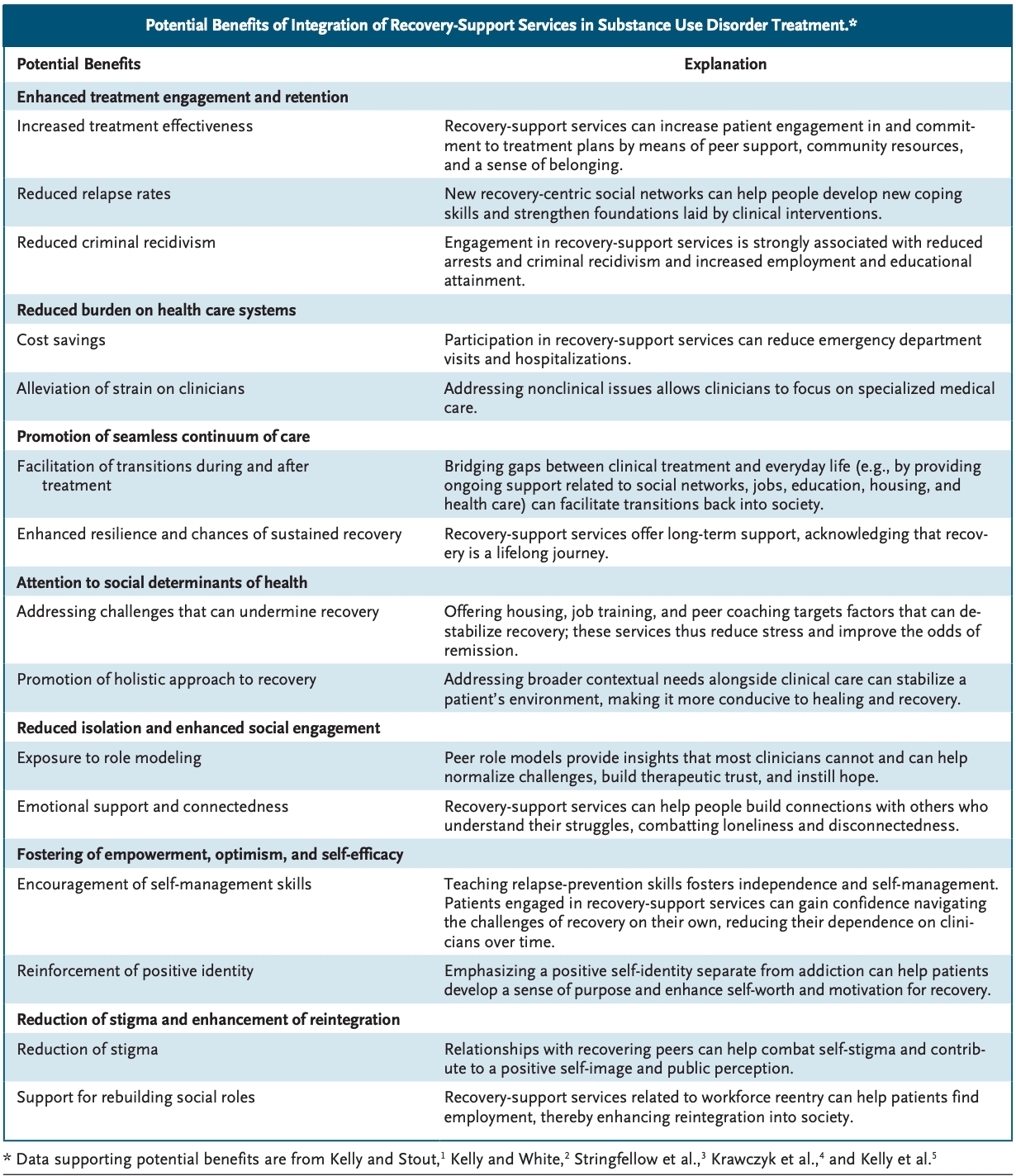
Table 1

Positive findings from these initiatives have inspired proposed legislation that would require appropriation of at least 10% of federal SUD block-grant funding to implementation of recoverysupport services and the establishment in 2021 of the Substance Abuse and Mental Health Services Administration’s Office of Recovery. Medicaid and state departments of public or mental health are increasingly paying for services such as recovery coaching, although such funding remains suboptimal and should be increased. Stigma and custom continue to lead to underpayment of both the recovery-support and clinical SUD workforces, and role definitions and quality and performance benchmarks for recovery-support services are needed to improve reimbursement structures.

The 2024 White House National Drug Control Strategy embraced greater interagency collaboration to expand payment for these services, but the extent to which the new federal administration will maintain this approach is unclear. Further evidence on recoverysupport services should be forthcoming; the National Institute on Drug Abuse, in partnership with other National Institutes of Health sponsors, recently launched the Recovery Research Networks initiative to establish multistakeholder groups to build infrastructure, train researchers, and document effective approaches in this area.

These developments mark a new phase in society’s understanding of SUD. During the past 50 years, approaches for addressing SUD have shifted away from the criminal legal system to the clinic — and they are now shifting toward greater clinic–community integration. Although additional drug-policy reforms are critical, and there have been examples of re-criminalization and public health policy reversals, these shifts reinforce the need to continue to build on clinical stabilization and other medical interventions. Incorporating recovery-support services as a component of SUD treatment infrastructure is essential. Doing so could help reduce people’s susceptibility to SUD recurrence by keeping the fire extinguished and increase the odds that some of the most vulnerable members of society will not only survive, but ultimately thrive.

Open Article as PDF

Abstract

New models integrating clinic-based care with community-based services for people with substance use disorder could reduce the time to stable remission and support recovery.

Summary

For over five decades, the United States has pursued a "war on drugs," with policies emphasizing strict enforcement and mandatory minimum sentences for drug possession. Historical evidence demonstrates these "tough-on-crime" approaches have been largely ineffective. Concurrently, there has been a significant shift in understanding substance use disorder (SUD) as a treatable medical condition. This change has spurred the development of effective, evidence-based treatments, including medications and psychosocial interventions. Addressing SUD effectively requires a blend of both short-term and long-term strategies, as initial interventions often span only a few weeks, while sustained remission frequently necessitates years of ongoing clinical care combined with support for broader social needs.

Individuals managing SUD face a risk of recurrence for years following initial remission. Achieving sustained remission often takes an average of eight years and multiple treatment engagements, with an additional five years needed before the risk of meeting SUD criteria aligns with that of the general population. This prolonged recovery journey has led to the adoption of a continuity-of-care model, integrating advanced clinical treatments with long-term community recovery support. This comprehensive approach, akin to rebuilding a structure after a fire, emphasizes providing the necessary "scaffolding" and "materials" for individuals to establish stable lives. Policies that criminalize drug use can hinder this rebuilding process by creating barriers to employment and education, thereby preventing access to crucial "recovery capital" such as supportive environments and services.

A growing network of cost-effective, community-based recovery-support services in the United States plays a vital role in fostering long-term healing. These services encompass mutual-aid organizations, peer-based coaching, mobile clinics, and integrated care within various settings like emergency departments and primary care offices. Peers in recovery often staff these programs, offering inspiration, modeling recovery pathways, and sharing coping skills. Research confirms the value of these services as extensions of clinical care. For instance, peer-coaching models can improve the uptake and long-term adherence to medication for opioid use disorder (MOUD), which often sees suboptimal use. Studies, including a Cochrane review, indicate that connecting individuals to mutual-aid recovery services can increase continuous abstinence and remission rates by 20% to 60% over three years compared to other evidence-based treatments, potentially leading to substantial healthcare cost savings. Similarly, individuals living in recovery residences have shown higher rates of remission, reduced involvement with the criminal justice system, and improved employment outcomes, resulting in significant savings per person.

The integration of clinic-based and community-based services is accelerating recovery for many individuals. Access to comprehensive recovery resources through "one-stop shop" peer recovery support centers can enable individuals to achieve a quality of life and functioning equivalent to the general public within approximately five years, a significant reduction from the previously observed average of fifteen years. This integration is increasingly being implemented at city and state levels, demonstrating clinical, public health, and economic efficiencies. These positive developments have prompted proposed legislation to increase federal funding for recovery-support services and led to the establishment of the Substance Use and Mental Health Services Administration’s Office of Recovery. While payment for services like recovery coaching by Medicaid and state agencies is increasing, funding remains insufficient, and challenges persist due to stigma, underpayment of the workforce, and a need for clearer role definitions and quality benchmarks to improve reimbursement structures.

These shifts reflect a new phase in the understanding and treatment of SUD, moving from a focus on the criminal legal system to clinic-based care, and now toward greater clinic-community integration. Despite ongoing needs for drug policy reforms and occasional setbacks, these developments underscore the importance of building upon clinical stabilization with comprehensive support. Integrating recovery-support services into the core infrastructure of SUD treatment is essential. This approach not only helps prevent recurrence but also significantly enhances the prospects for vulnerable individuals to achieve not just survival, but sustained well-being and a thriving life.

Open Article as PDF

Abstract

New models integrating clinic-based care with community-based services for people with substance use disorder could reduce the time to stable remission and support recovery.

The Need for Long-Term Substance Use Disorder Treatment

For over 50 years, "tough-on-crime" policies, like mandatory minimum sentences for drug possession, have proven ineffective in addressing substance use disorder (SUD). Scientific understanding has evolved, recognizing SUD as a treatable medical condition. This shift has led to advanced, evidence-based treatments, including medications and therapy. However, many current treatment protocols are short-term, typically lasting only a few months. Achieving lasting recovery often requires years of ongoing clinical care combined with support for broader social needs, as the risk of relapse can persist for many years. Effective treatment now often includes a "continuity-of-care" approach, integrating clinic-based care with long-term community recovery support services.

Rebuilding Lives Beyond Initial Treatment

Treating SUD is like extinguishing a fire: short-term interventions put out the immediate crisis. But once stable, individuals need support to rebuild their lives in a secure environment and prevent future problems. This rebuilding requires attention to social needs, such as finding employment and educational opportunities. Policies that criminalize drug use, like arrests for possession, can block access to these essential building blocks, making it harder for individuals to integrate back into society. Connecting individuals to supportive environments and long-term services provides what is called "recovery capital." This capital helps create conditions for healing, resilience, and significantly reduces the chance of relapse.

The Role of Community-Based Recovery Support Services

Many effective and affordable community-based services exist to support long-term recovery. These include mutual-aid groups like Alcoholics Anonymous, peer recovery coaching, street outreach programs, mobile clinics, and services offered through emergency departments, treatment courts, and primary care offices. These services are often led by individuals who are themselves in recovery, providing inspiration, hope, and practical coping skills. Research confirms that these recovery support services effectively extend clinical care. For instance, peer-coaching models can significantly improve the consistent use of medication for opioid use disorder (MOUD), which often sees high dropout rates. While peer workers play a vital role, they also need strong support, including trauma-informed supervision, due to their potential exposure to triggers.

Evidence of Effectiveness and Economic Benefits

Evidence strongly supports the effectiveness and cost-efficiency of recovery support services. One review found that connecting individuals to mutual-aid services led to 20% to 60% higher rates of continuous abstinence over three years compared to other standard treatments. Implementing these services widely could save the U.S. healthcare system an estimated $15 billion annually. Studies also show that individuals living in recovery residences were significantly more likely to achieve remission, avoid involvement with the criminal justice system, and gain employment, saving about $30,000 per person over two years. Integrating clinical and community services can accelerate healing, helping the millions of adults in recovery in the United States. Access to these combined services can help individuals achieve a quality of life similar to the general public in about five years, a significant reduction from the previously observed 15 years. This integration is already happening at city and state levels, showing benefits in health and economics.

Policy, Funding, and the Future of Recovery Support

The positive results from integrated care have led to legislative proposals, including requiring a portion of federal SUD funding for recovery support services and the creation of SAMHSA’s Office of Recovery. While Medicaid and state health departments are increasing payment for services like recovery coaching, overall funding is still insufficient, and workers in both recovery support and clinical SUD fields are often underpaid due to stigma. Clear role definitions and quality standards are needed to improve how these services are reimbursed. The White House has supported expanding payment for these services, and new research initiatives are underway to gather more evidence and build infrastructure for recovery research. These ongoing changes signify a new era in addressing SUD, moving from criminalization to clinic-based care, and now towards integrating clinic with community support. Incorporating recovery support services into the core treatment framework is vital. This approach can help prevent relapse and enable individuals affected by SUD to not only recover but also lead fulfilling lives.

Open Article as PDF

Abstract

New models integrating clinic-based care with community-based services for people with substance use disorder could reduce the time to stable remission and support recovery.

Summary

For over 50 years, the United States has approached substance use disorder (SUD) with policies focused on punishment, often called the "war on drugs." These "tough-on-crime" methods, including mandatory jail sentences for drug possession, have not been effective. Meanwhile, understanding of SUD has advanced, recognizing it as a medical condition that can be treated. New medical and therapeutic methods have been developed to help people recover.

Effective treatment for SUD requires more than just short-term care. While initial interventions might address immediate issues, helping someone achieve lasting recovery often takes years. People can be at risk of relapse for many years after they first get better. Achieving stable recovery usually takes about eight years and several attempts at treatment or support. Modern treatment now includes a continuous approach that combines clinical care with long-term support in the community. Criminalizing drug use, for instance through arrests, can prevent individuals from rebuilding their lives by making it harder to find jobs or education. Linking individuals to supportive environments and services provides "recovery capital," which helps them heal and stay strong against recurrence.

A growing number of community-based services are helping people with SUD achieve long-term healing. These services are often led by peers—people who are themselves in recovery. They include groups like Alcoholics Anonymous, peer coaching, street outreach, mobile clinics, and support in emergency departments or treatment courts. These programs inspire hope, offer emotional and practical support, and teach coping skills. Research confirms that these services extend the work of clinical treatments. For example, peer coaching can help people continue to use important medications for opioid use disorder, which many stop taking too soon.

Integrating clinic-based care with community services can significantly speed up recovery. Studies show that connecting people to mutual-aid support groups can increase remission rates by 20 to 60% over three years, saving billions in healthcare costs annually. Additionally, people living in recovery residences are more likely to stay in remission, avoid the criminal justice system, and find employment, leading to substantial savings. This integration helps individuals improve their quality of life and function as well as the general public, often much faster than before.

These positive results have led to policy changes, including proposed laws to set aside federal funding for recovery support services. Government agencies are also increasing payments for services like recovery coaching, although more funding is still needed. Despite the progress, stigma and traditional practices sometimes result in low pay for both clinical and recovery support workers. Clear definitions and quality standards are necessary to improve how these services are paid for. The overall approach to SUD is shifting from a focus on the criminal justice system, then to clinics, and now towards combining clinical care with community support. While further drug policy reforms are still important, building recovery support into the treatment system is crucial for helping people overcome SUD and thrive.

Open Article as PDF

Abstract

New models integrating clinic-based care with community-based services for people with substance use disorder could reduce the time to stable remission and support recovery.

Summary

For more than 50 years, the United States has tried to stop drug use with harsh laws. These laws often did not work, like those that put people in jail for having drugs. Now, doctors understand that drug addiction is a health problem that can be treated. New medicines and helpful programs have been developed to save lives.

Getting better from drug addiction needs both quick help and long-term support. People often need help for many years to truly get well. It can take a long time and many tries to stay sober. Good treatment now includes ongoing care, not just short programs. This means blending doctor's care with help in the community. This full support can help people recover faster and stay well.

Imagine someone starting treatment for drug addiction like a building on fire. Doctors quickly work to put out the fire. But after the fire is out, people need help rebuilding their lives safely. Laws that punish drug use, like arrests, can make it harder for people to get jobs or go to school. This makes it hard for them to rebuild. Connecting people to long-term help and support in their community helps them heal and avoid falling back into addiction.

Many helpful programs now exist in communities. These include groups where people support each other, like Alcoholics Anonymous. There are also coaches who have been through recovery themselves. They help connect people to doctors and community programs. These services offer hope, show others how to recover, give emotional support, and teach new ways to cope.

Studies show that these community support programs work very well. People who get this help are more likely to stay sober and live better lives. It also saves a lot of money. More and more, doctors and community groups are working together. This helps people get better faster and improves their lives. Governments are also starting to support these services more, seeing them as key to helping people recover from drug addiction for good.

Open Article as PDF

Footnotes and Citation

Cite

Kelly, J. F., Volkow, N. D., & Koh, H. K. (2025). The Changing Approach to Addiction - From Incarceration to Treatment and Recovery Support. The New England journal of medicine, 392(9), 833–836. https://doi.org/10.1056/NEJMp2414224

    Highlights