"Sex-specific differences in brain activity dynamics of youth with a family history of substance use disorder "
Louisa Schilling
S. Parker Singleton
Ceren Tozlu
Marie Hédo
Qingyu Zhao
SimpleOriginal

Summary

In 9–11-year-olds, family history of substance use disorder alters brain dynamics: girls need more energy to shift default-mode states, boys less in attention networks, suggesting sex-specific neural pathways to later SUD and SUD risk.

2025

"Sex-specific differences in brain activity dynamics of youth with a family history of substance use disorder "

Keywords Substance Use Disorder (SUD); Family History of SUD; Sex Differences; Adolescence; Neuroimaging; Network Control Theory (NCT); Transition Energy (TE); Brain Dynamics; Default Mode Network (DMN); Attentional Networks

Substance use disorder (SUD) has devastating consequences, including familial and financial instability, poor health outcomes and, far too often, death. It remains unclear why only a subset of individuals develop SUD, despite the commonplace use of substances. Dual-systems theories propose that SUD stems from heightened bottom–up reward sensitivity and underdeveloped top–down inhibitory control, an imbalance that peaks in adolescence when prefrontal maturation lags behind that of subcortical reward systems. Adolescents with a family history (FH) of SUD (FH+) may experience a premorbid exaggeration of this imbalance due to both genetic and environmental factors. Compared to youth without FH (FH−), FH+ youth are at greater risk for SUD and show behavioral and neurocognitive alterations, even before substance use.Sex assigned at birth (hereafter ‘sex’) also shapes SUD vulnerability. We use the terms ‘female’ and ‘male’ to refer to sex, but note that sex does not equate to gender—which has distinct neural correlates and influences on SUD risk—and differences reflect group-level tendencies with substantial overlap. Evidence suggests sex-modulated reinforcement sensitivity: females are more influenced by negative reinforcement (for example, alleviating distress), whereas males are more influenced by positive reinforcement (for example, drug reward). These mechanisms may underlie observed patterns, with females escalating more rapidly due to heightened withdrawal and craving, and males initiating earlier and developing SUD at higher rates. Similar patterns are evident in adolescence, where internalizing pathways are more common in females and externalizing pathways in males. Neuroimaging studies mirror these behavioral patterns, with men showing greater reward-related impulsivity and women showing heightened negative emotionality in task-based functional MRI (fMRI) paradigms across both adults and adolescents. Emerging evidence further suggests that FH of SUD may amplify these baseline sex differences in responses to reward and stress, as indicated by both behavioral and neuroimaging studies, although evidence remains limited.

Neuroimaging findings in FH+ youth reveal alterations in mesocorticolimbic regions (for example, prefrontal cortex, striatum and amygdala) that parallel those observed in adults with SUD—alterations previously presumed to solely reflect the consequences of chronic substance use. These parallels span functional activity, dopaminergic signaling, white matter integrity, gray-matter volume and cortical thickness. Together, this evidence suggests that neural correlates associated with SUD may, in part, reflect premorbid vulnerability.

Yet these alterations in FH+ individuals and those with SUD are not confined to isolated regions, but probably reflect changes in large-scale brain networks. Such networks undergo extensive reorganization during development to support cognitive functions including reward processing and inhibition. Premorbid disruptions in the activity and functional connectivity of these networks have been identified in youth who later develop SUD and in FH+ youth, particularly in networks also implicated in SUD: default mode (DMN), frontoparietal (FPN) and salience/ventral attention (VAT) networks. Sex modulates the manifestation of SUD in these networks, but there is limited research on the interaction of FH and sex. One study found no FH-by-sex effects on functional connectivity, whereas another study identified a three-way interaction of sex, childhood maltreatment and FH on activity in the FPN, executive control and DMN networks. Both, however, included older adolescents with previous substance exposure, limiting interpretation.Functional networks enable flexibly shifting between internally and externally oriented brain states. The dynamics of these transitions differ by sex, with females exhibiting less overall dynamism. SUD, too, alters these dynamics, with less time spent in internal states, more in external states, and fewer transitions overall. FH+ young adults, particularly males, show a reduction in a reconfiguration process in visual, DMN and attention networks associated with task-to-rest transitions. Together, these findings suggest that FH affects the ability to shift between brain states and is likely modulated by sex.Network control theory (NCT) is a powerful framework for capturing individual differences in brain dynamics. Unlike traditional metrics of functional activation or connectivity, NCT models how activity propagates across structural connections to support brain-state transitions. The ease of these transitions is quantified as the transition energy (TE), the cumulative input required to steer the brain from one state to another. TE indexes internal cognitive demands rather than direct metabolic costs, although it has recently been linked to metabolic activity. By directly estimating the effort needed to reconfigure activity across networks, TE provides an apt metric for investigating vulnerability to disorders characterized by imbalance in top–down and bottom–up control. Earlier work has linked altered TE to alcohol use, methamphetamine abstinence, dopaminergic dysfunction, psychopathology and sex-linked impulsivity. However, the relationship between FH of SUD and TE during adolescence has not yet been assessed.The literature on FH+ individuals is difficult to interpret due to methodological heterogeneity, small samples, wide age ranges, prior substance exposure and limited attention to sex. Nonetheless, four themes emerge: (1) SUD risk arises in adolescence from an imbalance of top–down and bottom–up control; (2) sex modulates this risk through distinct neurobehavioral pathways; (3) FH+ adolescents show a premorbid exaggeration of this neurodevelopmental profile, probably via altered network dynamics; and (4) FH and sex interact and may amplify baseline sex differences. However, no study has directly tested how sex and FH jointly influence brain-state dynamics. To address this gap, we applied NCT to functional and structural neuroimaging data from substance-naïve youth in the Adolescent Brain Cognitive Development Study (ABCD Study), quantifying sex-specific differences in TE between recurring brain states in FH+ versus FH− youth. By characterizing these premorbid dynamics, our work aims to clarify the neurobiological basis of SUD risk and to inform prevention and intervention strategies in vulnerable populations.

Results

Sample characteristics

To investigate sex-specific differences in the transition energies of youth with (FH+) and without (FH−) FH of SUD, we used diffusion MRI (dMRI) and resting-state functional MRI (rsfMRI) data from the ABCD Study’s baseline assessment of a large sample of substance-naïve youth (N = 1,886 individuals, 10.02 ± 0.62 years, 53% female) (Table 1). We classified individuals as FH+ if they had at least one parent or two grandparents with a history of SUD, and FH− if they had no parents or grandparents with a history. Individuals with just one grandparent with a history of SUD were classified as FH+/− and are included only in analyses of continuous associations (that is, FH density, FHD). See ‘Exclusions’ section for the exclusion criteria. Demographic comparisons indicated no significant differences between FH groups in terms of sex, age, framewise displacement or MRI scanner model distribution. However, FH+ individuals tended to have lower household income, greater racial/ethnic diversity, lower parental education status, higher rates of prenatal substance exposure and parental mental health issues, and more advanced pubertal stages.
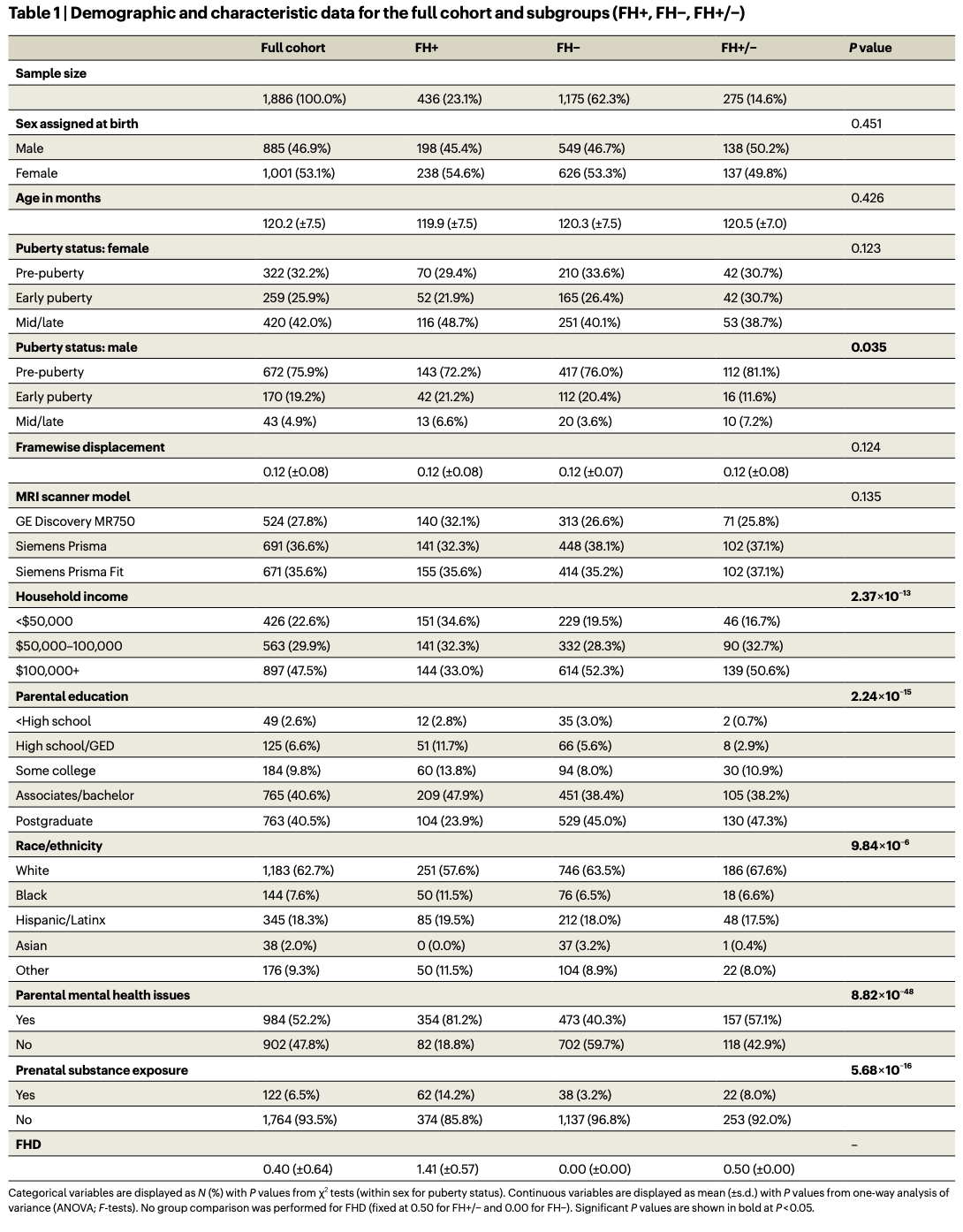
Table 1

NCT analysis

Following previous work, we applied k-means clustering to regional rsfMRI time-series data (86-region atlas) to identify k recurring patterns of brain activity, termed ‘brain states’ (Fig. 1). For each participant, we assigned each individual frame to a brain state and calculated individual brain-state centroids. We then applied NCT to calculate the global-, network- and region-level TE required to complete brain-state transitions. For this, we utilized a group-average structural connectome (SC; derived from dMRI from a subset of individuals in this dataset) as previously done, and as supported by observations that functional abnormalities precede white-matter changes in FH+ youth (Supplementary Section 10.3 provides a replication of our results using individual SCs). We calculated both the pairwise and mean TE for all levels of analysis—global, network and regional. Initial TE calculations result in ‘pairwise regional TE’ values, that is, 86 (number of regions) k × k matrices. For each matrix, we summed the pairwise regional TE of all regions belonging to each of the seven Yeo networks plus subcortical and cerebellar networks to yield ‘pairwise network TE’ values, that is, nine (number of networks) k × k matrices. We derived a single ‘pairwise global TE’ k × k matrix by summing across all 86 regions’ pairwise TEs for each transition k × k matrix. We also averaged all entries in pairwise TE matrices to derive mean TE values for each region, network and globally, resulting in 86 mean regional TE values, nine mean network TEs, and a single value for mean global TE. Thus, pairwise TE represents the energy required of a given region, network or whole brain to complete transitions between each pair of brain states, whereas mean TE represents the energy required to transition across the entire state space (that is, all pairwise transitions). The section ‘TE calculations’ provides more details.
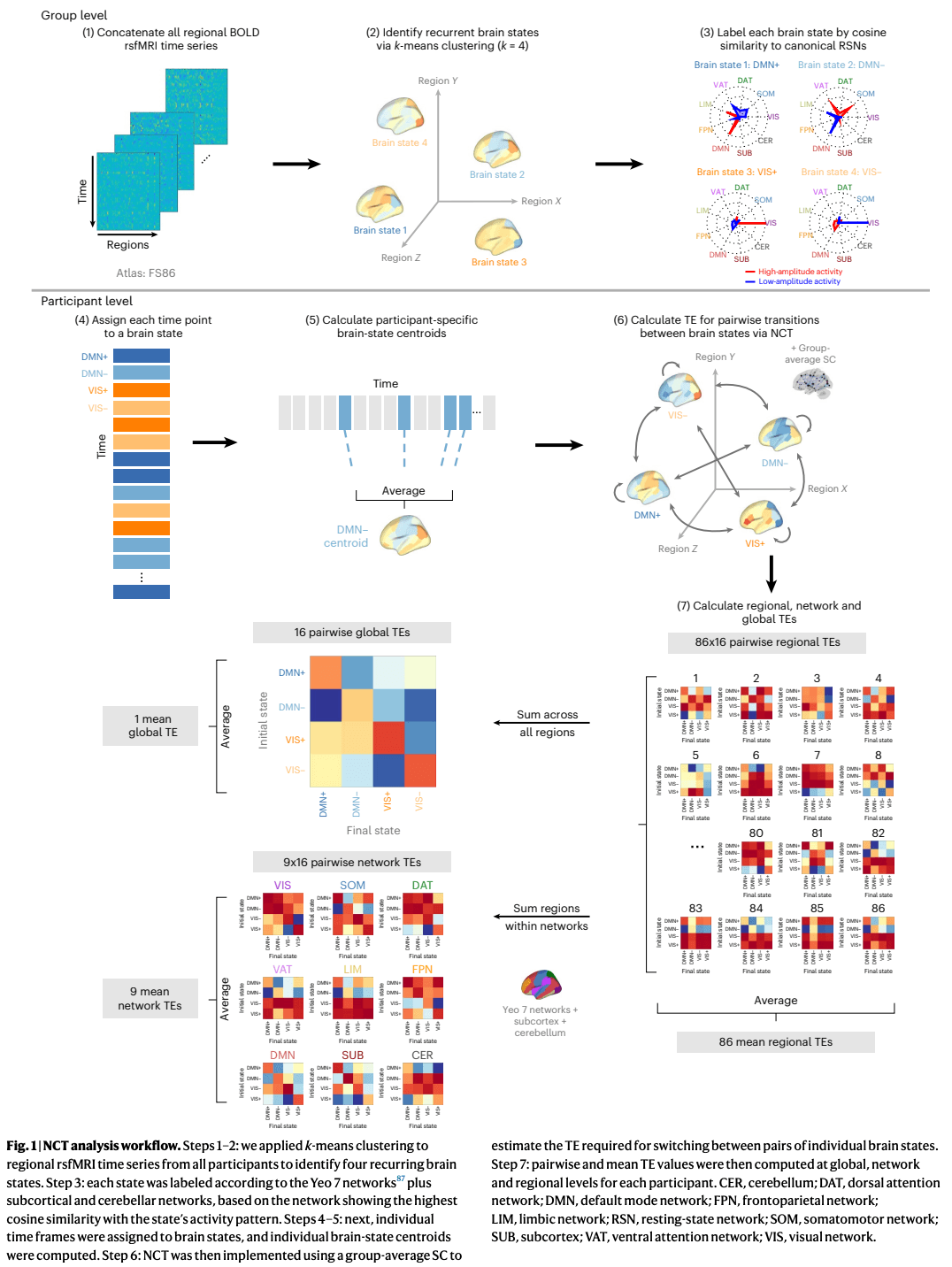
Fig 1

It is important to distinguish the four brain states from the nine networks used to calculate TE values, although both derive from a common nine-network parcellation (Yeo 7 networks plus subcortical and cerebellar networks). Brain states are the four k-means clusters assigned to the network whose high or low activity best explained each centroid. These descriptive labels did not influence analyses and are denoted with ‘+’ or ‘−’ to indicate above- or below-mean activity (for example, DMN+, VIS−). Network TE values, by contrast, are calculated by summing regional TEs across all regions in a given network and are referenced using the nine network names alone (for example, DAT, VIS, DMN).

We conducted a series of two-way analyses of covariance (ANCOVA) to examine the effects of FH of SUD and its interaction with sex on mean and pairwise TEs at global, network and regional levels. All models included the following independent variables: sex, age, FH of SUD (FH+ versus FH−), race/ethnicity, household income, parental education, parental mental health issues, prenatal substance exposure, MRI scanner model, in-scanner motion (mean framewise displacement) and puberty status. Additionally, three interaction terms were included: puberty and sex, FH of SUD and sex, and FH of SUD and income. The direction of effects was determined using post hoc unpaired t-tests on TE values that showed significant differences in ANCOVA models. To validate our findings, we used a continuous measure of FHD (number of affected first- and second-degree relatives) and performed Spearman’s rank correlations with significant TE values across all three groups (FH+, FH−, FH+/−). Effect sizes were reported as partial η2 for ANCOVA model results and Cohen’s d for the results of t-tests. To account for multiple comparisons, P values were adjusted using the Benjamini–Hochberg false discovery rate (FDR) procedure (q = 0.05), with PFDR < 0.05 considered significant.

Brain state identification

We found an optimal solution of k = 4 brain states, determined using a cutoff of additional explained variance of <1% (Supplementary Fig. 1). The identified brain states consist of two pairs of anticorrelated activity patterns (that is, meta-states), the first dominated by high- and low-amplitude activity in the default mode network (DMN+/−) and the second by high- and low-amplitude activity in the visual network (VIS+/−) (Supplementary Fig. 3), aligning with previous work. For replication of our results using k = 5, see Supplementary Fig. 13.

Global TE

We first examined whether FH of SUD or its interaction with sex had a measurable global impact on the brain’s overall energetic landscape. In a two-way ANCOVA model assessing mean global TE, the main effect of FH of SUD was non-significant (F(1, 1,588) = 0.05, P = 0.82, ). By contrast, the interaction between sex and FH of SUD reached nominal significance before correction (F(1, 1,588) = 4.00, P = 0.046, PFDR = 0.128, ). The lack of a main effect was partly driven by the opposite direction of effect in the sexes. Within-sex post hoc t-tests revealed FH+ females had higher mean global TE than FH− females (t = 1.73, P = 0.084, Cohen’s d = 0.13), whereas FH+ males had lower mean global TE than FH− males (t = −1.14, P = 0.256, Cohen’s d = −0.09) (Fig. 2a). Extending the analysis to include FH+/− individuals (that is, those with one grandparent with SUD) revealed weak, non-significant correlations between FHD and mean global TE, trending in the same direction as the categorical effects: a positive association in females (Spearman’s ρ = 0.06, P = 0.073) and a negative association in males (Spearman’s ρ = −0.04, P = 0.302) (Fig. 2b).
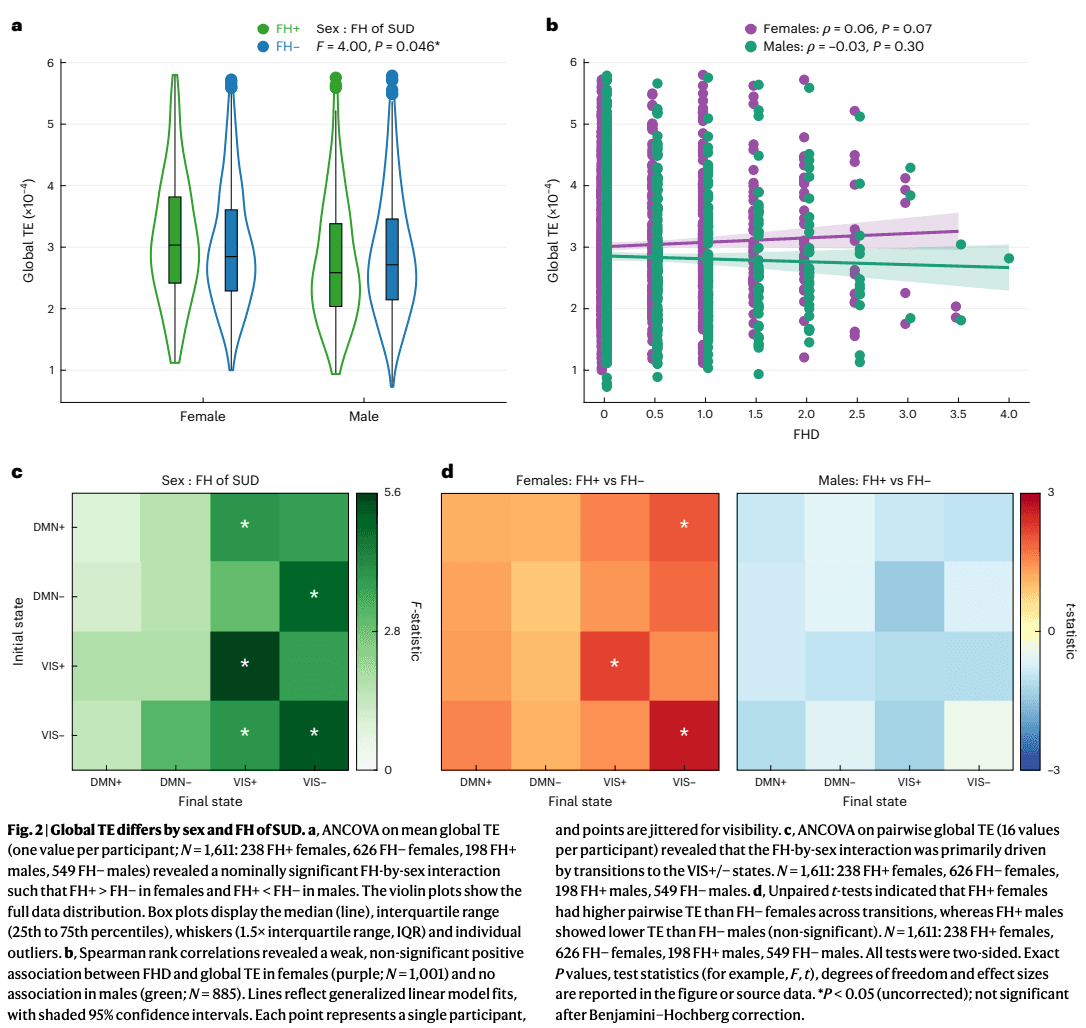
Fig 2

The main effect of sex was a significant effect on mean global TE (F(1, 1,588) = 25.93, P = 3.96 × 10⁻⁷, PFDR = 2.77 × 10⁻⁶, ). Post hoc analyses using two-sided, unpaired t-tests confirmed that females exhibited higher mean global TE compared to males (t = 4.29, P = 1.89 × 10⁻⁵, Cohen’s d = 0.20). Among all subgroups, FH+ females showed the highest mean global TE, followed by FH− females, FH− males and FH+ males.

Additionally, parental history of mental health issues significantly (before correction) affected mean global TE (F(1, 1,585) = 6.05, P = 0.014, PFDR = 0.065, ), driven by higher TE in youth with parental history of mental illness compared to without such history (t = 3.04, P = 0.002, Cohen’s d = 0.14). Other significant factors included MRI scanner model (F(2, 1,585) = 24.98, P = 2.08 × 10⁻¹¹, PFDR = 2.91 × 10⁻¹⁰, ) and the interaction of sex and puberty stage (F(2, 1,585) = 3.126, P = 0.043, PFDR = 0.668, ). Supplementary Table 4 presents the full ANCOVA results and Supplementary Fig. 18 additional analyses stratified by scanner type.

Two-way ANCOVA models for entries in the pairwise global TE matrix indicated that the effect of the interaction of sex and FH of SUD was strongest in transitions to and persistence within the VIS meta-state (Fig. 2c). Post hoc unpaired t-tests showed that this interaction effect was primarily driven by greater pairwise global TE in FH+ females versus FH− females in transitions to the VIS meta-state (Fig. 2d). All pairwise transitions had higher TE in FH+ females and lower TE in FH+ males compared to their sex-matched FH− counterparts.

Network TE

We next investigated which networks are driving the observed effects in global TE. For each network, we ran two-way ANCOVAs for mean network TE using the same covariates described above. Mean network TE did not show a significant main effect of FH of SUD in any network (Fig. 3a), but significant FH-by-sex interaction effects were observed in the DMN, DAT and VAT networks, although the VAT effect did not survive FDR correction across the nine networks (Fig. 3b). Full ANCOVA results for all networks are presented in Supplementary Information (Supplementary Fig. 6).

Fig. 3: Network-level TE differs by sex and FH of SUD.
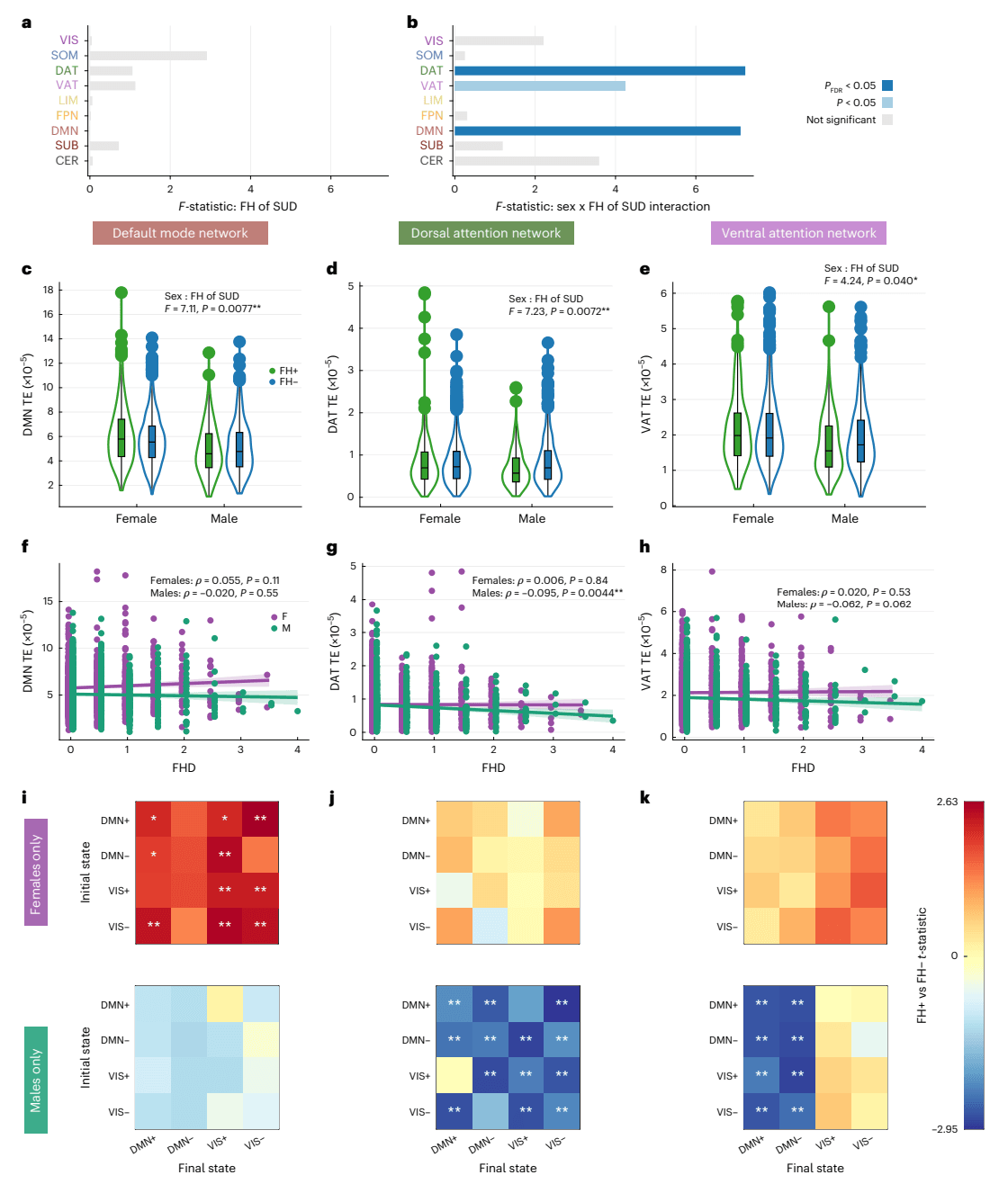
Fig 3

a,b, ANCOVA models performed on mean network TE across nine canonical brain networks (nine values per participant; N = 1,611; 238 FH+ females, 626 FH− females, 198 FH+ males, 549 FH− males) showed no main effect of FH (a), but a significant FH-by-sex interaction in the DMN and DAT networks (PFDR < 0.05, Benjamini–Hochberg corrected), and an uncorrected effect in the VAT network (P < 0.05) (b). Bar plots show F statistics, with color indicating significance before (light blue) and after (dark blue) multiple-comparison correction. ce, Violin plots showing kernel density estimates. Box plots indicate IQR, median (line), whiskers (1.5× IQR) and individual outliers for mean network TE in the DMN (c), DAT (d) and VAT (e). FH+ females (N = 238) showed higher TE than FH− females (N = 626) in the DMN, and FH+ males (N = 198) showed lower TE than FH− males (N = 549) in the DAT and VAT. fh, Spearman correlations between FHD and mean network TE showing a weak positive association in the DMN in females (f, purple; N = 1,001) and significant negative associations in males (green; N = 885) in the DAT (g) and VAT (h). Solid lines indicate linear fits from generalized linear models. Shaded bands represent 95% confidence intervals. Each point represents a single participant, and points are jittered for visibility. ik, t-tests of pairwise TE values (16 transitions per participant) supported these effects: FH+ females (N = 238) compared to FH− females (N = 626) had higher pairwise DMN TE especially in transitions to the VIS+/− states (i); FH+ males (N = 198) compared to FH− males (N = 549) had lower pairwise network TE in the DAT (j) across most transitions, and in the VAT (k), particularly in transitions to the DMN+/− states. All tests were two-sided. Multiple comparisons were controlled with Benjamini–Hochberg FDR (q = 0.05) across families of tests. Exact P values, test statistics (for example, F, t), degrees of freedom and effect sizes are reported in the figure or source data. *P < 0.05 before correction; **PFDR < 0.05.

To examine the direction of these interaction effects, we performed unpaired t-tests comparing FH+ and FH− individuals within each sex. In the DMN, the interaction was driven by higher mean TE in FH+ compared to FH− females (t = 2.55, P = 0.011, PFDR = 0.027, Cohen’s d = 0.19), but no significant difference was seen in FH+ versus FH− males (t = −1.19, P = 0.233, Cohen’s d = −0.10) (Fig. 3c). Supporting this pattern, FHD of SUD in females had a weak trending positive correlation with mean DMN TE (ρ = 0.051, P = 0.105; Fig. 3f). Conversely, in the DAT and VAT networks, the interaction effects were driven by significantly lower mean network TE in FH+ compared to FH− males (DAT: t = −3.38, P = 0.001, PFDR = 0.005, Cohen’s d = −0.28; VAT: t = −2.48, P = 0.014, PFDR = 0.027, Cohen’s d = −0.21), whereas females showed no significant differences in mean TE of these networks (DAT: t = 0.46, P = 0.646, Cohen’s d = 0.04; VAT: t = 0.90, P = 0.366, Cohen’s d = 0.07) (Fig. 3d,e). Finally, we found significant, albeit weak, negative correlations between mean network TE and FHD in males for both the DAT (ρ = −0.095, P = 0.004) and VAT (ρ = −0.063, P = 0.062) networks, though the VAT result did not survive FDR correction (Fig. 3g,h).

We next investigated which pairwise state transitions drive the observed effects of FH of SUD and sex on mean network TE. Within-sex unpaired t-tests revealed greater pairwise DMN TE in FH+ compared to FH− females across all transitions, particularly in transitions to the VIS meta-state and to DMN−, whereas FH+ and FH− males exhibited no significant differences in pairwise DMN TE (Fig. 3h). FH+ males had lower pairwise DAT TE for almost all transitions compared to FH− males (Fig. 3i) and lower pairwise VAT TE only in transitions to the DMN meta-state (Fig. 3j), whereas no differences were observed in FH+ versus FH− females.

Regional TE

We next sought to identify regions contributing to the observed FH-by-sex differences in global and network TE. We ran two-way ANCOVAs on mean regional TE (dependent variable) using the same terms included in the models above. ANCOVA results for all regions are provided in Supplementary Information (Supplementary Figs. 8 and 9). Before FDR correction (over 86 regions), FH of SUD had a significant effect on the mean regional TE of the bilateral paracentral lobule, bilateral superior temporal gyrus, right banks of the superior temporal sulcus (STS) and right amygdala (Fig. 4a). Unpaired t-tests were performed to compare FH+ and FH− individuals’ mean regional TE for the six regions found to have a significant effect of FH or FH-by-sex. All regions analyzed exhibited significantly greater mean regional TE in FH+ individuals compared to FH− individuals (regardless of sex; Fig. 4b), and had significant, though weak, positive correlations with FHD (Fig. 4c). These six regions belong to the DMN, somatomotor network (SOM) and SUB networks.
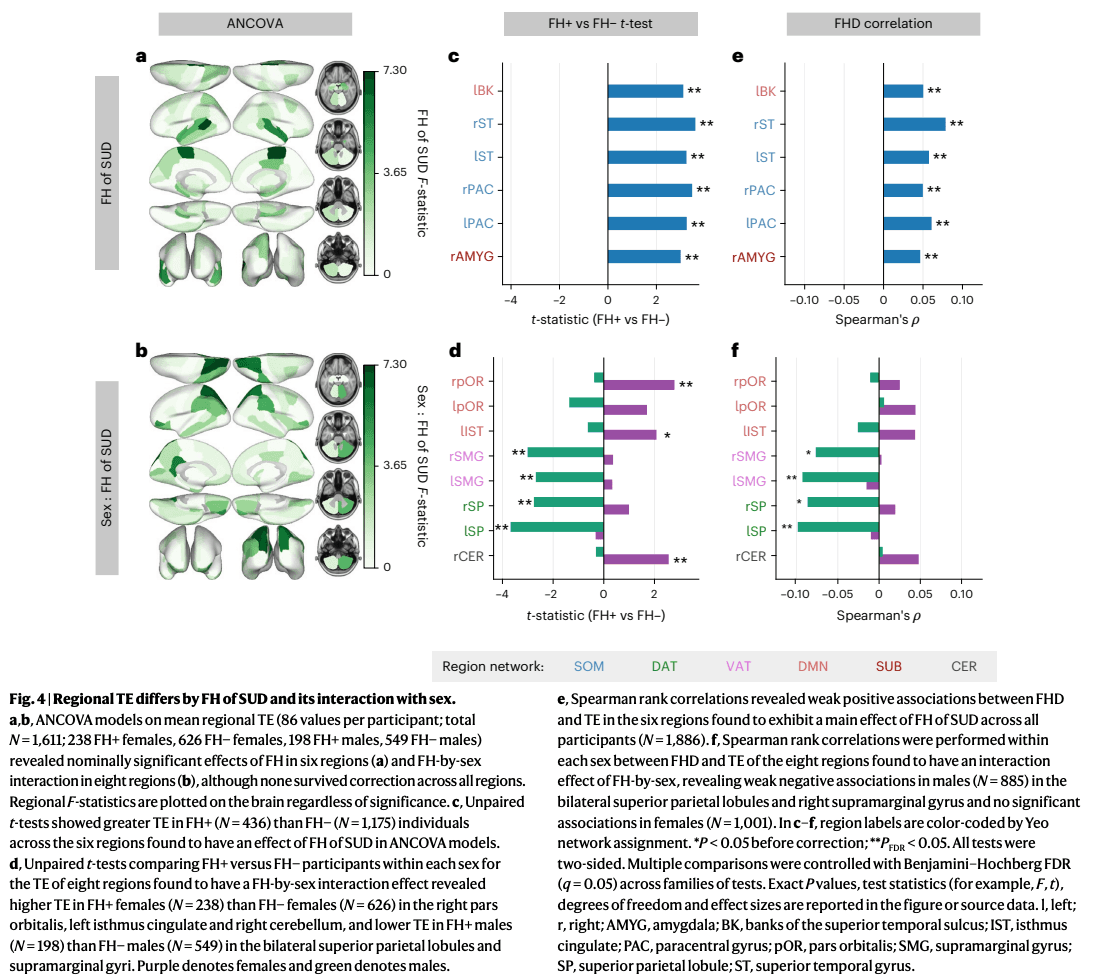
Fig 4

The interaction between FH of SUD and sex had a significant effect on mean regional TE—prior to correction—bilaterally in the pars orbitalis, superior parietal lobule and supramarginal gyrus, and in the left isthmus cingulate and right cerebellum (Fig. 4d). Unpaired within-sex t-tests revealed significantly higher mean regional TE of the bilateral pars orbitalis, left isthmus cingulate and right cerebellum in FH+ females compared to FH− females. Mean regional TE of the bilateral superior parietal lobule and bilateral supramarginal gyrus was significantly lower in FH+ males compared to FH− males (Fig. 4e). The direction of correlations between FHD and mean regional TE of these regions largely recapitulated the results of within-sex t-tests. The bilateral supramarginal gyri and superior parietal lobules demonstrated significant, yet mild, negative correlations with FHD in males (Fig. 4f). Group differences in pairwise regional TE of these regions were consistent with the mean regional TE results shown here (Supplementary Figs. 4 and 5). The regions found to have lower mean TE in FH+ versus FH− males all belong to the DAT and VAT networks, and the regions found to have greater mean TE in FH+ versus FH− females all belong to the DMN and CER networks.

Robustness analyses

To ensure the robustness of our results, we replicated our main findings in several ways: (1) re-clustering with k = 5 brain states, (2) utilizing individual SCs in a cortex-only parcellation and (3) in a cohort of sex, age and in-scanner motion-matched participants from an external dataset (the National Consortium on Alcohol and NeuroDevelopment in Adolescence, NCANDA). We also re-ran two-way ANCOVA models by stratifying our cohort in different ways: (1) a single site with the largest number of participants, (2) within each MRI scanner model and (3) within each income category.

We found that our main results were largely consistent when varying the number of clusters (k = 5) (Supplementary Fig. 13) and when using individual SCs (Supplementary Fig. 16). Our independent analysis of the NCANDA dataset showed similar trends of FH+ > FH− females and FH+ < FH− males at the global and regional levels for mean and pairwise TE, further supporting the generalizability of our findings across different populations (Supplementary Figs. 14 and 15). Analysis within the site with the greatest number of participants (site 16) displayed significant FH-by-sex interactions on mean global TE prior to correction, mean DMN TE after correction, and mean TE of the DAT and CER networks before correction (Supplementary Fig. 17). Analyzing the data by MRI scanner model, we observed that our main results were largely consistent in participants scanned with Siemens models, whereas results from the GE scanner differed, probably due to demographic differences and lower data quality (Supplementary Fig. 18). Supplementary Table 6 presents the participant demographics by MRI model. Previous ABCD analyses found GE scanners have lower reproducibility in dMRI metrics, higher distinguishability after site-normalization in rsfMRI data and higher non-compliance to imaging protocols across modalities, compared to Siemens scanners. Furthermore, Siemens scanners implement real-time motion monitoring but GE scanners do not, and motion correction is critical in this dataset of young adolescents. When stratifying the cohort by income level, our primary findings were consistent mainly in the highest income group (that is, largest subgroup; Supplementary Fig. 20). Overall, these analyses confirm the robustness and reliability of our findings across various conditions and datasets, but indicate a possible influence of socioeconomic and demographic factors.To further contextualize our findings, we examined associations between TE and behavioral and psychological risk factors for SUD in the ABCD cohort (Supplementary Section 12). Follow-up two-way ANCOVA and sex-stratified correlation analyses revealed that these relationships were often sex-specific. Overall, females exhibited modest positive correlations between TE and syndrome scales from the Childhood Behavior CheckList (CBCL), and males showed modest negative correlations with impulsivity-related traits from the Behavioral Inhibition/Behavioral Activation (BIS/BAS) and UPPS-P Impulsive Behavior (UPPS-P) scales. In females, mean DMN TE was positively correlated with CBCL subscales for rule-breaking behavior, social problems and somatic complaints. In males, mean DAT and VAT TE values showed modest negative associations with BAS Drive and Fun-Seeking, as well as UPPS-P Positive Urgency. Further details on the interactions between behavior, sex and FH are provided in Supplementary Section 12.2). These results suggest that altered brain dynamics in at-risk youth may reflect both sex-specific and potentially sex-general neurobehavioral vulnerabilities relevant to future SUD outcomes.

Discussion

Using an NCT framework, we modeled the brain as a networked dynamical system to examine how FH of SUD shapes brain activity dynamics in substance-naïve youth. Our findings demonstrate that FH of SUD manifests both through sex-independent increases in TE in specific regions and through divergent effects in males and females, with FH+ females exhibiting elevated DMN TE and FH+ males exhibiting reduced attentional network TE. These divergent findings in males and females with FH of SUD probably reflect sex-specific responses to genetic and environmental factors contributing to familial risk. The mechanism linking differences in TE at rest to SUD predisposition remains unclear. One possibility is that the energetic demand of a network or region determines its dominance in flexibly driving or suppressing brain-state transitions during rest, action and environmental processing. This theory, grounded in the principle of energy minimization, suggests that networks requiring greater TE exert less efficient and flexible control over whole-brain dynamics. In this context, our findings imply that familial SUD reduces the flexible control of the DMN in females and disinhibits lower-order attentional networks in males, potentially predisposing each sex to distinct neurobehavioral pathways to SUD.

Sex-independent elevation in regional TEs in FH+ youth

Across the sexes, FH+ youth showed elevated TE in the paracentral lobule, amygdala and superior temporal regions. These regions have been consistently linked to executive functioning, reward responsivity, craving and emotional processing in individuals with SUD and in FH+ youth. Notably, the amygdala—a region strongly implicated in internalizing disorders—shows alterations that are more pronounced in FH+ females across development, consistent with females’ greater tendency for internalizing pathways to SUD. Longitudinal studies are needed to determine whether regional TE trajectories differ by sex. Together, these findings suggest disruptions in these regions may represent shared familial markers of SUD risk.

Inflexible DMN dynamics in FH+ females

FH+ females exhibited the highest mean global TE across groups, suggesting reduced neural flexibility and a greater tendency to become ‘stuck’ in certain brain states. This pattern resembles the elevated global TE we previously observed in young adults with heavy drinking, and may help explain the accelerated habit formation reported in females. Elevated TE was most pronounced in the DMN, a network widely implicated in SUD risk and FH of SUD. Greater DMN TE may confer SUD vulnerability by promoting (1) persistence in internally oriented states, (2) disruption of rest-task transitions and (3) weakened top–down regulation of lower-order systems.The DMN is a task-negative network, most active at rest and associated with self-referential and internally directed cognition. FH+ females exhibited greater pairwise DMN TE for transitions to VIS+, VIS− and DMN− states, but not to the DMN+ state. This pattern suggests that once engaged in a negative internal state (for example, stress, withdrawal, craving), FH+ females may experience greater difficulty in disengaging. Supporting this, global and DMN TE correlated modestly with somatic symptoms—physical complaints that reflect underlying psychological distress (Supplementary Section 12.2)—indicating heightened sensitivity to negative internal states.The DMN also guides rest-task transitions, a process disrupted in FH+ youth. Consistent with this, denser FH of SUD has been linked to DMN hypoactivity during task and hyperactivity during rest. Elevated DMN TE in FH+ females may therefore reflect reduced flexibility in shifting between internal and external states, thereby weakening inhibitory control over goal-directed behavior, heightening vulnerability to rumination and stress reactivity, and biasing behavior toward negative reinforcement.

Positioned at the top of the network hierarchy, the DMN is thought to exert inhibitory regulation over attention and sensory systems. Elevated DMN TE during transitions to VIS+/− may therefore signal inefficient top–down control. This aligns with evidence that deficient DMN modulation in FH+ youth predicts impaired inhibition, reduced cognitive efficiency and poorer goal-directed behavior, and evidence that DMN inefficiency mediates the relationship between drug use, inhibitory deficits and disrupted sequential planning in adolescents. Such inefficiency may explain the correlations observed here between DMN TE and rule-breaking behavior in females (Supplementary Section 12.2). Regionally, elevated TE was observed in the pars orbitalis and isthmus cingulate, with the latter also showing higher TE in females in an external dataset (Supplementary Section 10.2). Both regions have been implicated in inhibitory deficits in FH+ youth. Elevated TE in the cerebellum, a DMN-coupled region with atypical inhibitory function in FH+ youth, further reinforces this interpretation. Notably, reduced efficiency of posterior cingulate-cerebellar circuits has been reported in alcoholism. These findings suggest that elevated TE in these regions probably represents premorbid alterations in the neural efficiency of inhibitory control, emerging before substance use and conferring vulnerability to its onset.Taken together, these findings suggest that FH+ females may be predisposed to SUD through DMN inflexibility that disrupts transitions between internal and external states and weakens inhibitory control. This inefficiency may heighten sensitivity to negative internal states such as rumination and stress, channeling risk along an internalizing pathway.

Disinhibited attentional dynamics in FH+ males

FH of SUD manifests in males in the opposite direction, with lower global TE suggesting overall disinhibition of brain dynamics. The largest TE differences in FH+ males were localized to attentional networks: the DAT, which supports goal-directed attention, and the VAT, which mediates bottom–up reorienting to salient stimuli. These findings align with evidence linking attention deficits to elevated SUD risk in youth, abnormal functional activity of attention networks in individuals with SUD, and a sustained attention network predictive of future substance use in adolescents. Furthermore, reduced P300 amplitude—a neural marker of disinhibition tied to inefficient attentional allocation—has been consistently observed in males, but not females, with SUD and with FH of SUD. Specifically, FH+ males showed reductions in pairwise VAT TE for bottom–up transitions to the DMN meta-state and in DAT TE for transitions to both the DMN and VIS meta-states. Reduced energetic demands in attentional networks may promote disinhibition by lowering the threshold for cue reactivity and reward-driven attention. Together, these alterations point to heightened sensitivity to external stimuli, potentially manifesting as greater responsivity to drug-related cues and reward-directed attention. Thus, reduced energetic demands in attentional networks before substance exposure may predispose FH+ males to more readily attend to the rewarding effects of substances once exposed. This interpretation is supported by the modest negative correlations we observed between DAT/VAT TE and behavioral measures, including positive urgency, lack of planning, fun-seeking and goal-driven behavior (Supplementary Section 12.2).

Regionally, FH+ males exhibited lower TE bilaterally in the superior parietal lobules and supramarginal gyri—regions implicated in drug cue reactivity in SUD. A systematic review has identified the parietal cortex, which supports goal-directed attention, as the most common region to show sex differences in SUD in rsfMRI studies. The left superior parietal lobule is hyperactive in individuals with SUD and during attentional control tasks in FH+ youth, and its functional connectivity exhibits protracted neurodevelopment in alcohol use disorder (AUD) FH+ youth. Moreover, reduced cortical thickness of the left supramarginal gyrus was the strongest predictor of future alcohol use in substance-naïve youth, second only to male sex. Together, regional reductions in TE in FH+ males appear to reflect overactive reward salience processing and attentional disinhibition.

Sex-divergent neural pathways of familial SUD risk

Our results suggest that FH+ males show stronger reward salience driven by low-cost attentional dynamics, whereas FH+ females exhibit high-cost DMN dynamics that could impair inhibitory control. These findings align with previous reports that females exhibit ‘stickier’ brain dynamics, marked by fewer state switches and slower response inhibition, whereas males show greater dynamic fluidity, shifting between states more frequently and exploring a larger state space. We build on two existing models of SUD risk: dual-systems theory of adolescent vulnerability and sex-divergent substance reinforcement.

First, dual-systems theory attributes SUD risk to an imbalance between heightened bottom–up salience and weakened top–down control, but is typically described as sex-invariant. Our data suggest that FH+ males and females map onto distinct halves of this model: higher TE may impair the DMN’s ability to exert inhibitory control in FH+ females, whereas lower TE in the DAT/VAT may amplify reward salience in FH+ males (Fig. 5a). Longitudinal work is needed to establish sex-specific developmental trajectories. By analogy, FH+ females appear less able to ‘step on the brakes’ (higher DMN TE), whereas FH+ males more readily ‘step on the gas’ (lower DAT TE), both alterations potentially accelerating progression to SUD. This echoes clinical evidence that males are more likely to initiate use earlier, whereas females progress more rapidly to loss of control once initiated. Importantly, the DMN and DAT are strongly anticorrelated from infancy, suggesting that opposite alterations in these networks may nonetheless converge on equifinal behavioral phenotypes of heightened SUD risk.
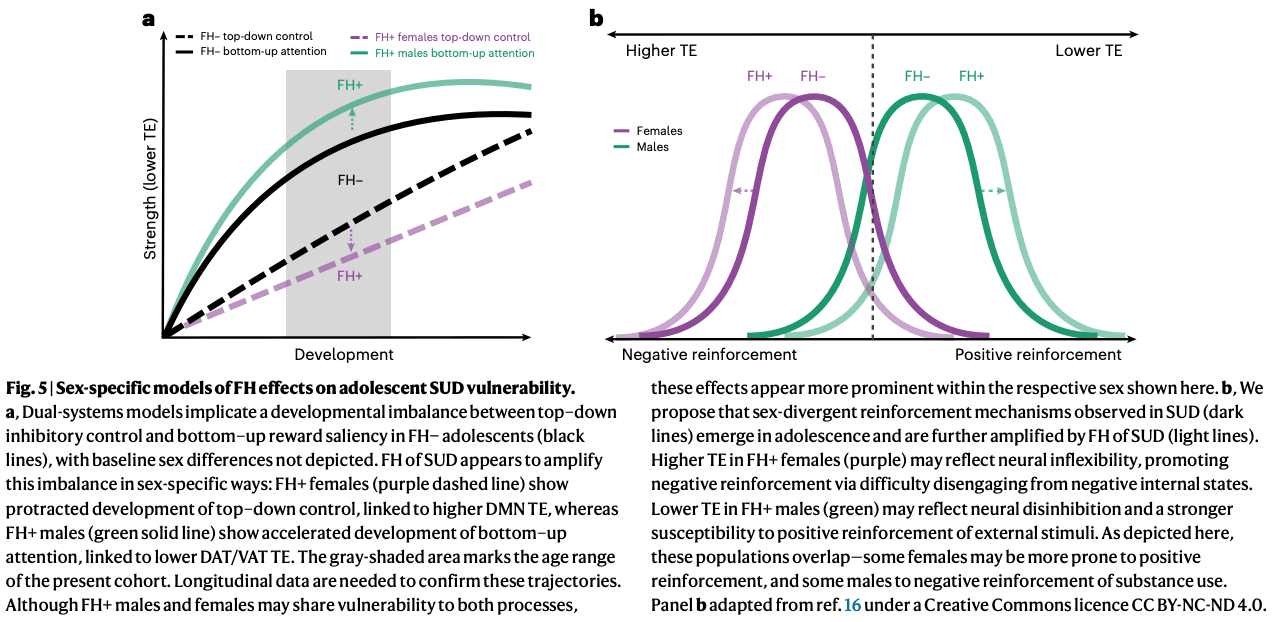
Fig 5

Second, sex-specificity in substance reinforcement (that is, stronger positive and negative reinforcement in males and females, respectively) has been thought to emerge in late adolescence or young adulthood. Our findings suggest that this divergence is already evident by ages 9–11 years and is amplified by FH (Fig. 5b). Greater DMN TE in FH+ females may explain heightened vulnerability to an internalizing pathway to SUD via negative reinforcement, whereas lower TE in attentional networks may bias FH+ males toward an externalizing pathway via positive reinforcement. Unexpectedly, in females, global and DMN TE correlated with externalizing rather than internalizing symptoms (Supplementary Section 12.2), a pattern that probably reflects developmental stage, as internalizing symptoms typically emerge in girls by mid-adolescence. Thus, greater TE in females may index a latent neural predisposition to both internalizing disorders and SUD, a vulnerability that may become more apparent as the cohort matures.

Taken together, our findings suggest that familial risk manifests as a dual-systems imbalance in both sexes, through opposite mechanisms that foreshadow adult reinforcement pathways and may widen the gap between sexes. Such sex-divergent effects—in which the same phenotype maps onto opposite neural manifestations—are well documented in SUD and SUD risk. For example, externalizing problems have been linked to DMN–FPN hyperconnectivity in males but DMN-affective hypoconnectivity in females, and greater prefrontal activity predicts lower stress reactivity in men but higher in women. Additionally, the networks most implicated here (that is, DAT, VAT and DMN) are also those in which baseline sex differences have been most consistently reported.

Specific mechanisms underlying this sex difference are not yet fully understood, but may include hormonal modulation of dopaminergic and fronto-striatal circuits, genetic and epigenetic regulation of reward pathways, and sex-specific neurodevelopmental responses to stressors and sociocultural factors. The historical neglect of women and people assigned female at birth, and the failure to account for sex as a moderator, may partly explain the mixed or null findings often reported in the familial risk literature. Without modeling the interaction between sex and FH, opposing effects in males and females cancel out. We urge future work to treat sex and gender as moderators of familial risk to uncover these hidden mechanisms and to advance precision prevention and intervention strategies tailored to at-risk youth.

Cortical functional dynamics as early markers of SUD vulnerability

Most alterations linked to FH of SUD were cortical, with the exception of the cerebellum and amygdala. This contrasts with previous work that emphasized subcortical dopaminergic systems in SUD risk. A meta-analysis has identified striatal differences as the most consistent marker of vulnerability, but largely in older adolescents who had already initiated use. Subcortical alterations may therefore emerge later in development or following chronic exposure. Indeed, addiction is characterized by both cortical and subcortical pathologies, whereas occasional use is marked by cortical dysfunction alone. Together, these findings suggest familial SUD risk manifests first in cortical networks, with subcortical abnormalities emerging later in adolescence or after exposure.

Structural findings in FH+ youth have been inconsistent. We previously reported higher TE in subcortical–frontoparietal transitions in young adults with heavy alcohol use that mapped to structural abnormalities. By contrast, here we identify functional cortical alterations in substance-naïve FH+ youth, robust across both group-average and individual SCs (Supplementary Fig. 16). Although some studies report structural connectivity alterations in FH+ adolescents, others find no differences in white-matter integrity. Our findings align with the latter, and suggest that functional cortical abnormalities precede substance initiation, with cortical and subcortical structural pathologies more likely accumulating after chronic use.

Limitations and future directions

Several limitations should be noted. The age range of our cohort coincides with a period of major neurodevelopmental change, which varies by sex and by interactions between FH and sex. The young age of the cohort also limited pubertal-stage diversity, constraining insights into how FH, sex and puberty interact. Thus, our findings should be validated and extended across the full developmental window. Notably, we partially replicated our results in the NCANDA dataset among individuals aged 12–16 years. The reported effect sizes fall in ranges traditionally considered small. However, small effects in large population-based samples are often reliable and reproducible. Moreover, effect size may be underestimated here by the exclusion of participants with excessive head motion, a heritable trait linked to impulsivity and future alcohol use.

The majority of FH+ participants had relatives with alcohol use problems, making our findings more representative of FH of AUD. Whether cross-substance effects generalize remains unclear. In addition, the present work does not disentangle whether findings in FH+ children reflect genetic predisposition, adverse childhood experiences associated with having a family member with SUD, prenatal substance exposure, or their combination. Future work should aim to separate these influences.Importantly, interpretation of sex differences is limited by a reliance on a binarized variable of sex assigned at birth and by not accounting for gender identity due to limited gender diversity in the cohort. Sex and gender are not binary, but are complex, multidimensional constructs with distinct neural manifestations, and ‘male’ and ‘female’ features exist as a mosaic in all brains. Although biological sex is a practical biomarker that revealed dimorphic traits in relation to FH of SUD, these differences may partly reflect variables covarying with sex rather than true dimorphisms. Thus, sex is an informative but imperfect proxy. Future research should test whether these traits vary across diverse sex and gender identities and examine how sex, gender and sexual orientation intersect with SUD risk, particularly given elevated rates among LGBTQ+ youth.

Conclusion

Our study reveals sex-specific effects of FH of SUD, with distinct network alterations in male and female youth: FH+ males exhibited lower TE in attentional networks, whereas FH+ females showed heightened TE in the DMN. This pattern may translate to FH+ males more readily ‘stepping on the gas’ and FH+ females having greater difficulty ‘stepping on the brakes’ in substance-use trajectories. These findings suggest that mechanisms underlying SUD predisposition are shaped by sex-specific neurodevelopmental pathways that may converge on similar behavioral outcomes. Our results validate previous reports of sex-related differences in familial risk and provide novel evidence that the neural substrates of sex-divergent substance-use behaviors observed in adults emerge in adolescence. By linking these alterations to behavioral measures, future substance use and replication in an external dataset spanning a wider age range, we strengthen the generalizability of our findings. Recognizing these mechanistic differences is essential for understanding SUD onset and developing targeted, sex-informed intervention strategies.

Methods

Sample characteristics

The Adolescent Brain Cognitive Development (ABCD) Study is longitudinally tracking the brain development and health of a nationally representative sample of children aged 9–11 years (at the time of enrollment) from 21 centers across the United States (https://abcdstudy.org). All parents or legal guardians provided written informed consent before participation in the study, and children provided verbal assent. Participants and their families received financial compensation for their time. Research protocols were approved by the institutional review board of the University of California, San Diego (no. 160091), and the institutional review boards of the 21 data-collection sites.

The current study utilized neuroimaging data from the 2.0.1 release and non-imaging instruments from the baseline assessment updated to ABCD Data Release 5.1. Access to ABCD Study data is restricted to protect participants’ privacy. Users must create an account through the National Institute of Mental Health Data Archive and they may then complete the necessary steps to gain access. Researchers with access to the ABCD data will be able to download the data from https://nda.nih.gov/study.html?id=1368.

Exclusions

From the original ABCD cohort of N = 11,868, we excluded youth who (1) did not survive strict MRI quality control and/or exclusion criteria previously established by refs. (N = 9,506), (2) were scanned on Phillips scanners (N = 2), (3) did not meet criteria for group definitions of FH+ or FH− (‘Exclusions’ section; N = 109), (4) had missing information on maternal substance use (‘Exposure to substances’ section; N = 59), (5) were adopted (N = 9), (6) had previously used substances (‘Exposure to substances’ section; N = 54), (7) had a mismatch between reported sex assigned at birth and their sex determined by salivary samples (N = 17), (8) had missing household income information (‘Household income and parental education’ section, N = 75), (9) had missing information on parental mental health issues (‘FH of SUD and mental illness’ section, N = 79) or (10) had missing information on pubertal status (‘Pubertal status’ section, N = 14). A further N = 58 participants were excluded (after k-means clustering and TE calculations) due to outlier mean global TE values (‘Defining outlier transition energies’ section). Our final cohort had N = 1,886 participants. Supplementary Table 1 provides information on excluded participant demographics.

FH of SUD and mental illness

We used the baseline Family History Module Screener (FHAM-S), in which parents reported substance use and psychopathology among first- and second-degree biological relatives. In the FHAM-S, drug or alcohol problems may include marital, work, school, legal (for example, DUI), health, rehabilitation, heavy use or social issues.Following previous work, participants were classified as FH+ if they had ≥1 parent or ≥2 grandparents with a history of SUD; FH− if no parents or grandparents had SUD; and FH+/− if they had one grandparent with SUD. FH+/− individuals, presumed to have minimal genetic load, were excluded from categorical analyses, but included in continuous FHD analyses. FHD was computed as the sum of substance-related problems in biological parents (+1 each) and grandparents (+0.5 each), ranging from 0 (no history) to 4 (SUD in both parents and all four grandparents).

Alcohol and drug histories were reported separately. We utilized a cross-substance definition of FH+ to capture shared heritable vulnerability and brain network abnormalities across various SUDs.To account for psychiatric comorbidity, we also included a binary variable indicating parental history of mental illness other than SUD. Per FHAM-S, this includes suicide, depression, mania, antisocial personality, schizophrenia and other emotional or mental health issues. Participants met criteria if ≥1 parent had any such condition.

Exposure to substances

For childhood substance use, to isolate the effects of FH of SUD from substance use itself, we excluded youth who had initiated substance use according to parents or children themselves. Participants were excluded if they self-reported lifetime use of more than a sip of alcohol, more than a puff of a cigarette/e-cigarettes or any use of nicotine products, cannabis products, synthetic cannabinoids, cocaine, cathinones, methamphetamine, ecstasy/MDMA, ketamine, gamma-hydroxybutyrate, heroin, psilocybin, salvia, other hallucinogens, anabolic steroids, inhalants or prescription misuse of stimulants, sedatives, opioid pain relievers or over-the-counter cough/cold medicine (N = 39). Parents were also asked about their child’s substance use, including alcohol (consumed three or more drinks a day, consumed two drinks in the last 12 months) or used drugs (cocaine, marijuana, solvents, stimulants, tobacco, opioids, hallucinogens, sedatives or other). If parents endorsed any of these, children were excluded from analyses (N = 15).Given the known impact of maternal substance use during pregnancy on brain development, we included prenatal substance exposure as a binary variable in our ANCOVA models. Prenatal substance exposure was reported based on caregiver recall in the ABCD Developmental History Questionnaire. Consistent with previous work using dichotomous analyses, we considered prenatal exposure as either present or absent based on whether mothers reported maternal use of alcohol or other drugs after the pregnancy was recognized. Additional details on the ABCD protocol and a table of the breakdown of substance type by FH of SUD group are provided in Supplementary Section 2.

Household income and parental education

We included two key socioeconomic indicators: household income (HI) and parental education (PE), both critical to mental health research per NIMH guidelines and linked to substance use outcomes. In the ABCD Study, HI and PE were parent-reported via demographic questionnaires. To simplify modeling while retaining detail, we followed previous work in re-coding these variables. PE responses (originally 21 options) were collapsed into five categories: high school, high school/GED, some college, associate’s/bachelor’s and postgraduate degree. The higher value was used if both caregivers provided data; otherwise, we used the available response. HI (originally nine levels) was collapsed into three levels: (1) less than US$50,000, (2) more than US$50,000 and less than US$100,000 and (3) over US$100,000. If only one caregiver reported HI, that value was used.

Sex assigned at birth

In our analyses, we utilized a binary measure of sex assigned at birth, which we refer to as ‘sex’. We did not control for or assess gender-based differences due to limited gender diversity in this cohort at baseline. We excluded individuals whose sex assigned at birth did not match their sex as determined in a salivary sample, as this could indicate clerical errors in reporting or reflect sex- and gender-diverse individuals, for whom we did not have a large enough population in this cohort to properly assess.

Pubertal status

We used parent-reported Pubertal Development Scale (PDS) summary scores from the baseline visit, as youth tend to overestimate their development at younger ages. When parent reports were missing (N = 30), child-reported scores were used. PDS questions are sex-specific and were summarized into a five-level categorical stage: (1) pre-pubertal, (2) early pubertal, (3) mid-pubertal, (4) late pubertal and (5) post-pubertal. Due to small sample sizes in higher stages (for example, only one male in stage > 3), we collapsed stages 3, 4 and 5 into a single level, resulting in three modified stages: 1 = pre-pubertal, 2 = early pubertal, 3 = mid to post-pubertal. Females generally had more advanced pubertal stages than males, and FH+ youth of both sexes showed more advanced development than FH− youth. The modified PDS stage and its interaction with sex were included in all ANCOVA models.

Neuroimaging data

Parcellation

In our main results, we present analyses in which the rsfMRI time series and group-average SCs were parcellated using an 86-region atlas derived from FreeSurfer (FS86) combining the 68 region Desikan–Killiany (DK68) gyral atlas (34 cortical regions per hemisphere) with 16 subcortical structures (eight per hemisphere, excluding brainstem) and two cerebellar structures (one per hemisphere) to render a whole-brain anatomically defined parcellation for each participant. Each cortical region was assigned to one of seven networks of the functionally defined Yeo 7-network parcellation. Subcortical regions were assigned to a subcortical network and cerebellar regions to a cerebellar network. The rsfMRI time series and individual SCs were also extracted in the DK68 cortical atlas (no subcortical region data).

rsfMRI

We analyzed baseline rsfMRI data from the ABCD Study, using minimally processed scans further preprocessed and quality-controlled as described in refs. Philips scanner data were excluded due to known post-processing errors per ABCD recommendations. Preprocessing included removal of initial frames, alignment to T1 images via boundary-based registration (BBR), and censoring of volumes with framewise displacement >0.3 mm or DVARS >50, plus one preceding and two following volumes. Uncensored segments <5 volumes were also censored. Runs were excluded if more than 50% of volumes were censored or BBR cost exceeded 0.6.Nuisance covariates (global signal, motion parameters, ventricular and white-matter signals, and their derivatives) were regressed out using non-censored volumes. Data were bandpass-filtered (0.009 ≤ f ≤ 0.08 Hz), mapped to FreeSurfer fsaverage6 space, and smoothed using a 6-mm full-width at half-maximum kernel. We then removed censored volumes and normalized BOLD time series by mean gray-matter signal (pre-filtering). After censoring, an average of 1,158.3 ± 289.18 (mean ± s.d.) rsfMRI frames remained per scan.To account for scanner effects, scanner model was included as a covariate in all ANCOVA models. Only Siemens Prisma, Siemens Prisma Fit and GE Discovery MR750 scanners were included.

SCs

In the ABCD Study, dMRI data were collected at baseline assessment. The preprocessed dMRI data were further processed by deterministic tractography with SIFT2 global streamline weighting and regional volume normalization. The SCs were extracted in FS86 (cortical and subcortical) for 149 participants and in DK68 (cortical only) for 2,080 participants. The SC matrices are symmetric, with the diagonal (self-connections) set equal to zero. Mean global TE values using a group-average SC and individual SCs for N participants were found to be highly correlated (Pearson’s ρ = 0.998, P < 0.0001). Given this high correlation and the known relevance of subcortical regions in the SUD literature, we chose to use the group-average SC for the FS86 atlas. This choice of a group-average SC is further supported by previous NCT work and recent observations of a lack of differences in white-matter integrity between FH+ and FH− drug-naïve adolescents, suggesting that familial predisposition is manifested primarily in functional dynamics. The main results were replicated in the DK68 parcellation using individual, cortex-only SCs (Supplementary Fig. 16).

Framewise displacement

Given the concern for head motion during neuroimaging of a pediatric cohort, we controlled for participants’ tendency to move their head during rest in the scanner by calculating the average framewise displacement (FD) across all time points for each participant. We include mean FD as a covariate of no interest in all ANCOVA models.

NCT analyses

Extraction of brain states

Following ref. 84, all participants’ fMRI time series were concatenated in time, and k-means clustering was applied to identify clusters of brain activation patterns, or brain states. Pearson correlation was used as the distance metric, and clustering was repeated ten times with random initializations before choosing the solution with the best separation of data. To further assess the stability of clustering and ensure our partitions were reliable, we independently repeated this process ten times and compared the adjusted mutual information (AMI) between each of the ten resulting partitions. The partition that shared the greatest total AMI with all other partitions was selected for further analysis. In general, we found that the mutual information shared between partitions was very high (>0.99), suggesting consistent clustering across independent runs. We chose the number of clusters k via the elbow criterion, that is, by plotting the gain in explained variance across clusterings for k = 2 through k = 14 and identifying the ‘elbow’ of the plot, which was at k = 4 (Supplementary Fig. 1). In addition, k = 4 fell below 1% of variance explained by clustering, a threshold used previously for determining k. We thus chose k = 4 for its straightforward and symmetric interpretation, and replicated the main results for k = 5, as shown in Supplementary Information (Supplementary Section 10.1). For interpretability, each cluster centroid was named via one of nine a priori defined canonical resting-state networks (RSNs) plus subcortical and cerebellar networks by the cosine similarity between the centroid and binary representations of each RSN. Because the mean signal from each scan’s BOLD time series was removed during bandpass filtering, positive values in the centroid reflect activation above the mean (high-amplitude) and negative values reflect activation below the mean (low-amplitude). Individual brain-state centroids were calculated for each individual across all included time points of their rsfMRI scans.

TE calculations

To calculate the TEs we followed procedures similar to those described elsewhere, and summarize them briefly here. We employed a linear time-invariant model:where A is a representative (group average) N × N structural connectivity matrix obtained as described above using deterministic tractography from a subset of ABCD participants (‘SCs’ section). A is normalized by its maximum eigenvalue plus 1 and subtracted by the identity matrix to create a continuous system. x(t) is a vector of length N containing the regional activation at time t. B is an N × N matrix of control points, in this case, the identity matrix is used for uniform control. u(t) is the external input into the system. N is the number of regions in our parcellation, where N = 86 for our main results. We selected a time horizon of T = 1.501, which yielded the strongest inverse relationship between TE and transition probability (that is, the likelihood of a transition to occur), across the tested range (T = 0.001 to 10), consistent with previous work. To compute the minimum control energy required to drive the system from an initial brain state to a target state over T, we computed an invertible controllability Gramian for controlling network A from N nodes.Using the above methodology to define brain states (‘Extraction of brain states’ section), we calculated the regional TE for a given transition between each pair of brain states and persistence within each state (pairwise regional TE). To calculate pairwise regional TEs, we integrated u(t) over the time horizon to yield the total amount of input signals into each region necessary to complete each transition, resulting in a k × k matrix for each region (where k = 4 in our main results). We calculated the global TE (pairwise global TE), a k × k matrix, by summing all pairwise regional TEs for the transition. We calculated the TE required of a network (pairwise network TE) by summing all pairwise regional TEs for those regions assigned to a network, resulting in a k × k matrix for each network. To calculate mean global TE (1 constant), mean network TE (vector of length equal to the number of networks) and mean regional TE (vector of length equal to number of regions), we averaged across all pairwise TEs at each respective level of analysis.

Defining outlier transition energies

After calculating mean global TE values, we excluded 58 individuals from further analyses due to outlier mean global TE values. Outliers were defined as participants with mean global TE values exceeding 1.5 times the IQR above the upper quartile (75th percentile) or below the lower quartile (25th percentile). The excluded participants exhibited significantly higher mean framewise displacement compared to non-outlier participants (t = 3.14, P = 0.0017). Sample characteristics of all excluded participants are provided in Supplementary Table 1.

Statistics

We tested for FH+ versus FH− group differences at various levels of TE using two-way ANCOVA models, with sex assigned at birth and F of SUD as the primary independent variables, and their interaction (sex × FH) as the effect of interest. Covariates included age, race/ethnicity, parental education, household income, prenatal substance exposure, parental mental health, MRI scanner model, in-scanner motion (mean framewise displacement) and pubertal stage. We also examined two additional interaction terms (FH × household income and sex × puberty). Full ANCOVA results are reported in Supplementary Section 8. Effect sizes for all model terms were summarized using partial η2. Additionally, for TE measures with significant ANCOVA effects, post hoc tests were conducted using unpaired, two-sided t-tests to determine the direction of effect between subgroups: FH+ versus FH− across all participants (for FH main effects) and FH+ versus FH− within each sex separately (for sex × FH interactions). Cohen’s d was reported as the effect size for post hoc t-tests. Associations between mean global TE and FHD were further assessed using Spearman’s rank correlations. Multiple comparisons were corrected using the Benjamini–Hochberg FDR procedure (q = 0.05)..Custom scripts were developed using MATLAB R2023a and Python 3.11. MATLAB visualizations were generated using the gramm toolbox (v2.25; https://github.com/piermorel/gramm). Python visualizations were rendered using brainmontageplot (v1.4.2; https://github.com/kjamison/brainmontageplot).

Open Article as PDF

Introduction

Substance use disorder (SUD) leads to severe personal and societal problems, including instability in families and finances, poor health, and often, premature death. It remains unclear why some individuals develop SUD while others, despite substance use, do not. Theories suggest that SUD arises from an imbalance in the brain: a strong drive for reward combined with weaker impulse control. This imbalance is particularly noticeable in adolescence, when brain regions associated with reward develop faster than those for self-control. Young people with a family history of SUD (FH+) face a higher risk. They may exhibit an exaggerated version of this brain imbalance due to genetic and environmental factors, showing differences in behavior and brain function even before they start using substances.

Biological sex also plays a role in SUD vulnerability. Research shows that females are more influenced by negative reinforcement, meaning they might use substances to alleviate distress or cope with negative emotions. Males, conversely, are more influenced by positive reinforcement, such as the pleasurable effects of drugs. These differences may explain observed patterns: females might escalate substance use more quickly due to stronger withdrawal and craving, while males might initiate use earlier and develop SUD at higher rates. During adolescence, females more commonly follow internalizing pathways to SUD, characterized by issues like anxiety or depression, while males tend to follow externalizing pathways, such as impulsivity or aggression. Brain imaging studies support these behavioral patterns, showing that males exhibit greater reward-related impulsivity and females show heightened negative emotionality. Early evidence suggests that a family history of SUD might amplify these sex differences in responses to reward and stress.

Brain imaging studies of young people with a family history of SUD reveal changes in brain regions vital for reward and emotion, including the prefrontal cortex and amygdala. These alterations are similar to those seen in adults with SUD, which were previously thought to be solely a consequence of long-term substance use. These similarities encompass functional brain activity, dopamine signaling, and the structure of white and gray matter. This evidence suggests that some brain characteristics associated with SUD may reflect a predisposition present before substance use begins.

However, these brain alterations in individuals with a family history of SUD or actual SUD are not confined to isolated areas; they likely reflect changes in large-scale brain networks. These networks undergo significant reorganization during development to support cognitive functions such as reward processing and impulse control. Disruptions in the activity and connectivity of these networks have been identified in young people who later develop SUD and in those with a family history of SUD, particularly in networks like the default mode network (DMN), frontoparietal network (FPN), and salience/ventral attention network (VAT), all implicated in SUD. While biological sex influences how SUD manifests in these networks, there is limited research on the interaction between family history and sex. Previous studies have been limited by factors such as older adolescents who had already used substances.

Functional brain networks allow for flexible shifts between internally focused thoughts and externally oriented attention. The dynamics of these shifts vary by sex; females generally show less overall flexibility. SUD also alters these dynamics, leading to less time spent in internal states, more in external ones, and fewer overall transitions. Young adults with a family history of SUD, particularly males, show reduced flexibility in how visual, DMN, and attention networks reorganize during transitions between tasks and rest. This suggests that a family history influences the brain's ability to change states, and this ability is likely modulated by sex. Network control theory (NCT) provides a framework to understand these individual differences in brain dynamics by quantifying "transition energy" (TE), which is the effort needed for the brain to switch between states. While previous research has linked changes in TE to various aspects of substance use and psychopathology, the relationship between a family history of SUD and TE in adolescents has not been thoroughly assessed, especially considering sex differences. This study aimed to address this gap by applying NCT to brain imaging data from young people who had not used substances, examining sex-specific differences in TE between recurring brain states in those with and without a family history of SUD. Understanding these early brain dynamics can help clarify the biological basis of SUD risk and inform prevention and intervention strategies for vulnerable populations.

Results

Sample Characteristics

The study examined transition energies in youth with (FH+) and without (FH-) a family history of SUD. Data came from a large sample of 1,886 substance-naïve youth, averaging about 10 years old, with slightly more females than males. Participants were categorized as FH+ if they had at least one parent or two grandparents with a history of SUD, and FH- if they had no such family history. A measure of "family history density" (FHD) was used for analyses that included individuals with a single grandparent with SUD (FH+/-). While FH+ and FH- groups were similar in sex, age, and MRI scanner distribution, FH+ individuals generally came from households with lower incomes, showed greater racial/ethnic diversity, had parents with less education, reported higher rates of prenatal substance exposure, had parents with mental health issues, and were at more advanced pubertal stages.

NCT Analysis

Researchers applied a method called k-means clustering to resting-state fMRI data, dividing the brain into 86 regions to identify four repeated patterns of brain activity, referred to as "brain states." For each participant, these brain states were identified. Network Control Theory (NCT) was then used to calculate "transition energy" (TE), representing the effort needed for the brain to switch between states. TE was calculated for the entire brain (global), specific brain networks, and individual brain regions, using a group-average map of structural brain connections. Both the energy for specific pairs of state transitions (pairwise TE) and the average energy across all possible transitions (mean TE) were measured. It is important to note that these four brain states are distinct from the nine larger brain networks used for TE calculations. Statistical analyses, specifically two-way ANCOVAs, investigated how family history of SUD, sex, and their interaction influenced TE at global, network, and regional levels. The models included various control factors such as age, race/ethnicity, household income, parental education, prenatal substance exposure, parental mental health, MRI scanner model, head motion during scans, and puberty status. Further tests clarified the direction of any significant findings, and family history density (FHD) was also correlated with TE values to confirm results. Adjustments were made for multiple comparisons to ensure reliable findings.

Brain State Identification

The study identified four optimal brain states, which consisted of two pairs of anticorrelated activity patterns. One pair was characterized by high and low activity in the default mode network (DMN), and the other by high and low activity in the visual network (VIS). These findings align with previous research.

Global TE

The study first examined the overall impact of family history of SUD and its interaction with sex on the brain's total energy for transitions (global TE). Family history alone did not have a significant overall effect. However, there was a notable interaction between sex and family history. Females with a family history of SUD (FH+ females) showed higher average global TE than females without a family history (FH- females). In contrast, FH+ males exhibited lower average global TE than FH- males. This opposing pattern contributed to the lack of an overall main effect for family history alone. Biological sex, independently, had a significant effect on global TE, with females showing higher average global TE compared to males. Among all groups, FH+ females displayed the highest global TE, followed by FH- females, then FH- males, and finally FH+ males. Parental history of other mental health issues also significantly influenced global TE, with higher TE in youth whose parents had such a history. Other influencing factors included the MRI scanner model and the interaction between sex and puberty stage. Analyzing specific pairwise global TE, the interaction between sex and family history was most prominent during transitions to and within the visual meta-state. This interaction was primarily driven by FH+ females showing greater pairwise global TE during these transitions compared to FH- females. In general, FH+ females had higher TE for all pairwise transitions, while FH+ males had lower TE compared to their counterparts without a family history.

Network TE

The study then investigated which specific brain networks contributed to the observed global TE effects. While family history of SUD did not show a significant main effect on the average TE of any single network, significant interactions between family history and sex were found in the Default Mode Network (DMN), Dorsal Attention Network (DAT), and Ventral Attention Network (VAT). Within the DMN, the interaction showed that FH+ females had higher average TE compared to FH- females, but no significant difference was observed in males. This pattern suggests a positive association between family history and DMN TE in females. Conversely, in the DAT and VAT networks, FH+ males displayed significantly lower average TE compared to FH- males, while females showed no significant differences in these networks. This indicates a negative association between family history and DAT/VAT TE in males. Further analysis of specific state transitions within networks reinforced these findings. FH+ females showed greater DMN TE across most transitions, particularly to the visual and DMN- states, with no similar differences observed in males. FH+ males, in contrast, had lower DAT TE for almost all transitions and lower VAT TE, especially for transitions to the DMN meta-state, with no similar differences found in females.

Regional TE

The study identified specific brain regions contributing to the observed family history by sex differences in global and network TE. Across both sexes, a family history of SUD was linked to significantly higher average TE in several regions, including the paracentral lobule, superior temporal gyrus, and amygdala. These regions, part of the DMN, somatomotor (SOM), and subcortical (SUB) networks, also showed positive correlations with family history density. The interaction between family history of SUD and sex also significantly affected regional TE. FH+ females showed higher average TE in areas such as the pars orbitalis, isthmus cingulate, and cerebellum. Conversely, FH+ males exhibited lower average TE in the superior parietal lobule and supramarginal gyrus. The regions with lower TE in males belong to the Dorsal Attention (DAT) and Ventral Attention (VAT) networks, while those with higher TE in females are part of the DMN and cerebellar (CER) networks. Correlations with family history density mirrored these sex-specific findings.

Robustness Analyses

To ensure the reliability of the findings, the study conducted several validation checks. This included re-analyzing the data with a different number of brain states, using individual brain connection maps, and testing the main findings in an independent group of participants from another study (NCANDA). The researchers also re-ran analyses by looking at data from a single large study site, by different MRI scanner types, and by income levels. The core results remained largely consistent across these different analyses. The independent NCANDA dataset showed similar trends, supporting the generalizability of the findings to other populations. While some results varied slightly by MRI scanner type or income level, indicating potential influences from demographic and socioeconomic factors, the overall findings proved robust. The study also explored associations between TE and behavioral and psychological risk factors for SUD. These relationships were often specific to sex. Females showed modest positive correlations between TE and certain behavioral problems, while males exhibited modest negative correlations with impulsivity-related traits. For example, in females, higher DMN TE was linked to rule-breaking behavior and social problems. In males, lower DAT and VAT TE values showed modest negative associations with impulsivity, fun-seeking, and goal-driven behavior. These results suggest that altered brain dynamics in at-risk youth may reflect both sex-specific and general brain-behavioral vulnerabilities relevant to future SUD outcomes.

Discussion

This study used a Network Control Theory framework to model the brain as a dynamic system, examining how a family history of SUD influences brain activity in youth who have not used substances. Findings indicate that a family history of SUD manifests through both sex-independent increases in transition energy (TE) in certain brain regions and through different effects in males and females. Specifically, females with a family history showed elevated TE in the Default Mode Network (DMN), while males showed reduced TE in attentional networks. These divergent findings likely reflect sex-specific responses to genetic and environmental factors contributing to familial risk. The exact mechanisms linking TE differences at rest to SUD predisposition are still being explored. One possibility is that the energetic demand of a network or region affects its ability to flexibly control brain-state transitions. Networks requiring greater TE might have less efficient and flexible control over overall brain dynamics. In this context, the findings suggest that familial SUD reduces the DMN’s flexible control in females and increases the activity of lower-order attentional networks in males, potentially predisposing each sex to different pathways towards SUD.

Sex-independent Elevation in Regional TEs in FH+ Youth

Across both sexes, young people with a family history of SUD exhibited higher TE in regions such as the paracentral lobule, amygdala, and superior temporal areas. These regions are consistently linked to executive functions, reward responses, craving, and emotional processing in individuals with SUD and in those with a family history. The amygdala, particularly implicated in internalizing disorders, shows more pronounced alterations in females with a family history throughout development, aligning with females' greater tendency for internalizing pathways to SUD. These findings suggest that disruptions in these brain regions may represent common markers of SUD risk that run in families.

Inflexible DMN Dynamics in FH+ Females

Females with a family history of SUD showed the highest average global TE, suggesting reduced brain flexibility and a greater tendency for their brains to become "stuck" in certain states. This pattern is similar to higher global TE observed in young adults with heavy drinking and might help explain the accelerated habit formation often reported in females. Elevated TE was most prominent in the DMN, a network widely implicated in SUD risk and family history of SUD. Greater DMN TE may contribute to SUD vulnerability by promoting a tendency to remain in internally focused states, disrupting transitions between rest and tasks, and weakening top-down control over lower-order brain systems. The DMN, most active during rest and involved in self-reflection, is a "task-negative" network. Females with a family history showed greater DMN TE for transitions to visual and negative DMN states, suggesting that once they are in a negative internal state (like stress or craving), it might be harder for them to disengage. This is supported by correlations between global and DMN TE and physical symptoms reflecting psychological distress, indicating heightened sensitivity to negative internal states. The DMN also plays a role in shifting between rest and tasks, a process known to be disrupted in youth with a family history of SUD. Elevated DMN TE in these females may therefore indicate reduced flexibility in shifting between internal and external states, weakening impulse control, increasing vulnerability to rumination and stress, and biasing behavior towards negative reinforcement. As a high-level network, the DMN is thought to regulate attention and sensory systems. Elevated DMN TE during transitions to visual states might signal inefficient top-down control. This aligns with evidence that poor DMN modulation in youth with a family history predicts impaired inhibition and poorer goal-directed behavior. Such inefficiency may explain the observed correlations between DMN TE and rule-breaking behavior in females. Regionally, higher TE was seen in the pars orbitalis, isthmus cingulate, and cerebellum, regions implicated in inhibitory deficits in youth with a family history of SUD. These findings suggest that elevated TE in these regions likely represents early changes in the brain's efficiency for inhibitory control, appearing before substance use and contributing to vulnerability.

Disinhibited Attentional Dynamics in FH+ Males

In males, a family history of SUD showed the opposite pattern, with lower global TE suggesting an overall disinhibition of brain dynamics. The most significant TE differences in males with a family history were found in attentional networks: the Dorsal Attention Network (DAT), which supports goal-directed attention, and the Ventral Attention Network (VAT), which helps reorient attention to important stimuli. These findings are consistent with research linking attention deficits to higher SUD risk in youth and abnormal activity in attention networks in individuals with SUD. Reduced TE in attentional networks may promote disinhibition by lowering the threshold for responding to cues and for attention driven by rewards. These changes suggest heightened sensitivity to external stimuli, potentially leading to greater responsiveness to drug-related cues and reward-focused attention. Thus, reduced energetic demands in attentional networks before substance exposure may predispose males with a family history to more readily engage with the rewarding effects of substances once exposed. This interpretation is supported by observed negative correlations between DAT/VAT TE and behavioral measures such as positive urgency and fun-seeking. Regionally, males with a family history exhibited lower TE in the superior parietal lobules and supramarginal gyri, areas implicated in drug cue reactivity in SUD. The parietal cortex, which supports goal-directed attention, often shows sex differences in SUD studies. Reduced TE in these regions in males with a family history appears to reflect overactive reward processing and attentional disinhibition.

Sex-divergent Neural Pathways of Familial SUD Risk

The results suggest that males with a family history of SUD exhibit stronger reward sensitivity driven by low-energy attentional dynamics, while females with a family history show high-energy DMN dynamics that may impair impulse control. These findings align with previous reports that females' brain dynamics are more "sticky," with fewer state changes and slower impulse inhibition, whereas males show greater dynamic fluidity. This study builds upon two existing models of SUD risk: the dual-systems theory of adolescent vulnerability and sex-divergent substance reinforcement. First, the dual-systems theory often describes SUD risk as an imbalance between strong bottom-up reward drive and weak top-down control, usually without considering sex differences. This study's data suggest that males and females with a family history map onto different aspects of this model: higher DMN TE may hinder the DMN’s ability to control impulses in females, while lower TE in DAT/VAT may enhance reward sensitivity in males. Conceptually, females with a family history may struggle to "hit the brakes" (higher DMN TE), while males may more readily "hit the gas" (lower DAT TE), both potentially speeding up SUD progression. This aligns with clinical evidence that males often start using substances earlier, while females progress more rapidly to losing control once they start. Second, sex-specific substance reinforcement (males being more driven by positive reinforcement, females by negative) has been thought to emerge later in adolescence or young adulthood. This study's findings suggest this divergence is already apparent in 9–11-year-olds and is amplified by family history. Greater DMN TE in females with a family history may explain their increased vulnerability to an internalizing pathway to SUD through negative reinforcement. In contrast, lower TE in attentional networks may bias males with a family history towards an externalizing pathway through positive reinforcement. Overall, the findings suggest that familial risk manifests as a dual-systems imbalance in both sexes, but through opposite mechanisms that foreshadow adult reinforcement patterns and may widen sex differences.

Cortical Functional Dynamics as Early Markers of SUD Vulnerability

Most of the brain alterations linked to a family history of SUD were found in cortical networks, with exceptions in the cerebellum and amygdala. This contrasts with earlier research that often emphasized subcortical dopamine systems in SUD risk, particularly in older adolescents who had already begun substance use. Subcortical changes may therefore emerge later in development or after chronic exposure. Addiction involves both cortical and subcortical pathologies, whereas occasional substance use may be marked more by cortical dysfunction alone. These findings suggest that familial SUD risk first appears in cortical networks, with subcortical abnormalities developing later in adolescence or after exposure. Findings on structural brain connections in youth with a family history have been inconsistent. This study identified functional cortical alterations in substance-naïve youth with a family history, which were consistent across different analyses of structural connections. While some studies report structural changes in adolescents with a family history, others do not find differences in white-matter integrity. This study’s findings align with the latter, suggesting that functional cortical abnormalities precede substance initiation, with structural brain pathologies more likely accumulating after chronic use.

Limitations and Future Directions

Several limitations should be considered. The study's age range coincides with a period of significant brain development, which varies by sex and is influenced by interactions between family history and sex. The young age of the participants also limited the diversity of puberty stages, restricting insights into how family history, sex, and puberty interact. Therefore, these findings should be further validated across the full developmental spectrum. While the reported effects are considered small, they are often reliable and reproducible in large population-based samples. The study also primarily focused on a family history of alcohol use problems, making it unclear if these cross-substance effects generalize. Furthermore, the study does not differentiate whether findings in children with a family history reflect genetic predisposition, adverse childhood experiences related to having a family member with SUD, prenatal substance exposure, or a combination of these factors. Future research should aim to separate these influences. It is important to note that the interpretation of sex differences is limited by using a binary measure of sex assigned at birth and not accounting for gender identity due to limited gender diversity in this cohort. Biological sex is a practical marker that revealed distinct traits related to family history of SUD, but these differences may partly reflect variables that co-vary with sex rather than pure biological differences. Future research should explore how these traits vary across diverse sex and gender identities and how sex, gender, and sexual orientation intersect with SUD risk.

Conclusion

This study reveals sex-specific effects of a family history of SUD, showing distinct brain network alterations in males and females. Males with a family history exhibited lower transition energy (TE) in attentional networks, while females showed heightened TE in the Default Mode Network (DMN). This pattern suggests that males with a family history might be more prone to "accelerate" towards substance use, while females might have greater difficulty "braking" in their substance-use trajectories. These findings indicate that the mechanisms underlying SUD predisposition are shaped by sex-specific brain development pathways, even if they ultimately lead to similar behavioral outcomes. The results validate previous reports of sex-related differences in familial risk and provide new evidence that the brain changes linked to sex-divergent substance-use behaviors observed in adults emerge during adolescence. By connecting these brain alterations to behavioral measures and confirming findings in another dataset, the generalizability of these results is strengthened. Recognizing these mechanistic differences is crucial for understanding how SUD begins and for developing targeted, sex-informed prevention and intervention strategies.

Methods

Sample Characteristics

The study utilized data from the Adolescent Brain Cognitive Development (ABCD) Study, initially comprising over 11,000 participants. To ensure data quality and specificity, many individuals were excluded based on stringent criteria. Exclusions included participants with poor MRI data quality, those scanned on specific equipment, individuals who did not meet family history group definitions, those with missing information on maternal substance use during pregnancy, adopted children, any youth who reported even minimal prior substance use (including alcohol or tobacco), those with mismatched biological sex data, and individuals with missing information on household income, parental mental health, or puberty status. An additional 58 participants with outlying global transition energy values were also excluded. The final analysis included 1,886 substance-naïve youth, approximately 10 years old.

Information regarding family history of Substance Use Disorder (SUD) and other mental illnesses was collected from parents using the Family History Module Screener (FHAM-S). Participants were classified as having a family history (FH+) if at least one parent or two grandparents had a history of SUD-related problems (e.g., legal issues, heavy use). Those without such a history were classified as FH-. A continuous measure of Family History Density (FHD) was also calculated, summing substance-related problems in biological parents and grandparents. A broad definition of SUD was used to capture shared vulnerabilities across various substance problems. Parental history of other mental health conditions, such as depression or schizophrenia, was also recorded and included in the analyses. To isolate the effects of family history from actual substance use, any participant who reported or whose parents reported any lifetime substance use was excluded. Data on prenatal substance exposure (maternal use of alcohol or other drugs during pregnancy) were collected via caregiver recall and included in the statistical models.

Two key socioeconomic indicators, household income and parental education, were obtained from parent reports and categorized into three and five levels, respectively, for analysis. The study used a binary measure of biological sex, as assigned at birth. Participants whose recorded sex did not match their biological sex as determined by genetic samples were excluded. Pubertal status was determined using parent-reported Pubertal Development Scale scores, categorized into three modified stages: pre-pubertal, early pubertal, and mid- to post-pubertal. These demographic and developmental variables were statistically controlled for in all analytical models.

Neuroimaging Data

The brain was divided into 86 specific regions for analysis of both resting-state functional MRI (rsfMRI) time series and structural connectomes (SC). This division included 68 cortical regions, 16 subcortical structures, and 2 cerebellar structures, creating a comprehensive anatomical map for each participant. Each cortical region was assigned to one of seven functionally defined brain networks, with subcortical and cerebellar regions assigned to their own respective networks.

Resting-state fMRI data, collected at baseline, underwent rigorous preprocessing and quality control. This included removing initial scans, aligning images to structural scans, and censoring or removing data affected by head motion. Nuisance signals, such as global brain activity, motion parameters, and signals from ventricles and white matter, were statistically removed. The data were then filtered and smoothed. The MRI scanner model used for each participant was included as a covariate in all statistical analyses.

Structural connectome (SC) data, which map the brain's physical connections, were derived from diffusion MRI (dMRI) scans. A group-average SC was primarily used for the main analyses, a choice supported by high correlations with individual SCs and the known relevance of subcortical regions in SUD research. This approach is also consistent with observations that functional abnormalities often precede white-matter changes in youth with a family history of SUD. To ensure robustness, the main results were also replicated using individual, cortex-only SCs. Given the concern for head motion in pediatric cohorts, the average head movement (framewise displacement) for each participant during scans was calculated and statistically controlled for in all ANCOVA models.

NCT Analyses

To identify distinct patterns of brain activity, referred to as "brain states," fMRI time series data from all participants were concatenated. K-means clustering was applied to identify four recurring brain states, chosen based on criteria that ensured optimal and stable clustering. Each cluster centroid, representing a brain state, was labeled based on its similarity to known resting-state networks. Individual brain state centroids were calculated for each participant.

Transition energy (TE) was calculated using a linear time-invariant mathematical model. This model used the group-average structural connectivity matrix to determine the minimum external input, or energy, required to steer the brain from one state to another over a specified time. This energy was calculated for each region to determine the "pairwise regional TE" for transitions between every pair of identified brain states and for remaining within a state. These regional TEs were then summed to calculate "pairwise network TE" for nine brain networks and "pairwise global TE" for the entire brain. The average of all pairwise TEs at each level (region, network, global) yielded the "mean TE." To ensure data accuracy, participants with mean global TE values identified as statistical outliers were excluded from further analyses.

Statistics

Statistical analyses were primarily conducted using two-way ANCOVA models to examine the effects of family history of SUD and sex, and their interaction, on various levels of transition energy. These models included several independent variables as covariates: age, race/ethnicity, parental education, household income, prenatal substance exposure, parental mental health issues, MRI scanner model, in-scanner motion (mean framewise displacement), and puberty status. Additional interaction terms, specifically puberty by sex and family history by income, were also included. When ANCOVA models showed significant effects, post hoc unpaired t-tests were performed to determine the direction of these effects within specific subgroups. The strength of the effects was summarized. Associations between mean global TE and family history density were further explored using Spearman’s rank correlations. To account for the large number of statistical comparisons, p-values were adjusted using the Benjamini–Hochberg false discovery rate procedure. All custom analytical scripts were developed using MATLAB and Python software.

Open Article as PDF

Understanding Substance Use Disorder Risk

Substance use disorder (SUD) can lead to serious problems for individuals and their families, including financial difficulties, poor health, and often death. It is not fully understood why some individuals develop SUD while others do not, even with similar exposure to substances. One theory, called dual-systems theory, suggests that SUD arises from an imbalance: a strong drive for rewards coupled with a less developed ability to control impulses. This imbalance is particularly noticeable during adolescence, when brain areas responsible for reward mature faster than those for impulse control. Adolescents with a family history of SUD (FH+) might have an exaggerated version of this imbalance due to both genetic and environmental factors. Studies show that FH+ youth face a greater risk for SUD and exhibit behavioral and brain differences even before they start using substances.

Biological sex, specifically sex assigned at birth, also influences a person's vulnerability to SUD. Researchers use the terms 'female' and 'male' to discuss these differences, acknowledging that sex is distinct from gender. Evidence indicates that females and males may be influenced by different types of reinforcement. Females might be more affected by negative reinforcement, such as using substances to relieve distress, while males might be more influenced by positive reinforcement, such as the direct pleasurable effects of a drug. These differences may explain why females might escalate their substance use more rapidly due to stronger withdrawal and cravings, while males might start using earlier and develop SUD at higher rates. Similar patterns are seen in adolescence, with internalizing issues (like anxiety or depression) being more common in females and externalizing issues (like impulsivity or aggression) in males. Brain imaging studies support these behavioral patterns, showing men with greater impulsivity related to reward and women with heightened negative emotional responses. Emerging evidence suggests that a family history of SUD may further amplify these baseline sex differences in how individuals respond to reward and stress, though more research is needed.

Brain imaging studies of FH+ youth reveal changes in brain areas involved in reward and emotion that are similar to those seen in adults with SUD. These changes were once thought to be only a result of long-term substance use. However, finding these alterations in young people before they use substances suggests that certain brain characteristics might represent an existing vulnerability to SUD. These alterations are not confined to isolated brain regions but likely reflect changes in large-scale brain networks. These networks undergo extensive reorganization during development to support various mental functions, including processing rewards and controlling impulses. Disruptions in the activity and connections of these networks have been found in youth who later develop SUD and in FH+ youth. These disruptions are particularly notable in networks also implicated in SUD, such as the default mode network (DMN), the frontoparietal network (FPN), and the salience/ventral attention network (VAT). Sex influences how SUD appears in these networks, but the interaction between family history and sex has not been widely studied.

Functional brain networks allow for flexible shifts between states focused internally (like daydreaming) and externally (like paying attention to a task). The way these shifts happen differs by sex, with females generally showing less overall flexibility. SUD also changes these dynamics, leading to less time spent in internal states, more in external states, and fewer transitions between them. FH+ young adults, especially males, show a reduced ability to reconfigure brain activity when shifting from a task to a resting state in visual, DMN, and attention networks. These findings suggest that a family history of SUD affects the brain's ability to shift between different activity patterns, and this ability is likely influenced by biological sex.

Network control theory (NCT) is a powerful method for understanding individual differences in brain dynamics. Unlike traditional measures of brain activation or connectivity, NCT models how activity spreads through brain connections to support these shifts between brain states. The ease of these shifts is quantified as "transition energy" (TE), which represents the mental effort required to guide the brain from one state to another. TE helps investigate vulnerability to disorders characterized by an imbalance in impulse control and reward sensitivity. Previous research has linked altered TE to alcohol use, drug abstinence, dopamine system issues, mental health problems, and impulsivity related to sex. However, the relationship between family history of SUD and TE during adolescence had not been previously explored.

Despite challenges in interpreting past research due to varied methods, small study groups, wide age ranges, prior substance exposure, and limited attention to sex, four main themes emerge: 1) SUD risk develops in adolescence from an imbalance of reward sensitivity and impulse control; 2) sex influences this risk through distinct brain and behavioral pathways; 3) FH+ adolescents show an exaggerated version of this developmental profile, likely through altered network dynamics; and 4) family history and sex interact, potentially amplifying existing sex differences. To address the gap in understanding how sex and family history jointly affect brain-state dynamics, this study used NCT on brain imaging data from youth who had never used substances. The goal was to characterize these brain dynamics before substance use and clarify the neurobiological basis of SUD risk, informing prevention and intervention strategies for vulnerable populations.

Results

A large sample of 1,886 substance-naïve youth, around 10 years old and 53% female, participated in the study. Participants were classified as FH+ if they had at least one parent or two grandparents with a history of SUD, and FH- if no parents or grandparents had such a history. The FH+ group tended to have lower household income, greater racial and ethnic diversity, lower parental education, higher rates of prenatal substance exposure, and more parental mental health issues.

The study used k-means clustering to identify four recurring patterns of brain activity, referred to as "brain states." Network Control Theory was then applied to calculate the "transition energy" (TE) required for the brain to move between these states. TE was calculated at global (whole brain), network (specific brain networks), and regional (individual brain areas) levels. These four brain states were distinct from the nine brain networks used to calculate TE values, which included networks like the default mode, visual, and attention networks.

The study first looked at global TE, representing the overall energetic landscape of the brain. While there was no significant main effect of family history alone, a significant interaction between sex and family history was observed. FH+ females tended to have higher mean global TE than FH- females, suggesting reduced overall brain flexibility. Conversely, FH+ males tended to have lower mean global TE than FH- males, suggesting increased overall brain flexibility. Overall, females exhibited higher mean global TE compared to males. Factors like parental history of mental health issues and the MRI scanner model also influenced global TE. The interaction between sex and family history was most pronounced in transitions involving the visual network, with FH+ females showing greater pairwise global TE when transitioning to or staying within visual network states compared to FH- females. All pairwise transitions generally showed higher TE in FH+ females and lower TE in FH+ males compared to their counterparts without a family history of SUD.

Next, the researchers examined TE at the network level. Similar to global TE, there was no significant main effect of family history on any network's TE. However, significant interactions between sex and family history were found in the Default Mode Network (DMN), Dorsal Attention Network (DAT), and Ventral Attention Network (VAT). Specifically, FH+ females showed higher mean TE in the DMN compared to FH- females. In contrast, FH+ males exhibited significantly lower mean TE in both the DAT and VAT compared to FH- males. These findings suggest that while females with a family history of SUD may have less flexible DMN dynamics, males with a family history of SUD may have more disinhibited attentional network dynamics.

At the regional level, some brain areas showed changes in TE regardless of sex. FH+ youth, across both sexes, had elevated TE in regions like the paracentral lobule, amygdala, and superior temporal regions. These areas are linked to executive functions, reward processing, and emotional control. The interaction between family history and sex also affected regional TE. FH+ females showed higher mean TE in the pars orbitalis, left isthmus cingulate, and right cerebellum. Conversely, FH+ males showed lower mean TE in the bilateral superior parietal lobule and bilateral supramarginal gyrus. The regions with higher TE in FH+ females are part of the DMN and cerebellar networks, while those with lower TE in FH+ males belong to the DAT and VAT networks.

To ensure the reliability of these findings, several robustness analyses were performed. The main results remained largely consistent when varying the number of identified brain states, using different methods for structural brain connections, and when tested in an external dataset of older adolescents. This consistency suggests that the findings are reliable across different populations and conditions. Behavioral and psychological risk factors for SUD were also examined. In females, mean DMN TE showed modest positive correlations with measures of rule-breaking behavior, social problems, and physical complaints. In males, mean DAT and VAT TE values showed modest negative associations with impulsivity-related traits, such as positive urgency and fun-seeking. These results indicate that altered brain dynamics in youth at risk for SUD may reflect sex-specific vulnerabilities that are relevant to future SUD outcomes.

Discussion

This study used Network Control Theory to model the brain as a dynamic system and investigate how a family history of SUD influences brain activity in youth who have not yet used substances. The findings show that a family history of SUD impacts the brain in two ways: through general increases in transition energy (TE) in certain brain regions, regardless of sex, and through distinct, opposite effects in males and females. FH+ females showed elevated TE in the Default Mode Network (DMN), while FH+ males exhibited reduced TE in attentional networks. These divergent findings likely reflect sex-specific responses to genetic and environmental factors contributing to familial risk. The precise mechanism linking these TE differences to SUD vulnerability is still unclear. One possibility is that higher TE indicates that a network requires more effort to change its activity, making it less efficient and flexible in controlling brain dynamics. In this context, the findings suggest that a family history of SUD reduces the flexible control of the DMN in females and increases the disinhibition of lower-level attentional networks in males, potentially predisposing each sex to different pathways leading to SUD.

Across both sexes, FH+ youth displayed elevated TE in the paracentral lobule, amygdala, and superior temporal regions. These brain areas are consistently linked to executive functions, reward responsiveness, cravings, and emotional processing in individuals with SUD and in FH+ youth. The amygdala, in particular, is implicated in internalizing disorders and shows more pronounced changes in FH+ females across development, which aligns with females' greater tendency towards internalizing pathways to SUD. These findings suggest that disruptions in these regions may represent common familial markers of SUD risk.

FH+ females exhibited the highest overall mean global TE, implying reduced neural flexibility and a greater tendency for the brain to become "stuck" in certain activity patterns. This pattern is similar to what has been observed in young adults with heavy alcohol use and might help explain the accelerated habit formation reported in females. Elevated TE was most prominent in the DMN, a network widely associated with SUD risk and family history of SUD. Greater DMN TE might increase SUD vulnerability by promoting persistent internal focus, disrupting shifts between rest and task activities, and weakening the DMN's ability to control other brain systems. This suggests that once FH+ females are in a negative internal state (like stress or craving), they may find it harder to disengage. Elevated DMN TE in FH+ females may also reflect reduced flexibility in shifting between internal and external states, thereby weakening impulse control, increasing vulnerability to rumination and stress, and biasing behavior towards negative reinforcement. Higher TE in specific DMN-related regions, such as the pars orbitalis, isthmus cingulate, and cerebellum, further supports the idea that these changes represent alterations in the brain's efficiency for inhibitory control that emerge before substance use.

In contrast, a family history of SUD manifests differently in males, with lower global TE suggesting overall disinhibition of brain dynamics. The largest TE differences in FH+ males were found in attentional networks: the Dorsal Attention Network (DAT), which supports goal-directed attention, and the Ventral Attention Network (VAT), which helps reorient attention to important stimuli. Lower energetic demands in these attentional networks may promote disinhibition by lowering the threshold for responding to cues and for reward-driven attention. These alterations suggest a heightened sensitivity to external stimuli, potentially leading to greater responsiveness to drug-related cues and an increased focus on rewards. Thus, reduced energetic demands in attentional networks before substance exposure may predispose FH+ males to more readily attend to the rewarding effects of substances once they are exposed. Regionally, FH+ males showed lower TE in the superior parietal lobules and supramarginal gyri, areas implicated in drug cue reactivity in SUD. These regional reductions in TE in FH+ males appear to reflect overly active processing of reward signals and disinhibited attention.

These results suggest that FH+ males show stronger reward-seeking tendencies driven by low-cost attentional dynamics, while FH+ females exhibit high-cost DMN dynamics that could impair impulse control. These findings align with previous observations that females exhibit "stickier" brain dynamics with fewer state changes, while males show greater dynamic fluidity. This study builds on existing models of SUD risk. Firstly, dual-systems theory suggests SUD risk comes from an imbalance between strong bottom-up reward processing and weak top-down control. This study suggests that FH+ males and females map onto distinct parts of this model: higher DMN TE may hinder impulse control in FH+ females, while lower DAT/VAT TE may amplify reward sensitivity in FH+ males. In an analogy, FH+ females might be less able to "step on the brakes," while FH+ males might more readily "step on the gas," both of which could accelerate progression to SUD. This mirrors clinical evidence that males often start using substances earlier, while females progress more rapidly to losing control once they begin. Secondly, the finding that sex-specific substance reinforcement (positive reinforcement in males, negative in females) is evident by ages 9-11 years suggests this divergence emerges earlier than previously thought and is amplified by family history. Greater DMN TE in FH+ females may explain their vulnerability to internalizing pathways to SUD via negative reinforcement, while lower TE in attentional networks may bias FH+ males toward externalizing pathways via positive reinforcement. Recognizing these mechanistic differences is crucial for understanding SUD onset and developing targeted, sex-informed intervention strategies.

Most of the brain changes linked to a family history of SUD were found in the cortex, with the exception of the cerebellum and amygdala. This contrasts with earlier research that often emphasized subcortical brain systems in SUD risk. This suggests that familial SUD risk first appears as changes in cortical networks, with subcortical abnormalities possibly developing later in adolescence or after substance exposure. This study's findings indicate that functional cortical abnormalities precede the initiation of substance use, while structural brain changes in the cortex and subcortex are more likely to accumulate after chronic use.

This study has several limitations. The young age range of the participants, a period of significant brain development, means the findings should be confirmed and extended across a wider developmental span. While the reported effect sizes were small, they are often considered reliable in large population-based studies. The study primarily focused on alcohol use problems in family members, so the findings may be more representative of a family history of alcohol use disorder. It is also challenging to separate whether the findings in FH+ children reflect genetic predisposition, adverse childhood experiences associated with having a family member with SUD, prenatal substance exposure, or a combination of these factors. Furthermore, the reliance on a binary measure of sex assigned at birth limits the interpretation of sex differences and does not account for gender identity. Despite these limitations, the study's findings strengthen the understanding of sex-related differences in familial risk and provide new evidence that the brain changes underlying sex-divergent substance-use behaviors seen in adults emerge during adolescence.

Methods

The Adolescent Brain Cognitive Development (ABCD) Study, a national study tracking brain development and health in children aged 9-11, provided the neuroimaging and non-imaging data for this research. All participants provided informed consent, and research protocols were approved by relevant institutional review boards.

From the larger ABCD cohort, some youth were excluded from this study. Reasons for exclusion included poor MRI data quality, not meeting the specific criteria for family history (FH+ or FH-), prior substance use, missing information on key variables (like maternal substance use, household income, parental mental health, or pubertal status), being adopted, or having a mismatch between reported sex and biological sex. The final group included 1,886 participants.

Family history of SUD and mental illness was determined from parent reports. Participants were classified as FH+ if they had at least one parent or two grandparents with a history of SUD, and FH- if no parents or grandparents had SUD. A continuous measure, Family History Density (FHD), was also calculated based on the number of affected relatives. The study used a broad definition of FH+ to include various SUDs. Parental history of other mental illnesses was also considered. To isolate the effects of family history from substance use itself, youth who had ever used substances (based on self-report or parent report) were excluded. Prenatal substance exposure was included as a variable in the analyses. Key socioeconomic indicators like household income and parental education were also collected from parent reports and used as controlling factors in the analysis.

Sex assigned at birth was used as a binary measure. Participants were excluded if their reported sex did not match biological markers. The study acknowledged the limitations of this binary approach and the need for future research to include diverse gender identities. Pubertal status was assessed using parent-reported scores and was included as a controlling factor.

Neuroimaging data included resting-state functional MRI (rsfMRI) and diffusion MRI (dMRI). Brain activity was organized into 86 regions, with each region assigned to one of seven functional networks, plus subcortical and cerebellar networks. rsfMRI data underwent extensive preprocessing to remove noise and artifacts, ensuring high-quality data for analysis. The average amount of head motion during scans was also accounted for in the analyses. Structural brain connections (SCs) were derived from dMRI data. For the main results, a group-average SC was used, which has been shown to be effective and is supported by findings that functional brain changes often precede structural changes in FH+ youth.

Network Control Theory (NCT) analyses were performed by first using k-means clustering to identify four recurring brain states, which are distinct patterns of brain activation. The Transition Energy (TE) was then calculated. TE represents the minimum effort required to drive the brain from one state to another. This was calculated for individual brain regions, specific networks, and the entire brain (global TE). Participants with extreme outlier TE values were excluded from the analysis. Statistical analyses primarily used two-way ANCOVA models to examine the effects of family history of SUD, sex assigned at birth, and their interaction on TE values, while controlling for various demographic and behavioral factors. Post hoc tests (t-tests) and Spearman correlations were used to further investigate significant findings, and a method called Benjamini–Hochberg FDR was applied to correct for multiple comparisons, ensuring the reliability of the results.

Open Article as PDF

Summary

Substance use disorder (SUD) has serious effects, causing problems in families, finances, and health, often leading to death. Researchers do not fully understand why some people develop SUD while many others who use substances do not. One idea, called dual-systems theory, suggests that SUD happens when the brain's reward system is too strong, and its control system is not strong enough. This imbalance is often most noticeable during teenage years. Young people with a family history of SUD (FH+) might have this imbalance even more, due to genes and their surroundings. They face a higher risk for SUD and show different brain and behavior patterns even before using substances.

Biological sex also plays a role in SUD risk. Studies show that females are more affected by negative feelings, like easing distress, while males are more influenced by positive rewards, like the pleasurable effects of a drug. These differences may explain why females might develop SUD faster due to increased withdrawal symptoms, and males might start using substances earlier and develop SUD more often. These patterns also appear in adolescents. Early research suggests that having a family history of SUD might make these existing sex differences in how the brain reacts to rewards and stress even stronger.

Brain Changes and Networks

Brain scans of FH+ youth show changes in areas like the prefrontal cortex, striatum, and amygdala. These changes are similar to those seen in adults with SUD, and they suggest that some brain differences linked to SUD might be present before substance use begins. These changes are not just in single brain areas but affect large brain networks that control thinking, reward processing, and self-control. Disruptions in these networks (default mode, frontoparietal, and salience/ventral attention networks) have been seen in FH+ youth and in those who later develop SUD. While sex affects how SUD shows up in these networks, there is not much research on how family history and sex interact.

These brain networks allow the brain to switch between focusing on internal thoughts and external surroundings. These switching patterns differ between sexes, with females generally showing less overall flexibility. SUD also changes these patterns, making it harder to shift between brain states. Family history appears to affect this ability to switch brain states, and sex likely plays a role. Network control theory (NCT) is a way to study these individual brain dynamics. It measures "transition energy" (TE), which is the effort needed for the brain to switch from one state to another. Higher TE suggests less efficient control. This study aimed to see how sex and family history together influence brain-state dynamics in young people who have not yet used substances.

Sample Characteristics and Study Methods

The study looked at brain imaging data from 1,886 young people (average age 10) who had not used substances. Participants were categorized based on their family history of SUD (FH+ if a parent or two grandparents had SUD, FH- if no parents or grandparents had SUD). Researchers used brain imaging to identify four recurring patterns of brain activity, called "brain states." They then used Network Control Theory (NCT) to measure the "transition energy" (TE), which is the amount of effort needed for the brain to shift between these states. This analysis helped examine how family history of SUD and biological sex influenced these brain activity changes.

Key Findings on Brain Energy

Overall, the amount of energy needed for the brain to switch between states showed a complex pattern involving both sex and family history. While family history alone did not have a clear global effect, the interaction between sex and family history was important. Specifically, FH+ females needed more overall brain energy to switch states compared to FH- females. In contrast, FH+ males needed less overall brain energy than FH- males. This suggests that the impact of family history on brain energy differs between sexes. Females in general showed higher mean global brain energy than males.

When looking at specific brain networks, family history alone did not show a clear impact on mean network energy. However, there were significant interactions between family history and sex in networks like the Default Mode Network (DMN), Dorsal Attention Network (DAT), and Ventral Attention Network (VAT). FH+ females showed higher mean DMN energy compared to FH- females, particularly when transitioning to visual states. FH+ males, on the other hand, showed lower mean DAT and VAT energy compared to FH- males, especially when transitioning to default mode states.

Specific Brain Regions Involved

The study also identified specific brain regions where family history and sex played a role. FH+ youth, regardless of sex, showed higher energy in regions such as the paracentral lobule, amygdala, and superior temporal areas. These areas are linked to executive function, reward, and emotional processing.

When considering the interaction of family history and sex, specific regional patterns emerged. FH+ females had higher energy in areas like the pars orbitalis, isthmus cingulate, and cerebellum. In contrast, FH+ males showed lower energy in regions like the superior parietal lobule and supramarginal gyrus. These regions are part of the attentional networks (DAT and VAT) and the default mode/cerebellar networks respectively, indicating different brain areas are affected in males and females.

Study Reliability

To ensure the results were trustworthy, the study repeated the analyses in several ways, including using a different number of brain states and using data from another research study (NCANDA). The main findings remained largely consistent across these different checks. This helps confirm that the observed differences in brain energy related to family history and sex are robust and reliable.

Understanding Brain Dynamics and SUD Risk

This study shows that having a family history of SUD changes how the brain works in young people who have not used substances, and these changes differ between males and females. FH+ females showed higher energy in the Default Mode Network (DMN), while FH+ males showed reduced energy in networks related to attention. These differences likely reflect how genetic and environmental factors contribute to SUD risk in each sex. The higher energy demand in a brain network might mean it has less flexible control over how the brain switches between different states. This suggests that family history of SUD could reduce flexible control in the DMN for females and lead to less controlled attention networks in males. Both could make each sex more likely to develop SUD through different pathways.

Shared and Female-Specific Patterns

Across both sexes, FH+ youth showed higher transition energy in regions like the paracentral lobule, amygdala, and superior temporal areas. These regions are important for decision-making, reward responses, and emotional processing, and disruptions here may be common signs of SUD risk within families.

Specifically, FH+ females showed the highest overall brain energy compared to other groups, suggesting their brains might be less flexible and more likely to get "stuck" in certain brain states. This inflexibility was most noticeable in the DMN, a network involved in self-reflection and internal thoughts. Higher DMN energy in FH+ females might make it harder for them to switch away from negative internal states, like stress or cravings, or to shift focus from internal thoughts to external tasks. This reduced flexibility could weaken their self-control and make them more vulnerable to stress, potentially leading to SUD through difficulties managing their feelings.

Male-Specific Patterns

In FH+ males, the pattern was different, with lower overall brain energy suggesting less inhibition or control over brain activity. The biggest differences were in attention networks, including the Dorsal Attention Network (DAT), which helps with focused attention, and the Ventral Attention Network (VAT), which helps with reacting to important external cues. These findings suggest that FH+ males might be more sensitive to external stimuli, like drug-related cues or rewards. Lower energy demands in these attention networks could mean it's easier for their brains to focus on and be drawn to the rewarding effects of substances. This might explain why FH+ males are more likely to pursue external rewards and could be predisposed to SUD if exposed to substances.

Different Pathways to SUD

The results suggest that FH+ males might be quicker to "step on the gas" (lower energy in attention networks, meaning more reward-driven attention), while FH+ females might have more difficulty "stepping on the brakes" (higher energy in the DMN, meaning less inhibitory control) when it comes to substance use. Both situations could lead to faster progression to SUD. This aligns with observations that males often start using substances earlier, while females might develop addiction more quickly once they start. These sex-specific differences in how the brain handles rewards and control appear to be present early in adolescence, amplified by family history.

The study also found that most of the brain changes linked to family history of SUD were in the brain's outer layer (cortex), rather than deeper (subcortical) areas. This suggests that changes in cortical networks might be early signs of SUD risk, appearing before any substance use begins. Subcortical issues might develop later, after consistent substance exposure.

Study Limitations and Future Research

This study had some limitations. The young age range of the participants (9-11 years) means the findings might not apply to all developmental stages, and it was harder to fully understand how puberty interacts with family history and sex. Most FH+ participants had a family history of alcohol use problems, so the findings are more specific to alcohol use disorder. It is also unclear whether the findings in FH+ children are due to genetics, difficult childhood experiences related to having family members with SUD, or prenatal substance exposure. Future research should try to separate these influences.

Finally, the study primarily used a binary definition of sex (male/female) based on biological sex assigned at birth. This does not fully capture the complexities of gender identity, which also influences SUD risk. Future studies should include more diverse gender identities to better understand these relationships. Despite these limitations, the study's findings are important for understanding how SUD develops and for creating prevention strategies tailored to the specific risks faced by males and females.

Conclusion

This study shows that family history of SUD affects the brains of young males and females differently. FH+ males showed lower brain energy in attention networks, while FH+ females showed higher brain energy in the default mode network. This might mean that FH+ males are more prone to "stepping on the gas" (more reward-driven attention), and FH+ females have more trouble "stepping on the brakes" (less inhibitory control) when it comes to substance use. These findings suggest that the reasons why people are more likely to develop SUD are shaped by different brain development pathways for each sex. Recognizing these differences is key to understanding how SUD starts and developing targeted prevention strategies for young people at risk.

Methods

This study used brain imaging data from the Adolescent Brain Cognitive Development (ABCD) Study, a large, ongoing research project tracking the health and brain development of children across the United States. Participants were 9-11 years old and had not used substances. Parental reports were used to determine family history of SUD, as well as other factors like parental mental health, prenatal substance exposure, household income, and pubertal stage. Biological sex was also recorded.

Researchers used two types of brain scans: diffusion MRI (dMRI) to understand brain connections, and resting-state functional MRI (rsfMRI) to measure brain activity while participants were at rest. These scans helped identify patterns of brain activity and measure the "transition energy" needed for the brain to switch between different states. Statistical methods were then used to examine how family history of SUD and sex, along with other factors, influenced these brain energy measures.

Open Article as PDF

Summary

Substance use disorder (SUD) causes many serious problems, like money troubles, family issues, poor health, and often, death. Scientists do not fully understand why some people develop SUD even though many people use substances. One idea is that SUD happens because people are too drawn to rewards and not good enough at stopping themselves from doing things. This problem is greatest in teenagers because the part of their brain that helps with control grows slower than the part that seeks rewards. Teenagers with a family history of SUD may have this problem even worse due to their genes and their surroundings, even before they start using substances.

A person's sex at birth also affects their risk for SUD. Females and males can be influenced differently. For example, females might be more affected by wanting to stop bad feelings, while males might be more affected by the good feelings from a drug. These differences might explain why females can get worse faster, while males might start using substances earlier and develop SUD more often. These patterns are also seen in teenagers. Brain studies also show these differences, with males showing more impulsivity when looking for rewards, and females showing more bad feelings when doing tasks. It seems that a family history of SUD might make these differences even stronger.

Brain scans of teenagers with a family history of SUD show changes in brain areas that are like those seen in adults with SUD. These changes were once thought to happen only after long-term substance use. These changes affect how the brain works, how brain signals are sent, and the size and thickness of brain parts. This shows that some brain differences linked to SUD might be there from the start, making someone more likely to develop SUD later.

These brain changes are not just in one small area, but likely affect large brain networks. These networks change a lot as people grow up to help with thinking skills, like how we react to rewards and how we control ourselves. Problems with these networks have been found in teenagers who later develop SUD and in those with a family history of SUD. These problems are seen in networks involved in thinking, planning, and paying attention. Sex also changes how SUD shows up in these networks, but not much research has looked at how family history and sex work together.

The way these brain networks switch between thinking about inner thoughts and outer events also differs by sex; females tend to switch less often. SUD also changes these switches. Research suggests that a family history of SUD affects how well the brain can switch between different states, and this is likely different for males and females. A special way to study brain activity, called "network control theory," looks at how much effort the brain needs to switch from one state to another. This "transition energy" can show if someone is more likely to develop disorders where reward seeking and self-control are out of balance. No studies have yet looked at how family history of SUD and sex affect this brain energy in teenagers.

Previous studies on people with a family history of SUD are hard to understand because they used different methods, had small groups, wide age ranges, and often included people who had already used substances. Also, they did not pay enough attention to sex differences. Still, four main ideas stand out: 1) The risk for SUD starts in teenage years from a brain imbalance; 2) Sex changes this risk in different brain and behavior ways; 3) Teenagers with a family history of SUD show an early, stronger version of these brain development patterns; and 4) Family history and sex work together, making existing sex differences even stronger. But no study has directly checked how sex and family history together affect these brain activity changes. To answer this, researchers studied brain scan data from young people who had never used substances. They looked at sex-specific differences in brain energy needed to switch between brain states in those with and without a family history of SUD. The goal was to better understand what makes someone vulnerable to SUD and to help create ways to prevent and treat it.

Results

To understand how family history of SUD (FH+) and sex affect brain energy in young people, brain scan data was used from nearly 2,000 children, about 10 years old, who had never used substances. About half were female. A family history was noted if a parent or two grandparents had SUD. Children were grouped as FH+ or FH- (no family history). There were no major differences between these groups in terms of sex or age, but FH+ children often came from families with lower incomes, had more diverse backgrounds, had parents with less schooling, had more exposure to substances before birth, and had parents with mental health problems. They also tended to be further along in puberty.

Researchers identified four main patterns of brain activity, called "brain states," from the brain scans. Then, using a special method, they measured the "transition energy" needed for the brain to switch between these states. This energy tells us how much effort the brain needs to change its activity. When looking at the brain's overall energy, a family history of SUD by itself did not make a big difference. However, how sex and family history worked together was important. FH+ females tended to have higher overall brain energy than FH- females, meaning their brains needed more effort to switch states. FH+ males, on the other hand, tended to have lower overall brain energy than FH- males. This meant their brains needed less effort to switch states. Females in general had higher brain energy than males. Other factors like parents' mental health, the type of MRI scanner used, and the interaction of sex and puberty also affected brain energy.

When looking at specific brain networks, family history alone did not show big differences. But the combination of sex and family history did affect energy in certain networks. FH+ females showed higher energy in the "Default Mode Network" (DMN), a network active when the mind wanders. FH+ males showed lower energy in "Dorsal Attention Network" (DAT) and "Ventral Attention Network" (VAT), which are involved in paying attention. This means FH+ females' DMN needed more energy to switch states, while FH+ males' attention networks needed less.

At a very detailed level, looking at specific brain regions, FH+ youth of both sexes showed higher energy in areas like the amygdala (involved in emotions) and parts of the temporal lobe. However, when considering sex, FH+ females showed higher energy in regions like the frontal lobe and cerebellum, which are linked to control. FH+ males, in contrast, showed lower energy in regions of the parietal lobe, which are linked to attention.

To make sure these results were reliable, researchers checked them in several ways. They used a different number of brain states, used individual brain maps instead of an average one, and even looked at data from a different group of teenagers. Most results stayed the same, showing they are strong. Some differences were noted depending on the type of MRI scanner and family income, suggesting these factors can also play a role.

Discussion

This study looked at how a family history of SUD affects brain activity in young people who have never used substances. The findings show that having a family history of SUD causes changes in brain energy that are different for males and females. FH+ females needed more energy in their DMN network, which suggests their brains are less flexible. FH+ males, however, showed less energy in their attention networks, which might mean they have less control over their attention. These differences likely come from a mix of genes and environment.

The brain's energy demand might show how well a network can control brain state changes. High energy suggests less flexible control. So, in FH+ females, their DMN might have less flexible control, and in FH+ males, their attention networks might be too easily turned on. This could make each sex more likely to develop SUD in different ways.

Some brain regions, like the amygdala and parts of the temporal lobe, showed higher energy in FH+ youth regardless of sex. These areas are linked to thinking, rewards, cravings, and emotions, and have been connected to SUD and family history. This suggests problems in these areas might be a shared family marker for SUD risk.

FH+ females had the highest overall brain energy, meaning their brains might be less flexible and get "stuck" in certain brain states more easily. This pattern is similar to what has been seen in young adults who drink a lot and might explain why females can form habits faster. This higher energy was especially seen in the DMN, a network important for SUD risk. Higher DMN energy in FH+ females might make it harder for them to switch away from negative thoughts or feelings like stress or cravings, or make it harder to control their actions.

In FH+ males, family history showed the opposite effect, with lower overall brain energy, suggesting their brains have less control. The biggest energy differences in FH+ males were in attention networks. This lower energy might make it easier for them to be drawn to exciting new things and rewards, possibly making them more sensitive to drug-related cues. This could mean FH+ males are more likely to pay attention to the rewarding effects of substances. Regionally, FH+ males had lower energy in parts of the brain related to attention and drug cues.

The results suggest that FH+ males might be more easily "stepping on the gas" (drawn to rewards with less effort), while FH+ females might have more trouble "stepping on the brakes" (less control over their thoughts and actions). These differences fit with the idea that males often start using substances earlier, while females may progress faster once they start. These different brain changes might lead to similar SUD risks in both sexes. The study shows these sex differences are present in young children and are made stronger by family history. This understanding is key because males and females often have different reasons for using substances. More research is needed to understand how hormones, genes, and environment play a role. The study highlights that ignoring sex differences in research might hide important details about SUD risk.

Most of the brain changes found in this study were in the outer layers of the brain (cortex), rather than deeper parts. This is different from some past studies that focused on deeper brain areas related to rewards. This suggests that for people with a family history of SUD who haven't used substances yet, the first signs of risk might be in these cortical networks. Deeper brain problems might appear later in life or after someone has used substances for a while.

Some study limitations include the young age of the children, which means the findings might not apply to all ages. Also, most FH+ participants had family members with alcohol problems, so the results might be more about alcohol use. The study also couldn't tell if the findings came from genes, difficult childhood experiences, or exposure to substances before birth. Finally, the study used a simple male/female category and didn't look at gender identity, which is complex and important. Future research should look at these factors.

Conclusion

This study shows that a family history of SUD affects the brains of young males and females differently. Males with a family history showed lower energy in brain networks related to attention, while females showed higher energy in a network involved in thinking and control. This suggests that males might be more likely to "step on the gas" (be drawn to substances), and females might have more trouble "stepping on the brakes" (controlling themselves) when it comes to substance use. These findings mean that the reasons someone is likely to develop SUD are shaped by specific brain development paths for each sex. The results confirm past ideas about sex differences in family risk and show that these differences start in the teenage years. Knowing these differences is important for understanding how SUD starts and for creating prevention and treatment plans that are tailored for each sex.

Methods

This study used brain scan data from the Adolescent Brain Cognitive Development (ABCD) Study, which follows the brain development of children across the United States. Parents gave permission, and children agreed to take part. Researchers used data from nearly 1,900 children aged 9-11 who had not used substances before. Children were excluded if their brain scans were not clear, if they had already used substances, or if key information was missing.

Family history of SUD was based on parents reporting substance use problems in biological parents or grandparents. Children were grouped as having a family history (FH+) or not (FH-). Information on parents' mental health, exposure to substances before birth, family income, parental education, and puberty stage was also collected.

Brain scans (fMRI and dMRI) were used to measure brain activity and connections. Researchers divided the brain into many regions and identified typical patterns of brain activity, called "brain states." Then, using a method called Network Control Theory, they calculated the "transition energy" needed for the brain to switch between these states. This energy tells us how much effort the brain uses to change its activity patterns.

To analyze the data, researchers used statistical models that looked at how family history of SUD and sex, as well as other factors like age, race, income, and head motion during the scan, affected the brain's transition energy. This helped them find significant differences and understand the direction of these effects. Special methods were used to make sure the findings were not due to chance and to account for multiple comparisons.

Open Article as PDF

Footnotes and Citation

Cite

Schilling, L., Singleton, S. P., Tozlu, C., Hédo, M., Zhao, Q., Pohl, K. M., ... & Kuceyeski, A. (2025). Sex-specific differences in brain activity dynamics of youth with a family history of substance use disorder. Nature Mental Health, 1-19.

    Highlights