Psychological Mechanisms Mediating Effects Between Trauma and Psychotic Symptoms: The Role of Affect Regulation, Intrusive Trauma Memory, Beliefs, and Depression
Amy Hardy
Richard Emsley
Daniel Freeman
SimpleOriginal

Summary

Childhood trauma can lead to psychotic symptoms, with emotional and sexual abuse affecting hallucinations and delusions through specific psychological processes.

2016

Psychological Mechanisms Mediating Effects Between Trauma and Psychotic Symptoms: The Role of Affect Regulation, Intrusive Trauma Memory, Beliefs, and Depression

Keywords avoidance; hyperarousal; psychosis; reexperiencing; schema; victimization

Abstract

Evidence suggests a causal role for trauma in psychosis, particularly for childhood victimization. However, the establishment of underlying trauma-related mechanisms would strengthen the causal argument. In a sample of people with relapsing psychosis (n = 228), we tested hypothesized mechanisms specifically related to impaired affect regulation, intrusive trauma memory, beliefs, and depression. The majority of participants (74.1%) reported victimization trauma, and a fifth (21.5%) met symptomatic criteria for Posttraumatic Stress Disorder. We found a specific link between childhood sexual abuse and auditory hallucinations (adjusted OR = 2.21, SE = 0.74, P = .018). This relationship was mediated by posttraumatic avoidance and numbing (OR = 1.48, SE = 0.19, P = .038) and hyperarousal (OR = 1.44, SE = 0.18, P = .045), but not intrusive trauma memory, negative beliefs or depression. In contrast, childhood emotional abuse was specifically associated with delusions, both persecutory (adjusted OR = 2.21, SE = 0.68, P = .009) and referential (adjusted OR = 2.43, SE = 0.74, P = .004). The link with persecutory delusions was mediated by negative-other beliefs (OR = 1.36, SE = 0.14, P = .024), but not posttraumatic stress symptoms, negative-self beliefs, or depression. There was no evidence of mediation for referential delusions. No relationships were identified between childhood physical abuse and psychosis. The findings underline the role of cognitive-affective processes in the relationship between trauma and symptoms, and the importance of assessing and treating victimization and its psychological consequences in people with psychosis.

Introduction

There is increasing evidence suggesting that the aetiology of psychosis is to a large extent psychosocial. Putative social causes include childhood victimization trauma. While the demonstration of causal relationships can never be completely validated, there are a number of strategies that together increase their likely veracity. In the context of a supposed trauma-psychosis link, these include a clear temporal sequence between cause and consequence, the robust replication of an association, the existence of a dose-response curve, and the demonstration of plausible and theoretically-based mechanisms. The resolution of trauma-related consequences should also result in symptom reduction.

In most psychosis research, trauma accounts are obtained from individuals some time after the events occurred, and, therefore, rely on recall being not distorted. In case-control studies, trauma histories are elicited from cases after the onset of psychosis, adding to the problems of interpretation. However, the accounts of people with psychosis are reasonably reliable and case-control investigations have been corroborated by prospective cohort studies. The association between childhood victimization and psychosis appears consistently strong: in methodologically robust epidemiological surveys, prospective studies, and case-control studies, it has been replicated both in relation to diagnosed psychosis and to psychotic symptoms in nonclinical samples; it also shows a clear dose-response relationship. The ending of events has also been associated with symptom reduction in a nonclinical sample.

Evidence for specific associations between trauma and symptom type adds further support for a causal link, in that particular events may be more likely to trigger specific psychological mechanisms. Findings from general population and clinical samples suggest specific associations (with ORs of >2 in most studies) between childhood sexual abuse with voices, of childhood physical abuse and childhood neglect with paranoia, and of parental communication deviance with formal thought disorder.

However, there have been relatively few investigations of trauma-related psychological mechanisms in clinical samples. The current study aims to replicate previous research linking trauma and psychotic symptoms and then to test theory-based hypotheses about potential causal mechanisms in a clinical sample of people with relapsing psychosis. Three such mechanisms have recently been put forward as potential causal paths linking trauma to psychosis.

The first involves the ways in which people regulate affect or threat. Read et al propose exposure to childhood victimization results in neurodevelopmental changes such as hyperactivity of the hypothalamic-pituitary axis. This leaves people vulnerable to understandable but unhelpful ways of regulating stress, which may then contribute to psychosis. We respond to threat with varying degrees of sympathetic (ie, fight and flight) and parasympathetic (ie, flag and faint) nervous system activation (the “defense cascade”), depending on the nature of the event and the individual. Once aroused, avoidant or detached dissociative responses may be protective, but they can become habitual and paradoxically perpetuate perceptions of threat. The role of affect regulation in psychosis has been demonstrated in studies showing that threat-biased information processing, dissociation, and avoidance are associated with symptom severity. The current study will test the hypothesis that trauma-related affect regulation (as assessed by posttraumatic avoidance and numbing, and hyperarousal symptoms) mediates identified associations between trauma, hallucinations, and delusions.

Second, we will examine the role of intrusive memory in the link between trauma and hallucinations. Memory encoding and retrieval is disrupted by arousal and dissociative detachment during trauma, such that we are more likely to store and remember sensory-perceptual than contextual information. This results in involuntary memory intrusions and impaired intentional recall. Evidence suggests that, following trauma, people with a vulnerability to psychosis may be more susceptible to experiencing intrusions lacking in contextual information, potentially resulting in more frequent, and fragmented images. Findings indicate intrusive trauma memory is associated with hallucinations, and has been implicated in the relationship between childhood sexual abuse and hallucinations. We therefore hypothesize that intrusive trauma memory will mediate the identified association between childhood sexual abuse and hallucinations.

The final mechanism concerns the role of trauma-related beliefs in the link between trauma and paranoia. These appraisals reflect cognitive representations of the self and others, or internal working models. Trauma is associated with negative beliefs about the self and others in psychosis, and this, at least partly, has accounted for its relationship with paranoia in clinical and nonclinical samples. Therefore, we predict negative beliefs will account for the identified relationship between childhood physical abuse and paranoia. Emotion is likely to be involved in all of the proposed causal mechanisms, given its well-established role as a precursor to, component of, and consequence of psychosis and trauma. The impact of depression on identified trauma and symptom associations will therefore be investigated.

In summary, we aim to investigate the psychological mechanisms involved in associations between trauma type and specific symptoms in people with relapsing psychosis. The mechanisms considered include affect regulation, intrusive trauma memory, beliefs, and depression. We hypothesize (1) that childhood sexual abuse and auditory hallucinations, and childhood physical abuse and paranoia will be linked independently of demographic variables; (2) that intrusive trauma memory will mediate the relationship between childhood sexual abuse and hallucinations; (3) that negative self and other beliefs will mediate associations between childhood physical abuse and paranoia; and (4) that affect and affect regulation processes (posttraumatic avoidance and numbing and hyperarousal symptoms, and depression) will mediate all identified relationships between trauma and psychosis.

Method

The sample was recruited for the Psychological Prevention of Relapse in Psychosis (PRP) Trial (ISRCTN83557988), a UK multicenter randomized controlled trial of cognitive behavioral therapy and family intervention for psychosis, based in 4 NHS Trusts in London and East Anglia. The study protocol was designed a priori to address questions about psychosocial processes associated with psychosis outcomes.

Participants

The sample comprised individuals with psychosis who had experienced a recent relapse in positive symptoms, either from a previously recovered state or from a state of persisting symptoms. They were recruited from inpatient and outpatient services. The inclusion criteria were: a current diagnosis of nonaffective psychosis, age between 18 and 65 years, a second or subsequent episode starting not more than 3 months before consent, and a rating of at least 4 (moderate severity) on the delusions, hallucinations, grandiosity, or suspiciousness/persecution items of the Positive and Negative Syndrome Scale (PANSS). The exclusion criteria were: a primary diagnosis of substance misuse, organic syndrome or learning disability, residential instability, and insufficient command of English to engage in therapy.

After providing informed consent, participants completed assessments of symptoms and psychosocial processes at baseline, and at 3-, 6-, 12-, and 24-month follow-up. Trauma and posttraumatic stress data for this study were collected as part of the trial assessment battery at 3-month follow-up, and symptom and mechanism data were therefore also taken from this time-point.

Measures

The Trauma History Questionnaire.

The Trauma History Questionnaire (THQ) is a structured interview for assessment of nonvictimization and victimization exposure. Acceptable psychometrics have been established for the THQ in psychosis samples. If participants reported at least 1 event, they were asked to indicate which trauma they were currently most affected by (categorized as the “index” event). This could include discrete, episodic, or persistent events. All reported events were categorized according to trauma type by childhood, adulthood, and lifetime prevalence. Trauma type was categorized into nonvictimization (ie, illness, accidents, and natural disasters) and victimization events. Victimization trauma was categorized into sexual, physical, and emotional abuse. Sexual abuse was coded from 2 items pertaining to child abuse (under age 13 and under age 18), and the adult abuse item. Physical abuse was coded from 2 items assessing physical attack (with and without a weapon) and the bullying item, which was reviewed for reference to interpersonal violence. Emotional abuse was categorized from reports of psychological abuse in the bullying item. Finally, event descriptions for the remaining items were examined for reports of victimization and coded accordingly.

The Scales for the Assessment of Positive Symptoms.

The Scales for the Assessment of Positive Symptoms contains 35 items measuring positive symptoms of psychosis and is rated on a 6-point scale (0–5) over the past month. For this study, symptoms were defined as absent (0 and 1) or present (2–5). Auditory hallucinations were coded from the auditory hallucinations, voices commenting and voices conversing items. The persecutory and referential delusions items were used to code these symptoms.

Self-report Scale for Posttraumatic Stress Disorder.

Participants were asked to complete the Self-report Scale for Posttraumatic Stress Disorder (SRS-PTSD) in relation to any identified index event. It consists of 17 items each corresponding to a diagnostic criterion of PTSD in DSM-IV. There are 5 reexperiencing or intrusive trauma memory, 7 avoidance and emotional numbing, and 5 hyperarousal items. Each item is rated on a 3-point scale from 0 to 2, assessed over the past month. PTSD symptom criteria are met in the presence of 1 reexperiencing, 3 avoidance, and 2 hyperarousal items. Internal consistency (Cronbach’s alphas of >.87), interrater reliability (kappa = 0.98) and likelihood ratios for positive and negative test results (4.3 and 0.18, respectively) are reported.

Brief Core Schema Scale.

The Brief Core Schema Scale (BCSS) is a 24-item self-report questionnaire rated on a 5-point scale (0–4) for the assessment of core beliefs. The negative-self and negative-other scales were used for the purpose of this study. The BCSS shows good internal consistency and Cronbach’s alpha coefficients are >.78.

Beck Depression Inventory II.

The Beck Depression Inventory (BDI-II) is a self-report questionnaire comprising 21 items, each rated on a 4 point scale (0–3) providing a total score (0–63). Depression is assessed over the past fortnight.

Analysis

All analyses were conducted using Stata v13.1. For the purposes of clarity and comparison with previous results, we excluded any psychosis-related events based on hallucinations and delusional appraisals that were reported in response to the THQ event type prompts. We used summary statistics (means and SD, number and percentage) to describe the sample and display the prevalence, putative mediators, and outcomes. First we assessed bivariate associations between all trauma types and symptoms. Then, for any significant associations, we performed logistic regression to assess the total effect of exposure on outcome adjusting for age, gender, and ethnicity as potential confounders. To assess the effect of exposure on putative mediators, we performed linear regression adjusting for the same set of confounders. Only those trauma-outcome and trauma-mediator relationships which were statistically significant at the 10% level were carried forward into the mediation analysis.

The mediating role of trauma-related psychological mechanisms in any identified associations between events and symptoms was examined using the counterfactual framework as summarized in Valeri and VanderWeele and implemented with the –paramed- command in Stata. We estimate the natural direct effect (NDE), which expresses how much the outcome would change in the presence vs absence of trauma, but for each individual if the mediator was kept at the level it would be if trauma had not occurred. We assume no interaction between exposure and mediator, implying the NDE is the same as the controlled direct effect. The corresponding natural indirect effect (NIE) is defined as how much the outcome would change on average if trauma was present and the mediator changed from the level it would be in the absence of trauma to the level it would be if trauma occurred. For a binary outcome, the total effect is the product between natural direct and natural indirect effects.

To estimate these causal effects, first the effect of trauma type on mediator was estimated using linear regression. Second, the effects of trauma type and the mediator on outcome were estimated using logistic regression. Both models also adjust for baseline demographics (age, sex and ethnicity). The relevant parameters from these models are combined to estimate the NDE and NIE, with SEs obtained using the delta method. A complete case analysis is conducted for each set of trauma-mediator-outcome-covariates, with the size of each analysis sets reported. Mediators were considered to reflect a partial indirect effect if the NIE was statistically significant, and evidence of full mediation if the direct effect also became nonsignificant.

Results

Sample

The PRP sample consisted of 301 participants. Two hundred twenty-eight (76% of the total) completed the THQ and were included in the current study. From a possible 3420 events (n= 228 participants reporting on 15 event types), only 28 events (0.82%) were reported that appeared to be the consequence of hallucinatory or delusional experience. The participants who completed the trauma measures were compared with those who did not on a range of demographic and clinical variables (ie, age, length of illness, gender, ethnicity, marital status, employment, and risk). There were no significant differences between the groups on any of the variables, indicating the trauma sample was sufficiently representative (t = −0.39–1.70, P = .090–.693, χ2 = −0.49–8.44, P = .134–.740). The mean age of participants was 38.24 years (SD = 11.11). There were more male (n = 165) than female (n = 63) participants. The majority of the sample were White (n = 167), then Black African (n = 23), Black Caribbean (n = 17) and other (n = 21). Most were single (n = 167), unemployed (n = 182) and inpatients at the time of recruitment into the trial (n = 155). Diagnoses were schizophrenia (n = 195), schizo-affective disorder (n = 29), and delusional disorder (n = 4). The mean length of contact with mental health services was 10.83 years (SD = 9.06).

Trauma

The rates of trauma types reported by the sample are shown in table 1. The majority of the sample reported experiencing a lifetime trauma (86.0%), with most reporting at least 1 lifetime victimization event (74.1%) and two-thirds reporting a lifetime nonvictimization event (66.2%). The mean number of traumatic events reported was 2.92 (SD = 2.12, range 0–10). A fifth of the sample reported childhood sexual abuse or childhood physical abuse, and a third described experiencing childhood emotional abuse. Just under a fifth of the sample reported adulthood sexual abuse or adulthood emotional abuse, whereas 40% indicated experiences of adulthood physical abuse. Overall, approximately half of the sample experienced lifetime physical abuse and lifetime emotional abuse, and just under a third lifetime sexual abuse. The rates of individual traumatic events, index traumas, and symptom criteria for PTSD are shown in table 2. The most common events were bullying, road traffic accidents then physical attacks. One hundred twenty-four participants (54.4%) reported an index trauma (ie, an event they were still currently affected by), with bullying, other stressful events, and physical attacks being most frequent. Symptom criteria for PTSD were met by 49 participants (21.5%), and were most likely to be associated with bullying, physical attacks then childhood sexual abuse.
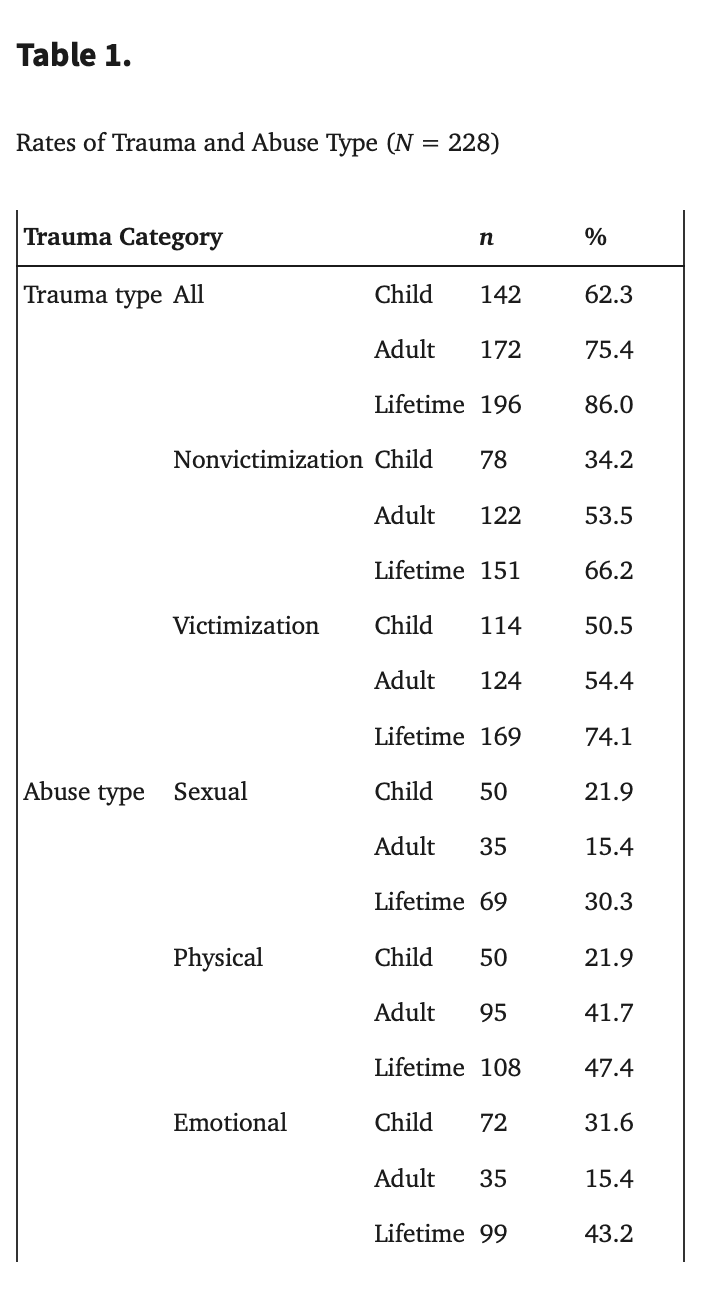
Table 1

able 2.

Traumatic Event (N = 228), Index Event (n = 143) and Posttraumatic Stress Disorder (PTSD; n = 49) Prevalence by Event Type

Event Type

Prevalence

Index

PTSD

n

%

n

%

n

%

War

7

3.1

1

1.3

0

0.0

Traffic accident

80

35.1

10

12.4

3

6.1

Natural disaster

22

9.7

0

0.0

0

0.0

Serious illness

23

10.1

3

3.7

1

2.0

Childhood sexual abuse: <age 13

26

11.6

5

6.2

2

4.1

Childhood sexual abuse: >age 12 and <age 18

30

13.4

9

11.2

6

12.2

Adulthood sexual abuse

32

14.4

9

11.2

4

8.2

Physical attack with weapon

64

28.3

12

14.9

4

8.2

Physical attack no weapon

70

31.3

14

17.4

6

12.2

Other events with actual serious injury

46

20.3

1

1.2

0

0.0

Other events with threat of injury/death

40

17.8

1

1.3

0

0.0

Witnessing serious harm or death

51

22.5

2

2.6

1

2.0

Other stressful events

55

24.3

16

19.8

3

6.1

Relative or friend killed or injured

19

8.4

6

7.4

3

6.1

Bullying

99

44.8

35

43.4

16

32.7

Trauma and Symptoms

The associations between trauma types and psychotic symptoms are shown in table 3. Consistent with our first hypothesis, there was a significant association between childhood sexual abuse and auditory hallucinations. However, our second hypothesis was not supported, as there was no association between childhood physical abuse and paranoia. In contrast, childhood emotional abuse was associated with persecutory beliefs and delusions of reference. These associations remained significant after adjusting for age, gender, and ethnicity, with OR ranging from 2.21 to 2.43 (supplementary table 1). No other significant associations between trauma type, auditory hallucinations, persecutory, and referential delusions were identified. There were also no significant effects of combined trauma types or cumulative trauma on symptoms (supplementary table 2).

Table 3.

Bivariate Associations Between Trauma Type and Symptoms (N = 228)

Auditory

Persecutory

Referential

Absent

Present

Absent

Present

Absent

Present

n

%

N

%

χ

2

P

OR (CI)

n

%

n

%

χ

2

P

OR (CI)

n

%

n

%

χ

2

P

OR (CI)

CNV

a

No

87

59

60

41

2.26

.133

1.5 (0.9–2.7)

78

53

69

47

0.97

.324

1.3 (0.8–2.3)

91

62

56

38

.378

.539

1.2 (0.7–2.1)

Yes

38

49

40

51

36

46

42

54

45

58

33

42

ANV

b

No

58

55

47

45

0.01

.929

0.8(0.6–1.7)

53

51

52

49

0.01

.957

1.0(0.6–1.7)

63

60

42

40

0.02

.899

1.0 (0.6–1.7)

Yes

67

56

53

44

61

51

59

49

73

61

47

39

CSA

c

No

105

60

70

40

6.30

.012*

2.3 (1.2–4.3)

89

51

86

50

0.01

.915

1.0 (0.6–1.9)

108

62

67

38

0.53

.466

1.3 (0.7–2.4)

Yes

20

40

30

60

25

50

25

50

28

56

22

44

ASA

d

No

107

56

84

44

0.11

.739

1.1 (0.5–2.4)

97

51

94

49

0.01

.933

1.0 (0.5–2.1)

115

60

76

40

0.03

.864

0.9 (0.4–2.0)

Yes

18

53

16

47

17

50

17

50

21

62

13

38

CPA

e

No

97

55

79

45

0.07

.800

0.9 (0.5–1.7)

91

52

85

48

0.35

.555

1.2 (0.6–2.3)

110

63

66

38

1.43

.232

1.5 (0.8–2.8)

Yes

28

57

21

43

23

47

26

53

26

53

23

47

APA

f

No

74

56

58

44

0.03

.856

1.1 (0.6–1.8)

68

52

64

48

0.09

.762

1.1 (0.6–1.8)

82

62

50

38

0.38

.540

1.2 (0.7–2.0)

Yes

51

55

42

45

46

49

47

51

54

58

39

42

CEA

g

No

87

57

67

44

0.18

.677

1.1 (0.6–2.0)

86

56

68

44

5.23

.022*

1.9 (1.1–3.5)

102

66

52

34

6.84

.009**

2.1 (1.2–3.8)

Yes

38

54

33

47

28

39

43

61

34

48

37

52

AEA

h

No

106

56

84

44

0.03

.869

1.1 (0.5–2.2)

98

52

92

48

0.41

.524

1.3 (0.6–2.6)

117

62

73

38

0.66

.417

1.4 (0.7–2.8)

Yes

19

54

16

46

16

46

19

54

19

54

16

46

Note: aChild nonvictimization.

bAdult nonvictimization.

cChild sexual abuse.

dAdult sexual abuse.

eChild physical abuse.

fAdult physical abuse.

gChild emotional abuse.

hAdult emotional abuse.

*P < .05.; **P < .01.

Trauma and Hypothesized Trauma-Related Mediators

The relationships between trauma types and trauma-related psychological mechanisms are shown in table 4. In line with our hypotheses, childhood sexual abuse was associated with posttraumatic numbing and avoidance, and hyperarousal, but had only a weak association with intrusive trauma memory (P = .107). In addition, childhood sexual abuse, childhood physical abuse, and childhood emotional abuse were associated with more severe negative-other beliefs. None of the trauma types were significantly associated with depression and negative-self beliefs. In supplementary table 3, the effects of combined trauma types on the mediators are shown. The presence of both childhood sexual abuse and childhood emotional abuse was associated with more severe negative-other beliefs and posttraumatic hyperarousal than the individual event types. The combination of childhood sexual abuse and childhood emotional abuse was not associated with more severe intrusive trauma memory or posttraumatic avoidance and numbing.

Table 4.

Means (M), Standard Deviations (SD), Adjusted Mean Difference (aMD), and Statistical Significance (P) Between Trauma Type and Mediators

Intrusive Trauma Memory

a

Posttraumatic Numbing and Avoidance

a

Posttraumatic Hyperarousal

a

Negative-Other

b

Negative-Self

c

Depression

d

M

SD

aMD (SE),

P

M

SD

aMD (SE),

P

M

SD

aMD (SE),

P

M

SD

aMD (SE),

P

M

SD

aMD (SE),

P

M

SD

aMD (SE),

P

CSA

No

4.55

3.52

1.18 (0.73), .107

6.61

4.17

2.49 (0.90), .006

4.37

3.38

1.81 (0.70), .011

7.52

7.12

2.85 (1.34), .035

5.63

5.38

1.36 (1.03), .190

19.37

12.74

2.62 (2.21), .237

Yes

5.94

3.42

9.06

4.23

6.26

3.43

10.10

8.52

6.92

6.91

22.11

13.05

CPA

No

4.70

3.63

0.97 (0.73), .187

7.24

4.46

0.16 (0.93), .861

4.72

3.61

0.79 (0.72), .276

7.53

7.15

2.53 (1.29), .051

5.61

5.56

1.48 (0.99), .137

19.64

12.98

1.86 (2.16), .392

Yes

5.53

3.21

7.30

3.90

5.30

3.08

9.86

8.40

6.93

6.24

21.02

12.30

CEA

No

4.59

3.82

0.94 (0.66), .155

7.19

4.54

0.18 (0.83), .832

4.68

3.60

0.58 (0.65), .374

7.17

7.04

3.09 (1.15), .008

5.49

5.64

1.42 (0.89), .111

19.61

12.90

1.55 (1.93), .423

Yes

5.45

2.95

7.36

3.93

5.18

3.29

10.03

8.11

6.78

5.85

20.70

12.71

Note: an = 118.

bn = 190.

cn = 194.

dn = 201.

Trauma, Symptoms, and Mechanisms

Given the relationships identified, we next tested our hypothesis that intrusive trauma memory and affect regulation processes would mediate the relationship between childhood sexual abuse and hallucinations. Mediation by negative-other beliefs was also investigated. The mediation hypothesis for childhood physical abuse was not examined, as this event type was not associated with persecutory beliefs. Similarly, mediation by negative-self beliefs and depression was not investigated, as these processes were not associated with trauma in our sample. However, we did examine whether negative-other beliefs mediated the relationships between childhood emotional abuse, persecutory beliefs and delusions of reference.

Table 5 shows the results of the mediation analysis. The total effect of childhood sexual abuse on auditory hallucinations had an OR of 2.929 (SE = 0.479, P = .025), which decomposed into a natural direct effect of 2.438 (SE = 0.465, P = .055) and a natural indirect effect of 1.201 (SE = 0.133, P = .169). The indirect effect was not statistically significant, indicating that there was no mediation through intrusive trauma memory.

Table 5.

Total, Direct, and Indirect Effects

Trauma Type

Symptom

Mediator

Total OR (SE),

P

Direct Effect OR (SE),

P

Indirect Effect OR (SE),

P

n

CSA

Auditory hallucinations

Intrusive trauma memory

2.929 (0.479), .025

2.438 (0.465), .055

1.201 (0.133), .169

118

CSA

Auditory hallucinations

Posttraumatic avoidance & numbing

3.026 (0.493), .025

2.052 (0.475), .131

1.475 (0.188), .038

118

CSA

Auditory hallucinations

Posttraumatic hyperarousal

3.027 (0.494), .025

2.104 (0.477), .119

1.439 (0.184), .048

118

CSA

Auditory hallucinations

Negative other beliefs

2.763 (0.395), .010

2.343 (0.387), .028

1.179 (0.098), .094

190

CEA

Persecutory delusions

Negative other beliefs

2.568 (0.376), .012

1.889 (0.356), .074

1.359 (0.136), .024

190

CEA

Delusions of reference

Negative other beliefs

2.303 (0.345), .016

1.950 (0.342), .051

1.181 (0.091), .069

190

The indirect effect of childhood sexual abuse on auditory hallucinations through posttraumatic avoidance and numbing (OR = 1.475, SE = 0.188, P = .038) was significant, and the direct effect was nonsignificant (OR = 2.052, P = .131) indicating mediation. The same pattern of results was observed for a significant indirect effect through posttraumatic hyperarousal (indirect effect OR = 1.439, SE = 0.184, P = .045).

There was no evidence of mediation through negative-other beliefs for the total effect of childhood sexual abuse on auditory hallucinations, or for the total effect of childhood emotional abuse on referential delusions. There was a significant indirect effect of childhood emotional abuse on persecutory delusions through negative-other beliefs (OR = 1.359, SE = 0.136, P = .024), which decomposes the total effect (OR = 2.568, P = .012) and the direct effect became nonsignificant (OR = 1.889, P = .074).

Discussion

This study is the first to demonstrate that trauma-related psychological mechanisms mediate victimization and psychotic symptoms associations in a large sample of people with relapsing psychosis. The identification of theoretically based psychological processes underlying specific associations between events and symptoms provides further support for the causal role of trauma in psychosis. Consistent with our hypothesis, childhood sexual abuse was associated with auditory hallucinations. The mediation hypotheses were partially supported, as posttraumatic avoidance, numbing, and hyperarousal (but not intrusive trauma memory or depression) accounted for this relationship. We did not find the hypothesized link between childhood physical abuse and paranoia, although persecutory and referential delusions were related to childhood emotional abuse. This suggests it may be psychological rather than physical threat in interpersonal relationships that is critical to the maintenance of paranoia in psychosis. Negative-other beliefs accounted for the relationship between childhood emotional abuse and persecutory delusions, and depression and posttraumatic affect regulation did not play a role.

As expected, we found a higher rate of trauma, particularly victimization trauma than in the general population. The rates of childhood sexual abuse and childhood emotional abuse identified are comparable to those reported in Bonoldi and colleagues’ meta-analysis, although the rate of childhood physical abuse in this study was somewhat lower. It is of note that the victimization rates we identified are lower than earlier studies of trauma prevalence in psychosis. This may be attributable to more robust assessment, a higher false negative rate or reducing the sampling bias that may occur when participants are recruited to studies solely focused on investigating trauma. Symptomatic criteria for PTSD was met in a fifth of the sample using a self-report measure, which is comparable to the rate reported (16%) in a recent study employing a gold-standard interview assessment.

Our findings are consistent with cognitive-behavioral models of psychosis that highlight the causal role of cognitive-affective processes in symptom development and maintenance. The specificity of associations found between particular trauma types and symptoms further supports this argument. While other researchers have argued childhood victimization has a nonspecific effect on psychosis, these findings relate to samples with less severe psychotic symptoms that may be less sensitive to detecting specific effects. However, investigating the associations between trauma and symptom is complex, given that people often experience multiple event and symptom types. Our results suggest a role for posttraumatic affect regulation processes in hallucinations, and negative beliefs about others in paranoia, and support theoretical models regarding the developmental impact of trauma on psychosis. Garety and Freeman argue talking therapies should target underlying causal mechanisms to improve their modest effects on psychotic symptoms. These findings indicate interventions modifying trauma-related affect regulation and beliefs may have benefit, such as coping strategy enhancement techniques, and verbal and experiential cognitive restructuring.

Contrary to our expectations, we found no evidence of mediation by intrusive trauma memory, negative-self beliefs or depression. However, the study was a stringent test of these hypotheses as our sample had relatively high rates of depression and negative beliefs. In relation to trauma memory, a significant limitation was that intrusive memories were assessed in relation to the index event; this was often not sexual abuse, and so intrusions related to this event type may have been missed. However, it is also possible that trauma memories are decontextualized in people with persistent psychosis such that intrusions are experienced as hallucinations and not reexperiencing of the event. These would be maintained by understandable, but maladaptive, affect regulation strategies such as hyperarousal, avoidance, and numbing. Promising findings have already been reported for trauma-focused exposure treatments aiming to contextualize and elaborate trauma memories in psychosis, and the impact of these interventions on psychotic symptom severity should be investigated.

Other limitations of the findings are that there was no direct assessment of neglect and psychosis-related trauma. Given the mediating role of posttraumatic stress numbing symptoms and the well-established role of dissociation in psychosis, it would have been useful to assess dissociative detachment symptoms, including depersonalization and derealisation. Another aspect of affect regulation that appears worthy of consideration in the trauma and psychosis association is affective dysregulation. Our findings suggest oscillations between arousal and numbing may drive hallucinatory experience in people with psychosis. The trauma measure also provided limited information on the severity of physical and psychological harm. This may account for the lack of a dose-response relationship between events and symptoms, or an impact of cumulative trauma. The study was cross-sectional and future work should investigate these processes in prospective or longitudinal studies, using comprehensive interview assessments of posttraumatic mechanisms. Further exploration of these mechanisms in clinical groups will inform the development of trauma-focused talking treatment for psychosis.

In conclusion, the findings suggest trauma-related psychological mechanisms mediate the specific associations between victimization and psychotic symptoms in a sample of people with relapsing psychosis. The study supports the growing call for mental health care providers to tailor psychosis services to the specific needs of people affected by trauma, including assessment and treatment of victimization and its psychological consequences.

Open Article as PDF

Abstract

Evidence suggests a causal role for trauma in psychosis, particularly for childhood victimization. However, the establishment of underlying trauma-related mechanisms would strengthen the causal argument. In a sample of people with relapsing psychosis (n = 228), we tested hypothesized mechanisms specifically related to impaired affect regulation, intrusive trauma memory, beliefs, and depression. The majority of participants (74.1%) reported victimization trauma, and a fifth (21.5%) met symptomatic criteria for Posttraumatic Stress Disorder. We found a specific link between childhood sexual abuse and auditory hallucinations (adjusted OR = 2.21, SE = 0.74, P = .018). This relationship was mediated by posttraumatic avoidance and numbing (OR = 1.48, SE = 0.19, P = .038) and hyperarousal (OR = 1.44, SE = 0.18, P = .045), but not intrusive trauma memory, negative beliefs or depression. In contrast, childhood emotional abuse was specifically associated with delusions, both persecutory (adjusted OR = 2.21, SE = 0.68, P = .009) and referential (adjusted OR = 2.43, SE = 0.74, P = .004). The link with persecutory delusions was mediated by negative-other beliefs (OR = 1.36, SE = 0.14, P = .024), but not posttraumatic stress symptoms, negative-self beliefs, or depression. There was no evidence of mediation for referential delusions. No relationships were identified between childhood physical abuse and psychosis. The findings underline the role of cognitive-affective processes in the relationship between trauma and symptoms, and the importance of assessing and treating victimization and its psychological consequences in people with psychosis.

Introduction

Evidence suggests that mental health conditions like psychosis are largely influenced by social and personal experiences. One potential social cause is experiencing trauma, such as abuse, during childhood. While it is difficult to prove exact cause-and-effect relationships, several factors can strengthen the likelihood that a connection exists. In the case of trauma and psychosis, these factors include: a clear timeline where trauma occurs before psychosis, consistent findings across many studies, an increase in psychosis symptoms with more severe trauma, and clear, theory-based explanations for how trauma leads to psychosis. Additionally, reducing the effects of trauma should also lessen psychosis symptoms.

In most research on psychosis, individuals report their trauma experiences sometime after they occurred, meaning the information relies on accurate memory. In studies comparing individuals with and without psychosis, trauma histories are collected after psychosis has started, which can complicate how the information is understood. However, the memories of individuals with psychosis are generally considered reliable, and findings from these comparison studies have been supported by studies that follow people over time. The link between childhood trauma and psychosis consistently appears strong. Reliable studies, including those that follow individuals over time and those that compare groups, have shown this connection in both diagnosed psychosis and in psychosis-like symptoms in people without a diagnosis. A clear relationship also exists where more trauma is linked to more severe symptoms. Ending traumatic experiences has also been linked to fewer symptoms in individuals without a diagnosis.

Evidence of specific links between certain types of trauma and particular symptoms further supports a causal connection, as specific events might trigger specific psychological processes. Research from both the general population and clinical groups suggests specific connections (with an increased risk greater than two in most studies). For example, childhood sexual abuse is linked to hearing voices, childhood physical abuse and neglect are linked to paranoia, and parental communication issues are linked to disorganized thinking.

However, limited research has explored the psychological processes related to trauma in clinical populations. This study aims to confirm previous research linking trauma and psychosis symptoms and then to test theories about potential causes in a clinical group of individuals with recurring psychosis. Three potential mechanisms have recently been proposed to explain how trauma might lead to psychosis.

The first mechanism involves how individuals manage emotions or threats. Some theories suggest that childhood trauma leads to changes in brain development, such as overactivity in the body's stress response system. This makes individuals vulnerable to understandable but unhelpful ways of coping with stress, which can then contribute to psychosis. People respond to threats with different levels of "fight or flight" (sympathetic nervous system activation) or "freeze or faint" (parasympathetic nervous system activation), depending on the situation and the individual. Once a person is highly stressed, responses like avoiding or emotionally detaching might offer protection, but these can become habitual and, ironically, reinforce feelings of threat. The role of emotion regulation in psychosis has been shown in studies where processing information with a threat bias, emotional detachment, and avoidance are linked to how severe symptoms are. This study will test the idea that trauma-related emotion regulation (measured by post-traumatic avoidance, emotional numbness, and symptoms of being overly alert) explains the connections found between trauma, hallucinations, and delusions.

Second, the study will examine how intrusive memories play a role in the link between trauma and hallucinations. Memory formation and retrieval are affected by high stress and emotional detachment during trauma. This can lead to storing and remembering sensory information more than the context of the event, resulting in unwanted, intrusive memories and difficulty recalling details intentionally. Evidence suggests that after trauma, individuals vulnerable to psychosis may be more likely to experience intrusive memories that lack context, potentially leading to more frequent and fragmented images. Findings show that intrusive trauma memories are linked to hallucinations and have been implicated in the relationship between childhood sexual abuse and hallucinations. Therefore, the hypothesis is that intrusive trauma memory will explain the identified connection between childhood sexual abuse and hallucinations.

The final mechanism focuses on the role of trauma-related beliefs in the link between trauma and paranoia. These beliefs reflect how individuals perceive themselves and others. Trauma is linked to negative beliefs about oneself and others in psychosis, and this has, at least partly, explained the relationship with paranoia in both clinical and non-clinical groups. Therefore, the prediction is that negative beliefs will explain the identified relationship between childhood physical abuse and paranoia. Emotions are likely involved in all proposed causal mechanisms, given their well-known role as a precursor, component, and consequence of both psychosis and trauma. The impact of depression on identified trauma and symptom associations will therefore be investigated.

In summary, the study aims to investigate the psychological processes involved in the links between different types of trauma and specific symptoms in individuals with recurring psychosis. The mechanisms considered include emotion regulation, intrusive trauma memories, beliefs, and depression. The hypotheses are: (1) childhood sexual abuse and auditory hallucinations, and childhood physical abuse and paranoia, will be linked independently of demographic factors; (2) intrusive trauma memory will explain the relationship between childhood sexual abuse and hallucinations; (3) negative beliefs about oneself and others will explain the links between childhood physical abuse and paranoia; and (4) emotions and emotion regulation processes (post-traumatic avoidance, emotional numbness, symptoms of being overly alert, and depression) will explain all identified relationships between trauma and psychosis.

Method

The participants for this study were recruited as part of the Psychological Prevention of Relapse in Psychosis (PRP) Trial, a UK-based study involving multiple centers. This trial tested cognitive behavioral therapy and family intervention for psychosis, operating in four National Health Service (NHS) Trusts in London and East Anglia. The study plan was created in advance to address questions about the social and psychological factors linked to psychosis outcomes.

Participants

The sample included individuals with psychosis who had recently experienced a return of positive symptoms, either after a period of recovery or from ongoing symptoms. Participants were recruited from both inpatient and outpatient services. The requirements for inclusion were: a current diagnosis of non-mood-related psychosis, age between 18 and 65 years, a second or later episode starting no more than 3 months before giving consent, and a score of at least 4 (moderate severity) on the delusions, hallucinations, grandiosity, or suspiciousness/persecution items of the Positive and Negative Syndrome Scale (PANSS). Exclusion criteria included: a primary diagnosis of substance use, an organic brain disorder or intellectual disability, unstable housing, and insufficient English language skills to participate in therapy.

After providing informed consent, participants completed assessments of their symptoms and psychological processes at the start of the study, and again at 3, 6, 12, and 24 months. Data related to trauma and post-traumatic stress for this specific study were collected as part of the trial's assessment package at the 3-month follow-up. Therefore, symptom and mechanism data were also taken from this same time point.

Measures

The Trauma History Questionnaire.

The Trauma History Questionnaire (THQ) is a structured interview designed to assess exposure to both victimization and non-victimization events. The THQ has shown good statistical reliability in studies involving individuals with psychosis. If participants reported at least one event, they were asked to identify the trauma that currently affected them the most (referred to as the "index" event). This could include single events, repeated events, or ongoing situations. All reported events were categorized by type of trauma, indicating whether they occurred in childhood, adulthood, or across the lifespan. Trauma types were divided into non-victimization events (such as illness, accidents, and natural disasters) and victimization events. Victimization trauma was further categorized into sexual, physical, and emotional abuse. Sexual abuse was identified from two items related to child abuse (under age 13 and under age 18) and the item about adult abuse. Physical abuse was identified from two items assessing physical assault (with and without a weapon) and the bullying item, which was reviewed for any mention of interpersonal violence. Emotional abuse was categorized from reports of psychological abuse in the bullying item. Finally, descriptions for the remaining events were examined for reports of victimization and coded accordingly.

The Scales for the Assessment of Positive Symptoms.

The Scales for the Assessment of Positive Symptoms (SAPS) contains 35 items that measure positive symptoms of psychosis, rated on a 6-point scale (0–5) based on the past month. For this study, symptoms were considered absent (scores of 0 or 1) or present (scores of 2–5). Auditory hallucinations were identified from the items on auditory hallucinations, voices commenting, and voices conversing. The items on persecutory and referential delusions were used to identify these symptoms.

Self-report Scale for Posttraumatic Stress Disorder.

Participants were asked to complete the Self-report Scale for Posttraumatic Stress Disorder (SRS-PTSD) in relation to any identified "index" event. This scale consists of 17 items, each corresponding to a diagnostic criterion for PTSD in the DSM-IV. There are 5 items related to re-experiencing or intrusive trauma memories, 7 items for avoidance and emotional numbness, and 5 items for hyperarousal. Each item is rated on a 3-point scale from 0 to 2, based on experiences over the past month. PTSD symptom criteria are met if an individual reports 1 re-experiencing, 3 avoidance, and 2 hyperarousal items. The scale has demonstrated good internal consistency (Cronbach’s alphas greater than .87), high agreement between raters (kappa = 0.98), and useful likelihood ratios for positive and negative test results (4.3 and 0.18, respectively).

Brief Core Schema Scale.

The Brief Core Schema Scale (BCSS) is a 24-item self-report questionnaire where individuals rate items on a 5-point scale (0–4) to assess core beliefs. For this study, the scales measuring negative beliefs about oneself and negative beliefs about others were used. The BCSS exhibits good internal consistency, with Cronbach’s alpha coefficients consistently above .78.

Beck Depression Inventory II.

The Beck Depression Inventory (BDI-II) is a self-report questionnaire with 21 items, each rated on a 4-point scale (0–3), which provides a total score ranging from 0 to 63. The BDI-II assesses depression over the past two weeks.

Analysis

All statistical analyses were conducted using Stata v13.1. To ensure clarity and allow for comparison with previous research, any reported events on the THQ that appeared to be consequences of hallucinations or delusions were excluded. Summary statistics (averages and standard deviations, counts and percentages) were used to describe the study participants and to show the frequency of trauma, potential mediating factors, and outcomes. First, the study assessed direct connections between all trauma types and symptoms. Then, for any statistically significant connections, logistic regression was used to determine the total impact of trauma exposure on the outcome, after accounting for age, gender, and ethnicity as possible influencing factors. To assess the impact of trauma exposure on potential mediating factors, linear regression was performed, adjusting for the same confounding variables. Only trauma-outcome and trauma-mediator relationships that were statistically significant at the 10% level were included in the mediation analysis.

The role of trauma-related psychological mechanisms in any identified associations between events and symptoms was examined using a specific statistical framework that considers counterfactual scenarios, as outlined by Valeri and VanderWeele and applied using a specific command in Stata. The natural direct effect (NDE) was estimated, which shows how much an outcome would change with versus without trauma, assuming that for each person, the mediating factor stayed at the level it would be if no trauma had occurred. No interaction between trauma exposure and the mediator was assumed, meaning the NDE is considered the same as the controlled direct effect. The corresponding natural indirect effect (NIE) is defined as how much the outcome would change, on average, if trauma were present and the mediator changed from what it would be without trauma to what it would be with trauma. For outcomes with two possible results (e.g., present or absent), the total effect is the result of multiplying the natural direct and natural indirect effects.

To estimate these causal effects, first, the effect of trauma type on the mediator was estimated using linear regression. Second, the effects of trauma type and the mediator on the outcome were estimated using logistic regression. Both models also adjusted for basic demographic information (age, sex, and ethnicity). The relevant values from these models were combined to estimate the NDE and NIE, with standard errors calculated using a specific statistical method. A full data analysis was conducted for each combination of trauma, mediator, outcome, and other variables, and the size of each analysis group was reported. Mediators were considered to show a partial indirect effect if the NIE was statistically significant. Evidence of full mediation was present if the direct effect also became statistically insignificant.

Results

Sample

The PRP study initially included 301 participants. Of these, 228 (76% of the total) completed the Trauma History Questionnaire (THQ) and were included in the current study. From a total of 3420 possible events reported (228 participants reporting on 15 event types), only 28 events (0.82%) were described as being caused by hallucinations or delusions. Participants who completed the trauma measures were compared to those who did not across various demographic and clinical factors (including age, illness duration, gender, ethnicity, marital status, employment, and risk). No significant differences were found between these groups for any of these variables, indicating that the trauma sample adequately represented the larger group. The average age of participants was 38.24 years (standard deviation = 11.11). There were more male participants (165) than female participants (63). The majority of the sample identified as White (167), followed by Black African (23), Black Caribbean (17), and other ethnicities (21). Most participants were single (167), unemployed (182), and were inpatients at the time of recruitment into the trial (155). Diagnoses included schizophrenia (195), schizo-affective disorder (29), and delusional disorder (4). The average length of contact with mental health services was 10.83 years (standard deviation = 9.06).

Trauma

The rates of different types of trauma reported by the participants are shown in table 1. Most participants (86.0%) reported experiencing at least one traumatic event in their lifetime. A significant portion (74.1%) reported at least one lifetime victimization event, and two-thirds (66.2%) reported a lifetime non-victimization event. The average number of traumatic events reported was 2.92 (standard deviation = 2.12, ranging from 0 to 10). One-fifth of the participants reported childhood sexual abuse or childhood physical abuse, and one-third described experiencing childhood emotional abuse. Just under one-fifth reported adulthood sexual abuse or adulthood emotional abuse, while 40% indicated experiences of adulthood physical abuse. Overall, approximately half of the sample experienced lifetime physical abuse and lifetime emotional abuse, and just under a third experienced lifetime sexual abuse. The rates of individual traumatic events, identified "index" traumas (events currently most affecting them), and symptoms meeting PTSD criteria are shown in table 2. The most common events were bullying, road traffic accidents, and physical attacks. One hundred twenty-four participants (54.4%) reported an index trauma, with bullying, other stressful events, and physical attacks being the most frequent. Symptoms meeting PTSD criteria were found in 49 participants (21.5%) and were most often associated with bullying, physical attacks, and childhood sexual abuse.

Trauma and Symptoms

The connections between different types of trauma and psychotic symptoms are presented in table 3. In line with the first hypothesis, a significant link was found between childhood sexual abuse and auditory hallucinations. However, the second hypothesis was not supported, as there was no connection between childhood physical abuse and paranoia. In contrast, childhood emotional abuse was linked to persecutory beliefs and delusions of reference. These connections remained significant even after adjusting for age, gender, and ethnicity, with odds ratios ranging from 2.21 to 2.43 (supplementary table 1). No other significant links were found between trauma type and auditory hallucinations, persecutory, or referential delusions. There were also no significant effects of combined trauma types or cumulative trauma on symptoms (supplementary table 2).

Trauma and Hypothesized Trauma-Related Mediators

The relationships between types of trauma and hypothesized psychological mechanisms are shown in table 4. Consistent with the hypotheses, childhood sexual abuse was linked to post-traumatic emotional numbness and avoidance, as well as hyperarousal. However, it had only a weak association with intrusive trauma memory (p = .107). Additionally, childhood sexual abuse, childhood physical abuse, and childhood emotional abuse were all linked to more severe negative beliefs about others. None of the trauma types were significantly associated with depression or negative beliefs about oneself. Supplementary table 3 shows the effects of combined trauma types on the mediating factors. The presence of both childhood sexual abuse and childhood emotional abuse was associated with more severe negative beliefs about others and post-traumatic hyperarousal than individual event types. The combination of childhood sexual abuse and childhood emotional abuse was not linked to more severe intrusive trauma memory or post-traumatic avoidance and emotional numbness.

Trauma, Symptoms, and Mechanisms

Given the relationships identified, the study next tested the hypothesis that intrusive trauma memory and emotion regulation processes would explain the link between childhood sexual abuse and hallucinations. The possibility of negative beliefs about others also explaining this relationship was investigated. The hypothesis concerning childhood physical abuse was not examined because this type of event was not linked to persecutory beliefs. Similarly, the role of negative beliefs about oneself and depression as mediating factors was not investigated, as these processes were not linked to trauma in this sample. However, the study did examine whether negative beliefs about others explained the relationships between childhood emotional abuse, persecutory beliefs, and delusions of reference.

Table 5 presents the results of the mediation analysis. The total effect of childhood sexual abuse on auditory hallucinations had an odds ratio (OR) of 2.929 (standard error [SE] = 0.479, p = .025). This was broken down into a natural direct effect of 2.438 (SE = 0.465, p = .055) and a natural indirect effect of 1.201 (SE = 0.133, p = .169). The indirect effect was not statistically significant, meaning there was no evidence of intrusive trauma memory explaining this relationship.

The indirect effect of childhood sexual abuse on auditory hallucinations through post-traumatic avoidance and emotional numbness (OR = 1.475, SE = 0.188, p = .038) was significant, and the direct effect became insignificant (OR = 2.052, p = .131), indicating mediation. The same pattern of results was observed for a significant indirect effect through post-traumatic hyperarousal (indirect effect OR = 1.439, SE = 0.184, p = .045).

There was no evidence that negative beliefs about others explained the total effect of childhood sexual abuse on auditory hallucinations, nor the total effect of childhood emotional abuse on referential delusions. However, a significant indirect effect of childhood emotional abuse on persecutory delusions was found through negative beliefs about others (OR = 1.359, SE = 0.136, p = .024). This indirect effect explained part of the total effect (OR = 2.568, p = .012), and the direct effect became insignificant (OR = 1.889, p = .074).

Discussion

This study is the first to show that psychological processes related to trauma explain the connections between victimization and psychotic symptoms in a large group of individuals with recurring psychosis. Identifying these theoretically-based psychological processes that underlie specific links between traumatic events and symptoms further supports the idea that trauma plays a causal role in psychosis. Consistent with the hypothesis, childhood sexual abuse was linked to auditory hallucinations. The hypotheses about mediating factors were partially supported, as post-traumatic avoidance, emotional numbness, and hyperarousal (but not intrusive trauma memory or depression) explained this relationship. The hypothesized link between childhood physical abuse and paranoia was not found. However, persecutory and referential delusions were related to childhood emotional abuse. This suggests that psychological threat, rather than physical threat, in interpersonal relationships might be crucial for maintaining paranoia in psychosis. Negative beliefs about others explained the relationship between childhood emotional abuse and persecutory delusions, and depression and post-traumatic emotion regulation did not play a role.

As expected, a higher rate of trauma, particularly victimization trauma, was found compared to the general population. The rates of childhood sexual abuse and childhood emotional abuse identified are similar to those reported in a recent meta-analysis, although the rate of childhood physical abuse in this study was somewhat lower. It is noteworthy that the victimization rates identified are lower than in earlier studies of trauma prevalence in psychosis. This might be due to more rigorous assessment methods, a higher rate of false negative results, or a reduction in sampling bias that can occur when participants are recruited to studies focused only on trauma. Symptomatic criteria for PTSD were met in one-fifth of the sample using a self-report measure, which is comparable to the rate reported (16%) in a recent study that used a more rigorous interview assessment.

These findings align with cognitive-behavioral models of psychosis, which emphasize the causal role of cognitive and emotional processes in the development and persistence of symptoms. The specificity of the associations found between particular trauma types and symptoms further supports this argument. While other researchers have argued that childhood victimization has a general, non-specific effect on psychosis, these findings often come from samples with less severe psychotic symptoms, which may be less sensitive to detecting specific effects. However, investigating the links between trauma and symptoms is complex, as people often experience multiple types of events and symptoms. The results suggest that post-traumatic emotion regulation processes play a role in hallucinations, and negative beliefs about others play a role in paranoia. These findings support theoretical models concerning the developmental impact of trauma on psychosis. Some researchers suggest that talking therapies should target underlying causal mechanisms to improve their modest effects on psychotic symptoms. These findings indicate that interventions that change trauma-related emotion regulation and beliefs, such as techniques to enhance coping strategies and verbal and experiential cognitive restructuring, may be beneficial.

Contrary to expectations, no evidence was found for mediation by intrusive trauma memory, negative beliefs about oneself, or depression. However, the study provided a rigorous test of these hypotheses, as the sample had relatively high rates of depression and negative beliefs. Regarding trauma memory, a significant limitation was that intrusive memories were assessed in relation to the "index" event, which was often not sexual abuse, meaning that intrusions related to sexual abuse might have been missed. However, it is also possible that trauma memories are disconnected from their context in individuals with persistent psychosis, such that intrusive memories are experienced as hallucinations rather than as re-experiencing the event itself. These might then be maintained by understandable but unhelpful emotion regulation strategies such as hyperarousal, avoidance, and emotional numbness. Promising results have already been reported for trauma-focused exposure treatments aimed at helping individuals with psychosis contextualize and elaborate on trauma memories. The impact of these interventions on the severity of psychotic symptoms should be investigated.

Other limitations of the findings include the lack of direct assessment for neglect and trauma specifically related to psychosis. Given the mediating role of post-traumatic stress symptoms related to emotional numbness and the well-established role of emotional detachment in psychosis, it would have been useful to assess symptoms of dissociative detachment, including depersonalization and derealization. Another aspect of emotion regulation that appears important to consider in the trauma and psychosis association is difficulty regulating emotions. These findings suggest that shifts between feeling overly alert and emotionally numb may drive hallucinatory experiences in individuals with psychosis. The trauma measure also provided limited information on the severity of physical and psychological harm. This might explain the absence of a relationship where more severe trauma leads to more severe symptoms, or an impact of cumulative trauma. The study was a snapshot in time, and future research should investigate these processes in studies that follow individuals over time, using comprehensive interview assessments of post-traumatic mechanisms. Further exploration of these mechanisms in clinical groups will help inform the development of trauma-focused talking treatments for psychosis.

In conclusion, the findings suggest that psychological processes related to trauma explain the specific connections between victimization and psychotic symptoms in a group of individuals with recurring psychosis. The study supports the increasing call for mental health care providers to adapt psychosis services to the specific needs of individuals affected by trauma, including assessing and treating victimization and its psychological consequences.

Open Article as PDF

Abstract

Evidence suggests a causal role for trauma in psychosis, particularly for childhood victimization. However, the establishment of underlying trauma-related mechanisms would strengthen the causal argument. In a sample of people with relapsing psychosis (n = 228), we tested hypothesized mechanisms specifically related to impaired affect regulation, intrusive trauma memory, beliefs, and depression. The majority of participants (74.1%) reported victimization trauma, and a fifth (21.5%) met symptomatic criteria for Posttraumatic Stress Disorder. We found a specific link between childhood sexual abuse and auditory hallucinations (adjusted OR = 2.21, SE = 0.74, P = .018). This relationship was mediated by posttraumatic avoidance and numbing (OR = 1.48, SE = 0.19, P = .038) and hyperarousal (OR = 1.44, SE = 0.18, P = .045), but not intrusive trauma memory, negative beliefs or depression. In contrast, childhood emotional abuse was specifically associated with delusions, both persecutory (adjusted OR = 2.21, SE = 0.68, P = .009) and referential (adjusted OR = 2.43, SE = 0.74, P = .004). The link with persecutory delusions was mediated by negative-other beliefs (OR = 1.36, SE = 0.14, P = .024), but not posttraumatic stress symptoms, negative-self beliefs, or depression. There was no evidence of mediation for referential delusions. No relationships were identified between childhood physical abuse and psychosis. The findings underline the role of cognitive-affective processes in the relationship between trauma and symptoms, and the importance of assessing and treating victimization and its psychological consequences in people with psychosis.

Summary

Evidence suggests that mental health problems, like psychosis, can be linked to difficult social experiences, especially traumatic events in childhood. It is difficult to prove a direct cause-and-effect relationship, but several factors can strengthen the likelihood of such a link. These include: a clear timeline where the trauma happened before the symptoms; consistent findings in many studies; evidence that more severe trauma leads to more severe symptoms; and clear, understandable ways that trauma might lead to psychosis. If the effects of trauma are resolved, symptoms should also decrease.

Most research on psychosis and trauma relies on individuals remembering past events, which can sometimes be inaccurate. When trauma histories are gathered from individuals after psychosis has started, it can also complicate understanding. However, accounts from individuals with psychosis are generally reliable, and past studies have been confirmed by long-term research. The link between childhood trauma and psychosis consistently appears strong across different types of studies, including those looking at diagnosed psychosis and symptoms in people without a diagnosis. This link also shows a clear pattern where more trauma means more severe symptoms. Reducing the impact of trauma has also been linked to a decrease in symptoms in non-clinical groups.

Specific connections between trauma and certain types of symptoms further support a causal link, as particular events might trigger specific psychological processes. Research from both the general population and clinical settings suggests that childhood sexual abuse is linked to hearing voices, childhood physical abuse and neglect are linked to paranoia, and unusual family communication patterns are linked to disorganized thinking.

However, not many studies have looked at the specific psychological ways trauma affects clinical groups. This study aims to confirm earlier research linking trauma and psychotic symptoms. It also plans to test specific theories about how trauma might cause psychosis in a clinical group of individuals experiencing recurring psychosis. Three such theories have recently been proposed as possible pathways from trauma to psychosis.

One theory suggests that childhood trauma leads to changes in how the brain handles stress, making individuals more vulnerable to unhelpful ways of coping with stress, which can then contribute to psychosis. People respond to threats with varying levels of physical reactions, from fighting or fleeing to freezing or fainting, depending on the event and the individual. While avoiding or detaching from a threat can be protective at first, these responses can become habitual and may unintentionally make threats feel constant. The role of stress regulation in psychosis is supported by studies showing that processing information in a threat-focused way, detachment, and avoidance are linked to how severe symptoms are. This study will examine if trauma-related stress regulation, measured by post-traumatic avoidance, emotional numbing, and hyperarousal symptoms, explains the connections between trauma, hallucinations, and delusions.

A second area of investigation involves the role of intrusive memories in the link between trauma and hallucinations. Stress and detachment during a traumatic event can disrupt how memories are stored and retrieved. This can lead to storing and recalling more sensory information (sights, sounds, feelings) rather than the full context of the event. This results in involuntary, fragmented memories and difficulty intentionally recalling the event. Evidence suggests that after trauma, individuals vulnerable to psychosis may be more prone to experiencing intrusive memories that lack context, potentially leading to more frequent and fragmented images. Findings indicate that intrusive trauma memories are linked to hallucinations and have been implicated in the relationship between childhood sexual abuse and hallucinations. Therefore, it is hypothesized that intrusive trauma memories will explain the connection between childhood sexual abuse and hallucinations.

The final mechanism explores the role of trauma-related beliefs in the link between trauma and paranoia. These beliefs reflect how individuals think about themselves and others. Trauma is associated with negative beliefs about oneself and others in individuals with psychosis, and this has partly explained the link with paranoia in both clinical and non-clinical groups. Therefore, it is predicted that negative beliefs will account for the connection between childhood physical abuse and paranoia. Emotions are likely involved in all proposed causal mechanisms, given their established role in starting, being part of, and resulting from both psychosis and trauma. The impact of depression on the identified links between trauma and symptoms will also be investigated.

In summary, the study aims to investigate the psychological pathways involved in the connections between different types of trauma and specific symptoms in individuals with recurring psychosis. The mechanisms considered include how emotions are regulated, intrusive trauma memories, beliefs, and depression. The study hypothesizes that (1) childhood sexual abuse will be linked to auditory hallucinations, and childhood physical abuse will be linked to paranoia, independently of demographic factors; (2) intrusive trauma memory will explain the relationship between childhood sexual abuse and hallucinations; (3) negative beliefs about oneself and others will explain the associations between childhood physical abuse and paranoia; and (4) emotional processes (post-traumatic avoidance, numbing, hyperarousal symptoms, and depression) will explain all identified relationships between trauma and psychosis.

Method

The participants for this study were recruited from the Psychological Prevention of Relapse in Psychosis (PRP) Trial, a multi-center randomized controlled trial in the UK. This trial evaluated cognitive behavioral therapy and family intervention for psychosis across four National Health Service (NHS) Trusts in London and East Anglia. The study plan was specifically designed to investigate psychosocial factors related to psychosis outcomes.

Participants

The study included individuals with psychosis who had recently experienced a return of positive symptoms, either after a period of recovery or while still experiencing ongoing symptoms. Participants were recruited from both inpatient and outpatient mental health services. To be included, individuals needed a current diagnosis of non-affective psychosis, to be between 18 and 65 years old, to be experiencing a second or later episode that started no more than three months before giving consent, and to have a rating of at least 4 (moderate severity) on the delusions, hallucinations, grandiosity, or suspiciousness/persecution items of the Positive and Negative Syndrome Scale (PANSS). Excluded were individuals with a primary diagnosis of substance misuse, an organic brain syndrome, a learning disability, unstable housing, or insufficient English language skills to participate in therapy.

After providing informed consent, participants completed assessments of their symptoms and psychological processes at the start of the study, and then at 3, 6, 12, and 24 months later. Data on trauma and post-traumatic stress for this particular study were collected as part of the trial's assessment battery at the 3-month follow-up. Therefore, symptom and mechanism data were also taken from this same time point.

Measures

The Trauma History Questionnaire.

The Trauma History Questionnaire (THQ) is a structured interview used to assess exposure to both victimization (e.g., abuse) and non-victimization (e.g., accidents) events. This questionnaire has been shown to be reliable and valid in studies with individuals experiencing psychosis. If participants reported at least one traumatic event, they were asked to identify the event that currently affected them the most, which was called the "index" event. This could include single, repeated, or ongoing events. All reported events were categorized by type of trauma and by whether they occurred in childhood, adulthood, or across the lifespan. Trauma types were divided into non-victimization (such as illness, accidents, and natural disasters) and victimization events. Victimization trauma was further categorized into sexual, physical, and emotional abuse. Sexual abuse was identified from questions about child abuse (under 13 and under 18) and adult abuse. Physical abuse was identified from questions about physical attacks (with and without a weapon) and bullying that involved interpersonal violence. Emotional abuse was categorized from reports of psychological abuse within the bullying item. Finally, descriptions of other events were reviewed for reports of victimization and coded appropriately.

The Scales for the Assessment of Positive Symptoms.

The Scales for the Assessment of Positive Symptoms (SAPS) includes 35 items that measure positive symptoms of psychosis. Items are rated on a 6-point scale (0–5) based on experiences over the past month. For this study, symptoms were considered absent (0 and 1) or present (2–5). Auditory hallucinations were identified from items about auditory hallucinations, voices commenting, and voices conversing. The items for persecutory and referential delusions were used to identify these specific symptoms.

Self-report Scale for Posttraumatic Stress Disorder.

Participants completed the Self-report Scale for Posttraumatic Stress Disorder (SRS-PTSD) in relation to the traumatic event they identified as the "index" event. This scale has 17 items, each corresponding to a diagnostic criterion for PTSD in the DSM-IV. These include 5 items for re-experiencing or intrusive trauma memories, 7 for avoidance and emotional numbing, and 5 for hyperarousal symptoms. Each item is rated on a 3-point scale from 0 to 2, based on experiences over the past month. PTSD symptom criteria are met if an individual reports at least one re-experiencing item, three avoidance items, and two hyperarousal items. The scale has demonstrated good internal consistency (Cronbach’s alphas greater than 0.87), high agreement between raters (kappa = 0.98), and useful positive and negative test results (likelihood ratios of 4.3 and 0.18, respectively).

Brief Core Schema Scale.

The Brief Core Schema Scale (BCSS) is a 24-item self-report questionnaire where participants rate items on a 5-point scale (0–4) to assess core beliefs. For this study, the negative-self and negative-other scales were used. The BCSS demonstrates good internal consistency, with Cronbach’s alpha coefficients greater than 0.78.

Beck Depression Inventory II.

The Beck Depression Inventory (BDI-II) is a self-report questionnaire with 21 items. Each item is rated on a 4-point scale (0–3), providing a total score ranging from 0 to 63. This scale assesses depression over the past two weeks.

Analysis

All analyses were performed using Stata v13.1 software. For clarity and to compare with previous research, any events reported in the Trauma History Questionnaire (THQ) that were clearly the result of hallucinations or delusional thoughts were excluded. Summary statistics (averages, standard deviations, counts, and percentages) were used to describe the study participants and to show the frequency of trauma, potential mediating factors, and outcomes. First, the study examined simple connections between all trauma types and symptoms. Then, for any significant connections, logistic regression was used to determine the overall effect of trauma exposure on symptoms, while adjusting for age, gender, and ethnicity to account for their potential influence. To assess the effect of trauma exposure on potential mediating factors, linear regression was used, also adjusting for the same confounding variables. Only trauma-outcome and trauma-mediator relationships that were statistically significant at the 10% level were included in the mediation analysis.

The role of trauma-related psychological processes in explaining any identified links between traumatic events and symptoms was investigated using a statistical method called the counterfactual framework, as outlined by Valeri and VanderWeele and implemented with the –paramed- command in Stata. This method estimates the natural direct effect (NDE), which indicates how much the symptom would change if trauma occurred versus not, assuming the mediating factor stayed at the level it would be if no trauma had occurred. It is assumed there is no interaction between trauma and the mediating factor, meaning the NDE is the same as the controlled direct effect. The corresponding natural indirect effect (NIE) describes how much the symptom would change, on average, if trauma was present and the mediating factor changed from the level it would be without trauma to the level it would be if trauma occurred. For symptoms that are either present or absent, the total effect is the combined result of the natural direct and natural indirect effects.

To estimate these causal effects, first, the effect of trauma type on the mediating factor was estimated using linear regression. Second, the effects of both trauma type and the mediating factor on the symptom outcome were estimated using logistic regression. Both of these statistical models also adjusted for demographic factors collected at the start of the study (age, sex, and ethnicity). The relevant numbers from these models were then combined to estimate the NDE and NIE, with standard errors calculated using the delta method. An analysis was performed for each complete set of trauma, mediator, outcome, and demographic variables, with the size of each analysis group reported. Mediating factors were considered to show a partial indirect effect if the NIE was statistically significant, and evidence of full mediation if the direct effect also became statistically insignificant.

Results

Sample

The PRP study began with 301 participants. Of these, 228 (76%) completed the Trauma History Questionnaire (THQ) and were included in the current study. Out of a possible 3420 reported events (from 228 participants reporting on 15 event types), only 28 events (0.82%) appeared to be consequences of hallucinatory or delusional experiences. The participants who completed the trauma measures were compared to those who did not, across several demographic and clinical factors (including age, duration of illness, gender, ethnicity, marital status, employment, and risk level). No significant differences were found between these groups for any of these factors, suggesting that the trauma sample adequately represented the larger group (t values ranged from -0.39 to 1.70, P values from 0.090 to 0.693; χ2 values ranged from -0.49 to 8.44, P values from 0.134 to 0.740). The average age of participants was 38.24 years (standard deviation = 11.11). There were more male participants (165) than female participants (63). The majority of the sample identified as White (167), followed by Black African (23), Black Caribbean (17), and other ethnicities (21). Most participants were single (167), unemployed (182), and hospitalized at the time of recruitment into the trial (155). Diagnoses included schizophrenia (195), schizo-affective disorder (29), and delusional disorder (4). The average length of contact with mental health services was 10.83 years (standard deviation = 9.06).

Trauma

The prevalence of different types of trauma reported by the participants is shown in Table 1. Most participants (86.0%) reported experiencing at least one traumatic event during their lifetime. The majority (74.1%) reported at least one lifetime victimization event, and two-thirds (66.2%) reported a lifetime non-victimization event. The average number of traumatic events reported was 2.92 (standard deviation = 2.12, ranging from 0 to 10). One-fifth of the participants reported childhood sexual abuse or childhood physical abuse, and one-third described experiencing childhood emotional abuse. Just under one-fifth of the sample reported adulthood sexual abuse or adulthood emotional abuse, while 40% indicated experiences of adulthood physical abuse. Overall, approximately half of the sample experienced lifetime physical abuse and lifetime emotional abuse, and just under one-third experienced lifetime sexual abuse. Table 2 presents the rates of individual traumatic events, "index" traumas (events currently most affecting participants), and symptom criteria for PTSD. The most commonly reported events were bullying, road traffic accidents, and physical attacks. One hundred twenty-four participants (54.4%) identified an "index" trauma, with bullying, other stressful events, and physical attacks being the most frequent. Symptom criteria for PTSD were met by 49 participants (21.5%), and these were most often associated with bullying, physical attacks, and childhood sexual abuse.

Trauma and Symptoms

The connections between different types of trauma and psychotic symptoms are shown in Table 3. In line with the first hypothesis, a significant association was found between childhood sexual abuse and auditory hallucinations. However, the second hypothesis was not supported, as there was no association between childhood physical abuse and paranoia. In contrast, childhood emotional abuse was linked to persecutory beliefs and delusions of reference. These associations remained significant even after adjusting for age, gender, and ethnicity, with odds ratios (OR) ranging from 2.21 to 2.43 (see supplementary table 1). No other significant associations were identified between trauma types and auditory hallucinations, persecutory, or referential delusions. Furthermore, there were no significant effects of combined trauma types or the total number of traumatic events on symptoms (see supplementary table 2).

Trauma and Hypothesized Trauma-Related Mediators

Table 4 displays the relationships between different trauma types and the hypothesized psychological mechanisms related to trauma. Consistent with the hypotheses, childhood sexual abuse was associated with post-traumatic emotional numbing and avoidance, and hyperarousal, but only had a weak association with intrusive trauma memory (P = 0.107). Additionally, childhood sexual abuse, childhood physical abuse, and childhood emotional abuse were all associated with more severe negative beliefs about others. None of the trauma types were significantly linked to depression or negative beliefs about oneself. Supplementary Table 3 illustrates the effects of combined trauma types on the mediating factors. The presence of both childhood sexual abuse and childhood emotional abuse was associated with more severe negative beliefs about others and post-traumatic hyperarousal than when these events occurred individually. However, the combination of childhood sexual abuse and childhood emotional abuse was not associated with more severe intrusive trauma memory or post-traumatic avoidance and numbing.

Trauma, Symptoms, and Mechanisms

Given the relationships identified, the study next tested the hypothesis that intrusive trauma memory and emotional regulation processes would explain the link between childhood sexual abuse and hallucinations. Mediation by negative beliefs about others was also investigated. The mediation hypothesis for childhood physical abuse was not examined because this type of event was not associated with persecutory beliefs. Similarly, mediation by negative beliefs about oneself and depression was not investigated, as these processes were not linked to trauma in this sample. However, the study did examine whether negative beliefs about others explained the relationships between childhood emotional abuse, persecutory beliefs, and delusions of reference.

Table 5 presents the results of the mediation analysis. The overall effect of childhood sexual abuse on auditory hallucinations had an odds ratio (OR) of 2.929 (standard error = 0.479, P = 0.025). This effect was broken down into a natural direct effect of 2.438 (standard error = 0.465, P = 0.055) and a natural indirect effect of 1.201 (standard error = 0.133, P = 0.169). The indirect effect was not statistically significant, meaning that intrusive trauma memory did not explain the link.

The indirect effect of childhood sexual abuse on auditory hallucinations through post-traumatic avoidance and emotional numbing was significant (OR = 1.475, SE = 0.188, P = 0.038), and the direct effect became non-significant (OR = 2.052, P = 0.131), indicating that avoidance and numbing mediated the relationship. A similar pattern was observed for a significant indirect effect through post-traumatic hyperarousal (indirect effect OR = 1.439, SE = 0.184, P = 0.045).

There was no evidence that negative beliefs about others explained the overall effect of childhood sexual abuse on auditory hallucinations, nor the overall effect of childhood emotional abuse on referential delusions. However, a significant indirect effect was found for childhood emotional abuse on persecutory delusions through negative beliefs about others (OR = 1.359, SE = 0.136, P = 0.024). This indirect effect contributed to the overall effect (OR = 2.568, P = 0.012), and the direct effect became non-significant (OR = 1.889, P = 0.074), suggesting mediation.

Discussion

This study is the first to show that specific psychological processes related to trauma help explain the links between victimization and psychotic symptoms in a large group of individuals with recurring psychosis. Identifying these theory-based psychological processes that underlie specific connections between traumatic events and symptoms further supports the idea that trauma plays a causal role in psychosis. Consistent with the hypothesis, childhood sexual abuse was linked to auditory hallucinations. The hypotheses about psychological factors explaining these links were partially supported, as post-traumatic avoidance, emotional numbing, and hyperarousal (but not intrusive trauma memory or depression) helped explain this relationship. The hypothesized link between childhood physical abuse and paranoia was not found. However, persecutory and referential delusions were related to childhood emotional abuse. This suggests that psychological, rather than physical, threats in relationships might be crucial for maintaining paranoia in psychosis. Negative beliefs about others explained the relationship between childhood emotional abuse and persecutory delusions, and depression and post-traumatic emotional regulation did not play a role.

As expected, a higher rate of trauma, particularly victimization trauma, was found compared to the general population. The rates of childhood sexual abuse and emotional abuse identified are similar to those reported in other large analyses, although the rate of childhood physical abuse in this study was somewhat lower. It is important to note that the victimization rates found are lower than those in earlier studies of trauma prevalence in psychosis. This might be due to more rigorous assessment methods, a higher rate of missed cases, or a reduction in sampling bias that can occur when participants are recruited only for studies focused on trauma. Symptomatic criteria for PTSD were met by one-fifth of the sample using a self-report measure, which is comparable to the 16% rate reported in a recent study that used a more rigorous interview assessment.

These findings align with cognitive-behavioral models of psychosis, which emphasize the causal role of cognitive and emotional processes in the development and persistence of symptoms. The specific connections found between particular types of trauma and symptoms further support this argument. While some researchers have argued that childhood victimization has a general effect on psychosis, those findings often relate to groups with less severe psychotic symptoms, which may be less sensitive to detecting specific effects. However, investigating the connections between trauma and symptoms is complicated, as individuals often experience multiple types of events and symptoms. These results suggest a role for post-traumatic emotional regulation processes in hallucinations and for negative beliefs about others in paranoia. They also support theoretical models regarding how trauma impacts the development of psychosis. Some experts argue that talking therapies should target underlying causal mechanisms to improve their modest effects on psychotic symptoms. These findings indicate that interventions focusing on modifying trauma-related emotional regulation and beliefs, such as coping strategy enhancement techniques and cognitive restructuring (both verbal and experiential), may be beneficial.

Contrary to expectations, no evidence was found for mediation by intrusive trauma memory, negative beliefs about oneself, or depression. However, the study provided a rigorous test of these hypotheses, as the sample had relatively high rates of depression and negative beliefs. Regarding trauma memory, a significant limitation was that intrusive memories were assessed in relation to the "index" event, which was often not sexual abuse. Therefore, intrusive memories related to sexual abuse may have been overlooked. However, it is also possible that for individuals with persistent psychosis, trauma memories become decontextualized, so that intrusions are experienced as hallucinations rather than as re-experiencing the original event. These could then be maintained by understandable but unhelpful emotional regulation strategies like hyperarousal, avoidance, and numbing. Promising findings have already been reported for trauma-focused exposure treatments aimed at contextualizing and elaborating trauma memories in psychosis, and the impact of these interventions on the severity of psychotic symptoms should be investigated.

Other limitations of the findings include the lack of direct assessment for neglect and trauma specifically related to psychosis. Given the mediating role of post-traumatic stress numbing symptoms and the well-established role of dissociation in psychosis, it would have been useful to assess dissociative symptoms, including depersonalization (feeling detached from oneself) and derealization (feeling detached from reality). Another aspect of emotional regulation that warrants consideration in the trauma and psychosis association is affective dysregulation (difficulty managing emotions). These findings suggest that fluctuations between arousal and emotional numbing might drive hallucinatory experiences in individuals with psychosis. The trauma measure also provided limited information on the severity of physical and psychological harm. This may explain the lack of a dose-response relationship between events and symptoms, or an impact of cumulative trauma. The study was a snapshot in time; future work should investigate these processes in prospective or longitudinal studies, using comprehensive interview assessments of post-traumatic mechanisms. Further exploration of these mechanisms in clinical groups will inform the development of trauma-focused talking treatments for psychosis.

In conclusion, the findings suggest that psychological processes related to trauma help explain the specific connections between victimization and psychotic symptoms in a group of individuals experiencing recurring psychosis. This study supports the growing call for mental health care providers to adapt psychosis services to the specific needs of individuals affected by trauma, including assessing and treating victimization and its psychological consequences.

Open Article as PDF

Abstract

Evidence suggests a causal role for trauma in psychosis, particularly for childhood victimization. However, the establishment of underlying trauma-related mechanisms would strengthen the causal argument. In a sample of people with relapsing psychosis (n = 228), we tested hypothesized mechanisms specifically related to impaired affect regulation, intrusive trauma memory, beliefs, and depression. The majority of participants (74.1%) reported victimization trauma, and a fifth (21.5%) met symptomatic criteria for Posttraumatic Stress Disorder. We found a specific link between childhood sexual abuse and auditory hallucinations (adjusted OR = 2.21, SE = 0.74, P = .018). This relationship was mediated by posttraumatic avoidance and numbing (OR = 1.48, SE = 0.19, P = .038) and hyperarousal (OR = 1.44, SE = 0.18, P = .045), but not intrusive trauma memory, negative beliefs or depression. In contrast, childhood emotional abuse was specifically associated with delusions, both persecutory (adjusted OR = 2.21, SE = 0.68, P = .009) and referential (adjusted OR = 2.43, SE = 0.74, P = .004). The link with persecutory delusions was mediated by negative-other beliefs (OR = 1.36, SE = 0.14, P = .024), but not posttraumatic stress symptoms, negative-self beliefs, or depression. There was no evidence of mediation for referential delusions. No relationships were identified between childhood physical abuse and psychosis. The findings underline the role of cognitive-affective processes in the relationship between trauma and symptoms, and the importance of assessing and treating victimization and its psychological consequences in people with psychosis.

Summary

Growing evidence suggests that a person's life experiences, particularly traumatic ones in childhood, can contribute to the development of psychosis. Proving a direct cause-and-effect relationship is difficult, but several factors increase the likelihood of such a link. These include a clear timeline where trauma occurs before psychosis, consistent findings across different studies, a "dose-response" effect where more trauma leads to more severe symptoms, and understandable ways that trauma could lead to psychosis. Reducing the impact of trauma should also lessen symptoms.

Information about trauma is often collected from individuals with psychosis after their symptoms begin, which could affect how accurately they remember. However, reports from people with psychosis are generally reliable, and studies that track people over time have supported the findings from studies that look back at past events. Research consistently shows a strong link between childhood trauma and psychosis, including both diagnosed conditions and psychotic symptoms in people who do not have a diagnosis. This link also shows a clear dose-response relationship, and ending traumatic experiences has been associated with fewer symptoms in some cases.

Specific types of trauma appear to be linked to specific types of symptoms, which further supports a causal connection. Studies have found that childhood sexual abuse is often linked with hearing voices, while childhood physical abuse and neglect are often linked with paranoia. Problems in how parents communicate are also linked to disorganized thinking.

However, not many studies have explored the specific psychological processes that connect trauma to psychosis in clinical populations. This study aimed to confirm previous research on trauma and psychotic symptoms. It then investigated three potential psychological pathways that might explain how trauma leads to psychosis in adults experiencing repeated episodes of psychosis.

The first pathway involves how people manage strong emotions or threats. One theory suggests that childhood trauma can change brain development, making individuals more vulnerable to unhelpful ways of coping with stress, which may contribute to psychosis. People react to threats with varying levels of "fight or flight" or "freeze" responses. While these reactions can initially be protective, they can become ingrained habits and unintentionally maintain feelings of threat. Studies have shown that how people process threatening information, their level of emotional detachment (dissociation), and avoidance behaviors are all linked to how severe psychotic symptoms are. This study will test if trauma-related ways of managing emotions, like post-traumatic avoidance, emotional numbing, and feeling constantly on edge, explain the connection between trauma, hallucinations, and delusions.

The second pathway explores the role of intrusive memories in the link between trauma and hallucinations. During a traumatic event, high stress and emotional detachment can disrupt how memories are formed and recalled. This can lead to storing more sensory details than context, resulting in involuntary, fragmented memories and difficulty intentionally remembering the event. Evidence suggests that after trauma, people prone to psychosis may be more likely to experience these intrusive memories without much context, potentially leading to more frequent and fragmented images. Research indicates that intrusive trauma memories are linked to hallucinations and have been implicated in the relationship between childhood sexual abuse and hallucinations. The study therefore predicts that intrusive trauma memories will explain the connection between childhood sexual abuse and hallucinations.

The final pathway looks at how trauma-related beliefs connect trauma and paranoia. These beliefs reflect how individuals see themselves and others. Trauma is linked to negative beliefs about oneself and others in people with psychosis, which has partly explained the connection between trauma and paranoia in both clinical and non-clinical groups. Therefore, the study predicts that negative beliefs will explain the identified relationship between childhood physical abuse and paranoia. Emotions are likely involved in all proposed pathways, given their established role in the development and experience of psychosis and trauma. The impact of depression on the connections between trauma and symptoms will also be investigated.

In summary, this research explores the psychological processes that explain the connections between different types of trauma and specific symptoms in individuals experiencing recurring psychosis. The investigated mechanisms include emotional regulation, intrusive trauma memories, beliefs, and depression. The study predicts that (1) childhood sexual abuse will be linked to auditory hallucinations, and childhood physical abuse will be linked to paranoia, even when considering demographic factors; (2) intrusive trauma memories will explain the relationship between childhood sexual abuse and hallucinations; (3) negative beliefs about oneself and others will explain the connections between childhood physical abuse and paranoia; and (4) emotional processes (post-traumatic avoidance, emotional numbing, feeling on edge, and depression) will explain all identified relationships between trauma and psychosis.

Method

The participants for this study were drawn from a larger UK study called the Psychological Prevention of Relapse in Psychosis (PRP) Trial. This trial was a multi-center randomized controlled trial that tested cognitive behavioral therapy and family interventions for psychosis. The current study’s protocol was specifically designed to investigate psychosocial factors related to psychosis outcomes.

Participants

The study included individuals with psychosis who had recently experienced a relapse of their positive symptoms, either after a period of recovery or while still having symptoms. They were recruited from both inpatient and outpatient services. To be included, participants had to have a current diagnosis of non-affective psychosis, be between 18 and 65 years old, be experiencing a second or later episode that started no more than three months before they agreed to participate, and have a moderate or higher severity rating (at least 4) on specific items of the Positive and Negative Syndrome Scale (PANSS) related to delusions, hallucinations, grandiosity, or suspiciousness/persecution. Participants were excluded if they had a primary diagnosis of substance misuse, an organic brain syndrome, a learning disability, unstable housing, or if their English language skills were not sufficient for therapy.

After providing informed consent, participants completed assessments of their symptoms and psychological processes at the beginning of the study, and again at 3, 6, 12, and 24 months. For this particular study, data on trauma and post-traumatic stress were collected as part of the trial’s assessments at the 3-month follow-up. Therefore, all symptom and mechanism data used in this study also came from this same time point.

Measures

The Trauma History Questionnaire.

The Trauma History Questionnaire (THQ) is a structured interview used to assess exposure to both victimization (harm from others) and non-victimization events. The THQ has been shown to be reliable and valid in studies involving people with psychosis. If participants reported at least one event, they were asked to identify which trauma currently affected them the most (this was called the "index" event). This could include single events, repeated events, or ongoing events. All reported events were categorized by type of trauma and whether they occurred in childhood, adulthood, or across the lifespan. Trauma types were divided into non-victimization (such as illness, accidents, and natural disasters) and victimization events. Victimization trauma was further categorized into sexual, physical, and emotional abuse. Sexual abuse was identified from two items asking about abuse before age 13 and before age 18, and an item about adult abuse. Physical abuse was identified from two items assessing physical attacks (with and without a weapon) and an item about bullying that was reviewed for interpersonal violence. Emotional abuse was categorized from reports of psychological abuse mentioned in the bullying item. Finally, descriptions of other events were reviewed to identify and code any additional reports of victimization.

The Scales for the Assessment of Positive Symptoms.

The Scales for the Assessment of Positive Symptoms (SAPS) consists of 35 items that measure positive symptoms of psychosis, rated on a 6-point scale (0-5) based on the past month. For this study, symptoms were considered absent if rated 0 or 1, and present if rated 2-5. Auditory hallucinations were identified from items about auditory hallucinations, voices commenting, and voices conversing. Persecutory and referential delusions were identified from their respective items.

Self-report Scale for Posttraumatic Stress Disorder.

Participants completed the Self-report Scale for Posttraumatic Stress Disorder (SRS-PTSD) based on any identified "index" event. This scale has 17 items, each corresponding to a diagnostic criterion for PTSD in DSM-IV. These include 5 items for re-experiencing or intrusive trauma memories, 7 for avoidance and emotional numbing, and 5 for hyperarousal symptoms. Each item is rated on a 3-point scale from 0 to 2, covering symptoms over the past month. PTSD symptom criteria are met if an individual reports at least 1 re-experiencing item, 3 avoidance items, and 2 hyperarousal items. The scale has good internal consistency (Cronbach’s alphas above .87), high agreement between different raters (kappa = 0.98), and useful likelihood ratios for positive and negative test results (4.3 and 0.18, respectively).

Brief Core Schema Scale.

The Brief Core Schema Scale (BCSS) is a 24-item self-report questionnaire that assesses core beliefs, rated on a 5-point scale (0-4). For this study, the negative-self and negative-other subscales were used. The BCSS demonstrates good internal consistency, with Cronbach’s alpha coefficients above .78.

Beck Depression Inventory II.

The Beck Depression Inventory (BDI-II) is a self-report questionnaire with 21 items. Each item is rated on a 4-point scale (0-3), providing a total score ranging from 0 to 63. This scale assesses depression symptoms experienced over the past two weeks.

Analysis

All analyses were conducted using Stata v13.1. To ensure clarity and allow for comparison with previous research, any reported events on the THQ that appeared to be consequences of hallucinations or delusions were excluded. Summary statistics (means, standard deviations, counts, and percentages) were used to describe the study sample and show the rates of trauma, potential mediating factors, and outcomes. First, the study assessed simple connections between all trauma types and symptoms. Then, for any connections found to be significant, a logistic regression was performed to evaluate the overall effect of trauma exposure on symptoms, while also adjusting for age, gender, and ethnicity as potential influencing factors. To assess the effect of trauma exposure on potential mediating factors, a linear regression was performed, adjusting for the same confounding factors. Only trauma-outcome and trauma-mediator relationships that were statistically significant at the 10% level were included in the mediation analysis.

The role of trauma-related psychological mechanisms in any identified connections between events and symptoms was investigated using a statistical framework known as the counterfactual framework, as outlined by Valeri and VanderWeele and implemented using the –paramed- command in Stata. This method estimates the "natural direct effect" (NDE), which shows how much the outcome would change if trauma were present versus absent, assuming the mediating factor stayed at the level it would be if no trauma had occurred. This analysis assumed no interaction between trauma exposure and the mediating factor, meaning the NDE is the same as the controlled direct effect. The "natural indirect effect" (NIE) is defined as how much the outcome would change, on average, if trauma were present and the mediating factor shifted from the level it would be without trauma to the level it would be with trauma. For outcomes that are either present or absent (binary), the total effect is the result of multiplying the natural direct and natural indirect effects.

To estimate these causal effects, first, the effect of trauma type on the mediating factor was calculated using linear regression. Second, the effects of both trauma type and the mediating factor on the outcome were calculated using logistic regression. Both models also adjusted for basic demographic information (age, sex, and ethnicity). The relevant values from these models were then combined to estimate the NDE and NIE, with standard errors calculated using the delta method. A complete case analysis was performed for each set of trauma, mediator, outcome, and demographic variables, and the size of each analysis set was reported. Mediating factors were considered to show a partial indirect effect if the NIE was statistically significant. Evidence of full mediation was found if the direct effect also became statistically insignificant.

Results

Sample

The PRP study began with 301 participants. Of these, 228 (76%) completed the Trauma History Questionnaire (THQ) and were included in this study. Out of a possible 3420 events (calculated from 228 participants reporting on 15 event types), only 28 events (0.82%) were reported that seemed to be a result of hallucinatory or delusional experiences. Participants who completed the trauma measures were compared to those who did not, across several demographic and clinical factors (including age, duration of illness, gender, ethnicity, marital status, employment, and risk). There were no significant differences between these groups on any of these variables, suggesting that the trauma sample accurately represented the overall group (statistical comparisons: t = -0.39–1.70, P = .090–.693; χ2 = -0.49–8.44, P = .134–.740). The average age of participants was 38.24 years (standard deviation = 11.11). There were more male participants (165) than female participants (63). Most of the sample identified as White (167), followed by Black African (23), Black Caribbean (17), and other ethnicities (21). The majority were single (167), unemployed (182), and were inpatients when they joined the trial (155). Diagnoses included schizophrenia (195), schizo-affective disorder (29), and delusional disorder (4). The average length of time participants had been in contact with mental health services was 10.83 years (standard deviation = 9.06).

Trauma

The rates of different types of trauma reported by the participants are shown in table 1. Most of the sample (86.0%) reported experiencing a traumatic event at some point in their lives. The majority (74.1%) reported at least one victimization event in their lifetime, and two-thirds (66.2%) reported a non-victimization event. The average number of traumatic events reported was 2.92 (standard deviation = 2.12, range 0–10). One-fifth of the participants reported childhood sexual abuse or childhood physical abuse, and one-third reported experiencing childhood emotional abuse. Just under one-fifth reported adulthood sexual abuse or adulthood emotional abuse, while 40% reported experiences of adulthood physical abuse. Overall, approximately half of the sample experienced lifetime physical abuse and lifetime emotional abuse, and just under one-third experienced lifetime sexual abuse. The rates of individual traumatic events, "index" traumas (events currently most affecting participants), and criteria met for PTSD are shown in table 2. The most common events were bullying, road traffic accidents, and then physical attacks. One hundred twenty-four participants (54.4%) reported an index trauma, with bullying, other stressful events, and physical attacks being the most frequent. Symptom criteria for PTSD were met by 49 participants (21.5%), and these were most often associated with bullying, physical attacks, and then childhood sexual abuse.

Trauma and Symptoms

The connections between different types of trauma and psychotic symptoms are shown in table 3. In line with the first hypothesis, a significant link was found between childhood sexual abuse and auditory hallucinations. However, the second hypothesis was not supported, as there was no connection between childhood physical abuse and paranoia. In contrast, childhood emotional abuse was linked to persecutory beliefs and delusions of reference. These connections remained significant even after adjusting for age, gender, and ethnicity, with odds ratios (OR) ranging from 2.21 to 2.43 (supplementary table 1). No other significant links between trauma type, auditory hallucinations, or persecutory and referential delusions were identified. There were also no significant effects when combining different trauma types or looking at the total number of traumatic events on symptoms (supplementary table 2).

Trauma and Hypothesized Trauma-Related Mediators

The relationships between trauma types and trauma-related psychological mechanisms are displayed in table 4. Consistent with the hypotheses, childhood sexual abuse was linked to post-traumatic numbing and avoidance, and hyperarousal. However, it only showed a weak association with intrusive trauma memory (P = .107). Additionally, childhood sexual abuse, childhood physical abuse, and childhood emotional abuse were all associated with more severe negative beliefs about others. None of the trauma types were significantly linked to depression or negative beliefs about oneself. Supplementary table 3 shows the effects of combined trauma types on the mediating factors. The presence of both childhood sexual abuse and childhood emotional abuse was associated with more severe negative beliefs about others and post-traumatic hyperarousal than either event type individually. The combination of childhood sexual abuse and childhood emotional abuse was not associated with more severe intrusive trauma memory or post-traumatic avoidance and numbing.

Trauma, Symptoms, and Mechanisms

Given the relationships found, the study next tested the hypothesis that intrusive trauma memory and affect regulation processes would explain the connection between childhood sexual abuse and hallucinations. Mediation by negative beliefs about others was also investigated. The mediation hypothesis for childhood physical abuse was not examined because this type of event was not linked to persecutory beliefs. Similarly, mediation by negative beliefs about oneself and depression was not investigated, as these processes were not linked to trauma in this sample. However, the study did examine whether negative beliefs about others explained the relationships between childhood emotional abuse, persecutory beliefs, and delusions of reference.

Table 5 presents the results of the mediation analysis. The overall effect of childhood sexual abuse on auditory hallucinations had an odds ratio (OR) of 2.929 (standard error = 0.479, P = .025). This effect was broken down into a natural direct effect of 2.438 (standard error = 0.465, P = .055) and a natural indirect effect of 1.201 (standard error = 0.133, P = .169). The indirect effect was not statistically significant, meaning that intrusive trauma memory did not explain the relationship.

The indirect effect of childhood sexual abuse on auditory hallucinations through post-traumatic avoidance and numbing (OR = 1.475, standard error = 0.188, P = .038) was significant, and the direct effect became insignificant (OR = 2.052, P = .131), indicating mediation. A similar pattern of results was observed for a significant indirect effect through post-traumatic hyperarousal (indirect effect OR = 1.439, standard error = 0.184, P = .045).

There was no evidence that negative beliefs about others explained the overall effect of childhood sexual abuse on auditory hallucinations, or the overall effect of childhood emotional abuse on referential delusions. However, there was a significant indirect effect of childhood emotional abuse on persecutory delusions through negative beliefs about others (OR = 1.359, standard error = 0.136, P = .024). This indirect effect explained part of the overall effect (OR = 2.568, P = .012), and the direct effect became insignificant (OR = 1.889, P = .074).

Discussion

This study is the first to show that psychological processes related to trauma help explain the connections between victimization and psychotic symptoms in a large group of individuals experiencing recurring psychosis. Identifying these theoretically-based psychological processes that underlie specific connections between events and symptoms further supports the idea that trauma plays a causal role in psychosis. Consistent with the hypothesis, childhood sexual abuse was linked to auditory hallucinations. The hypotheses about mediation were partly supported, as post-traumatic avoidance, numbing, and hyperarousal (but not intrusive trauma memory or depression) explained this relationship. The study did not find the hypothesized link between childhood physical abuse and paranoia. However, persecutory and referential delusions were related to childhood emotional abuse. This suggests that psychological threats in interpersonal relationships, rather than physical threats, might be crucial for maintaining paranoia in psychosis. Negative beliefs about others explained the relationship between childhood emotional abuse and persecutory delusions, and depression and post-traumatic affect regulation did not play a role.

As expected, the study found a higher rate of trauma, particularly victimization trauma, than in the general population. The rates of childhood sexual abuse and childhood emotional abuse identified are similar to those reported in a previous large-scale analysis, although the rate of childhood physical abuse in this study was somewhat lower. It is worth noting that the victimization rates identified here are lower than those in earlier studies of trauma prevalence in psychosis. This might be due to more rigorous assessment methods, a higher rate of false negatives, or a reduction in bias that can occur when participants are recruited specifically for studies focused solely on trauma. Symptom criteria for PTSD were met by one-fifth of the sample using a self-report measure, which is comparable to the rate (16%) reported in a recent study that used a more rigorous interview assessment.

The findings are consistent with cognitive-behavioral models of psychosis, which emphasize the causal role of cognitive and emotional processes in the development and persistence of symptoms. The specific connections found between particular trauma types and symptoms further support this argument. While other researchers have suggested that childhood victimization has a general, non-specific effect on psychosis, those findings often came from samples with less severe psychotic symptoms, which might be less able to detect specific effects. However, investigating the connections between trauma and symptoms is complex, as people often experience multiple types of events and symptoms. These results suggest that post-traumatic emotional regulation processes play a role in hallucinations, and negative beliefs about others play a role in paranoia. This supports theoretical models about how trauma impacts the development of psychosis. Some experts argue that talking therapies should target underlying causal mechanisms to improve their modest effects on psychotic symptoms. These findings indicate that interventions that change trauma-related emotional regulation and beliefs, such as coping strategy enhancement techniques and verbal and experiential cognitive restructuring, may be beneficial.

Contrary to expectations, the study found no evidence that intrusive trauma memory, negative beliefs about oneself, or depression acted as mediating factors. However, this study was a strict test of these hypotheses because the sample had relatively high rates of depression and negative beliefs. Regarding trauma memory, a significant limitation was that intrusive memories were assessed in relation to the "index" event, which was often not sexual abuse, meaning that intrusive memories related to sexual abuse might have been missed. However, it is also possible that for individuals with ongoing psychosis, trauma memories become fragmented, so intrusive memories are experienced as hallucinations rather than as re-experiencing the original event. These could then be maintained by understandable, but unhelpful, emotional regulation strategies such as hyperarousal, avoidance, and numbing. Promising results have already been reported for trauma-focused exposure treatments aimed at helping people with psychosis contextualize and process trauma memories, and the impact of these interventions on the severity of psychotic symptoms should be investigated.

Other limitations of the findings include the lack of direct assessment for neglect and trauma specifically related to psychosis. Given the mediating role of post-traumatic stress numbing symptoms and the well-established role of dissociation in psychosis, it would have been valuable to assess symptoms of dissociative detachment, including depersonalization and derealization. Another aspect of emotional regulation that seems important to consider in the connection between trauma and psychosis is emotional dysregulation. The findings suggest that shifts between feeling highly aroused and feeling numb might drive hallucinatory experiences in people with psychosis. The trauma measure also provided limited information on the severity of physical and psychological harm. This might explain why no "dose-response" relationship was found between events and symptoms, or an impact of cumulative trauma. The study was a snapshot in time, and future research should investigate these processes in studies that follow individuals over time, using comprehensive interview assessments of post-traumatic mechanisms. Further exploration of these mechanisms in clinical groups will help inform the development of trauma-focused talking treatments for psychosis.

In conclusion, the findings suggest that psychological processes related to trauma help explain the specific connections between victimization and psychotic symptoms in a group of individuals experiencing recurring psychosis. The study supports the growing call for mental health care providers to adapt psychosis services to meet the specific needs of people affected by trauma, which includes assessing and treating victimization and its psychological consequences.

Open Article as PDF

Abstract

Evidence suggests a causal role for trauma in psychosis, particularly for childhood victimization. However, the establishment of underlying trauma-related mechanisms would strengthen the causal argument. In a sample of people with relapsing psychosis (n = 228), we tested hypothesized mechanisms specifically related to impaired affect regulation, intrusive trauma memory, beliefs, and depression. The majority of participants (74.1%) reported victimization trauma, and a fifth (21.5%) met symptomatic criteria for Posttraumatic Stress Disorder. We found a specific link between childhood sexual abuse and auditory hallucinations (adjusted OR = 2.21, SE = 0.74, P = .018). This relationship was mediated by posttraumatic avoidance and numbing (OR = 1.48, SE = 0.19, P = .038) and hyperarousal (OR = 1.44, SE = 0.18, P = .045), but not intrusive trauma memory, negative beliefs or depression. In contrast, childhood emotional abuse was specifically associated with delusions, both persecutory (adjusted OR = 2.21, SE = 0.68, P = .009) and referential (adjusted OR = 2.43, SE = 0.74, P = .004). The link with persecutory delusions was mediated by negative-other beliefs (OR = 1.36, SE = 0.14, P = .024), but not posttraumatic stress symptoms, negative-self beliefs, or depression. There was no evidence of mediation for referential delusions. No relationships were identified between childhood physical abuse and psychosis. The findings underline the role of cognitive-affective processes in the relationship between trauma and symptoms, and the importance of assessing and treating victimization and its psychological consequences in people with psychosis.

Summary

This study looks at how bad past experiences, like childhood harm, might lead to psychosis symptoms in adults. It suggests that how people handle feelings and thoughts after these experiences can play a big part.

Many people with psychosis have gone through hard times, like being hurt as children. This study checks if there's a clear link between these bad experiences and certain psychosis symptoms. It also looks at why these links might happen. For example, it explores if people's ways of coping, like avoiding feelings or having unwanted memories, connect past harm to current symptoms.

The study wants to see if changing these ways of coping could help lessen psychosis symptoms. It also aims to give mental health workers better ways to help people who have experienced trauma and have psychosis.

Method

This study looked at people who had psychosis and had recently experienced more symptoms. These people were part of a larger study in the UK about therapy for psychosis.

Participants

The study included adults aged 18 to 65 with a type of psychosis that was not related to mood or substance use. They had recently had a return of symptoms. They were found in hospitals and clinics. People were not included if they had a main problem with drugs, brain issues, or couldn't speak English well enough for therapy.

After agreeing to join, participants were asked about their symptoms and feelings at the start and then again at 3, 6, 12, and 24 months later. Information about past difficult experiences and stress was collected at the 3-month check.

Measures

The Trauma History Questionnaire.

This survey asks about different types of bad experiences a person might have had, including being hurt by others. The survey works well for people with psychosis. If someone said they had a bad experience, they were asked which one still bothered them the most. Experiences were grouped by when they happened (childhood, adulthood) and if they involved being hurt by someone (like abuse) or not (like accidents). Abuse was split into sexual, physical, and emotional.

The Scales for the Assessment of Positive Symptoms.

This tool helps rate how strong psychosis symptoms have been in the last month. Symptoms were marked as present if they were at a certain level. This included hearing voices and having strong false beliefs (like paranoia).

Self-report Scale for Posttraumatic Stress Disorder.

Participants filled out this survey about the bad experience that still affected them most. It asks about 17 common signs of stress after a bad event, like re-experiencing the event, avoiding things related to it, and being easily startled.

Brief Core Schema Scale.

This survey has 24 questions that ask about a person's core beliefs about themselves and others.

Beck Depression Inventory II.

This survey has 21 questions that ask about how a person has been feeling depressed in the past two weeks.

Analysis

The study used computers to look at all the information. It removed any reported events that seemed to be caused by psychosis symptoms themselves, to keep things clear. The study first looked at simple connections between different types of bad experiences and symptoms.

If there was a strong connection, the study then used a special method to see if certain ways of coping or beliefs (called "mediators") helped explain why that connection existed. This method also considered things like age, gender, and background.

The goal was to see if these coping styles or beliefs were the missing link between a bad experience and a psychosis symptom. For example, if childhood sexual abuse was linked to hearing voices, the study would check if avoiding feelings or having unwanted memories helped explain that link.

Results

Sample

This study looked at 228 people out of 301 who were part of the main study. These 228 people completed the questions about past bad experiences. Very few reported events that seemed to be caused by their psychosis. The people in this study were similar to those who didn't complete the questions, so the group was a good representation. Most participants were men (165), white (167), single (167), and not working (182). Their average age was about 38 years old. Most had schizophrenia (195).

Trauma

Most people in the study (86%) had experienced a bad event in their lives. About three-quarters (74.1%) had been hurt by someone. About one-fifth had experienced childhood sexual abuse or childhood physical abuse. One-third had experienced childhood emotional abuse. Many also had bad experiences as adults. On average, people reported almost three bad events. The most common events were bullying, car accidents, and physical attacks. More than half of the people (124) still felt affected by a past event, most often bullying. About one-fifth (49 people) met the signs for PTSD, mostly linked to bullying, physical attacks, and childhood sexual abuse.

Trauma and Symptoms

The study found that childhood sexual abuse was clearly linked to hearing voices. This supports the first idea. However, the study did not find a link between childhood physical abuse and paranoia (false beliefs about being harmed). Instead, childhood emotional abuse was linked to paranoia and other false beliefs. These links stayed strong even when age, gender, and background were considered. The study did not find other clear links between types of bad experiences and these specific symptoms.

Trauma and Hypothesized Trauma-Related Mediators

As predicted, childhood sexual abuse was linked to avoiding feelings, emotional numbness, and being overly alert. However, it only had a weak link to unwanted memories of the event. Also, childhood sexual, physical, and emotional abuse were all linked to having strong negative beliefs about other people. None of the bad experiences were strongly linked to depression or negative beliefs about oneself. When looking at combinations of bad experiences, having both childhood sexual abuse and childhood emotional abuse was linked to stronger negative beliefs about others and being overly alert.

Trauma, Symptoms, and Mechanisms

The study then looked at whether unwanted memories and ways of handling feelings helped explain the link between childhood sexual abuse and hearing voices. It also checked if negative beliefs about others played a role. It did not look at physical abuse and paranoia because no link was found there.

The study found that avoiding feelings and emotional numbness, and being overly alert, did help explain the link between childhood sexual abuse and hearing voices. This means these ways of coping acted as "mediators." However, unwanted memories of the event did not explain this link.

Negative beliefs about others did help explain the link between childhood emotional abuse and paranoia. But these negative beliefs did not explain the link between childhood sexual abuse and hearing voices, or emotional abuse and other false beliefs.

Discussion

This study shows for the first time that how people deal with their feelings and thoughts after a bad experience can explain why certain past hurts are linked to psychosis symptoms. This gives more proof that bad experiences can play a role in psychosis. The study found that childhood sexual abuse was linked to hearing voices. The ways people cope, like avoiding feelings or being overly alert, helped explain this link.

The study did not find the expected link between childhood physical abuse and paranoia. Instead, childhood emotional abuse was linked to paranoia and other false beliefs. This suggests that emotional threats in relationships might be more important for paranoia in psychosis. Negative beliefs about others helped explain the link between childhood emotional abuse and paranoia.

As expected, the study found more bad experiences, especially being hurt by others, in this group compared to the general population. The rates of childhood sexual and emotional abuse were similar to other studies, though physical abuse was a bit lower. It is important that the methods used in this study were careful, which might explain why the rates are lower than some older studies. About one-fifth of the people met the criteria for PTSD, which is similar to other research.

These findings support ideas that certain ways of thinking and feeling play a key role in developing and keeping psychosis symptoms. The specific links found between types of trauma and symptoms also support this. While some believe trauma has a general effect on psychosis, these findings suggest more specific connections, especially in people with more severe symptoms. The results suggest that therapies focusing on how people handle feelings and beliefs after trauma could be helpful.

However, the study did not find that unwanted memories, negative beliefs about oneself, or depression explained the links. It is possible that the way unwanted memories were asked about was not ideal, as they were linked to the event that bothered people most, which wasn't always sexual abuse. Also, it's possible that for people with ongoing psychosis, unwanted memories might feel more like hallucinations than remembering the past.

Other limitations include not directly checking for neglect or trauma related to psychosis itself. Also, the study didn't look at all ways people cope with feelings, like dissociation (feeling detached). The trauma questions also didn't give much detail about how severe the harm was, which might explain why no clear "more trauma equals more symptoms" pattern was found. This study looked at a single point in time, so future studies should follow people over time.

In closing, this study suggests that how people handle past bad experiences, like abuse, and their thoughts about others, help explain the specific links between these experiences and psychosis symptoms. This means that mental health workers should assess and treat past hurts and their effects when helping people with psychosis.

Open Article as PDF

Footnotes and Citation

Cite

Hardy, A., Emsley, R., Freeman, D., Bebbington, P., Garety, P. A., Kuipers, E. E., Dunn, G., & Fowler, D. (2016). Psychological mechanisms mediating effects between trauma and psychotic symptoms: The role of affect regulation, intrusive trauma memory, beliefs, and depression. Schizophrenia Bulletin, 42(Suppl. 1), S34–S43. https://doi.org/10.1093/schbul/sbv175

    Highlights