Planting misinformation in the human mind: A 30-year investigation of the malleability of memory
Elizabeth F. Loftus
SimpleOriginal

Summary

Research shows that misleading information can alter memories of events, causing people to recall details that never occurred and form false memories. Susceptibility varies by conditions, individuals, and the timing of misinformation

2005

Planting misinformation in the human mind: A 30-year investigation of the malleability of memory

Keywords Misinformation effect; memory; false memories; neuroimaging; memory distortion; source misattribution effect; eyewitness testimony; suggestibility; cognitive psychology; memory impairment

Abstract

The misinformation effect refers to the impairment in memory for the past that arises after exposure to misleading information. The phenomenon has been investigated for at least 30 years, as investigators have addressed a number of issues. These include the conditions under which people are especially susceptible to the negative impact of misinformation, and conversely when are they resistant. Warnings about the potential for misinformation sometimes work to inhibit its damaging effects, but only under limited circumstances. The misinformation effect has been observed in a variety of human and nonhuman species. And some groups of individuals are more susceptible than others. At a more theoretical level, investigators have explored the fate of the original memory traces after exposure to misinformation appears to have made them inaccessible. This review of the field ends with a brief discussion of the newer work involving misinformation that has explored the processes by which people come to believe falsely that they experienced rich complex events that never, in fact, occurred.

In 2005 the journal Learning & Memory published the first experimental work using neuroimaging to reveal the underlying mechanisms of the “misinformation effect,” a phenomenon that had captured the interest of memory researchers for over a quarter century (Okado and Stark 2005). These new investigators used a variation of the standard three-stage procedure typical in studies of misinformation. Their subjects first saw several complex events, for example one involving a man stealing a girl's wallet. Next some of the subjects got misinformation about the event, such as the fact that the girl's arm was hurt in the process (rather than her neck). Finally the subjects were asked to remember what they saw in the original event. Many claimed that they saw the misinformation details in the original event. For example, they remembered seeing the arm being hurt, not the neck. Overall, the misinformation was remembered as being part of the original event about 47% of the time. So, expectedly, a robust impairment of memory was produced by exposure to misinformation— the misinformation effect. But the researchers' new work had a twist: They went on to show that the neural activity that occurred while the subjects processed the events and later the misinformation predicted whether a misinformation effect would occur.

In an essay that accompanied the Okado and Stark findings, I placed their results within the context of 30 years of research on behavioral aspects of the misinformation effect (Loftus 2005). Their work received much publicity, and boosted public interest in the misinformation effect as a scientific phenomenon. For example, WebMD (Hitti 2005) touted the new findings showing that brain scans can predict whether the memories would be accurate or would be infected with misinformation. And the Canadian press applauded the study as being the first to investigate how the brain encodes misinformation (Toronto Star 2005).

So what do we know about the misinformation effect after 30 years? The degree of distortion in memory observed in the Okado and Stark neuroimaging study has been found in hundreds of studies involving a wide variety of materials. People have recalled nonexistent objects such as broken glass. They have been misled into remembering a yield sign as a stop sign, hammers as screwdrivers, and even something large, like a barn, that was not part of the bucolic landscape by which an automobile happened to be driving. Details have been planted into memory for simulated events that were witnessed (e.g. a filmed accident), but also into memory for real-world events such as the planting of wounded animals (that were not seen) into memory for the scene of a tragic terrorist bombing that actually had occurred in Russia a few years earlier (Nourkova et al. 2004). The misinformation effect is the name given to the change (usually for the worse) in reporting that arises after receipt of misleading information. Over its now substantial history, many questions about the misinformation effect have been addressed, and findings bearing on a few key ones are summarized here.

  1. Under what conditions are people particularly susceptible to the negative impact of misinformation? (The When Question)

  2. Can people be warned about misinformation, and successfully resist its damaging influence?

  3. Are some types of people particularly susceptible? (The Who Question)

  4. When misinformation has been embraced by individuals, what happens to their original memory?

  5. What is the nature of misinformation memories?

  6. How far can you go with people in terms of the misinformation you can plant in memory?

Previous SectionNext Section

The When Question

Long ago, researchers showed that certain experimental conditions are associated with greater susceptibility to misinformation. So, for example, people are particularly prone to having their memories be affected by misinformation when it is introduced after the passage of time has allowed the original event memory to fade (Loftus et al. 1978). One reason this may be true is that with the passage of time, the event memory is weakened, and thus, there is less likelihood that a discrepancy is noticed while the misinformation is being processed. In the extreme, with super-long time intervals between an event and subsequent misinformation, the event memory might be so weak that it is as if it had not been presented at all. No discrepancy between the misinformation and original memory would be detected, and the subject might readily embrace the misinformation. These ideas led to the proposal of a fundamental principle for determining when changes in recollection after misinformation would occur: the Discrepancy Detection principle (Tousignant et al. 1986). It essentially states that recollections are more likely to change if a person does not immediately detect discrepancies between misinformation and memory for the original event. Of course, it should be kept in mind that false memories can still occur even if a discrepancy is noticed. The rememberer sometimes thinks, “Gee, I thought I saw a stop sign, but the new information mentions a yield sign, I guess I must be wrong and it was a yield sign.” (Loftus and Hoffman 1989).

The other important time interval is the period between the misinformation and the test. One study asked subjects to say whether a key item was part of the event only, part of the misinformation, in both parts, or in neither. Misinformation effects occur when subjects say that the item is part of the event only, or that the item was in both parts. Overall, subjects were slightly more likely to say “both” (22%) than “event only” (17%). But the timing of the test affected these ratios. With a short interval between the misinformation and the test, subjects are less likely to claim that the misinformation item was in the event only (Higham 1998). This makes sense. If subjects have recently read the misinformation they might well remember doing so when tested and at the same time might also incorrectly believe that they also saw the misinformation detail during an original event.

Temporarily changing someone's state can increase misinformation effects. So for example, if people are led to believe that they have drunk alcohol, they are more susceptible (Assefi and Garry 2002), and when people are hypnotized, they are more susceptible (Scoboria et al. 2002). These temporary states may have the effect of disrupting the ability of subjects to detect discrepancies between the misinformation and what remains of their original memory.

Previous SectionNext Section

Warnings

Long ago, researchers showed that warning people about the fact that they might in the future be exposed to misinformation sometimes helps them resist the misinformation. However, a warning given after the misinformation had been processed did not improve the ability to resist its damaging effects (Greene et al. 1982). The lack of effectiveness of post-misinformation warnings presumably occurred because the misinformation had already been incorporated into the memory and an altered memory now existed in the mind of the individual. The research on warnings fits well with the Discrepancy Detection principle. If people are warned prior to reading post-event information that the information might be misleading, they can better resist its influence, perhaps by increasing the likelihood that the person scrutinizes the post-event information for discrepancies.

More recent work suggests that warning people that they may have in the past been exposed to misinformation (post-misinformation warnings) may have some success, but only in limited circumstances. In one study, an immediate post-misinformation warning helped subjects resist the misinformation, but only when the misinformation was in a relatively low state of accessibility. With highly accessible misinformation, the immediate post-misinformation warnings didn't work at all. (The accessibility of misinformation can be enhanced by presenting it multiple times versus a single time). Moreover, it didn't seem to matter whether the warning was quite general or item-specific (Eakin et al. 2003). The general warning informed subjects that the narrative they had read referred to some objects and events from the slides in an inaccurate way. The specific warning explicitly mentioned the misleading details (e.g., they would be told the misinformation was about the tool). Eakin et al. explained these results with several hypotheses. They favored a suppression hypothesis, which states that when people get a warning, they suppress the misinformation and it has less ability to interfere with answering on the final test. Moreover they suggested that the entire context of the misinformation might be suppressed by the warning. Suppression might have more trouble working when misinformation is too accessible. Also, highly accessible misinformation might distract the subject from thinking to scrutinize the misinformation for discrepancies from some presumably overwhelmed original event memory.

Previous SectionNext Section

The Who Question

Misinformation affects some people more than others. For one thing, age matters. In general young children are more susceptible to misinformation than are older children and adults (see Ceci and Bruck 1993). Moreover, the elderly are more susceptible than are younger adults (Karpel et al. 2001; Davis and Loftus 2005). These age effects may be telling us something about the role of cognitive resources, since we also know that misinformation effects are stronger when attentional resources are limited. In thinking about these age effects, it should probably be emphasized that suggestion-induced distortion in memory is a phenomenon that occurs with people of all ages, even if it is more pronounced with certain age groups.

In terms of personality variables, several have been shown to be associated with greater susceptibility to misinformation such as empathy, absorption, and self-monitoring. The more one has self-reported lapses in memory and attention, the more susceptible one is to misinformation effects. So, for example, Wright and Livingston-Raper (2002) showed that about 10% of the variance in susceptibility to misinformation is accounted for by dissociation scores that measure the frequency of such experiences as how often a person can't remember whether he did something or just thought about doing that thing (see Davis and Loftus 2005 for a review of these personality variables).

Interestingly, misinformation effects have also been obtained with some unusual subject samples, including three-month-old infants (Rovee-Collier et al. 1993), gorillas (Schwartz et al. 2004), and even with pigeons and rats (Harper and Garry 2000; M. Garry and D.N. Harper, in prep.). One challenging aspect of these studies is finding ways to determine that misinformation had taken hold in species that are unable to explicitly say so. Take pigeons, for example. They have an amazing ability to remember pictures that they were shown as long as two years earlier (Vaughan and Greene 1983, 1984). But their otherwise good memory can be disrupted by misinformation. In two different studies, Harper and Garry examined misinformation effects in pigeons by using an entirely visual paradigm (see also M. Garry and D.N. Harper, in prep.). First, the pigeons saw a light (let's say a red light). They had been trained over many many trials to peck the light to show that they had paid attention to it. After they pecked the light, it turned off. After a delay, the pigeons were exposed to post-event information, where they saw either the same colored light or a different colored light. They had to peck this light, too. Then came the test: The pigeons saw the original light and a novel colored light. If they pecked the originally correct color, they got food. If they pecked the novel color, they got no food. The pigeons were more accurate when the post-event experience did not mislead them. Moreover, like humans, pigeons are more susceptible to the misinformation if it occurs later in the original–final test interval than if it occurs early in that interval. M. Garry and D.N. Harper (in prep.) make the point that knowing that pigeons and humans respond the same way to misleading information provides more evidence that the misinformation effect is not just a simple matter of retrograde interference. Retrograde interference is a mere disruption in performance, not a biasing effect. That is, it typically makes memory worse, but does not pull for any particular wrong answer. But for pigeons, like humans, who use the misinformation differentially depending on when they are exposed to it, the misinformation appears to have a specific biasing effect too. The observation of a misinformation effect in nonverbal creatures also suggests that the misinformation effects are not a product of mere demand characteristics. That is, they are not produced by “people” who give a response just to please the experimenter, even when it is not the response they think they should give.

Previous SectionNext Section

The fate of the original memory?

One of the most fundamental questions one can ask about memory is the question about the permanence of our long-term memories. If information makes it way into our long-term memories, does it stay there permanently even when we can't retrieve it on demand? Or do memory traces once stored become susceptible to decay or damage or alteration? In this context, we can pose the more specific question: When misinformation is accepted and incorporated into a person's recollection, what happens to their original memory? Does the misinformation impair the original memory, perhaps by altering the once-formed traces? Or does the misinformation cause retrieval impairment, possibly by making the original memory less accessible?A lively debate developed in the 1980s when several investigators rejected the notion that misinformation causes any type of impairment of memory (McCloskey and Zaragoza 1985). Instead, they explicitly and boldly pressed the idea that misinformation had no effect on the original event memory. Misinformation, according to this view, merely influences the reports of subjects who never encoded (or for other reasons can't recall) the original event. Instead of guessing at what they saw, these subjects would be lured into producing the misinformation response. Alternatively, the investigators argued that misinformation effects could be arising because subjects remember both sources of information but select the misleading information because, after deliberation, they conclude it must be correct.

To support their position, McCloskey and Zaragoza (1985) devised a new type of test. Suppose the subjects saw a burglar pick up a hammer and received the misinformation that it was a screwdriver. The standard test would allow subjects to select between a hammer and a screwdriver. On the standard test, control subjects who had not received the misinformation would tend to select the hammer. Many subjects exposed to misinformation (called misled subjects) would, of course, select the screwdriver, producing the usual misinformation test. In the new test, called the “Modified Test,” the misinformation option is excluded as a response alternative. That is, the subjects have to choose between a hammer and a totally novel item, wrench. With the modified test, subjects were very good at selecting the original event item (hammer, in this example), leading McCloskey and Zaragoza to argue that it was not necessary to assume any memory impairment at all—neither impairment of traces nor impairment of access to traces. Yet later analyses of a collection of studies using the modified test showed that small misinformation effects were obtained even when these unusual types of tests were employed (Ayers and Reder 1998), and even when nonverbal species were the subjects of the experiments.

While space is too limited to present the myriad paradigms that were devised by investigators wishing to explore the fate of the original memory (e.g., Wagenaar and Boer 1987; Belli 1989; Tversky and Tuchin 1989), suffice it to say that the entire debate heightened appreciation for the different ways by which people come to report a misinformation item as their memory. Sometimes this occurs because they have no original memory (it was never stored or it has faded). Sometimes this occurs because of deliberation. And sometimes it appears as if the original event memories have been impaired in the process of contemplating misinformation. Moreover, the idea that you can plant an item into someone's memory (apart from whether you have impaired any previous traces) was downright interesting in its own right.

Previous SectionNext Section

The nature of misinformation memories

Subjectively, what are misinformation memories like? One attempt to explore this issue compared the memories of a yield sign that had actually been seen in a simulated traffic accident, to the memories of other subjects who had not seen the sign but had it suggested to them (Schooler et al. 1986). The verbal descriptions of the “unreal” memories were longer, contained more verbal hedges (I think I saw...), more references to cognitive operations (After seeing the sign the answer I gave was more of an immediate impression...), and fewer sensory details. Thus statistically a group of real memories might be different from a group of unreal ones. Of course, many of the unreal memory descriptions contained verbal hedges and sensory detail, making it extremely difficult to take a single memory report and reliably classify it as real or unreal. (Much later, neurophysiological work would attempt to distinguish real from unreal memories, a point we return to later).

A different approach to the nature of misinformation memories came from the work of Zaragoza and Lane (1994) who asked this question: Do people confuse the misleading suggestions for their “real memories” of the witnessed event? They asked this question because of the real possibility that subjects could be reporting misinformation because they believed it was true, even if they had no specific memory of seeing it. After numerous experiments in which subject were asked very specific questions about their memory for the source of suggested items that they were embracing, the investigators concluded that misled subjects definitely do sometimes come to remember seeing things that were merely suggested to them. They referred to the phenomenon as the “source misattribution effect.” But they also noted that the size of the effect can vary, and emphasized that source misattributions are not inevitable after exposure to suggestive misinformation.

How much misinformation can you plant in one mind?: Rich false memories

It is one thing to change a stop sign into a yield sign, to make a person believe that a crime victim was hurt in the arm instead of the neck, or to add a detail to an otherwise intact memory. But it is quite another thing to plant an entire memory for an event that never happened. Researchers in the mid-1990s devised a number of techniques for planting whole events, or what have been called “rich false memories.” One study used scenarios made up by relatives of subjects, and planted false memories of being lost for an extended time in a shopping mall at age 6 and rescued by an elderly person (Loftus 1993; Loftus and Pickrell 1995). Other studies used similar methods to plant a false memory that as a child the subject had had an accident at a family wedding (Hyman Jr. et al. 1995), had been a victim of a vicious animal attack (Porter et al. 1999), or that he or she had nearly drowned and had to be rescued by a lifeguard (Heaps and Nash 2001).

Sometimes subjects will start with very little memory, but after several suggestive interviews filled with misinformation they will recall the false events in quite a bit of detail. In one study, a subject received the suggestion that he or she went to the hospital at age 4 and was diagnosed as having low blood sugar (Ost et al. 2005). At first the subject remembered very little: “... I can't remember anything about the hospital or the place. It was the X general hospital where my mum used to work? She used to work in the baby ward there... but I can't... no. I know if I was put under hypnosis or something I'd be able to remember it better, but I honestly can't remember.” Yet in the final interview in week 3, the subject developed a more detailed memory and even incorporated thoughts at the time into the recollection: “... I don't remember much about the hospital except I know it was a massive, huge place. I was 5 years old at the time and I was like `oh my God I don't really want to go into this place, you know it's awful'... but I had no choice. They did a blood test on me and found out that I had a low blood sugar...”Taken together these studies show the power of this strong form of suggestion. It has led many subjects to believe or even remember in detail events that did not happen, that were completely manufactured with the help of family members, and that would have been traumatic had they actually happened.

Some investigators have called this strong form of suggestion the “familial informant false narrative procedure” (Lindsay et al. 2004); others find the term awfully cumbersome, and prefer to simply call the procedure the “lost-in-the-mall” technique, after the first study that used the procedure. Across many studies that have now utilized the “lost-in-the-mall” procedure, an average of ∼30% of subjects have gone on to produce either partial or complete false memory (Lindsay et al. 2004). Other techniques, such as those involving guided imagination (see Libby 2003 for an example), suggestive dream interpretation, or exposure to doctored photographs, have also led subjects to believe falsely that they experienced events in their distant and even in their recent past (for review, see Loftus 2003).

Figure 1.
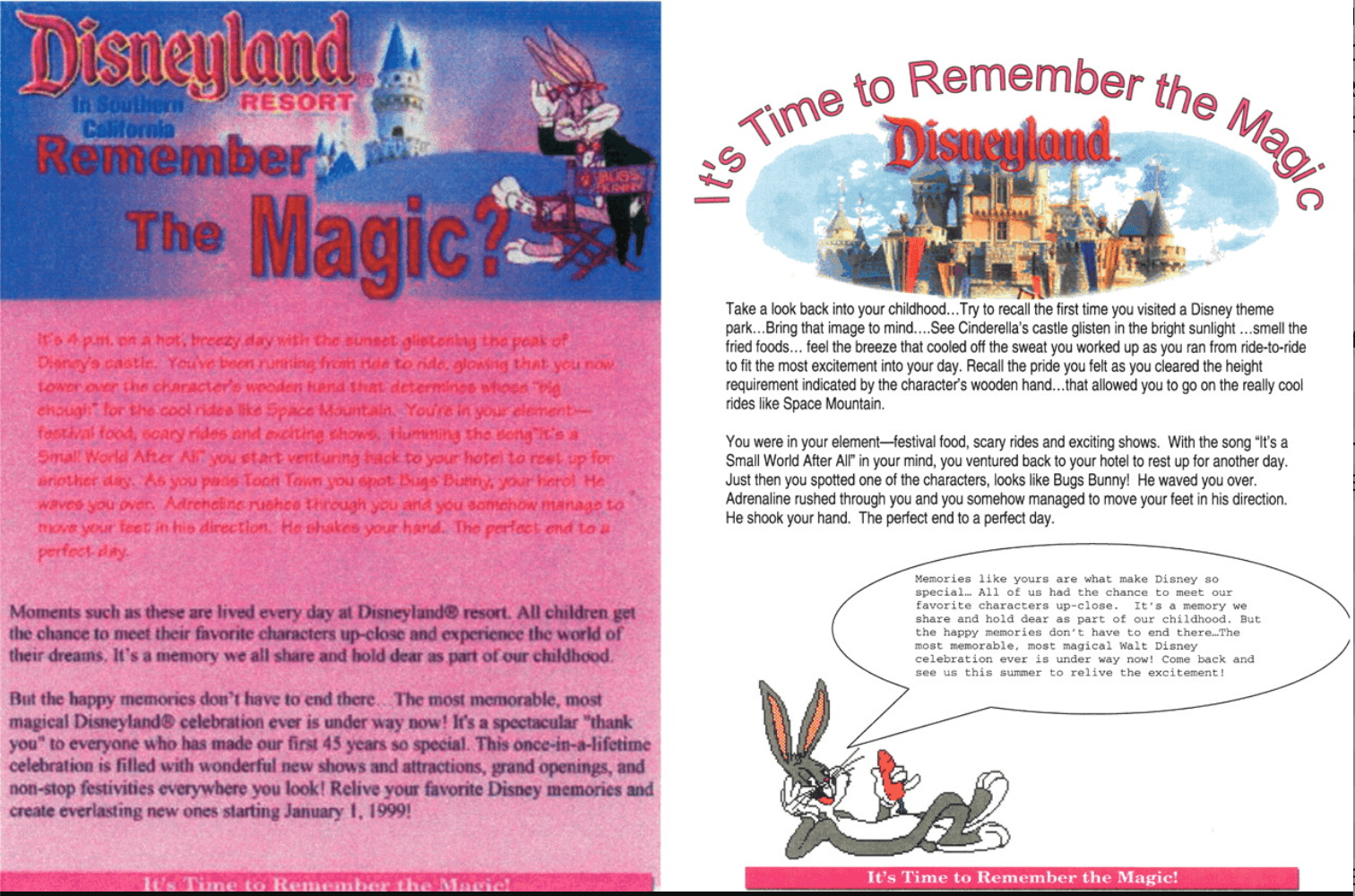
Figure 1

Fake advertisements showing Bugs Bunny at a Disney resort, used to plant false beliefs in Braun et al. (2002) and Braun-LaTour et al. (2004).

A concern about the recent work showing the creation of very rich false beliefs and memories is that these might reflect true experiences that have been resurrected from memory by the suggestive misinformation. To counter that concern, some investigators have tried to plant implausible or impossible false memories. In several studies subjects were led to believe that they met Bugs Bunny at a Disney Resort after exposure to fake ads for Disney that featured Bugs Bunny. An example of an ad containing the false Bugs Bunny information is shown in Figure 1; subjects simply evaluate the ad on a variety of characteristics. In one study, the single fake ad led 16% of subjects to later claim that they had met him (Braun et al. 2002), which could not have occurred because Bugs Bunny is a Warner Brothers character and would not be seen at a Disney resort. Later studies showed even higher rates of false belief, and that the ads that contained a picture of Bugs produced more false memories than ads that contained only a verbal mention (Braun-LaTour et al. 2004.) While obviously less complex, these studies dovetail nicely with real-world examples in which individuals have come to develop false beliefs or memories for experiences that are implausible or impossible (e.g., alien abduction memories, as studied by McNally and colleagues 2004).

Concluding remarks

Misinformation can cause people to falsely believe that they saw details that were only suggested to them. Misinformation can even lead people to have very rich false memories. Once embraced, people can express these false memories with confidence and detail. There is a growing body of work using neuroimaging techniques to assist in locating parts of the brain that might be associated with true and false memories, and these reveal the similarities and differences in the neural signatures (e.g., Curran et al. 2001; Fabiani et al. 2000). Those with strong interests in neuroscience will find interesting the recent neuroimaging and electrophysiological studies suggesting that sensory activity is greater for true recognition than false recognition (Schacter and Slotnick 2004). These studies suggest, more explicitly, that the hippocampus and a few other cortical regions come into play when people claim to have seen things that they didn't see. But, keep in mind that for the most part these studies are done with relatively pallid sorts of true and false memories (e.g., large collections of words or simple pictures). With the Okado and Stark (2005) neuroimaging investigation of misinformation we are one step closer to developing some techniques that might enable us to use neural activity to tell whether a report about a complex event is probably based on a true experience or whether it is based on misinformation. We are still, however, a long way from a reliable assessment when all we have is a single memory report to judge.

In the real world, misinformation comes in many forms. When witnesses to an event talk with one another, when they are interrogated with leading questions or suggestive techniques, when they see media coverage about an event, misinformation can enter consciousness and can cause contamination of memory. These are not, of course, the only source of distortion in memory. As we retrieve and reconstruct memories, distortions can creep in without explicit external influence, and these can become pieces of misinformation. This might be a result of inference-based processes, or some automatic process, and can perhaps help us understand the distortions we see in the absence of explicit misinformation (e.g., Schmolck et al.'s [2000] distortions in recollections of the O.J. Simpson trial verdict).

An obvious question arises as to why we would have evolved to have a memory system that is so malleable in its absorption of misinformation. One observation is that the “updating” seen in the misinformation studies is the same kind of “updating” that allows for correction of incorrect memories. Correct information can supplement or distort previously stored error, and this, of course, is a good thing. Whatever the misinformation reveals about normal memory processes, one thing is clear: the practical implications are significant. The obvious relevance to legal disputes, and other real-world activities, makes it understandable why the public would want to understand more about the misinformation effect and what it tells us about our malleable memories.

Open Article as PDF

Abstract

The misinformation effect refers to the impairment in memory for the past that arises after exposure to misleading information. The phenomenon has been investigated for at least 30 years, as investigators have addressed a number of issues. These include the conditions under which people are especially susceptible to the negative impact of misinformation, and conversely when are they resistant. Warnings about the potential for misinformation sometimes work to inhibit its damaging effects, but only under limited circumstances. The misinformation effect has been observed in a variety of human and nonhuman species. And some groups of individuals are more susceptible than others. At a more theoretical level, investigators have explored the fate of the original memory traces after exposure to misinformation appears to have made them inaccessible. This review of the field ends with a brief discussion of the newer work involving misinformation that has explored the processes by which people come to believe falsely that they experienced rich complex events that never, in fact, occurred.

Summary

The "misinformation effect" refers to how misleading information can change a person's memory of an event. In 2005, a study used brain imaging to show how this effect happens. Researchers showed subjects events, then gave some subjects false information about those events. Many subjects later remembered the false details as part of the original event. The study also found that brain activity during these stages could predict whether someone would be affected by the misinformation.

This research brought new attention to the misinformation effect, which has been studied for over 30 years. Previous studies have shown that misleading information can cause people to remember things that were never there, such as non-existent objects or incorrect details. The effect has been observed in various situations, including simulated accidents and real-world events. Several key questions have guided the research on the misinformation effect.

The When Question

Certain conditions make people more likely to be affected by misinformation. For example, if misleading information is introduced a long time after the original event, when the memory of that event has started to fade, people are more susceptible. This is because a weaker original memory makes it harder to notice differences when new, false information is presented.

Another important factor is the time between when misleading information is given and when memory is tested. If the test happens soon after the misinformation, people are less likely to say they only remember the false detail from the original event. They might remember both the false detail and the original event, or think the false detail was part of both.

Temporary changes in a person's state, such as believing they have consumed alcohol or being under hypnosis, can also increase susceptibility to misinformation. These states may make it harder for individuals to notice differences between the misleading information and their actual memories.

Warnings

Warning people beforehand that they might encounter misleading information can help them resist its influence. However, warnings given after the misinformation has already been processed typically do not help. This is likely because the false information has already become part of the memory. Pre-event warnings may work by encouraging individuals to carefully check new information for inconsistencies.

More recent studies suggest that post-misinformation warnings might have some success in limited situations. For instance, an immediate warning after misleading information helped subjects resist it, but only if the false information was not easily remembered. If the false information was very accessible, the warnings did not work. This suggests that suppressing easily recalled misinformation is more difficult.

The Who Question

Some people are more affected by misinformation than others. Young children and older adults are generally more susceptible than younger adults. These age differences might be linked to how much mental effort a person can use, as misinformation effects are stronger when mental resources are limited. It is important to note that memory distortion from suggestion can happen at any age, even if it is more common in certain age groups.

Certain personality traits also make people more vulnerable to misinformation, such as empathy, being easily absorbed in thoughts, and self-monitoring. People who report more memory lapses are also more susceptible.

Interestingly, misinformation effects have also been observed in very young infants, gorillas, pigeons, and rats. For nonverbal creatures, researchers must find indirect ways to determine if misinformation has affected their memory. For example, pigeons can have their memories disrupted by misleading visual information, similar to humans. The fact that the misinformation effect appears in nonverbal animals suggests it is not just a result of people trying to please experimenters.

The fate of the original memory?

A key question is what happens to a person's original memory when misinformation is accepted. Does the false information damage the original memory, or does it simply make the original memory harder to access? Some researchers in the 1980s argued that misinformation does not harm the original memory at all. They suggested that misinformation only affects what subjects report, especially if they never properly remembered the original event or cannot recall it. In this view, subjects might choose the misleading information because they believe it is correct.

To test this idea, researchers developed a "Modified Test." For example, if subjects saw a hammer but were told it was a screwdriver, the standard test would offer both options. The modified test, however, would offer the hammer and a completely new item, like a wrench, but not the screwdriver. On this modified test, subjects were often good at choosing the original item, leading some to argue that the original memory was not impaired. However, later analyses showed that small misinformation effects still occurred even with these modified tests, even in nonverbal animals.

Overall, this debate highlighted the various reasons why people might report false details. Sometimes it is because they have no original memory, or because they thoughtfully consider the information. Other times, it seems the original memories may be affected when people think about misleading information. The idea that entirely new items can be planted into someone's memory, regardless of whether old memories are damaged, also became a significant area of study.

The nature of misinformation memories

What do misinformation memories feel like to the person experiencing them? One study compared memories of a real yield sign to memories of a suggested yield sign. The "unreal" memories were often longer, contained more uncertain phrases ("I think I saw..."), and fewer specific sensory details. This suggests that groups of real and unreal memories can be statistically different, but it remains very hard to tell if a single memory report is real or not.

Another approach explored whether people confuse misleading suggestions with their actual memories of an event. Researchers found that misled subjects sometimes do remember seeing things that were only suggested. This is called the "source misattribution effect," meaning they misremember where the information came from. However, this effect varies and does not always happen after exposure to misleading information.

How much misinformation can be planted in one mind?: Rich false memories

Beyond changing small details, researchers in the mid-1990s began to implant entire false memories for events that never happened. They used techniques such as creating scenarios with the help of family members. For example, some subjects were led to believe they had been lost in a shopping mall as a child, had an accident at a wedding, were attacked by an animal, or nearly drowned.

Sometimes, subjects who initially remember very little will develop detailed false memories after several interviews containing suggestive information. They might even include their thoughts and feelings from the time of the false event. These studies demonstrate how powerful strong suggestion can be, leading many people to believe or even remember in detail traumatic events that were completely made up.

This strong form of suggestion is sometimes called the "familial informant false narrative procedure" or the "lost-in-the-mall" technique. Across many studies using this method, about 30% of subjects have developed partial or complete false memories. Other techniques, such as guided imagination, dream interpretation, or doctored photographs, have also caused people to falsely believe they experienced events in their past.

Some concerns arose that these rich false memories might be real experiences that were brought back by suggestion. To address this, researchers tried to plant false memories that were impossible or highly unlikely. For example, subjects were led to believe they met Bugs Bunny at a Disney Resort after seeing fake ads. This could not have happened because Bugs Bunny is a Warner Brothers character. In one study, 16% of subjects claimed to have met him after seeing a single fake ad. Later studies showed even higher rates of false belief, especially when the ads included a picture of Bugs Bunny. These findings align with real-world examples where individuals develop false beliefs or memories for implausible events, such as alien abductions.

Open Article as PDF

Abstract

The misinformation effect refers to the impairment in memory for the past that arises after exposure to misleading information. The phenomenon has been investigated for at least 30 years, as investigators have addressed a number of issues. These include the conditions under which people are especially susceptible to the negative impact of misinformation, and conversely when are they resistant. Warnings about the potential for misinformation sometimes work to inhibit its damaging effects, but only under limited circumstances. The misinformation effect has been observed in a variety of human and nonhuman species. And some groups of individuals are more susceptible than others. At a more theoretical level, investigators have explored the fate of the original memory traces after exposure to misinformation appears to have made them inaccessible. This review of the field ends with a brief discussion of the newer work involving misinformation that has explored the processes by which people come to believe falsely that they experienced rich complex events that never, in fact, occurred.

Summary

In 2005, a study published in Learning & Memory used brain imaging to understand how the "misinformation effect" works. This effect, which memory researchers had studied for over 25 years, describes how false information can change someone's memory of an event. In the study, participants first watched complex events, such as a man stealing a wallet. Then, some participants received false details about the event, like hearing that a girl's arm was hurt instead of her neck. Finally, participants were asked to recall what they originally saw. Many participants incorrectly remembered the false details as part of the original event, with the misinformation being remembered about 47% of the time. This confirmed that exposure to false information significantly impairs memory. The researchers also found that brain activity during the event and misinformation exposure could predict whether the misinformation effect would occur.

This new research gained significant public attention and increased interest in the misinformation effect. Media outlets highlighted the findings, noting that brain scans could predict whether memories would be accurate or influenced by false information.

Over 30 years of research on the misinformation effect have shown similar memory distortions in many studies. People have recalled objects that did not exist, remembered a yield sign as a stop sign, or replaced a hammer with a screwdriver. Even large details, like a barn that was not present in a scene, have been falsely recalled. False details have been implanted into memories of both simulated and real-world events. The misinformation effect refers to a change in memory reporting, usually for the worse, after receiving misleading information. Throughout its history, several key questions about this effect have been explored.

The When Question

Researchers have found that certain conditions make people more vulnerable to misinformation. For instance, memories are more easily affected by false information if it is introduced after a significant amount of time has passed, allowing the original memory to fade. This may be because a weaker original memory makes it harder to notice discrepancies when false information is presented. If the original memory is very weak, a person might readily accept the misinformation without detecting any conflict. This idea led to the Discrepancy Detection principle, which states that memories are more likely to change if a person does not immediately notice differences between the false information and their original memory. However, false memories can still form even if a discrepancy is noticed, as individuals might conclude that their original memory was incorrect.

The timing between receiving misinformation and being tested also plays a role. In studies where participants identified whether an item was from the original event, the misinformation, or both, misinformation effects occurred when participants incorrectly claimed the item was from the event or both. The timing of the test influenced these results, with shorter intervals making participants less likely to claim the false item was solely from the event. This suggests that recent exposure to misinformation can lead to both remembering the misinformation itself and incorrectly believing it was part of the original event.

Temporary changes in a person's state can also increase susceptibility to misinformation. For example, individuals who believe they have consumed alcohol or are under hypnosis are more vulnerable. These states may reduce a person's ability to notice differences between false information and their original memories.

Warnings

Early research showed that warning individuals before they encounter false information can help them resist its influence. However, warnings given after the misinformation had already been processed did not help. This is likely because the false information had already become part of the memory, creating an altered recollection. This aligns with the Discrepancy Detection principle; a pre-exposure warning might encourage individuals to carefully examine new information for inconsistencies.

More recent studies suggest that warnings given after misinformation has been presented can sometimes be effective, but only in specific situations. One study found that an immediate post-misinformation warning helped participants resist false information, but only if that misinformation was not highly memorable or "accessible." If the misinformation was very accessible (e.g., presented multiple times), the warning had no effect. The type of warning, whether general or specific, did not seem to matter. Researchers proposed a "suppression hypothesis," suggesting that warnings lead people to suppress the misinformation, reducing its ability to interfere with memory retrieval. This suppression might be less effective when misinformation is highly accessible, as it could distract individuals from checking for discrepancies.

The Who Question

The misinformation effect varies among individuals. Age is a factor; young children are generally more susceptible than older children and adults, and older adults are more susceptible than younger adults. These age differences may relate to cognitive abilities, as misinformation effects are stronger when a person's attention is limited. It is important to note that memory distortion from suggestion can happen at any age, even if it is more pronounced in certain age groups.

Personality traits also play a role. Individuals who score higher on measures of empathy, absorption, and self-monitoring tend to be more susceptible to misinformation. People who report more frequent memory and attention lapses are also more vulnerable. For example, one study found that a measure of dissociation, which assesses how often someone cannot distinguish between doing something and just thinking about doing it, accounted for about 10% of the variation in misinformation susceptibility.

Interestingly, misinformation effects have been observed in unusual subjects, including three-month-old infants, gorillas, pigeons, and rats. A challenge in these studies is determining if misinformation has taken hold in species that cannot verbally express their memories. For example, pigeons have excellent visual memory, but it can be disrupted by false information. Studies with pigeons showed that their accuracy was higher when post-event information was not misleading. Similar to humans, pigeons were more susceptible to misinformation if it occurred later rather than earlier between the original event and the final test. This suggests that the misinformation effect is not just a general disruption of memory (retrograde interference) but also a specific biasing effect. Observing this effect in nonverbal creatures also suggests it is not simply a result of participants trying to please the experimenter.

The Fate of the Original Memory?

A fundamental question about memory is whether long-term memories are permanent, even if they cannot always be retrieved, or if they can decay, be damaged, or altered. Specifically, when false information is accepted and integrated into a person's memory, what happens to their original memory? Does the misinformation damage the original memory itself, or does it make the original memory harder to access?

In the 1980s, a debate arose when some researchers argued that misinformation did not actually impair original memories. They proposed that misinformation only influenced what people reported if they never properly stored the original event or could not recall it. In this view, people might simply guess based on the false information rather than truly remembering it. Alternatively, it was suggested that people might remember both the original and false information but choose the misleading information because they believe it is correct.

To support this idea, researchers developed a "Modified Test." For example, if participants saw a burglar with a hammer and were later told it was a screwdriver, the standard test would offer both options. The modified test would exclude the misinformation option (screwdriver), asking participants to choose between the original item (hammer) and a new item (wrench). With this modified test, participants were very good at selecting the original item, leading some to argue that no memory impairment occurred. However, later analyses of many studies using the modified test still found small misinformation effects, even in nonverbal species.

While many studies explored the fate of original memories, it is clear that people report false information for various reasons. Sometimes it is due to a lack of original memory, sometimes due to careful consideration, and sometimes it seems as if original memories have been altered by the false information. The idea that entirely new details could be implanted into someone's memory, regardless of whether original traces were impaired, also proved to be a significant area of interest.

The Nature of Misinformation Memories

What do misinformation memories feel like subjectively? One study compared memories of a yield sign that was actually seen in a simulated accident to memories of a yield sign that was only suggested. The verbal descriptions of the "unreal" memories were longer, included more uncertain phrases ("I think I saw..."), more references to cognitive processes ("After seeing the sign the answer I gave was more of an immediate impression..."), and fewer sensory details. While a group of real memories might differ statistically from a group of unreal ones, it was very difficult to reliably classify a single memory report as real or unreal due to overlapping characteristics.

Another approach explored whether people confuse false suggestions with their "real memories." This question arose from the possibility that participants might report misinformation because they believed it was true, even without a specific memory of seeing it. After several experiments asking specific questions about the source of embraced false items, researchers concluded that misled participants do sometimes remember seeing things that were only suggested. This phenomenon was called the "source misattribution effect." However, they also noted that the size of this effect can vary and that source misattributions are not guaranteed after exposure to false suggestions.

How Much Misinformation Can Be Planted in One Mind?: Rich False Memories

It is one thing to change a small detail like a stop sign to a yield sign or add a minor detail to an existing memory. It is much more significant to implant an entire memory for an event that never happened. In the mid-1990s, researchers developed techniques to implant "rich false memories" of whole events. One study used stories created by family members to plant false memories in subjects, such as being lost in a shopping mall at age six and being rescued by an elderly person. Other studies used similar methods to plant false memories of childhood accidents at weddings, animal attacks, or near-drowning incidents.

Sometimes, individuals initially recall very little, but after several suggestive interviews containing misinformation, they develop detailed recollections of the false events. For example, one study suggested to a participant that they went to the hospital at age four for low blood sugar. Initially, the participant remembered almost nothing. However, after several interviews, the participant developed a detailed false memory, even incorporating thoughts from that imagined time: "... I don't remember much about the hospital except I know it was a massive, huge place. I was 5 years old at the time and I was like 'oh my God I don't really want to go into this place, you know it's awful'... but I had no choice. They did a blood test on me and found out that I had a low blood sugar..." These studies demonstrate the powerful effect of strong suggestion, leading many individuals to believe or even vividly remember traumatic events that were entirely fabricated.

Some researchers call this strong form of suggestion the "familial informant false narrative procedure," while others prefer the simpler term "lost-in-the-mall" technique, named after the first study that used it. Across many "lost-in-the-mall" studies, an average of about 30% of participants have developed either partial or complete false memories. Other methods, such as guided imagination, suggestive dream interpretation, or exposure to altered photographs, have also led people to falsely believe they experienced events in their past.

There was a concern that the creation of rich false beliefs and memories might actually be the retrieval of true experiences resurrected by suggestive information. To address this, some researchers tried to implant implausible or impossible false memories. In several studies, participants were led to believe they met Bugs Bunny at a Disney Resort after seeing fake ads featuring the character. Bugs Bunny is a Warner Brothers character and would not be at a Disney resort. In one study, a single fake ad led 16% of participants to later claim they had met him. Later studies showed even higher rates of false belief, and ads with a picture of Bugs Bunny created more false memories than those with only a verbal mention. These studies, while less complex, align with real-world examples where individuals develop false beliefs or memories for experiences that are implausible or impossible, such as alien abduction memories.

Concluding Remarks

Misinformation can cause people to falsely believe they saw details that were only suggested to them, even leading to very rich false memories. Once these false memories are accepted, individuals can describe them with confidence and detail. A growing area of research uses brain imaging to identify brain regions associated with true and false memories, revealing similarities and differences in brain activity patterns. Studies suggest that sensory activity is greater for true recognition than false recognition, and that specific brain regions, like the hippocampus, are active when people falsely claim to have seen things. However, most of these studies use relatively simple true and false memories, such as lists of words or pictures. The 2005 study on misinformation using neuroimaging brings researchers closer to developing techniques that might use brain activity to determine if a report about a complex event is based on a true experience or misinformation. However, a reliable assessment based on a single memory report is still a distant goal.

In the real world, misinformation can come from various sources: witnesses talking to each other, leading questions during interrogations, or media coverage of an event. These can all introduce false information and contaminate memories. Memory distortions can also occur without explicit external influence as memories are retrieved and reconstructed. These might result from inference-based processes or automatic processes, helping to explain distortions seen even without direct misinformation.

An important question is why human memory would evolve to be so easily influenced by misinformation. One perspective is that the "updating" observed in misinformation studies is the same process that allows for the correction of incorrect memories. Accurate information can improve or alter previously stored errors, which is beneficial. Whatever the misinformation effect reveals about normal memory processes, its practical implications are significant. Its clear relevance to legal disputes and other real-world situations highlights why the public is interested in understanding the misinformation effect and the malleable nature of human memory.

Open Article as PDF

Abstract

The misinformation effect refers to the impairment in memory for the past that arises after exposure to misleading information. The phenomenon has been investigated for at least 30 years, as investigators have addressed a number of issues. These include the conditions under which people are especially susceptible to the negative impact of misinformation, and conversely when are they resistant. Warnings about the potential for misinformation sometimes work to inhibit its damaging effects, but only under limited circumstances. The misinformation effect has been observed in a variety of human and nonhuman species. And some groups of individuals are more susceptible than others. At a more theoretical level, investigators have explored the fate of the original memory traces after exposure to misinformation appears to have made them inaccessible. This review of the field ends with a brief discussion of the newer work involving misinformation that has explored the processes by which people come to believe falsely that they experienced rich complex events that never, in fact, occurred.

Summary

In 2005, a study in the journal Learning & Memory used brain imaging to understand how the "misinformation effect" works. This effect had interested memory researchers for over 25 years. The study involved people first watching events, then some received incorrect information about what they saw, and finally, they were asked to recall the original event. Many remembered the incorrect details as part of the original event, showing that misinformation can significantly change memories. The researchers also found that brain activity during the event and when misinformation was given could predict if the misinformation effect would occur.

This study gained a lot of public attention, highlighting the misinformation effect as a scientific topic. For instance, news outlets reported that brain scans might predict accurate or flawed memories, and some praised it as the first study to look at how the brain processes misinformation.

After 30 years of research, much is known about the misinformation effect. Studies have shown this memory distortion in many situations, like people recalling objects that were not present or confusing signs. Misinformation can even be planted into memories of real events. The misinformation effect describes the change, usually negative, in what someone remembers after being given misleading information. Researchers have explored several key questions about this effect.

The When Question

Researchers have found that certain conditions make people more likely to be affected by misinformation. For example, memories are more easily influenced if misinformation is introduced long after the original event, when the original memory has started to fade. This fading makes it less likely for a person to notice a difference between the new information and their old memory. If the original memory is very weak, a person might easily accept the misinformation as true. This led to the "Discrepancy Detection principle," which states that memories are more likely to change if a person does not immediately notice differences between misleading information and their original memory. However, false memories can still form even if a person notices a difference, as they might believe the new information is correct.

The time between receiving misinformation and being tested on a memory also matters. One study found that if there is a short time between the misinformation and the test, people are less likely to claim the incorrect detail was only part of the original event. This suggests that recent exposure to misinformation can lead people to mistakenly believe they saw it initially.

Temporary changes in a person's state can also increase the misinformation effect. For instance, people who believe they have consumed alcohol or are under hypnosis are more vulnerable. These states might disrupt their ability to notice differences between misinformation and their original memories.

Warnings

Early research showed that warning people beforehand about potential misinformation can help them resist its influence. However, warnings given after misinformation had already been processed did not help. This is likely because the misinformation had already become part of the memory. This aligns with the Discrepancy Detection principle: if people are warned before seeing misleading information, they might pay closer attention and better identify inaccuracies.

More recent studies suggest that warnings given after misinformation (post-misinformation warnings) can sometimes be effective, but only in specific situations. One study found that an immediate post-misinformation warning helped if the misinformation was not easily remembered. If the misinformation was very accessible (e.g., presented multiple times), these warnings had no effect. The type of warning, whether general or specific, did not seem to matter. Researchers proposed that warnings might cause people to suppress the misinformation, reducing its impact on memory. However, highly accessible misinformation might be harder to suppress and could distract a person from checking for differences with their original memory.

The Who Question

The misinformation effect impacts some individuals more than others. Age is a factor; young children and older adults are generally more susceptible than younger adults. These age differences might relate to how much mental effort a person can use, as misinformation effects are stronger when a person's attention is limited. It is important to remember that memory distortion caused by suggestion can happen to people of all ages, even if it is more noticeable in certain age groups.

Certain personality traits are also linked to greater susceptibility to misinformation, such as empathy, being easily absorbed in experiences, and self-monitoring. People who report frequent memory and attention lapses are more likely to be affected. For example, research has shown that some of the differences in misinformation susceptibility can be explained by scores related to how often a person cannot recall whether they did something or just thought about doing it.

Interestingly, misinformation effects have also been observed in unexpected subjects, including three-month-old babies, gorillas, and even pigeons and rats. A challenge in these studies is determining that misinformation has affected species that cannot verbally express their memories. For example, pigeons can remember pictures for a long time, but misinformation can disrupt this memory. Studies with pigeons showed that their accuracy was better when the information they saw after an event was not misleading. Similar to humans, pigeons were more affected by misinformation if it occurred later rather than earlier after the original event. This suggests that the misinformation effect is not simply a disruption in performance but also involves a specific bias, and that it is not just caused by subjects trying to please the experimenter.

The Fate of the Original Memory?

A basic question about memory is whether long-term memories are permanent. Once stored, can memories decay, be damaged, or change? Specifically, when misinformation is accepted and incorporated, what happens to the original memory? Does the misinformation damage the original memory, or does it simply make the original memory harder to access? In the 1980s, some researchers argued that misinformation did not harm the original memory at all. They suggested that misinformation only influenced what people reported, especially those who never fully stored the original event or could not recall it. These individuals might choose the misinformation as their answer instead of guessing. Another idea was that people might remember both the correct and misleading information but choose the misleading information because they believe it is correct.

To support their view, researchers developed a "Modified Test." For example, if someone saw a burglar pick up a hammer but was later told it was a screwdriver, a standard test would offer both options. The modified test, however, would exclude the misinformation option, asking subjects to choose between the original item (hammer) and a new item (wrench). Using this modified test, subjects were very good at picking the original item, leading researchers to suggest that actual memory damage was not occurring. However, later analyses of many studies using the modified test still found small misinformation effects, even in experiments with nonverbal animals.

While many methods were used to study the fate of original memories, this debate highlighted the various reasons people might report misinformation as their memory. Sometimes it is because they have no original memory, or it has faded. Other times, it is due to careful thought, or it might seem that original memories have been harmed during the process of thinking about misinformation. Furthermore, the idea of planting a completely new item into someone's memory, regardless of whether it affected previous memories, was compelling on its own.

The Nature of Misinformation Memories

What do misinformation memories feel like subjectively? One study compared memories of a yield sign that people actually saw in a simulated accident with memories of subjects who were only told about the sign. The verbal descriptions of these "unreal" memories were longer, used more cautious language (e.g., "I think I saw..."), referred more to thought processes, and contained fewer sensory details. So, as a group, real and unreal memories might differ. However, many unreal memory descriptions still included cautious language and sensory details, making it very difficult to reliably classify a single memory report as real or unreal.

Another approach explored whether people confuse misleading suggestions with their actual memories. Researchers asked specific questions about where people thought they heard certain details. They concluded that misled subjects sometimes do remember seeing things that were only suggested to them, a phenomenon called the "source misattribution effect." However, they also noted that the size of this effect can vary, and mistaking the source of information does not always happen after exposure to misleading suggestions.

How Much Misinformation Can Be Planted in One Mind?: Rich False Memories

It is one thing to change a minor detail, like a stop sign to a yield sign, or add a detail to an existing memory. It is quite another to plant an entire memory for an event that never happened. In the mid-1990s, researchers developed ways to plant whole events, known as "rich false memories." One study, using stories provided by relatives, planted false memories of being lost in a shopping mall at age six and being rescued by an older person. Other studies used similar methods to create false memories of childhood accidents at weddings, vicious animal attacks, or nearly drowning and being rescued.

Sometimes, people begin with very little memory of an event, but after several suggestive interviews with misinformation, they recall false events in great detail. In one study, a person was told they went to the hospital at age four for low blood sugar. Initially, the person remembered very little, but after a few weeks of interviews, they developed a detailed memory, even including their thoughts at the time. These studies demonstrate the powerful effect of strong suggestion, leading many people to believe or even remember in detail events that never happened, were entirely made up with family help, and would have been traumatic if real.

Some researchers call this strong suggestion the "familial informant false narrative procedure," while others prefer the simpler term "lost-in-the-mall" technique. Across many studies using this technique, about 30% of subjects have developed partial or complete false memories. Other methods, such as guided imagination, suggestive dream interpretation, or altered photographs, have also led people to falsely believe they experienced events in their past.

Figure 1.

Fake advertisements showing Bugs Bunny at a Disney resort, used to plant false beliefs in Braun et al. (2002) and Braun-LaTour et al. (2004).

A concern is whether these rich false beliefs and memories are actually true experiences brought back by suggestion. To address this, some researchers tried to plant implausible or impossible false memories. In several studies, people were led to believe they met Bugs Bunny at a Disney Resort after seeing fake ads featuring the character. An example of such an ad is shown in Figure 1. In one study, a single fake ad led 16% of subjects to later claim they had met Bugs Bunny, which is impossible because Bugs Bunny is a Warner Brothers character and would not be at a Disney resort. Later studies showed even higher rates of false belief, and ads with a picture of Bugs Bunny created more false memories than those with only a verbal mention. These studies, though less complex, align with real-world examples where individuals develop false beliefs or memories for experiences that are unlikely or impossible, such as alien abduction memories.

Concluding Remarks

Misinformation can cause people to falsely believe they saw details that were only suggested to them, and can even lead to very rich false memories. Once accepted, people can describe these false memories with confidence and detail. There is growing research using brain imaging to identify brain areas linked to true and false memories, revealing similarities and differences in brain activity. Studies suggest that sensory activity is greater for true recognition than false recognition. More specifically, the hippocampus and other brain regions appear to be involved when people claim to have seen things they did not. However, most of these studies use relatively simple true and false memories (e.g., lists of words or simple pictures). The Okado and Stark (2005) brain imaging study of misinformation moves closer to techniques that might use brain activity to determine if a report about a complex event is based on a true experience or misinformation. However, a reliable assessment based on a single memory report is still a long way off.

In the real world, misinformation takes many forms. When witnesses discuss an event, when they are asked leading questions, or when they see media coverage, misinformation can enter their minds and contaminate their memories. These are not the only sources of memory distortion. As people recall and reconstruct memories, distortions can occur without outside influence, and these can become part of the misinformation. This might result from mental shortcuts or automatic processes, and can help explain distortions seen without explicit misinformation.

An obvious question is why humans would have evolved a memory system that is so easily influenced by misinformation. One idea is that the "updating" seen in misinformation studies is the same kind of updating that allows for correcting incorrect memories. Correct information can add to or change a previously stored error, which is beneficial. Whatever the misinformation effect reveals about normal memory processes, its practical implications are significant. Its clear relevance to legal cases and other real-world situations makes it understandable why the public wants to learn more about the misinformation effect and what it tells us about our adaptable memories.

Open Article as PDF

Abstract

The misinformation effect refers to the impairment in memory for the past that arises after exposure to misleading information. The phenomenon has been investigated for at least 30 years, as investigators have addressed a number of issues. These include the conditions under which people are especially susceptible to the negative impact of misinformation, and conversely when are they resistant. Warnings about the potential for misinformation sometimes work to inhibit its damaging effects, but only under limited circumstances. The misinformation effect has been observed in a variety of human and nonhuman species. And some groups of individuals are more susceptible than others. At a more theoretical level, investigators have explored the fate of the original memory traces after exposure to misinformation appears to have made them inaccessible. This review of the field ends with a brief discussion of the newer work involving misinformation that has explored the processes by which people come to believe falsely that they experienced rich complex events that never, in fact, occurred.

Summary

In 2005, a study looked at how the brain handles false information. It showed how people's memories can be changed by wrong details. For example, people saw a man stealing a wallet. Later, some were told a girl's arm was hurt, not her neck. Many remembered seeing the arm hurt in the original event. This showed that false information can change memories almost half the time. The study also found that brain activity could predict if someone's memory would be tricked.

This work got a lot of public attention. News sources reported that brain scans could tell if memories were true or false.

For 30 years, much has been learned about how false information changes memories. People have recalled things that were never there, like broken glass or a barn. They have mixed up stop signs and yield signs. False details have been added to memories of both made-up and real-life events. The "misinformation effect" is the term for when memories change, usually for the worse, after someone gets wrong information. Many questions have been asked about this effect.

The questions include:

  1. When are people most likely to be tricked by wrong information?

  2. Can warnings help people avoid being tricked?

  3. Are some people more likely to be tricked than others?

  4. What happens to a person's first memory when wrong information is believed?

  5. What are these false memories like?

  6. How much false information can be put into someone's memory?

The When Question

Researchers found that certain situations make people more likely to be tricked by wrong information. For instance, if a long time passes after an event, the original memory can fade. This makes it easier for false information to change the memory. If the first memory is weak, people might not notice when new information is wrong. They might then believe the false information easily. This idea is called the "Discrepancy Detection principle." It means memories are more likely to change if a person does not notice the difference between the wrong information and their first memory. But false memories can still happen even if a difference is noticed. A person might think, "I thought I saw a stop sign, but the new information says a yield sign. I must be wrong."

The time between getting the false information and being tested on the memory also matters. Studies show that if there is a short time between getting the false information and the test, people are less likely to wrongly say that the false detail was part of the original event. This makes sense because they might still remember reading the false information.

Changing a person's temporary state can also make them more likely to be tricked. For example, people are more open to false information if they think they have had alcohol or if they are hypnotized. These states might make it harder to notice when new information does not match their first memory.

Warnings

Researchers found that warning people before they get false information can help them resist it. However, a warning given after they have already gotten the false information usually does not help. This is likely because the false information has already become part of their memory. The research on warnings supports the idea that noticing differences is important. If people are warned ahead of time that new information might be wrong, they might look more closely for differences.

Newer studies suggest that warnings given after false information might help sometimes, but only in certain situations. If the false information is not easy to remember, a warning right after can help. But if the false information is very easy to remember (for example, if it was heard many times), warnings given after do not help at all. It also did not matter if the warning was general or about a specific detail. One idea is that warnings help people push away the false information so it does not interfere with their memory test. But this pushing away might not work if the false information is too strong.

The Who Question

False information affects some people more than others. Age is one factor. Young children are more likely to be tricked than older children and adults. Also, older adults are more likely to be tricked than younger adults. These age differences might show that when it is harder to pay attention, false information has a stronger effect. It is important to remember that memory changes caused by suggestions can happen to people of all ages, even if some age groups are more affected.

Certain personality traits also make people more likely to be tricked, such as being very caring, easily lost in thought, or changing behavior to fit in. People who often forget things or have trouble paying attention are also more likely to be affected by false information. For example, one study showed that how often someone cannot remember if they did something or just thought about doing it can explain about 10% of how easily they are tricked by false information.

Interestingly, false information has also affected very young babies, gorillas, and even pigeons and rats. It is tricky to know if these animals are tricked because they cannot speak. For example, pigeons can remember pictures for up to two years. But their good memory can be changed by false information. In studies, pigeons saw a light of a certain color. Later, they saw either the same color or a different color. Then, they were tested and had to pick the original color for food. The pigeons were better at picking the right color when the second light did not give them wrong information. Also, like humans, pigeons were more easily tricked if the false information came later, not earlier. This shows that the misinformation effect is not just a simple problem with memory performance; it also changes what is remembered. Seeing this effect in animals that cannot speak also means that people are not just giving wrong answers to please the experimenter.

The fate of the original memory?

A main question about memory is whether our long-term memories stay forever, even if we cannot remember them easily. Or can memories change over time? More specifically, when false information is believed, what happens to the original memory? Does the false information damage the first memory? Or does it just make the first memory harder to find?

In the 1980s, some researchers argued that false information does not harm the original memory at all. They believed that false information only affects what people say they remember, especially if they never properly stored the original event or cannot recall it. In this view, people might guess and use the false information instead. Or, they might remember both the true and false details but pick the false one because they think it must be right.

To support their idea, some researchers created a new kind of test. For example, if someone saw a burglar pick up a hammer and was later told it was a screwdriver, a normal test would ask them to pick between a hammer and a screwdriver. People who did not get false information would pick the hammer. Many who got false information would pick the screwdriver. In the new test, called the "Modified Test," the false option (screwdriver) was not given. Instead, people had to choose between the hammer and a new item, like a wrench. With this test, people were very good at picking the hammer. This led researchers to say that the original memory was not damaged. However, later studies showed that even with these special tests, small misinformation effects still happened, even in animals.

Many studies explored what happens to the original memory. It showed that people report false information for different reasons. Sometimes it is because they do not have a strong original memory. Sometimes it is because they think about it and decide the false information is correct. And sometimes it seems like the original memory itself has been harmed. Also, the idea that a new item can be placed into someone's memory, even if it does not harm old memories, was very interesting.

The nature of misinformation memories

What do false memories feel like? One study compared memories of a yield sign that people actually saw to memories of a yield sign that was only suggested to them. The descriptions of the "unreal" memories were longer and used more unsure words like "I think I saw..." They also talked more about thinking processes and had fewer details about what was seen. So, a group of real memories might be different from a group of unreal ones. But many unreal memories still had unsure words and sensory details, making it hard to tell if a single memory was real or not.

Another way to look at false memories asked if people confuse the suggested wrong details with their "real" memories of an event. Researchers asked this because people might report false information even if they do not remember seeing it but believe it is true. After many studies, they found that people sometimes truly remember seeing things that were only suggested. This is called the "source misattribution effect," meaning they remember the detail but forget where they heard it. But this effect can vary, and it does not always happen after seeing wrong information.

How much misinformation can you plant in one mind?: Rich false memories

It is one thing to change a stop sign to a yield sign, or to add a small detail to a memory. But it is another thing to put a whole new memory of an event that never happened into someone's mind. In the mid-1990s, researchers found ways to plant whole false events, called "rich false memories." In one study, relatives helped create stories, and people were made to believe they got lost in a shopping mall at age 6 and were saved by an older person. Other studies used similar methods to plant false memories of an accident at a wedding, being attacked by an animal, or almost drowning and being saved by a lifeguard.

Sometimes people remember very little at first. But after several interviews with suggestions, they will recall false events with a lot of detail. For example, in one study, a person was told they went to the hospital at age 4 for low blood sugar. At first, they remembered almost nothing. But after three weeks, they remembered more details and even thoughts they had at the time. These studies show how powerful strong suggestions can be. Many people came to believe or remember in detail events that did not happen, were made up with the help of family, and would have been upsetting if real.

Some researchers call this method the "familial informant false narrative procedure." Others simply call it the "lost-in-the-mall" technique, after the first study that used it. Across many studies using this method, about 30% of people created partial or full false memories. Other methods, like imagining things, interpreting dreams, or looking at fake photos, have also made people falsely believe they experienced events in their past.

To address worries that these rich false memories might be real forgotten experiences, some researchers tried to plant impossible false memories. In some studies, people were led to believe they met Bugs Bunny at a Disney Resort after seeing fake ads with Bugs Bunny at Disney. Bugs Bunny is not a Disney character, so this could not happen. One fake ad made 16% of people claim they had met him. Later studies showed even higher rates, and pictures of Bugs Bunny in ads worked better than just words. These studies are like real-world examples where people have false memories of things that are impossible, like being taken by aliens.

Concluding remarks

False information can make people wrongly believe they saw details that were only suggested. It can even create detailed false memories. Once people believe these false memories, they can describe them with confidence and many details. Brain studies are helping to find parts of the brain linked to true and false memories. These studies show how true and false memories are alike and different in the brain. They suggest that true memories might involve more sensory activity. The hippocampus and other brain areas seem to be involved when people say they saw things they did not see. But most of these studies use simple memories, like words or pictures. The 2005 study on false information brought researchers closer to using brain activity to tell if a memory of a complex event is real or based on false information. However, it is still hard to reliably tell if a single memory report is true or false.

In daily life, false information can come in many ways. When witnesses talk to each other, when they are asked tricky questions, or when they see news about an event, false information can enter their minds and change their memories. These are not the only ways memories can be changed. As people remember and piece together memories, changes can happen even without outside influence. These changes can become like false information. This might happen because of how we think or other automatic processes.

It might seem strange that our memory system can be so easily changed by false information. But one idea is that this "updating" ability also lets us correct wrong memories. Correct information can add to or change old errors, which is a good thing. What the misinformation effect shows us about how memory works is very important. Its clear links to legal cases and other real-world situations help explain why people want to know more about it and how it shows that our memories can change.

Open Article as PDF

Footnotes and Citation

Cite

Loftus, E. F. (2005). Planting misinformation in the human mind: A 30-year investigation of the malleability of memory. Learning & memory, 12(4), 361-366. http://www.learnmem.org/cgi/doi/10.1101/lm.94705

    Highlights