Pathways to the persistence of drug use despite its adverse consequences
Gavan P. McNally
Philip Jean-Richard-dit-Bressel
E. Zayra Millan
Andrew J. Lawrence
SimpleOriginal

Summary

Addiction persists despite harm via 3 pathways: cognitive (not recognize consequences), motivational (overvaluing drugs vs. costs), and behavioral (habitual, stimulus-response). Each involves brain circuits and need tailored treatment.

2023

Pathways to the persistence of drug use despite its adverse consequences

Keywords Addiction; persistent drug use; insensitivity to adverse consequences; cognitive pathway; motivational pathway; behavioral pathway; adverse consequences; behavior change; neurobiological mechanisms

Abstract

The persistence of drug taking despite its adverse consequences plays a central role in the presentation, diagnosis, and impacts of addiction. Eventual recognition and appraisal of these adverse consequences is central to decisions to reduce or cease use. However, the most appropriate ways of conceptualizing persistence in the face of adverse consequences remain unclear. Here we review evidence that there are at least three pathways to persistent use despite the negative consequences of that use. A cognitive pathway for recognition of adverse consequences, a motivational pathway for valuation of these consequences, and a behavioral pathway for responding to these adverse consequences. These pathways are dynamic, not linear, with multiple possible trajectories between them, and each is sufficient to produce persistence. We describe these pathways, their characteristics, brain cellular and circuit substrates, and we highlight their relevance to different pathways to self- and treatment-guided behavior change.

Introduction

In 2016, Pickard and Ahmed posed the ‘puzzle of choice’. They began by considering evidence that people with problematic drug use can frequently control their behavior and can choose to abstain under many circumstances. Given this evidence for controlled drug use, Pickard and Ahmed asked why do these individuals choose to use despite the portent of negative consequences from that use?

The apparent insensitivity of drug taking to its adverse consequences is among the most pernicious features of addiction. It is responsible for a large part of the human toll of addiction, contributing directly to the detriments in health and well-being suffered by individuals, and imposing substantial burdens upon families and communities. Insensitivity to adverse consequences is not limited to drug use. It is shared with other problematic behaviors such as problem gambling that impose real and significant costs on individuals and the community.

Given the key role that insensitivity to adverse consequences plays in the presentation, diagnosis, and impacts of persistent drug use, as well as evidence that the eventual recognition and appraisal of these adverse consequences contributes to decisions to reduce or cease use, it is not surprising that it has been of intense interest. However, the most appropriate ways of conceptualizing this insensitivity remains unclear and sometimes controversial. The diverse conditions under which insensitivity is observed and heterogeneity in its presentation imply that it is multifactorial. Yet, often only single mechanism solutions are presented for this problem, and these are typically presented as linear transitions or trajectories.

Here we argue for three pathways to insensitivity that may contribute to persistent drug use despite its negative consequences (Fig. 1). A cognitive pathway for recognition of adverse consequences, a motivational pathway for valuation of these consequences, and a behavioral pathway for responding to these consequences. These pathways can operate in the same individual at different times, they can be independent with multiple possible trajectories between them, and each is sufficient to produce insensitivity. These pathways are embedded in complex backgrounds of intoxication, history of dependence, acute or protracted withdrawal, and stress. We describe how these pathways differ from each other and we consider their relevance for self- and treatment-guided behavior change.

Fig. 1: Pathways to insensitivity and their potential resolution.
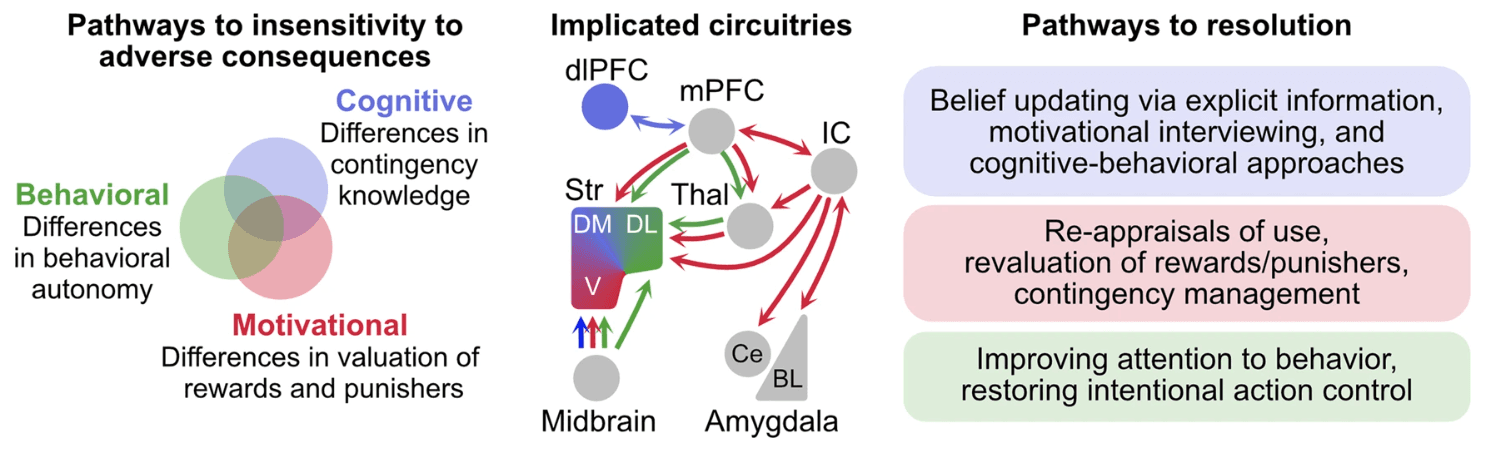
Fig 1

At least three pathways, representing distinct psychological factors, may each be sufficient to produce insensitivity to punishment and cause persistent, detrimental behavior. Insensitivity can arise from poor instrumental contingency knowledge (cognitive pathway), distortions in positive and/or negative valuation of consequences (motivational pathway), and/or alterations in behavioral autonomy (behavioral pathway). These pathways occur against complex backgrounds of intoxication, history of dependence, acute or protracted withdrawal, and acute as well as chronic stressors that can influence capacity to detect, appropriately learn about, weight, and respond to negative consequences. These pathways can operate independently but may also interact. They are underpinned by still poorly understood distinct (as shown in colored) but partially overlapping (as shown in gray) neural circuitries. These pathways are likely dynamic and non-linear. Each may operate within the same individual at different times. Resolution of problematic behaviors will depend on which of these factors is contributing at specific times to cause persistence of behavior. dlPFC—dorsolateral prefrontal cortex, mPFC—medial prefrontal cortex, IC—insular cortex, Thal—thalamus, Str—striatum, DM—dorsomedial striatum, DL—dorsolateral striatum, V—ventral striatum, Ce—central amygdala, BL—basolateral amygdala complex.

The adverse consequences of drug use

Although not all drug use, even when prolonged, has negative consequences for an individual, prolonged drug use can have profound deleterious impacts on the health and well-being of individual users, ranging from acute toxicity to chronic health conditions. Some adverse consequences may be directly, causally linked to drug use (e.g., overdose, hepatitis, HIV), whereas others are multifactorial and drug use adds to their risk (e.g., psychiatric disorders, cancers). Regardless, the burden of illicit drug use is estimated at 0.8% of global all-cause disability adjusted life years. The impact of licit substance use is greater still with alcohol use alone accounting for 5.1% of the global burden of disease and injury. Adverse effects are not restricted to impacts on health. Persistent substance use creates and exacerbates relationship and interpersonal problems and can lead to detrimental neglect of familial and occupational responsibilities as well as direct harm to others. Persistence of use in the face of adverse impacts is held to distinguish problematic from recreational drug use. It also forms a key part of formal diagnosis.

Non-human animal models of drug use serve an important role in studying adverse consequences because they allow precise control over drug history, assessment of individual differences, and titration of adverse consequences. Indeed, there has been progress in understanding whether, when, and why laboratory animals persist in drug self-administration despite adverse consequences. In a typical experiment, rats or mice are first trained to self-administer a substance, under simple (e.g., fixed ratio) or more sophisticated (e.g., ‘seeking-taking’) schedules. Then, adverse consequences are introduced to punish this behavior, such as arranging that responding for the substance also leads to footshock, conditioned fear, air puffs, or adulteration of the substance. The precise parametric relationship between drug seeking or taking and punishment varies across studies and these parameters are important to consider because they constrain and confound interpretation. In general, though, under these conditions, some laboratory animals reduce or cease drug self-administration, showing that drug seeking and taking are sensitive to adverse consequences. However, despite being subjected to negative consequences, some laboratory animals persist in seeking and taking. Such persistence has been observed in laboratory animals self-administering cocaine, heroin, methamphetamine, and alcoho.

This work has identified at least five features of insensitivity to adverse consequences. First, when low to moderate intensity punishers are used, only some mice and rats are insensitive, speaking to individual variability in humans. Second, factors relating to initial drug use, including preference, intake, and rate of self-administration, are unrelated to insensitivity. This shows that insensitivity is separate to mechanisms governing initial use. Third, extended self-administration and longer access per self-administration session favor insensitivity. Fourth, propensity to drug seek under progressive ratio schedules , increased responding during extinction or increased economic demand can predict insensitivity. Fifth, response impulsivity, such as reduced ability to wait before performing an appropriate response can predict insensitivity. These features are robust and replicable. They are important because they speak to, and constrain, mechanisms for insensitivity. We draw on these features when considering properties of the three putative pathways to insensitity to adverse consequences.

Cognitive pathways: recognizing adverse consequences

The cognitive pathway to persisting in drug taking despite negative consequences refers to the knowledge that an individual has about the consequences of their drug use (Fig. 1). Recognizing and identifying the negative consequences of drug use are necessary conditions for those consequences to change behavior. Yet for many individuals, choices to use a drug often do not incorporate possible adverse consequences from that use. To be sure, severe adverse consequences such as financial, familial, medical, employment, or legal problems can predict treatment seeking in some people. However, recognition of the severity of these consequences and their relationship to drug use is rarely immediate. Recognition that one’s drug use is responsible for negative consequences often occurs gradually, with individuals engaging in cognitive appraisals that can help drive self- or treatment-guided behavior change.

Engaging in these reappraisals may be difficult. Counselling approaches, such as motivational interviewing, capitalize on and enhance motivation to change. These approaches can be highly effective for some people but they can be less effective at creating the initial motivation to change. Reappraisals start gradually and behavior changes irregularly, often in highly personalized ways. This individuality has been argued to be beyond the reach of neuroscience, but recent work is beginning to show why correctly recognizing the negative consequences of our actions can be difficult.

Experience does not always deliver veridical causal knowledge about our actions. Humans and other animals differ profoundly in what they learn about the consequences of their actions. These differences in learning can drive pronounced differences in choice. Some people form correct causal beliefs about how their actions cause adverse consequences. They can use this knowledge to choose other behaviors. In contrast, other people form incorrect beliefs about the causes of adverse consequences. Their lack of correct awareness leads them to choose actions with adverse consequences.

For example, Jean-Richard-dit-Bressel et al. used a conditioned punishment task in young adults that allowed them to choose between two responses, one earning probabilistic rewards and one earning probabilistic reward and punishment. Participants were provided with no information about the specific punishment contingencies. They had to learn these from experience. Some readily learned to reallocate behavior away from the punished behavior, others did not. These differences were not due to differences in engagement with the task or in valuation of reward or punishment. Instead, sensitive and insensitive individuals differed profoundly in what they learned. Punishment sensitive individuals acquired correct causal beliefs about their behavior. They learned the correct Action–Punisher contingencies that they used to avoid further punishment. Punishment insensitive individuals also learned Action–Punisher contingencies. However, what they had learned was incorrect. Insensitive individuals formed incorrect beliefs about the causes of negative consequences so they could not withhold the specific action that caused punishment. This same bimodal punishment sensitivity driven by deficits in accurate instrumental contingency knowledge is observed in non-human animals, suggesting that it is a core property of learning and amenable to mechanistic deconstruction.

Lacking awareness or possessing erroneous causal beliefs about the adverse consequence of a behavior is not always problematic. In many individuals, lack of awareness or incorrect causal beliefs can be corrected to change behavior. For example, explicit information about Action–Punisher contingencies changes the behavior and beliefs of some insensitive people, causing them to cease that behavior and avoid further punishment. However, lack of awareness or incorrect beliefs can sometimes be problematic. In some insensitive people, behavior resists counterevidence about why they are being punished, trapping them in a cycle of repeating negative consequences. This is likely under at least one condition: when adverse consequences are infrequent. Under this condition, some insensitive individuals discount veridical counterevidence about the causes of punishment and detrimental behavior persists.

So, insensitivity to adverse consequences can emerge from the different things that we learn about the negative consequences of our actions. Three features make the negative consequences of drug use especially prone to this insensitivity. First, the negative consequences of drug use are probabilistic, and any experienced contingencies are typically weak. The probability that any individual act of drug use will have detectable negative consequences for the individual is low. This makes learning about adverse consequences from experience difficult. We underweight rare, adverse events when making experience-based choices. Indeed, when individuals do experience adverse consequences from initial drug use (e.g., nausea in response to nicotine; flushing in response to ethanol), further use can be slowed. Second, the trajectory of drug-related harms often involves escalation from minor to more severe, typically over many years. This trajectory undermines the ability of those consequences to change behavior. Severe negative consequences are less effective at changing behavior if they have been preceded by less severe negative consequences than if they had been experienced from the outset. Third, the negative consequences of drug use are often temporally removed from the act of use. This delay between cause and effect further undermines learning and the capacity of negative outcomes to shape choices and behavior.

The brain mechanisms underlying this cognitive pathway are poorly understood. Core features are that valuation and action control can be intact but individuals differ in correct awareness of the consequences of their behavior as well as in their willingness to update beliefs in response to counterevidence. Progress in understanding may benefit from considering theoretical and computational advances in the mechanisms of belief updating and their application to neuropsychiatric conditions. This has identified key roles for dopamine and a network of cortical regions involving dorsolateral prefrontal cortex and their interactions with medial prefrontal cortex. Interestingly, these mechanisms for belief updating depend on more than just the prediction error often studied in addiction neuroscience. For example, they depend on the meaningfulness of the new information being considered to the belief rather than on just how surprising or different from expectation that information is. There is some evidence from laboratory animal studies that exposure to addictive drugs may alter these updating processes.

Given these pronounced individual differences in what we learn about the adverse consequences of behavior and in our willingness to change behavior in response to counterevidence, we argue that a cognitive pathway to persistent drug use despite potential negative consequences is more common than appreciated in the addiction neuroscience literature. Correctly recognizing the adverse consequences of one’s actions is more complex than simply experiencing or being educated about those consequences. Sustaining correct recognition may be equally difficult. These cognitive barriers must be overcome if negative consequences are to shape future choice and action.

Motivational pathways: valuing adverse consequences

If the negative consequences of drug use have been recognized and attributed, then a second pathway to persisting in drug taking despite adverse consequences can be linked to distortions in value-based choice (Fig. 1). This has emerged from literature studying drug choice and economic demand. It shows that drug seeking and taking can be strongly linked to the relative value of the drug which, in turn, is determined by its relevance to the users’ current desires and needs. Drugs can be chosen when their expected benefits exceed those of other behaviors, and they exceed any expected costs. When controlled by expected value, drug use can be highly flexible, with individuals choosing to use despite negative consequences and choosing to abstain should there be sufficient incentive. The evidence for this is compelling. It aligns with laboratory findings from smokers, opioid users and polydrug users as well as with self-reports that cognitive appraisals and cost-benefit evaluations about use precede self- and treatment-guided behavior change. It also aligns well with the evidence that cognitive re-evaluations of the ‘pros and cons’ of drug use are central to behavior change.

Pharmacotherapies designed to manage craving and withdrawal as well as treatments such as contingency management capitalize directly on this role of value to provide approaches effective for some people. For example, in voucher-based reinforcement therapy, individuals earn vouchers and other incentives if they reach an agreed therapeutic goal. Success of these treatments is influenced by variables known to influence value computations, including voucher value and immediacy of voucher receipt.

Value is pleiotropic. So, distortions of value not only explain why an individual persists in drug-seeking despite adverse consequences but also why this persistence is expressed in other behaviors such as increased break points, increased responding during extinction and increased economic demand in animal models, highlighting the need for such assessments when attempting to isolate causes of punishment insensitivity. Moreover, this pathway predicts that sensitivity or insensitivity to punishment depends on the experiences of the individual.

The importance of value in dictating choices to abstain or use underscores the need for deeper understanding of how negative and positive value are computed and used. One possibility is that excessive valuation is due to increased dopaminergic neurotransmission. To study this, Lüscher and colleagues developed an optical model of midbrain dopamine neuron self-stimulation. Here mice respond under simple or seeking-taking schedules for dopamine neuron excitation that also yield footshock punishment. Under these conditions some mice are insensitive to punishment. This insensitivity is due to increased excitability of orbitofrontal cortex neurons and potentiation of orbitofrontal synapses in dorsal striatum. Remarkably, artificially sculpting plasticity in this orbitofrontal projection induced persistent seeking in punishment sensitive mice and reversed persistent seeking in punishment resistant mice. Whether plasticity in this circuit adjusts response and/or outcome values remains unclear. Furthermore, the mechanisms for valuation are likely to be more complex still. Dopamine serves different roles in learning depending on its specific local and long-range circuit features. This role is often value free and increasing dopamine neurotransmission has also been shown to increase, not decrease, punishment learning.

A second possibility is linked to the repeated cycles of instrumental incentive learning embedded in drug use. Here, individuals learn from experience that drug taking augments positive emotional states and/or ameliorates negative ones (boredom, social exclusion, depressed mood, drug withdrawal). This learning causes a revaluation of the drug, inflating its value and transforming it into a goal to be sought in future such states. For example, experiencing the alleviation of drug withdrawal by drug intake increases the incentive value of the drug in, and propensity to seek and take the drug during, future withdrawal states. This learning is outcome (i.e., drug) and state specific, so it can account for context-specific drug preferences and their reversal in different settings. Incentive learning is well established for non-drug reinforcers. However, evidence from drug reinforcers is sparse. Understanding whether this incentive learning guides drug choices in the face of adverse consequences remains important, as does understanding how pharmacotherapies for withdrawal management affect this transformation and use of drug values.

The neurobiological mechanisms for these choices to seek and consume drugs despite negative consequences have attracted considerable attention. In addition to the mechanisms described above, insula cortex, basolateral amygdala and their interactions are essential to encoding internal states and dynamic changes in reward and punishment value in humans, non-human primates, and rodents. Meta and mega analyses show alterations in human insula volume and/or gray matter thickness across dependence to several drugs, that could suggest potential alterations in punishment or reward encoding. This is supported by alterations in resting state functional connectivity of frontal and insular cortical regions in cocaine users.

Laboratory animal studies extend these findings. Propensity to seek alcohol or nicotine after punishment or seek methamphetamine after voluntary (i.e., choice-induced) abstinence is associated with increased activity in the anterior insula whereas choice-induced prevention of incubated craving for methamphetamine is linked to reduced anterior insula cortex activity. Studies with non-drug rewards implicate insula projections to ventral striatum, particularly accumbens core, in retrieving and using outcome values in action selection. This pathway also mediates punishment resistant alcohol drinking. However, other insula projections are relevant, including projections to the central amygdala. This projection mediates propensity to choose methamphetamine when alternative non-drug choices are removed. Activity of amygdaloid PKCδ + neurons predicts punishment resistant alcohol drinking. Reducing activity of these neurons reduces punished alcohol choice and mediates the protective effect of non-drug choices on incubation of methamphetamine craving. However, this circuitry is more complex still, with important roles for orbitofrontal cortex. Both lateral and medial orbitofrontal cortex are essential for learning about the adverse consequences of behavior. Studies with non-drug rewards show that distinct orbitofrontal cortical-amygdala projections in encoding (lateral orbitofrontal → basolateral amygdala) and retrieving (medial orbitofrontal → basolateral amygdala) reward value. The role of these orbitofrontal cortical-amygdala interactions in choices to seek and take drugs despite negative consequences are important issues for the field to address.

Medial prefrontal cortex and its projections are also relevant. Medial prefrontal cortex is essential to value-based choice including cost-benefit decisions. Medial prefrontal cortex shows structural alterations across dependence to several drugs and animal studies show that drug self-administration and exposure remodels and reduces excitability as well as plasticity of prefrontal neurons. These circuits, especially those in the rodent prelimbic cortex and its projections to striatum and midbrain, are directly implicated in the choice of reward (sucrose, alcohol, cocaine) under punishment. Moreover, punishment resistant seeking has been linked to reductions in excitability of prelimbic neurons, while increasing activity in these prelimbic circuits can reduce choice of punished cocaine and alcohol.

Choice is more than behavioral allocation. Process models such as sequential sampling models (e.g., drift-diffusion and linear ballistic accumulator) provide computationally tractable decomposition of choice into its latent cognitive processes. These models identify computational similarities between human, non-human primate, and rodent choice. They have parallels to circuit function, holding promise for achieving a formal understanding of how value is used when making drug choices, complementing reinforcement learning models for learning this value. They may help identify how medications and interventions facilitate cognitive appraisal of the negative consequences of use that drive abstinence. Field et al. have shown that these process models provide coherent explanations of drug choices as well as their remediation across recovery. This aligns with demonstrations that deliberative choice, including when evaluating the risk versus benefits of seeking rewards under punishment, is linked to medial prefrontal cortex and its projections to thalamus. These findings are relevant to evidence that training deliberative choice of non-alcohol rewards over alcohol reduces rates of relapse to alcohol drinking in the high-risk period following inpatient discharge. Process models also hold promise for understanding intra-individual variation in choice. Even with correct understanding of consequences, choices are not always optimal and preference is not always stable. Process models provide one way of understanding stochastic and probabilistic variation in choice including those based on fluctuations in value and cognitive control.

Behavioral pathways: responding to adverse consequences

If the negative consequences of drug use have been recognized, attributed, and valued, then a third pathway to persisting in drug taking despite adverse consequences is behavioral (Fig. 1). Proposed and elaborated by Everitt, Robbins et al., this pathway is based on dichotomy of control by goal-directed versus habitual instrumental learning and their distinct neural circuit bases. Across prolonged drug self-administration, there may be a transition from intentional control of value-based choice to Stimulus–Response control that is separate to any value of the drug to the users’ needs or desires. Such seeking is a relatively automatic response to antecedent environmental and behavioral stimuli.

Drug seeking as a habit may be autonomous but not necessarily insensitive to adverse consequences. Stimulus–Response associations are not immutable and they may be especially fragile. For example in the laboratory, detection of behavioral autonomy depends on context and number of behavioral choices, among other variables. Thus, it is additionally assumed that a feature of drug seeking Stimulus–Response habits, and a characteristic that makes them resistant to their adverse consequences, is that they are divorced from the reinforcement mechanisms that would otherwise update them. Under these conditions, drug seeking can be insensitive to any consequences, adverse or otherwise.

The relevance of this pathway to the experiences and behavior of drug users has been questioned. This pathway may be the most difficult to study because it requires exclusion of the cognitive and motivational pathways. Nonetheless, this pathway captures a core feature of human and other animal behavior. Choices, including among cocaine or alcohol dependent individuals, can sometimes be independent of the current value of what is being chosen. The behavioral pathway offers parsimonious explanation of examples of drug seeking in humans (e.g., absentminded relapse) that are reminiscent of the ‘slips of action’ observed in human laboratory choice tasks.

The brain mechanisms of this behavioral pathway are based on findings in humans and rodents identifying a change in control from ventral to dorsal and then from dorsomedial to dorsolateral striatum/putamen, as well as a reduction in “deliberative” medial prefrontal control, as behavior becomes more stimulus-bound. They include, but are not limited to, demonstrations from laboratory animals that prolonged self-administration promotes dorsolateral striatal control of cocaine, alcohol, and heroin seeking. Importantly, the control of choice by Stimulus–Response mechanisms in alcohol-dependent individuals is associated with increased putamen choice-related activity. The cortical morphological and volumetric changes seen in drug dependence are obvious candidates for alterations in top-down control. Indeed, choice in alcohol-dependent individuals is associated with reductions in ventromedial prefrontal cortex activity.

Punishment-resistant drug seeking can depend on these striatal circuits. For example, Jonkman showed that cocaine seeking under punishment, but not in the absence of punishment, was reduced by reversible inactivation of dorsolateral striatum. Giuliano et al. extended this to show that persistent alcohol seeking despite punishment was predicted by the extent to which alcohol seeking depended on dopamine receptors in the dorsolateral striatum. Crucially, after rats had been identified as sensitive or insensitive to punishment, dorsolateral striatal dopamine receptor antagonism only reduced seeking in laboratory animals insensitive to punishment. Giuliano et al. could exclude differences in propensity to drink alcohol, differences in alcohol preference, and differences in alcohol self-administration as causal to this insensitivity. Persistence of alcohol-seeking in the face of punishment may be due to this failure to disengage dopamine-dependent signalling in the dorsolateral striatum. The mechanisms for this are poorly understood but these are important targets for pharmacotherapies due to their potential to facilitate value-based choice essential for cognitive appraisals of drug use. It is worth noting that a common role for dorsolateral striatal circuitry in punishment-resistant drug seeking and a role for this circuitry in autonomous Stimulus–Response associations does not show that such associations drive punishment resistance, but it does add some evidence for this behavioral pathway.

Alterations in endocannabinoid and serotonin signalling (5-HT) may also be relevant. 5-HT has complex roles in behavioral control that may contribute to insensitivity. Pelloux et al. showed that rats insensitive to punishment of cocaine seeking under a seeking-taking schedule had reduced 5-HT turnover in prefrontal cortex and striatum. Insensitivity was alleviated by the selective serotonin-reuptake inhibitor citalopram. This was linked to 5-HT actions at 5-HT2C receptors because 5-HT2C agonist mCPP counteracted insensitivity while 5-HT2C antagonist increased punished cocaine-seeking. Other 5-HT receptors have also been implicated. Lüscher and colleagues showed that 5-HT1B receptors on orbitofrontal cortical projections to dorsal striatum promote presynaptic depression of this projection and maintain sensitivity of cocaine taking to punishment in mice. Projection-specific knock-out of these 5-HT1B receptors reduced the sensitivity of cocaine taking to punishment. These findings suggest that upregulating 5-HT may assist in pharmacotherapy for drug use disorder, but evidence remains unclear.

Conclusions

The persistence of drug use despite negative consequences is complex. We have argued that this is not a unitary construct but rather that there are at least three pathways to this persistence—cognitive, motivational, and behavioral. These pathways are dissociable but they are neither mutually exclusive nor exhaustive. They may operate dynamically within the same individual at different times. They can also interact. For example, valuation (motivational pathway) depends on correctly recognizing actions and their consequences (cognitive pathway) but valuation also governs salience and detection of these consequences [207, 208]. Likewise, transient fluctuations in attention to action can influence relative contributions of the cognitive or behavioral pathways [183]. Crucially, these pathways occur against complex backgrounds of intoxication, individual histories of drug use, acute or protracted withdrawal, and acute as well as chronic stressors that can influence capacity to detect, appropriately learn about, weight, and ultimately respond to negative consequences.

Different pathways for persistent drug use despite adverse consequences align well with and may help reconcile findings that there are only partially overlapping brain circuitries for this persistence. We argue that understanding how insensitivity to adverse consequences arises has important implications not only for understanding the underlying brain mechanisms of this persistence but also for understanding how different pharmacotherapies and treatment strategies may act, possibly in complementary ways, to reduce this persistence and enhance sensitivity to adverse consequences.

Finally, different pathways for persistent drug use despite its adverse consequences align well with the fact that recovery from drug addiction is highly personalized. Choices to use or abstain from use of a drug are not immalleable. Individuals follow different pathways to self- or treatment-guided recovery—where the necessary appraisals of costs versus benefits of use are predicated upon being able to recognize those costs, evaluate their importance, and adjust behavior in response to them. Progress is neither linear nor always predictable. We argue that resolution of problematic behaviors will depend on which of these pathways is contributing at specific times to cause persistence of behavior. A better understanding of why behaviors persist despite adverse consequences, and a more thorough examination of these underlying pathways to insensitivity may help us understand these recoveries, improve understanding of the variation in efficacy of existing treatment strategies, as well as promote development of more effective individualized treatments.

Open Article as PDF

Abstract

The persistence of drug taking despite its adverse consequences plays a central role in the presentation, diagnosis, and impacts of addiction. Eventual recognition and appraisal of these adverse consequences is central to decisions to reduce or cease use. However, the most appropriate ways of conceptualizing persistence in the face of adverse consequences remain unclear. Here we review evidence that there are at least three pathways to persistent use despite the negative consequences of that use. A cognitive pathway for recognition of adverse consequences, a motivational pathway for valuation of these consequences, and a behavioral pathway for responding to these adverse consequences. These pathways are dynamic, not linear, with multiple possible trajectories between them, and each is sufficient to produce persistence. We describe these pathways, their characteristics, brain cellular and circuit substrates, and we highlight their relevance to different pathways to self- and treatment-guided behavior change.

Introduction

In 2016, researchers highlighted a "puzzle of choice" regarding problematic drug use. They noted that individuals often control their behavior and can choose to stop using drugs in many situations. Given this ability to control use, the question arose: why do these individuals choose to continue using drugs, even when aware of potential negative outcomes?

The fact that drug use often seems unaffected by its harmful consequences is a serious aspect of addiction. This insensitivity contributes significantly to the health and well-being problems experienced by individuals and places considerable burdens on families and communities. Such disregard for negative consequences is not unique to drug use; it is also seen in other problematic behaviors like problem gambling, which also carry real costs for individuals and society.

Considering the crucial role insensitivity to negative consequences plays in the presentation and diagnosis of ongoing drug use, and recognizing that acknowledging these consequences can lead to decisions to reduce or stop use, its study has garnered much attention. However, how to best understand this insensitivity remains unclear and sometimes debated. The varied situations in which insensitivity is observed, and its diverse manifestations, suggest that multiple factors are involved. Despite this, often only single explanations are proposed, typically described as simple, linear processes.

Three pathways are proposed that may explain persistent drug use despite negative consequences. These include a cognitive pathway, related to recognizing adverse consequences; a motivational pathway, concerning how these consequences are valued; and a behavioral pathway, which involves responding to these consequences. These pathways can operate in the same individual at different times. They can also function independently with various possible interactions between them, and each pathway alone can lead to insensitivity. These pathways are influenced by complex factors such as intoxication, history of dependence, withdrawal symptoms, and stress. The distinctions between these pathways and their relevance to self-guided and treatment-guided behavior change are important to consider.

Insensitivity to punishment and persistent harmful behavior can stem from at least three distinct psychological factors. This insensitivity might result from poor understanding of how actions lead to consequences (cognitive pathway), distorted positive or negative valuation of outcomes (motivational pathway), or changes in how much control individuals have over their own behavior (behavioral pathway). These processes occur against a complex background of factors like intoxication, past dependence, withdrawal, and stress, all of which can affect the ability to detect, learn about, weigh, and respond to negative outcomes. These pathways can act independently or interact, and they are thought to be dynamic and non-linear, possibly shifting within the same person over time. Addressing problematic behaviors requires understanding which of these factors is contributing at any given moment to the persistence of the behavior.

The adverse consequences of drug use

While not all drug use, even when prolonged, leads to negative outcomes, extended drug use can have severe detrimental effects on an individual's health and well-being. These range from immediate toxic effects to chronic health conditions. Some negative consequences are directly caused by drug use (e.g., overdose, infections), while others are multi-faceted, with drug use increasing their risk (e.g., mental health disorders, cancers). Globally, illicit drug use is estimated to account for 0.8% of all disability-adjusted life years. The impact of legal substance use is even greater, with alcohol use alone contributing to 5.1% of the global burden of disease and injury. The harmful effects are not limited to health; persistent substance use creates and worsens relationship problems, can lead to neglect of family and work responsibilities, and may directly harm others. Continuing drug use despite negative impacts is considered a key difference between problematic and recreational use, and it is a critical part of a formal diagnosis.

Animal models play a significant role in studying adverse consequences of drug use, as they allow for precise control over drug history, assessment of individual differences, and careful adjustment of adverse outcomes. Research has progressed in understanding if, when, and why laboratory animals continue to self-administer drugs despite negative consequences. Typically, rats or mice are first trained to self-administer a substance under various schedules. Then, negative consequences, such as foot shock, conditioned fear, air puffs, or substance adulteration, are introduced to punish this behavior. The exact relationship between drug seeking/taking and punishment varies across studies, and these variations are important for interpreting findings. Generally, under these conditions, some laboratory animals reduce or stop drug self-administration, indicating sensitivity to negative consequences. However, some animals persist in seeking and taking drugs despite experiencing these negative outcomes. Such persistence has been observed in animals self-administering cocaine, heroin, methamphetamine, and alcohol.

This research has identified at least five key characteristics of insensitivity to adverse consequences. First, when low to moderate intensity punishments are used, only some animals show insensitivity, similar to individual variability observed in humans. Second, factors related to initial drug use, such as preference, intake, and rate of self-administration, do not predict insensitivity. This suggests that insensitivity operates separately from mechanisms governing initial use. Third, extended self-administration and longer access to the substance per session increase the likelihood of insensitivity. Fourth, a tendency to seek drugs under progressive ratio schedules, increased responding during extinction, or increased economic demand can predict insensitivity. Fifth, impulsivity in responding, such as a reduced ability to wait before performing a correct action, can also predict insensitivity. These robust and repeatable findings are important as they inform and constrain the proposed mechanisms of insensitivity. These features are considered when examining the properties of the three proposed pathways to insensitivity to adverse consequences.

Cognitive pathways: recognizing adverse consequences

The cognitive pathway for persistent drug use despite negative consequences relates to an individual's knowledge about the outcomes of their drug use. Recognizing and identifying the negative consequences of drug use are essential steps for those consequences to influence behavior. Yet, for many individuals, decisions to use a drug often do not fully account for possible adverse outcomes. While severe negative consequences, such as financial, family, medical, employment, or legal problems, can prompt some individuals to seek treatment, recognizing the severity of these consequences and their link to drug use is rarely immediate. The realization that one's drug use is causing negative outcomes often happens gradually, involving cognitive assessments that can encourage self- or treatment-guided behavior change.

Undertaking these reappraisals can be difficult. Counseling methods, like motivational interviewing, aim to use and strengthen motivation for change. These approaches can be highly effective for some people but may be less effective at creating the initial motivation to change. Reappraisals begin slowly, and behavior changes are often irregular and highly personal. Although it has been suggested that this individuality is beyond the scope of neuroscience, recent research is beginning to explain why it can be hard to correctly recognize the negative consequences of one's actions.

Experience does not always provide accurate knowledge about how our actions cause specific outcomes. Humans and other animals show significant differences in what they learn about the consequences of their actions, and these learning differences can lead to notable variations in choices. Some individuals form correct beliefs about how their actions lead to negative consequences and use this knowledge to choose alternative behaviors. In contrast, others develop incorrect beliefs about the causes of adverse consequences, and this lack of accurate awareness leads them to choose actions with harmful outcomes.

For example, a study using a conditioned punishment task showed that some young adults quickly learned to avoid a punished behavior, while others did not. These differences were not due to how engaged they were with the task or how they valued rewards or punishments. Instead, sensitive and insensitive individuals learned very differently. Those sensitive to punishment developed correct beliefs about how their actions caused punishment, using this knowledge to avoid future negative outcomes. Insensitive individuals also learned about action-punisher links, but what they learned was incorrect. They formed inaccurate beliefs about the causes of negative consequences, making them unable to stop the specific action that led to punishment. This dual pattern of punishment sensitivity, driven by a lack of accurate knowledge about action-outcome connections, is also seen in animals, suggesting it is a fundamental aspect of learning and can be mechanistically understood.

Lacking awareness or holding incorrect beliefs about the adverse consequences of a behavior is not always problematic. For many individuals, a lack of awareness or incorrect beliefs can be corrected, leading to behavior change. For instance, explicit information about action-punisher relationships can alter the behavior and beliefs of some insensitive people, causing them to stop the behavior and avoid further punishment. However, a lack of awareness or incorrect beliefs can sometimes be problematic. In some insensitive individuals, behavior resists conflicting evidence about why they are being punished, trapping them in a cycle of repeated negative consequences. This is particularly likely to happen when negative consequences are infrequent. Under these conditions, some insensitive individuals disregard accurate counter-evidence about the causes of punishment, and harmful behavior persists.

Therefore, insensitivity to adverse consequences can arise from the different ways individuals learn about the negative outcomes of their actions. Three factors make the negative consequences of drug use particularly susceptible to this insensitivity. First, the negative consequences of drug use are often probabilistic, and any experienced connections between use and harm are typically weak. The chance that any single act of drug use will have noticeable negative consequences is low, making it difficult to learn about adverse outcomes from experience. Individuals tend to undervalue rare, negative events when making choices based on experience. Indeed, when individuals do experience adverse consequences from initial drug use (e.g., nausea from nicotine, flushing from alcohol), further use can be slowed. Second, the progression of drug-related harms often involves an escalation from minor to more severe issues, typically over many years. This gradual progression undermines the ability of those consequences to change behavior, as severe negative consequences are less effective if they follow a series of less severe ones compared to if they occurred from the outset. Third, the negative consequences of drug use are often delayed after the act of use. This time gap between cause and effect further hinders learning and the capacity of negative outcomes to shape choices and behavior.

The brain mechanisms underlying this cognitive pathway are not well understood. Key aspects are that while valuing outcomes and controlling actions may be intact, individuals differ in their accurate awareness of behavioral consequences and their willingness to update beliefs in response to new evidence. Advances in theoretical and computational models of belief updating, applied to neuropsychiatric conditions, may help improve understanding. This research points to important roles for dopamine and a network of brain regions, including the dorsolateral prefrontal cortex and its interactions with the medial prefrontal cortex. These mechanisms for belief updating involve more than just the "prediction error" often studied in addiction neuroscience. For example, they depend on how meaningful the new information is to an existing belief, rather than just how surprising or different from expectations that information is. Some animal studies suggest that exposure to addictive drugs might alter these updating processes.

Given these significant individual differences in what is learned about the adverse consequences of behavior and in the willingness to change behavior in response to conflicting evidence, it is argued that a cognitive pathway to persistent drug use, despite potential negative outcomes, is more common than often recognized in addiction neuroscience. Correctly recognizing the adverse consequences of one's actions is more complex than simply experiencing or being educated about them. Maintaining this correct recognition may be equally challenging. These cognitive barriers must be overcome for negative consequences to influence future choices and actions.

Motivational pathways: valuing adverse consequences

If the negative consequences of drug use have been recognized and attributed, a second pathway to persistent drug use despite adverse outcomes can be linked to distortions in value-based choices. This concept comes from research on drug choice and economic demand, showing that drug seeking and taking are strongly tied to the drug's perceived value, which is shaped by an individual's current desires and needs. Drugs may be chosen when their expected benefits outweigh those of other behaviors and any anticipated costs. When driven by expected value, drug use can be highly adaptable, with individuals choosing to use despite negative consequences or choosing to abstain if there is sufficient incentive. The evidence for this is strong, supported by laboratory findings from studies on smokers, opioid users, and polydrug users, as well as self-reports indicating that cognitive assessments and cost-benefit evaluations often precede self- and treatment-guided behavior change. This also aligns with the understanding that re-evaluating the "pros and cons" of drug use is central to changing behavior.

Drug therapies aimed at managing craving and withdrawal, as well as treatments like contingency management, directly utilize this role of value to provide effective approaches for some individuals. For instance, in voucher-based reinforcement therapy, individuals earn vouchers and other incentives if they achieve an agreed therapeutic goal. The success of these treatments is influenced by factors known to affect value calculations, such as the voucher's worth and how quickly it is received.

Value is multifaceted, meaning distortions in value can explain not only why an individual continues to seek drugs despite adverse consequences but also why this persistence shows up in other behaviors, such as increased "break points," heightened responding during extinction, and increased economic demand in animal models. This highlights the need for such assessments when trying to pinpoint the causes of punishment insensitivity. Furthermore, this pathway predicts that sensitivity or insensitivity to punishment depends on an individual's past experiences.

The importance of value in determining choices to abstain or use underscores the need for a deeper understanding of how negative and positive values are calculated and applied. One possibility is that excessive valuation stems from increased dopaminergic neurotransmission. To investigate this, researchers developed an optical model for self-stimulation of midbrain dopamine neurons. In this model, mice respond for dopamine neuron excitation, which also carries a footshock punishment. Under these conditions, some mice show insensitivity to punishment. This insensitivity is linked to increased excitability of neurons in the orbitofrontal cortex and strengthened synapses in the dorsal striatum that originate from the orbitofrontal cortex. Remarkably, artificially altering this plasticity in this orbitofrontal pathway caused persistent seeking in mice previously sensitive to punishment and reversed persistent seeking in mice that were punishment-resistant. Whether this circuit plasticity adjusts the value of responses or outcomes remains unclear. Moreover, the mechanisms for valuation are likely even more complex, as dopamine plays different roles in learning depending on its specific local and long-range circuit features. This role is often not tied to value, and increasing dopamine neurotransmission has also been shown to enhance, not reduce, punishment learning.

A second possibility is connected to the repeated cycles of incentive learning embedded in drug use. Here, individuals learn from experience that taking drugs enhances positive emotional states or alleviates negative ones (e.g., boredom, social isolation, depressed mood, drug withdrawal). This learning revalues the drug, inflating its importance and turning it into a goal to be sought in similar future states. For example, experiencing relief from drug withdrawal through drug intake increases the incentive value of the drug and the likelihood of seeking and taking the drug during future withdrawal states. This learning is specific to the outcome (i.e., the drug) and the state, which can explain context-specific drug preferences and their reversal in different settings. Incentive learning is well-established for non-drug rewards, but evidence for drug rewards is sparse. Understanding whether this incentive learning guides drug choices when facing negative consequences remains important, as does understanding how therapies for withdrawal management affect this transformation and use of drug values.

The brain mechanisms behind choices to seek and consume drugs despite negative consequences have attracted considerable attention. Beyond the mechanisms already described, the insula cortex, basolateral amygdala, and their interactions are crucial for encoding internal states and dynamic changes in the value of rewards and punishments in humans, non-human primates, and rodents. Large-scale analyses indicate changes in the volume or gray matter thickness of the human insula across dependence on various drugs, suggesting potential alterations in how punishment or reward is encoded. This is supported by observed changes in resting-state functional connectivity between frontal and insular cortical regions in cocaine users.

Animal studies expand on these findings. A tendency to seek alcohol or nicotine after punishment, or methamphetamine after voluntary abstinence, is associated with increased activity in the anterior insula. In contrast, chosen prevention of incubated craving for methamphetamine is linked to reduced activity in the anterior insula cortex. Studies involving non-drug rewards suggest that insula projections to the ventral striatum, particularly the accumbens core, are involved in retrieving and using outcome values in action selection. This pathway also mediates alcohol drinking that is resistant to punishment. However, other insula projections are also relevant, including those to the central amygdala. This projection mediates the tendency to choose methamphetamine when alternative non-drug choices are removed. Activity of specific neurons (PKCδ+) in the amygdala predicts punishment-resistant alcohol drinking. Reducing the activity of these neurons decreases punished alcohol choice and mediates the protective effect of non-drug choices on the incubation of methamphetamine craving. However, this circuitry is even more complex, with important roles for the orbitofrontal cortex. Both the lateral and medial orbitofrontal cortex are essential for learning about the adverse consequences of behavior. Studies with non-drug rewards show that distinct orbitofrontal cortical-amygdala projections are involved in encoding (lateral orbitofrontal → basolateral amygdala) and retrieving (medial orbitofrontal → basolateral amygdala) reward value. The role of these orbitofrontal cortical-amygdala interactions in choices to seek and take drugs despite negative consequences represents important areas for future research.

The medial prefrontal cortex and its projections are also relevant. The medial prefrontal cortex is essential for value-based decision-making, including cost-benefit analyses. This region shows structural changes across dependence on several drugs, and animal studies demonstrate that drug self-administration and exposure remodel and reduce the excitability and plasticity of prefrontal neurons. These circuits, especially those in the rodent prelimbic cortex and its projections to the striatum and midbrain, are directly involved in choosing rewards (sucrose, alcohol, cocaine) under punishment. Moreover, punishment-resistant seeking has been linked to reductions in the excitability of prelimbic neurons, while increasing activity in these prelimbic circuits can reduce the choice of punished cocaine and alcohol.

Choice involves more than just allocating behavior. Process models, such as sequential sampling models, offer a way to break down choice into its underlying cognitive processes in a computationally manageable way. These models identify computational similarities across human, non-human primate, and rodent choices, and they have parallels to brain circuit function. They hold promise for formally understanding how value is used in making drug choices, complementing reinforcement learning models for acquiring this value. They may also help identify how medications and interventions facilitate the cognitive assessment of negative consequences of drug use that drives abstinence. Research has shown that these process models provide coherent explanations for drug choices and their remediation during recovery. This aligns with findings that deliberate choice, particularly when evaluating the risks versus benefits of seeking rewards under punishment, is linked to the medial prefrontal cortex and its projections to the thalamus. These findings are relevant to evidence that training individuals to deliberately choose non-alcohol rewards over alcohol reduces relapse rates in the high-risk period following inpatient discharge. Process models also offer a way to understand individual variations in choice. Even with a correct understanding of consequences, choices are not always optimal, and preferences are not always stable. Process models provide a method for understanding random and probabilistic variations in choice, including those based on fluctuations in value and cognitive control.

Behavioral pathways: responding to adverse consequences

If the negative consequences of drug use have been recognized, attributed, and valued, a third pathway to persistent drug use despite adverse outcomes is behavioral. This pathway, proposed by Everitt, Robbins, and others, is based on the idea that behavior is controlled by either goal-directed or habitual instrumental learning, each with distinct brain circuits. With prolonged drug self-administration, there may be a shift from intentional, value-based choice to Stimulus-Response control, which operates independently of the drug's current value to the user's needs or desires. Such drug seeking becomes a relatively automatic response to environmental and behavioral cues.

Drug seeking as a habit may be automatic but not necessarily immune to adverse consequences. Stimulus-Response associations are not fixed and can be fragile. For example, in laboratory settings, the detection of behavioral autonomy depends on context and the number of behavioral choices, among other variables. Thus, it is also assumed that a characteristic feature of drug seeking Stimulus-Response habits, making them resistant to adverse consequences, is their disconnection from the reinforcement mechanisms that would normally update them. Under these conditions, drug seeking can become insensitive to any consequences, whether adverse or otherwise.

The relevance of this pathway to the experiences and behavior of drug users has been questioned, as it can be challenging to study because it requires excluding the cognitive and motivational pathways. Nevertheless, this pathway captures a fundamental aspect of human and animal behavior. Choices, even among individuals dependent on cocaine or alcohol, can sometimes be independent of the current value of what is being chosen. The behavioral pathway offers a concise explanation for instances of drug seeking in humans (e.g., absentminded relapse) that resemble the "slips of action" observed in human laboratory choice tasks.

The brain mechanisms of this behavioral pathway are based on findings in humans and rodents that show a shift in control from the ventral to the dorsal striatum, and then from the dorsomedial to the dorsolateral striatum/putamen, as well as a reduction in "deliberative" control by the medial prefrontal cortex, as behavior becomes more tied to specific stimuli. These include, but are not limited to, demonstrations from laboratory animals that prolonged self-administration promotes dorsolateral striatal control of cocaine, alcohol, and heroin seeking. Importantly, control of choice by Stimulus-Response mechanisms in alcohol-dependent individuals is associated with increased activity in the putamen related to choice. The cortical morphological and volumetric changes observed in drug dependence are likely candidates for alterations in top-down control. Indeed, choice in alcohol-dependent individuals is associated with reductions in ventromedial prefrontal cortex activity.

Punishment-resistant drug seeking can depend on these striatal circuits. For example, research showed that cocaine seeking under punishment, but not without punishment, was reduced by temporary inactivation of the dorsolateral striatum. Another study extended this by showing that persistent alcohol seeking despite punishment was predicted by how much alcohol seeking depended on dopamine receptors in the dorsolateral striatum. Crucially, after rats were categorized as sensitive or insensitive to punishment, blocking dorsolateral striatal dopamine receptors only reduced seeking in the animals insensitive to punishment. These researchers ruled out differences in propensity to drink alcohol, alcohol preference, and alcohol self-administration as causes of this insensitivity. The persistence of alcohol-seeking in the face of punishment may be due to a failure to disengage dopamine-dependent signaling in the dorsolateral striatum. The mechanisms behind this are poorly understood, but they represent important targets for drug therapies due to their potential to facilitate value-based choice, which is essential for cognitive assessments of drug use. It is worth noting that a common role for dorsolateral striatal circuitry in punishment-resistant drug seeking and a role for this circuitry in automatic Stimulus-Response associations does not definitively prove that such associations drive punishment resistance, but it does add some evidence for this behavioral pathway.

Alterations in endocannabinoid and serotonin (5-HT) signaling may also be relevant. Serotonin plays complex roles in behavioral control that could contribute to insensitivity. One study found that rats insensitive to punishment for cocaine seeking had reduced serotonin turnover in the prefrontal cortex and striatum. This insensitivity was relieved by a selective serotonin reuptake inhibitor. This effect was linked to serotonin actions at 5-HT2C receptors, as a 5-HT2C agonist counteracted insensitivity, while a 5-HT2C antagonist increased punished cocaine seeking. Other serotonin receptors have also been implicated. Another study showed that 5-HT1B receptors on orbitofrontal cortical projections to the dorsal striatum promote a reduction in signal strength at the synapse, which helps maintain sensitivity of cocaine taking to punishment in mice. Genetically removing these 5-HT1B receptors in specific projections reduced the sensitivity of cocaine taking to punishment. These findings suggest that increasing serotonin levels might assist in drug therapies for substance use disorder, but the evidence remains inconclusive.

Conclusions

The persistence of drug use despite negative consequences is a complex phenomenon. It is argued that this is not a single issue but rather stems from at least three distinct pathways: cognitive, motivational, and behavioral. These pathways can be separated, but they are not mutually exclusive or exhaustive. They may operate dynamically within the same individual at different times and can also interact. For instance, how outcomes are valued (motivational pathway) depends on correctly recognizing actions and their consequences (cognitive pathway), but valuation also influences how noticeable and detected these consequences are. Similarly, temporary shifts in attention to actions can affect the relative contributions of the cognitive or behavioral pathways. Crucially, these pathways operate within complex contexts that include intoxication, individual histories of drug use, acute or prolonged withdrawal, and various stressors, all of which can influence an individual's capacity to detect, appropriately learn about, weigh, and ultimately respond to negative consequences.

The existence of different pathways for persistent drug use despite adverse consequences aligns well with, and may help reconcile, findings that show only partially overlapping brain circuitries for this persistence. Understanding how insensitivity to adverse consequences arises has significant implications not only for comprehending the underlying brain mechanisms of this persistence but also for understanding how different drug therapies and treatment strategies may work, possibly in complementary ways, to reduce this persistence and enhance sensitivity to adverse outcomes.

Finally, the different pathways for persistent drug use despite its adverse consequences correspond well with the highly personalized nature of recovery from drug addiction. Choices to use or abstain from a drug are not unchangeable. Individuals follow diverse paths to self- or treatment-guided recovery, where the necessary assessments of costs versus benefits of use depend on being able to recognize those costs, evaluate their importance, and adjust behavior accordingly. Progress is neither linear nor always predictable. It is argued that resolving problematic behaviors will depend on which of these pathways is contributing at specific times to cause the persistence of the behavior. A deeper understanding of why behaviors persist despite adverse consequences, and a more thorough examination of these underlying pathways to insensitivity, may help clarify these recoveries, improve understanding of the varying effectiveness of existing treatment strategies, and promote the development of more effective individualized treatments.

Open Article as PDF

Abstract

The persistence of drug taking despite its adverse consequences plays a central role in the presentation, diagnosis, and impacts of addiction. Eventual recognition and appraisal of these adverse consequences is central to decisions to reduce or cease use. However, the most appropriate ways of conceptualizing persistence in the face of adverse consequences remain unclear. Here we review evidence that there are at least three pathways to persistent use despite the negative consequences of that use. A cognitive pathway for recognition of adverse consequences, a motivational pathway for valuation of these consequences, and a behavioral pathway for responding to these adverse consequences. These pathways are dynamic, not linear, with multiple possible trajectories between them, and each is sufficient to produce persistence. We describe these pathways, their characteristics, brain cellular and circuit substrates, and we highlight their relevance to different pathways to self- and treatment-guided behavior change.

Introduction

Pickard and Ahmed posed the ‘puzzle of choice’ in 2016. They observed that people with problematic drug use often show control over their behavior and can choose to abstain in many situations. Given this evidence, Pickard and Ahmed questioned why these individuals continue to use drugs despite knowing the negative consequences that can result from such use.

This apparent disregard for harmful outcomes is a damaging characteristic of addiction. It is responsible for much of the human suffering caused by addiction, directly contributing to health and well-being problems for individuals, and imposing substantial burdens on families and communities. This insensitivity to negative consequences is not limited to drug use; it is also seen in other problematic behaviors, such as problem gambling, which also carry significant costs for individuals and society.

Eventually recognizing and evaluating these negative consequences contributes to decisions to reduce or stop drug use. However, understanding the most appropriate ways to conceptualize this insensitivity remains unclear and sometimes controversial. The diverse conditions under which insensitivity is observed, and the variations in how it appears, imply that it has many causes. Yet, often only single-mechanism solutions are proposed, typically described as simple, linear progressions.

This paper suggests three ways, or pathways, that may contribute to persistent drug use despite its negative consequences. These include a cognitive pathway for recognizing harm, a motivational pathway for how people value these harms, and a behavioral pathway for how they act in response to them. These pathways can operate in the same person at different times, they can be independent with various possible interactions, and each is sufficient to cause insensitivity. These pathways are influenced by complex factors such as intoxication, history of dependence, acute or prolonged withdrawal, and stress. The differences between these pathways and their relevance for behavior change guided by individuals or by treatment are discussed.

The adverse consequences of drug use

While not all drug use, even when prolonged, leads to negative consequences for an individual, long-term drug use can have severe detrimental impacts on a person's health and well-being, ranging from immediate toxicity to chronic health conditions. Some negative consequences may be directly caused by drug use (e.g., overdose, hepatitis, HIV), while others are multifaceted, with drug use adding to their risk (e.g., psychiatric disorders, cancers). Regardless, the global burden of illicit drug use is estimated at 0.8% of all disability-adjusted life years, a measure of healthy life lost. The impact of legal substance use is even greater, with alcohol use alone accounting for 5.1% of the global burden of disease and injury. Adverse effects are not restricted to health impacts. Persistent substance use creates and worsens relationship problems and can lead to detrimental neglect of family and job responsibilities, as well as direct harm to others. Continuing to use drugs despite these adverse impacts is considered to distinguish problematic use from recreational use and is a key part of formal diagnoses.

Non-human animal models of drug use play an important role in studying adverse consequences because they allow precise control over drug history, assessment of individual differences, and careful adjustment of negative consequences. Indeed, there has been progress in understanding whether, when, and why laboratory animals continue to self-administer drugs despite these harms. In a typical experiment, rats or mice are first trained to administer a substance to themselves. Then, negative consequences are introduced to punish this behavior, such as arranging for responses to the substance to also lead to foot shock, conditioned fear, air puffs, or adulteration of the substance. The exact relationship between drug seeking or taking and punishment varies across studies, and these variations are important to consider because they can constrain and influence interpretation. Generally, under these conditions, some laboratory animals reduce or stop drug self-administration, showing that drug seeking and taking are sensitive to adverse consequences. However, despite being subjected to negative consequences, some laboratory animals continue to seek and take the drug. Such persistence has been observed in laboratory animals self-administering cocaine, heroin, methamphetamine, and alcohol.

This work has identified at least five characteristics of insensitivity to adverse consequences. First, when low to moderate intensity punishments are used, only some mice and rats show insensitivity, reflecting the individual variability seen in humans. Second, factors related to initial drug use, including preference, intake, and rate of self-administration, are not related to insensitivity. This shows that insensitivity operates separately from the mechanisms governing initial use. Third, extended self-administration and longer access to the drug per session tend to promote insensitivity. Fourth, a tendency to seek drugs under challenging conditions can predict insensitivity. Fifth, response impulsivity, such as a reduced ability to wait before performing an appropriate response, can also predict insensitivity. These features are robust and consistently observed. They are important because they inform, and constrain, the possible mechanisms for insensitivity. These features are considered when examining the properties of the three proposed pathways to insensitivity to adverse consequences.

Cognitive pathways: recognizing adverse consequences

The cognitive pathway to continued drug use, despite negative outcomes, involves an individual's understanding of the harms caused by their drug use. Recognizing these harms is essential for changing behavior. Many people, however, often do not consider potential adverse consequences when choosing to use drugs. While severe problems like financial, family, or legal issues can prompt some to seek treatment, understanding the link between drug use and these consequences is rarely immediate. This awareness often develops gradually through cognitive evaluations that can drive self-guided or treatment-supported behavior change.

Making these re-evaluations can be challenging. Counseling methods like motivational interviewing aim to boost the desire to change, and while effective for some, they may be less successful at creating initial motivation. Re-evaluations occur slowly, and behavior changes are often inconsistent and highly personal. Recent research is beginning to explain why accurately recognizing the negative consequences of one's actions can be difficult. Experience does not always provide correct information about how actions lead to outcomes. People vary greatly in what they learn, which leads to significant differences in choices. Some individuals correctly understand the causal links between their actions and negative outcomes, allowing them to choose different behaviors. Others, however, form incorrect beliefs about the causes of negative consequences, which leads them to continue actions that result in harm.

For example, a study showed that young adults differed in their ability to learn to avoid a punished behavior. Those who were sensitive to punishment developed correct beliefs about how their actions caused punishment. In contrast, those who were insensitive formed incorrect beliefs, preventing them from stopping the specific action that led to harm. This pattern, where faulty knowledge about action-punishment links drives insensitivity, is also observed in animals, suggesting it is a fundamental aspect of learning.

Lacking awareness or holding incorrect beliefs about the adverse effects of a behavior is not always problematic. For many, these beliefs can be corrected, leading to behavior change. For instance, providing clear information about action-punishment links can alter behavior and beliefs in some insensitive people, causing them to stop the harmful action. However, this lack of awareness can sometimes be deeply problematic. For some insensitive individuals, their behavior resists evidence that explains why they are being punished, trapping them in a cycle of repeated negative outcomes. This is especially likely when negative consequences are infrequent; in such cases, some individuals discount accurate counterevidence, and detrimental behavior persists.

Several factors make the negative consequences of drug use particularly prone to this cognitive insensitivity. First, these consequences are often unpredictable and weak. The probability that any single act of drug use will have noticeable negative consequences is low, making it difficult to learn from experience. Individuals tend to undervalue rare, negative events when making choices. Second, drug-related harms often escalate slowly over many years, from minor to severe. This gradual progression makes severe consequences less effective at changing behavior than if they were experienced immediately. Third, the negative consequences of drug use are frequently delayed, separating the cause from the effect, which further hinders learning and the ability of negative outcomes to shape choices. The brain mechanisms underlying this pathway are not fully understood, but research points to roles for dopamine and a network of cortical regions, including the dorsolateral prefrontal cortex and its interactions with the medial prefrontal cortex, in updating beliefs.

Motivational pathways: valuing adverse consequences

If the negative consequences of drug use are recognized and attributed, a second pathway to continued drug use despite these harms involves distortions in how an individual values choices. This concept comes from research on drug choice and economic demand, showing that drug seeking and use are strongly tied to the drug's perceived value, which is shaped by current desires and needs. Drugs may be chosen when their expected benefits outweigh other options and any anticipated costs. When choices are driven by expected value, drug use can be flexible, meaning individuals may use drugs despite negative outcomes or abstain if there are enough incentives to do so. This is supported by studies with smokers, opioid users, and poly-drug users, as well as self-reports that cognitive evaluations of pros and cons precede changes in behavior. It also aligns with the idea that re-evaluating the benefits and drawbacks of drug use is central to changing behavior.

Medications designed to manage craving and withdrawal, as well as treatments like contingency management, directly use this principle of value to provide effective approaches for some people. For example, in voucher-based reinforcement therapy, individuals earn vouchers or other incentives by achieving agreed-upon therapeutic goals. The success of these treatments is affected by factors known to influence value calculations, such as the value of the voucher and how quickly it is received.

Value is complex, meaning distortions in value can explain not only why someone continues drug-seeking despite negative consequences but also why this persistence shows up in other behaviors, such as increased effort to obtain the drug in animal models. This highlights the need for such broad assessments when trying to pinpoint the causes of insensitivity to punishment. Moreover, this pathway suggests that sensitivity or insensitivity to punishment depends on an individual's past experiences. The importance of value in guiding choices to abstain or use emphasizes the need to better understand how negative and positive values are calculated and used. One theory is that excessive valuation is due to increased dopamine activity in the brain. Researchers have studied this using models where mice self-stimulate dopamine neurons, even when it causes foot shock. Some mice show insensitivity to punishment, linked to increased activity in specific brain regions. While some findings suggest dopamine's role in valuation, it can also play different, sometimes value-free, roles in learning, and increased dopamine has also been shown to increase learning from punishment.

Another theory is linked to repeated cycles of instrumental incentive learning in drug use. Here, individuals learn from experience that taking drugs improves positive emotional states or reduces negative ones (like boredom, loneliness, depression, or withdrawal). This learning inflates the drug's value, turning it into a goal sought in similar future states. For example, experiencing relief from drug withdrawal by taking drugs increases the drug's incentive value and the likelihood of seeking it during future withdrawal states. This learning is specific to the drug and state, explaining context-specific preferences. While incentive learning is well-established for non-drug rewards, evidence for drug rewards is sparser. Understanding if this learning guides drug choices despite negative consequences, and how withdrawal medications affect this process, remains important.

The neurobiological mechanisms for choosing to seek and consume drugs despite negative consequences have attracted considerable attention. Key brain areas include the insula cortex and basolateral amygdala, which are essential for encoding internal states and changes in reward and punishment value. Studies have observed structural changes in the insula of individuals with drug dependence and altered brain connectivity. Animal research supports these findings, showing that drug-seeking despite punishment is linked to increased activity in specific parts of the insula and amygdala. Conversely, reducing activity in certain amygdala neurons can decrease punished alcohol choice. The orbitofrontal cortex is also crucial for learning about adverse consequences, and distinct pathways involving this region and the amygdala are involved in processing reward value. Furthermore, the medial prefrontal cortex, vital for value-based and cost-benefit decisions, shows structural changes in drug dependence, with animal studies indicating that drug use alters prefrontal neuron activity. Circuits within the prelimbic cortex are directly implicated in choosing rewards under punishment, and increasing activity in these circuits can reduce the choice of punished drugs. Finally, process models, such as sequential sampling models, provide a way to understand how value is used when making drug choices. These models can help identify how medications and interventions improve the cognitive evaluation of negative consequences that lead to abstinence. They also offer insights into why choices are not always optimal and why preferences can vary, even when consequences are understood.

Behavioral pathways: responding to adverse consequences

If the negative consequences of drug use have been recognized, understood, and valued, a third pathway to continued drug use despite these harms is behavioral. This pathway suggests that prolonged drug self-administration can lead to a shift from intentional, value-based choices to more automatic, habitual responses. Such drug seeking becomes an automatic reaction triggered by specific environmental cues, largely independent of the drug's current value or the user's desires.

While drug-seeking as a habit can be automatic, it is not necessarily immune to negative consequences. These automatic associations are not always fixed and can be influenced by context and available choices. However, a key idea is that drug-seeking habits become resistant to negative consequences because they disconnect from the usual feedback mechanisms that would otherwise update them. In these situations, drug seeking can become insensitive to any consequences, whether positive or negative.

The relevance of this pathway to human drug users has been debated, as it is challenging to study independently of cognitive and motivational factors. Nevertheless, it describes a core aspect of behavior: choices, even in individuals with cocaine or alcohol dependence, can sometimes occur regardless of the chosen item's current value. This behavioral pathway offers a straightforward explanation for phenomena like 'absentminded relapse' in humans, which resemble automatic 'slips of action' observed in laboratory tasks.

The brain mechanisms for this behavioral pathway involve a shift in control within the striatum, moving from areas involved in goal-directed actions to those associated with habits. This also includes a reduction in "deliberative" control from the medial prefrontal cortex as behavior becomes more automatic. Animal studies show that long-term drug self-administration promotes control by the dorsolateral striatum for seeking cocaine, alcohol, and heroin. In humans, choice control by these automatic mechanisms in alcohol-dependent individuals is linked to increased activity in the putamen. Changes in brain structure observed in drug dependence are likely involved in altering this top-down control.

Research indicates that punishment-resistant drug seeking can depend on these striatal circuits. For example, studies have shown that temporarily deactivating parts of the dorsolateral striatum can reduce cocaine seeking even when punishment is involved. Similarly, persistent alcohol seeking despite punishment has been linked to the extent of dopamine receptor activity in the dorsolateral striatum. In animals identified as insensitive to punishment, blocking these dopamine receptors reduced seeking, even when other factors like alcohol preference were ruled out. While the exact mechanisms are still being explored, these brain areas are important targets for potential medications, as they could help restore value-based choices essential for evaluating drug use. Additionally, alterations in serotonin signaling in the brain may play a role in insensitivity to punishment, with some studies showing that increasing serotonin activity can improve sensitivity to negative consequences.

Conclusions

The continued use of drugs despite negative consequences is a complex issue. This paper has argued that this is not a single problem but rather involves at least three pathways: cognitive, motivational, and behavioral. These pathways are distinct but not mutually exclusive, nor do they cover every possible cause. They can operate dynamically within the same individual at different times and can also interact. For example, how something is valued (motivational pathway) depends on correctly recognizing actions and their consequences (cognitive pathway), and value also affects how noticeable these consequences are. Similarly, momentary shifts in attention can influence the roles of cognitive or behavioral pathways. Crucially, these pathways exist within complex contexts, including intoxication, individual drug use history, withdrawal, and stress, all of which can affect a person's ability to detect, learn about, weigh, and respond to negative consequences.

These different pathways for persistent drug use, despite adverse consequences, align well with and may help explain findings that show only partially overlapping brain circuits are involved. It is argued that understanding how insensitivity to negative consequences develops has significant implications. This includes not only understanding the brain mechanisms behind this persistence but also how different medications and treatment strategies might work, potentially in complementary ways, to reduce this persistence and enhance sensitivity to adverse consequences.

Finally, the idea of different pathways to persistent drug use despite harms fits with the highly personalized nature of recovery from drug addiction. Choices to use or abstain from a drug are not fixed. Individuals follow diverse paths to recovery, whether self-guided or treatment-supported. These paths rely on being able to recognize the costs of use, evaluate their importance, and adjust behavior in response. Progress is neither linear nor always predictable. This paper suggests that resolving problematic behaviors will depend on which specific pathway is contributing to the behavior's persistence at a given time. A better understanding of why behaviors persist despite negative consequences, and a more thorough examination of these underlying pathways to insensitivity, may help explain individual recoveries, improve the effectiveness of existing treatments, and promote the development of more personalized and effective interventions.

Open Article as PDF

Abstract

The persistence of drug taking despite its adverse consequences plays a central role in the presentation, diagnosis, and impacts of addiction. Eventual recognition and appraisal of these adverse consequences is central to decisions to reduce or cease use. However, the most appropriate ways of conceptualizing persistence in the face of adverse consequences remain unclear. Here we review evidence that there are at least three pathways to persistent use despite the negative consequences of that use. A cognitive pathway for recognition of adverse consequences, a motivational pathway for valuation of these consequences, and a behavioral pathway for responding to these adverse consequences. These pathways are dynamic, not linear, with multiple possible trajectories between them, and each is sufficient to produce persistence. We describe these pathways, their characteristics, brain cellular and circuit substrates, and we highlight their relevance to different pathways to self- and treatment-guided behavior change.

Introduction

In 2016, researchers discussed a mystery: why do people with problematic drug use often choose to use drugs, even when they know it will lead to serious negative outcomes? Studies show that many individuals can control their drug use and choose to stop in certain situations. However, despite these abilities, they still choose to use drugs despite the risk of bad consequences.

One of the most harmful aspects of addiction is this apparent inability to stop using drugs, even when faced with adverse effects. This contributes greatly to the suffering of individuals and places a heavy burden on families and communities. This problem is not limited to drug use; it also appears in other harmful behaviors like problem gambling.

Because this insensitivity to negative consequences plays such a crucial role in drug use and its diagnosis, and because recognizing these consequences can help people decide to reduce or stop use, it has been a major area of research. However, how to best understand this insensitivity is still unclear and sometimes debated. The different situations in which insensitivity occurs, and the different ways it appears, suggest that many factors are involved. Often, only single explanations are offered for this issue, usually describing simple, straightforward paths.

This discussion proposes three possible ways individuals might become insensitive to the negative consequences of persistent drug use. One way is a cognitive pathway, which involves how people recognize adverse consequences. A second is a motivational pathway, which relates to how people value these consequences. The third is a behavioral pathway, which deals with how people respond to these consequences. These different ways can affect the same person at different times, work independently, and each can cause insensitivity on its own. These pathways are also influenced by complex factors such as being intoxicated, a history of dependence, withdrawal symptoms, and stress. The following sections will describe how these pathways differ and their importance for individuals trying to change their behavior, whether on their own or with treatment.

The Adverse Consequences of Drug Use

While not all drug use leads to negative consequences, prolonged drug use can have profound harmful effects on an individual's health and well-being. These can range from immediate toxic reactions to chronic health conditions. Some negative consequences are directly caused by drug use, such as overdose or infections like hepatitis and HIV. Others are due to many factors, with drug use increasing the risk, such as psychiatric disorders or cancers. Overall, the burden of illegal drug use is estimated to cause a loss of 0.8% of healthy life years globally. The impact of legal substance use is even greater, with alcohol use alone accounting for 5.1% of the global burden of disease and injury.

The negative effects are not only on health. Persistent substance use creates and worsens relationship problems, can lead to neglect of family and work responsibilities, and can directly harm others. Continuing to use drugs despite these negative impacts is what distinguishes problematic use from recreational use. It is also a key part of an official addiction diagnosis.

Studies using animals like rats and mice are important for understanding adverse consequences. These studies allow researchers to control drug history, observe individual differences, and precisely introduce negative consequences. Significant progress has been made in understanding if, when, and why laboratory animals continue to self-administer drugs despite facing adverse consequences. In a typical experiment, animals learn to give themselves a drug. Then, negative consequences are added to punish this behavior, such as a foot shock or an unpleasant taste. While some animals reduce or stop taking the drug, showing they are sensitive to the negative consequences, others continue to seek and take the drug despite the punishment. This persistence has been seen in animals using cocaine, heroin, methamphetamine, and alcohol.

This research has identified at least five key features of insensitivity to negative consequences. First, when mild to moderate punishments are used, only some animals are insensitive, which suggests individual differences in humans. Second, factors like initial drug preference or how much drug is consumed do not predict insensitivity, showing that insensitivity is separate from what drives initial use. Third, longer periods of self-administration or more access to the drug tend to favor insensitivity. Fourth, a greater tendency to work hard for drugs or an increase in drug-seeking behavior when the drug is unavailable can predict insensitivity. Fifth, impulsive behavior, such as a reduced ability to wait before acting, can also predict insensitivity. These findings are reliable and help explain how insensitivity develops. These features are considered when discussing the three proposed pathways to insensitivity to adverse consequences.

Cognitive Pathways: Recognizing Adverse Consequences

The cognitive pathway involves a person's knowledge about the negative consequences of their drug use. Recognizing and identifying these consequences are necessary steps for them to change behavior. However, many individuals often do not consider the possible bad outcomes when they choose to use a drug. While severe problems—such as financial, family, medical, employment, or legal issues—can motivate some people to seek treatment, recognizing the seriousness of these consequences and how they relate to drug use is rarely immediate. This recognition often happens gradually, as individuals think about their situation in ways that can lead to self-driven or treatment-guided behavior change.

Changing one's thinking can be challenging. Counseling methods, like motivational interviewing, aim to build and strengthen a person's desire to change. These methods can be very effective for some people, but they may be less effective at creating the initial motivation to change. Rethinking these issues often starts slowly, and behavior changes irregularly, often in very personal ways. While some thought this individual nature was beyond scientific understanding, recent research is beginning to show why it can be difficult to correctly recognize the negative consequences of one's actions.

Experience does not always teach people the true cause-and-effect relationship of their actions. Humans and animals learn differently about how their actions lead to consequences, and these differences can greatly influence their choices. Some people form correct beliefs about how their actions cause negative outcomes and use this knowledge to choose other behaviors. In contrast, others form incorrect beliefs about what causes adverse consequences. Their lack of accurate understanding leads them to continue choosing actions with bad outcomes.

For example, one study used a task where young adults chose between two actions: one that earned rewards, and another that earned rewards but also punishments. Participants were not told about the punishments; they had to learn from experience. Some quickly learned to avoid the punished action, while others did not. These differences were not due to how much they valued rewards or punishments, but rather to what they learned. Those sensitive to punishment developed correct beliefs about their behavior and used this knowledge to avoid further punishment. Those insensitive to punishment also learned about the actions and punishments, but their understanding was incorrect. They formed wrong beliefs about the causes of negative outcomes and thus could not stop the specific action that caused the punishment. This kind of two-part sensitivity to punishment, driven by incorrect understanding of cause-and-effect, is also seen in animals, suggesting it is a fundamental part of learning that can be scientifically analyzed.

Not having awareness or holding incorrect beliefs about the negative consequences of a behavior is not always a problem. For many individuals, these issues can be corrected to change behavior. For instance, clearly explaining the connection between an action and its punishment can change the behavior and beliefs of some insensitive people, causing them to stop that behavior and avoid further punishment. However, a lack of awareness or incorrect beliefs can sometimes be problematic. For some insensitive people, their behavior resists clear evidence about why they are being punished, trapping them in a cycle of repeated negative consequences. This is particularly likely when adverse consequences happen only rarely. In such cases, some insensitive individuals ignore true evidence about the causes of punishment, and their harmful behavior continues.

Therefore, insensitivity to negative consequences can stem from the different things people learn about the bad outcomes of their actions. Three factors make the negative consequences of drug use especially prone to this insensitivity. First, the negative consequences of drug use are often uncertain, and any connections experienced are usually weak. The chance that any single act of drug use will have noticeable negative consequences for an individual is low. This makes learning about adverse consequences from experience difficult, as people tend to undervalue rare, negative events when making choices based on experience. Second, the path of drug-related harm often escalates from minor to more severe issues, typically over many years. This gradual increase makes it harder for these consequences to change behavior. Severe negative consequences are less effective at changing behavior if they have been preceded by less severe consequences, compared to experiencing them from the start. Third, the negative consequences of drug use often occur much later than the act of using. This delay between cause and effect further hinders learning and the ability of negative outcomes to shape choices and behavior.

The brain mechanisms behind this cognitive pathway are not well understood. Key aspects are that the ability to value things and control actions may be normal, but individuals differ in their correct awareness of the consequences of their behavior and their willingness to update beliefs when faced with new evidence. Better understanding might come from recent theories and calculations about how beliefs are updated, as applied to mental health conditions. Research has highlighted the important roles of dopamine and a network of brain regions, including the dorsolateral prefrontal cortex and its interactions with the medial prefrontal cortex. These mechanisms for updating beliefs depend on more than just the "prediction error" often studied in addiction science. For example, they depend on how meaningful new information is to a belief, not just how surprising or different from expectations it is. Some animal studies suggest that exposure to addictive drugs may alter these updating processes.

Given these clear individual differences in what people learn about the negative consequences of behavior and their willingness to change behavior based on new evidence, it is argued that a cognitive pathway to continued drug use despite potential negative consequences is more common than generally recognized in addiction neuroscience. Correctly understanding the adverse consequences of one's actions is more complex than simply experiencing or being told about them. Maintaining that correct understanding may be equally difficult. These cognitive barriers must be overcome for negative consequences to influence future choices and actions.

Motivational Pathways: Valuing Adverse Consequences

Even if the negative consequences of drug use are recognized and understood, a second pathway to continuing drug use despite adverse outcomes can arise from distortions in how people make value-based choices. Research in drug choice and economic demand shows that drug-seeking and drug-taking behavior can be strongly linked to the perceived value of the drug. This value, in turn, is determined by how relevant the drug is to the user's current desires and needs. People may choose to use drugs when they expect the benefits to outweigh those of other behaviors, as well as any expected costs. When choices are based on expected value, drug use can be very flexible; individuals might choose to use despite negative consequences but also choose to stop if there is enough incentive. Strong evidence supports this idea, including findings from studies with smokers, opioid users, and polydrug users, as well as self-reports that thinking about the "pros and cons" of drug use often precedes behavior change, whether self-directed or treatment-guided. This also aligns with the idea that re-evaluating the costs and benefits of drug use is central to changing behavior.

Medications designed to manage craving and withdrawal, as well as treatments like contingency management, directly use this role of value to provide effective approaches for some people. For example, in voucher-based reinforcement therapy, individuals earn vouchers and other rewards if they reach a therapeutic goal. The success of these treatments is influenced by factors known to affect value calculations, such as the value of the voucher and how quickly it is received.

Value has many effects. So, distortions in value can explain not only why an individual persists in drug-seeking despite negative consequences, but also why this persistence shows up in other behaviors, such as working harder for drugs or seeking drugs more vigorously in animal models. This highlights the need for such assessments when trying to pinpoint the causes of insensitivity to punishment. Moreover, this pathway predicts that sensitivity or insensitivity to punishment depends on a person's experiences.

The importance of value in guiding choices to stop or use drugs emphasizes the need to better understand how positive and negative values are calculated and used. One possibility is that excessive valuation is due to increased dopamine activity in the brain. Researchers developed a model to study this, where mice self-stimulate dopamine neurons, which also results in foot shock punishment. Under these conditions, some mice are insensitive to punishment. This insensitivity is linked to increased activity in specific brain cells (orbitofrontal cortex neurons) and strengthened connections in the dorsal striatum. Interestingly, artificially changing these connections in the brain could cause punishment-sensitive mice to persistently seek drugs and reverse this behavior in punishment-resistant mice. However, it is still unclear whether these changes in brain connections adjust the value of actions or outcomes. Furthermore, the mechanisms for valuing things are likely even more complex, as dopamine plays different roles in learning depending on its specific location and connections in the brain. This role is often not tied to value, and increased dopamine activity has also been shown to increase, not decrease, learning from punishment.

A second possibility is linked to the repeated cycles of learning that occur during drug use. Here, individuals learn from experience that taking drugs improves positive emotional states or reduces negative ones (like boredom, loneliness, sadness, or drug withdrawal). This learning causes the drug to be revalued, increasing its importance and turning it into a goal to be sought in future similar states. For example, experiencing the relief of drug withdrawal by drug intake increases the drug's perceived value and the likelihood of seeking and taking the drug during future withdrawal states. This learning is specific to the drug and the state, so it can explain why drug preferences vary by situation and how they can be reversed in different settings. This type of learning is well-established for non-drug rewards. However, there is less evidence for drug rewards. Understanding whether this learning guides drug choices when facing negative consequences is important, as is understanding how medications for withdrawal management affect this change in drug values and their use.

The brain mechanisms involved in these choices to seek and consume drugs despite negative consequences have received significant attention. In addition to the mechanisms described above, specific brain regions, including the insula cortex and basolateral amygdala, and their interactions, are crucial for processing internal states and dynamic changes in the value of rewards and punishments in humans, primates, and rodents. Studies show changes in the size or thickness of the human insula in people dependent on several drugs, which might suggest alterations in how punishment or reward is processed. This is supported by changes in brain connectivity in cocaine users.

Animal studies support these findings. The tendency to seek alcohol or nicotine after punishment, or to seek methamphetamine after choosing to abstain, is linked to increased activity in a specific part of the insula. In contrast, choosing to prevent an increased craving for methamphetamine is linked to reduced activity in the same area. Studies with non-drug rewards suggest that projections from the insula to the ventral striatum, particularly the accumbens core, are involved in retrieving and using outcome values for choosing actions. This pathway also mediates alcohol drinking that resists punishment. However, other insula connections are also important, including those to the central amygdala. This connection mediates the tendency to choose methamphetamine when other non-drug choices are removed. Activity in certain neurons in the amygdala predicts alcohol drinking that resists punishment. Reducing the activity of these neurons reduces punished alcohol choice and helps explain why non-drug choices protect against increased methamphetamine craving. However, this brain circuitry is even more complex, with important roles for the orbitofrontal cortex. Both the lateral and medial orbitofrontal cortex are essential for learning about the negative consequences of behavior. Studies with non-drug rewards show that distinct orbitofrontal cortical-amygdala connections are involved in encoding (lateral orbitofrontal to basolateral amygdala) and retrieving (medial orbitofrontal to basolateral amygdala) reward value. The role of these orbitofrontal cortical-amygdala interactions in choices to seek and take drugs despite negative consequences are important questions for research.

The medial prefrontal cortex and its connections are also relevant. This area is essential for value-based choices, including decisions involving costs and benefits. The medial prefrontal cortex shows structural changes in people dependent on several drugs, and animal studies show that drug self-administration and exposure alter and reduce the activity and flexibility of prefrontal neurons. These circuits, especially those in the rodent prelimbic cortex and its connections to the striatum and midbrain, are directly involved in choosing rewards (sucrose, alcohol, cocaine) under punishment. Moreover, drug-seeking that resists punishment has been linked to reduced activity in prelimbic neurons, while increasing activity in these circuits can reduce the choice of punished cocaine and alcohol.

Choice involves more than just how behavior is distributed. Models that describe processes, such as sequential sampling models, can computationally break down choice into its underlying cognitive processes. These models identify similarities in choices made by humans, primates, and rodents. They have parallels to how brain circuits function, offering a way to formally understand how value is used when making drug choices, complementing reinforcement learning models for learning this value. They may help identify how medications and interventions help people evaluate the negative consequences of drug use that drive abstinence. Research has shown that these process models provide clear explanations of drug choices and how they are addressed during recovery. This aligns with findings that training people to make deliberate choices for non-alcohol rewards over alcohol reduces relapse rates in the high-risk period after leaving inpatient treatment. Process models also offer a way to understand how choices vary within a single person. Even with a correct understanding of consequences, choices are not always optimal, and preferences are not always stable. Process models offer one way to understand random and uncertain variations in choice, including those based on changes in value and cognitive control.

Behavioral Pathways: Responding to Adverse Consequences

If the negative consequences of drug use have been recognized, understood, and valued, then a third pathway to continuing drug use despite adverse consequences is behavioral. Researchers have proposed that this pathway is based on two ways actions are controlled: by goals or by habit. These two types of learning have distinct brain circuits. With prolonged drug self-administration, control can shift from intentional, value-based choices to automatic responses triggered by cues in the environment. This kind of drug-seeking becomes an automatic response to specific environmental and behavioral triggers, separate from any value the drug holds for the user's needs or desires.

Drug-seeking as a habit might be automatic but not necessarily insensitive to negative consequences. Automatic responses are not unchanging and can be fragile. For example, in laboratory settings, whether automatic behavior is detected depends on the situation and the number of choices available, among other factors. Therefore, it is also assumed that a characteristic of drug-seeking habits—one that makes them resistant to their negative consequences—is that they become disconnected from the reward systems that would otherwise update them. Under these conditions, drug-seeking can become insensitive to any consequences, good or bad.

The relevance of this pathway to the experiences and behavior of drug users has been questioned. This pathway may be the most difficult to study because it requires ruling out the cognitive and motivational pathways. Nevertheless, this pathway captures a core feature of human and animal behavior: choices, including those made by individuals dependent on cocaine or alcohol, can sometimes be independent of the current value of what is being chosen. The behavioral pathway offers a simple explanation for instances of drug-seeking in humans (such as absentminded relapse) that resemble the "slips of action" observed in human laboratory tasks.

The brain mechanisms of this behavioral pathway are based on findings in humans and rodents showing a shift in control within the striatum (from ventral to dorsal, and then from dorsomedial to dorsolateral regions), as well as a reduction in "deliberative" control from the medial prefrontal cortex, as behavior becomes more automatic. These findings include animal studies demonstrating that prolonged drug self-administration promotes control of cocaine, alcohol, and heroin seeking by the dorsolateral striatum. Importantly, in individuals dependent on alcohol, automatic control of choice by cues is associated with increased activity in a brain region called the putamen during choice. The changes in brain structure seen in drug dependence are likely candidates for alterations in this "top-down" control. Indeed, choices in alcohol-dependent individuals are associated with reduced activity in the ventromedial prefrontal cortex.

Drug-seeking that resists punishment can depend on these striatal circuits. For example, one study showed that cocaine seeking under punishment, but not without punishment, was reduced by temporarily inactivating the dorsolateral striatum. Another study further showed that persistent alcohol seeking despite punishment was predicted by how much alcohol seeking depended on dopamine receptors in the dorsolateral striatum. Crucially, after rats were identified as sensitive or insensitive to punishment, blocking dopamine receptors in the dorsolateral striatum only reduced seeking in the animals insensitive to punishment. Researchers could rule out differences in drinking habits or preferences as causes of this insensitivity. The persistence of alcohol-seeking in the face of punishment may be due to a failure to disengage dopamine-dependent signaling in the dorsolateral striatum. The mechanisms for this are poorly understood, but these are important targets for medications because they have the potential to enable value-based choices essential for evaluating drug use. It is worth noting that while the dorsolateral striatum plays a role in both punishment-resistant drug seeking and automatic cue-response associations, this does not definitively prove that such associations cause punishment resistance, but it does provide some evidence for this behavioral pathway.

Changes in brain chemicals like endocannabinoids and serotonin (5-HT) may also be relevant. Serotonin has complex roles in controlling behavior that may contribute to insensitivity. One study showed that rats insensitive to punishment for cocaine seeking had reduced serotonin activity in the prefrontal cortex and striatum. This insensitivity was improved by a specific antidepressant medication called citalopram. This effect was linked to serotonin's actions on certain receptors (5-HT2C receptors), because a drug that activates these receptors counteracted insensitivity, while a drug that blocks them increased punished cocaine-seeking. Other serotonin receptors have also been implicated. Research showed that 5-HT1B receptors on connections from the orbitofrontal cortex to the dorsal striatum promote a reduction in communication in this pathway, which helps maintain sensitivity of cocaine taking to punishment in mice. Genetically removing these 5-HT1B receptors in this specific connection reduced the sensitivity of cocaine taking to punishment. These findings suggest that increasing serotonin might help treat drug use disorder, but more evidence is needed.

Conclusions

The continued use of drugs despite negative consequences is a complex issue. It is argued that this is not a single problem but rather involves at least three pathways: cognitive, motivational, and behavioral. These pathways can be distinguished, but they are not entirely separate, nor do they cover every possibility. They can operate dynamically within the same individual at different times and can interact with each other. For example, how something is valued (motivational pathway) depends on correctly recognizing actions and their consequences (cognitive pathway), but valuation also influences what catches attention and is noticed. Similarly, temporary shifts in attention can affect how much the cognitive or behavioral pathways contribute. Crucially, these pathways exist against complex backgrounds of intoxication, individual drug use histories, withdrawal symptoms, and stress, all of which can influence a person's ability to detect, learn about, weigh, and ultimately respond to negative consequences.

These different pathways for persistent drug use despite adverse consequences align well with and may help explain findings that show only partially overlapping brain circuits are involved in this persistence. Understanding how insensitivity to negative consequences develops has important implications not only for understanding the underlying brain mechanisms of this persistence but also for understanding how different medications and treatment strategies might work, possibly in complementary ways, to reduce this persistence and increase sensitivity to adverse consequences.

Finally, these different pathways for persistent drug use align well with the reality that recovery from drug addiction is highly personalized. Choices to use or abstain from a drug are not fixed. Individuals follow different paths to recovery, whether on their own or with treatment. These recoveries are based on being able to recognize the costs of drug use, evaluate their importance, and adjust behavior in response. Progress is neither linear nor always predictable. It is argued that resolving problematic behaviors will depend on which of these pathways is contributing at specific times to cause the behavior to persist. A better understanding of why behaviors continue despite negative consequences, and a more thorough examination of these underlying pathways to insensitivity, may help clarify these recoveries, improve understanding of why existing treatments vary in effectiveness, and promote the development of more effective, individualized treatments.

Open Article as PDF

Abstract

The persistence of drug taking despite its adverse consequences plays a central role in the presentation, diagnosis, and impacts of addiction. Eventual recognition and appraisal of these adverse consequences is central to decisions to reduce or cease use. However, the most appropriate ways of conceptualizing persistence in the face of adverse consequences remain unclear. Here we review evidence that there are at least three pathways to persistent use despite the negative consequences of that use. A cognitive pathway for recognition of adverse consequences, a motivational pathway for valuation of these consequences, and a behavioral pathway for responding to these adverse consequences. These pathways are dynamic, not linear, with multiple possible trajectories between them, and each is sufficient to produce persistence. We describe these pathways, their characteristics, brain cellular and circuit substrates, and we highlight their relevance to different pathways to self- and treatment-guided behavior change.

Introduction

A puzzle was raised in 2016 about why people with drug problems still choose to use drugs. Even though they can often control their drug use and stop, they sometimes keep using despite bad outcomes.

Not caring about the bad results of drug use is a major part of addiction. This causes many health problems for people and burdens their families and communities. Other problems, like gambling, also show this lack of care for bad results.

It is important to understand why people do not care about bad results from drug use, especially since seeing these bad results can help some people stop. But it is hard to fully understand why this happens. Many things can cause people to not care about bad results, but often only one simple reason is given.

This paper talks about three main reasons why people keep using drugs despite bad outcomes. These are: not knowing about the bad outcomes (a "thinking problem"), not caring enough about them (a "wanting problem"), or just acting out of habit (a "doing problem"). These reasons can all work differently in one person at different times and can lead to someone not caring about bad results. They are also affected by being high, past drug use, withdrawal, and stress. Understanding these reasons can help people change their drug use.

The adverse consequences of drug use

Not all drug use causes problems, but using drugs for a long time can really harm a person's health and life. Some problems, like overdose or HIV, come directly from drug use. Other problems, like mental health issues or cancer, become worse with drug use. Drug use causes a lot of health problems worldwide. It also harms relationships, work, and family life. If someone keeps using drugs despite these bad effects, it shows they have a drug problem, and this is how doctors often diagnose it.

Scientists study drug use in animals like rats and mice to learn about its bad effects. This helps them control how much drugs the animals get and how bad the outcomes are. In these studies, animals learn to give themselves drugs. Then, something bad happens when they take the drug, like a small shock. Some animals stop taking drugs when this happens, showing they care about the bad outcomes. But other animals keep taking drugs, even with the bad outcomes. This has been seen with drugs like cocaine, heroin, and alcohol.

These animal studies have shown five things about not caring about bad outcomes:

  • Only some animals do not care about mild punishments, just like people are different.

  • How much an animal first liked or took the drug does not predict if they will stop. Not caring is different from why they started.

  • If animals use drugs for a long time or have more chances to use, they are more likely to not care about bad outcomes.

  • Animals that try harder to get drugs or cannot stop looking for them are more likely to not care.

  • Animals that act without thinking are more likely to not care.

These five points help in considering the three reasons why people might keep using drugs despite bad results.

Cognitive pathways: recognizing adverse consequences

One reason people keep using drugs despite bad results is a "thinking problem." This means they do not know enough about the bad things that happen from their drug use. For actions to change, a person must first see and understand the bad results. But many people do not think about these bad things when they choose to use drugs. Sometimes, very bad problems (like money or health issues) make people seek help. But it takes time for people to really see that their drug use causes these problems. It can be hard for people to truly understand the harm. Counseling can help some people, but it can be hard to get started.

People do not always learn the truth about why bad things happen after their actions. Some people learn correctly that their actions lead to bad results and change what they do. Others learn the wrong ideas about why bad things happen. This means they keep doing things that cause problems. For instance, in one study, people could choose between actions. Some actions sometimes led to a small punishment, but people were not told which ones. Some people quickly learned to avoid the actions that caused punishment. Others did not. The people who kept getting punished had learned wrong ideas about what caused the punishment. They could not stop the action that caused the bad outcome. This shows that not knowing the real cause of bad results can make people keep repeating harmful actions.

Sometimes, people who do not know the real cause of bad results can be helped by being told the facts. This can make them change their actions. But for some people, even when shown proof, they still do not believe why they are being punished. This makes them keep doing harmful things, especially if the bad results do not happen very often. They just do not pay attention to the facts.

Not caring about bad results can happen because of what people learn (or do not learn) about their actions. Three things make this especially true for drug use:

  • Bad results from drug use do not happen every time. It is rare for one use to cause a big problem, which makes it hard to learn from. People tend to ignore rare bad events.

  • Problems from drug use often start small and get worse over many years. When bad things get worse slowly, they do not make people change as much as a big problem right away would.

  • The bad results often happen much later than when the drug was used. This delay makes it hard to connect the drug use to the problem, so people do not learn from it.

Scientists do not fully understand how the brain causes this "thinking problem." It seems that people can still want things and control actions, but they do not correctly know the results of their actions or do not want to believe new facts. Brain chemicals like dopamine and parts of the brain like the prefrontal cortex might be involved. It is not just about what surprises a person, but how much new information matters to them. Studies in animals show that addictive drugs might change how the brain learns and updates beliefs.

Motivational pathways: valuing adverse consequences

Even if a person knows about the bad results of drug use, a second reason they might keep using is a "wanting problem." This means they value the drug too much. People choose drugs when the good feelings they expect are stronger than any bad results or other choices. If the drug seems very important to their current needs, they might use it even with bad outcomes. This idea is supported by studies of people who use drugs and by treatments that give rewards for staying clean. These treatments, like giving vouchers, work better when the reward is bigger or given faster.

This "wanting problem" explains why people keep seeking drugs and also why animals in studies show certain behaviors like trying very hard to get drugs. It means that whether someone cares about punishment depends on their past experiences. Scientists want to know how the brain figures out how good or bad something is. One idea is that too much valuing of drugs comes from too much dopamine, a brain chemical. Studies in mice show that some mice keep seeking dopamine even when it causes a shock. This is linked to certain brain cells and how they connect. Changing these connections can make mice either ignore or care about punishment. However, dopamine's role is complex and can also help with learning from punishment.

Another idea is that people learn from experience that drugs make them feel better or stop bad feelings (like boredom or withdrawal). This makes the drug seem more valuable, so they seek it out when they feel that way again. For example, if taking drugs eases withdrawal, the drug becomes more valuable during future withdrawal times. This "incentive learning" is known for other rewards, but more study is needed for drugs. Many brain parts, like the insula and amygdala, are important for how people value rewards and punishments. Changes in these brain areas are seen in people with drug problems, suggesting problems with how they value things.

Animal studies also show that brain areas like the insula, amygdala, and orbitofrontal cortex are key. For example, increased activity in the insula can make animals seek alcohol or nicotine even after punishment. Different parts of the brain, like the medial prefrontal cortex, help with making choices by weighing costs and benefits. Drug use can change these brain circuits. Research shows that boosting activity in certain circuits can reduce choosing drugs when there are bad outcomes. Understanding how the brain makes choices, even when someone understands the risks, can help create better treatments. This includes teaching people to choose non-drug rewards over drugs, which can help prevent relapse.

Behavioral pathways: responding to adverse consequences

A third reason people keep using drugs, even if they know the bad results and do not even value the drug that much anymore, is a "doing problem." This means drug use has become a habit. At first, people choose to use drugs for a reason, but after a long time, it can become an automatic action, like tying a shoe. This habit is triggered by things around them, not by thinking about what they want or the bad results. This kind of drug seeking can be very hard to stop because it is like an autopilot response, separate from what the person truly wants or believes.

Even though it is hard to study, this "doing problem" helps explain why people might use drugs without thinking, like an "absentminded relapse." Their actions do not seem to be linked to what they currently want. Brain studies in animals and people show that when drug use becomes a habit, different brain parts take over. Control moves from areas that think about choices to areas that deal with automatic actions. This can be seen in changes in brain areas like the striatum and prefrontal cortex in people with drug problems.

These brain circuits in the striatum are important for drug seeking that ignores punishment. For example, in studies, blocking parts of the striatum in rats that do not care about punishment can make them stop seeking drugs. This suggests that how dopamine works in this brain area plays a big role. Also, brain chemicals like serotonin can affect this problem. Studies show that low serotonin in some brain parts can make rats ignore punishment. Increasing serotonin sometimes helps. More research is needed to fully understand these brain processes and how they can be used for treatments.

Conclusions

It is hard to understand why people keep using drugs despite bad results. This paper says there are at least three main reasons: not knowing about the bad results (a "thinking problem"), not caring enough about them (a "wanting problem"), or just acting out of habit (a "doing problem"). These reasons can work separately or together in one person, and they can change over time. Things like being high, past drug use, withdrawal, and stress can also affect how well a person sees and reacts to bad results.

These different reasons for drug use help explain why different brain parts are involved. If there is an understanding of why people ignore bad results, it can help in learning more about how the brain works in addiction. It can also help in finding better ways to treat drug problems, maybe by using different treatments together to help people care more about the bad results.

Recovery from drug addiction is different for each person. People can and do change their drug use. They find their own ways to get better, often by seeing the costs of drug use, deciding if those costs are important, and then changing their actions. Getting better is not always a straight line or easy to guess. Knowing which of the three reasons (thinking, wanting, or doing) is causing the problem at any given time can help in understanding recovery better. This can lead to new and better treatments that fit each person's needs.

Open Article as PDF

Footnotes and Citation

Cite

McNally, G.P., Jean-Richard-dit-Bressel, P., Millan, E.Z. et al. Pathways to the persistence of drug use despite its adverse consequences. Mol Psychiatry 28, 2228–2237 (2023). https://doi.org/10.1038/s41380-023-02040-z

    Highlights