In the wake of Miller and Montgomery: A national view of people sentenced to juvenile life without parole
J.Z. Bennett;
Daphne M. Brydon
SimpleOriginal

Summary

This study provides a foundation for subsequent work to examine equity in the implementation of Miller and Montgomery within and across states, and to study reentry of a population that has spent critical life stages behind bars.

2024

In the wake of Miller and Montgomery: A national view of people sentenced to juvenile life without parole

Keywords juvenile life without parole; JLWOP; mass incarceration; life sentences; long sentences; resentencing; decarceration; criminal justice reform; Miller v. Alabama; Montgomery v. Louisiana

Abstract

Objective: The movement to end mass incarceration has largely concentrated on people serving shorter sentences for non-violent offenses. There has been less consideration for the 1 in 7 people in prison serving life sentences, overwhelmingly for violent offenses, including those serving juvenile life without parole (JLWOP). Recent U.S. Supreme Court decisions result in a pressing need for data on second chance considerations for JLWOP. This study tracks outcomes of the national population of juvenile lifers. Data/methods: We cross-reference data to identify the JLWOP population at the time of Miller (N =2904) to build a demographic profile and track resentencing, release, and mortality statuses. Statistics and data visualization are used to establish national and state-level baselines. Results: Findings reveal more than 2500 individuals have been resentenced and more than 1000 have been released. There is notable state variation in the number of JLWOP sentences, the extent to which JLWOP is still allowed, sentence review mechanisms, and percentage of juvenile lifers released. Conclusions/implications: The present study provides an important foundation for subsequent work to examine equity in the implementation of Miller and Montgomery within and across states, and to study reentry of an aging population that has spent critical life stages behind bars.

1. Introduction

The United States (U.S.) has one of the world's highest incarceration rates, with almost two million people currently incarcerated in state and federal prisons and jails (Prison Policy Initiative, 2023; World Prison Brief, 2024). The nation's dependence on incarceration over the last five decades is more than five times what it was 50 years ago (Ghandnoosh, 2023) and a reflection of the social-political climate (e.g., war on crime, super-predator theory, expansion of access to firearms) of the late 20th and early 21st centuries (Alexander, 2012; Mills, Dorn, & Hritz, 2015; Yun, 2011). Life and long sentences are an important driver of the problem of mass incarceration as these sentences are issued at higher rates than anywhere else in the world (Seeds, 2022). Unlike short-term sentences, the effects of long sentences accumulate over time as persons spend decade(s) in prison, if not their whole life.

Currently, one of every seven people incarcerated in U.S. prisons is serving a life sentence—inclusive of life with parole (LWP), life without parole (LWOP), and virtual life sentences (typically defined as 40+ years; U.S. Sentencing Commission, 2015)—and 54 % of the people incarcerated in U.S. prisons are serving a sentence of 10 years or more (Komar, Nellis, & Budd, 2023). Incarcerating individuals for long periods is generally unnecessary for public safety (Bersani & Doherty, 2018; Kazemian & Travis, 2015) and expensive for taxpayers (Mauer, King, & Young, 2004), with even higher correctional costs for aging populations(Luallen & Kling, 2014; Nellis, 2010). Research shows that effectively all those involved in criminal behavior eventually age out of this conduct (Sampson & Laub, 2005) and most do so in early adulthood (Bersani & Doherty, 2018). This phenomenon is particularly relevant for individuals serving life sentences who experience significant personal development and maturation over time (Johnson & Dobrzanska, 2005; Johnson & Leigey, 2020; Johnson, Rocheleau, & Martin, 2016). As a result, they often become different people from who they were at the time of their offense. Hence, life and long sentences contradict prevailing wisdom on community safety (Bersani & Doherty, 2018; Kazemian & Travis, 2015) and contribute to the “graying” incarcerated population problem (Reimer, 2008; see also Pew Charitable Trusts, 2014).

National efforts to end the crisis of mass incarceration have largely focused on the decarceration of people imprisoned for non-violent felony offenses (Daftary-Kapur & Zottoli, 2020; Kazemian & Travis, 2015), with less focused consideration of individuals serving long-term sentences for violent crimes—even though more than 60 % of persons in state prison have a conviction for a violent offense (Carson, 2018). Consideration of second chances is further diminished for those serving life sentences for acts of homicide. However, two landmark U.S. Supreme Court decisions have mandated second chance considerations for individuals who were convicted of homicide as children and sentenced to juvenile life without the possibility of parole (JLWOP: Miller v. Alabama, 2012; Montgomery v. Louisiana, 2016). A JLWOP sentence is a type of life sentence given to minors (those under age 18) convicted of homicide offenses and subsequently tried in adult criminal courts. JLWOP sentences increased dramatically during the “tough on crime” era of the 1980s and 1990s, reflecting a societal stance that categorized these youth as exceptionally dangerous and implying that they should never rejoin society. Across the forty-four states that permitted JLWOP pre-Miller, it is estimated that nearly 12,000 people have been sentenced to life for offenses committed as children, under the age of eighteen at the time of their offense (Mauer & Nellis, 2018; The Sentencing Project, 2017, The Sentencing Project, 2018). Of these, past estimates indicate that there are more than 2000 juveniles serving life without the possibility of parole and nearly 10,000 juveniles serving LWP and virtual life sentences (Mauer & Nellis, 2018; The Sentencing Project, 2017, The Sentencing Project, 2018).

Globally, the United States is the only developed nation in the world that sentences children to life without parole (JLWOP), which directly conflicts with provisions of international law, including Article 37 of the United Nations Convention on the Rights of the Child that prohibits life sentences for juveniles (Parker, 2005). Sentencing children to life without parole (JLWOP) is a major human rights issue (Butler, 2010; Daftary-Kapur & Zottoli, 2020; Mauer & Nellis, 2018; Nellis, 2012; Parker, 2005). Recently, the UN Human Rights Committee has urged the U.S. to implement a moratorium on life imprisonment without the possibility of parole—for all ages—and to abolish these sentences for juveniles. This call is part of wider concerns regarding human rights abuses, notably the disproportionate impact on individuals of African descent (Center for Constitutional Rights, 2023).

Few studies have empirically examined people sentenced to JLWOP, and most reports on this population have been prepared for awareness and advocacy initiatives (Daftary-Kapur & Zottoli, 2020; Nellis, 2012; Parker, 2005). For example, a seminal analysis of JLWOP was prepared by Human Rights Watch and Amnesty International in 2005 and was the first to report that the United States was the world's leader in sentencing children to spend the rest of their lives in prison for acts of homicide (Parker, 2005). The most comprehensive national tracking efforts to date are produced by advocacy organizations, including The Sentencing Project and The Campaign for the Fair Sentencing of Youth that have influenced policy and legislation around JLWOP as well as other efforts to reduce mass incarceration. These endeavors have resulted in important knowledge about the life histories of juvenile lifers prior to incarceration (e.g., family abuse, educational failure, socioeconomic disadvantage, racial disparities), as well as descriptions of their lives and prevailing disparities while incarcerated (Nellis, 2012) and have contributed to banning extreme sentences for children in the U.S., including JLWOP (CFSY, 2020). Otherwise, recent empirical research on the JLWOP population and JLWOP reform has come largely from small-scale, single-state or -locality studies, which are limited in scope (e.g., Abrams, Canlione, & Applegarth, 2020; Bennett, 2022; Brydon, 2021; Daftary-Kapur & Zottoli, 2020; Kokkalera, 2022; Ouellet & Wareham, 2023).

While the above-referenced works are highly informative, the national picture of the JLWOP population remains “pixelated” (Vannier, 2018) and incomplete. This gap is particularly concerning given the accumulation of juvenile lifers in prison pre-Miller, highlighting a significant omission in research literature that lacks a comprehensive inventory of national-level data on the lives of juvenile lifers (Parker, 2005). The absence of academic documentation has led researchers to depend on the writings of journalists, advocacy organizations, and the incarcerated. These sources have been informative and useful for early advocacy related to JLWOP sentences but do not offer a complete picture (Wacquant, 2002). The present study offers the most comprehensive national tracking effort of the JLWOP population to date. For the first time, by supplying concrete numbers, we provide a window into the full demographic profile of this population along with current resentencing and release statuses, and other key outcomes including mortality and exonerations. Further, we also offer time-series views into core outcomes, and consider variation in state-level policy contexts and resentencing mechanisms.

2. Policy landscape in the aftermath of Miller and Montgomery

In Miller v. Alabama (2012), the court ruled mandatory JLWOP sentences were unconstitutional, invalidating sentencing schemas requiring LWOP regardless of the defendant's age. Following Miller, sentencers must consider youth and related characteristics as mitigating evidence before imposing a JLWOP sentence. The court further instructed that JLWOP would likely be unconstitutionally disproportionate for the vast majority of youth. Four years later, the court instituted retroactive sentencing eligibility for people serving JLWOP sentences pre-Miller (Montgomery v. Louisiana, 2016). Prior research estimated that this ruling applied to more than 2000 people serving such sentences across 43 jurisdictions (Liem, 2016; Mills et al., 2015; Rovner, 2020), though the exact numbers vary by reporting source. Despite the clear federal mandates of Miller and Montgomery, little guidance for how to comply was provided to states. Each jurisdiction was left to create their own sentencing, parole, and sentence review policies, leading to the potential for wide variation in Miller's and Montgomery's implementation.

The implementation of policies in the wake of Miller and Montgomery is disparate across states—based in part on underlying pre-Miller sentencing schemes, state supreme court decisions post-Miller and Montgomery, and subsequent state legislative reform. For example, some jurisdictions, such as Alaska, Kansas, and Maine, did not utilize a mandatory life sentence scheme pre-Miller and did not have anyone serving a JLWOP sentence. Several states such as Massachusetts, West Virginia, and Texas banned the use of mandatory JLWOP sentences both prospectively and retroactively post-Miller but pre-Montgomery, while others (e.g., Colorado, Kentucky) banned the use prospectively. Still other states (e.g., Georgia, Washington, Wisconsin) retained JLWOP's discretionary use. After Montgomery, a slew of additional reforms were adopted, with additional states moving to ban JLWOP's use and other states passing legislation ensuring that the factors associated with Miller are incorporated into any decision to impose JLWOP. However, the Jones v. Mississippi decision in 2021 held that separate fact finding of a minor's permanent incorrigibility is not mandated to justify the imposition of LWOP in a state retaining discretionary use.

State variations in sentence review mechanisms and release decisions for retroactive JLWOP cases are also notable. For example, some states, such as Michigan, resentence cases one by one in a process requiring a judge to review each case in a courtroom to determine if an individual will be resentenced to a term of years or to LWOP again (Michigan Judicial Institute, 2020). In contrast, the state legislature in neighboring Ohio granted parole eligibility to everyone serving a JLWOP sentence prior to Miller, permitting the regular parole process to determine who should be released and when (Senate Bill 256, 2021). Maryland, as another example, removed JLWOP as a sentencing option and uses a process of retroactive judicial review in which judges are tasked with determining whether and how to modify a sentence for anyone sentenced to more than 20 years for crimes committed as a minor (Public Act 61, 2021).

Second look policies, often referred to as ‘second chance reforms’ (Murray, Hecker, Skocpol, & Elkins., 2021), have evolved considerably since Miller and Montgomery, even within the same jurisdiction over short intervals. California, for example, carved out the possibility for people serving JLWOP to apply for a resentencing hearing in California Senate Bill 9 (2012). In 2017, California Senate Bill 394 granted automatic eligibility for a specialized Youth Offender Parole Hearing (YOPH) for all people serving a JLWOP sentence at 25 years served. SB394 also extends YOPH for people serving life sentences for crimes committed when they were under age 25 and all provisions apply retroactively (Abrams, Canlione, Ouellet, & Melillo, 2023). While we focus on the JLWOP population in the present study, these examples highlight the potential for JLWOP policy to influence sentencing, second chances, and parole policies for other groups serving long sentences as well.

Systematic study of this population and the policies guiding the sentencing of children for violent offenses is warranted as the Miller and Montgomery decisions have propelled the JLWOP population to serve as a de facto test case for safe and equitable decarceration efforts of individuals who were convicted of acts of homicide committed as juveniles—considered by society to be the most dangerous persons and deemed unsuitable to ever reenter the community. A more complete picture and systematic documentation of the statuses of the juvenile lifer population, as well as the national policy landscape, is essential for ongoing policy reform, public safety considerations, and empirical research related to life and long sentences—key drivers of the problem of mass incarceration. The present study merges data from databases compiled by The Campaign for the Fair Sentencing of Youth and The Sentencing Project to identify the national population of individuals sentenced to JLWOP at the time of Miller and track their resentencing and release statuses, while also documenting state-level variations in the policy landscape related to JLWOP sentencing post-Miller.

3. Current study

The current study fills a critical need to understand the current resentencing and imprisonment status of the juvenile lifer population—at national and state levels. Systematic study of the JLWOP population has the potential for important applied implications for sentence modification and reentry policies and practices, as well as for advancements in understandings about life-course dynamics among those who have spent decades in prison. Several research objectives help to establish a necessary baseline that future empirical and policy work can build upon. First, we describe the demographic profile (e.g., race, gender, current age, age at offense, offense classification) of the national population of individuals sentenced to JLWOP pre-Miller. Second, we describe the current resentencing statuses, along with resentencing mechanisms and resentencing outcomes, and release statuses of the JLWOP population. In doing so, we document how frequently JLWOP is reimposed during resentencings, and whether resentencing mechanisms are connected with release outcomes. Third, we document the number of individuals who have been awarded retrial, commuted, exonerated, and/or have died. Fourth, we to analyze JLWOP offenses, resentencings, releases, and morality of this population over time in historical context. Finally, we analyze state variation in current statuses of JLWOP, usage, resentencing, and release statuses.

4. Data & methods

4.1. Data

In this study, we use two types of data. The first type of data includes individual-level data from an active archival data collection effort on the entire known national population of those sentenced to JLWOP pre-Miller (N = 2904). To assemble the tracking database, a variety of data sources were compiled including official DOC records, dockets, court decisions, information gathered from attorneys, online databases (e.g., VINELink), and newspaper articles. This active archival data collection includes information on a variety of factors such as demographics (e.g., age, sex race, date of birth), geographical details (e.g., county, state), offense characteristics (e.g., date of offense, age at offense, number of victims), resentencing information (e.g., date of resentencing, resentencing mechanism(s), and resentence ranges), exoneration status, release status, and mortality. Second, we supplement the archival data with state-level data gathered through ongoing policy analysis, in which state-level legislative statutes and supreme court rulings are tracked to measure the extent to which JLWOP sentences are allowed in each state (i.e., “policy surveillance”; see Burris, Hitchcock, Ibrahim, Penn, & Ramanathan, 2016). In particular, we aggregate several variables from the individual-level archival database to the state level and merge these with policy surveillance data on JLWOP ban status across the nation—enabling a window into the resentencing and release statuses of individuals within the policy contexts in which they occur. As both policies and individuals are moving targets, we note that all data were last updated in January 2024.

4.2. Measures

4.2.1. Demographics

Race is a nominal variable: White (0), Black (1), Hispanic (2), and Other (3); other is a combined category of Asian and Native American as frequencies for these two racial groups were less than 2 % and 1 % of the population, respectively. Sex is a dichotomous variable: female (0) and male (1); we did not have any other information about sex or gender. Current age and age at offense are both measured in years. Offense, resentencing, release, and death dates are coded in years enabling a time-series view into these variables. First degree murder is a binary indicator of whether the individual was convicted of: second/ third degree murder (0), or first-degree murder (1).

4.2.2. Criminal justice data

Resentencing status is a nominal variable categorizing the current status of juvenile lifers into three groups: not yet resentenced (0), resentenced (1), and other (2). It should be noted that we interject additional nuanced information in the results when discussing descriptives for the resentencing status measure as appropriate. Resentencing mechanism is a nominal variable indicating how juvenile lifers' received consideration for sentence modification: judicial decision (0), legislative relief (1), resentencing (2), multiple (3), and other (4). Minimum sentence is a nominal variable that categorizes juvenile lifers who have been resentenced into five groups: 0 to <25 years (0), 25 to <40 years (1), virtual life or 40+ years (2), life-reviewable (3), and life (4).

Release status is a dichotomous variable indicating whether an individual has been released from prison and is coded: not released (0) and released (1). As with resentencing status, we interject additional information to clarify who has been released through traditional mechanisms as compared to commutation and exonerations. To enable a more nuanced view of the population, we include several dichotomous indicator variables that are not fundamentally mutually exclusive: awarded retrial, commuted, exonerated, deceased, and ineligible/affirmed/relief denied. The latter of these dummy variables is a combined indicator of whether an individual had their relief denied by a court reviewing their eligibility, were found to be ineligible for resentencing or parole eligibility under the amended statutory scheme, and/or the courts affirmed the JLWOP sentence. All of these indicator variables are coded 0 when the status is not present (e.g., not deceased) and 1 when it is present (e.g., deceased). Cause of death is a nominal variable: homicide (0), suicide (1), illness/natural cause (2), and unknown (3).

4.2.3. Policy-level data

JLWOP ban status is a nominal measure indicating the current extent to which JLWOP has been limited in each state and is coded: Discretionary (0), Banned (1), Banned (Prospectively) (2), and Not in use (3).

5. Analytic plan

To describe the profile and carceral statuses of the U.S. population of juvenile lifers, we use several data visualization and statistical methods. We begin with a table of descriptive statistics and interlace this with findings from bivariate analyses. We then highlight differences in usage of JLWOP sentences and current policy practices across states by constructing a U.S. state map projected in Albers (with relocations for AK and HI). More specifically, we display current JLWOP ban status as of January 2024 alongside the total number of JLWOP in each state. This information is supplemented with an appendix of more detailed state-level breakdowns, including resentencing and release statuses by state and JLWOP rates per population (adjusted to 2020 U.S. Census) and corresponding state rankings. Finally, time-series line plots are used to provide a historical view of how offense, resentencing, release, and mortality has unfolded, given the sociolegal contexts of the times.

6. Results

Table 1 contains descriptive statistics on demographics, statuses, and mechanisms of the JLWOP population (n = 2904). The overwhelming majority of individuals who were sentenced to JLWOP prior to Miller are male (97.1 %). A strong majority of juvenile lifers are Black (61.1 %), with the remainder having official classifications of White (26.9 %), Hispanic (9.4 %), and Other (2.6 %, which is comprised of roughly 1.7 % Asian and 0.9 % Native American). While a large majority of those sentenced to JLWOP were convicted of a first-degree murder charge, nearly one in six (15.5 %) juvenile lifers received JLWOP from a conviction of second- or third-degree murder. Average age at the time of the offense was 16.3 years of age. A slight majority of individuals were 17 (52.7 %) at the time of the offense. About 32 % and 12 % of juvenile lifers were 16 and 15, respectively, at the time of the offense. Finally, a total of 3 % combined were just 13 or 14 years of age at the time of the homicide that led to their JLWOP sentence. The oldest living juvenile lifer is 86 whereas the youngest juvenile lifer sentenced pre-Miller is 27 years of age. The average juvenile lifer is 45.8 years old.

Table 1. Descriptive Statistics of Demographic Profile and Statuses of the JLWOP Population

Frequency (%) or Mean (SD)

Race/Ethnicity

White

760 (26.9 %)

Black

1728 (61.1 %)

Hispanic

265 (9.4 %)

Other

75 (2.6 %)

Sex

Female

84 (2.9 %)

Male

2815 (97.1 %)

Age

45.79 (9.23)

Age at Offense

16.34 (0.82)

First Degree Murder

Second/Third Degree

450 (15.5 %)

First Degree

2449 (84.5 %)

Resentencing Status

Not yet Resentenced

279 (9.6 %)

Resentenced

2539 (87.4 %)

Other

86 (3.0 %)

Resentencing Mechanism

Judicial Decision

119 (4.8 %)

Legislative Relief

612 (24.5 %)

Resentencing

1729 (69.1 %)

Multiple

32 (1.3 %)

Other

10 (0.4 %)

Minimum Sentence

0 to <25

398 (16.0 %)

25 to <40

1536 (61.6 %)

Virtual Life (40+)

451 (18.1 %)

Life (Reviewable)

5 (0.2 %)

Life

102 (4.1 %)

Release Status

Not Released

1834 (63.2 %)

Released

1070 (36.8 %)

Awarded Retrial

No

2894 (99.7 %)

Yes

10 (0.3 %)

Commuted

No

2891 (99.6 %)

Yes

13 (0.4 %)

Exonerated

No

2873 (98.9 %)

Yes

31 (1.1 %)

Deceased

No

2829 (97.4 %)

Yes

75 (2.6 %)

Ineligible/Affirmed/Denied

No

2849 (98.1 %)

Yes

55 (1.9 %)

Cause of Death

Homicide

6 (8.0 %)

Suicide

9 (12.0 %)

Illness/Natural Causes

28 (37.3 %)

Unknown

32 (42.7 %)

A large majority of the JLWOP population has been resentenced (87.4 %), but nearly 1 in 10 JLWOP (9.6 %) are presumed eligible but still awaiting resentencing. A relatively small number of JLWOP were classified as ‘other’ (3.0 %) as these individuals cannot or likely will not be resentenced based on the Miller and Montgomery rulings. More specifically, among the 86 cases classified as ‘other’, some were awarded a retrial (9.3 %), resentenced based on ineffective assistance of counsel prior to Miller (∼1 %), were commuted prior to resentencing (12.8 %), died prior to resentencing (51.2 %), were exonerated (24.4 %), or escaped and lived under asylum in another state and later passed away (∼1 %). It should be noted that of the 2539 who are currently classified as resentenced, 55 (2.2 %) of these individuals were denied relief, found to be ineligible for resentencing under statute, and/or had their JLWOP sentence affirmed in appellate courts.

Focusing on the sentence review mechanisms among those juvenile lifers who were resentenced, a sizeable majority underwent resentencing (69.1 %) where roughly one-fourth experienced blanket legislative relief (24.5 %). Less than 1 in 20 juvenile lifers were impacted by a state appellate judicial decision that was responsible for their sentence change (4.8 %). In a small handful of cases, often due to the rapidly evolving state policy landscape changes, juvenile lifers were flagged to have multiple resentencing mechanisms relevant (1.3 %) and, finally, a few odd cases were categorized as other (0.4 %).

Among juvenile lifers who have been resentenced, the most common minimum sentence category is 25 to <40 years in prison (61.6 %). Virtual life sentences (i.e., sentences of 40+ years) are the minimum sentence for about 18.1 % of individuals, whereas 0 to <25 years is the minimum sentence for 16 % of juvenile lifers that have been resentenced. It is important to note that life sentences are being reissued at relatively low rates; still, roughly 4 of every 100 individuals has received a new minimum sentence that is life (4.1 %) or life-reviewable (0.2 %). Overall, these sentence modifications are leading to a sizeable number of persons returning to the community, often after spending decades in prison.

As of January 2024, a total of 1070 individuals have been released, which comprises 36.8 % of those sentenced to JLWOP prior to Miller. More than 95 % of released individuals attained their freedom because of resentencing following the Miller/Montgomery rulings (n = 1033). However, about 5 in every 100 have returned to the community because they have been awarded a retrial that led to their freedom, had their sentence commuted, and/or were exonerated. We assess whether there are any associations between release and resentencing mechanism, particularly among the three key mechanisms of resentencing, legislative relief, and appellate judicial decision (see Table 2). Roughly 48 % and 46 % of the individuals whose sentence review mechanism was appellate judicial decision and individualized resentencing, respectively, have been released to date. By comparison, however, only 28 % of those who were resentenced through legislative relief have been released. A Pearson chi-square cross-tabulation analysis reveals that mechanism type is significantly associated with likelihood of release (X2 = 66.9, p < 0.001). More informatively, adjusted residuals analysis reveals that juvenile lifers who were resentenced through legislative relief are significantly less likely to be released (AR = −7.5, p < 0.001), whereas those whose mechanism was resentencing are more likely to be released (AR = + 7.59, p < 0.001), than would be expected by chance.

Table 2. Cross-tabulation of release status by resentencing mechanism type.

Release Status

Resentencing Mechanism

Empty Cell

Judicial Decision

Legislative Relief

Resentencing

Multiple

Other

Total

Not Released

62

439 ↑

939 ↓

26 ↑

4

1470

52.1 %

71.7 %

54.3 %

81.2 %

40.0 %

Released

57

173 ↓

790 ↑

6 ↓

6

1032

47.9 %

28.3 %

45.7 %

18.8 %

60.0 %

Total

119

612

1729

32

10

2502

X2 = 66.94, p < 0.0001. First row has frequencies, and second row has column percentages. Cell significance in adjusted residual analysis: ↑ indicates cell higher than expected; ↓ indicates cell lower than expected. Resentencing mechanism missing for 37 cases.


It is important to note that about 1 in every 100 individuals in these data spent significant portions of their life course in prison for an offense in which they would be later be exonerated (n = 31). Commutations have occurred but have been used somewhat sparingly to date (n = 13) and a handful of individuals have been awarded a retrial (n = 10), each which typically, though not in all cases, has led to release. To date, a total of 75 juvenile lifers (2.6 %) are known to have died. Although the causes of death are currently unknown for about four in ten juvenile lifers who have passed away, available mortality data reveal that individuals sentenced to JLWOP have died from homicide (8 %) and suicide (12 %), as well as illness/natural causes (37.3 %).

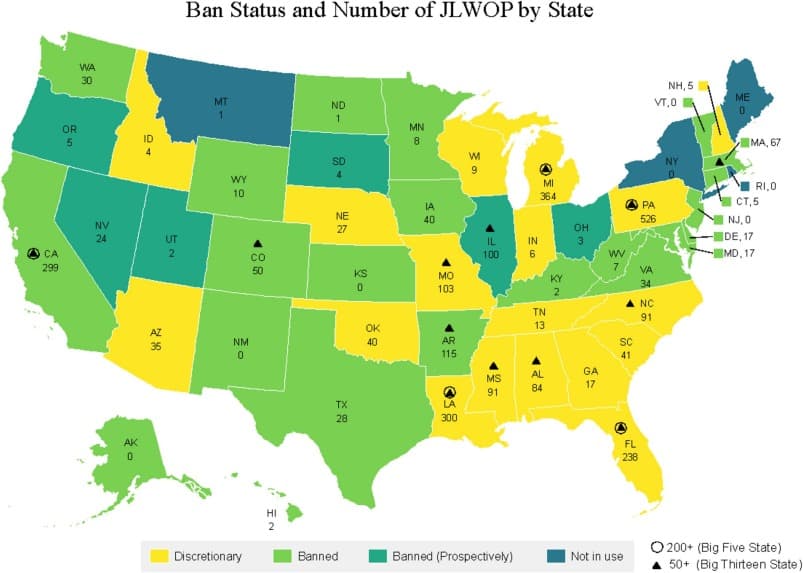
The above aggregate national view provides a critical update current as of January 2024 on the overall status of resentencing and decarceration for the juvenile lifer population. In addition, it is important to describe fragmented policy approaches in the aftermath of the Miller and Montgomery decisions and to understand state variation in resentencing and release statuses. To begin, Fig. 1 is a U.S. state map that summarizes current ban status and the number of JLWOP in each state. Pennsylvania has the most juvenile lifers (526, 18.1 % of all JLWOP). There are five states (California, Florida, Louisiana, Michigan, Pennsylvania) that have more than 200 juvenile lifers each and, together, these “Big Five” states account for approximately three-fifths (59.5 %) of all juvenile lifers across the nation. There are eight additional states (Alabama, Arkansas, Colorado, Illinois, Mississippi, Missouri, North Carolina, Massachusetts) that have more than 50 juvenile lifers, with three of these (Arkansas, Missouri, Illinois) having over 100 juvenile lifers each. Collectively, these 13 states count for roughly five-sixths (83.6 %) of all juvenile lifers. We refer to this larger group of states as the “Big Thirteen.” As of January 2024, a total of 28 states (56 %) have banned JLWOP sentences. More specifically, twenty-two states (44 %) have outright banned JLWOP sentences while the remaining 6 states (12 %) have banned these sentences prospectively. In 18 states (36 %), JLWOP sentences are still allowed given judicial discretion. Finally, four states (8 %) are categorized as ‘not in use’ indicating that JLWOP is technically on the books but not currently used. Regarding the ban status of the states with the highest number of JLWOP, 80 % percent of the Big Five states and 69 % of the Big Thirteen states have discretionary JLWOP sentencing.
Image

Fig. 1. Ban Status and Number of JLWOP by State.


Appendix A supplements Fig. 1 with the rate of juvenile lifers per 1 million population, state rankings by JLWOPs per population, the percentage of individuals in each state that have been resentenced, and the percentage of JLWOP who have returned to the community. Among the “Big Five” states by total JLWOP counts, Louisiana (1st), Pennsylvania (2nd), and Michigan (3rd) maintain a top five status when adjusting for (2020 U.S. Census) population; however, Florida (12th) and California (20th) do not. Focusing on the Big Thirteen, there are notable differences among these states with respect to the percentage of individuals who have been resentenced and the percentage released. Regarding resentencing, with only rare exceptions for a few unique cases, everyone (99 %) in California has been resentenced. However, in Alabama and North Carolina, 65 % and 68 % have been resentenced, respectively; perhaps it is not surprising that these two states also notably lag other states in percentage released. Regarding release in the Big Five states, Pennsylvania and Michigan have each released more than 1 in 2 juvenile lifers, Louisiana more than 1 in 3, Florida about 1 in 5, and California about 1 in 7. Aside from a very small handful of unique cases that do not fit the mold in each of the Big 5 states, juvenile lifers in California experienced legislative relief, those in Florida, Michigan, and Pennsylvania were resentenced, and a healthy majority in Louisiana were resentenced though about a third experienced legislative relief. Legislation in Louisiana created a new discretionary sentencing scheme whereby prosecutors decided whether or not to seek LWOP at resentencing. If they did not seek LWOP at resentencing, the individual received eligibility as set out in the statute. If they did seek LWOP, the case proceeded to a resentencing hearing where the judge chose between LWP and LWOP. Importantly then, variation in both the resentencing and release statuses across states, alongside difference in states' chosen mechanisms to comply with the Miller and Montgomeryrulings, points to the importance of building a better understanding of the degree to which state policy contexts shape equitable (or inequitable) resentencing and life course outcomes.

Fig. 2 provides a time-series window into the number of individuals each year who have an offense date that led to a JLWOP sentence prior to Miller, who have been resentenced, who have been released, and who have passed away. We include key court cases along with a few historical events along the timeline to help place these trends in context. The first JLWOP sentence stemmed from an incident in 1947. JLWOP was used sparingly for the next two decades; at the time of President Johnson's call for a War of Crime in 1965 there were just 10 total JLWOP sentences nationwide. Beginning in 1974, the year in which the famous Martinson’s (1974) “what works” paper was published, and continuing through 2010, incidents resulting in JLWOP were occurring at a clip of at least 21 per year, peaking at 222 per year in 1995, the year in which DiLulio advanced the super-predator notion (DiLulio, 1995). From 1995 onward, there was a general downward trend in JLWOP sentences until about 2003, followed by an uptick through 2007, and then a continued lessening of JLWOP usage up to the Miller decision.
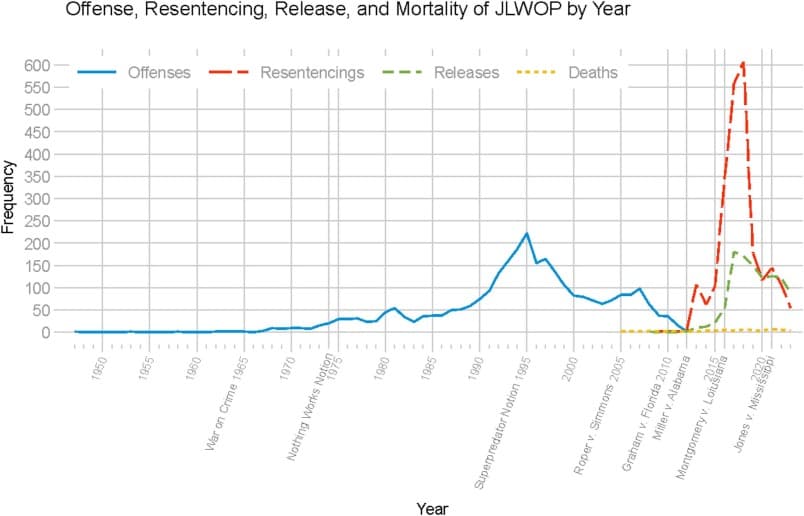
Image 2

Fig. 2. Offense, Resentencing, Release, and Mortality of JLWOP by Year.

Note: Data include those individuals sentenced to LWOP as minors pre-Miller.


Next, we focus on the number of resentencings occurring each year through any mechanism. There were only five JLWOP cases resentenced in 2012, with a majority occurring in that year, after the June 25th Millerruling. However, over the three years leading up to the Montgomery decision, there were nearly 275 resentencings completed with more than 100 in 2013 and 2015. Findings reveal 350 resentencings in 2016, with all but a small handful coming after the January 25th Montgomery ruling—which opened the door for second chances to the full JLWOP population. Resentencing surged again in 2017 topping 550 that year and then peaked in 2018 eclipsing 600 before sharply declining in 2019. In 2016, the year of the Montgomerydecision, 54 juvenile lifers were released bringing the total number released to 100. In 2017, the year with the most releases, more than 180 juvenile lifers across the nation returned to communities. More than 120 juvenile lifers have been released every year between 2017 and 2022, and in 2023 the cumulative number of JLWOP released eclipsed 1000.

Regarding mortality, data reveal that the first known death occurred in 2005. Up to and including the year in which the Miller decision occurred (i.e., 2012), there were five years in which a single individual passed away and three years in which there were multiple deaths. However, over the course of the next decade, there has not been a single year yet where multiple deaths have not occurred. Recall, individuals sentenced to JLWOP have died from homicide and suicide, as well as illness/natural causes. Taken together, the increasing mortality rate serves as both a reminder of the aging nature of this population and signals the importance of the need to study and understand complex mental and physical health (and safety) needs among those who have been incarcerated for long periods of the life course.

7. Discussion

The present study draws on important work (e.g., Mills et al., 2015; Nellis, 2012) to conduct the most comprehensive national tracking effort of the JLWOP population to date. Despite the significant role of advocacy organizations in spearheading national tracking efforts and accumulating valuable knowledge, a gap remains: prior to this study, the research literature lacks an all-encompassing national repository of data detailing the experiences of juvenile lifers, a notable omission given their increasingly prominent presence in prisons over recent decades (Parker, 2005). A comprehensive database is pivotal for enhancing our understanding of national decarceration efforts and for laying a solid foundation for future research, particularly in scrutinizing the equity of the implementation of landmark rulings like Miller and Montgomery. Our study makes a substantial contribution to the literature and breaks new ground by addressing several critical first-order descriptive questions about this national population.

The current study also presents the first national overview of the policy landscape related to JLWOP sentencing post-Miller. The findings unveil a landscape rife with disparities in resentencing and release practices across various states. Our concentration on the changing legal and policy contexts following the Miller and Montgomery decisions are a vital contribution and provide a more in-depth understanding of how state-level policies may be impacting the lives of those serving JLWOP sentences. Additionally, this study addresses the historical inattention from the research community, notably from criminologists, on individuals with life sentences. By comprehensively tracking the juvenile lifer population and state-level legislation related to JLWOP we offer statistics to both the criminological community and policymakers, to support criminal legal reform efforts. With these data, we hope to provide guidance for reform, specifically focused on the procedures of resentencing and the opportunities for release and reintegration of life-sentenced individuals. Moreover, this tracking effort provides a roadmap for following other populations serving life and long sentences on how to provide national and state-level snapshots and the policy landscape in these related areas. Although some of these efforts may be similar, researchers would need to consider how policies that influence JLWOP may spillover to influence these other populations as well, and consider other policies that more directly target those serving virtual or defacto life sentences.

7.1. Understanding the JLWOP population: ongoing analysis required

Our research signifies an urgent need for ongoing analysis of the JLWOP population, particularly concerning their legal statuses. As we navigate the evolving landscape following landmark legal decisions like Millerand Montgomery, continual monitoring and analysis of the JLWOP population is paramount. The present study offers a fundamental baseline of who these individuals are—their demographic makeup, the nature of their convictions, and their current carceral statuses—all of which are pivotal for developing tailored approaches to resentencing and reintegration.

Unsurprisingly, findings from our analysis reveal that an overwhelming majority of juvenile lifers are Black men consistent with previous studies, where JLWOP sentences are noted to be imposed on Black youth at rates up to ten times that of White youth (Maur & Nellis, 2018; Mills et al., 2015; Parker, 2005). Our study also shows that five states—California, Florida, Louisiana, Michigan, Pennsylvania (i.e., the “Big Five”)—have more than 200 juvenile lifers each and together, account for approximately 60 % of all juvenile lifers nationally, aligning with prior knowledge (Mills et al., 2015; Rovner, 2020). Eight additional states (Alabama, Arkansas, Colorado, Illinois, Mississippi, Missouri, North Carolina, Massachusetts) each have more than 50 juvenile lifers. With the Big Five included, these 13 states collectively account for almost 85 % of the nation's juvenile lifers. Beyond the state variation in the imposition of JLWOP sentences, we see significant variation in the ban status by state (see Fig. 1) as well as the rates of release by state (see Appendix A) and by time (see Fig. 2), illustrating a complex and dynamic policy and practice landscape. By tracking and describing the national population of JLWOP and associated policy landscape, this study sets a key baseline in the wake of the Miller and Montgomery decisions needed for future empirical work.

7.2. Policy perspectives on second chances: exploring effective strategies

The current study's findings underscore the potentially prominent role of state policies and their implementation in determining the fate of individuals sentenced to life without parole and highlight the importance of developing effective strategies for states to provide second chances to individuals serving life and extended sentences. For instance, results demonstrate variability in how states have responded to the federal mandates set by Miller and Montgomery, presenting both challenges and opportunities for policy reform. For example, California has effectively resentenced everyone. Other states, such as Alabama and North Carolina, have taken a slower approach with their resentencings with low rates of release that follow. Yet, the speed at which resentencings have occurred is not the only thing that contributes to reducing mass incarceration. The resentencing mechanism that a state uses—legislative relief vis-à-vis resentencing—was associated with an individual's chances of being released (see Table 2). The stark contrasts between states in their readiness to release individuals point to a fragmented approach to implementing post-Miller and Montgomery resentencing. However, it is unclear the degree to which the resentencing mechanisms or other factors such as parole board function, carceral contexts, or an incarcerated person's experiences and behavior contribute to these differences. More research is needed to understand individual and contextual factors that contribute to (in)equitable outcomes in resentencing and release.

State-level variation affects more than just legal or procedural aspects; it significantly influences social justice and equity, as well as the capacity and infrastructure available to support reentry and reintegration. The state-dependent nature of release opportunities raises ethical and legal concerns, especially as we see how geographic location appears to influence an individual's life trajectory—pre- and post-incarceration—thereby challenging the principles of fairness and uniform justice. For example, 28 states (56 %) have banned JLWOP sentences since Miller, though six states (12 %) only banned JLWOP sentences prospectively. In contrast, JLWOP sentences remain discretionary in 18 states (36 %), and in four additional states (8 %), JLWOP sentences are technically legal but are not actually in use.

In this way, the Miller and Montgomery decisions have positioned the JLWOP population as a key test case for assessing safe and equitable decarceration efforts for people convicted of homicide offenses. The findings in this study highlight a need for more research in service of developing equitable and effective policies, especially in states where resentencing and release practices are inconsistent or overly punitive. A comprehensive study of state policy decisions could yield significant applications for sentence modification, reentry policies, and practices—extending beyond minors recieving LWOP sentences. For example, Massachusetts recently established a landmark precedent by banning life without parole sentences for individuals under 21 years old in Commonwealth v. Mattis (2024), a decision that was consistent with scientific evidence that young adults also have a diminished capacity to fully understand the risks and consequences of their actions (Steinberg, 2008). Michigan is also hearing cases to rule against the use of LWOP sentences for those who committed homicide offenses at the age of 18 years old, and in Pennsylvania ongoing legislative debates aim to reform life without parole sentences for young people, particularly for certain types of homicide. Insights from the experiences of juvenile lifers could inform legislation extending the ending of life without parole sentences to young adults involved in homicide up to the age of 25. Effective second chance policies should balance public safety concerns with the potential for rehabilitation and recognize the unique developmental needs of individuals sentenced as youth. In the future, policy surveillance study (Burris et al., 2016) will allow us to provide further nuanced views on state-level variations in policymaking and highlight patterns in second chance reform measures. Systematically examining the variations in policy formulation and implementation around decarceration and second chances for juvenile lifers can facilitate recommendations for best practices, including for additional reform measures for JLWOP and other groups of lifers and people serving long sentences.

7.3. Limitations and directions for future study

National efforts to combat mass incarceration have primarily centered on decarcerating individuals convicted of non-violent felony offenses (Daftary-Kapur & Zottoli, 2020; Kazemian & Travis, 2015). Yet, there has been a lack of focus on those serving long-term sentences for violent crimes, a significant oversight given that over 60 % of state prison inmates are convicted of such offenses (Carson, 2018). This issue is particularly acute for those serving life sentences for homicide. To effectively address mass incarceration, it is imperative for criminal justice system actors and policymakers to reconsider the length of sentences being imposed for those whose actions are considered to warrant prison time, alongside other efforts to reduce prosecution or prison admissions where appropriate (e.g., progressive prosecution; see Davis, 2019). A key factor driving mass incarceration is the substantial increase in the duration of imprisonment, especially the rise in life sentences. Persisting with extreme sentences is inconsistent with evidence showing that prolonged incarceration offers minimal deterrent effects, tends to incapacitate older individuals who pose a diminished public safety threat, and is a significant financial strain (National Research Council, 2014)—further diverting resources from more efficacious public safety strategies. While we highlight the importance of decarcerating individuals convicted of violent offenses as a vital measure to address the widespread problem of mass incarceration, this study can only provide both a historical lookback and current national snapshot of an evolving landscape. This limitation underscores the need for a more dynamic, ongoing data collection and analysis mechanism; the next phase of research and policy development should focus on creating a national data dashboard. Such a tool would enable researchers, policymakers, and the public to access accurate, up-to-date information on individuals serving life sentences for violent crimes. Investing in this data infrastructure is essential for crafting targeted interventions that address the complexities of mass incarceration, ensuring that efforts to reduce the prison population are informed by a clear, comprehensive picture of those it comprises. Departments of corrections and related agencies play a crucial role in making data more accessible for researchers and policymakers in real-time. By improving data collection and sharing practices, these agencies can provide accurate and timely information that supports evidence-based decision-making and policy development, especially in relation to developing and implementing second chance policies.

As juvenile lifers reenter society, it is vital to understand the ramifications of prolonged confinement on their personal development and how this impacts their reintegration into society, especially as most transitioned from adolescence to adulthood while incarcerated. Research on the unique experiences of the very young and very old post-release is scarce (Laub & Sampson, 2003). Most studies have focused on the effects of long-term imprisonment within prison settings, centering on recidivism and basic social adjustment rather than exploring in-depth psychosocial changes (Kim, 2012; Kokkalera & Marques, 2022; Maur & Nellis, 2018; Mauer et al., 2004; Mears, Cochran, & Siennick, 2013; Weisberg, Mukamal, & Segall, 2011). Juvenile lifers re-entering society face numerous challenges, including limited access to public housing and employment opportunities (Bennett, 2022; Brydon, 2021; Daftary-Kapur, Zottoli, Faust, & Schneider, 2022; Franke, 2023; Travis, 2005), with older individuals encountering additional age-related discrimination in the job market (Kazemian & Travis, 2015; Liem, 2016). We also know that decades in prison can lead to significant health issues (Massoglia & Pridemore, 2015) and recent scholarship has drawn attention to the importance of meeting physical and mental health needs for better reentry success (e.g., Link, Ward, & Stansfield, 2019). Further, juvenile lifers are returning to a modern society that looks and functions very differently from the one in which they lived in during their adolescence. Taken together, future research should include comprehensive assessment of risk and protective factors, employment readiness, educational background, social supports, health and wellbeing, and carceral experiences. For those who have been released, barriers and facilitators to reintegration, the impact of criminal justice debt, and exploration of subjective experiences related to rehabilitation and reentry are needed.

8. Conclusion

In the wake of the landmark Supreme Court rulings in Miller and Montgomery, our research offers a critical national and state-level overview of JLWOP sentences in the United States. Our findings reveal significant disparities in resentencing and release processes across states, underscoring the pressing need for a comprehensive, national database to inform equitable decarceration efforts. Additionally, the study also highlights the evolving policy landscape's impact on juvenile lifers, advocating for continued analysis to ensure equitable implementation of these pivotal rulings. By documenting state-level variations in JLWOP sentencing, this research lays a critical foundation for future research and policy reform aimed at remedying inequities within the criminal justice system. Ultimately, we call for a collaborative effort among scholars, policymakers, and practitioners to develop and implement reforms that recognize the potential for rehabilitation and reintegration of juvenile lifers and to afford second chances for equitable and safe decarceration for those sentenced to life and other long sentences.

Open Article as PDF

Abstract

Objective: The movement to end mass incarceration has largely concentrated on people serving shorter sentences for non-violent offenses. There has been less consideration for the 1 in 7 people in prison serving life sentences, overwhelmingly for violent offenses, including those serving juvenile life without parole (JLWOP). Recent U.S. Supreme Court decisions result in a pressing need for data on second chance considerations for JLWOP. This study tracks outcomes of the national population of juvenile lifers. Data/methods: We cross-reference data to identify the JLWOP population at the time of Miller (N =2904) to build a demographic profile and track resentencing, release, and mortality statuses. Statistics and data visualization are used to establish national and state-level baselines. Results: Findings reveal more than 2500 individuals have been resentenced and more than 1000 have been released. There is notable state variation in the number of JLWOP sentences, the extent to which JLWOP is still allowed, sentence review mechanisms, and percentage of juvenile lifers released. Conclusions/implications: The present study provides an important foundation for subsequent work to examine equity in the implementation of Miller and Montgomery within and across states, and to study reentry of an aging population that has spent critical life stages behind bars.

Summary

The United States has a very high rate of people in prison, with almost two million individuals held in state and federal facilities. This high rate is five times what it was 50 years ago, showing how much the country has relied on putting people in prison for a long time. Life and long sentences are a big part of this problem, given at higher rates than anywhere else in the world. These sentences keep people in prison for decades, sometimes their entire lives, and their effects add up over time.

One out of every seven people in U.S. prisons is serving a life sentence, which includes sentences with or without the chance of parole, and sentences of 40 years or more. More than half of all people in U.S. prisons are serving sentences of 10 years or longer. Keeping people in prison for long periods is generally not needed for public safety and is very expensive for taxpayers, especially as people get older in prison. Studies show that most people involved in criminal behavior stop these activities as they age, usually by early adulthood. This is especially true for people with life sentences, who often change and mature significantly over time, becoming different from who they were when they committed their offense. Therefore, long sentences often go against what is known about community safety and add to the problem of an aging prison population.

Efforts to reduce the number of people in prison have mostly focused on those convicted of non-violent crimes. Less attention has been given to individuals serving long sentences for violent crimes, even though over 60% of people in state prisons were convicted of such offenses. The possibility of a second chance is even smaller for those serving life sentences for homicide. However, two important Supreme Court decisions have required that children convicted of homicide and sentenced to life without parole must be given a second chance. This type of sentence, known as Juvenile Life Without Parole (JLWOP), was given to people under 18 who were tried as adults for homicide. JLWOP sentences increased a lot in the 1980s and 1990s, during a time when society viewed these youth as very dangerous, implying they should never return to society. Before the Miller ruling, nearly 12,000 people were sentenced to life for crimes committed as children. Among these, over 2,000 were serving life without parole, and nearly 10,000 were serving life with parole or virtual life sentences.

The United States is the only developed country in the world that sentences children to life without parole, which goes against international laws, including a United Nations rule that prohibits life sentences for juveniles. Sentencing children to JLWOP is a major human rights concern. Recently, the UN Human Rights Committee has asked the U.S. to stop giving life sentences without parole for all ages and to end these sentences for juveniles. This request is part of broader concerns about human rights, particularly how these sentences affect people of African descent.

There have been few formal studies on people sentenced to JLWOP. Most reports have been created for public awareness and advocacy. For instance, a key report by Human Rights Watch and Amnesty International in 2005 was the first to state that the U.S. leads the world in sentencing children to life in prison for homicide. Advocacy groups like The Sentencing Project and The Campaign for the Fair Sentencing of Youth have done the most thorough national tracking. Their efforts have influenced laws and policies related to JLWOP and other ways to reduce the number of people in prison. These efforts have provided important information about the lives of juvenile lifers before prison (such as family abuse, school problems, poverty, and racial differences), as well as details about their lives and ongoing inequalities while in prison. This work has helped to ban extreme sentences for children in the U.S., including JLWOP. However, recent formal research on the JLWOP population and related reforms has mostly come from smaller studies in single states or cities, which have a limited focus.

While these studies are very helpful, the full national picture of the JLWOP population is still unclear and incomplete. This lack of information is especially concerning because many juvenile lifers were in prison before the Miller ruling. This shows a big gap in research, as there is no full collection of national data on the lives of juvenile lifers. Because formal academic records are missing, researchers have had to rely on articles from journalists, advocacy groups, and people in prison. These sources have been useful for early advocacy about JLWOP sentences but do not offer a complete picture. This study provides the most thorough national tracking of the JLWOP population to date. For the first time, by giving exact numbers, it offers a detailed look at the full demographic information of this group, along with their current resentencing and release statuses, and other key outcomes like deaths and exonerations. The study also examines how these outcomes have changed over time and considers how different state policies and resentencing methods affect them.

Policy Changes After Miller and Montgomery

In Miller v. Alabama (2012), the Supreme Court ruled that mandatory life sentences without parole for juveniles were unconstitutional. This decision meant that judges could not automatically give a life sentence without parole regardless of the young person's age. After Miller, judges must consider a young person's age and related factors as reasons to give a lighter sentence before deciding on a JLWOP sentence. The court also said that JLWOP would likely be unconstitutional for most young people. Four years later, in Montgomery v. Louisiana (2016), the court made this rule apply to people who were already serving JLWOP sentences before the Miller decision. Previous research estimated that this ruling affected more than 2,000 people serving such sentences in 43 states, though the exact numbers vary. Despite the clear federal rules from Miller and Montgomery, states were given little guidance on how to follow them. Each state had to create its own policies for sentencing, parole, and reviewing sentences. This led to many differences in how Miller and Montgomery were put into practice.

How states have put these policies into practice after Miller and Montgomery varies greatly. This is partly due to the sentencing rules they had before Miller, decisions made by state supreme courts after Miller and Montgomery, and new state laws. For example, some states like Alaska, Kansas, and Maine did not use mandatory life sentences before Miller and had no one serving a JLWOP sentence. Several states, such as Massachusetts, West Virginia, and Texas, banned mandatory JLWOP sentences for both new and old cases after Miller but before Montgomery. Other states, like Colorado and Kentucky, banned them only for new cases. Still, other states, like Georgia, Washington, and Wisconsin, kept the option to use JLWOP sentences at a judge's discretion. After Montgomery, many more reforms were adopted. Additional states banned JLWOP, and others passed laws to make sure that the factors mentioned in Miller were considered before imposing a JLWOP sentence. However, the Jones v. Mississippi decision in 2021 stated that judges do not need to make a separate finding that a minor is permanently unable to change in order to give a life sentence without parole in states where it is still allowed at a judge's choice.

State differences in how sentences are reviewed and how people serving JLWOP sentences from before Miller are released are also notable. For example, some states, like Michigan, review cases one by one. This means a judge reviews each case in court to decide if the person will be resentenced to a certain number of years or to life without parole again. In contrast, the state legislature in Ohio made everyone serving a JLWOP sentence from before Miller eligible for parole. This allows the regular parole process to decide who should be released and when. Maryland, as another example, removed JLWOP as a sentencing option. It now uses a process where judges review past cases to decide whether and how to change a sentence for anyone given more than 20 years for crimes committed as a minor.

Policies that offer a "second look," often called "second chance reforms," have changed a lot since Miller and Montgomery, even within the same state over short periods. For example, California created a way for people serving JLWOP to ask for a new sentencing hearing through California Senate Bill 9 (2012). In 2017, California Senate Bill 394 made all people serving a JLWOP sentence automatically eligible for a special Youth Offender Parole Hearing after serving 25 years. This bill also extended these hearings to people serving life sentences for crimes committed when they were under 25, and all these rules apply to past cases as well. While this study focuses on the JLWOP population, these examples show how JLWOP policies can influence sentencing, second chances, and parole policies for other groups serving long sentences.

It is important to study this group of people and the policies that guide how children are sentenced for violent crimes. The Miller and Montgomery decisions have made the JLWOP population a test case for how to safely and fairly reduce the number of people in prison, especially for individuals convicted of homicide as juveniles, who society often sees as the most dangerous and unfit to return to the community. A clearer picture and systematic record of the status of the juvenile lifer population, along with the national policy landscape, are crucial for ongoing policy reform, public safety, and research related to life and long sentences, which are major causes of the mass incarceration problem. This study combines data from The Campaign for the Fair Sentencing of Youth and The Sentencing Project to identify the national population of individuals sentenced to JLWOP at the time of Miller. It also tracks their resentencing and release statuses and documents how state-level policies related to JLWOP sentencing have varied since Miller.

Current Study

This study addresses a critical need to understand the current resentencing and imprisonment status of the juvenile lifer population at both national and state levels. A systematic study of the JLWOP population can have important practical uses for policies related to sentence changes and returning to society. It can also help improve understanding of how life events affect individuals who have spent decades in prison. Several research goals help to establish a necessary starting point for future research and policy work. First, the study describes the basic information (such as race, gender, current age, age at offense, and type of offense) of the national population of individuals sentenced to JLWOP before Miller. Second, it describes the current resentencing statuses, including the methods and results of resentencing, and the release statuses of the JLWOP population. In doing so, it documents how often JLWOP is given again during resentencings and whether the methods used for resentencing are linked to release outcomes. Third, it records the number of individuals who have been granted a new trial, had their sentence reduced, were found innocent, and/or have died. Fourth, it analyzes JLWOP offenses, resentencings, releases, and deaths in this population over time, considering the historical context. Finally, it analyzes how JLWOP statuses, usage, resentencing, and release statuses vary by state.

Data & Methods

Data

This study uses two types of data. The first type includes individual information from an ongoing effort to collect records on the entire known national population of individuals sentenced to JLWOP before Miller (2,904 people). To create this tracking database, various sources were used, such as official prison records, court documents, court decisions, information from lawyers, online databases, and newspaper articles. This ongoing data collection includes details on many factors, such as demographics (e.g., age, sex, race, birth date), geographic information (e.g., county, state), offense characteristics (e.g., offense date, age at offense, number of victims), resentencing information (e.g., resentencing date, methods used for resentencing, and new sentence lengths), exoneration status, release status, and deaths. Second, this archival data is supplemented with state-level information gathered through ongoing policy analysis. This involves tracking state laws and supreme court rulings to measure how much JLWOP sentences are allowed in each state. Specifically, several variables from the individual-level database are grouped by state and combined with policy data on whether JLWOP is banned across the nation. This allows for a look at the resentencing and release statuses of individuals within the specific policy contexts of their states. Since both policies and individuals can change, all data were last updated in January 2024.

Measures

Demographics

Race is categorized as White, Black, Hispanic, and Other; "Other" combines Asian and Native American because these groups made up less than 2% and 1% of the population, respectively. Sex is recorded as female or male; no other information about sex or gender was available. Current age and age at offense are both measured in years. Dates for offenses, resentencing, release, and death are recorded in years to show changes over time. First-degree murder indicates whether the person was convicted of second/third-degree murder or first-degree murder.

Criminal Justice Data

Resentencing status is a category variable that places juvenile lifers into three groups: not yet resentenced, resentenced, and other. More detailed information is provided in the results section when describing this measure. Resentencing mechanism is a category variable showing how juvenile lifers were considered for a sentence change: judicial decision, legislative relief, resentencing, multiple mechanisms, and other. Minimum sentence is a category variable that divides resentenced juvenile lifers into five groups: 0 to less than 25 years, 25 to less than 40 years, virtual life or 40+ years, life-reviewable, and life.

Release status is a variable that shows whether a person has been released from prison, coded as not released or released. Similar to resentencing status, additional details are given to clarify who was released through traditional means versus commutation or exoneration. To offer a more detailed view, several separate but not mutually exclusive indicator variables are included: awarded retrial, commuted, exonerated, deceased, and ineligible/affirmed/relief denied. The last of these combines cases where relief was denied, individuals were found ineligible for resentencing or parole, or their JLWOP sentence was upheld. All these indicator variables are coded 0 if the status is not present (e.g., not deceased) and 1 if it is (e.g., deceased). Cause of death is a category variable: homicide, suicide, illness/natural cause, and unknown.

Policy-Level Data

JLWOP ban status is a measure that shows the current extent to which JLWOP has been restricted in each state, categorized as: Discretionary, Banned, Banned (Prospectively), and Not in use.

Analytic Plan

To describe the characteristics and imprisonment statuses of the U.S. juvenile lifer population, several data visualization and statistical methods are used. The study begins with a table of descriptive statistics and includes findings from analyses that compare two variables. Then, it highlights differences in how JLWOP sentences are used and current policy practices across states by creating a U.S. state map. More specifically, the map displays the current JLWOP ban status as of January 2024, along with the total number of JLWOP cases in each state. This information is supported by an appendix with more detailed state-level breakdowns, including resentencing and release statuses by state, JLWOP rates per population (adjusted to the 2020 U.S. Census), and corresponding state rankings. Finally, line graphs are used to show historical trends in offenses, resentencings, releases, and deaths, placing these trends within their social and legal contexts.

Results

Table 1 provides descriptive statistics on the demographics, statuses, and mechanisms for the JLWOP population (2,904 individuals). The vast majority of individuals sentenced to JLWOP before Miller are male (97.1%). A large majority of juvenile lifers are Black (61.1%), with the remaining officially classified as White (26.9%), Hispanic (9.4%), and Other (2.6%, which includes approximately 1.7% Asian and 0.9% Native American). While most of those sentenced to JLWOP were convicted of first-degree murder, nearly one in six (15.5%) juvenile lifers received JLWOP for a conviction of second- or third-degree murder. The average age at the time of the offense was 16.3 years. A slight majority of individuals were 17 years old (52.7%) at the time of the offense. About 32% and 12% of juvenile lifers were 16 and 15 years old, respectively, when they committed the offense. Finally, a total of 3% were just 13 or 14 years old at the time of the homicide that led to their JLWOP sentence. The oldest living juvenile lifer is 86 years old, while the youngest juvenile lifer sentenced before Miller is 27 years old. The average juvenile lifer is 45.8 years old.

A large majority of the JLWOP population (87.4%) has been resentenced, but nearly 1 in 10 JLWOP individuals (9.6%) are presumed eligible but still waiting for resentencing. A relatively small number of JLWOP cases (3.0%) were classified as ‘other’ because these individuals cannot or likely will not be resentenced based on the Miller and Montgomery rulings. More specifically, among the 86 cases classified as ‘other’, some were granted a new trial (9.3%), resentenced due to ineffective legal help before Miller (about 1%), had their sentence reduced before resentencing (12.8%), died before resentencing (51.2%), were found innocent (24.4%), or escaped and lived under protection in another state and later passed away (about 1%). It should be noted that among the 2,539 individuals currently classified as resentenced, 55 (2.2%) were denied relief, found ineligible for resentencing under the law, and/or had their JLWOP sentence upheld in appeals courts.

Among juvenile lifers who were resentenced, a significant majority (69.1%) underwent a full resentencing process, while about a quarter (24.5%) benefited from broad legislative changes. Less than 1 in 20 juvenile lifers (4.8%) had their sentence changed due to a state appeals court decision. In a small number of cases, often due to rapid changes in state policy, juvenile lifers were affected by multiple resentencing methods (1.3%), and a few unusual cases were categorized as "other" (0.4%).

Among juvenile lifers who have been resentenced, the most common minimum sentence category is 25 to less than 40 years in prison (61.6%). Virtual life sentences (i.e., sentences of 40+ years) are the minimum sentence for about 18.1% of individuals, while 0 to less than 25 years is the minimum sentence for 16% of resentenced juvenile lifers. It is important to note that life sentences are being reissued at relatively low rates; still, roughly 4 out of every 100 individuals (4.1%) have received a new minimum sentence that is life or life-reviewable (0.2%). Overall, these sentence changes are leading to a significant number of people returning to the community, often after spending decades in prison.

As of January 2024, a total of 1,070 individuals have been released, which makes up 36.8% of those sentenced to JLWOP before Miller. More than 95% of released individuals gained their freedom because of resentencing after the Miller/Montgomery rulings (1,033 individuals). However, about 5 out of every 100 people have returned to the community because they were granted a new trial that led to their freedom, had their sentence reduced, and/or were found innocent. This study examines whether there are any links between release and the method of resentencing, especially among the three main methods: resentencing, legislative relief, and appellate judicial decision (see Table 2). Approximately 48% of individuals whose sentence review method was an appellate judicial decision, and 46% of those whose method was individualized resentencing, have been released to date. In comparison, however, only 28% of those who were resentenced through legislative relief have been released. A statistical analysis (Pearson chi-square cross-tabulation) shows that the type of mechanism is significantly linked to the likelihood of release. More specifically, an analysis of adjusted residuals reveals that juvenile lifers who were resentenced through legislative relief are significantly less likely to be released, while those whose mechanism was resentencing are more likely to be released than would be expected by chance.

It is important to note that about 1 out of every 100 individuals in these data spent significant parts of their lives in prison for an offense for which they would later be found innocent (31 individuals). Sentence reductions (commutations) have occurred but have been used somewhat rarely to date (13 individuals), and a few individuals have been granted a new trial (10 individuals), each of which typically, though not always, led to release. To date, a total of 75 juvenile lifers (2.6%) are known to have died. Although the causes of death are currently unknown for about four out of ten juvenile lifers who have passed away, available death data show that individuals sentenced to JLWOP have died from homicide (8%), suicide (12%), and illness/natural causes (37.3%).

The national overview provides an important update as of January 2024 on the overall status of resentencing and reducing the number of people in prison for the juvenile lifer population. In addition, it is important to describe the varied policy approaches after the Miller and Montgomery decisions and to understand how resentencing and release statuses differ by state. To start, Figure 1 is a U.S. state map that summarizes the current ban status and the number of JLWOP cases in each state. Pennsylvania has the most juvenile lifers (526, 18.1% of all JLWOP). There are five states (California, Florida, Louisiana, Michigan, Pennsylvania) that each have more than 200 juvenile lifers; together, these "Big Five" states account for approximately three-fifths (59.5%) of all juvenile lifers across the nation. There are eight additional states (Alabama, Arkansas, Colorado, Illinois, Mississippi, Missouri, North Carolina, Massachusetts) that each have more than 50 juvenile lifers, with three of these (Arkansas, Missouri, Illinois) having over 100 juvenile lifers each. Combined, these 13 states account for roughly five-sixths (83.6%) of all juvenile lifers. This larger group of states is referred to as the "Big Thirteen." As of January 2024, a total of 28 states (56%) have banned JLWOP sentences. More specifically, 22 states (44%) have completely banned JLWOP sentences, while the remaining 6 states (12%) have banned these sentences only for future cases. In 18 states (36%), JLWOP sentences are still allowed at the judge's discretion. Finally, four states (8%) are categorized as ‘not in use’, meaning that JLWOP is technically on the books but not currently being applied. Regarding the ban status of the states with the highest number of JLWOP cases, 80% of the Big Five states and 69% of the Big Thirteen states allow JLWOP sentencing at the judge's discretion.

Appendix A adds to Figure 1 by showing the rate of juvenile lifers per 1 million people, state rankings by JLWOPs per population, the percentage of individuals in each state who have been resentenced, and the percentage of JLWOP individuals who have returned to the community. Among the "Big Five" states by total JLWOP counts, Louisiana (1st), Pennsylvania (2nd), and Michigan (3rd) remain in the top five when adjusted for population (2020 U.S. Census). However, Florida (12th) and California (20th) do not. Focusing on the Big Thirteen, there are notable differences among these states regarding the percentage of individuals who have been resentenced and the percentage released. Regarding resentencing, with only rare exceptions for a few unique cases, everyone (99%) in California has been resentenced. However, in Alabama and North Carolina, 65% and 68% have been resentenced, respectively; perhaps it is not surprising that these two states also significantly lag other states in the percentage released. Regarding release in the Big Five states, Pennsylvania and Michigan have each released more than 1 in 2 juvenile lifers, Louisiana more than 1 in 3, Florida about 1 in 5, and California about 1 in 7. Aside from a very small number of unique cases that do not fit the pattern in each of the Big 5 states, juvenile lifers in California experienced legislative relief, those in Florida, Michigan, and Pennsylvania were resentenced, and a large majority in Louisiana were resentenced, though about a third experienced legislative relief. Legislation in Louisiana created a new system where prosecutors decided whether or not to seek life without parole at resentencing. If they did not seek life without parole at resentencing, the individual became eligible for parole as defined by law. If they did seek life without parole, the case went to a resentencing hearing where the judge chose between life with parole and life without parole. Therefore, variations in both the resentencing and release statuses across states, along with differences in the states' chosen methods to comply with the Miller and Montgomery rulings, point to the importance of better understanding how state policy contexts shape fair (or unfair) resentencing and life outcomes.

Figure 2 shows a timeline of the number of individuals each year who committed an offense leading to a JLWOP sentence before Miller, who have been resentenced, released, and who have passed away. Key court cases and a few historical events are included on the timeline to help put these trends into context. The first JLWOP sentence resulted from an incident in 1947. JLWOP was rarely used for the next two decades; by the time President Johnson called for a War on Crime in 1965, there were only 10 total JLWOP sentences nationwide. Starting in 1974, the year the famous Martinson’s (1974) “what works” paper was published, and continuing through 2010, incidents leading to JLWOP were occurring at a rate of at least 21 per year, peaking at 222 per year in 1995, the year DiLulio introduced the super-predator idea. From 1995 onward, there was a general downward trend in JLWOP sentences until about 2003, followed by an increase through 2007, and then a continued decrease in JLWOP usage until the Miller decision.

Next, the focus is on the number of resentencings occurring each year through any method. Only five JLWOP cases were resentenced in 2012, with most occurring that year, after the Miller ruling on June 25th. However, in the three years leading up to the Montgomery decision, nearly 275 resentencings were completed, with over 100 in both 2013 and 2015. Findings show 350 resentencings in 2016, with all but a small number happening after the Montgomery ruling on January 25th, which opened the door for second chances for the entire JLWOP population. Resentencing surged again in 2017, exceeding 550 that year, and then peaked in 2018, going above 600, before sharply declining in 2019. In 2016, the year of the Montgomery decision, 54 juvenile lifers were released, bringing the total number released to 100. In 2017, the year with the most releases, more than 180 juvenile lifers across the nation returned to communities. More than 120 juvenile lifers have been released every year between 2017 and 2022, and in 2023, the total number of JLWOP individuals released passed 1,000.

Regarding deaths, data show that the first known death occurred in 2005. Up to and including the year of the Miller decision (2012), there were five years in which a single individual died and three years in which there were multiple deaths. However, over the next decade, there has not been a single year without multiple deaths. Recall that individuals sentenced to JLWOP have died from homicide, suicide, and illness/natural causes. Taken together, the increasing death rate serves as a reminder of the aging nature of this population and highlights the importance of studying and understanding the complex mental and physical health (and safety) needs of those who have been in prison for long periods of their lives.

Discussion

This study builds on important previous work to provide the most thorough national tracking of the JLWOP population to date. Although advocacy organizations have played a significant role in leading national tracking efforts and gathering valuable knowledge, there was still a gap. Before this study, research lacked a complete national collection of data detailing the experiences of juvenile lifers, which is a notable absence given their growing presence in prisons over recent decades. A comprehensive database is essential for improving understanding of national efforts to reduce the number of people in prison and for creating a strong base for future research, especially when examining how fairly major rulings like Miller and Montgomery have been put into practice. This study significantly contributes to existing knowledge and makes new advancements by answering several key descriptive questions about this national population.

This study also presents the first national overview of policies related to JLWOP sentencing after Miller. The findings reveal a situation with many differences in resentencing and release practices across various states. The focus on the changing legal and policy environments following the Miller and Montgomery decisions is a vital contribution and provides a deeper understanding of how state-level policies may be affecting the lives of those serving JLWOP sentences. Additionally, this study addresses the historical lack of attention from researchers, particularly criminologists, on individuals with life sentences. By thoroughly tracking the juvenile lifer population and state laws related to JLWOP, the study offers statistics to both the criminology community and policymakers to support reforms in the criminal justice system. With this data, the goal is to provide guidance for reform, specifically focusing on the procedures for resentencing and the opportunities for release and reintegration of individuals serving life sentences. Moreover, this tracking effort offers a blueprint for how to monitor other groups serving life and long sentences, providing national and state-level snapshots and detailing the policy landscape in these related areas. While some of these efforts may be similar, researchers would need to consider how policies that affect JLWOP might also impact these other populations, and to consider other policies that more directly target those serving virtual or de facto life sentences.

Understanding the JLWOP Population: Ongoing Analysis Required

The research highlights an urgent need for ongoing analysis of the JLWOP population, especially regarding their legal statuses. As the situation continues to change after important legal decisions like Miller and Montgomery, constant monitoring and analysis of the JLWOP population are crucial. This study provides a basic understanding of who these individuals are—their demographics, the nature of their convictions, and their current imprisonment statuses—all of which are vital for developing specific approaches to resentencing and reintegration.

As expected, the analysis shows that the vast majority of juvenile lifers are Black men, which aligns with previous studies that found JLWOP sentences are given to Black youth at rates up to ten times higher than to White youth. The study also reveals that five states—California, Florida, Louisiana, Michigan, Pennsylvania (referred to as the "Big Five")—each have over 200 juvenile lifers, and together, they account for approximately 60% of all juvenile lifers nationwide, which is consistent with earlier findings. Eight additional states (Alabama, Arkansas, Colorado, Illinois, Mississippi, Missouri, North Carolina, Massachusetts) each have more than 50 juvenile lifers. Including the Big Five, these 13 states together account for almost 85% of the nation's juvenile lifers. Beyond the state differences in how JLWOP sentences are imposed, there is significant variation in whether JLWOP is banned by state, as well as in the rates of release by state and over time. This illustrates a complex and changing landscape of policies and practices. By tracking and describing the national JLWOP population and the related policy environment, this study establishes a crucial baseline following the Miller and Montgomery decisions, which is needed for future research.

Policy Perspectives on Second Chances: Exploring Effective Strategies

The findings of this study emphasize the potentially significant role of state policies and how they are put into practice in determining the outcomes for individuals sentenced to life without parole. They also highlight the importance of creating effective strategies for states to offer second chances to individuals serving life and long sentences. For example, the results show differences in how states have responded to the federal rules set by Miller and Montgomery, which presents both challenges and opportunities for policy reform. California, for instance, has effectively resentenced almost everyone. Other states, such as Alabama and North Carolina, have moved more slowly with their resentencings, resulting in low release rates. However, the speed of resentencings is not the only factor that helps reduce the number of people in prison. The method a state uses for resentencing—whether legislative changes or individual resentencing—was linked to an individual's chances of being released. The clear differences between states in their willingness to release individuals suggest a fragmented approach to implementing post-Miller and Montgomery resentencing policies. However, it is unclear how much these resentencing methods or other factors, such as the function of parole boards, prison conditions, or an incarcerated person's experiences and behavior, contribute to these differences. More research is needed to understand the individual and situational factors that lead to fair (or unfair) outcomes in resentencing and release.

Differences at the state level affect more than just legal or procedural aspects; they significantly influence social justice and fairness, as well as the capacity and resources available to support people returning to society. The fact that opportunities for release depend on the state raises ethical and legal concerns, especially since geographic location appears to affect an individual's life path—both before and after prison. This challenges the principles of fairness and consistent justice. For example, 28 states (56%) have banned JLWOP sentences since Miller, though six states (12%) only banned them for future cases. In contrast, JLWOP sentences remain at the judge's discretion in 18 states (36%), and in four additional states (8%), JLWOP sentences are legally possible but are not currently used.

In this way, the Miller and Montgomery decisions have made the JLWOP population a key test case for evaluating efforts to reduce the prison population safely and fairly for people convicted of homicide offenses. The findings in this study highlight the need for more research to develop fair and effective policies, especially in states where resentencing and release practices are inconsistent or overly harsh. A thorough study of state policy decisions could have significant practical applications for sentence changes, reentry policies, and practices—extending beyond minors receiving life without parole sentences. For example, Massachusetts recently set an important new standard by banning life without parole sentences for individuals under 21 years old in Commonwealth v. Mattis (2024). This decision aligned with scientific evidence showing that young adults also have a reduced ability to fully understand the risks and results of their actions. Michigan is also hearing cases to rule against the use of life without parole sentences for those who committed homicide offenses at the age of 18, and in Pennsylvania, ongoing legislative discussions aim to reform life without parole sentences for young people, particularly for certain types of homicide. Insights from the experiences of juvenile lifers could inform laws that extend the ban on life without parole sentences to young adults involved in homicide up to the age of 25. Effective second chance policies should balance concerns for public safety with the potential for rehabilitation and recognize the unique developmental needs of individuals sentenced as youth. In the future, a policy surveillance study will allow for more detailed views on state-level variations in policymaking and will highlight patterns in second chance reform measures. Systematically examining the differences in how policies are created and put into practice regarding reducing the number of people in prison and offering second chances for juvenile lifers can help in making recommendations for best practices, including for additional reform measures for JLWOP and other groups of people serving life and long sentences.

Limitations and Directions for Future Study

National efforts to address mass incarceration have mainly focused on releasing individuals convicted of non-violent felony offenses. However, there has been a lack of focus on those serving long-term sentences for violent crimes, which is a significant oversight given that over 60% of state prison inmates are convicted of such offenses. This issue is particularly severe for those serving life sentences for homicide. To effectively address mass incarceration, it is essential for criminal justice system leaders and policymakers to rethink the length of sentences being given to those whose actions are considered to warrant prison time, alongside other efforts to reduce prosecutions or prison admissions where appropriate. A key factor driving mass incarceration is the significant increase in how long people stay in prison, especially the rise in life sentences. Continuing with extreme sentences goes against evidence showing that long imprisonment has minimal effects in stopping crime, tends to incapacitate older individuals who pose a reduced threat to public safety, and is a major financial burden—further taking away resources from more effective public safety strategies. While this study highlights the importance of releasing individuals convicted of violent offenses as a vital step to address the widespread problem of mass incarceration, it can only offer both a historical overview and a current national snapshot of a changing situation. This limitation emphasizes the need for a more dynamic, ongoing method of data collection and analysis; the next phase of research and policy development should focus on creating a national data dashboard. Such a tool would allow researchers, policymakers, and the public to access accurate, up-to-date information on individuals serving life sentences for violent crimes. Investing in this data infrastructure is essential for creating specific interventions that address the complexities of mass incarceration, ensuring that efforts to reduce the prison population are based on a clear, comprehensive picture of who it includes. Prison departments and related agencies play a crucial role in making data more accessible for researchers and policymakers in real-time. By improving data collection and sharing practices, these agencies can provide accurate and timely information that supports evidence-based decision-making and policy development, especially regarding creating and implementing second chance policies.

As juvenile lifers return to society, it is vital to understand how long periods of imprisonment affect their personal development and how this impacts their ability to reintegrate into society, especially since most transitioned from adolescence to adulthood while incarcerated. Research on the unique experiences of very young and very old individuals after release is limited. Most studies have focused on the effects of long-term imprisonment within prison settings, concentrating on whether people commit new crimes and on basic social adjustment, rather than exploring deep psychological and social changes. Juvenile lifers returning to society face many challenges, including limited access to public housing and job opportunities, with older individuals encountering additional age-related discrimination in the job market. It is also known that decades in prison can lead to significant health issues, and recent studies have highlighted the importance of meeting physical and mental health needs for better success after release. Furthermore, juvenile lifers are returning to a modern society that looks and functions very differently from the one they lived in during their adolescence. Therefore, future research should include a thorough assessment of risk and protective factors, job readiness, educational background, social support, health and well-being, and experiences in prison. For those who have been released, research is needed on the barriers and facilitators to reintegration, the impact of criminal justice debt, and an exploration of subjective experiences related to rehabilitation and returning to society.

Conclusion

Following the landmark Supreme Court rulings in Miller and Montgomery, this research provides a critical national and state-level overview of JLWOP sentences in the United States. The findings reveal significant differences in resentencing and release processes across states, highlighting the urgent need for a comprehensive national database to guide fair efforts to reduce the number of people in prison. Additionally, the study emphasizes how the changing policy landscape affects juvenile lifers, advocating for continued analysis to ensure these important rulings are put into practice fairly. By documenting state-level variations in JLWOP sentencing, this research establishes a crucial foundation for future studies and policy reforms aimed at correcting unfairness within the criminal justice system. Ultimately, there is a call for scholars, policymakers, and practitioners to work together to develop and implement reforms that acknowledge the potential for rehabilitation and reintegration of juvenile lifers, and to provide second chances for fair and safe reductions in the number of people serving life and other long sentences.

Open Article as PDF

Abstract

Objective: The movement to end mass incarceration has largely concentrated on people serving shorter sentences for non-violent offenses. There has been less consideration for the 1 in 7 people in prison serving life sentences, overwhelmingly for violent offenses, including those serving juvenile life without parole (JLWOP). Recent U.S. Supreme Court decisions result in a pressing need for data on second chance considerations for JLWOP. This study tracks outcomes of the national population of juvenile lifers. Data/methods: We cross-reference data to identify the JLWOP population at the time of Miller (N =2904) to build a demographic profile and track resentencing, release, and mortality statuses. Statistics and data visualization are used to establish national and state-level baselines. Results: Findings reveal more than 2500 individuals have been resentenced and more than 1000 have been released. There is notable state variation in the number of JLWOP sentences, the extent to which JLWOP is still allowed, sentence review mechanisms, and percentage of juvenile lifers released. Conclusions/implications: The present study provides an important foundation for subsequent work to examine equity in the implementation of Miller and Montgomery within and across states, and to study reentry of an aging population that has spent critical life stages behind bars.

Introduction

The United States has one of the highest rates of incarceration globally, with nearly two million people in prisons and jails. This reliance on incarceration has grown fivefold over the past 50 years, reflecting social and political trends. Long sentences, including life sentences, are a major reason for this high incarceration rate. Unlike shorter sentences, the effects of long sentences build up over time, as individuals spend many decades, or even their entire lives, in prison.

Currently, one out of every seven people in U.S. prisons is serving a life sentence. This includes sentences of life with parole, life without parole, and virtual life sentences (typically 40 years or more). Additionally, 54% of people in U.S. prisons are serving sentences of 10 years or longer. Keeping individuals incarcerated for extended periods is generally not necessary for public safety and is expensive for taxpayers, especially when dealing with an aging prison population. Research indicates that most people involved in criminal behavior eventually stop such activities, often in early adulthood. This is particularly true for those serving life sentences, who often undergo significant personal growth and change over time. As a result, they may become very different people from who they were when they committed their crimes. Therefore, life and long sentences often go against common ideas about community safety and contribute to an increasing number of older people in prison.

Efforts to reduce mass incarceration in the U.S. have mostly focused on releasing people convicted of non-violent crimes. However, less attention has been given to individuals serving long sentences for violent crimes, even though over 60% of people in state prisons were convicted of such offenses. Opportunities for a "second chance" are even more limited for those serving life sentences for homicide. Despite this, two important U.S. Supreme Court decisions have required second-chance considerations for individuals convicted of homicide as children and sentenced to juvenile life without the possibility of parole (JLWOP). A JLWOP sentence is given to individuals under 18 who are convicted of homicide and tried in adult courts. Such sentences became much more common during the "tough on crime" era of the 1980s and 1990s, based on the idea that these young people were exceptionally dangerous and should never return to society. It is estimated that nearly 12,000 people were sentenced to life for crimes committed as children across the 44 states that allowed JLWOP before the Miller ruling. Of these, over 2,000 juveniles were serving life without parole, and nearly 10,000 were serving life with parole or virtual life sentences.

Globally, the United States is the only developed country that sentences children to life without parole. This goes against international law, including Article 37 of the United Nations Convention on the Rights of the Child, which prohibits life sentences for juveniles. Sentencing children to life without parole is a major human rights concern. The UN Human Rights Committee has recently urged the U.S. to stop imposing life imprisonment without parole for people of all ages and to eliminate these sentences for juveniles. This call is part of broader concerns about human rights abuses, particularly the disproportionate impact on people of African descent.

There have been few studies that have directly examined individuals sentenced to JLWOP. Most reports on this group have been prepared for awareness and advocacy campaigns. For example, a significant analysis by Human Rights Watch and Amnesty International in 2005 was the first to report that the United States led the world in sentencing children to spend their entire lives in prison for homicide. The most thorough national tracking efforts to date have been carried out by advocacy groups like The Sentencing Project and The Campaign for the Fair Sentencing of Youth. These organizations have influenced policies and laws related to JLWOP and other efforts to reduce mass incarceration. Their work has provided important information about the life histories of juvenile lifers before they were incarcerated (such as family abuse, educational problems, socioeconomic disadvantages, and racial disparities), as well as details about their lives and ongoing inequalities while in prison. These efforts have also helped ban extreme sentences for children in the U.S., including JLWOP. However, recent scientific research on the JLWOP population and related reforms has mostly come from small, single-state or local studies, which have limited scope.

While the existing work is very informative, the national picture of the JLWOP population remains fragmented and incomplete. This is particularly concerning given the growing number of juvenile lifers in prison before the Miller decision, highlighting a significant gap in research that lacks a complete national record of the lives of juvenile lifers. The absence of academic documentation has led researchers to rely on writings from journalists, advocacy organizations, and incarcerated individuals. While these sources have been helpful for early advocacy related to JLWOP sentences, they do not offer a full picture. The current study provides the most comprehensive national tracking effort of the JLWOP population to date. For the first time, by offering concrete numbers, this study provides a detailed demographic profile of this population, along with their current resentencing and release statuses, and other key outcomes such as mortality and exonerations. Furthermore, it offers historical views into core outcomes and examines variations in state-level policy contexts and resentencing mechanisms.

Policy Landscape in the Aftermath of Miller and Montgomery

In Miller v. Alabama (2012), the Supreme Court ruled that mandatory JLWOP sentences were unconstitutional, meaning that sentencing laws requiring life without parole regardless of the defendant's age were invalid. Following Miller, judges must consider factors related to youth as reasons to reduce a sentence before imposing a JLWOP sentence. The court also suggested that JLWOP would likely be unconstitutionally severe for most young people. Four years later, the court made this ruling apply to people already serving JLWOP sentences before Miller in Montgomery v. Louisiana (2016). Earlier research estimated that this ruling affected over 2,000 people serving such sentences across 43 jurisdictions, although the exact numbers vary. Despite the clear federal requirements of Miller and Montgomery, states received little guidance on how to comply. Each state was left to create its own sentencing, parole, and sentence review policies, which led to significant differences in how Miller and Montgomery were put into practice.

The implementation of policies after Miller and Montgomery varies greatly among states. This is partly due to the sentencing laws that existed before Miller, state supreme court decisions after Miller and Montgomery, and subsequent state legislative changes. For example, some states, like Alaska, Kansas, and Maine, did not use mandatory life sentences before Miller and had no one serving a JLWOP sentence. Several states, such as Massachusetts, West Virginia, and Texas, banned the use of mandatory JLWOP sentences both for future cases and retroactively after Miller but before Montgomery. Other states (e.g., Colorado, Kentucky) banned its use only for future cases. Still other states (e.g., Georgia, Washington, Wisconsin) continued to allow discretionary use of JLWOP. After Montgomery, many more reforms were adopted, with additional states banning JLWOP and others passing laws to ensure that the factors from Miller are included in any decision to impose JLWOP. However, the Jones v. Mississippi decision in 2021 stated that a separate finding of a minor's permanent inability to change is not required to justify imposing life without parole in a state that allows discretionary use.

State differences in how sentences are reviewed and decisions are made for retroactive JLWOP cases are also notable. For example, some states, like Michigan, resentence cases one by one. This process requires a judge to review each case in a courtroom to decide if an individual will be resentenced to a set number of years or to life without parole again. In contrast, the state legislature in neighboring Ohio made everyone serving a JLWOP sentence before Miller eligible for parole, allowing the regular parole process to determine who should be released and when. Maryland, as another example, removed JLWOP as a sentencing option and uses a process of retroactive judicial review where judges decide whether and how to change a sentence for anyone sentenced to more than 20 years for crimes committed as a minor.

Policies providing second chances have changed significantly since Miller and Montgomery, even within the same state over short periods. For example, California Senate Bill 9 (2012) allowed individuals serving JLWOP to apply for a resentencing hearing. In 2017, California Senate Bill 394 made all individuals serving a JLWOP sentence automatically eligible for a special Youth Offender Parole Hearing after serving 25 years. SB394 also extends these parole hearings to people serving life sentences for crimes committed when they were under 25, and all provisions apply retroactively. While this study focuses on the JLWOP population, these examples show how JLWOP policies can influence sentencing, second chances, and parole policies for other groups serving long sentences.

A systematic study of this population and the policies guiding the sentencing of children for violent offenses is necessary. The Miller and Montgomery decisions have made the JLWOP population a real-world test case for safe and fair efforts to reduce incarceration for individuals convicted of homicide as juveniles—a group society often considers the most dangerous and unfit to reenter the community. A more complete picture and systematic documentation of the statuses of the juvenile lifer population, as well as the national policy landscape, is crucial for ongoing policy reform, public safety considerations, and scientific research related to life and long sentences—which are key factors in the problem of mass incarceration. This study combines data from databases compiled by The Campaign for the Fair Sentencing of Youth and The Sentencing Project to identify the national population of individuals sentenced to JLWOP at the time of Miller and track their resentencing and release statuses, while also documenting state-level variations in the policy landscape related to JLWOP sentencing after Miller.

Current Study

The current study addresses a critical need to understand the current resentencing and imprisonment status of the juvenile lifer population at both national and state levels. A systematic study of the JLWOP population has the potential for important practical implications for policies and practices related to sentence modification and reentry, as well as for advances in understanding how individuals' lives change over time after spending decades in prison. Several research objectives help establish a necessary starting point for future scientific and policy work. First, the study describes the demographic profile (e.g., race, gender, current age, age at offense, offense type) of the national population of individuals sentenced to JLWOP before Miller. Second, it describes the current resentencing statuses, including the mechanisms and outcomes of resentencing, and the release statuses of the JLWOP population. In doing so, it documents how often JLWOP is reimposed during resentencings and whether resentencing mechanisms are connected to release outcomes. Third, the study documents the number of individuals who have been granted retrial, had their sentences commuted, been exonerated, or have died. Fourth, it analyzes JLWOP offenses, resentencings, releases, and mortality in this population over time within a historical context. Finally, it analyzes state variations in the current statuses of JLWOP, its usage, resentencing, and release statuses.

Data & Methods

Data

This study uses two types of data. The first type includes individual-level data from an ongoing effort to collect archival data on the entire known national population of individuals sentenced to JLWOP before Miller (N = 2904). To create the tracking database, various data sources were compiled, including official Department of Corrections records, court dockets, court decisions, information from attorneys, online databases (e.g., VINELink), and newspaper articles. This active archival data collection includes information on factors such as demographics (e.g., age, sex, race, date of birth), geographical details (e.g., county, state), offense characteristics (e.g., date of offense, age at offense, number of victims), resentencing information (e.g., date of resentencing, resentencing mechanisms, and resentence ranges), exoneration status, release status, and mortality. Second, the archival data are supplemented with state-level data gathered through ongoing policy analysis, which tracks state legislative statutes and supreme court rulings to measure the extent to which JLWOP sentences are permitted in each state (known as "policy surveillance"). Specifically, several variables from the individual-level archival database are aggregated to the state level and combined with policy surveillance data on JLWOP ban status across the nation. This allows for an examination of the resentencing and release statuses of individuals within the specific policy contexts in which they occur. As both policies and individuals are subject to change, all data were last updated in January 2024.

Measures

Demographics

Race is a categorical variable with categories: White (0), Black (1), Hispanic (2), and Other (3). "Other" combines Asian and Native American groups because their frequencies were less than 2% and 1% of the population, respectively. Sex is a two-category variable: female (0) and male (1); no other information about sex or gender was available. Current age and age at offense are both measured in years. Offense, resentencing, release, and death dates are coded in years, allowing for a time-series view of these variables. First-degree murder is a binary indicator of whether the individual was convicted of: second/third-degree murder (0) or first-degree murder (1).

Criminal Justice Data

Resentencing status is a categorical variable that groups the current status of juvenile lifers into three categories: not yet resentenced (0), resentenced (1), and other (2). Additional detailed information is provided in the results section when discussing the descriptive statistics for resentencing status, as appropriate. Resentencing mechanism is a categorical variable indicating how juvenile lifers received consideration for sentence modification: judicial decision (0), legislative relief (1), resentencing (2), multiple (3), and other (4). Minimum sentence is a categorical variable that classifies resentenced juvenile lifers into five groups: 0 to <25 years (0), 25 to <40 years (1), virtual life or 40+ years (2), life-reviewable (3), and life (4).

Release status is a two-category variable indicating whether an individual has been released from prison, coded as: not released (0) and released (1). Similar to resentencing status, additional information is provided to distinguish releases through traditional mechanisms from those due to commutation and exonerations. To allow for a more detailed view of the population, several binary indicator variables, which are not necessarily mutually exclusive, are included: awarded retrial, commuted, exonerated, deceased, and ineligible/affirmed/relief denied. The last of these combined variables indicates whether an individual had their relief denied by a court reviewing their eligibility, was found ineligible for resentencing or parole eligibility under the amended law, and/or had their JLWOP sentence confirmed by the courts. All these indicator variables are coded 0 when the status is not present (e.g., not deceased) and 1 when it is present (e.g., deceased). Cause of death is a categorical variable: homicide (0), suicide (1), illness/natural cause (2), and unknown (3).

Policy-Level Data

JLWOP ban status is a categorical measure indicating the current extent to which JLWOP has been restricted in each state, coded as: Discretionary (0), Banned (1), Banned (Prospectively) (2), and Not in use (3).

Analytic Plan

To describe the characteristics and incarceration statuses of the U.S. population of juvenile lifers, this study uses several data visualization and statistical methods. It begins with a table of descriptive statistics and combines this with findings from analyses of two variables at a time. Then, it highlights differences in the use of JLWOP sentences and current policy practices across states by creating a U.S. state map. This map displays the current JLWOP ban status as of January 2024, along with the total number of JLWOP in each state. This information is supplemented by an appendix with more detailed state-level breakdowns, including resentencing and release statuses by state, JLWOP rates per population (adjusted to the 2020 U.S. Census), and corresponding state rankings. Finally, time-series line plots are used to provide a historical view of how offense, resentencing, release, and mortality have evolved, considering the social and legal contexts of those periods.

Results

Table 1 presents descriptive statistics on the demographics, statuses, and mechanisms for the JLWOP population (n = 2904). The vast majority of individuals sentenced to JLWOP before Miller are male (97.1%). A large majority of juvenile lifers are Black (61.1%), with the remaining officially classified as White (26.9%), Hispanic (9.4%), and Other (2.6%, comprising roughly 1.7% Asian and 0.9% Native American). While most of those sentenced to JLWOP were convicted of first-degree murder, nearly one in six (15.5%) juvenile lifers received JLWOP for a conviction of second- or third-degree murder. The average age at the time of the offense was 16.3 years. A slight majority of individuals were 17 (52.7%) at the time of the offense. About 32% and 12% of juvenile lifers were 16 and 15, respectively, at the time of the offense. Finally, a combined total of 3% were just 13 or 14 years old at the time of the homicide that led to their JLWOP sentence. The oldest living juvenile lifer is 86, while the youngest juvenile lifer sentenced before Miller is 27 years old. The average juvenile lifer is 45.8 years old.

A significant majority of the JLWOP population has been resentenced (87.4%), but nearly 1 in 10 (9.6%) are presumed eligible but still awaiting resentencing. A relatively small number of JLWOP cases were classified as ‘other’ (3.0%), meaning these individuals cannot or likely will not be resentenced based on the Miller and Montgomery rulings. More specifically, among the 86 cases classified as ‘other’, some were granted a retrial (9.3%), resentenced due to ineffective legal assistance before Miller (~1%), had their sentences commuted before resentencing (12.8%), died before resentencing (51.2%), were exonerated (24.4%), or escaped and lived under asylum in another state and later passed away (~1%). It should be noted that of the 2,539 individuals currently classified as resentenced, 55 (2.2%) were denied relief, found ineligible for resentencing under the law, and/or had their JLWOP sentence upheld in appeals courts.

Among the juvenile lifers who have been resentenced, the most common type of sentence review mechanism was resentencing itself (69.1%), while roughly one-fourth received comprehensive legislative relief (24.5%). Less than 1 in 20 juvenile lifers were affected by a state appellate judicial decision that led to their sentence change (4.8%). In a small number of cases, often due to rapid changes in state policy, juvenile lifers were identified as having multiple relevant resentencing mechanisms (1.3%), and a few unusual cases were categorized as "other" (0.4%).

Among juvenile lifers who have been resentenced, the most common minimum sentence category is 25 to less than 40 years in prison (61.6%). Virtual life sentences (i.e., sentences of 40 or more years) are the minimum sentence for about 18.1% of individuals, while 0 to less than 25 years is the minimum sentence for 16% of resentenced juvenile lifers. It is important to note that life sentences are being reissued at relatively low rates; still, approximately 4 out of every 100 individuals have received a new minimum sentence that is life (4.1%) or life-reviewable (0.2%). Overall, these sentence modifications are leading to a significant number of people returning to the community, often after spending decades in prison.

As of January 2024, a total of 1,070 individuals have been released, which represents 36.8% of those sentenced to JLWOP prior to Miller. More than 95% of released individuals gained their freedom through resentencing following the Miller/Montgomery rulings (n = 1033). However, about 5 out of every 100 individuals have returned to the community because they were granted a retrial that led to their freedom, had their sentence commuted, and/or were exonerated. This study assesses whether there are any connections between release and the resentencing mechanism, particularly among the three main mechanisms: resentencing, legislative relief, and appellate judicial decision (see Table 2). Roughly 48% and 46% of individuals whose sentence review mechanism was an appellate judicial decision and individualized resentencing, respectively, have been released to date. In comparison, however, only 28% of those who were resentenced through legislative relief have been released. A statistical analysis (Pearson chi-square cross-tabulation) reveals that the mechanism type is significantly associated with the likelihood of release (X2 = 66.9, p < 0.001). More specifically, an adjusted residuals analysis shows that juvenile lifers who were resentenced through legislative relief are significantly less likely to be released, while those whose mechanism was resentencing are more likely to be released, than would be expected by chance.

It is important to note that about 1 in every 100 individuals in these data spent significant parts of their lives in prison for an offense for which they would later be exonerated (n = 31). Commutations have occurred but have been used somewhat rarely to date (n = 13), and a few individuals have been granted a retrial (n = 10), each of which typically, though not always, led to release. To date, a total of 75 juvenile lifers (2.6%) are known to have died. Although the causes of death are currently unknown for about four in ten juvenile lifers who have passed away, available mortality data show that individuals sentenced to JLWOP have died from homicide (8%), suicide (12%), and illness/natural causes (37.3%).

The aggregate national view provided above offers a crucial update, as of January 2024, on the overall status of resentencing and decarceration for the juvenile lifer population. Additionally, it is important to describe the fragmented policy approaches after the Miller and Montgomery decisions and to understand state variations in resentencing and release statuses. To begin, Figure 1 is a U.S. state map that summarizes the current ban status and the number of JLWOP in each state. Pennsylvania has the most juvenile lifers (526, 18.1% of all JLWOP). There are five states (California, Florida, Louisiana, Michigan, Pennsylvania) that each have more than 200 juvenile lifers, and together, these “Big Five” states account for approximately three-fifths (59.5%) of all juvenile lifers nationwide. There are eight additional states (Alabama, Arkansas, Colorado, Illinois, Mississippi, Missouri, North Carolina, Massachusetts) that each have more than 50 juvenile lifers, with three of these (Arkansas, Missouri, Illinois) having over 100 juvenile lifers each. Collectively, these 13 states account for roughly five-sixths (83.6%) of all juvenile lifers. This larger group of states is referred to as the “Big Thirteen.” As of January 2024, a total of 28 states (56%) have banned JLWOP sentences. More specifically, twenty-two states (44%) have completely banned JLWOP sentences, while the remaining 6 states (12%) have banned these sentences for future cases only. In 18 states (36%), JLWOP sentences are still allowed based on judicial discretion. Finally, four states (8%) are categorized as ‘not in use,’ indicating that JLWOP is technically on the books but not currently applied. Regarding the ban status of the states with the highest number of JLWOP, 80% of the Big Five states and 69% of the Big Thirteen states allow discretionary JLWOP sentencing.

Appendix A complements Figure 1 by showing the rate of juvenile lifers per 1 million population, state rankings by JLWOPs per population, the percentage of individuals in each state who have been resentenced, and the percentage of JLWOP who have returned to the community. Among the “Big Five” states by total JLWOP counts, Louisiana (1st), Pennsylvania (2nd), and Michigan (3rd) remain in the top five when adjusted for the 2020 U.S. Census population; however, Florida (12th) and California (20th) do not. Focusing on the Big Thirteen, there are notable differences among these states regarding the percentage of individuals who have been resentenced and the percentage released. Regarding resentencing, with only rare exceptions for a few unique cases, everyone (99%) in California has been resentenced. However, in Alabama and North Carolina, 65% and 68% have been resentenced, respectively; it is perhaps not surprising that these two states also significantly lag other states in the percentage released. Regarding release in the Big Five states, Pennsylvania and Michigan have each released more than 1 in 2 juvenile lifers, Louisiana more than 1 in 3, Florida about 1 in 5, and California about 1 in 7. Aside from a very small number of unique cases that do not fit the mold in each of the Big Five states, juvenile lifers in California experienced legislative relief, those in Florida, Michigan, and Pennsylvania were resentenced, and a healthy majority in Louisiana were resentenced, although about a third experienced legislative relief. Legislation in Louisiana created a new discretionary sentencing system where prosecutors decided whether or not to seek life without parole at resentencing. If they did not seek life without parole, the individual became eligible as set out in the law. If they did seek life without parole, the case proceeded to a resentencing hearing where the judge chose between life with parole and life without parole. Importantly, variations in both resentencing and release statuses across states, along with differences in the mechanisms states chose to comply with the Miller and Montgomery rulings, highlight the importance of better understanding how state policy contexts shape fair (or unfair) resentencing and life outcomes.

Figure 2 provides a year-by-year view of the number of individuals who had an offense date leading to a JLWOP sentence before Miller, who have been resentenced, who have been released, and who have passed away. Key court cases and a few historical events are included along the timeline to help put these trends into context. The first JLWOP sentence resulted from an incident in 1947. JLWOP was used infrequently for the next two decades; at the time of President Johnson's call for a War on Crime in 1965, there were only 10 total JLWOP sentences nationwide. Starting in 1974, the year Martinson's famous "what works" paper was published, and continuing through 2010, incidents resulting in JLWOP occurred at a rate of at least 21 per year, peaking at 222 per year in 1995, the year DiLulio introduced the super-predator concept. From 1995 onward, there was a general downward trend in JLWOP sentences until about 2003, followed by an increase through 2007, and then a continued decrease in JLWOP usage until the Miller decision.

Next, the focus is on the number of resentencings occurring each year through any mechanism. Only five JLWOP cases were resentenced in 2012, with most happening that year, after the June 25th Miller ruling. However, in the three years leading up to the Montgomery decision, nearly 275 resentencings were completed, with over 100 in both 2013 and 2015. Findings show 350 resentencings in 2016, with almost all occurring after the January 25th Montgomery ruling—which opened the door for second chances to the entire JLWOP population. Resentencing surged again in 2017, exceeding 550 that year, and then peaked in 2018, going above 600, before sharply declining in 2019. In 2016, the year of the Montgomery decision, 54 juvenile lifers were released, bringing the total number released to 100. In 2017, the year with the most releases, over 180 juvenile lifers nationwide returned to their communities. More than 120 juvenile lifers have been released every year between 2017 and 2022, and in 2023, the cumulative number of JLWOP released surpassed 1,000.

Regarding mortality, data show that the first known death occurred in 2005. Up to and including the year of the Miller decision (i.e., 2012), there were five years in which a single individual passed away and three years in which there were multiple deaths. However, over the next decade, there has not yet been a single year without multiple deaths. Recall, individuals sentenced to JLWOP have died from homicide, suicide, and illness/natural causes. Taken together, the increasing mortality rate serves as both a reminder of the aging nature of this population and signals the importance of studying and understanding the complex mental and physical health (and safety) needs among those who have been incarcerated for long periods of their lives.

Discussion

This study builds on important previous work to provide the most comprehensive national tracking of the JLWOP population to date. While advocacy organizations have played a significant role in leading national tracking efforts and gathering valuable information, a gap has remained: before this study, research lacked a complete national collection of data detailing the experiences of juvenile lifers. This omission is notable given their increasing presence in prisons over recent decades. A comprehensive database is essential for improving understanding of national efforts to reduce incarceration and for creating a strong foundation for future research, especially in examining how fairly landmark rulings like Miller and Montgomery have been applied. This study makes a significant contribution to the existing literature and breaks new ground by addressing several key descriptive questions about this national population for the first time.

The current study also provides the first national overview of the policy landscape related to JLWOP sentencing after Miller. The findings reveal a landscape full of differences in resentencing and release practices across various states. The focus on the changing legal and policy contexts following the Miller and Montgomery decisions is a vital contribution and provides a deeper understanding of how state-level policies may be affecting the lives of those serving JLWOP sentences. Additionally, this study addresses the historical lack of attention from the research community, especially from criminologists, regarding individuals with life sentences. By comprehensively tracking the juvenile lifer population and state-level laws related to JLWOP, this study offers statistics to both the criminological community and policymakers to support criminal justice reform efforts. With this data, the aim is to provide guidance for reform, specifically focusing on the procedures of resentencing and the opportunities for release and reintegration of individuals serving life sentences. Moreover, this tracking effort offers a blueprint for monitoring other populations serving life and long sentences, showing how to provide national and state-level snapshots and the policy landscape in these related areas. Although some of these efforts may be similar, researchers would need to consider how policies that influence JLWOP might also affect these other populations, and to consider other policies that more directly target those serving virtual or de facto life sentences.

Understanding the JLWOP Population: Ongoing Analysis Required

This research indicates an urgent need for ongoing analysis of the JLWOP population, particularly concerning their legal statuses. As the landscape evolves following landmark legal decisions like Miller and Montgomery, continuous monitoring and analysis of the JLWOP population are crucial. This study provides a fundamental baseline of who these individuals are—their demographic makeup, the nature of their convictions, and their current incarceration statuses—all of which are vital for developing tailored approaches to resentencing and reintegration.

Not surprisingly, findings from this analysis reveal that an overwhelming majority of juvenile lifers are Black men, which is consistent with previous studies. These studies note that JLWOP sentences are imposed on Black youth at rates up to ten times higher than on White youth. This study also shows that five states—California, Florida, Louisiana, Michigan, Pennsylvania (the “Big Five”)—each have more than 200 juvenile lifers, and together, they account for approximately 60% of all juvenile lifers nationally, aligning with prior knowledge. Eight additional states (Alabama, Arkansas, Colorado, Illinois, Mississippi, Missouri, North Carolina, Massachusetts) each have more than 50 juvenile lifers. Including the Big Five, these 13 states collectively account for almost 85% of the nation's juvenile lifers. Beyond the state variation in the imposition of JLWOP sentences, there is significant variation in the ban status by state, as well as the rates of release by state and over time. This illustrates a complex and dynamic policy and practice landscape. By tracking and describing the national population of JLWOP and the associated policy landscape, this study establishes a key baseline after the Miller and Montgomery decisions, which is necessary for future research.

Policy Perspectives on Second Chances: Exploring Effective Strategies

The current study's findings highlight the potentially significant role of state policies and their implementation in determining the fate of individuals sentenced to life without parole. The findings emphasize the importance of developing effective strategies for states to offer second chances to individuals serving life and extended sentences. For example, the results show variability in how states have responded to the federal requirements set by Miller and Montgomery, presenting both challenges and opportunities for policy reform. California, for instance, has effectively resentenced everyone. Other states, such as Alabama and North Carolina, have adopted a slower approach to resentencing, with low rates of release. However, the speed of resentencing is not the only factor that contributes to reducing mass incarceration. The mechanism a state uses for resentencing—legislative relief versus individualized resentencing—was associated with an individual's chances of being released. The stark differences between states in their readiness to release individuals point to a fragmented approach to implementing post-Miller and Montgomery resentencing. However, it is unclear the extent to which the resentencing mechanisms or other factors, such as parole board function, prison environments, or an incarcerated person's experiences and behavior, contribute to these differences. More research is needed to understand the individual and contextual factors that contribute to fair (or unfair) outcomes in resentencing and release.

State-level variation affects more than just legal or procedural aspects; it significantly influences social justice and fairness, as well as the capacity and resources available to support reentry and reintegration. The fact that release opportunities depend on the state raises ethical and legal concerns, especially as geographic location appears to influence an individual's life trajectory—both before and after incarceration. This challenges the principles of fairness and uniform justice. For example, 28 states (56%) have banned JLWOP sentences since Miller, although six states (12%) only banned JLWOP sentences for future cases. In contrast, JLWOP sentences remain discretionary in 18 states (36%), and in four additional states (8%), JLWOP sentences are technically legal but are not actually used.

In this way, the Miller and Montgomery decisions have made the JLWOP population a key test case for evaluating safe and fair efforts to reduce incarceration for people convicted of homicide offenses. The findings in this study highlight the need for more research to develop fair and effective policies, especially in states where resentencing and release practices are inconsistent or overly punitive. A comprehensive study of state policy decisions could have significant applications for sentence modification, reentry policies, and practices—extending beyond minors receiving life without parole sentences. For example, Massachusetts recently established an important legal precedent by banning life without parole sentences for individuals under 21 years old in Commonwealth v. Mattis (2024). This decision was consistent with scientific evidence showing that young adults also have a reduced capacity to fully understand the risks and consequences of their actions. Michigan is also hearing cases to rule against the use of life without parole sentences for those who committed homicide offenses at 18 years old, and in Pennsylvania, ongoing legislative discussions aim to reform life without parole sentences for young people, particularly for certain types of homicide. Insights from the experiences of juvenile lifers could inform laws that extend the end of life without parole sentences to young adults involved in homicide up to the age of 25. Effective second-chance policies should balance public safety concerns with the potential for rehabilitation and recognize the unique developmental needs of individuals sentenced as youth. In the future, policy surveillance studies will allow for more detailed views on state-level variations in policymaking and highlight patterns in second-chance reform measures. Systematically examining the variations in policy creation and implementation related to reducing incarceration and providing second chances for juvenile lifers can lead to recommendations for best practices, including for additional reform measures for JLWOP and other groups of people serving life and long sentences.

Limitations and Directions for Future Study

National efforts to combat mass incarceration have primarily focused on releasing individuals convicted of non-violent felony offenses. However, there has been a lack of focus on those serving long-term sentences for violent crimes. This is a significant oversight, given that over 60% of state prison inmates are convicted of such offenses. To effectively address mass incarceration, criminal justice system actors and policymakers must reconsider the length of sentences imposed for those whose actions are deemed to warrant prison time, alongside other efforts to reduce prosecution or prison admissions where appropriate. A key factor driving mass incarceration is the substantial increase in the duration of imprisonment, especially the rise in life sentences. Continuing with extreme sentences is inconsistent with evidence showing that prolonged incarceration offers minimal deterrent effects, tends to incapacitate older individuals who pose a reduced public safety threat, and is a significant financial burden—further diverting resources from more effective public safety strategies. While this study emphasizes the importance of releasing individuals convicted of violent offenses as a vital step to address the widespread problem of mass incarceration, it can only provide both a historical look back and a current national snapshot of an evolving situation. This limitation highlights the need for a more dynamic, ongoing data collection and analysis system; the next phase of research and policy development should focus on creating a national data dashboard. Such a tool would allow researchers, policymakers, and the public to access accurate, up-to-date information on individuals serving life sentences for violent crimes. Investing in this data infrastructure is essential for developing targeted interventions that address the complexities of mass incarceration, ensuring that efforts to reduce the prison population are informed by a clear, comprehensive picture of those it includes. Departments of corrections and related agencies play a crucial role in making data more accessible for researchers and policymakers in real-time. By improving data collection and sharing practices, these agencies can provide accurate and timely information that supports evidence-based decision-making and policy development, especially regarding the creation and implementation of second-chance policies.

As juvenile lifers return to society, it is crucial to understand the effects of prolonged imprisonment on their personal development and how this impacts their reintegration, especially since most transitioned from adolescence to adulthood while incarcerated. Research on the unique experiences of very young and very old individuals after release is limited. Most studies have focused on the effects of long-term imprisonment within prison settings, concentrating on reoffending and basic social adjustment rather than exploring in-depth psychological and social changes. Juvenile lifers re-entering society face numerous challenges, including limited access to public housing and employment opportunities, with older individuals encountering additional age-related discrimination in the job market. It is also known that decades in prison can lead to significant health issues, and recent scholarship has highlighted the importance of meeting physical and mental health needs for better reentry success. Furthermore, juvenile lifers are returning to a modern society that looks and functions very differently from the one they lived in during their adolescence. Taken together, future research should include a comprehensive assessment of risk and protective factors, employment readiness, educational background, social supports, health and well-being, and experiences in prison. For those who have been released, there is a need to explore barriers and facilitators to reintegration, the impact of criminal justice debt, and subjective experiences related to rehabilitation and reentry.

Conclusion

Following the landmark Supreme Court rulings in Miller and Montgomery, this research provides a critical national and state-level overview of JLWOP sentences in the United States. The findings reveal significant differences in resentencing and release processes across states, highlighting the urgent need for a comprehensive national database to inform fair efforts to reduce incarceration. Additionally, the study emphasizes the impact of the evolving policy landscape on juvenile lifers, advocating for continued analysis to ensure equitable implementation of these crucial rulings. By documenting state-level variations in JLWOP sentencing, this research establishes a critical foundation for future research and policy reform aimed at correcting inequalities within the criminal justice system. Ultimately, there is a call for a collaborative effort among scholars, policymakers, and practitioners to develop and implement reforms that acknowledge the potential for rehabilitation and reintegration of juvenile lifers, and to offer second chances for fair and safe reductions in incarceration for those sentenced to life and other long sentences.

Open Article as PDF

Abstract

Objective: The movement to end mass incarceration has largely concentrated on people serving shorter sentences for non-violent offenses. There has been less consideration for the 1 in 7 people in prison serving life sentences, overwhelmingly for violent offenses, including those serving juvenile life without parole (JLWOP). Recent U.S. Supreme Court decisions result in a pressing need for data on second chance considerations for JLWOP. This study tracks outcomes of the national population of juvenile lifers. Data/methods: We cross-reference data to identify the JLWOP population at the time of Miller (N =2904) to build a demographic profile and track resentencing, release, and mortality statuses. Statistics and data visualization are used to establish national and state-level baselines. Results: Findings reveal more than 2500 individuals have been resentenced and more than 1000 have been released. There is notable state variation in the number of JLWOP sentences, the extent to which JLWOP is still allowed, sentence review mechanisms, and percentage of juvenile lifers released. Conclusions/implications: The present study provides an important foundation for subsequent work to examine equity in the implementation of Miller and Montgomery within and across states, and to study reentry of an aging population that has spent critical life stages behind bars.

Introduction

The United States has one of the highest rates of people in prison globally, with nearly two million individuals currently held in state and federal facilities. Over the past 50 years, the number of people in prison has grown more than five times, reflecting social and political trends from the late 20th and early 21st centuries. A major reason for this high number is the frequent use of life and long sentences, more so than in any other country. Unlike short sentences, the impact of long sentences grows over time, as individuals spend many years, or even their entire lives, in prison.

Currently, one out of every seven people in U.S. prisons is serving a life sentence. This includes sentences with the possibility of parole, without parole, and “virtual” life sentences (which usually mean 40 years or more). Additionally, 54% of people in U.S. prisons are serving sentences of 10 years or longer. Keeping individuals in prison for extended periods is generally not needed for public safety and is costly for taxpayers, especially as the prison population ages. Research indicates that almost everyone involved in criminal behavior eventually stops this conduct, most often in early adulthood. This is particularly true for those serving life sentences, who often mature and change significantly during their time in prison. This means they may become very different people from who they were when they committed their offenses. Therefore, life and long sentences often go against common ideas about community safety and contribute to an aging prison population.

Efforts across the country to reduce the number of people in prison have mostly focused on releasing individuals convicted of non-violent crimes. Less attention has been given to those serving long sentences for violent crimes, even though over 60% of people in state prisons were convicted of a violent offense. The possibility of a second chance is even lower for those serving life sentences for murder. However, two important Supreme Court decisions have required that second chances be considered for individuals who committed murder as children and were sentenced to juvenile life without parole (JLWOP). A JLWOP sentence is given to minors (under 18) convicted of murder and tried in adult courts. These sentences became much more common during the "tough on crime" period of the 1980s and 1990s, based on the belief that these young people were extremely dangerous and should never return to society. Before the Miller decision, it is estimated that nearly 12,000 people were sentenced to life for crimes committed as children across 44 states.

The United States is the only developed nation that sentences children to life without parole, which goes against international laws, including a United Nations rule that forbids life sentences for minors. Sentencing children to JLWOP is a significant human rights concern. Recently, the UN Human Rights Committee has urged the U.S. to stop all life imprisonment without parole sentences, for all ages, and to end them completely for juveniles. This is part of broader worries about human rights violations, especially the unequal impact on people of African descent.

There have been few formal studies on individuals sentenced to JLWOP, and most reports on this group have been for raising awareness and advocacy. For example, a major study by Human Rights Watch and Amnesty International in 2005 was the first to report that the U.S. led the world in sentencing children to life in prison for murder. Most of the thorough national efforts to track this population come from advocacy groups like The Sentencing Project and The Campaign for the Fair Sentencing of Youth. These groups have influenced policies and laws regarding JLWOP and other efforts to reduce the prison population. Their work has provided important information about the backgrounds of juvenile lifers before prison (such as family abuse, school failures, economic hardship, and racial differences), as well as details about their lives and ongoing inequalities while in prison. This work has helped to ban extreme sentences for children in the U.S., including JLWOP. Other recent research on JLWOP individuals and reforms has largely come from small studies in single states or areas, which have limited scope.

While these studies are very helpful, the full national picture of the JLWOP population remains incomplete. This lack of information is particularly concerning given the growing number of juvenile lifers in prison before the Miller ruling. There is a clear gap in research that lacks a complete national record of information on the lives of juvenile lifers. Because there is little academic documentation, researchers have relied on writings from journalists, advocacy groups, and incarcerated individuals. These sources have been informative and helpful for early advocacy related to JLWOP sentences but do not offer a complete view. The current study provides the most thorough national tracking effort of the JLWOP population to date. By offering specific numbers for the first time, this study provides a look at the full demographics of this group, along with their current resentencing and release statuses, and other important outcomes like deaths and exonerations. The study also offers historical views of key outcomes and examines how state-level policies and resentencing processes vary.

Policy Changes After Miller and Montgomery

In 2012, the Supreme Court ruled in Miller v. Alabama that mandatory life without parole sentences for juveniles were unconstitutional. This decision meant that courts could no longer automatically impose JLWOP sentences without considering the youth's age and other related factors. The Court also indicated that JLWOP would likely be an unconstitutional punishment for most young people. Four years later, in Montgomery v. Louisiana (2016), the Court made these sentencing changes apply to people who were already serving JLWOP sentences before the Miller ruling. Previous estimates suggested this decision affected over 2,000 individuals in 43 states, though exact numbers vary. Despite these clear federal orders, states received little guidance on how to follow them. Each state had to create its own policies for sentencing, parole, and sentence review, leading to potentially wide differences in how Miller and Montgomery were put into practice.

How states have put these policies into effect varies greatly. This is partly due to the original sentencing rules before Miller, decisions made by state supreme courts after Miller and Montgomery, and new state laws that followed. For example, some states like Alaska, Kansas, and Maine did not have mandatory life sentences before Miller and had no one serving a JLWOP sentence. Several states, such as Massachusetts, West Virginia, and Texas, banned mandatory JLWOP sentences for both future and past cases after Miller but before Montgomery. Other states, like Colorado and Kentucky, only banned future use. Still others, such as Georgia, Washington, and Wisconsin, kept JLWOP as an option that judges could choose. After Montgomery, many more changes were made. Some states moved to ban JLWOP entirely, while others passed laws to make sure that the factors mentioned in Miller were considered when imposing JLWOP. However, the Jones v. Mississippi decision in 2021 stated that courts do not need to make a separate finding that a minor is permanently unable to be reformed to justify a life without parole sentence in states where judges can still choose this option.

There are also significant differences among states in how they review sentences and make release decisions for old JLWOP cases. For example, some states, like Michigan, review cases one by one. This process requires a judge to examine each case in court to decide if the person will be resentenced to a set number of years or to life without parole again. In contrast, Ohio's state legislature made everyone serving a JLWOP sentence before Miller eligible for parole. This allows the standard parole process to determine who is released and when. Maryland, as another example, removed JLWOP as a sentencing option. It now uses a process of backward-looking judicial review where judges decide whether and how to change a sentence for anyone sentenced to more than 20 years for crimes committed as a minor.

"Second look" policies, sometimes called "second chance reforms," have changed a lot since Miller and Montgomery, even within the same state over short periods. California, for instance, created a way for people serving JLWOP to ask for a new sentencing hearing through Senate Bill 9 (2012). In 2017, California Senate Bill 394 made everyone serving a JLWOP sentence automatically eligible for a special Youth Offender Parole Hearing after serving 25 years. This bill also extended these hearings to people serving life sentences for crimes committed when they were under 25, and all parts of the bill applied to past cases. While this study focuses on the JLWOP population, these examples show how JLWOP policies can affect sentencing, second chances, and parole rules for other groups serving long sentences as well.

It is important to study this population and the policies guiding the sentencing of children for violent crimes. The Miller and Montgomery decisions have made the JLWOP population a real-world test case for safe and fair efforts to reduce the number of people in prison, specifically for individuals who committed murder as juveniles—a group often seen as the most dangerous and unfit to return to society. Having a more complete and organized record of the juvenile lifer population's status, along with the national policy situation, is crucial for ongoing policy reform, public safety considerations, and research related to life and long sentences, which are key reasons for the large number of people in prison. The current study combines information from databases compiled by The Campaign for the Fair Sentencing of Youth and The Sentencing Project to identify the national group of individuals sentenced to JLWOP at the time of Miller. It also tracks their resentencing and release statuses and documents state-level differences in policies related to JLWOP sentencing after Miller.

Current Study

The current study addresses a critical need to understand the current resentencing and imprisonment status of the juvenile lifer population at both national and state levels. A systematic study of the JLWOP population can have important practical effects for policies and practices related to changing sentences and returning to society. It can also help us better understand how individuals change throughout their lives after spending decades in prison. Several research goals help establish a necessary starting point for future research and policy work. First, the study describes the demographic makeup (such as race, gender, current age, age at offense, and type of offense) of the national population of individuals sentenced to JLWOP before Miller. Second, it describes the current resentencing statuses, including the ways sentences were modified and the outcomes, and the release statuses of the JLWOP population. In doing so, it documents how often JLWOP is imposed again during resentencing and whether the resentencing methods are linked to release outcomes. Third, the study documents the number of individuals who have been granted new trials, had their sentences reduced (commuted), been proven innocent (exonerated), and/or have died. Fourth, the study analyzes JLWOP offenses, resentencings, releases, and deaths in this population over time, considering historical context. Finally, it analyzes how JLWOP statuses, use, resentencing, and release vary across states.

Data & Methods

Data

This study uses two types of data. The first type includes individual-level data from an ongoing collection effort on the entire known national population of those sentenced to JLWOP before Miller (2,904 individuals). To create this tracking database, information was gathered from various sources, including official Department of Corrections records, court documents, court decisions, information from lawyers, online databases, and newspaper articles. This ongoing data collection includes details on factors such as demographics (like age, sex, race, date of birth), geographic information (like county, state), offense characteristics (like date of offense, age at offense, number of victims), resentencing information (like date of resentencing, the methods used for resentencing, and new sentence ranges), exoneration status, release status, and death. Second, the study adds state-level data gathered through continuous policy analysis. This analysis tracks state laws and supreme court rulings to measure how much JLWOP sentences are allowed in each state. Specifically, several variables from the individual-level database are grouped by state and combined with policy data on JLWOP ban status across the nation. This provides insight into the resentencing and release statuses of individuals within the specific policy environments where they occur. Because both policies and individuals are constantly changing, all data were last updated in January 2024.

Measures

Race is divided into four categories: White, Black, Hispanic, and Other. "Other" combines Asian and Native American groups because their numbers were small (less than 2% and 1% of the population, respectively). Sex is a two-choice variable: female or male. There was no other information about sex or gender. Current age and age at offense are both measured in years. The dates of the offense, resentencing, release, and death are recorded in years to allow for a look at these variables over time. First-degree murder is a binary indicator, showing whether the person was convicted of second/third-degree murder or first-degree murder.

Resentencing status is a variable that puts juvenile lifers into three groups: not yet resentenced, resentenced, and other. More detailed information is provided in the results section for the "other" category. Resentencing mechanism is a variable that shows how juvenile lifers' sentences were considered for change: judicial decision, legislative relief, resentencing, multiple methods, or other. Minimum sentence is a variable that categorizes resentenced juvenile lifers into five groups: 0 to less than 25 years, 25 to less than 40 years, virtual life or 40+ years, life-reviewable, and life.

Release status is a variable indicating whether an individual has been released from prison: not released or released. Similar to resentencing status, additional information is provided to clarify releases through traditional methods compared to commutations and exonerations. To give a more detailed view of the population, several binary indicators are included, which are not necessarily exclusive: awarded retrial, commuted, exonerated, deceased, and ineligible/affirmed/relief denied. The last category combines individuals whose relief was denied by a court, who were found not eligible for resentencing or parole under new laws, and/or whose JLWOP sentence was upheld by courts. All these indicators are coded 0 if the status is not present (e.g., not deceased) and 1 if it is present (e.g., deceased). Cause of death is categorized as: homicide, suicide, illness/natural cause, and unknown.

JLWOP ban status is a measure showing how much JLWOP has been limited in each state: Discretionary, Banned, Banned (Prospectively), and Not in use.

Analytic Plan

To describe the characteristics and imprisonment statuses of the U.S. juvenile lifer population, several data visualization and statistical methods are used. The analysis begins with a table of descriptive statistics and combines these with findings from analyses that compare two variables. The study then highlights differences in how JLWOP sentences are used and current policy practices across states by creating a U.S. state map. Specifically, it displays the current JLWOP ban status as of January 2024 along with the total number of JLWOP in each state. This information is supplemented by an appendix with more detailed state-level breakdowns, including resentencing and release statuses by state and JLWOP rates per population (adjusted to the 2020 U.S. Census) and corresponding state rankings. Finally, line graphs over time are used to show a historical view of how offenses, resentencing, release, and deaths have changed, considering the social and legal contexts of those times.

Results

Table 1 provides summary statistics on the demographics, statuses, and mechanisms for the JLWOP population (2,904 individuals). Most individuals sentenced to JLWOP before Miller are male (97.1%). A large majority of juvenile lifers are Black (61.1%), with the remaining officially classified as White (26.9%), Hispanic (9.4%), and Other (2.6%, which includes about 1.7% Asian and 0.9% Native American). While most of those sentenced to JLWOP were convicted of first-degree murder, nearly one in six (15.5%) juvenile lifers received JLWOP for a conviction of second- or third-degree murder. The average age at the time of the offense was 16.3 years. A slight majority of individuals were 17 (52.7%) at the time of the offense. About 32% and 12% of juvenile lifers were 16 and 15, respectively, at the time of the offense. Finally, a total of 3% were just 13 or 14 years old when they committed the homicide that led to their JLWOP sentence. The oldest living juvenile lifer is 86, while the youngest sentenced before Miller is 27 years old. The average juvenile lifer is 45.8 years old.

A large majority of the JLWOP population (87.4%) has been resentenced, but nearly 1 out of 10 (9.6%) are presumed eligible but still waiting for resentencing. A relatively small number of JLWOP cases (3.0%) were categorized as "other" because these individuals cannot or likely will not be resentenced based on the Miller and Montgomery rulings. More specifically, among the 86 cases classified as "other," some were granted a new trial (9.3%), resentenced due to poor legal help before Miller (about 1%), had their sentences reduced (commuted) before resentencing (12.8%), died before resentencing (51.2%), were proven innocent (exonerated) (24.4%), or escaped and lived under asylum in another state before passing away (about 1%). It is important to note that among the 2,539 individuals currently classified as resentenced, 55 (2.2%) were denied relief, found ineligible for resentencing under the law, and/or had their JLWOP sentence upheld by appeals courts.

Focusing on how sentences were reviewed for those juvenile lifers who were resentenced, a significant majority (69.1%) underwent a full resentencing process. About one-fourth (24.5%) benefited from broad legislative relief. Less than 1 in 20 juvenile lifers (4.8%) had their sentence changed due to a decision by a state appeals court. In a small number of cases, often because state policies changed quickly, juvenile lifers had multiple resentencing methods apply (1.3%), and a few unusual cases were categorized as "other" (0.4%).

Among juvenile lifers who have been resentenced, the most common new minimum sentence is 25 to less than 40 years in prison (61.6%). Virtual life sentences (meaning 40+ years) are the minimum sentence for about 18.1% of individuals, while 0 to less than 25 years is the minimum sentence for 16% of those resentenced. It is important to note that life sentences are being reissued at relatively low rates; however, about 4 out of every 100 individuals (4.1%) have received a new minimum sentence that is life or life-reviewable (0.2%). Overall, these changes in sentences are leading to a considerable number of people returning to their communities, often after spending decades in prison.

As of January 2024, a total of 1,070 individuals have been released, which accounts for 36.8% of those sentenced to JLWOP before Miller. Over 95% of released individuals gained their freedom due to resentencing after the Miller/Montgomery rulings (1,033 individuals). However, about 5 out of every 100 have returned to the community because they were granted a new trial that led to their freedom, had their sentence reduced, and/or were proven innocent. The study assesses whether there are any connections between release and the way sentences were changed, particularly among the three main methods: resentencing, legislative relief, and appeals court decisions (see Table 2). About 48% and 46% of individuals whose sentence review method was an appeals court decision and individualized resentencing, respectively, have been released to date. By comparison, however, only 28% of those who were resentenced through legislative relief have been released. A statistical analysis shows that the type of mechanism is significantly linked to the likelihood of release. More specifically, the analysis reveals that juvenile lifers who were resentenced through legislative relief are significantly less likely to be released, while those whose mechanism was resentencing are more likely to be released than would be expected by chance.

It is important to note that about 1 out of every 100 individuals in this data spent significant parts of their lives in prison for a crime for which they would later be proven innocent (31 individuals). Sentence reductions (commutations) have occurred but have been used somewhat rarely to date (13 individuals), and a handful of individuals have been granted a new trial (10 individuals), which usually, though not always, leads to release. To date, a total of 75 juvenile lifers (2.6%) are known to have died. Although the causes of death are currently unknown for about four in ten juvenile lifers who have passed away, available death data show that individuals sentenced to JLWOP have died from homicide (8%) and suicide (12%), as well as illness/natural causes (37.3%).

The overall national view provides an important update as of January 2024 on the status of resentencing and release for the juvenile lifer population. In addition, it is important to describe the differing policy approaches after the Miller and Montgomery decisions and to understand how resentencing and release statuses vary by state. To begin, Figure 1 is a U.S. state map that summarizes the current ban status and the number of JLWOP in each state. Pennsylvania has the most juvenile lifers (526, 18.1% of all JLWOP). There are five states (California, Florida, Louisiana, Michigan, Pennsylvania) that each have more than 200 juvenile lifers, and together, these "Big Five" states account for approximately three-fifths (59.5%) of all juvenile lifers across the nation. There are eight additional states (Alabama, Arkansas, Colorado, Illinois, Mississippi, Missouri, North Carolina, Massachusetts) that have more than 50 juvenile lifers, with three of these (Arkansas, Missouri, Illinois) having over 100 juvenile lifers each. Together, these 13 states make up roughly five-sixths (83.6%) of all juvenile lifers. This larger group of states is referred to as the "Big Thirteen." As of January 2024, a total of 28 states (56%) have banned JLWOP sentences. More specifically, 22 states (44%) have completely banned JLWOP sentences, while the remaining 6 states (12%) have banned these sentences only for future cases. In 18 states (36%), JLWOP sentences are still allowed if a judge chooses to impose them. Finally, four states (8%) are categorized as "not in use," meaning that JLWOP is technically allowed by law but is not currently being used. Regarding the ban status of the states with the highest number of JLWOP, 80% of the Big Five states and 69% of the Big Thirteen states allow judges to decide on JLWOP sentencing.

Appendix A adds to Figure 1 by showing the rate of juvenile lifers per 1 million people, state rankings by JLWOPs per population, the percentage of individuals in each state who have been resentenced, and the percentage of JLWOP who have returned to the community. Among the "Big Five" states by total JLWOP counts, Louisiana (1st), Pennsylvania (2nd), and Michigan (3rd) remain in the top five when adjusted for population (2020 U.S. Census). However, Florida (12th) and California (20th) do not. Focusing on the Big Thirteen, there are notable differences among these states in terms of the percentage of individuals who have been resentenced and the percentage released. Regarding resentencing, with only rare exceptions for a few unique cases, everyone (99%) in California has been resentenced. However, in Alabama and North Carolina, 65% and 68% have been resentenced, respectively. Perhaps it is not surprising that these two states also fall behind others in the percentage released. Regarding release in the Big Five states, Pennsylvania and Michigan have each released more than 1 in 2 juvenile lifers, Louisiana more than 1 in 3, Florida about 1 in 5, and California about 1 in 7. Aside from a very small number of unique cases that do not fit the pattern in each of the Big Five states, juvenile lifers in California experienced legislative relief, those in Florida, Michigan, and Pennsylvania were resentenced, and a large majority in Louisiana were resentenced, though about a third experienced legislative relief. Legislation in Louisiana created a new system where prosecutors decided whether or not to seek life without parole at resentencing. If they did not seek life without parole, the individual became eligible for release as set out in the law. If they did seek life without parole, the case went to a resentencing hearing where the judge chose between life with parole and life without parole. Importantly, variations in both the resentencing and release statuses across states, along with differences in the methods states chose to comply with the Miller and Montgomery rulings, highlight the importance of better understanding how state policy contexts influence fair (or unfair) resentencing and life outcomes.

Figure 2 provides a look over time at the number of individuals each year who committed an offense that led to a JLWOP sentence before Miller, who have been resentenced, who have been released, and who have passed away. Key court cases and a few historical events are included along the timeline to help put these trends into context. The first JLWOP sentence came from an incident in 1947. JLWOP was used sparingly for the next two decades; at the time of President Johnson's call for a War on Crime in 1965, there were only 10 total JLWOP sentences nationwide. Starting in 1974, the year a famous paper on "what works" was published, and continuing through 2010, incidents leading to JLWOP were happening at a rate of at least 21 per year. This peaked at 222 per year in 1995, the year when the "super-predator" idea was introduced. From 1995 onward, there was a general decrease in JLWOP sentences until about 2003, followed by an increase through 2007, and then a continued reduction in JLWOP use up to the Miller decision.

Next, the focus is on the number of resentencings that occurred each year through any method. Only five JLWOP cases were resentenced in 2012, with most happening in that year after the June 25th Miller ruling. However, in the three years leading up to the Montgomery decision, nearly 275 resentencings were completed, with over 100 in 2013 and 2015. Findings show 350 resentencings in 2016, with almost all of them occurring after the January 25th Montgomery ruling, which opened the door for second chances for the entire JLWOP population. Resentencing surged again in 2017, reaching over 550 that year, and then peaked in 2018, exceeding 600, before sharply declining in 2019. In 2016, the year of the Montgomery decision, 54 juvenile lifers were released, bringing the total number released to 100. In 2017, the year with the most releases, over 180 juvenile lifers across the nation returned to their communities. More than 120 juvenile lifers have been released every year between 2017 and 2022, and in 2023, the total number of JLWOP released surpassed 1,000.

Regarding deaths, data show that the first known death occurred in 2005. Up to and including the year of the Miller decision (2012), there were five years in which a single individual passed away and three years in which there were multiple deaths. However, over the next decade, there has not been a single year where multiple deaths have not occurred. As a reminder, individuals sentenced to JLWOP have died from homicide and suicide, as well as illness/natural causes. Together, the increasing death rate highlights both the aging nature of this population and the importance of studying and understanding the complex mental and physical health (and safety) needs of those who have been imprisoned for long periods.

Discussion

This study builds on important earlier work to provide the most comprehensive national tracking of the JLWOP population to date. While advocacy organizations have played a significant role in leading national tracking efforts and gathering valuable information, there was a gap before this study: the research lacked a complete national collection of data detailing the experiences of juvenile lifers, which is a notable omission given their increasing presence in prisons over recent decades. A comprehensive database is essential for improving our understanding of national efforts to reduce the prison population and for establishing a strong foundation for future research, especially when examining how fairly major court rulings like Miller and Montgomery have been applied. This study makes a significant contribution to the existing research and explores new territory by answering several crucial basic questions about this national population.

The current study also provides the first national overview of policies related to JLWOP sentencing after Miller. The findings reveal a landscape full of differences in resentencing and release practices across various states. The study's focus on the changing legal and policy environments following the Miller and Montgomery decisions is a vital contribution and provides a deeper understanding of how state-level policies may be affecting the lives of those serving JLWOP sentences. Additionally, this study addresses the historical lack of attention from researchers, particularly criminologists, on individuals serving life sentences. By thoroughly tracking the juvenile lifer population and state laws related to JLWOP, the study offers statistics to both the criminology community and policymakers to support efforts to reform the criminal legal system. With this data, the aim is to guide reforms, specifically focusing on resentencing procedures and opportunities for release and reintegration of individuals serving life sentences. Furthermore, this tracking effort provides a blueprint for following other populations serving life and long sentences, showing how to offer national and state-level snapshots and the policy landscape in these related areas. Although some of these efforts may be similar, researchers would need to consider how policies that affect JLWOP might also impact these other populations, and also consider other policies that specifically target those serving virtual or de facto life sentences.

Understanding the JLWOP Population: Ongoing Analysis Required

This research indicates an urgent need for continuous analysis of the JLWOP population, especially regarding their legal situations. As the changing landscape following major legal decisions like Miller and Montgomery is navigated, ongoing monitoring and analysis of the JLWOP population are crucial. This study offers a fundamental starting point, outlining who these individuals are—their demographics, the nature of their convictions, and their current imprisonment statuses—all of which are essential for developing specific approaches to resentencing and returning to society.

Not surprisingly, findings from this analysis show that an overwhelming majority of juvenile lifers are Black men, which matches previous studies. These studies note that JLWOP sentences are given to Black youth at rates up to ten times higher than to White youth. This study also shows that five states—California, Florida, Louisiana, Michigan, Pennsylvania (referred to as the "Big Five")—each have more than 200 juvenile lifers. Together, these states account for approximately 60% of all juvenile lifers nationally, which aligns with previous information. Eight additional states (Alabama, Arkansas, Colorado, Illinois, Mississippi, Missouri, North Carolina, Massachusetts) each have more than 50 juvenile lifers. With the Big Five included, these 13 states collectively account for almost 85% of the nation's juvenile lifers. Beyond the state differences in how JLWOP sentences are imposed, significant variation is seen in the ban status by state, as well as the rates of release by state and over time. This illustrates a complex and changing policy and practice environment. By tracking and describing the national population of JLWOP and the related policy landscape, this study establishes a key baseline after the Miller and Montgomery decisions, which is needed for future research.

Policy Perspectives on Second Chances: Exploring Effective Strategies

The findings of this study highlight the potentially significant role of state policies and their implementation in determining the future of individuals sentenced to life without parole. They also emphasize the importance of developing effective strategies for states to offer second chances to individuals serving life and lengthy sentences. For example, the results show differences in how states have responded to the federal requirements set by Miller and Montgomery, creating both challenges and opportunities for policy reform. California, for instance, has effectively resentenced everyone. Other states, such as Alabama and North Carolina, have taken a slower approach with their resentencings, leading to low release rates. However, the speed of resentencing is not the only factor that helps reduce the number of people in prison. The method a state uses for resentencing—such as legislative relief versus individual resentencing—was linked to an individual's chances of being released. The stark differences between states in their willingness to release individuals suggest a fragmented approach to implementing post-Miller and Montgomery resentencing. However, it is unclear to what extent the resentencing methods or other factors, such as parole board functions, prison conditions, or an incarcerated person's experiences and behavior, contribute to these differences. More research is needed to understand the individual and situational factors that lead to fair (or unfair) outcomes in resentencing and release.

Differences at the state level affect more than just legal or procedural matters; they significantly influence social justice and fairness, as well as the resources and support available for individuals returning to society. The fact that release opportunities depend on the state raises ethical and legal concerns, especially as it appears that geographic location influences an individual's life path—both before and after prison. This challenges the principles of fairness and consistent justice. For example, 28 states (56%) have banned JLWOP sentences since Miller, though six states (12%) only banned them for future cases. In contrast, JLWOP sentences remain an option for judges in 18 states (36%), and in four other states (8%), JLWOP sentences are legally allowed but not actually used.

In this way, the Miller and Montgomery decisions have made the JLWOP population a key test case for evaluating safe and fair efforts to reduce the prison population for people convicted of murder. The findings in this study highlight the need for more research to develop fair and effective policies, especially in states where resentencing and release practices are inconsistent or too harsh. A thorough study of state policy decisions could have significant practical uses for changing sentences, and for policies and practices related to returning to society—extending beyond minors receiving life without parole sentences. For example, Massachusetts recently set an important precedent by banning life without parole sentences for individuals under 21 years old, a decision consistent with scientific evidence that young adults also have a reduced ability to fully understand the risks and consequences of their actions. Michigan is also hearing cases to rule against the use of life without parole sentences for those who committed murder at age 18, and in Pennsylvania, ongoing legislative discussions aim to reform life without parole sentences for young people, particularly for certain types of murder. Insights from the experiences of juvenile lifers could inform laws that extend the ban on life without parole sentences to young adults involved in murder up to age 25. Effective second-chance policies should balance public safety concerns with the potential for rehabilitation and recognize the unique developmental needs of individuals sentenced as youth. In the future, policy surveillance studies will allow for more detailed views on state-level differences in policymaking and highlight patterns in second-chance reform measures. Systematically examining the variations in how policies are created and put into practice regarding reducing prison populations and offering second chances for juvenile lifers can help in recommending best practices, including for further reforms for JLWOP and other groups of people serving life and long sentences.

Limitations and Directions for Future Study

National efforts to reduce the number of people in prison have mainly focused on releasing individuals convicted of non-violent crimes. However, there has been a lack of attention on those serving long sentences for violent crimes, which is a major oversight given that over 60% of state prison inmates are convicted of such offenses. This problem is particularly severe for those serving life sentences for murder. To effectively address the large number of people in prison, those involved in the criminal justice system and policymakers must rethink the length of sentences given to those whose actions are deemed to require prison time, alongside other efforts to reduce prosecution or prison admissions where appropriate. A key factor driving the high incarceration rate is the substantial increase in how long people are imprisoned, especially the rise in life sentences. Continuing with extreme sentences goes against evidence showing that prolonged imprisonment has minimal deterrent effects, tends to hold older individuals who pose a reduced threat to public safety, and is a significant financial burden—further taking resources away from more effective public safety strategies. While this study highlights the importance of releasing individuals convicted of violent offenses as a vital step to address the widespread problem of mass incarceration, it can only provide both a historical look back and a current national snapshot of a changing situation. This limitation emphasizes the need for a more dynamic, continuous way to collect and analyze data. The next phase of research and policy development should focus on creating a national data dashboard. Such a tool would allow researchers, policymakers, and the public to access accurate, up-to-date information on individuals serving life sentences for violent crimes. Investing in this data infrastructure is essential for creating targeted interventions that address the complexities of mass incarceration, ensuring that efforts to reduce the prison population are based on a clear, comprehensive picture of those it includes. Prison departments and related agencies play a crucial role in making data more accessible for researchers and policymakers in real-time. By improving data collection and sharing practices, these agencies can provide accurate and timely information that supports evidence-based decision-making and policy development, especially in relation to creating and implementing second-chance policies.

As juvenile lifers return to society, it is crucial to understand how long imprisonment affects their personal development and how this impacts their reintegration, especially since most transitioned from adolescence to adulthood while incarcerated. Research on the unique experiences of very young and very old people after release is scarce. Most studies have focused on the effects of long-term imprisonment within prison settings, focusing on whether people commit new crimes and basic social adjustment rather than deeply exploring psychological and social changes. Juvenile lifers returning to society face many challenges, including limited access to public housing and job opportunities. Older individuals face additional age-related discrimination in the job market. It is also known that decades in prison can lead to significant health issues, and recent scholarship has highlighted the importance of meeting physical and mental health needs for better success in returning to society. Furthermore, juvenile lifers are returning to a modern society that looks and functions very differently from the one they lived in during their adolescence. Taken together, future research should include a comprehensive assessment of risk and protective factors, job readiness, educational background, social supports, health and well-being, and experiences in prison. For those who have been released, more information is needed on barriers and aids to reintegration, the impact of criminal justice debt, and an exploration of personal experiences related to rehabilitation and returning to society.

Conclusion

Following the major Supreme Court rulings in Miller and Montgomery, this research provides a crucial national and state-level overview of JLWOP sentences in the United States. The findings reveal significant differences in how states handle resentencing and release processes, highlighting the urgent need for a comprehensive national database to guide fair efforts to reduce the prison population. Additionally, the study emphasizes how the changing policy landscape affects juvenile lifers, advocating for continued analysis to ensure these important rulings are applied fairly. By documenting state-level differences in JLWOP sentencing, this research establishes a vital foundation for future studies and policy reforms aimed at correcting inequalities within the criminal justice system. Ultimately, the call is for a cooperative effort among researchers, policymakers, and practitioners to develop and implement reforms that recognize the potential for rehabilitation and reintegration of juvenile lifers, and to provide second chances for fair and safe reduction of prison populations for those sentenced to life and other long sentences.

Open Article as PDF

Abstract

Objective: The movement to end mass incarceration has largely concentrated on people serving shorter sentences for non-violent offenses. There has been less consideration for the 1 in 7 people in prison serving life sentences, overwhelmingly for violent offenses, including those serving juvenile life without parole (JLWOP). Recent U.S. Supreme Court decisions result in a pressing need for data on second chance considerations for JLWOP. This study tracks outcomes of the national population of juvenile lifers. Data/methods: We cross-reference data to identify the JLWOP population at the time of Miller (N =2904) to build a demographic profile and track resentencing, release, and mortality statuses. Statistics and data visualization are used to establish national and state-level baselines. Results: Findings reveal more than 2500 individuals have been resentenced and more than 1000 have been released. There is notable state variation in the number of JLWOP sentences, the extent to which JLWOP is still allowed, sentence review mechanisms, and percentage of juvenile lifers released. Conclusions/implications: The present study provides an important foundation for subsequent work to examine equity in the implementation of Miller and Montgomery within and across states, and to study reentry of an aging population that has spent critical life stages behind bars.

Summary

The United States has many people in prison, more than most other countries. The number of people in prison has grown a lot over the last 50 years. This is because of changes in society, like a focus on fighting crime. A big reason for this problem is that many people get very long prison sentences, sometimes for life. The U.S. gives out more life sentences than any other country. When people stay in prison for many years, their sentences add up over time.

About one out of every seven people in U.S. prisons has a life sentence. Also, more than half of the people in U.S. prisons are serving sentences of 10 years or more. Keeping people in prison for a long time often does not make communities safer and costs a lot of taxpayer money, especially for older people in prison. Studies show that most people stop committing crimes as they get older, often by early adulthood. People serving life sentences often change a lot over the many years they spend in prison. This means they can become very different people from when they committed their crime. So, very long sentences do not always help community safety and lead to more older people in prison.

Efforts to reduce the number of people in prison have mostly focused on people who committed less serious crimes. Not as much attention has been given to people with long sentences for violent crimes, even though most people in state prisons are there for violent crimes. It is even harder for people serving life sentences for murder to get a second chance. However, two big Supreme Court decisions said that children who were given life sentences for murder must be given a second chance. These sentences are called "juvenile life without parole" (JLWOP). This means a child was found guilty of murder and sentenced to prison for the rest of their life. JLWOP sentences became common in the 1980s and 1990s when there was a strong belief that these young people were very dangerous and should never return to society. Before these court decisions, about 12,000 people were given life sentences for crimes they committed as children.

The United States is the only developed country that gives children life sentences without the chance of release. This goes against world laws that say children should not get life sentences. Giving children life without parole is seen as a major human rights issue. Recently, a United Nations group asked the U.S. to stop giving life sentences to people of all ages, and especially to children. This is part of bigger worries about human rights, especially how these sentences affect Black people more often.

Not many studies have looked closely at people sentenced to JLWOP. Most reports about them are made to raise awareness and support changes. For example, a big report in 2005 showed that the U.S. was the only country in the world that sentenced children to spend their whole lives in prison for murder. Groups like The Sentencing Project and The Campaign for the Fair Sentencing of Youth have collected the most information. Their work has helped change laws about JLWOP and has worked to lower the number of people in prison. They have learned about the lives of these young people before prison (like abuse or not doing well in school) and what their lives are like in prison. Their work has helped stop extreme sentences for children in the U.S. However, most recent studies on JLWOP are small, only looking at one state or area.

Because of this, we do not have a full picture of the JLWOP population across the country. This is a problem because many young people were given life sentences before the Supreme Court decisions. Researchers have had to rely on stories from reporters, advocacy groups, and people in prison. While these stories have been helpful, they do not show the whole picture. This study aims to be the most complete look at the JLWOP population across the country. For the first time, this study gives clear numbers about who these people are, what happened with their sentences, if they were released, and other important facts like if they died or were found innocent. This study also looks at how things have changed over time and how different states handle these cases.

Policy After Court Decisions

In 2012, the Supreme Court said that states could not automatically give children life sentences without parole. This meant that before giving a JLWOP sentence, judges had to think about how young the person was and other important facts. The court also said that most young people should not get JLWOP sentences. Four years later, in 2016, the court said that people who had already received JLWOP sentences before the 2012 decision should also get a second chance. Experts believed this decision would apply to over 2,000 people in many states. But the Supreme Court did not tell states exactly how to follow these new rules. Each state had to create its own rules for sentencing, parole, and reviewing sentences. This has led to different results in different states.

States have responded to these court decisions in different ways. Some states, like Alaska, Kansas, and Maine, did not use automatic life sentences for children and did not have anyone serving a JLWOP sentence before 2012. Some states, like Massachusetts, West Virginia, and Texas, stopped using mandatory JLWOP sentences for all cases after the 2012 decision. Other states, like Colorado and Kentucky, only stopped using them for new cases. Still other states, like Georgia, Washington, and Wisconsin, still allowed JLWOP sentences if a judge decided it was right. After the 2016 decision, more changes were made. Some states completely banned JLWOP, and others passed laws to make sure judges considered a child's youth when giving a JLWOP sentence. However, a 2021 court decision said that a judge does not have to specifically say that a child cannot be changed to give a life sentence without parole.

How states review sentences and decide about release for old JLWOP cases also varies. For example, in Michigan, a judge looks at each case to decide if the person will get a shorter sentence or another life sentence without parole. But in Ohio, the state law changed so that everyone who had a JLWOP sentence before 2012 can now be considered for parole. Maryland removed JLWOP as a sentencing choice. Judges there now review sentences of more than 20 years for crimes committed by minors. They decide if and how to change these sentences.

Policies that give people a "second chance" have changed a lot since the court decisions. California, for example, passed a law in 2012 that allowed people with JLWOP to ask for a new sentencing hearing. In 2017, another California law said that everyone serving a JLWOP sentence automatically gets a special parole hearing after 25 years in prison. This law also applies to people under 25 who committed crimes and received life sentences. While this study focuses on JLWOP, these examples show how policies for young people can also affect other groups with long sentences.

It is important to study people with JLWOP sentences and the laws about sentencing children for violent crimes. The court decisions have made JLWOP cases a way to test how to safely and fairly release people who were convicted of murder as children. These people were once thought to be too dangerous to ever return to society. We need a clearer picture and better records of what is happening with people who had JLWOP sentences, as well as the laws across the country. This information is key for making new policies, keeping communities safe, and doing more research on life and long sentences. These sentences are a main reason for the problem of too many people in prison. This study combines information from two groups, The Campaign for the Fair Sentencing of Youth and The Sentencing Project. It aims to find all the people who had JLWOP sentences at the time of the 2012 court decision and track their new sentences and releases. It also records how state laws about JLWOP have changed since then.

Current Study

This study is important because it helps us understand what is happening now with JLWOP sentences and releases across the country and in each state. By studying the JLWOP group, we can learn important things that can help make better policies for changing sentences and helping people return to society. It can also help us better understand how people change over many years in prison. This study has several goals: First, it describes who the people with JLWOP sentences were before the 2012 court decision. This includes their race, gender, current age, age when they committed the crime, and type of crime. Second, it describes what happened with their sentences, including how their sentences were reviewed and the results, and if they were released. This also shows how often JLWOP is given again after a new review and if the way their sentence was reviewed affects whether they are released. Third, it counts how many people were given a new trial, had their sentence reduced by the governor, were found innocent, or died. Fourth, it looks at JLWOP crimes, new sentences, releases, and deaths over time, connecting them to historical events. Last, it looks at how the current status of JLWOP, its use, new sentences, and releases differ in each state.

Data & Methods

Data

This study uses two types of information. First, it uses information about each person who had a JLWOP sentence before the 2012 court decision. This is a collection of records for all 2,904 known people. This information was gathered from prison records, court papers, court decisions, lawyers, online tools, and newspaper stories. It includes facts like age, gender, race, birth date, where the crime happened, when it happened, age at the time of the crime, how many victims, details about new sentences, if they were found innocent, if they were released, and if they died. Second, the study uses information about state laws. This means looking at state laws and court decisions to see how much each state allows JLWOP sentences. This is called "policy watching." We combine information about individuals with facts about state laws to see how new sentences and releases happen within different state laws. Because both laws and people's situations change, all the information was last updated in January 2024.

Measures

Demographics

Race is a way to group people: White, Black, Hispanic, and Other. "Other" includes Asian and Native American because there were very few people in these groups. Sex is either female or male; no other information about sex or gender was available. Current age and age at offense are measured in years. The dates of the crime, new sentencing, release, and death are recorded in years to see changes over time. First-degree murder means if the person was found guilty of second/third-degree murder or first-degree murder.

Criminal Justice Data

Resentencing status describes what happened to a person's sentence: not yet resentenced, resentenced, or other. More details are given in the results section. Resentencing mechanism explains how people got a chance to change their sentence: judge's decision, new law, resentencing process, multiple ways, or other. Minimum sentence groups people who got new sentences into five categories: 0 to less than 25 years, 25 to less than 40 years, like a life sentence (40+ years), life with review, and life.

Release status shows if someone has been released from prison: not released or released. More details are given about who was released through regular ways versus through a governor's decision or being found innocent. To give a clearer picture, we also include several yes/no facts that are not always separate: awarded retrial (given a new trial), commuted (sentence reduced by governor), exonerated (found innocent), deceased (died), and ineligible/affirmed/relief denied (relief was denied, not eligible for new sentencing, or life sentence was upheld). These are recorded as "0" if it did not happen and "1" if it did. Cause of death is how someone died: murder, suicide, illness/natural causes, or unknown.

Policy-Level Data

JLWOP ban status shows how much JLWOP is limited in each state: allowed (judge decides), banned (not allowed), banned (for new cases only), and not used (allowed but not happening).

Analytic Plan

To describe the people with JLWOP sentences and their prison status in the U.S., we use different ways to look at information and numbers. We start with a table that shows basic facts and mix this with findings from looking at how two things relate. Then, we show how states differ in using JLWOP sentences and their current rules. We do this by making a map of the U.S. that shows if JLWOP is banned and how many people with JLWOP are in each state. More details about each state are given in an extra section. This includes how many JLWOPs there are per population, state rankings, and percentages of new sentences and releases. Finally, we use line graphs to show how crimes, new sentences, releases, and deaths have changed over time, looking at past laws and events.

Results

Table 1 shows facts about the people with JLWOP sentences (2,904 people). Most people with JLWOP sentences before the 2012 court decision are men (97.1%). A large number of them are Black (61.1%). The rest are White (26.9%), Hispanic (9.4%), and Other (2.6%, including Asian and Native American people). Most people with JLWOP sentences were found guilty of first-degree murder, but about one in six (15.5%) were found guilty of second or third-degree murder. The average age when the crime happened was 16.3 years old. Most (52.7%) were 17 years old. About 32% were 16, and 12% were 15. A small group (3%) were only 13 or 14 years old when the murder happened that led to their JLWOP sentence. The oldest person with a JLWOP sentence who is still alive is 86, and the youngest is 27. The average age of a person with a JLWOP sentence is 45.8 years old.

Most people with JLWOP sentences (87.4%) have had their sentences reviewed and changed. But about 1 in 10 (9.6%) are likely to get a new sentence but are still waiting. A small number (3.0%) are in an "other" group because they cannot or likely will not get new sentences based on the court rulings. More specifically, out of 86 cases in the "other" group, some were given a new trial (9.3%), some had their sentence changed before 2012 due to bad legal help (about 1%), some had their sentence reduced by the governor before a new sentence (12.8%), more than half died before a new sentence (51.2%), some were found innocent (24.4%), or one person escaped and lived in another state before dying (about 1%). It is important to know that out of the 2,539 people who got a new sentence, 55 (2.2%) were denied relief, were found not eligible for a new sentence, or their JLWOP sentence was kept the same by higher courts.

Looking at how people got their new sentences, most (69.1%) went through a new sentencing process. About one-fourth (24.5%) got new sentences because of a new law that applied to many people. Less than 1 in 20 (4.8%) had their sentence changed by a state court decision. In a few cases, people had multiple ways their sentence was changed (1.3%), often because state laws were changing quickly. A few other rare cases were put in the "other" group (0.4%).

For people who got a new sentence, the most common minimum prison time is 25 to less than 40 years (61.6%). About 18.1% of people got sentences that are like a life sentence (40+ years). About 16% got minimum sentences of 0 to less than 25 years. It is important to note that full life sentences are not given very often anymore. Still, about 4 out of every 100 people got a new minimum sentence that is for life (4.1%) or life with a chance for review (0.2%). Overall, these sentence changes are leading many people to return to their communities, often after spending many decades in prison.

As of January 2024, a total of 1,070 people have been released. This is about 36.8% of those who had JLWOP sentences before the 2012 court decision. More than 95% of those released got their freedom because of new sentences after the court rulings (1,033 people). However, about 5 out of every 100 people returned to their communities because they were given a new trial that led to their freedom, had their sentence reduced by the governor, or were found innocent. We looked to see if there is a connection between being released and the way a sentence was reviewed. About 48% of people whose sentence review came from a court decision and 46% of those who went through an individual new sentencing process have been released. But only 28% of those who got new sentences because of a new law have been released. This shows that the type of sentence review is connected to whether someone gets released. People who got new sentences through a general law are much less likely to be released, while those who went through an individual new sentencing process are more likely to be released.

It is important to remember that about 1 out of every 100 people in this information spent many years in prison for a crime they were later found innocent of (31 people). Sentences have been reduced by governors, but not very often (13 people). A few people were given a new trial (10 people), which usually, but not always, led to their release. So far, 75 people with JLWOP sentences (2.6%) have died. We do not know why about 4 out of 10 of these people died. But for those we do know, people with JLWOP sentences have died from murder (8%), suicide (12%), and illness or natural causes (37.3%).

The information above gives a full picture of what is happening now across the country, as of January 2024, with new sentences and releases for people with JLWOP sentences. It is also important to describe the different ways states have handled policies after the court decisions and how new sentences and releases vary by state. To start, Figure 1 is a map of the U.S. that shows if JLWOP is currently banned and how many people with JLWOP are in each state. Pennsylvania has the most people with JLWOP (526, which is 18.1% of all JLWOP). There are five states (California, Florida, Louisiana, Michigan, Pennsylvania) that each have more than 200 people with JLWOP. Together, these "Big Five" states have about three-fifths (59.5%) of all people with JLWOP in the country. There are eight more states (Alabama, Arkansas, Colorado, Illinois, Mississippi, Missouri, North Carolina, Massachusetts) that each have more than 50 people with JLWOP. Three of these (Arkansas, Missouri, Illinois) have over 100 each. Altogether, these 13 states have about five-sixths (83.6%) of all people with JLWOP. We call this larger group the "Big Thirteen." As of January 2024, a total of 28 states (56%) have banned JLWOP sentences. More specifically, 22 states (44%) have completely banned JLWOP sentences, while the other 6 states (12%) have only banned them for new cases. In 18 states (36%), JLWOP sentences are still allowed if a judge decides it. Finally, four states (8%) are listed as "not in use," meaning JLWOP is technically allowed but not currently used. Among the states with the most JLWOP cases, 80% of the Big Five states and 69% of the Big Thirteen states allow judges to decide on JLWOP sentences.

Appendix A adds more details to Figure 1. It shows the number of JLWOP cases for every 1 million people, state rankings based on this number, the percentage of people in each state who have received a new sentence, and the percentage of people with JLWOP who have returned to the community. Among the "Big Five" states with the most JLWOP cases, Louisiana (1st), Pennsylvania (2nd), and Michigan (3rd) are still in the top five when considering their population. However, Florida (12th) and California (20th) are not. Looking at the Big Thirteen states, there are clear differences in the percentage of people who have received new sentences and the percentage who have been released. For new sentences, almost everyone (99%) in California has received one. But in Alabama and North Carolina, only 65% and 68% have received new sentences, respectively. It is perhaps not surprising that these two states also have much lower release rates than other states. Regarding releases in the Big Five states, Pennsylvania and Michigan have each released more than half of their JLWOP population. Louisiana has released more than one in three, Florida about one in five, and California about one in seven. Except for a few special cases in each of the Big Five states, people with JLWOP in California received new sentences due to new laws. Those in Florida, Michigan, and Pennsylvania went through an individual new sentencing process. In Louisiana, most went through an individual new sentencing process, but about a third benefited from new laws. A law in Louisiana created a new system where prosecutors decided whether to ask for a life sentence without parole in a new hearing. If they did not ask for it, the person became eligible for release as stated in the law. If they did ask for it, the case went to a new sentencing hearing where the judge chose between life with parole and life without parole. This means that differences in new sentences and releases across states, along with how states chose to follow the court rulings, show how important it is to understand how state laws affect fair (or unfair) outcomes for people's lives.

Figure 2 shows how many people each year had a crime date that led to a JLWOP sentence before 2012, how many got new sentences, how many were released, and how many died. Key court cases and some historical events are included on the timeline to help understand these trends. The first JLWOP sentence was given in 1947. JLWOP was not used much for the next 20 years. In 1965, when President Johnson called for a "War on Crime," there were only 10 total JLWOP sentences in the whole country. From 1974 through 2010, at least 21 incidents per year resulted in JLWOP. This peaked at 222 per year in 1995, the year when the idea of "super-predators" became popular. From 1995 on, JLWOP sentences generally went down until about 2003, then went up until 2007, and then continued to decrease until the 2012 court decision.

Next, we look at the number of new sentences each year, regardless of how they happened. Only five JLWOP cases received new sentences in 2012, most of them after the court decision on June 25th. However, in the three years leading up to the 2016 court decision, nearly 275 new sentences were completed, with over 100 in 2013 and 2015. Findings show 350 new sentences in 2016, with almost all of them happening after the January 25th ruling, which gave everyone with a JLWOP sentence a second chance. New sentences increased again in 2017 to over 550 that year and then reached a high point in 2018 with over 600, before dropping sharply in 2019. In 2016, the year of the 2016 court decision, 54 people with JLWOP were released, bringing the total number released to 100. In 2017, the year with the most releases, more than 180 people with JLWOP across the country returned to their communities. More than 120 people with JLWOP have been released every year between 2017 and 2022. In 2023, the total number of JLWOP releases went over 1,000.

Regarding deaths, records show the first known death happened in 2005. Up to and including 2012, the year of the first court decision, there were five years when one person died and three years when more than one person died. However, over the next ten years, there has not been a single year where multiple deaths have not happened. Remember, people with JLWOP have died from murder, suicide, and illness or natural causes. Together, the increasing death rate reminds us that this group of people is getting older and shows how important it is to study and understand the complicated health (physical and mental) and safety needs of people who have been in prison for a long time.

Discussion

This study uses important past work to create the most complete national record of people with JLWOP sentences. While advocacy groups have been key in tracking these cases and gathering knowledge, there was no full national collection of information about the lives of people with JLWOP before this study. This was a clear gap, especially since more and more people have been in prison for a long time. A complete database is crucial to better understand efforts to reduce the number of people in prison and to set a strong base for future research, especially to check if big court decisions like those in 2012 and 2016 are being applied fairly. This study adds a lot to what we know and explores new ground by answering important first questions about this national group.

This study also provides the first national look at the laws related to JLWOP sentences after the 2012 court decision. The findings show many differences in how states handle new sentences and releases. Our focus on how legal and policy rules changed after the court decisions is a very important part of this study. It helps us understand more deeply how state laws might be affecting the lives of people with JLWOP sentences. Also, this study addresses the lack of attention this group has received from researchers, especially criminologists (people who study crime), who have not focused much on people with life sentences. By thoroughly tracking the JLWOP population and state laws about JLWOP, we offer facts to both crime researchers and lawmakers. This supports efforts to change criminal laws. With this information, we hope to guide changes, especially in how new sentences are given and how people with life sentences can be released and rejoin society. Also, this way of tracking can show how to follow other groups with life and long sentences. While some of these efforts might be similar, researchers would need to think about how policies for JLWOP might also affect other groups. They would also need to consider other policies that directly target people serving sentences that are like life sentences or are very long.

Understanding People with JLWOP: Always Needing More Study

Our research shows that we urgently need to keep studying people with JLWOP sentences, especially about their legal situations. As we see how things change after big court decisions like those in 2012 and 2016, it is very important to keep watching and studying the JLWOP group. This study gives a basic idea of who these people are—their background, why they were found guilty, and their current prison status. All of this is key for making specific plans for new sentences and helping people return to society.

As expected, our study found that most people with JLWOP sentences are Black men. This matches earlier studies that showed JLWOP sentences are given to Black youth up to ten times more often than to White youth. Our study also shows that five states—California, Florida, Louisiana, Michigan, Pennsylvania (the "Big Five")—each have more than 200 people with JLWOP. Together, they make up about 60% of all JLWOP cases in the country. This also matches what was known before. Eight more states (Alabama, Arkansas, Colorado, Illinois, Mississippi, Missouri, North Carolina, Massachusetts) each have more than 50 people with JLWOP. Including the Big Five, these 13 states make up almost 85% of the country's JLWOP cases. Besides differences in how states give JLWOP sentences, we also see big differences in whether JLWOP is banned by state law and how many people are released by state and over time. This shows a complicated and changing situation with laws and practices. By tracking and describing the national JLWOP group and the laws related to it, this study sets an important starting point after the 2012 and 2016 court decisions, which is needed for future research.

Ideas for Second Chances: Finding Good Ways to Help

The findings of this study show how important state laws and how they are put into action can be in deciding what happens to people with life sentences without parole. It also highlights the need for states to find good ways to give second chances to people serving life and very long sentences. For example, the study shows that states have responded differently to the federal rules set by the court decisions. This brings both problems and chances for changing laws. For example, California has successfully given new sentences to almost everyone. But other states, like Alabama and North Carolina, have been slower with new sentences and have low release rates. However, how fast new sentences happen is not the only thing that helps lower the number of people in prison. The way a state changes sentences—whether through a general law or individual new sentencing—was connected to a person's chances of being released. The clear differences between states in how ready they are to release people show that there is no single plan for new sentences after the court decisions. But it is not clear how much the way sentences are changed, or other things like how parole boards work, prison conditions, or a person's experiences and behavior in prison, lead to these differences. More research is needed to understand what factors for individuals and in different situations lead to fair (or unfair) outcomes in new sentences and releases.

Differences between states affect more than just legal rules; they greatly impact fairness and equality, as well as the support and services available to help people return to society. The fact that release depends on the state where someone is raises ethical and legal questions. This is especially true when we see how where someone lives seems to affect their life—before and after prison—which challenges the ideas of fairness and equal justice. For example, 28 states (56%) have banned JLWOP sentences since 2012, but six of these states (12%) only banned JLWOP for new cases. In contrast, JLWOP sentences are still allowed if a judge decides in 18 states (36%). In four other states (8%), JLWOP sentences are legally possible but are not actually being used.

In this way, the court decisions have made the JLWOP group a main test to see if we can safely and fairly release people found guilty of murder. This study's findings show that more research is needed to create fair and good policies, especially in states where new sentences and release practices are not consistent or are too harsh. A full study of state policy decisions could lead to important ideas for changing sentences, policies for returning to society, and practices. This would go beyond just young people with JLWOP sentences. For example, Massachusetts recently made a big decision that banned life without parole sentences for people under 21 years old. This decision matched scientific evidence that young adults also do not fully understand the risks and results of their actions. Michigan is also hearing cases to rule against using life without parole sentences for those who committed murder at age 18. In Pennsylvania, lawmakers are discussing changes to life without parole sentences for young people, especially for certain types of murder. What we learn from people with JLWOP could help create laws that stop life without parole sentences for young adults involved in murder up to age 25. Good second chance policies should balance keeping the public safe with the chance for people to change. They should also understand the special needs of young people who were sentenced when they were young. In the future, studying laws will help us understand more about how state policies differ and find patterns in efforts to give second chances. By carefully looking at how policies are made and put into action for releasing and giving second chances to people with JLWOP, we can make suggestions for best practices. This includes ideas for more changes for JLWOP and other groups with life and very long sentences.

Problems with the Study and What to Study Next

Efforts across the country to fix the problem of too many people in prison have mostly focused on releasing people found guilty of less serious crimes. But there has not been enough focus on those serving long sentences for violent crimes. This is a big problem because over 60% of people in state prisons are there for such crimes. This issue is even worse for people serving life sentences for murder. To truly solve the problem of too many people in prison, people in the justice system and lawmakers need to rethink how long sentences are for those whose actions require prison time. This is in addition to other efforts to reduce how many people are charged with crimes or sent to prison. A key reason for too many people in prison is that sentences are much longer, especially life sentences. Continuing to give very long sentences does not fit with what we know: long prison terms do not stop crime much, they keep older people in prison who are less of a danger to the public, and they cost a lot of money. This money could be used for other things that would make communities safer. While we say it is important to release people found guilty of violent crimes to help fix the big problem of too many people in prison, this study can only show a look back in history and a current picture of a changing situation. This means we need to keep collecting and studying information all the time. The next step in research and policy should be to create a national online tool that shows current information. This tool would allow researchers, lawmakers, and the public to get correct, up-to-date facts about people serving life sentences for violent crimes. Investing in this data system is important for making specific plans that deal with the complex problems of too many people in prison. It would make sure that efforts to lower the prison population are based on a clear, full picture of who is in prison. Prison departments and related groups play a key role in making information easier for researchers and lawmakers to get quickly. By getting better at collecting and sharing information, these groups can provide correct and timely facts that help make decisions based on evidence and create policies, especially for making and using second chance policies.

As people with JLWOP return to society, it is vital to understand how being in prison for a long time affects their personal growth and how this impacts them rejoining society. This is especially true since most of them grew from teenagers to adults while in prison. There is not much research on the special experiences of very young and very old people after they are released. Most studies have looked at how long prison terms affect people inside prison, focusing on whether they commit new crimes and how well they adjust, rather than looking deeply at changes in their thoughts and feelings. People with JLWOP returning to society face many problems, such as not being able to get public housing or jobs. Older people also face extra age discrimination in the job market. We also know that many years in prison can cause serious health problems, and recent studies have shown how important it is to meet physical and mental health needs for a better return to society. Also, people with JLWOP are returning to a modern society that looks and works very differently from when they were teenagers. So, future research should include a full look at things that help or hurt them, how ready they are for jobs, their schooling, their social support, their health and well-being, and their experiences in prison. For those who have been released, we need to study what helps and hurts them rejoin society, how prison debt affects them, and what they think about changing and returning to society.

Conclusion

After the big Supreme Court decisions in 2012 and 2016, our research gives an important national and state-by-state look at JLWOP sentences in the United States. Our findings show big differences in how states handle new sentences and releases. This means we urgently need a full, national collection of information to guide fair efforts to reduce the number of people in prison. Also, the study highlights how changing laws affect people with JLWOP sentences. It calls for more study to make sure these important rulings are put into action fairly. By recording how JLWOP sentencing varies by state, this research sets an important base for future studies and changes in laws aimed at fixing unfairness in the criminal justice system. In the end, we ask scholars, lawmakers, and people who work in the system to work together. This is to create and put into action changes that understand that people with JLWOP can change and rejoin society. It is also to give second chances for fair and safe releases for those with life and other long sentences.

Open Article as PDF

Footnotes and Citation

Cite

Bennett, J. Z., Brydon, D. M., Ward, J. T., Jackson, D. B., Ouellet, L., Turner, R., & Abrams, L. S. (2024). In the wake of Miller and Montgomery: A national view of people sentenced to juvenile life without parole. Journal of Criminal Justice, 93, 102199. https://doi.org/10.1016/j.jcrimjus.2024.102199

    Highlights