Impaired learning, memory, and extinction in posttraumatic stress disorder: translational meta-analysis of clinical and preclinical studies
Milou S. C. Sep
Elbert Geuze
Marian Joëls
SimpleOriginal

Summary

A meta-analysis of 274 studies finds PTSD is linked to impaired neutral learning, memory, and fear extinction across humans and animals, while effects on emotional and trauma-related memory differ between species.

2023

Impaired learning, memory, and extinction in posttraumatic stress disorder: translational meta-analysis of clinical and preclinical studies

Keywords PTSD; posttraumatic stress disorder; learning; memory; fear extinction; neurobiology; emotional memory; neutral memory; animal models; treatment

Abstract

in only part of PTSD patients. Therefore, novel neurobiologically informed approaches are urgently needed. Clinical and translational neuroscience point to altered learning and memory processes as key in (models of) PTSD psychopathology. We extended this notion by clarifying at a meta-level (i) the role of information valence, i.e. neutral versus emotional/fearful, and (ii) comparability, as far as applicable, between clinical and preclinical phenotypes. We hypothesized that cross-species, neutral versus emotional/fearful information processing is, respectively, impaired and enhanced in PTSD. This preregistered meta-analysis involved a literature search on PTSD+Learning/Memory+Behavior, performed in PubMed. First, the effect of information valence was estimated with a random-effects meta-regression. The sources of variation were explored with a random forest-based analysis. The analyses included 92 clinical (N = 6732 humans) and 182 preclinical (N = 6834 animals) studies. A general impairment of learning, memory and extinction processes was observed in PTSD patients, regardless of information valence. Impaired neutral learning/memory and fear extinction were also present in animal models of PTSD. Yet, PTSD models enhanced fear/trauma memory in preclinical studies and PTSD impaired emotional memory in patients. Clinical data on fear/trauma memory was limited. Mnemonic phase and valence explained most variation in rodents but not humans. Impaired neutral learning/memory and fear extinction show stable cross-species PTSD phenotypes. These could be targeted for novel PTSD treatments, using information gained from neurobiological animal studies. We argue that apparent cross-species discrepancies in emotional/fearful memory deserve further in-depth study; until then, animal models targeting this phenotype should be applied with utmost care.

Introduction

After a severe traumatic experience, some individuals may develop posttraumatic stress disorder (PTSD) [1]. PTSD symptoms include intrusive trauma-recollections, avoidance behaviors, negative alterations in cognition and mood, and hyperarousal symptoms. Although various evidence-based treatments -including psychotherapy and pharmacotherapy- are available for PTSD, current options are not efficacious for all patients: dropout rates (~16% for psychological therapies), posttreatment symptoms, relapse (23.8% following CBT), and treatment resistance (non-response up to 50%) are considerable. This clearly illustrates the need for more effective, neurobiologically informed, treatments for PTSD.

Clinical and translational neuroscience have generated models of PTSD psychopathology that highlight abnormalities in the neurocircuitries underlying fear learning, threat detection, emotion regulation, and context processing (in fear and reward), yet full understanding of PTSD psychopathology, which is essential for the identification of novel therapeutic targets, is still limited. Many neurobiological models place alterations in learning and memory of stressful/fearful information -and their subsequent effects on emotional functioning- at a central position in PTSD pathology (e.g. refs.). Indeed, this framework can explain aspects of PTSD pathology and the mechanisms of action in psychotherapy. Yet, it does not incorporate the impairments in learning and memory of neutral information, which are consistently observed in neuropsychological meta-analyses on PTSD (e.g. refs.). These impairments are nevertheless an important part of PTSD’s clinical reality, as they negatively affect treatment responses to psychotherapy and patients’ life satisfaction, as well as social and occupational functioning.

Together the evidence above illustrates that (1) learning and memory processes play a central role in PTSD pathology, and (2) abnormalities in the underlying neurobiological systems are likely to affect the processing of both emotional/fearful and neutral information, which in turn can influence treatment efficacy. To date, though, there is no comprehensive systematic literature overview available that evaluates PTSD patients’ abilities to learn and memorize neutral and emotionally valenced information together. To fill this gap, we performed a systematic review and meta-analysis to provide a comprehensive overview of current knowledge on learning and memory in PTSD, assessed with behavioral tasks including neutral, emotional, and fearful information (plus fear extinction). Although PTSD is a uniquely human disorder, animal models can offer valuable insights into PTSD’s neurobiology and foster drug-development when their phenotype aligns -at least partly- with specific aspects of clinical presentation.

To provide a comprehensive overview of the learning and memory phenotype in current animal models of PTSD, preclinical studies were evaluated in addition to clinical studies. Our primary aim was thus to evaluate the cross-valence mnemonic performance of (i) PTSD patients and (ii) animals in PTSD models, compared to their appropriate healthy control group, keeping in mind the limitations of such a cross-species approach. As demonstrated by PTSD psychopathology models, neuropsychological evidence, and systematic observations in animal models of PTSD, we hypothesize that cross-species, emotional/fearful learning, and memory are enhanced, while fear extinction and neutral learning and memory are impaired in PTSD.

Importantly, PTSD’s heterogeneous nature leads to a diverse patient group, and learning and memory processes are especially prone to inter-individual differences. To address this, our secondary aim was to explore which variables explain variation (heterogeneity) within the clinical and preclinical data. The identification of factors that explain individual variation in learning and memory processes in PTSD is important, as it has been hypothesized that inter-individual differences e.g. in response to traumatic stress play an important role in PTSD psychopathology and resilience. It is highly likely that the identification of underlying abnormalities in specific PTSD phenotypes will promote personalized precision medicine for PTSD in the future.

Methods and materials

This preregistered project (PROSPERO CRD42017062309) is performed in accordance with the PRISMA, MOOSE, SYRCLE, and ARRIVE guidelines. Completed checklists of these guidelines are available on Open Science Framework (OSF; https://osf.io/wn34s).

Search strategy and screening

Materials, data, and R-code used for literature search, screening, data extraction, and meta-analysis are available via OSF (https://osf.io/8ypm5/). A comprehensive literature search on PTSD + Learning and MemoryFootnote1 + Behavior was conducted in the electronic PubMed database (final search on 22 May 2020). The two specific search strings for clinical and preclinical data are provided in Appendix A1. Retrieved articles were independently screened by MS and EG for eligibility against a priori defined inclusion criteria (Appendix A2): (1) PTSD group/model, (2) healthy control group, (3) experimental study, (4) adults, (5) learning/memory/fear-conditioning task, (6) behavioral memory measure (including physiological responses in FC), (7) post-trauma memory measure, and (8) article in English and essential data available. Discrepancies were discussed until consensus was reached. If eligibility could not be determined based on title and abstract, full-text articles were checked.

Data extraction and study quality assessment

A priori defined data from eligible studies was extracted by one researcher and independently checked by another. The data extraction codebook is provided as Appendix A3 and included details about (1) publication (author, year), (2) sample (e.g. n, age, sex), (3) trauma and PTSD (e.g. trauma type, time since trauma), (4) learning/memory task (e.g. task, measure), and (5) memory performance (mean, SD/SEM). All tasks and measures were categorized in categories (e.g. phase, valence, etc.) following the tasks and measures codebook (details are described in Appendix A6).

Data that was exclusively presented in graphs was digitalized with Plot Digitizer and authors were not contacted for missing or additional data. Missing values were included in the data and processed as described in section “Exploratory analysis”.

Study quality and risk of bias were assessed with an adapted version of the Newcastle-Ottawa case-control Scale (NOS) (see Appendix A4) in the clinical case-control studies, and with SYRCLE’s risk of bias tool in the experimental preclinical studies. On both scales, unreported details were scored as an unclear risk of bias.

Meta-analysis

The analytic strategy is based on earlier work of our group and performed with α = 0.05 in R version 4.0.3, with the use of packages dplyr, purr, tidyr, osfr , metafor, metaforest, caret, metacart, ggplot2, ggpubr, gridExtra, Gmisc, viridis, and arsenal. As effect size we calculated the standardized mean difference Hedge’s G. Clinical and preclinical data were always analyzed as separate datasets.

Random-effects meta-regression: valence × phase

To answer the primary research question, the overall effect size per valence type (neutral, emotional, fear, and trauma) and phase (learning, memory and extinction) was estimated with a nested random-effects model with restricted maximum likelihood estimation and valence × phase as moderator, as variation between studies (heterogeneity) was expected. The estimation was nested within studies and independent PTSD groups (experimental groups). Combinations of valence and phase that were not present in the data were excluded from the model (e.g. neutral + extinction); levels of categorical variables with <4 studies were also excluded. P-values were Bonferroni corrected within the clinical and preclinical dataset.

Cochrane Q-test and the I2-statistic were used to asses heterogeneity. I2 of 25%, 50%, and 75% represent respectively low, moderate, and high levels of heterogeneity. Rosenthal’s fail-safe N was calculated for each valence × phase level in the models, to evaluate the robustness of the estimated effects. Egger’s regression was used to asses funnel plot asymmetry as an index for publication bias. The potential influence of (1) study quality, (2) outliers and influential cases, and (3) comparison type was evaluated with a sensitivity analysis. To evaluate the influence of study quality, the scores on NOS (for clinical data) and SYRCLE’s risk of bias tool (for preclinical data) were combined into summary risk of bias scores (yes = 0; unclear = 0.5; no = 1), where higher scores represent more risk of bias.

Exploratory analysis

The sources of variation (heterogeneity) within the clinical and preclinical subgroup were explored with a two-step data-driven analysis. Missing values (<1/3 missing) in ‘sex‘ and ‘time since trauma‘ were replaced by the most prevalent category and median value, respectively. No missing values were present in the other variables.

First, potential moderators of the effect sizes were ranked based on their permuted variable importance in MetaForest, a random forest-based meta-analysis. The 10-fold cross-validated random-forests (500 trees) were tuned for minimal RMSE in clinical (fixed weighting, 2 candidate moderators at each split, minimum node size of 6) and preclinical (random weighting, 6 candidate moderators at each split, minimum node size of 2) data separately. Models showed good convergence (Figs. S4 and S5). The predicted effect size by different levels of a specific moderator -when all other moderators are kept constant- were explored via partial dependence (PD) plots.

Next, potential interactions between moderators were explored by fitting a tree-based random-effects meta-CART algorithm with look-ahead strategy to the datasets (pruning parameter c = 0.5, maximum of 10 splits, 10-fold cross-validation). Although tree-based models (like meta-CART) are less stable and more prone to overfitting than random-forest-based models (like MetaForest), meta-CART has an advantage over the ‘black box’ MetaForest in its ability to provide interpretable interactions. As advised, to overcome the potential instability of meta-CART, the suggested interactions were explored via PD plots in the MetaForest model.

Results

Study selection and characteristics

After the screening of 1653 records, 92 clinical (6732 humans), and 182 preclinical (6834 animals) studies were included in the meta-analysis (Fig. 1). A complete reference list of all screened and included articles is provided as supplement, see Appendix A5. Characteristics of these studies are provided in Tables S4S6. The independent clinical PTSD groups represented civilians (52%) and veterans (48%) and were mostly of mixed gender (58%) and middle-aged (56%). Most independent preclinical PTSD groups contained rats (83%), males (94%), and young adults (88%). Most clinical PTSD groups were compared to trauma-exposed (61%) or non-exposed (37%) controls, while the majority of preclinical PTSD groups were defined as ‘trauma-exposed’ and compared to non-exposed controls (93%). Cued tasks (94%) and neutral valenced information (64%) were mostly used in clinical groups, while contextual tasks (70%), fear (39%), and trauma-related (46%) information were mostly assessed in preclinical groups.

Fig. 1: Flowchart.
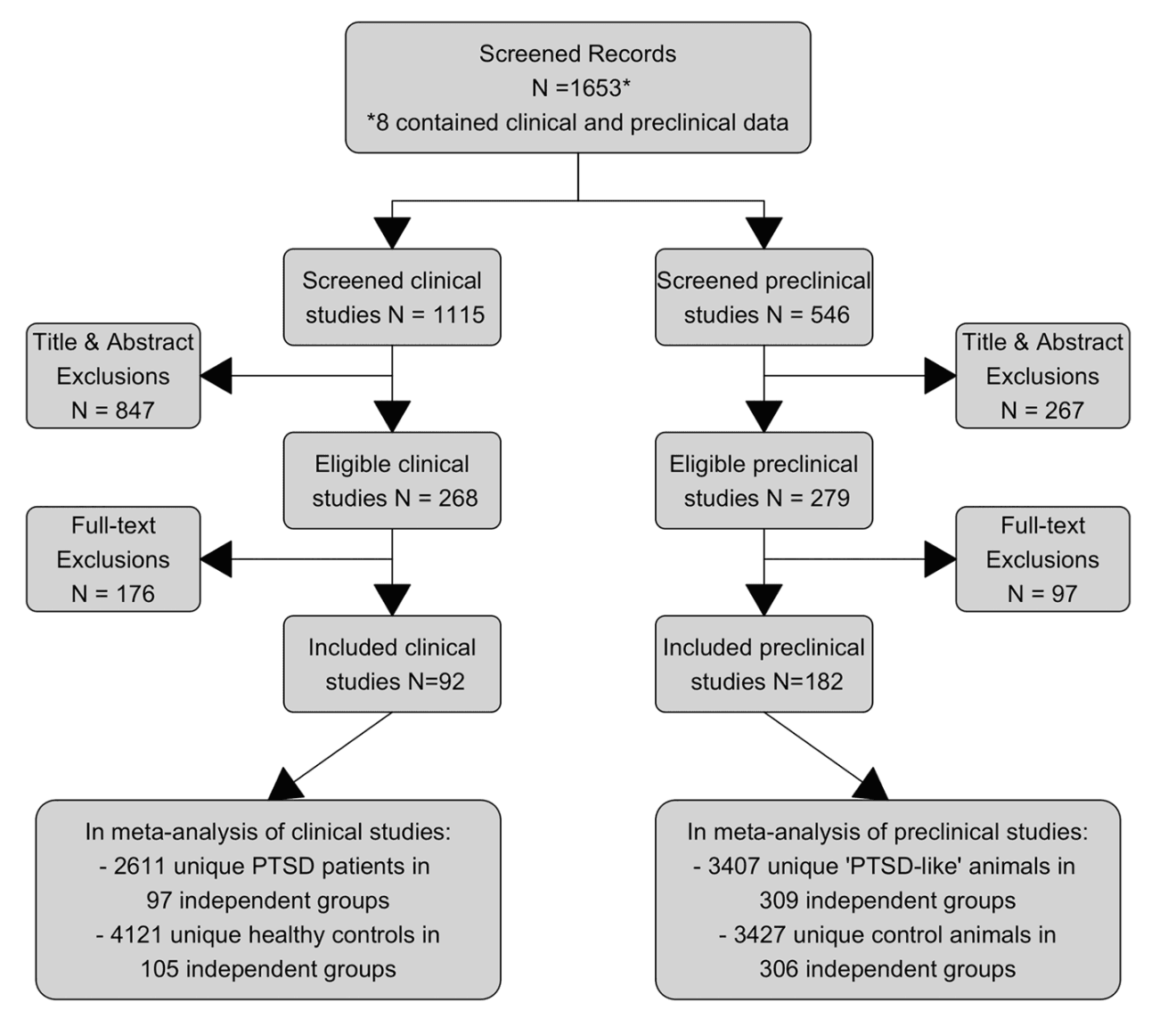
Fig 1

Flowchart of study selection.

More than 70% of the clinical studies reported low risk of bias on all NOS items, except bias due to non-response rates during recruitment (low risk only reported in 10% of the studies). In preclinical studies, reporting was less adequate: no studies were reported on all SYRCLE’s items (Fig. S1). Risk of bias due to (non-)random housing (100%), (non-)random outcome assessment (100%), and allocation concealment (97%) was unclear in almost all preclinical studies. Most preclinical studies were at high risk of bias due to unblinded experimenters (65%), but at low risk of bias due to (equal) baseline characteristics (98%) and blinded outcome assessment (59%).

Effect of PTSD on neutral and emotional learning, memory, and extinction

The random-effects meta-regression on clinical data (Fig. 2A and Table S7) showed that PTSD patients have an impaired ability to learn neutral information (Hedge’s G = −0.667, p < 0.001), remember neutral (Hedge’s G = −0.544, p < 0.001), and emotional material (Hedge’s G = −0.655, p < 0.001), and extinguish fearful information (Hedge’s G = −0.804, p < 0.001), compared to healthy controls. Fear learning did not differ significantly between PTSD patients and healthy controls (Hedge’s G = −0.200, p = 1). The effect of PTSD on trauma learning (1 study), fear memory (1 study), and trauma memory (2 studies) could not be estimated reliably in the clinical dataset, due to an insufficient number of studies (<4).

Fig. 2: Meta-regression: cross-valence mnemonic performance in clinical and preclinical data.
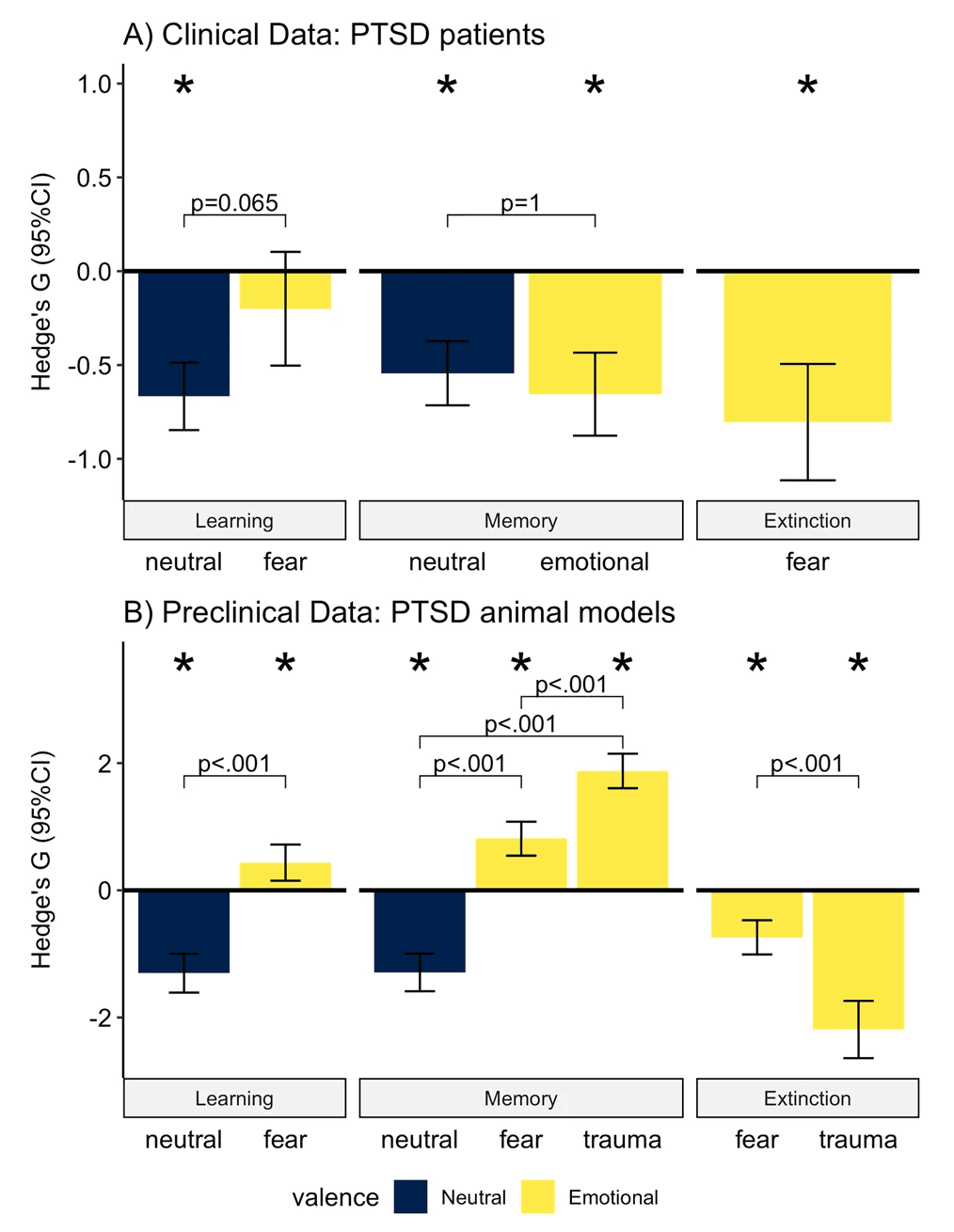
Fig 2

The standardized mean difference Hedge’s G and 95% confidence intervals for clinical (A) and preclinical (B) data. Positive effect sizes indicate improved performance in PTSD, negative effect size indicates reduced performance in PTSD. Asterisk indicates effect size was significantly different from 0 (Bonferroni corrected P < 0.05).

In animal models of PTSD the impairments in neutral learning (Hedge’s G = −1.304, p < 0.001) and neutral memory (Hedge’s G = −1.291, p < 0.001) were also present (Fig. 2B and Table S8). Moreover, enhanced fear learning (Hedge’s G = 0.435, p = 0.034), stronger memory for fear (Hedge’s G = 0.812, p < 0.001) and especially trauma-related (Hedge’s G = 1.877, p < 0.001) material, was observed compared to controls (fear vs trauma memory: difference in Hedge’s G = 1.065, p < 0.001). To explore how this relates to the reduction in patients’ emotional memory performance, we estimated the effect sizes of the three clinical studies (PTSD patients: n = 52; healthy controls: n = 67) that measured fear and trauma memory. This explorative analysis revealed positive effect sizes which might indicate that trauma (Hedge’s G = 0.357; p = 0.162) and fear (Hedge’s G = 0.425; p = 0.252) memory is also enhanced in PTSD patients, but these estimations should be interpreted with caution as they are based on less than the recommended 4 studies per subgroup. Finally, as in humans the preclinical data shows reduced fear extinction (Hedge’s G = −0.741, p < 0.001); interestingly, extinction of trauma-related material (Hedge’s G = −2.190, p < 0.001) was more impaired than other forms of fear extinction (difference in Hedge’s G = −1.449, p < 0.001).

Robustness of the effect

Substantial heterogeneity was observed in both clinical (Q(542) = 7242.000, p < 0.001; I2 = 83.97, 75.42% between study variance, 8.55% within study variance) and preclinical data (Q(1082) = 5762.943, p < 0.001; I2 = 88.60, 75.56% between study variance, 13.03% within study variance). Qualitative evaluation of funnel plot asymmetry suggests some publication bias, which was confirmed by Egger’s regression in clinical (Fig. S2), not preclinical (Fig. S3), data. Yet Rosenthal’s fail-safe N analyses suggest that this is unlikely to influence interpretation of the clinical (Table S9) or preclinical (Table S10) results. Sensitivity analysis confirmed that study quality was not a significant moderator of the overall effect in clinical s(Q(1) = 0.062, p = 0.804) and preclinical (Q(1) = 0.089, p = 0.766) data. Nor did exclusion of influential cases and outliers change the clinical (Table S11) or preclinical (Table S18) results.

The influence of comparison type remains partly inconclusive, due to insufficient data for some combinations of phase and valence. For most categories with sufficient data (≥4 studies) findings of the main analysis were also observed in each comparison type (Table 1), except for enhanced fear memory in preclinical data: which was not present when trauma-exposed controls were compared to animals with PTSD like behavior.

Table 1 Summary sensitivity analysis by comparison typea.
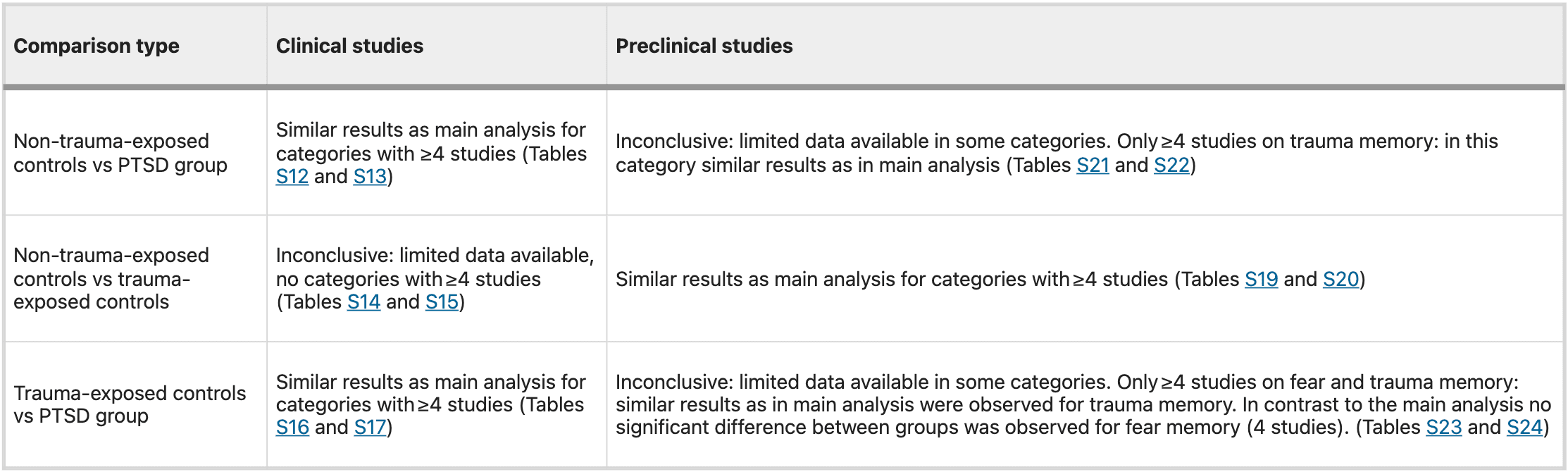
Table 1

aThe Appendix B5 provides an overview of the available data and sensitivity analysis results per comparison type for clinical studies (Tables S12S17) and preclinical studies (Tables S19S24). Potential moderators in clinical studies

Together the variables in the MetaForest model explained only 8% of the variance in effect sizes in the clinical dataset (Rcv2[SD] = 0.081 [0.106]). The ranking of the moderators is shown in Fig. 3. Information type, sample and phase were selected as the most important variables, but the relatively low variable importance scores (Fig. 3) and 8% total variance explained (Rcv2) do not suggest strong moderation. Indeed, the follow-up PD plots suggest that performance is generally impaired (Hedge’s G ~ −0.5) across all levels of the evaluated moderators (Fig. S6). In the absence of strong moderators, no further meta-CART analysis was performed on the clinical dataset. Together with the impaired performance of PTSD patients in all categories of the meta-regression, these findings suggest a general impairment in learning, memory, and extinction in PTSD patients, as far as evaluated. Of note, the influence of cue/context remains inconclusive due to the limited variation in the dataset (94% cued tasks).

Fig. 3: Clinical MetaForest variable importance.
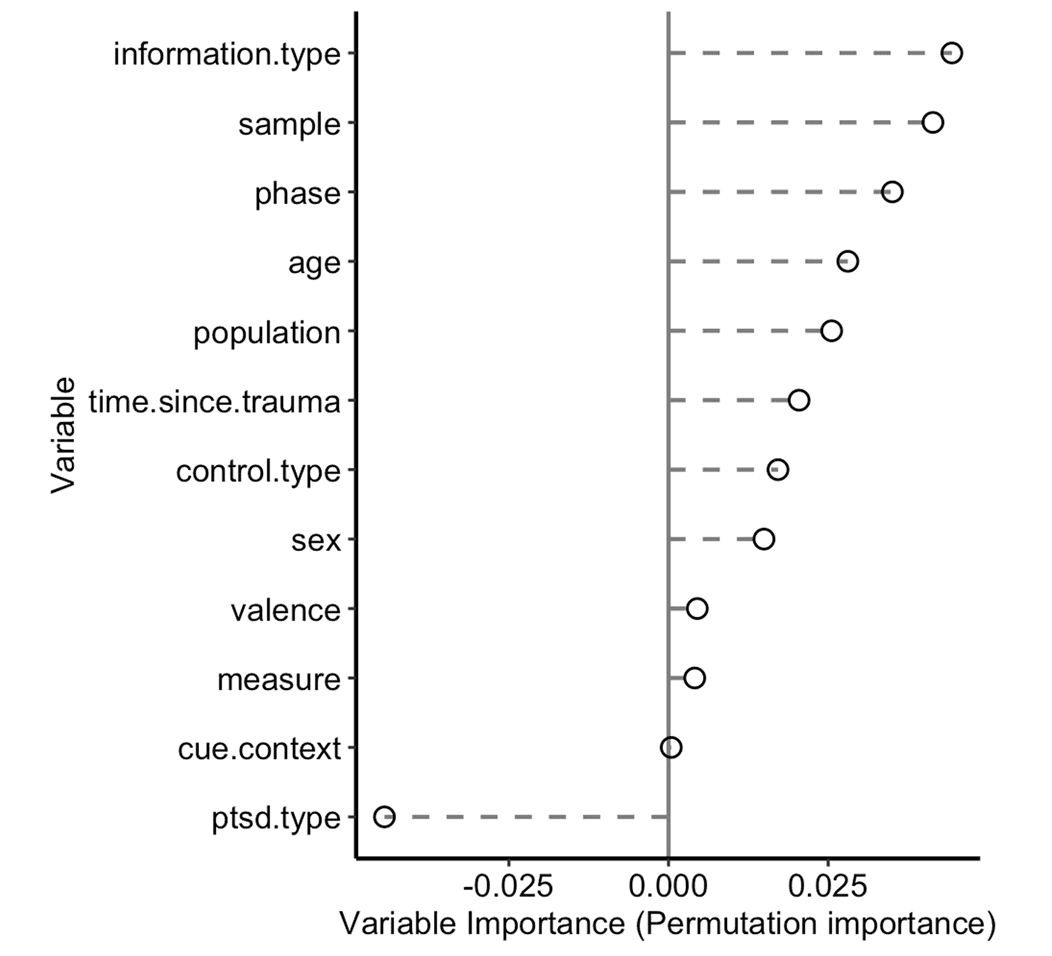
Fig 3

Relative importance of potential moderators based on ‘permuted variable importance’ in the random forest-based meta-analyses on clinical data. In total, 8% variance in effect sizes was explained by the MetaForest model. Indeed, the low variable importance score do not suggest strong moderation by any of the estimated variables.

Potential moderators in preclinical studies

For the preclinical data, 53.4% of the variance in effect sizes was explained by the variables evaluated with MetaForest (Rcv2[Sd] = 0.534 [0.096]). This is a considerable amount, and the variable ranking shown in Fig. 4 indicates that phase and valence are the most important moderators, followed by information type (i.e. olfactory vs safety vs spatial vs threat vs visual information). Note, these moderators were also included in the meta-regression, which illustrates that the most important factors were evaluated in this analysis. Indeed, the follow-up PD plots (Fig. S7) of these variables correspond with the results of the meta-regression.

Fig. 4: Preclinical MetaForest variable importance.
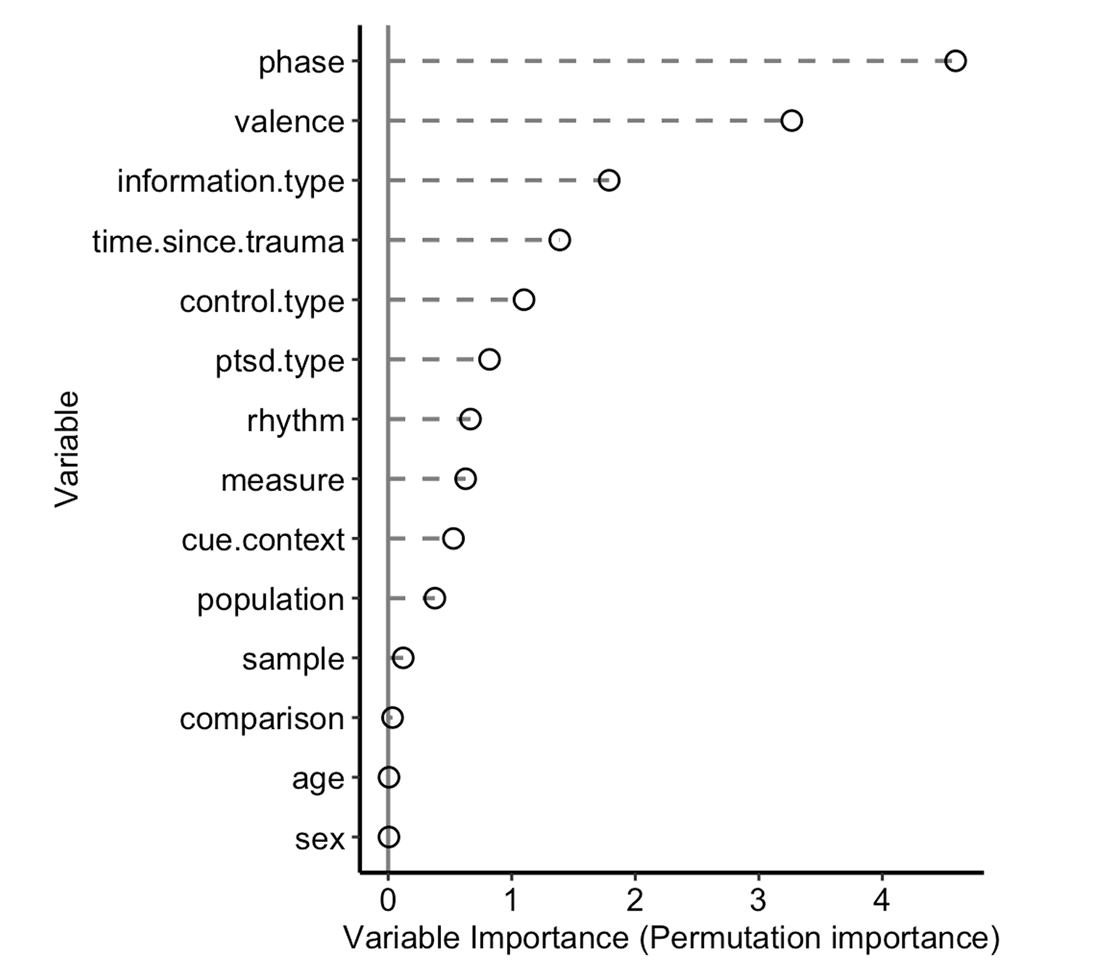
Fig 4

Relative importance of potential moderators based on ‘permuted variable importance’ in the random forest-based meta-analyses on pre-clinical data. In total, the MetaForest model explained 53.4% of variance in effect sizes. Phase and valence are selected as the most important variables, there effects were also evaluated in the meta-regression.

Meta-CART suggested that the effect sizes in preclinical data were influenced by phase and PTSD type, each in interaction with information type (Fig. S8). Exploration of these interactions in MetaForest PD plots (Fig. S9) only provides evidence for a phase × information type interaction, largely in line with the meta-regression analysis.

Discussion

Here we report the first comprehensive meta-analysis on learning, memory, and extinction of neutral and emotional (including fearful and trauma-related) information in PTSD patients and animal models of PTSD. The results confirmed the hypothesis that neutral learning/memory and fear extinction are cross-species impaired in PTSD, but the expected stronger fear memory in PTSD was only observed in preclinical studies (PTSD patients showed impaired emotional memory). This emphasizes that preclinical researchers should carefully evaluate their phenotype of interest cross-species before selecting an animal model to make inferences about the neurobiology underlying clinical aspects of PTSD.

Of note, clinical and preclinical studies differed in many characteristics. Clinical studies mostly investigated older patients of mixed gender, while preclinical studies typically included younger, male animals which -in terms of genetic background and housing conditions – were quite homogeneous. Stronger effect sizes were observed in preclinical studies (likely due to their controlled nature) and overall reporting on potential risks of bias was better in clinical studies. Importantly, animals exposed to trauma were typically considered to represent ‘the PTSD group’ in most preclinical studies. This is an inaccurate conceptualization of PTSD, as clinical studies showed that only a minority of trauma-exposed individuals actually develop PTSD, which was confirmed in those animals studies that addressed the issue. Unfortunately, insufficient data was available to quantify the influence of this experimental difference, but future preclinical studies should definitely pay attention to this inconsistency.

Partly as expected, learning, memory, and extinction were impaired in PTSD patients. This impairment is strong for both neutral as well as emotionally valenced material. No strong moderators of these effects were identified, suggesting a general impairment of learning and memory processes in PTSD patients. This contrasts, for example, with earlier reports on the influence of sex on fear conditioning, or on HPA-axis function in PTSD 76. Like PTSD patients, animals in PTSD models showed impaired neutral learning/memory and fear extinction (especially for trauma-related information). The reduced extinction in preclinical data might be hampered by strong fear (and mostly trauma) memories that compete with fear expression during extinction learning. PTSD patients could show a similar phenotype, but definite conclusions await more studies. Phase and valence were the strongest moderators of performance in animal models (pointing towards limited influence of age, sex, PTSD-model, species, strain, etc.). Note, the apparent lack of importance of age and sex in the preclinical dataset can also be due to limited variation in these variables (i.e. mostly young adult and male animals). Together the preclinical and (as far as available) clinical data seem to indicate that PTSD affects neutral and emotional on the one hand versus fear/trauma memory on the other hand in opposite directions.

Impaired fear extinction in PTSD

In line with earlier seminal research, our results confirm that impaired fear extinction is a strong phenotype in PTSD patients and animal models, as evidenced by large effect sizes, despite substantial heterogeneity in the data. Animal models highlight that extinction of trauma-related information is particularly impaired. This aligns with current neurobiological models of PTSD and justifies that extinction is the prime target of exposure-based psychotherapies for PTSD. However, the observation that impaired extinction is not limited to trauma-related information might also indicate that the neurobiological mechanisms underlying the extinction process itself do not function optimally in PTSD patients (see ref. for a review of earlier animal work on this notion). There is even some evidence that this is a pre-existing trait which makes these subjects vulnerable to the development of PTSD in the face of trauma. Indeed, abnormalities in brain areas involved -amygdala, hippocampus, and prefrontal cortex- have been observed in PTSD [17]. Perhaps, this explains why exposure-treatments that rely on the patients ‘existing’ extinction abilities can be less effective for some patients. Indeed, extinction abilities vary between individuals and some patients might benefit from complementary therapies that boost extinction. Various psychological, behavioral, brain-stimulation, and psychopharmacological interventions hold the potential to augment extinction. Interestingly, there is a range of possible neurobiological targets, including synaptic plasticity, prefrontal cortex-amygdala/hippocampus connectivity, and several neurotransmitter systems, including serotonin, dopamine, noradrenalin, choline, glutamate, GABA, (endo)cannabinoid, glucocorticoid, and others. Although successful translation of single-target interventions into clinical practice is still limited, this range opens possibilities for the development of multi-target approaches, tailored to the patient-specific neurobiological abnormalities that underlie impaired extinction. Our results indicate that preclinical studies can accurately model this clinical phenotype and potentially serve to develop new therapies.

Impaired neutral learning and memory in PTSD

Reduced ability to learn and memorize neutral information was another strong phenotype in both PTSD patients and animal models. This phenotype should not be overlooked in PTSD research and clinical practice, as it is just as prevalent as impaired extinction and can substantially burden PTSD patients’ daily functioning and treatment response. Moreover, a prospective study showed that deficits in neutral learning and memory contribute to PTSD vulnerability. One can speculate that this phenotype hampers the discrimination between safe and neutral events, thereby contributing to impaired safety learning in PTSD patients. Interestingly, it has been found that psychotherapy can improve verbal memory in PTSD, which might be explained by its enhancing effects on hippocampal functioning and changes in FKBP5 expression. To improve clinical practice, novel (complementary) treatments should target this phenotype directly, for example via (1) behavioral interventions - such as targeted memory reactivation, behavioral tagging, reconsolidation updating, and reminders - that tap into endogenous encoding and retrieval processes; (2) cognitive training that enhances learning and memory strategies; (3) physical exercise - like cardiovascular exercise and balance training - that stimulates the hippocampal memory system; (4) sleep interventions that enhance slow-wave sleep; (5) neurofeedback training that improves prefrontal cortex-hippocampus connectivity; or (6) pharmacotherapy that targets neurotransmitter systems (e.g. serotonin, dopamine, choline or modulates neuronal processes (e.g. neurogenesis, neuro-inflammation, or neuronal damage). Importantly for future neurobiological research and drug-development, our results show that this phenotype is also present in animal models of PTSD.

Differences in emotional and fearful/trauma memory

Contrary to fear extinction and neutral memory formation, our meta-analysis suggests that PTSD might have opposing effects on emotional (impaired in clinical data) and fearful/trauma memory (improved in preclinical data) in clinical versus preclinical studies respectively, although the differences in these two lines of research are extensive and ask for very careful comparison of the results. One neurobiological explanation may be linked to the stress system. Thus, in humans emotional memory tasks are unlikely to trigger activation of the HPA-axis, while preclinical fear conditioning tasks most certainly do. Our findings suggest that PTSD (or trauma exposure) related changes in HPA-axis functioning benefit memory for fearful information -as corticosteroids can enhance memory formation, at the cost of neutral and slightly emotional information. This conclusion should be drawn with caution, though, as studies on HPA-axis alterations in PTSD yield mixed results and there was insufficient data available on fearful/trauma memory in patients and emotional memory in animal models for the current meta-analysis. Another explanation could be related to the fact that some aspects of PTSD, such as feelings of shame or guilt, cannot be easily captured in (current) animal models. The absence of these unique human responses to trauma might contribute to the different post-trauma stressful memory phenotype observed in animal models of PTSD. Via these processes or other uncaptured aspects, the opposing phenotype observed in animal models and PTSD patients (i.e. impaired emotional learning after trauma in animal models vs enhanced emotional learning in PTSD patients) could reflect a real difference between species. If present, this would be problematic for drug-development research, as agents that reduce (enhanced) emotional learning in animal models of PTSD would inevitably fail to improve (impaired) emotional learning in PTSD patients.

Strengths and limitations

The large cross-species dataset (274 studies), and integrated hypothesis-driven meta-regression with state-of-the-art heterogeneity exploration via random-forest and tree-based models are strengths of this meta-analysis. To improve cross-species comparability, only behavioral measures of learning and memory (including physiological responses in fear conditioning) were included, which might limit the generalizability of our findings to, for example, neuroimaging or self-report measures.

Conclusion

All in all, this meta-analysis shows that both impaired neutral learning/memory and fear extinction are two strong clinical phenotypes of PTSD, that can be accurately modeled in preclinical studies. Novel PTSD treatments could target these phenotypes and benefit from animal models to unravel the underlying neurobiology and foster drug-development. In addition, future research should elaborate on the origin of potential differences between emotional and fear/trauma memory in PTSD across species. Until this issue is resolved, we do not recommend to use animal models for drug-development that targets emotional/fearful memory in PTSD.

Open Article as PDF

Abstract

in only part of PTSD patients. Therefore, novel neurobiologically informed approaches are urgently needed. Clinical and translational neuroscience point to altered learning and memory processes as key in (models of) PTSD psychopathology. We extended this notion by clarifying at a meta-level (i) the role of information valence, i.e. neutral versus emotional/fearful, and (ii) comparability, as far as applicable, between clinical and preclinical phenotypes. We hypothesized that cross-species, neutral versus emotional/fearful information processing is, respectively, impaired and enhanced in PTSD. This preregistered meta-analysis involved a literature search on PTSD+Learning/Memory+Behavior, performed in PubMed. First, the effect of information valence was estimated with a random-effects meta-regression. The sources of variation were explored with a random forest-based analysis. The analyses included 92 clinical (N = 6732 humans) and 182 preclinical (N = 6834 animals) studies. A general impairment of learning, memory and extinction processes was observed in PTSD patients, regardless of information valence. Impaired neutral learning/memory and fear extinction were also present in animal models of PTSD. Yet, PTSD models enhanced fear/trauma memory in preclinical studies and PTSD impaired emotional memory in patients. Clinical data on fear/trauma memory was limited. Mnemonic phase and valence explained most variation in rodents but not humans. Impaired neutral learning/memory and fear extinction show stable cross-species PTSD phenotypes. These could be targeted for novel PTSD treatments, using information gained from neurobiological animal studies. We argue that apparent cross-species discrepancies in emotional/fearful memory deserve further in-depth study; until then, animal models targeting this phenotype should be applied with utmost care.

Introduction

After a severe traumatic event, some individuals may develop posttraumatic stress disorder (PTSD). PTSD symptoms include re-experiencing the trauma, avoiding certain things, changes in thinking and mood, and being overly alert. While various treatments exist for PTSD, such as therapy and medication, they do not work for everyone. Many patients drop out of therapy, still have symptoms after treatment, experience a return of symptoms, or do not respond to treatment at all. This shows a clear need for more effective treatments based on a better understanding of the brain.

Research has shown that PTSD is linked to problems in brain circuits involved in learning to fear, detecting threats, managing emotions, and understanding context. However, there is still much to learn about PTSD, which is needed to find new ways to treat it. Many ideas about PTSD suggest that problems with learning and remembering stressful or scary information, and how this affects emotions, are central to the disorder. This idea helps explain some aspects of PTSD and how therapy works. Yet, it does not fully explain why people with PTSD often struggle with learning and remembering everyday information, which is a common problem shown in studies. These difficulties significantly impact how well patients respond to therapy, their satisfaction with life, and their ability to function socially and at work.

The evidence suggests two main points: (1) learning and memory are very important in PTSD, and (2) problems in the brain systems that support these processes likely affect how people handle both emotional and neutral information, which can then impact how well treatments work. Currently, there is no complete review that looks at how PTSD patients learn and remember both neutral and emotional information. To address this, a systematic review and meta-analysis was conducted to get a full picture of current knowledge on learning and memory in PTSD, using tasks that involve neutral, emotional, and scary information, as well as fear extinction. While PTSD is a human condition, animal studies can offer valuable insights into its brain biology and help develop new medications if the animal's symptoms match some aspects of human PTSD.

To get a complete view of how learning and memory are affected in animal models of PTSD, studies on animals were reviewed in addition to human studies. The main goal was to compare the learning and memory performance of (i) PTSD patients and (ii) animals in PTSD models to healthy control groups, keeping in mind the challenges of comparing different species. Based on models of PTSD, neuropsychological findings, and observations in animal models, it was expected that learning and memory for emotional/fearful information would be stronger in PTSD across species, while fear extinction and neutral learning and memory would be weaker.

It is important to note that PTSD affects a diverse group of patients, and learning and memory processes vary greatly from person to person. To account for this, a secondary goal was to explore which factors explain differences in the data from human and animal studies. Identifying these factors is important because individual differences, such as how people react to traumatic stress, are thought to play a key role in PTSD and resilience. It is highly likely that understanding the brain problems in specific types of PTSD will lead to more personalized treatments in the future.

Methods and Materials

This project followed specific guidelines for research and its details were registered beforehand.

Search Strategy and Screening

Information, data, and computer code used for searching, reviewing, extracting data, and conducting the meta-analysis are publicly available. A thorough search for studies on PTSD, learning and memory, and behavior was performed in a scientific database. Two specific search terms were used for human and animal studies. Retrieved articles were independently checked by two researchers against predefined criteria: (1) presence of a PTSD group/model, (2) a healthy control group, (3) an experimental study design, (4) adult participants, (5) a learning/memory/fear-conditioning task, (6) a behavioral measure of memory (including physical responses in fear conditioning), (7) a memory measure taken after trauma, and (8) the article being in English with essential data available. Any disagreements were resolved through discussion. If a decision could not be made from the title and abstract, the full article was reviewed.

Data Extraction and Study Quality Assessment

Predetermined data from eligible studies were extracted by one researcher and verified by another. A detailed guide for data extraction included information about (1) publication (author, year), (2) participants (e.g., number, age, sex), (3) trauma and PTSD (e.g., trauma type, time since trauma), (4) learning/memory task (e.g., task, measure), and (5) memory performance (mean, standard deviation/standard error of the mean). All tasks and measures were categorized (e.g., by phase, emotional content, etc.) according to a specific codebook.

Data presented only in graphs were converted to digital values, and authors were not contacted for missing or additional data. Missing values were included in the analysis as described in the "Exploratory analysis" section.

The quality of studies and the risk of bias were assessed using adapted scales: the Newcastle-Ottawa case-control Scale for human studies and SYRCLE's risk of bias tool for animal studies. On both scales, unreported details were considered an "unclear" risk of bias.

Meta-Analysis

The analysis strategy was based on previous work and performed using specific statistical software. The effect size, which measures the strength of a difference, was calculated as Hedge's G. Human and animal data were always analyzed separately.

Random-Effects Meta-Regression: Valence × Phase

To answer the main research question, the overall effect size for each type of emotional content (neutral, emotional, fear, and trauma) and phase (learning, memory, and extinction) was estimated using a statistical model that accounts for variation between studies. Emotional content and phase were used as factors to explain differences. Combinations of emotional content and phase not present in the data, or categories with fewer than four studies, were excluded. Statistical significance values were adjusted for multiple comparisons within human and animal datasets.

Tests were used to assess how much variation existed between studies. An I2 value of 25%, 50%, and 75% indicates low, moderate, and high levels of variation, respectively. A statistical method was used to check the robustness of the estimated effects, and Egger’s regression was used to look for publication bias (when studies with certain results are more likely to be published). The potential influence of (1) study quality, (2) extreme or influential cases, and (3) type of comparison was evaluated through sensitivity analysis. To assess study quality influence, scores from the assessment tools were combined into summary risk of bias scores, where higher scores indicated more risk of bias.

Exploratory Analysis

The reasons for variation within the human and animal subgroups were explored using a two-step data-driven analysis. Missing values (less than one-third missing) in 'sex' and 'time since trauma' were replaced with the most common category and median value, respectively. No missing values were present in other variables.

First, potential factors that could explain differences in effect sizes were ranked based on their importance in a random forest-based meta-analysis method called MetaForest. This method was specifically adjusted for human and animal data separately. The predicted effect size for different levels of a specific factor, while keeping other factors constant, was explored using partial dependence (PD) plots.

Next, potential interactions between factors were explored by fitting a tree-based meta-CART algorithm to the datasets. Although tree-based models can be less stable and more prone to overfitting than random-forest models, meta-CART can provide understandable interactions. To address the potential instability of meta-CART, suggested interactions were further explored using PD plots in the MetaForest model.

Results

Study Selection and Characteristics

After reviewing 1653 records, 92 human studies (involving 6732 people) and 182 animal studies (involving 6834 animals) were included in the meta-analysis. A complete list of all reviewed and included articles is provided separately. The characteristics of these studies are also provided in separate tables. The independent human PTSD groups included civilians (52%) and veterans (48%), were mostly mixed gender (58%), and middle-aged (56%). Most independent animal PTSD groups involved rats (83%), males (94%), and young adults (88%). Most human PTSD groups were compared to controls who had experienced trauma (61%) or had not (37%), while most animal PTSD groups were defined as 'trauma-exposed' and compared to non-exposed controls (93%). In human groups, tasks using cues (94%) and neutral information (64%) were most common. In animal groups, contextual tasks (70%) and fear (39%) and trauma-related (46%) information were mostly assessed.

Over 70% of the human studies reported a low risk of bias on most quality assessment items, except for bias due to non-response rates during recruitment (only 10% reported low risk). In animal studies, reporting was less adequate; no studies reported on all risk of bias items. Risk of bias related to housing conditions, outcome assessment, and allocation concealment was unclear in almost all animal studies. Most animal studies had a high risk of bias due to unblinded experimenters (65%), but a low risk of bias due to similar baseline characteristics (98%) and blinded outcome assessment (59%).

Effect of PTSD on Neutral and Emotional Learning, Memory, and Extinction

The statistical analysis of human data showed that PTSD patients have trouble learning neutral information, remembering neutral and emotional material, and overcoming fearful information, compared to healthy controls. Fear learning did not significantly differ between PTSD patients and healthy controls. The effect of PTSD on trauma learning, fear memory, and trauma memory could not be reliably estimated in the human dataset due to a lack of sufficient studies.

In animal models of PTSD, similar problems were observed in neutral learning and neutral memory. Additionally, animals showed stronger fear learning, stronger memory for fear, and especially for trauma-related material, compared to controls. To understand how this relates to the reduced emotional memory performance in human patients, an exploratory analysis of three human studies that measured fear and trauma memory revealed positive effect sizes, suggesting that trauma and fear memory might also be stronger in PTSD patients. However, these estimates should be viewed with caution as they are based on very few studies. Finally, similar to humans, animal data showed reduced fear extinction; interestingly, extinction of trauma-related material was more impaired than other forms of fear extinction.

Robustness of the Effect

Significant differences were observed across studies in both human and animal data. Qualitative assessment of graphs suggested some publication bias, which was confirmed in human data but not in animal data. However, further analysis suggested that this bias was unlikely to affect the overall interpretation of the results. Sensitivity analysis confirmed that study quality did not significantly alter the overall effect in human or animal data. Removing influential cases and outliers also did not change the results in either human or animal studies.

The influence of the comparison type remains partially unclear due to insufficient data for some combinations of phase and emotional content. For most categories with enough data, the findings of the main analysis were also observed for each comparison type, except for stronger fear memory in animal data, which was not present when trauma-exposed controls were compared to animals with PTSD-like behavior.

Potential Moderators in Clinical Studies

The factors included in the MetaForest model explained only a small amount (8%) of the differences in effect sizes in the human dataset. The ranking of these factors showed that information type, participant group, and phase were the most important variables, but their low importance scores and the small amount of total variance explained suggest that they did not strongly influence the results. Follow-up plots indicated that performance was generally impaired across all levels of the evaluated factors. Without strong influencing factors, no further in-depth analysis was performed on the human dataset. These findings, along with the impaired performance of PTSD patients across all categories in the main analysis, suggest a general problem with learning, memory, and extinction in PTSD patients, as far as evaluated. The influence of cues versus context remains unclear due to limited variation in the dataset (most tasks used cues).

Potential Moderators in Preclinical Studies

For the animal data, 53.4% of the differences in effect sizes were explained by the factors evaluated with MetaForest. This is a considerable amount, and the ranking of factors indicated that phase and emotional content were the most important, followed by the type of information (e.g., smell, safety, spatial, threat, visual). These factors were also included in the main analysis, showing that the most important factors were evaluated. Indeed, the follow-up plots for these variables matched the results of the main analysis.

Further analysis suggested that the effect sizes in animal data were influenced by phase and PTSD type, each interacting with information type. Exploring these interactions in MetaForest plots only provided evidence for a phase by information type interaction, which largely aligned with the main analysis.

Discussion

This is the first comprehensive meta-analysis to examine learning, memory, and extinction of neutral and emotional (including fearful and trauma-related) information in PTSD patients and animal models. The results confirmed the hypothesis that neutral learning/memory and fear extinction are impaired in PTSD across species. However, the expected stronger fear memory in PTSD was only seen in animal studies, while human PTSD patients showed impaired emotional memory. This highlights the importance for animal researchers to carefully compare their findings with human conditions before using animal models to understand the brain biology of clinical PTSD.

It is important to note that human and animal studies had many differences. Human studies often involved older, mixed-gender patients, while animal studies typically included younger, male animals with similar genetic backgrounds and living conditions. Stronger effects were observed in animal studies (likely due to their controlled nature), and overall reporting on potential risks of bias was better in human studies. Significantly, animals exposed to trauma were often considered to represent the 'PTSD group' in most animal studies. This is an inaccurate understanding of PTSD, as human studies show that only a minority of trauma-exposed individuals actually develop PTSD, a fact confirmed in animal studies that addressed this issue. Unfortunately, there was not enough data to measure the impact of this experimental difference, but future animal studies should definitely address this inconsistency.

As partly expected, learning, memory, and extinction were impaired in PTSD patients. This impairment is significant for both neutral and emotionally charged material. No strong factors that influenced these effects were found, suggesting a general problem with learning and memory processes in PTSD patients. This is different from earlier reports, for example, on how sex affects fear conditioning or how the HPA-axis functions in PTSD. Like human PTSD patients, animals in PTSD models also showed impaired neutral learning/memory and fear extinction (especially for trauma-related information). The reduced extinction in animal data might be hampered by strong fear (and mostly trauma) memories that compete with fear expression during extinction learning. PTSD patients could show a similar pattern, but more studies are needed for definite conclusions. Phase and emotional content were the strongest factors influencing performance in animal models (suggesting limited influence of age, sex, PTSD model, species, strain, etc.). The apparent lack of importance of age and sex in the animal dataset might be due to limited variation in these variables (i.e., mostly young adult and male animals). Overall, the animal and (as far as available) human data seem to suggest that PTSD affects neutral and emotional memory in one direction, and fear/trauma memory in the opposite direction.

Impaired Fear Extinction in PTSD

Consistent with earlier important research, these results confirm that impaired fear extinction is a prominent characteristic in both PTSD patients and animal models. This is supported by large effect sizes, despite considerable differences in the data. Animal models show that extinction of trauma-related information is particularly impaired. This aligns with current brain-based models of PTSD and supports why extinction is the main goal of exposure-based therapies for PTSD. However, the finding that impaired extinction is not limited to trauma-related information might also indicate that the brain mechanisms underlying the extinction process itself do not function optimally in PTSD patients. There is even some evidence that this might be a pre-existing trait that makes individuals vulnerable to developing PTSD after trauma. Indeed, problems have been observed in brain areas involved, such as the amygdala, hippocampus, and prefrontal cortex, in PTSD. Perhaps, this explains why exposure treatments that rely on patients' existing extinction abilities may be less effective for some. Extinction abilities vary among individuals, and some patients might benefit from additional therapies that boost extinction. Various psychological, behavioral, brain-stimulation, and medication interventions have the potential to enhance extinction. Interestingly, there are many possible brain targets, including synaptic plasticity, connectivity between the prefrontal cortex, amygdala, and hippocampus, and several neurotransmitter systems, such as serotonin, dopamine, noradrenaline, choline, glutamate, GABA, (endo)cannabinoid, and glucocorticoid systems. Although successfully applying single-target interventions in clinical practice is still limited, this range opens possibilities for developing multi-target approaches tailored to a patient's specific brain problems that cause impaired extinction. The results indicate that animal studies can accurately model this clinical characteristic and potentially help develop new therapies.

Impaired Neutral Learning and Memory in PTSD

A reduced ability to learn and remember neutral information was another prominent characteristic in both PTSD patients and animal models. This characteristic should not be overlooked in PTSD research and clinical practice, as it is as common as impaired extinction and can significantly hinder daily functioning and treatment response for PTSD patients. Furthermore, a study showed that problems with neutral learning and memory contribute to vulnerability to PTSD. It is possible that this characteristic makes it harder to distinguish between safe and neutral events, thereby contributing to impaired safety learning in PTSD patients. Interestingly, psychotherapy has been found to improve verbal memory in PTSD, which might be explained by its positive effects on hippocampal function and changes in specific gene expression. To improve clinical practice, new (complementary) treatments should directly target this characteristic. Examples include: (1) behavioral interventions that use natural encoding and retrieval processes, such as targeted memory reactivation, behavioral tagging, reconsolidation updating, and reminders; (2) cognitive training to enhance learning and memory strategies; (3) physical exercise, like cardiovascular exercise and balance training, that stimulates the brain's memory system; (4) sleep interventions that improve deep sleep; (5) neurofeedback training to improve connectivity between the prefrontal cortex and hippocampus; or (6) medications that target neurotransmitter systems (e.g., serotonin, dopamine, choline) or modulate neuronal processes (e.g., neurogenesis, neuro-inflammation, or neuronal damage). Importantly for future brain research and drug development, these results show that this characteristic is also present in animal models of PTSD.

Differences in Emotional and Fearful/Trauma Memory

In contrast to fear extinction and neutral memory formation, this meta-analysis suggests that PTSD might have opposite effects on emotional memory (impaired in human data) and fearful/trauma memory (improved in animal data) in human versus animal studies, respectively. However, the extensive differences between these two lines of research require very careful comparison of the results. One brain-related explanation might be linked to the stress system. In humans, emotional memory tasks are unlikely to trigger activation of the stress response system, while animal fear conditioning tasks almost certainly do. The findings suggest that PTSD (or trauma exposure) related changes in the stress response system may benefit memory for fearful information, as stress hormones can enhance memory formation, but at the expense of neutral and slightly emotional information. This conclusion should be drawn with caution, however, as studies on stress response system changes in PTSD have mixed results, and there was not enough data on fearful/trauma memory in patients and emotional memory in animal models for the current meta-analysis. Another explanation could be that some aspects of PTSD, such as feelings of shame or guilt, are not easily captured in current animal models. The absence of these unique human responses to trauma might contribute to the different post-trauma stressful memory pattern observed in animal models of PTSD. Through these processes or other uncaptured aspects, the opposing pattern observed in animal models and PTSD patients (i.e., impaired emotional learning after trauma in animal models versus enhanced emotional learning in PTSD patients) could reflect a real difference between species. If this is the case, it would be problematic for drug development research, as agents that reduce enhanced emotional learning in animal models of PTSD would inevitably fail to improve impaired emotional learning in PTSD patients.

Strengths and Limitations

The large cross-species dataset (274 studies) and the combination of hypothesis-driven statistical analysis with advanced exploration of differences using random-forest and tree-based models are strengths of this meta-analysis. To improve comparability across species, only behavioral measures of learning and memory (including physiological responses in fear conditioning) were included, which might limit how broadly the findings can be applied to, for example, brain imaging or self-report measures.

Conclusion

Overall, this meta-analysis demonstrates that both impaired neutral learning/memory and fear extinction are two strong clinical characteristics of PTSD that can be accurately modeled in animal studies. New PTSD treatments could target these characteristics and benefit from animal models to understand the underlying brain biology and accelerate drug development. Additionally, future research should explore the origin of potential differences between emotional and fear/trauma memory in PTSD across species. Until this issue is resolved, it is not recommended to use animal models for drug development that targets emotional/fearful memory in PTSD.

Open Article as PDF

Abstract

in only part of PTSD patients. Therefore, novel neurobiologically informed approaches are urgently needed. Clinical and translational neuroscience point to altered learning and memory processes as key in (models of) PTSD psychopathology. We extended this notion by clarifying at a meta-level (i) the role of information valence, i.e. neutral versus emotional/fearful, and (ii) comparability, as far as applicable, between clinical and preclinical phenotypes. We hypothesized that cross-species, neutral versus emotional/fearful information processing is, respectively, impaired and enhanced in PTSD. This preregistered meta-analysis involved a literature search on PTSD+Learning/Memory+Behavior, performed in PubMed. First, the effect of information valence was estimated with a random-effects meta-regression. The sources of variation were explored with a random forest-based analysis. The analyses included 92 clinical (N = 6732 humans) and 182 preclinical (N = 6834 animals) studies. A general impairment of learning, memory and extinction processes was observed in PTSD patients, regardless of information valence. Impaired neutral learning/memory and fear extinction were also present in animal models of PTSD. Yet, PTSD models enhanced fear/trauma memory in preclinical studies and PTSD impaired emotional memory in patients. Clinical data on fear/trauma memory was limited. Mnemonic phase and valence explained most variation in rodents but not humans. Impaired neutral learning/memory and fear extinction show stable cross-species PTSD phenotypes. These could be targeted for novel PTSD treatments, using information gained from neurobiological animal studies. We argue that apparent cross-species discrepancies in emotional/fearful memory deserve further in-depth study; until then, animal models targeting this phenotype should be applied with utmost care.

Summary

After a traumatic experience, some individuals may develop posttraumatic stress disorder (PTSD). Symptoms include intrusive thoughts, avoidance behaviors, negative changes in mood, and heightened alertness. While treatments like therapy and medication exist, they do not work for everyone. Many patients drop out of therapy, still have symptoms after treatment, relapse, or do not respond to treatment at all. This highlights a strong need for more effective treatments for PTSD that are based on understanding the brain.

Research into the brain has shown that PTSD is linked to problems in brain circuits that control fear, threat detection, emotion, and how the brain processes context related to fear and reward. However, a full understanding of PTSD, which is key to finding new treatments, is still limited. Many theories suggest that changes in how people learn and remember stressful or fearful information, and how these changes affect emotions, are central to PTSD. This idea can explain parts of PTSD and how therapy works. Yet, these theories often do not account for difficulties in learning and remembering neutral information, which are consistently seen in studies of PTSD patients. These difficulties are a significant part of living with PTSD, as they negatively impact treatment success, life satisfaction, and social and work abilities.

The evidence suggests that learning and memory are crucial to PTSD, and that problems in the brain systems that support these processes likely affect how both emotional/fearful and neutral information are handled. This, in turn, can influence how well treatments work. Currently, there is no complete review that examines how PTSD patients learn and remember both neutral and emotional information together. To address this gap, a systematic review and meta-analysis was conducted to provide a thorough overview of current knowledge about learning and memory in PTSD, using tasks that include neutral, emotional, and fearful information, as well as fear extinction. While PTSD is a human condition, animal models can offer valuable insights into its brain biology and help develop new drugs if their characteristics match some aspects of the human condition.

To provide a complete picture of learning and memory in current animal models of PTSD, both preclinical (animal) and clinical (human) studies were evaluated. The main goal was to assess learning and memory performance across different types of information in (i) PTSD patients and (ii) animals in PTSD models, compared to healthy control groups. The limitations of comparing different species were kept in mind. Based on existing models of PTSD, neuropsychological evidence, and observations in animal models, it was hypothesized that emotional/fearful learning and memory would be increased, while fear extinction and neutral learning and memory would be impaired in both species with PTSD.

It is important to note that PTSD affects a diverse group of patients, and learning and memory processes vary greatly among individuals. To account for this, a secondary goal was to explore which factors explain differences in the clinical and preclinical data. Identifying factors that explain individual variations in learning and memory in PTSD is important, as it has been suggested that individual differences, such as reactions to traumatic stress, play a key role in PTSD and resilience. It is highly likely that understanding the underlying brain problems in specific types of PTSD will lead to personalized medicine for PTSD in the future.

Methods and Materials

This project was registered in advance and followed specific guidelines for systematic reviews and meta-analyses. The methods, data, and computer code used for searching, screening, extracting data, and analyzing are available online. A thorough search for studies on PTSD, learning, memory, and behavior was performed in a scientific database.

Search Strategy and Screening

Articles found were independently reviewed by two researchers to determine if they met the predefined inclusion criteria. These criteria included: having a PTSD group or model, a healthy control group, being an experimental study, involving adults, using a learning/memory/fear-conditioning task, measuring memory behavior (including physical responses to fear conditioning), measuring memory after trauma, and being an article in English with essential data available. Any disagreements were resolved through discussion. If a decision could not be made from the title and abstract, the full article was reviewed.

Data Extraction and Study Quality Assessment

Predetermined data from eligible studies were extracted by one researcher and checked by another. The extracted data included publication details, sample characteristics (like number of participants, age, sex), trauma and PTSD details (like trauma type, time since trauma), learning/memory task details, and memory performance (average, standard deviation). All tasks and measures were categorized. Data only presented in graphs were digitally extracted. Missing data were noted and handled as described in the "Exploratory analysis" section. The quality of clinical studies and the risk of bias in preclinical studies were assessed using adapted scales. Unreported details were considered an "unclear" risk of bias.

Meta-analysis

The analysis was performed using statistical software. The standardized mean difference (Hedge's G) was used as the measure of effect size. Clinical and preclinical data were always analyzed separately.

Random-effects Meta-Regression: Valence × Phase

To answer the main research question, the overall effect size for each type of information (neutral, emotional, fear, and trauma) and phase (learning, memory, and extinction) was estimated. A statistical model that accounted for variation between studies was used, with information type and phase as factors. Combinations of information type and phase not present in the data, or categories with fewer than four studies, were excluded. The significance levels were adjusted to reduce the chance of false positives. Statistical tests were used to assess the level of variation between studies. A measure called Rosenthal’s fail-safe N was calculated to check the reliability of the estimated effects. A test was also used to assess for publication bias (where studies with positive results are more likely to be published). The influence of study quality, extreme data points, and comparison type was evaluated through additional analysis.

Exploratory Analysis

To understand the sources of variation within the clinical and preclinical data, a two-step data-driven analysis was performed. Missing values for "sex" and "time since trauma" (if less than one-third of the data was missing) were filled in with the most common category or median value, respectively. No missing values were present in other variables. First, potential factors influencing the effect sizes were ranked based on their importance in a random forest-based meta-analysis. This analysis identified the most important variables. The predicted effect size for different levels of a specific factor, while keeping other factors constant, was explored using plots. Second, potential interactions between factors were explored using a tree-based statistical algorithm. While tree-based models can be less stable, they offer insights into how factors interact. To address potential instability, suggested interactions were further examined using plots from the random forest model.

Results

Study Selection and Characteristics

After reviewing 1653 records, 92 clinical studies (involving 6732 people) and 182 preclinical studies (involving 6834 animals) were included in the meta-analysis. A complete list of all reviewed articles is available. The characteristics of these studies are also available. Clinical PTSD groups included civilians (52%) and veterans (48%), were mostly mixed gender (58%), and middle-aged (56%). Most preclinical PTSD groups involved rats (83%), were male (94%), and young adults (88%). Most clinical PTSD groups were compared to controls who had either experienced trauma (61%) or had not (37%). In contrast, the majority of preclinical PTSD groups were defined as 'trauma-exposed' and compared to non-exposed controls (93%). Clinical studies most often used tasks involving cues (94%) and neutral information (64%), while preclinical studies frequently used tasks involving context (70%), fear (39%), and trauma-related information (46%).

More than 70% of clinical studies reported a low risk of bias on most quality assessment items, except for bias related to non-response rates during recruitment, where only 10% reported a low risk. In preclinical studies, reporting was less adequate; no studies reported on all quality assessment items. The risk of bias related to how animals were housed, how outcomes were assessed, and how groups were assigned was unclear in almost all preclinical studies. Most preclinical studies had a high risk of bias due to unblinded experimenters (65%), but a low risk of bias due to similar baseline characteristics (98%) and blinded outcome assessment (59%).

Effect of PTSD on Neutral and Emotional Learning, Memory, and Extinction

The statistical analysis of clinical data showed that PTSD patients have difficulty learning neutral information, remembering neutral and emotional material, and extinguishing fearful information, compared to healthy controls. Fear learning did not significantly differ between PTSD patients and healthy controls. The effects of PTSD on trauma learning, fear memory, and trauma memory could not be reliably estimated in the clinical dataset due to too few studies.

In animal models of PTSD, similar difficulties were observed in neutral learning and memory. Additionally, animal models showed increased fear learning, stronger memory for fear, and especially for trauma-related material, compared to controls. This difference in memory for fear versus trauma-related information was significant. To explore how this relates to the reduced emotional memory performance in patients, an exploratory analysis of three clinical studies that measured fear and trauma memory revealed positive effect sizes, which might suggest enhanced trauma and fear memory in PTSD patients. However, these estimates should be interpreted with caution due to the small number of studies. Finally, similar to humans, preclinical data showed reduced fear extinction; interestingly, extinction of trauma-related material was more impaired than other forms of fear extinction.

Robustness of the Effect

Significant differences between studies were observed in both clinical and preclinical data. A qualitative review of funnel plots suggested some publication bias, which was confirmed in clinical but not preclinical data. However, additional analyses indicated that this bias was unlikely to affect the overall interpretation of the results. Sensitivity analysis confirmed that study quality did not significantly influence the overall effect in either clinical or preclinical data. Removing influential cases or extreme data points also did not change the clinical or preclinical results.

The influence of the type of comparison (e.g., trauma-exposed controls vs. PTSD patients) remained partly unclear due to insufficient data for some combinations of phases and types of information. For most categories with enough data, the findings of the main analysis were consistent across different comparison types. An exception was enhanced fear memory in preclinical data, which was not present when trauma-exposed controls were compared to animals exhibiting PTSD-like behavior.

Potential Moderators in Clinical Studies

The variables in the statistical model explained only a small amount (8%) of the differences in effect sizes in the clinical dataset. The ranking of these factors showed that information type, sample characteristics, and phase (learning, memory, extinction) were the most important. However, their low importance scores and the small amount of explained variation suggest that these factors do not strongly influence the results. Follow-up plots indicated that performance was generally impaired across all levels of the evaluated factors. Given the lack of strong influencing factors, no further in-depth analysis was conducted on the clinical dataset. These findings, combined with the general impaired performance of PTSD patients across all categories, suggest a broad difficulty in learning, memory, and extinction in PTSD patients, as far as evaluated. It is worth noting that the influence of cues versus context remains unclear due to limited variation in the dataset, with most tasks being cued.

Potential Moderators in Preclinical Studies

For preclinical data, a considerable amount (53.4%) of the differences in effect sizes was explained by the variables evaluated. The ranking of these factors indicated that phase and information type were the most important, followed by the specific type of information (e.g., smell, safety, spatial, threat, visual). These factors were also included in the initial statistical analysis, confirming that the most important influences were examined. The follow-up plots for these variables matched the results of the initial statistical analysis. An additional analysis suggested that the effect sizes in preclinical data were influenced by phase and PTSD type, each interacting with the type of information. Further exploration of these interactions only provided evidence for an interaction between phase and information type, which was largely consistent with the initial statistical analysis.

Discussion

This study is the first comprehensive meta-analysis on learning, memory, and extinction of neutral and emotional (including fearful and trauma-related) information in PTSD patients and animal models of PTSD. The results confirmed the hypothesis that the ability to learn/remember neutral information and to extinguish fear is impaired in both humans and animals with PTSD. However, the expected stronger fear memory in PTSD was only observed in preclinical studies, while PTSD patients showed impaired emotional memory. This highlights the importance for researchers to carefully compare findings across species when selecting animal models to understand the brain mechanisms underlying clinical aspects of PTSD.

It is important to note that clinical and preclinical studies had many differences. Clinical studies typically involved older patients of mixed genders, while preclinical studies usually used younger, male animals that were quite genetically similar and lived in controlled environments. Preclinical studies showed stronger effects, likely due to their controlled nature, and clinical studies generally reported potential risks of bias more thoroughly. Importantly, in most preclinical studies, animals exposed to trauma were considered to represent the 'PTSD group.' This is not an accurate understanding of PTSD, as clinical studies show that only a minority of trauma-exposed individuals actually develop PTSD, a finding confirmed in some animal studies. Unfortunately, there was not enough data to quantify the influence of this experimental difference, but future preclinical studies should certainly address this inconsistency.

As partly expected, learning, memory, and extinction were impaired in PTSD patients. This impairment is significant for both neutral and emotionally charged material. No strong factors that influenced these effects were identified, suggesting a general difficulty in learning and memory processes in PTSD patients. This contrasts with earlier reports on how sex or brain stress responses affect fear conditioning in PTSD. Similar to PTSD patients, animals in PTSD models showed impaired neutral learning/memory and fear extinction (especially for trauma-related information). The reduced fear extinction in preclinical data might be complicated by strong fear (and often trauma) memories that compete with the expression of fear during extinction learning. PTSD patients could show a similar pattern, but more studies are needed to confirm this. Phase and the emotional nature of the information were the strongest factors influencing performance in animal models, suggesting limited influence from age, sex, PTSD model type, species, or strain. However, the apparent lack of importance of age and sex in the preclinical data could be due to limited variation in these variables (i.e., mostly young adult and male animals). Overall, the preclinical and (where available) clinical data seem to suggest that PTSD affects neutral and emotional memory in one way, and fear/trauma memory in an opposite way.

Impaired Fear Extinction in PTSD

Consistent with previous research, these results confirm that impaired fear extinction is a significant characteristic in both PTSD patients and animal models, shown by large effects despite considerable variation in the data. Animal models indicate that the extinction of trauma-related information is particularly impaired. This aligns with current brain models of PTSD and supports why exposure-based therapies for PTSD focus on extinction. However, the observation that impaired extinction is not limited to trauma-related information might also suggest that the brain mechanisms underlying extinction itself are not working optimally in PTSD patients. There is even some evidence that this is a pre-existing trait that makes individuals vulnerable to developing PTSD after trauma. Indeed, problems have been observed in brain areas involved in extinction, such as the amygdala, hippocampus, and prefrontal cortex, in individuals with PTSD. This might explain why exposure treatments, which rely on a patient's existing extinction abilities, may be less effective for some. Extinction abilities vary among individuals, and some patients might benefit from additional therapies that enhance extinction. Various psychological, behavioral, brain-stimulation, and medication interventions have the potential to improve extinction. There are several possible brain targets, including changes in how brain cells connect, communication between brain regions, and various chemical messengers in the brain. While translating single-target interventions into clinical practice has been challenging, this range of targets opens possibilities for developing multi-target approaches tailored to a patient's specific brain problems that contribute to impaired extinction. The results indicate that preclinical studies can accurately model this clinical characteristic and potentially help develop new therapies.

Impaired Neutral Learning and Memory in PTSD

A reduced ability to learn and remember neutral information was another significant characteristic observed in both PTSD patients and animal models. This characteristic should not be overlooked in PTSD research and clinical practice, as it is as common as impaired extinction and can significantly impact the daily functioning and treatment response of PTSD patients. Furthermore, a study showed that difficulties in neutral learning and memory contribute to vulnerability to PTSD. It is possible that this difficulty hinders the ability to distinguish between safe and neutral events, thereby contributing to impaired safety learning in PTSD patients. Interestingly, psychotherapy has been found to improve verbal memory in PTSD, which might be explained by its positive effects on hippocampal function and changes in certain gene expressions. To improve clinical care, new (complementary) treatments should directly target this difficulty. Examples include behavioral interventions that tap into natural encoding and retrieval processes, cognitive training that improves learning and memory strategies, physical exercise that stimulates the hippocampal memory system, sleep interventions that enhance deep sleep, neurofeedback training that improves brain connectivity, or medications that target brain chemical systems or modulate neuronal processes. Importantly for future brain research and drug development, these results show that this characteristic is also present in animal models of PTSD.

Differences in Emotional and Fearful/Trauma Memory

In contrast to fear extinction and neutral memory formation, this meta-analysis suggests that PTSD might have opposite effects on emotional memory (impaired in human data) and fearful/trauma memory (improved in animal data) when comparing clinical and preclinical studies. However, the differences in these two lines of research are extensive and require very careful comparison of the results. One biological explanation could be linked to the stress system. In humans, emotional memory tasks are unlikely to activate the stress response system, while preclinical fear conditioning tasks almost certainly do. The findings suggest that PTSD (or trauma exposure) related changes in the stress response system may enhance memory for fearful information, but at the cost of neutral and slightly emotional information. This conclusion should be drawn with caution, however, as studies on stress response changes in PTSD have mixed results, and there was insufficient data on fearful/trauma memory in patients and emotional memory in animal models for the current analysis. Another explanation could be that some aspects of PTSD, such as feelings of shame or guilt, are difficult to capture in current animal models. The absence of these uniquely human responses to trauma might contribute to the different patterns of stressful memory observed in animal models of PTSD. Through these processes or other uncaptured aspects, the opposing patterns observed in animal models and PTSD patients (i.e., impaired emotional learning after trauma in animal models versus enhanced emotional learning in PTSD patients) could reflect a real difference between species. If this is the case, it would be problematic for drug development research, as treatments that reduce (enhanced) emotional learning in animal models of PTSD would inevitably fail to improve (impaired) emotional learning in PTSD patients.

Strengths and Limitations

The large dataset, spanning both human and animal studies (274 studies), and the combination of hypothesis-driven statistical analysis with advanced methods for exploring variations in the data, are strengths of this meta-analysis. To improve comparisons across species, only behavioral measures of learning and memory were included, which might limit how broadly the findings apply to, for example, brain imaging or self-report measures.

Conclusion

Overall, this meta-analysis demonstrates that both impaired neutral learning/memory and impaired fear extinction are two significant clinical characteristics of PTSD that can be accurately studied in animal models. New PTSD treatments could target these characteristics and benefit from animal models to understand the underlying brain biology and aid in drug development. Additionally, future research should explore the reasons for potential differences in emotional and fear/trauma memory in PTSD across species. Until this issue is resolved, it is not recommended to use animal models for developing drugs that target emotional/fearful memory in PTSD.

Open Article as PDF

Abstract

in only part of PTSD patients. Therefore, novel neurobiologically informed approaches are urgently needed. Clinical and translational neuroscience point to altered learning and memory processes as key in (models of) PTSD psychopathology. We extended this notion by clarifying at a meta-level (i) the role of information valence, i.e. neutral versus emotional/fearful, and (ii) comparability, as far as applicable, between clinical and preclinical phenotypes. We hypothesized that cross-species, neutral versus emotional/fearful information processing is, respectively, impaired and enhanced in PTSD. This preregistered meta-analysis involved a literature search on PTSD+Learning/Memory+Behavior, performed in PubMed. First, the effect of information valence was estimated with a random-effects meta-regression. The sources of variation were explored with a random forest-based analysis. The analyses included 92 clinical (N = 6732 humans) and 182 preclinical (N = 6834 animals) studies. A general impairment of learning, memory and extinction processes was observed in PTSD patients, regardless of information valence. Impaired neutral learning/memory and fear extinction were also present in animal models of PTSD. Yet, PTSD models enhanced fear/trauma memory in preclinical studies and PTSD impaired emotional memory in patients. Clinical data on fear/trauma memory was limited. Mnemonic phase and valence explained most variation in rodents but not humans. Impaired neutral learning/memory and fear extinction show stable cross-species PTSD phenotypes. These could be targeted for novel PTSD treatments, using information gained from neurobiological animal studies. We argue that apparent cross-species discrepancies in emotional/fearful memory deserve further in-depth study; until then, animal models targeting this phenotype should be applied with utmost care.

Summary

Some people develop post-traumatic stress disorder (PTSD) after a very upsetting event. Symptoms of PTSD include constantly replaying the trauma, avoiding certain things, negative changes in thoughts and mood, and feeling overly alert. Even though there are treatments like therapy and medication, they don't work for everyone. Many people stop therapy, still have symptoms, or relapse. This shows a clear need for new, more effective treatments based on how the brain works.

Scientists have created models that show problems in brain circuits linked to fear, detecting danger, controlling emotions, and processing information in people with PTSD. However, a complete understanding of PTSD is still limited, which makes it hard to find new ways to treat it. Many models suggest that changes in how stressful or fearful information is learned and remembered are central to PTSD. This idea helps explain some aspects of PTSD and how therapies work. However, these models often don't include problems with learning and remembering everyday, non-emotional information, which are often seen in people with PTSD. These problems are a significant part of living with PTSD, affecting how well therapy works, life satisfaction, and daily functioning.

The evidence suggests that learning and memory are key to PTSD, and problems in the brain systems involved likely affect how both emotional and neutral information is processed. This can also influence how well treatments work. Currently, there isn't a full review of studies that looks at how people with PTSD learn and remember both neutral and emotional information. To address this, a detailed review and meta-analysis were conducted. This included studies on how people with PTSD and animals in PTSD models learn and remember, using tasks with neutral, emotional, and fearful information, as well as fear extinction. While PTSD is a human condition, animal models can offer valuable insights into its brain biology and help develop new drugs if their symptoms match certain aspects of human PTSD.

The main goal was to compare the learning and memory performance of people with PTSD and animals in PTSD models to healthy control groups. It was expected that learning and memory for emotional or fearful things would be stronger, while fear extinction and learning/memory for neutral things would be weaker in PTSD, across both humans and animals.

A secondary goal was to find out what factors might explain the differences seen in the data, since PTSD is complex and learning and memory can vary greatly from person to person. Understanding these factors could help create more personalized treatments for PTSD in the future.

Methods and Materials

This study followed specific guidelines for research and its details are available online.

Search Strategy and Screening

Information, data, and computer code used for searching, screening, extracting data, and analyzing were made available online. A thorough search for studies on PTSD, learning, memory, and behavior was done using the PubMed database. Specific search terms for human and animal studies were used. Two researchers independently reviewed the articles to see if they met certain criteria: (1) included a PTSD group or model, (2) included a healthy control group, (3) was an experimental study, (4) involved adults, (5) used a learning, memory, or fear-conditioning task, (6) measured memory through behavior (including physical responses in fear conditioning), (7) measured memory after trauma, and (8) was an English article with essential data. Any disagreements were discussed until an agreement was reached. If a decision couldn't be made from the title and abstract, the full article was reviewed.

Data Extraction and Study Quality Assessment

One researcher extracted information from eligible studies, and another independently checked it. The extracted data included details about the publication, participants (like number, age, gender), trauma and PTSD information (like type of trauma, time since trauma), the learning/memory task used, and memory performance results. All tasks and measurements were grouped into categories.

Data found only in graphs was converted into digital format. Authors were not contacted for missing information. Missing values were included and handled in a specific way during analysis.

The quality of clinical studies and the risk of bias were assessed using a modified scale. For animal studies, a different tool was used. Unreported details were considered an "unclear" risk of bias.

Meta-analysis

The analysis followed previous work by this research group and used specific statistical software. Hedge's G, which measures the difference between groups, was calculated as the effect size. Human and animal data were always analyzed separately.

Random-effects meta-regression: valence × phase

To answer the main question, the overall effect size for each type of information (neutral, emotional, fear, and trauma) and stage (learning, memory, and extinction) was estimated. This used a model that accounted for differences between studies. Combinations of information type and stage not present in the data were excluded, as were categories with fewer than four studies. The p-values were adjusted for multiple comparisons within human and animal datasets.

Tests were used to check for variation between studies. An I2 value of 25%, 50%, and 75% indicated low, moderate, and high variation, respectively. A statistical measure was used to assess the robustness of the estimated effects. Another test checked for publication bias. A sensitivity analysis looked at how study quality, unusual cases, and the type of comparison influenced the results. To assess study quality, scores from the quality scales were combined into a summary risk of bias score, where higher scores indicated more risk of bias.

Exploratory Analysis

The reasons for variation within the human and animal subgroups were explored using a two-step analysis. Missing values in "sex" and "time since trauma" (if less than one-third were missing) were replaced with the most common category or the middle value, respectively. No missing values were found in other variables.

First, potential factors influencing the effect sizes were ranked based on their importance using a random forest-based meta-analysis method. This analysis was done separately for human and animal data. Plots were used to show how different levels of a specific factor affected the predicted effect size when other factors were kept constant.

Next, potential interactions between factors were explored using a tree-based meta-analysis algorithm. While these models are less stable, they can reveal understandable interactions. To address potential instability, the suggested interactions were further explored using the random forest model plots.

Results

Study Selection and Characteristics

After reviewing 1653 records, 92 human studies (involving 6732 people) and 182 animal studies (involving 6834 animals) were included in the meta-analysis. A full list of all reviewed and included articles is available as a supplement.

The human PTSD groups consisted of civilians (52%) and veterans (48%), were mostly of mixed genders (58%), and were middle-aged (56%). Most animal PTSD groups involved rats (83%), were male (94%), and were young adults (88%). Most human PTSD groups were compared to controls who had experienced trauma (61%) or who had not (37%). In contrast, most animal PTSD groups were defined as "trauma-exposed" and compared to controls who had not been exposed to trauma (93%). Human studies often used tasks with cues (94%) and neutral information (64%), while animal studies mostly used tasks based on context (70%) and assessed fear (39%) and trauma-related (46%) information.

More than 70% of human studies reported a low risk of bias for most quality items, except for bias due to people not responding during recruitment, which was low in only 10% of studies. In animal studies, reporting was less thorough, with no studies reporting on all quality items. The risk of bias related to how animals were housed (100%), how outcomes were assessed (100%), and how treatments were assigned (97%) was unclear in almost all animal studies. Most animal studies had a high risk of bias because experimenters were not blinded (65%), but they had a low risk of bias for similar starting characteristics (98%) and blinded outcome assessment (59%).

Effect of PTSD on Neutral and Emotional Learning, Memory, and Extinction

The analysis of human data showed that people with PTSD had difficulty learning neutral information, remembering neutral and emotional material, and overcoming fearful memories (extinction), compared to healthy individuals. There was no significant difference in fear learning between people with PTSD and healthy controls. The effects of PTSD on learning about trauma, remembering fear, and remembering trauma could not be reliably estimated in the human data due to too few studies.

In animal models of PTSD, difficulties with neutral learning and memory were also present. Additionally, animals showed stronger fear learning, stronger memory for fear, and especially stronger memory for trauma-related material compared to controls. This difference was particularly significant between fear and trauma memory. An exploratory analysis of a small number of human studies suggested that trauma and fear memory might also be stronger in people with PTSD, but these findings need to be interpreted cautiously due to the limited data. Finally, similar to humans, animal data showed reduced fear extinction. Interestingly, overcoming trauma-related memories was more impaired than other types of fear extinction.

Robustness of the Effect

Significant differences were found among studies in both human and animal data. Visual assessment of plots suggested some publication bias in human data, which was confirmed by statistical tests, but not in animal data. However, further analysis indicated that this publication bias was unlikely to change the overall interpretation of the results for either human or animal studies. Sensitivity analysis confirmed that study quality did not significantly influence the overall effect in either human or animal data. Removing unusual cases or outliers also did not change the results for human or animal studies.

The influence of the type of comparison (e.g., PTSD patients vs. trauma-exposed controls) remained partly unclear due to insufficient data for some categories. For most categories with enough data, the main findings were consistent across different comparison types. However, enhanced fear memory in animal data was not observed when trauma-exposed controls were compared to animals exhibiting PTSD-like behavior.

Potential Moderators in Clinical Studies

The variables in the analysis model for human data explained only 8% of the differences in effect sizes. Information type, participant group, and stage of memory (learning, memory, extinction) were identified as the most important variables. However, their relatively low importance scores and the small amount of variance explained suggest that these factors did not strongly influence the results. Further analysis plots showed that performance was generally impaired (around -0.5 on the effect size scale) across all levels of the evaluated factors. Since there were no strong influencing factors, no further analysis was performed on the human data. Along with the impaired performance of PTSD patients in all categories of the main analysis, these findings suggest a general problem with learning, memory, and extinction in people with PTSD, as far as was evaluated. The influence of cues versus context in tasks remains unclear because most tasks were cued tasks.

Potential Moderators in Preclinical Studies

For animal data, the variables evaluated explained a substantial 53.4% of the differences in effect sizes. The analysis showed that the stage of memory (phase) and the emotional nature of the information (valence) were the most important influencing factors, followed by the type of information (e.g., smell, safety, spatial, threat, visual). These factors were also included in the main analysis, confirming that the most significant influences were studied. Further analysis plots for these variables aligned with the results of the main analysis.

A different analysis method suggested that effect sizes in animal data were influenced by the memory stage and PTSD type, both interacting with the information type. However, further exploration of these interactions only provided evidence for an interaction between the memory stage and information type, which was largely consistent with the main analysis.

Discussion

This study presents the first detailed meta-analysis on learning, memory, and extinction for both neutral and emotional information in people with PTSD and in animal models. The results confirmed the idea that learning and remembering neutral information and overcoming fear are impaired in PTSD across species. However, the expected stronger fear memory in PTSD was only seen in animal studies, while people with PTSD showed impaired emotional memory. This highlights the importance for animal researchers to carefully compare their findings with human conditions before using animal models to understand the brain biology of clinical PTSD.

It is important to note that human and animal studies had many differences. Human studies generally involved older, mixed-gender participants, while animal studies typically used younger, male animals with similar genetic backgrounds and living conditions. Stronger effects were seen in animal studies, likely due to their controlled environments, and reporting on potential biases was generally better in human studies. Crucially, animals exposed to trauma were often considered to represent the 'PTSD group' in most animal studies. This is not entirely accurate, as clinical studies show that only a minority of trauma-exposed individuals develop PTSD. Unfortunately, there wasn't enough data to quantify how this experimental difference influenced the results, but future animal studies should definitely consider this inconsistency.

As partly expected, learning, memory, and extinction were impaired in people with PTSD. This impairment was significant for both neutral and emotional material. No strong factors were found to explain differences in these effects, suggesting a general impairment in learning and memory processes in people with PTSD. This contrasts with previous reports on how factors like gender might influence fear conditioning or stress hormone function in PTSD. Similar to people with PTSD, animals in PTSD models also showed impaired neutral learning/memory and reduced fear extinction, especially for trauma-related information. The reduced extinction in animal data might be hindered by strong fear (and mostly trauma) memories that compete with expressing fear during extinction learning. People with PTSD could show a similar pattern, but more studies are needed for a definitive conclusion. Memory stage and the emotional nature of information were the strongest factors influencing performance in animal models, suggesting limited influence from age, sex, PTSD model type, or species. However, the apparent lack of importance of age and sex in the animal data could also be due to limited variation in these variables (i.e., mostly young adult and male animals). Overall, the animal and (where available) human data seem to suggest that PTSD affects neutral and emotional memory in one way, and fear/trauma memory in an opposite way.

Impaired Fear Extinction in PTSD

Consistent with earlier research, these results confirm that impaired fear extinction is a significant characteristic in people with PTSD and animal models. This was shown by large effect sizes, despite significant variation in the data. Animal models highlighted that overcoming trauma-related information is particularly difficult. This aligns with current brain models of PTSD and supports why exposure-based therapies for PTSD focus on extinction. However, the finding that impaired extinction isn't limited to trauma-related information might also indicate that the brain mechanisms underlying extinction itself are not working optimally in people with PTSD. Some evidence even suggests this might be a pre-existing trait that makes individuals vulnerable to developing PTSD after trauma. Indeed, abnormalities have been observed in brain areas involved in extinction, such as the amygdala, hippocampus, and prefrontal cortex, in people with PTSD. This might explain why exposure treatments, which rely on a patient's existing ability to extinguish fear, can be less effective for some. Extinction abilities vary among individuals, and some patients might benefit from additional therapies that boost extinction. Various psychological, behavioral, brain stimulation, and medication approaches have the potential to enhance extinction. There are many possible targets in the brain, including changes in how brain cells communicate, connections between brain regions, and various chemical systems in the brain. While translating single-target treatments into clinical practice has been challenging, this range of targets offers possibilities for developing multi-target approaches tailored to a patient's specific brain abnormalities that lead to impaired extinction. The results indicate that animal studies can accurately model this clinical symptom and potentially help develop new treatments.

Impaired Neutral Learning and Memory in PTSD

A reduced ability to learn and remember everyday, non-emotional information was another significant characteristic observed in both people with PTSD and animal models. This aspect should not be overlooked in PTSD research and clinical practice, as it is as common as impaired extinction and can significantly affect a person's daily life and how they respond to treatment. Furthermore, a study showed that problems with neutral learning and memory contribute to vulnerability to PTSD. It is possible that this difficulty makes it harder for people with PTSD to tell the difference between safe and neutral events, contributing to problems with learning about safety. Interestingly, psychotherapy has been found to improve verbal memory in PTSD, possibly by enhancing hippocampal function and changing gene expression. To improve clinical practice, new (additional) treatments should directly target this problem. This could involve (1) behavioral interventions that use the brain's natural learning and retrieval processes, (2) cognitive training to improve learning and memory strategies, (3) physical exercise that stimulates the memory system in the brain, (4) sleep interventions that improve deep sleep, (5) neurofeedback training that improves brain connectivity, or (6) medications that target brain chemicals or neuronal processes. Importantly for future brain research and drug development, these results show that this characteristic is also present in animal models of PTSD.

Differences in Emotional and Fearful/Trauma Memory

Unlike fear extinction and neutral memory formation, this meta-analysis suggests that PTSD might have opposite effects on emotional memory (impaired in human data) and fearful/trauma memory (improved in animal data) in human versus animal studies. However, the extensive differences between these two areas of research require very careful comparison of the results. One biological explanation might be linked to the stress system. In humans, emotional memory tasks are unlikely to trigger the body's stress response, while animal fear conditioning tasks almost certainly do. The findings suggest that PTSD (or trauma exposure) related changes in the stress response system may enhance memory for fearful information, but at the cost of neutral and mildly emotional information. However, this conclusion should be drawn cautiously, as studies on stress system changes in PTSD have mixed results, and there was not enough data on fearful/trauma memory in patients and emotional memory in animal models for this meta-analysis. Another explanation could be that some aspects of PTSD, such as feelings of shame or guilt, are not easily captured in current animal models. The absence of these unique human responses to trauma might contribute to the different patterns of stressful memory observed in animal models of PTSD. Through these processes or other uncaptured aspects, the opposing pattern seen in animal models and people with PTSD (impaired emotional learning after trauma in animal models versus enhanced emotional learning in people with PTSD) could reflect a real difference between species. If this is the case, it would be problematic for drug development, as drugs that reduce enhanced emotional learning in animal models of PTSD would inevitably fail to improve impaired emotional learning in people with PTSD.

Strengths and Limitations

The large dataset, including studies across species (274 studies), and the integrated approach using hypothesis-driven analysis with advanced methods for exploring variations in the data, are strengths of this meta-analysis. To improve comparisons between species, only behavioral measures of learning and memory (including physical responses in fear conditioning) were included. This might limit how broadly the findings apply to other measures, such as brain imaging or self-reported information.

Conclusion

Overall, this meta-analysis shows that both impaired neutral learning/memory and reduced fear extinction are two significant symptoms of PTSD that can be accurately studied in animal models. New PTSD treatments could target these symptoms and benefit from animal models to understand the underlying brain biology and aid in drug development. Additionally, future research should investigate the reasons for potential differences in emotional and fear/trauma memory in PTSD across species. Until this issue is resolved, it is not recommended to use animal models for developing drugs that specifically target emotional/fearful memory in PTSD.

Open Article as PDF

Abstract

in only part of PTSD patients. Therefore, novel neurobiologically informed approaches are urgently needed. Clinical and translational neuroscience point to altered learning and memory processes as key in (models of) PTSD psychopathology. We extended this notion by clarifying at a meta-level (i) the role of information valence, i.e. neutral versus emotional/fearful, and (ii) comparability, as far as applicable, between clinical and preclinical phenotypes. We hypothesized that cross-species, neutral versus emotional/fearful information processing is, respectively, impaired and enhanced in PTSD. This preregistered meta-analysis involved a literature search on PTSD+Learning/Memory+Behavior, performed in PubMed. First, the effect of information valence was estimated with a random-effects meta-regression. The sources of variation were explored with a random forest-based analysis. The analyses included 92 clinical (N = 6732 humans) and 182 preclinical (N = 6834 animals) studies. A general impairment of learning, memory and extinction processes was observed in PTSD patients, regardless of information valence. Impaired neutral learning/memory and fear extinction were also present in animal models of PTSD. Yet, PTSD models enhanced fear/trauma memory in preclinical studies and PTSD impaired emotional memory in patients. Clinical data on fear/trauma memory was limited. Mnemonic phase and valence explained most variation in rodents but not humans. Impaired neutral learning/memory and fear extinction show stable cross-species PTSD phenotypes. These could be targeted for novel PTSD treatments, using information gained from neurobiological animal studies. We argue that apparent cross-species discrepancies in emotional/fearful memory deserve further in-depth study; until then, animal models targeting this phenotype should be applied with utmost care.

Summary

After a very bad experience, some people can develop post-traumatic stress disorder (PTSD). Symptoms include having unwanted memories, avoiding certain things, bad thoughts and feelings, and being easily startled. There are treatments like talking to a therapist or taking medicine. But these don't always work for everyone. Many people still have symptoms or get sick again. This means better treatments are needed.

Scientists are trying to understand how PTSD affects the brain. They know it changes how people learn, how they react to danger, and how they control their feelings. But a full understanding of PTSD is still missing. Many ideas about PTSD focus on how people learn and remember scary things. This can explain some parts of PTSD, and why some treatments work. But it doesn't explain why people with PTSD also have trouble learning and remembering everyday, non-scary things. These problems are common in people with PTSD and can make life harder.

So, learning and memory are very important in PTSD. Problems in the brain's systems likely affect how people process both scary and everyday information. This can also affect how well treatments work. So far, there hasn't been a full review of how people with PTSD learn and remember different kinds of information.

To learn more, researchers looked at many studies. They studied how people with PTSD and animals in PTSD studies learn and remember normal, emotional, and scary information. They also looked at how they stop being afraid of something (fear extinction). The goal was to see if these groups learn and remember better for scary things, but worse for normal things and for stopping fear.

Researchers also wanted to find out what might cause differences in learning and memory among people with PTSD. This is important because everyone with PTSD is different. Understanding these differences could lead to treatments that are made just for each person.

Ways of Working

This study followed specific rules for how to do research. All the steps and information are online for others to see.

How Studies Were Found and Checked

Researchers searched a large medical database for studies about PTSD, learning, memory, and behavior. They used specific search words for studies on people and studies on animals. Two researchers checked each study to see if it met certain rules. These rules included having a PTSD group, a healthy comparison group, being an experiment, involving adults, using a learning or memory task, measuring behavior, measuring memory after the trauma, and being written in English with all needed information. If there was a disagreement, they talked until they agreed.

How Information Was Taken Out and Checked for Quality

One researcher took out important information from the studies, and another researcher checked it. This information included who wrote the study, the year, details about the people or animals (like age and sex), details about the trauma and PTSD, the type of learning/memory task, and how well they remembered. All tasks and measures were put into different groups.

If information was only in graphs, it was pulled out using a special tool. The researchers did not ask authors for missing information.

The quality of the studies and any possible problems were checked. For studies on people, they used a changed version of a special scale. For studies on animals, they used a tool to check for risks of problems. If details were not reported, it was counted as unclear risk.

How the Information Was Studied

The way the information was studied was based on earlier work by the same group. They used specific computer programs for this. They looked at the "Hedge's G" to measure how big the differences were. Studies on people and studies on animals were always looked at separately.

How They Looked at Learning, Memory, and Stopping Fear

To answer the main question, they looked at how well people learned, remembered, and stopped fear for different types of information (normal, emotional, scary, and trauma-related). They expected differences between studies. If there were not enough studies for a certain type of information, it was not included. They adjusted the results to make sure they were correct.

They also looked at how much the results differed between studies. They checked for possible problems with studies being published or not. They also checked if the quality of the study or other issues changed the main results.

Looking for Other Reasons for Differences

Researchers looked at what might explain the differences in the results from studies on people and animals. They used a two-step process to do this. For some missing information, they filled it in with the most common answer or the middle value.

First, they ranked possible reasons for differences using a special computer method. They looked at the most important reasons that came up. They also looked at how these reasons affected the results when everything else stayed the same.

Next, they looked for ways these reasons might work together. They used another computer method to find these connections. They then checked these connections using the first computer method to make sure they were real.

Findings

Which Studies Were Picked and What They Were Like

After looking at 1653 records, the study included 92 studies on people (6732 people) and 182 studies on animals (6834 animals). A full list of all studies is available. The people in the studies were mostly regular citizens (52%) or veterans (48%), often men and women (58%), and middle-aged (56%). Most of the animals in the studies were rats (83%), males (94%), and young adults (88%). Most studies on people compared those with PTSD to others who had also gone through a trauma (61%) or those who had not (37%). Most studies on animals compared those who had gone through trauma to those who had not (93%). Studies on people often used tasks with clear signals (94%) and normal information (64%). Studies on animals often used tasks related to places (70%) and scary (39%) or trauma-related (46%) information.

More than 7 out of 10 studies on people had a low risk of problems, except for how many people chose not to participate (only 1 out of 10 studies reported a low risk here). In studies on animals, reporting was not as good. No studies reported on all important quality items. Almost all animal studies had unclear risks for how animals were housed, how results were measured, and how groups were assigned. Most animal studies had a high risk of problems because the people doing the experiment knew which animals were in which group (65%). But they had a low risk of problems with groups starting out the same (98%) and the people measuring results not knowing which animals were in which group (59%).

How PTSD Affects Learning, Memory, and Stopping Fear for Normal and Emotional Things

The study on people showed that those with PTSD had a harder time learning normal information, remembering normal things, remembering emotional things, and stopping being afraid of scary things compared to healthy people. How well they learned scary things was not much different between people with PTSD and healthy people. The study could not reliably measure how PTSD affected learning about trauma, remembering scary things, or remembering trauma because there weren't enough studies.

In animal studies, animals with PTSD also had a harder time with neutral learning and neutral memory. Also, they learned fear more easily, remembered fear better, and remembered trauma-related things much better than control animals. This difference was even bigger for trauma memory than for general fear memory. To see if this was true for people, researchers looked at a few studies on people that measured fear and trauma memory. These studies hinted that people with PTSD might also remember trauma and fear better, but more studies are needed to be sure. Finally, like humans, animals in PTSD studies had a harder time stopping fear, especially for trauma-related things. This problem with stopping fear for trauma was worse than for other types of fear.

How Strong and Reliable the Results Were

There were big differences in the results across many studies, for both studies on people and animals. This means there were many different results, which is common in research. There was some evidence that studies with big results were more likely to be published, but this did not seem to change the main findings. Checking the quality of the studies did not change the main results. Also, taking out studies that were very different from others did not change the results.

The effects of different comparison groups (e.g., comparing people with PTSD to people who experienced trauma but did not get PTSD) were not fully clear because there wasn't enough information for some groups. For most groups with enough information, the main findings were still true. However, the stronger fear memory in animal studies was not seen when animals with PTSD-like behavior were compared to animals that had also gone through trauma.

Possible Reasons for Differences in Studies on People

The study found that only a small part (8%) of the differences in results from studies on people could be explained by the factors they looked at. The type of information, the group of people, and the phase of memory (learning or remembering) were the most important factors. But because they didn't explain much of the differences, it suggests that these factors do not strongly change the main findings. This means that people with PTSD generally have trouble with learning, memory, and stopping fear, across all the things that were looked at. The effect of cues or contexts was not clear because almost all tasks used clear cues.

Possible Reasons for Differences in Studies on Animals

For studies on animals, more than half (53.4%) of the differences in results could be explained by the factors they looked at. The phase of memory and the type of information (normal, emotional, scary) were the most important factors. This suggests these factors strongly influence the results in animal studies. The study also looked at how these factors worked together. It mostly found that the phase of memory and the type of information interacted.

Talk About the Findings

This study is the first full review of how people with PTSD and animals in PTSD studies learn, remember, and stop fear for both normal and emotional information. The results showed that having trouble with neutral learning/memory and stopping fear is common in both people with PTSD and animal models. However, the expected stronger fear memory in PTSD was only seen in animal studies. In people with PTSD, emotional memory was actually worse. This means that scientists doing animal studies need to be careful when choosing animal models to understand how the brain works in PTSD in humans.

It is important to note that studies on people and animals were very different in many ways. Studies on people usually looked at older individuals with both genders, while animal studies typically used younger, male animals that were very similar to each other. Animal studies showed bigger differences (likely because they are more controlled), and studies on people generally reported better on possible risks of bias. Importantly, in most animal studies, animals that had gone through trauma were simply called the "PTSD group." This isn't completely accurate because, in humans, only a small number of people who experience trauma actually get PTSD. While there wasn't enough data to fully measure this difference, future animal studies should pay attention to this.

As expected, people with PTSD had trouble with learning, memory, and stopping fear. This problem was big for both normal and emotional information. No strong reasons were found to explain why these effects might be different for certain people, which suggests that people with PTSD generally have problems with learning and memory. This is different from earlier research that showed how sex could affect fear reactions in PTSD. Like people with PTSD, animals in PTSD models also had trouble with neutral learning/memory and stopping fear (especially for trauma-related information). It's possible that the difficulty in stopping fear in animals is made worse by very strong fear (and especially trauma) memories. People with PTSD might show a similar pattern, but more studies are needed. The phase of memory and the type of information were the most important factors that affected performance in animal models, meaning things like age, sex, and the type of PTSD model had less influence. However, this could also be because most animals were young and male. Overall, the studies on both people and animals seem to show that PTSD affects normal and emotional memory differently than it affects fear/trauma memory.

Trouble Stopping Fear in PTSD

Like earlier important research, these results confirm that having trouble stopping fear is a strong sign of PTSD in both people and animal models. This was seen in big differences, even though there was a lot of variation in the data. Animal studies showed that stopping fear for trauma-related information was especially difficult. This fits with what we know about how the brain works in PTSD and why treatments that involve facing fears are often used for PTSD. However, the fact that trouble stopping fear is not just for trauma-related information might mean that the brain's system for stopping fear itself isn't working well in people with PTSD. Some evidence even suggests that this might be something people are born with, which makes them more likely to get PTSD after a trauma. Problems in brain areas involved in fear, memory, and decision-making have been seen in PTSD. This might explain why some treatments that rely on a person's existing ability to stop fear might not work as well for everyone. Because people's ability to stop fear is different, some might benefit from other treatments that help boost this ability. There are many possible ways to do this, including psychological help, brain stimulation, and certain medicines. These methods could target different parts of the brain and its chemicals. While it's been hard to make new single-target treatments work well, this opens up possibilities for treatments that work on many targets at once, made just for each patient's brain problems that cause trouble stopping fear. Our results show that animal studies can accurately show this problem and help create new treatments.

Trouble with Learning and Remembering Normal Things in PTSD

Having a reduced ability to learn and remember normal information was another strong sign in both people with PTSD and animal models. This problem should not be ignored in PTSD research and treatment because it's just as common as trouble stopping fear and can make daily life and treatment harder for people with PTSD. Also, one study showed that problems with neutral learning and memory can make someone more likely to get PTSD. It's possible that this problem makes it harder for people with PTSD to tell the difference between safe and normal situations, which makes it harder to learn what is safe. Interestingly, it has been found that therapy can improve verbal memory in PTSD, perhaps by improving how the memory part of the brain works. To make treatments better, new approaches should directly target this problem. This could include things like special memory training, exercises that help the brain's memory system, sleep help, brain training, or medicines that affect brain chemicals or processes. Importantly for future research and drug development, our results show that this problem is also seen in animal models of PTSD.

Differences in Emotional and Fearful/Trauma Memory

Unlike trouble stopping fear and remembering normal things, our study suggests that PTSD might have opposite effects on emotional memory (worse in studies on people) and fearful/trauma memory (better in animal studies). However, the differences between these two types of research are big, so the results need to be compared very carefully. One reason for this might be related to how the body reacts to stress. In humans, tasks that involve emotional memory usually don't cause the body to release stress hormones, but animal fear tasks almost certainly do. Our findings suggest that changes in how the body handles stress in PTSD (or after trauma) might help remember scary information more, but at the cost of remembering normal and slightly emotional information. But this idea should be taken with caution because studies on stress hormones in PTSD have had mixed results, and there wasn't enough information on fearful/trauma memory in people or emotional memory in animal models for this study. Another reason could be that some parts of PTSD, like feelings of shame or guilt, are hard to study in animals. The lack of these human reactions to trauma might lead to different memory problems seen in animal models of PTSD. Through these processes or other unmeasured things, the opposite effect seen in animal models and people with PTSD (worse emotional learning in animals vs. better emotional learning in people with PTSD) could be a real difference between species. If this is true, it would be a problem for developing new medicines, as drugs that reduce enhanced emotional learning in animal models might not help with impaired emotional learning in people with PTSD.

Strengths and Weaknesses

This study's strengths include looking at a large number of studies (274) across different species, and using advanced ways to explore different results. To make sure studies across species could be compared, only behavioral measures of learning and memory were included. This might mean the findings don't apply as much to other measures like brain scans or self-reports.

Conclusion

Overall, this study shows that both having trouble with neutral learning/memory and stopping fear are clear signs of PTSD in humans. These signs can also be accurately seen in animal studies. New PTSD treatments could focus on these problems and use animal models to understand how the brain works and to help develop new medicines. Also, future research should look into why emotional and fear/trauma memory might be different in PTSD across species. Until this is understood, it is not recommended to use animal models to develop drugs that target emotional/fearful memory in PTSD.

Open Article as PDF

Footnotes and Citation

Cite

Sep, M. S., Geuze, E., & Joëls, M. (2023). Impaired learning, memory, and extinction in posttraumatic stress disorder: translational meta-analysis of clinical and preclinical studies. Translational Psychiatry, 13(1), 376.

    Highlights