Genetic risk-dependent brain markers of resilience to childhood Trauma
Han Lu
Edmund T. Rolls
Hanjia Liu
Dan J. Stein
Barbara J. Sahakian
SimpleOriginal

Summary

Study shows resilience to childhood trauma depends on brain networks and genetic risk. In girls, stronger orbitofrontal or lower visual network activity reduces emotional symptoms and predicts later mental health outcomes.

2025

Genetic risk-dependent brain markers of resilience to childhood Trauma

Keywords Resilience; Childhood Trauma; Emotional Disorders; Brain Networks; Genetic Risk; Adolescence; Sex Differences; Neuroimaging; Polygenic Risk Score; Orbitofrontal Cortex

Abstract

Resilience to developing emotional disorders is critical for adolescent mental health, especially following childhood trauma. Yet, brain markers of resilience remain poorly understood. By analyzing brain responses to angry faces in a large-scale longitudinal adolescent cohort (IMAGEN), we identified two functional networks located in the orbitofrontal and occipital regions. In girls with high genetic risks for depression, higher orbitofrontal-related network activation was associated with a reduced impact of childhood trauma on emotional symptoms at age 19, whereas in those with low genetic risks, lower occipital-related network activation had a similar association. These findings reveal genetic risk-dependent brain markers of resilience (GRBMR). Longitudinally, the orbitofrontal-related GRBMR predicted subsequent emotional disorders in late adolescence, which were generalizable to an independent prospective cohort (ABCD). These findings demonstrate that high polygenic depression risk relates to activations in the orbitofrontal network and to resilience, with implications for biomarkers and treatment.

Introduction

Resilience, which is crucial for mental health, refers to the capacity for positive adaptation in coping with stress. Childhood trauma (e.g., emotional abuse, physical abuse and sexual abuse), affecting over a billion people globally, heightens the risk of emotional disorders such as depression and anxiety. These disorders have been linked to dysfunctions in the brain’s emotion processing system (e.g., brain regions activated during emotion perception and emotion regulation), which is influenced by genetics during adolescent brain development. Advanced knowledge of the genetic influences on the brain’s role in resilience can enhance the prediction of emotional disorders and aid in accurately identifying vulnerable individuals to facilitate early intervention.

In population-based neuroimaging studies, a brain marker of resilience is typically identified by its association with fewer emotional symptoms following childhood trauma. Emotional disorders are characterised by dysfunctions in the brain’s emotional circuits, especially for processing negative emotional information. Accordingly, many previous studies have focused on brain responses to negative emotional stimuli (e.g., angry and fearful faces) in predefined regions of interest, including the orbitofrontal cortex (OFC), medial prefrontal cortex, anterior cingulate cortex, and amygdala. These regions have been employed as candidate regions for identifying brain markers of resilience1. Following childhood trauma, maladaptive responses in these regions (e.g., hyper amygdala reactivity, weaker medial prefrontal cortex activity, etc.) to negative emotional stimuli are associated with susceptibility to emotional disorders, whereas adaptive responses indicate resilience. These adaptive responses are considered brain markers of resilience. However, these regional findings remain inconclusive. For example, the role of the amygdala in resilience appears inconsistent in the literature, with both hyper- and hypo-amygdala responses to negative emotional stimuli linked to resilience. Emerging evidence suggests that brain networks, rather than isolated regions, provide more robust associations with emotion processing. This implies that resilience may be a property of functional networks as a whole. Therefore, functional networks for emotion processing in adolescent brains may serve as better candidate networks for identifying brain markers of resilience.

Meanwhile, sex differences in the brain markers of resilience have also been reported in the literature. For instance, resilience is associated with stronger spontaneous OFC activation in boys, but weaker activation in girls, as well as larger prefrontal volume in boys and smaller volume in girls. Such sex differences have also been observed in the temporal and frontal volumes. Although boys and girls may share the same brain networks for emotion processing, sex differences have been observed in the maturation processes of these networks. Therefore, these brain networks may play different functional roles in resilience between boys and girls.

These previous studies have primarily focused on the association between a brain feature, as a marker of resilience, and reduced emotional symptoms in individuals exposed to trauma. However, this association does not exclude the possibility that the brain feature could correlate with fewer emotional symptoms independent of childhood trauma, i.e., a trauma-independent form of protection. A marker of resilience may instead be defined by a two-way interaction between a brain feature (e.g., higher / lower activations) and childhood trauma (e.g., exposure / non-exposure), where this brain feature reduces the impact of childhood trauma on emotional symptoms, i.e., a trauma -related form of protection. Studying resilience based on interactions between childhood trauma and brain markers is rare in the literature, but it is important to distinguish between trauma -related and trauma -independent forms of protection when defining the brain marker of resilience to developing emotional disorders following childhood trauma1. This is crucial, as emotional symptoms during childhood and adolescence have been associated with an elevated risk of developing major depressive disorders (MDD) in adulthood. Thus, such a two-way interaction could enhance the ability to predict emotional disorders.

In another line of research, the diathesis-stress model suggests that genetic predispositions, which may cause maladaptive brain changes following childhood trauma, can increase the risk of developing emotional disorders. A classic example is the depression-related 5-HTTLPR short variant, where carriers exhibit negative associations between amygdala responses to emotional faces and life stress, while non-carriers show positive associations. A recent example is that following negative life events, frontal and parietal volumes decreased (i.e., adaptive changes following environmental stress) in healthy controls but increased (i.e., maladaptive changes) in MDD patients. Particularly, lower amygdala responses to looming faces are significantly associated with higher resilience, as measured by the Connor-Davidson resilience scale, in nondepressed young adults with, but not in those without, a family history of depression. Therefore, we hypothesised that the roles of brain networks in resilience might differ between subpopulations of individuals with varying genetic risk profiles, such as higher or lower polygenic risk scores for MDD (PRSMDD). To assess whether PRSMDD moderates these roles, a three-way interaction involving brain networks, childhood trauma, and PRSMDD should be tested. Identifying such an interaction could define a genetic risk-dependent brain marker of resilience (GRBMR), which is associated with fewer emotional symptoms following childhood trauma within a genetic risk-stratified subpopulation only, but does not indicate universal resilience in the whole population. However, previous studies have struggled to detect significant three-way interactions due to limited sample sizes. Recently, the IMAGEN study, a neuroimaging cohort of adolescents, provided a uniquely large sample size to detect this interaction effect.

Based on these studies and considerations, we hypothesise that the adolescent brain’s emotional processing networks, rather than any single brain region, are more suitable candidates for identifying resilience markers that are predictive of subsequent emotional disorders. Importantly, the roles of these networks in resilience should be examined in a genetically dependent manner and analysed separately for boys and girls. To test this hypothesis, we aim to answer the following four main questions (Fig. 1): (1) Can we isolate functional networks in the adolescent brain’s emotion processing system as candidate networks for identifying markers for resilience? (2) Can we identify the GRBMR by detecting significant three-way interactions among these functional networks, childhood trauma and PRSMDD, when analysed separately for boys and girls? (3) Can these identified GRBMR predict subsequent emotional disorders? (4) Are these predictions generalisable to other developmental stages and independent datasets?
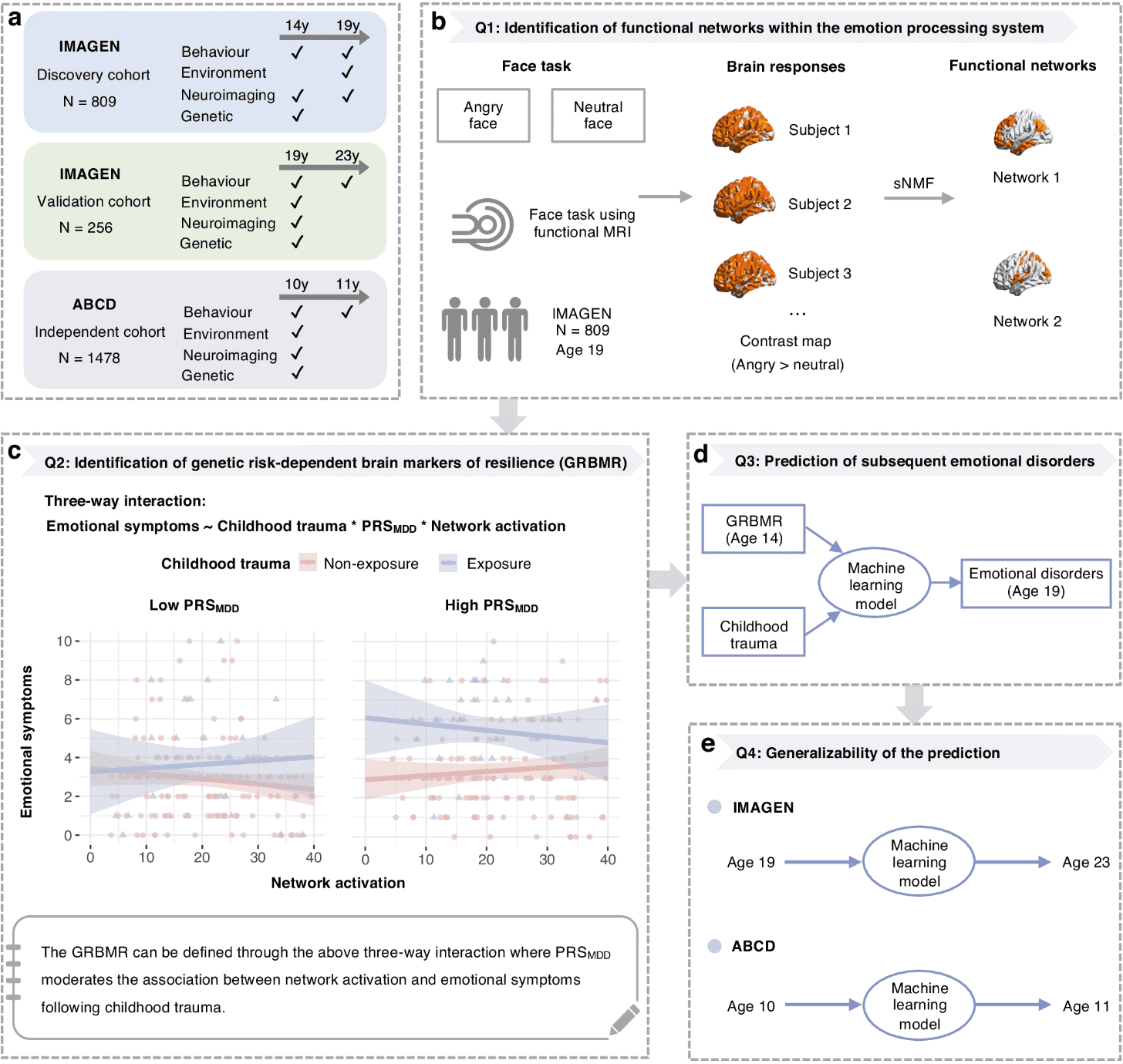
Figure 1

a Longitudinal cohorts included in the study. b Distinct functional networks were identified as candidate networks whose adaptive responses to angry faces may indicate resilience, using sparse non-negative matrix factorisation (sNMF) applied to brain responses to angry faces. c Genetic risk-dependent brain markers of resilience (GRBMR) were identified by testing a three-way interaction among childhood trauma, PRSMDD and candidate networks (shown in b) in relation to emotional symptoms at age 19, analysed separately for boys and girls. The error bands denote 95% confidence intervals around the regression lines. d The predictive utility of GRBMR was assessed using machine learning models. e Generalisability of the prediction was evaluated across developmental stages and in an independent dataset.

Results

Summary of experimental steps

Instead of using brain areas as candidate regions for identifying markers of resilience, the first analysis was to isolate functional networks within the brain’s emotion processing system as better candidates. Using a large neuroimaging sample of adolescents (19.02 ± 0.75 years; N = 809, 430 girls; the IMAGEN cohort; Table 1), we decomposed brain responses to angry faces into distinct functional networks by sparse non-negative matrix factorisation (sNMF). These networks were further characterised by their neuroanatomy, function, development, and sex differences. Second, for each of these candidate networks, we evaluated the interaction effect between its response to angry faces and childhood trauma on emotional symptoms separately for boys and girls. To identify GRBMRs, we further examined three-way interactions on emotional symptoms, involving the candidate networks, childhood trauma and PRSMDD. Third, we conducted longitudinal analyses to assess predictive values of the identified GRBMRs in genetically stratified populations. We built prediction models using the data collected at age 14 to predict emotional disorders at age 19. Finally, we tested the generalisability of the prediction models using both the latest follow-up data at age 23 in the IMAGEN cohort and another independent cohort, namely the Adolescent Brain Cognitive Development (ABCD) cohort (Fig. 1).

Table 1 Demographic characteristics of the IMAGEN sample in this study
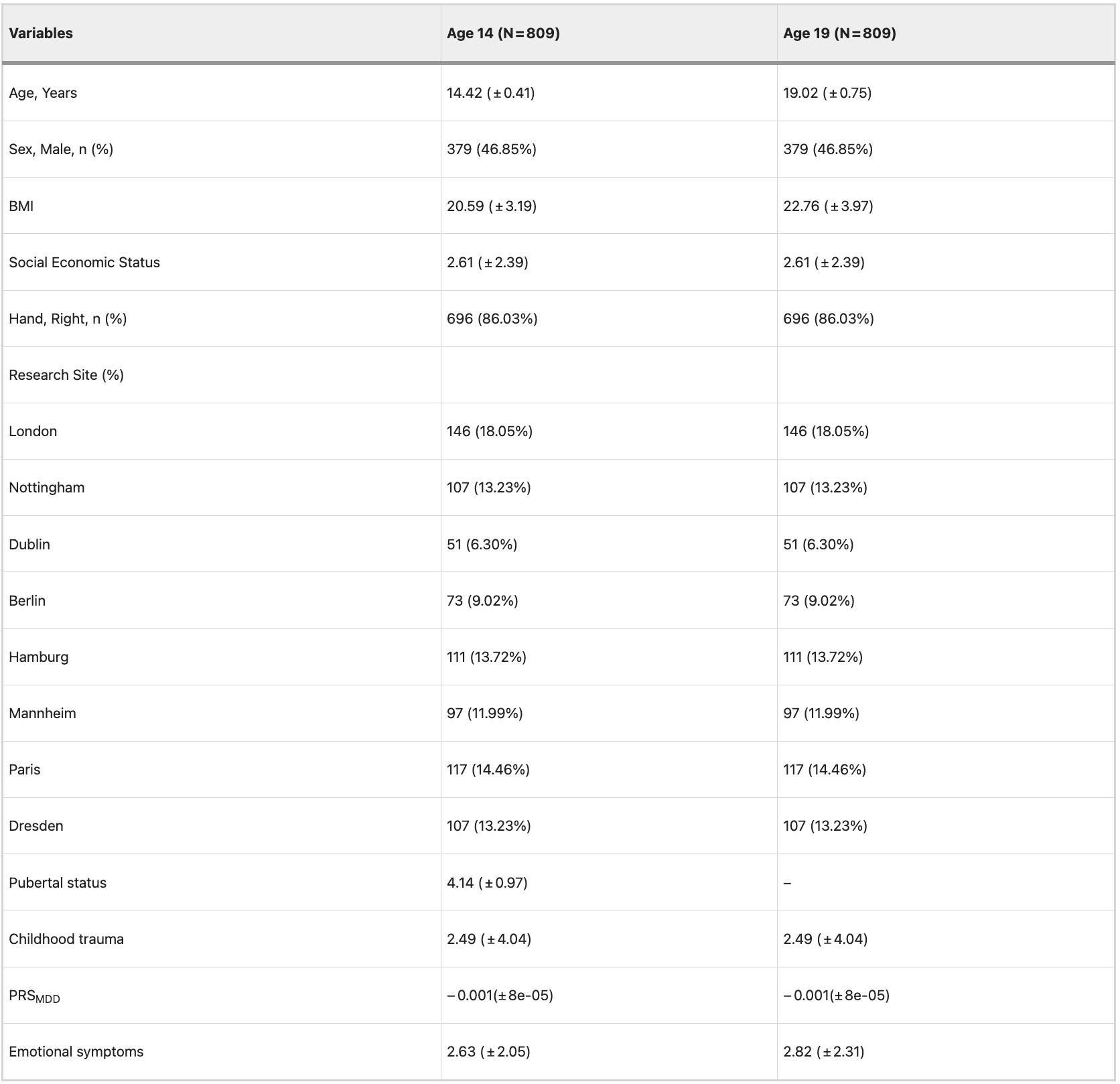
Table 1

BMI, body mass index; PRSMDD, Polygenic risk scores for major depression disorder. Higher scores on the pubertal status reflect more advanced pubertal maturation. Numbers of subjects are presented as integers (percentage), and quantitative measurements are presented as mean values ± standard deviations.

Candidate networks for identifying brain markers of resilience

The brain’s emotion processing system was activated by an fMRI face task. We analysed the angry>neutral contrast map for activations responding to angry faces higher than those to neutral faces (Figs. 1b, 2a). By applying the sNMF with optimal parameters to these brain activation data (Supplementary Fig. S2), we identified two distinct functional networks, including the orbitofrontal- and occipital-related networks (Fig. 2b). The orbitofrontal-related network mainly covered the lateral orbitofrontal cortex (OFC), ventromedial prefrontal cortex (vmPFC), medial superior prefrontal cortex, anterior cingulate cortex (ACC), precuneus, posterior cingulate cortex and dorsolateral prefrontal cortex (dlPFC) (Supplementary Table S2). The occipital-related network was mainly located in visual cortical regions: the lingual gyrus, cuneus, part of the inferior occipital gyrus (including the occipital face area, OFA), fusiform gyrus (including the fusiform face area, FFA), insula, amygdala, and Heschl’s gyrus (Fig. 3a and Supplementary Table S3). Using a database of brain functions (i.e., the NeuroSynth), we found that the orbitofrontal-related network was mainly related to high-level cognitive terms, such as episodic memory, memory retrieval and self-reference, while the occipital-related network showed associations with perceptual terms, such as vision and perception (Fig. 3b).

Fig. 2: Identification of functional networks within the brain’s emotion processing system.
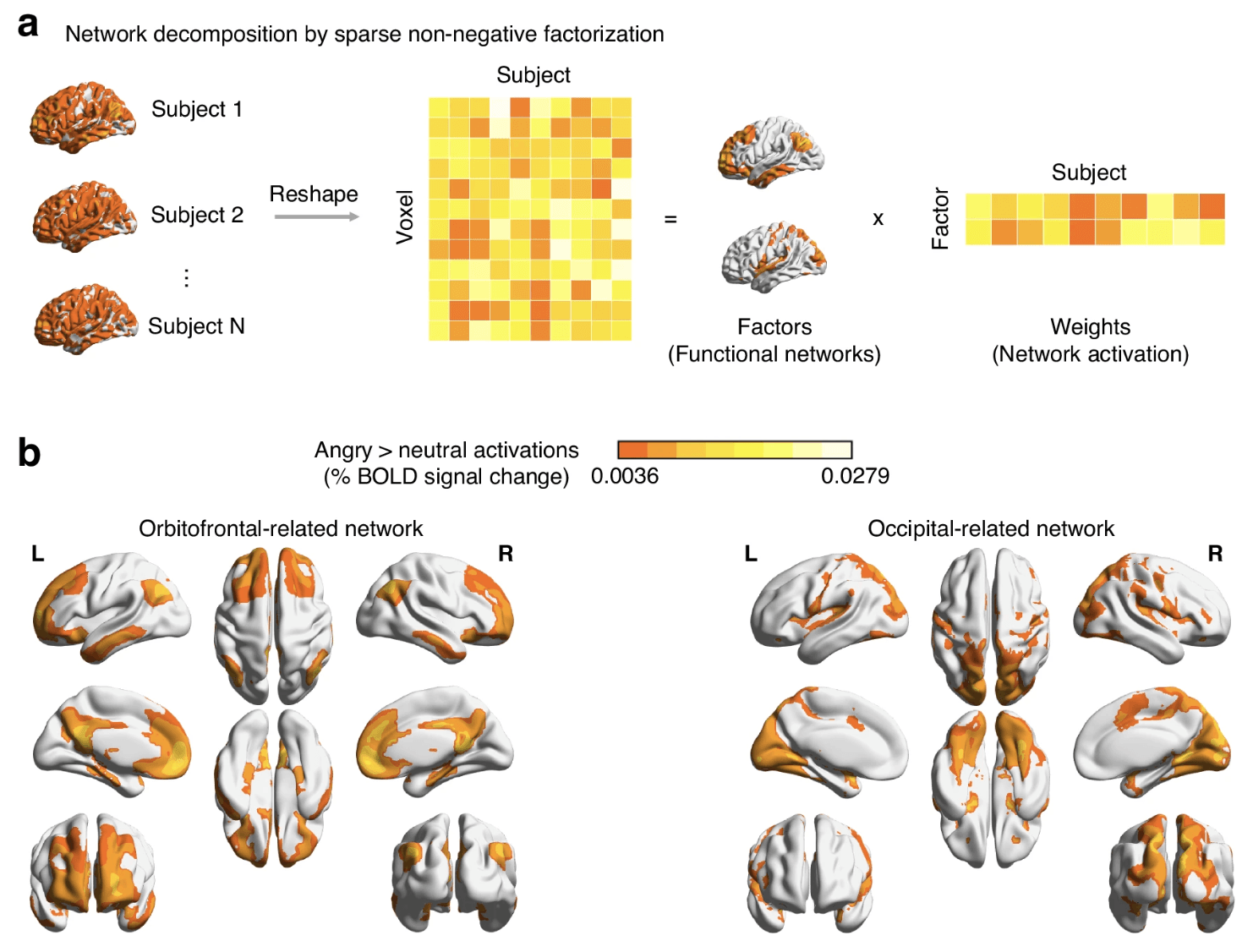
Fig 2

a Brain responses to angry faces were decomposed into factors (i.e., functional networks) and factor weights (i.e., network activation) using sparse non-negative matrix factorisation. b Brain maps show the orbitofrontal-related and occipital-related networks. The colour scale indicates voxel-wise factor values, with brighter colours representing higher contributions to the spatial profile of each network. Source data are provided in the Source Data file.

Fig. 3: Neuroanatomical and functional characterisation of the two identified networks.
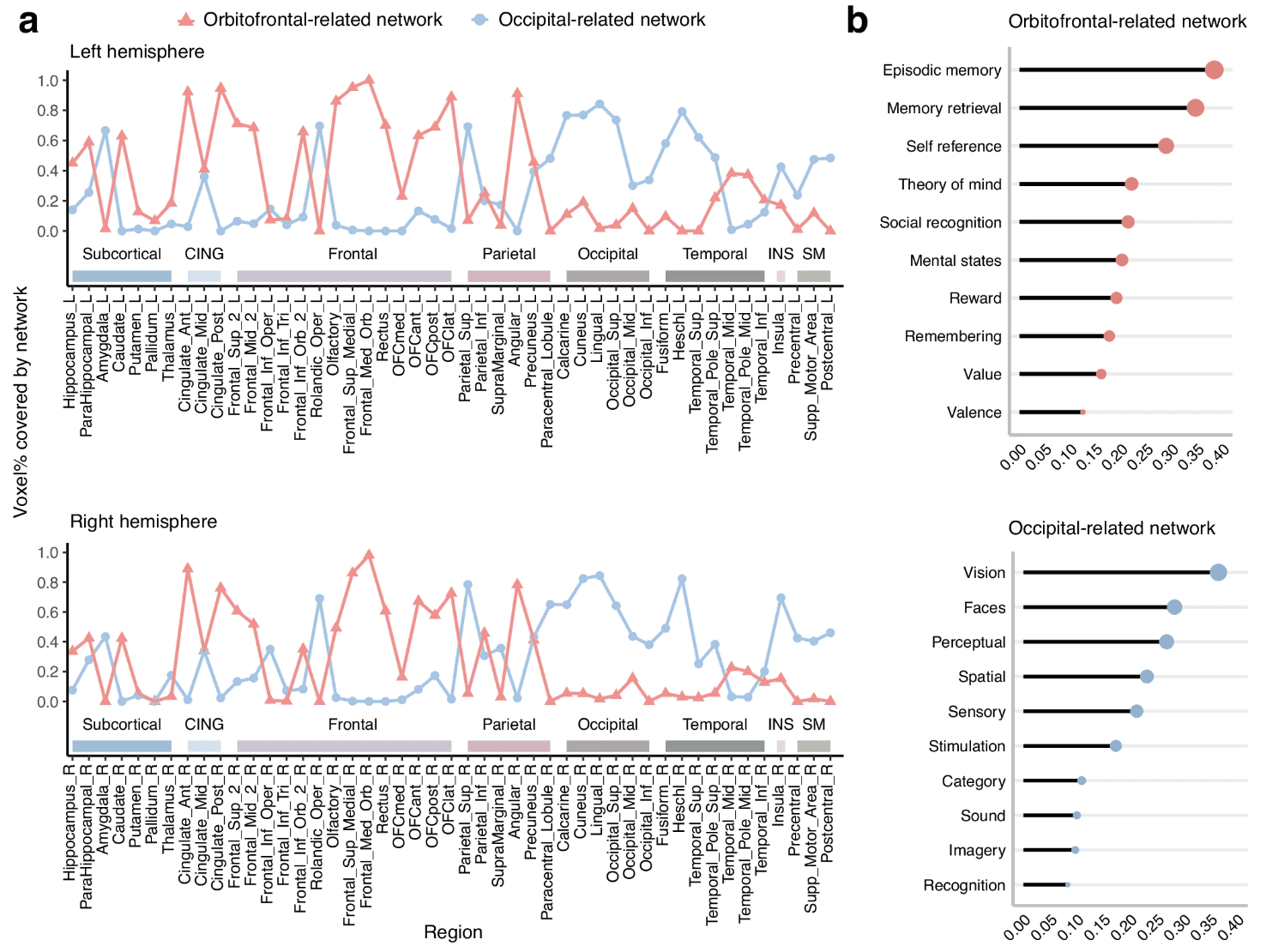
Fig 3

a Proportion of voxels within AAL2 regions covered by the orbitofrontal- and occipital-related networks. b NeuroSynth decoding of the two networks. The lollipop charts show the correlation coefficients for each network with the top 10 functional terms. CING, cingulate cortex; INS, insula; SM, sensorimotor. Source data are provided as a Source Data file.

Sex differences in these networks

We found significant sex differences in these two networks at age 19 years and in their developmental trajectories between ages 14 and 19 years. Compared with boys at age 19, we found that the network activation (i.e., the factor weight) of the occipital-related network was smaller in girls (=− 0.230, 95%CI = [− 0.369, − 0.090], p = 0.001; Supplementary Table S7). During the 5-year follow-up period, we found that the activation of the orbitofrontal-related network increased in both boys (= 0.012, F = 4.509, p = 0.034) and girls (= 0.010, F = 4.142, p = 0.042). Meanwhile, the activation of the occipital-related network significantly increased in boys (= 0.012, F = 4.593, p = 0.033) but not in girls (p = 0.643; Supplementary Tables S8, 9).

Genetic moderations of the brain networks’ roles in resilience

As expected, higher levels of childhood trauma were associated with more emotional symptoms at age 19 in both boys (= 0.205, 95% CI = [0.091, 0.319], p = 0.0004, N = 379) and girls (= 0.146, 95%CI = [0.059, 0.234], p = 0.001, N = 430; Fig. 4a).

Fig. 4: Distinct brain markers of resilience for girls within different genetic risk strata.
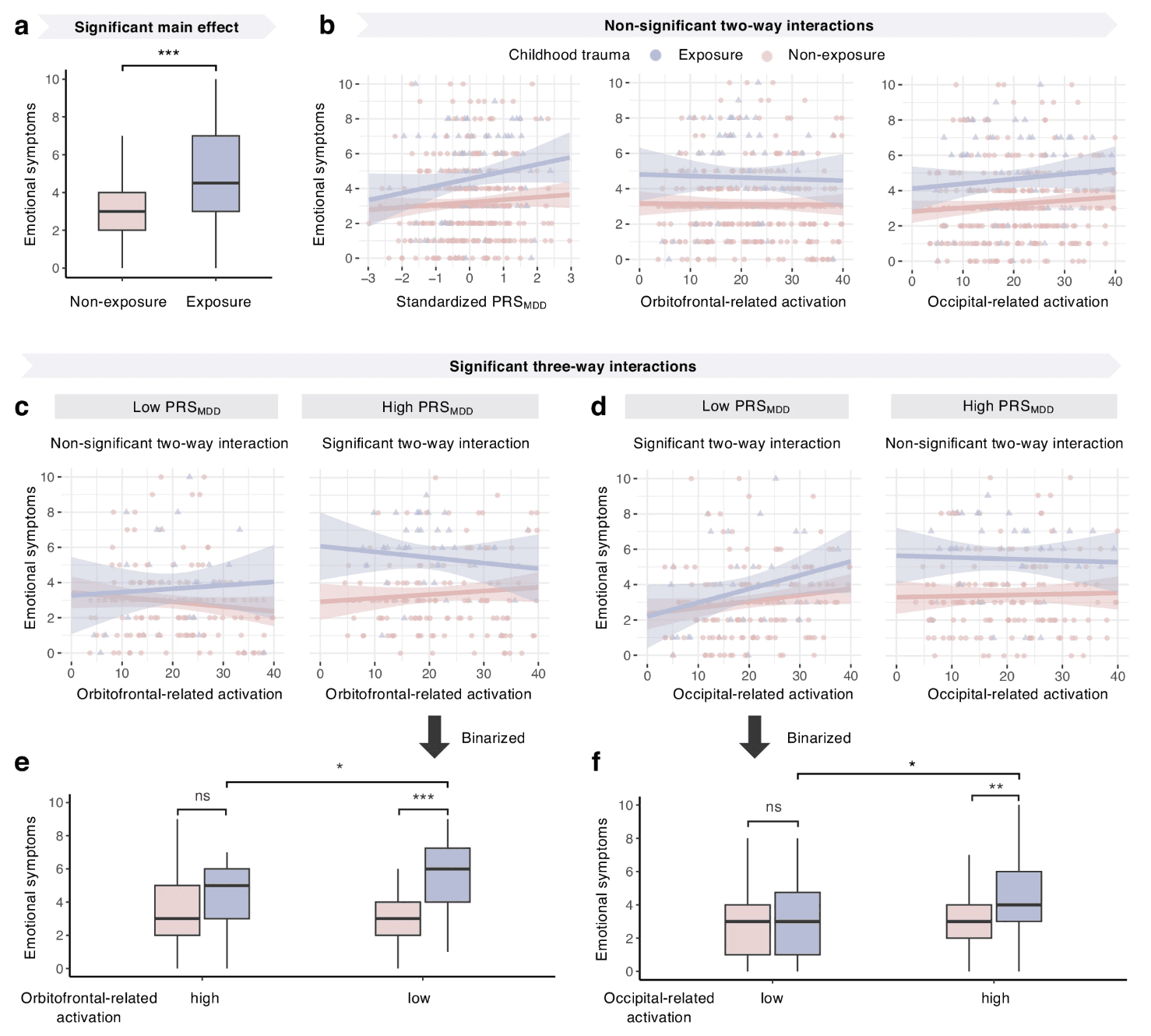
Fig 4

Childhood trauma was dichotomised based on clinical cut-offs (see “Methods”). a Girls with childhood trauma (N = 100) exhibited more emotional symptoms than those without exposure (N = 330; t = 5.139, ptwo-sided = 8.1810−7; two-sample t test). b No significant two-way interactions between trauma and either PRSMDD or network activations. c,d For illustration, PRSMDD was binarised by median split. After controlling for main effects and all two-way interactions, significant three-way interactions were observed among trauma, PRSMDD and activations of the orbitofrontal- and occipital-related networks. e,f Network activations were similarly binarised. Group differences in symptom levels were assessed using two-sample t tests. e In girls with high PRSMDD, those with low orbitofrontal-related activation and trauma exposure (N = 32) had more symptoms than those with low activation but without exposure (N = 73; t = 5.764, ptwo-sided = 3.1910−7), and also more than those with high activation despite exposure (N = 21; t = 2.152, ptwo-sided = 0.037). f In girls with low PRSMDD, those with high occipital-related activation and exposure (N = 25) had more symptoms than those with high activation but without exposure (N = 81; t = 2.929, ptwo-sided = 0.004), and also more than those with low activation despite exposure (N = 22; t = 2.082, ptwo-sided = 0.043). In a, e and f, the upper and lower whiskers represent the Q3 + 1.5 × IQR and Q1 − 1.5 × IQR, respectively. The upper and lower edges of a box represent the Q3 and Q1, and the central line represents the median. In b-d, the error bands represent the 95% confidence intervals of the linear fitted models. *p < 0.05; **p < 0.01; ***p < 0.001; ns, non-significant. Source data are provided in the Source Data file.

For both boys and girls, we found no significant two-way interactions between childhood trauma and either PRSMDD or activations of the two networks identified above (Fig. 4b). These findings suggest that neither PRSMDD nor network activations per se are sufficient to independently indicate resilience.

In girls, we identified two GRBMRs as defined by two significant three-way interactions between childhood trauma, PRSMDD, and the activations of both the orbitofrontal-related (Cohen’s f 2 = 0.058, = − 0.128, 95%CI = [− 0.224, − 0.031], p = 0.009; Fig. 4c) and occipital-related (Cohen’s f 2 = 0.067, =− 0.148, 95%CI = [− 0.253, − 0.043], p = 0.005; Fig. 4d) networks in predicting emotional symptoms at age 19 (Supplementary Table S10 and 11). The Shapiro-Wilk normality test confirmed the applicability of these linear models with three-way interaction terms by testing the normality of model residuals (all W > 0.96 and p > 0.05).

As binarized for illustrative purpose in Fig. 4e, among girls with higher PRSMDD, we observed a two-way interaction between the orbitofrontal-related network activation and childhood trauma (=− 0.147, 95%CI = [− 0.262, − 0.032], p = 0.012, N = 215), where higher network activation reduced the association between childhood trauma and increased emotional symptoms, and thereby defined a brain marker of resilience for girls with higher PRSMDD. However, this two-way interaction was not significant among girls with lower PRSMDD.

As illustrated in Fig. 4f, among girls with lower PRSMDD, we also found a two-way interaction between the occipital-related network activation and childhood trauma (= 0.183, 95%CI = [0.015, 0.351], p = 0.011, N = 215), where lower network activation reduced the association between childhood trauma and increased emotional symptoms, and thereby defined another brain marker of resilience for girls with lower PRSMDD. However, this two-way interaction was not significant among girls with higher PRSMDD.

No such three-way interactions were significant in boys; thus, we focused on girls in the following analyses.

Sensitivity analyses

The three-way interactions identified above remained significant in the following sensitivity analyses. First, we confirmed that our current sample provided enough statistical power to detect those three-way interactions. To detect a three-way interaction with a small-to-medium effect size (Cohen’s f 2 = 0.058) at a significance level of 0.05, and a desired power of 0.8, a sample size of 358 was required, as indicated by the power analysis in the R package ‘pwr’ (version 1.3.0). Second, these interactions were confirmed when the childhood trauma was binarised by clinical cut-offs (Supplementary Table S15). Third, these interactions remained significant after additionally controlling for the age, childhood neglect, IQ and substance use (Supplementary Table S16). Fourth, these interactions were specific to emotional symptoms only and were not significant for the other four types of behavioural problem scores in the SDQ. Fifth, these interactions on the emotional symptoms were specific to PRSMDD and were not significant for either PRSADHD or PRSSCZ (Supplementary Table S17).

Prediction of emotional disorders

Next, we assessed the predictability of the two GRBMRs identified above for emotional disorders. Separately for girls with the higher and lower PRSMDD, we built machine learning models using data collected at age 14 to predict emotional disorders at age 19 (N = 430), and compared the model performance by the 5-fold cross-validation with 10 repetitions (see “Methods”). Among girls with higher PRSMDD, we found that the GRBMR model using the interaction term between the orbitofrontal-related network activation and childhood trauma outperformed the network model without using the interaction term, which in turn outperformed the baseline model without using the network activation. These findings were consistent across various thresholds for the higher PRSMDD (Table 2; see “Methods”). These findings were not significant for either girls with lower PRSMDD or when using the occipital-related network.

Table 2 Comparison of model performance for the prediction of emotional disorders in girls at age 19
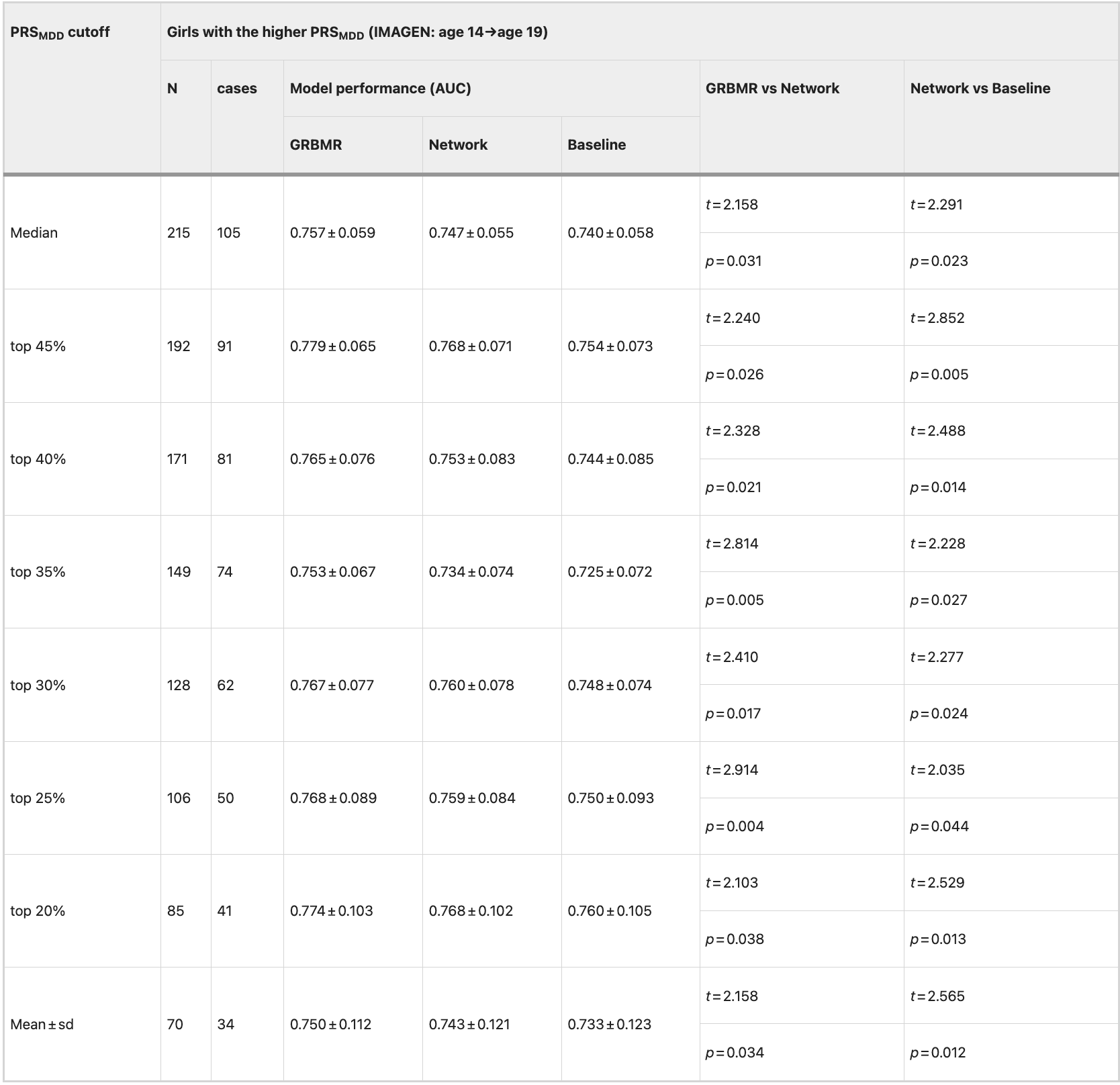
Table 2

PRSMDD, polygenic risk score for major depressive disorder. GRBMR, genetic risk-dependent brain marker of resilience. AUC, area under the curve. The mean and the standard deviation established by repeating a 5-fold cross validation 10 times were reported before and after the ‘±’, respectively. Paired t tests were used to assess the significance of differences in AUC between models, with both t-values and p-values (two-sided) reported.

Generalisability of the prediction model

Using the latest follow-up data collected in the IMAGEN cohort, we found that the predictability of the GRBMR model extended into early adulthood. Specifically, the GRBMR model with the orbitofrontal-related network activation at age 19 significantly improved the prediction of emotional disorders at age 23 in girls with higher PRSMDD (Table 3).

Table 3 Comparison of model performance for the prediction of emotional disorders in girls at age 23
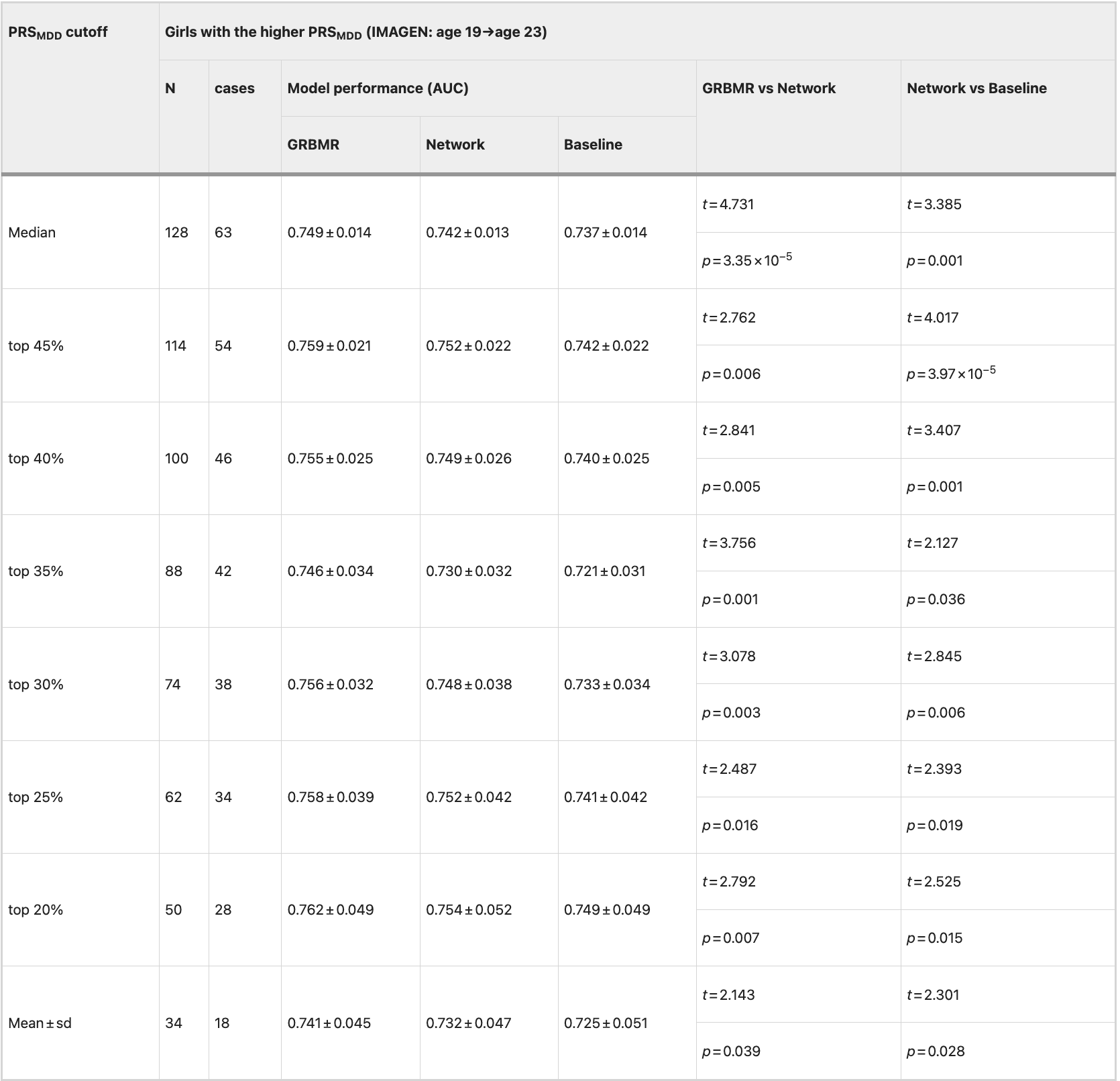
Table 3

PRSMDD, polygenic risk score for major depressive disorder. GRBMR, genetic risk-dependent brain marker of resilience. AUC, area under the curve. The mean and the standard deviation established by repeating a 5-fold cross validation 10 times were reported before and after the ‘±’, respectively. Paired t tests were used to assess the significance of differences in AUC between models, with both t-values and p-values (two-sided) reported.

Table 4 Comparison of model performance for the prediction of emotional disorders in girls from ABCD cohort
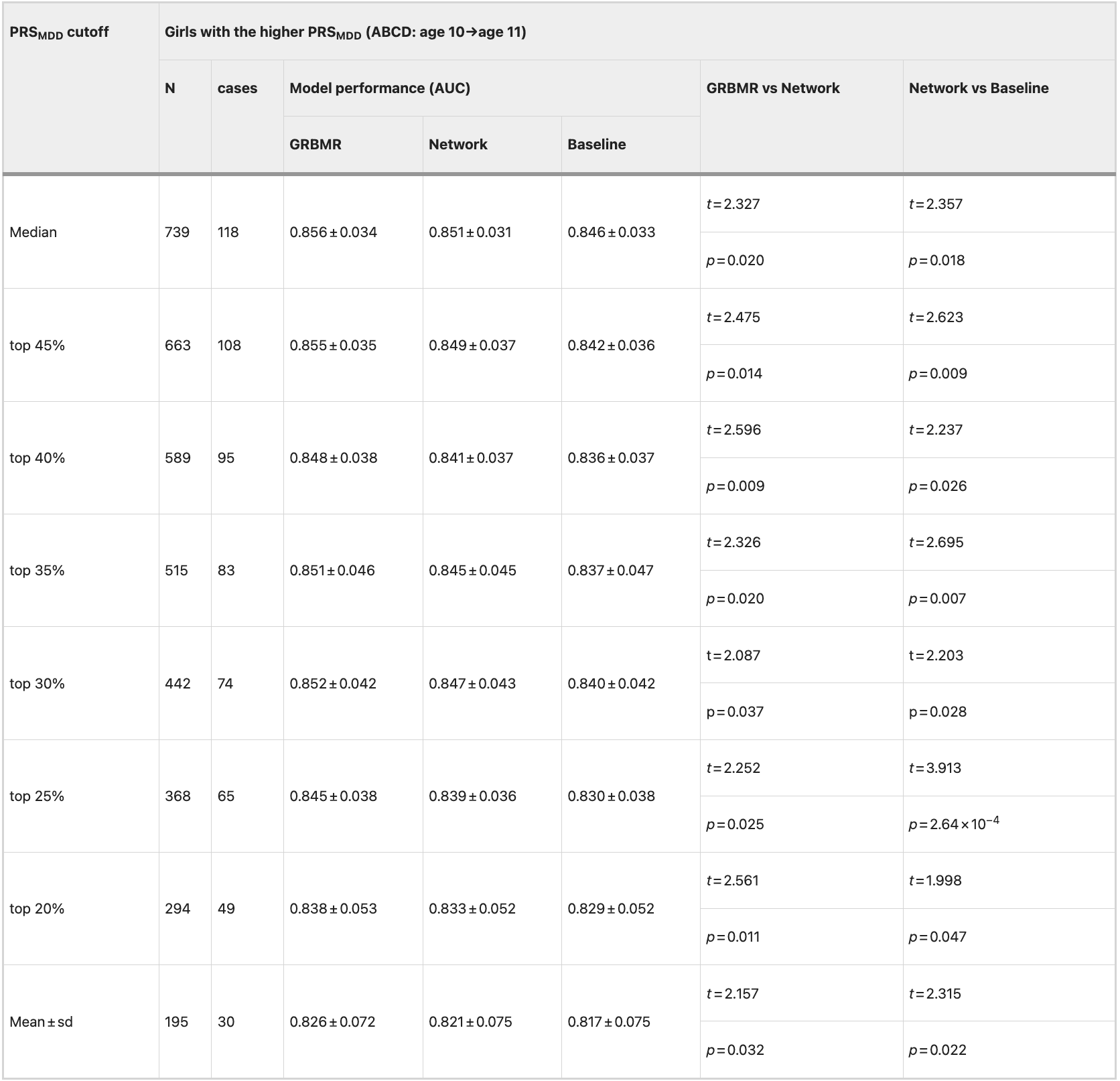
Table 4

PRSMDD, polygenic risk score for major depressive disorder. GRBMR, genetic risk-dependent brain marker of resilience. AUC, area under the curve. The mean and the standard deviation established by repeating a 5-fold cross validation 10 times were reported before and after the ‘±’, respectively. Paired t tests were used to assess the significance of differences in AUC between models, with both t-values and p-values (two-sided) reported.

Discussion

Guided by our hypotheses, this study investigated the functional role of the adolescent brain’s emotional processing networks in resilience in a genetically dependent manner, with analyses separately for boys and girls. First, we isolated two candidate networks, the orbitofrontal- and occipital-related networks, for identifying markers of resilience. These networks exhibited different developmental patterns and significant sex differences. Second, building on our established two-way interaction approach for identifying brain markers of resilience (i.e., a brain marker is associated with a reduced trauma-symptom association), we hypothesised distinct neural mechanisms of resilience in subpopulations carrying different genetic risk profiles. Indeed, our three-way interaction analyses identified two GRBMRs: (1) Within the group of girls carrying high PRSMDD exposed to childhood trauma, higher orbitofrontal-related network engagement during angry-face processing is associated with fewer emotional symptoms, a sign of resilience; (2) Within the group of girls carrying low PRSMDD exposed to childhood trauma, lower occipital-related network reactivity to angry faces is associated with fewer emotional symptoms, a sign of resilience. Thus, we have identified two brain markers of resilience, strengthened regulatory engagement and reduced threat reactivity, for girls carrying high and low polygenic depression risks, respectively, where resilience refers to fewer emotional symptoms following childhood trauma within their respective genetic contexts. Third, we found that among girls with higher PRSMDD, the orbitofrontal-related GRBMR at age 14 significantly improved the prediction of emotional disorders at age 19. Fourth, this predictive improvement was validated using the latest follow-up data collected at age 23 in the IMAGEN cohort and was generalisable to another independent cohort (i.e., ABCD). These findings highlight the genetic influences on orbitofrontal cortex function related to resilience, suggesting how markers for resilience can be used, and having implications for targeting treatment to appropriate individuals at risk.

Our findings revealed two separable and interacting networks processing angry facial expressions in adolescents. The existing literature has hypothesised that there are multiple interconnected emotional circuits in the brain for facial emotion processing, and these systems have hierarchically developmental trajectories during adolescence. Here, combining a longitudinal functional neuroimaging sample of the emotional face task for adolescents with an advanced matrix factorisation approach, we identified a two-network system underlying angry face processing. Many key parts of the orbitofrontal-related network, including the vmPFC, the ACC and the lateral OFC, have long been implicated in the neural representations of negative emotion. Notably, this network covering more than 80% of the lateral OFC but less than 23% of the medial OFC (Supplementary Table S2) provided strong evidence supporting the theory of a positive-to-negative gradient in the medial-to-lateral OFC. Meanwhile, the occipital-related network, which is in fact a ventral cortical stream network that includes the FFA, that is involved in visual perception, is well supported by a 2022 meta-analysis of 141 fMRI studies showing the occipital cortex as a key part of the emotion processing system. Longitudinally, the medial prefrontal activity in the orbitofrontal-related network implicated in emotion regulation grows throughout adolescence, while the occipital activity, including those in the face-selective regions (i.e., the fusiform gyrus) in the occipital-related network often shows substantial developmental changes before adolescence. These changes in the two-network emotion processing system may confer some adaptive advantages, such as greater flexibility in adjusting one’s intrinsic motivations and goal priorities amidst changing social contexts in adolescence.

The current findings emphasise that different brain systems can have different functional roles related to resilience to developing emotional disorders following childhood trauma within subpopulations carrying distinct genetic risk profiles. Our hypotheses and analyses focus on the resilience, referring to fewer emotional symptoms following childhood trauma within each genetic risk-stratified subgroup. This is different from previous studies investigating the resilience that is universal in the whole population. For example, following childhood trauma, individuals with the high orbitofrontal-related network activity had fewer emotional symptoms when compared with their peers within the subgroup carrying high PRSMDD; however, this did not hold when compared across the genetic subgroups, i.e., with low-PRSMDD individuals following childhood trauma. The functional networks (i.e., the orbitofrontal- and occipital-related networks), where we identified the GRBMRs, covered the brain regions that have been implicated in resilience in the literature1, such as the OFC and ACC in the orbitofrontal-related network and the amygdala in the occipital-related network. Different from previous studies, we could not uncover any brain marker of resilience on the whole population despite the large size of the IMAGEN sample. Instead, our finding of genetic moderation of the resilience-brain network relationship provided a possible explanation for the inconsistent findings reported in the literature. For example, following stressful life events, genetically high-risk individuals (i.e., carriers with the depression-related 5-HTTLPR short variant) displayed elevated amygdala activation in response to fearful faces, while the low-risk individuals showed inverse activation patterns. Such moderation is not so surprising, as the genetic risks for depression have already been associated with both structures and functions of the brain’s emotion processing system. Furthermore, our finding of the resilience-related advanced maturation in orbitofrontal function provided new evidence for the stress acceleration hypothesis of resilience, suggesting that it should account for individuals with varying genetic risks. The stronger function of the orbitofrontal-related network, including the dlPFC, OFC and hippocampus, may be linked to resilience through a better neurocognitive function of the top-down suppression of traumatic memories. This link was further supported by a clinical rTMS study of patients with MDD, where depression symptoms were ameliorated through enhanced activations in both OFC and hippocampus. This is also supported by the overlap between this network and the default mode network (DMN), particularly medial frontoparietal regions, which have been implicated in remembering the past and self-referencing. In an imaging genetic study, the alterations of the DMN have been associated with both childhood trauma and the gene expression of SLC6A4. Furthermore, our enrichment finding of the dopaminergic synapse pathway (Method S5, Supplementary Figs. S4, 5) provided a neurobiological link between the orbitofrontal-related network and the dopaminergic signature of resilience.

Our finding of non-significant three-way interactions in boys may be due to the fact that boys exhibit fewer emotional symptoms at age 19 when compared with girls. Furthermore, girls have been found to exhibit greater developmental reorganisation of the depression-related brain system during adolescence than boys, a process modulated by expression of X chromosome genes. This heightened plasticity may increase girls’ neural sensitivity to environmental stressors like childhood trauma. In addition, sex differences in depression risk mechanisms are evident: postmortem brain studies reveal distinct molecular changes between male and female MDD patients, and animal models demonstrate that female-specific resilience genes (e.g., LINC00473) are downregulated in depressed female mice but not males. Together, these literatures suggest that girls’ dynamic neurodevelopment and stronger genetic susceptibility create a biological context where gene-environment-brain interactions are more readily detectable. In contrast, boys’ neurodevelopmental trajectories may be less influenced by such interactions due to their lower baseline emotional vulnerability, reduced depression-related neural plasticity, and/or sex-specific genetic buffering mechanisms, potentially explaining the absence of detectable resilience markers in our study.

Our findings also have significant clinical implications for promoting adolescent mental health. In this study, we also examined whether three-way interactions between activations of two identified networks, childhood trauma and PRSMDD were associated with emotional symptoms at age 14 in the IMAGEN cohort and at age 10 in the ABCD cohort. We found that these interactions had the same trend as the main finding at age 19 but did not reach a statistical significance level (Supplementary Table S18). This result might be understood by the developmental change from childhood to adolescence. Despite the lack of replication in three-way interactions in different age groups, the prediction of subsequent emotional disorders using the interaction term between orbitofrontal-related network activation and childhood trauma demonstrated generalisability. This suggests that while cross-sectional interactions may be age-specific, the underlying predictive mechanism is developmentally robust, and the window for building resilience by enhancing the function of this network may extend from preadolescence to late adolescence. The predictive value might come from the significant maturation processes of this network during adolescence, as the occipital-related network with non-significant change during the same period was not predictive. Recently, neurofeedback training, such as the real-time fMRI feedback training of OFC and amygdala, have been used to enhance emotion regulation skills and reduce emotional symptoms. However, the intervention results are mixed. Our findings suggest that the OFC-targeted interventions might be particularly effective for those individuals carrying high genetic risks for depression. Therefore, the genetic-informed and neuroimaging-targeted approach might offer a promising way of promoting adolescent mental health.

The current study is not without limitations. First, we focused only on the brain function involved in facial emotion processing. Future studies are needed to test the generalisability of our findings to other types of emotional processing, which might lead to the discovery of additional brain markers for resilience. Second, data on childhood trauma exposure were collected retrospectively at age 19. Future prospective cohort studies are needed to exclude the potential for recall bias. Third, although our main findings in the IMAGEN cohort were generalisable to the independent ABCD cohort, these two cohorts mainly cover the White population with middle-to-high socioeconomic status. Therefore, future studies are needed to test whether the main findings could generalise to broader populations with diverse socioeconomic or racial/ethnic backgrounds. Fourth, apart from the covariates considered in the current study, many other psychosocial, cognitive and environmental factors (e.g., intervention programme, school engagement, etc.) can also contribute to the recovery from the exposure to childhood trauma. Future researches with comprehensively characterised information of these factors are needed to assess the effects of these factors on resilience. Fifth, recent literature highlights that resilience may manifest across multiple domains of functioning. While our study focused on mental health symptoms, future studies could examine other social, academic and cognitive domains of functioning. Sixth, we only found significant results for emotional symptoms in girls. Future studies could investigate externalising symptoms, which may be more prevalent in boys, to identify brain markers of resilience for them. Seventh, future pre-registered studies should validate the finding that the relationship between childhood trauma and emotional symptoms would differ as a function of orbitofrontal-related network activation in a sex-dependent fashion. Finally, the clinical value of building resilience through the genetic-informed and neuroimaging-targeted intervention strategy needs to be tested by randomised clinical trials.

Taken together, our study uncovered distinct brain markers, associated with fewer emotional symptoms following childhood trauma—whose effects differed between two subpopulations stratified by polygenic risk for depression (high vs. low), as revealed by a significant three-way interaction.

Methods

Participants

Participants were drawn from the IMAGEN project, a multicenter longitudinal study of adolescent brain development and mental health that recruited 2000 participants at age 14 in Europe and the UK. Among them, 1335 participants had neuroimaging data at both ages 14 and 19. Following the previous work, we selected 1269 participants with consistent activation patterns by examining the similarity of brain activations across research sites. Since genotype data were only available for Caucasian participants, this study included 809 Caucasian adolescents (430 girls) with complete neuroimaging, mental health, childhood trauma, and genome data (Table 1 and Supplementary Fig. S1). Notably, the included sample did not differ significantly from the excluded IMAGEN participants in key demographic or psychological variables (Supplementary Table S1). The local research ethics committees approved this study, and written consent was obtained from each participant and a parent or guardian.

Measurements

Behavioural and emotional problems

The Strengths and Difficulties Questionnaire (SDQ) is a valid and reliable assessment and is often used to measure the emotional and behavioural problems in adolescents, including emotional symptoms, conduct problems, hyperactivity/inattention, peer relationship problems, and prosocial behaviour. SDQ questionnaires gathered directly from adolescents themselves are more reliable than those from their parents, especially for the emotional symptom subscale. Therefore, the self-reported versions of the SDQ at ages 14 and 19 were used in this study.

Childhood trauma measurements

The Childhood Trauma Questionnaire (CTQ) is a 28-item self-report inventory used to assess the history of abuse and neglect before the age of 19 years. Given that the IMAGEN study is based on a population cohort, the severity of reported abuse may be underestimated. In this study, three abuse subscales (i.e., emotional abuse, physical abuse and sexual abuse) were summed to generate a composite measure of childhood trauma. The higher the composite score, the greater the severity of childhood trauma.

Polygenic risk scores

Since emotional disorders are not single-gene diseases, it is promising to use PRS to reflect the complex genetic architecture in the context of environment-gene-brain interactions7. We used GWAS summary data from European-ancestry participants (135,458 cases and 344,901 controls) provided by the Psychiatric Genomics Consortium as the discovery sample. Cases were required to meet international consensus criteria (DSM-IV, ICD-9, or ICD-10) for a lifetime diagnosis of MDD, while controls were screened for the absence of lifetime MDD. 493,592 single-nucleotide polymorphisms (SNPs) were shared by the discovery sample and the IMAGEN cohort. After the quality control measures (Method S1), a total of 123,481 SNPs were selected to compute the PRSMDD in our sample using the genetic analysis tool PLINK (version 2.0). The means of the PRSs at 7 p-value thresholds (i.e., 0.001, 0.05, 0.10, 0.20, 0.30, 0.40, and 0.50) were used in the current study in keeping with a previous study. The principal component analysis of ancestral information was performed, and the first 8 principal components (PCs) were used as covariates when PRS was considered as the predictor in the models.

Nuisance covariates

Pubertal status was assessed using the Pubertal Development Scale. A total neglect score was generated from the summation of two types of neglect (i.e., emotional neglect and physical neglect) in the CTQ. Socioeconomic status was rated according to the total score derived from all the 16 items related to family stress of the Development and Well-being Assessment, with each item offering three response options: 0 (‘No, or does not apply’), 1 (‘A little’), and 2 (‘A lot’). Therefore, a lower score represents a better socioeconomic condition. The IQ score of each participant was calculated as the total score derived from the Wechsler Intelligence Scale for Children-Fourth Edition (WISC-IV). Substance use was measured using the European School Survey Project on Alcohol and Drugs (ESPAD) as ever/never smoking cigarettes, drinking alcohol, or using illicit drugs.

The face task and fMRI preprocessing

The face task paradigm was used to elicit strong activation in the brain’s emotion processing system. In this task, participants passively watched 18 s blocks of either a face movie (presenting faces with angry, happy or neutral expressions) or a control stimulus (concentric circles). Details can be found in the initial report on this paradigm. In this study, we explored the neural reactivity associated with angry expressions, as neuroimaging data on these expressions was available at both ages 14 and 19. After the fMRI pre-processing (Method S2), the contrast map of angry vs. neutral faces was obtained for each participant. The angry > neutral (i.e., the activations responding to angry faces were higher than those to neutral faces) activations were used to measure the activation of the emotion processing system in the brain responding to angry faces. Although the mechanisms underlying the neutral > angry activations remained unclear, we still examined such activations in the supplementary materials to enhance the comprehensiveness of our study. The voxels within the automated anatomical labelling (AAL2) template for grey matter were considered in the following analyses (47,640 voxels).

Matrix decomposition

We constructed an activation matrix for the angry>neutral activations. The activation matrix has a number of rows equal to the voxel count (m = 47,640) and a number of columns corresponding to the number of subjects (n = 809). Sparse non-negative matrix factorisation (sNMF) was employed to decompose the activation matrix at age 19 into a factor matrix and a weight matrix (Fig. 2a). To facilitate meaningful sparse representation, we explicitly incorporated 0 -sparseness constraints on the columns of the factor matrix. Meanwhile, each row of the factor matrix can have only one non-zero value to ensure that no overlapping voxels among the latent factors are obtained by the decomposition (Method S3). To determine the optimal parameter for sparsity (, L is the maximal number of non-zeros voxels in each factor, m is the total number of voxels) and the optimal number of factors, we tested both the reconstruction error and the reproducibility of the obtained decompositions by a random half split for 80 times (Method S4).

Characterisation analysis of the functional networks

Neuroanatomical characterisation

We identified the respective positions of the non-zero values in each column of the factor matrix (i.e., each latent factor) within 47,640 voxels in the AAL2 template.

Functional characterisation

As recommended by the previous work, we compared the spatial pattern of the networks (i.e., factors) to the functional anatomy of the human brain using NeuroSynth (http://www.neurosynth.org/), an online platform for meta-analysis of functional neuroimaging literature. Specifically, we sorted all correlation coefficients for each network in descending order and adopted the top ten terms to characterise each network. Similar terms (e.g., “percept” and “perception”) were merged into a base form to avoid selecting repetitive terms.

Sex difference

We built a linear regression model to test the association between sex and the activation of each network (i.e., the weights of each factor) at age 19. In this model, we adjusted for the following essential covariates (i.e., research sites, socioeconomic status, BMI at age 19 and handedness) in this analysis. These essential covariates were also used in the following analyses where applicable.

Developmental trajectory

We applied the NMF back-reconstruction algorithm to compute the activation of each network of each participant at age 14 (Method S6). Next, for boys and girls separately, we carried out repeated measures analyses of variance (ANOVAs) to investigate the developmental trajectories of the network activations. The age 14 and age 19 network activations were the within-subject variables. In addition to the essential covariates, we incorporated pubertal status as an additional covariate, considering the relationship between pubertal maturation and the reactivity of the brain’s emotion processing system during early adolescence.

Moderation analysis

For boys and girls separately, associations were assessed by a linear regression model between emotional symptoms at age 19 and childhood trauma before age 19. Next, to identify the GRBMR, we examined the three-way interaction among PRSMDD, the activations of the above identified functional networks, and childhood trauma, in relation to emotional symptoms at age 19 in a linear regression model. In this model, we used 25 predictors, including 3 for main effects, 3 for two-way interaction effects, 1 for the three-way interaction effect, 7 dummy variables for research sites, 8 PCs for PRSMDD, BMI, handedness and socioeconomic status. The coefficients (standardised ) of the linear regression models and their 95% confidence intervals (CIs) are reported. A significant three-way interaction indicates that PRSMDD moderates the association between a higher level of this brain marker and fewer emotional symptoms following childhood trauma.

Sensitivity analyses

We tested whether the three-way interaction remained significant when the childhood trauma score was binarised using the following cut-offs as recommended in the literature, including a cut-off of 8 for emotional abuse, 7 for physical abuse, and 5 for sexual abuse. If any type of the above abuse occurred, childhood exposure to trauma was scored as “1”; if not, a score of “0” was recorded. We also included age, childhood neglect, IQ or substance use as an additional covariate in the moderation models to examine their potential confounding effects. To investigate the specificity of the moderation effects, we reran the models while (1) replacing the emotional symptom scores with behavioural problem scores from the other four dimensions in the SDQ; (2) replacing the PRSMDD with the PRSADHD or the PRSSCZ.

Prediction models for late-adolescence emotional disorders

Using the GRBMRs identified in the three-way interaction analysis, we built prediction models for emotional disorders at age 19 for girls with higher and lower PRSMDD separately. To reduce the potential bias of using specific thresholds for partitioning genetic risk groups, we defined higher- and lower-risk groups using a range of cutoffs based on the PRSMDD distribution, including the median, the highest and lowest tail cut-offs (45%, 40%, 35%, 30%, 25%, 20%), and the mean ± standard deviation. The emotional disorders were indicated by an emotional symptom score above a clinical cut-off of 4, which has been recommended to favour the instrument’s (i.e., SDQ) sensitivity in identifying depression and generalised anxiety. We considered the following three kinds of models: (1) The baseline model considered the following variables: childhood trauma, emotional symptom score, sites of data collection, handedness, pubertal status, socioeconomic status, and BMI. (2) A network model incorporated the activation of one brain network identified above into the baseline model. (3) A GRBMR model further included the interaction terms between the network activation and childhood trauma into a network model. These models were implemented using the Python package scikit-learn (version 1.3.2). To evaluate model performance, we repeated a 5-fold cross-validation 10 times to obtain the mean area under the curve (AUC). To assess the predictability of the GRBMR, the paired t test was used to test the significance of the difference in AUC between the GRBMR models and the network models, as well as between the network models and the baseline models.

Generalisability of the prediction models

Generalisability in early adulthood

Using the latest follow-up data at age 23 in the IMAGEN study, we tested the model performance among 256 girls. We applied the aforementioned trained models, without retraining (i.e., fixed weights), to see whether emotional disorders at age 23 can be predicted by the model using measurements at age 19.

Generalisability in an independent dataset

To test whether the GRBMR models could be generalised to an independent dataset, we used the data from the ABCD cohort (the ABCD data used in this study came from Data Release 5.0, https://doi.org/10.15154/8873-zj65) to rerun the prediction models. This independent dataset recruited 11,875 children between 9 and 10 years of age from 21 sites across the United States. The negative > neutral activations during 0 back in the EN-back task were used. To ensure homogeneity of the datasets, only self-reported white people in the ABCD cohort were included. We applied the NMF back-reconstruction algorithm again to compute the activations of the functional networks for each participant. After quality control (the same as the IMAGEN cohort), 1478 participants with complete neuroimaging data, PRSMDD, adverse childhood experiences (ACEs), and the essential covariates at baseline, as well as the internalising symptoms of the Child Behaviour Checklist at both baseline and the 1-year follow-up were analysed. The emotional disorders were indicated by an internalising symptom t-score above a cut-off of 60. Similarly, we first built the baseline model using the baseline measurements to predict emotional disorders at the 1-year follow-up for both the high and low genetic risk groups. Next, we added the network activation to construct the network model and further incorporated its interaction with ACEs to form the GRBMR model.

Reporting summary

Further information on research design is available in the Nature Portfolio Reporting Summary linked to this article.

Data availability

The IMAGEN data are available by application to the consortium coordinator, Dr. Schumann (http://imagen-europe.com), after evaluation according to an established procedure. The ABCD data are publicly released on an annual basis through the National Institute of Mental Health (NIMH) data archive (NDA, https://nda.nih.gov/abcd). The ABCD study data are openly available to qualified researchers for free. Access can be requested at https://nda.nih.gov/abcd/request-access. All the processed data used in this study are available from the corresponding author upon reasonable request. All data needed to evaluate the conclusions in this study are present in the paper and/ or the Supplementary Information. Source data are provided in this paper.

Code availability

The code used by the current study is made available at the following webpage: https://github.com/hanluyt/modulation_emotionalBrain.

Open Article as PDF

Abstract

Resilience to developing emotional disorders is critical for adolescent mental health, especially following childhood trauma. Yet, brain markers of resilience remain poorly understood. By analyzing brain responses to angry faces in a large-scale longitudinal adolescent cohort (IMAGEN), we identified two functional networks located in the orbitofrontal and occipital regions. In girls with high genetic risks for depression, higher orbitofrontal-related network activation was associated with a reduced impact of childhood trauma on emotional symptoms at age 19, whereas in those with low genetic risks, lower occipital-related network activation had a similar association. These findings reveal genetic risk-dependent brain markers of resilience (GRBMR). Longitudinally, the orbitofrontal-related GRBMR predicted subsequent emotional disorders in late adolescence, which were generalizable to an independent prospective cohort (ABCD). These findings demonstrate that high polygenic depression risk relates to activations in the orbitofrontal network and to resilience, with implications for biomarkers and treatment.

Introduction

Resilience is a key factor for good mental health. It is the ability to adapt positively when dealing with stress. Childhood trauma, such as emotional, physical, or sexual abuse, affects over a billion people worldwide. It increases the risk of emotional disorders like depression and anxiety. These disorders are linked to problems in how the brain processes emotions. This process involves brain areas activated during emotion perception and regulation, and it is shaped by genetics during adolescence. Understanding how genetics influence the brain's role in resilience can help predict emotional disorders. This knowledge can also help identify vulnerable individuals early for intervention.

In brain imaging studies, a sign of resilience is often a brain marker linked to fewer emotional symptoms after childhood trauma. Emotional disorders involve problems in the brain's emotional circuits, especially when processing negative emotions. Past studies have focused on how the brain responds to negative emotional images, such as angry or fearful faces, in specific areas. These areas include the orbitofrontal cortex (OFC), medial prefrontal cortex, anterior cingulate cortex, and amygdala. Problems in these regions after childhood trauma, such as strong amygdala reactions or weak medial prefrontal cortex activity to negative emotions, are linked to a higher risk of emotional disorders. In contrast, healthy responses in these areas suggest resilience. However, findings about these individual brain regions are not always consistent. For example, the amygdala's role in resilience is unclear, with both strong and weak responses to negative emotions linked to it. Newer evidence suggests that brain networks, rather than single regions, are more strongly connected to emotion processing. This means resilience might be a feature of entire functional networks. Therefore, emotion-processing networks in adolescent brains may be better for finding resilience markers.

Differences in resilience brain markers have also been found between sexes. For instance, resilience is linked to stronger OFC activity in boys but weaker activity in girls. Boys also show larger prefrontal volume, while girls show smaller volume. Similar sex differences are seen in temporal and frontal brain volumes. While boys and girls may use the same brain networks for emotion processing, their development may differ. This suggests these brain networks might play different roles in resilience for boys and girls.

Previous research mainly looked at how a brain feature, as a marker of resilience, related to fewer emotional symptoms in people who experienced trauma. However, this does not rule out the possibility that the brain feature could be linked to fewer emotional symptoms regardless of trauma, which would be a form of trauma-independent protection. A marker of resilience should instead be defined by a two-way interaction between a brain feature (e.g., higher or lower activity) and childhood trauma (e.g., exposure or no exposure). In this interaction, the brain feature reduces the impact of childhood trauma on emotional symptoms, showing a trauma-related form of protection. Studying resilience based on these interactions between childhood trauma and brain markers is uncommon but important. It helps distinguish between trauma-related and trauma-independent protection when defining a brain marker of resilience for developing emotional disorders after childhood trauma. This distinction is vital because emotional symptoms in childhood and adolescence are linked to a higher risk of major depressive disorders (MDD) in adulthood. Such a two-way interaction could improve the ability to predict emotional disorders.

Another area of research, the diathesis-stress model, suggests that genetic tendencies can lead to unhealthy brain changes after childhood trauma, increasing the risk of emotional disorders. For example, people with a specific gene variant (5-HTTLPR short variant), linked to depression, show negative connections between amygdala responses to emotional faces and life stress. People without this variant show positive connections. In a recent study, frontal and parietal brain volumes decreased in healthy individuals after negative life events, which is an adaptive change. However, these volumes increased in MDD patients, which is a maladaptive change. Specifically, lower amygdala responses to threatening faces are strongly linked to higher resilience in young adults who do not have depression but have a family history of it. This link is not seen in those without a family history of depression. Based on this, it is thought that the role of brain networks in resilience might differ in people with different genetic risk profiles, such as those with higher or lower polygenic risk scores for MDD (PRSMDD). To see if PRSMDD affects these roles, a three-way interaction involving brain networks, childhood trauma, and PRSMDD should be tested. Finding such an interaction could identify a genetic risk-dependent brain marker of resilience (GRBMR). This marker would be linked to fewer emotional symptoms after childhood trauma only within a specific genetic risk group, not across the whole population. However, past studies have had trouble finding significant three-way interactions due to small sample sizes. Recently, the IMAGEN study, a brain imaging study of adolescents, provided a large enough sample size to detect this type of interaction.

Considering these studies, the hypothesis is that adolescent brain networks for emotional processing, not single brain regions, are better for identifying resilience markers that can predict later emotional disorders. Importantly, the role of these networks in resilience should be examined in a way that considers genetic factors and should be analyzed separately for boys and girls. To test this, the study aims to answer four main questions: (1) Can specific functional networks in the adolescent brain's emotion processing system be identified as potential markers for resilience? (2) Can GRBMRs be found by detecting significant three-way interactions among these functional networks, childhood trauma, and PRSMDD, with separate analyses for boys and girls? (3) Can these identified GRBMRs predict future emotional disorders? (4) Can these predictions be applied to other developmental stages and different datasets?

The study involves several steps. First, longitudinal studies were used. Second, distinct functional networks were identified as potential candidates for resilience markers. These networks were found by analyzing brain responses to angry faces using a method called sparse non-negative matrix factorization (sNMF). Third, GRBMRs were identified by testing a three-way interaction involving childhood trauma, PRSMDD, and the candidate networks. This analysis looked at how these factors relate to emotional symptoms at age 19, with separate analyses for boys and girls. Fourth, the usefulness of GRBMRs in predicting emotional disorders was evaluated using machine learning. Fifth, the ability to apply these predictions was assessed across different developmental stages and in a separate dataset.

Summary of Experimental Steps

Instead of using individual brain areas as markers for resilience, the first step was to identify functional networks within the brain's emotion processing system as better candidates. A large group of adolescents (average age 19.02 years, 809 participants, 430 girls) from the IMAGEN study was used. Their brain responses to angry faces were broken down into distinct functional networks using a method called sparse non-negative matrix factorization (sNMF). These networks were then described based on their brain structure, function, development, and sex differences. Second, for each network, the study looked at how the network's response to angry faces and childhood trauma interacted to affect emotional symptoms, analyzing boys and girls separately. To find Genetic Risk-Dependent Brain Markers of Resilience (GRBMRs), three-way interactions among the networks, childhood trauma, and polygenic risk scores for major depressive disorder (PRSMDD) were examined for their effect on emotional symptoms. Third, long-term analyses were performed to see how well the identified GRBMRs predicted emotional disorders in genetically defined groups. Prediction models were built using data from age 14 to predict emotional disorders at age 19. Finally, the study checked if these prediction models could be used with later data from the IMAGEN study at age 23 and with a different study group, the Adolescent Brain Cognitive Development (ABCD) cohort.

Candidate Networks for Identifying Brain Markers of Resilience

The brain's emotion processing system was activated during a face task in an fMRI scan. The study looked at brain activity when participants saw angry faces compared to neutral faces, specifically focusing on activations that were higher for angry faces. By applying a method called sparse non-negative matrix factorization (sNMF) to this brain activity data, two distinct functional networks were identified: the orbitofrontal-related and occipital-related networks. The orbitofrontal-related network included parts of the lateral orbitofrontal cortex (OFC), ventromedial prefrontal cortex (vmPFC), medial superior prefrontal cortex, anterior cingulate cortex (ACC), precuneus, posterior cingulate cortex, and dorsolateral prefrontal cortex (dlPFC). The occipital-related network was mostly found in visual areas, such as the lingual gyrus, cuneus, part of the inferior occipital gyrus (including the occipital face area, OFA), fusiform gyrus (including the fusiform face area, FFA), insula, amygdala, and Heschl’s gyrus. Using a database of brain functions (NeuroSynth), it was found that the orbitofrontal-related network was mainly linked to high-level thinking terms like episodic memory, memory retrieval, and self-reference. The occipital-related network, however, was associated with perceptual terms such as vision and perception.

Sex Differences in These Networks

Significant differences were found between sexes in these two networks at age 19 and in how they developed between ages 14 and 19. At age 19, girls showed less activation in the occipital-related network compared to boys. Over the five-year period, activation in the orbitofrontal-related network increased in both boys and girls. However, activation in the occipital-related network significantly increased in boys but not in girls.

Genetic Moderations of the Brain Networks’ Roles in Resilience

As expected, higher levels of childhood trauma were linked to more emotional symptoms at age 19 in both boys and girls.

No significant two-way interactions were found between childhood trauma and either polygenic risk scores for major depressive disorder (PRSMDD) or the activity of the two identified networks for both boys and girls. This suggests that neither PRSMDD nor network activity alone is enough to indicate resilience.

In girls, two Genetic Risk-Dependent Brain Markers of Resilience (GRBMRs) were identified. These were defined by two significant three-way interactions involving childhood trauma, PRSMDD, and the activity of both the orbitofrontal-related and occipital-related networks, all of which predicted emotional symptoms at age 19. Statistical tests confirmed that these linear models were appropriate.

Specifically, among girls with higher PRSMDD, a two-way interaction was observed between orbitofrontal-related network activity and childhood trauma. In this group, higher network activity lessened the link between childhood trauma and increased emotional symptoms, indicating a brain marker of resilience for girls with higher PRSMDD. This interaction was not significant for girls with lower PRSMDD.

Similarly, among girls with lower PRSMDD, a two-way interaction was found between occipital-related network activity and childhood trauma. Here, lower network activity lessened the link between childhood trauma and increased emotional symptoms, defining another brain marker of resilience for girls with lower PRSMDD. This interaction was not significant for girls with higher PRSMDD.

No such three-way interactions were significant in boys, so further analyses focused on girls.

Sensitivity Analyses

The three-way interactions found remained significant in several checks. First, the sample size was large enough to detect these interactions. Second, the results were confirmed when childhood trauma was classified using specific clinical thresholds. Third, the interactions were still significant after controlling for other factors like age, childhood neglect, IQ, and substance use. Fourth, these interactions specifically affected emotional symptoms and not other behavioral problems. Fifth, these interactions related to emotional symptoms were specific to PRSMDD and not to other polygenic risk scores for ADHD or schizophrenia.

Prediction of Emotional Disorders

Next, the study assessed how well the two identified GRBMRs could predict emotional disorders. For girls with higher and lower PRSMDD, separately, machine learning models were built using data from age 14 to predict emotional disorders at age 19. The models' performance was compared using a technique called 5-fold cross-validation with 10 repetitions. Among girls with higher PRSMDD, the GRBMR model, which included the interaction between orbitofrontal-related network activity and childhood trauma, performed better than a network model without this interaction. The network model, in turn, performed better than a basic model that did not use network activity. These findings remained consistent across different ways of defining the "higher PRSMDD" group. However, these findings were not significant for girls with lower PRSMDD or when using the occipital-related network.

Generalisability of the Prediction Model

The ability of the GRBMR model to predict outcomes was also found to extend into early adulthood. Using the latest follow-up data from the IMAGEN study, the GRBMR model that included orbitofrontal-related network activity at age 19 significantly improved the prediction of emotional disorders at age 23 in girls with higher PRSMDD.

The study also checked if the GRBMR models could be applied to a different, independent dataset called the Adolescent Brain Cognitive Development (ABCD) cohort.

Discussion

This study examined the role of adolescent brain networks for emotional processing in resilience, considering genetic factors and analyzing boys and girls separately. First, two networks were identified as potential markers for resilience: the orbitofrontal-related and occipital-related networks. These networks showed different developmental patterns and significant sex differences. Second, building on a method for finding brain markers of resilience that involve a reduced link between trauma and symptoms, the study proposed that different genetic risk profiles might lead to different brain mechanisms for resilience. Indeed, analyses showed two GRBMRs in girls: (1) For girls with high polygenic risk scores for major depressive disorder (PRSMDD) who experienced childhood trauma, greater activity in the orbitofrontal-related network during angry-face processing was linked to fewer emotional symptoms, indicating resilience. (2) For girls with low PRSMDD who experienced childhood trauma, less activity in the occipital-related network in response to angry faces was linked to fewer emotional symptoms, also indicating resilience. This means two brain markers of resilience were found for girls with high and low polygenic depression risks, representing strengthened regulatory engagement and reduced threat reactivity, respectively. Resilience here means fewer emotional symptoms after childhood trauma within their specific genetic contexts. Third, among girls with higher PRSMDD, the orbitofrontal-related GRBMR at age 14 significantly improved the prediction of emotional disorders at age 19. Fourth, this improved prediction was confirmed with later data from the IMAGEN study at age 23 and could be applied to another independent study group (ABCD). These findings highlight how genetics influence orbitofrontal cortex function related to resilience. They suggest how resilience markers can be used and have implications for directing treatments to individuals at risk.

The study found two distinct, interacting networks in adolescents that process angry facial expressions. Research suggests that the brain has multiple interconnected circuits for processing facial emotions, which develop in stages during adolescence. By using a longitudinal brain imaging study of adolescents performing an emotional face task and an advanced analysis method, the study identified a two-network system involved in processing angry faces. Key parts of the orbitofrontal-related network, including the vmPFC, ACC, and lateral OFC, are known to be involved in processing negative emotions. This network, covering most of the lateral OFC but less of the medial OFC, supports the idea that the medial-to-lateral OFC has a positive-to-negative gradient. The occipital-related network, which is a ventral cortical stream network including the fusiform face area (FFA), is involved in visual perception. A 2022 meta-analysis of fMRI studies supports the occipital cortex as a key part of the emotion processing system. Over time, activity in the medial prefrontal cortex within the orbitofrontal-related network, involved in emotion regulation, increases throughout adolescence. Meanwhile, occipital activity, including in face-selective regions like the fusiform gyrus in the occipital-related network, often shows significant developmental changes before adolescence. These changes in the two-network emotion processing system might offer advantages, such as more flexibility in adjusting motivations and priorities in changing social situations during adolescence.

The current findings emphasize that different brain systems can have different functional roles related to resilience to developing emotional disorders after childhood trauma within groups of people with different genetic risk profiles. The study's hypotheses and analyses focus on resilience as meaning fewer emotional symptoms after childhood trauma within each genetic risk group. This differs from previous studies that looked for resilience that is common across the entire population. For example, after childhood trauma, individuals with high orbitofrontal-related network activity had fewer emotional symptoms when compared to their peers within the group with high PRSMDD. However, this was not true when comparing across genetic groups, meaning with individuals with low PRSMDD who also experienced childhood trauma. The functional networks where GRBMRs were found (the orbitofrontal- and occipital-related networks) include brain regions previously linked to resilience, such as the OFC and ACC in the orbitofrontal-related network and the amygdala in the occipital-related network. Unlike earlier studies, no brain marker of resilience was found that applied to the whole population, despite the large sample size of the IMAGEN study. Instead, the finding that genetics influence the relationship between resilience and brain networks provides a possible explanation for the inconsistent results in previous research. For instance, after stressful life events, individuals with high genetic risk (those with the depression-related 5-HTTLPR short variant) showed increased amygdala activation when seeing fearful faces, while low-risk individuals showed the opposite pattern. This genetic influence is not surprising, as genetic risks for depression are already known to be linked to both the structure and function of the brain's emotion processing system. Furthermore, the finding of resilience-related advanced development in orbitofrontal function offers new evidence for the stress acceleration hypothesis of resilience, suggesting that it should consider individuals with different genetic risks. Stronger function in the orbitofrontal-related network, including the dlPFC, OFC, and hippocampus, may be linked to resilience through better cognitive control that suppresses traumatic memories. This link is further supported by a clinical study of patients with major depressive disorder (MDD), where depression symptoms improved with increased activity in both the OFC and hippocampus. This is also supported by the overlap between this network and the default mode network (DMN), particularly medial frontoparietal regions, which are involved in remembering the past and self-referencing. In a genetic imaging study, changes in the DMN have been linked to both childhood trauma and the expression of the SLC6A4 gene. Additionally, the finding of enrichment in the dopaminergic synapse pathway provides a biological link between the orbitofrontal-related network and the role of dopamine in resilience.

The lack of significant three-way interactions in boys might be because boys typically show fewer emotional symptoms at age 19 compared to girls. Also, girls have shown greater developmental changes in depression-related brain systems during adolescence, a process affected by genes on the X chromosome. This increased flexibility might make girls' brains more sensitive to environmental stressors like childhood trauma. Furthermore, sex differences in the causes of depression are clear: postmortem brain studies show different molecular changes in male and female MDD patients, and animal studies demonstrate that specific resilience genes in females are less active in depressed female mice but not in males. Together, these findings suggest that girls' dynamic brain development and stronger genetic susceptibility create a biological setting where gene-environment-brain interactions are more easily detected. In contrast, boys' brain development might be less influenced by such interactions due to their lower basic emotional vulnerability, less brain flexibility related to depression, and/or specific genetic protections for their sex, which could explain why no resilience markers were found in boys in this study.

These findings also have important implications for promoting adolescent mental health. The study also looked at whether three-way interactions between the activity of two identified networks, childhood trauma, and polygenic risk scores for major depressive disorder (PRSMDD) were linked to emotional symptoms at age 14 in the IMAGEN group and at age 10 in the ABCD group. While these interactions showed a similar pattern to the main finding at age 19, they did not reach statistical significance. This might be due to developmental changes from childhood to adolescence. Despite the lack of consistent three-way interactions across different age groups, the ability to predict future emotional disorders using the interaction between orbitofrontal-related network activity and childhood trauma was generally applicable. This suggests that while direct interactions might be specific to certain ages, the underlying mechanism for prediction is strong across development. The period for building resilience by improving the function of this network may extend from before adolescence to late adolescence. The predictive value might come from the significant development of this network during adolescence, as the occipital-related network, which did not change much during the same period, was not predictive. Recently, neurofeedback training, such as real-time fMRI feedback training of the OFC and amygdala, has been used to improve emotion regulation skills and reduce emotional symptoms. However, the results of these interventions vary. These findings suggest that interventions targeting the OFC might be especially effective for individuals with a high genetic risk for depression. Therefore, using a genetics-informed and brain imaging-targeted approach might be a promising way to promote adolescent mental health.

This study has some limitations. First, it focused only on brain function related to processing facial emotions. Future studies should examine other types of emotional processing to see if more brain markers for resilience can be found. Second, information about childhood trauma was collected by asking participants to remember past events at age 19. Future studies should use real-time observations to avoid potential memory biases. Third, although the main findings from the IMAGEN study applied to the separate ABCD study, both groups mostly consisted of White individuals with middle-to-high socioeconomic status. Therefore, future studies need to check if these findings apply to more diverse populations in terms of socioeconomic or racial/ethnic backgrounds. Fourth, besides the factors considered in this study, many other social, cognitive, and environmental factors (e.g., intervention programs, school involvement) can also help individuals recover from childhood trauma. Future research needs to gather thorough information on these factors to assess their effects on resilience. Fifth, recent research shows that resilience can appear in many areas of functioning. While this study focused on mental health symptoms, future studies could look at other social, academic, and cognitive areas. Sixth, significant results for emotional symptoms were only found in girls. Future studies could investigate externalizing symptoms, which might be more common in boys, to find brain markers of resilience for them. Seventh, future pre-registered studies should confirm the finding that the relationship between childhood trauma and emotional symptoms differs based on orbitofrontal-related network activity in a sex-dependent way. Finally, the clinical benefit of building resilience through genetic-informed and brain imaging-targeted interventions needs to be tested through randomized clinical trials.

In summary, this study discovered distinct brain markers linked to fewer emotional symptoms after childhood trauma. The effects of these markers differed between two groups of people, those with high versus low genetic risk for depression, as shown by a significant three-way interaction.

Methods

Participants

Participants came from the IMAGEN project, a long-term study of adolescent brain development and mental health. It initially recruited 2000 participants in Europe and the UK at age 14. Of these, 1335 had brain imaging data at both ages 14 and 19. Consistent brain activation patterns were found in 1269 participants across different research sites. Since genetic data were only available for Caucasian participants, this study included 809 Caucasian adolescents (430 girls) with complete brain imaging, mental health, childhood trauma, and genetic data. Importantly, the participants included in this study did not differ significantly from the excluded IMAGEN participants in important demographic or psychological characteristics. Local research ethics committees approved this study, and written consent was obtained from each participant and a parent or guardian.

Measurements

Behavioural and Emotional Problems

The Strengths and Difficulties Questionnaire (SDQ) is a reliable tool used to measure emotional and behavioral problems in adolescents. This includes emotional symptoms, conduct problems, hyperactivity/inattention, peer relationship problems, and prosocial behavior. Self-reported SDQ questionnaires from adolescents are considered more reliable than those from their parents, especially for emotional symptoms. Therefore, the self-reported versions of the SDQ at ages 14 and 19 were used in this study.

Childhood Trauma Measurements

The Childhood Trauma Questionnaire (CTQ) is a 28-item self-report survey that assesses a person's history of abuse and neglect before age 19. Because the IMAGEN study is a general population study, the reported severity of abuse might be lower than in clinical samples. In this study, scores from three subscales (emotional abuse, physical abuse, and sexual abuse) were added together to create a single measure of childhood trauma. A higher total score indicates more severe childhood trauma.

Polygenic Risk Scores

Since emotional disorders are not caused by a single gene, using polygenic risk scores (PRS) is a promising way to understand the complex genetic makeup related to how genes, environment, and brain interact. Data from a large genetic study (GWAS) of people of European descent (135,458 cases and 344,901 controls) were used as the reference sample. Cases met international criteria for a lifetime diagnosis of major depressive disorder (MDD), while controls were screened to confirm they had never had MDD. A large number of single-nucleotide polymorphisms (SNPs) were shared between the reference sample and the IMAGEN cohort. After quality control, a total of 123,481 SNPs were used to calculate the PRSMDD in the study sample using a genetic analysis tool called PLINK (version 2.0). The average of the PRSs at seven different statistical thresholds (0.001, 0.05, 0.10, 0.20, 0.30, 0.40, and 0.50) was used, consistent with a previous study. To account for genetic ancestry, the first 8 principal components from a principal component analysis were included as additional factors in the models when PRS was used as a predictor.

Nuisance Covariates

Pubertal status was assessed using the Pubertal Development Scale. A total neglect score was created by adding up scores for emotional neglect and physical neglect from the CTQ. Socioeconomic status was determined by a total score from 16 items related to family stress in the Development and Well-being Assessment. Each item had three response options: 0 ('No, or does not apply'), 1 ('A little'), and 2 ('A lot'). Therefore, a lower score indicated better socioeconomic conditions. Each participant's IQ score was calculated using the total score from the Wechsler Intelligence Scale for Children-Fourth Edition (WISC-IV). Substance use was measured by the European School Survey Project on Alcohol and Drugs (ESPAD) and included whether a person had ever smoked cigarettes, drunk alcohol, or used illicit drugs.

The Face Task and fMRI Preprocessing

A face task was used to strongly activate the brain's emotion processing system during fMRI. In this task, participants passively watched 18-second blocks of either face videos (showing angry, happy, or neutral expressions) or a control image (concentric circles). The details of this task are available in an earlier report. This study focused on brain responses to angry expressions because brain imaging data for these expressions were available at both ages 14 and 19. After initial fMRI data processing, a "contrast map" was created for each participant, comparing brain activity during angry faces versus neutral faces. The brain activity that was higher for angry faces than neutral faces was used to measure the activation of the brain's emotion processing system. Although the reasons for higher activity during neutral faces compared to angry faces are not fully understood, these activations were also examined in supplementary materials for completeness. Only voxels within the grey matter as defined by the automated anatomical labeling (AAL2) template were included in the analyses (47,640 voxels).

Matrix Decomposition

An activation matrix was created for brain activity that was higher for angry faces compared to neutral faces. This matrix had rows for each brain voxel (47,640 voxels) and columns for each participant (809 participants). A method called sparse non-negative matrix factorization (sNMF) was used to break down this activation matrix at age 19 into a factor matrix (representing functional networks) and a weight matrix (representing how much each participant used each network). To make sure the networks were clearly defined, specific constraints were put on the factor matrix columns, requiring them to be sparse (meaning most values are zero). Additionally, each row of the factor matrix could only have one non-zero value, ensuring that no brain voxels overlapped between the identified networks. The best settings for sparsity and the number of networks were determined by testing how well the data could be reconstructed and how consistently the networks were found across repeated analyses using randomly split data.

Characterisation Analysis of the Functional Networks

Neuroanatomical Characterisation

The locations of the non-zero values in each column of the factor matrix (representing each functional network) were identified within the 47,640 voxels in the AAL2 template.

Functional Characterisation

To understand what each network does, its spatial pattern was compared to the functional anatomy of the human brain using NeuroSynth, an online platform for meta-analysis of brain imaging studies. Specifically, for each network, the top ten most correlated functional terms were used to describe its function. Similar terms (e.g., “percept” and “perception”) were combined to avoid repetition.

Sex Difference

A linear regression model was used to test the relationship between sex and the activity of each network (how much each factor was weighted) at age 19. This model accounted for important additional factors such as research sites, socioeconomic status, body mass index (BMI) at age 19, and handedness. These additional factors were also used in other relevant analyses.

Developmental Trajectory

The NMF back-reconstruction algorithm was applied to calculate the activity of each network for each participant at age 14. Then, for boys and girls separately, repeated measures analyses of variance (ANOVAs) were used to study how network activity changed over time. Network activations at age 14 and age 19 were considered within-subject variables. In addition to the essential influencing factors, pubertal status was included as another influencing factor, given its connection to how the brain's emotion processing system reacts during early adolescence.

Moderation Analysis

For boys and girls separately, a linear regression model was used to assess the relationship between emotional symptoms at age 19 and childhood trauma experienced before age 19. Next, to identify the Genetic Risk-Dependent Brain Marker of Resilience (GRBMR), a linear regression model examined the three-way interaction among polygenic risk scores for major depressive disorder (PRSMDD), the activity of the identified functional networks, and childhood trauma, all in relation to emotional symptoms at age 19. This model used 25 predictors, including three for main effects, three for two-way interaction effects, one for the three-way interaction effect, seven dummy variables for research sites, eight principal components for PRSMDD, BMI, handedness, and socioeconomic status. The standardized coefficients (β) of the linear regression models and their 95% confidence intervals (CIs) are reported. A significant three-way interaction means that PRSMDD influences the relationship between a higher level of this brain marker and fewer emotional symptoms after childhood trauma.

Sensitivity Analyses

The study checked if the three-way interaction remained significant under various conditions. First, it confirmed the interactions even when childhood trauma scores were simplified into a binary (yes/no) variable, using common clinical cut-offs for emotional, physical, and sexual abuse. If any of these abuses occurred, trauma exposure was marked as "1"; otherwise, "0." Second, the interactions were re-examined by adding age, childhood neglect, IQ, or substance use as extra factors to the models, to see if they altered the findings. Third, to ensure the moderation effects were specific, the models were run again, first by replacing emotional symptom scores with scores from other behavioral problem areas of the SDQ, and then by replacing PRSMDD with polygenic risk scores for ADHD or schizophrenia.

Prediction Models for Late-Adolescence Emotional Disorders

Using the GRBMRs identified from the three-way interaction analysis, prediction models were built for emotional disorders at age 19, separately for girls with higher and lower PRSMDD. To avoid bias from using specific thresholds to divide genetic risk groups, "higher-risk" and "lower-risk" groups were defined using a range of cutoffs based on the PRSMDD distribution (median, various tail cut-offs, and mean ± standard deviation). Emotional disorders were identified by an emotional symptom score above a clinical threshold of 4, which is recommended for detecting depression and generalized anxiety using the SDQ. Three types of models were considered: (1) A baseline model included childhood trauma, emotional symptom score, data collection sites, handedness, pubertal status, socioeconomic status, and BMI. (2) A network model added the activity of one of the identified brain networks to the baseline model. (3) A GRBMR model further added interaction terms between network activity and childhood trauma to the network model. These models were implemented using the Python scikit-learn package (version 1.3.2). To evaluate model performance, a 5-fold cross-validation was repeated 10 times to get the average area under the curve (AUC). To assess how well the GRBMR predicted outcomes, paired t-tests were used to check for significant differences in AUC between the GRBMR models and the network models, as well as between the network models and the baseline models.

Generalisability of the Prediction Models

Generalisability in Early Adulthood

Using the most recent follow-up data from the IMAGEN study, the performance of the models was tested among 256 girls. The previously trained models (with fixed weights) were applied to see if emotional disorders at age 23 could be predicted using measurements taken at age 19.

Generalisability in an Independent Dataset

To test if the GRBMR models could be applied to a different dataset, data from the Adolescent Brain Cognitive Development (ABCD) cohort (Data Release 5.0) were used to rerun the prediction models. This independent dataset included 11,875 children aged 9 to 10 from 21 sites across the United States. Brain activity (negative > neutral activations during the 0-back condition of the EN-back task) was used. To ensure consistency across datasets, only self-reported White individuals in the ABCD cohort were included. The NMF back-reconstruction algorithm was reapplied to calculate the activity of the functional networks for each participant. After quality control (similar to the IMAGEN cohort), 1478 participants with complete brain imaging data, PRSMDD, adverse childhood experiences (ACEs), essential influencing factors at the start of the study, and internalizing symptoms from the Child Behavior Checklist at both the start and one-year follow-up were analyzed. Emotional disorders were identified by an internalizing symptom t-score above a cut-off of 60. Similarly, a baseline model was first built using baseline measurements to predict emotional disorders at the one-year follow-up for both high and low genetic risk groups. Next, network activation was added to create the network model, and its interaction with ACEs was further included to form the GRBMR model.

Open Article as PDF

Abstract

Resilience to developing emotional disorders is critical for adolescent mental health, especially following childhood trauma. Yet, brain markers of resilience remain poorly understood. By analyzing brain responses to angry faces in a large-scale longitudinal adolescent cohort (IMAGEN), we identified two functional networks located in the orbitofrontal and occipital regions. In girls with high genetic risks for depression, higher orbitofrontal-related network activation was associated with a reduced impact of childhood trauma on emotional symptoms at age 19, whereas in those with low genetic risks, lower occipital-related network activation had a similar association. These findings reveal genetic risk-dependent brain markers of resilience (GRBMR). Longitudinally, the orbitofrontal-related GRBMR predicted subsequent emotional disorders in late adolescence, which were generalizable to an independent prospective cohort (ABCD). These findings demonstrate that high polygenic depression risk relates to activations in the orbitofrontal network and to resilience, with implications for biomarkers and treatment.

Summary

Resilience is the ability to adapt well when facing stress. Childhood trauma, such as abuse, increases the risk of emotional problems like depression and anxiety. These problems are linked to how the brain processes emotions, a process influenced by genetics during teenage brain development. Understanding how genes affect brain function in resilience could help predict emotional disorders and lead to early support for those at risk.

Many studies have looked at how specific brain areas respond to negative emotions, like angry faces, after childhood trauma. If these brain areas show unhealthy responses, it can signal a higher chance of emotional disorders. Healthy responses, however, may indicate resilience. Yet, findings about specific brain regions have not always been consistent. Growing evidence suggests that whole brain networks, not just single regions, might be more important for understanding emotional processing. Therefore, looking at how these networks function in teenagers might be a better way to find markers for resilience.

Research also shows differences between boys and girls in brain markers for resilience. For example, specific brain activity and brain size linked to resilience can differ by sex. Although boys and girls might use the same brain networks for emotions, these networks may develop differently in each sex, leading to different roles in resilience.

Previous studies have mainly focused on whether a brain feature is linked to fewer emotional symptoms after trauma. However, this does not show if the brain feature offers protection specifically because of the trauma, or if it generally leads to fewer symptoms regardless of trauma. A true marker of resilience should show a two-way interaction: the brain feature reduces the negative impact of childhood trauma on emotional symptoms. Studying this kind of interaction is uncommon but important for understanding how the brain protects against emotional disorders after childhood trauma. This understanding could improve predictions of emotional disorders, especially since emotional problems in youth increase the risk of depression in adulthood.

Another area of research, the diathesis-stress model, suggests that genetic factors can make individuals more vulnerable to emotional disorders after childhood trauma by causing unhelpful brain changes. This study proposes that the way brain networks contribute to resilience might vary among individuals with different genetic risk profiles for depression. To explore this, a three-way interaction involving brain networks, childhood trauma, and genetic risk scores for major depressive disorder (PRSMDD) needs to be tested. Finding such an interaction could identify a "genetic risk-dependent brain marker of resilience" (GRBMR), meaning it is linked to fewer emotional symptoms after trauma only within specific genetic risk groups, not across everyone. Detecting these complex interactions often requires large study groups. The IMAGEN study, with its large number of teenage participants, offers a unique opportunity to find these effects.

Based on these considerations, this study hypothesizes that teenagers' emotional processing brain networks, rather than individual brain regions, are better for identifying resilience markers that can predict future emotional disorders. It is important to study how these networks work in resilience, considering genetic differences and analyzing boys and girls separately. This research aims to answer four main questions: 1) Can specific functional networks in the teenage brain be identified as candidates for resilience markers? 2) Can GRBMRs be found by detecting significant three-way interactions among these networks, childhood trauma, and PRSMDD, when analyzed separately for boys and girls? 3) Can these GRBMRs predict future emotional disorders? 4) Can these predictions be applied to other developmental stages and different datasets?

Summary of Experimental Steps

Instead of using individual brain areas to find resilience markers, the first step involved identifying functional networks within the brain's emotion processing system as better candidates. Researchers used a large brain imaging dataset of teenagers (IMAGEN cohort; 809 participants, mean age 19, 430 girls) and a method called sparse non-negative matrix factorization (sNMF) to break down brain responses to angry faces into distinct functional networks. These networks were then studied for their brain structure, function, development, and sex differences.

Second, for each of these networks, the study looked at how its response to angry faces interacted with childhood trauma to affect emotional symptoms, analyzing boys and girls separately. To find Genetic Risk-Dependent Brain Markers of Resilience (GRBMRs), researchers further examined three-way interactions involving these networks, childhood trauma, and polygenic risk scores for major depressive disorder (PRSMDD) in relation to emotional symptoms.

Third, longitudinal analyses were conducted to evaluate how well the identified GRBMRs could predict emotional disorders in genetically defined groups over time. Prediction models were built using data collected at age 14 to forecast emotional disorders at age 19.

Finally, the models' ability to generalize was tested using the latest follow-up data at age 23 from the IMAGEN cohort, as well as an independent dataset called the Adolescent Brain Cognitive Development (ABCD) cohort.

Candidate Networks for Identifying Brain Markers of Resilience

The brain's emotion processing system was activated by a face task during fMRI scanning. Researchers analyzed the "angry > neutral" contrast, which shows brain areas that responded more strongly to angry faces than to neutral faces. Using a method called sparse non-negative matrix factorization (sNMF) with optimal settings on these brain activation data, two distinct functional networks were identified: the orbitofrontal-related network and the occipital-related network.

The orbitofrontal-related network included areas such as the lateral orbitofrontal cortex (OFC), ventromedial prefrontal cortex (vmPFC), medial superior prefrontal cortex, anterior cingulate cortex (ACC), precuneus, posterior cingulate cortex, and dorsolateral prefrontal cortex (dlPFC). The occipital-related network was mostly found in visual processing areas, including the lingual gyrus, cuneus, part of the inferior occipital gyrus (including the occipital face area, OFA), fusiform gyrus (including the fusiform face area, FFA), insula, amygdala, and Heschl’s gyrus.

Using a database of brain functions (NeuroSynth), it was found that the orbitofrontal-related network was primarily linked to high-level thinking terms like episodic memory, memory retrieval, and self-reference. In contrast, the occipital-related network was associated with terms related to perception, such as vision and general perception.

Sex Differences in These Networks

Significant sex differences were observed in these two networks at age 19 and in how they developed between ages 14 and 19. At age 19, the occipital-related network showed less activation in girls compared to boys.

Over the five-year follow-up period, the activation of the orbitofrontal-related network increased in both boys and girls. However, the occipital-related network's activation significantly increased in boys but not in girls.

Genetic Influences on the Brain Networks' Roles in Resilience

As expected, higher levels of childhood trauma were associated with more emotional symptoms at age 19 in both boys and girls.

No significant two-way interactions were found between childhood trauma and either polygenic risk scores for major depressive disorder (PRSMDD) or the activation of the two identified brain networks, for both boys and girls. This indicates that neither PRSMDD nor network activations alone were sufficient to independently show resilience.

In girls, two "genetic risk-dependent brain markers of resilience" (GRBMRs) were identified through significant three-way interactions among childhood trauma, PRSMDD, and the activations of both the orbitofrontal-related and occipital-related networks. These interactions predicted emotional symptoms at age 19. These linear models were suitable for analysis, as confirmed by normality tests of the residuals.

Specifically, among girls with higher PRSMDD, a two-way interaction was observed: higher activation in the orbitofrontal-related network reduced the link between childhood trauma and increased emotional symptoms. This suggests that this brain activity acts as a resilience marker for girls with higher PRSMDD. This interaction was not seen in girls with lower PRSMDD.

Conversely, among girls with lower PRSMDD, a two-way interaction was found: lower activation in the occipital-related network reduced the link between childhood trauma and increased emotional symptoms. This suggests that this brain activity acts as another resilience marker for girls with lower PRSMDD. This interaction was not significant in girls with higher PRSMDD.

No such three-way interactions were significant in boys, leading the researchers to focus subsequent analyses on girls.

Sensitivity Analyses

The three-way interactions found remained significant in several sensitivity analyses. First, the study sample size provided enough statistical power to detect these interactions. Second, the interactions were confirmed when childhood trauma was grouped using clinical cutoff scores. Third, these interactions remained significant even after controlling for additional factors like age, childhood neglect, IQ, and substance use. Fourth, these interactions were specific to emotional symptoms and not significant for other types of behavioral problems. Fifth, the interactions related to emotional symptoms were specific to PRSMDD and not found for polygenic risk scores for ADHD or schizophrenia.

Prediction of Emotional Disorders

Researchers assessed how well the two identified genetic risk-dependent brain markers of resilience (GRBMRs) could predict emotional disorders. For girls in both higher and lower PRSMDD groups, machine learning models were built using data from age 14 to predict emotional disorders at age 19. Model performance was compared using a 5-fold cross-validation repeated 10 times.

Among girls with higher PRSMDD, the GRBMR model, which included the interaction between orbitofrontal-related network activation and childhood trauma, performed better than a network model without the interaction term. This network model, in turn, performed better than a baseline model that did not use network activation. These results were consistent across various PRSMDD cutoff points. These findings were not significant for girls with lower PRSMDD or when using the occipital-related network.

Generalizability of the Prediction Model

Using the latest follow-up data from the IMAGEN cohort, the GRBMR model's predictability was found to extend into early adulthood. Specifically, the GRBMR model, which included orbitofrontal-related network activation at age 19, significantly improved the prediction of emotional disorders at age 23 in girls with higher PRSMDD.

To test if the GRBMR models could be applied to an independent dataset, data from the Adolescent Brain Cognitive Development (ABCD) cohort were used. The results showed that the prediction models for emotional disorders also generalized to this independent cohort of girls.

Discussion

This study investigated how emotional processing networks in the adolescent brain contribute to resilience, considering genetic differences and analyzing boys and girls separately. First, two candidate networks, the orbitofrontal-related and occipital-related networks, were identified as potential markers of resilience. These networks showed distinct developmental patterns and significant differences between sexes. Second, building on a two-way interaction approach for resilience markers (where a brain marker reduces the link between trauma and symptoms), the study hypothesized different brain mechanisms of resilience in groups with varying genetic risk profiles. The analyses identified two genetic risk-dependent brain markers of resilience (GRBMRs) in girls: 1) Among girls with high PRSMDD who experienced childhood trauma, greater activation in the orbitofrontal-related network during angry-face processing was linked to fewer emotional symptoms, indicating resilience. 2) Among girls with low PRSMDD who experienced childhood trauma, less activity in the occipital-related network in response to angry faces was linked to fewer emotional symptoms, also indicating resilience. This means that for girls, resilience involved either stronger regulatory control (orbitofrontal) or reduced threat response (occipital), depending on their genetic risk for depression. Third, for girls with higher PRSMDD, the orbitofrontal-related GRBMR at age 14 significantly improved the prediction of emotional disorders at age 19. Fourth, this predictive improvement was confirmed with later follow-up data at age 23 from the IMAGEN cohort and was also generalizable to another independent dataset (ABCD). These findings highlight how genetics influence orbitofrontal cortex function related to resilience, suggesting ways to use resilience markers and guide targeted treatments for individuals at risk.

The findings showed two separate, interacting brain networks involved in processing angry facial expressions in teenagers. Existing research suggests that the brain uses multiple linked emotional circuits for face processing, which develop in stages during adolescence. This study used longitudinal brain imaging data from teenagers performing an emotional face task, along with an advanced analysis method, to identify a two-network system for processing angry faces. Key parts of the orbitofrontal-related network, including the vmPFC, ACC, and lateral OFC, are known to be involved in negative emotions. The finding that this network primarily covered the lateral OFC supports the idea that the medial-to-lateral OFC has a positive-to-negative emotional gradient. Meanwhile, the occipital-related network, which is a ventral cortical stream network including the FFA and is involved in visual perception, aligns with a meta-analysis showing the occipital cortex as a key part of the emotion processing system. Over time, the medial prefrontal activity in the orbitofrontal-related network, important for emotion regulation, increases throughout adolescence. In contrast, occipital activity, including in face-selective regions of the occipital-related network, often shows significant developmental changes earlier than adolescence. These changes in the two-network emotion processing system might offer adaptive benefits, such as greater flexibility in adjusting motivations and goals in changing social situations during adolescence.

The current findings emphasize that different brain systems can play different roles in resilience to emotional disorders after childhood trauma, depending on an individual's genetic risk profile. The study's focus was on resilience as fewer emotional symptoms after childhood trauma within specific genetic risk groups. This differs from previous studies that looked for resilience that applies to everyone. For example, among girls with high PRSMDD, those with high orbitofrontal-related network activity showed fewer emotional symptoms after trauma compared to their peers in the same high-PRSMDD group. However, this pattern did not hold when comparing them to individuals with low PRSMDD who also experienced trauma. The functional networks (orbitofrontal- and occipital-related) where GRBMRs were found include brain regions, such as the OFC, ACC, and amygdala, that have been linked to resilience in other research. Unlike previous studies, this research did not find a universal brain marker of resilience for the entire population, despite using a large sample. Instead, the finding that genetics influence the resilience-brain network relationship offers a possible explanation for inconsistent results in prior literature. For example, genetically high-risk individuals showed elevated amygdala activation to fearful faces after stressful events, while low-risk individuals showed the opposite. Such genetic influence is not surprising, as genetic risks for depression are already linked to both the structure and function of the brain's emotion processing system. Furthermore, the finding of resilience-related advanced maturation in orbitofrontal function provides new support for the stress acceleration hypothesis of resilience, suggesting it should consider individuals with different genetic risks. Stronger function of the orbitofrontal-related network might be linked to resilience through better top-down control over traumatic memories. This is supported by clinical studies showing that improving OFC and hippocampus function can reduce depression symptoms. The overlap of this network with the default mode network (DMN), involved in memory and self-referencing, also supports this idea. An imaging genetic study found that DMN changes are linked to both childhood trauma and gene expression. Additionally, the finding of dopamine synapse pathway involvement provides a biological link between the orbitofrontal-related network and a dopamine-related aspect of resilience.

The lack of significant three-way interactions in boys might be due to boys generally showing fewer emotional symptoms at age 19 compared to girls. Also, girls show greater developmental changes in depression-related brain systems during adolescence, a process influenced by X chromosome genes. This increased flexibility might make girls' brains more sensitive to environmental stressors like childhood trauma. Furthermore, sex differences in depression risk are clear: brain studies after death show different molecular changes in male and female depression patients, and animal models show that female-specific resilience genes are reduced in depressed female mice but not males. These findings suggest that girls' dynamic brain development and stronger genetic susceptibility create a biological setting where interactions between genes, environment, and brain are more easily detected. In contrast, boys' brain development might be less influenced by such interactions due to their lower emotional vulnerability, less depression-related brain flexibility, and/or sex-specific genetic protection mechanisms, which could explain why resilience markers were not found in boys in this study.

These findings have important clinical implications for promoting mental health in teenagers. This study also examined whether three-way interactions were associated with emotional symptoms at age 14 in the IMAGEN cohort and at age 10 in the ABCD cohort. While these interactions showed a similar trend to the main findings at age 19, they did not reach statistical significance. This might be due to developmental changes from childhood to adolescence. Despite the lack of replication of three-way interactions in different age groups, the ability to predict later emotional disorders using the interaction between orbitofrontal-related network activation and childhood trauma was generalizable. This suggests that while specific interactions might depend on age, the underlying predictive mechanism is stable across development, and the period for building resilience by strengthening this network could extend from preadolescence to late adolescence. The predictive value might come from the significant maturation of this network during adolescence, as the occipital-related network, which showed no significant change during the same period, was not predictive. Recently, neurofeedback training has been used to improve emotion regulation skills and reduce emotional symptoms. However, the results have been mixed. This study's findings suggest that interventions targeting the OFC might be especially effective for individuals with high genetic risks for depression. Therefore, combining genetic information with brain imaging targets might be a promising way to improve mental health in teenagers.

This study has some limitations. First, it focused only on brain function related to processing facial emotions. Future studies should explore other types of emotional processing to find more brain markers for resilience. Second, information about childhood trauma was gathered by asking participants about their past at age 19, which might introduce recall bias. Future studies should collect this information prospectively. Third, while the main findings generalized to an independent dataset, both study groups primarily consisted of White individuals from middle-to-high socioeconomic backgrounds. Future research needs to test if these findings apply to more diverse populations. Fourth, many other factors (e.g., intervention programs, school involvement) can also contribute to recovery from childhood trauma. Future studies should include a comprehensive assessment of these factors. Fifth, resilience can show up in many areas of functioning. This study focused on mental health symptoms, but future research could look at social, academic, and cognitive aspects. Sixth, significant results for emotional symptoms were only found in girls. Future studies could investigate externalizing symptoms, which might be more common in boys, to identify resilience markers for them. Seventh, future pre-registered studies should confirm that the relationship between childhood trauma and emotional symptoms differs based on orbitofrontal-related network activation in a sex-dependent way. Finally, the clinical benefit of building resilience through genetically informed and neuroimaging-targeted interventions needs to be tested in randomized clinical trials.

In conclusion, this study identified distinct brain markers linked to fewer emotional symptoms following childhood trauma. The effects of these markers varied between two groups defined by their genetic risk for depression (high vs. low), which was revealed by a significant three-way interaction.

Methods

Participants

Participants were drawn from the IMAGEN project, a large study tracking brain development and mental health in European teenagers. Of 2000 participants recruited at age 14, 1335 had brain imaging data at both ages 14 and 19. To ensure consistent activation patterns, 1269 participants were selected. This study focused on 809 Caucasian teenagers (430 girls) who had complete brain imaging, mental health, childhood trauma, and genetic data. The participants included did not significantly differ from those excluded in important demographic or psychological areas. Local ethics committees approved the study, and consent was obtained from each participant and a parent or guardian.

Measurements

Behavioral and Emotional Problems

The Strengths and Difficulties Questionnaire (SDQ) is a reliable tool used to assess emotional and behavioral problems in teenagers, including emotional symptoms, conduct problems, hyperactivity, peer relationship problems, and prosocial behavior. Self-reported SDQ versions from ages 14 and 19 were used in this study, as they are considered more reliable than parent reports, especially for emotional symptoms.

Childhood Trauma Measurements

The Childhood Trauma Questionnaire (CTQ), a 28-item self-report survey, was used to assess past abuse and neglect before age 19. Due to the study's population-based nature, reported abuse severity might be underestimated. Three abuse subscales (emotional, physical, and sexual abuse) were combined to create a single measure of childhood trauma severity; higher scores indicated greater severity.

Polygenic Risk Scores

Since emotional disorders are complex, polygenic risk scores (PRS) are useful for understanding the genetic architecture in gene-environment-brain interactions. Researchers used genetic data from a large European-ancestry sample (Psychiatric Genomics Consortium: 135,458 individuals with major depressive disorder (MDD) and 344,901 controls) as the discovery sample. After quality control, 123,481 single-nucleotide polymorphisms (SNPs) were used to calculate the polygenic risk scores for MDD (PRSMDD) in the study's sample using PLINK software. The average of PRSs at seven different statistical significance thresholds was used. The first 8 principal components from an ancestral information analysis were used as control variables when PRS was a predictor in the models.

Nuisance Covariates

Pubertal status was assessed using the Pubertal Development Scale. A total neglect score was created by combining emotional and physical neglect scores from the CTQ. Socioeconomic status was determined by a score from 16 items related to family stress from the Development and Well-being Assessment; lower scores indicated better socioeconomic conditions. IQ was measured using the Wechsler Intelligence Scale for Children-Fourth Edition (WISC-IV). Substance use was assessed using the European School Survey Project on Alcohol and Drugs (ESPAD), noting whether participants had ever smoked cigarettes, drunk alcohol, or used illicit drugs.

The Face Task and fMRI Preprocessing

A face task was used during fMRI scanning to strongly activate the brain's emotion processing system. Participants passively viewed 18-second blocks of either face movies (showing angry, happy, or neutral expressions) or a control stimulus (concentric circles). This study focused on brain responses to angry expressions, as data for these expressions were available at both ages 14 and 19. After fMRI preprocessing, a contrast map of angry versus neutral faces was created for each participant. The "angry > neutral" activations (responses to angry faces greater than neutral faces) were used to measure the emotion processing system's activity. Activations for "neutral > angry" were also examined in supplementary materials. Only voxels (3D pixels) within the gray matter of the automated anatomical labeling (AAL2) template were included in the analyses (47,640 voxels).

Matrix Decomposition

An activation matrix was built using the "angry > neutral" activations, with rows representing voxels (47,640) and columns representing subjects (809). Sparse non-negative matrix factorization (sNMF) was used to break down this matrix from age 19 into a factor matrix (representing functional networks) and a weight matrix (representing network activation). To ensure meaningful sparse representation, specific constraints were applied to the factor matrix, ensuring that voxels did not overlap among the identified factors. The optimal parameters for sparsity and the number of factors were determined by testing reconstruction error and reproducibility through repeated random half-splits.

Characterization Analysis of the Functional Networks

Neuroanatomical Characterization

The precise locations of the active voxels in each identified network (latent factor) were mapped within the 47,640 voxels of the AAL2 template.

Functional Characterization

To understand the function of these networks, their spatial patterns were compared to a database of human brain functions (NeuroSynth). The top ten most correlated functional terms for each network were used to describe its function. Similar terms were combined to avoid repetition.

Sex Difference

A linear regression model was used to examine the relationship between sex and the activation of each network (factor weights) at age 19. This model accounted for important control variables such as research site, socioeconomic status, BMI at age 19, and handedness, which were also used in subsequent analyses as needed.

Developmental Trajectory

The NMF back-reconstruction algorithm was applied to calculate the activation of each network for each participant at age 14. Then, separate repeated measures analyses of variance (ANOVAs) were performed for boys and girls to study how network activations changed over time. Network activations at ages 14 and 19 were treated as within-subject variables. In addition to essential control variables, pubertal status was included as an extra control variable due to its known link with emotional processing system reactivity during early adolescence.

Moderation Analysis

For boys and girls separately, linear regression models assessed the relationship between emotional symptoms at age 19 and childhood trauma before age 19. Next, to find the genetic risk-dependent brain markers of resilience (GRBMR), a linear regression model examined the three-way interaction among PRSMDD, the activations of the identified functional networks, and childhood trauma, in relation to emotional symptoms at age 19. This model included 25 predictors: 3 for main effects, 3 for two-way interactions, 1 for the three-way interaction, 7 dummy variables for research sites, 8 principal components for PRSMDD, BMI, handedness, and socioeconomic status. Standardized coefficients and their 95% confidence intervals (CIs) were reported. A significant three-way interaction indicates that PRSMDD influences how a higher level of a brain marker is associated with fewer emotional symptoms following childhood trauma.

Sensitivity Analyses

The study confirmed that the three-way interaction remained significant under several conditions. First, childhood trauma scores were categorized using specific clinical cut-offs for different types of abuse. Second, age, childhood neglect, IQ, or substance use were added as extra control variables to the moderation models to check for confounding effects. Third, to ensure the specificity of the moderation effects, the models were rerun using: 1) behavioral problem scores from the other four dimensions of the SDQ instead of emotional symptom scores, and 2) polygenic risk scores for ADHD or schizophrenia instead of PRSMDD.

Prediction Models for Late-Adolescence Emotional Disorders

Using the GRBMRs identified in the three-way interaction analysis, prediction models for emotional disorders at age 19 were built separately for girls with higher and lower PRSMDD. To reduce bias from specific genetic risk group thresholds, different cutoffs (median, various tail cut-offs, mean ± standard deviation) were used. Emotional disorders were defined as an emotional symptom score above a clinical cutoff of 4, a threshold recommended for identifying depression and generalized anxiety using the SDQ. Three types of models were considered: 1) A baseline model included childhood trauma, emotional symptom score, data collection sites, handedness, pubertal status, socioeconomic status, and BMI. 2) A network model added the activation of one identified brain network to the baseline model. 3) A GRBMR model further included the interaction terms between network activation and childhood trauma into the network model. These models were implemented using the scikit-learn Python package. Model performance was evaluated by repeating a 5-fold cross-validation 10 times to get the mean area under the curve (AUC). Paired t-tests assessed the significance of AUC differences between GRBMR models and network models, and between network models and baseline models.

Generalizability of the Prediction Models

Generalizability in Early Adulthood

Using the latest follow-up data at age 23 from the IMAGEN study, the trained prediction models (with fixed weights) were applied to 256 girls to see if emotional disorders at age 23 could be predicted using measurements from age 19.

Generalizability in an Independent Dataset

To test if the GRBMR models could be applied to a new dataset, data from the Adolescent Brain Cognitive Development (ABCD) cohort (Data Release 5.0) were used. This dataset included 11,875 children aged 9-10. Researchers used negative > neutral activations during a specific task (0-back in the EN-back task). To ensure consistency, only self-reported White participants in the ABCD cohort were included. After quality control, 1478 participants with complete neuroimaging data, PRSMDD, adverse childhood experiences (ACEs), and essential control variables at baseline, along with internalizing symptoms from the Child Behavior Checklist at both baseline and 1-year follow-up, were analyzed. Emotional disorders were indicated by an internalizing symptom t-score above a cutoff of 60. Similarly, a baseline model was built using baseline measurements to predict emotional disorders at the 1-year follow-up for both high and low genetic risk groups. Then, network activation was added to create the network model, and its interaction with ACEs was further included to form the GRBMR model.

Open Article as PDF

Abstract

Resilience to developing emotional disorders is critical for adolescent mental health, especially following childhood trauma. Yet, brain markers of resilience remain poorly understood. By analyzing brain responses to angry faces in a large-scale longitudinal adolescent cohort (IMAGEN), we identified two functional networks located in the orbitofrontal and occipital regions. In girls with high genetic risks for depression, higher orbitofrontal-related network activation was associated with a reduced impact of childhood trauma on emotional symptoms at age 19, whereas in those with low genetic risks, lower occipital-related network activation had a similar association. These findings reveal genetic risk-dependent brain markers of resilience (GRBMR). Longitudinally, the orbitofrontal-related GRBMR predicted subsequent emotional disorders in late adolescence, which were generalizable to an independent prospective cohort (ABCD). These findings demonstrate that high polygenic depression risk relates to activations in the orbitofrontal network and to resilience, with implications for biomarkers and treatment.

Summary

This study explored how brain networks involved in processing emotions in adolescents might offer protection against emotional problems, especially for those who have experienced childhood trauma. Researchers focused on how genetics influence these protective brain responses and whether there are differences between boys and girls. The study identified two specific brain networks, the orbitofrontal-related and occipital-related networks, as important for resilience. The research found that resilience, meaning fewer emotional problems after trauma, appears to work differently depending on a girl's genetic risk for depression. For girls with a high genetic risk, more activity in the orbitofrontal-related network during angry-face processing was linked to fewer emotional symptoms. For girls with a low genetic risk, less activity in the occipital-related network was associated with fewer symptoms. These findings suggest that understanding a person's genetic background can help predict their risk of emotional disorders and guide interventions.

Introduction

Resilience is the ability to adapt well when faced with stress and is very important for mental health. Childhood trauma, like emotional, physical, or sexual abuse, affects over a billion people worldwide and increases the risk of emotional disorders such as depression and anxiety. These disorders are linked to problems in the brain's emotion processing system, which develops during adolescence and is influenced by genetics. A better understanding of how genes affect the brain's role in resilience could help predict emotional disorders and identify individuals who need early support.

In studies that use brain imaging, a sign of resilience in the brain is often seen as fewer emotional symptoms after childhood trauma. Emotional disorders involve problems in the brain's emotion circuits, particularly when processing negative emotions. Past research has often looked at brain responses to negative emotional images, such as angry or fearful faces, in specific brain areas like the orbitofrontal cortex and amygdala. These areas have been considered potential markers of resilience. After childhood trauma, unhelpful responses in these areas, like an overactive amygdala, are linked to a higher chance of emotional disorders. However, helpful responses suggest resilience. Still, findings about these specific brain regions are not always consistent. For example, the amygdala's role in resilience has shown conflicting results. Recent evidence suggests that whole brain networks, rather than isolated areas, might offer a more reliable link to emotion processing. This suggests that resilience might be a function of these entire networks. Therefore, brain networks that process emotions in adolescents might be better indicators for identifying resilience markers.

Differences in brain markers of resilience between sexes have also been reported. For instance, resilience has been linked to stronger activity in the orbitofrontal cortex in boys but weaker activity in girls, and larger prefrontal brain volume in boys versus smaller volume in girls. While boys and girls may use the same brain networks for emotion processing, these networks can mature differently in each sex. This suggests that these brain networks might play different roles in resilience for boys and girls.

Previous studies have mainly focused on the link between a brain feature, as a marker of resilience, and fewer emotional symptoms in individuals who have experienced trauma. However, this connection does not rule out the possibility that the brain feature might be linked to fewer emotional symptoms regardless of trauma exposure. A true marker of resilience might be better defined by a specific interaction between a brain feature and childhood trauma. This interaction would show that the brain feature reduces the negative impact of childhood trauma on emotional symptoms. Studying resilience based on these interactions between trauma and brain markers is uncommon but important. It helps distinguish between protection that is related to trauma and protection that is present regardless of trauma. This distinction is crucial because emotional symptoms in childhood and adolescence are linked to a higher risk of developing major depressive disorders in adulthood. Such an interaction could therefore improve the ability to predict emotional disorders.

Another area of research, the diathesis-stress model, suggests that genetic tendencies can lead to unhelpful brain changes after childhood trauma, increasing the risk of emotional disorders. An example is a specific genetic variation linked to depression, where individuals with this variation show different amygdala responses to stress compared to those without it. More recently, studies have shown that after negative life events, certain brain volumes decreased in healthy individuals but increased in those with major depressive disorder, indicating unhelpful changes. Specifically, lower amygdala responses to threatening faces are linked to greater resilience in young adults with a family history of depression, but not in those without. Therefore, researchers proposed that the role of brain networks in resilience might vary among people with different genetic risk profiles, such as those with higher or lower polygenic risk scores for major depressive disorder (PRSMDD). To see if PRSMDD affects these roles, a three-way interaction involving brain networks, childhood trauma, and PRSMDD should be examined. Identifying such an interaction could define a genetic risk-dependent brain marker of resilience (GRBMR), which is linked to fewer emotional symptoms after childhood trauma only within a specific genetic risk group, not across the entire population. However, past studies have struggled to find significant three-way interactions due to small sample sizes. A recent study, IMAGEN, with its large group of adolescents, provides a unique opportunity to detect this interaction effect.

Based on these studies, researchers believe that adolescent brain networks involved in emotion processing, rather than single brain regions, are better candidates for identifying resilience markers that can predict future emotional disorders. Importantly, the roles of these networks in resilience should be studied in a way that considers genetic differences and analyzed separately for boys and girls. To investigate this, the study aimed to answer four main questions: (1) Can functional networks in the adolescent brain's emotion processing system be identified as candidates for resilience markers? (2) Can genetic risk-dependent brain markers of resilience (GRBMR) be found by looking for three-way interactions among these networks, childhood trauma, and PRSMDD, while analyzing boys and girls separately? (3) Can these identified GRBMRs predict future emotional disorders? (4) Can these predictions be applied to other developmental stages and different groups of individuals?

Summary of Experimental Steps

Instead of using individual brain areas to find markers of resilience, the first step in this study was to identify functional networks within the brain's emotion processing system as more suitable candidates. Researchers used a large brain imaging study of adolescents (IMAGEN cohort) and analyzed their brain responses to angry faces. This process, called sparse non-negative matrix factorization (sNMF), helped break down brain responses into distinct functional networks. These networks were then described by their brain structure, function, development, and differences between sexes.

Next, for each candidate network, researchers looked at how its response to angry faces interacted with childhood trauma to affect emotional symptoms in both boys and girls separately. To find genetic risk-dependent brain markers of resilience (GRBMRs), they further examined three-way interactions involving the candidate networks, childhood trauma, and PRSMDD (polygenic risk scores for major depressive disorder).

Third, the study conducted long-term analyses to see how well the identified GRBMRs could predict emotional problems in groups with different genetic risks. Prediction models were created using data collected at age 14 to forecast emotional disorders at age 19.

Finally, the models' ability to generalize was tested using the latest follow-up data from the IMAGEN cohort at age 23 and another independent group of adolescents (ABCD cohort).

Candidate Networks for Identifying Brain Markers of Resilience

The brain's emotion processing system became active during a face task in an fMRI scanner. Researchers looked at brain activity when participants saw angry faces compared to neutral faces. Using a method called sparse non-negative matrix factorization (sNMF) on this brain activation data, two distinct functional networks were identified: the orbitofrontal-related network and the occipital-related network.

The orbitofrontal-related network included areas such as the lateral orbitofrontal cortex (OFC), ventromedial prefrontal cortex (vmPFC), medial superior prefrontal cortex, anterior cingulate cortex (ACC), precuneus, posterior cingulate cortex, and dorsolateral prefrontal cortex (dlPFC). The occipital-related network was mainly found in visual brain regions like the lingual gyrus, cuneus, part of the inferior occipital gyrus (including the occipital face area, OFA), fusiform gyrus (including the fusiform face area, FFA), insula, amygdala, and Heschl's gyrus.

When researchers used a database of brain functions (NeuroSynth), they found that the orbitofrontal-related network was mainly linked to high-level thinking terms, such as episodic memory, memory retrieval, and self-reference. In contrast, the occipital-related network was associated with terms related to sight and perception.

Sex Differences in These Networks

The study found notable differences between sexes in these two networks at age 19 and in how they developed between ages 14 and 19. At age 19, girls showed less activity in the occipital-related network compared to boys.

Over the five-year period, activity in the orbitofrontal-related network increased in both boys and girls. However, activity in the occipital-related network significantly increased in boys but not in girls.

Genetic Influences on the Brain Networks' Roles in Resilience

As expected, higher levels of childhood trauma were associated with more emotional symptoms at age 19 in both boys and girls.

For both sexes, there were no significant two-way interactions between childhood trauma and either polygenic risk scores for major depressive disorder (PRSMDD) or the activity of the two identified brain networks. This suggests that neither PRSMDD nor brain network activity alone are enough to independently indicate resilience.

However, in girls, two genetic risk-dependent brain markers of resilience (GRBMRs) were identified. These were defined by two significant three-way interactions involving childhood trauma, PRSMDD, and the activity of both the orbitofrontal-related and occipital-related networks when predicting emotional symptoms at age 19.

For girls with higher PRSMDD, there was a two-way interaction between orbitofrontal-related network activity and childhood trauma. Higher activity in this network reduced the link between childhood trauma and increased emotional symptoms, indicating a brain marker of resilience for these girls. This interaction was not significant in girls with lower PRSMDD.

Similarly, for girls with lower PRSMDD, a two-way interaction was found between occipital-related network activity and childhood trauma. Lower activity in this network reduced the link between childhood trauma and increased emotional symptoms, suggesting another brain marker of resilience for these girls. This interaction was not significant in girls with higher PRSMDD.

No such three-way interactions were significant in boys, so further analyses focused on girls.

Sensitivity Analyses

The three-way interactions found remained significant in additional analyses. First, the study confirmed that the sample size was large enough to detect these interactions. Second, the interactions were still significant even when childhood trauma was grouped into a binary (yes/no) category based on clinical guidelines. Third, these interactions remained significant after accounting for other factors like age, childhood neglect, IQ, and substance use. Fourth, these interactions were specific to emotional symptoms and did not apply to other types of behavioral problems. Fifth, the interactions were specific to PRSMDD and not to polygenic risk scores for ADHD or schizophrenia.

Prediction of Emotional Disorders

Researchers then tested how well the identified genetic risk-dependent brain markers of resilience (GRBMRs) could predict emotional disorders. For girls with higher and lower PRSMDD separately, machine learning models were built using data from age 14 to predict emotional disorders at age 19.

Among girls with higher PRSMDD, the GRBMR model, which included the interaction between orbitofrontal-related network activity and childhood trauma, performed better at predicting emotional disorders than models that did not include this interaction. This pattern remained consistent across different thresholds for defining higher PRSMDD. These findings were not significant for girls with lower PRSMDD or when using the occipital-related network.

Generalizability of the Prediction Model

The study found that the ability of the GRBMR model to predict emotional disorders extended into early adulthood. Specifically, the GRBMR model using orbitofrontal-related network activity at age 19 significantly improved the prediction of emotional disorders at age 23 in girls with higher PRSMDD.

To further test if these GRBMR models could be applied to a new group, researchers used data from an independent group of adolescents (ABCD cohort). The results indicated that the models were generalizable.

Discussion

This study examined how adolescent brain networks involved in emotion processing contribute to resilience, considering genetic factors and analyzing boys and girls separately. The research first identified two key networks: the orbitofrontal-related and occipital-related networks, which showed different developmental patterns and sex differences. The study built on an approach that defines brain markers of resilience as those that reduce the link between trauma and symptoms. It proposed that different brain mechanisms for resilience exist in groups with varying genetic risks.

The analysis revealed two genetic risk-dependent brain markers of resilience (GRBMRs). In girls with high polygenic risk scores for major depressive disorder (PRSMDD) who experienced childhood trauma, higher activity in the orbitofrontal-related network during angry-face processing was linked to fewer emotional symptoms, indicating resilience. Conversely, in girls with low PRSMDD who experienced trauma, lower activity in the occipital-related network during angry-face processing was associated with fewer emotional symptoms, also indicating resilience. Therefore, the study identified two types of resilience markers for girls based on their genetic risk for depression: strengthened regulatory engagement and reduced threat reactivity.

Third, for girls with higher PRSMDD, the orbitofrontal-related GRBMR at age 14 significantly improved the prediction of emotional disorders at age 19. Fourth, this improved prediction was confirmed using later follow-up data at age 23 and was also applicable to a different group of individuals (ABCD cohort). These findings highlight the genetic influences on orbitofrontal cortex function related to resilience, suggesting how resilience markers can be used and implying targeted treatment approaches for at-risk individuals.

The findings showed two distinct networks that process angry facial expressions in adolescents. Previous research suggested multiple interconnected emotional circuits in the brain for processing facial emotions, with development occurring in stages during adolescence. This study, using a large group of adolescents and advanced analysis, identified a two-network system involved in processing angry faces. Many parts of the orbitofrontal-related network, including the ventromedial prefrontal cortex (vmPFC), anterior cingulate cortex (ACC), and lateral orbitofrontal cortex (OFC), have long been known to be involved in processing negative emotions. This network, covering much of the lateral OFC, supports the idea that emotion processing changes from positive to negative across the medial-to-lateral OFC. Meanwhile, the occipital-related network, which is a visual processing network including the fusiform face area (FFA), is supported by a meta-analysis showing the occipital cortex as a key part of the emotion processing system. Over time, the medial prefrontal activity in the orbitofrontal-related network, involved in emotion regulation, increases throughout adolescence. In contrast, occipital activity, including in face-selective regions of the occipital-related network, often shows significant developmental changes before adolescence. These changes in the two-network emotion processing system may offer advantages, such as increased flexibility in adjusting personal motivations and goals in changing social situations during adolescence.

The current findings emphasize that different brain systems can have different functional roles related to resilience against emotional disorders after childhood trauma, especially within groups of people with distinct genetic risk profiles. The study's focus was on resilience as fewer emotional symptoms after childhood trauma within each genetic risk group. This differs from previous studies that looked for resilience that applies to everyone. For example, after childhood trauma, individuals with high activity in the orbitofrontal-related network had fewer emotional symptoms when compared to others in their high-PRSMDD group. However, this was not true when comparing them across different genetic groups, like with low-PRSMDD individuals who also experienced trauma. The functional networks where GRBMRs were found, like the OFC and ACC in the orbitofrontal-related network and the amygdala in the occipital-related network, include brain regions previously linked to resilience. Unlike previous studies, this research could not find any brain marker of resilience that applied to the entire population, despite the large sample size. Instead, the finding that genetic factors influence the relationship between brain networks and resilience offers a possible explanation for inconsistent findings in past research. For instance, after stressful events, individuals at high genetic risk showed increased amygdala activation in response to fearful faces, while low-risk individuals showed the opposite. Such genetic influence is not surprising, as genetic risks for depression have been linked to both the structure and function of the brain's emotion processing system. Additionally, the finding that more mature orbitofrontal function is linked to resilience provides new evidence for the stress acceleration hypothesis of resilience, suggesting that it should consider individuals with different genetic risks. The stronger function of the orbitofrontal-related network, including areas like the dorsolateral prefrontal cortex (dlPFC), OFC, and hippocampus, may be linked to resilience through better top-down suppression of traumatic memories. This link is supported by a clinical study where depression symptoms were reduced by increased activity in both the OFC and hippocampus. It is also supported by the overlap between this network and the default mode network (DMN), especially medial frontal and parietal regions, which are involved in memory and self-referencing. In a genetic imaging study, changes in the DMN have been linked to both childhood trauma and gene expression. Furthermore, the discovery of an enrichment in the dopaminergic synapse pathway provides a biological link between the orbitofrontal-related network and the brain's dopamine system, which is associated with resilience.

The study's inability to find significant three-way interactions in boys might be due to boys generally experiencing fewer emotional symptoms at age 19 compared to girls. Additionally, girls have been observed to undergo greater reorganization of the brain system related to depression during adolescence than boys, a process influenced by genes on the X chromosome. This increased flexibility might make girls' brains more sensitive to environmental stressors like childhood trauma. Also, sex differences in mechanisms for depression risk are clear: brain studies after death show distinct molecular changes in male and female patients with major depressive disorder (MDD), and animal studies show that resilience genes specific to females are less active in depressed female mice but not in males. Together, these findings suggest that girls' changing brain development and higher genetic sensitivity create a biological situation where interactions between genes, environment, and brain are more easily detected. In contrast, boys' brain development might be less influenced by such interactions because they have lower basic emotional vulnerability, less brain flexibility related to depression, or genetic protection mechanisms specific to their sex, which could explain why resilience markers were not found in boys in this study.

The findings also have important practical implications for promoting adolescent mental health. The study investigated whether three-way interactions between the activity of the two identified networks, childhood trauma, and PRSMDD were linked to emotional symptoms at age 14 in the IMAGEN cohort and at age 10 in the ABCD cohort. While these interactions showed similar trends to the main finding at age 19, they did not reach statistical significance in the younger age groups. This result might be due to developmental changes from childhood to adolescence. Despite the lack of replication of these three-way interactions in different age groups, the ability of the prediction model, which included the interaction between orbitofrontal-related network activity and childhood trauma, to predict later emotional disorders was still applicable. This suggests that while specific interactions might change with age, the core predictive mechanism is stable across development, and the window for building resilience by strengthening this network's function might extend from before adolescence through late adolescence. The predictive value might come from the significant maturation of this network during adolescence, as the occipital-related network, which did not change much during the same period, was not predictive. Recently, neurofeedback training, such as real-time fMRI feedback training of the OFC and amygdala, has been used to improve emotion regulation skills and reduce emotional symptoms. However, the results of these interventions have been mixed. This study's findings suggest that interventions targeting the OFC might be particularly effective for individuals with a high genetic risk for depression. Therefore, an approach that combines genetic information with brain imaging targets could offer a promising way to promote adolescent mental health.

This study does have some limitations. First, it only focused on brain function related to processing facial emotions. More research is needed to see if these findings apply to other types of emotional processing, which could lead to finding more brain markers for resilience. Second, information about childhood trauma was collected later, at age 19, which means there could be errors in memory. Future studies should collect this information over time. Third, while the main findings from the IMAGEN study applied to the independent ABCD study, both groups mostly consisted of White individuals with middle-to-high socioeconomic status. Therefore, future research needs to confirm if these findings apply to a wider range of people from different socioeconomic or racial/ethnic backgrounds. Fourth, besides the factors considered in this study, many other social, thinking, and environmental factors (like intervention programs or school engagement) can also help individuals recover from childhood trauma. Future studies should gather comprehensive information on these factors to assess their impact on resilience. Fifth, recent research suggests that resilience can appear in many areas of life. While this study focused on mental health symptoms, future studies could look at other social, academic, and cognitive areas. Sixth, significant results for emotional symptoms were only found in girls. Future studies could investigate externalizing symptoms, which might be more common in boys, to identify brain markers of resilience for them. Seventh, future pre-registered studies should confirm that the relationship between childhood trauma and emotional symptoms changes depending on orbitofrontal-related network activity in a way that differs between sexes. Finally, the practical benefit of building resilience through genetic-informed and brain-imaging-targeted interventions needs to be tested in randomized clinical trials.

In summary, this study discovered distinct brain markers linked to fewer emotional symptoms after childhood trauma. The effects of these markers differed between two groups of girls based on their genetic risk for depression (high versus low), as shown by a significant three-way interaction.

Open Article as PDF

Abstract

Resilience to developing emotional disorders is critical for adolescent mental health, especially following childhood trauma. Yet, brain markers of resilience remain poorly understood. By analyzing brain responses to angry faces in a large-scale longitudinal adolescent cohort (IMAGEN), we identified two functional networks located in the orbitofrontal and occipital regions. In girls with high genetic risks for depression, higher orbitofrontal-related network activation was associated with a reduced impact of childhood trauma on emotional symptoms at age 19, whereas in those with low genetic risks, lower occipital-related network activation had a similar association. These findings reveal genetic risk-dependent brain markers of resilience (GRBMR). Longitudinally, the orbitofrontal-related GRBMR predicted subsequent emotional disorders in late adolescence, which were generalizable to an independent prospective cohort (ABCD). These findings demonstrate that high polygenic depression risk relates to activations in the orbitofrontal network and to resilience, with implications for biomarkers and treatment.

Summary

It is important for people to be able to bounce back from stress. This is called resilience. Some people experience bad things as children, like abuse. This can make them more likely to have sad or worried feelings later on. These feelings can be linked to how certain parts of the brain work. Knowing more about how genes affect the brain's ability to be resilient could help doctors find people who are at risk earlier. Then, they can get help sooner.

When scientists study the brain to understand resilience, they look for signs in the brain that are linked to fewer sad or worried feelings after tough childhood experiences. Problems with emotions often involve how the brain handles negative feelings. Past studies have focused on how specific brain areas react to things like angry faces. But these studies have not always agreed. Newer research suggests that whole brain networks, not just single areas, might be more important for processing emotions. So, looking at how these networks work in young people might be a better way to find signs of resilience.

Also, boys and girls may show resilience differently in their brains. Their brain networks for emotions might grow and change in different ways. This means that these networks might play different roles in how boys and girls bounce back from stress.

Earlier studies mostly looked for brain signs that simply led to fewer emotional problems after a bad childhood experience. But this does not tell us if the brain sign helps only when there has been trauma. True resilience might mean that a brain sign lessens the impact of bad childhood events on emotional problems. It is important to know the difference between a brain sign that protects generally and one that helps specifically after trauma. This can help predict who might struggle with depression later in life.

Some ideas suggest that a person's genes can make them more likely to have brain changes after bad childhood events, which can then lead to emotional problems. For example, some people with a certain gene variation show different brain responses to stress. This study thought that the way brain networks help with resilience might be different for people with different genetic risks for depression. To check this, researchers looked for a "three-way interaction" between brain networks, childhood trauma, and genetic risk. Finding such an interaction could help identify a brain sign of resilience that works only for specific groups of people with certain genetic risks, not for everyone. Past studies had trouble finding these complex interactions because they did not have enough people. However, a large study called IMAGEN offered enough people to look for this.

This study believed that emotional processing networks in the brains of young people, rather than single brain areas, are better for finding signs of resilience that can predict future emotional problems. It was also thought that these networks should be looked at differently for boys and girls, and in a way that considers their genes. The study asked four main questions: Can we find these important brain networks in young people? Can we find signs of resilience by looking at how these networks, childhood trauma, and genetic risk work together for boys and girls separately? Can these signs predict future emotional problems? Do these predictions hold true for different ages and in other groups of people?

Summary of experimental steps

Instead of using single brain areas to find signs of resilience, the first step was to find whole brain networks that would be better. Researchers looked at brain responses to angry faces in many young people (809 people, 430 girls, from the IMAGEN study). They used a special method to break down these brain responses into different networks. These networks were then studied to understand their location, what they do, how they grow, and if they differed between boys and girls.

Next, for each network, researchers checked if its response to angry faces, along with childhood trauma, affected emotional problems in boys and girls separately. To find brain signs of resilience linked to genes, they looked for a three-way interaction between these networks, childhood trauma, and genetic risk for depression.

Third, they looked at information collected over time to see if the identified brain signs could predict emotional problems later on. They used information from age 14 to predict emotional problems at age 19.

Finally, they checked if these predictions worked for even older ages (age 23 in the IMAGEN study) and in a different group of young people (the ABCD study).

Candidate networks for identifying brain markers of resilience

A task involving faces made the brain's emotion system active. Researchers looked at brain activity when people saw angry faces compared to neutral faces. Using a special math method, they found two main networks: one linked to the front-bottom part of the brain (orbitofrontal) and another linked to the back part (occipital), which is involved in seeing.

The orbitofrontal network mostly included areas at the front and middle of the brain. This network was mainly involved in high-level thinking, like remembering things and thinking about oneself. The occipital network was mostly in the parts of the brain that handle vision and seeing.

Sex differences in these networks

Differences were found in these two networks between boys and girls at age 19, and in how they changed from age 14 to 19. At age 19, girls showed less activity in the occipital network compared to boys.

Over five years, both boys and girls showed more activity in the orbitofrontal network. The occipital network also showed more activity in boys, but not in girls.

Genetic moderations of the brain networks’ roles in resilience

As expected, young people who had more childhood trauma had more emotional problems at age 19, for both boys and girls.

However, simply having genetic risk for depression or having certain brain network activity alone did not mean a person was resilient. There was no simple two-way link between these things and childhood trauma.

For girls, two special brain signs of resilience linked to genes were found. These were based on how childhood trauma, genetic risk for depression, and the activity of both the orbitofrontal and occipital networks worked together to affect emotional problems at age 19.

To make it easier to understand, when looking at girls with a higher genetic risk for depression, higher activity in the orbitofrontal network lessened the connection between childhood trauma and more emotional problems. This showed a brain sign of resilience for these girls. This was not true for girls with a lower genetic risk.

Also, for girls with a lower genetic risk for depression, lower activity in the occipital network lessened the connection between childhood trauma and more emotional problems. This showed another brain sign of resilience for these girls. This was not true for girls with a higher genetic risk.

These complex interactions were not found in boys. So, the rest of the study focused on girls.

Sensitivity analyses

The findings about these three-way interactions remained strong even after checking them in different ways. First, there were enough people in the study to find these interactions. Second, the results were still true when childhood trauma was defined differently. Third, the results held up even after considering other factors like age, other types of childhood neglect, intelligence, and drug use. Fourth, these interactions were only found for emotional problems and not for other types of behavior problems. Fifth, these interactions were specific to genetic risk for depression and not for other genetic risks like ADHD or schizophrenia.

Prediction of emotional disorders

Next, the study looked at how well these special brain signs could predict emotional problems. For girls with higher genetic risk and those with lower genetic risk, separate computer models were built using information from age 14 to predict emotional problems at age 19.

For girls with a higher genetic risk for depression, a model that included the interaction between orbitofrontal network activity and childhood trauma did a better job of predicting emotional problems than models without this interaction. This finding was true for various ways of defining "higher genetic risk." These findings were not significant for girls with lower genetic risk or when using the occipital network.

Generalisability of the prediction model

Using later information from the IMAGEN study, it was found that the prediction from the special brain sign still worked into early adulthood. Specifically, the model with orbitofrontal network activity at age 19 helped predict emotional problems at age 23 in girls with higher genetic risk for depression.

To see if these models worked for a different group of people, data from the ABCD study were used. This study found that the special brain sign could also help predict emotional problems in this new group of girls.

Discussion

This study looked at how emotional processing networks in the brains of young people help them bounce back from stress, considering their genes and whether they were boys or girls. First, two networks were found: the orbitofrontal and occipital networks. These networks grew differently and showed differences between boys and girls. Second, this study found two special brain signs of resilience linked to genes. For girls with a high genetic risk for depression who had experienced childhood trauma, more activity in the orbitofrontal network meant fewer emotional problems. For girls with a low genetic risk for depression who had experienced childhood trauma, less activity in the occipital network meant fewer emotional problems. This means different brain markers show resilience in girls depending on their genetic risk. Third, for girls with a higher genetic risk, the orbitofrontal brain sign at age 14 was good at predicting emotional problems at age 19. Fourth, this prediction was also true at age 23 in the same study and in a different group of young people (ABCD study). These findings show how genes affect brain function related to resilience. They also suggest new ways to help people at risk by targeting specific parts of their brain.

This study found two networks that work separately but together when young people process angry faces. Earlier ideas suggested that there are many connected brain pathways for understanding emotions on faces, and these pathways change as young people grow. By using a large study of young people's brains and a special math method, this study found a two-network system for processing angry faces. Key parts of the orbitofrontal network are known to be involved in negative emotions. The occipital network, which is involved in seeing, is also known to be part of the emotion processing system. Over time, activity in parts of the orbitofrontal network involved in controlling emotions grows during the teen years. Activity in the occipital network often changes a lot before the teen years. These changes in the two networks might help young people better adjust to changing social situations.

This study shows that different brain systems can play different roles in helping people bounce back from emotional problems after childhood trauma, especially for groups of people with different genetic risks. This is different from earlier studies that looked for resilience that was the same for everyone. For example, girls with high orbitofrontal network activity had fewer emotional problems if they also had a high genetic risk for depression and experienced trauma. But this was only true when compared to others in their high-risk group, not when compared to people with low genetic risk. The brain networks where these special resilience signs were found included parts of the brain that other studies have also linked to resilience. But unlike those studies, this study could not find one brain sign of resilience that worked for everyone, even with a lot of people. Instead, finding that genes changed how the brain networks related to resilience might explain why past studies had mixed results. This also suggests that genes for depression are linked to how the brain's emotion system works.

The reason no complex interactions were found in boys might be that boys have fewer emotional problems at age 19 compared to girls. Also, girls' brains seem to change more in areas related to depression during the teen years, and this is affected by genes. This greater brain flexibility in girls might make them more sensitive to stress like childhood trauma. Also, there are known differences in how depression affects boys' and girls' brains, and some genes might protect girls but not boys. All this suggests that girls' changing brains and stronger genetic risk might make it easier to see how genes, environment, and the brain work together. Boys' brains might be less affected by these interactions because they have less risk for emotional problems, less brain flexibility related to depression, or have special genes that protect them. This could explain why no resilience signs were found in boys in this study.

These findings also have important ideas for helping young people with their mental health. This study also looked at whether these complex interactions between brain networks, childhood trauma, and genetic risk were linked to emotional problems at younger ages (age 14 and age 10 in the ABCD study). The trends were similar to the main findings at age 19, but they were not strong enough to be considered a firm result. This might be because the brain changes a lot from childhood to the teen years. Even though these complex interactions were not found at younger ages, the brain sign related to the orbitofrontal network still predicted later emotional problems, showing it is a strong predictor over time. This suggests that helping to build resilience by improving this network's function could be helpful from before the teen years through the late teen years. This value might come from how much this network grows during the teen years. Special brain training, like using real-time MRI to help control the orbitofrontal cortex, has been used to improve emotion skills and reduce emotional problems. However, the results have been mixed. This study's findings suggest that training focused on the orbitofrontal cortex might work best for people with a high genetic risk for depression. So, using information about genes and brain imaging together might be a good way to help young people's mental health.

This study has some limits. First, it only looked at how the brain processes emotions on faces. Future studies should look at other types of emotional processing to find more brain signs of resilience. Second, information about childhood trauma was collected by asking people to remember it later, which might not be perfectly accurate. Future studies should collect this information as it happens. Third, the study mainly included white people from middle-to-high income families. Future studies should check if these findings apply to more diverse groups of people. Fourth, other factors like school involvement can also help people recover from childhood trauma. Future studies should look at these factors too. Fifth, resilience can be seen in many areas of life. This study only focused on emotional problems. Future studies could look at social or school-related resilience. Sixth, this study only found important results for emotional problems in girls. Future studies could look at problems like acting out, which might be more common in boys, to find brain signs of resilience for them. Seventh, future studies that are planned ahead of time should confirm that the link between childhood trauma and emotional problems changes depending on orbitofrontal network activity and a person's sex. Finally, whether these new ways of helping people are truly useful needs to be tested in real-world studies with different groups of people.

In short, this study found different brain signs that were linked to fewer emotional problems after childhood trauma. The effects of these brain signs were different for two groups of people who had different genetic risks for depression (high versus low). This was shown by a complex three-way interaction.

Open Article as PDF

Footnotes and Citation

Cite

Lu, H., Rolls, E. T., Liu, H., Stein, D. J., Sahakian, B. J., Elliott, R., ... & Imagen Consortium. (2025). Genetic risk-dependent brain markers of resilience to childhood Trauma. Nature Communications, 16(1), 6219.

    Highlights