Eavesdropping on Memory
Elizabeth F. Loftus
SimpleOriginal

Summary

Memory is malleable: suggestion and misinformation can distort or create vivid false memories, making confidence a poor guide to truth and reshaping eyewitness testimony, therapy, and everyday beliefs about what happened for all of us.

2017

Eavesdropping on Memory

Keywords memory; false memory; eyewitness testimony; autobiography

INTRODUCTION

A few years ago, I received a horrifying email. It came from a woman I'll call Betty, with a subject line in all capital letters: HAVE YOU NO SHAME AT ALL. After learning that I had testified for the defense in a criminal trial involving allegations of abuse by a priest, Betty wrote:

Loftus, I remember you trying to discredit every single victim of sexual abuse that crossed your line of vision, but this is a new low even for you.. to attack the victims of predatory Catholic priests, who needed every drop of courage they had to come forward in the first place.

Do NOT send me a reply. All I want is to hold up a mirror to you for an instant and let you see things about yourself that will have you waking up in the middle of the night screaming. And if you contact me, believe me, whore of the press, I will make you wish you had never heard of me. I will make you beg for me to shut the fuck up.

The email continued in this vein, ending by calling me a bitch. I never wrote back to Betty. Her communication was among the most vitriolic that I've received over the past few decades, but it was far from the only attack. Fortunately for me, the Bettys of the world are outnumbered by the Alices.On June 26, 2014, I received this email from a woman I'll call Alice who lives in Nevada. Alice wrote:

Dr. Loftus,

I wanted to take a moment to thank you for your work. Until last year I'd never heard of you, and then suddenly you became someone I desperately needed to hear. I met a wonderful man whose wife (an old friend of mine) had died of cancer and he had the awful task of waiting for the right moment to tell me his middle daughter had accused him of heinous things.

I went online and researched recovered memories and realized from lots of sources that she was a textbook case of false memory syndrome and

married him. Most of the time he manages to make her accusations irrelevant to his daily life but there are days he still struggles,

especially when he realized he probably lost his first wife due to these troubles..

I found your Ted talk and it was such a relief, such an oasis for those of us in these situations. I just had to let you know that you are a clear voice in our darkness and I hope you continue speaking out for us.

I wrote back to Alice right away and stored her email in my “WhenBlue” file, which contains a collection of letters I can read when the next unexpected Betty decides to send a hateful message my way.

MY CHILDHOOD: IN MEMORY

Growing up in Los Angeles, I never for a moment anticipated that I would become both a target of vitriol and an object of adoration; a bitch to some, but a clear voice in the darkness to others. I never for a moment imagined that I would become a scientist who could alter what people believe about their own histories.

I was born in 1944, while World War II was still raging. Everyone called me Beth. I met my father, Sidney Fishman, about a year later when he returned from the war. I lived with this workaholic physician, my librarian mother Rebecca, and, later, my two brothers, David and Robert. We had a charming, placid life together. I remember ballet classes, although I was never very good. I remember begging to take piano lessons when I was about 8 and then begging to be able to quit them when I was about 9. I remember the scariness of changing elementary schools, required by a family move. I remember bagels at Aunt Pearl's, swimming in Uncle Herman's pool, and visits from Uncle Joe and the Pittsburgh family branch. And I remember when this idyllic childhood ended. My mother drowned in a swimming pool when I was 14 and my younger brothers only 12 and 9. I kept a diary during those years and wrote about that day as “the most tragic day of my life.” It still is. 1Many teenage girls who keep diaries fear that someone might find and read them, and I was no exception. I could have censored my diary, but I came up with a different idea. When I wanted to write something particularly painful or private, I would jot the thoughts on a separate piece of paper, which I clipped to the page in the diary that contained the date of the thought. Then, if some putative boyfriend begged to read the diary as proof of my genuine affection, I could unclip the little pieces of paper before he got his hands on them. I would later call these my “removable truths.” Not all of these removable truths were about matters of childhood romance, such as which boy I had a crush on or who tried to kiss me. One removable truth was titled “My greatest regret.” It described in detail how I wished I had been kinder to my mother. It is ironic that I would one day grow up to become a scientist who built her career on removing “truths” from people's memories.Only two years after my mother died, a raging Southern California fire burned down our family house, along with more than 400 others in our neighborhood in west Los Angeles. I had returned from a normal high school day with my younger brother David to find roadblocks, which we eluded using shortcuts. I actually ran into our burning house to grab the encyclopedia so I could complete my homework, but it was too dangerous to try to retrieve my diaries. I fretted about these precious possessions: Were they burned, or would they be found with my removable truths still attached? Eventually, when we were able to go back and sift through the charred remains, the diaries were recovered, and so my permanent record of truths, both removable and otherwise, exists today. I consulted them once, 40 years after my mother's death, when I wrote her a letter, titled “Dear Mother,” telling her how I felt on the day she died, during the weeks and months in the aftermath, and four decades later (Loftus 2003a).

THE YEARS OF HIGHER EDUCATION

Writing this autobiography wasn't as easy for me as you might think. I was invited 10 years ago to write one for the History of Psychology in Autobiography (Loftus 2007a) and another for an edited volume devoted to my contributions to science, law, and academic freedom (Loftus 2007b). I've told my life story before; the past hasn't changed in the past 10 years. Or has it?Growing up, I loved math. When I was in school, math was the one thing that brought me and my father together; he enjoyed helping me with my homework, and I treasured the time I spent learning from him. In high school, I excelled in algebra and geometry, and when I began college at the University of California, Los Angeles in 1962, I majored in mathematics. In college, I was a bit disheartened to discover that my math classes were taught by only male professors instructing almost exclusively male students. I wasn't as crazy about calculus, but by then, I felt I had invested too much effort in math and was determined to finish a degree in that field. Along the way, I happened to take an introductory psychology course and was utterly fascinated. I finished college in four years with a double major in math and psychology.

What would I do next? My undergraduate professors told me about a subfield in psychology called mathematical psychology, which sounded perfect to me, given my double major. In 1966, I began graduate school at Stanford and majored in psychology, with an emphasis in mathematical psychology. I soon discovered I wasn't particularly interested in mathematical psychology, but I never missed the required Friday seminar sessions where faculty and fellow graduate students discussed their research findings, even though my mind was elsewhere. I would often sit in the back and write letters to my relatives. Sometimes I actually got some sewing done (e.g., hemming skirts that needed to be shortened) to the sound of voices discussing the latest developments in mathematical learning theory.

It was then customary in the Stanford Psychology Department to pair an incoming graduate student with a second-year student who could provide some mentoring. My assigned mentee was a gorgeous graduate of Brown University, named Geoff Loftus, who had driven his black BMW motorcycle across the country to Stanford. I guess you could say I took my mentoring seriously, because nine months later, Beth Fishman became Elizabeth Loftus. 2Recently, I found a letter written to me by my soon-to-be father-in-law, Russell Loftus, only two weeks before I married his son. Russ thanked me for a birthday present I had sent him (a 1969 San Francisco calendar). He said I was the “most imaginatively thoughtful person” he had ever met. (I guess he liked the calendar.) The ending of his letter reminded me of an important episode in my past with Geoff. Russ wrote, “Beth dear, I was going to try to get through this letter without being maudlin. I can't. Pete [Geoff's mother] and I constantly think of you and Geoff with more love and affection than we shall ever be able to express…also with concern. Concern only because of the nature of the times with all of the related implications.…” What was that concern? Oh, yes, I remember now: America was in the midst of the Vietnam War, and Geoff was in enormous danger of being drafted and sent to Vietnam. In fact, we decided to get married in the hope of finding a course of joint action that would keep him from fighting in a war that neither of us believed in. It's a long story, but, for roundabout reasons, it worked. We married in my family home in Los Angeles and had a one-day honeymoon so that I could get back to Stanford to study for the comprehensive exams.

I spent my early years at Stanford working on projects that involved computer-assisted instruction. Richard Atkinson chaired my master's thesis committee and helped me complete a thesis on using computerized instruction to learn spelling. Patrick Suppes chaired my doctoral committee and helped me complete a dissertation on using computerized instruction to learn mathematics. I admired these busy professors and wished they could have spent more time with me. It was also satisfying to be able to complete research projects and see them appear in print (Fishman et al. 1968, Loftus & Suppes 1972). But I never got swept off my feet by this line of work.

It wasn't until the later years of graduate school that I was introduced to research that I could truly get excited about. With the social psychologist Jonathan Freedman, I studied semantic memory, i.e., memory for words, concepts, and factual knowledge of the world (Collins & Loftus 1975). It is our repository of general information disassociated from any moment in time. A semantic memory could be knowing that bananas are fruits that are yellow, or that zebra is the name of an animal that is striped. Freedman and I did a number of studies to explore how semantic information is organized in memory. For example, in one study we showed participants the category cue “animal” either before or after the descriptor “striped.” We found that participants were a quarter of a second faster to give the response “zebra” when the category cue came before the descriptor. From this we inferred that information in semantic memory is organized according to categories such as animals, rather than attributes such as striped, enabling the mental search for a word to begin sooner when the word's category is given first. Freedman and I published several additional studies together (e.g., Freedman & Loftus 1971, Loftus & Freedman 1972), and I began to give conference talks on semantic memory. I finished graduate school in 1970 and taught for a few years in New York City. Geoff and I had a problem many academic couples face, known as the two-body problem. We wanted to find jobs in the same city. After a few years of job searching, Geoff and I both received offers from the University of Washington, where I would ultimately spend the next several decades.

REAL-WORLD MEMORIES

A few years after my honeymoon with semantic memory, I faced the fact that I wanted to do research with more obvious practical applications. My dad died of cancer at the age of 61 in 1975. I would have loved to do something about the cancer problem, but I obviously lacked the skills and training. My new project would have to involve memory, but how? I decided to study the memories of witnesses to accidents, crimes, and other legal events, combining my experience in memory and my growing interest in legal matters. After obtaining research funding from the US Department of Transportation, I began showing people films of car accidents and noticed that the questions I asked could skew the answers I got from witnesses. Asking, “How fast were the cars going when they smashed into each other?” led to higher estimates of speed than a more neutral question such as, “How fast were the cars going when they hit each other?” The “smashed” question also increased the likelihood that witnesses would say that they saw broken glass at the accident scene, even though there was no broken glass at all. The published paper describing this study has one of my favorite titles: “Reconstruction of Automobile Destruction.” I coauthored this paper with John Palmer, an undergraduate who would go on to become a fantastic researcher himself (Loftus & Palmer 1974). This early study on memory distortion caused by leading questions was followed by others (e.g., Loftus 1975), and it soon became clear that leading questions are one way—though only one of several—by which witnesses’ memories can be contaminated. I also found that memories can be contaminated when witnesses talk to one another or when they are exposed to media coverage that contains erroneous detail. Misinformation encountered after the fact can lead to problems with accurate memory, a phenomenon that became known as the misinformation effect (Loftus & Hoffman 1989).

Just for the heck of it, as I was writing this chapter, I searched for “misinformation effect” using Google and discovered that it has a Wikipedia page. Wikipedia tells us that, “The misinformation effect happens when our recall of episodic memories becomes less accurate because of postevent information” ( https://en.wikipedia.org/wiki/Misinformation_effect ). How fun! The entry goes on to describe another of my studies from the l970s. In this study, subjects saw a simulated accident in which a car stopped at a stop sign. Afterward, some subjects received misinformation that it was a yield sign. Finally, subjects were tested on what they had originally seen. Many subjects reported that they had seen a yield sign, succumbing to the misinformation. A cute cartoon accompanied this description ( Figure 1 ).

Figure 1
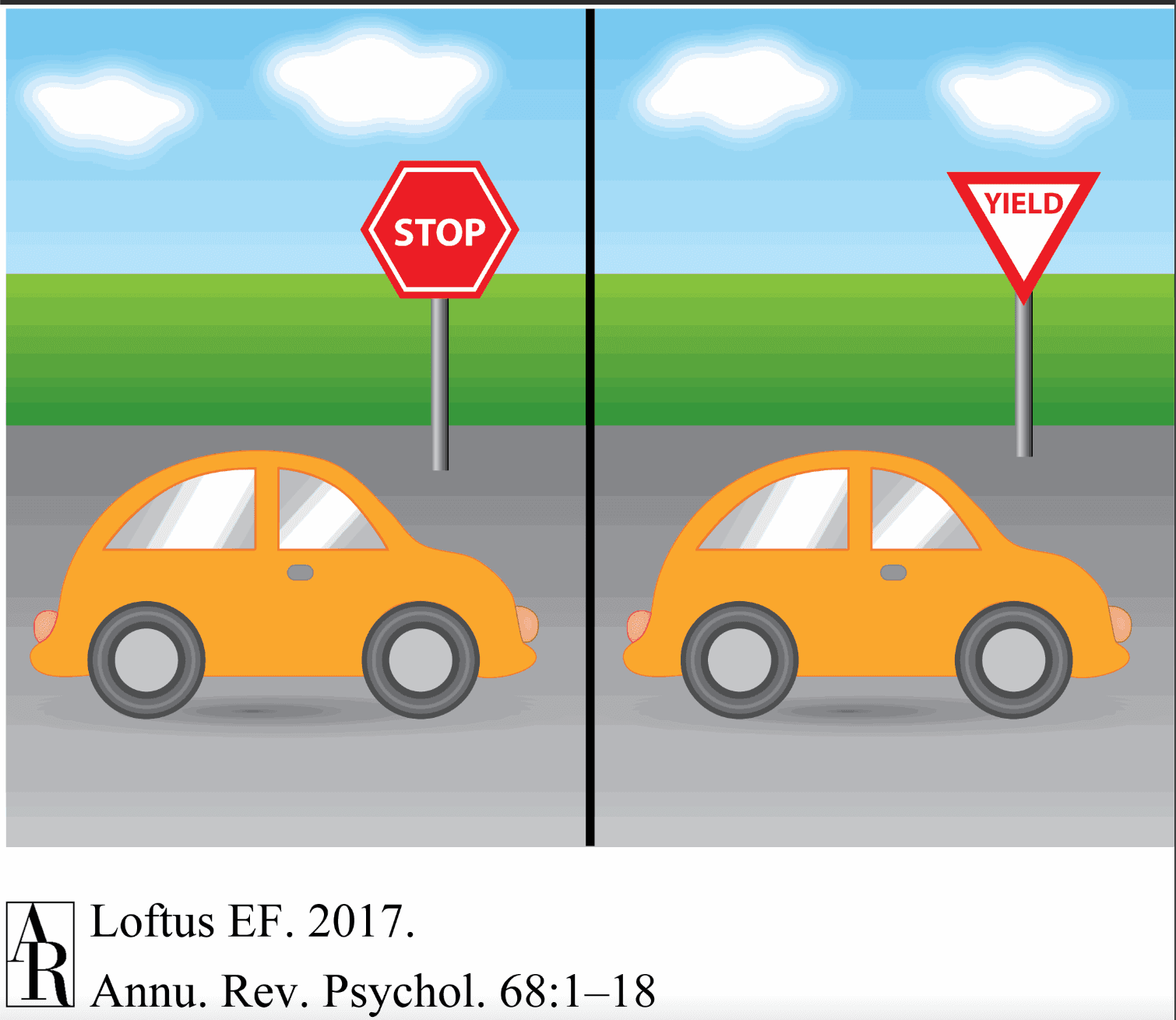
Figure 1

Cartoon used by Wikipedia to illustrate the misinformation effect. Figure modified from CaitlinJames/Wikipedia ( https://en.wikipedia.org/wiki/Misinformation_effect)/CC-BY-SA-3.0.

Studying the misinformation effect has kept me busy because there have been so many interesting questions to ask about the phenomenon (Frenda et al. 2011). When are people particularly prone to having their recollections modified by misinformation? Early on, we showed that people are more susceptible to misinformation about older memories than about more recent ones (Loftus 1992). More recently, we showed that people are also more susceptible when they are sleep deprived than when they are rested (Frenda et al. 2014), to the extent that they can be especially likely to confess to “crimes” that they did not commit (Frenda et al. 2016). These misinformation memories can last for quite a while; in one study, the false memories lasted more than a year (Zhu et al. 2012). What groups of people are especially susceptible to impairments from misinformation? First, we showed that young children were more susceptible to misinformation than adults (Loftus et al. 1992). Second, we showed that people with low cognitive ability are more susceptible to misinformation than those with high cognitive ability (Zhu et al. 2010). Even people who have superior autobiographical memories are susceptible to misinformation. We conducted a study on a special group of individuals with highly superior autobiographical memory (HSAM). Although these individuals have an extraordinary ability to recall specific dates and autobiographical events, they were as susceptible to memory distortion as their age-matched controls. Taken together, this research invites the speculation that no group of individuals is completely immune to the distorting effects of suggestion and misinformation (Patihis et al. 2013). Finally, we have done numerous studies that show how difficult it is to tell whether a particular memory is authentic or not; one needs independent corroboration (Bernstein & Loftus 2009).

MY FORAY INTO THE WORLD OF LAW

My research on distortions in memory implicitly challenges the credibility and value of memories in a variety of contexts, including eyewitness memories in legal cases. However, eyewitness testimony is typically seen as highly trustworthy evidence by American jurors. In the mid-1970s, I wrote an article for Psychology Today magazine titled “Reconstructing Memory: The Incredible Eyewitness” (Loftus 1974). In this article, I wrote about how eyewitness testimony is perceived by jurors and how it can influence the outcome of legal cases. I discussed an unpublished study I had performed with mock jurors. In this study, mock jurors read about a grocery store robbery in which the owner was killed and then had to decide if the defendant was guilty or not. The first group of jurors was told that there had been no eyewitnesses, only circumstantial evidence. The second was told that a store clerk had identified the defendant. The third group was told that the store clerk's identification had been discredited by his poor vision. The results showed that without the eyewitness the evidence for guilt was weak, with only l8% of jurors in the first group voting guilty. Adding a single eyewitness increased the rate of guilty verdicts to 72% in the second group. Discrediting the perceptions of the eyewitness had little impact, with 68% of jurors in the third group supporting a guilty verdict. I also described some of my then-recent studies showing that, in fact, eyewitness testimony is malleable, and leading questions can easily affect what witnesses remember and report. Finally, I talked about a case that I had worked on in which a woman was accused of murder on the basis of eyewitness memory. Perhaps it was due to her acquittal that lawyers began to call me to request case advice and invite me to speak at their conferences.

Attorneys also began asking me to testify in court on the malleability of eyewitness memory. However, at the time, judges were resistant to my work and typically excluded my testimony on the grounds that it invaded the province of the jury or that it was all common knowledge. When one judge finally agreed to let me testify, it came at a terrible time. I will never forget that day—June 3, 1975. My brother David called to tell me that our father had died that morning after a battle with melanoma. I had visited him only a couple of weeks before. I was still wiping away tears when the phone rang again. It was David Allen, a Seattle attorney, who asked me to come to the courthouse right away because it looked like the judge would admit my testimony. Could I really set aside my grief and do this? I somehow managed to collect myself and go to court. Judge Janice Neimi admitted my testimony into trial. Today, when prosecutors try to discredit me by asking how many times I have testified in court (translation: “you're a hired gun”), I often mention the exact date I first began testifying. Then the conversation goes something like this:

Prosecutor: I see you have no trouble remembering that date, even though you've been testifying about difficulties with memory.

Me: I remember that date because it was the day my father died.

Prosecutor: (silence)

I testified at three trials in 1975, five trials in 1976, and seven trials in 1977, and continued testifying at many trials each year. Despite the occasional harsh cross examination, I enjoyed testifying. I felt like I was helping people and spreading the truth about memory. Sometimes my experiences would give me ideas for additional research studies, and the cases were fascinating to my students, enlivening my lectures and writing. I wrote about some of these cases in my presidential address for the American Psychology-Law Society (Loftus 1986b). Some of my scholarship even examined my dual role as an expert witness and an experimental psychologist. Should this role involve being only an impartial educator? Or could it involve some element of advocacy (Loftus 1986a)?Eventually, I coauthored a book about some of the cases in which I had testified and the role that memory science had played in them (Loftus & Ketcham 1991). My wonderful coauthor, Kathy Ketcham, had been my secretary for years while she was helping put her husband through school. She typed my papers and became fascinated by my work with memory in the process. She is now a successful writer. In writing Witness for the Defense (Loftus & Ketcham 1991), Ketcham and I drew material from trial transcripts, police reports, newspaper accounts, and interviews with witnesses, defendants, attorneys, jurors, and family members. We did our best to get accurate information but ultimately had to rely on the memories of people directly involved in the legal dramas, as well as on my own personal memories. We acknowledged in the author's note that “It is unavoidable that these retrospective interpretations will contain memory flaws” (Loftus & Ketcham 1991, p. xiv). Memory, we said, is not always the same thing as truth.

In Witness for the Defense, I wrote about some of the more unusual people I met along the way—people involved in criminal and civil cases in which memory was an issue. I've met notorious individuals such as Ted Bundy and Timothy McVeigh. I've also met famous people who got entangled in legal situations in which memory played a role. For example, in my 2007 autobiography (Loftus 2007a), I wrote about Oliver North and, briefly, Martha Stewart as well. I interviewed Martha in New York about a critical phone call with her stockbroker, in which, as she remembered, he told her about ImClone stock. The government thought she was lying when she said she didn't remember being told that the president was selling the stock. I wondered if distractions or other factors could have explained her lack of memory, so I asked her where she was when she received the call. She told me she was on a private plane heading to Mexico for a short vacation and took the call when the aircraft stopped to refuel in San Antonio.

EL: What were you doing just before the call?

MS: Eating lunch.

EL: What did you have for lunch?

MS: Smoked salmon, caviar, and vodka.

EL: Vodka? How much vodka?

MS: Couple of drinks.

EL: Well, two to three drinks are enough to affect the formation of new memories, unless there is some reason you don't want people to know that.

She insisted she didn't care one way or the other, and so the vodka theory was potentially to be offered at trial. When the trial began, her lawyers felt things were going so well that they cut short their defense and dropped the vodka theory. To what I'm sure was her great disappointment, she was convicted. But that one little-known fact might have changed the outcome of her case. I'm pleased to see her smiling face in many magazines today; she obviously bounced back and is a model for how one can hit bottom and survive, even thrive.

I've also met Phil Spector, the famous American music producer, who worked with the Beatles and other talented musicians. Rolling Stone magazine had him on their list of the greatest artists of all time. In 2009, he went on trial for murder in the shooting death of an actress in his California home. I testified at his trial about the memory issues surrounding what his driver claimed he had heard Spector say. A few days after testifying, Phil sent me a little card with this message: “Dr. Loftus. Thank you for your amazing and brilliant testimony. I am most grateful and appreciative, and you're prettier than Leslie Stahl.” (He was referring to my then-recent interview by Stahl on 60 Minutes, during which I temporarily tampered with her memory for faces. To her credit, she allowed her memory mistakes to be shown to millions of viewers.) The jury in Spector's case had to decide: Was the actress’ death an accident or murder? Ultimately, my testimony did not help his case; he was convicted and began serving a prison sentence of 19 years to life.

THE MEMORY WARSI was introduced in earnest to the notion of repressed memory in the early 1990s. It began with a phone call from a lawyer who was representing George Franklin, a man accused of murder based on a repressed memory. Franklin's daughter, Eileen, claimed she had recovered a terrible memory, in which she witnessed her dad kill her best friend 20 years earlier. I've written extensively about this case (Loftus 1993, Loftus & Ketcham 1994). At Franklin's trial, Eileen testified in great detail about watching the murder. A prominent psychiatrist vouched for the memory's authenticity. Franklin was convicted, much to my dismay and that of his attorneys and many family members. He became the first American citizen to be convicted of murder based on nothing more than a claim of repressed memory. Five years later, a federal judge reversed his conviction, concluding that the risk of an unreliable outcome was unacceptable.

Because of this case, I started to wonder how such detailed whole memories could grow in someone's mind despite the memories being completely false. If Eileen Franklin's memories were false, she was not simply remembering a detail differently, like a stop sign instead of a yield sign. She was remembering huge events (murders, years of rapes) that didn't happen. How could such elaborate false memories develop in people? I wanted to study this, but what type of false memory could I try to plant in people's minds? It did not seem likely that the Human Subjects Review Committee would appreciate a proposal to plant memories that the subject's father had killed their best friend or raped them repeatedly, so I had to find an analog, something that would have been at least mildly traumatic if it had actually happened to the subjects. Eventually, I had the idea to plant a memory that the subject had been lost in a shopping mall and, after a period of great upset, had been discovered by an elderly person and reunited with their family. 3This became our first effort to deliberately plant relatively harmless but rich false memories in volunteers. Along with other researchers, I have been quite successful in getting people to believe and remember that they had all sorts of experiences that would have been at least mildly troubling had they actually happened. Not only have we led ordinary healthy people to believe that they had been lost in a shopping mall as a child (Loftus & Pickrell 1995), but we and other psychologists have also planted even more bizarre or unusual false memories, such as nearly drowning and being rescued by a lifeguard, witnessing demonic possession, or committing a crime as a teenager (for reviews of some of these memory planting findings, see Loftus 2003b, 2005; Loftus & Davis 2006). In the years after the Franklin case, thousands of other repressed memory cases emerged. The memories often revolved around severe sexual abuse. People were going into therapy with one sort of problem, such as depression or an eating disorder, and coming out with another problem: horrific memories of sexual abuse allegedly perpetrated over years and then repressed into the unconscious until the memory returned. People were suing their family and former neighbors, as well as their doctors, dentists, and teachers. Many families were destroyed in the process, and I found myself deep in the midst of these wars. I tried to speak out about these travesties, the dubious nature of repressed memories, and the injustice of convicting people of crimes based on these memories without additional evidence. I was met with a great deal of anger from people like Betty. The anger came from both the repressed memory patients, convinced of the veracity of their newly “recovered” memories, and the therapists who had helped these patients “find” their memories.

I could endure nasty letters and emails. I could handle death threats made to universities that invited me to speak. But I was not quite prepared for the lengthy battle I would face when I investigated a case that was being touted as solid “proof” of repressed memory, the case of Jane Doe. Jane Doe had accused her mother of sexual abuse when she was a child caught in the midst of an unpleasant divorce and custody battle. A psychiatrist videotaped the “retrieval” of this memory and showed the tapes to others discussing this new “proof.” I investigated the case with Mel Guyer, a lawyer and psychologist from the University of Michigan. Our investigation suggested that it was quite possible that no abuse ever occurred to Jane Doe. However, when we published our findings in the Skeptical Inquirer (Loftus & Guyer 2002a,b) without identifying Jane Doe, a number of bad things happened. We shielded her identity, but Jane Doe sued us anyway, using her real name, Nicole Taus. She filed her case in 2003, asking for $1.3 million for defamation, invasion of privacy, and other claims. Over the ensuing years of litigation, a trio of California courts threw out 20 of the 21 allegations that she made against me and the other defendants.

My graduate seminar actually traveled from the University of California, Irvine to Los Angeles to watch the oral arguments being made to the California Supreme Court. It would have been a much more fascinating experience for me if there had not been so much personally at stake. Earlier courts had thrown out most of the claims, and the California Supreme Court tossed out all the rest but one. That one claim was that I had misrepresented myself to a foster mother of Taus, allegedly pretending I was a colleague and supervisor of the psychiatrist who was popularizing her case—a claim I completely deny. Ms. Taus's foster mother supported her story by also claiming that she abruptly terminated the interview when she realized my identity, which is not true. Photographs taken of us right after the interview showed the cordial nature of our interaction. Personally, I suspect that after our interview, she regretted what she had told me about Ms. Taus. (Journalists call this source remorse.)After the California Supreme Court effectively finished gutting her case, Taus offered to withdraw her case against me in return for a payment of $7,500. I would have preferred to have a jury vindicate me, but the insurance company for the magazine decided that the cost of a trial would far exceed $7,500. Insurance companies have a label for this: nuisance settlement. The California Supreme Court also ordered the trial judge to determine how much Taus herself would have to pay for attorney fees and costs incurred by the other defendants who had been cleared of charges along the way. These included my coauthor, Mel Guyer; the Skeptical Inquirer, which had published our essay; and Carol Tavris, whom we had thanked in a footnote for her help with the essay. The trial judge determined that Taus would be responsible for nearly $250,000 in attorney and court fees, and she declared bankruptcy soon after. So, what do I say when people ask me, “Who won the case?” No one won, except perhaps the attorneys; they were well compensated for their time.

During this protracted and miserable legal process, I learned a great deal about the vulnerability of academics to lawsuits. Scholars are not always afforded the full protection of constitutional guarantees, and this is especially true when the scholars work on problems that matter in people's lives and are therefore likely to be sources of controversy or conflict. But these are precisely the kinds of scholarly inquiries in which there is a profound need for our institutions to provide vigilant protection of free speech (Geis & Loftus 2009).

BACK TO RESEARCH

Despite the emotional and financial burden of the Taus complaint, I was able to develop a new line of research with Dan Bernstein, who was a postdoc at the time, and several graduate students at UC Irvine. We wanted to better understand the repercussions of implanted memories—how these false memories impact later thoughts, intentions, and behaviors. In our initial studies, we planted false memories in participants of having gotten sick eating particular foods, such as eggs, pickles, or strawberry ice cream, and found that the participants with the false memories didn't want to eat these foods as much as did participants without false memories (for details, see Bernstein et al. 2005a,b; for a review, see Loftus 2007a). In another study, we planted false memories of having gotten sick on vodka, and the participants were subsequently less interested in drinking a vodka drink. We also planted pleasant memories about white wine and found that people who developed the false memories were more attracted to white wine (Clifasefi et al. 2013, Mantonakis et al. 2013).

This research suggests that it can be disturbingly easy to manipulate people's memories in ways that shape their behavior, a finding that raises a number of ethical concerns. Should we think about banning the use of these mind-manipulating techniques entirely? Could we affirmatively and responsibly use these techniques to help people live happier and healthier lives? These basic ethical questions must be considered carefully in pursuing and applying this line of memory research.

THE TED TALKBy the end of 2012, when I was invited to give a TED talk on false memories ( Figure 2 ), I had already been teaching for four decades. When I first started teaching, I wrote out my lectures word for word, even the jokes. Then, if I got nervous, I would have the notes to rely on. By 2012, I was pretty comfortable in the classroom and in front of large one-time audiences. But this did not prepare me for the kind of talk that would be required at TEDGlobal. First I had to submit an outline, and then a script. The TED organizers told me my script was too long for a l6-minute talk, and I had to cut it. When it got to an acceptable length, I began the work of memorizing it. After all, it would be on the Internet and translated into a large number of languages. Exact wording mattered in a way that it never really does in the classroom. I got help from my longtime collaborator, Maryanne Garry, and her students, who found much hipper slides to accompany the talk than I would have found on my own. A few months before the event, I rehearsed the talk via Skype with the TED organizers, and even then I was still reading. I practiced the talk in guest lectures that I volunteered to give for colleagues. To memorize the talk, I used the method of loci, a memorization method developed more than 2,000 years ago in ancient Greece. Specifically, I used familiar locations in my home to remember chunks of the talk. For example, I visualized Steve Titus, a falsely accused man, greeting me at my front door. That reminded me to start the talk by telling the audience about the sad case of Steve Titus. I visually entered my house and noticed on my right a portrait that my mother-in-law had painted of me at the time I married her son: a reminder to tell them about myself and why I had worked on the Titus case. I noticed on my left a bowl of pine cones: Those became the hundreds of falsely accused people. In all, I placed eight chunks of my talk into eight locations in my home. When I wanted to remember the talk, I took a mental walk through the house, stopping at each location to pick up the chunk of the talk that I had mentally deposited there earlier.

Figure 2
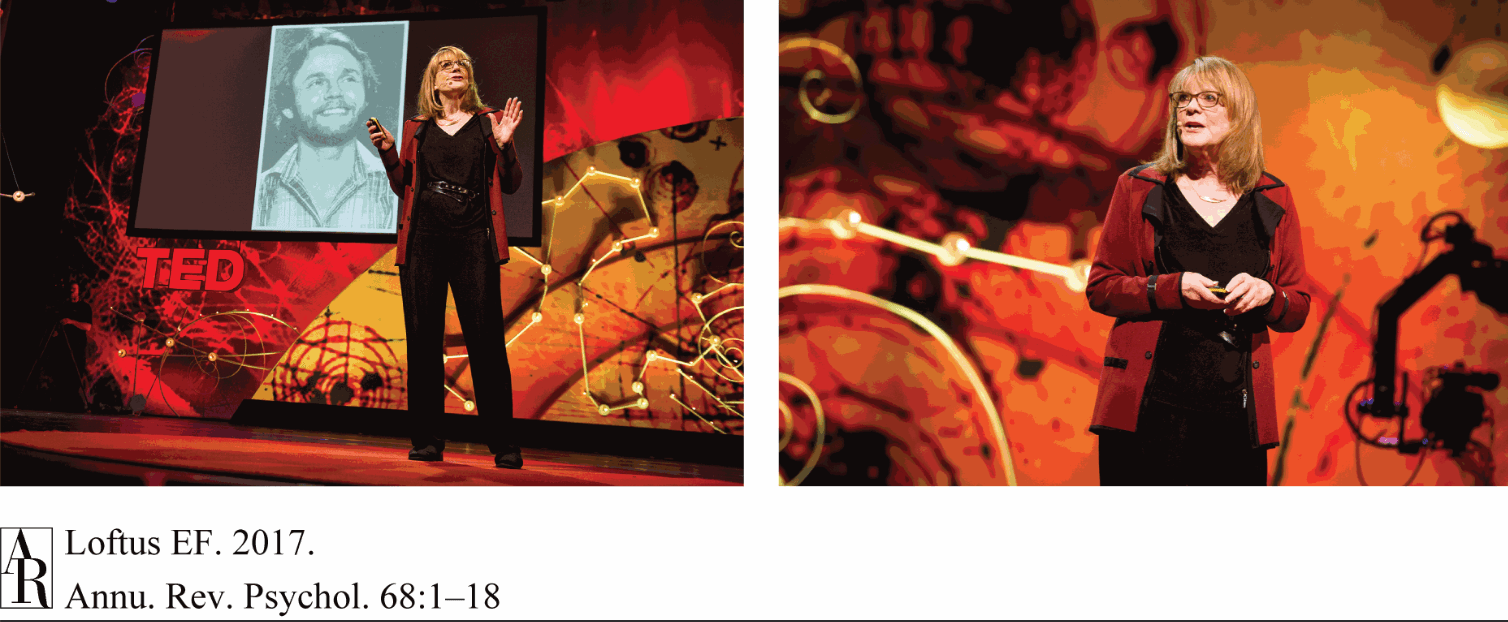
Figure 2

Photos of Elizabeth Loftus giving a TED talk at TEDGlobal in 2013. Photo credits: (a) J.D. Davidson/TED, (b) TED.

In June 2013, I flew to Edinburgh, Scotland, thumb drive in tow. My former doctoral student Shari Berkowitz joined me for the five-day adventure. Nearly a thousand people had paid thousands of dollars to attend TEDGlobal. Shari and I met and ate and drank with some fascinating people, such as Shonda Rhimes, the wildly successful television producer, and Marlies Carruth, a scouter for the MacArthur Genius Award program. We watched other TED talks that were amazing, such as that given by Apollo Robbins, the American deception specialist, and Arthur Benjamin, the mathematician, who gave a splendid Mathemagic performance. We also watched a brilliant neuroscientist lose her train of thought in the middle of her talk and struggle to finish. My worst nightmare! In the end, I got through my talk without a hitch, and to my amazement the video of it has, as I write this, been viewed more than 2.8 million times ( http://www.ted.com/talks/elizabeth_loftus_the_fiction_of_memory ).

TED AND THE MEMORY WARS

Near the end of my TED Talk in Scotland, I offered the audience a simple take-home message: Just because someone tells you something with confidence, just because they say it with lots of detail, just because they express emotion when they say it, that doesn't mean that it really happened. We can't reliably distinguish true memories from false memories. This weakness in memory has implications for the legal profession, for psychotherapy, and for other aspects of our social lives. Personally, I feel that exposure to this research has made me more tolerant of the everyday memory mistakes and distortions made by my friends and family members. If a sibling or friend tells a story that I know is not accurate, I don't instantly assume they are deliberately fibbing; more typically, I start with the thought that they might have a genuine false memory. I apply the same attitude to public cases of potential lies. When celebrities such as Hillary Clinton or NBC News anchor Brian Williams are shredded by the press for telling inaccurate stories, I sometimes come to their defense with the possibility of a false memory. In the cases of both Clinton and Williams, the spontaneous creation of false memories seems far more plausible to me than the theory that they are deliberately lying, given that both of them told inaccurate stories that had a high chance of being disproven. They had a great deal to lose by lying but very little to gain. To me, this makes the possibility of a false memory in such cases more plausible than lying.

xJust to be clear, I don't always assume that a purveyor of falsehoods is honestly mistaken or misremembering. Some people knowingly, consciously lie. Because my research has dramatically challenged the assumptions and therapeutic practices of many repressed-and-recovered-memory practitioners, some of them have repeatedly tried to kill the messenger—me—when they can't kill the data. For example, the Jane Doe case reared its ugly head again in 2014, when a journal published several essays about the case. Virtually all came from people who had found something to complain about in my handling of the case and who were primarily believers in recovered memories of abuse, which they had promoted in their own work for years. They were heavily invested in the Jane Doe story, because they believed it gave their cause credibility. They're entitled to their opinions, of course, but their essays were riddled with distortions of the evidence, which Mel Guyer and I had already addressed in previous publications (Loftus & Guyer 2002a,b). One commenter, whom I'll call K, used his essay as an opportunity to tell a lie about me that dates back two decades, when I resigned from membership in the American Psychological Association (APA) because of the mistreatment of two female colleagues and because of the APA's shift toward becoming more of a guild for practitioners than a home for psychological scientists. In my resignation letter, I wrote that I would be devoting myself to organizations that valued science more highly and more consistently, and I went on to become active in the Association for Psychological Science. At the time of my resignation from the APA, Ray Fowler, then the CEO, urged me to reconsider because he feared more experimental psychologists would join my exodus. But in K's Jane Doe essay, he claimed that Fowler had tipped me off about a pending ethics complaint so that I could resign in time to avoid it. This is a flat-out lie that Fowler himself denied before he died. This rumor still turns up when I'm on the witness stand, being interviewed by prosecutors trying to discredit me. I mention it because it is abhorrent to me when people pass out untruths for applause lines, for attention, or because they don't like scientific work that doesn't jibe with their orthodoxies. Fortunately, the nastiness of people like pants-on-fire K and his allies is outweighed by the Alices of the world.

UNIVERSITY LIFE

I love my job. A colleague once quipped, “Isn't academia great? You get to work any 80 hours a week you want.” Yes, I work a lot of hours, but for the most part it is pretty enjoyable work. It's a near-perfect combination of structure and entrepreneurial opportunity. One of my favorite aspects is the interactions with the students, postdocs, and faculty collaborators who help me plan and conduct my research. I wish I had more space to mention them all. 4 I love hearing updates on the students’ lives, such as when one becomes chair of a psychology department or another wins a teaching award at her liberal arts college. I like strategizing when one complains about being overworked and under-appreciated at her corporate research scientist position or when one complains about his status as a freeway flyer.

One aspect of my professional life that might be different than those of others is the gigantic number of requests for help I routinely receive from people outside the university setting. Some requests come from prisoners and desperate family members; I try to answer all of these. Then there are the weekly requests from far-away college students who want help with papers they are writing, from high school students who want help with assignments, and from elementary students who ask for help with science fair projects. Eighty hours a week isn't enough to answer them all, so I crafted a polite reply that I can easily send back with a few clicks on the keyboard:

Thanks for your email. I'm so sorry I'm going to have to decline this project. I'm so swamped with work, I barely have time for the things I've already promised to do. So while this sounds exciting, I know I would have trouble meeting any additional obligations. I hope you understand. Best of luck to you and your project.

Sometimes I just couldn't bring myself to send the polite reply, as was the case when a middle school student in Weston, Connecticut, who seemed passionate about human memory, asked for my help. Although she was overly apologetic for intruding on my “busy schedule,” she had some questions for me. While asking them, she managed to slip in the fact that her mother was a science reporter for the New York Times. I took the time to answer her questions about false memories, the role of trauma in memory, and the processes by which people store and recall memories. Her email arrived just a few months after her mother had written a terrific piece for the Times called “Memories Weaken Without Reinforcement,” which reported on a new study providing evidence that when a new experience enters memory, it can weaken the ability to remember older experiences (Belluck 2015). This is an issue I had thought deeply about more than three decades ago (Loftus & Loftus 1980). It seemed so cute that the daughter, perhaps a budding science journalist herself, was following in her mother's footsteps, so I answered her right away.

In addition to the interactions with students and colleagues, another great thing about the academic lifestyle is the sabbatical. I used one of those opportunities to spend a year at Harvard University as an American Council on Education fellow working for the President of the university and the Dean of Harvard College. Another year, I spent my sabbatical at the Center for Advanced Study in the Behavioral Sciences at Stanford, where I wrote my first book, Eyewitness Testimony (Loftus 1979). I spent another leave at the Georgetown Law Center in Washington, DC, teaching law students and getting a feel for life as a law professor. I spent my last sabbatical in Irvine, using most of my time to write this article. It was not the only thing that I had hoped to accomplish during the sabbatical. My original plan was to spend some time in Tunisia. I had been invited to participate in the International Congress on Cognition, Emotion, and Motivation to be held in Tunisia. In fact, I had been invited not only to present my research at the conference but also to serve as Honorary Chair. I crafted a letter that was posted on the website welcoming people to this important conference, which was dedicated to the proposition that in order to fully understand how we manage everyday tasks in life, such as knowing how to order dinner at a favorite restaurant, or deciding whether to give a B or a B− to a student, or judging whether a defendant is guilty or not guilty, we need to integrate what scientists are discovering about cognition, emotion, and motivation. Tunisia, the furthest north of all countries in Africa, would have been an exciting place to gather and discuss these issues. How moving it would be to discuss psychology while also soaking up some of the geography, politics, and history of a country that held its first free elections only within the past few years. Sadly, I would never get to have this exciting and moving experience. Shortly after my travel plans were firmly in place, three terrorists attacked the Bardo National Museum in Tunis, the capital city, taking hostages in the process. It was March 18, 2015, and more than 20 people, primarily tourists, were killed, and many others were injured. Three months later, on June 26, 2015, armed terrorists attacked two hotels in a tourist resort area not far from the city of Sousse in Tunisia, killing 40 people, also mostly tourists. These unexpected events likely contributed to the financial difficulties that the conference organizers experienced. In any event, funding was no longer available to bring me to Tunisia. I was able to deliver my presentation and to answer questions in November 2015 via videoconferencing from the terror-free safety of UC Irvine. But I never got the full experience of visiting a beautiful, progressive country that only gave women full legal status, so that they could run their own businesses, deposit money in their own bank accounts, and receive passports that would allow them to travel by themselves, about 50 years ago.

BRIEF CANDLES IN THE ROMANTIC DARK

My marriage to Geoff lasted for 23 years and ended in large part because of my workaholic ways. Happily, we have remained good friends and speak on the phone at least three times a year: on each of our birthdays and on the day of our wedding anniversary. 5Since Geoff, I've had a few romantic entanglements, some lasting for days and some for years. I spent time with corporate presidents, film producers, and successful lawyers and academics, but also with mailmen and bakers. I love the beginnings, when you share past memories as you're getting to know each other. I've used these opportunities to dredge up the past and to tell some favored stories, like the ones that had to do with maneuvering a difficult relationship with a stepmother. I cherish some of the wonderful things that have been said to me at the beginning of a new relationship, such as, “If I could make a woman from scratch, she'd be just like you.” I've sometimes been the one to end things, but I've had my share of disappointed feelings when he's not as interested as I am. One of the worst breakup lines I have heard was, “When I was in college I dated women who were trim and fit, and, well, you're not that.” I can laugh about it now—and even turned it into a Johnny Cochran line: “Trim and fit, and you're not it.”What I've learned is that female friends have the best intentions when they try to offer you an excuse for why he isn't calling, but their comforting words may not be the best medicine. As in the film He's Just Not That into You, well-meaning friends might say something like, “Maybe he lost your phone number.” “He can't handle your emotional maturity.” “You're too pretty; he can't handle that.” The film opens with scenes of girlfriends giving these placating excuses to each other all over the world—England, Japan, India—but when I watched two women in Africa having this same conversation, I almost fell off my chair laughing. One woman is distraught that he wasn't calling, and her friend says, “Maybe he was eaten by a lion.” After the chair stopped shaking, I thought more. Are these excuse-finding morsels simply helpful white lies that make a friend feel better? Perhaps not if, as my pal Carol Tavris cautioned me, they delay the process of accepting the truth and moving on in life. Maybe we should appreciate our friends when they resist the temptation to make us feel better by suggesting that he was eaten by a lion and tell us, straight, he's just not that into us. They are offering us removable truths—truths worth keeping, even if we temporarily remove them from our diaries.

MEMORY AND SOCIETY

One of the things I'm most pleased to see is how the public understanding about memory has changed, perhaps in part due to the scientific work that I and others have published and publicized. The common understanding that memory is often not reliable has permeated our culture in important ways. Judges who were once resistant to admitting expert testimony from memory scientists into court cases are now more willing to do so. Methods for gathering memory evidence in legal cases have changed, embracing reforms that can lead to greater accuracy. Psychotherapists have become more aware of problematic techniques that can lead their patients into false memories that wreak havoc on the lives of patients and those around them. You can see evidence of the changes in our view of memory over time in a study described in our paper “Are the Memory Wars Over?” (Patihis et al. 2014). It's a thrill for me to be reading some unrelated article in, say, the New Yorker, and see heartwarming proclamations, as happened twice in a single day while I was on a long airplane trip. I was catching up with my early 2016 issues of the New Yorker and read one piece about child welfare in which the author referred to the “sexual-abuse scandals of the eighties and the recovered-memory travesty of the nineties” (Lepore 2016), and another piece about the series Making a Murderer in which the author mentioned that “seventy-two percent of wrongful convictions involve a mistaken eyewitness” (Schulz 2016).

Of course, there is still much educating to do, and we can't remain complacent. While writing this article, the New York Times columnist David Brooks published an essay titled “The Year of Unearthed Memories” that made me cringe (Brooks 2015). Brooks has long been a champion for psychological science; he has embraced what our field has to offer and used it to help his readers understand politics, conflict, and even themselves. But in his 2015 essay, he touted worthless theories about how memory works, including the psychobabble that traumatic memories are buried deep in primitive regions of the brain, tucked underneath conscious awareness, yet leaking toxic waste into people's lives. Brooks tied these myths to global racism and oppression. My former postdoc and longtime collaborator, Maryanne Garry, and I wrote a complaining letter to the Times that they never published. My favorite part of our letter took Brooks to task for his poor use of metaphor, arguing that he was not helping the world “by drawing a parallel between the culturally-shaped, pseudoscientific operatic plot device that is repressed memory and the culturally-shared, very real burden of painful memories.” As Brooks well knows, pseudoscience helped create the beliefs that support racism and oppression. Our short letter ended with a crucial message in three words: “Pseudoscience never helps.”And so, after all these years of studying how we as humans come to be visited by memories that aren't true, I end this review with a message from someone who seems to understand this well and can express it even better. In the words of Harold Pinter in Old Times: “The past is what you remember, imagine you remember, convince yourself you remember, or pretend you remember.”In that spirit, I hope this memoire consists more of what I remember than of what I imagine or pretend to remember. But you never know.

disclosure statementThe author is not aware of any affiliations, memberships, funding, or financial holdings that might be perceived as affecting the objectivity of this review.

ACKNOWLEDGMENTS

Acknowledgements

I would like to thank the many students and colleagues who have helped with my research and publications; even if I didn't have the space to name you all, I deeply appreciate your contributions to our efforts to eavesdrop on memory. I would also like to thank my family and friends, who provided comfort in difficult times. Those times gave me a small taste of the human suffering endured by the falsely accused people I've had a chance to meet.

Open Article as PDF

Summary

An account of a professional's career in memory research and its impact on legal and psychological fields is provided. The author's journey began with personal experiences, including a challenging childhood and early academic pursuits in mathematics and psychology. This foundation led to groundbreaking work on memory distortion and false memories. The narrative highlights the individual's involvement in high-profile legal cases, where scientific understanding of memory was applied to real-world situations, often challenging existing beliefs about eyewitness testimony and repressed memories. The discussion also touches upon the "memory wars," a period of intense debate surrounding the validity of recovered memories, and the personal and professional challenges encountered during this time. The text concludes with reflections on the evolving public understanding of memory and the ongoing need to combat misinformation and pseudoscience.

Introduction

Several years ago, an individual received a hostile email from a woman referred to as Betty. The email expressed strong criticism regarding the individual's testimony in a criminal trial involving allegations of abuse, suggesting a lack of integrity and threatening further harassment. This communication was noted as one of the most aggressive received over several decades. In contrast, another email was received from a woman referred to as Alice, who expressed gratitude for the individual's work. Alice described how research on recovered memories provided clarity and support after her husband was accused of past misconduct, leading her to believe he was a victim of false memory syndrome. This appreciative message was saved as a source of encouragement for difficult times.

Childhood Memories

The author's childhood in Los Angeles, beginning in 1944, did not suggest a future involving both public criticism and admiration. The prospect of becoming a scientist capable of influencing perceptions of personal history was unforeseen. Life with a physician father, librarian mother, and two younger brothers was generally calm. Ballet and piano lessons, a school change, and family gatherings are recalled as early experiences. This tranquil period ended with the mother's drowning at age 14, an event recorded as the most tragic in a personal diary. The practice of attaching "removable truths"—private thoughts on separate papers—to the diary is noted, a method that ironically foreshadowed a career focused on altering memory. Two years after the mother's death, a fire destroyed the family home. Diaries, initially feared lost, were later recovered, preserving a record of personal history. These diaries were consulted 40 years later when a letter expressing feelings about the mother's death was composed.

Higher Education Years

Reflecting on past autobiographical writings, the author notes that while life events remain consistent, perspectives can shift. A childhood enjoyment of mathematics, fostered by a father's assistance with homework, led to a mathematics major at UCLA in 1962. College courses, predominantly male-taught and attended, eventually led to a dual major in mathematics and psychology due to a developing fascination with psychology. Graduate studies in mathematical psychology at Stanford began in 1966. Despite a lack of deep interest in this specific field, attendance at Friday research seminars was consistent, even if personal focus was often elsewhere. During graduate studies, a mentorship with Geoff Loftus, a second-year student, developed into marriage nine months later. A letter from the future father-in-law, Russell Loftus, expressed affection and concern regarding the Vietnam War, which posed a significant threat of conscription for Geoff. Marriage was partly motivated by the desire to avoid Geoff's participation in the war. The couple married in Los Angeles and had a brief honeymoon before returning to Stanford for comprehensive exams. Early graduate work focused on computer-assisted instruction, resulting in published research. However, this area did not ignite a significant passion. Later in graduate school, research on semantic memory with Jonathan Freedman sparked genuine interest. This work explored how words, concepts, and factual knowledge are organized in memory. Studies demonstrated faster recall when categorical cues preceded descriptive ones, suggesting a hierarchical organization of information. Several studies were published, and conference presentations on semantic memory began. After completing graduate school in 1970 and teaching in New York City, the author and Geoff Loftus faced the "two-body problem" of finding academic positions in the same city. Both eventually secured offers from the University of Washington, where the author spent many decades.

Real-World Memories

Following initial work on semantic memory, a desire for research with practical applications emerged after the father's death from cancer in 1975. Lacking skills for cancer research, the focus shifted to witness memories in legal contexts, combining memory expertise with a growing interest in law. Funding from the US Department of Transportation facilitated studies on car accidents. This research revealed that question phrasing could influence witness responses and perceptions. For instance, asking "How fast were the cars going when they smashed into each other?" resulted in higher speed estimates and increased reports of seeing broken glass, even when none was present. This led to the publication "Reconstruction of Automobile Destruction." Further studies confirmed that leading questions and exposure to misinformation (e.g., from other witnesses or media) could distort memories, a phenomenon termed the "misinformation effect." The misinformation effect is now a recognized concept, even having a Wikipedia page. Studies in the 1970s, like one involving a stop sign vs. a yield sign in a simulated accident, demonstrated how easily people could succumb to misinformation. Research on the misinformation effect has continued, exploring factors that increase susceptibility, such as older memories, sleep deprivation, and low cognitive ability. Even individuals with highly superior autobiographical memory have shown susceptibility. These findings suggest that no group is entirely immune to suggestion and misinformation. Furthermore, numerous studies indicate the difficulty in distinguishing authentic from inauthentic memories without independent corroboration.

Foray into the World of Law

Research on memory distortions implicitly challenges the reliability of memories, especially eyewitness accounts in legal cases, which are often highly valued by jurors. An article in Psychology Today in the mid-1970s, "Reconstructing Memory: The Incredible Eyewitness," explored how eyewitness testimony influences legal outcomes. A study with mock jurors demonstrated that the presence of an eyewitness significantly increased guilty verdicts, even if the eyewitness's credibility was questioned. This research, combined with early studies showing memory's malleability, led to invitations from lawyers for case advice and conference presentations. Attorneys began requesting expert testimony on eyewitness memory, though judges initially resisted, deeming it an invasion of the jury's role or common knowledge. The first instance of admitted testimony occurred on June 3, 1975, a day marked by the father's death. This personal tragedy allows for a poignant response when prosecutors attempt to discredit the individual's memory for the date of initial testimony. Testifying in numerous trials throughout the 1970s became a regular activity, providing a sense of helping people and disseminating knowledge about memory, while also inspiring further research. Discussions on the role of an expert witness, as either an impartial educator or an advocate, also emerged. A book, Witness for the Defense, coauthored with Kathy Ketcham, documented several cases where memory science played a crucial role. This book relied on various sources, acknowledging that retrospective interpretations might contain memory flaws. In Witness for the Defense, encounters with diverse individuals involved in legal cases with memory issues are described, including notorious figures and celebrities. An interview with Martha Stewart regarding a crucial phone call illustrated how distractions or other factors might influence memory, particularly regarding a claim about consuming alcohol. Although the "vodka theory" was prepared for trial, it was ultimately not presented, and Stewart was convicted. Another experience involved testifying in the murder trial of music producer Phil Spector. Despite receiving a complimentary note from Spector, the testimony did not prevent his conviction.

The Memory Wars

The concept of repressed memory gained prominence in the early 1990s, initiated by a lawyer representing George Franklin, accused of murder based on his daughter Eileen's recovered memory of witnessing the crime 20 years prior. Despite detailed testimony and psychiatric endorsement of the memory's authenticity, Franklin was convicted, marking the first such conviction based solely on repressed memory. The conviction was later reversed by a federal judge due to concerns about reliability. This case prompted exploration into how elaborate false memories, far beyond minor factual distortions, could develop. Ethical considerations for research prevented the planting of traumatic false memories, leading to studies on milder scenarios, such as being lost in a shopping mall. This initial effort and subsequent studies successfully implanted various harmless but rich false memories, including near-drowning or committing a teenage crime. Following the Franklin case, thousands of repressed memory cases emerged, often involving severe sexual abuse allegations surfaced during therapy. Many families were fractured by lawsuits against relatives, doctors, and teachers. The individual became deeply involved in these "memory wars," speaking out against the dubious nature of repressed memories and the injustice of convictions without corroborating evidence. This stance was met with significant anger from both patients convinced of their recovered memories and therapists who facilitated these recoveries. While able to endure hateful communications and threats, a lengthy battle ensued after investigating the "Jane Doe" case, which was presented as evidence for repressed memory. Jane Doe accused her mother of sexual abuse, and a psychiatrist videotaped the "retrieval" of this memory. An investigation suggested that the abuse might not have occurred. Publication of these findings in the Skeptical Inquirer, while shielding Jane Doe's identity, led to a lawsuit by Jane Doe (Nicole Taus) for defamation and invasion of privacy, seeking $1.3 million. Over years of litigation, California courts dismissed most of her allegations. The California Supreme Court upheld the dismissal of all but one claim, which alleged misrepresentation to Taus's foster mother. The foster mother's account, contradicted by photographs, was suspected of being influenced by "source remorse." Ultimately, Taus offered to withdraw her case for $7,500, a "nuisance settlement" accepted by the magazine's insurance company to avoid higher trial costs. The trial judge ordered Taus to pay nearly $250,000 in attorney and court fees to the cleared defendants, leading to her bankruptcy. This experience highlighted the vulnerability of academics to lawsuits, particularly when addressing controversial issues that affect people's lives. It underscored the importance of protecting free speech in scholarly inquiry.

Back to Research

Despite the legal challenges from the Taus complaint, new research was developed with Dan Bernstein and graduate students at UC Irvine. This work aimed to understand the impact of implanted memories on later thoughts, intentions, and behaviors. Early studies successfully planted false memories of becoming ill after eating certain foods (e.g., eggs, pickles, strawberry ice cream), leading participants with these false memories to express less desire for those foods. Similar results were found with vodka, while positive false memories about white wine increased its appeal. This research demonstrates the unsettling ease with which memories can be manipulated to shape behavior, raising significant ethical questions about potential misuse and responsible application of these techniques for promoting healthier lives.

The TED Talk

By late 2012, after four decades of teaching, an invitation to deliver a TEDGlobal talk on false memories was extended. This required a rigorous preparation process, including submitting and shortening a script for a 16-minute presentation, then memorizing it precisely due to its online presence and global translation. Assistance from collaborator Maryanne Garry and her students helped create engaging slides. Rehearsals via Skype with TED organizers and in guest lectures honed the delivery. The method of loci, an ancient Greek memorization technique, was employed to recall segments of the talk by associating them with specific locations in a home. In June 2013, the presentation took place in Edinburgh, Scotland, attended by nearly a thousand people. The experience included meeting notable individuals and witnessing other impressive, and sometimes challenging, TED talks. The individual's talk proceeded without incident, and the video has since garnered millions of views.

TED and the Memory Wars

Near the conclusion of the TED Talk in Scotland, a key message was conveyed: confidence, detail, and emotion do not reliably indicate a memory's truthfulness. Distinguishing true from false memories is difficult, with implications for legal, psychotherapeutic, and social contexts. This research has fostered a greater tolerance for everyday memory errors in personal relationships, prompting the consideration of genuine false memories rather than deliberate deception when inaccuracies arise. This perspective is also applied to public figures accused of inaccurate statements, where the spontaneous creation of false memories is often deemed more plausible than intentional lying, especially when significant reputational risks are involved. However, the author acknowledges that some individuals do lie knowingly. The research has profoundly challenged the assumptions of some repressed-and-recovered-memory practitioners, leading to continued attempts to discredit the work. For example, the Jane Doe case re-emerged in 2014 with critical essays, largely from proponents of recovered memories. These essays contained distortions of evidence previously addressed. One individual, referred to as K, propagated a false rumor about the author's resignation from the American Psychological Association (APA) two decades prior, claiming it was to avoid an ethics complaint. This untruth, despite being denied by the late CEO of the APA, continues to be used by prosecutors attempting to discredit the author in court. This highlights the reprehensible nature of spreading falsehoods for personal gain or to counter scientific findings that challenge established orthodoxies. Fortunately, such negativity is outweighed by the support received from others.

University Life

The author finds academic work largely enjoyable, offering a blend of structure and entrepreneurial freedom. Interactions with students, postdocs, and faculty collaborators are a favorite aspect, providing opportunities for research planning and execution. Keeping up with former students' career advancements and offering strategic advice for professional challenges are also valued. A unique aspect of professional life is the high volume of requests for assistance from outside the university, including prisoners, family members, and students at various educational levels. Due to time constraints, a polite, standardized refusal is often sent. However, an exception was made for a middle school student passionately interested in human memory, whose mother was a science reporter for the New York Times. The author answered questions about false memories and trauma, noting the student's potential as a future science journalist. Sabbaticals have provided valuable opportunities, including a year at Harvard University and a period at the Center for Advanced Study in the Behavioral Sciences at Stanford, where the first book, Eyewitness Testimony, was written. Another sabbatical involved teaching law students at Georgetown Law Center. The most recent sabbatical was primarily dedicated to writing the current article. A planned trip to Tunisia for an international conference, where the author was invited to serve as Honorary Chair, was unfortunately canceled due to terrorist attacks in Tunis and Sousse. Despite the inability to travel, the presentation was delivered via videoconferencing. The missed opportunity to visit Tunisia, a progressive country with significant legal advancements for women, is noted with regret.

Brief Candles in the Romantic Dark

The marriage to Geoff lasted 23 years, concluding partly due to work commitments. However, the relationship remains friendly, with regular phone contact on birthdays and the anniversary. Subsequent romantic relationships, varying in duration, have involved diverse individuals, from corporate presidents to mailmen. The initial phase of these relationships, characterized by sharing past memories, is cherished. The author recalls telling favored stories, such as navigating a difficult relationship with a stepmother, and appreciates compliments received early in a relationship. While sometimes ending relationships, the author has also experienced disappointment. A particularly harsh breakup line, "When I was in college I dated women who were trim and fit, and, well, you're not that," is now viewed with humor. Female friends' well-intentioned but often unhelpful excuses for a partner's disinterest are noted, akin to scenarios in the film He's Just Not That into You. The humorous extreme of "Maybe he was eaten by a lion" highlights the tendency to offer comforting lies. However, a friend's advice to accept the truth and move on is recognized as more beneficial, representing "removable truths" that are ultimately valuable.

Memory and Society

The evolving public understanding of memory, partly influenced by scientific work, is a source of satisfaction. The recognition that memory is often unreliable has significantly permeated cultural discourse. Judges are now more open to admitting expert testimony from memory scientists, and methods for collecting memory evidence in legal cases have been reformed to enhance accuracy. Psychotherapists have become more aware of problematic techniques that can induce false memories, causing distress for patients and their families. Evidence of this shift in perspective is documented in studies like "Are the Memory Wars Over?" The author expresses delight at encountering informed discussions about memory in mainstream publications, such as the New Yorker, which referenced "the sexual-abuse scandals of the eighties and the recovered-memory travesty of the nineties" and the high percentage of wrongful convictions linked to mistaken eyewitnesses. Despite progress, ongoing education is crucial. A New York Times essay by David Brooks, "The Year of Unearthed Memories," caused dismay due to its promotion of unscientific theories about memory, including the notion of traumatic memories buried in primitive brain regions. A letter of complaint, coauthored with Maryanne Garry, was submitted to the Times, criticizing Brooks's use of metaphor and emphasizing that "Pseudoscience never helps." After years of studying the phenomenon of false memories, the author concludes with Harold Pinter's observation: "The past is what you remember, imagine you remember, convince yourself you remember, or pretend you remember." This personal memoir, therefore, is hoped to reflect true memories rather than imagined or pretended ones, though acknowledging the inherent uncertainty.

Open Article as PDF

Summary

A prominent memory researcher describes a career dedicated to understanding how memory works and how it can be unreliable. The work has drawn both strong praise and intense criticism, particularly when applied to legal cases and repressed memories.

Introduction

An email from a woman referred to as Betty criticized a researcher for testifying in a criminal trial involving abuse allegations against a priest. The email expressed strong disapproval of the researcher's work and included hostile language. This was one of many negative communications received over decades.

Conversely, another woman, referred to as Alice, sent an email expressing gratitude for the researcher's work on recovered memories. Alice explained how this research helped her and her husband navigate accusations made by his daughter. The researcher found Alice's message comforting, storing it in a "WhenBlue" file for difficult times.

Childhood Memories

The researcher, born Beth Fishman in 1944, grew up in Los Angeles with a physician father, librarian mother, and two younger brothers. The family experienced a pleasant life until the mother's drowning when the researcher was 14. This event was described in a diary as "the most tragic day of my life."

The researcher kept a diary during teenage years, sometimes attaching "removable truths" on separate pieces of paper for private thoughts. One such truth expressed regret about not being kinder to her mother. Years later, the family home burned down, but the diaries were recovered.

Higher Education Years

The researcher initially pursued mathematics at UCLA, a subject shared with her father. Despite enjoying math, the field was predominantly male, and calculus was less engaging. A psychology course sparked new interest, leading to a double major in math and psychology.

Graduate studies at Stanford focused on mathematical psychology, which proved uninteresting. However, seminars discussing research findings were attended, and in 1966, the researcher married a fellow graduate student, Geoff Loftus, becoming Elizabeth Loftus. The marriage was partly motivated by a desire to prevent Geoff from being drafted into the Vietnam War.

Early graduate work involved computer-assisted instruction. Later, the researcher became passionate about semantic memory, studying how words and concepts are organized in memory. Experiments revealed that information in semantic memory is categorized. After completing graduate school in 1970 and teaching in New York City, the researcher and her husband accepted positions at the University of Washington.

Real-World Memories

After the death of her father in 1975, the researcher sought to apply memory research to practical problems. This led to studying the memories of witnesses in legal contexts, combining memory research with an interest in law.

Initial studies on car accidents showed that the way questions were phrased could influence witness recollections, a phenomenon called memory distortion. For example, using the word "smashed" instead of "hit" led to higher speed estimates and false reports of broken glass. Further research identified the "misinformation effect," where incorrect information encountered after an event can contaminate memories.

The misinformation effect is well-documented, even having a Wikipedia page. Studies have shown that people are more susceptible to misinformation when recalling older memories, when sleep-deprived, or when they have lower cognitive ability. Even individuals with highly superior autobiographical memory can be affected. This research suggests that it is difficult to distinguish true memories from false ones without independent verification.

Involvement in Legal Cases

Research on memory distortions challenged the reliability of eyewitness testimony, which is often highly trusted by jurors. An article in Psychology Today highlighted how eyewitness testimony could sway legal outcomes, even when discredited. Lawyers subsequently began seeking advice and expert testimony from the researcher.

The researcher's first court testimony occurred on June 3, 1975, the same day her father died. Despite personal grief, the judge allowed the testimony, marking the beginning of frequent court appearances. The researcher found satisfaction in helping people and sharing knowledge about memory, with cases often inspiring new research questions.

A co-authored book, Witness for the Defense, detailed some of these cases, drawing on trial transcripts and interviews. The book acknowledged the inherent flaws in retrospective accounts, stating that memory is not always equivalent to truth. The researcher also encountered various individuals in legal cases, including notorious figures and celebrities. One example involved Martha Stewart's memory of a crucial phone call, where the researcher proposed that alcohol consumption might have affected memory formation.

The researcher also testified in the murder trial of music producer Phil Spector. Despite his appreciation for the testimony, it did not prevent his conviction.

The Memory Wars

In the early 1990s, the researcher encountered the concept of repressed memory through the case of George Franklin, who was accused of murder based on his daughter's recovered memory. Franklin's conviction, based solely on this memory, deeply concerned the researcher.

This case led to questions about how elaborate false memories could develop. Since implanting memories of serious trauma was unethical, researchers designed studies to plant milder false memories, such as being lost in a shopping mall as a child. These studies successfully demonstrated that individuals could be led to believe and remember experiences that never occurred.

The Franklin case led to thousands of other repressed memory cases, often involving severe sexual abuse. These cases frequently arose during therapy and sometimes resulted in lawsuits that damaged families. The researcher publicly questioned the reliability of repressed memories and the fairness of convictions based on such evidence, facing anger from both patients and therapists.

A legal battle arose from the researcher's investigation into a prominent repressed memory case, referred to as Jane Doe. The researcher and a colleague published their findings, suggesting the abuse might not have occurred. Jane Doe, identified as Nicole Taus, sued for defamation and invasion of privacy. While most allegations were dismissed by the courts, one claim of misrepresentation led to a nuisance settlement, with Taus later declaring bankruptcy due to legal fees. This experience highlighted the vulnerability of academics to lawsuits when their work touches controversial areas.

Return to Research

Despite the legal challenges, a new line of research emerged, exploring the impact of implanted false memories on subsequent thoughts and behaviors. Studies showed that false memories of getting sick from certain foods or vodka could reduce interest in those items. Conversely, positive false memories about white wine increased its appeal. This research underscored the ease with which memories can be manipulated to influence behavior, raising significant ethical considerations regarding their potential use.

The TED Talk

In 2012, the researcher was invited to deliver a TEDGlobal talk on false memories. Preparing for this involved extensive script revision and memorization, aided by collaborators and the ancient method of loci. The talk, delivered in Edinburgh, Scotland, covered the malleability of memory and its implications. The video of the talk subsequently received millions of views online.

TED and the Memory Wars

The TED Talk concluded with the message that confidence, detail, or emotion do not reliably indicate the truth of a memory. This understanding has implications for legal and therapeutic practices and can foster greater tolerance for everyday memory errors. The researcher sometimes suggests false memory as an explanation for inaccurate public statements by figures like Hillary Clinton or Brian Williams.

However, the researcher acknowledges that some individuals consciously lie. The researcher has faced ongoing criticism from proponents of recovered memories. For example, a journal published essays criticizing the handling of the Jane Doe case, containing what the researcher considered distortions and a false accusation about leaving the American Psychological Association to avoid an ethics complaint. The researcher emphasizes the importance of combating pseudoscience.

University Life

The researcher expresses enjoyment for academic work, particularly interacting with students and collaborators. While receiving numerous requests for help from individuals outside the university, the demanding schedule often necessitates sending a polite refusal. However, an exception was made for a middle school student with a keen interest in human memory, whose mother was a science reporter for the New York Times.

Academic life also includes sabbaticals, which have been used for various pursuits, including working at Harvard University, writing a book at Stanford, and teaching at Georgetown Law Center. A planned sabbatical in Tunisia for an international conference was canceled due to terrorist attacks, leading to a remote presentation instead.

Brief Candles in the Romantic Dark

The researcher's marriage to Geoff Loftus lasted 23 years, partly ending due to work commitments, but they remain friends. Subsequent romantic relationships have varied in duration. The researcher reflects on the process of sharing past memories in new relationships and the challenge of accepting unwelcome truths, contrasting comforting white lies with the importance of direct honesty.

Memory and Society

The public's understanding of memory has evolved, with increased awareness of its unreliability. This shift is evident in the legal system, where judges are more open to expert testimony on memory, and in psychotherapy, where there is greater recognition of problematic techniques that can create false memories. Studies confirm this change in perception.

Despite progress, there remains a need for continued education. The researcher criticized a New York Times essay for promoting inaccurate theories about traumatic memories, emphasizing that pseudoscience can be harmful. The essay concludes with a quote from Harold Pinter, highlighting that the past is a construct of what is remembered, imagined, or pretended, hoping that this memoir leans more towards actual memories.

Open Article as PDF

Introduction

Some years ago, a harsh email arrived from a woman, referred to as Betty, accusing a defense witness in a criminal trial of showing "no shame at all." Betty strongly criticized the individual for testifying in a case involving a priest and allegations of abuse. The email contained deeply offensive language and ended with a personal insult. While this communication was among the most aggressive received, such attacks were not isolated incidents. Fortunately, these negative experiences were outweighed by supportive messages.

For example, a woman, referred to as Alice, wrote an email expressing gratitude for the individual's work. Alice explained that she had learned about the individual's research on recovered memories when her husband faced accusations from his daughter. Alice found the information helpful in understanding her situation and thanked the individual for being a "clear voice" in difficult times. This supportive email was saved for future encouragement during challenging moments.

Childhood Memories

Growing up in Los Angeles, there was no expectation of becoming a figure who would experience both strong criticism and admiration. The thought of becoming a scientist capable of influencing people's beliefs about their own past never crossed the mind.

Born in 1944 during World War II, the individual, known as Beth, met her father upon his return from the war a year later. Life with her physician father, librarian mother, and two younger brothers was peaceful. Memories include ballet classes, piano lessons, the apprehension of changing elementary schools, family gatherings, and swimming. This peaceful childhood ended tragically when the mother drowned at age 14. A diary from that time described it as "the most tragic day of my life," a feeling that remains true.

During adolescence, a diary was kept. To protect private thoughts from being read, especially by boyfriends, sensitive information was written on separate pieces of paper and clipped to the relevant diary pages. These "removable truths" included personal reflections, such as a major regret about not being kinder to her mother. It is ironic that this practice foreshadowed a career focused on examining the reliability of people's memories.

Two years after the mother's death, a fire destroyed the family home in Los Angeles. During the fire, the individual bravely retrieved an encyclopedia for homework but could not save the diaries. Concern arose about the fate of these precious records and their "removable truths." Eventually, the diaries were recovered from the charred remains, preserving a personal history. Decades later, these diaries were consulted when a letter, "Dear Mother," was written, reflecting on the day of her death and the years that followed.

Higher Education Years

Writing an autobiography has been a repeated task, with previous invitations from psychology publications. While the past generally remains the same, perspectives can evolve.

Growing up, mathematics was a shared interest with her father, who enjoyed helping with homework. Excelling in algebra and geometry in high school, the individual majored in mathematics at the University of California, Los Angeles in 1962. College math courses were predominantly taught by and attended by men, which was somewhat discouraging. Though calculus was not as engaging, a commitment to the math major continued. An introductory psychology course, however, proved captivating. The individual ultimately graduated with a double major in mathematics and psychology.

The next step involved considering career paths. Professors suggested mathematical psychology, a field seemingly ideal for someone with a double major. In 1966, graduate studies began at Stanford, focusing on psychology with an emphasis on mathematical psychology. This specialization did not hold long-term interest. However, attendance at weekly research seminars was consistent, even if personal attention was sometimes elsewhere, often used for writing letters or sewing.

At Stanford, new graduate students were typically paired with a second-year mentor. The assigned mentor, Geoff Loftus, was a handsome graduate of Brown University. Nine months after being mentored, Beth Fishman married Geoff Loftus and became Elizabeth Loftus.

A letter from Geoff's father, Russell Loftus, written just weeks before the marriage, revealed a significant concern. While expressing love and affection, Russell also mentioned "concern only because of the nature of the times with all of the related implications." This concern was due to the Vietnam War, as Geoff was at risk of being drafted. The couple married with the hope of finding a way to prevent him from serving in a war they did not support. Their efforts were successful. The wedding took place at the family home in Los Angeles, followed by a brief one-day honeymoon before returning to Stanford for comprehensive exams.

Early graduate school years focused on computer-assisted instruction. Projects included a master's thesis on using computers to teach spelling and a doctoral dissertation on computer-based math instruction. While respected professors guided these projects, this area of research did not inspire deep passion. However, it was satisfying to see research published.

True excitement for research emerged later in graduate school through studies on semantic memory with social psychologist Jonathan Freedman. Semantic memory refers to the memory of words, concepts, and factual world knowledge, independent of specific time. An example is knowing that bananas are yellow fruits. Research explored how semantic information is organized. For instance, participants were quicker to identify "zebra" when given the category "animal" before the descriptor "striped," suggesting memory organizes information by categories. Several studies were published, and conference talks on semantic memory began. After graduating in 1970 and teaching in New York City, a common challenge for academic couples, the "two-body problem," arose. The couple sought jobs in the same city and eventually both received offers from the University of Washington, where decades of work would follow.

Real-World Memories

After focusing on semantic memory, a desire grew to pursue research with more practical uses. In 1975, the individual's father died from cancer at 61. Though unable to contribute to cancer research, a new project focused on the memories of witnesses to accidents, crimes, and legal events, combining memory research with an interest in law. With funding from the U.S. Department of Transportation, studies began involving films of car accidents. It was observed that the way questions were asked could influence witness responses. For example, asking "How fast were the cars going when they smashed into each other?" led to higher speed estimates and an increased likelihood of witnesses reporting seeing broken glass, even when none was present, compared to asking "How fast were the cars going when they hit each other?" This research was published in a paper titled "Reconstruction of Automobile Destruction." This early study, co-authored with an undergraduate, demonstrated how leading questions could distort memory. Further research confirmed that memories can be affected by witnesses talking to each other or by exposure to inaccurate media reports. This phenomenon, where new information after an event contaminates memory, became known as the misinformation effect.

The "misinformation effect" has a Wikipedia page that defines it as the inaccuracy of episodic memories due to information received after an event. The page describes a study from the 1970s where participants viewed a simulated accident involving a car at a stop sign. When some participants were later given incorrect information that it was a yield sign, many subsequently reported seeing a yield sign, demonstrating their susceptibility to misinformation. A cartoon on the Wikipedia page illustrates this concept.

Studying the misinformation effect has been a continuous area of research, with many interesting questions. Investigations have explored factors that make people more prone to memory modification by misinformation. It was found that older memories are more susceptible to misinformation than recent ones. Additionally, sleep-deprived individuals are more vulnerable than those who are well-rested, to the extent that they might even confess to "crimes" they did not commit. These false memories can persist for over a year. Research also identified groups particularly susceptible to misinformation. Young children were found to be more susceptible than adults, and individuals with lower cognitive ability showed greater susceptibility than those with higher ability. Even people with highly superior autobiographical memory (HSAM), who can recall specific dates and events with remarkable accuracy, were as vulnerable to memory distortion as others. This research suggests that no one is completely immune to memory distortion from suggestion and misinformation. Furthermore, numerous studies highlight the difficulty of distinguishing authentic memories from false ones without independent evidence.

Entry into the Legal World

Research on memory distortions implicitly challenges the reliability of memories, especially in legal cases where eyewitness testimony is often considered highly credible by jurors. In the mid-1970s, an article for Psychology Today titled "Reconstructing Memory: The Incredible Eyewitness" explored how jurors perceive and are influenced by eyewitness testimony. A study with mock jurors demonstrated this impact: without an eyewitness, only 18% voted guilty in a robbery case. Adding a single eyewitness increased guilty verdicts to 72%. Even when the eyewitness's vision was discredited, 68% still voted guilty. The article also discussed recent studies showing the malleability of eyewitness testimony through leading questions. A real case where a woman accused of murder was acquitted, possibly due to this research, led lawyers to seek advice and invitations to speak at conferences.

Attorneys increasingly requested testimony in court about the malleability of eyewitness memory. Initially, judges often rejected this testimony, deeming it an intrusion on the jury's role or common knowledge. The first time a judge allowed this testimony, it was a profoundly difficult day—June 3, 1975. News arrived that the individual's father had died that morning. Despite grief, a Seattle attorney called, urging immediate presence in court as the judge was likely to admit the testimony. Despite tears, the individual gathered composure and went to court, where Judge Janice Neimi allowed the testimony. Today, when prosecutors question the frequency of court appearances, the exact date of this first testimony is often shared. When the prosecutor comments on the precise memory, the response is: "I remember that date because it was the day my father died," often leading to silence from the prosecutor.

In 1975, testimony occurred in three trials, followed by five in 1976, and seven in 1977, continuing regularly each year. Despite occasional challenging cross-examinations, testifying was enjoyable. It offered a sense of helping others and sharing scientific insights about memory. These experiences often inspired new research ideas, and the cases captivated students, enriching lectures and writing. Some cases were detailed in a presidential address for the American Psychology-Law Society. Research also examined the dual role of expert witness and experimental psychologist, questioning whether the role should be solely impartial education or include an element of advocacy.

Eventually, a book was co-authored about specific cases and the role of memory science within them. The co-author, Kathy Ketcham, had been a secretary who developed a fascination with memory research. In writing Witness for the Defense, material was gathered from trial transcripts, police reports, news articles, and interviews. The authors acknowledged that these retrospective accounts would likely contain memory flaws, emphasizing that memory is not always synonymous with truth.

In Witness for the Defense, accounts of unusual individuals involved in criminal and civil cases where memory was a factor were shared. These included notorious figures like Ted Bundy and Timothy McVeigh, as well as famous individuals caught in legal situations. For instance, a previous autobiography mentioned Oliver North and Martha Stewart. The individual interviewed Martha Stewart in New York about a crucial phone call with her stockbroker concerning ImClone stock. Stewart recalled not being told that the company president was selling the stock, a claim the government believed was untrue. Inquiring about the circumstances of the call, Stewart recalled being on a private plane to Mexico, taking the call during a refueling stop in San Antonio. She mentioned eating smoked salmon, caviar, and having "a couple of drinks" of vodka. The possibility that two to three drinks could affect the formation of new memories was raised. Stewart was willing to consider this explanation for her memory gap. However, during the trial, her lawyers, confident in their case, shortened the defense and dropped the "vodka theory." Stewart was convicted, but this lesser-known detail might have altered the outcome. Today, she has recovered and is seen as an example of resilience.

Phil Spector, the renowned music producer, was also met. In 2009, he faced a murder trial for the shooting death of an actress. Testimony was provided at his trial regarding memory issues related to his driver's claims. Days later, Spector sent a card expressing gratitude for the "amazing and brilliant testimony" and complimented the appearance. Despite the testimony, Spector was convicted and sentenced to 19 years to life.

The Memory Wars

The concept of repressed memory gained significant attention in the early 1990s, beginning with a call from a lawyer representing George Franklin, who was accused of murder based on a repressed memory. Franklin's daughter, Eileen, claimed to have suddenly recalled witnessing her father kill her best friend two decades earlier. This case has been extensively documented. At Franklin's trial, Eileen provided detailed testimony, and a prominent psychiatrist supported the memory's authenticity. Franklin was convicted, a decision that dismayed his legal team and many family members. This marked the first conviction in the U.S. based solely on a claim of repressed memory. Five years later, a federal judge overturned the conviction, citing an unacceptable risk of an unreliable outcome.

The Franklin case prompted questions about how such detailed false memories could develop. Eileen Franklin's memories were not minor inaccuracies but recollections of major, non-existent events like murders and years of abuse. Research began to explore how elaborate false memories could be planted. Since ethical concerns precluded planting traumatic memories like murder or rape, a milder, yet still troubling, false memory was chosen: being lost in a shopping mall as a child, experiencing distress, and being found by an elderly person.

This initiated efforts to deliberately plant relatively harmless but detailed false memories in volunteers. Researchers successfully led individuals to believe and remember various mildly troubling experiences, such as being lost in a shopping mall, nearly drowning, witnessing demonic possession, or committing a teenage crime. Following the Franklin case, thousands of other repressed memory cases emerged, often involving claims of severe sexual abuse. Individuals seeking therapy for issues like depression or eating disorders sometimes "recovered" horrific memories of long-repressed sexual abuse. These claims led to lawsuits against family members, former neighbors, doctors, dentists, and teachers, often devastating families. The individual found herself deeply involved in these "memory wars," speaking out against the dubious nature of repressed memories and the injustice of convictions based solely on such claims. This stance was met with intense anger from both patients convinced of their "recovered" memories and the therapists who facilitated their "discovery."

While unpleasant letters and emails, and even death threats against universities, were endured, a lengthy legal battle was unexpected. This battle arose from investigating the "Jane Doe" case, which was presented as strong evidence for repressed memory. Jane Doe had accused her mother of sexual abuse during a difficult divorce and custody dispute. A psychiatrist videotaped the "retrieval" of this memory, sharing it as new proof. An investigation with Mel Guyer, a lawyer and psychologist, suggested that no abuse might have occurred. When these findings were published without identifying Jane Doe, a lawsuit followed.

Despite protecting her identity, Jane Doe, whose real name was Nicole Taus, sued in 2003 for $1.3 million, alleging defamation and invasion of privacy. Over several years, California courts dismissed 20 of 21 allegations. A graduate seminar even attended oral arguments at the California Supreme Court. Most claims were dismissed, with only one remaining: an accusation of misrepresenting oneself to Taus's foster mother by pretending to be a colleague and supervisor of the psychiatrist who popularized the case. This claim was denied. The foster mother also claimed to have abruptly ended the interview upon realizing the identity, which was contradicted by cordial photographs taken afterward. It is suspected she regretted what she shared after the interview.

After the California Supreme Court largely dismissed her case, Taus offered to withdraw the lawsuit for $7,500. While a jury vindication was preferred, the magazine's insurance company settled, considering the trial costs would exceed that amount—a "nuisance settlement." The California Supreme Court also mandated that Taus pay attorney fees and costs for other cleared defendants, including co-author Mel Guyer, Skeptical Inquirer, and Carol Tavris. Taus was ordered to pay nearly $250,000 and subsequently declared bankruptcy. The question of "who won" reveals that only the attorneys benefited financially.

This prolonged legal process highlighted the vulnerability of academics to lawsuits, especially when working on controversial topics that impact people's lives. It underscored the crucial need for institutions to protect free speech in such scholarly inquiries.

Return to Research

Despite the emotional and financial strain of the Taus lawsuit, a new research direction was developed with Dan Bernstein and graduate students at UC Irvine. The goal was to understand the consequences of implanted memories—how false memories affect future thoughts, intentions, and behaviors. Early studies involved planting false memories in participants about getting sick from specific foods, such as eggs or strawberry ice cream. It was found that those with false memories consumed less of these foods. In another study, false memories of getting sick from vodka led to less interest in drinking vodka. Conversely, planting pleasant memories about white wine increased participants' attraction to it.

This research indicates that manipulating people's memories to influence their behavior can be surprisingly easy, raising significant ethical questions. It prompts consideration of whether such "mind-manipulating" techniques should be banned entirely or if they could be used responsibly to promote healthier lives. These fundamental ethical considerations must be carefully addressed in pursuing and applying this memory research.

The TED Talk

By late 2012, with four decades of teaching experience, an invitation arrived to give a TED talk on false memories. While comfortable in classrooms and with large audiences, the requirements for TEDGlobal were different. An outline and then a script were needed. The script was too long for a 16-minute talk and required shortening. Once the length was acceptable, memorization began, as the talk would be online and translated globally, making precise wording crucial. Help was received from a longtime collaborator, Maryanne Garry, and her students, who found more engaging slides. Months before the event, rehearsals were conducted via Skype with TED organizers, initially involving reading. Further practice occurred during guest lectures for colleagues. To memorize the talk, the ancient Greek "method of loci" was used, associating parts of the talk with specific locations in one's home. For instance, visualizing a falsely accused man, Steve Titus, at the front door served as a reminder to begin with his case. Progressing mentally through the house, various objects triggered different sections of the talk, allowing for sequential recall.

In June 2013, a trip was made to Edinburgh, Scotland, for TEDGlobal, accompanied by a former doctoral student. Nearly a thousand attendees had paid significant fees. Interactions took place with fascinating individuals, including a successful television producer and a scout for the MacArthur Genius Award. Other captivating TED talks were observed, such as performances by a deception specialist and a mathematician. Witnessing a brilliant neuroscientist lose her train of thought during her talk highlighted a personal fear. Ultimately, the talk proceeded smoothly. To the presenter's astonishment, the video has been viewed over 2.8 million times.

TED and the Memory Wars

Near the conclusion of the TED Talk in Scotland, a simple message was shared: confidence, detail, and emotion in a story do not guarantee its truth. It is difficult to reliably distinguish true memories from false ones. This inherent weakness in memory has significant implications for legal professionals, psychotherapists, and social interactions. Personally, exposure to this research has fostered greater tolerance for everyday memory errors made by friends and family. If a loved one tells an inaccurate story, the initial thought is often of a genuine false memory rather than intentional deception. This perspective also extends to public cases of potential inaccuracies. When public figures face criticism for inaccurate stories, such as Hillary Clinton or Brian Williams, the possibility of a false memory seems more plausible than deliberate lying, especially since both had much to lose and little to gain from intentional falsehoods that were likely to be disproven.

It is important to clarify that not every false statement is attributed to an honest mistake or misremembering. Some individuals knowingly and intentionally lie. Because the research significantly challenged the assumptions and practices of many who promoted repressed-and-recovered-memory, some attempted to discredit the individual when they could not refute the scientific data. For example, the Jane Doe case re-emerged in 2014 when a journal published essays criticizing the handling of the case. These essays largely came from individuals who believed in recovered memories of abuse and had promoted them in their own work, heavily invested in the Jane Doe narrative to support their cause. While they are entitled to their opinions, their essays contained distortions that had already been addressed in previous publications. One commenter, referred to as K, used his essay to spread a two-decade-old lie about the individual's resignation from the American Psychological Association (APA). The resignation stemmed from the mistreatment of female colleagues and a perceived shift in the APA's focus from scientific endeavors to practitioner advocacy. In the resignation letter, a commitment to organizations valuing science more consistently was stated, leading to active involvement in the Association for Psychological Science. At the time, the APA CEO, Ray Fowler, urged reconsideration, fearing an exodus of experimental psychologists. However, K's essay falsely claimed that Fowler warned the individual of an impending ethics complaint to allow resignation before it could be filed. Fowler himself denied this lie before his death. This rumor persists, appearing during cross-examinations by prosecutors seeking to undermine credibility. This untruth is mentioned because it is abhorrent to witness people spreading falsehoods for attention or to dismiss scientific work that challenges their established beliefs. Fortunately, the negativity from individuals like K and his allies is outweighed by the support from others.

University Life

The work is thoroughly enjoyed. A colleague once humorously remarked, "Isn't academia great? You get to work any 80 hours a week you want." Indeed, many hours are dedicated, but the work is largely satisfying, offering a blend of structure and entrepreneurial freedom. A favorite aspect is interacting with students, postdocs, and faculty collaborators who assist with research. Updates on students' career successes, such as becoming a department chair or winning a teaching award, are always appreciated. Strategies are often discussed when a student expresses dissatisfaction with corporate research roles or faces challenges as a "freeway flyer."

One unique aspect of this professional life is the substantial volume of requests for assistance received from outside the university. These include pleas from prisoners and concerned family members, all of which are answered. Weekly requests also come from college, high school, and elementary students seeking help with papers, assignments, and science fair projects. Since it is impossible to address all these requests within an 80-hour workweek, a polite, standardized reply is sent.

Occasionally, the polite refusal is set aside. This happened when a middle school student from Weston, Connecticut, passionate about human memory, asked for help. Despite her apologies for intruding, her questions were compelling. She also subtly mentioned her mother was a science reporter for The New York Times. The student's email arrived months after her mother had written an excellent Times article on memory, which discussed a new study showing how new experiences can weaken older memories—a topic deeply considered decades ago. It was endearing that the daughter, potentially a future science journalist, was following in her mother's footsteps, prompting an immediate response to her questions about false memories, trauma's role in memory, and memory storage and recall processes.

Beyond interactions with students and colleagues, sabbaticals are a valued part of academic life. One sabbatical was spent at Harvard University as an American Council on Education fellow, working with the university president and the dean of Harvard College. Another sabbatical at the Center for Advanced Study in the Behavioral Sciences at Stanford led to writing the first book, Eyewitness Testimony. A different leave was taken at Georgetown Law Center, teaching law students and experiencing life as a law professor. The most recent sabbatical was primarily dedicated to writing this article. An initial plan for this sabbatical included a trip to Tunisia to participate in the International Congress on Cognition, Emotion, and Motivation as honorary chair. A welcoming letter for the conference, posted on the website, emphasized the integration of cognition, emotion, and motivation to understand daily tasks like ordering dinner or judging guilt. Tunisia, Africa's northernmost country, promised an exciting venue for discussing psychology amidst its rich geography, politics, and history, particularly as it had held its first free elections recently. Unfortunately, this experience was not to be. Shortly after travel plans were confirmed, terrorists attacked the Bardo National Museum in Tunis in March 2015, killing over 20 people. Three months later, in June 2015, another attack on two hotels near Sousse killed 40 more. These events likely contributed to financial difficulties for the conference organizers, leading to the cancellation of travel funding. The presentation and Q&A were ultimately delivered via videoconferencing from UC Irvine in November 2015. However, the opportunity to visit a progressive country that had granted women full legal status fifty years prior was missed.

Brief Flames in the Romantic Dark

The marriage to Geoff lasted 23 years, largely ending due to work-focused habits. Despite the separation, a strong friendship remains, with phone calls three times a year on birthdays and the wedding anniversary. Since that marriage, there have been several romantic relationships, some brief, others lasting years, involving individuals from various professions, including corporate presidents, film producers, lawyers, academics, mailmen, and bakers. The early stages of relationships are cherished for the opportunity to share past memories. Favorite stories are told, such as those about navigating a challenging relationship with a stepmother. Kind words received at the start of new relationships, like "If I could make a woman from scratch, she'd be just like you," are treasured. While sometimes being the one to end relationships, there have also been experiences of disappointment when interest was not reciprocated. One particularly harsh breakup line was, "When I was in college I dated women who were trim and fit, and, well, you're not that." This phrase can now be laughed about and even adapted into a humorous line.

What has been learned is that well-meaning female friends, while trying to offer comforting excuses for why a partner isn't calling, may not provide the best advice. Like in the film He's Just Not That into You, friends might offer platitudes such as, "Maybe he lost your phone number," or "He can't handle your emotional maturity." Observing two women in Africa having a similar conversation in the film, one distraught over a lack of contact and her friend suggesting, "Maybe he was eaten by a lion," highlighted the universality of these comforting but perhaps unhelpful "white lies." Further reflection suggests that while these excuses might momentarily make a friend feel better, they could delay accepting the truth and moving forward. Perhaps true friendship involves resisting the urge to offer such fanciful excuses and instead delivering the straightforward truth, even if it is a "removable truth" that might initially be set aside.

Memory and Society

One of the most satisfying developments has been the shift in public understanding of memory, possibly influenced by scientific research. The awareness that memory is often unreliable has significantly permeated cultural understanding. Judges, who once resisted expert testimony from memory scientists, are now more receptive. Methods for collecting memory evidence in legal cases have evolved, adopting reforms that improve accuracy. Psychotherapists have become more conscious of problematic techniques that could lead patients to develop false memories, causing distress to them and their loved ones. Evidence of this changing view of memory is highlighted in a paper titled "Are the Memory Wars Over?" It is thrilling to encounter affirmations of this understanding in unrelated articles, such as finding two instances in a single New Yorker issue. One piece referenced the "sexual-abuse scandals of the eighties and the recovered-memory travesty of the nineties," while another noted that "seventy-two percent of wrongful convictions involve a mistaken eyewitness."

However, further education is still needed, and complacency must be avoided. While writing this article, The New York Times columnist David Brooks published an essay, "The Year of Unearthed Memories," which caused concern. Brooks, often a supporter of psychological science, presented inaccurate theories about memory in his 2015 essay. He promoted pseudoscientific ideas, such as traumatic memories being deeply buried in primitive brain regions, subconsciously affecting lives. Brooks linked these myths to global racism and oppression. A critical letter, co-written with former postdoc Maryanne Garry, was submitted to The Times but never published. A key point of the letter criticized Brooks's poor use of metaphor, arguing that equating culturally shaped, pseudoscientific repressed memory narratives with the culturally shared, very real burden of painful memories was unhelpful. As Brooks himself knows, pseudoscience has historically supported beliefs that fuel racism and oppression. The letter concluded with a crucial three-word message: "Pseudoscience never helps."

After years of studying how humans experience memories that are not real, this review ends with a message from Harold Pinter's Old Times: "The past is what you remember, imagine you remember, convince yourself you remember, or pretend you remember." In this spirit, it is hoped that this memoir reflects what is genuinely remembered rather than what is imagined or pretended. However, one can never be entirely sure.

Open Article as PDF

Summary

Some years ago, a person received a very angry email from someone named Betty. Betty was upset that the person had helped in a court case about abuse. Betty's email was full of mean words and threats. The person did not write back to Betty.

Luckily, there are more people like Alice than Betty in the world. Alice sent a kind email, thanking the person for their work. Alice's husband was accused of bad things by his daughter. Alice found the person's talks helpful and called them a "clear voice in our darkness." The person wrote back to Alice and saved her email for times when they might feel down because of hateful messages.

Early Life and Studies

Growing up, the person never thought they would be loved by some and hated by others. They never imagined becoming a scientist who could change what people believe about their past.

Born in 1944, the person, called Beth, lived a calm life with their parents and two brothers. They remember ballet, piano lessons, and family visits. When they were 14, their mother drowned. This was a very sad time for them.

The person used to keep a diary. When they wrote about private things, they would use separate pieces of paper that could be removed. They called these "removable truths." It's interesting because later, they became a scientist who focused on changing "truths" in people's memories.

Two years after their mother died, their family home burned down. The diaries were found later, keeping a record of their thoughts.

College Years

The person loved math as a child and studied it in college. But college math classes were mostly men. They also took a psychology class and found it very interesting. They ended up with two degrees, one in math and one in psychology.

After college, they went to graduate school to study psychology. They weren't very interested in their math psychology classes but always went to the research talks. Sometimes they would write letters or even sew during these talks.

In graduate school, they met Geoff Loftus, another student, who later became their husband. They got married to help Geoff avoid fighting in the Vietnam War. They had a quick wedding and honeymoon so the person could study for important exams.

At first, the person worked on teaching with computers. But later, they found their true passion in studying how people remember words and facts. They learned that people remember things better if they are grouped by categories. After finishing school, they and Geoff both got jobs at the University of Washington.

Real-World Memories

After a few years, the person wanted to do research that helped people in real life. Their father passed away from cancer, and they wished they could help with that, but they didn't have the skills. So, they decided to study how people remember accidents and crimes.

They found that the way questions were asked could change what witnesses remembered. For example, asking "How fast were the cars going when they smashed into each other?" made people think the cars were going faster and might even say they saw broken glass, even if there wasn't any. This showed that memories can be changed by new information, which is called the misinformation effect.

The misinformation effect is when new information makes older memories less correct. For example, in one study, people saw a car stop at a stop sign. Later, if they were told it was a yield sign, many remembered seeing a yield sign instead.

This research also showed that some people are more likely to have their memories changed. This includes people remembering older events, those who are tired, children, and people with lower thinking abilities. Even people with very good memories can be affected. This means it's hard to know if a memory is real without other proof.

Getting Into Law

The person's research showed that memories can be wrong, which was important for court cases. Jurors often trust what eyewitnesses say. The person wrote an article showing that a single eyewitness could make jurors believe someone was guilty, even if the eyewitness's vision was bad.

Lawyers started asking the person to give advice and speak at their meetings. They also asked the person to speak in court about how memory can be changed. Judges at first did not want this testimony.

The first time a judge allowed the person to testify was on a very sad day: June 3, 1975, the day their father died. They still went to court, even though they were very sad. They continued to testify in many trials each year, feeling like they were helping people and sharing important facts about memory. They even wrote a book about some of these cases and how memory science helped.

In their work, the person met many different people involved in court cases, some famous and some not. They met Martha Stewart, who was accused of lying about a phone call. The person thought Martha's memory might have been fuzzy because she had a couple of drinks. Martha was found guilty, but the drink theory was not used in court.

They also met music producer Phil Spector, who was on trial for murder. The person testified about memory problems in his case, but he was still found guilty.

The Memory Wars

In the early 1990s, the person learned about "repressed memory." This began when a lawyer called them about George Franklin, who was accused of murder because his daughter remembered seeing it happen 20 years earlier. The daughter said she had just "recovered" this memory. Franklin was found guilty, but later a judge said the memory might not be real.

This made the person wonder how people could believe such detailed false memories. They decided to study how to plant false memories that were not harmful. They successfully made people believe they had been lost in a shopping mall as a child, or other slightly troubling things.

After the Franklin case, many other cases came up where people said they had "recovered" memories of terrible abuse. Families were torn apart, and the person spoke out about how these memories might not be real if there was no other proof. This made many people angry, including those who believed their "recovered" memories and the therapists who helped them find these memories.

The person faced a long legal fight when they looked into the "Jane Doe" case, which was said to be proof of repressed memory. Jane Doe accused her mother of abuse, and a doctor showed videos of her remembering this. The person and a lawyer looked into the case and thought the abuse might not have happened. When they published their findings, Jane Doe sued them.

After many years, most of Jane Doe's claims were thrown out by the courts. The person's insurance company paid a small amount of money to end the last claim, even though the person wanted to go to trial. The judge also said Jane Doe had to pay a lot of money for legal fees. No one really won except the lawyers. This showed the person how hard it can be for scholars who study controversial topics.

Back to Research

Even with the stress of the lawsuit, the person started new research. They wanted to see how false memories affected people's future actions. They made people believe they got sick from certain foods, and those people then wanted to eat those foods less. They also made people believe pleasant things about wine, and those people wanted to drink more wine.

This research showed that it's easy to change people's memories in ways that change their behavior. This raises important questions about what is right and wrong to do with this knowledge. Should these methods be banned, or could they be used to help people live better lives?

The TED Talk

In 2012, the person was asked to give a TED talk about false memories. They had to cut down their speech and memorize it perfectly because it would be online in many languages. They used an old method of memory called "method of loci," where they imagined parts of their talk in different places in their house.

In 2013, they gave the talk in Scotland. It went well, and the video has been seen by millions of people.

TED and the Memory Wars

At the end of their TED Talk, the person shared a simple message: Just because someone says something with a lot of confidence, detail, or emotion, it doesn't mean it's true. It's hard to tell real memories from false ones. This is important for law, therapy, and social life.

The person said that this research helps them be more understanding when friends or family misremember things. They don't think it's always lying, but possibly a false memory. They even think this might explain why some famous people tell inaccurate stories.

However, the person also knows that some people lie on purpose. They mentioned that some who strongly believe in "recovered memories" have tried to hurt their reputation because they don't like the scientific findings. They talked about a false rumor spread about them to discredit their work. But they believe the kindness of people like Alice outweighs the nastiness.

Life at the University

The person loves their job, even though it means working many hours. They enjoy working with students and other researchers. They like to hear about their students' successes and help them with their problems.

They get many requests for help from people outside the university, like prisoners, students, and family members. They try to answer everyone, but sometimes they have to send a polite refusal because they are too busy. But they did help a middle school student who was very interested in memory, especially since her mother was a science reporter.

Another great part of their job is getting time off to do special projects. They used this time to study at other universities and write books. They had planned to go to Tunisia for a conference, but attacks there made it unsafe. They ended up giving their talk by video from home.

Love Life

The person's marriage lasted 23 years, partly ending because they worked so much. But they are still good friends. Since then, they have had other relationships. They enjoy sharing old memories when getting to know someone new. They've also learned that friends trying to make you feel better with excuses might not be the best advice; it's better to accept the truth and move on.

Memory and Society

The person is happy to see that people now understand more about how memory works and that it's not always perfect. Judges are more willing to listen to memory scientists in court. Therapists are more aware of methods that can create false memories. News articles now mention how common wrongful convictions are due to mistaken eyewitnesses.

But there's still more to teach. The person was upset by an article that shared old, incorrect ideas about how traumatic memories are buried in the brain. They wrote a letter saying that "Pseudoscience never helps."

After all these years of studying false memories, the person believes that the past is what you remember, imagine you remember, convince yourself you remember, or pretend to remember. They hope their own story is mostly what they truly remember.

Open Article as PDF

Footnotes and Citation

Cite

Loftus, E. F. (2017). Eavesdropping on memory. Annual Review of Psychology, 68, 1–18. https://doi.org/10.1146/annurev-psych-010416-044138

    Highlights