Developing a strong sense of coherence as a pathway beyond intergenerational trauma: Narratives of adult children of Vietnamese boat refugees
Yen Pham
Marguerite Daniel
SimpleOriginal

Summary

Study of Vietnamese boat refugee adults uses narrative interviews to examine how trauma-shaped parent–child interactions affect later life and how developing sense of coherence helps overcome intergenerational trauma.

2026

Developing a strong sense of coherence as a pathway beyond intergenerational trauma: Narratives of adult children of Vietnamese boat refugees

Keywords intergenerational trauma; Vietnamese boat refugees; children of refugees; sense of coherence; differentiation of self; salutogenesis; family systems theory

Abstract

Maladaptive family interaction is one of the mechanisms through which trauma is transmitted across generations. The current intervention approach for trauma-affected families focuses on traumatized parents and child–parent dyads during childhood. This leaves a gap in how adult children, who might no longer live with their parents, can overcome the negative impacts of maladaptive childhood interactions with parents as a legacy of parental trauma history. This study focuses on the children of Vietnamese boat refugees in their 30s and 40s in two cities in Norway, applying narrative interviews to elicit long narratives about their lifespan experiences. A hybrid analytic approach utilizes Thematic Network Analysis, informed by a conceptual framework integrating salutogenesis theory and Bowen family systems theory. The findings reveal that maladaptive parent–child interactions in Vietnamese boat refugee families include parents’ high expectations, harsh parenting, children’s obligation to please parents, and adultification, which are trauma-shaped and mediated by Vietnamese culture. Developing a strong sense of coherence (SOC), characterized by enhancing one’s understanding of the self in relation to family, making meaning regarding the past, and playing an active role in reframing relationships with one’s parents, serves as a pathway to outgrow the impacts of maladaptive patterns in one’s family of origin. Overall, this paper contributes a salutogenic, lifespan-oriented framework for understanding recovery beyond childhood impacts of intergenerational trauma.

Highlights

Public health relevance—How does this work relate to a public health issue?

  • Intergenerational trauma is commonly experienced across various populations around the world, making it a public health issue with a burden sustained across generations.

  • Understanding how the adult children of Vietnamese boat refugees overcome the intergenerational impact of trauma is essential for a transferrable understanding of adult recovery and movement toward health.

Public health significance—Why is this work of significance to public health?

  • This study contributes a salutogenic, lifespan-oriented framework for understanding recovery beyond childhood impacts of intergenerational trauma.

  • This study shifts the attention from childhood intervention focusing on traumatized parents and child–parent dyads for intergenerational trauma to adult recovery through meaning making, enhanced understanding, and differentiation from maladaptive patterns of childhood family.

Public health implications—What are the key implications or messages for practitioners, policy makers and/or researchers in public health?

  • Healthcare services for the refugee population should be provided in a culturally responsive manner.

  • Seeing the good side of events, drawing meaning from the past, and differentiation from the impacts of childhood trauma-shaped family interactions contribute as potential pathways for adult recovery from intergenerational trauma.

1. Introduction

Trauma exposure is commonly experienced across various populations around the world [1], making it a public mental health issue with multiple layers of influences over individuals, relationships, community, and society [2,3]. This paper focuses on intergenerational trauma, where the influences of trauma are transmitted across generations [4].

Intergenerational trauma refers to a phenomenon in which the impacts of traumatic experiences not only occur in the trauma-exposed generation but also linger on over the next generations [4]. Published studies have shown that the children of trauma-exposed parents are more vulnerable than those of parents without trauma exposure [5,6,7,8]. Refugees who flee to a new country due to safety reasons often experience migration-related trauma, especially before and during their migration journey [9,10]. Previous studies show poor health outcomes among the children of trauma-exposed refugees [11,12]. Notably, refugees’ health status upon arrival in the new country predicts their children’s health outcomes two decades later [13]. This suggests that migration-related trauma has a negative intergenerational impact on refugee families.

Empirical studies on intergenerational trauma among refugee populations suggest that family interaction (i.e., poor parenting) is one of the channels through which trauma is transmitted across generations [4,14]. Most intergenerational trauma interventions focus on parents or parent–child dyads during childhood [15]. The evidence supporting these approaches is enormous. For example, empirical studies focusing on trauma-affected parents address parents’ holistic well-being [16], sense of coherence [17], and social network [12,13,18] as protective factors for children’s health outcomes. Also, empirical studies that focus on parent–child relationships have suggested that adaptive family functioning [19], an improvement in parenting [20], family rapport [5,21], and open communication about past trauma [19,22] could buffer the impact of parental trauma on children. However, there is limited empirical understanding of how adult children can navigate, reinterpret, and heal from childhood trauma-shaped family interactions later in their lives.

The literature refers to the term ‘maladaptive parenting’ [23,24] to describe poor parenting strategies, such as hard discipline and child abuse, which work as a channel of trauma transmission across generations. Inspired by this term, we use the term ‘maladaptive child-parent interaction’ in this paper to recognize the response of children in a poor relationship with their parents. How a maladaptive relationship is defined can be explained by the Interpersonal Acceptance–Rejection Theory [25], which proposes that relationships with significant others, such as parents, that cannot offer individuals warmth, comfort, support, care, and the like may impose a negative impact on their health, sense of self, and worldview.

In this qualitative study, through the perspectives of the adult children of Vietnamese boat refugees in Norway, we explore how intergenerational trauma is experienced in refugee families and how children overcome it. In particular, we first identify maladaptive parent–child interactions shaped by the trauma occurring in a family’s migration history. Next, we evaluate what helps the children overcome the negative impacts of these maladaptive parent–child interactions. As maladaptive parent–child interactions are popularly considered a mechanism of trauma transmission across generations [4], a better understanding of children’s recovery sheds light on intervention directions for the children of refugees.

2. Literature Review

2.1. Intergenerational Trauma and Relevant Terms

In the broadest meaning, intergenerational trauma refers to the phenomenon that trauma experienced in one generation might impact the health of the subsequent generation [4]. In the literature, the term ‘intergenerational trauma’ is grouped with other relevant terms such as multigenerational trauma, transgenerational trauma, collective trauma, and historic trauma ([26], p. 320) ([27], p. 415) ([28], p. 175). To the broadest extent, all these terms describe the ‘multigenerational nature’ of trauma experienced ([26], p. 320). Accordingly, in the literature, some of these terms are used interchangeably without distinction, e.g., intergenerational trauma and transgenerational trauma [28,29], especially intergenerational trauma and historic trauma [29,30].

However, a slight differentiation has been proposed between intergenerational trauma, collective trauma, and historic trauma. Collective trauma is a massive trauma experienced collectively among a group or community, which could alter the identities, ideas, and interactions within the affected community [29], for example, collective trauma due to floods, hurricanes, storms, eruptions, famine, war, genocide, etc. [31]. Collective trauma, unlike intergenerational trauma, generally refers to the collective effect of trauma within a community or group. Meanwhile, intergenerational trauma often refers to the impact of trauma across familial generations [32,33], emphasizing the intergenerational effect. Examples of intergenerational trauma include studies about the experiences of the descendants of Holocaust survivors [34] or children born of war rape [35]. Historic trauma covers both the collective and intergenerational effects of trauma, that is, trauma is collectively shared among a community or group, and the resultant wounding accumulates or snowballs over time across generations [33,36]. An example of historic trauma is the case of the American Indian/Alaskan Native population; their long history of subjugation through colonization, war, and genocide explains the race-related health disparities between them and the US population [37].

All these forms of trauma can co-occur in refugee populations. Examples of previous studies include collective trauma [38] among Afghan refugees under decades of war and displacement; intergenerational trauma [39] across three generations of Palestinian refugees due to the ongoing impact of settler colonial and military violence; and historic trauma among Southeast Asian refugees arriving in the US [40] due to multiple losses they experienced during a long history of war, political instability, and genocide.

In this study, while the main analytic focus is on intergenerational trauma to describe the effects of trauma across familial generations of Vietnamese boat refugee families, we also address a broader historical and collective context of the community for further understanding.

2.2. How Trauma Shapes Parent–Child Interactions

The literature on refugee populations suggests parenting and family relationships are the underlying mechanism that maintains the intergenerational effects of trauma ([4], p. 751). As the focus of this paper, we summarize empirical studies that describe parent–child interaction under the impact of migration-related trauma experienced by refugee parents. Studies that describe intergenerational interaction under the influence of other aspects of refugee families’ experiences, such as acculturation stress and intergenerational cultural gaps, will not be included here.

The parent–child interaction referred to in this article includes the experiences of the parents and the children toward each other, shaped by the impact of the trauma occurring in their family history. Regarding the parental side, the literature on refugee families reports maladaptive parenting among traumatized parents, including violence, hard discipline, high expectations, and overprotection of children. In particular, poor health status (e.g., PTSD symptoms) due to traumatic experiences can impair parents’ parenting capacities [41], which explains why more violence is experienced among the children of traumatized parents than among those of non-traumatized parents [41,42]. Unresolved trauma among refugee parents has been linked to the high expectations they impose on their children, for example, related to education [43,44]. Unresolved trauma also links to parents’ silence about the trauma and the past as strategies to protect their children [45,46].

Regarding the children’s perspective, published studies describe that the children of refugees might feel indebted by their parents’ sacrifice and want to compensate their parents [46]. The literature also describes parentification or adultification among the children of refugees, in which children may take on adult roles in the family [19,47] to take care of their parents emotionally or to be in charge of household demands as a way to alleviate trauma experienced by their parents in the past.

2.3. Vietnamese Boat Refugee Families in Norway

During the colonial era, Vietnam was divided into North and South Vietnam. The French transformed South Vietnam toward Western capitalism; meanwhile, North Vietnam followed the road of communism [48]. The cultural difference between the two regions continued during the American sponsorship period, after French colonization. When communism seized control over the country, which led to the Fall of Saigon [49], a substantial population in South Vietnam fled the country [48].

Vietnamese boat refugees, or the boat people, refer to those who escaped Vietnam by boat ([50], p. 84). An estimated 200,000–400,000 boat people did not survive storms, overcrowded boats, and dangers from pirates on the sea, and were not able to receive humanitarian help to assist their access to transit camps en route to recipient countries [50].

According to Statistics Norway ([51], p. 26), more than 10,000 Vietnamese people came to Norway as refugees. Of these, more than 6000 were main refugees, while the rest, more than 3000, came through family reunification with main refugees. Resonating with the experiences of other refugee groups, Vietnamese boat refugees also experienced hardship before and during their migration journey. Published studies describe the traumatic experiences of Vietnamese refugees when they were in Vietnam, such as witnessing deaths and severe injuries from war, torture, and military experiences [52]. After fleeing from Vietnam, refugees experienced challenges, including waiting in refugee camps, being separated from their families, suffering injuries, witnessing the deaths of family members, experiencing violence, and being assaulted [53]. At the family level, these historical traumas of war and displacement have negative impacts on the mental health of refugees [54], which then impacts their children’s mental health [13].

A group of studies in Norway follows up on Vietnamese refugees who arrived in Norway from transit camps after two decades, describing their difficulties in adapting to their new country, such as poor participation in the workforce [55] and acculturative hassles [56] related to learning and using the Norwegian language. In this context, Vietnamese refugees relied on the Vietnamese community in their new country to help them raise their children and adapt to the new country [57]. The existing literature also describes the potential conflicts between parents and children due to cultural gaps in the new country [58].

3. Theoretical Framework

How Children Can Overcome the Intergenerational Impact of Trauma

How can the children of Vietnamese boat refugees overcome negative impacts from the maladaptive parent–child interactions as the legacy of their family’s migration-related trauma? In seeking a theoretical framework of how one grows beyond the negative impact of their family, we engage in the Bowen family systems theory [59,60] and Antonovsky’s theory of sense of coherence ([61], p. vii), ([62], p. 19).

According to Bowen, a family functions like a whole system, in which every part is interconnected and influences the other ([59], p. 351). Under the impact of the family system, the child develops with varying levels of self on a continuum, from a confusion of self to a differentiation of self ([60], pp. 108–109). Confusion of self is an ill state, referring to circumstances when one is not able to develop their unique self, so their lives and choices are passively directed by their family’s impact, which helps repeat the patterns of the family system ([60], pp. 108–109). Meanwhile, differentiation of self is a mature state, referring to circumstances when one develops a well-defined self, so that one can direct one’s own life and choices beyond the family system’s impact ([60], pp. 108–109).

To understand the intergenerational transmission of trauma among refugee families, according to this theory, when parents are affected by migration-related trauma, their children are affected throughout the interconnections and interactions within the family system. These maladaptive parent–child interactions might impact children and be detrimental to their health. When the children are passively affected by the impact of trauma transmitted through family interactions, they have a ‘confusion of self’, mirroring the dysfunctional family system. However, if the children can overcome the impact of trauma transmitted through maladaptive family interactions, they develop a differentiated self, indicating their ability to separate themselves from the dysfunctional family system, to grow beyond it, and be able to direct their own lives and choices.

But how can one shift from being influenced by maladaptive family interactions to acquiring a differentiated self? The lens of health promotion considers this mobilization from illness (confusion of self) toward health and well-being (differentiation of self) as a process of enhancing a sense of coherence, facilitated by generalized resistance resources [62], ([63], pp. 95–99). A strong sense of coherence (SOC) is an indicator of well-functioning and healthy individuals, characterized by three dimensions, including the cognitive aspect (comprehensibility)—the belief that challenges are understood and that the internal and external worlds are consistent, structured, and clear, rather than chaotic or disordered ([62], p. 17); the behavioral aspect (manageability)—the belief that one has available and adequate resources to cope with a challenge in a salutary manner [64]; and the motivational aspect (meaningfulness)—‘a way of looking at life as worth living, of seeing stressors as perhaps painful and yet worthy of being coped with rather than anaesthetized’ ([65], p. 79). In empirical studies, many interventions measure SOC as an indicator of health improvement [66,67,68]. SOC also shows an alignment with many other well-known health-orienting indicators, such as quality of life and self-esteem [68]. Next, generalized resistance resources (GRRs) are ‘any characteristic of the person, the group, or the environment that can facilitate effective tension management.’ ([69], p. 99). According to Antonovsky, GRRs facilitate the development of a strong SOC ([63], pp. 95–97).

While the family systems theory helps to address a solution allowing one to outgrow the intergenerational impact of trauma transmitted through the family system, it falls short in addressing how the mobilization toward this well-being state (differentiation of self) from illness (confusion of self) occurs. The combination of the Bowen family systems theory and Antonovsky’s framework enables us to cover both aspects—the outcomes and the pathways. In particular, we adopt the general three-component structure of SOC and apply it to describe a differentiated self. That is, the development of a differentiated self is interpreted as an SOC-enhancing process, facilitated by GRRs, characterized by the enhancement in comprehensibility—the ability to reflect on themselves in relation with their family relations and develop a thorough understanding about how family situations and how family interactions impact themselves; manageability—the ability to use resources to play an active role in relationships with parents and to configure their own choices and lives apart from family impacts; and meaningfulness—insights or meaningful lessons learned from experiences with family. What is more, this combination of two frameworks is appropriate since SOC’s sub-components are strongly aligned with the psychological standpoint on interventions for children of traumatized parents—emphasizing the importance of one’s ability to reflect and understand oneself in relation to significant others in the family. A thorough understanding and insights are the key to helping one play an active role in these relationships and break the trauma cycle transmitted through family interactions ([70], p. 97), [71,72].This understanding of the development of a strong sense of coherence (a differentiated self) as a pathway to grow beyond the impact of trauma transmitted through maladaptive family interactions will guide our data analysis for this paper.

4. Methods

This paper is a part of a larger qualitative study. The original sample of participants includes six adult children of Vietnamese boat refugees and four religious leaders, as presented in Table 1. Participants were recruited through gatekeepers, as well as the snowball and convenience strategies, in Oslo and Bergen from June to October 2023. The first author reached out to Vietnamese grocery stores and religious centers to inquire whether they are aware of any children of boat people (‘con của thuyền nhân’). The children of Vietnamese boat refugees had to meet the inclusion criteria of being the first child born to Vietnamese boat refugee(s) after their parents arrived in Norway or having come along with their parents when they were little to ensure that they were not immediately exposed to migration-related trauma. For triangulation ([73], p. 66), Group 2 participants are religious leaders who have served the Vietnamese community in Norway. The religious leaders were recruited through Catholic churches and Buddhist temples, since these are the two main religious affiliations of the Vietnamese community in Norway ([74], p. 3).

Table 1. List of participants.
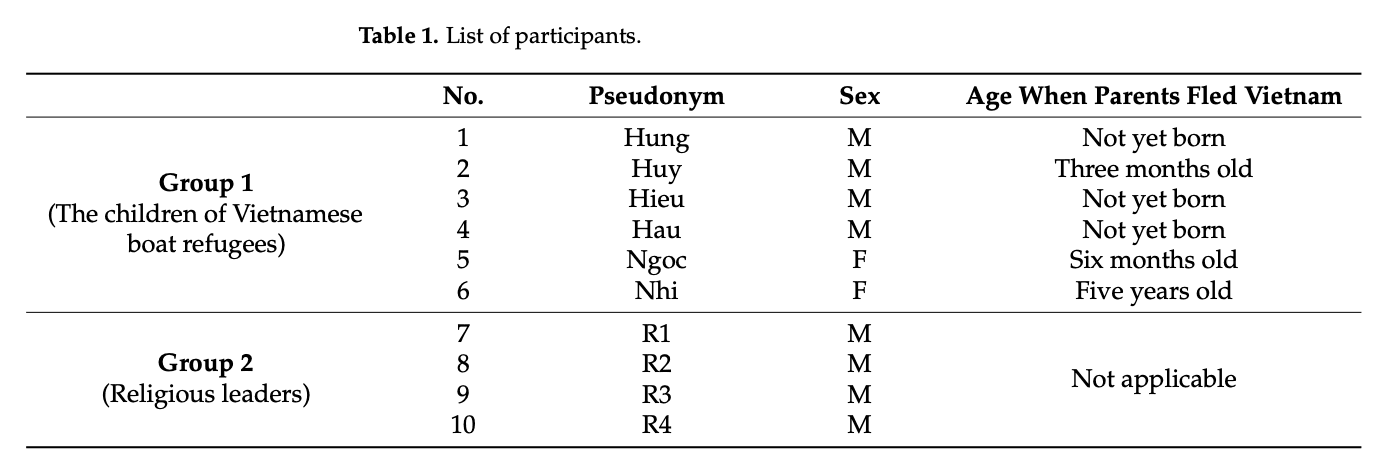
Table 1. List of participants.

The narrative interview [75] was used to elicit a long, narrative response. The adult children (Group 1) were asked three main broad questions: “Could you tell me about your parents’ experiences when they left Vietnam and moved to Norway?”; “Could you tell me about your life?”, and “In your opinion, how do your parents’ experiences influence your life experiences?”. For each question, the first author then used the prompts to help the participants navigate their stories: stages (before leaving Vietnam, during the journey, after arriving in Norway), timeframe (childhood, teenager, etc.), location (at home, at school, at work, etc.), and events (difficulties, pathways to overcome). Similarly, the religious leaders (Group 2) were asked about their observation of the experiences of children of Vietnamese boat refugees, focusing on the refugee parents’ experiences, the children’s experiences, and how the refugees’ experiences influenced their children’s experiences. The average interview duration was one hour, ranging from 40 min to one and a half hours. Interviews took place at workplaces, cafeterias, or homes based on participants’ convenience and preferences. Before the data collection, the proposal for data processing and management was submitted to SIKT (The Norwegian Agency for Shared Services in Education and Research) for an ethical assessment. All participants were informed about the research aim, how data would be processed, and their rights in terms of voluntary participation, confidentiality, and anonymity or partial anonymity (religious leaders). Ten participants agreed to participate in this study.

Due to the narrative interview method, rich and extensive data were collected about the experiences of children of Vietnamese boat refugees, highlighting two aspects: acculturation and intergenerational trauma. On the whole, religious leaders described their observations of the former aspect rather than the latter. For the interest of this paper, the religious leaders were excluded from the data analysis for this paper. One participant (Nhi), who left Vietnam at the age of five years old, was also excluded from the analysis for this paper, as this person might have been directly exposed to migration-related trauma, which makes her experience with trauma different from the other participants. The findings reported in this study are hence based on data from five participants, Hung, Huy, Hieu, Hau, and Ngoc, as shown in Table 1.

Data analysis was conducted following Thematic Network Analysis [76]. While this analysis shares key features with other qualitative analyses in uncovering themes from both implicit and explicit statements, its strength lies in offering an organizing principle and a presentational means ([76], p. 388). The step-by-step process of labeling codes and constructing basic themes, organizing themes, and global themes is systematic, rigorous, and transparent. The interviews were transcribed and managed using NVivo 12. The first author read the transcripts line by line to generate codes that are relevant to our excerpts. Related codes were grouped into basic themes, which were then combined into organizing themes. Then, organizing themes were clustered to construct global themes, as presented in Table 2 and Table 3. While the process of generating codes and lower themes (basic themes) is inductive, the process of constructing higher themes (organizing themes, global themes) is deductively guided by the theoretical framework. Given the rich and extensive narrative data, using a hybrid analysis approach ensures a thorough understanding of narratives while enabling well-framed findings.

Table 2. Global Theme 1—Maladaptive Parent–Child Interactions as Manifestations of Intergenerational Impacts of Trauma in Families.
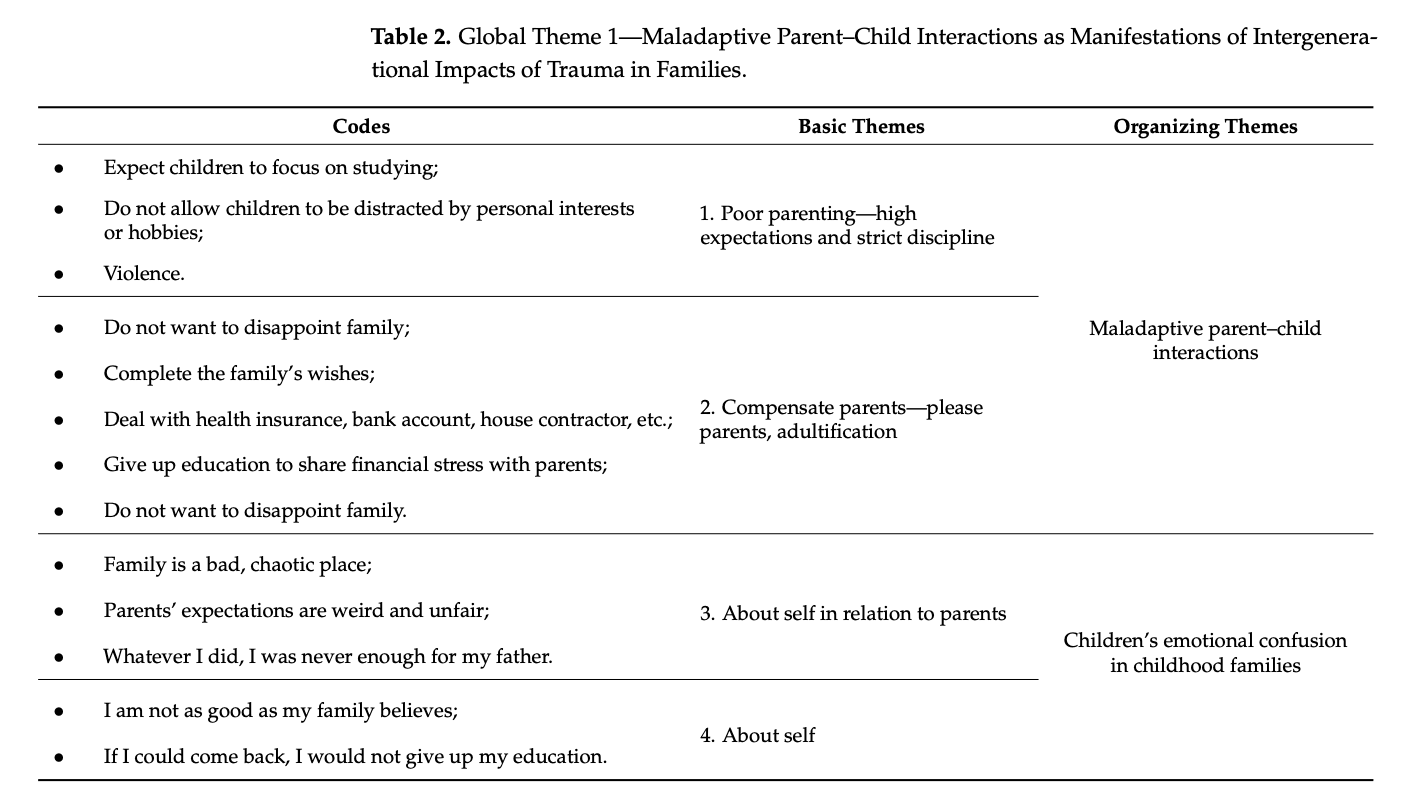
Table 2. Global Theme 1—Maladaptive Parent–Child Interactions as Manifestations of Intergenerational Impacts of Trauma in Families.

Table 3. Global Theme 2—A Strong Sense of Soherence as a Pathway to Outgrow the Intergenerational Impacts of Trauma in Families.
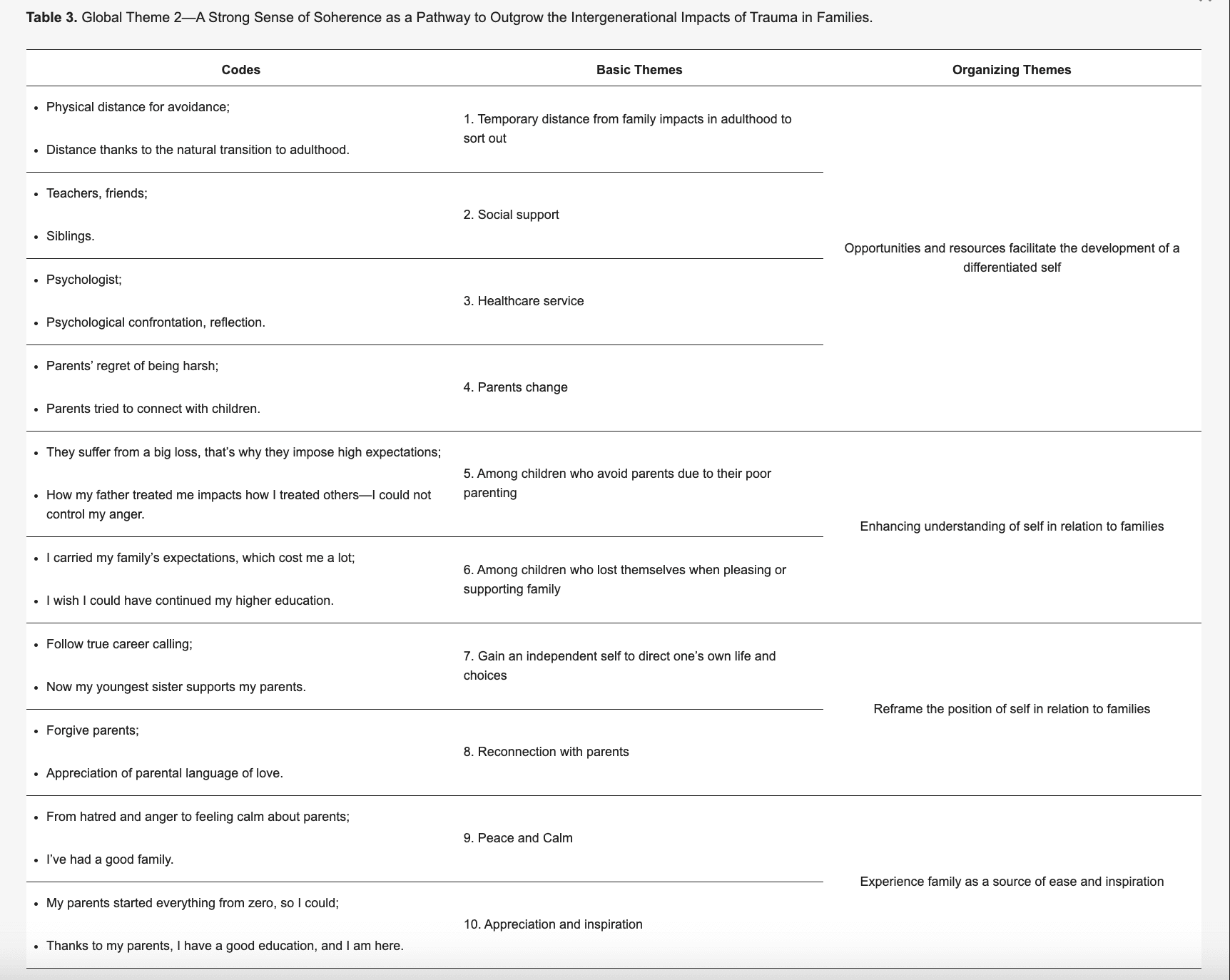
Table 3. Global Theme 2—A Strong Sense of Soherence as a Pathway to Outgrow the Intergenerational Impacts of Trauma in Families.

The study’s credibility, which deals with the congruency of the findings with the researched realities, is handled as follows: obtaining thick descriptions and concrete details of the researched phenomenon ([73], p. 64) through applying a narrative interview strategy, spending considerable amounts of time getting along with the Vietnamese communities in Norway, and applying triangulation, in terms of using different types of information sources [73], p. 66), to contrast and compare the collected data from different groups.

5. Findings

The findings describe maladaptive parent–child interactions as the manifestations of intergenerational trauma occurring in Vietnamese boat refugee families, which is followed by pathways through which the children grow beyond these family impacts.

5.1. Intergenerational Trauma Manifested Through Parent–Child Interactions

Two types of maladaptive parent–child interactions were revealed in Vietnamese boat refugees. The first type, on the parental side, was parents imposing high expectations on their children to succeed in school and practicing harsh parenting. The second type, on the children’s side, was feeling obligated to please their parents as compensation for parental hardships, or carrying out adult roles from an early age to share family responsibilities with their parents. The children of Vietnamese boat refugees in this study experienced either of these two types of maladaptive relationships with parents.

5.1.1. Maladaptive Parent–Child Interactions

The first type of maladaptive parent–child interaction is poor parenting. The children of Vietnamese boat refugees (Huy, Hau, Ngoc) described that their parents imposed high expectations on them related to school success. In particular, the refugee parents expected their children to focus on studying exclusively and did not allow their children to have interests or hobbies. As Huy recounted:

‘At that time, I did not remember exactly what he [his father] talked about. I think he wanted me to focus on studying … I was just six or seven years old at that time …If I hung out with my friends, or as soon as I touched the ball [to play football], my father scolded me.’

Hau also echoed Huy’s story that ‘If I don’t do homework, if I don’t go to school, or if there are any troubles at school, my parents punish me harder … I meant physical punishment’. Huy, Ngoc, and Hau also described that they got beaten a lot when they were little at home. Huy recounted the parenting he experienced at home as a child:

‘I could not figure out anything that I did that could satisfy my father. I hung out with my friends, I came back home late by five minutes, and I got beaten. I caused a fight at school with those who bullied my brother, and I got beaten. I got reported to my parents about issues at school, and I got beaten. My friends and I collected bottles to trade for cash to buy candies. My father found the candy wrappers, and I got beaten … [In adulthood] He commented on everything I did—making friends, girlfriends, clothing style, bearing style, everything.’

Especially since Huy tried to play football secretly during his childhood without his father’s permission, he was always afraid that his father would find out, which would cause serious punishment. However, his father finally found out and continued to prohibit him from playing football, even when Huy was selected by the national football club. As a reflection in adulthood, Huy said that the only way to please his father so that his father would let him play football was his excellent achievements in school. As Huy recounted:

‘At 12 years old … when I climbed the fence [after joining the football club], my head, every day, three times per week, was always repeating ‘Dad doesn’t pass by, Dad doesn’t pass by, Dad doesn’t pass by’—My mind kept repeating. Having climbed the fence without being seen, how relieved, how scary… When I was 15 years old, that day, […] when I was just putting one leg on the fence, my dad passed by. That day, when I got back home, my dad did not scold me, but I had already cried … One day, when I was playing for my club team, I saw him watching me from the fence […]. I did not understand why he came. In my head, I thought he came to claim that I was useless […] so he would ban me from playing football […] Before seeing him, I had scored three goals, […] but since I saw him […] I could not play anymore […] When I was nearly 17 years old, I was chosen as a main player of a football club […] they wanted to sign the contract with me […], but my dad did not want me to play football. I was not old enough to sign the contract […]. Since then, I had pinned my hatred on him. I hated him so much […] That pressure is unsolvable. […] I think if I could come back to my thirteen and fourteen, I could advise myself that, okay, I should have pleased my father’s intention, then he would have […] let me do something that I was not allowed to do back then. […] Maybe, at 13 and 14 years old, had I obeyed him not to play football for one or two years and stayed focused on studying, always gotten the highest score at school … my father would have rewarded me with something to make me happy. Then, when I was 16 … [he would have signed the football contract for me].’

The second type of maladaptive parent–child interaction revealed in this study is the children’s obligation to compensate their parents for their migration-related difficulties in the past. The children would try to please their parents or carry out adult roles in the family from an early age. As Hieu noted, he always tried to please his parents, which caused him stress:

‘I’m the oldest grandson on my grandfather’s side, … I had some pressure on myself to become successful, so that’s why … I chose to become an architect because an architect in Vietnam, for us, is a high-standard profession. Nobody on my father’s side had ever had higher education, so my parents were very happy and proud of that … It was hard work … I was giving my parents something to be happy about, and they went to tell other Vietnamese families that I was this and I was that…’

Hieu explained that he knew his parents had worked so hard for him to have this life and that he could not just waste it away.

Hung’s story also resonates with Hieu’s story in the way he took care of his parents. Since an early age, Hung carried out numerous family responsibilities, including providing translations, preparing tax documents, and negotiating with a lawyer and with the house-building contractor for his parents. Also, as a child, Hung was sensitive to his parents’ emotions. Hung noticed when his parents were stressed: ‘I knew my parents were stressed even though they did not tell us, the children. I stayed under the same roof with them, so I just knew, I listened, and I knew.’ Notably, he even sacrificed his education to support his family, as Hung described: ‘It was a difficult time, so I thought I could do education later. I decided to go to work to reduce my parents’ financial stress.’

5.1.2. Children’s Emotional Confusion in Childhood Families

These maladaptive parent–child interactions create emotional confusion for the children, obstructing them from developing an adequate understanding of themselves (i.e., acknowledging their genuine choices and capabilities), as well as their ability to navigate their relationships with their parents. For Huy, Hau, and Ngoc, who experienced poor parenting by their parents, as children, they experienced emotional confusion about their parents. In particular, Huy found that regardless of whatever he did, he was never adequate to his father. Similarly, as a child, Ngoc found her parents’ high expectations ‘weird’ and ‘unfair’:

‘the expectation is like … unfair because they haven’t gone to school, so they don’t know how difficulties … So, they have like really weird expectations, that everything is easy, and everything should be easy because here [it] is a free country, school is free, you know … everything is free, so everyone can be whatever they want. Why they didn’t have anything, they still got everything. If they can do this, of course, we can do it.’

She also found her childhood home a ‘chaotic’ place where she and her siblings got beaten a lot. Likewise, as a child, Hau felt embarrassed about his parents when he compared himself with his classmates, since he was the only one who came to class with bruises from his parents’ physical punishment at home: “I had a lot of friends that were Norwegian … we’re always comparing [sharing about experiences at home] … only me coming to school with bruises”.For Hung and Hieu, who, as children, tried to compensate for their parents’ migration-related difficulties, they experienced emotional confusion about themselves. Since Hieu tried to please his parents and meet their expectations, as a child, he was confused about his own capabilities. As Hieu articulated:

‘I didn’t feel, sometimes, … I am not good enough. I always put up a façade to keep my Vietnamese parents happy, and make them feel good, while me, … I know that I was not perfect and maybe not as smart and right as they think I was.’

This doubt increased when he was pursuing higher education in the profession of architecture, and even more after two consecutive family losses, which affected his academic performance. Hieu felt worst about himself for being an underachiever:

‘I felt ashamed, I felt that I was a loser, … like I didn’t deserve to be there, among other people who worked really hard to get good results. I also worked very hard, but I didn’t get any results … I was feeling ashamed, and it went so far that I got social anxiety, because I felt like I didn’t belong there.’

In Hung’s story, he did not clearly mention that the way he carried out adult responsibilities as a child imposed a negative impact on him, but he wished he had been able to continue his higher education after his family’s financial pressures were solved—in fact, he did not. As Hung described: ‘If I could go back, I’d be determined to go to university, then my path would be easier. I feel that decision [sacrificing his education to support family] was somewhat wrong.’

5.2. Developing a Strong Sense of Coherence to Grow Beyond the Intergenerational Impact of Trauma in Refugee Families

In this study, the pathway through which the children of Vietnamese boat refugees grow beyond the intergenerational impacts of trauma characterizes the development of a differentiated self, as presented in Table 3. In particular, the shift to a differentiated self, equivalent to a sense-of-coherence-enhancing process, was facilitated by social support, health services, improvements in the parenting of refugee parents, and a temporary distance from parental impacts in their adulthood. The children show an enhanced understanding of themselves in relation to their families and their parents’ migration-related difficulties; they were able to reframe their connections with their parents, in which they could direct their own lives and choices free from their parents’ impacts; they could perceive their parents as a source of peace and inspiration, instead of a source of stress like they had experienced as children.

5.2.1. Resources for the Development of a Strong Sense of Coherence

The shift from being affected by the maladaptive parent–child relationship to developing a differentiated self, a sense-of-coherence-enhancing process, starts with a temporary distance from the family’s impact, which was experienced by all the adult children. The first type of temporary distance occurred due to the children’s effort to avoid their parents. For example, Hau and Ngoc moved out to be away from their parents once they reached adulthood. Huy tried to avoid his father by finding a job far away from home. Physical distance as a means of avoidance is common among those children who experienced strict parental discipline in childhood. For example, Huy described his avoidance of his father:

‘Every day after school, I stopped by my Mom’s shop and asked my Mom if she was doing well […] However, whenever my Dad came, I left. I did not want to talk to my Dad. […] Regardless of what I did, he always opposed … Up to a certain point, I had to leave, to work on what I want.’

The second type of temporary distance occurred thanks to the natural transition into adulthood. For example, Hung got married and invested more in his own new family. Hieu waited for graduation from the architectural university, which marked his completion of the family’s wishes, to have his own freedom.

‘And then I graduated, it was a very good relief. From that moment, I want to … yeah, to live my life. […] After turning to 30s, I don’t value it [school achievements] as much as personal freedom, and being happy and feeling optimal and having a good emotional life.’

Temporary distance due to this natural transition is common among those children who, in childhood, felt obligated to please their parents or sacrifice for their parents.

The analysis also reveals other resources that facilitate the development of a differentiated self, experienced by the children of Vietnamese boat refugees. The first resource is social support. Ngoc described that when she was trying to avoid her parents during childhood, she leaned on her siblings, which maintained her feelings of family. Hieu also mentioned the support of his friends and teachers in helping him confront his anxiety: ‘After an event at school, I found out what happened to me in the confrontation … So, I confronted and told them how it was, and then they … the teachers were starting to believe me’. The second resource is health services. Particularly, Huy mentioned the important role of a psychologist in helping him understand the relationship between himself and his father. Also, reflection and psychological confrontation are psychological strategies that Hieu and Ngoc applied to understand themselves in relation to their families. The third resource is a change in the parents. In Huy’s story, his father changed when Huy was nearly 40 years old, which finally eased his struggle in his relationship with his father. As Huy recounted:

‘In the recent five years, I could feel at ease. He [his father] called and asked me if I was doing well, and how I played football as a child, since he found a lot of medals at home … That day, when I received a call from him, I felt like I had never been as happy as I was that day … I felt like 100 kg lifted off my shoulders … That is to say, no pressure in my life could compare to the pressure my father imposed on me.’

5.2.2. Enhancing Understanding of Self in Relation to Families

The children of Vietnamese boat refugees developed a more thorough understanding of themselves in relationships with their parents in their 30s and 40s. They understand how migration-related trauma impacted their parents’ parenting (Ngoc), how their parents’ poor parenting impacted their experiences (Huy), as well as how carrying out the obligation to please their parents caused them stress (Hieu). For example, Ngoc described her understanding of how her parents’ migration-related trauma translated into her parents’ high expectations for her and her siblings:

‘They lost their culture, they lost the language, they lost the land, they lost the family, … That’s not easy, they kind of tried to live through the kids, … wanting, wishing, … forcing us to a path we can succeed …’

Also, Ngoc understood why her parents applied strict discipline to her and her siblings:

‘They lost everything … All they got were us, and we just tried to integrate into Norway, that is the biggest loss… They did it [bad control] ‘cause that’s the only way they know, that’s the only way they can. Can imagine the frustration that the kids, eleven kids that are the only ones you have, then turn their backs on you because they don’t want to speak the language, they don’t really want to keep the culture, and they just want to be a part of, you know, the Norwegian culture.’

Huy, who experienced his father’s hard discipline, gained an understanding of how the negative impacts of his relationship with his father translated into his relationships with others. Huy recounted that he had to use psychological support in his adulthood since he could not control his anger toward others:

‘The psychologist helps me to understand what makes me get angry. Regardless of how excellent I am in football or at work, I still have something repressed inside. I was under high pressure from my father, who made me feel I was never good enough. This way, I also apply high demands to others.’

Hieu, who tried to please his parents from an early age, also described his understanding of how keeping the façade to please his parents made him ill. Later on, this burden was lifted off his shoulders through a psychological confrontation at school, thanks to the support of the teacher and friends. He confronted and told his teacher and classmates about what causes his anxiety. This confrontation marks his clear understanding of himself in relation to his parents and family situation.

5.2.3. Reframe the Position of Self in Relation to Family

A thorough understanding of the maladaptive interactions with parents in the past helped the children of Vietnamese boat refugees in this study reposition themselves in these interactions. Those who avoided their parents due to their parents’ poor parenting are now able to reconnect with their parents (Huy, Ngoc, Hau). For example, Huy no longer becomes angry at the presence of his father; he decided to forgive him, and he was then able to have dinner with his father and talk about his achievements in football in the past: ‘My father has now retired for 20 years … when I come back home for family meals, I recognize his regrets so I don’t blame him anymore. I want to be closer to him’. Likewise, Ngoc, after 15 years living in another city to avoid her childhood family, could reconnect with her parents and enjoy food as her parents’ ‘language of love’, instead of seeing home as a bad and sad place, as she articulated:

‘[…] when I was growing up in my house, my parents, because of the situation, we just saw the sad part […], the way of acting, the way of showing love, that was just their ways from that time […]. Now I love them to death. Just a period in my upbringing that I hated them [my parents] as so many kids do.’

Those who lost themselves due to always trying to please their parents or carry out household responsibilities are now able to follow their own interests and leave behind the obligatory tendency to please their parents. For example, after graduating with a degree in architecture, Hieu pursued his interest in dance and became a known dancer in Europe. Likewise, Hung, who took an adult role in childhood, is now taking care of his own family and lets his sister help with taking care of his parents.

5.2.4. Experience Families as a Source of Ease and Inspiration

At the time of the interview, in their 30s and 40s, all the adult children were able to experience their relationship with their refugee parents as a source of ease and inspiration. Those who felt ‘embarrassed’ (Hau) of, ‘pinned a hatred’ (Huy) on, or ‘hated’ (Ngoc) their parents at an early age could feel calmer and at ease with their parents. They acknowledged more positive sides of their families, which they could not see as children (Hau, Ngoc). Those who lost themselves when they tried to please their parents (Hieu) or sacrificed their own interests for their parents (Hung) have now gained a better sense of themselves and their own lives (Hieu, Hung). In particular, most of the adult children referred to their parents’ migration-related trauma as a source of inspiration for them in dealing with difficulties in their lives. As Ngoc described:

‘You are a mom yourself, you’ve gotten two children, and you know, … how hard it is to raise two children. So just imagine, how it is to have like 11 kids … how it is to not speak the language, not have money or anything … My Mom and Dad didn’t complain that much [though] they had more problems than me … Then I faced it at work. I solved all the wrong things [in my life].’

6. Discussion

This paper echoes prior studies regarding the motivation of trauma-shaped child–parent interactions, including parents’ high expectations (e.g., [43]), strict parenting (e.g., [42]), children’s obligation to please parents (e.g., [46]), and children’s adultification (e.g., [47]). However, these manifestations of intergenerational trauma might be slightly mediated by the culture. For example, what might be unique in the experiences of the children of Vietnamese boat refugees is that nearly all these maladaptive interactions in this study are likely related to the Vietnamese parents’ attitudes toward the value of academic success. That is the reason why, when the children navigated how to please their parents, they chose to be excellent at school or enroll in the profession perceived as most prestigious by the Vietnamese community (i.e., Hieu’s narrative). The trauma-affected parents protected their children from hardships by forcing them to succeed at school and applying strict parenting when the children did not focus on studying. Huy could not find anything he did that could satisfy his father, yet he tried to be excellent at school, which was also his insight later on in adulthood. The parents’ obsession with their children’s school success might cause constant parent–child tension, given that children engage in education for at least 12 years during their childhood in Norway. Accordingly, in supporting refugee families, it is worth considering the culturally shaped motivations behind parents’ maladaptive parenting, instead of just trying to change them.

If manifestations of trauma-shaped child–parent interactions are mediated by the culture they belong to, how much are these interactions observed in that culture when the intergenerational impact of trauma is not present? While the manifestation of intergenerational trauma might sound like it just reflects the values and practices of Vietnamese families, regardless of trauma effects, such as strict parenting or high achievement in school [77], the motivation behind them might be different between those with and without trauma effects. First, although Vietnamese children are culturally encouraged to obtain high academic achievements [78], one of our participants (Hieu) chose to study hard as a way to please his parents to compensate for their hardships. This motivation of compensating parents for their hardships echoes other trauma-affected populations [46]. Next, an additional motivation behind the strict parenting or high academic achievement expectations experienced by the participants might be parents’ unresolved trauma or strategies to protect their children from hardships. This trauma-driven parenting caused great confusion for our participants in their relationship with their parents. In other words, while the nature of child–parent interactions is driven by both intergenerational trauma effects and Vietnamese cultural values, a probable sign to differentiate between those with and without trauma effects within the same cultural context is whether the children experience great confusion in their relationship with their parents and about themselves.

Despite experiencing maladaptive interactions with refugee parents in childhood as a legacy of war and migration-related trauma in family history, the adult children of Vietnamese boat refugees could overcome the intergenerational impact of trauma through developing a strong sense of coherence.

How does the development of a sense of coherence help individuals overcome the intergenerational impact of trauma? Through applying the Bowen Family Systems framework [59,60], this paper addresses that developing a differentiated self is the pathway to outgrowing the negative impacts of one’s family, instead of maintaining a confused self where individuals continue being passively directed by family impacts, which serves as a mechanism of repeating trauma-impacted patterns across generations. Furthermore, the shift from a confused self (ill state) in childhood to a differentiated self (with better health and well-being) is equivalent to the process of enhancing a sense of coherence, facilitated by generalized resistance resources (GRRs). Indeed, this study contributes a salutogenic, lifespan-oriented pathway for understanding recovery from intergenerational trauma.

Interestingly, the shift to a stronger sense of coherence among all the adult children in this study started first and foremost with a temporary distance from their parents, either by an intentional move out of the childhood home, finding a job far away from home, or through the natural transition to adulthood due to having their own family or completing their parents’ wishes. This temporary distance from maladaptive interactions with parents is important, giving the adult children space to recognize what is truly meaningful to themselves and their own lives, apart from parents’ expectations or obligations. Among those who experienced strict parenting, physical distance could help them feel calmer and safer in sorting out their lives, which resonates with the experiences of some participants in a prior study ([46], p. 418). Furthermore, looking at this from Antonovsky’s understanding of coping [61], temporary distance likely helps children avoid facing stressors that establish a tension state, where the challenge is still present, but children gain more manageability and control over the situation.

Next, social support plays an important role in helping children deal with the intergenerational impact of trauma. When the children could not find peace in their relationship with their parents, who could they lean on? This is when support from, for example, siblings, friends, and teachers becomes very important. These social resources appear in the adult children’s narratives as individuals they could trust and to whom they could reveal and confront their vulnerabilities (e.g., Hieu’s story) or lean on when their relationship with their parents was a source of chaos and stress (e.g., Ngoc’s account). This is aligned with Antonovsky’s notion of ‘legitimate others’ as a resource for health ([62], pp. 17–18).

However, in one case in this study, temporary distance and social support were not enough to overcome the intergenerational impact of trauma. Huy could not resolve his struggles in his relationship with his parents until his father called him to ask how he was doing and showed recognition of his passion for football in the past. This suggests that when the root cause of low-quality parent–child interaction lies with the parents, a change in the parents may be very important for the health and well-being of the children. This also aligned with the current intervention approach to intergenerational trauma [15]—improving parenting and the health conditions of traumatized parents.

It is not easy to address which of the three SOC components is the most important for the children of Vietnamese boat refugees in overcoming the intergenerational impact of trauma. According to Antonovsky ([62], p. 22), meaningfulness is the most crucial component, serving as a sense of motivation for an individual to see their challenge as worth coping with. However, for the adult children of Vietnamese boat refugees in this study, some of them avoided their parents for nearly two decades, without any motivation to reconnect (e.g., Huy, Ngoc). The motivation to reconnect with parents, spend time with them, and forgive them for being strict in the past emerged after they developed a thorough understanding of themselves in their relationship with their parents, about the family’s history, and about why their parents did what they did, that is, when their comprehensibility was enhanced, as defined by salutogenesis theory. However, it could also be reasonable to argue that, for these Vietnamese children, reconnecting with family is always an essential thing that adult children wish to do, which is why they could not just erase their ties with their parents and feel at ease, even when they were staying apart from their family. Their motivation (meaningfulness) was always there; they just did not know how to do it yet, until their comprehensibility of themselves and their relationship with their parents improved. This could be a good point. However, if the essence of meaningfulness is defined as one’s active participation in finding a challenge, though painful, worthy of coping with, it is not clear in this study that meaningfulness comes first in this process. Instead, some adult children (Huy, Ngoc, Hau) chose to avoid their parents, a perceived source of intensive stressors, and they played an active role in reconnecting with their parents after their understanding of their situation was improved, so that stressors (the parents) were then perceived as non-stressors.

Comprehensibility, as a SOC component among the adult children of Vietnamese boat refugees who have successfully overcome the intergenerational impact of trauma, covers multiple aspects. It includes the children’s understanding of their family’s migration-related trauma, how these traumatic experiences influenced the parents’ interactions with their children, what the language of love of their refugee parents truly is, why their parents did what they did in their new country, and what the good sides of their families and home culture are. This understanding could emerge through the children’s own reflections on their life experiences (e.g., Ngoc’s narrative) or through professional or external support (e.g., psychologists and teachers in Huy’s and Hieu’s accounts). A thorough understanding of their own family and culture then plays an important role in children of Vietnamese boat refugees creating meaning for themselves and their own lives and in transforming their relationship with their parents, which then contributes to their health and well-being. This is aligned with existing psychological intervention approaches for trauma-impacted families [71,72]—enhancing the ability to interpret thoughts and feelings related to trauma and to make meaning of one’s own experiences.

While the study was successful in obtaining the rich lived experiences of the children of Vietnamese boat refugees, the small number of participants and the lack of gender balance might limit the patterns of themes to some extent. The initial study design with diverse types of interview participants (the adult children and the religious leaders) for triangulation [73] has not yet been successfully applied for this topic, intergenerational trauma, where its manifestations often occur within family interactions and might not be obvious to outside observers, such as religious leaders. This methodological point should be considered in future research designs. Also, compared to the other adult children, the negative impact of intergenerational trauma experienced by Hung seemed to be slightly less intense, suggesting that not all the trauma-exposed parents had a similar level of negative impacts on their children. This is possibly due to the parents’ own recovery and resilience, which is not confirmed through this study, and could be promising for future research, e.g., intergenerational resilience. A key strength of this study is the combination of the concept of the differentiated self from the Bowen family systems theory [59,60] and the sense of coherence concept from salutogenesis theory [61,62] to address a possible solution and pathways to overcome the intergenerational impact of trauma. This is especially meaningful for those who have been affected by trauma in moving forward with coherence, meaning, and health. This also contributes to the current intervention approach for trauma-affected families by shifting the focus from childhood intervention for intergenerational trauma [15] to adult meaning-making and differentiation from maladaptive family impacts. The hybrid analytic method is another strength of this study. The deductive part informs well-framed findings; meanwhile, the inductive part generates insights from rich narratives to seek a relevant conceptual framing. This hybrid analysis process, with iterations between data and conceptual framing, strengthens the credibility of this research.

This study also suggests the need for healthcare support (e.g., screening to discover need, workshops, and dialogue for reflection) among the adult children of refugees to help them better understand themselves in relation to their home culture and their family’s history of trauma as a pathway to grow beyond intergenerational trauma. Healthcare professionals who support refugees should be aware that while the transmission of intergenerational trauma is shared across different communities, their expressions might be slightly moulded by the culture of the population. Accordingly, healthcare services (e.g., counselling, family interventions, and community-based interventions) for refugee populations should be provided in a culturally responsive and adaptive manner. Also, in supporting the adult children of refugees, regardless of how painful their experiences have been, it is very important to help them find meaning in these experiences. Without seeing any good sides to their situation, without finding any meaning in their childhood maladaptive family interactions, and without realizing that their parents actually care for them in some ways, they might not ever feel calm and at ease about their family of origin or their past. Of course, it would be ideal if the parents could change or if the parent–child relationship could be improved, but this might not always be the case for adult children, especially if their parents have died before this could happen.

7. Conclusions

This study extends the literature on intergenerational trauma by centering the voices of adult children of Vietnamese boat refugees and illuminating how individuals move forward to health despite enduring trauma-shaped family interactions. While grounded in the specific historical and cultural context of the Vietnamese forced migration, the findings offer transferable insights into how intergenerational trauma is sustained and transformed across diverse cultural settings. Across the narratives, intergenerational trauma was transmitted not solely through recounting parents’ migration-related trauma, but also through trauma-shaped daily child–parent interactions, including harsh parenting, high achievement expectations, obligation to compensate parents, and adultification. These mechanisms echo patterns documented among other refugees, as well as Indigenous, Holocaust-surviving, and conflict-affected populations, suggesting that while the expressions of intergenerational trauma are culturally situated, the mechanisms of trauma transmission are structurally consistent across contexts.

Critically, this study shifts the attention toward a less-examined but highly consequential population: adult children who no longer reside with their family of origin yet who continue to carry the emotional and relational legacies of trauma sustained through maladaptive interactions with parents in childhood. The findings suggest that recovery in adulthood from the intergenerational impact of trauma is not about erasing family ties, but rather playing an active role in reframing them through enhanced understanding, applying meaning-making to their past. This is how the self-differentiation from the impact of maladaptive patterns in their family of origin occurs. This is also a sense-of-coherence-enhancing process for better health and well-being, which is facilitated by generalized resistance resources.

Open Article as PDF

Abstract

Maladaptive family interaction is one of the mechanisms through which trauma is transmitted across generations. The current intervention approach for trauma-affected families focuses on traumatized parents and child–parent dyads during childhood. This leaves a gap in how adult children, who might no longer live with their parents, can overcome the negative impacts of maladaptive childhood interactions with parents as a legacy of parental trauma history. This study focuses on the children of Vietnamese boat refugees in their 30s and 40s in two cities in Norway, applying narrative interviews to elicit long narratives about their lifespan experiences. A hybrid analytic approach utilizes Thematic Network Analysis, informed by a conceptual framework integrating salutogenesis theory and Bowen family systems theory. The findings reveal that maladaptive parent–child interactions in Vietnamese boat refugee families include parents’ high expectations, harsh parenting, children’s obligation to please parents, and adultification, which are trauma-shaped and mediated by Vietnamese culture. Developing a strong sense of coherence (SOC), characterized by enhancing one’s understanding of the self in relation to family, making meaning regarding the past, and playing an active role in reframing relationships with one’s parents, serves as a pathway to outgrow the impacts of maladaptive patterns in one’s family of origin. Overall, this paper contributes a salutogenic, lifespan-oriented framework for understanding recovery beyond childhood impacts of intergenerational trauma.

Summary

Trauma can affect families across generations, which is a public health concern. This study looks at how adult children of Vietnamese boat refugees dealt with the effects of this trauma. Understanding their experiences can help other adults recover from similar situations and improve their health.

This research offers a way to understand recovery from intergenerational trauma that focuses on long-term health, not just childhood issues. It shifts the focus from helping parents or young children to how adults can heal by understanding their past, finding meaning in their experiences, and breaking away from harmful family patterns formed in childhood.

For healthcare providers, policymakers, and researchers, this study highlights the need for culturally sensitive services for refugees. It suggests that seeing the positive aspects of past events, finding meaning in them, and separating oneself from childhood family interactions shaped by trauma are important steps for adults recovering from intergenerational trauma.

1. Introduction

Many people worldwide experience trauma, and its effects can impact individuals, relationships, communities, and society. This paper focuses on intergenerational trauma, which means the effects of trauma are passed down through generations.

Intergenerational trauma occurs when the effects of difficult experiences not only affect the generation that lived through them but also continue to impact future generations. Studies show that children of parents who experienced trauma are more vulnerable than children of parents who did not. Refugees often experience trauma before and during their journey to a new country. Research indicates that children of traumatized refugees have worse health outcomes. A refugee's health upon arrival in a new country can even predict their children's health decades later, showing the negative impact of migration-related trauma across generations.

Studies on intergenerational trauma in refugee populations suggest that family interactions, like poor parenting, are one way trauma is passed down. Most interventions for intergenerational trauma focus on parents or on parents and children together during childhood. There is a lot of evidence supporting these approaches. For example, studies focusing on traumatized parents look at their overall well-being, sense of control, and social support as factors that protect their children's health. Studies on parent-child relationships suggest that healthy family functioning, better parenting, good family connections, and open communication about past trauma can lessen the impact of parental trauma on children. However, there is limited understanding of how adult children can deal with, understand differently, and heal from family interactions shaped by childhood trauma later in life.

The term "maladaptive parenting" describes poor parenting strategies, such as harsh discipline and child abuse, that can pass trauma across generations. This paper uses the term "maladaptive child-parent interaction" to include how children respond in difficult relationships with their parents. The Interpersonal Acceptance-Rejection Theory explains that relationships with important people, like parents, that do not offer warmth, comfort, support, or care, can negatively affect a person's health, self-worth, and worldview.

In this study, researchers used the experiences of adult children of Vietnamese boat refugees in Norway to explore how intergenerational trauma affects refugee families and how children overcome it. The study first identifies challenging parent-child interactions caused by the family's migration history. Then, it examines what helps children overcome the negative effects of these interactions. Since difficult parent-child interactions are widely seen as a way trauma is passed down, understanding how children recover can help guide interventions for refugee children.

2. Literature Review

2.1. Intergenerational Trauma and Relevant Terms

Broadly, intergenerational trauma means that trauma in one generation can affect the health of the next. In research, this term is often used with other similar terms like multigenerational trauma, transgenerational trauma, collective trauma, and historic trauma. All these terms generally describe how trauma affects multiple generations. Sometimes, these terms are used interchangeably, for example, intergenerational trauma and transgenerational trauma, or intergenerational trauma and historic trauma.

However, some differences have been suggested between intergenerational trauma, collective trauma, and historic trauma. Collective trauma is a widespread trauma experienced by a group or community, which can change their identities, beliefs, and interactions. Examples include trauma from floods, wars, or genocide. Collective trauma usually refers to the overall effect of trauma within a community. Intergenerational trauma, on the other hand, often focuses on how trauma affects family members across generations. Examples include studies on descendants of Holocaust survivors or children born from wartime rape. Historic trauma includes both collective and intergenerational effects, meaning trauma is shared by a community and its negative impacts accumulate over time across generations. The experiences of American Indian/Alaskan Native populations, who faced long histories of colonization and violence, illustrate historic trauma and explain health differences.

All these forms of trauma can happen together in refugee populations. Past studies have looked at collective trauma among Afghan refugees, intergenerational trauma across three generations of Palestinian refugees, and historic trauma among Southeast Asian refugees in the U.S.

This study mainly focuses on intergenerational trauma to describe how trauma affects family generations of Vietnamese boat refugees. However, it also considers the broader historical and community context for a fuller understanding.

2.2. How Trauma Shapes Parent–Child Interactions

Research on refugee populations suggests that parenting and family relationships are the main ways trauma's effects are passed down through generations. This paper focuses on how parent-child interactions are affected by migration-related trauma experienced by refugee parents. It does not include studies about other aspects of refugee families, like stress from adapting to a new culture or differences between generations.

The parent-child interactions discussed in this article include how parents and children experience each other, shaped by trauma in their family history. For parents, studies on refugee families report unhealthy parenting among traumatized parents. This includes violence, strict discipline, high expectations, and overprotection of children. Specifically, poor health (like PTSD symptoms) from traumatic experiences can make it harder for parents to parent effectively. This explains why children of traumatized parents experience more violence. Unresolved trauma in refugee parents has also been linked to high expectations for their children, particularly in education. Additionally, unresolved trauma is connected to parents staying silent about their past trauma to protect their children.

From the children's perspective, studies describe that refugee children might feel a debt to their parents for their sacrifices and try to make up for it. The research also mentions "parentification" or "adultification" among refugee children, where children take on adult roles in the family. This might involve caring for their parents emotionally or handling household tasks to ease the trauma their parents experienced.

2.3. Vietnamese Boat Refugee Families in Norway

During the colonial period, Vietnam was divided into North and South. The French influenced South Vietnam toward Western capitalism, while North Vietnam became communist. These cultural differences continued after French colonization during American support. When communism took over the country, leading to the Fall of Saigon, many people in South Vietnam fled.

Vietnamese boat refugees, or "boat people," were those who escaped Vietnam by boat. It is estimated that between 200,000 and 400,000 boat people died from storms, overcrowded boats, and pirates. Many also did not receive humanitarian help to reach transit camps on their way to new countries.

According to official statistics, over 10,000 Vietnamese people came to Norway as refugees. More than 6,000 were primary refugees, and over 3,000 joined them later through family reunification. Like other refugee groups, Vietnamese boat refugees faced great difficulties before and during their migration. Studies describe their traumatic experiences in Vietnam, such as witnessing war deaths, injuries, torture, and military involvement. After fleeing, refugees encountered challenges like waiting in camps, family separation, injuries, witnessing family deaths, violence, and assault. At the family level, these past traumas from war and displacement negatively affect refugees' mental health, which in turn impacts their children's mental health.

A series of studies in Norway followed Vietnamese refugees who arrived in the country from transit camps two decades later. These studies described their challenges in adapting to Norway, such as low participation in the workforce and difficulties with the Norwegian language and culture. In this situation, Vietnamese refugees relied on their community in Norway to help raise their children and adjust to the new country. Existing research also describes potential conflicts between parents and children due to cultural differences in the new country.

3. Theoretical Framework

How Children Can Overcome the Intergenerational Impact of Trauma

How can adult children of Vietnamese boat refugees overcome the negative effects of challenging parent-child interactions, which are a legacy of their family's migration trauma? To find a framework for how individuals grow beyond their family's negative influences, this study uses Bowen's family systems theory and Antonovsky's theory of sense of coherence.

Bowen's theory states that a family acts like a complete system, where every part is connected and influences the others. Within this family system, a child develops a sense of self that can range from confused to differentiated. "Confusion of self" is an unhealthy state where an individual cannot develop their unique identity, and their life choices are passively guided by their family's influence, leading to a repetition of family patterns. In contrast, "differentiation of self" is a mature state where an individual has a clear sense of self and can make their own life choices, moving beyond the family system's influence.

To understand how trauma is passed down through generations in refugee families, this theory suggests that when parents are affected by migration-related trauma, their children are also affected through family connections and interactions. These challenging parent-child interactions can harm children's health. If children are passively affected by trauma passed down through family interactions, they have a "confusion of self," mirroring the family's unhealthy system. However, if children can overcome the trauma's impact from these interactions, they develop a differentiated self. This shows their ability to separate from the unhealthy family system, grow beyond it, and direct their own lives and choices.

But how does someone move from being influenced by difficult family interactions to achieving a differentiated self? From a health promotion perspective, this shift from illness (confusion of self) to health and well-being (differentiation of self) is a process of strengthening a "sense of coherence," which is helped by "generalized resistance resources." A strong sense of coherence (SOC) indicates a well-functioning and healthy individual. It has three parts: comprehensibility (cognitive aspect), which is the belief that challenges are understood, and that the internal and external worlds are consistent and clear, not chaotic; manageability (behavioral aspect), which is the belief that one has enough resources to cope with challenges in a healthy way; and meaningfulness (motivational aspect), which is seeing life as worth living and challenges as worth dealing with rather than avoiding. Studies often use SOC as a measure of health improvement. SOC also aligns with other well-known health indicators like quality of life and self-esteem. Generalized resistance resources (GRRs) are "any characteristic of the person, the group, or the environment that can help manage tension effectively." Antonovsky believed that GRRs help build a strong SOC.

While family systems theory helps find a way for individuals to overcome the intergenerational impact of trauma passed through the family, it does not fully explain how this movement from illness (confusion of self) to well-being (differentiation of self) happens. Combining Bowen's family systems theory and Antonovsky's framework allows us to cover both the results and the paths to get there. Specifically, this study uses the three-part structure of SOC to describe a differentiated self. The development of a differentiated self is seen as a process that enhances SOC, supported by GRRs, and marked by improved comprehensibility (the ability to reflect on oneself in relation to family and understand how family situations and interactions affect oneself); manageability (the ability to use resources to actively engage in relationships with parents and make one's own choices and life decisions separate from family influences); and meaningfulness (insights or valuable lessons learned from family experiences). This combination of frameworks is also suitable because SOC's components align with psychological approaches for children of traumatized parents, which stress the importance of being able to reflect on and understand oneself in relation to important family members. A deep understanding and insights are key to helping individuals take an active role in these relationships and break the cycle of trauma passed down through family interactions. This understanding of how a strong sense of coherence (a differentiated self) develops as a way to move beyond the impact of trauma from unhealthy family interactions will guide the data analysis in this paper.

4. Methods

This paper is part of a larger study that used qualitative methods. The original group of participants included six adult children of Vietnamese boat refugees and four religious leaders. These participants were found through community contacts and by asking current participants to suggest others (snowball sampling) in Oslo and Bergen between June and October 2023. The lead researcher contacted Vietnamese grocery stores and religious centers to ask if they knew any children of "boat people." The adult children of Vietnamese boat refugees had to be the first child born to Vietnamese boat refugee parents after they arrived in Norway, or have come with their parents when they were very young, to ensure they were not directly exposed to migration-related trauma. To ensure the accuracy and trustworthiness of the findings, religious leaders who served the Vietnamese community in Norway were also included. These leaders were recruited from Catholic churches and Buddhist temples, as these are the main religions among Vietnamese people in Norway.

Narrative interviews were used to encourage participants to share long, detailed stories. The adult children were asked three broad questions: "Could you tell me about your parents’ experiences when they left Vietnam and moved to Norway?"; "Could you tell me about your life?"; and "In your opinion, how do your parents’ experiences influence your life experiences?". For each question, the researcher used prompts to help participants recall details, such as different life stages (before leaving Vietnam, during the journey, after arriving in Norway), timeframes (childhood, teenager, etc.), locations (at home, at school, at work, etc.), and specific events (difficulties, ways of overcoming them). Similarly, the religious leaders were asked about their observations of the experiences of children of Vietnamese boat refugees, focusing on the parents' experiences, the children's experiences, and how the refugees' experiences affected their children's lives. Interviews lasted about one hour, ranging from 40 minutes to one and a half hours. Interviews were held in places convenient and preferred by the participants, such as workplaces, cafeterias, or homes. Before collecting data, the plan for data processing and management was reviewed for ethical considerations by SIKT (The Norwegian Agency for Shared Services in Education and Research). All participants were informed about the study's purpose, how their data would be handled, and their rights, including voluntary participation, confidentiality, and anonymity or partial anonymity (for religious leaders). Ten participants agreed to take part.

The narrative interviews provided extensive and rich data about the experiences of children of Vietnamese boat refugees, highlighting two main aspects: adjusting to a new culture and intergenerational trauma. Overall, the religious leaders' observations focused more on cultural adjustment than on intergenerational trauma. For this paper, the religious leaders were not included in the data analysis. One participant (Nhi), who left Vietnam at age five, was also excluded because she might have been directly exposed to migration-related trauma, making her experiences with trauma different from the other participants. The findings in this study are based on data from five participants: Hung, Huy, Hieu, Hau, and Ngoc.

Data analysis followed Thematic Network Analysis. While this analysis shares features with other qualitative methods in finding themes from both spoken and implied statements, its strength is in providing an organized way to present findings. The step-by-step process of labeling codes, building basic themes, organizing themes, and creating global themes is systematic, thorough, and clear. Interviews were transcribed and managed using NVivo 12. The lead researcher read the transcripts line by line to create codes relevant to the excerpts. Related codes were grouped into basic themes, which were then combined into organizing themes. Finally, organizing themes were clustered to create global themes. While creating codes and basic themes was based on the data, the process of constructing higher themes (organizing and global themes) was guided by the theoretical framework. Using a hybrid analysis approach ensured a deep understanding of the narratives while producing well-structured findings, given the rich and extensive narrative data.

The study's credibility, meaning how well the findings reflect the realities studied, was ensured in several ways. This included gathering detailed descriptions of the phenomenon through narrative interviews, spending significant time engaging with Vietnamese communities in Norway, and using different types of information sources to compare data from various groups.

5. Findings

The study's findings describe unhealthy parent-child interactions as signs of intergenerational trauma in Vietnamese boat refugee families. This is followed by how the children moved beyond these family impacts.

5.1. Intergenerational Trauma Manifested Through Parent–Child Interactions

Two types of unhealthy parent-child interactions were found in Vietnamese boat refugee families. The first type, from the parents' side, involved parents placing high expectations on their children to succeed in school and using harsh parenting methods. The second type, from the children's side, involved feeling obligated to please their parents to make up for the parents' past hardships, or taking on adult responsibilities from a young age to share family duties. The adult children of Vietnamese boat refugees in this study experienced one or both of these types of difficult relationships with their parents.

5.1.1. Maladaptive Parent–Child Interactions

The first type of unhealthy parent-child interaction is poor parenting. The children of Vietnamese boat refugees (Huy, Hau, Ngoc) explained that their parents had very high expectations for their school success. Specifically, refugee parents expected their children to focus only on studying and did not allow them to have other interests or hobbies. Huy recalled:

"At that time, I did not remember exactly what he [his father] talked about. I think he wanted me to focus on studying … I was just six or seven years old at that time … If I hung out with my friends, or as soon as I touched the ball [to play football], my father scolded me."

Hau also shared a similar experience, saying, "If I don’t do homework, if I don’t go to school, or if there are any troubles at school, my parents punish me harder … I meant physical punishment." Huy, Ngoc, and Hau also described being beaten often at home when they were young. Huy described his childhood parenting:

"I could not figure out anything that I did that could satisfy my father. I hung out with my friends, I came back home late by five minutes, and I got beaten. I caused a fight at school with those who bullied my brother, and I got beaten. I got reported to my parents about issues at school, and I got beaten. My friends and I collected bottles to trade for cash to buy candies. My father found the candy wrappers, and I got beaten … [In adulthood] He commented on everything I did—making friends, girlfriends, clothing style, bearing style, everything."

Huy secretly played football during his childhood without his father's permission and was always afraid his father would find out, which would lead to severe punishment. His father eventually discovered it and continued to forbid him from playing football, even when Huy was selected by the national football club. Looking back as an adult, Huy felt that the only way to please his father and be allowed to play football was to achieve excellent grades in school. Huy explained:

"At 12 years old … when I climbed the fence [after joining the football club], my head, every day, three times per week, was always repeating ‘Dad doesn’t pass by, Dad doesn’t pass by, Dad doesn’t pass by’—My mind kept repeating. Having climbed the fence without being seen, how relieved, how scary… When I was 15 years old, that day, […] when I was just putting one leg on the fence, my dad passed by. That day, when I got back home, my dad did not scold me, but I had already cried … One day, when I was playing for my club team, I saw him watching me from the fence […]. I did not understand why he came. In my head, I thought he came to claim that I was useless […] so he would ban me from playing football […] Before seeing him, I had scored three goals, […] but since I saw him […] I could not play anymore […] When I was nearly 17 years old, I was chosen as a main player of a football club […] they wanted to sign the contract with me […], but my dad did not want me to play football. I was not old enough to sign the contract […]. Since then, I had pinned my hatred on him. I hated him so much […] That pressure is unsolvable. […] I think if I could come back to my thirteen and fourteen, I could advise myself that, okay, I should have pleased my father’s intention, then he would have […] let me do something that I was not allowed to do back then. […] Maybe, at 13 and 14 years old, had I obeyed him not to play football for one or two years and stayed focused on studying, always gotten the highest score at school … my father would have rewarded me with something to make me happy. Then, when I was 16 … [he would have signed the football contract for me]."

The second type of unhealthy parent-child interaction found in this study is children feeling obligated to compensate their parents for their past migration difficulties. Children would try to please their parents or take on adult roles in the family from a young age. Hieu noted that he always tried to please his parents, which caused him stress:

"I’m the oldest grandson on my grandfather’s side, … I had some pressure on myself to become successful, so that’s why … I chose to become an architect because an architect in Vietnam, for us, is a high-standard profession. Nobody on my father’s side had ever had higher education, so my parents were very happy and proud of that … It was hard work … I was giving my parents something to be happy about, and they went to tell other Vietnamese families that I was this and I was that…"

Hieu explained that he knew his parents had worked so hard for him to have his life, and he felt he could not waste it.

Hung's story is similar to Hieu's in how he cared for his parents. From a young age, Hung took on many family responsibilities, including translating, preparing tax documents, and negotiating with a lawyer and a house-building contractor for his parents. As a child, Hung was also sensitive to his parents' emotions. He noticed when they were stressed: "I knew my parents were stressed even though they did not tell us, the children. I stayed under the same roof with them, so I just knew, I listened, and I knew." Notably, he even sacrificed his education to support his family, as Hung described: "It was a difficult time, so I thought I could do education later. I decided to go to work to reduce my parents’ financial stress."

5.1.2. Children’s Emotional Confusion in Childhood Families

These unhealthy parent-child interactions caused emotional confusion for the children. This prevented them from developing a clear understanding of themselves (like knowing their true choices and abilities) and their ability to manage their relationships with their parents. For Huy, Hau, and Ngoc, who experienced poor parenting, they felt confused about their parents as children. Huy, in particular, felt that no matter what he did, he was never good enough for his father. Similarly, as a child, Ngoc found her parents' high expectations "weird" and "unfair":

"The expectation is like … unfair because they haven’t gone to school, so they don’t know how difficulties … So, they have like really weird expectations, that everything is easy, and everything should be easy because here [it] is a free country, school is free, you know … everything is free, so everyone can be whatever they want. Why they didn’t have anything, they still got everything. If they can do this, of course, we can do it."

She also described her childhood home as "chaotic" and a place where she and her siblings were often beaten. Likewise, as a child, Hau felt embarrassed by his parents when he compared himself to his classmates because he was the only one who came to class with bruises from his parents' physical punishment at home: "I had a lot of friends that were Norwegian … we’re always comparing [sharing about experiences at home] … only me coming to school with bruises." For Hung and Hieu, who tried to make up for their parents' migration difficulties as children, they experienced emotional confusion about themselves. Since Hieu tried to please his parents and meet their expectations, he was confused about his own abilities as a child. Hieu explained:

"I didn’t feel, sometimes, … I am not good enough. I always put up a façade to keep my Vietnamese parents happy, and make them feel good, while me, … I know that I was not perfect and maybe not as smart and right as they think I was."

This self-doubt grew when he pursued higher education in architecture, and even more after two family losses affected his academic performance. Hieu felt terrible about himself for not succeeding:

"I felt ashamed, I felt that I was a loser, … like I didn’t deserve to be there, among other people who worked really hard to get good results. I also worked very hard, but I didn’t get any results … I was feeling ashamed, and it went so far that I got social anxiety, because I felt like I didn’t belong there."

In Hung's story, he did not clearly state that taking on adult responsibilities as a child negatively affected him. However, he wished he had been able to continue his higher education after his family's financial problems were resolved, which he did not. Hung described: "If I could go back, I’d be determined to go to university, then my path would be easier. I feel that decision [sacrificing his education to support family] was somewhat wrong."

5.2. Developing a Strong Sense of Coherence to Grow Beyond the Intergenerational Impact of Trauma in Refugee Families

In this study, the path through which the children of Vietnamese boat refugees moved beyond the intergenerational impacts of trauma involves developing a differentiated self. This shift to a differentiated self, which is like a process of strengthening one's sense of coherence, was helped by social support, health services, improvements in the parenting of refugee parents, and a temporary separation from parental influences in adulthood. The children showed a greater understanding of themselves in relation to their families and their parents’ migration-related difficulties. They were able to change their connections with their parents, allowing them to direct their own lives and choices free from their parents’ impacts. They could see their parents as a source of peace and inspiration, rather than a source of stress as they had experienced in childhood.

5.2.1. Resources for the Development of a Strong Sense of Coherence

The shift from being affected by unhealthy parent-child relationships to developing a differentiated self, a process that enhances a sense of coherence, begins with a temporary distance from the family's influence. All adult children in the study experienced this. The first type of temporary distance occurred because the children actively tried to avoid their parents. For example, Hau and Ngoc moved out to live away from their parents once they became adults. Huy tried to avoid his father by finding a job far from home. Physical distance as a way to avoid is common among children who experienced strict parental discipline in childhood. For instance, Huy described avoiding his father:

"Every day after school, I stopped by my Mom’s shop and asked my Mom if she was doing well […] However, whenever my Dad came, I left. I did not want to talk to my Dad. […] Regardless of what I did, he always opposed … Up to a certain point, I had to leave, to work on what I want."

The second type of temporary distance occurred naturally with the transition into adulthood. For example, Hung got married and focused more on his own new family. Hieu waited until he graduated from architectural university, which symbolized fulfilling his family's wishes, to gain his own freedom.

"And then I graduated, it was a very good relief. From that moment, I want to … yeah, to live my life. […] After turning to 30s, I don’t value it [school achievements] as much as personal freedom, and being happy and feeling optimal and having a good emotional life."

Temporary distance due to this natural transition is common among children who, in childhood, felt obligated to please their parents or make sacrifices for them.

The analysis also shows other resources that help adult children of Vietnamese boat refugees develop a differentiated self. The first resource is social support. Ngoc explained that when she tried to avoid her parents during childhood, she relied on her siblings, which helped her maintain a sense of family. Hieu also mentioned the support of his friends and teachers in helping him face his anxiety: "After an event at school, I found out what happened to me in the confrontation … So, I confronted and told them how it was, and then they … the teachers were starting to believe me." The second resource is health services. Huy specifically mentioned the important role of a psychologist in helping him understand his relationship with his father. Also, reflecting and psychological confrontation were strategies Hieu and Ngoc used to understand themselves in relation to their families. The third resource is a change in the parents. In Huy's story, his father changed when Huy was almost 40 years old, which finally eased his struggle in his relationship with his father. Huy recalled:

"In the recent five years, I could feel at ease. He [his father] called and asked me if I was doing well, and how I played football as a child, since he found a lot of medals at home … That day, when I received a call from him, I felt like I had never been as happy as I was that day … I felt like 100 kg lifted off my shoulders … That is to say, no pressure in my life could compare to the pressure my father imposed on me."

5.2.2. Enhancing Understanding of Self in Relation to Families

The adult children of Vietnamese boat refugees developed a deeper understanding of themselves in their relationships with their parents in their 30s and 40s. They understood how migration-related trauma affected their parents’ parenting (Ngoc), how their parents’ poor parenting impacted their experiences (Huy), and how feeling obligated to please their parents caused them stress (Hieu). For example, Ngoc described how she understood that her parents' migration-related trauma led to their high expectations for her and her siblings:

"They lost their culture, they lost the language, they lost the land, they lost the family, … That’s not easy, they kind of tried to live through the kids, … wanting, wishing, … forcing us to a path we can succeed …"

Ngoc also understood why her parents disciplined her and her siblings strictly:

"They lost everything … All they got were us, and we just tried to integrate into Norway, that is the biggest loss… They did it [bad control] ‘cause that’s the only way they know, that’s the only way they can. Can imagine the frustration that the kids, eleven kids that are the only ones you have, then turn their backs on you because they don’t want to speak the language, they don’t really want to keep the culture, and they just want to be a part of, you know, the Norwegian culture."

Huy, who experienced his father's harsh discipline, came to understand how the negative effects of his relationship with his father carried over into his other relationships. Huy explained that he needed psychological support as an adult because he could not control his anger towards others:

"The psychologist helps me to understand what makes me get angry. Regardless of how excellent I am in football or at work, I still have something repressed inside. I was under high pressure from my father, who made me feel I was never good enough. This way, I also apply high demands to others."

Hieu, who tried to please his parents from a young age, also described how maintaining a facade to make his parents happy made him unwell. Later, this burden was lifted through a psychological confrontation at school, with the support of his teacher and friends. He confronted and told his teacher and classmates what caused his anxiety. This confrontation marked his clear understanding of himself in relation to his parents and family situation.

5.2.3. Reframe the Position of Self in Relation to Family

A deep understanding of past challenging interactions with parents helped the adult children of Vietnamese boat refugees in this study change their role in these interactions. Those who avoided their parents due to poor parenting are now able to reconnect with them (Huy, Ngoc, Hau). For example, Huy no longer gets angry when his father is present; he decided to forgive him and was then able to have dinner with his father and talk about his past football achievements: "My father has now retired for 20 years … when I come back home for family meals, I recognize his regrets so I don’t blame him anymore. I want to be closer to him." Likewise, Ngoc, after 15 years living in another city to avoid her childhood family, could reconnect with her parents and enjoy food as her parents' "language of love," instead of seeing home as a sad place. She explained:

"[…] when I was growing up in my house, my parents, because of the situation, we just saw the sad part […], the way of acting, the way of showing love, that was just their ways from that time […]. Now I love them to death. Just a period in my upbringing that I hated them [my parents] as so many kids do."

Those who lost themselves by always trying to please their parents or carry out household responsibilities are now able to follow their own interests and let go of the need to please their parents. For instance, after earning an architecture degree, Hieu pursued his interest in dance and became a well-known dancer in Europe. Similarly, Hung, who took on an adult role in childhood, is now caring for his own family and lets his sister help with his parents.

5.2.4. Experience Families as a Source of Ease and Inspiration

At the time of the interview, in their 30s and 40s, all the adult children could experience their relationship with their refugee parents as a source of comfort and inspiration. Those who felt "embarrassed" (Hau) by, "pinned a hatred" (Huy) on, or "hated" (Ngoc) their parents at a young age now felt calmer and more at ease with them. They recognized more positive aspects of their families, which they could not see as children (Hau, Ngoc). Those who lost themselves trying to please their parents (Hieu) or sacrificed their own interests for their parents (Hung) now have a stronger sense of themselves and their own lives (Hieu, Hung). Most of the adult children, in particular, referred to their parents' migration-related trauma as a source of inspiration for dealing with difficulties in their own lives. As Ngoc described:

"You are a mom yourself, you’ve gotten two children, and you know, … how hard it is to raise two children. So just imagine, how it is to have like 11 kids … how it is to not speak the language, not have money or anything … My Mom and Dad didn’t complain that much [though] they had more problems than me … Then I faced it at work. I solved all the wrong things [in my life]."

6. Discussion

This paper confirms previous studies about the reasons behind parent-child interactions shaped by trauma. These include parents' high expectations, strict parenting, children feeling obligated to please parents, and children taking on adult roles. However, these signs of intergenerational trauma might be slightly influenced by culture. For example, what might be unique in the experiences of children of Vietnamese boat refugees is that almost all of these unhealthy interactions in this study seem related to Vietnamese parents' views on the importance of academic success. This is why children, when trying to please their parents, aimed for academic excellence or pursued professions highly respected by the Vietnamese community (as seen in Hieu's story). Parents affected by trauma protected their children from hardship by pushing them to succeed in school and using strict parenting when children did not focus on studying. Huy felt he could never satisfy his father, yet he tried to excel in school, which he later understood as an adult. Parents' obsession with their children's school success might cause ongoing tension between parents and children, especially since children spend at least 12 years in school in Norway. Therefore, when supporting refugee families, it is important to consider the cultural reasons behind parents' difficult parenting, rather than just trying to change it.

If the signs of trauma-shaped parent-child interactions are influenced by their culture, how much are these interactions seen in that culture when intergenerational trauma is not present? While the signs of intergenerational trauma might seem to just reflect Vietnamese family values and practices, such as strict parenting or high achievement, the reasons behind them might differ in families with and without trauma. First, even though Vietnamese children are culturally encouraged to achieve high academic success, one participant (Hieu) chose to study hard to please his parents and compensate for their hardships. This motivation to compensate parents for their difficulties is seen in other populations affected by trauma. Additionally, a possible reason for the strict parenting or high academic expectations experienced by participants might be parents' unresolved trauma or their attempts to protect their children from hardship. This trauma-driven parenting caused great confusion for participants in their relationships with their parents. In other words, while parent-child interactions are influenced by both intergenerational trauma and Vietnamese cultural values, a possible sign to tell the difference between families with and without trauma effects in the same culture is whether the children experience significant confusion in their relationship with their parents and about themselves.

Despite experiencing unhealthy interactions with refugee parents in childhood as a result of war and migration-related trauma in their family history, the adult children of Vietnamese boat refugees were able to overcome the intergenerational impact of trauma by developing a strong sense of coherence.

How does developing a sense of coherence help individuals overcome the intergenerational impact of trauma? By applying the Bowen Family Systems framework, this paper suggests that developing a differentiated self is the way to move beyond the negative impacts of one's family. This is instead of maintaining a confused self, where individuals continue to be passively guided by family influences, which perpetuates trauma-affected patterns across generations. Furthermore, the shift from a confused self (an unhealthy state) in childhood to a differentiated self (with better health and well-being) is similar to the process of enhancing a sense of coherence, which is helped by generalized resistance resources (GRRs). This study, therefore, offers a health-focused, lifelong approach to understanding recovery from intergenerational trauma.

Interestingly, the shift to a stronger sense of coherence among all the adult children in this study began first and foremost with a temporary separation from their parents. This happened either by intentionally moving out of their childhood home, finding a job far from home, or through the natural transition to adulthood, such as having their own family or fulfilling their parents' wishes. This temporary distance from unhealthy interactions with parents is important. It gives adult children space to recognize what is truly meaningful to them and their own lives, separate from their parents' expectations or obligations. Among those who experienced strict parenting, physical distance helped them feel calmer and safer as they sorted out their lives, which matches the experiences of some participants in an earlier study. Furthermore, from Antonovsky's view of coping, temporary distance likely helps children avoid stressors that create a state of tension. The challenge is still there, but children gain more control and ability to manage the situation.

Furthermore, social support plays a crucial role in helping children cope with the intergenerational impact of trauma. When children could not find peace in their relationship with their parents, who could they rely on? This is where support from siblings, friends, and teachers becomes very important. These social resources appear in the adult children's stories as individuals they could trust and to whom they could reveal their vulnerabilities (e.g., Hieu's story) or lean on when their relationship with their parents was a source of chaos and stress (e.g., Ngoc's account). This aligns with Antonovsky's idea of "legitimate others" as a resource for health.

However, in one case in this study, temporary distance and social support were not enough to overcome the intergenerational impact of trauma. Huy could not resolve his struggles with his parents until his father called him to ask how he was doing and showed recognition of his past passion for football. This suggests that when the root cause of poor parent-child interaction lies with the parents, a change in the parents may be very important for the children's health and well-being. This also aligns with current approaches to intergenerational trauma interventions—improving parenting and the health of traumatized parents.

It is difficult to say which of the three sense of coherence components is most important for the children of Vietnamese boat refugees in overcoming the intergenerational impact of trauma. According to Antonovsky, meaningfulness is the most crucial component, providing motivation to see a challenge as worth coping with. However, for the adult children of Vietnamese boat refugees in this study, some avoided their parents for almost two decades, without any motivation to reconnect (e.g., Huy, Ngoc). The motivation to reconnect with parents, spend time with them, and forgive them for past strictness emerged after they developed a deep understanding of themselves in their relationship with their parents, about their family's history, and why their parents acted as they did. This occurred when their comprehensibility, as defined by salutogenesis theory, was enhanced. However, it could also be argued that for these Vietnamese children, reconnecting with family is always essential, which is why they could not simply cut ties with their parents and feel at ease, even when living apart. Their motivation (meaningfulness) was always present; they just did not know how to act on it until their understanding of themselves and their relationship with their parents improved. This is a valid point. However, if meaningfulness is defined as actively participating in finding a painful challenge worthy of coping with, it is not clear in this study that meaningfulness comes first in this process. Instead, some adult children (Huy, Ngoc, Hau) chose to avoid their parents, who were perceived as a source of intense stress. They then played an active role in reconnecting with their parents after their understanding of their situation improved, so that the stressors (the parents) were no longer perceived as such.

Comprehensibility, as a component of sense of coherence among the adult children of Vietnamese boat refugees who successfully overcame intergenerational trauma, includes many aspects. It involves children understanding their family's migration-related trauma, how these traumatic experiences influenced parents' interactions with their children, what their refugee parents' true "language of love" is, why their parents acted as they did in their new country, and the positive aspects of their families and home culture. This understanding could emerge through children's own reflections on their life experiences (e.g., Ngoc's story) or through professional or external support (e.g., psychologists and teachers in Huy's and Hieu's accounts). A thorough understanding of their own family and culture then plays an important role in helping children of Vietnamese boat refugees find meaning for themselves and their lives and in transforming their relationship with their parents. This, in turn, contributes to their health and well-being. This aligns with existing psychological intervention approaches for trauma-affected families, which focus on improving one's ability to interpret thoughts and feelings related to trauma and to find meaning in one's experiences.

While the study successfully captured the rich lived experiences of the children of Vietnamese boat refugees, the small number of participants and the lack of gender balance might limit the patterns of themes to some extent. The initial study design, which included diverse interview participants (adult children and religious leaders) for cross-referencing, has not yet been fully applied to the topic of intergenerational trauma. This is because its manifestations often occur within family interactions and might not be obvious to outside observers, such as religious leaders. This methodological point should be considered in future research designs. Also, compared to the other adult children, the negative impact of intergenerational trauma experienced by Hung seemed slightly less intense, suggesting that not all trauma-exposed parents had similar levels of negative impacts on their children. This could be due to the parents' own recovery and resilience, which was not confirmed in this study but could be a promising area for future research, such as intergenerational resilience. A key strength of this study is combining the concept of the differentiated self from Bowen's family systems theory and the sense of coherence concept from salutogenesis theory to address a possible solution and pathways to overcome the intergenerational impact of trauma. This is especially meaningful for those affected by trauma in moving forward with clarity, purpose, and health. This also contributes to current intervention approaches for trauma-affected families by shifting the focus from childhood intervention for intergenerational trauma to adult meaning-making and differentiation from unhealthy family impacts. The hybrid analytical method is another strength of this study. The deductive part helps frame the findings well, while the inductive part generates insights from rich narratives to find a relevant conceptual framework. This hybrid analysis process, with repeated cycles between data and conceptual framing, strengthens the credibility of this research.

This study also suggests the need for healthcare support, such as screening to identify needs, workshops, and discussions for reflection, among adult children of refugees. This support can help them better understand themselves in relation to their home culture and their family's history of trauma as a way to move beyond intergenerational trauma. Healthcare professionals who support refugees should be aware that while the transmission of intergenerational trauma is common across different communities, its expressions might be slightly shaped by the culture of the population. Therefore, healthcare services, such as counseling, family interventions, and community-based interventions, for refugee populations should be provided in a way that is sensitive and adaptable to their culture. Also, when supporting adult children of refugees, regardless of how painful their experiences have been, it is very important to help them find meaning in these experiences. Without seeing any positive aspects of their situation, without finding any meaning in their childhood's unhealthy family interactions, and without realizing that their parents actually cared for them in some ways, they might never feel calm and at ease about their family of origin or their past. Of course, it would be ideal if parents could change or if the parent-child relationship could improve, but this may not always happen for adult children, especially if their parents have passed away before this could occur.

7. Conclusions

This study adds to the understanding of intergenerational trauma by focusing on the experiences of adult children of Vietnamese boat refugees. It shows how individuals achieve health despite enduring family interactions shaped by trauma. While rooted in the specific historical and cultural context of Vietnamese forced migration, the findings offer insights that can be applied to how intergenerational trauma is maintained and changed in different cultural settings. Across the stories, intergenerational trauma was passed down not only through recounting parents’ migration-related trauma but also through daily parent-child interactions shaped by trauma, including harsh parenting, high expectations for achievement, an obligation to compensate parents, and children taking on adult roles. These methods echo patterns documented among other refugees, as well as Indigenous, Holocaust-surviving, and conflict-affected populations, suggesting that while the expressions of intergenerational trauma are culturally specific, the ways trauma is passed down are consistent across different situations.

Importantly, this study shifts attention to a less-studied but highly significant group: adult children who no longer live with their original families but who continue to carry the emotional and relational effects of trauma sustained through unhealthy interactions with parents in childhood. The findings suggest that recovery in adulthood from the intergenerational impact of trauma is not about erasing family ties. Instead, it involves actively re-shaping those ties through a deeper understanding and finding meaning in their past. This is how individuals achieve self-differentiation from the impact of unhealthy patterns in their family of origin. This is also a process that strengthens a sense of coherence for better health and well-being, which is supported by general coping resources.

Open Article as PDF

Abstract

Maladaptive family interaction is one of the mechanisms through which trauma is transmitted across generations. The current intervention approach for trauma-affected families focuses on traumatized parents and child–parent dyads during childhood. This leaves a gap in how adult children, who might no longer live with their parents, can overcome the negative impacts of maladaptive childhood interactions with parents as a legacy of parental trauma history. This study focuses on the children of Vietnamese boat refugees in their 30s and 40s in two cities in Norway, applying narrative interviews to elicit long narratives about their lifespan experiences. A hybrid analytic approach utilizes Thematic Network Analysis, informed by a conceptual framework integrating salutogenesis theory and Bowen family systems theory. The findings reveal that maladaptive parent–child interactions in Vietnamese boat refugee families include parents’ high expectations, harsh parenting, children’s obligation to please parents, and adultification, which are trauma-shaped and mediated by Vietnamese culture. Developing a strong sense of coherence (SOC), characterized by enhancing one’s understanding of the self in relation to family, making meaning regarding the past, and playing an active role in reframing relationships with one’s parents, serves as a pathway to outgrow the impacts of maladaptive patterns in one’s family of origin. Overall, this paper contributes a salutogenic, lifespan-oriented framework for understanding recovery beyond childhood impacts of intergenerational trauma.

Summary

Intergenerational trauma affects many people globally and is a public health issue that can impact multiple generations. Understanding how adult children of Vietnamese boat refugees recover from this trauma can offer insights into how adults move towards better health. This research provides a new framework for understanding recovery from intergenerational trauma that goes beyond childhood experiences. It shifts the focus from interventions that target traumatized parents or young children to adult recovery through making sense of past events, gaining understanding, and separating from unhealthy family patterns developed in childhood.

For healthcare providers, policymakers, and researchers, the study suggests that services for refugees should be culturally sensitive. It also highlights that seeing the positive aspects of past events, finding meaning in experiences, and separating from childhood trauma-influenced family interactions are potential paths for adults to recover from intergenerational trauma.

1. Introduction

Many people worldwide experience trauma, making it a significant public mental health issue that affects individuals, relationships, communities, and society. This paper focuses on intergenerational trauma, which describes how the effects of trauma are passed down through generations.

Intergenerational trauma means that the impact of traumatic experiences affects not only the generation that directly experienced the trauma but also future generations. Studies show that children of traumatized parents are more vulnerable than children of non-traumatized parents. Refugees often experience trauma before and during their migration. Research indicates that refugees' health status upon arrival in a new country can predict their children's health outcomes decades later, suggesting a negative intergenerational impact of migration-related trauma on refugee families.

Studies on intergenerational trauma among refugees often point to family interactions, such as poor parenting, as a way trauma is passed down. Most interventions for intergenerational trauma focus on parents or parent-child pairs during childhood, and there is strong evidence supporting these approaches. For instance, interventions for traumatized parents often focus on their overall well-being, sense of stability, and social networks as protective factors for their children. Similarly, studies on parent-child relationships suggest that healthy family functioning, improved parenting, good family connections, and open communication about past trauma can reduce the impact of parental trauma on children. However, there is limited understanding of how adult children can navigate, reinterpret, and heal from childhood family interactions shaped by trauma later in life.

The term "maladaptive parenting" describes poor parenting strategies, such as harsh discipline or child abuse, which transmit trauma across generations. This paper uses the term "maladaptive child-parent interaction" to acknowledge children's responses within difficult parental relationships. Interpersonal Acceptance-Rejection Theory explains that relationships with important people, like parents, that lack warmth, comfort, or support can negatively affect an individual's health, sense of self, and worldview.

This qualitative study explores how intergenerational trauma is experienced and overcome by adult children of Vietnamese boat refugees in Norway. Specifically, it identifies unhealthy parent-child interactions shaped by family migration trauma. It then examines what helps these children overcome the negative effects of these interactions. Understanding how children recover from maladaptive parent-child interactions, which are a common way trauma is passed down, can help guide interventions for refugee children.

2. Literature Review

2.1. Intergenerational Trauma and Relevant Terms

Broadly, intergenerational trauma refers to the idea that trauma experienced in one generation can affect the health of the next. The literature uses several related terms, such as multigenerational trauma, transgenerational trauma, collective trauma, and historic trauma. All these terms describe trauma's "multigenerational nature," and some are used interchangeably, particularly intergenerational trauma and historic trauma.

However, slight differences exist between intergenerational trauma, collective trauma, and historic trauma. Collective trauma is a large-scale trauma shared by a group or community, which can change their identities, beliefs, and interactions. Examples include the effects of natural disasters, war, or genocide. Collective trauma typically refers to community-wide effects, while intergenerational trauma focuses on the impact of trauma across family generations. Examples of intergenerational trauma include experiences of descendants of Holocaust survivors or children born from war rape. Historic trauma covers both collective and intergenerational effects, meaning trauma is shared within a community and its wounds accumulate over time across generations. The experiences of American Indian/Alaskan Native populations, with a long history of subjugation, illustrate historic trauma and related health disparities.

All these forms of trauma can occur simultaneously in refugee populations. Past studies have documented collective trauma among Afghan refugees, intergenerational trauma across Palestinian refugee generations, and historic trauma among Southeast Asian refugees in the US due to multiple losses from war, instability, and genocide.

This study primarily focuses on intergenerational trauma to describe the effects of trauma across family generations of Vietnamese boat refugees. However, it also considers the broader historical and collective context of the community for a more complete understanding.

2.2. How Trauma Shapes Parent–Child Interactions

Research on refugee populations suggests that parenting and family relationships are key mechanisms through which trauma's intergenerational effects are maintained. This paper focuses on how parent-child interactions are shaped by migration-related trauma experienced by refugee parents. It does not include studies on other factors like acculturation stress or cultural gaps.

Parent-child interaction, as discussed here, includes how parents and children experience each other, influenced by trauma in their family history. For parents, studies report unhealthy parenting among traumatized refugees, including violence, strict discipline, high expectations, and overprotection. Poor health due to trauma can reduce parents' ability to parent effectively, leading to more violence towards their children. Unresolved trauma in refugee parents is also linked to high expectations for their children, particularly in education, and to parents remaining silent about trauma as a way to protect their children.

From the children's perspective, studies describe that refugee children may feel obligated to compensate their parents for their sacrifices. Children of refugees may also take on adult roles, such as caring for parents emotionally or managing household tasks, to ease their parents' past trauma.

2.3. Vietnamese Boat Refugee Families in Norway

During the colonial era, Vietnam was divided into North and South, with the South adopting Western capitalism and the North following communism. This cultural difference continued after French colonization and during American sponsorship. When communism took control of the country, leading to the Fall of Saigon, many people in South Vietnam fled.

Vietnamese boat refugees, also known as boat people, were those who escaped Vietnam by sea. An estimated 200,000 to 400,000 boat people died from storms, overcrowded boats, pirate attacks, and lack of humanitarian aid while trying to reach transit camps and recipient countries.

According to Statistics Norway, over 10,000 Vietnamese people arrived in Norway as refugees; more than 6,000 were primary refugees, and over 3,000 joined them through family reunification. Similar to other refugee groups, Vietnamese boat refugees faced severe hardships before and during their migration. Studies describe traumatic experiences in Vietnam, such as witnessing war deaths and injuries, torture, and military experiences. After fleeing, they faced challenges including long waits in refugee camps, family separation, injuries, witnessing family deaths, violence, and assault. At the family level, these historical traumas negatively impacted refugees' mental health, which then affected their children's mental health.

Studies in Norway that followed Vietnamese refugees who arrived from transit camps two decades later found difficulties adapting to their new country, such as low workforce participation and acculturation stress related to learning Norwegian. In this context, Vietnamese refugees relied on their community in Norway to help raise their children and adjust. The existing literature also describes potential conflicts between parents and children due to cultural gaps in the new country.

3. Theoretical Framework

How Children Can Overcome the Intergenerational Impact of Trauma

This study explores how adult children of Vietnamese boat refugees overcome the negative effects of unhealthy parent-child interactions, which are a legacy of their family's migration-related trauma. It uses Bowen family systems theory and Antonovsky's theory of sense of coherence as a framework.

According to Bowen, a family operates as a whole system where all parts are connected and influence each other. Within this system, a child develops a sense of self that ranges from confused to differentiated. A "confusion of self" describes a state where an individual cannot develop their unique identity, and their life choices are passively guided by family influences, perpetuating family patterns. In contrast, a "differentiation of self" is a mature state where an individual develops a clear sense of self, enabling them to direct their own life and choices beyond family system influences.

In the context of intergenerational trauma among refugee families, when parents are affected by migration-related trauma, their children are impacted through family connections and interactions. These unhealthy parent-child interactions can negatively affect children's health. If children are passively affected by trauma transmitted through family interactions, they experience a "confusion of self," mirroring the dysfunctional family system. However, if children can overcome the impact of trauma transmitted through unhealthy family interactions, they develop a differentiated self, showing their ability to separate from the dysfunctional family system, grow beyond it, and make their own choices.

The question then becomes how an individual moves from being influenced by unhealthy family interactions to achieving a differentiated self. A health promotion perspective views this shift from illness (confusion of self) to health and well-being (differentiation of self) as a process of strengthening one's sense of coherence (SOC), supported by generalized resistance resources (GRRs). A strong SOC indicates healthy functioning and is characterized by three dimensions: comprehensibility (understanding challenges and perceiving the world as consistent), manageability (believing one has resources to cope with challenges), and meaningfulness (seeing life as worthwhile and stressors as worth coping with). Empirical studies often use SOC as a measure of health improvement, and it aligns with other health indicators like quality of life and self-esteem. GRRs are personal, group, or environmental characteristics that help manage stress effectively. Antonovsky suggests that GRRs promote the development of a strong SOC.

While family systems theory offers a solution for outgrowing the intergenerational impact of trauma transmitted through the family system, it does not fully explain how this shift from illness to well-being occurs. Combining Bowen's theory with Antonovsky's framework allows for understanding both the outcomes and the pathways. Specifically, this study adopts the three components of SOC to describe a differentiated self. The development of a differentiated self is seen as an SOC-enhancing process, aided by GRRs, and marked by improved comprehensibility (ability to reflect on family relationships and understand their impact), manageability (ability to use resources to actively engage in parental relationships and make personal choices), and meaningfulness (insights or valuable lessons learned from family experiences). This combination of frameworks is appropriate because SOC's components align with psychological approaches to help children of traumatized parents, which emphasize reflection and self-understanding in relation to family members. A deep understanding and insights are crucial for individuals to actively participate in these relationships and break the cycle of trauma transmitted through family interactions. This understanding of how a strong sense of coherence (a differentiated self) develops as a way to overcome the impact of trauma from unhealthy family interactions will guide the data analysis for this paper.

4. Methods

This paper is part of a larger qualitative study. The initial participants included six adult children of Vietnamese boat refugees and four religious leaders. Participants were recruited in Oslo and Bergen between June and October 2023, using gatekeepers, snowball sampling, and convenience sampling. The first author contacted Vietnamese grocery stores and religious centers to find children of boat people ("con của thuyền nhân"). To be included, adult children of Vietnamese boat refugees had to be the first child born after their parents arrived in Norway or have come to Norway as young children, ensuring they were not directly exposed to migration-related trauma. For method validation, religious leaders who served the Vietnamese community in Norway were also recruited from Catholic churches and Buddhist temples, as these are the main religious affiliations within the community.

Narrative interviews were used to gather detailed stories. Adult children were asked three main questions: "Could you tell me about your parents’ experiences when they left Vietnam and moved to Norway?"; "Could you tell me about your life?"; and "In your opinion, how do your parents’ experiences influence your life experiences?". Prompts related to life stages (before leaving Vietnam, during the journey, after arriving in Norway), timeframes (childhood, teenager, etc.), locations (home, school, work, etc.), and events (difficulties, ways to overcome them) helped participants share their stories. Similarly, religious leaders were asked about their observations of the experiences of children of Vietnamese boat refugees, focusing on parents' experiences, children's experiences, and the influence of refugee experiences on their children. Interviews lasted an average of one hour, ranging from 40 minutes to 1.5 hours, and took place at participants' workplaces, cafeterias, or homes. Before data collection, the data processing and management plan was submitted to SIKT (The Norwegian Agency for Shared Services in Education and Research) for ethical review. All ten participants gave informed consent regarding the research aims, data processing, and their rights to voluntary participation, confidentiality, and anonymity or partial anonymity (for religious leaders).

The narrative interview method yielded rich data on acculturation and intergenerational trauma among children of Vietnamese boat refugees. Religious leaders primarily described observations related to acculturation rather than intergenerational trauma. For the purpose of this paper, religious leaders were excluded from the analysis. One participant (Nhi), who left Vietnam at age five, was also excluded because her direct exposure to migration-related trauma might make her experiences different from the other participants. Therefore, the findings in this study are based on data from five participants: Hung, Huy, Hieu, Hau, and Ngoc.

Data analysis followed Thematic Network Analysis. This method shares features with other qualitative analyses in identifying themes from both spoken and implied statements, but it excels in providing an organizing framework and presentation style. The systematic process involved labeling codes, constructing basic themes, organizing these into larger themes, and finally creating global themes. Interviews were transcribed and managed using NVivo 12. The first author read transcripts line by line to generate relevant codes. Related codes were grouped into basic themes, then combined into organizing themes, and finally clustered into global themes. While code generation and basic theme construction were inductive, higher-level themes (organizing and global themes) were deductively guided by the theoretical framework. This hybrid approach ensured a thorough understanding of the rich narratives while producing well-framed findings.

The study's credibility, or the alignment of findings with the realities studied, was ensured by: obtaining detailed descriptions of the phenomenon through narrative interviews, spending significant time engaging with Vietnamese communities in Norway, and using triangulation (comparing data from different sources) to contrast and compare information from different groups.

5. Findings

The findings describe unhealthy parent-child interactions as manifestations of intergenerational trauma in Vietnamese boat refugee families, followed by the ways children overcome these family impacts.

5.1. Intergenerational Trauma Manifested Through Parent–Child Interactions

Two types of unhealthy parent-child interactions emerged among Vietnamese boat refugees. First, parents placed high expectations on their children for academic success and used harsh parenting methods. Second, children felt obligated to please their parents to make up for their parents' past hardships or took on adult responsibilities at an early age to help their parents. The adult children in this study experienced either of these two types of difficult relationships with their parents.

5.1.1. Maladaptive Parent–Child Interactions

The first type of unhealthy interaction involves poor parenting. Children of Vietnamese boat refugees (Huy, Hau, Ngoc) reported that their parents had high expectations for their academic success. Parents expected their children to focus solely on studying and did not allow them hobbies or other interests. For example, Huy recalled his father prohibiting him from playing football:

“At that time, the exact words my father said escaped me. I think he wanted me to focus on studying… I was only six or seven years old then… If I spent time with friends or even touched a football, my father would scold me.”

Hau also mentioned, “If I didn’t do homework, or if there were problems at school, my parents punished me more severely… I mean physical punishment.” Huy, Ngoc, and Hau all described being frequently beaten at home as children. Huy shared his childhood parenting experience:

“I could never figure out what I did that would satisfy my father. If I went out with friends, if I came home five minutes late, I was beaten. If I got into a fight at school defending my brother, I was beaten. If my school reported issues about me, I was beaten. My friends and I collected bottles to exchange for cash to buy candies. My father found the candy wrappers, and I was beaten… [As an adult] He criticized everything I did—my friends, my girlfriends, my clothing style, my demeanor, everything.”

Huy secretly played football in childhood, constantly fearing his father would discover it and administer severe punishment. His father eventually found out and continued to forbid him from playing, even when Huy was selected by a national football club. Looking back as an adult, Huy realized that his only way to gain his father's permission to play football would have been through outstanding academic achievements. Huy recounted:

“At 12 years old… when I climbed the fence [after joining the football club], my mind, three times a week, constantly repeated ‘Dad doesn’t pass by, Dad doesn’t pass by, Dad doesn’t pass by’—My thoughts kept cycling. Having climbed the fence unseen, what a relief, how scary… When I was 15, that day… as I was putting one leg on the fence, my dad passed by. That day, when I got home, my dad didn’t scold me, but I was already crying… One day, while playing for my club team, I saw him watching me from the fence… I didn’t understand why he came. In my head, I thought he came to say I was useless… so he would ban me from playing football… Before seeing him, I had scored three goals… but after seeing him… I couldn’t play anymore… When I was nearly 17, I was chosen as a main player for a football club… they wanted to sign a contract with me… but my dad didn’t want me to play football. I wasn’t old enough to sign the contract… From then on, I held hatred towards him. I hated him so much… That pressure was unbearable… I think if I could go back to when I was thirteen or fourteen, I would advise myself, ‘Okay, I should have pleased my father’s wishes, then he would have… let me do something I wasn’t allowed to do back then.’… Maybe, at 13 or 14, if I had obeyed him not to play football for a year or two and focused on studying, always getting the highest scores at school… my father would have rewarded me with something to make me happy. Then, when I was 16… [he would have signed the football contract for me].”

The second type of unhealthy parent-child interaction in this study involved children feeling obligated to compensate their parents for past migration-related difficulties. These children would try to please their parents or take on adult roles in the family from a young age. Hieu noted that he constantly tried to please his parents, which caused him stress:

“I’m the eldest grandson on my grandfather’s side… I felt some pressure to succeed, so that’s why… I chose to become an architect because, in Vietnam, an architect is a highly respected profession for us. No one on my father’s side had ever had higher education, so my parents were very happy and proud of that… It was hard work… I was giving my parents something to be happy about, and they would tell other Vietnamese families about my achievements…”

Hieu explained that he knew his parents had worked incredibly hard to provide him with this life, and he felt he could not waste it.

Hung’s story also echoes Hieu’s. From an early age, Hung took on many family responsibilities, including translating, preparing tax documents, and negotiating with a lawyer and a house-building contractor for his parents. As a child, Hung was also sensitive to his parents' emotions. He noticed when his parents were stressed: "I knew my parents were stressed even though they didn't tell us, the children. I lived under the same roof with them, so I just knew, I listened, and I knew." Notably, he even sacrificed his education to support his family, as he described: "It was a difficult time, so I thought I could pursue education later. I decided to go to work to reduce my parents' financial stress."

5.1.2. Children’s Emotional Confusion in Childhood Families

These unhealthy parent-child interactions created emotional confusion for the children, hindering their ability to develop a clear understanding of themselves (e.g., recognizing their true choices and abilities) and to navigate their relationships with their parents. For Huy, Hau, and Ngoc, who experienced poor parenting, they felt emotionally confused about their parents as children. Huy, for instance, felt that no matter what he did, he was never good enough for his father. Similarly, Ngoc found her parents' high expectations "weird" and "unfair" as a child:

“The expectation is… unfair because they haven’t gone to school, so they don’t know how difficult things are… So, they have really weird expectations, that everything is easy, and everything should be easy because here [Norway] it’s a free country, school is free, you know… everything is free, so everyone can be whatever they want. Why did they have nothing but still got everything? If they can do this, of course, we can do it.”

She also described her childhood home as a "chaotic" place where she and her siblings were often beaten. Likewise, Hau felt embarrassed about his parents as a child when comparing himself to classmates, as he was the only one with bruises from physical punishment at home: “I had a lot of Norwegian friends… we were always comparing [sharing about home experiences]… only me coming to school with bruises.” For Hung and Hieu, who, as children, tried to compensate for their parents’ migration difficulties, they experienced emotional confusion about themselves. Since Hieu tried to please his parents and meet their expectations, he was confused about his own capabilities as a child. Hieu explained:

“I didn’t feel, sometimes… I am not good enough. I always put on a facade to keep my Vietnamese parents happy, and make them feel good, while me… I know that I was not perfect and maybe not as smart and right as they think I was.”

This self-doubt increased when he pursued higher education in architecture, and even more after two consecutive family losses affected his academic performance. Hieu felt terrible about himself for being an underachiever:

“I felt ashamed, I felt that I was a loser… like I didn’t deserve to be there, among other people who worked really hard to get good results. I also worked very hard, but I didn’t get any results… I was feeling ashamed, and it went so far that I got social anxiety, because I felt like I didn’t belong there.”

In Hung’s story, he did not explicitly state that taking on adult responsibilities as a child negatively impacted him. However, he wished he had been able to continue his higher education after his family's financial pressures were resolved; he did not. Hung described: "If I could go back, I’d be determined to go to university, then my path would be easier. I feel that decision [sacrificing his education to support family] was somewhat wrong."

5.2. Developing a Strong Sense of Coherence to Grow Beyond the Intergenerational Impact of Trauma in Refugee Families

This study found that adult children of Vietnamese boat refugees overcome the intergenerational impacts of trauma by developing a differentiated self. This shift, equivalent to strengthening a sense of coherence, was supported by social support, health services, improvements in parents' parenting, and a temporary separation from parental influence in adulthood. These children showed an increased understanding of themselves in relation to their families and parents' migration difficulties. They were able to reframe their connections with their parents, allowing them to direct their own lives and choices independently. They came to view their parents as a source of peace and inspiration, rather than a source of stress as they had experienced in childhood.

5.2.1. Resources for the Development of a Strong Sense of Coherence

The shift from being affected by unhealthy parent-child relationships to developing a differentiated self—a process of strengthening a sense of coherence—began with a temporary separation from the family's influence. All adult children experienced this separation. One type of temporary separation occurred when children actively avoided their parents. For instance, Hau and Ngoc moved out of their childhood homes after becoming adults. Huy tried to avoid his father by finding a job far from home. This physical distance as a means of avoidance was common among children who experienced strict parental discipline. Huy described avoiding his father:

“Every day after school, I stopped by my Mom’s shop and asked my Mom if she was doing well… However, whenever my Dad came, I left. I didn’t want to talk to my Dad… Regardless of what I did, he always opposed… At a certain point, I had to leave to pursue what I wanted.”

The second type of temporary separation occurred through the natural transition into adulthood. For example, Hung married and focused more on his own new family. Hieu waited until graduating from architectural university, marking the completion of his family's wishes, to gain his own freedom.

“And then I graduated, it was a great relief. From that moment, I wanted to… yeah, to live my life… After turning 30, I don’t value it [school achievements] as much as personal freedom, and being happy and feeling optimal and having a good emotional life.”

Temporary distance due to this natural transition was common among children who, in childhood, felt obligated to please or sacrifice for their parents.

The analysis also identified other resources that helped the adult children of Vietnamese boat refugees develop a differentiated self. The first resource is social support. Ngoc described leaning on her siblings when avoiding her parents in childhood, which helped her maintain a sense of family. Hieu also mentioned support from friends and teachers in dealing with his anxiety: "After an event at school, I understood what happened to me during the confrontation… So, I confronted them and explained the situation, and then they… the teachers started to believe me." The second resource is health services. Huy specifically mentioned a psychologist's crucial role in helping him understand his relationship with his father. Additionally, Hieu and Ngoc used reflection and psychological confrontation as strategies to understand themselves in relation to their families. The third resource is a change in the parents. In Huy’s story, his father changed when Huy was almost 40, which finally eased the tension in their relationship. Huy recounted:

“In the last five years, I have felt at ease. He [his father] called and asked me how I was doing, and about my childhood football days, as he found many medals at home… That day, when he called, I felt happier than ever… I felt like 100 kg had been lifted off my shoulders… No other pressure in my life could compare to the pressure my father put on me.”

5.2.2. Enhancing Understanding of Self in Relation to Families

The adult children of Vietnamese boat refugees, in their 30s and 40s, developed a more complete understanding of themselves in relation to their parents. They understood how migration-related trauma affected their parents' parenting (Ngoc), how their parents' poor parenting influenced their own experiences (Huy), and how feeling obligated to please their parents caused them stress (Hieu). For example, Ngoc described her understanding of how her parents' migration-related trauma led to high expectations for her and her siblings:

“They lost their culture, they lost the language, they lost the land, they lost the family… That’s not easy; they kind of tried to live through the kids… wanting, wishing… forcing us onto a path where we could succeed…”

Ngoc also understood why her parents used strict discipline with her and her siblings:

“They lost everything… All they had were us, and we just tried to integrate into Norway, that was the biggest loss… They did it [bad control] because that’s the only way they knew, that’s the only way they could. Imagine the frustration when your children, eleven children who are the only ones you have, turn their backs on you because they don’t want to speak the language, they don’t really want to keep the culture, and they just want to be a part of, you know, Norwegian culture.”

Huy, who experienced his father’s harsh discipline, came to understand how the negative impacts of his relationship with his father affected his relationships with others. Huy recounted needing psychological support in adulthood because he could not control his anger towards others:

“The psychologist helps me understand what makes me angry. No matter how excellent I am in football or at work, I still have something repressed inside. I was under high pressure from my father, who made me feel I was never good enough. This led me to also place high demands on others.”

Hieu, who tried to please his parents from a young age, also described how maintaining a facade to please them made him unwell. Later, this burden was lifted through a psychological confrontation at school, with the support of a teacher and friends. He confronted and told his teacher and classmates what caused his anxiety. This confrontation marked a clear understanding of himself in relation to his parents and family situation.

5.2.3. Reframe the Position of Self in Relation to Family

A thorough understanding of past unhealthy interactions with parents helped the adult children of Vietnamese boat refugees in this study to redefine their roles within these interactions. Those who avoided their parents due to poor parenting are now able to reconnect with them (Huy, Ngoc, Hau). For example, Huy no longer felt angry in his father's presence; he decided to forgive him and could then have dinner with his father and talk about his past football achievements: "My father has now been retired for 20 years… when I come home for family meals, I recognize his regrets so I don’t blame him anymore. I want to be closer to him." Similarly, Ngoc, after 15 years living in another city to avoid her childhood family, reconnected with her parents and now enjoys food as her parents' "language of love," rather than seeing home as a sad place, as she articulated:

“…when I was growing up in my house, my parents, because of the situation, we just saw the sad part… the way of acting, the way of showing love, that was just their ways from that time… Now I love them to death. Just a period in my upbringing that I hated them [my parents] as so many kids do.”

Those who lost themselves by constantly trying to please their parents or carry out household responsibilities are now able to follow their own interests and abandon the urge to please their parents. For instance, after earning an architecture degree, Hieu pursued his interest in dance and became a well-known dancer in Europe. Likewise, Hung, who took on an adult role in childhood, now focuses on his own family and allows his sister to help care for his parents.

5.2.4. Experience Families as a Source of Ease and Inspiration

At the time of the interview, in their 30s and 40s, all adult children could experience their relationship with their refugee parents as a source of comfort and inspiration. Those who felt "embarrassed" (Hau), "pinned a hatred" (Huy) on, or "hated" (Ngoc) their parents at a young age now felt calmer and more at ease with them. They recognized more positive aspects of their families, which they could not see as children (Hau, Ngoc). Those who lost themselves by trying to please their parents (Hieu) or sacrificing their own interests (Hung) now have a better sense of themselves and their own lives (Hieu, Hung). Most adult children referred to their parents' migration-related trauma as a source of inspiration for dealing with difficulties in their own lives. As Ngoc described:

“You are a mom yourself, you’ve gotten two children, and you know… how hard it is to raise two children. So just imagine, how it is to have like 11 kids… how it is to not speak the language, not have money or anything… My Mom and Dad didn’t complain that much [though] they had more problems than me… Then I faced it at work. I solved all the wrong things [in my life].”

6. Discussion

This paper supports previous studies on the motivations behind trauma-shaped parent-child interactions, including high parental expectations, strict parenting, children feeling obligated to please parents, and children taking on adult roles. However, these manifestations of intergenerational trauma may be somewhat influenced by culture. For instance, a unique aspect for children of Vietnamese boat refugees in this study is that nearly all these unhealthy interactions are likely linked to Vietnamese parents' value placed on academic success. This explains why children tried to please their parents by excelling in school or pursuing prestigious professions (e.g., Hieu's narrative). Trauma-affected parents protected their children from hardship by pushing them to succeed in school and using strict parenting when children did not focus on studying. Huy felt nothing he did could satisfy his father, yet he later realized that excelling in school was a way to please him. Parents' intense focus on their children's academic success could cause constant parent-child tension, given the many years children spend in education in Norway. Therefore, when supporting refugee families, it is important to consider the cultural motivations behind parents' challenging parenting styles, rather than just trying to change them.

If manifestations of trauma-shaped parent-child interactions are influenced by culture, how much are these interactions observed in that culture when intergenerational trauma is absent? While the expression of intergenerational trauma might seem to simply reflect traditional Vietnamese family values and practices, such as strict parenting or high academic achievement, the underlying motivations may differ in families affected by trauma. Firstly, while Vietnamese children are culturally encouraged to achieve academically, one participant (Hieu) studied hard to please his parents and compensate for their hardships. This motivation to compensate parents for their difficulties aligns with other trauma-affected populations. Secondly, an additional motivation for the strict parenting or high academic expectations experienced by participants might be parents' unresolved trauma or their strategy to protect their children from hardships. This trauma-driven parenting caused significant confusion for participants in their relationships with their parents. In other words, while parent-child interactions are influenced by both intergenerational trauma and Vietnamese cultural values, a likely indicator to distinguish between those with and without trauma effects within the same cultural context is whether children experience deep confusion in their relationships with their parents and about themselves.

Despite experiencing unhealthy interactions with refugee parents in childhood—a legacy of war and migration-related trauma in their family history—the adult children of Vietnamese boat refugees were able to overcome the intergenerational impact of trauma by developing a strong sense of coherence.

How does developing a sense of coherence help individuals overcome the intergenerational impact of trauma? By applying the Bowen Family Systems framework, this paper suggests that developing a differentiated self is the path to outgrowing negative family influences, rather than maintaining a confused self where individuals are passively guided by family impacts, thus perpetuating trauma-affected patterns across generations. Furthermore, the shift from a confused self (an unhealthy state) in childhood to a differentiated self (with better health and well-being) is equivalent to a process of strengthening a sense of coherence, facilitated by generalized resistance resources (GRRs). This study contributes a health-focused, lifespan-oriented pathway for understanding recovery from intergenerational trauma.

Interestingly, the shift towards a stronger sense of coherence among all adult children in this study began primarily with a temporary separation from their parents' influence. This occurred either through intentionally moving out of their childhood home, finding a job far from home, or through the natural transition to adulthood, such as forming their own family or fulfilling their parents' wishes. This temporary distance from unhealthy interactions with parents is important because it gives adult children space to recognize what is truly meaningful for themselves and their own lives, separate from parental expectations or obligations. For those who experienced strict parenting, physical distance helped them feel calmer and safer in sorting out their lives, echoing experiences in previous studies. Furthermore, from Antonovsky's perspective on coping, temporary distance likely helps children avoid confronting stressors that create tension, allowing them to gain more manageability and control over the situation even while the challenge remains.

Social support also plays an important role in helping children deal with the intergenerational impact of trauma. When children could not find peace in their relationship with their parents, they leaned on others. Support from siblings, friends, and teachers became crucial. These social resources appeared in the adult children’s stories as individuals they could trust and to whom they could reveal their vulnerabilities (e.g., Hieu's story) or seek comfort when their relationship with their parents was a source of chaos and stress (e.g., Ngoc’s account). This aligns with Antonovsky’s concept of "legitimate others" as a resource for health.

However, in one case in this study, temporary distance and social support were not enough to overcome the intergenerational impact of trauma. Huy could not resolve his struggles with his parents until his father called him to check on him and acknowledged his past passion for football. This suggests that when the root cause of poor parent-child interaction lies with the parents, a change in the parents may be very important for the children's health and well-being. This also aligns with current intervention approaches for intergenerational trauma—improving parenting and the health of traumatized parents.

It is difficult to determine which of the three Sense of Coherence (SOC) components is most important for the children of Vietnamese boat refugees in overcoming the intergenerational impact of trauma. Antonovsky suggested that meaningfulness is the most crucial component, providing the motivation to view a challenge as worth coping with. However, for some adult children in this study (e.g., Huy, Ngoc), they avoided their parents for nearly two decades without any motivation to reconnect. The motivation to reconnect with parents, spend time with them, and forgive past strictness emerged after they developed a thorough understanding of themselves in relation to their parents, their family's history, and why their parents acted as they did—that is, when their comprehensibility was enhanced. However, it could also be argued that for these Vietnamese children, reconnecting with family is always an essential desire for adult children. This might be why they could not simply cut ties with their parents and feel at ease, even when living separately. Their motivation (meaningfulness) might have always been present; they just did not know how to act until their understanding of themselves and their relationship with their parents improved. This is a valid point. However, if meaningfulness is defined as actively engaging with a challenge, even a painful one, and seeing it as worth coping with, it is not clear in this study that meaningfulness comes first. Instead, some adult children (Huy, Ngoc, Hau) chose to avoid their parents, a perceived source of intense stress. They then played an active role in reconnecting with their parents after their understanding of the situation improved, leading them to no longer perceive their parents as stressors.

Comprehensibility, as an SOC component among adult children of Vietnamese boat refugees who successfully overcame intergenerational trauma, encompasses multiple aspects. It includes children's understanding of their family's migration-related trauma, how these traumatic experiences influenced parents' interactions with their children, the true "language of love" of their refugee parents, why their parents acted as they did in their new country, and the positive aspects of their families and home culture. This understanding could emerge through children's own reflections on their life experiences (e.g., Ngoc's narrative) or through professional or external support (e.g., psychologists and teachers in Huy's and Hieu's accounts). A thorough understanding of their own family and culture then plays an important role in helping Vietnamese refugee children create meaning for themselves and their lives, and in transforming their relationship with their parents, which contributes to their health and well-being. This aligns with existing psychological intervention approaches for trauma-affected families—enhancing the ability to interpret thoughts and feelings related to trauma and to make meaning of one's own experiences.

While the study successfully gathered rich accounts of the experiences of children of Vietnamese boat refugees, the small number of participants and lack of gender balance might limit the observed patterns of themes. The initial study design, which included diverse interview participants (adult children and religious leaders) for triangulation, was not fully effective for the topic of intergenerational trauma. Its manifestations often occur within family interactions and may not be obvious to external observers like religious leaders. This methodological consideration should be addressed in future research designs. Additionally, compared to the other adult children, the negative impact of intergenerational trauma experienced by Hung seemed slightly less intense, suggesting that not all trauma-exposed parents had similar levels of negative impact on their children. This could be due to the parents' own recovery and resilience, which was not confirmed in this study but presents a promising area for future research, such as intergenerational resilience. A key strength of this study is its combination of the "differentiated self" concept from Bowen family systems theory and the "sense of coherence" concept from salutogenesis theory. This combination provides a potential solution and pathways for overcoming the intergenerational impact of trauma. This is particularly meaningful for those affected by trauma in moving towards coherence, meaning, and health. It also contributes to current intervention approaches for trauma-affected families by shifting the focus from childhood interventions for intergenerational trauma to adult meaning-making and differentiation from unhealthy family influences. The hybrid analytical method is another strength of this study. The deductive part guides well-framed findings, while the inductive part generates insights from rich narratives to identify relevant conceptual frameworks. This iterative process between data and conceptual framing strengthens the credibility of this research.

This study also suggests the need for healthcare support (e.g., screening for needs, workshops, and dialogue for reflection) for adult children of refugees. This support would help them better understand themselves in relation to their home culture and family trauma history as a pathway to overcome intergenerational trauma. Healthcare professionals supporting refugees should be aware that while the transmission of intergenerational trauma is common across communities, its expressions may be influenced by the population's culture. Therefore, healthcare services (e.g., counseling, family interventions, and community-based interventions) for refugee populations should be provided in a culturally responsive and adaptive manner. Additionally, when supporting adult children of refugees, regardless of how painful their experiences have been, it is crucial to help them find meaning in these experiences. Without recognizing any positive aspects of their situation, without finding meaning in their childhood unhealthy family interactions, and without realizing that their parents genuinely cared for them in some ways, they may never feel calm and at ease about their family of origin or their past. Ideally, parents could change or parent-child relationships could improve, but this may not always be possible for adult children, especially if their parents have passed away before such changes could occur.

7. Conclusions

This study expands the understanding of intergenerational trauma by highlighting the experiences of adult children of Vietnamese boat refugees and showing how individuals achieve health despite enduring family interactions shaped by trauma. Although rooted in the specific historical and cultural context of Vietnamese forced migration, the findings offer insights into how intergenerational trauma is maintained and transformed across different cultural settings. The narratives indicate that intergenerational trauma was transmitted not only through recounting parents' migration-related trauma but also through daily parent-child interactions shaped by trauma, including harsh parenting, high achievement expectations, the obligation to compensate parents, and children taking on adult roles. These mechanisms mirror patterns found among other refugee, Indigenous, Holocaust-survivor, and conflict-affected populations, suggesting that while the expression of intergenerational trauma is culturally specific, the ways trauma is passed down are structurally similar across contexts.

Crucially, this study shifts attention to a less-examined but highly important population: adult children who no longer live with their families of origin but still carry the emotional and relational legacies of trauma sustained through unhealthy interactions with parents in childhood. The findings suggest that adult recovery from intergenerational trauma does not involve erasing family ties but rather actively reframing them through enhanced understanding and finding meaning in their past. This process leads to self-differentiation from the impact of unhealthy patterns in their family of origin. It is also a process of strengthening one's sense of coherence for better health and well-being, facilitated by generalized resistance resources.

Open Article as PDF

Abstract

Maladaptive family interaction is one of the mechanisms through which trauma is transmitted across generations. The current intervention approach for trauma-affected families focuses on traumatized parents and child–parent dyads during childhood. This leaves a gap in how adult children, who might no longer live with their parents, can overcome the negative impacts of maladaptive childhood interactions with parents as a legacy of parental trauma history. This study focuses on the children of Vietnamese boat refugees in their 30s and 40s in two cities in Norway, applying narrative interviews to elicit long narratives about their lifespan experiences. A hybrid analytic approach utilizes Thematic Network Analysis, informed by a conceptual framework integrating salutogenesis theory and Bowen family systems theory. The findings reveal that maladaptive parent–child interactions in Vietnamese boat refugee families include parents’ high expectations, harsh parenting, children’s obligation to please parents, and adultification, which are trauma-shaped and mediated by Vietnamese culture. Developing a strong sense of coherence (SOC), characterized by enhancing one’s understanding of the self in relation to family, making meaning regarding the past, and playing an active role in reframing relationships with one’s parents, serves as a pathway to outgrow the impacts of maladaptive patterns in one’s family of origin. Overall, this paper contributes a salutogenic, lifespan-oriented framework for understanding recovery beyond childhood impacts of intergenerational trauma.

Public Health Relevance

Intergenerational trauma is a common issue affecting many communities worldwide, creating problems that can last for generations. It is important to understand how adult children of Vietnamese boat refugees recover from this type of trauma. This understanding can help others recover and move toward better health.

Public Health Significance

This study offers a new way to understand recovery from the effects of intergenerational trauma, focusing on how individuals heal beyond childhood experiences. It shifts attention from helping traumatized parents and young children to focusing on how adults can recover by finding meaning in their experiences, gaining understanding, and separating themselves from harmful family patterns from childhood.

Public Health Implications

Healthcare services for refugees should be sensitive to their culture. Ways to recover from intergenerational trauma in adulthood include seeing the positive side of past events, finding meaning in what happened, and moving away from harmful family interactions shaped by childhood trauma.

Introduction

Many people worldwide experience trauma, making it a public health concern that affects individuals, relationships, communities, and society in many ways. This paper focuses on intergenerational trauma, where the effects of trauma are passed down through generations.

Intergenerational trauma occurs when the impact of traumatic events extends beyond the generation that experienced them, affecting future generations. Studies show that children of parents who experienced trauma are more likely to be vulnerable than children of parents who did not. Refugees, who often flee their homes for safety, frequently experience trauma before and during their journey. Research indicates that children of traumatized refugees tend to have poorer health outcomes. In fact, a refugee's health upon arrival in a new country can predict their children's health outcomes decades later, highlighting the lasting negative impact of migration-related trauma on refugee families.

Research on intergenerational trauma in refugee populations suggests that family interactions, such as poor parenting, are one way trauma is passed down. Most efforts to address intergenerational trauma focus on parents or parent-child pairs during childhood, and there is strong evidence supporting these approaches. For example, studies show that supporting parents' overall well-being, sense of purpose, and social connections can protect children's health. Improving family relationships, parenting skills, family communication, and open discussions about past trauma can also lessen the effects of parental trauma on children. However, there is limited understanding of how adult children can navigate, rethink, and heal from family interactions shaped by childhood trauma later in life.

The term "maladaptive parenting" describes poor parenting strategies, such as harsh discipline and child abuse, which can pass trauma across generations. This paper uses the term "maladaptive child-parent interaction" to acknowledge how children respond to difficult relationships with their parents. The Interpersonal Acceptance-Rejection Theory explains that relationships with important people, like parents, that do not offer warmth, comfort, support, or care can negatively affect an individual's health, self-identity, and view of the world.

This study uses a qualitative approach to explore how intergenerational trauma affects refugee families and how children overcome it, specifically from the viewpoints of adult children of Vietnamese boat refugees in Norway. First, it identifies harmful parent-child interactions resulting from a family's history of migration-related trauma. Second, it examines what helps these children overcome the negative effects of these interactions. Since harmful parent-child interactions are widely seen as a way trauma is passed down, a better understanding of children's recovery can guide interventions for children of refugees.

Literature Review

Intergenerational Trauma and Related Terms

In general, intergenerational trauma means that trauma experienced by one generation can affect the health of future generations. In academic writing, "intergenerational trauma" is often grouped with terms like multigenerational trauma, transgenerational trauma, collective trauma, and historic trauma. These terms broadly describe how trauma can span multiple generations. As a result, some of these terms, such as intergenerational and transgenerational trauma, or intergenerational and historic trauma, are used interchangeably without clear distinctions.

However, some subtle differences have been suggested between intergenerational, collective, and historic trauma. Collective trauma refers to widespread trauma experienced by a group or community, which can change their identities, beliefs, and interactions. Examples include trauma from natural disasters, wars, or genocides. Unlike intergenerational trauma, collective trauma generally focuses on the shared impact within a community. Intergenerational trauma, on the other hand, typically refers to the effects of trauma across family generations, emphasizing its impact within families. Examples include studies on the descendants of Holocaust survivors or children born from war rape. Historic trauma includes both the collective and intergenerational effects of trauma, meaning it is shared by a community or group and its negative impact accumulates over generations. An example is the long history of colonization, war, and genocide experienced by American Indian/Alaskan Native populations, which explains health differences between them and the general U.S. population.

All these forms of trauma can affect refugee populations. Previous studies include collective trauma among Afghan refugees due to war and displacement, intergenerational trauma across three generations of Palestinian refugees from ongoing conflict, and historic trauma among Southeast Asian refugees in the U.S. due to many losses during a long period of war, political instability, and genocide.

This study mainly focuses on intergenerational trauma to describe how trauma affects generations within Vietnamese boat refugee families. However, it also considers the broader historical and collective context of the community to provide a deeper understanding.

How Trauma Shapes Parent-Child Interactions

Research on refugee populations suggests that parenting and family relationships are key ways trauma is passed down through generations. This paper focuses on how parent-child interactions are affected by migration-related trauma experienced by refugee parents. It does not include studies about how other aspects of refugee families' experiences, such as stress from adapting to a new culture or differences between generations, influence these interactions.

The parent-child interactions discussed here include the experiences parents and children have with each other, shaped by trauma in their family history. For parents, studies on refugee families report harmful parenting among traumatized parents, including violence, harsh discipline, high expectations, and overprotection of children. Specifically, poor health (such as PTSD symptoms) from traumatic experiences can reduce parents' ability to parent effectively. This explains why children of traumatized parents often experience more violence than children of non-traumatized parents. Unresolved trauma in refugee parents has also been linked to high expectations for their children, especially regarding education. Additionally, unresolved trauma can lead parents to remain silent about their past trauma as a way to protect their children.

From the children's perspective, studies show that children of refugees might feel they owe their parents for their sacrifices and try to make up for them. There are also accounts of parentification or adultification among refugee children, where they take on adult roles in the family, such as emotionally caring for their parents or managing household duties, to ease the trauma their parents experienced.

Vietnamese Boat Refugee Families in Norway

During colonial times, Vietnam was divided into North and South. The French influenced South Vietnam toward Western capitalism, while North Vietnam followed communism. These cultural differences continued after French rule during American support. When communism took over the country, leading to the Fall of Saigon, many people in South Vietnam left the country.

Vietnamese boat refugees, also known as "boat people," were those who escaped Vietnam by boat. Estimates suggest that between 200,000 and 400,000 boat people died from storms, overcrowded boats, and pirate attacks at sea, or could not get humanitarian help to reach temporary camps on their way to host countries.

According to official statistics, over 10,000 Vietnamese people came to Norway as refugees. More than 6,000 were primary refugees, while over 3,000 joined them through family reunification. Like other refugee groups, Vietnamese boat refugees faced extreme hardship before and during their migration. Studies describe their traumatic experiences in Vietnam, such as witnessing deaths and severe injuries from war, torture, and military service. After fleeing, refugees encountered challenges like waiting in refugee camps, family separation, injuries, witnessing family deaths, violence, and assaults. At the family level, these historical traumas of war and displacement negatively affect refugees' mental health, which then impacts their children's mental health.

Several studies in Norway have tracked Vietnamese refugees who arrived from transit camps two decades later. These studies describe their difficulties adapting to their new country, such as low participation in the workforce and struggles with cultural adjustment related to learning and using the Norwegian language. In this situation, Vietnamese refugees relied on their community in Norway for help raising their children and adapting. Existing literature also notes potential conflicts between parents and children due to cultural differences in the new country.

Theoretical Framework

How Children Can Overcome the Intergenerational Impact of Trauma

How do adult children of Vietnamese boat refugees move past the negative effects of harmful parent-child interactions, which are a legacy of their family's migration-related trauma? To find a theoretical framework for growing beyond a family's negative impact, we look to Bowen's family systems theory and Antonovsky's theory of sense of coherence.

Bowen's theory states that a family acts as a single system where all parts are connected and influence each other. Within this family system, a child develops a sense of self that can range from confused to differentiated. A "confusion of self" means an unhealthy state where an individual cannot develop their unique identity, allowing their life and choices to be passively guided by their family's influence, which can repeat family patterns. In contrast, a "differentiation of self" is a healthy state where an individual develops a clear sense of self, enabling them to direct their own life and make choices independently of the family system's influence.

To understand how trauma is passed down through generations in refugee families, this theory suggests that when parents are affected by migration-related trauma, their children are also affected through the connections and interactions within the family. These harmful parent-child interactions can impact children and harm their health. When children are passively affected by trauma passed through family interactions, they have a "confusion of self," reflecting the dysfunctional family system. However, if children can overcome the impact of trauma passed through harmful family interactions, they develop a differentiated self. This shows their ability to separate from the dysfunctional family system, grow beyond it, and direct their own lives and choices.

But how does someone move from being influenced by harmful family interactions to achieving a differentiated self? From a health promotion perspective, this shift from illness (confusion of self) to health and well-being (differentiation of self) is seen as a process of strengthening one's "sense of coherence," which is helped by "generalized resistance resources." A strong sense of coherence (SOC) indicates a well-functioning and healthy individual, characterized by three parts:

  • Comprehensibility: A cognitive aspect—the belief that challenges are understood and that one's internal and external worlds are consistent, structured, and clear, rather than chaotic.

  • Manageability: A behavioral aspect—the belief that one has enough resources to cope with a challenge in a healthy way.

  • Meaningfulness: A motivational aspect—seeing life as worth living and stressors as perhaps painful but worth dealing with rather than avoiding.

In studies, SOC is often measured as a sign of improved health and aligns with other well-known health indicators like quality of life and self-esteem. Generalized resistance resources (GRRs) are "any characteristic of the person, the group, or the environment that can facilitate effective tension management." According to Antonovsky, GRRs help develop a strong SOC.

While family systems theory offers a solution for growing beyond the intergenerational impact of trauma transmitted through the family system, it does not fully explain how this movement toward well-being (differentiation of self) from illness (confusion of self) happens. Combining Bowen's family systems theory and Antonovsky's framework allows us to cover both the outcomes and the pathways. Specifically, we use the three-part structure of SOC to describe a differentiated self. The development of a differentiated self is seen as a process that enhances SOC, supported by GRRs, and is characterized by improvements in:

  • Comprehensibility: The ability to reflect on oneself in relation to family and gain a deep understanding of how family situations and interactions impact them.

  • Manageability: The ability to use resources to actively participate in relationships with parents and make their own choices and direct their lives independently of family influences.

  • Meaningfulness: Insights or valuable lessons learned from family experiences.

This combination of frameworks is suitable because SOC's components strongly align with psychological approaches for children of traumatized parents, which emphasize the importance of one's ability to reflect on and understand oneself in relation to important family members. A deep understanding and insights are key to helping individuals play an active role in these relationships and break the cycle of trauma passed down through family interactions. This understanding of how developing a strong sense of coherence (a differentiated self) can help someone grow beyond the impact of trauma from harmful family interactions will guide the data analysis for this paper.

Methods

This paper is part of a larger qualitative study. The original group of participants included six adult children of Vietnamese boat refugees and four religious leaders. Participants were recruited through community contacts, as well as snowball and convenience methods, in Oslo and Bergen from June to October 2023. The lead researcher contacted Vietnamese grocery stores and religious centers to ask about children of "boat people." The adult children of Vietnamese boat refugees had to meet certain criteria: they were the first child born to Vietnamese boat refugee parents after their arrival in Norway, or they came with their parents when they were very young, ensuring they were not directly exposed to migration-related trauma. For deeper understanding, religious leaders who served the Vietnamese community in Norway were also included. These leaders were recruited from Catholic churches and Buddhist temples, as these are the main religious groups among Vietnamese people in Norway.

Narrative interviews were used to encourage detailed, story-like responses. The adult children were asked three main questions: "Could you tell me about your parents' experiences when they left Vietnam and moved to Norway?", "Could you tell me about your life?", and "In your opinion, how do your parents' experiences influence your life experiences?". For each question, the researcher used prompts to help participants share their stories, focusing on stages (before leaving Vietnam, during the journey, after arriving in Norway), timeframes (childhood, teenager, etc.), locations (at home, at school, at work, etc.), and events (difficulties, ways to overcome them). Similarly, religious leaders were asked about their observations of the experiences of children of Vietnamese boat refugees, focusing on the parents' experiences, the children's experiences, and how the refugees' experiences influenced their children's lives. Interviews lasted about one hour, ranging from 40 minutes to an hour and a half. Interviews took place at workplaces, cafeterias, or homes, based on participants' convenience. Before data collection, a proposal for data processing and management was submitted to SIKT (The Norwegian Agency for Shared Services in Education and Research) for ethical review. All participants were informed about the study's goal, how data would be used, and their rights regarding voluntary participation, confidentiality, and anonymity or partial anonymity (for religious leaders). Ten participants agreed to participate.

The narrative interview method collected rich and extensive data about the experiences of children of Vietnamese boat refugees, highlighting two aspects: cultural adjustment and intergenerational trauma. Overall, religious leaders described their observations more about cultural adjustment than intergenerational trauma. For this paper's focus, the religious leaders were not included in the data analysis. One participant, Nhi, who left Vietnam at five years old, was also excluded because her direct exposure to migration-related trauma meant her experience differed from the other participants. Therefore, the findings in this study are based on data from five participants: Hung, Huy, Hieu, Hau, and Ngoc.

Data analysis followed Thematic Network Analysis. While this method shares features with other qualitative analyses in finding themes from both stated and unstated ideas, its strength is in providing an organized structure and way to present findings. The systematic process involved labeling codes, building basic themes, organizing themes, and creating global themes. Interviews were transcribed and managed using NVivo 12. The lead researcher read transcripts line by line to generate relevant codes. Related codes were grouped into basic themes, then combined into organizing themes. Organizing themes were then clustered to form global themes. While creating codes and basic themes was an inductive process (derived from the data), constructing higher themes (organizing and global themes) was deductively guided by the theoretical framework. Given the rich and detailed narrative data, using a hybrid analysis approach ensured a thorough understanding of the stories while allowing for well-structured findings.

The study's credibility, meaning how well the findings match the real experiences studied, was addressed by: obtaining detailed descriptions of the phenomenon through narrative interviews, spending significant time engaging with Vietnamese communities in Norway, and using triangulation by contrasting and comparing data from different sources and groups.

Findings

The findings describe how intergenerational trauma appears in Vietnamese boat refugee families through harmful parent-child interactions, followed by the ways children move beyond these family influences.

Intergenerational Trauma Shown Through Parent-Child Interactions

Two types of harmful parent-child interactions were found among Vietnamese boat refugees. The first type, from the parents' side, involved high expectations for their children's school success and harsh parenting. The second type, from the children's side, involved feeling obligated to please their parents to make up for their parents' past difficulties, or taking on adult responsibilities from a young age to share family burdens. The children in this study experienced either one of these types of difficult relationships with their parents.

Harmful Parent-Child Interactions

The first type of harmful parent-child interaction is poor parenting. Children of Vietnamese boat refugees (Huy, Hau, Ngoc) explained that their parents had high expectations for their academic success. Specifically, refugee parents expected their children to focus only on studying and did not allow them to have other interests or hobbies. Huy recalled:

"At that time, I did not remember exactly what he [his father] talked about. I think he wanted me to focus on studying … I was just six or seven years old at that time …If I hung out with my friends, or as soon as I touched the ball [to play football], my father scolded me."

Hau also shared a similar experience, saying, "If I don’t do homework, if I don’t go to school, or if there are any troubles at school, my parents punish me harder … I meant physical punishment." Huy, Ngoc, and Hau also mentioned being frequently beaten at home when they were young. Huy described his childhood parenting:

"I could not figure out anything that I did that could satisfy my father. I hung out with my friends, I came back home late by five minutes, and I got beaten. I caused a fight at school with those who bullied my brother, and I got beaten. I got reported to my parents about issues at school, and I got beaten. My friends and I collected bottles to trade for cash to buy candies. My father found the candy wrappers, and I got beaten … [In adulthood] He commented on everything I did—making friends, girlfriends, clothing style, bearing style, everything."

Huy secretly played football during his childhood without his father's permission, always fearing he would be found out and severely punished. His father eventually found out and continued to forbid him from playing, even when Huy was chosen by a national football club. Looking back as an adult, Huy believed the only way to please his father and be allowed to play football was to excel in school. Huy recalled:

"At 12 years old … when I climbed the fence [after joining the football club], my head, every day, three times per week, was always repeating ‘Dad doesn’t pass by, Dad doesn’t pass by, Dad doesn’t pass by’—My mind kept repeating. Having climbed the fence without being seen, how relieved, how scary… When I was 15 years old, that day, […] when I was just putting one leg on the fence, my dad passed by. That day, when I got back home, my dad did not scold me, but I had already cried … One day, when I was playing for my club team, I saw him watching me from the fence […]. I did not understand why he came. In my head, I thought he came to claim that I was useless […] so he would ban me from playing football […] Before seeing him, I had scored three goals, […] but since I saw him […] I could not play anymore […] When I was nearly 17 years old, I was chosen as a main player of a football club […] they wanted to sign the contract with me […], but my dad did not want me to play football. I was not old enough to sign the contract […]. Since then, I had pinned my hatred on him. I hated him so much […] That pressure is unsolvable. […] I think if I could come back to my thirteen and fourteen, I could advise myself that, okay, I should have pleased my father’s intention, then he would have […] let me do something that I was not allowed to do back then. […] Maybe, at 13 and 14 years old, had I obeyed him not to play football for one or two years and stayed focused on studying, always gotten the highest score at school … my father would have rewarded me with something to make me happy. Then, when I was 16 … [he would have signed the football contract for me]."

The second type of harmful parent-child interaction in this study is the children's feeling of obligation to compensate their parents for past migration-related hardships. Children would try to please their parents or take on adult roles in the family from a young age. Hieu noted that he always tried to please his parents, which caused him stress:

"I’m the oldest grandson on my grandfather’s side, … I had some pressure on myself to become successful, so that’s why … I chose to become an architect because an architect in Vietnam, for us, is a high-standard profession. Nobody on my father’s side had ever had higher education, so my parents were very happy and proud of that … It was hard work … I was giving my parents something to be happy about, and they went to tell other Vietnamese families that I was this and I was that…" Hieu explained that he knew his parents had worked very hard for him to have his life and that he could not waste it."

Hung's story also mirrors Hieu's in how he cared for his parents. From a young age, Hung took on many family responsibilities, including providing translations, preparing tax documents, and negotiating with lawyers and house-building contractors for his parents. As a child, Hung was also sensitive to his parents' emotions. He noticed when his parents were stressed: "I knew my parents were stressed even though they did not tell us, the children. I stayed under the same roof with them, so I just knew, I listened, and I knew." Notably, he even gave up his education to support his family, saying: "It was a difficult time, so I thought I could do education later. I decided to go to work to reduce my parents’ financial stress."

Children's Emotional Confusion in Childhood Families

These difficult parent-child interactions caused emotional confusion for the children, preventing them from understanding themselves (e.g., recognizing their true choices and abilities) and how to manage their relationships with their parents. Huy, Hau, and Ngoc, who experienced poor parenting, felt emotional confusion about their parents as children. Huy, in particular, felt that nothing he did was ever good enough for his father. Similarly, as a child, Ngoc found her parents' high expectations "weird" and "unfair." She said:

"the expectation is like … unfair because they haven’t gone to school, so they don’t know how difficulties … So, they have like really weird expectations, that everything is easy, and everything should be easy because here [it] is a free country, school is free, you know … everything is free, so everyone can be whatever they want. Why they didn’t have anything, they still got everything. If they can do this, of course, we can do it."

She also described her childhood home as a "chaotic" place where she and her siblings were often beaten. Likewise, as a child, Hau felt embarrassed about his parents when he compared himself to his classmates because he was the only one who came to school with bruises from his parents' physical punishment at home: "I had a lot of friends that were Norwegian … we’re always comparing [sharing about experiences at home] … only me coming to school with bruises."

For Hung and Hieu, who tried to make up for their parents' migration-related difficulties as children, they experienced emotional confusion about themselves. Because Hieu tried to please his parents and meet their expectations, he was confused about his own abilities as a child. Hieu explained:

"I didn’t feel, sometimes, … I am not good enough. I always put up a façade to keep my Vietnamese parents happy, and make them feel good, while me, … I know that I was not perfect and maybe not as smart and right as they think I was."

This doubt grew when he pursued higher education in architecture, and even more after two family losses affected his academic performance. Hieu felt terrible about himself for being an underachiever:

"I felt ashamed, I felt that I was a loser, … like I didn’t deserve to be there, among other people who worked really hard to get good results. I also worked very hard, but I didn’t get any results … I was feeling ashamed, and it went so far that I got social anxiety, because I felt like I didn’t belong there."

In Hung's story, he did not clearly state that taking on adult responsibilities as a child negatively affected him. However, he wished he had been able to continue his higher education after his family's financial problems were solved, which he did not. Hung described: "If I could go back, I’d be determined to go to university, then my path would be easier. I feel that decision [sacrificing his education to support family] was somewhat wrong."

Developing a Strong Sense of Coherence to Grow Beyond the Intergenerational Impact of Trauma in Refugee Families

In this study, the path for children of Vietnamese boat refugees to move beyond the intergenerational effects of trauma involves developing a differentiated self. Specifically, the shift to a differentiated self, which is like a process of strengthening a sense of coherence, was helped by social support, health services, improvements in how refugee parents parented, and a temporary separation from parental influences in adulthood. The children showed a deeper understanding of themselves in relation to their families and their parents' migration difficulties. They were able to rethink their connections with their parents, allowing them to direct their own lives and choices free from their parents' influence. They could see their parents as a source of peace and inspiration, rather than a source of stress as they had experienced in childhood.

Resources for Developing a Strong Sense of Coherence

The shift from being affected by harmful parent-child relationships to developing a differentiated self, a process that strengthens a sense of coherence, began with a temporary separation from the family's influence. All the adult children experienced this separation. The first type of temporary distance occurred because children tried to avoid their parents. For example, Hau and Ngoc moved out to live away from their parents once they became adults. Huy tried to avoid his father by finding a job far from home. Physical distance as a way to avoid is common among children who experienced strict parental discipline in childhood. For instance, Huy described avoiding his father:

"Every day after school, I stopped by my Mom’s shop and asked my Mom if she was doing well […] However, whenever my Dad came, I left. I did not want to talk to my Dad. […] Regardless of what I did, he always opposed … Up to a certain point, I had to leave, to work on what I want."

The second type of temporary distance happened as a natural part of becoming an adult. For example, Hung got married and focused more on his own new family. Hieu waited to graduate from architecture university, which marked the completion of his family's wishes, to gain his own freedom.

"And then I graduated, it was a very good relief. From that moment, I want to … yeah, to live my life. […] After turning to 30s, I don’t value it [school achievements] as much as personal freedom, and being happy and feeling optimal and having a good emotional life."

Temporary distance due to this natural transition is common among children who, in childhood, felt obligated to please their parents or sacrifice for them.

The analysis also reveals other resources that help children of Vietnamese boat refugees develop a differentiated self. The first resource is social support. Ngoc mentioned that when she tried to avoid her parents during childhood, she relied on her siblings, which helped maintain her sense of family. Hieu also spoke about the support from friends and teachers in dealing with his anxiety: "After an event at school, I found out what happened to me in the confrontation … So, I confronted and told them how it was, and then they … the teachers were starting to believe me." The second resource is health services. Huy specifically highlighted the important role of a psychologist in helping him understand his relationship with his father. Additionally, reflection and psychological confrontation are strategies Hieu and Ngoc used to understand themselves in relation to their families. The third resource is a change in the parents. In Huy's story, his father changed when Huy was nearly 40, which finally eased the difficulties in his relationship with his father. Huy recalled:

"In the recent five years, I could feel at ease. He [his father] called and asked me if I was doing well, and how I played football as a child, since he found a lot of medals at home … That day, when I received a call from him, I felt like I had never been as happy as I was that day … I felt like 100 kg lifted off my shoulders … That is to say, no pressure in my life could compare to the pressure my father imposed on me."

Enhancing Understanding of Self in Relation to Families

The children of Vietnamese boat refugees developed a deeper understanding of themselves in relation to their parents in their 30s and 40s. They understood how migration-related trauma affected their parents' parenting (Ngoc), how their parents' poor parenting influenced their own experiences (Huy), and how feeling obligated to please their parents caused them stress (Hieu). For example, Ngoc described how she understood that her parents' migration trauma led to their high expectations for her and her siblings:

"They lost their culture, they lost the language, they lost the land, they lost the family, … That’s not easy, they kind of tried to live through the kids, … wanting, wishing, … forcing us to a path we can succeed …"

Ngoc also understood why her parents were strict with her and her siblings:

"They lost everything … All they got were us, and we just tried to integrate into Norway, that is the biggest loss… They did it [bad control] ‘cause that’s the only way they know, that’s the only way they can. Can imagine the frustration that the kids, eleven kids that are the only ones you have, then turn their backs on you because they don’t want to speak the language, they don’t really want to keep the culture, and they just want to be a part of, you know, the Norwegian culture."

Huy, who experienced his father's harsh discipline, came to understand how the negative effects of his relationship with his father carried over into his other relationships. Huy explained that he needed psychological support as an adult because he struggled to control his anger toward others:

"The psychologist helps me to understand what makes me get angry. Regardless of how excellent I am in football or at work, I still have something repressed inside. I was under high pressure from my father, who made me feel I was never good enough. This way, I also apply high demands to others."

Hieu, who tried to please his parents from a young age, also described how maintaining a facade to make his parents happy made him feel unwell. Later, this burden was lifted through a psychological confrontation at school, thanks to the support of a teacher and friends. He confronted and told his teacher and classmates what caused his anxiety. This confrontation marked a clear understanding of himself in relation to his parents and family situation.

Reframe the Position of Self in Relation to Family

A thorough understanding of past harmful interactions with parents helped the children of Vietnamese boat refugees in this study change how they viewed these interactions. Those who avoided their parents due to poor parenting are now able to reconnect with them (Huy, Ngoc, Hau). For example, Huy no longer gets angry when his father is present; he decided to forgive him and was then able to have dinner with his father and talk about his past football achievements: "My father has now retired for 20 years … when I come back home for family meals, I recognize his regrets so I don’t blame him anymore. I want to be closer to him." Similarly, Ngoc, after 15 years living in another city to avoid her childhood family, reconnected with her parents and enjoys food as her parents' "language of love," instead of seeing home as a sad place. She explained:

"[…] when I was growing up in my house, my parents, because of the situation, we just saw the sad part […], the way of acting, the way of showing love, that was just their ways from that time […]. Now I love them to death. Just a period in my upbringing that I hated them [my parents] as so many kids do."

Those who lost themselves by always trying to please their parents or carry out household duties are now able to follow their own interests and let go of the need to please their parents. For example, after graduating with an architecture degree, Hieu pursued his interest in dance and became a known dancer in Europe. Likewise, Hung, who took on an adult role in childhood, is now taking care of his own family and allows his sister to help with caring for their parents.

Experience Families as a Source of Ease and Inspiration

At the time of the interview, in their 30s and 40s, all the adult children could experience their relationships with their refugee parents as a source of comfort and inspiration. Those who felt "embarrassed" (Hau), "pinned a hatred" (Huy) on, or "hated" (Ngoc) their parents at a young age now feel calmer and more at ease with them. They recognized more positive aspects of their families, which they could not see as children (Hau, Ngoc). Those who lost themselves trying to please their parents (Hieu) or sacrificed their own interests for their parents (Hung) have now gained a better sense of themselves and their own lives (Hieu, Hung). Most of the adult children, in particular, referred to their parents' migration-related trauma as a source of inspiration for dealing with difficulties in their own lives. As Ngoc described:

"You are a mom yourself, you’ve gotten two children, and you know, … how hard it is to raise two children. So just imagine, how it is to have like 11 kids … how it is to not speak the language, not have money or anything … My Mom and Dad didn’t complain that much [though] they had more problems than me … Then I faced it at work. I solved all the wrong things [in my life]."

Discussion

This paper supports earlier studies about the reasons behind trauma-shaped child-parent interactions, including parents' high expectations, strict parenting, children's obligation to please parents, and children taking on adult roles. However, these ways intergenerational trauma shows up might be influenced by culture. For example, what might be unique to the experiences of Vietnamese boat refugee children is that almost all the harmful interactions in this study seem linked to Vietnamese parents' attitudes about the importance of academic success. That is why, when children tried to please their parents, they aimed for excellent school performance or pursued professions seen as highly prestigious in the Vietnamese community (as Hieu's story shows). Parents affected by trauma protected their children from hardship by pushing them to succeed in school and using strict parenting if children did not focus on studying. Huy felt nothing he did pleased his father, yet he tried to excel in school, which he later understood as an adult. Parents' intense focus on their children's school success can create ongoing tension between parents and children, especially since children in Norway spend at least 12 years in school. Therefore, when helping refugee families, it is important to consider the cultural reasons behind parents' harmful parenting, rather than just trying to change it.

If the ways trauma-shaped child-parent interactions appear are influenced by culture, how often are these interactions seen in that culture when intergenerational trauma is absent? While the signs of intergenerational trauma might seem to simply reflect Vietnamese family values and practices, such as strict parenting or high achievement in school, the motivation behind them might differ in families with and without trauma. First, even though Vietnamese children are culturally encouraged to achieve high academic success, one participant (Hieu) chose to study hard to please his parents and compensate for their hardships. This motivation to compensate parents for their struggles is also seen in other populations affected by trauma. Second, an additional reason for the strict parenting or high academic expectations experienced by participants might be parents' unresolved trauma or their attempts to protect their children from hardship. This trauma-driven parenting caused great confusion for participants in their relationships with their parents. In other words, while child-parent interactions are shaped by both intergenerational trauma and Vietnamese cultural values, a likely sign to distinguish between families with and without trauma effects in the same cultural context is whether the children experience significant confusion in their relationship with their parents and about themselves.

Despite experiencing harmful interactions with refugee parents in childhood due to the legacy of war and migration-related trauma in their family history, the adult children of Vietnamese boat refugees were able to overcome the intergenerational impact of trauma by developing a strong sense of coherence.

How does developing a sense of coherence help individuals overcome the intergenerational impact of trauma? By using Bowen's Family Systems framework, this paper argues that developing a differentiated self is the way to grow beyond the negative impacts of one's family, instead of remaining in a confused state where individuals are passively guided by family influences, which can repeat trauma-affected patterns across generations. Furthermore, the shift from a confused self (an unhealthy state) in childhood to a differentiated self (with better health and well-being) is similar to strengthening a sense of coherence, which is supported by generalized resistance resources. This study, in fact, provides a health-focused, lifespan-oriented path to understanding recovery from intergenerational trauma.

Interestingly, the shift toward a stronger sense of coherence among all adult children in this study began, first and foremost, with a temporary distance from their parents. This distance came either from intentionally moving out of their childhood home, finding a job far from home, or through the natural transition to adulthood, such as starting their own family or fulfilling their parents' wishes. This temporary separation from harmful interactions with parents is important because it gives adult children space to recognize what is truly meaningful to them and their own lives, separate from their parents' expectations or obligations. Among those who experienced strict parenting, physical distance helped them feel calmer and safer in managing their lives, which aligns with experiences described by some participants in an earlier study. Furthermore, from Antonovsky's view of coping, temporary distance likely helps children avoid confronting stressors that create tension, allowing them to gain more control over the situation even if the challenge remains.

Next, social support plays a significant role in helping children deal with the intergenerational impact of trauma. When children could not find peace in their relationship with their parents, who could they rely on? This is when support from siblings, friends, and teachers becomes very important. These social resources appear in the adult children's stories as individuals they could trust and to whom they could reveal their vulnerabilities (e.g., Hieu's story) or lean on when their relationship with their parents was a source of chaos and stress (e.g., Ngoc's account). This aligns with Antonovsky's idea of "legitimate others" as a resource for health.

However, in one case in this study, temporary distance and social support were not enough to overcome the intergenerational impact of trauma. Huy could not resolve his struggles with his parents until his father called him to check on him and acknowledged his past passion for football. This suggests that when the root cause of poor parent-child interaction lies with the parents, a change in the parents may be very important for the children's health and well-being. This also aligns with current approaches to intergenerational trauma interventions—improving parenting and the health conditions of traumatized parents.

It is difficult to determine which of the three Sense of Coherence (SOC) components is most important for the children of Vietnamese boat refugees in overcoming intergenerational trauma. According to Antonovsky, meaningfulness is the most crucial component, providing motivation to see challenges as worth coping with. However, for the adult children in this study, some avoided their parents for almost two decades without any motivation to reconnect (e.g., Huy, Ngoc). The motivation to reconnect with parents, spend time with them, and forgive them for past strictness emerged after they developed a deep understanding of themselves in their relationship with their parents, about their family's history, and why their parents acted as they did—meaning their comprehensibility improved, as defined by salutogenesis theory. However, it could also be argued that for these Vietnamese children, reconnecting with family is always essential, which is why they could not simply cut ties with their parents and feel at ease, even when living apart. Their motivation (meaningfulness) was always present; they just did not know how to act on it until their understanding of themselves and their relationship with their parents improved. This is a valid point. Yet, if meaningfulness is defined as actively choosing to cope with a painful challenge, it is not clear in this study that meaningfulness comes first in this process. Instead, some adult children (Huy, Ngoc, Hau) chose to avoid their parents, whom they perceived as intense stressors, and only later played an active role in reconnecting after their understanding of the situation improved, transforming their parents from stressors into non-stressors.

Comprehensibility, as an SOC component among the adult children of Vietnamese boat refugees who successfully overcame intergenerational trauma, covers many aspects. It includes children's understanding of their family's migration-related trauma, how these traumatic experiences influenced parents' interactions with their children, what their refugee parents' "language of love" truly is, why their parents acted as they did in their new country, and the positive aspects of their families and home culture. This understanding can come from children's own reflections on their life experiences (e.g., Ngoc's story) or through professional or external support (e.g., psychologists and teachers in Huy's and Hieu's accounts). A thorough understanding of their own family and culture then helps children of Vietnamese boat refugees create meaning for themselves and their lives and transform their relationship with their parents, contributing to their health and well-being. This aligns with existing psychological intervention approaches for trauma-affected families—which focus on enhancing the ability to interpret thoughts and feelings related to trauma and to find meaning in one's experiences.

While the study successfully gathered rich personal stories from children of Vietnamese boat refugees, the small number of participants and uneven gender distribution might limit the range of themes found. The initial study design included different types of interviewees (adult children and religious leaders) for deeper understanding. However, this approach was not fully effective for this topic, intergenerational trauma, as its effects often occur within family interactions and might not be easily seen by outside observers, such as religious leaders. This methodological point should be considered in future research. Also, compared to other adult children, the negative impact of intergenerational trauma experienced by Hung seemed slightly less intense, suggesting that not all trauma-exposed parents had a similar level of negative impact on their children. This could be due to the parents' own recovery and resilience, which was not confirmed in this study but could be a promising area for future research, such as intergenerational resilience. A key strength of this study is combining the concept of the differentiated self from Bowen's family systems theory with the sense of coherence concept from salutogenesis theory. This combination provides a possible solution and ways to overcome the intergenerational impact of trauma, which is especially meaningful for those affected by trauma in moving forward with clarity, meaning, and health. This also contributes to current intervention approaches for trauma-affected families by shifting focus from childhood interventions for intergenerational trauma to adult meaning-making and separating oneself from harmful family influences. The hybrid analysis method is another strength of this study. The deductive part helps structure the findings well, while the inductive part generates insights from rich stories to find relevant theoretical frameworks. This iterative process between data and conceptual framing strengthens the study's credibility.

This study also suggests the need for healthcare support (e.g., screenings, workshops, and dialogues for reflection) for adult children of refugees. This support can help them better understand themselves in relation to their home culture and their family's history of trauma, providing a path to move beyond intergenerational trauma. Healthcare professionals supporting refugees should be aware that while the transmission of intergenerational trauma is common across different communities, its expressions can be subtly shaped by the specific culture of the population. Therefore, healthcare services (e.g., counseling, family interventions, and community-based interventions) for refugee populations should be provided in a way that is culturally sensitive and adaptable. Additionally, when supporting adult children of refugees, regardless of how painful their experiences have been, it is crucial to help them find meaning in these experiences. Without seeing any positive aspects of their situation, without finding meaning in their childhood's harmful family interactions, and without realizing that their parents genuinely cared for them in some ways, they might never feel calm and at ease about their family of origin or their past. Of course, it would be ideal if parents could change or if the parent-child relationship could improve, but this may not always be possible for adult children, especially if their parents have passed away before such changes could occur.

Conclusions

This study expands what is known about intergenerational trauma by focusing on the experiences of adult children of Vietnamese boat refugees. It shows how individuals achieve health despite ongoing family interactions shaped by trauma. While rooted in the specific history and culture of Vietnamese forced migration, the findings offer insights into how intergenerational trauma is maintained and changed across different cultural settings. Across the stories, intergenerational trauma was passed down not just by talking about parents' migration trauma, but also through daily child-parent interactions shaped by trauma, including harsh parenting, high expectations for achievement, feeling obligated to compensate parents, and children taking on adult roles. These ways trauma manifests are similar to patterns found among other refugees, as well as Indigenous, Holocaust-surviving, and conflict-affected populations. This suggests that while how intergenerational trauma appears varies by culture, the ways trauma is passed down are structurally similar in different situations.

Crucially, this study shifts attention to a group that has received less examination but is highly important: adult children who no longer live with their original families but still carry the emotional and relational effects of trauma from harmful interactions with parents during childhood. The findings suggest that recovery in adulthood from the intergenerational impact of trauma is not about erasing family ties. Instead, it involves actively re-framing these ties through increased understanding and finding meaning in one's past. This is how individuals differentiate themselves from the harmful patterns in their family of origin. This process also enhances one's sense of coherence, leading to better health and well-being, and is supported by generalized resistance resources.

Open Article as PDF

Abstract

Maladaptive family interaction is one of the mechanisms through which trauma is transmitted across generations. The current intervention approach for trauma-affected families focuses on traumatized parents and child–parent dyads during childhood. This leaves a gap in how adult children, who might no longer live with their parents, can overcome the negative impacts of maladaptive childhood interactions with parents as a legacy of parental trauma history. This study focuses on the children of Vietnamese boat refugees in their 30s and 40s in two cities in Norway, applying narrative interviews to elicit long narratives about their lifespan experiences. A hybrid analytic approach utilizes Thematic Network Analysis, informed by a conceptual framework integrating salutogenesis theory and Bowen family systems theory. The findings reveal that maladaptive parent–child interactions in Vietnamese boat refugee families include parents’ high expectations, harsh parenting, children’s obligation to please parents, and adultification, which are trauma-shaped and mediated by Vietnamese culture. Developing a strong sense of coherence (SOC), characterized by enhancing one’s understanding of the self in relation to family, making meaning regarding the past, and playing an active role in reframing relationships with one’s parents, serves as a pathway to outgrow the impacts of maladaptive patterns in one’s family of origin. Overall, this paper contributes a salutogenic, lifespan-oriented framework for understanding recovery beyond childhood impacts of intergenerational trauma.

Summary

This work looks at how difficult experiences can affect families for many generations. This is called "intergenerational trauma," and it's a big health issue around the world.

It's important to understand how the adult children of Vietnamese refugees who came by boat are dealing with this trauma. This can help us learn how adults can heal and become healthier.

This study shows a way to understand healing from this kind of trauma. It helps us see how adults can get better even after tough childhoods.

The study helps us think about adult healing, not just fixing things when children are young. It shows how adults can find meaning in their past, understand things better, and break away from bad family patterns from childhood.

For people who work in healthcare, this means offering services that fit the culture of refugees. It also shows that seeing the good in tough events, finding meaning in the past, and breaking away from bad family habits can help adults heal from trauma that has been passed down.

1. Introduction

Many people around the world have experienced very difficult events, which can cause trauma. This can affect individuals, their relationships, and whole communities. This paper talks about trauma that gets passed down from one generation to the next.

Intergenerational trauma means that the effects of bad experiences don't just stay with the people who went through them. They also affect their children and grandchildren. Studies show that children of parents who went through trauma are more likely to have problems.

Refugees often face trauma when they leave their homes to find safety. This trauma can happen before or during their journey. Studies show that children of refugee parents who experienced trauma often have poor health. In fact, how healthy refugees are when they first arrive in a new country can predict their children's health twenty years later. This tells us that the trauma of moving can have bad effects on refugee families for generations.

Studies about trauma in refugee families show that how families interact, like poor parenting, is one way trauma gets passed down. Most programs for this kind of trauma focus on parents or on parents and children together when the children are young. There's a lot of proof that these programs help. For example, helping parents feel better and have good social support can protect their children's health. Also, good family relationships and talking openly about past trauma can lessen the impact on children. But we don't know much about how adult children can deal with, understand, and heal from family interactions that were shaped by childhood trauma.

The term "bad parenting" is used to describe poor ways of raising children, like harsh rules or child abuse, which can pass trauma down through families. We use "bad child-parent interaction" to include how children react in these tough relationships. A bad relationship can happen when important people, like parents, don't offer warmth, comfort, or support. This can hurt a person's health, their self-worth, and how they see the world.

This study asked adult children of Vietnamese boat refugees in Norway how they experienced trauma in their families and how they got through it. First, we looked at the bad interactions between parents and children that were shaped by the family's history of moving. Then, we looked at what helped the children overcome these bad interactions. Since bad parent-child interactions are known to pass trauma down through families, understanding how children heal can help us create better support for refugee children.

2. Literature Review

2.1. Intergenerational Trauma and Related Terms

In simple terms, intergenerational trauma means that bad experiences in one generation can affect the health of the next. In books and studies, this term is often used with other similar words like "multigenerational trauma" or "historic trauma." All these terms talk about how trauma can affect many generations. Sometimes, these words are used to mean the same thing.

However, some people see small differences. "Collective trauma" is a big trauma that a whole group or community goes through, like a war or natural disaster. This can change how the group sees itself and how people act. "Intergenerational trauma" usually means trauma that affects families from one generation to the next, like what happened to the children of people who survived very bad events. "Historic trauma" covers both of these: it's trauma that a group shares, and its effects get worse over many generations. For example, the long history of unfair treatment of Native Americans has led to health problems today.

All these kinds of trauma can happen to refugees. For example, Afghan refugees have experienced collective trauma from years of war. Palestinian refugees have experienced intergenerational trauma from ongoing conflict. Southeast Asian refugees in the U.S. have faced historic trauma from many losses during war and hardship.

In this study, we mainly focus on intergenerational trauma in Vietnamese boat refugee families, looking at how trauma affects families over generations. But we also consider the bigger history and experiences of the community to understand things better.

2.2. How Trauma Shapes Parent–Child Interactions

Studies about refugees suggest that parenting and family relationships are the main ways trauma is passed down through generations. This paper looks at how parents and children interact when parents have experienced trauma from moving to a new country. We will not talk about how other things, like cultural differences, affect these interactions.

The parent-child interactions we are talking about here include how parents and children experience each other, shaped by trauma in their family's past. For parents, studies show that traumatized refugee parents may use bad parenting methods. This can include being violent, very strict, expecting too much from their children, or protecting them too much. For example, parents with mental health issues from trauma might not be able to parent well, leading to more violence toward their children. Unresolved trauma can also make parents expect their children to do very well in school. Sometimes, parents stay quiet about their trauma and past to protect their children.

From the children's side, studies show that children of refugees might feel they owe their parents a lot because of their parents' sacrifices. They might try to make their parents happy. Children might also take on adult roles in the family, like taking care of their parents' feelings or handling household tasks. This is a way to help ease their parents' past trauma.

2.3. Vietnamese Boat Refugee Families in Norway

Vietnam was once divided into North and South. The French influenced the South to be more like Western capitalism, while the North became communist. After the French left, America supported the South. When communism took over the whole country, many people from South Vietnam fled.

Vietnamese boat refugees were people who escaped Vietnam by boat. It's thought that between 200,000 and 400,000 people died at sea from storms, crowded boats, pirates, or not getting help.

More than 10,000 Vietnamese people came to Norway as refugees. Many were the main refugees, and others came later to join their families. Like other refugee groups, Vietnamese boat refugees faced great hardship before and during their journey. Studies show they experienced trauma in Vietnam, like seeing death and injury from war or torture. After leaving Vietnam, they faced challenges like living in refugee camps, being separated from family, getting hurt, seeing family members die, and experiencing violence. These past traumas from war and moving have hurt the mental health of refugees, which then affects their children's mental health.

Studies in Norway have followed Vietnamese refugees who arrived there. After twenty years, they still faced challenges in fitting in, such as not getting jobs easily and having trouble learning and using Norwegian. Because of this, Vietnamese refugees relied on their community in Norway to help raise their children and adapt. There were also sometimes disagreements between parents and children due to cultural differences in the new country.

3. Theoretical Framework

How Children Can Overcome the Intergenerational Impact of Trauma

How can adult children of Vietnamese boat refugees get past the bad effects of tough parent-child interactions, which are a leftover of their family's trauma from moving? To answer this, we look at two ideas: Bowen's family systems theory and Antonovsky's idea of a "sense of coherence."

Bowen said that a family works like a whole system, where every part is linked and affects the others. In a family system, a child grows up with different levels of understanding themselves. Some children might be "confused about themselves," meaning their lives and choices are mainly directed by their family's influence. This can cause them to repeat old family problems. Other children might reach a "differentiated self," meaning they are mature and can make their own choices, separate from their family's issues.

To understand how trauma is passed down in refugee families, this idea says that if parents are affected by trauma from moving, their children are affected through family connections. These bad parent-child interactions can hurt children's health. If children are just passively affected by trauma passed through family, they have a "confused self." But if children can get past the trauma from bad family interactions, they develop a "differentiated self." This means they can separate from the family's problems, grow beyond them, and guide their own lives.

But how does someone go from being pulled along by bad family interactions to having a "differentiated self"? Thinking about health, this move from being unwell (confused self) to being healthy (differentiated self) is a process of building a "sense of coherence." This is helped by "generalized resistance resources" (things that help a person handle stress). A strong sense of coherence means a person is doing well and is healthy. It has three parts:

  • Understanding: Believing that challenges make sense and that the world is clear, not messy.

  • Managing: Believing that they have enough help and ways to deal with challenges in a healthy way.

  • Meaning: Seeing life as worth living and challenges as something to deal with, not just ignore. Many studies measure a sense of coherence to see if people are getting healthier. It also connects with other signs of good health, like feeling good about life and themselves. Generalized resistance resources are "anything about the person, group, or environment that can help them handle stress well." These resources help build a strong sense of coherence.

While the family systems theory shows a way to grow past trauma effects from the family, it doesn't fully explain how someone moves from being unwell to being healthy. Combining Bowen's theory with Antonovsky's ideas helps us look at both the results and the steps. We use the three parts of a sense of coherence to describe a "differentiated self." This means that developing a differentiated self is a process of building a stronger sense of coherence, helped by resources. It involves:

  • Better understanding: Being able to think about themselves and their family, and truly understand how family situations and interactions affect them.

  • Better managing: Being able to use resources to play an active part in relationships with parents and make their own choices, separate from family influences.

  • Finding meaning: Learning insights or valuable lessons from family experiences. This combination of ideas works well because the parts of a sense of coherence fit with what experts say about helping children of traumatized parents. It's important for people to think about and understand themselves in relation to important family members. A deep understanding and insights are key to playing an active role in these relationships and stopping the cycle of trauma passed down through family. This understanding of building a strong sense of coherence (a differentiated self) as a way to get past trauma from bad family interactions will guide how we look at the information for this paper.

4. Methods

This paper is part of a bigger study. We spoke to six adult children of Vietnamese boat refugees and four religious leaders. We found participants by asking people we knew and by spreading the word in Oslo and Bergen between June and October 2023. The main researcher contacted Vietnamese grocery stores and religious centers to ask if they knew any children of boat people. The adult children had to be the first child born to Vietnamese boat refugee parents after they arrived in Norway, or have come with their parents when they were very young. This was to make sure they hadn't directly experienced trauma from the move themselves. To get a wider view, we also spoke to religious leaders who work with the Vietnamese community in Norway. They were found through Catholic churches and Buddhist temples, which are the main religions for Vietnamese people in Norway.

We used a type of interview that encouraged long, detailed stories. The adult children were asked three main questions: "Could you tell me about your parents' experiences when they left Vietnam and moved to Norway?"; "Could you tell me about your life?"; and "In your opinion, how do your parents' experiences influence your life experiences?". For each question, the researcher used prompts to help them share their stories, like talking about different times (before leaving Vietnam, during the journey, after arriving in Norway), ages (childhood, teenager), places (home, school, work), and events (problems, ways to overcome them). The religious leaders were asked about what they had seen regarding the experiences of children of Vietnamese boat refugees, focusing on the parents' experiences, the children's experiences, and how the parents' experiences affected their children. Each interview lasted about an hour, ranging from 40 minutes to an hour and a half. Interviews took place in workplaces, coffee shops, or homes, depending on what was easiest for the participants. Before collecting the information, we sent our plan to a Norwegian agency for ethical review. All participants knew what the study was about, how their information would be used, and their rights to join or leave the study, and to keep their information private. Ten people agreed to be in the study.

Because we used detailed interviews, we collected a lot of information about the experiences of children of Vietnamese boat refugees. This information showed two main things: how they adapted to a new culture and how trauma was passed down through generations. Overall, the religious leaders talked more about adapting to a new culture than about trauma being passed down. For this paper, we decided not to include the religious leaders' information in our analysis. We also left out one participant (Nhi) who left Vietnam at age five, as she might have directly experienced trauma from moving, which would make her experience different from the others. So, the findings in this study are based on information from five participants: Hung, Huy, Hieu, Hau, and Ngoc.

We looked at the information using a method called Thematic Network Analysis. This method helps find patterns in what people say and also gives a clear way to organize and show the results. The steps involve labeling parts of the interviews, grouping related labels into basic ideas, then combining those into bigger ideas, and finally into main themes. We wrote down the interviews and used a computer program to manage them. The main researcher read each line of the interviews to find ideas. Related ideas were grouped into basic themes, which were then combined into organizing themes. These organizing themes were then put together to create global themes. While the first steps of finding ideas were open-ended, the later steps of creating bigger themes were guided by our theoretical framework. Having lots of detailed stories, and using a mix of open-ended and guided analysis, helped us truly understand the stories and present clear findings.

We made sure the study's results were believable and matched what happened in real life. We did this by getting very detailed stories from interviews, spending a lot of time getting to know the Vietnamese communities in Norway, and comparing information from different groups of people.

5. Findings

The study shows that bad parent-child interactions happen in Vietnamese boat refugee families because of trauma passed down through generations. It also shows how the children get past these family problems.

5.1. Intergenerational Trauma Shown Through Parent–Child Interactions

We found two types of bad parent-child interactions in Vietnamese boat refugee families. The first type was parents expecting their children to do very well in school and being very strict. The second type was children feeling like they had to make their parents happy because of the hardships their parents faced, or children taking on adult roles at a young age to help with family duties. The children in this study experienced one or both of these types of bad relationships with their parents.

5.1.1. Bad Parent–Child Interactions

The first type of bad parent-child interaction is poor parenting. Some children (Huy, Hau, Ngoc) said their parents expected them to do very well in school. They were told to only focus on studying and not to have hobbies. Huy remembered:

'At that time, I did not remember exactly what he [his father] talked about. I think he wanted me to focus on studying … I was just six or seven years old at that time …If I hung out with my friends, or as soon as I touched the ball [to play football], my father scolded me.'

Hau also said, 'If I don’t do homework, if I don’t go to school, or if there are any troubles at school, my parents punish me harder … I meant physical punishment.' Huy, Ngoc, and Hau also said they were hit a lot when they were young. Huy described his childhood at home:

'I could not figure out anything that I did that could satisfy my father. I hung out with my friends, I came back home late by five minutes, and I got beaten. I caused a fight at school with those who bullied my brother, and I got beaten. I got reported to my parents about issues at school, and I got beaten. My friends and I collected bottles to trade for cash to buy candies. My father found the candy wrappers, and I got beaten … [As an adult] He commented on everything I did—making friends, girlfriends, clothing style, bearing style, everything.'

Huy secretly played football as a child because his father wouldn't let him. He was always scared his father would find out and punish him. His father eventually found out and still wouldn't let him play, even when Huy was chosen for the national football club. As an adult, Huy realized that the only way to get his father to let him play football was to do extremely well in school. Huy said:

'At 12 years old … when I climbed the fence [after joining the football club], my head, every day, three times per week, was always repeating ‘Dad doesn’t pass by, Dad doesn’t pass by, Dad doesn’t pass by’—My mind kept repeating. Having climbed the fence without being seen, how relieved, how scary… When I was 15 years old, that day, […] when I was just putting one leg on the fence, my dad passed by. That day, when I got back home, my dad did not scold me, but I had already cried … One day, when I was playing for my club team, I saw him watching me from the fence […]. I did not understand why he came. In my head, I thought he came to claim that I was useless […] so he would ban me from playing football […] Before seeing him, I had scored three goals, […] but since I saw him […] I could not play anymore […] When I was nearly 17 years old, I was chosen as a main player of a football club […] they wanted to sign the contract with me […], but my dad did not want me to play football. I was not old enough to sign the contract […]. Since then, I had pinned my hatred on him. I hated him so much […] That pressure is unsolvable. […] I think if I could come back to my thirteen and fourteen, I could advise myself that, okay, I should have pleased my father’s intention, then he would have […] let me do something that I was not allowed to do back then. […] Maybe, at 13 and 14 years old, had I obeyed him not to play football for one or two years and stayed focused on studying, always gotten the highest score at school … my father would have rewarded me with something to make me happy. Then, when I was 16 … [he would have signed the football contract for me].'

The second type of bad parent-child interaction found in this study is children feeling like they had to make up for their parents' past struggles from moving. Children would try to make their parents happy or take on adult tasks in the family from a young age. Hieu said he always tried to please his parents, which made him stressed:

'I’m the oldest grandson on my grandfather’s side, … I had some pressure on myself to become successful, so that’s why … I chose to become an architect because an architect in Vietnam, for us, is a high-standard profession. Nobody on my father’s side had ever had higher education, so my parents were very happy and proud of that … It was hard work … I was giving my parents something to be happy about, and they went to tell other Vietnamese families that I was this and I was that…'

Hieu felt he knew his parents worked very hard for him to have a good life, and he couldn't waste it.

Hung's story was similar to Hieu's. From a young age, Hung took on many family jobs, like translating, doing tax papers, and talking to lawyers and house builders for his parents. As a child, Hung also noticed his parents' feelings. He knew when they were stressed, even if they didn't say anything: 'I knew my parents were stressed even though they did not tell us, the children. I stayed under the same roof with them, so I just knew, I listened, and I knew.' He even stopped his education to help his family, saying: 'It was a difficult time, so I thought I could do education later. I decided to go to work to reduce my parents’ financial stress.'

5.1.2. Children’s Emotional Confusion in Childhood Families

These bad parent-child interactions made children feel confused. They struggled to understand themselves (like their true choices and abilities) and how to deal with their parents. Huy, Hau, and Ngoc, who had strict parents, felt confused about their parents as children. Huy felt that no matter what he did, he was never good enough for his father. Ngoc, as a child, found her parents' high expectations "weird" and "unfair":

'the expectation is like … unfair because they haven’t gone to school, so they don’t know how difficulties … So, they have like really weird expectations, that everything is easy, and everything should be easy because here [it] is a free country, school is free, you know … everything is free, so everyone can be whatever they want. Why they didn’t have anything, they still got everything. If they can do this, of course, we can do it.'

She also said her childhood home was a "chaotic" place where she and her siblings were often hit. Hau, as a child, felt ashamed of his parents when he saw his classmates, because he was the only one who came to school with bruises from his parents hitting him: "I had a lot of friends that were Norwegian … we’re always comparing [sharing about experiences at home] … only me coming to school with bruises."

For Hung and Hieu, who tried to make up for their parents' past difficulties as children, they felt confused about themselves. Hieu, who always tried to please his parents and meet their expectations, was confused about his own abilities as a child. Hieu explained:

'I didn’t feel, sometimes, … I am not good enough. I always put up a façade to keep my Vietnamese parents happy, and make them feel good, while me, … I know that I was not perfect and maybe not as smart and right as they think I was.'

This doubt grew when he studied architecture, and even more after two family deaths, which affected his schoolwork. Hieu felt terrible about himself for not doing well enough:

'I felt ashamed, I felt that I was a loser, … like I didn’t deserve to be there, among other people who worked really hard to get good results. I also worked very hard, but I didn’t get any results … I was feeling ashamed, and it went so far that I got social anxiety, because I felt like I didn’t belong there.'

Hung didn't clearly say that taking on adult duties as a child hurt him. But he wished he had been able to continue his higher education after his family's money problems were solved. He didn't, and said: 'If I could go back, I’d be determined to go to university, then my path would be easier. I feel that decision [sacrificing his education to support family] was somewhat wrong.'

5.2. Developing a Strong Sense of Coherence to Grow Beyond the Intergenerational Impact of Trauma in Refugee Families

In this study, the way adult children of Vietnamese boat refugees moved past the trauma passed down through generations showed them developing a clearer sense of self. This means they began to understand themselves better. This change, which is like growing a stronger sense of coherence, was helped by social support, healthcare services, improvements in their parents' parenting, and a time away from their parents' influence as adults. The children showed a better understanding of themselves in relation to their families and their parents' struggles from moving. They could change how they connected with their parents, letting them live their own lives and make their own choices without their parents' influence. They began to see their parents as a source of peace and inspiration, instead of a source of stress like they had experienced as children.

5.2.1. Resources for the Development of a Strong Sense of Coherence

The change from being affected by bad parent-child relationships to developing a clear sense of self—a process of growing stronger—started with a temporary break from the family's influence. All the adult children experienced this. One way this break happened was when children tried to avoid their parents. For example, Hau and Ngoc moved out of their parents' homes when they became adults. Huy tried to avoid his father by finding a job far from home. This physical distance to avoid parents was common among children who had very strict parents when they were young. Huy described avoiding his father:

'Every day after school, I stopped by my Mom’s shop and asked my Mom if she was doing well […] However, whenever my Dad came, I left. I did not want to talk to my Dad. […] Regardless of what I did, he always opposed … Up to a certain point, I had to leave, to work on what I want.'

Another way a temporary break happened was simply by growing into adulthood. For example, Hung got married and put more effort into his own new family. Hieu waited to graduate from architecture school, which meant he had finished what his family wanted, so he could have his own freedom.

'And then I graduated, it was a very good relief. From that moment, I want to … yeah, to live my life. […] After turning to 30s, I don’t value it [school achievements] as much as personal freedom, and being happy and feeling optimal and having a good emotional life.'

This kind of temporary distance, due to growing up, was common for children who, when they were young, felt they had to please their parents or make sacrifices for them.

The study also found other things that helped the children of Vietnamese boat refugees develop a clear sense of self. The first was social support. Ngoc said that when she tried to avoid her parents as a child, she relied on her siblings, which helped her still feel part of a family. Hieu also said his friends and teachers helped him deal with his anxiety: 'After an event at school, I found out what happened to me in the confrontation … So, I confronted and told them how it was, and then they … the teachers were starting to believe me.' The second resource was health services. Huy, in particular, said a psychologist was very important in helping him understand his relationship with his father. Also, Hieu and Ngoc used thinking and talking through their feelings as ways to understand themselves and their families. The third resource was a change in the parents. In Huy's story, his father changed when Huy was almost 40 years old. This finally eased Huy's struggles with his father. Huy said:

'In the recent five years, I could feel at ease. He [his father] called and asked me if I was doing well, and how I played football as a child, since he found a lot of medals at home … That day, when I received a call from him, I felt like I had never been as happy as I was that day … I felt like 100 kg lifted off my shoulders … That is to say, no pressure in my life could compare to the pressure my father imposed on me.'

5.2.2. Enhancing Understanding of Self in Relation to Families

The adult children of Vietnamese boat refugees, in their 30s and 40s, developed a clearer understanding of themselves and their relationships with their parents. They understood how trauma from moving affected their parents' parenting (Ngoc), how their parents' poor parenting affected them (Huy), and how trying to please their parents caused them stress (Hieu). For example, Ngoc explained how her parents' trauma led to their high expectations for her and her siblings:

'They lost their culture, they lost the language, they lost the land, they lost the family, … That’s not easy, they kind of tried to live through the kids, … wanting, wishing, … forcing us to a path we can succeed …'

Ngoc also understood why her parents were so strict with her and her siblings:

'They lost everything … All they got were us, and we just tried to integrate into Norway, that is the biggest loss… They did it [bad control] ‘cause that’s the only way they know, that’s the only way they can. Can imagine the frustration that the kids, eleven kids that are the only ones you have, then turn their backs on you because they don’t want to speak the language, they don’t really want to keep the culture, and they just want to be a part of, you know, the Norwegian culture.'

Huy, who had a strict father, understood how the bad effects of his relationship with his father showed up in his relationships with others. Huy said he needed psychological help as an adult because he couldn't control his anger toward others:

'The psychologist helps me to understand what makes me get angry. Regardless of how excellent I am in football or at work, I still have something repressed inside. I was under high pressure from my father, who made me feel I was never good enough. This way, I also apply high demands to others.'

Hieu, who tried to please his parents from a young age, also understood how pretending to be perfect for his parents made him sick. Later, he felt this burden lift after talking through his feelings at school with the help of a teacher and friends. He told his teacher and classmates what caused his anxiety. This open talk showed his clear understanding of himself in relation to his parents and family.

5.2.3. Reframe the Position of Self in Relation to Family

A deep understanding of their past bad interactions with parents helped the children of Vietnamese boat refugees in this study change their place in those relationships. Those who avoided their parents because of poor parenting can now connect with them again (Huy, Ngoc, Hau). For example, Huy no longer gets angry when his father is around; he chose to forgive him. He can now eat dinner with his father and talk about his past football achievements: 'My father has now retired for 20 years … when I come back home for family meals, I recognize his regrets so I don’t blame him anymore. I want to be closer to him.' Similarly, Ngoc, after living in another city for 15 years to avoid her childhood family, could reconnect with her parents and enjoy food, which she saw as her parents' 'language of love.' She no longer saw home as a bad or sad place, saying:

'[…] when I was growing up in my house, my parents, because of the situation, we just saw the sad part […], the way of acting, the way of showing love, that was just their ways from that time […]. Now I love them to death. Just a period in my upbringing that I hated them [my parents] as so many kids do.'

Those who lost themselves trying to please their parents or taking on household duties can now follow their own interests and stop feeling obligated to make their parents happy. For example, after getting his architecture degree, Hieu followed his interest in dance and became a well-known dancer in Europe. Hung, who took on adult roles as a child, is now taking care of his own family and lets his sister help with his parents.

5.2.4. Experience Families as a Source of Ease and Inspiration

At the time of the interviews, in their 30s and 40s, all the adult children could see their relationship with their refugee parents as a source of peace and inspiration. Those who felt "ashamed" (Hau) of, "hated" (Huy), or "hated" (Ngoc) their parents when they were young now felt calmer and more at ease with them. They recognized more positive aspects of their families that they couldn't see as children (Hau, Ngoc). Those who lost themselves trying to please their parents (Hieu) or gave up their own interests for their parents (Hung) now had a better sense of themselves and their own lives (Hieu, Hung). Most of the adult children even saw their parents' trauma from moving as something that inspired them to deal with tough times in their own lives. As Ngoc said:

'You are a mom yourself, you’ve gotten two children, and you know, … how hard it is to raise two children. So just imagine, how it is to have like 11 kids … how it is to not speak the language, not have money or anything … My Mom and Dad didn’t complain that much [though] they had more problems than me … Then I faced it at work. I solved all the wrong things [in my life].'

6. Discussion

This paper agrees with earlier studies about what causes parent-child interactions shaped by trauma. These include parents having high expectations, being strict, children feeling they owe their parents, and children taking on adult roles too soon. However, these ways that trauma shows up might be a bit different because of culture. For example, what might be special about the children of Vietnamese boat refugees is that almost all these bad interactions in this study seem to be about how much Vietnamese parents value doing well in school. That's why, when children tried to please their parents, they aimed to do great in school or choose a job that was seen as very important in the Vietnamese community (like Hieu's story). Parents who had experienced trauma protected their children from hardship by pushing them to succeed in school and being strict if the children didn't focus on studying. Huy couldn't find anything he did that made his father happy, but he still tried to do well in school, which he realized later as an adult. Parents' strong focus on their children's school success can cause constant tension between parents and children, especially since children go to school for at least 12 years in Norway. So, when helping refugee families, it's important to think about the cultural reasons behind parents' difficult parenting, instead of just trying to change it.

If how trauma shows up in parent-child interactions is affected by culture, how much are these interactions seen in that culture when trauma is not present? While the way trauma appears might seem to just reflect Vietnamese family values and ways of doing things, like strict parenting or aiming for high academic success, the reason behind these actions might be different for families with and without trauma. First, even though Vietnamese children are usually encouraged to do well in school, one participant (Hieu) studied hard to make his parents happy and make up for their past difficulties. This desire to make up for parents' hardships is also seen in other groups affected by trauma. Also, an extra reason for the strict parenting or high school expectations experienced by the participants might be that parents' past trauma hasn't been dealt with, or they are trying to protect their children from hardship. This type of parenting, driven by trauma, caused a lot of confusion for our participants in their relationships with their parents. In short, while parent-child interactions are shaped by both trauma and Vietnamese culture, a possible way to tell the difference between those with and without trauma in the same culture is whether the children feel very confused in their relationships with their parents and about themselves.

Even though the adult children of Vietnamese boat refugees experienced bad interactions with their refugee parents as children—a lasting effect of war and trauma from moving in their family history—they were able to get past the intergenerational impact of trauma by developing a strong sense of coherence.

How does developing a sense of coherence help people get past trauma passed down through generations? Using the Bowen Family Systems idea, this paper says that developing a clear sense of self is the way to get past bad family influences. Instead of staying confused and letting family problems guide their lives, which can repeat trauma patterns over generations, people can become clearer about who they are. Also, moving from a confused self (being unwell) in childhood to a clear self (being healthier) is like building a stronger sense of coherence, helped by things that resist stress. This study offers a way to understand healing from intergenerational trauma throughout a person's life, focusing on health.

It's interesting that for all the adult children in this study, getting a stronger sense of coherence started first with a temporary time away from their parents. This happened either by intentionally moving out of their childhood home, finding a job far from home, or by simply growing into adulthood and having their own family or finishing what their parents wanted. This temporary break from bad interactions with parents is important. It gives adult children space to realize what is truly important to them and their own lives, separate from their parents' expectations or obligations. For those who had strict parents, physical distance helped them feel calmer and safer to sort out their lives, similar to what some people in another study experienced. Also, looking at this through Antonovsky's view of coping, temporary distance likely helps children avoid facing stressful situations. The challenge is still there, but children gain more control over it.

Social support is also very important in helping children deal with trauma passed down through generations. When children couldn't find peace with their parents, who could they turn to? This is when support from siblings, friends, and teachers becomes very important. These social helps appear in the adult children's stories as people they could trust and to whom they could show their weaknesses (like Hieu's story), or lean on when their relationship with their parents was messy and stressful (like Ngoc's story). This matches Antonovsky's idea of "legitimate others" as a help for health.

However, in one case in this study, temporary distance and social support were not enough to get past the trauma. Huy couldn't solve his struggles with his parents until his father called him to ask how he was doing and showed he knew about Huy's passion for football in the past. This suggests that when the main problem in a poor parent-child relationship comes from the parents, a change in the parents might be very important for the children's health and well-being. This also matches how trauma is usually addressed now—by making parenting better and improving the health of traumatized parents.

It is hard to say which of the three parts of a sense of coherence is most important for the children of Vietnamese boat refugees in getting past trauma. Antonovsky said that finding meaning is the most important part, because it gives a person the will to see their challenge as worth dealing with. However, for the adult children in this study, some avoided their parents for almost twenty years, without wanting to reconnect. The desire to reconnect with parents, spend time with them, and forgive them for being strict came after they truly understood themselves in their relationship with their parents, their family's history, and why their parents did what they did. This means their understanding grew, as the health theory describes. But one could also argue that for these Vietnamese children, connecting with family is always very important, which is why they couldn't just cut ties with their parents and feel at peace, even when they were apart. Their motivation (meaning) was always there; they just didn't know how to act until they better understood themselves and their relationship with their parents. This could be a good point. However, if finding meaning is defined as actively deciding that a challenge, even a painful one, is worth dealing with, it's not clear in this study that meaning comes first. Instead, some adult children (Huy, Ngoc, Hau) chose to avoid their parents, who they saw as a big source of stress. They only actively reconnected with their parents after their understanding of their situation improved, so that the stressors (their parents) were no longer seen as stressors.

Understanding, as a part of a sense of coherence among the adult children of Vietnamese boat refugees who have successfully overcome trauma, covers many things. It includes children understanding their family's trauma from moving, how these bad experiences affected how parents interacted with their children, what their refugee parents' "language of love" truly is, why their parents acted as they did in their new country, and what the good sides of their families and home culture are. This understanding could come from children thinking about their own lives (like Ngoc's story) or from help from professionals or others (like psychologists and teachers in Huy's and Hieu's stories). A deep understanding of their own family and culture then helps children of Vietnamese boat refugees find meaning for themselves and their lives and change their relationship with their parents, which then helps their health and well-being. This fits with current ways of helping families affected by trauma—by helping people understand their thoughts and feelings about trauma and find meaning in their experiences.

While the study successfully gathered rich personal stories from children of Vietnamese boat refugees, the small number of participants and uneven number of men and women might limit how broadly these patterns apply. The original study plan to use different types of interviews (adult children and religious leaders) to get a full picture hasn't fully worked for this topic. Trauma often shows up in family interactions and might not be clear to outsiders like religious leaders. This point about methods should be thought about for future studies. Also, compared to the other adult children, Hung seemed to be less affected by trauma that was passed down. This might be because his parents themselves healed and were strong, but this study doesn't confirm that. This could be a good area for future research, like looking at how strength is passed down through generations. A key strength of this study is combining the idea of a clear sense of self from Bowen's family systems theory with the idea of a sense of coherence from health theory. This helps to show a possible solution and ways to get past trauma passed down through generations. This is especially helpful for those affected by trauma to move forward with understanding, meaning, and health. This also adds to current ways of helping families affected by trauma by focusing on adults making sense of things and separating from bad family influences, rather than just helping children when they are young. Using a mix of open-ended and guided analysis methods is another strength of this study. The guided part helps to create clear findings, while the open-ended part helps to find new ideas from rich stories to fit a good framework. This back-and-forth analysis process makes the study more believable.

This study also suggests that adult children of refugees need healthcare support (like checks to find needs, workshops, and talks for thinking) to help them better understand themselves in relation to their culture and their family's history of trauma. This can help them get past trauma that has been passed down. Healthcare workers who support refugees should know that while trauma passing down through generations is common across different groups, how it shows up might be shaped by the culture of that group. So, healthcare services (like counseling and family support) for refugees should be given in a way that respects and fits their culture. Also, when supporting adult children of refugees, it's very important to help them find meaning in their experiences, no matter how painful they have been. Without seeing any good sides to their situation, without finding any meaning in their childhood bad family interactions, and without realizing that their parents actually cared for them in some ways, they might never feel calm and at ease about their original family or their past. Of course, it would be best if parents could change or if parent-child relationships could get better, but this might not always happen for adult children, especially if their parents have died before this could happen.

7. Conclusions

This study adds to what we know about trauma passed down through generations. It shares the stories of adult children of Vietnamese boat refugees and shows how people move toward health even after having tough family interactions shaped by trauma. While this study focuses on the specific history and culture of Vietnamese people forced to move, what we learned can also help us understand how trauma is passed down and changed in other cultures. In these stories, trauma wasn't just passed down by talking about parents' trauma from moving. It was also passed down through daily parent-child interactions shaped by trauma, including strict parenting, high expectations for success, feeling like they owed their parents, and taking on adult roles too soon. These ways trauma showed up are similar to what has been seen in other refugee groups, as well as in Native American, Holocaust survivor, and conflict-affected groups. This suggests that while trauma shows up differently in different cultures, the ways it is passed down are similar across different situations.

Importantly, this study focuses on a group that hasn't been studied as much but is very important: adult children who no longer live with their original family but still carry the emotional and relational effects of trauma from bad interactions with parents in childhood. The study found that healing as an adult from trauma passed down through generations isn't about forgetting family ties. Instead, it's about actively changing how they see those ties by gaining a better understanding and finding meaning in their past. This is how they create a clearer sense of self, separate from the bad patterns in their original family. This is also a process of building a stronger sense of coherence for better health and well-being, helped by things that resist stress.

Open Article as PDF

Footnotes and Citation

Cite

Pham, Y., & Daniel, M. (2026). Developing a strong sense of coherence as a pathway beyond intergenerational trauma: Narratives of adult children of Vietnamese boat refugees. International Journal of Environmental Research and Public Health, 23(2), 266. https://doi.org/10.3390/ijerph23020266

    Highlights